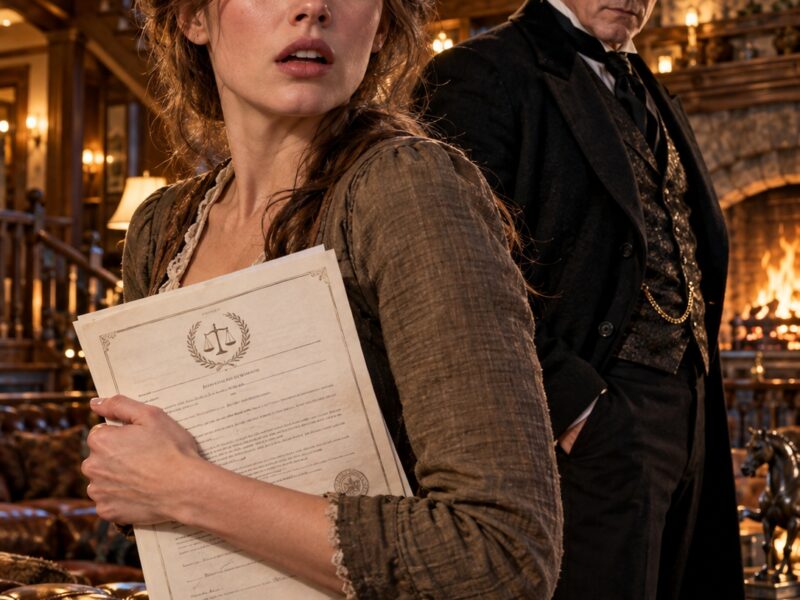
FOUR BRIDES RAN FROM HIS RANCH—THEN THE FIFTH BRIDE DISCOVERED WHO HE WAS HIDING INSIDE

Four women had traveled more than a thousand miles to marry Caleb Mercer.
All four had run away.
The fifth woman arrived carrying one suitcase, thirty-eight dollars, and absolutely no intention of becoming number five.
Her name was Vivien Hale.
By the time the stagecoach stopped in Blackstone Hollow, Montana, every person on Main Street seemed to know exactly who she was.
And exactly how her story would end.
Vivien knew it from the way conversations stopped when she stepped down.
A woman outside the general store lowered her voice.
Two ranch hands standing near the saloon turned openly to stare.
A little girl holding her mother’s hand pointed at Vivien’s luggage until her mother quickly pulled her away.
Even Horace, the stagecoach driver who had barely spoken to Vivien during eleven miserable days of travel, looked at her as though he were delivering a lamb to a slaughterhouse.
He lowered her trunk into the dust.
“Miss Hale.”
Vivien brushed travel dirt from the front of her brown dress.
“What?”
Horace hesitated.
Then he said, “You don’t have to do this.”
She stared at him.
“Do what?”
“Go up there.”
A dry Montana wind moved through the street.
Vivien looked past him at the mountains rising behind town.
Somewhere up there was the Mercer ranch.
Somewhere up there was the man whose three letters had convinced her to sell nearly everything she owned and leave Missouri.
Caleb Mercer.
Widower.
Rancher.
Father.
Thirty-four years old.
Not handsome, at least according to himself.
Not wealthy.
Not charming.
Not promising romance.
His advertisement had been so painfully practical that Vivien had read it twice.
Widowed rancher seeks wife capable of hard work, isolation, severe winters, livestock, household management, and raising a child.
No poetry.
No promises.
No nonsense.
That had appealed to her.
Now Horace was looking at her as though Caleb Mercer had forgotten to mention a graveyard behind the barn.
“You’re the fourth person who’s warned me since Helena,” Vivien said.
Horace took off his hat.
“Then maybe you ought to listen.”
“To what? Nobody will tell me anything.”
His jaw tightened.
Finally he looked down the empty street.
“Four women came before you.”
Vivien went still.
“Four?”
“In the last couple months.”
She hadn’t known that.
Caleb had mentioned that previous arrangements had “not worked out.”
That was very different from four women.
“What happened?”
Horace gave a humorless laugh.
“They ran.”
“From Caleb?”
“I didn’t say that.”
“Then from what?”
He looked toward the mountains.
“That’s the problem.”
Vivien waited.
Horace didn’t continue.
“You’re not going to tell me.”
“I can’t tell you what I don’t know.”
“But you know something.”
“I know the last woman came back into town before sunrise without half her things. She waited right there—”
He pointed toward the edge of the street.
“—until the southbound coach came.”
Vivien followed his finger.
“Was she hurt?”
“No.”
“Did Caleb threaten her?”
“Not that she said.”
“Did he touch her?”
“No.”
“Was he drunk?”
“Never heard of Mercer getting drunk.”
“Violent?”
“No.”
“Then why did she run?”
Horace slowly replaced his hat.
“She wouldn’t say.”
That frightened Vivien more than any accusation would have.
Horace climbed back onto the driver’s bench.
“I’ll be back Saturday.”
“For what?”
“For you.”
Despite herself, Vivien smiled.
“You seem very confident.”
“I’ve seen this before.”
He picked up the reins.
“I’ll save you a seat.”
Then the coach rolled away.
Vivien stood alone beside her trunk while half of Blackstone Hollow watched her from windows and porches.
She should have been terrified.
Instead, she was angry.
Not at Caleb.
Not yet.
She was angry because everyone seemed to have already decided what she would do.
Run.
Fail.
Come back humiliated.
Vivien had spent too much of her life watching other people decide what frightened people were capable of.
She picked up her carpetbag.
Then she walked into Brennan’s General Store.
The bell above the door rang.
A thin man behind the counter looked up.
His expression changed the moment he saw her.
“You must be the Mercer woman.”
Vivien placed her bag on the counter.
“My name is Vivien Hale.”
From behind a curtain came a woman’s voice.
“She’s here?”
A stout gray-haired woman appeared.
She studied Vivien from boots to hat.
“Well,” she said. “You don’t look stupid.”
Vivien blinked.
“Thank you?”
The woman ignored the sarcasm.
“I’m Martha Brennan. That’s my husband, Harold.”
Harold adjusted his glasses.
“Stage comes back Saturday.”
“So I’ve been told.”
Martha’s mouth twitched.
“Horace already warned you?”
“Several times.”
“Good.”
Vivien leaned forward.
“Now perhaps someone could stop warning me and start explaining.”
Silence.
Harold suddenly became interested in rearranging a stack of invoices.
Martha folded her arms.
“Caleb Mercer isn’t a bad man.”
“Everyone keeps saying that immediately before telling me to run from him.”
“I’m serious. He doesn’t drink much. Doesn’t gamble. Doesn’t beat women. Works harder than any man I’ve met.”
“That sounds terrible.”
Martha almost smiled.
“But there’s something at that ranch the other women couldn’t accept.”
Vivien felt her stomach tighten.
“What?”
Martha exchanged a glance with Harold.
Finally Harold said quietly:
“His boy.”
Vivien remembered Caleb’s letters.
“Noah.”
Martha nodded.
“Eight years old.”
“Caleb told me about him.”
“Did he tell you everything?”
That question followed Vivien all six miles to the ranch.
The road climbed steadily into the mountains.
Pines crowded the hillsides.
The town disappeared behind her.
And with every mile, Vivien wondered whether she had confused honesty with desperation.
Maybe Caleb hadn’t lied.
Maybe he’d simply omitted the one truth that mattered.
Then she reached the top of a ridge.
The Mercer ranch appeared below.
Vivien stopped the buggy.
It wasn’t beautiful in the way wealthy estates were beautiful.
It was something better.
Cared for.
Fences stood straight.
Firewood had been stacked beneath a covered shed.
The barn roof had been repaired recently.
The garden had been cleared for winter.
Someone had spent countless hours making sure every small thing survived.
This was not the home of a careless man.
It was the home of someone holding his world together with both hands.
She drove down.
Before she reached the porch, the front door opened.
Caleb Mercer stepped outside.
He was taller than Vivien expected.
Broad-shouldered, dark-haired, work shirt rolled above his forearms. His face wasn’t conventionally handsome. It was too weathered for that, his jaw marked by an old scar.
But his eyes surprised her.
Hazel.
Tired.
Guarded.
He didn’t smile.
“Miss Hale.”
“Mr. Mercer.”
“I wasn’t sure you’d come.”
“I said I would.”
Something passed across his face.
“Others said that too.”
There it was.
Vivien climbed down.
“I heard.”
Caleb’s expression hardened slightly.
“Town tell you everything?”
“No.”
“They never do.”
He lifted her trunk from the buggy.
Then stopped before reaching the porch.
“There’s something I should tell you before you enter this house.”
Vivien’s heartbeat quickened.
Caleb put the trunk down.
“My son.”
“Noah.”
His eyes shifted toward an upstairs window.
“He’s different.”
Vivien said nothing.
“He doesn’t speak much. Some days he doesn’t speak at all. He doesn’t like people touching him. Loud sounds upset him. Changes upset him. Strangers…”
Caleb exhaled.
“Strangers can be difficult.”
“And the other women?”
“They saw him.”
“That’s all?”
His jaw tightened.
“That was enough.”
Something about the way he said it hurt.
Caleb looked directly at her.
“If you want to leave, I’ll understand.”
Vivien remembered another boy.
Her younger brother Daniel.
Daniel arranging buttons by color for hours.
Daniel covering his ears when church bells rang.
Daniel refusing to look at strangers.
Daniel being called stupid.
Possessed.
Broken.
Her father defending him until the day he died.
Her mother slowly shrinking beneath the shame other people insisted she should feel.
And finally Daniel being sent away because respectable people had convinced a grieving family it was “for his own good.”
Vivien had never forgiven herself for failing to stop it.
“Where is Noah?” she asked.
Caleb frowned.
“Inside.”
“Then perhaps I should meet him before deciding whether to be frightened of him.”
For the first time, Caleb looked genuinely surprised.
He opened the door.
The house was warm.
A stew simmered near the fire.
A small pair of boots sat beside the wall.
Vivien noticed wooden animals arranged in a perfectly straight line along the mantel.
Then she saw movement.
A boy stood in the hallway.
Thin.
Brown-haired.
Barefoot.
Watching her.
Noah.
Vivien didn’t approach.
She didn’t smile too brightly.
Didn’t crouch.
Didn’t say hello.
She simply put down her carpetbag.
Noah stared at her.
Then at the bag.
Then at the brass clasp.
His fingers moved rapidly against the side of his trousers.
Caleb spoke softly.
“Noah, this is Miss Hale.”
The boy covered his ears.
Caleb immediately stopped talking.
Vivien understood.
She slowly sat on the floor.
Not near Noah.
Several feet away.
Then she began unfastening her gloves.
Noah watched.
Vivien removed one glove.
Then the other.
She folded them carefully.
Placed one on top of the other.
Straightened them.
Noah’s fingers stopped moving.
Vivien deliberately shifted the top glove slightly crooked.
Noah stared.
She waited.
Seconds passed.
Then Noah crossed the hallway.
He moved the glove until its edges aligned perfectly.
Vivien didn’t touch him.
“Thank you,” she said quietly.
Noah looked at her face for half a second.
Then ran upstairs.
Vivien heard a door close.
Caleb stood frozen.
“What?”
She looked at him.
“What did I do?”
“He came near you.”
“So?”
“He doesn’t come near strangers.”
Vivien shrugged.
“Maybe I’m less interesting than the gloves.”
A sound came from upstairs.
A tiny sound.
Almost laughter.
Caleb looked toward the ceiling.
Then back at Vivien.
For the first time, he smiled.
It transformed him.
And that frightened her more than anything else had.
Because suddenly she could imagine staying.
The first weeks weren’t romantic.
They were exhausting.
Vivien learned the ranch.
She cooked.
Mended clothes.
Collected eggs.
Helped preserve vegetables.
She learned Caleb liked coffee strong enough to frighten reasonable people.
She learned he became almost completely silent when worried.
She learned Noah ate foods separately and became distressed if they touched on his plate.
She learned he loved horses but hated dogs barking.
She learned he could identify individual birds by sound.
And she learned the smooth piece of wood he carried everywhere mattered more to him than any toy.
Noah didn’t suddenly trust her.
Trust came in inches.
One morning he sat at the same table.
Three days later he allowed her to pour his milk.
A week after that, he brought her a broken wooden horse.
Vivien repaired it.
He watched every stitch of glue.
When she handed it back, Noah whispered:
“Good.”
It was the first word he ever spoke directly to her.
That evening Caleb stood alone outside the barn.
Vivien found him there.
“Are you crying?”
“No.”
“You are.”
“It’s dust.”
“It’s raining.”
Caleb wiped his face.
Vivien pretended not to notice.
Then the first real trouble came.
A black carriage appeared one afternoon.
Caleb saw it from the field.
Every muscle in his body changed.
“Take Noah inside.”
Vivien looked toward the road.
“Who is it?”
“My uncle.”
Everett Mercer stepped down wearing a dark coat too expensive for ranch work.
He was Caleb’s father’s younger brother.
Clean-shaven.
Polished.
Smiling.
Vivien disliked him instantly.
“So,” Everett said. “This is the newest one.”
Vivien’s eyes narrowed.
“My name is Vivien.”
“I know.”
His gaze moved toward the house.
“Where’s the boy?”
Caleb stepped between him and the porch.
“You don’t need to see Noah.”
Everett sighed.
“Still doing this?”
“Doing what?”
“Pretending isolation is treatment.”
Caleb’s fists tightened.
Vivien felt something cold move through her.
Treatment.
Everett turned toward her.
“Did he tell you?”
“Tell me what?”
“That the boy isn’t right.”
Caleb moved.
Vivien caught his arm.
Everett smiled.
“Careful, nephew.”
Then he looked at Vivien.
“Noah belongs somewhere equipped to handle children like him.”
“Children like him?”
“Defective children.”
Vivien slapped him.
The sound cracked across the yard.
Nobody moved.
Everett slowly turned his face back toward her.
Vivien’s palm burned.
“Say that about him again,” she said, “and I’ll forget I’m supposed to be a lady.”
Everett stared at her.
Then smiled.
Not kindly.
“Interesting.”
He turned to Caleb.
“You finally found one as damaged as you are.”
He returned to his carriage.
Before climbing inside, he looked back.
“The hearing is next month.”
Vivien’s stomach dropped.
Caleb said nothing.
Everett smiled again.
“Didn’t he tell you that either?”
The carriage disappeared down the road.
Vivien turned.
“What hearing?”
Caleb wouldn’t look at her.
“Caleb.”
“My uncle filed for guardianship.”
“Of Noah?”
“He wants the court to declare me incapable of providing appropriate care.”
Vivien stared at him.
“Why didn’t you tell me?”
“Because you had already traveled a thousand miles.”
“That isn’t an answer.”
“I thought you’d leave.”
The words were quiet.
And painfully honest.
Vivien stepped back.
“So you let me walk into a custody battle without knowing.”
“I told you there would be trouble.”
“You told me people talked.”
“I was afraid.”
“Of Everett?”
Caleb finally looked at her.
“Of losing Noah.”
That stopped her.
He sank onto the porch.
“I lost Sarah. Then four women came here and looked at my son like he was some animal. Every one of them told me the same thing. Send him away.”
His voice cracked.
“And now my uncle has convinced half this county that keeping my own child is cruelty.”
Vivien sat beside him.
“What does Everett gain?”
Caleb was silent too long.
That told her there was more.
“Caleb.”
“The ranch.”
Vivien turned toward him.
“What?”
“My father left most of the Mercer property to me. Noah inherits after me.”
“And Everett?”
“Gets nothing while Noah remains my legal heir.”
There it was.
The larger truth.
This had never been only about concern.
Vivien looked toward the upstairs window.
A small face disappeared behind the curtain.
Noah had been watching.
“When is the hearing?”
“Five weeks.”
“And what does your lawyer say?”
“That being an unmarried rancher raising a boy the town considers abnormal doesn’t help.”
Vivien stared at the mountains.
Five weeks.
Then she asked:
“What would help?”
Caleb looked at her.
Vivien already knew the answer.
So did he.
Neither said it.
Not yet.
The next weeks became war.
Everett spoke to neighbors.
People who had never spent ten minutes with Noah suddenly had opinions about where he belonged.
Whispers followed Vivien in town.
Poor boy.
Dangerous.
Unnatural.
Institution.
Professional care.
Then one Sunday outside church, a woman named Margaret Cooper cornered Vivien.
“You’re encouraging Caleb.”
“Encouraging him to what?”
“Keep that boy hidden away.”
“Noah isn’t hidden.”
“He should be somewhere trained people can manage him.”
Vivien stared at her.
“Have you ever spoken to him?”
Margaret hesitated.
“That’s irrelevant.”
“No. That’s the only relevant question.”
People nearby were listening.
Vivien raised her voice.
“You all talk about Noah Mercer as if he’s a problem to solve. How many of you know his favorite horse?”
Silence.
“How many know he can recognize six species of birds by their calls?”
Nothing.
“How many know he leaves carrots beside the barn for a rabbit with one damaged ear?”
Margaret’s face reddened.
“That’s not the point.”
“Then what is?”
Nobody answered.
From that day, something began shifting.
Not enough.
But something.
Then Everett made his mistake.
He came to the ranch again.
Noah saw him.
The boy panicked.
He ran to the barn loft, covered his ears and rocked violently.
Caleb was furious.
But Vivien climbed the ladder.
Slowly.
She sat six feet away.
Noah wouldn’t look at her.
“He’s gone,” she said.
No response.
“He scared me too.”
Noah rocked.
Vivien picked up a piece of straw.
“Your uncle thinks he knows what’s best for you.”
His breathing remained rapid.
“He doesn’t.”
The rocking slowed.
“Your papa knows you.”
Slower.
“I know you.”
Noah lowered one hand from his ear.
Vivien’s throat tightened.
“Nobody is taking you away without a fight.”
Noah opened his eyes.
Tears ran silently down his face.
Then he did something he had never done.
He reached into his pocket.
Removed the smooth piece of wood.
And held it toward her.
Vivien stared at it.
She knew what it meant.
Trust.
She didn’t grab it.
She opened her palm.
Noah placed the wood there.
Then he whispered:
“Safe.”
Vivien closed her fingers around it.
“Yes.”
Down below, Caleb stood at the bottom of the ladder.
He had heard everything.
That night Vivien couldn’t sleep.
She sat at the kitchen table with court documents spread around her.
Caleb came downstairs.
“What are you doing?”
“Thinking.”
“That’s dangerous.”
She almost smiled.
Then she pushed one document toward him.
“Your lawyer says the court wants stability.”
“Yes.”
“A household.”
“Yes.”
“Two parents would help.”
Caleb stopped.
Vivien met his eyes.
“We should get married.”
Silence.
The fire popped.
Caleb stared at her.
“You don’t mean that.”
“I do.”
“You came here to consider marriage, not become a legal shield in a custody case.”
“I came here looking for a life.”
“This isn’t the life you imagined.”
“No.”
Vivien thought of Noah’s wooden token upstairs.
“It’s more important.”
Caleb shook his head.
“I won’t use you.”
“You’re not.”
“I’d be marrying you because it improves my chances of keeping my son.”
“And I’d be marrying you because it improves Noah’s chances of keeping his father.”
“Vivien—”
“I’m not asking for romance.”
That hurt more than she expected.
She ignored it.
“I’m not asking you to pretend you love me.”
Caleb’s expression shifted.
“I’m asking whether you trust me.”
“Yes.”
The answer came immediately.
Vivien swallowed.
“Then let me stand beside you.”
Caleb sat across from her.
“If we do this, Everett won’t stop.”
“I know.”
“People will say things.”
“They already do.”
“You’ll be tied to us.”
Vivien leaned forward.
“I once watched people convince my family that my brother needed to be sent away.”
Caleb went still.
“I was young. I told myself adults knew better.”
Her voice shook.
“They didn’t.”
She looked toward the stairs.
“I’m not making that mistake twice.”
The following morning they rode into Blackstone Hollow.
By sunset, Vivien Hale became Vivien Mercer.
There were no flowers.
No white dress.
No music.
Martha Brennan cried anyway.
Harold pretended he had dust in his eye.
And when Caleb kissed Vivien after the vows, it was supposed to be brief.
Practical.
Symbolic.
Instead, for one dangerous second, neither of them moved away.
Something passed between them.
Something neither was ready to name.
Then Noah tugged Caleb’s sleeve.
“Home?”
Caleb smiled.
“Yeah, son.”
He looked at Vivien.
“Home.”
The hearing came three weeks later.
Everett arrived with an attorney.
Caleb arrived with Vivien.
And Noah.
The courtroom was packed.
Judge Thornton listened to testimony about Noah’s behavior.
His silence.
His fear of strangers.
His difficulty with change.
Everett’s lawyer described the ranch as isolated.
He described Caleb as unqualified.
Then he described Vivien’s marriage as suspiciously convenient.
“Mrs. Mercer,” he asked, “isn’t it true you married Mr. Mercer only after learning this hearing was scheduled?”
“Yes.”
Murmurs filled the room.
Caleb closed his eyes.
The lawyer smiled.
“So this marriage was arranged to influence the court.”
“It was arranged to protect a child.”
“That’s not what I asked.”
“It’s the answer.”
The judge leaned forward.
The lawyer continued.
“Do you love your husband?”
Vivien looked at Caleb.
She had promised herself she would not lie.
“No.”
Caleb’s face changed.
Then Vivien continued.
“Not when I married him.”
The courtroom went silent.
She looked at the judge.
“I married Caleb because Noah needed someone willing to stand beside his father.”
“And now?”
Vivien looked at Caleb again.
The answer frightened her.
“Now I don’t know exactly when duty became something else.”
Caleb stared at her.
Vivien turned back toward the judge.
“But I know this: I’ve watched that man wake before sunrise every morning to care for his son. I’ve watched him learn every sound Noah makes when he’s frightened. I’ve watched him sacrifice friendships, money, sleep and reputation rather than abandon his child.”
Her voice hardened.
“Everett Mercer calls that incompetence.”
She looked directly at Everett.
“I call it fatherhood.”
Then Noah stood.
Caleb reached for him.
Noah pulled away.
Every eye in the courtroom turned toward the boy.
He hated crowds.
He hated strangers.
He hated being watched.
Vivien could see his hands trembling.
Judge Thornton softened his voice.
“Noah?”
The boy stared at the floor.
Everett’s lawyer shifted impatiently.
Noah looked at Caleb.
Then Vivien.
Then the judge.
“I want…”
His voice disappeared.
Nobody moved.
Noah tried again.
“I want Papa.”
Caleb’s hand covered his mouth.
Noah swallowed.
“And Vivien.”
Vivien’s eyes filled.
“She stays.”
Three words.
But they changed everything.
Judge Thornton ruled that afternoon.
Noah would remain with Caleb.
Everett’s petition was denied.
Outside the courthouse, Caleb leaned against the wagon as if his legs could no longer support him.
“We won.”
Vivien smiled through tears.
“We won.”
Noah climbed between them during the ride home.
Halfway to the ranch, he fell asleep against Vivien.
Caleb looked at her.
“You don’t have to stay married to me.”
Vivien’s chest tightened.
“The hearing’s over. You did what you promised.”
“I know.”
“I won’t hold you to anything.”
Vivien looked down at Noah.
Then toward the mountains.
Months earlier she had believed she was traveling west because she had nowhere else to belong.
She had been wrong.
She hadn’t been running from an empty life.
She had been traveling toward this one.
“I’m staying.”
Caleb said nothing.
“Not because of the hearing.”
“Vivien—”
“Not because I pity Noah.”
She looked at him.
“And not because I made a promise.”
“Then why?”
Vivien smiled faintly.
“Because somewhere along the way, this became home.”
Caleb reached across Noah and took her hand.
“Then welcome home, Mrs. Mercer.”
But Everett wasn’t finished.
His lawyers appealed.
Then appealed again.
Each envelope arriving at the ranch reopened the fear.
Every knock at the door made Caleb tense.
Every unfamiliar horse on the road made Vivien look toward Noah.
Everett was trying to exhaust them.
And for a while, it worked.
One January night Caleb sat with his head in his hands.
“I’m tired.”
Vivien put down the legal papers.
“I know.”
“No. I’m tired in here.”
He touched his chest.
“I’m tired of waiting for someone to decide whether I’m allowed to be my son’s father.”
Vivien moved beside him.
“Then we stop.”
Caleb looked up.
“Stop fighting?”
“No.”
She took the papers and placed them inside a drawer.
“We stop letting Everett live in this house.”
“What does that mean?”
“It means when papers arrive, we answer them. When court calls, we go. When he attacks, we defend ourselves.”
She closed the drawer.
“But we don’t invite him to dinner every night by talking about him.”
Caleb stared at her.
“This is our home.”
Vivien looked toward the ceiling where Noah slept.
“He doesn’t get to own the air inside it.”
So they lived.
Winter passed.
Noah began feeding chickens.
He spoke more.
Some mornings he came downstairs and said:
“Morning, Papa.”
Every time, Caleb froze like it was the first.
Then one bitter February afternoon Noah walked toward Vivien while she mended socks beside the fire.
He held the smooth wooden piece.
“Keep.”
Vivien opened her hand.
“For you?”
Noah nodded.
“Keep safe.”
“Always.”
He pressed it into her palm.
Then said:
“You’re my mama now.”
Vivien stopped breathing.
Across the room, Caleb froze.
Vivien looked at Noah.
She could have accepted the word.
Instead she chose the harder truth.
“Sarah is your mama too.”
Noah listened.
“She’s the mama who gave birth to you. She loved you very much.”
Noah nodded.
“And I’m…”
Vivien struggled to keep her voice steady.
“I’m the mama who’s here now. If that’s what you want.”
Noah considered this carefully.
Then nodded.
“You stay.”
Vivien laughed and cried at the same time.
“I stay.”
In March, Martha arrived carrying news.
Everett had withdrawn every appeal.
Judge Thornton had threatened sanctions if he continued wasting the court’s time.
For the first time in nearly a year, Caleb allowed himself to believe Noah might truly be safe.
Spring came.
Then something even stranger happened.
Blackstone Hollow changed.
Slowly.
Not completely.
Prejudice rarely disappears in a dramatic moment.
It erodes.
One conversation.
One apology.
One person choosing curiosity instead of fear.
Women who had once whispered about Noah began bringing pies.
Men who had called Caleb irresponsible offered help repairing fences.
Some never changed.
That was all right.
The Mercers stopped needing everyone’s approval.
One morning Vivien found Noah drawing circles in the dirt.
“What’s that?”
“Garden.”
“For what?”
Noah pointed.
“First Mama.”
Another circle.
“Second Mama.”
Vivien swallowed.
“A garden for Sarah and me?”
He nodded.
They planted it together.
Flowers Sarah had loved.
Yellow wildflowers Noah had once noticed Vivien admiring beside the road.
He had remembered.
Of course he had.
Noah noticed things other people missed.
That summer, Martha convinced them to host a gathering at the ranch.
Neighbors came.
Children ran near the barn.
Noah stayed at the edge of the crowd.
Then another shy boy wandered toward his garden.
Noah showed him the flowers.
Caleb watched from behind the barn.
Vivien found him wiping his eyes.
“Dust again?”
He laughed.
“Apparently.”
She stood beside him.
They watched Noah kneel beside the other boy.
“A year ago,” Caleb said, “I thought he’d spend his whole life hiding.”
“He may always need quiet.”
“I know.”
“He may always experience the world differently.”
“I know.”
Vivien took his hand.
“That doesn’t mean he’s hiding.”
Caleb looked at her.
“When did this become real?”
“What?”
“Us.”
Vivien’s heart accelerated.
“This marriage.”
He laughed nervously.
“We married because of a courtroom.”
“We did.”
“But somewhere…”
He stopped.
Vivien finished it.
“It stopped being pretend.”
Caleb turned fully toward her.
“I love you.”
No grand speech.
No practiced declaration.
Just truth.
The kind of truth that had brought her there in the first place.
Vivien smiled.
“I know.”
His face fell.
She laughed.
“And I love you too.”
He kissed her behind the barn while their son showed another child the garden he had made for two mothers.
A year after Vivien arrived in Blackstone Hollow, Caleb mentioned the anniversary over dinner.
“One year.”
Vivien looked up.
“Since what?”
“Since a stubborn woman arrived at my ranch and refused to be frightened.”
“I was terrified.”
“You didn’t look terrified.”
“That’s because I was too tired.”
Noah looked between them.
“Mama stayed.”
Caleb smiled.
“She did.”
“The others left.”
Vivien touched Noah’s hand.
“They made the choice they needed to make.”
Noah thought about that.
Then said:
“Mama brave.”
“I’m stubborn.”
“Brave.”
Caleb nodded solemnly.
“I wouldn’t argue with him.”
Vivien rolled her eyes.
But tears had already begun filling them.
Years later, people in Blackstone Hollow would tell the story differently.
They would tell it as though Vivien Hale had arrived fearless.
She hadn’t.
They would say she knew immediately that Caleb was a good man.
She didn’t.
They would say she somehow understood Noah better than everyone else.
That wasn’t true either.
She misunderstood him many times.
She made mistakes.
She pushed when she should have waited.
Waited when she should have acted.
She and Caleb argued.
They worried about money.
Winter storms destroyed fences.
Cattle became sick.
Legal bills took years to recover from.
Noah never transformed into the child other people had wanted him to become.
That was the point.
He became himself.
He grew into a quiet young man with extraordinary patience around horses and an almost unsettling ability to notice small details.
He became an artist.
A rancher.
A son.
Later, a husband.
Eventually, a father.
He remained different.
He also remained whole.
And on cold nights, when his own children asked why their grandmother Vivien kept a small smooth piece of wood inside a box near her bed, Noah told them.
He told them about five brides.
Four who came and left.
And one who stayed.
Not because she was stronger.
Not because she was better.
Because when she entered a house everyone else had warned her to fear, she saw what they had refused to see.
Not a dangerous child.
A frightened one.
Not a cruel father.
An exhausted one.
Not a cursed ranch.
A lonely home waiting for someone willing to belong there.
Decades later, when Vivien’s hair had turned silver and Caleb walked more slowly, they still sat beside the same fireplace during Montana winters.
The ranch had changed.
The old barn had been rebuilt.
Electric lights eventually replaced oil lamps.
Roads improved.
Blackstone Hollow grew.
But the mountains remained.
So did the garden.
Every spring, yellow flowers returned beside Sarah’s roses.
One snowy evening, Vivien sat near the window while Noah’s children played on the floor.
Caleb had fallen asleep in his chair.
Noah, now a grown man, stood beside her.
“Do you ever think about leaving?”
Vivien smiled.
“That first night?”
He nodded.
“Yes.”
Noah looked surprised.
“I almost did.”
“Why?”
“Because I was scared.”
“Of me?”
Vivien considered lying.
She didn’t.
“A little.”
Noah looked down.
She reached for his hand.
“But mostly I was scared of making the wrong choice.”
“What changed?”
Vivien looked across the room.
At Caleb sleeping.
At Noah’s children.
At the fire.
At the life that had grown from one impossible decision.
“You moved my glove.”
Noah frowned.
Then remembered.
A smile appeared.
“You put it crooked.”
“I did.”
“On purpose?”
“Yes.”
Noah laughed.
“You tricked me.”
“I needed to know if you’d come closer.”
“And I did.”
“You did.”
Outside, snow covered the ranch in white.
For a while neither spoke.
Then Noah said quietly:
“I’m glad you stayed.”
Vivien looked at him.
The frightened eight-year-old boy was still somewhere inside that face.
So was the young man who had stood trembling in a courtroom and found enough courage to say what he wanted.
Papa.
Vivien.
She stays.
Vivien squeezed his hand.
“So am I.”
She had spent years believing the most important choice of her life had been getting on a stagecoach in Missouri.
It wasn’t.
Arriving had been easy.
Staying had been the choice.
Staying when Noah screamed.
Staying when Caleb shut down.
Staying when Everett threatened them.
Staying when the town whispered.
Staying when love hadn’t arrived yet.
Staying when it finally did.
Perhaps that was what family had always been.
Not blood.
Not perfection.
Not people fitting neatly into the shapes the world prepared for them.
Family was the person who remained when leaving would have been easier.
The hand that stayed open long enough for a frightened child to place something precious inside it.
The father who refused to surrender his son simply because powerful people told him the boy was too difficult to love.
The woman who discovered that the place everyone warned her to escape from was the first place that had ever truly needed her.
Vivien turned toward the window.
Snow was falling harder now.
The mountains beyond the glass had disappeared into darkness.
But the garden was still out there beneath the snow.
Sarah’s roses.
Vivien’s yellow flowers.
Two mothers occupying the same earth without one replacing the other.
Behind her, one of Noah’s children laughed.
Caleb stirred in his chair.
Noah walked toward the fire.
And Vivien thought about the dusty afternoon when an entire town had watched her step off a stagecoach, certain they knew how her story would end.
They had been wrong.
Four brides had looked at Caleb Mercer’s ranch and seen something they couldn’t live with.
Vivien Hale had looked at the same house, the same exhausted father, the same frightened boy, the same impossible future…
and eventually understood something nobody in Blackstone Hollow had understood when she arrived.
The secret Caleb Mercer had been hiding inside his house had never been a monster.
It was a child.
A child waiting for someone to stop asking what was wrong with him…
and start asking what had been wrong with a world that made him believe he wasn’t worth staying for.
Vivien had stayed.
And in the end, that small, stubborn choice changed all of them.
Outside, winter swallowed the road that had once brought her there.
Inside, Noah’s wooden token rested safely in the box beside her bed.
Exactly where she had promised it would be.
Exactly where it had remained for the rest of her life.









