FOUR ORPHANED SISTERS WERE AUCTIONED OFF TO PAY THEIR FATHER’S DEBT—BUT THE SCARRED MOUNTAIN MAN WHO BOUGHT THEIR FREEDOM WAS HIDING A HEARTBREAKING SECRET
The first bid for Nora Hayes was twelve dollars.
Her youngest sister was only eight.
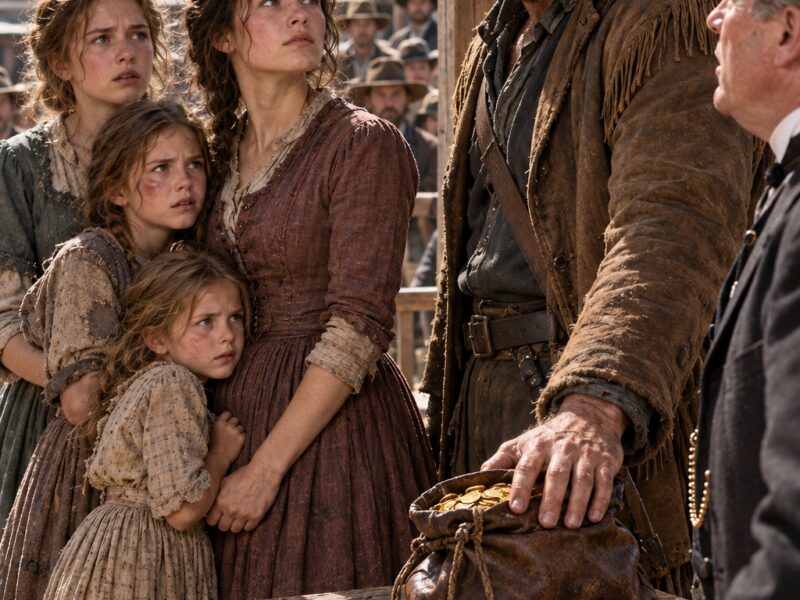
And when a scarred mountain man laid a pouch of gold on the auction table, Nora feared she had just watched a stranger purchase all four of them.
But the man everyone in Red Creek called a monster had not come to buy four sisters.
He had come to settle a debt that had haunted him for fifteen years.
And before winter ended, the truth about that debt would bring the most powerful man in town to his knees.
PART 1 — THE PRICE OF FOUR DAUGHTERS
The first bid on Nora Hayes’s future was twelve dollars.
“Twelve,” a man called from beneath the wooden platform. “For the eldest.”
Someone laughed, and Nora felt her seventeen-year-old sister stiffen beside her. She kept her eyes fixed on the bank across Red Creek’s dusty square because if she looked down at the men bidding, she was afraid she might reach for the small paring knife hidden inside her boot.
It was September 1887, and the Colorado mountain town had gathered to watch four orphaned sisters lose the last thing their parents had left them: the right to remain together.
Three weeks earlier, Nora had buried her mother beside her father beneath a cottonwood tree at the edge of their farm. Her father had died of pneumonia after working through a bitter spring with a fever he refused to acknowledge. Her mother, already weakened by years of illness, had followed him nine days later.
The house had barely grown quiet after the funeral when Amos Farrow, president of the Red Creek Bank, arrived with a ledger and two men carrying rifles.
He said the Hayes estate owed nearly five hundred dollars in unpaid seed loans, equipment notes, and medical expenses.
Nora had asked for time to bring in the autumn harvest.
Farrow had looked around the kitchen, where Josie’s rag doll sat beside an unfinished loaf of bread, and replied, “Your father already had time, Miss Hayes. Now the bank requires payment.”
The following week, the sheriff posted a notice announcing the seizure of the farm and its equipment. Another document, signed by the mayor and supported by a disputed county court order, offered the sisters’ labor under indenture agreements to anyone willing to assume a portion of the estate’s debt.
Nora knew enough to understand that calling it an indenture did not make it right.
Clara, seventeen, had spent the previous night sewing little pockets inside their dresses so they could conceal their mother’s wedding ring, their father’s pocket watch, and the photographs salvaged from the farmhouse.
Maeve, fourteen, had refused to pack.
Josie, eight, believed the auction was a misunderstanding that would be corrected if she explained that she could milk goats and sew buttons.
Now they stood together beneath the September sun while Mayor Henry Bell described them as though they were livestock.
“Healthy girls. Experienced with cooking, sewing, poultry, preserving, and ordinary household responsibilities.”
“Sounds like a wife,” someone shouted.
More laughter followed.
Josie pressed her face against Nora’s dress, and Nora rested a hand on the child’s hair. It had taken her nearly an hour that morning to braid it because her fingers would not stop trembling.
A widowed farmer named Silas Boone raised his hand.
“Twenty dollars for the oldest. She looks strong enough.”
Nora finally looked down.
“I won’t go with him.”
Mayor Bell cleared his throat. “Miss Hayes, you will not interrupt the proceedings.”
“We stay together.”
Amos Farrow stepped out from the shadow of the bank’s awning. His gray suit was immaculate, his silver watch chain glinting against a waistcoat that probably cost more than the sisters’ remaining possessions.
“That is not one of the conditions,” he announced.
“It is mine.”
“You are in no position to set conditions.”
Nora met his eyes. “Then come up here and drag me down yourself.”
A nervous murmur moved through the crowd.
Beside her, Maeve whispered, “If they separate us, I’ll run.”
“They’ll catch you,” Nora said.
“Then I’ll bite.”
Nora believed her. Two days earlier, Maeve had bitten a deputy who tried to take Josie’s doll, and the dark bruise circling her wrist showed what he had done afterward.
Then a voice came from the rear of the crowd.
“How much is the debt?”
The question was not loud.
It did not need to be.
Men turned, and the crowd slowly divided.
The stranger walking toward the platform was enormous through the shoulders, with a worn buckskin coat, a dark beard, and a pale scar running from the corner of his left eye toward his jaw. His boots were muddy, his hands roughened by axes and cold weather, and he moved with the quiet caution of someone accustomed to walking where one careless step meant death.
Nora recognized him immediately.
Gideon Rust.
The mountain man beyond Black Elk Ridge.
People said he lived alone because he had killed a man. Others claimed his face had been torn apart by a wolf. Children whispered that he kept human bones beneath his cabin floor, although no child had ever come close enough to see the cabin.
Gideon stopped beneath the platform.
He noticed Josie’s bare feet, Clara’s torn sleeve, and the bruises around Maeve’s wrist.
Only then did he look at Nora.
Not the way the bidders had.
Straight at her face.
“How much?” he repeated.
“Five hundred and eighteen dollars,” Farrow answered. “Counting fees.”
Gideon’s eyes narrowed.
“What fees?”
“Administrative expenses.”
“You’re charging orphans for the privilege of being sold?”
Someone in the crowd coughed to conceal a laugh.
Farrow’s cheeks reddened. “The principal is five hundred.”
Gideon climbed the platform.
Nora immediately moved between him and her sisters.
“If you’re thinking of taking one of us,” she said, “don’t.”
“I’m not.”
“All four or none.”
“I heard you.”
He reached inside his coat, removed a heavy leather pouch, and dropped it onto the auction table.
Gold struck wood with a sound that silenced the square.
Farrow stared at the pouch.
So did Nora.
Gideon placed his palm over it before the banker could reach forward.
“Papers first.”
“What papers?”
“Every Hayes note. Every labor claim. Every guardianship agreement you think gives this town authority over those girls.”
Farrow hesitated.
Gideon’s voice became colder.
“Transfer the debt to me. Give me the original notes, the mortgage, the release documents, and signed receipts. I want witnesses.”
Farrow studied him.
“And what does a man alone on a mountain intend to do with four girls?”
No one laughed.
Gideon became completely still.
“Read the papers,” he said.
Mayor Bell adjusted his spectacles with shaking fingers.
The first agreement concerned Nora’s proposed indenture. It contained language giving the holder authority over her labor until the assigned debt was discharged.
The second concerned Clara.
The third concerned Maeve.
Josie’s name appeared beneath a separate heading.
Gideon’s eyes stopped there.
“She’s eight.”
Bell swallowed. “Her placement would be described as domestic guardianship.”
“To whom?”
“The successful applicant.”
“And where is the judge who approved it?”
The mayor glanced toward Farrow.
That was the first time Nora saw uncertainty in the banker’s expression.
Gideon picked up the papers and examined the signatures.
“These aren’t court orders,” he said.
Farrow reached for them. “They were prepared through the proper channels.”
“Then you won’t mind taking them before a district judge.”
The banker withdrew his hand.
For a long moment, the only sound came from a horse stamping near the hitching rail.
Then Gideon pushed the pouch forward.
“Five hundred dollars against the estate accounts, conditional on the bank providing a full discharge of every Hayes debt and releasing its claim against the farm. The eighteen dollars in fees can go to the clerk if he can prove they’re owed.”
Farrow’s mouth tightened.
The deal was completed slowly, with the town clerk summoned to prepare receipts and the sheriff asked to witness the documents. Gideon refused the mayor’s original agreements and insisted on new instruments that expressly canceled every proposed labor arrangement.
When the last paper was signed, he gathered the originals and handed them to Nora.
“These are yours.”
She stared at him.
“What do you want?”
“Nothing.”
“Nobody spends five hundred dollars for nothing.”
“No,” he said quietly. “Usually they don’t.”
The answer frightened her more than a threat.
Gideon turned toward the waiting crowd.
“The auction is finished.”
Silas Boone protested. “I came all this way to bid.”
Gideon looked at him.
“Then ride home.”
Boone did not argue.
But when Gideon offered Nora a place on his wagon, she remained where she stood.
“We have a farm,” she said.
“Had one,” Farrow interrupted. “The bank took possession last week.”
“You just released the mortgage,” Nora said.
“The building was already placed in receivership. Returning possession will require a separate order.”
Gideon studied Farrow for a long moment.
Then he turned to Nora.
“I have a cabin, food put away for winter, and four empty beds. You can stay until we straighten this out.”
“Why?”
His eyes moved briefly toward Josie.
“Because it’ll snow on the ridge before the month is over.”
Nora did not trust him.
But she trusted Farrow less.
By late afternoon, the four sisters were riding toward Black Elk Ridge in Gideon’s wagon, with their possessions bundled beneath a canvas tarp.
The town disappeared behind the trees.
Josie fell asleep against Clara’s shoulder.
Maeve kept one hand wrapped around a length of rope she had found beneath the seat.
Nora sat opposite Gideon, watching the scar on his face whenever the fading sunlight caught it.
“Can we leave whenever we choose?” she finally asked.
“Yes.”
“Will you lock the doors?”
“Only against bears.”
“Will you make us work?”
He looked at her.
“You’ll be asked to help with what you use. Same as I do.”
“And if we refuse?”
“Then I expect we’ll have an unpleasant conversation about chores.”
Maeve nearly smiled.
Nora did not.
The road narrowed as they climbed into the mountains. Pines crowded the trail, the air grew colder, and their wagon wheels crossed streams that reflected the orange evening sky.
Near dusk, they reached a clearing surrounded by tall fir trees.
At its center stood a sturdy log cabin with a stone chimney, two smaller outbuildings, a covered woodpile, and a fenced garden. Smoke rose into the evening air, and several chickens wandered beneath a lean-to.
It was not the wilderness prison Nora had imagined.
Inside, there were four beds in a loft, freshly made with wool blankets.
On the kitchen table sat a loaf of bread, a pot of venison stew, and four clean tin cups.
Gideon removed his coat.
“You girls take the loft. I’ll sleep downstairs.”
Clara looked at the beds.
“Did you know we were coming?”
Gideon hesitated.
“Not until this morning.”
“Then why are there four beds?”
For the first time since the auction, the mountain man seemed unable to answer.
He eventually said, “I built them a while ago.”
That night, after her sisters had fallen asleep, Nora heard Gideon moving downstairs.
The floorboards creaked.
A drawer opened.
Then came a small, unmistakable sound.
A man crying.
Not loudly.
Not in the theatrical way some people wept at funerals.
It was a broken, restrained sound, as if someone had learned long ago that grief was something to be hidden.
Nora slipped from her bed.
Through a gap in the loft railing, she saw Gideon seated beside the fireplace.
He held a small wooden box.
Inside lay a child’s blue ribbon, a little pair of shoes, and a faded photograph of a smiling woman holding a young girl.
Gideon’s thumb moved over the child’s face.
“I’m sorry,” he whispered.
Nora’s chest tightened.
Then he said something that made her grip the railing.
“I couldn’t save you, Ellie. But I won’t fail them.”
Nora backed away from the opening.
She had never told him her youngest sister’s name.
And there was something about the child’s photograph that terrified her.
Not because the girl resembled Josie.
But because, even in the dim firelight, Nora could see that Gideon Rust had once had a family of his own.
And someone had taken them from him.
The following morning, she would discover that the man responsible was the same banker who had placed four Hayes sisters on an auction platform.
PART 2 — THE CHILDREN HE COULD NOT SAVE
By sunrise, Nora had slept less than an hour.
She found Gideon outside splitting firewood, each stroke of the axe landing with the same measured force. His movements were steady, but there were dark shadows beneath his eyes.
“I heard you last night,” she said.
He stopped working.
“I wasn’t trying to listen.”
His gaze moved toward the cabin.
“Did I wake your sisters?”
“No.”
He leaned the axe against the chopping block.
Nora crossed her arms against the cold.
“Who was Ellie?”
The change in his face was immediate.
His jaw tightened, and for several seconds he stared beyond the fence toward the mountains.
“My daughter.”
Nora had expected the answer.
Hearing it still unsettled her.
“Where is she?”
Gideon looked down at his hands.
“Buried beside her mother.”
The wind stirred the loose ends of Nora’s braid.
“How old?”
“Six.”
He said it so quietly she almost missed the word.
Nora glanced toward the cabin, where Josie was helping Clara arrange breakfast.
“I’m sorry.”
Gideon nodded once.
Then he picked up the axe.
The conversation was over.
During the following days, Nora discovered that the stories told about Gideon Rust in Red Creek were almost entirely wrong.
He did not keep bones beneath his floorboards.
He did not drink himself senseless, threaten strangers, or disappear into the mountains to avoid some imaginary murder charge.
He rose before dawn, fed the animals, carried water from a spring, and worked until his shoulders trembled from exhaustion.
The scar on his face came from a wagon accident during a winter storm, although he offered no further explanation.
He rarely raised his voice.
When Josie accidentally dropped a crock of preserved peaches, she stood frozen among the broken pottery and began apologizing so quickly she could barely breathe.
Gideon knelt beside her.
“Are you cut?”
She shook her head.
“Then it’s only peaches.”
“But I broke your jar.”
“I’ve broken worse.”
He handed her a clean cloth.
“Next time, call for help with the heavy ones.”
That evening, Nora found him quietly repairing Josie’s rag doll with a crooked needle and coarse brown thread.
He was terrible at it.
One arm ended up shorter than the other.
Josie declared it perfect.
Nora watched from the doorway, remembering the men who had offered money for her sisters.
For the first time, she felt ashamed of how readily she had believed the rumors.
But gratitude did not erase suspicion.
She knew Gideon had spent an extraordinary amount of money on strangers, and she could not understand why.
The answer began to emerge on the sixth day.
Clara found a stack of newspapers inside a wooden chest while looking for spare blankets.
The oldest was fifteen years old.
A headline described a spring flood that had destroyed several farms along Willow Creek, twenty miles south of Red Creek.
Beneath the article was a photograph of a younger Gideon Rust standing beside a small woman and a little girl.
His face had no scar.
His expression was almost unrecognizably happy.
Clara brought the paper downstairs.
“Nora, look.”
Nora studied it.
Then she read the accompanying article.
The flood had damaged a private bridge operated by Amos Farrow’s lumber company. Several families had attempted to cross after being assured the structure was safe.
The bridge had collapsed.
Nine people died.
Among them were Evelyn Rust and her six-year-old daughter, Eleanor.
Nora slowly lowered the paper.
“Farrow owned the bridge?”
Clara nodded.
“And it says he was cleared of responsibility.”
A voice came from behind them.
“He wasn’t cleared of responsibility.”
Gideon stood in the doorway.
“He was cleared of wrongdoing by men who owed him money.”
Neither sister spoke.
He walked to the stove, removed the kettle, and filled three cups with water for tea.
Only after setting the cups down did he sit.
“Farrow’s company cut timber along Willow Creek. They built a bridge that wasn’t meant to carry the weight they were putting on it. I worked there as a foreman.”
His fingers tightened around his cup.
“That spring, I found a crack in one of the support beams. I reported it. Farrow said replacing the bridge would delay a shipment worth thousands.”
Nora remembered Gideon’s scars.
“You tried to stop them?”
“I closed the bridge. Farrow ordered it opened again.”
He stared into the stove.
“Three days later, the river rose.”
His wife and daughter had been visiting Evelyn’s sister when the storm began. Their wagon had joined a line of families trying to reach higher ground.
The bridge gave way shortly after noon.
Gideon had been working downstream when someone came running to tell him.
He reached the river as the last section of bridge broke loose.
He found his wife clinging to a piece of timber near the opposite bank.
Ellie was in her arms.
“I went into the water,” he said.
His voice remained steady, but Nora saw his hand begin to shake.
“I caught the wagon door they were holding. I had Evelyn by the wrist.”
He stopped.
Clara covered her mouth.
“The current pulled the timber sideways. Something struck me here.”
He touched the pale scar along his cheek.
“When I came up again, they were gone.”
Nora felt tears gather behind her eyes.
Gideon looked toward the window.
“They found Evelyn the next morning.”
“And Ellie?”
He shook his head.
“Three days later.”
No one spoke for a long time.
At last, Nora asked, “What happened to Farrow?”
“He claimed the flood was an act of God. His lawyer produced an inspection report saying the bridge was sound.”
“Was it?”
“No.”
“Could you prove it?”
“I had the original repair recommendation. Signed and dated.”
“Then why didn’t you show the court?”
Gideon’s expression changed.
“I did.”
Nora waited.
“Farrow’s men burned my house the night before the hearing.”
The fire had destroyed most of his documents.
Gideon had escaped through a bedroom window after trying to rescue a box of family keepsakes.
The burns and a falling beam had permanently scarred his face.
At the hearing, Farrow’s lawyer accused him of fabricating the warning after the accident.
With no surviving copy and two employees willing to lie, Gideon’s testimony was dismissed.
Months later, he left Willow Creek and built his cabin beyond Black Elk Ridge.
“Why didn’t you leave Colorado?” Nora asked.
“Because my family is buried here.”
He stood.
“And because somewhere in Farrow’s records, there’s proof of what he did.”
Nora looked at Clara.
The same realization had come to both of them.
“Our father’s debt,” Nora said slowly. “That’s why you bought it.”
Gideon faced her.
“What do you mean?”
“Did you know Amos Farrow was the man who held our notes?”
“Yes.”
“Did you know our father?”
“I knew his name. He brought lumber through Willow Creek when I worked there.”
“Then you went to the auction because of Farrow.”
Gideon considered the question.
“I went because I heard four girls were being separated. I knew what it felt like to lose a family because a powerful man decided someone else’s life was worth less than his profit.”
His voice grew quiet.
“I wasn’t going to stand there and watch it happen again.”
Nora believed him.
But later that afternoon, she found something that made her question everything.
Inside the bundle of documents Gideon had obtained from the bank was a copy of the earliest Hayes loan agreement.
Her father’s signature appeared at the bottom.
So did the name of a witness.
Gideon Rust.
Nora stared at the writing.
The date was almost a decade old.
When Gideon came inside carrying a bucket of potatoes, she placed the paper before him.
“You knew about our debts.”
He stopped.
“I knew about one.”
“Then why didn’t you tell me?”
“Because I wasn’t sure it was the same note.”
Nora pressed a finger against his signature.
“You witnessed it.”
“Yes.”
“Why?”
Gideon set down the bucket.
“Your father came to me after a timber delivery. He needed money for seed, and Farrow wouldn’t extend the loan without another witness. I told him the interest was too high.”
“Did you loan him money yourself?”
“No. He wouldn’t accept it.”
Nora stared at him.
“My father never mentioned you.”
“We weren’t friends. We met twice.”
“Then why did he ask you?”
Gideon’s eyes fell to the paper.
“He didn’t. Farrow asked me to witness the signing because I’d brought your father into his office.”
Nora felt something tighten in her stomach.
“Why had you brought him there?”
Gideon hesitated.
“Your father told me Farrow was using false weights at the timber yard. He wanted someone who knew the operation to stand beside him when he confronted the banker.”
“What happened?”
“Farrow denied it. Then he offered your father a loan.”
Nora remembered how her father had come home that year with enough seed to save the farm.
He had called it a lucky break.
Now she wondered whether the loan had been a trap.
That evening, Maeve returned from checking the chicken coop with a scrap of paper tucked into her sleeve.
“I found this nailed to the fence.”
It contained six words.
Send the girls back before winter.
No signature.
But Nora knew who had written it.
The following morning, someone poisoned the water trough in Gideon’s pasture.
Two goats died.
Gideon discovered the third staggering near the fence, its legs trembling beneath it.
He carried the animal into the barn, mixed a treatment from charcoal and water under a veterinarian’s earlier instructions, and worked for nearly an hour before the shaking stopped.
Josie cried beside the stall.
Clara held her.
Nora stood near the door with the note in her hand.
“We should leave.”
Gideon looked up.
“Why?”
“Because whoever did this wants us gone.”
“Then leaving would give him what he wants.”
“He could hurt Josie.”
Gideon’s expression hardened.
“He won’t get near her.”
“You can’t promise that.”
For a moment, he said nothing.
Then he looked at Nora with an exhaustion she had not seen before.
“No,” he admitted. “I can’t.”
His honesty frightened her.
It also made her trust him more.
That night, Gideon placed a loaded rifle above the kitchen door, beyond Josie’s reach, and told Nora how to use the signal bell near the barn if someone approached.
He also gave her the key to the locked cabinet containing the rest of his money and papers.
“Why are you giving me this?” she asked.
“Because you need to know where things are if something happens to me.”
“Don’t say that.”
“It’s only a precaution.”
Nora closed her fingers around the key.
“I won’t let Farrow frighten us out of this house.”
Gideon looked at her for a long moment.
Then he said, “Your father would have been proud of you.”
She swallowed.
“You barely knew him.”
“I knew enough.”
Two days later, a letter arrived from Red Creek.
It came from an elderly former bookkeeper named Samuel Price, who had worked for Farrow before being dismissed for refusing to alter estate accounts.
Price claimed to possess copies of documents showing that the Hayes family owed far less than the bank had demanded.
He asked Gideon and Nora to meet him at an abandoned gristmill outside town.
Gideon read the letter twice.
“It’s probably a trap.”
“Then we don’t go,” Clara said.
But Nora was staring at the sentence written along the bottom.
Your father discovered something about the Willow Creek bridge before he died.
Gideon went pale.
Nora took the letter from his hand.
“We’re going.”
They left Clara in charge of the cabin, with instructions to remain inside until their return. Gideon took his rifle, and Nora concealed the paring knife in her boot.
They reached the gristmill shortly before sunset.
The building stood beside a dry creek bed, its wooden wheel motionless and its windows shattered.
Samuel Price waited near the entrance.
He was thin, gray-haired, and dressed in a coat several sizes too large.
When he saw Nora, tears filled his eyes.
“You look like your mother.”
Nora approached cautiously.
“You knew her?”
“I helped your father prepare the accounts.”
Gideon remained beside the wagon.
“Show us what you have.”
Price opened a leather satchel.
Inside were copies of payment receipts, shipping records, and a letter bearing Nora’s father’s handwriting.
Price placed the letter on a wooden barrel.
Nora recognized the careful slant of the words immediately.
Her father had written it three weeks before his death.
Mr. Price,
If anything happens to me, please see that Nora receives the enclosed account sheets. The debt is wrong. I have paid the seed note twice over, and I believe Mr. Farrow has deliberately concealed the credits.
There is something else. The lumber he purchased for the Willow Creek bridge was not what the company records claimed. I still have the delivery tallies.
I should have spoken fifteen years ago. I was afraid of losing the farm. That fear has cost me more than I can bear.
Thomas Hayes.
Gideon took one slow step backward.
Nora looked up.
“What does this mean?”
Price’s hands trembled.
“Your father delivered timber to Farrow’s company. He learned the supporting beams had been substituted with cheaper, damaged lumber. Farrow told him to stay quiet.”
“Did my father know people might die?”
“He knew there was a problem. I don’t believe he understood how dangerous it was until after the accident.”
Gideon closed his eyes.
For fifteen years, he had believed the original report was the only missing evidence.
Now another man had been carrying the truth.
Nora touched her father’s signature.
“Why didn’t he tell us?”
Price looked miserable.
“Because Farrow threatened to foreclose on the farm if he spoke. Your father thought he was protecting his family.”
Then a floorboard creaked.
Gideon turned.
Three men emerged from behind the mill’s broken machinery.
One held a shotgun.
Another carried a length of chain.
And standing between them was Silas Boone, the farmer who had tried to purchase Nora at the auction.
Price backed against the barrel.
“I’m sorry,” he whispered. “They made me write the letter.”
Nora’s blood turned cold.
Gideon moved in front of her.
Boone smiled.
“Mr. Farrow wants his papers back.”
Gideon slowly raised his hands.
“Let the girl leave.”
Boone shook his head.
“That isn’t what we were paid for.”
And when Nora looked toward the wagon, she saw another armed man stepping from the trees.
They had been surrounded.
PART 3 — THE PAPERS THAT COULD BURY A BANKER
Gideon had survived fifteen mountain winters because he understood one thing better than most men.
Panic killed faster than cold.
He kept his hands raised while Boone approached.
“Give me the satchel.”
Price stood shaking beside the barrel.
Nora could hear the dry creek rattling with wind through the reeds.
Gideon glanced toward the broken window above the mill wheel.
Then he looked at Boone.
“Farrow must be frightened.”
Boone spat.
“He’s tired of your meddling.”
“Then why send four men?”
The farmer’s smile disappeared.
Gideon took a half step to the left.
The shotgun followed him.
That was what he wanted.
“Run, Nora!”
He hurled the barrel between them.
It struck Boone’s knees, sending him sprawling as the shotgun discharged into the ceiling.
Nora grabbed Price’s satchel and sprinted toward the side doorway.
Another man lunged from the shadows.
She pulled the paring knife from her boot and slashed across his sleeve.
He shouted and stumbled back.
Gideon caught the second attacker by the collar and threw him against a support beam, but the third man struck him across the shoulder with the iron chain.
Nora heard the blow.
She turned.
Gideon dropped to one knee.
For a terrible instant, she saw the auction platform again.
The scarred stranger.
The pouch of gold.
The man who had stepped between four helpless sisters and a town willing to sell them.
She could not leave him.
Nora seized a shovel leaning beside the doorway and swung it with both hands.
The blade struck the chain wielder’s forearm.
He cried out.
Gideon surged upward, caught the man’s wrist, and drove him backward into a stack of empty grain crates.
“Go!” he shouted.
This time Nora obeyed.
She reached the wagon, untied the horse, and turned it toward the mill entrance.
Gideon came through the doorway seconds later with blood running down his neck.
Nora held out her hand.
He climbed aboard.
A gunshot cracked behind them.
Wood splintered along the wagon’s rear rail.
Gideon took the reins and drove the horse hard toward the timber road.
They did not slow until the mill disappeared behind the trees.
Only then did Nora notice how badly he was bleeding.
“Your shoulder.”
“It’s nothing.”
“That is not nothing.”
He grimaced.
“I’ve had worse.”
“That doesn’t make this better.”
Despite everything, he gave a faint, surprised laugh.
They reached the cabin after dark.
Clara opened the door before the wagon stopped, holding the signal bell in one hand and Gideon’s spare rifle in the other.
Josie rushed forward.
Then she saw the blood.
Her smile vanished.
“Gideon?”
He stepped down from the wagon.
“I’m all right, little bird.”
It was the first time Nora had heard him use a pet name for her sister.
Josie burst into tears anyway.
Inside, Nora cut away Gideon’s torn shirt while Clara boiled water.
The wound along his shoulder was deep but did not appear to have damaged the joint. He had also suffered a painful bruise across his back.
Nora cleaned the injury as carefully as she could.
Gideon remained silent until she pressed a folded cloth against the deepest cut.
Then he winced.
“Sorry,” she whispered.
“Don’t apologize for helping.”
She stared at his scarred face.
“You could have died today.”
“So could you.”
“Why did you go back for those papers?”
Gideon looked at her.
“Because your father left them for you.”
“Not for me. For us.”
He said nothing.
Nora lowered her eyes.
“You’re part of that now, whether you like it or not.”
For several seconds, Gideon appeared unable to speak.
Then Josie climbed onto the bench beside him and laid her small hand over his.
“You’re not allowed to die,” she announced.
His mouth trembled.
“I’ll do my best.”
The next morning, Gideon and Nora began examining the documents.
Samuel Price had survived the ambush and escaped through the mill’s rear entrance. Before disappearing, he had concealed additional records inside the lining of the satchel.
Among them were three receipts showing that Thomas Hayes had paid substantial amounts toward the original seed loan.
Several entries appeared twice in Farrow’s books.
The largest debt had been increased through interest charges that Nora could not reconcile with the contract.
There was also a handwritten memorandum from the Willow Creek lumber yard.
It described the substitution of weakened support timber for the bridge and bore the initials of a company manager employed by Farrow.
But the most important document was a letter Gideon recognized.
It had been written to his employer, Farrow’s company, by Thomas Hayes in the weeks before the disaster.
In it, Thomas warned that the timber selected for the bridge was unsuitable for prolonged exposure to river water.
Gideon read it three times.
Nora watched his expression.
“My father tried to warn someone.”
“He did.”
“Then why didn’t he tell the court?”
“Because Farrow knew how to frighten him.”
Gideon folded the letter.
“Fear doesn’t excuse everything.”
Nora looked down.
“No.”
“Your father should have spoken.”
“I know.”
“But that doesn’t mean he was responsible for what Farrow chose to do.”
His voice was steady.
And something inside Nora loosened.
She had been afraid he would turn against her father, or worse, against the daughters who had inherited his silence.
Instead, he was making room for a truth that hurt them both.
The evidence still had to reach someone outside Red Creek.
Gideon knew a retired circuit judge in Silverton named Benjamin Hale, who had once investigated irregularities involving Farrow’s lumber company.
They decided Nora and Gideon would travel there with copies of the documents, leaving the originals hidden in a sealed tin beneath a loose board in the cabin.
But the storm arrived early.
Within two days, snow covered the upper trail.
The creek froze along its banks, the mountain road disappeared beneath drifts, and the temperature dropped so sharply that the water bucket froze inside the barn.
For nearly a week, they remained trapped.
At first, the sisters treated the snow as an adventure.
Maeve built a crude sled from discarded boards.
Clara taught Josie to make braided wool cords.
Nora helped Gideon patch the roof above the pantry while wind shook the cabin walls.
In the evenings, Gideon read aloud from an old copy of Treasure Island, stumbling over unfamiliar words while Josie corrected him with the confidence of someone who could barely read.
One night, Clara asked him whether he had always lived in the mountains.
“No.”
“Were you happy before?”
The room went quiet.
Gideon looked toward the fireplace.
“Very.”
Josie leaned against his arm.
“Are you ever happy now?”
He glanced at the four sisters gathered around the table.
For a long moment, his answer seemed too difficult to say.
Then he reached for another piece of firewood.
“Sometimes,” he said.
Nora turned away before he saw her eyes fill.
The following afternoon, the storm cleared.
But before they could prepare for the journey to Silverton, a rider appeared at the cabin.
It was Sheriff Daniel Mercer.
He arrived alone, his horse exhausted and his beard coated with ice.
Gideon met him outside.
“What brings you up here?”
Mercer removed his hat.
“I came to warn you.”
“About Farrow?”
The sheriff nodded.
“He knows Price gave you documents. Boone came back to town with a broken wrist and a story about being attacked by a mountain madman.”
Nora stepped onto the porch.
“Is Samuel Price alive?”
“He is. He’s hiding with his sister north of town.”
“Then he can testify.”
“If we can keep him alive long enough.”
Gideon’s face hardened.
Mercer looked toward the cabin.
“Farrow has a plan. He’s going to accuse you of kidnapping these girls. He’s already persuaded the mayor to sign an affidavit claiming the auction agreements were temporary guardianship arrangements and that you took the sisters under false pretenses.”
Nora stared at him.
“He sold us.”
“I know.”
“You stood there.”
The sheriff’s face changed.
“I know that too.”
Her anger rose.
“You could have stopped it.”
He looked down at his hat.
“I should have.”
No one spoke.
Then Mercer reached inside his coat and removed a folded document.
“Farrow wants a warrant issued before you get to Silverton.”
Gideon took the paper.
“What are you going to do?”
The sheriff’s jaw tightened.
“Something I should have done when I first saw those girls on the platform.”
He looked at Nora.
“Help you.”
That evening, they developed a plan.
Mercer would escort Nora, Gideon, and the documents to the district court in Silverton as soon as the lower road became passable.
Clara, Maeve, and Josie would stay at the cabin with Gideon’s trusted neighbor, an elderly trapper named Elias Ward, who lived two miles to the north.
But Farrow moved faster.
Just before midnight, someone struck the barn bell.
Gideon sat upright from his blanket beside the stove.
A second bell rang.
Then a third.
He was already reaching for his boots when Maeve appeared at the stairs.
“There’s fire outside!”
The sisters rushed to the window.
Orange flames climbed the eastern wall of the barn.
The horses screamed.
Gideon seized his coat.
“Nora, get the girls away from the buildings!”
She grabbed Josie’s hand.
Clara took the emergency bundle containing their documents and clothes.
Maeve ran toward the barn before Nora could stop her.
“The goats!”
“Maeve, come back!”
But the fourteen-year-old was already disappearing through the smoke.
Gideon went after her.
The barn roof crackled.
Wind drove sparks toward the cabin.
Nora pushed Josie and Clara toward the creek bed, where deep snow offered a safer place to wait.
Then she turned back.
Through the barn doorway, she saw Gideon struggling with a frightened horse.
Maeve was beside the goat pen, trying to free a tangled rope.
Above them, a burning roof beam began to sag.
“Gideon!”
He looked up.
For one terrifying instant, Nora saw the history of another collapsing structure written across his face.
A bridge.
A river.
A child he could not save.
Then Gideon dropped the horse’s lead rope, seized Maeve around the waist, and threw himself toward the doorway.
The roof came down behind them.
The force of the collapse knocked all three of them into the snow.
Flames burst upward.
Nora fell to her knees beside Gideon.
He was breathing.
Maeve was crying.
But one of Gideon’s legs lay trapped beneath a broken timber.
Nora and Maeve struggled together to lift it.
It would not move.
Gideon clenched his jaw.
“Take your sisters.”
“No.”
“Nora.”
“No!”
She gripped the wood again.
This time, Clara appeared beside her.
Then Maeve.
Together, the three sisters forced the timber upward just enough for Gideon to pull his leg free.
They dragged him into the snow as the barn collapsed.
For several minutes, no one spoke.
They simply watched the place where their animals had slept disappear beneath the flames.
Then a horse whinnied from beyond the clearing.
Nora turned.
Two riders stood among the trees.
One wore a gray overcoat.
Even at that distance, she recognized Amos Farrow.
He watched the burning barn.
Then he turned his horse and rode away.
Gideon saw him too.
His expression did not change.
But when Nora placed her hand over his, she felt it shaking.
Not from pain.
From rage.
And she realized that the fire had not been intended merely to frighten them.
Farrow had tried to destroy the documents.
This time, he had nearly killed everyone in the house.
PART 4 — THE MAN WHO STOOD BEFORE THE JUDGE
The barn was gone by morning.
Three goats survived, along with both horses and most of the chickens. The family’s winter hay, two saddles, and nearly all of Gideon’s stored lumber were destroyed.
His injured leg had swollen badly, and he could barely stand without leaning on the table.
Nora wanted him to rest.
He refused.
“Farrow thinks that fire ended this.”
“Then let him think so.”
Gideon looked at her.
“What are you planning?”
She placed the leather satchel on the table.
“You’re not going to Silverton.”
“Nora—”
“I am.”
Clara lifted her head.
“Not alone.”
Nora turned.
Clara was already reaching for her coat.
Maeve stood beside the stove with her arms folded.
“And I’m going with you.”
“Absolutely not,” Nora replied.
“You’re not leaving me here to wonder whether Farrow catches you.”
Josie appeared at the bottom of the stairs.
“Then I want to come too.”
The room went silent.
Gideon looked at the four sisters standing together.
Then he said quietly, “I believe Miss Hayes made a rule about that.”
Nora closed her eyes.
All four or none.
She remembered saying it on the auction platform, not knowing whether she would survive the day.
Now the words belonged to all of them.
Sheriff Mercer returned shortly after sunrise with a wagon and two deputies he trusted.
Elias Ward agreed to watch the damaged property, feed the surviving animals, and send word if Farrow’s men returned.
With Gideon sitting beside Nora and Josie bundled beneath blankets, the entire household set off for Silverton.
The journey took two days.
The mountain roads were icy, and Gideon’s leg grew steadily worse.
At night, they sheltered in a small boardinghouse beside a stagecoach stop.
Nora sat beside him while the others slept.
He was looking at the window.
“Does it hurt?” she asked.
“Some.”
“You don’t have to pretend.”
He smiled faintly.
“I’ve had a great deal of practice.”
Nora folded a clean blanket over his knees.
“Why did you build four beds?”
Gideon looked at her.
For a long time, he said nothing.
Then he reached into his coat and took out a small, creased letter.
It had been written in a woman’s handwriting.
“My wife wanted more children,” he said. “Two more, perhaps three. Ellie used to say she wanted enough brothers and sisters to fill the whole loft.”
Nora’s throat tightened.
“After the accident, I couldn’t bear to throw away the plans Evelyn had drawn for our house.”
He unfolded the paper.
It was a rough sketch of a cabin with a large loft.
Four little beds had been drawn beneath a window.
“I built them years ago,” he said. “At first, I told myself it was something to do during the winter.”
“And later?”
His eyes filled.
“Later, I suppose I hoped there might be some use for them.”
Nora looked down at the drawing.
“Did you think we’d come?”
“No.”
“Then why keep them?”
Gideon carefully refolded the paper.
“Because I couldn’t bring myself to close the door on the life she wanted.”
Nora reached across the table and placed her hand over his.
He stared at it.
Then, very slowly, he turned his palm upward.
Neither spoke.
Some grief was too old for comforting words.
But that night, for the first time in fifteen years, Gideon Rust did not have to sit alone with his.
They reached Silverton the following afternoon.
Judge Benjamin Hale received them in his chambers after Sheriff Mercer explained the urgency of their visit.
Hale was a lean man in his sixties with silver hair, tired eyes, and the careful manner of someone who had spent decades listening to stories in which only one person could be telling the truth.
He read the Hayes debt records.
Then the bridge documents.
Then the auction agreements.
His expression grew progressively colder.
“Mr. Rust, these indenture instruments are extraordinary.”
Gideon nodded.
“That wasn’t the word I used.”
Hale studied the signatures.
“Who authorized the auction?”
“Mayor Bell, with the bank’s attorney.”
“And the girls’ guardian?”
Nora spoke.
“No one was properly appointed, Your Honor.”
The judge looked at her.
“How old are you?”
“Twenty.”
“Then you are an adult, Miss Hayes. No one in Red Creek had authority to contract away your labor.”
He turned to the younger sisters.
“The court will determine the appropriate guardianship arrangements for the children. Until then, I see no reason to separate them from their eldest sister.”
Josie’s small shoulders relaxed.
Judge Hale set the documents aside.
“The bank’s conduct demands investigation. But we must distinguish what these papers prove from what still requires testimony.”
He tapped the lumber-yard memorandum.
“This appears to corroborate the warning that was allegedly suppressed. It does not, by itself, establish every allegation concerning the fire or the bridge.”
Gideon nodded.
“I understand.”
“Where is Samuel Price?”
“Alive,” Sheriff Mercer said. “And willing to testify if he can be protected.”
Hale looked directly at the sheriff.
“Then bring him to Silverton under escort.”
He ordered an immediate hearing on the Hayes estate, directed the county attorney to investigate the contested labor agreements, and arranged for an inquiry into the bank records.
A temporary order barred Farrow from disposing of the Hayes property while the accounts were examined.
Nora sat very still.
For the first time since her father’s death, someone in authority had listened to her without looking at her as though she were a burden.
Then Judge Hale noticed Gideon’s injured leg.
“Mr. Rust, you appear unwell.”
“Barn fell on me.”
“How recently?”
“Two nights ago.”
The judge stared.
“And you traveled over the ridge?”
“Had to.”
Hale sighed.
“Go see a physician before that stubbornness costs you a limb.”
For the first time that afternoon, Nora smiled.
But the legal battle had only begun.
Farrow arrived in Silverton three days later with an attorney, a stack of bank ledgers, and a sworn statement accusing Gideon of intimidation, theft, and unlawful detention of minors.
He entered the courtroom confidently.
Until he saw Nora sitting beside Gideon.
Then he saw Samuel Price.
The elderly bookkeeper had been escorted into town that morning under the protection of two deputies.
Farrow’s steps slowed.
He glanced toward his lawyer.
The hearing began with the Hayes accounts.
Farrow insisted that the original five-hundred-dollar debt was legitimate.
Price testified that the bank had repeatedly failed to record payments and had compounded charges beyond the terms of the agreements.
A court-appointed accountant confirmed several discrepancies.
Nora’s father’s receipts matched Price’s copies.
The evidence showed that the bank had materially overstated what the estate owed and had improperly threatened collection against the sisters’ labor.
Farrow’s attorney protested.
Judge Hale silenced him.
“Your client is free to explain the discrepancies. He is not free to interrupt the witness.”
By noon, the atmosphere in the courtroom had changed.
The banker who once commanded Red Creek’s public square now sat rigidly beside his lawyer, unable to stop the questions.
Then came the testimony about the bridge.
Gideon described the damaged support beam, his written warning, the reopening of the crossing, and the flood.
His voice remained steady until he described entering the river.
He stopped.
Nora saw his fingers tighten against the edge of the witness stand.
Judge Hale waited.
Gideon swallowed.
“My wife was holding our daughter.”
The room fell silent.
“I almost reached them.”
He looked down.
“Almost.”
Nora felt Josie take her hand.
When Gideon finished, Samuel Price identified the surviving company memorandum and explained how the original investigation had been influenced by falsified records.
The new evidence was enough for the district attorney to request a grand jury investigation into the bridge disaster and the conduct of the company.
But Farrow still had one weapon.
His lawyer rose.
“Your Honor, Mr. Rust has spent fifteen years nursing a grievance against my client. He purchased these young women’s debts, concealed them in an isolated mountain cabin, and now uses them to pursue personal revenge.”
Nora stood.
“That’s a lie.”
The judge raised a hand.
“Miss Hayes, you will have an opportunity to testify.”
She sat.
The attorney continued.
“Mr. Rust’s intentions remain troubling. Four young women, three of them minors, taken to a remote residence by a man with a documented history of violence.”
Gideon’s face darkened.
Nora waited until she was called.
Then she walked to the witness stand and placed her hand on the Bible.
She was frightened.
Her fingers were cold.
But she remembered the platform in Red Creek.
The laughter.
The bids.
The smell of dust beneath the September sun.
And the enormous stranger who had looked at her face instead of her body.
“Miss Hayes,” the attorney began, “did Mr. Rust pay five hundred dollars in connection with your family’s debt?”
“Yes.”
“Did you leave town in his wagon?”
“Yes.”
“Did he take you to his isolated mountain cabin?”
“Yes.”
The attorney turned toward the judge.
“Then surely—”
“He didn’t take us,” Nora interrupted.
The attorney stopped.
“We went with him.”
“Because you believed you had no alternative.”
Nora looked at Gideon.
Then she faced the attorney.
“No. Because he gave us a choice when your client hadn’t.”
She described the auction, the forged authority, the canceled contracts, and the four beds waiting in the cabin.
She spoke about the meals Gideon cooked, the books he read, and the way he had repaired Josie’s doll.
Then her voice changed.
“When Mr. Rust brought us home, I asked whether we could leave whenever we wanted. He said yes. I asked if he’d lock the doors. He said only against bears.”
A small ripple of laughter moved through the courtroom.
Nora did not smile.
“Your client wants you to believe Gideon Rust kept us prisoner. But the only people who ever tried to sell us, threaten us, or punish us for wanting to stay together were the men who worked for Amos Farrow.”
She turned toward the banker.
“You stood beneath that platform and told me I had no right to set conditions.”
Farrow looked away.
Nora’s eyes burned.
“Well, I’m setting one now.”
Judge Hale leaned forward.
“What condition is that, Miss Hayes?”
Her voice shook.
“That no one ever uses my father’s debts to decide what my sisters are worth again.”
Silence settled over the courtroom.
Judge Hale removed his spectacles.
“That,” he said quietly, “is a condition this court intends to respect.”
The hearing did not end with Farrow in handcuffs.
Real justice moved more slowly than that.
But the judge suspended the disputed estate claims, ordered an independent accounting, and referred the questionable indenture documents to the county attorney.
He also approved Nora as temporary guardian of her minor sisters, with Gideon providing their residence and financial support by agreement.
For the first time, no stranger held a paper claiming ownership of their future.
Outside the courthouse, Josie ran toward Gideon.
He crouched awkwardly on his injured leg.
She wrapped both arms around his neck.
“Did we win?”
Gideon looked toward Nora.
“Not all of it.”
Josie considered that.
“Can we still go home?”
His face softened.
“Yes, little bird.”
She pressed her cheek against his scar.
“Then we won the important part.”
Gideon closed his eyes.
And the man who had survived a fire, a flood, and fifteen years of loneliness began to cry in the middle of a courthouse yard.
This time, he did not hide it.
PART 5 — THE HOME NO ONE COULD TAKE AWAY
The investigation lasted through the winter.
Amos Farrow’s bank records were seized under court authority after the grand jury found sufficient grounds to examine allegations of fraud.
Several borrowers came forward with receipts proving that their payments had been misapplied or concealed.
Samuel Price testified about the altered ledgers.
The county attorney charged Farrow and two associates in connection with the estate-account fraud and the attempted use of unlawful labor agreements.
The bridge disaster required a separate inquiry.
The surviving documents, together with testimony from former company employees, supported charges arising from the falsification of safety records and efforts to obstruct the original investigation.
The fire at Gideon’s barn remained difficult to prove.
Boone denied being near the property.
Farrow denied giving any orders.
But when one of the hired men was arrested in another county, he offered testimony in exchange for consideration on his own charges.
He identified Boone as the organizer of the attack and described Farrow’s instructions to retrieve the satchel and frighten the witnesses.
The investigation widened.
By January, Farrow was no longer president of the bank.
By February, the court had ruled that the Hayes mortgage accounts were fundamentally unreliable and ordered the estate’s balance corrected, with improper charges removed and overpayments credited.
The farm was returned to Nora’s possession after the receivership was set aside.
She received the news in a letter delivered by Sheriff Mercer.
Gideon was beside the stove when she opened it.
Her hands trembled as she read.
Clara watched from the table.
“What does it say?”
Nora tried to answer.
No words came.
Then she began to cry.
Maeve rushed toward her.
“What’s wrong?”
Nora held up the letter.
“We have our house back.”
For a moment, no one moved.
Then Clara covered her mouth.
Maeve laughed.
Josie began jumping in place.
“Our house? With Mama’s apple tree?”
Nora nodded.
“And Papa’s barn?”
“Yes.”
“And the little porch?”
“Yes, sweetheart.”
Josie ran to Gideon.
“We can all go!”
The room became very quiet.
Gideon smiled, but Nora saw the sadness beneath it.
“Of course you can.”
He looked toward the window.
“I’ll help you get settled when the roads open.”
Nora lowered the letter.
For months, she had dreamed of returning to the farmhouse.
She had imagined opening the kitchen door and smelling the old pine boards, standing beside her mother’s stove, and watching Josie run beneath the apple tree again.
But in every version of that dream, she had forgotten one thing.
Gideon was not there.
That evening, after her sisters had gone to bed, Nora found him working at the table.
He was repairing an old harness.
There were four small wool stockings hanging above the fireplace.
Clara had made them for Christmas.
Gideon had pretended not to notice, although Nora had seen him touch them when he believed no one was watching.
“Do you want us to leave?” she asked.
His hands stopped.
“No.”
“Then why did you say it that way?”
He set down the leather strap.
“Because that farm belongs to your family.”
“So does this place.”
Gideon looked at her.
Nora stepped closer.
“You gave us a roof when no one else would. You fed us, protected us, and nearly died trying to save Maeve from that barn.”
“Anyone would have done the same.”
“No,” she said. “They wouldn’t.”
Her voice softened.
“You know that better than anyone.”
He looked away.
Nora sat across from him.
“I spent months believing I was responsible for keeping everyone alive. I wouldn’t let Clara be frightened. I wouldn’t let Maeve see me cry. I wouldn’t tell Josie when I had no idea how we would eat the next week.”
Gideon listened without interrupting.
“When we came here, I thought you were another man who wanted something from us.”
“I know.”
“I kept waiting for the price.”
His face tightened.
“Nora—”
“But there wasn’t one.”
She glanced toward the stockings above the fire.
“You never asked us to belong to you. You just made room for us.”
Gideon stared at the table.
For a long time, he said nothing.
Then he whispered, “I was afraid.”
Nora blinked.
“Of what?”
“Of loving any of you.”
His voice almost disappeared.
“Because I know what it feels like when you lose someone you love.”
Nora reached across the table.
He looked at her hand.
She waited.
Then he took it.
“You already love us,” she said.
His eyes filled.
“Yes.”
“Then you’re already taking the risk.”
Outside, snow brushed against the window.
Inside, the fire crackled.
And for the first time in fifteen years, Gideon Rust allowed himself to believe that loving someone again did not mean betraying those he had lost.
In March, Nora traveled back to the Hayes farm with her sisters.
Gideon went with them.
The farmhouse stood exactly where she remembered, with its weathered porch, crooked fence, and dormant apple tree beside the kitchen window.
But the place had suffered through months of neglect.
Several windows were broken.
The garden was overgrown.
The barn door hung from one hinge.
Clara walked slowly through the kitchen.
Maeve went straight to the old swing.
Josie stood in her mother’s bedroom with her rag doll pressed against her chest.
Nora found her there.
“Do you remember Mama?” Josie asked.
Nora knelt beside her.
“Every day.”
“I remember her hands.”
Nora swallowed.
“What about them?”
“They were always warm, even when she was sick.”
Nora held out her own hands.
Josie took them.
“Yours are warm too.”
Nora pulled her close.
She had spent so long trying to become the mother her sisters had lost that she had nearly forgotten she was allowed to miss her own.
For several minutes, she held Josie and cried.
Then someone knocked gently on the door.
Gideon stood outside with his hat in his hands.
“The fence can be fixed,” he said.
Nora wiped her cheeks.
“All of it?”
He looked around the room.
“Most things can.”
During the spring, they restored the farmhouse together.
Gideon repaired the roof and barn.
Maeve rebuilt the chicken coop.
Clara planted beans and onions beside the porch.
Nora negotiated the sale of hay, arranged for seed, and reopened the accounts in her own name.
Josie painted a wooden sign for the front gate.
Her letters leaned in every direction.
HAYES FARM.
Beneath them, in smaller writing, she added:
RUST FAMILY WELCOME.
Gideon discovered the sign while carrying fence posts.
He stood staring at it so long that Maeve came to investigate.
“What’s wrong?”
He shook his head.
“Nothing.”
“Then why are you crying?”
He wiped his face with the back of his hand.
“Wind.”
Maeve looked at the still trees.
“Terrible wind.”
She walked away smiling.
By the end of summer, the farm had begun to recover.
Nora received an offer from a neighboring farmer who wanted to buy the land.
The price was generous.
For several days, she considered it.
Then she traveled to Black Elk Ridge alone.
Gideon was repairing the cabin porch when she arrived.
He looked surprised.
“Everything all right?”
“Yes.”
“Girls?”
“All well.”
He leaned the hammer against a post.
“Then what brings you up here?”
Nora handed him a folded paper.
He opened it.
It was a proposal to establish a small shared timber-and-farm partnership between the Hayes property and his mountain holding, with Nora retaining ownership of her family’s land.
Gideon read it twice.
“What’s this?”
“A business arrangement.”
“I can see that.”
“You have timber. I have fields and a barn. Red Creek needs lumber hauled down from the ridge, and I can supply feed and storage.”
He studied her.
“That’s a lot of responsibility.”
“I’ve had practice.”
He smiled.
Then his expression became cautious.
“Nora, I don’t want you making decisions because you think you owe me.”
She stepped closer.
“I don’t owe you my life, Gideon.”
He looked at her.
“You made sure I understood that on the day we met.”
Nora touched the folded paper.
“This is something I want.”
He considered her for a long moment.
Then he reached for his pen.
They signed the agreement at the kitchen table while the late summer sun slanted across the floor.
It was not a marriage.
It was not an adoption.
It was something the law could not easily name.
A shared undertaking between people who had lost families and chosen to build a new one without erasing the old.
By autumn, the sisters moved freely between the farm and the mountain cabin.
Clara began apprenticing with a dressmaker in Silverton, sending home letters filled with sketches of dresses she intended to make.
Maeve discovered she had a remarkable talent for handling horses and announced that she would someday run a breeding stable.
Josie attended school regularly, where she informed her teacher that Gideon Rust was the kindest man in Colorado.
The teacher, who remembered the old rumors, was startled.
Josie considered that very foolish.
Nora continued working the farm.
And Gideon, whose cabin had once contained nothing but silence and memories, began hearing laughter through its open windows.
One September evening, almost exactly a year after the auction, the family gathered around a long table in the farmhouse kitchen.
Clara had returned from Silverton.
Maeve was telling an exaggerated story about a stubborn mule.
Josie was trying to convince Gideon that her doll needed a horse of its own.
Nora stood at the stove stirring apple preserves.
Outside, the fields glowed gold beneath the lowering sun.
Gideon watched them from his chair.
Four young women.
Four voices.
Four lives that had almost been scattered across the county because a banker believed poverty made people disposable.
He looked down at his hands.
The scars were still there.
The memories were still there.
Evelyn and Ellie were still gone.
Nothing could change those truths.
But grief no longer occupied every corner of his life.
Josie suddenly climbed into his lap.
He grunted in surprise.
“You’re getting too big for this.”
“No, I’m not.”
“You certainly are.”
She wrapped her arms around his neck.
“Gideon?”
“Yes, little bird?”
“Do you remember when you bought us?”
The room grew quiet.
Nora turned from the stove.
Gideon looked at the child for a long moment.
Then he shook his head.
“No, Josie.”
She frowned.
“But you gave that mean banker all your money.”
“I remember giving him the money.”
“Then you bought us.”
Gideon gently lifted her chin.
“No, sweetheart.”
His voice was rough.
“I paid a debt that should never have been used against you.”
Josie considered his answer.
“Then what did you get?”
He looked around the table.
At Clara’s soft smile.
At Maeve’s determined expression.
At Nora standing beside the stove with tears shining in her eyes.
His throat tightened.
“I got to come home to people again.”
Josie rested her head against his chest.
“That’s good.”
“Yes,” he whispered.
“It is.”
Later that night, when everyone had gone to bed, Gideon stepped onto the porch.
Nora followed him carrying two mugs of coffee.
The sky was clear.
A thousand stars glittered above the mountains.
She handed him a mug.
“Thinking about Ellie?”
He nodded.
“And Evelyn.”
Nora stood beside him.
“Do you think they’d like us?”
Gideon smiled through his tears.
“Evelyn would have loved your stubbornness.”
“And Ellie?”
He looked toward the house.
“She would have followed Josie everywhere.”
Nora reached for his hand.
For a while, they stood without speaking.
Then she said, “You know, everyone in Red Creek still talks about what happened at the auction.”
Gideon sighed.
“I wish they’d stop.”
“They say you bought four girls for five hundred dollars.”
His expression darkened.
“I didn’t buy—”
“I know.”
Nora squeezed his hand.
“They’re wrong about you.”
He looked at her.
“They’ve been wrong about you for a very long time.”
The mountain wind moved softly through the cottonwoods.
Nora gazed toward the distant ridge.
“Maybe someday they’ll understand.”
Gideon looked toward the warm kitchen window.
Inside, Josie’s uneven little sign stood propped against the wall, waiting to be repaired after a summer storm.
HAYES FARM.
RUST FAMILY WELCOME.
He smiled.
“Doesn’t matter if they do.”
Nora turned toward him.
“Why not?”
He rested his scarred hand over hers.
“Because the people who matter already know.”
And on the anniversary of the day four orphaned sisters had been placed on an auction platform, the man who had paid their debt sat at their table, listening to their laughter, knowing at last that he had never needed to own a single one of them to become their family.
THE END.









