He Abandoned His Bride Before the Wedding—Then Came Home to Hear His Dead House Laughing Again
The first thing Adrien Blackwood heard when he came home was his son laughing.
He stopped with one gloved hand still resting on the front door.
For three weeks, Adrien had ridden through the northern reaches of his estate pretending a boundary dispute required his personal attention. He had inspected fences that did not need inspecting, signed papers that could easily have been sent by courier, and slept in cold hunting lodges simply because returning home meant facing the woman he had agreed to marry.
A woman he had never met.
A woman he did not love.
A woman who had arrived at Blackwood Hall while its master deliberately stayed away.
He had expected anger when he finally returned.
Perhaps tears.
Perhaps accusations.
What he had not expected was laughter.
Especially not Oliver’s.
The bright, breathless sound floated down the great staircase and stopped Adrien more effectively than a gunshot could have.
He knew that laugh.
Or rather, he realized with a sick twist in his chest that he should have known it.
Oliver was his son.
And yet Adrien could not remember the last time he had heard the boy sound happy.
He stood beneath the enormous chandelier, snow melting from his coat onto the black-and-white marble, and listened as another burst of laughter echoed from somewhere upstairs.
Then came a woman’s voice.
“Oliver, if you put another wooden horse in my pocket, I shall have to start charging him rent.”
The child giggled again.
Adrien stared toward the staircase.
Something was wrong.
No.
Something was different.
For two years, Blackwood Hall had been a house trained not to make noise.
The curtains remained half drawn.
Servants spoke softly.
Doors closed carefully.
Meals were served beneath the weight of conversations nobody dared begin.
Certain rooms were never entered at all.
But now winter sunlight spilled through windows that had been hidden behind velvet drapes for years. Evergreen branches stood in a vase beside the staircase. A child’s scarf had been dropped carelessly across a chair.
Wooden blocks lay scattered near the hearth.
And there was a fire burning.
Not merely in the main fireplace.
Adrien had already seen smoke rising from another chimney when he rode through the gates.
The nursery chimney.
His stomach tightened.
That room had been locked for two years.
By his order.
Then footsteps sounded above him.
Adrien looked up.
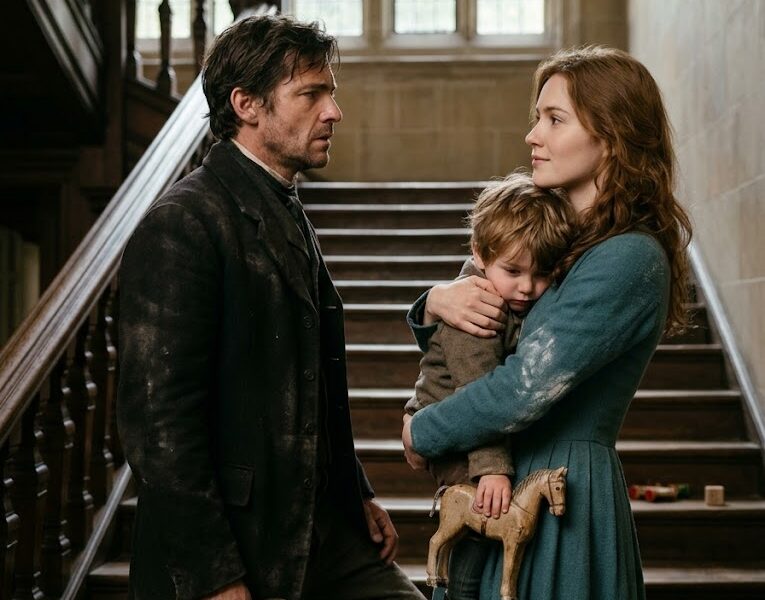
A woman appeared at the top of the staircase carrying Oliver on one hip.
For several seconds, neither of them moved.
Her dark blue dress was simple and slightly wrinkled. Several strands of chestnut hair had escaped their pins. There was a faint streak of flour across one sleeve, as though she had spent the morning somewhere far less dignified than a drawing room.
She did not look like a duchess.
She looked like someone who had been living.
Oliver had both arms around her neck.
And he was smiling.
Until he saw his father.
The smile disappeared.
Adrien watched his son’s little body stiffen.
Then Oliver turned away and buried his face against Evelyn Hartley’s shoulder.
The movement was small.
Almost nothing.
But it struck Adrien harder than any accusation could have.
His own son was hiding from him.
Behind the woman Adrien had abandoned.
Evelyn’s gaze remained on him.
“So,” she said quietly.
Adrien swallowed.
“You must be Miss Hartley.”
“And you must be the man whose house I’ve apparently invaded.”
There was no cruelty in her voice.
That somehow made it worse.
Adrien removed his gloves.
“I owe you an apology.”
“Probably several.”
He looked at her.
For the first time, something resembling amusement touched her expression.
“But,” Evelyn continued, shifting Oliver comfortably against her, “we needn’t count them today.”
Adrien had rehearsed his explanation during the entire ride home.
He had prepared formal sentences about estate obligations and unexpected complications in the north.
Standing beneath Evelyn’s steady gaze, every one of them sounded pathetic.
“I should have been here when you arrived.”
“Yes.”
“I behaved discourteously.”
“Yes.”
He almost smiled despite himself.
Evelyn did.
Then she looked down at Oliver.
“Your father has ridden a very long way.”
Oliver did not move.
Evelyn continued casually, “I imagine his horse is exhausted.”
A small eye appeared above her shoulder.
Adrien’s throat tightened.
Evelyn pretended not to notice.
“Do you suppose horses become hungry after traveling that far?”
Oliver whispered something into her neck.
“What was that?”
“Apples.”
“Apples?”
Oliver nodded.
Evelyn looked at Adrien as though they were discussing the most important diplomatic matter in England.
“Does your horse eat apples, Your Grace?”
Adrien understood what she was doing.
She was giving his son a safe reason to speak to him.
He lowered himself slightly so Oliver would not have to look so far down the staircase.
“He does.”
Oliver peeked at him.
Adrien continued, “Far too many, actually.”
“How many?”
It was the first question his son had asked him directly in months.
Adrien felt something crack.
“Enough that the stable master claims I have spoiled him.”
Oliver considered this.
Then, very quietly, he asked, “Can I give him one?”
Adrien’s voice almost failed.
“Yes.”
A pause.
“Two, if you like.”
Oliver finally lifted his face completely.
For one fragile second, father and son looked at each other.
Evelyn said nothing.
She merely stood between them, holding the bridge she had built from a horse, an apple, and a little boy’s courage.
Adrien did not yet understand that this woman had been doing the same thing throughout his entire house.
Opening one locked door at a time.
Including doors inside him.
And the most dangerous one had already begun to move.
Three weeks earlier, Evelyn Hartley had arrived at Blackwood Hall expecting to meet the man she was supposed to marry.
Instead, she met his children.
The carriage had rolled through iron gates crusted with frost and stopped before an enormous gray-stone house beneath a sky heavy with snow.
No groom waited on the steps.
No smiling family.
No nervous husband-to-be.
Only an elderly housekeeper and two children standing several feet behind her.
The girl was seven.
Amelia.
She wore a dark wool dress and held herself with the unnatural stillness of a child who had learned adults preferred her invisible.
The boy was four.
Oliver clutched the housekeeper’s skirt.
“Your Grace has been detained in the north,” the housekeeper explained.
Evelyn looked toward the enormous doors.
“For how long?”
A hesitation.
“He left three weeks ago.”
Evelyn understood immediately.
Adrien Blackwood had not been detained.
He had fled.
A lesser humiliation might have made her furious.
Her entire future had been negotiated around a man who could not even be bothered to meet her.
She had every right to return to her carriage.
Instead, she looked at the children.
Amelia was watching her.
Not with curiosity.
With calculation.
As if she were trying to determine how long Evelyn would remain before leaving too.
That look changed everything.
Evelyn stepped inside.
The cold surprised her.
Not the winter cold.
The emotional cold.
Blackwood Hall was beautiful in the way museums were beautiful—expensive, preserved, and strangely lifeless.
Portraits watched from dark-paneled walls. Furniture stood exactly where someone had arranged it years earlier. Heavy curtains blocked the afternoon sun.
Evelyn heard no music.
No running feet.
No conversation.
“What do the children do in the afternoon?” she asked.
The housekeeper blinked.
“Do?”
“Play.”
Another hesitation.
“Miss Amelia has lessons.”
“And Oliver?”
“The nurse sees to him.”
Evelyn crouched.
“Hello, Oliver.”
The boy pressed farther behind the housekeeper.
Evelyn did not reach for him.
She simply smiled.
Then she looked at Amelia.
“And what do you like doing when no one is telling you what you’re supposed to do?”
Amelia’s expression changed almost imperceptibly.
“I read.”
“What?”
“Everything.”
That was the first crack Evelyn noticed.
Not in the house.
In the girl.
A spark hidden under discipline.
Over the next several days, Evelyn discovered more.
Amelia was extraordinarily bright.
She understood arithmetic faster than her tutor realized. She memorized constellations from an old astronomy book and deliberately pretended not to know answers when adults questioned her.
Oliver rarely spoke around unfamiliar people.
At night, he woke screaming.
And nobody mentioned their mother.
Not once.
Evelyn eventually asked the housekeeper.
The older woman’s face changed.
“Her Grace died two winters ago.”
“Clara?”
“You know her name?”
“I was told.”
The housekeeper glanced toward the corridor before lowering her voice.
“His Grace does not like the name spoken.”
Evelyn looked around the silent hall.
Suddenly she understood.
This was not a home recovering from grief.
It was a home imprisoned by it.
“What happened?”
“Fever.”
The answer came quietly.
“Four days.”
Evelyn closed her eyes.
“And the children?”
“Miss Amelia remembers everything. Master Oliver remembers almost nothing.”
That, Evelyn thought, might be worse.
One child had memories she was forbidden to discuss.
The other had an absence he could not understand.
“And the nursery?”
The housekeeper became visibly uncomfortable.
“It has been closed.”
“Why?”
“It belonged to the children when their mother was alive.”
Evelyn stared at her.
“The children’s nursery has been locked because their mother died?”
“It was His Grace’s order.”
“Where do they play?”
Silence answered her.
That afternoon, Evelyn asked for the key.
The housekeeper refused.
Evelyn asked again.
The woman nearly whispered, “Miss Hartley, His Grace was very clear.”
Evelyn looked toward Amelia, who sat alone beside a window with a book open on her lap.
“His Grace isn’t here.”
The housekeeper stared.
Evelyn held out her hand.
“Key.”
Twenty minutes later, the nursery door opened.
Dust floated through a thin blade of hallway light.
Everything inside remained almost exactly as Clara Blackwood had left it.
A wooden rocking horse stood near the wall.
Children’s books lined a low shelf.
A faded blanket lay folded over a chair.
Heavy curtains covered the windows.
The fireplace was cold.
Amelia appeared behind Evelyn.
Her face had gone white.
“Papa said we weren’t allowed.”
Evelyn turned.
“Do you want to come inside?”
Amelia looked terrified.
Not of the room.
Of wanting it.
“My mother used to sit there.”
She pointed toward a chair beside the fireplace.
It was the first time Evelyn had heard Clara mentioned by either child.
Evelyn could have changed the subject.
Instead she asked, “What did she do there?”
Amelia’s lower lip trembled.
“Read.”
“What stories?”
The girl’s eyes filled.
“I don’t remember.”
And suddenly she was crying.
Not loudly.
That would have violated too many rules.
She cried silently, shoulders trembling while tears rolled down her cheeks.
Evelyn knelt.
“Amelia.”
“I don’t want to forget her.”
“You don’t have to.”
“Papa doesn’t want us to talk about her.”
Evelyn felt something inside her harden.
Not against Adrien.
Against what grief had done to this family.
She opened the curtains.
Winter light flooded the room.
Amelia covered her eyes.
Evelyn opened another curtain.
Then another.
She instructed a servant to bring wood.
By evening, flames were burning in the fireplace.
Oliver wandered inside carrying a wooden horse.
Evelyn sat on the floor.
She did not announce that anything had changed.
She simply began stacking blocks.
Eventually Oliver sat opposite her.
Then Amelia joined them.
That night, for the first time in two years, smoke rose from the nursery chimney.
Three weeks later, Adrien Blackwood saw it from the road.
And thought something had gone terribly wrong.
“What else has she changed?”
Adrien asked the housekeeper on his first evening home.
The woman looked almost amused.
“Would Your Grace like the complete list?”
His eyes narrowed.
“Is it long?”
“Considerably.”
He glanced toward the ceiling.
Children’s voices floated from upstairs.
“Start with the nursery.”
“Miss Hartley opened it on her second day.”
“Without permission.”
“Yes.”
“She knew my instructions?”
“Yes.”
Adrien waited for anger.
None came.
That unsettled him more than anger would have.
“What possessed her?”
The housekeeper folded her hands.
“She saw two children who needed somewhere to be children.”
Adrien stared at her.
“And the curtains?”
“Miss Hartley.”
“The greenery?”
“Miss Hartley.”
“The toys in my entrance hall?”
“Master Oliver, technically. Though Miss Hartley declined to have them removed.”
Adrien almost protested.
Then laughter sounded upstairs.
He stopped.
The housekeeper watched him.
“What exactly has she done to them?”
The woman’s expression softened.
“Nothing extraordinary, Your Grace.”
“No?”
“She looked at them.”
Adrien frowned.
“Everyone looks at them.”
“No.”
The housekeeper shook her head.
“She sees them.”
The distinction followed Adrien into his study.
It followed him through dinner.
It followed him upstairs.
And when he passed the nursery later that evening, it stopped him outside the partially open door.
Amelia sat beside Evelyn working on a puzzle.
Oliver slept near the fire.
Adrien was about to continue walking when Amelia spoke.
“I don’t want you to be my mother.”
Adrien froze.
Evelyn’s hand stopped above a puzzle piece.
Amelia stared down at the table.
“My mother was Clara.”
Adrien braced himself.
He expected hurt.
Perhaps embarrassment.
Instead Evelyn said, “Of course she was.”
Amelia looked up.
“And she always will be.”
“You aren’t angry?”
“Why would I be?”
“Because you’re supposed to marry Papa.”
Evelyn considered her answer.
“Amelia, I don’t want to become your mother.”
The girl’s eyes widened.
“You don’t?”
“You already have one.”
Something in Adrien’s chest constricted.
Evelyn continued.
“Nobody can take Clara’s place. Not me. Not anyone.”
Amelia’s chin trembled.
“Then what are you?”
Evelyn smiled gently.
“I hoped, eventually, I might become your friend.”
That was when Amelia broke.
The girl launched herself across the small distance between them.
Evelyn caught her.
Amelia sobbed against her shoulder with two years of restraint collapsing at once.
“I miss her.”
“I know.”
“I can’t remember her voice anymore.”
Evelyn closed her eyes.
“Oh, sweetheart.”
Adrien stood unseen in the corridor.
His daughter’s words cut through him.
He had believed silence protected them.
He had believed speaking Clara’s name would reopen a wound.
But Amelia’s wound had never closed.
He had merely forced her to bleed quietly.
Adrien walked away before either of them saw him.
He entered his bedroom and shut the door.
Then he sat on the edge of the bed Clara had once shared with him.
For the first time in two years, he whispered his dead wife’s name aloud.
“Clara.”
Nothing terrible happened.
The walls remained standing.
His heart hurt.
But it continued beating.
That frightened him almost as much as it relieved him.
Adrien began observing Evelyn.
At first, he told himself it was suspicion.
It soon became something else.
She never demanded affection from the children.
That impressed him.
She allowed Oliver to approach her.
She allowed Amelia to withdraw.
She learned when to ask questions and when silence was kinder.
At breakfast she listened when Amelia explained something about the stars as though the girl’s thoughts mattered.
When Oliver spilled milk, Evelyn did not summon a servant with irritation.
She handed him a cloth.
“Disaster,” she whispered.
Oliver’s eyes widened.
“Are we doomed?”
“Probably.”
The boy giggled.
“Unless…”
“Unless what?”
“We clean it before anyone discovers what you’ve done.”
Oliver grabbed the cloth.
Adrien watched from across the table.
It was such a ridiculous moment.
Milk.
A cloth.
A conspiratorial smile.
And yet he could not stop thinking about it.
He had forgotten how many families were built out of moments too small to remember.
He had been waiting for life to return through some enormous event.
Evelyn seemed to understand that life returned in teaspoons.
One morning, Adrien found Oliver waiting near the stable.
The boy held an apple in both hands.
“For Apollo.”
Adrien crouched.
“He’s been expecting you.”
Oliver looked toward the enormous black horse.
“Will he bite?”
“Only people he dislikes.”
Oliver stared at his father.
Adrien let the silence hang.
Then added, “Unfortunately, he dislikes almost everyone.”
Oliver laughed.
Adrien lifted him.
The boy stiffened automatically.
Adrien nearly put him down.
Then Oliver relaxed.
His small hand settled on Adrien’s shoulder.
It was the first time his son had allowed himself to be held without fear.
Adrien closed his eyes for half a second.
When he opened them, Evelyn was standing beneath the archway.
She had seen everything.
She did not smile triumphantly.
She simply turned away, giving father and son the dignity of believing the moment belonged only to them.
That was when Adrien first became afraid of her.
Because gratitude was becoming something else.
And Adrien Blackwood knew exactly what love could cost.
Clara had died in four days.
That was the fact around which Adrien had rebuilt his entire existence.
Four days.
On Monday she complained of chills.
On Tuesday the physician came.
By Wednesday she could barely lift her head.
Friday morning, Adrien held her hand and felt warmth leaving it.
He had been thirty-five years old.
Old enough to believe himself powerful.
Rich enough to summon physicians from three counties.
Important enough that men stood when he entered rooms.
And none of it mattered.
Death entered his house without knocking.
It took Clara.
Then left Adrien behind.
For months afterward, he had awakened expecting her beside him.
Then came the worse stage.
He stopped expecting her.
He locked the nursery because Clara had spent so much time there.
He avoided the gardens she loved.
He forbade servants from mentioning her.
He stopped visiting the village churchyard.
He told himself these things were survival.
In truth, he had confused surviving with refusing to live.
Evelyn discovered the grave almost accidentally.
One gray afternoon, Adrien saw her standing beside the stone wall surrounding St. Alden’s churchyard.
He approached.
“You’ve been avoiding this place.”
She did not turn.
“You’ve noticed?”
“I notice more than you think.”
He stopped beside her.
Beyond the wall, snow covered rows of headstones.
Clara lay somewhere among them.
Adrien had not crossed that wall since the burial.
Evelyn looked at him.
“Tell me about her.”
Every muscle in his body tightened.
“No.”
“All right.”
That answer surprised him.
She did not push.
They stood silently.
Finally Adrien said, “She loved winter.”
Evelyn waited.
“Which was absurd.”
“Why?”
“She was always cold.”
Evelyn smiled.
Adrien looked toward the churchyard.
“She’d open windows in January because she liked the smell of snow.”
His voice changed.
“Then complain that her hands were freezing.”
“What else?”
“Amber flowers.”
“Amber?”
“And gold. She kept them after they wilted. I used to tease her.”
The memories came faster.
Clara dancing barefoot after a country dinner.
Clara furious with him after Amelia’s birth because he had fallen asleep while she was in labor.
Clara laughing when Oliver first sneezed.
Clara standing at the nursery window.
Clara burning with fever.
Clara whispering that she was frightened.
Clara asking him to take care of the children.
Adrien stopped breathing properly.
“I failed her.”
Evelyn turned.
“What?”
“The children.”
His voice broke.
“I failed them.”
“You were grieving.”
“So were they.”
That truth landed without mercy.
Adrien covered his face.
“I couldn’t look at Amelia because she has Clara’s eyes.”
Evelyn said nothing.
“Oliver smelled like her when he was a baby. Do you understand that?”
His shoulders began shaking.
“I would pick him up and smell her, and for one second I’d forget, and then I’d remember all over again.”
Evelyn’s eyes filled.
“So I stopped holding him.”
There it was.
The ugliest truth.
Adrien forced himself to say it.
“I stopped holding my own son because loving him hurt.”
Evelyn moved closer.
Adrien expected reassurance.
She did not give him any.
Instead she said, “Then start holding him now.”
He looked at her.
“What if I lose him too?”
Evelyn’s expression changed.
“Adrien, you will lose everyone eventually.”
He stared.
“That is the bargain.”
Her voice softened.
“People leave. People die. Children grow up. Nothing we love belongs to us forever.”
“That’s supposed to comfort me?”
“No.”
She stepped closer.
“But perhaps this will.”
Her hand touched his.
“The heart isn’t a house with a fixed number of rooms.”
Adrien looked down at their joined hands.
“Loving your children doesn’t push Clara out. Loving your life doesn’t betray her.”
He could not speak.
“And someday,” Evelyn whispered, “if you ever love someone else, that won’t erase her either.”
Something inside him collapsed.
For two years Adrien had not cried.
Now he did.
He wept beside the wall of the graveyard where his wife was buried while another woman held his hand.
And for the first time, he understood that grief had lied to him.
It had told him healing meant forgetting.
It had told him laughter was betrayal.
It had told him survival required emptiness.
Evelyn asked nothing from him.
She merely stayed.
When his tears finally stopped, Adrien realized her hand was still in his.
He did not let go.
Their courtship, if it could be called that, began almost accidentally.
They walked through the winter market.
Adrien bought Evelyn a blue ribbon and immediately regretted how absurdly nervous he felt handing it to her.
“For me?”
“Unless Oliver has developed an interest in ribbons.”
Evelyn laughed.
Adrien wanted to hear it again.
So he bought two wooden animals for the children and deliberately pretended the merchant had cheated him.
“You paid exactly what he asked.”
“I was robbed.”
“You didn’t even bargain.”
“I was distracted.”
“By what?”
He looked at her.
Evelyn’s smile disappeared slowly.
For one suspended second, the noisy market seemed to recede around them.
Adrien could have answered.
He almost did.
Then fear returned.
He looked away.
“By the horse.”
“The wooden horse?”
“A suspicious-looking creature.”
Evelyn laughed again.
Adrien hated himself for retreating.
That night he stood alone in his study and admitted what he had spent weeks refusing to name.
He loved Evelyn.
And immediately felt guilty.
He looked at Clara’s portrait.
“I’m sorry.”
The painted woman offered no answer.
Adrien sat beneath her gaze until midnight.
Then a strange thought came.
If Clara had survived and Adrien had died, would he have wanted her to spend the rest of her life alone?
Would he have wanted their children raised inside a mausoleum?
Would he have called her laughter betrayal?
Of course not.
Then why had he turned grief into a punishment Clara had never asked him to endure?
The realization did not free him immediately.
But another lock opened.
Winter deepened.
Adrien began joining his children in the nursery.
At first, Amelia regarded him cautiously.
Then one morning she placed an astronomy book in front of him.
“What is this?”
Adrien studied the illustration.
“Orion.”
She narrowed her eyes.
“You’re certain?”
“Completely.”
“It’s Perseus.”
Adrien looked again.
Amelia smiled.
“You knew.”
“Yes.”
“You tricked me.”
“Yes.”
For a second, he thought she might apologize.
Instead she laughed.
Adrien laughed too.
The sound startled both of them.
Oliver began climbing onto his lap during stories.
Amelia took his hand during walks.
The house changed around them.
Or perhaps Adrien finally noticed what Evelyn had changed already.
Then one night, they carried the children outside beneath a sky sharpened by cold.
Oliver slept against Adrien’s chest.
Evelyn wrapped Amelia in a blanket.
Adrien pointed toward the stars.
“That is Cassiopeia.”
Amelia squinted.
“Why?”
“Because ancient kings had nothing better to do than name stars.”
“That’s not true.”
“It might be.”
Evelyn laughed behind them.
Adrien looked at her.
She was not watching the sky.
She was watching him holding his son.
Their eyes met.
And something passed between them that no arrangement, title, inheritance, or family obligation could explain.
Adrien knew.
Evelyn knew he knew.
He decided he would tell her the next morning.
He would stop hiding.
He would tell her he loved her.
But morning came with Oliver burning from fever.
Adrien touched his son’s forehead.
The world disappeared.
Heat.
Too much heat.
“No.”
Evelyn looked up.
“What?”
“He’s burning.”
Within an hour, the physician arrived.
Oliver lay beneath blankets, cheeks red, breathing too quickly.
Adrien stood near the window.
He was no longer seeing Oliver.
He was seeing Clara.
Four days.
He heard the physician speaking.
“Children often develop fevers—”
“How high?”
“Your Grace—”
“How high?”
“Adrien.”
Evelyn touched his arm.
He jerked away.
“Don’t.”
She stared at him.
“I know what you’re thinking.”
“No, you don’t.”
“I do.”
“You weren’t here.”
His voice sharpened.
“You didn’t watch Clara die.”
The room went silent.
Evelyn absorbed the blow.
Adrien immediately regretted it.
But fear was stronger than shame.
“Four days,” he whispered.
The physician looked toward him.
“Your Grace, this is not necessarily the same illness.”
“You said that then.”
The old man’s face changed.
Adrien remembered.
Of course he remembered.
Rest.
Fluids.
Wait.
The same careful language.
Oliver whimpered.
Adrien backed toward the door.
Evelyn caught his wrist.
“Where are you going?”
“I can’t.”
“Can’t what?”
“Do this again.”
Her grip tightened.
Adrien stared at her.
Evelyn’s voice dropped.
“You don’t get to leave this time.”
The words struck him.
“He’s your son.”
“I know.”
“Then be frightened beside him.”
Adrien’s eyes burned.
“Be useless. Be terrified. Pray. Cry. Hold his hand. But do not make that little boy face this without his father because you’re afraid history might repeat itself.”
Adrien looked toward the bed.
Oliver’s small body shifted restlessly.
“Papa?”
One word.
Barely audible.
It destroyed him.
Adrien crossed the room.
He sat beside his son.
And took his hand.
“I am here.”
Oliver’s fingers closed weakly around his.
Adrien bent his head.
“I am right here.”
The fever climbed.
One night became two.
Evelyn barely slept.
She changed cloths.
Coaxed water between Oliver’s cracked lips.
Held him when nightmares made him cry.
Adrien stayed too.
At some point after midnight on the second night, Oliver began murmuring.
“Mama.”
Adrien froze.
“Mama.”
Evelyn closed her eyes.
Adrien stood.
He could not breathe.
“I can’t—”
Evelyn reached across the bed and took his hand.
This time he did not pull away.
“Stay.”
So he stayed.
Oliver called for a mother he could barely remember.
Evelyn stroked his hair.
Adrien held his hand.
And together they waited for dawn.
Near sunrise on the third morning, Evelyn suddenly leaned forward.
“Adrien.”
He woke instantly.
“What?”
“Come here.”
Something in her voice terrified him.
He rushed to the bed.
“Touch him.”
Adrien placed his palm against Oliver’s forehead.
Cool.
He stared.
Touched again.
Cool.
“The fever…”
“It’s breaking.”
Adrien looked at the physician.
The old man nodded.
“He is through the worst of it.”
Adrien’s knees nearly gave way.
He sank beside the bed.
Then he cried.
Not quietly.
Not with dignity.
He cried like a man whose entire body had been holding one scream for two years.
Evelyn knelt beside him.
Adrien turned toward her.
She wrapped her arms around him.
He buried his face against her shoulder.
And for once he allowed another person to carry some of the weight.
When he finally lifted his head, the room was gray with morning.
Oliver slept peacefully.
Evelyn looked exhausted.
Beautiful.
Real.
Alive.
Adrien touched her face.
“Marry me.”
She stared.
“Adrien—”
“No.”
He shook his head.
“Not because Margaret arranged it.”
Evelyn’s eyes filled.
“Not because Blackwood Hall needs a duchess. Not because my children need someone to raise them.”
He swallowed.
“Marry me because I love you.”
A tear slipped down Evelyn’s cheek.
Adrien continued before fear could stop him.
“I loved Clara.”
“I know.”
“I still love her.”
“I know.”
“I think part of me always will.”
“I hope so.”
That answer almost broke him again.
“But I love you too.”
His voice trembled.
“I didn’t know I could.”
Evelyn covered his hand with hers.
“You taught my children how to laugh in this house again.”
He shook his head.
“You taught me.”
She was crying openly now.
“I came home and thought you had invaded everything I’d tried to preserve.”
A fragile smile touched her lips.
“I did invade your nursery.”
“Completely without permission.”
“I regret nothing.”
Adrien laughed through his tears.
Then became serious.
“You didn’t destroy what was left of Clara.”
“No.”
“You gave her back to us.”
Evelyn closed her eyes.
“And you gave me my children back.”
His thumb brushed her cheek.
“Then you gave me back to myself.”
Evelyn whispered, “I loved you before you knew how to do any of that.”
Adrien stared.
“When?”
“The day you came home.”
“I was horrible.”
“You were terrified.”
“I barely spoke.”
“You didn’t need to.”
She glanced toward Oliver.
“I watched him hide from you, and I watched your face when he did.”
Her voice softened.
“Everyone else saw a cold man.”
“What did you see?”
“A grieving father who had become so frightened of losing people that he was losing them anyway.”
Adrien closed his eyes.
Evelyn leaned her forehead against his.
“And I wanted very badly for you to stop.”
He kissed her.
Not with the desperation of a man replacing one love with another.
Not with guilt.
Not with apology.
He kissed Evelyn as a man finally choosing the life still standing in front of him.
And for the first time since Clara died, Adrien did not feel that he was betraying the dead by loving the living.
There was one person whose permission mattered before the wedding.
Amelia.
Adrien sat beside his daughter near the nursery fire.
Evelyn remained across the room.
“I want to marry Evelyn,” he said.
Amelia looked down.
“I know.”
“But I wanted to tell you myself.”
Silence.
Then came the question Adrien had feared.
“Do you still love Mama?”
He answered immediately.
“Yes.”
Amelia looked up.
“I will love your mother until the day I die.”
“Then how can you marry Evelyn?”
Adrien glanced toward the woman who had taught him the answer.
“Because loving one person doesn’t require us to stop loving another.”
Amelia considered this.
“Will we still talk about Mama?”
“As much as you want.”
“Can her picture stay?”
“Always.”
“Can I tell Oliver stories about her?”
“I hope you will.”
Amelia turned toward Evelyn.
“And you don’t mind?”
Evelyn came closer.
“Amelia, I would be very sad if you stopped.”
“Why?”
“Because Oliver deserves to know his mother.”
Amelia’s eyes filled.
“And so do I.”
Evelyn knelt.
“I don’t want Clara erased just so there is room for me.”
Amelia stared at her.
Then crossed the room.
She wrapped her arms around Evelyn.
Adrien turned his face away.
For two years, he had believed a family became whole only when nothing was missing.
Now he understood.
Wholeness did not mean absence disappeared.
It meant love learned how to gather around the empty chair.
But one final door remained closed.
And Adrien knew he could not begin a new marriage until he opened it.
Snow covered St. Alden’s churchyard the morning Adrien returned to Clara’s grave.
Evelyn walked beside him.
They stopped at the stone wall.
Adrien’s breathing changed.
“You don’t have to do this today,” Evelyn said.
“Yes.”
He looked through the gate.
“I do.”
His steps slowed as they approached the grave.
Clara Blackwood.
Beloved wife.
Beloved mother.
The inscription blurred.
Adrien stood silently.
Then spoke.
“Hello, Clara.”
Evelyn stepped slightly away.
Adrien tightened his hold on her hand.
“No.”
She looked at him.
“Stay.”
So she did.
Adrien looked back at the stone.
“I’ve been a coward.”
Wind moved softly through the bare trees.
“I told myself I was protecting what we had.”
His voice cracked.
“I wasn’t.”
He told Clara about Amelia.
How brilliant she was.
How she loved astronomy.
How she remembered her mother and had spent two years terrified she might forget.
He told her about Oliver.
How the boy loved horses.
How he had survived the fever.
How Adrien had finally learned to hold him without thinking about losing him.
Then he spoke about Evelyn.
“She’s good.”
His hand tightened around hers.
“Better than I deserved when she arrived.”
Evelyn’s eyes filled.
“She opened the nursery.”
A laugh escaped him.
“You would have liked that.”
He wiped his face.
“Actually, you probably would have helped her break the lock.”
Evelyn laughed softly through her tears.
Adrien looked at Clara’s name.
“I love her.”
The words hung in the winter air.
“And I still love you.”
His voice steadied.
“I spent two years believing those truths couldn’t exist together.”
He looked at Evelyn.
“I was wrong.”
For a long time, nobody spoke.
Then Adrien placed amber and gold flowers against Clara’s grave.
Her favorite colors.
“Goodbye isn’t the right word.”
He touched the stone.
“So I’ll say what I should have said two years ago.”
He drew a breath.
“Thank you.”
For their years.
For Amelia.
For Oliver.
For having loved him.
Then Adrien turned away from the grave.
Not because Clara no longer mattered.
Because she always would.
Evelyn waited.
Adrien reached for her hand.
“Come.”
“Where?”
He looked toward the church.
“Forward.”
They married on a bright winter morning.
There was no enormous crowd.
No political spectacle.
No strangers invited merely because their names carried influence.
Amelia wore the color of a winter sky and carried amber and gold flowers.
Oliver refused to remain quiet during the vows.
When the priest asked Adrien whether he took Evelyn as his wife, Oliver announced loudly, “He does.”
Everyone laughed.
Even Adrien.
Especially Adrien.
Aunt Margaret dabbed her eyes while pretending something had irritated them.
The housekeeper cried without making any such excuse.
And Evelyn stood before Adrien beneath the old stone arches of St. Alden’s, wearing the blue ribbon he had bought her at the winter market hidden among the flowers at her wrist.
Adrien noticed.
Of course he noticed.
When it came time to speak his vows, he looked at her and remembered the first day he had seen her.
Hair falling loose.
Flour on her sleeve.
His son hiding against her shoulder.
He had thought she was an outsider.
Now he understood she had become the center toward which all the rooms of his life seemed to open.
They did not take a wedding journey.
Neither wanted to leave the children.
Instead they returned to Blackwood Hall.
The good china appeared for the first time in two years.
Oliver fell asleep against Adrien’s arm before dessert.
Amelia laughed so loudly at something Aunt Margaret said that everyone stopped and stared.
Amelia immediately covered her mouth.
Adrien looked at his daughter.
For one dangerous second, the old reflex returned.
Silence.
Control.
Do not disturb the house.
Then he smiled.
“Don’t stop.”
Amelia lowered her hand.
“What?”
“Laugh.”
Her eyes widened.
Adrien leaned back.
“I’ve spent enough years in a quiet house.”
Amelia smiled.
Then laughed again.
Evelyn’s laughter joined hers.
Oliver slept through all of it.
Adrien sat surrounded by the noise.
And realized he had never heard anything more beautiful.
Years passed.
Winter continued returning to Blackwood Hall.
But it no longer meant what it once had.
Oliver became fearless around horses and terrified of spiders.
Amelia filled notebooks with constellations and questions.
She stopped pretending not to know answers.
Nobody punished joy anymore.
Nobody lowered their voices when Clara’s name was spoken.
Her portrait remained.
Her favorite flowers returned every winter.
On her birthday, Adrien told the children stories.
Sometimes they were funny.
Sometimes he cried.
Nobody hurried him.
Evelyn never competed with a dead woman.
That was perhaps the greatest gift she gave him.
She understood that Clara belonged to the family’s story.
And because Evelyn never demanded that Adrien close the past, he eventually became capable of walking freely into the future.
Years after their wedding, Amelia asked Adrien to tell her again about the day he returned from the north.
“The smoke story?”
“Again?”
“You always leave things out.”
“I do not.”
“You do.”
Oliver appeared immediately.
“Tell it.”
Adrien sighed theatrically.
“Very well.”
They gathered near the fire.
He told them about riding through the gates.
About seeing smoke rising from the nursery chimney.
About believing someone had disobeyed his orders.
“You were angry?” Oliver asked.
“I was confused.”
“You were angry,” Evelyn called from her chair.
Adrien looked at her.
“Betrayed by my own wife.”
“You weren’t married to me yet.”
“Which apparently did nothing to prevent you from reorganizing my entire house.”
Evelyn smiled.
Amelia interrupted.
“Then what?”
Adrien looked at his children.
“I came inside.”
“And?”
“I heard something.”
“What?”
Adrien smiled.
“Your brother laughing.”
Oliver rolled his eyes.
“I laugh all the time.”
“Now.”
Adrien’s voice softened.
“But you didn’t then.”
The room became quiet.
Oliver looked toward the fire.
Adrien continued.
“I had forgotten what your laughter sounded like.”
His son’s expression changed.
“And when I heard it, I knew something had happened while I was away.”
“What?”
Adrien looked at Evelyn.
She was watching him with the same steady eyes she had possessed the first day.
“Someone opened a door.”
Amelia frowned.
“The nursery?”
“Yes.”
Adrien reached for Evelyn’s hand.
“But not only that one.”
One January night many years later, snow fell outside the windows.
Amelia had fallen asleep with a book against her chest.
Oliver lay sprawled near the fire beneath a blanket he had kicked halfway onto the floor.
Adrien lifted it and covered him again.
Then he returned to Evelyn.
She rested her head against his shoulder.
For several minutes, they watched the snow.
“Do you ever regret it?” she asked.
Adrien looked down.
“Regret what?”
“Me.”
He laughed.
Evelyn nudged him.
“I’m serious.”
“So am I.”
He kissed her forehead.
“My only regret is that I wasted three weeks riding north to avoid meeting you.”
“Three?”
“Perhaps I should have stayed four.”
She struck his arm.
Adrien caught her hand.
They smiled.
Outside, snow covered the grounds.
The same kind of snow had fallen when Clara died.
For years Adrien could not see winter without remembering her fever.
Her hand.
The final breath.
He had thought healing would mean one day forgetting those images.
He never did.
He still remembered.
Grief remained.
But grief was no longer the only thing winter carried.
Now winter also meant Evelyn opening curtains.
Amelia laughing.
Oliver feeding apples to Apollo.
Amber flowers on a grave.
A blue ribbon at a wedding.
Children sleeping beside a fire.
A woman beside him whose love had never asked him to forget the woman who came before her.
Adrien finally understood something he wished someone had told him when Clara died.
A heart did not heal by returning to what it had been.
His never did.
It became something different.
Larger in some places.
Scarred in others.
Capable of holding contradictions he had once thought impossible.
He could miss Clara and love Evelyn.
He could fear loss and still hold his children tightly.
He could remember death and still choose tomorrow.
He could look at falling snow without demanding that it apologize for what winter had once taken from him.
Evelyn rested a hand against his chest.
“What are you thinking?”
Adrien looked toward Amelia and Oliver.
“About the first day I came home.”
“The day you looked at me as though I had committed treason?”
“You had opened a forbidden room.”
“There were children inside your house who needed it.”
“I know.”
“You didn’t then.”
“No.”
He smiled faintly.
“I didn’t know very much then.”
Evelyn became quiet.
After a moment she asked, “And now?”
Adrien looked around.
At the fire.
At his sleeping children.
At the woman beside him.
At the windows glowing warm against the winter darkness.
“Now I know what a home sounds like.”
Evelyn smiled.
Outside, the snow continued falling.
Blackwood Hall stood exactly where it had stood through generations of winters.
The stone was the same.
The gates were the same.
The long drive was the same.
Clara was still gone.
Nothing miraculous had reversed that loss.
No one had returned from the dead.
No wound had disappeared simply because enough time had passed.
The miracle was smaller than that.
And perhaps greater.
A frightened little girl had learned she was allowed to remember her mother.
A lonely boy had learned his father’s arms were safe.
A grieving man had learned love was not something he could preserve by refusing to give it.
And a woman who arrived to marry a stranger had walked into a house full of locked doors and understood that some of them needed opening.
That night, Oliver shifted in his sleep.
Amelia murmured something about stars.
Evelyn’s head remained against Adrien’s shoulder.
Adrien watched snow gather along the windowsill.
Once, winter had meant the end of everything.
Now there was firelight reflected in the glass.
There were children’s books scattered where servants no longer hurried to remove them.
There were muddy boots by the entrance.
Flowers in rooms once kept dark.
There was laughter embedded so deeply in the walls that Adrien could no longer remember how Blackwood Hall had ever endured without it.
And there was Clara too.
Not as a ghost demanding sorrow.
Not as an empty chair everyone was forbidden to see.
But as a woman who had lived.
A mother whose children knew her name.
A love that had mattered.
A chapter that did not have to be destroyed for another chapter to begin.
Adrien lowered his head and kissed Evelyn’s hair.
Then he closed his eyes.
For years he had believed the cruelest truth about love was that everything precious could be taken away.
Perhaps that was true.
But it was only half the truth.
The other half had taken him years to understand.
Sometimes what is lost never comes back.
Sometimes the person you were before the loss never comes back either.
But if you are brave enough to open the door when warmth arrives again, something new can enter the empty rooms.
Not a replacement.
Not an erasure.
A continuation.
And sometimes that is the closest thing this life gives us to a miracle.
Outside, snow kept falling over Blackwood Hall.
Inside, nobody was afraid of winter anymore.









