HE BET 100 COWS SHE COULDN’T FIX NINE DEAD TRACTORS—FIVE YEARS LATER, HE REALIZED WHAT HE’D REALLY GIVEN AWAY
“Four mechanics already quit.”
Clayton Reeves folded his arms across his chest and looked at Maya Carter as if she were a child who had wandered into the wrong building.
Behind him sat nine silent John Deere machines.
Nine.
Tractors. A sprayer. A forage harvester. Equipment worth more money than Maya had earned in the last several years combined.
All of them dead.
Clayton tilted his head.
“What makes you think you’re any different?”
Two ranch hands standing near the open machinery-shed door laughed.
Maya didn’t.
She was twenty-six years old, five-foot-six in work boots, with dark blond hair pulled into a rough ponytail and a grease stain already marking the sleeve of her faded denim shirt.
Her father’s scratched metal toolbox sat beside her right boot.
She looked past Clayton at the machines.
Then she looked back at him.
“Show me.”
Clayton’s smile widened.
“Excuse me?”
“Show me what the other mechanics couldn’t fix.”
One of the ranch hands coughed to hide another laugh.
Clayton didn’t bother hiding his.
“Sweetheart, these aren’t lawn mowers.”
Maya’s face didn’t change.
“No. Lawn mowers are usually cleaner.”
The laughter stopped.
For half a second, Clayton’s smile tightened.
Then he stepped closer.
He was sixty-one, broad through the shoulders, silver-haired, sun-browned, and accustomed to occupying space as though every acre around him existed because he had permitted it.
Reeves Ranch was one of the largest cattle operations in Harland County.
Everybody knew that.
Everybody knew Clayton Reeves.
And everybody knew Daniel Carter, too.
Or they had.
Daniel had been the mechanic farmers called when dealership technicians had run out of ideas.
Daniel could listen to an engine for thirty seconds and hear what other men needed a diagnostic computer to find.
But Daniel Carter had been dead four years.
The daughter standing in Clayton’s shed wasn’t Daniel.
Clayton made sure she understood that.
“Your daddy was one hell of a mechanic,” he said.
Maya held his gaze.
“He was.”
“You’re not him.”
“No.”
Something about the speed of her answer seemed to disappoint him.
Clayton had been expecting defensiveness.
Instead, Maya turned toward the first tractor.
“When did this one last run?”
Clayton shrugged.
“Months ago.”
“What happened?”
“Stopped.”
“Machines don’t ‘stop.’ Something causes them to stop.”
“Well, that’s why you’re here, isn’t it?”
She crouched beside the tractor.
Clayton watched her for several minutes, growing visibly bored as she examined connectors, fuel lines, service markings, wiring harnesses and control housings without touching anything.
Finally he said, “I’ll save you some time.”
Maya glanced back.
“Please do.”
“Four certified mechanics have been through this shed. Dealership guys. Men with twenty years under them. One told me I’d spend more chasing these failures than replacing half the equipment.”
Maya stood.
“Then why haven’t you replaced it?”
The question landed harder than she intended.
Or perhaps exactly as hard.
Clayton’s expression changed.
Only slightly.
But Maya saw it.
That was the first crack.
Then it disappeared.
Clayton smiled again.
“You want the job or not?”
“I haven’t given you a price.”
“I’m not asking for one.”
Maya waited.
Clayton turned toward the open shed door.
Beyond it, spring sunlight stretched over hundreds of acres of Reeves land.
Cattle grazed beyond the fences.
Barn roofs rose in the distance.
From where Maya stood, the ranch looked exactly the way Clayton wanted Harland County to see it.
Large.
Successful.
Permanent.
Then Clayton pointed toward the northern fields.
“Tell you what, Maya. You get all nine machines running.”
She said nothing.
“Seven days.”
Still nothing.
“And I’ll give you a hundred head.”
Maya thought she’d misheard him.
“A hundred what?”
“Cows.”
One ranch hand laughed.
The other stared at Clayton.
Clayton was enjoying himself now.
“A hundred cows,” he repeated. “You fix all nine machines within seven days, they’re yours.”
Maya studied him.
Clayton spread his hands.
“What?”
“Which hundred?”
His smile flickered.
“The north-pasture herd.”
“And if I don’t?”
“You get nothing.”
“No labor.”
“No.”
“No parts reimbursement.”
“No.”
“Nothing.”
Clayton nodded.
“You walk away knowing four certified mechanics were smarter than you.”
That got the laugh he wanted.
Maya looked through the shed opening toward the north pasture.
She couldn’t see much from there.
Only distant cattle moving against pale grass.
Then she turned back.
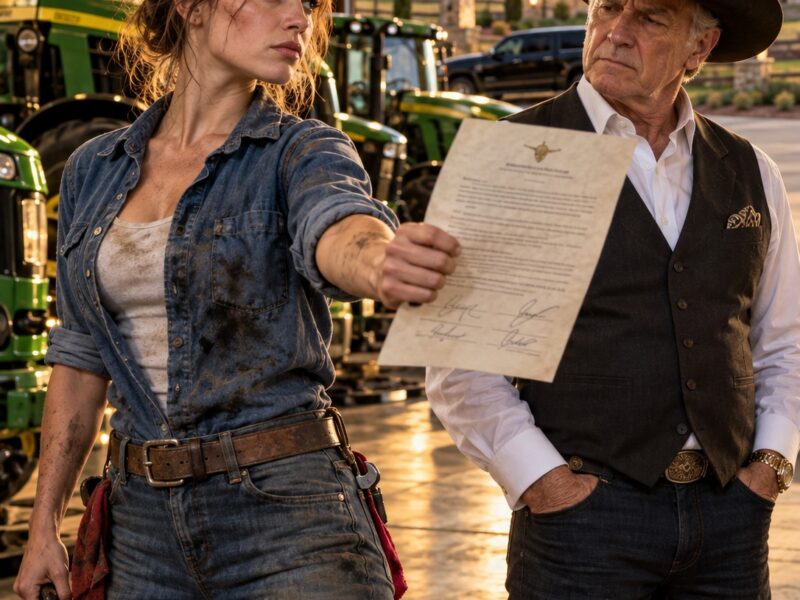
“Put it in writing.”
The ranch hands went quiet.
Clayton blinked.
“What?”
“You heard me.”
Maya took her phone from her pocket and opened the camera.
“If I repair all nine machines to normal operating condition within seven calendar days, ownership of one hundred cattle currently held in the north pasture transfers to me.”
Clayton stared at her.
“Are you serious?”
“Very.”
“You think I’m going to back out?”
“I think men who intend to keep their word aren’t afraid to sign it.”
One of the ranch hands looked at the floor.
Clayton’s jaw shifted.
Maya could almost see the decision forming behind his eyes.
If he refused, he would look afraid.
If he signed, he believed he would lose nothing.
His pride made the choice for him.
“Write it down, girl.”
Maya pulled a small notebook from her toolbox.
Clayton dictated.
She made him specify the machines.
She made him specify the deadline.
She made him identify the cattle.
She made him write that no payment would be due for the animals if she completed the repairs.
Then she pushed the page across the workbench.
“Sign.”
Clayton laughed.
“My pleasure, sweetheart.”
He signed his name with a flourish.
Maya photographed the agreement.
Then she photographed him holding it.
Clayton laughed again.
He thought she wanted evidence because she expected him to cheat.
She did.
But that wasn’t the only reason.
Because by then Maya had already noticed something inside the shed that Clayton hadn’t realized she’d seen.
And for the first time that morning, she was no longer wondering whether she could repair the machines.
She was wondering why somebody had wanted some of them to stay broken.
Harland County had a way of deciding what a person was before that person had a chance to decide for themselves.
Maya learned that when she was twenty-two.
Three weeks after burying her father, she reopened Carter Agricultural Repair.
The sign outside still said:
DANIEL CARTER
DIESEL • FARM EQUIPMENT • HYDRAULICS
She couldn’t bring herself to change it.
Not then.
Customers came because Daniel had fixed their equipment for thirty years.
Then they walked inside and saw Maya.
The first few conversations were almost identical.
“Daniel around?”
“He passed away.”
“Oh. Right. Sorry.”
Then the pause.
“Is there… someone else working here?”
“Me.”
Another pause.
“You handle the books?”
“I handle the repairs.”
Sometimes they smiled politely.
Sometimes they didn’t.
One farmer looked over her shoulder and asked, “Your husband the mechanic?”
Maya wasn’t married.
Another asked whether she could “get one of the guys” to inspect his baler.
There were no guys.
There was Maya.
Eventually she stopped explaining.
She repaired whatever people left.
She sent invoices.
When the machine worked, they paid.
When it failed again because of something unrelated, they blamed her faster than they had ever blamed Daniel.
She learned to document everything.
She learned that competence did not erase doubt immediately.
It merely forced doubt to retreat one inch at a time.
Her father had left her three metal toolboxes, an aging workshop, shelves of mismatched parts, dozens of notebooks, and barely enough money to cover funeral expenses.
The notebooks mattered most.
Daniel wrote down everything.
Not formal repair procedures.
Observations.
Patterns.
Questions.
Things other mechanics dismissed.
One sentence appeared more than once.
When the machine keeps giving you the wrong answer, ask who benefits from you believing it.
As a teenager, Maya had thought it sounded unnecessarily philosophical for a man who spent most of his life smelling like diesel.
At twenty-six, she understood.
Machines lied only when people made them.
That Tuesday at Reeves Ranch, she had seen enough to know something wasn’t right.
The nine failures weren’t identical.
That would have been obvious.
Instead, they were different in a way that almost felt designed to discourage pattern recognition.
Fuel-pressure problems.
Hydraulic failure.
Control-module communication faults.
Emergency shutdowns.
A tractor that cranked but wouldn’t remain running.
Individually, each problem made sense.
Together, they bothered her.
One sensor connector looked loosened, not degraded.
A relay was positioned incorrectly.
A hydraulic restriction looked too deliberate.
Then there were the service tags.
Three machines had internal maintenance tags signed by the same Reeves Ranch employee eight months earlier.
Someone had touched them after the problems began.
Maya didn’t know why.
She knew only that Clayton’s wager suddenly felt less like arrogance and more like a door he believed couldn’t possibly open.
That night, Denise Carter read the handwritten agreement twice.
Maya’s mother sat at the same kitchen table where Daniel had once rebuilt carburetors despite Denise repeatedly telling him not to.
She placed the paper down.
“One hundred cows?”
“Yes.”
“For seven days of work?”
“If I finish.”
Denise removed her glasses.
“What is wrong with them?”
“The cows?”
“The entire situation.”
Maya smiled faintly.
“That’s what I’m trying to figure out.”
“Maya.”
“I know.”
“No. Listen to me.”
Denise leaned forward.
“Men like Clayton Reeves do not gamble things they think they can lose.”
“I know.”
“So either those machines can’t be repaired in seven days, or those cattle aren’t worth what you think they’re worth.”
“Probably.”
Denise stared at her.
“And you’re still doing this?”
Maya looked at the signature.
“Yes.”
“Why?”
Maya was silent for several seconds.
Then she said, “Because I don’t think Clayton is worried about losing the cattle.”
Denise frowned.
“What is he worried about?”
“I don’t know yet.”
And that was the part Maya couldn’t stop thinking about.
She arrived at Reeves Ranch at 4:47 the next morning.
Before touching anything, she photographed everything.
Serial numbers.
Wiring positions.
Relays.
Connectors.
Fluid levels.
Diagnostic codes.
Service tags.
Fuel samples.
Hydraulic lines.
She created folders on her phone for every machine.
Clayton arrived shortly after seven.
He stood at the shed entrance holding coffee.
“You planning to fix them or photograph them?”
“Both.”
“You’re wasting daylight.”
“It’s my daylight.”
His mouth tightened.
Maya kept working.
By noon, she had separated the failures into two categories.
Neglect.
And interference.
She couldn’t yet prove who had interfered or why.
So she said nothing.
She started repairing.
The first tractor came alive at 5:18 that afternoon.
Its diesel engine caught with a hard cough, then settled into a steady rumble that filled the shed.
Every ranch hand nearby turned.
Maya climbed into the cab.
She drove it outside.
Parked it in the sunlight.
Shut it down.
Restarted it.
Perfect.
She climbed down and walked back toward the shed.
One of the ranch hands called, “That’s one.”
Maya didn’t answer.
She was already thinking about number two.
Clayton stood near the barn.
Watching.
On the second afternoon, another tractor rolled out.
Nobody laughed.
That evening Maya overheard Clayton speaking to his foreman through the thin wall of the storage bay.
“Nobody helps her.”
A pause.
“You understand?”
“Yes, sir.”
“She moves her own parts. She gets her own supplies. She wants to prove something, let her prove it.”
Maya stood on the other side of the wall holding a socket wrench.
She waited until Clayton’s footsteps disappeared.
Then she smiled.
Not because she wasn’t angry.
Because now she knew something had changed.
On Tuesday, Clayton had wanted to watch her fail.
By Thursday, he needed her to.
Day three nearly broke her.
She drove sixty miles round trip for a fuel-injection component.
That night she returned to her father’s workshop and fabricated a mounting bracket because the correct replacement was backordered.
At 1:17 a.m., Denise found her welding.
“You’ve slept?”
“Some.”
“When?”
“Yesterday.”
“That isn’t an answer.”
Maya lifted her shield.
“I’ve got four days.”
“You’ve got one body.”
“I noticed.”
Denise looked at her daughter’s swollen knuckles.
For a moment neither woman spoke.
Then Denise walked to the refrigerator, took out a sandwich, wrapped it in foil and placed it beside Maya’s toolbox.
“You get this stubbornness from your father.”
Maya looked at the welding torch.
“You’ve been telling me my whole life I got it from you.”
“That was before it became inconvenient.”
Maya laughed.
It was the first time she’d laughed in two days.
At dawn she returned to Reeves Ranch.
By noon the sprayer was operational.
Before sunset the forage harvester cleared its emergency shutdown cycle.
Four machines.
Then five.
Then six.
By the end of day six, eight green John Deere machines stood outside the shed.
Running.
The sight of them had changed the atmosphere of Reeves Ranch.
Neighbors had started hearing about the wager.
Farmers drove slowly past.
Employees lingered near the shed.
People who had ignored Carter Agricultural Repair for years suddenly knew exactly who Maya Carter was.
But inside the shed sat machine number nine.
The largest utility tractor.
And it refused to cooperate.
The engine cranked normally.
Fuel pressure was normal.
Compression held.
Sensors communicated.
No obvious mechanical failure explained the shutdown.
Every time Maya brought the engine close to full ignition, something killed it.
Again.
And again.
And again.
At 8:40 that night, Maya sat alone on the concrete floor.
Her back rested against the front tire.
Her father’s diagnostic computer lay beside her.
For the first time all week, she felt afraid.
Not of losing cattle.
She had never owned cattle.
You couldn’t mourn losing something that had never been yours.
What frightened her was the thought of Clayton standing in this exact spot tomorrow and saying:
See?
She hated that his opinion mattered.
But pretending it didn’t would have been another kind of lie.
For four years she’d told herself she worked only for herself.
Yet every doubtful face had followed her.
Every customer asking for “a real mechanic.”
Every man who explained diesel engines to her while she was repairing his.
Every person who treated Daniel Carter’s knowledge as though it had died because the wrong child inherited his tools.
Maybe Clayton wasn’t the only person she wanted to prove wrong.
Maybe she wanted to prove something to the twenty-two-year-old woman who had stood in her father’s empty workshop after his funeral and wondered whether keeping the doors open was bravery or denial.
Maya shut off the lights.
For the first time in six days, she went home without an answer.
By eight the next morning, cars were parked along the fence.
Nobody had invited them.
They came anyway.
Harland County loved two things equally: watching somebody win and watching somebody collapse after getting close enough to taste it.
Clayton checked his watch.
Maya ignored him.
She went through the tractor again.
Fuel.
Air.
Compression.
ECU.
Sensors.
Harness.
Ground.
Nothing.
Two hours disappeared.
Then three.
Sweat ran down the back of her shirt.
Outside, people waited.
Clayton finally walked inside.
“Getting late.”
Maya didn’t look at him.
“I’m aware of how clocks work.”
“You did good.”
That made her look up.
Clayton smiled.
“Eight out of nine? Better than I expected.”
There it was.
The consolation prize offered before the corpse was cold.
“You want me to quit?”
“I’m saying there’s no shame in knowing when you’re beat.”
Maya stared at him.
Then she looked at the tractor.
And suddenly she heard her father’s voice.
Not literally.
Memory had simply found the right moment.
She remembered being sixteen, angry over an engine that kept producing contradictory readings.
Daniel had watched her replace two perfectly good components before stopping her.
“Quit asking what the machine says is wrong.”
“What am I supposed to ask?”
He tapped the diagnostic screen.
“Who benefits if you believe it?”
At sixteen, she’d rolled her eyes.
Now Maya slowly lowered the diagnostic tool.
Clayton watched.
“What?”
She didn’t answer.
She opened the secondary electrical compartment.
She had already inspected it.
Twice.
This time she stopped looking at what she was supposed to see.
She removed the entire rear mounting plate.
And there it was.
A wire.
Small.
Professionally routed.
Almost invisible against the factory harness.
Maya’s heartbeat changed.
The wire did not belong there.
She followed it.
Straight into the engine shutdown circuit.
“Oh, you son of a bitch.”
Clayton stiffened.
“What?”
Maya took out her phone.
Photograph.
Another angle.
Another.
She photographed the connection points.
The routing.
The mounting plate.
Then she removed the wire.
Clayton stepped forward.
“What did you find?”
Maya looked at him.
For the first time all week, he didn’t look amused.
“A lie.”
She restored the factory circuit.
Closed the compartment.
Then climbed into the cab.
Less than five minutes remained.
People moved closer.
Clayton stood completely still.
Maya inserted the key.
For one strange second, she thought about Daniel.
Not his funeral.
Not the hospital.
She remembered him standing in sunlight outside the workshop, wiping grease onto a red shop rag, telling her never to celebrate before an engine had run long enough to prove it meant what it said.
Maya turned the key.
The engine cranked once.
Caught.
And roared alive.
Nobody spoke.
The diesel settled into a deep, steady idle.
Maya pressed the throttle.
The engine climbed cleanly.
No shutdown.
She held it.
Still running.
Someone outside shouted.
Then the entire fence line erupted.
Maya didn’t.
She drove the tractor out.
Eight green machines stood in a row.
She parked the ninth beside them.
Then she climbed down.
Clayton Reeves was waiting.
His face had gone pale beneath the tan.
Maya walked toward him.
She didn’t raise her voice.
She didn’t smile.
“When can I move my cattle?”
Clayton looked toward the north pasture.
Then back at her.
“Immediately.”
Too fast.
Much too fast.
Maya noticed.
And suddenly winning didn’t feel like the end of anything.
It felt like she had just accepted delivery of another mystery.
Before loading a single animal, Maya called Samuel Brooks.
Samuel was seventy and had known Daniel Carter longer than Maya had been alive.
He arrived with a livestock trailer and two men.
Maya also called Dr. Rachel Hayes.
Clayton seemed irritated when the veterinarian arrived.
“What’s she doing here?”
“Inspecting my cattle.”
“They’re healthy enough.”
Maya looked at him.
“You didn’t think my tractors needed inspecting either.”
Clayton walked away.
Rachel began working.
Maya expected problems.
Parasites.
Hoof issues.
Respiratory disease.
Poor body condition.
She had already started calculating veterinary costs in her head.
Rachel examined the first cow.
Then another.
Then another.
After the fifth, she stopped writing.
“Maya?”
“What?”
“Did Reeves disclose bull exposure?”
“No.”
Rachel looked at the cow.
“How long were these animals in that pasture?”
“I don’t know.”
Rachel continued.
Ten.
Fifteen.
Twenty.
Maya noticed the veterinarian’s expression changing.
“What is it?”
“Let me finish.”
By the time Rachel lowered her clipboard, Maya had stopped guessing.
Rachel looked directly at her.
“Seventy-three.”
Maya frowned.
“Seventy-three what?”
“Pregnant.”
Silence.
Samuel turned.
Maya stared at Rachel.
“Out of the hundred?”
“Yes.”
“How far?”
“Varies. Several are well along.”
Meaning the pregnancies had begun before Clayton made the wager.
Maya turned toward the main barn.
Clayton stood in the distance.
He wasn’t looking at them.
Samuel, meanwhile, was examining ear tags.
He stopped at one cow.
Then another.
“Where did he get these?”
Maya walked over.
“What?”
Samuel pointed at an identification number.
“I know this line.”
“What line?”
He looked at her.
“Your father worked on equipment here when Reeves was running his old maternal breeding program.”
Maya waited.
Samuel checked another tag.
Then another.
“I kept some records for them years ago.”
“Samuel.”
He looked toward the herd.
“I think Clayton Reeves just gave you cattle he doesn’t understand.”
That was different from worthless.
Very different.
But Maya was about to learn that valuable and easy were not remotely the same thing.
The first calf died on a freezing April night.
Maya held it in her lap beneath the yellow light of a barn lamp while Rachel examined the exhausted cow behind her.
The calf had been too weak.
The mother had entered pregnancy under poor nutritional conditions.
Maya had done what she could.
It hadn’t been enough.
At 3:12 a.m., after Rachel left, Maya remained sitting in the straw.
This wasn’t repairing a tractor.
Machines waited.
Animals didn’t.
A week later, another cow went into difficult labor.
Maya and Rachel worked through most of the night.
The calf survived.
Maya barely slept.
Feed bills arrived.
Fence repairs followed.
Water systems failed.
She traded repair labor for hay.
Samuel let her use a rough pasture that hadn’t been grazed in two seasons.
In exchange, Maya repaired his equipment.
Her first livestock trailer was old enough that Denise stared at it and said, “Are you sure it transports cows and not tetanus?”
Maya rebuilt it.
She repaired a well pump herself.
She fabricated feeders.
She patched fences.
She learned that a hundred cows could consume money with astonishing efficiency.
By November, she sat at Daniel’s old workbench staring at a ledger that refused to become positive no matter how many times she added the numbers.
Denise entered quietly.
“How bad?”
Maya closed the book.
“That depends.”
“On?”
“How attached you are to electricity.”
Denise pulled up a chair.
Maya stared at the shelves.
“I thought winning would change things.”
“It did.”
“Not the way I thought.”
“No.”
Maya swallowed.
“I’ve never worked this hard to be this broke.”
Denise smiled sadly.
“That sounds like farming.”
Maya laughed once.
Then covered her face.
For a moment she was simply tired.
Not inspirational.
Not brave.
Tired.
“I don’t know what I’m doing.”
“Yes, you do.”
“With machines.”
“With problems.”
“That’s not the same thing.”
“No,” Denise said. “But it’s closer than you think.”
Months later, DNA testing confirmed Samuel’s suspicion.
A significant portion of Maya’s cattle descended from the high-performing maternal line Reeves Ranch had once developed.
Good calving characteristics.
Feed efficiency.
Consistency.
The herd hadn’t been deliberately hidden.
The truth was stranger.
Clayton had forgotten what he owned.
As experienced staff left Reeves Ranch, recordkeeping deteriorated.
Animals moved between groups.
Breeding documentation became incomplete.
The north pasture gradually became a place where cattle ended up when nobody knew where else to put them.
Clayton had been so focused on maintaining the appearance of a successful operation that he’d stopped understanding the operation itself.
And the machines?
Maya eventually pieced that together too.
Clayton’s financial problems had become serious.
Replacing nine major pieces of equipment would have exposed just how weak his cash position was.
So he had ordered a trusted employee to keep several machines parked while Clayton negotiated financing privately.
The employee had gone further.
Connectors loosened.
Relays moved.
Failures complicated.
Finally, the hidden bypass wire had been installed to imitate a catastrophic internal fault expensive enough to justify leaving the largest tractor idle indefinitely.
Clayton had not created an elaborate trap specifically for Maya.
That realization mattered.
He hadn’t planned everything.
He had done something more ordinary and perhaps more destructive.
He had built a life around appearances.
Then he’d lost track of the truth inside it.
The same blindness had cost him the machines.
Then it cost him the cattle.
Maya thought she understood the lesson.
Two years later, she discovered she didn’t.
The drought arrived quietly.
Then all at once.
Grass browned.
Ponds shrank.
Hay prices nearly doubled.
Water became an expense Maya hadn’t properly modeled.
By then her herd was larger.
Growth had been the goal.
Now growth became the threat.
Three major repair customers delayed payment within the same month.
Maya’s shop income tightened.
Her cattle expenses climbed.
She applied for additional operating credit.
The bank declined.
She drove home with the rejection letter lying on the passenger seat.
That night she started making a list.
Calves to sell.
Then breeding females.
Then some of the original hundred.
She stared at the page.
If that wasn’t enough, she could mortgage the repair property.
If that failed, sell part of it.
She stopped writing.
Her father’s workshop was visible through the kitchen window.
For the first time since Daniel died, Maya seriously considered losing it.
Three days later, Clayton Reeves sent an intermediary.
The offer was simple.
He would buy back a substantial portion of the herd.
Cash.
Enough to solve Maya’s immediate problems.
She read the number twice.
It was fair.
Maybe even generous.
That made it worse.
She had spent years imagining the moment Clayton might admit he had underestimated those cattle.
Now the admission had arrived disguised as a check.
All Maya had to do was accept.
That evening Denise found her in Daniel’s workshop.
The lights were on.
The ledger was open.
Clayton’s offer lay beside it.
Maya didn’t look up when her mother entered.
“He wants them back.”
Denise saw the paper.
“How many?”
“Enough.”
“To save you?”
Maya’s mouth tightened.
“For now.”
Denise sat.
Maya stared at her father’s tools.
“You know what the worst part is?”
“What?”
“He might be right.”
“About what?”
“Me.”
Denise said nothing.
Maya’s eyes filled before she could stop them.
“Maybe everyone was right.”
“Who is everyone?”
“All of them.”
Her voice cracked.
“Maybe I can fix things, Mom. Maybe that’s all I can do. Give me a broken engine, I know where to start. Give me a hydraulic system, wiring fault, fuel problem—I know how to find the failure.”
She tapped the ledger.
“But this?”
Her voice dropped.
“I don’t know how to build something.”
Denise remained silent for a long time.
Then she reached toward Daniel’s old notebook.
“Your father broke things.”
Maya looked up.
“What?”
“All the time.”
“Dad?”
“Your father once spent three days repairing Mr. Holloway’s baler, drove it out of the shop, and discovered he’d created a completely different problem.”
Despite herself, Maya smiled.
“He never told me that.”
“Of course not. Fathers edit history for their daughters.”
Maya looked down.
Denise touched the ledger.
“Fixing something doesn’t mean making sure it never breaks again.”
Maya waited.
“It means knowing what to do when it does.”
That sentence followed Maya home.
It followed her into bed.
It was still there when she woke before sunrise.
At 7:04 a.m., she called Clayton’s intermediary.
“No.”
There was a pause.
“No?”
“I’m not selling them back.”
“Maya, you understand the offer expires—”
“I understand.”
She hung up.
Then she walked into her father’s workshop and finally saw the mistake she’d been making.
She had treated her two businesses as separate lives.
Repair work on one side.
Cattle on the other.
But they didn’t have to compete.
They could support each other.
That changed everything.
Maya stopped trying to operate like larger ranches.
She couldn’t outspend them.
So she stopped trying.
Instead of financing new commercial feeding systems, she bought damaged equipment at regional auctions.
Then she rebuilt it.
Portable feeders.
Hay-handling systems.
Water-distribution equipment.
Pasture-renovation tools.
Machines other ranchers considered junk became infrastructure Maya could own for a fraction of retail cost.
Then something unexpected happened.
Customers saw the equipment.
“Where’d you get that?”
“Bought it broken.”
“You rebuilt it?”
“Yes.”
“Could you rebuild mine?”
Repair-shop revenue increased.
The shop subsidized the cattle.
The cattle demonstrated the shop.
For the first time, Maya wasn’t merely keeping two struggling businesses alive.
She had created one system.
Samuel taught her pasture management.
Not through lectures.
Through questions.
“Why are you moving that group?”
“Grass is shorter.”
“That’s what you see. What happens in three weeks?”
Rachel redesigned herd-health protocols.
Maya started recording everything.
Pregnancy rates.
Calving difficulty.
Weaning weights.
Feed efficiency.
Maternal consistency.
She sold low-performing animals even when she liked them.
She retained females that consistently produced.
One season became two.
Two became three.
There was no miracle year.
No morning when Maya woke rich.
There were frozen water lines.
Bad auctions.
Broken equipment.
A bull that escaped at the worst possible time.
Customers who paid late.
Calves that got sick.
Years when the weather seemed personally hostile.
There were also small changes.
Then larger ones.
Buyers returned.
Then returned again.
They began asking specifically for Carter females.
Not because Maya was Daniel Carter’s daughter.
Not because of Clayton Reeves.
Because the cattle performed.
The original herd of one hundred grew past four hundred head.
Maya named the operation Carter Heritage Cattle.
Beside it, Carter Agricultural Repair expanded.
She hired people.
One of them was Kayla Bennett.
Kayla was twenty-one when she first walked into Maya’s shop.
She carried a résumé that six agricultural-equipment businesses had already rejected.
Maya read it.
Then looked at her.
“You know electrical diagnostics?”
“Some.”
“Diesel?”
“I can learn.”
“Hydraulics?”
“Yes.”
Maya nodded toward a dead tractor.
“Tell me what you see.”
Kayla stared at it.
Then at Maya.
“You’re interviewing me right now?”
“No.”
“What is this?”
“Work.”
Kayla smiled.
Maya hired her that week.
Three years later, Kayla supervised apprentices.
Some had certifications.
Some didn’t.
Maya cared about one thing.
Could they learn to see what was actually in front of them instead of what somebody had told them to expect?
Because that, more than anything, was what Daniel had taught her.
Five years after Clayton Reeves signed the wager, Maya stood at one of the largest regional cattle sales of her career.
Carter Heritage wasn’t selling four hundred animals.
Maya had selected a smaller offering.
The best representation of what she’d spent years building.
Commercial ranchers began bidding early.
Then Maya noticed three people near the pens wearing badges from a multi-state beef breeding company.
They weren’t looking at one calf.
They were looking at records.
One approached her.
“You’re Maya Carter?”
“Yes.”
“We’ve been tracking performance from cattle purchased out of your program.”
Maya felt something tighten inside her chest.
“Good or bad?”
The man smiled.
“If it were bad, I wouldn’t be standing here.”
Over the following weeks, conversations became meetings.
Meetings became negotiations.
The company wasn’t interested in buying Carter Heritage.
Maya wouldn’t have agreed anyway.
They wanted access to the genetics.
A multi-year supply and genetics partnership.
If performance targets held, the agreement carried potential value in the millions.
Millions.
Maya sat in her office after receiving the final proposal and stared at the number.
Daniel’s notebooks were stacked on the corner of her desk.
Above them hung the original wager.
Nine machines.
Seven days.
One hundred cows.
Clayton Reeves’s signature at the bottom.
She didn’t celebrate.
Not yet.
Her father had taught her better than that.
But she allowed herself to touch the frame.
Just once.
Clayton was at the sale.
Maya didn’t notice him immediately.
Reeves Ranch was smaller now.
Much smaller.
The problems Clayton had hidden behind appearances eventually became impossible to hide.
Acreage had been sold.
Cattle numbers reduced.
Several barns stood empty.
The ranch still existed.
Clayton was not destitute.
Life rarely delivered consequences that neatly.
But the empire people once assumed would outlive him had contracted around the decisions he’d refused to make when they still could have been made cheaply.
After bidding ended, Maya stood near the rail talking with Kayla.
Kayla had a tablet in one hand, explaining diagnostic data from a customer’s machine scheduled for the next morning.
Maya listened.
Then she saw Clayton approaching.
Five years had aged him.
Or maybe Maya had simply stopped seeing him as larger than he was.
He stopped a few feet away.
“Hell of a sale.”
“Thank you.”
He looked toward the cattle.
“I heard about the partnership.”
“Harland County still talks fast.”
“Always did.”
Silence settled between them.
Clayton put his hands into his jacket pockets.
For a moment, Maya wondered whether he would apologize.
He didn’t.
Some people weren’t built for apologies.
Instead he looked toward the pens.
“I suppose those cows weren’t worthless after all.”
Five years earlier, that sentence might have made Maya angry.
Now it almost made her sad.
She looked at him.
“They never were.”
Clayton nodded slowly.
Maya could have stopped there.
Instead she said, “You just stopped looking closely enough to see it.”
His eyes returned to hers.
Neither of them was talking only about cattle anymore.
Clayton glanced toward Kayla.
“Works for you?”
“She runs one of my teams.”
“How old?”
“Twenty-four.”
Clayton raised his eyebrows.
Maya almost smiled.
He looked back at the cattle.
Then at Maya.
“I was wrong about you.”
There were years when Maya had imagined hearing those words.
In some versions she gave a perfect speech.
In others she walked away.
Sometimes she humiliated him.
Sometimes she forgave him.
The real moment felt quieter.
Because his judgment no longer had enough power to give her what she had once wanted from it.
Maya nodded.
“Yes.”
Clayton almost laughed.
“You’re not going to make this easy on me, are you?”
“I don’t think it was ever supposed to be easy.”
He held her gaze for another moment.
Then he walked away.
Maya watched him disappear into the crowd.
Kayla stepped beside her.
“That Clayton Reeves?”
“Yes.”
“The wager guy?”
Maya glanced at her.
“The wager guy?”
“That’s what everybody calls him.”
“Wonderful.”
Kayla smiled.
“Is the story true?”
“Depends which version.”
“Nine tractors?”
“Yes.”
“Seven days?”
“Yes.”
“One hundred cows?”
Maya nodded.
Kayla stared after Clayton.
“He must hate that piece of paper.”
Maya looked toward the sale ring.
“No.”
“What?”
“I don’t think he thinks about the paper nearly as much as people assume.”
“Then why do you keep it framed?”
Maya didn’t answer immediately.
That evening, after the sale grounds had emptied, Maya returned to her office.
Carter Heritage was quiet.
Outside, cattle moved slowly beneath a darkening sky.
Through another window she could see the lights of the repair shop.
Kayla was still there with two apprentices.
Maya almost told them to go home.
Then she remembered being twenty-two.
She remembered customers walking into Daniel’s shop and looking behind her for a man.
She remembered Clayton standing in front of nine broken machines.
Four mechanics quit.
What makes you think you’re any different?
She remembered the laughter when she asked him to put the wager in writing.
She remembered eight tractors sitting outside the shed and the ninth refusing to run.
The hidden wire.
The first calf dying in her arms.
The ledger that didn’t balance.
Clayton’s offer to buy the cattle back.
Her mother sitting beside her in Daniel’s workshop.
Maybe everyone was right.
Maybe I know how to fix machines, but not how to build something.
Maya looked around the office.
The business around her had answered that question years ago.
She walked to the framed wager.
Visitors assumed she displayed it because it proved she had beaten Clayton Reeves.
That wasn’t why.
The machines had never been the most important thing she repaired.
The cattle had never been the most important thing she won.
The paper mattered because it marked the exact moment somebody else’s certainty about her became impossible to ignore.
For years, Maya had fought other people’s judgment.
Then somewhere along the way she understood something harder.
Clayton’s opinion had hurt only because part of her had been carrying a quieter version of it inside herself.
Maybe you’re not your father.
Maybe you don’t belong here.
Maybe fixing machines is different when nobody trusts the hands holding the wrench.
Maybe you can survive but never build.
Maybe you’re one mistake away from proving them right.
That was the machine Maya had spent years repairing.
Herself.
Not because she had been broken.
Because she had spent too long measuring her limits with somebody else’s ruler.
Outside, an engine started.
Maya recognized it immediately.
An old diesel.
Uneven idle.
Probably fuel delivery.
She smiled.
Then she noticed Daniel’s notebook on the corner of her desk.
She opened it.
The pages smelled faintly of oil even after all these years.
His handwriting leaned hard to the right.
There were measurements.
Part numbers.
Questions.
Fragments of thoughts.
Then the sentence.
When the machine keeps giving you the wrong answer, ask who benefits from you believing it.
Maya ran her thumb over the faded ink.
For years she’d thought Daniel had been talking about engines.
Maybe he had been.
Maybe that was enough.
She closed the notebook.
On the wall above her, Clayton’s signature remained frozen beneath glass.
Nine John Deere machines.
Seven days.
One hundred cows.
One arrogant bet.
Five years earlier, Clayton Reeves had looked at Maya Carter and seen a twenty-six-year-old woman carrying her dead father’s battered tools.
He saw someone who didn’t belong in his machinery shed.
He looked at nine silent machines and saw worthless metal.
He looked at one hundred neglected cows and saw a joke he could afford to lose.
He had been wrong about all three.
But that wasn’t the part Maya remembered when she turned off the office light.
She remembered something smaller.
The moment before Clayton signed.
The moment when the pen hovered over the paper.
He had never looked toward the north pasture.
Not once.
He hadn’t checked the cattle.
Hadn’t checked the records.
Hadn’t asked what he was actually giving away.
He had been too certain of her failure to examine the value of what he already possessed.
Maya stepped outside.
The evening air smelled of hay, cooling earth and diesel exhaust.
Across the yard, Kayla stood beside the open hood of an old tractor while two apprentices watched.
One of the young men pointed toward the diagnostic screen.
“The computer says injector failure.”
Kayla shook her head.
“Don’t replace anything yet.”
“Why?”
She leaned closer to the engine.
“Because the machine’s answer doesn’t make sense.”
Maya stopped walking.
Kayla looked toward the apprentices.
“So ask a better question.”
For a moment, Maya heard her father.
Not like a ghost.
Nothing supernatural.
Just an idea surviving the person who first spoke it.
She looked toward the pasture.
Hundreds of cattle moved as dark silhouettes against the last strip of orange sky.
Some descended from the hundred Clayton Reeves had signed away.
Some didn’t.
That didn’t matter anymore.
The ranch wasn’t valuable because Clayton had once owned part of its beginning.
It was valuable because Maya had stayed through everything that came afterward.
The dead calves.
The drought.
The debt.
The rejection letter.
The nights in the workshop.
The mistakes nobody applauded her for surviving.
Winning the wager had taken seven days.
Building a life from it had taken years.
And maybe that was the truth nobody told when they repeated the story around Harland County.
They liked the version where an arrogant rancher laughed at a young woman, wagered a hundred cows, and watched her repair nine machines nobody else could fix.
It had a villain.
A challenge.
A deadline.
A perfect moment when the ninth engine roared to life.
People loved that story.
But Maya knew better.
The engine starting wasn’t the ending.
It was barely the beginning.
Because sometimes the thing you win becomes heavier than the thing you fought for.
Sometimes opportunity arrives sick, expensive, neglected and pregnant.
Sometimes proving another person wrong is easy compared with surviving what happens after they finally admit you were right.
And sometimes the greatest mistake a person can make isn’t failing to recognize what someone else might become.
It’s becoming so obsessed with appearances that you stop seeing the value already standing in front of you.
Clayton Reeves had spent years looking successful.
Maya Carter had spent years becoming capable.
Eventually, only one of those things survived close inspection.
She walked toward the repair shop.
Behind her, the office went dark.
But through the window, the last light from the yard caught the glass covering the old wager.
For one brief second, Clayton’s signature shone against the wall.
Then Maya kept walking.
She didn’t need to look back.









