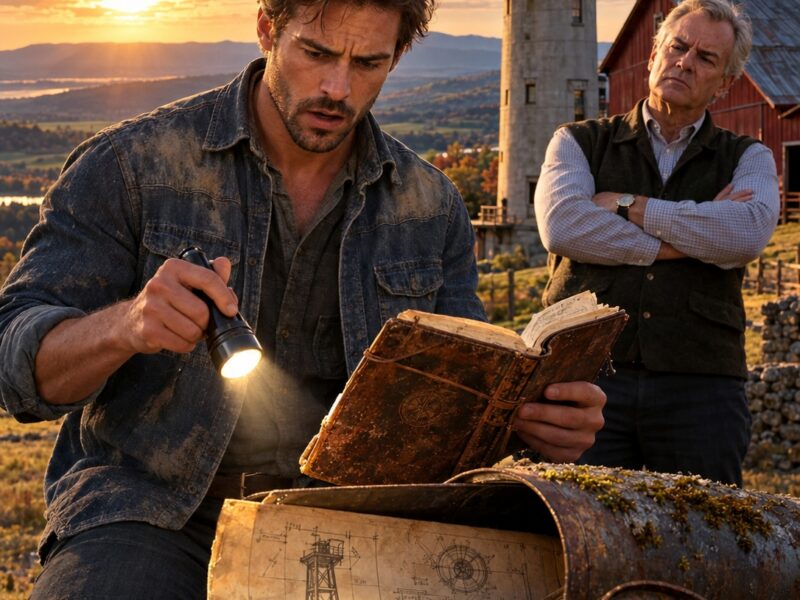
HE BOUGHT AN ABANDONED VIRGINIA FARM FOR $14,000—THEN A 100-YEAR-OLD MACHINE OPENED A SECRET BENEATH HIS FEET
The sound came from beneath Julian Cole’s boots.
A single metallic click.
He froze at the bottom of the concrete tower, one hand still gripping the cold iron railing of the spiral staircase.
Above him, brass gears that had not moved in more than forty years were slowly turning inside the walls.
A steel cable trembled.
A counterweight descended.
Then a section of the concrete floor shifted.
Julian stared at it.
Three days earlier, everyone had told him he had wasted fourteen thousand dollars on eight acres of Virginia weeds, a collapsing barn, and whatever snakes had inherited the place.
Now something buried beneath that “worthless” property was opening by itself.
And Julian had no idea that what he was about to pull from the floor would contain his own last name.
Three days earlier, there had been nothing mysterious about the property.
It had simply looked dead.
The eight acres sat in Virginia’s Shenandoah Valley, beyond a narrow county road where pastureland rolled toward the Blue Ridge Mountains and cell service became unreliable enough that people still gave directions using barns, churches, and bends in the river.
The property had been abandoned for more than forty years.
Time had not treated it gently.
A wooden barn leaned toward the east as if one more hard winter might finally persuade it to lie down. Several sections of the roof had collapsed. The remaining boards had faded from red to a brownish gray, and wild vines crawled through broken windows and wrapped themselves around the rafters.
Thistles reached Julian’s waist.
Honeysuckle had swallowed an old fence line.
A rusted gate hung from one hinge.
From the road, the place looked less like real estate than something nature had begun taking back.
That was precisely why Julian noticed it.
At thirty-two, Julian Cole made his living restoring buildings other people had stopped seeing value in.
Old houses.
Country stores.
Small churches.
Farm structures.
Once, a nineteenth-century mill whose owner had been told demolition would be cheaper than repair.
Julian had spent most of his adult life walking into damaged places and asking a question that rarely interested anyone else.
What is still here?
Not what had rotted.
Not what had broken.
What had survived.
So when the eight-acre parcel appeared in a county foreclosure auction, Julian studied the listing longer than anyone expected.
The photographs were terrible.
The description was worse.
ABANDONED IMPROVEMENTS.
UNINHABITABLE STRUCTURES.
PROPERTY SOLD AS-IS.
NO WARRANTY REGARDING EXISTING OUTBUILDINGS.
His friend Mason Reed looked over Julian’s shoulder when he saw the listing on Julian’s laptop.
“You’re not actually thinking about buying that.”
Julian enlarged a photograph of the barn.
“Maybe.”
“Maybe?”
“There’s good land underneath the brush.”
“There might be a sinkhole underneath the brush.”
Julian smiled.
Mason did not.
“You restore buildings for other people,” he said. “That doesn’t mean you have to adopt every dying structure in Virginia.”
Julian leaned closer to the screen.
Behind the barn, barely visible through the summer foliage, something vertical rose above the vines.
Gray.
Round.
Concrete.
“What’s that?”
Mason squinted.
“Silo?”
“Maybe.”
“Congratulations. You’ll own a collapsing barn and an ugly silo.”
Julian kept staring.
There was something strange about the proportions.
But the photograph had been taken from too far away to tell.
At the auction, the property attracted almost no serious competition.
A farmer wanted the acreage but not the structures.
A developer asked about road access and lost interest.
Another bidder stopped when the price crossed eleven thousand.
Julian won at fourteen thousand dollars.
When the auctioneer announced the sale, the man beside Julian gave him a sympathetic glance.
“You local?”
“Close enough.”
“You been out there?”
“Once.”
The man laughed under his breath.
“Then you know what you bought.”
Julian looked toward the paperwork being prepared.
“I know what everyone else thinks I bought.”
That distinction mattered to him.
At least it did then.
By the third afternoon, Julian was beginning to wonder whether everyone else had been right.
He had already filled a trailer with rotten lumber, scrap wire, broken fencing, and trash.
The barn was worse up close.
Two foundation stones had shifted.
One corner post was badly compromised.
There were raccoon tracks in the loft and enough poison ivy around the north wall to make Julian reconsider every life decision that had brought him there.
The October sun was beginning to drop behind the mountains when he started clearing the weeds behind the barn.
He used a brush cutter until the vines became too thick.
Then he switched to pruning shears.
Every few feet revealed another piece of concrete.
At first he assumed he was uncovering an old retaining wall.
Then he stepped backward.
And looked up.
The vines were hiding something enormous.
Julian put the shears down.
He grabbed one of the thick stems with both hands and pulled.
Leaves showered over his shoulders.
Another vine came loose.
Then another.
Gray concrete emerged beneath them.
Curved concrete.
Julian walked around the growth, clearing a path until he could finally see the shape.
It was a tower.
Nearly thirty feet high.
Solid.
Circular.
The structure had been almost completely hidden behind the barn and decades of vegetation.
An iron ladder climbed the exterior toward a narrow balcony at the top.
Near ground level was a dark entrance framed in steel.
Julian stood completely still.
He had seen farm silos before.
Dozens of them.
This did not feel like one.
He touched the wall.
The concrete was unusually thick.
Not decorative thick.
Structural thick.
He walked toward the entrance and crouched beside the frame.
Reinforced steel.
Heavy anchors disappeared deep into the concrete.
He frowned.
A grain silo did not need an entrance like that.
“Okay,” Julian whispered.
The property had finally asked him a question he could not answer.
He pulled out his phone and called Mason.
“You remember the silo?”
“The ugly one?”
“It isn’t a silo.”
A pause.
“What is it?”
“I don’t know.”
“That is not a comforting answer.”
Julian ran his fingers over the steel frame.
“The wall looks close to three times thicker than I’d expect.”
“Bunker?”
“It’s thirty feet tall.”
“Water tower?”
“No tank.”
“Then maybe stop touching mysterious abandoned structures until somebody who knows what they are gets there.”
Julian smiled despite himself.
“You know that’s not happening.”
“Yes. Unfortunately, I do.”
There were two obvious choices.
Climb the exterior ladder and inspect the top.
Or walk through the dark entrance.
Julian chose the entrance.
He returned to his truck, took a high-powered flashlight from his restoration pack, and came back.
The temperature changed almost immediately when he stepped inside.
Outside, the afternoon was warm.
Inside, the concrete held decades of cold.
The beam of his flashlight swept across the curved wall.
No grain.
No agricultural equipment.
No feed chute.
No machinery he recognized from a farm.
The room smelled dry and metallic.
Then the flashlight crossed something bright.
Julian stopped.
A thick polished brass shaft rose vertically from the center of the floor and disappeared through the ceiling.
Even beneath the dust, the metal reflected the light.
He moved closer.
“What the hell were you doing out here?”
His voice echoed upward.
The answer seemed to be waiting on the walls.
Heavy iron pulleys.
Steel cables.
Counterweights.
Mechanical linkages.
Everything was arranged around the central brass shaft with an almost obsessive precision.
This was not abandoned farm equipment thrown into a room.
It was a machine.
The entire tower was a machine.
Julian followed one cable with his flashlight.
It ran through a pulley overhead, crossed the curved wall, then disappeared upward.
Another cable was connected to a massive iron weight suspended in a recessed channel.
He imagined the system moving.
The weight descending.
The cable tightening.
Something turning above him.
But what?
Then he saw the gauges.
Three circular brass dials were mounted on a metal panel near the wall.
Julian wiped one with his sleeve.
Numbers appeared beneath the dust.
Pressure.
Altitude.
He stared at them.
That made even less sense.
“What were you measuring?”
He continued searching until he noticed a small brass tag fixed near the bottom of the central pipe.
Most of it was black with age.
Julian crouched and carefully rubbed the surface with his thumb.
Letters emerged.
He wiped again.
Then read them aloud.
“Property of Shenandoah Optics and Telegraph Company.”
He stopped.
Below the company name was another line.
MODEL 1922.
Julian remained crouched for several seconds.
He looked around the room again, and suddenly everything changed.
The pulleys were no longer random machinery.
The gauges were no longer odd farm equipment.
The tower was not a silo.
It was communication infrastructure.
And someone had built it behind an ordinary Virginia farm more than a century earlier.
Julian photographed the plate.
Then the gauges.
Then the pulley system.
He sent all three pictures to Mason.
The reply arrived almost immediately.
You bought a spy tower.
Julian laughed.
Probably not.
Mason answered:
That is exactly what someone standing inside a spy tower would say.
But Julian barely noticed the joke.
He had found the beginning of an explanation.
Now he wanted the rest.
A narrow iron spiral staircase curved upward around the interior wall.
He tested the first step.
Solid.
The second.
Solid.
Julian climbed carefully.
Halfway up, he paused and looked down.
The flashlight resting on the ground floor cast long shadows across the counterweights.
The central brass shaft rose beside him like the spine of the building.
Whatever the tower had been designed to do, its machinery connected the bottom to the top.
He continued climbing.
The upper room was smaller.
A narrow horizontal opening faced across the valley.
In front of it sat a large bronze mechanism.
Julian approached slowly.
The assembly consisted of rotating shutters, brackets, a reflector mount, and mechanical controls connected to the cables below.
He looked through the opening.
The view stopped him.
The barn roof sat below him.
Beyond it, the land dropped toward miles of fields and wooded ridges.
Farther away, the mountains layered themselves against the horizon.
Julian looked back at the bronze mechanism.
Then out toward the ridge.
Then back again.
Light.
Line of sight.
Altitude.
The pieces began fitting together.
Over the next two days, Julian researched the company name.
The references were scarce.
Shenandoah Optics and Telegraph Company had operated during the early twentieth century and had apparently manufactured specialized optical equipment.
But there was little about the tower.
A few archived references mentioned experimental emergency communication stations in rural Virginia.
That was all.
Julian called Dr. Evelyn Hart, an engineering historian he had once met while restoring an old municipal building.
He emailed her photographs.
She called twelve minutes later.
“Where did you find this?”
“On my property.”
“No, Julian. Where?”
“Behind the barn.”
Silence.
“You bought that property?”
“Three days ago.”
Another silence.
Then Evelyn said, “Do not dismantle anything.”
“I wasn’t planning to.”
“Do not polish anything either.”
Julian looked at the rag in his hand.
“Good timing.”
She asked him to send photographs of the upper mechanism.
When he did, her voice changed.
“That may be an optical signaling shutter.”
“A what?”
“Before reliable radio coverage, visual signaling could transmit information over long distances. Mirrors in daylight. Powerful lamps at night. Shutters for coded pulses.”
“Morse code?”
“Potentially.”
Julian looked through the narrow window toward the mountains.
“How far?”
“Depends on the elevation, weather, equipment. Miles.”
Julian thought about the isolated farm.
Suddenly it did not seem isolated at all.
If another tower had once stood on one of those distant ridges, this structure had been looking directly at it.
Evelyn continued.
“The pressure gauges suggest weather observation may have been part of the station too. Rural communication systems sometimes served multiple purposes.”
“So why here?”
“That,” she said, “is the interesting question.”
The answer began emerging from old records.
During the 1920s and 1930s, severe mountain weather repeatedly damaged telephone and telegraph lines throughout parts of the valley.
Floods isolated communities.
Storms knocked down poles.
Roads became impassable.
A mechanical optical network offered something wires could not.
It could keep communicating after the wires were gone.
Operators could aim bright arc lamps and reflectors toward distant stations and use mechanical shutters to transmit Morse code.
The tower Julian had bought was not merely a lookout.
It had been part of an emergency communications system.
And much of its machinery required no outside electrical power.
The massive counterweights inside the walls stored mechanical energy.
Julian returned to the tower with a completely different feeling.
He was no longer exploring a strange ruin.
He was standing inside forgotten technology.
But one question bothered him.
Could any of it still move?
The next afternoon, he examined the mechanism carefully.
The cables showed corrosion but remained intact.
The gears were dirty but surprisingly well protected by the dry interior.
A heavy iron control handle projected from the assembly near the central pulley.
Julian wrapped his hand around it.
For several seconds, he did nothing.
A hundred years of machinery waited on the other side of that handle.
He pulled.
Nothing.
He adjusted his grip.
Pulled harder.
A gear shifted.
Julian immediately released the handle.
The sound was small but unmistakable.
Metal against metal.
He looked upward.
“No way.”
He pulled again.
This time the handle moved several inches.
A cable tightened.
One of the counterweights rose slightly.
Then something extraordinary happened.
The brass gears began turning.
Slowly at first.
Then smoothly.
A mechanical hum traveled through the tower.
Julian stepped backward.
The central shaft rotated.
Above him, the shutter mechanism moved.
After decades of silence, the machine was alive.
Not electrically.
Not digitally.
Mechanically.
Exactly as its builders had intended.
Julian laughed aloud.
“You stubborn old thing.”
Then—
click.
The sound came from below.
The machinery continued turning.
Julian stopped smiling.
Another faint movement came from the base of the central shaft.
He released the handle and hurried down the spiral stairs.
At ground level, his flashlight revealed something he had not seen before.
A rectangular section of concrete near the shaft had lifted approximately an inch.
Julian crouched.
There was a recessed metal edge underneath.
Not a crack.
Not structural damage.
A hatch.
Apparently the pulley mechanism had released a hidden latch.
Julian slipped his fingers beneath the edge and lifted.
The concrete-covered panel swung upward.
Beneath it was a shallow compartment.
And inside that compartment sat a cylindrical tin container.
Julian stared.
The cylinder was roughly the length of his forearm.
Its lid had been sealed with thick yellow-brown wax.
Beeswax, he guessed.
Whoever had put it there had not wanted moisture getting inside.
Julian sat back on his heels.
For the first time since buying the property, he felt something stronger than curiosity.
Responsibility.
Someone had deliberately hidden this.
Someone had designed the machine so the compartment would not open until the mechanism moved.
He called Evelyn.
“I found something.”
“What?”
“A compartment under the floor.”
Silence.
“Was it open?”
“No. The mechanism released it.”
“And inside?”
“A sealed metal cylinder.”
“Julian, photograph everything before you touch it.”
He already had.
The container came free with surprising weight.
He carried it to a worktable outside the barn where the daylight was better.
The beeswax had darkened with age.
There was no writing on the outside.
Julian photographed the seal from every angle.
Then, as carefully as possible, he began removing the wax.
The lid resisted.
He worked around the edge.
Finally it released with a soft metallic pop.
Dry air escaped.
Inside, wrapped and stacked with deliberate care, were three groups of objects.
The first was a leather-bound journal.
The cover had stiffened with age, but the pages inside were remarkably well preserved.
The second was a folded blueprint.
The third was a felt pouch containing two brass-mounted optical lenses.
Julian picked up the journal first.
He opened it.
Dates.
Weather conditions.
Times.
Sequences of dots and dashes.
Station identifiers.
Message summaries.
Page after page of transmissions.
The entries continued until 1938.
It was not a personal diary.
It was an operational log.
Julian unfolded the blueprint.
His breath caught.
Eight locations were marked across the Shenandoah Valley.
Lines connected them.
Each line represented a visual corridor between towers.
The structure behind his barn had not been an isolated experiment.
It had belonged to a network.
Julian traced one line with his finger.
His tower connected to another station across the valley.
That station connected to two more.
Eight towers.
Eight points of light capable of passing information across the mountains when normal communication failed.
He returned to the journal.
Several entries recorded storm warnings.
Others referenced river levels.
One message instructed a downstream station to warn farms along a low-lying road.
Another documented a failed telegraph connection followed by successful optical transmission.
Julian read faster.
These people had been communicating through storms.
Warning communities.
Passing information from ridge to ridge.
Then he turned back to the first page.
There was a formal inscription near the top.
Station Operator: Arthur Cole.
Julian stopped breathing.
Cole.
He stared at the name.
Then read it again.
Arthur Cole.
“No.”
He turned the journal toward the light as though the letters might rearrange themselves.
They did not.
His phone was already in his hand before he consciously decided whom to call.
His mother answered.
“Hey, honey.”
“Mom, who was Arthur Cole?”
There was a pause.
“What?”
“Arthur Cole. Do you know that name?”
Another pause.
Longer this time.
“I haven’t heard that name in years.”
Julian sat down.
“Who was he?”
“Your grandfather used to talk about an Uncle Arthur.”
Julian looked at the tower.
“What did he do?”
“I don’t know. Something technical, I think. Telegraphs maybe. Why?”
Julian lowered his eyes to the century-old journal in his hands.
“Because I think I just found his handwriting.”
His mother laughed softly, assuming he was joking.
Then she heard his silence.
“Julian?”
“I bought Arthur Cole’s station.”
“What station?”
“The property.”
She did not answer.
Julian continued.
“There’s a communications tower behind the barn. The operator’s log says Arthur Cole.”
His mother became quiet enough that Julian could hear the faint television playing in her house.
“That property belonged to our family?”
“I don’t know yet.”
“But you didn’t know when you bought it?”
“No.”
“You bought it at random?”
“At a foreclosure auction.”
His mother exhaled.
For Julian, the discovery suddenly became difficult to explain in practical terms.
He had bought the land because he saw potential.
Because it was cheap.
Because he liked old buildings.
Because something about the hidden structure in the auction photograph had caught his attention.
None of those reasons explained why, a century earlier, a member of his own family had apparently stood inside that tower transmitting signals across the valley.
His mother finally said, “Your grandfather kept a box of family papers.”
“Do you still have it?”
“I think so.”
“When can I see it?”
“You’re really asking?”
Julian looked at Arthur’s name.
“Tonight.”
That evening, the coincidence became history.
Among old photographs and folded family documents, Julian found references to Arthur Cole, his great-granduncle.
Arthur had worked with communications equipment.
One faded photograph showed a thin man standing beside a utility vehicle.
On the back, in pencil, someone had written:
Arthur — Shenandoah station work, 1927.
Julian held the photograph for a long time.
His mother sat across the dining table.
“So you really bought the place?”
“Yes.”
“Without knowing?”
“Yes.”
She shook her head slowly.
“Your grandfather would have loved this.”
That sentence landed harder than Julian expected.
His grandfather had died when Julian was nineteen.
He had been the person who first taught Julian how to use hand tools properly.
Never force an old screw.
Find out why a door is crooked before trimming it.
Wood tells you what happened if you learn how to look.
Julian had thought those lessons were about carpentry.
Now, holding Arthur’s photograph, they felt like something larger.
The next morning, Julian brought the journal, blueprint, photographs, and lenses to the regional historical society.
Evelyn joined him there with two professors from a nearby university engineering department.
The meeting lasted nearly four hours.
At one point, Professor Daniel Mercer placed both hands on the blueprint and simply stared.
“This is eight stations.”
“That’s what I counted,” Julian said.
“No, I mean we knew there were references to multiple optical sites, but we didn’t have a complete network map.”
Evelyn leaned closer.
“Look at these station codes.”
Mercer nodded.
“These match fragments in county emergency records.”
Julian watched them move between the journal and the blueprint.
For him, the objects were already extraordinary.
For them, they were evidence.
The journal did more than confirm that the tower had existed.
It explained what the network had done.
During severe rainstorms in the 1930s, operators monitored weather conditions and relayed warnings across the valley.
When telephone and telegraph infrastructure failed, light signals continued moving between stations.
Messages traveled from tower to tower.
Some warned farmers about rising water.
Some reported blocked roads.
Some coordinated local responses.
A system that had nearly vanished from memory had once helped people prepare before floodwater reached their fields.
Mercer carefully turned another page.
“This is incredible.”
Julian smiled.
“I keep hearing that.”
“No. I mean historically. This fills a gap.”
“How big?”
Mercer looked up.
“Potentially decades.”
The tower had sat behind the barn for more than forty abandoned years while vines grew over its walls.
People had driven past it.
Children had probably called it a silo.
Property records reduced it to an “outbuilding.”
And inside, a complete piece of early communications engineering had remained almost untouched.
The irony was not lost on Julian.
Everyone at the auction had seen a liability.
He had seen a structure.
Arthur Cole had once seen a lifeline.
The next question was what Julian would do with it.
Demolition was no longer imaginable.
Selling it felt equally impossible.
So he did what he knew how to do.
He restored it.
But this time, every decision felt personal.
Julian refused to make the tower look new.
He wanted it to look cared for.
There was a difference.
For the next three months, the property consumed him.
He began with the exterior.
Decades of vines had embedded themselves into cracks and joints.
Some could be removed by hand.
Others required careful cutting.
He used controlled high-pressure water cleaning on appropriate concrete surfaces, working section by section until the gray walls emerged from beneath moss, dirt, and vegetation.
The transformation was gradual.
One afternoon Mason drove onto the property, parked beside the barn, and stared upward.
“I hate saying this.”
Julian kept working.
“Then don’t.”
“You may not have made the worst purchase in Virginia.”
Julian grinned.
“That’s practically an apology.”
“Don’t get excited.”
Mason walked around the tower.
“You really think this thing is worth saving?”
Julian looked at him.
“Arthur did.”
Mason’s expression changed.
By then, he knew the story.
“That still gets me,” he said. “You could have bought any property.”
“I know.”
“And you bought this one.”
“I know.”
“You realize if this were a movie, nobody would believe it.”
Julian looked toward the entrance.
“Good thing it isn’t.”
Inside, the restoration required even more restraint.
He treated corrosion on the iron components.
He cleaned the steel cables.
He lubricated the pulley system.
The brass was polished carefully enough to reveal its workmanship without stripping away every mark of age.
Each gear was inspected.
Each bearing checked.
Each counterweight tested.
The mechanism did not need to become perfect.
It needed to remain authentic.
The more Julian worked, the more he understood Arthur’s daily environment.
The tower was not comfortable.
It was functional.
In winter, the concrete would have been brutally cold.
In summer, the upper room would have trapped heat.
During storms, an operator might have stood at the shutter controls listening to wind hammer the tower while waiting for a signal from a distant ridge.
Julian imagined Arthur watching for flashes through rain.
A sequence.
A pause.
Another sequence.
Then writing the message into the same journal Julian had found a century later.
Sometimes restoration was physical.
Sometimes it was an act of imagination.
Julian began to feel he was restoring both.
The upper deck needed reinforcement.
The old iron railing had survived but was not safe for visitors.
Julian strengthened it while preserving the original appearance.
He installed clear protective glazing around the observation openings.
The bronze shutter mechanism remained in place.
So did the central brass shaft.
So did the counterweights.
When possible, Julian kept everything functional.
That mattered to him.
He did not want visitors to look at dead machinery behind ropes.
He wanted them to pull a control and understand.
Weight becomes motion.
Motion turns gears.
Gears move shutters.
Shutters interrupt light.
Light becomes language.
Language crosses a valley.
One afternoon, several weeks into the work, Evelyn stood in the upper room while Julian demonstrated the restored mechanism.
He pulled the handle.
The counterweight shifted.
The gears began turning.
The bronze shutter rotated smoothly.
Evelyn smiled.
“You know what’s strange?”
“What?”
“This is easier to understand when you can hear it.”
Julian listened.
The mechanism had a rhythm.
Cable.
Gear.
Click.
Pause.
Gear.
Click.
It sounded almost like a message itself.
By early spring, the transformation was difficult to believe.
The structure that had looked like a concrete ruin now stood clearly above the property.
The cleaned walls caught the afternoon light.
The iron railing traced the upper balcony.
The old barn still needed major work, but somehow its weathered boards now looked less abandoned beside the restored tower.
The property was beginning to feel inhabited again.
Julian eventually converted part of the upper room into a quiet study and architectural design space.
He kept the intervention minimal.
A wooden desk.
A chair.
Shelving.
Nothing that competed with the original machinery.
From the balcony, thirty feet above the ground, he could see nearly 360 degrees across the Shenandoah Valley.
On clear mornings, fog sat low between the ridges.
By noon, sunlight moved across fields in broad patches.
At sunset, distant windows occasionally flashed with reflected light.
Julian noticed those flashes differently now.
He imagined one of them repeating.
Short.
Long.
Short.
A message traveling home.
The historical society continued researching the network.
Some tower sites had disappeared.
Others had been altered beyond recognition.
One location appeared to have been demolished decades earlier.
Julian’s tower was different.
Because it had been abandoned rather than reused, much of its original equipment had simply remained where the operators left it.
Neglect had almost destroyed the exterior.
Ironically, neglect had also protected the interior from modernization.
Eventually, the historical society began the process of formally recognizing the structure.
What locals had casually called “the old silo” now had a name.
Cole Optical Signaling Tower.
When Julian heard it, he objected at first.
“You don’t have to name it after me.”
Evelyn smiled.
“We didn’t.”
He understood.
Cole had been connected to the tower long before Julian arrived.
The name belonged as much to Arthur as to him.
When the structure was formally recognized as a historic local landmark and added to the relevant historic registry, Julian stood near the entrance while a small group gathered outside.
There were historians.
Neighbors.
Students.
Several older residents who admitted they had driven past the property their entire lives without knowing what the tower was.
One man looked up at the balcony and shook his head.
“My father told me it was for grain.”
Julian laughed.
“So did everybody else.”
“Funny.”
“What?”
The man pointed toward the tower.
“How something can stand right in front of you for eighty years and nobody actually sees it.”
Julian looked up.
That sentence stayed with him.
He began hosting small educational visits.
Nothing elaborate.
A few students at a time.
Local history groups.
Engineering classes.
People interested in early communications technology.
Julian enjoyed watching the moment visitors understood the mechanism.
He would show them the counterweight.
Then the gears.
Then the shutter.
Finally, he would point through the observation opening toward the distant ridge.
“Imagine there’s another operator over there.”
The students would look.
“No phones,” Julian would say.
“No reliable electrical grid out here. A storm has taken down the telegraph lines. The river is rising.”
Then he would touch the shutter control.
“You have one thing the storm hasn’t taken away.”
He would point toward the horizon.
“Line of sight.”
The simplicity always surprised them.
That was part of the beauty.
Modern communication disappeared into invisible systems.
Arthur’s system was physical.
You could see the light.
Hear the gears.
Feel the resistance of the handle.
Communication had weight.
One day, Julian’s mother came to the property.
She had seen photographs during the restoration, but she had not climbed the tower since it was completed.
Julian led her slowly up the spiral stairs.
At the top, she stepped onto the balcony and gripped the railing.
For a while, she said nothing.
The valley stretched beneath them.
Finally she asked, “Arthur saw this?”
“Every day he worked here.”
She looked toward the western ridge.
“And Grandpa knew?”
“Probably pieces of it.”
“Why didn’t anyone tell us?”
Julian leaned against the railing.
“Families lose things.”
She looked at him.
“Things?”
“Stories.”
The wind moved gently across the balcony.
His mother nodded.
“Sometimes those are the same thing.”
Julian later showed her Arthur’s journal, now properly preserved and digitized.
She touched the cover carefully.
Not because the book was valuable.
Because a relative she had never known had once touched the same leather.
That was when Julian understood why the discovery mattered beyond engineering.
History usually arrived cleaned up.
Behind glass.
Printed on plaques.
Reduced to dates.
But real history was messier.
Sometimes it sat underneath weeds.
Sometimes it smelled like rust.
Sometimes it was hidden beneath a concrete floor because someone a hundred years earlier had decided that a journal and two lenses were important enough to protect.
And sometimes you spent fourteen thousand dollars without realizing you were buying your own inheritance back.
The financial numbers became part of the local story because they were almost absurd.
Auction price: approximately $14,000.
Initial restoration materials for cleaning, rust treatment, lubrication, and brass conservation: roughly $800, with Julian performing much of the skilled labor himself.
Historical value?
There was no useful number.
How much was the only surviving intact station of a forgotten regional network worth?
How much was a journal documenting emergency warnings worth?
How much was the missing map of eight towers worth?
How much was it worth to give a community back something it had forgotten about itself?
Julian stopped trying to answer.
Instead, he finished one last detail.
He commissioned a polished brass plaque for the entrance.
On the morning it arrived, he carried it behind the barn alone.
The tower rose above him in the clear Virginia light.
The concrete was clean now.
The vines were gone.
The railing had been repaired.
Inside, the gears waited in silence.
Julian positioned the plaque beside the heavy entrance door.
Four screws.
He tightened each by hand.
Then stepped backward.
The inscription read:
COLE OPTICAL SIGNALING TOWER
BUILT 1922
RESTORED 2026 BY JULIAN COLE
He stood there longer than necessary.
A truck moved somewhere on the distant county road.
Birds called from the tree line.
Wind passed through the grass that Julian had spent months reclaiming from weeds.
Behind him was the old barn he had originally believed would be the heart of the property.
He had plans for it.
New structural supports.
Repaired siding.
A workshop.
Eventually, a home would rise nearby.
That had been the dream when he raised his bidder card at the county auction.
A fresh homestead.
A place belonging to the future.
He had never imagined that the first thing the land would give him was the past.
Later that evening, Julian climbed the tower alone.
He sat at the desk in the upper room until the valley became blue with dusk.
The restored brass mechanism caught the last light.
Arthur’s original journal was no longer stored in the tower, but Julian kept a reproduction on the shelf.
He opened it to one of the storm entries.
The handwriting was small and controlled.
Time.
Station.
Weather.
Signal.
Message received.
Message transmitted.
Nothing dramatic.
Arthur had not written about destiny.
He had not written about legacy.
He had simply done his job.
A storm was coming.
People needed warning.
Send the message.
Julian closed the book.
Outside, scattered lights appeared across the valley.
Homes.
Roads.
Farms.
A century earlier, darkness would have been deeper.
The mountains would have disappeared into black silhouettes.
And somewhere across that darkness, another operator might have been staring toward this exact tower.
Waiting.
Julian stood and walked toward the restored control.
He placed his hand on the iron handle.
Then pulled.
The counterweight moved.
The central brass shaft turned.
The old gears began their steady mechanical hum.
Click.
Turn.
Click.
The shutter moved across the observation opening.
For an instant, Julian imagined the tower doing what it had been built to do.
Not standing as a monument.
Not attracting historians.
Not proving that his fourteen-thousand-dollar gamble had been worthwhile.
Working.
Sending something important through the darkness.
He thought about the first afternoon he had stood outside the vine-covered concrete cylinder wondering whether it was worth saving.
He thought about the man at the auction who had looked at him as if he had purchased somebody else’s problem.
He thought about Mason calling it an ugly silo.
He thought about Arthur Cole writing messages into a leather journal almost a hundred years before Julian was born.
Then he remembered something his grandfather used to tell him whenever they repaired old furniture together.
Don’t decide something is useless before you understand why it was built.
As a boy, Julian had thought his grandfather was talking about chairs and cabinets.
Standing inside the tower, he finally understood that he had been talking about almost everything.
Buildings.
Machines.
Land.
History.
Maybe even people.
Julian released the handle.
The gears slowed.
One by one, the sounds stopped.
The last metallic click echoed down the concrete shaft.
Then the tower became quiet again.
But it was not the same silence Julian had found there months earlier.
That silence had belonged to abandonment.
This one belonged to preservation.
The difference was enormous.
The following morning, a group of local students arrived for a tour.
One boy stood beside the entrance staring upward.
“That thing was really hidden behind the barn?”
“Pretty much,” Julian said.
“And nobody knew what it was?”
“People thought they knew.”
The boy considered that.
Then asked the question Julian had heard in different forms ever since the discovery.
“What would have happened if you tore it down?”
Julian looked at the tower.
The easiest answer was that the machinery would have been lost.
The journal might have been destroyed.
The blueprint might never have been found.
Arthur Cole’s connection to the property might have disappeared permanently.
But Julian thought the real answer was larger.
A community would have remained unaware that, long before smartphones, cell towers, weather alerts, and instant communication, people in this valley had built an ingenious system of brass, steel, glass, gravity, and light to protect one another.
Eight stations had once watched across the mountains.
When storms destroyed the wires, operators kept talking through darkness.
And for decades, almost everyone forgot.
Julian looked back at the boy.
“We would have lost a story we didn’t know we had.”
The boy nodded as though this were a perfectly reasonable explanation.
Then he stepped inside.
Julian followed.
A moment later, the familiar sound began again.
Steel cable tightening.
Counterweight moving.
Brass gears turning.
A mechanical shutter clicking into motion after a century of storms, neglect, silence, and forgetting.
Outside, sunlight crossed the Shenandoah Valley.
Inside, an old machine turned that light into history.
Julian had gone to a county auction looking for eight cheap acres and a place to build something new.
He came home with a collapsing barn, a concrete tower everyone thought was useless, and fourteen thousand dollars less in his bank account.
But beneath forty years of vines, he found something no property listing could have valued.
He found a machine that once carried warnings through storms.
He found a map that returned eight forgotten towers to history.
He found a journal that restored a missing chapter of the valley’s past.
And on its first page, he found the name of a man from his own family who had stood in the same room, looked toward the same mountains, and waited for light to answer light.
Sometimes the most valuable thing on an abandoned property is not buried treasure.
Sometimes it is the thing everyone has been looking at for years and dismissing as worthless.
Sometimes history does not disappear.
It simply waits beneath ivy, rust, and silence for someone patient enough to ask what everyone else stopped asking:
What was this built to do?
And sometimes, if you are extraordinarily lucky, the answer carries your own name.









