He Bought Cookies From a 13-Year-Old Boy—Then the Boy Returned the Wallet That Could Have Changed His Life
The first thing Richard Hail noticed about the boy was not the tray of homemade cookies balanced against his chest.
It was the fact that the boy was shivering.
October had turned cold early in Philadelphia that year, and the wind cutting between the downtown towers had teeth. Men in tailored coats hurried toward revolving doors. Women with coffee cups tucked their chins into scarves. Black SUVs slid along the curb, dropping executives beneath polished awnings.
And in the middle of all that steel, glass, money, and hurry stood a thirteen-year-old boy wearing a navy hoodie that was too thin for the weather.
“Good morning, sir.”
Richard almost kept walking.
Almost.
“Would you like to buy some cookies?”
The boy lifted the tray.
“They’re really good. I made them myself.”
Richard stopped.
That alone was unusual.
People did not stop Richard Hail.
Board members waited when he was late. Attorneys rearranged calendars around him. A bank president once delayed his daughter’s engagement dinner because Richard had requested a meeting at six-thirty.
At fifty years old, Richard controlled Hail Systems, a technology and logistics company occupying thirty-two floors of the building behind him. Business magazines estimated his personal fortune somewhere north of nine hundred million dollars.
Employees feared disappointing him.
Competitors feared underestimating him.
Most people who approached him wanted something.
Yet the boy standing in front of him seemed less interested in Richard’s watch than in whether he might genuinely enjoy a cookie.
Richard looked at the handwritten sign.
HOMEMADE — $5 A BOX
“How many have you sold?”
The boy glanced down.
“Six boxes so far, sir.”
“And how long have you been standing here?”
“Since seven.”
It was 9:17.
Richard studied him.
There was something unsettlingly familiar about the boy’s face—not the features themselves, but the age. The awkward length of his arms. The hair that refused to stay flat. The stubborn attempt to sound older than he was.
“How old are you?”
“Thirteen, sir.”
The city disappeared.
For one brutal second, Richard heard another voice.
Dad, I’m thirteen. Stop checking the movie rating.
Noah.
His son would have been sixteen now.
Richard’s fingers tightened around the handle of his briefcase.
“Thirteen,” he repeated.
“Yes, sir.”
“You do this every morning?”
“Before school sometimes. Mostly afternoons. Weekends too.”
“Why?”
The boy hesitated.
Not because he was inventing an answer.
Because he seemed embarrassed by the truth.
“My sister and I have bills.”
Richard frowned.
“Your parents?”
The boy’s eyes dropped for half a second.
“They died two years ago.”
The wind moved between them.
“So it’s just you and your sister?”
“Yes, sir.”
“How old is she?”
“Twenty-eight.”
“And she lets you stand out here in this weather?”
That finally brought some fire into the boy’s face.
“She doesn’t let me do anything.”
Richard raised an eyebrow.
The boy immediately softened.
“Sorry, sir. I just mean Rachel works a lot. She washes dishes at a diner. Sometimes twelve hours. She tells me school is my job.”
“And yet you’re selling cookies.”
“School doesn’t pay rent.”
Richard stared at him.
The answer should not have come from a thirteen-year-old.
“What’s your name?”
“Caleb Brooks.”
“Caleb.”
“Yes, sir.”
Richard looked at the boxes again.
“I’ll take one.”
Caleb smiled.
It was such a simple smile that Richard nearly looked away.
“Five dollars.”
Richard pulled out his wallet.
Inside were several hundred-dollar bills, three credit cards, his driver’s license, a photograph he had not looked at directly in almost three years, and an old boarding pass he could never bring himself to throw away.
He handed Caleb a ten.
The boy immediately reached into a plastic pouch.
“Here’s your change.”
“Keep it.”
Caleb held the five-dollar bill toward him.
“No, sir.”
Richard blinked.
“Consider it a tip.”
“For what?”
“The cookies.”
“You already paid for those.”
Richard almost smiled.
“Then consider it because you’re standing in the cold.”
“That’s not something I did for you.”
For the first time in weeks, maybe months, Richard laughed.
Barely.
But it happened.
“Take the five dollars, Caleb.”
“No, sir.”
There was no performance in the refusal.
No wounded pride.
No calculation.
Just a rule.
Something inside the boy had decided that money had to belong somewhere before he would touch it.
Richard accepted the bill.
“All right.”
“Thank you, sir.”
“For refusing my money?”
“For buying the cookies.”
Richard shook his head and walked toward the building.
He had gone perhaps forty yards when his phone rang.
“Mr. Hail,” his assistant, Margaret Parker, said. “The Zurich team moved the call to nine-thirty. Legal is already upstairs.”
“Tell them I’m coming.”
“There’s also an issue with the—”
“Later.”
Richard stepped into the lobby.
Security guards straightened.
“Morning, Mr. Hail.”
He nodded.
The elevator doors opened.
He reached automatically for his wallet to retrieve his building access card.
His hand found an empty pocket.
Richard froze.
He checked the other pocket.
Then his coat.
Nothing.
His wallet was gone.
Before he could turn around, he heard sneakers slapping against marble.
“Sir!”
A security guard stepped forward.
“Hey—slow down.”
“Sir!”
Richard turned.
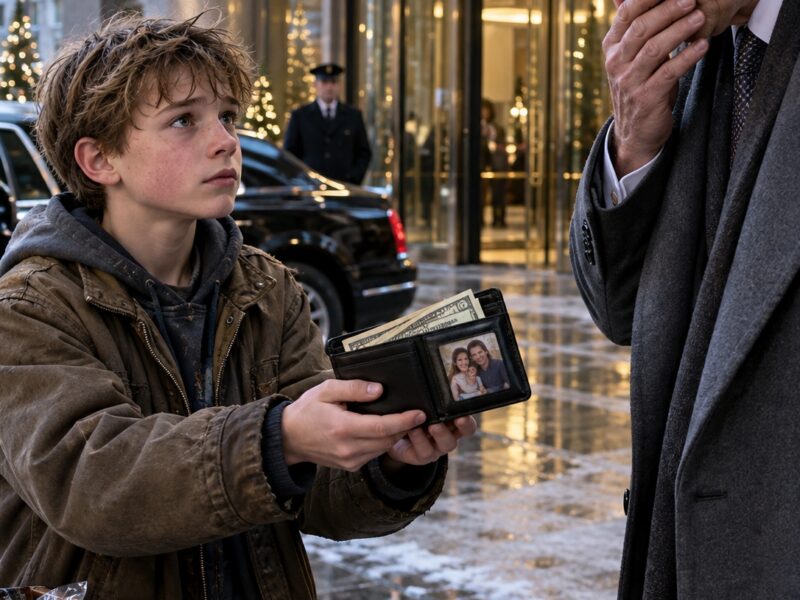
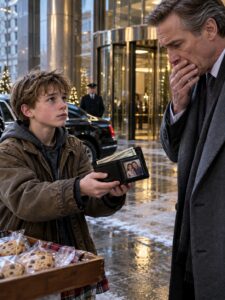
Caleb came running through the revolving doors, breathless, holding a black leather wallet over his head.
“You dropped this.”
The lobby went strangely quiet.
Caleb stopped in front of him.
“I saw it after you left.”
Richard stared at the wallet.
Then at the boy.
“You opened it?”
“No, sir.”
“You didn’t check what was inside?”
“No.”
“Why not?”
Caleb looked confused.
“Because it’s yours.”
Richard took the wallet.
There was enough cash inside to cover several months of the Brooks siblings’ rent.
The cards could have been sold.
The watch dealer around the corner would probably have given Caleb more for the wallet itself than he could make selling cookies all week.
Yet the boy had abandoned his stand to chase him.
Richard slowly opened it.
Everything was there.
Including the photograph.
Anna stood in the center, laughing at something outside the frame. Emma had her mother’s eyes. Lily was missing a front tooth. Noah, thirteen years old, wore a baseball cap backward despite Richard repeatedly telling him not to.
The photograph had been taken eight days before the plane crash.
Caleb noticed Richard’s expression.
“Are you okay, sir?”
Richard shut the wallet.
Those four words hit harder than they should have.
“I’m fine.”
Caleb nodded as though he did not believe him but was polite enough not to say so.
“You should get back to your cookies.”
“Yes, sir.”
Richard watched him turn.
“Caleb.”
The boy looked back.
“You’re an honest young man.”
Caleb shrugged.
“My parents taught me.”
Then he ran outside.
Richard remained in the lobby long after the boy disappeared behind the glass.
Margaret called again.
“Mr. Hail?”
He answered without taking his eyes from the sidewalk.
“Yes?”
“The board is waiting.”
Richard looked down at the wallet in his hand.
For the first time in three years, the board could wait.
Because a thirteen-year-old boy he had known for less than ten minutes had just reminded him of someone he had spent three years trying not to remember.
His son.
And Richard suddenly needed to know why.
Rachel Brooks had learned that poverty had sounds.
It was the refrigerator clicking off because you had unplugged it to save electricity.
It was the radiator knocking without producing enough heat.
It was coins dropping into a glass jar at midnight.
It was the landlord’s footsteps in the hallway three days before rent was due.
And sometimes, it was your thirteen-year-old brother whispering numbers at the kitchen table because he thought you were asleep.
“Forty-seven… fifty-two… sixty-two…”
Rachel stood silently in the doorway.
Caleb had spread his earnings across the table.
Singles.
Fives.
Coins.
Beside them sat a blue metal box with a piece of masking tape across the lid.
RENT
Rachel leaned against the doorframe.
“You’re supposed to be doing algebra.”
Caleb jumped.
“I finished.”
“You said that yesterday.”
“I finished yesterday’s algebra.”
“Caleb.”
He smiled.
It was impossible to stay angry with him.
Almost.
Rachel walked into their tiny kitchen and took off her diner shoes.
Her socks were damp.
Her lower back burned from twelve hours of standing over industrial sinks, scraping dried gravy from plates while cooks shouted orders behind her.
Caleb noticed her hands.
“You’re bleeding again.”
“I’m fine.”
“You always say that.”
“So do you.”
He disappeared into the bathroom and returned with a small tube of antibiotic cream.
Rachel sighed.
“Sit down.”
“I’m supposed to tell you that.”
“You’re thirteen.”
“And you’re stubborn.”
“That’s hereditary.”
They both became quiet.
Their mother had said that.
Rachel stared at the faded yellow curtains above the sink.
Two years.
Some days the loss felt old.
Other days she expected her father’s key to scrape against the lock at 6:10 p.m.
Caleb gently rubbed cream across a crack in her knuckle.
“I sold everything today.”
“All the cookies?”
“Every box.”
“That’s great.”
“There was this man.”
Rachel glanced at him.
“What man?”
“Gray coat. Tall. Kind of scary at first.”
Rachel’s shoulders stiffened.
“Caleb—”
“He’s fine.”
“You don’t know that.”
“He bought cookies.”
“Serial killers eat cookies.”
Caleb rolled his eyes.
“He dropped his wallet.”
Rachel stopped.
“I gave it back.”
“How much was inside?”
“I don’t know.”
“You didn’t open it?”
“No.”
Rachel studied her brother.
Then she reached over and touched his cheek.
“Good.”
“He looked surprised.”
“Some people get so used to being disappointed that honesty surprises them.”
“He looked sad too.”
Rachel began collecting the money from the table.
“Sad people can still be dangerous.”
“I know.”
“No getting into cars. No going anywhere with strangers. No giving anyone our address.”
“I know, Rach.”
“And if anyone bothers you—”
“I know.”
She placed the bills in the rent box.
Caleb watched her.
“He reminded me of Dad a little.”
Her hand stopped.
“How?”
“I don’t know.”
Caleb looked toward the window.
“Like he was somewhere else even when he was standing right in front of me.”
Rachel swallowed.
Then she closed the rent box.
“We need thirty-eight more dollars by Friday.”
“I’ll make another batch tomorrow.”
“You have a science test.”
“I can do both.”
“You shouldn’t have to.”
Caleb looked at her.
Neither of them said what they were thinking.
Neither should you.
But there was no one else.
Rachel was twenty-eight when their parents died in a highway collision caused by a drunk driver.
Caleb had been eleven.
Overnight, Rachel became sister, mother, father, emergency contact, permission-slip signer, cook, nurse, disciplinarian, and the person who had to say we’re going to be okay even when she had no evidence.
She had dropped out of a nursing program six weeks before graduation.
She had sold her car.
She had taken the diner job because it paid weekly.
She had never told Caleb how many nights she sat on the bathroom floor after he went to sleep and cried into a towel so he would not hear.
Caleb never told her how often he heard anyway.
“Rach?”
“Hmm?”
“One day you won’t wash dishes.”
She smiled tiredly.
“That right?”
“I’m going to build software.”
“You’d better.”
“I’ll make a lot of money.”
“Now you’re definitely dreaming.”
“I’m serious.”
“So am I.”
He leaned toward her.
“And then I’m going to take care of you.”
Rachel’s smile disappeared.
“You already do.”
Caleb looked down.
Rachel reached across the table and squeezed his hand.
They had eighty-two dollars in a blue metal box.
Half a loaf of bread.
Two cans of soup.
And each other.
Across the city, Richard Hail was about to discover how much that was worth.
At 11:40 that night, Richard sat alone at a dining table built for fourteen.
One bowl.
One spoon.
One glass of water.
The chandelier above him illuminated eleven empty chairs.
He had stopped using the chair at the far end after Anna died.
That had been hers.
For the first six months, Richard still asked the housekeeper to set five places.
Then four.
Then one.
Eventually, the housekeeper quit.
She said the silence frightened her.
Richard understood.
He opened Caleb’s cookie box.
One chocolate chip cookie remained.
He took a bite.
Cinnamon.
Anna used to put cinnamon in chocolate chip cookies.
Richard stopped chewing.
“Noah would have liked these,” he said aloud.
The room gave him nothing back.
Richard looked toward the framed family photograph on the sideboard.
Three years earlier, Anna had taken Emma, Lily, and Noah to California for spring break.
Richard was supposed to go.
At the last minute, a merger negotiation had collapsed.
He had stood in their bedroom knotting his tie while Anna zipped her suitcase.
“Come with us.”
“I’ll take the next flight.”
“You always say that.”
“Anna.”
“I know.”
She had kissed him.
Then Noah appeared in the doorway.
“You promised.”
“I’ll be there tomorrow.”
“You swear?”
Richard smiled.
“I swear.”
Their plane never reached Denver.
Richard spent the next three years wondering whether one word—yes—could have changed the universe.
He buried himself in work because spreadsheets did not accuse him.
Buildings did not ask why he had stayed behind.
Money never said, You promised.
The next morning, Margaret entered his office carrying a stack of documents.
“The board wants an answer on the Eastport acquisition.”
Richard was staring through the window.
Far below, Caleb was arranging cookie boxes.
“Sir?”
“Hmm?”
Margaret followed his gaze.
“The boy?”
“What about him?”
“Security asked whether we should remove the stand. Technically, he’s on Hail property.”
Richard turned.
“Who asked?”
“Mr. Garrison said it makes the entrance look—”
“Nobody touches that stand.”
Margaret blinked.
“Understood.”
“And tell Garrison if a thirteen-year-old selling cookies damages our corporate image, we need a better corporate image.”
Margaret almost smiled.
Richard returned to the window.
Caleb had no idea he was being watched.
He carefully lined up the boxes.
Straightened his handwritten sign.
Rubbed his hands together against the cold.
Something inside Richard hurt.
Something else moved.
“Clear my afternoon.”
Margaret stared.
“You have the investors at two.”
“Move them.”
“The Zurich—”
“Move it.”
“May I ask why?”
Richard reached for his coat.
“I need more cookies.”
Margaret watched him leave.
She had worked for Richard Hail for seventeen years.
She had watched him negotiate hostile acquisitions without blinking.
She had watched him bury four members of his family in one week.
She had watched whatever warmth remained inside him disappear afterward.
But when the elevator doors closed, Margaret realized something extraordinary.
Richard Hail had been smiling.
“Eleven boxes?”
Richard asked.
Caleb nodded.
“That’s all I have left.”
“I’ll take them.”
Caleb laughed.
“You can’t eat eleven boxes.”
“I have three hundred employees.”
“You’re going to give my cookies to three hundred people?”
“Not if I eat them first.”
Caleb grinned.
Then Richard’s laptop chimed.
He opened it.
The screen froze.
“Damn it.”
Caleb leaned slightly closer.
“Something wrong?”
“Software issue. I have a presentation in an hour.”
“Can I see?”
Richard looked at him.
“You fix computers too?”
“Sometimes.”
“My IT team is coming.”
“How long?”
“Forty-five minutes.”
Caleb checked the screen.
“Give me one minute.”
Richard should have refused.
Instead, he handed over a six-thousand-dollar laptop to a thirteen-year-old selling cookies.
Caleb sat on the low stone wall.
His fingers moved quickly.
A window opened.
Another closed.
He typed something Richard did not understand.
Twenty seconds.
Forty.
Then the frozen program disappeared.
Caleb handed the laptop back.
“There.”
Richard stared.
“That’s it?”
“It was stuck trying to sync with a corrupted temporary file.”
Richard looked at his watch.
Seventy-eight seconds.
“Do you know how much I pay my technology department?”
Caleb shook his head.
“Maybe you should ask for a refund.”
Richard laughed so loudly that two employees entering the building turned around.
He reached for his wallet and pulled out two hundred dollars.
Caleb stepped back.
“No.”
“You just saved an important meeting.”
“It took a minute.”
“Take it.”
“No, sir.”
“Caleb.”
“I didn’t earn two hundred dollars.”
“You earned whatever I decide your work was worth.”
The boy considered that.
Then shook his head.
“Five.”
“What?”
“Five dollars.”
Richard stared.
“You fixed my laptop for five dollars?”
“It was easy.”
Richard handed him a five.
Caleb accepted it.
“Thank you.”
Richard sat beside him.
“Where did you learn computers?”
“Library.”
“That’s all?”
“And videos online.”
“What do you want to do when you grow up?”
Caleb did not hesitate.
“Build software.”
Richard smiled.
“Then why cookies?”
The smile faded.
“Because software won’t pay Friday’s rent.”
Richard looked at him.
He could have solved the problem instantly.
One phone call.
One check.
One apartment.
One scholarship.
But he was beginning to understand Caleb.
Help offered too quickly could feel like pity.
And pity was one thing the Brooks family apparently refused to eat.
“So eleven boxes,” Richard said.
“Yes.”
“Full price.”
Caleb nodded.
“And then?”
“Homework.”
“Good.”
Richard stood.
Caleb began putting the boxes into a paper bag.
“Sir?”
“Yes?”
“Why do you keep coming back?”
Richard looked at him.
Because you are thirteen.
Because my son was thirteen.
Because your voice fills a place inside me I thought had been buried.
Instead, Richard said, “Good cookies.”
Caleb narrowed his eyes.
“You’re a bad liar.”
Richard almost answered.
Then his phone vibrated.
A calendar reminder appeared.
ANNA — EMMA — LILY — NOAH
3 YEARS
Richard’s face changed.
Caleb saw it.
“Sir?”
Richard locked the screen.
“I have somewhere to be.”
And by sunset, he was standing in front of four graves.
The cemetery was nearly empty.
Richard placed white roses beside Anna’s stone.
Then Emma’s.
Lily’s.
Noah’s.
He remained in front of his son.
Thirteen forever.
Richard lowered himself onto the stone bench nearby.
“I met a boy.”
His voice sounded strange outdoors.
“He’s your age.”
A cold breeze moved through the maple trees.
“He’s smarter than my entire IT department.”
Richard smiled.
Then the smile broke.
“I think you would have liked him.”
His eyes burned.
“I should have been on that plane.”
The sentence had lived inside him for three years.
He finally let it out.
“I should have gone.”
His shoulders shook.
Richard Hail had cried at the funeral.
He had not cried since.
Not when he sold Anna’s car.
Not when Noah’s school mailed a graduation notice by mistake.
Not when he found Lily’s red mitten beneath a guest-room bed eleven months after her death.
But that evening, alone beneath a gray Philadelphia sky, something in him finally collapsed.
He did not hear the woman approaching.
Rachel had come to the cemetery carrying three grocery-store daisies.
She visited her parents whenever she could afford the bus ride.
She saw the man on the bench.
At first, she walked past.
Grief deserved privacy.
Then she heard him say, “I’m sorry.”
Not once.
Again.
And again.
Rachel knew that voice.
Not his.
The voice grief gave people when they believed the dead could still judge them.
She stopped.
“Sir?”
Richard wiped his face immediately.
Rachel nearly apologized and left.
Instead she asked, “Are you okay?”
Richard looked up.
The question stunned him.
“No one has asked me that in three years.”
Rachel’s expression softened.
“Then I’m glad I did.”
Richard looked toward the graves.
“My wife.”
Rachel followed his eyes.
“And your children.”
He nodded.
“All three.”
Rachel sat at the far end of the bench.
Not close enough to intrude.
Not far enough to abandon him.
“You don’t have to talk,” she said.
Richard stared ahead.
“You don’t even know me.”
“No.”
“You could leave.”
“I could.”
She remained.
After a while, Richard asked, “Who are you visiting?”
“My parents.”
“How long?”
“Two years.”
“Does it get easier?”
Rachel considered lying.
“No.”
Richard looked at her.
She continued.
“But you get stronger at carrying it.”
He lowered his eyes.
“I’m tired of carrying it.”
“Then put it down sometimes.”
“I don’t know how.”
“Neither do I.”
That answer mattered more than advice would have.
They sat without speaking.
Two strangers.
Two separate tragedies.
One bench.
When Rachel eventually stood, she placed one of her daisies beside Lily’s grave.
Richard noticed.
“That was for your parents.”
“They can share.”
“Thank you.”
Rachel nodded.
“My brother is waiting for me.”
Richard almost asked her name.
He didn’t.
She almost asked his.
She didn’t.
Some moments were safer without names.
“Take care of yourself,” she said.
Richard watched her walk away.
That night, he slept for six uninterrupted hours.
He had not done that since the crash.
He did not know that the woman from the cemetery was Rachel Brooks.
And Rachel did not know that the grieving stranger she had sat beside was the billionaire buying her brother’s cookies every afternoon.
But Caleb was about to bring both secrets to the same street corner.
Over the next week, Richard stopped pretending the cookies were the reason he came downstairs.
Sometimes he bought nothing.
Sometimes he sat beside Caleb for twenty minutes.
They talked about school.
Computers.
Basketball.
Bad cafeteria food.
Caleb complained about algebra.
Richard complained about board members.
“Same thing,” Caleb decided.
“How?”
“Both are problems people pretend are harder than they are.”
Richard laughed.
One afternoon, Caleb asked, “Do you have kids?”
Richard became still.
“I did.”
Caleb immediately understood.
“I’m sorry.”
“My wife too.”
Caleb lowered his eyes.
Richard expected pity.
Instead, the boy moved over slightly on the bench.
“You can sit here.”
Richard looked at him.
“I’m already sitting.”
“I mean… you don’t have to go upstairs yet.”
Richard understood.
So he stayed.
After several minutes Caleb said, “Everybody needs somebody.”
“Your sister teach you that?”
“She teaches me everything.”
Richard smiled.
“I’d like to meet her.”
Caleb brightened.
“She picks me up at five tomorrow.”
“Then I’ll be here.”
That evening, Caleb practically burst through the apartment door.
“Rach.”
Rachel was stirring canned tomato soup.
“What?”
“He wants to meet you.”
“Who?”
“My friend.”
“What friend?”
“The cookie man.”
Rachel stared.
“The adult businessman you keep calling your friend?”
“He is my friend.”
“Caleb—”
“He lost his family.”
Rachel stopped stirring.
“All of them.”
Something in Caleb’s voice softened her.
“He says you must be a wonderful person.”
Rachel snorted.
“He doesn’t know me.”
“He knows me.”
“That is not the same thing.”
“He says a kid like me doesn’t happen by accident.”
Rachel turned away before Caleb could see her eyes.
“Manipulative little traitor.”
“Is that a yes?”
“It means I’m picking you up at five.”
Caleb grinned.
Across town, Richard stood in front of his closet for ten minutes deciding which coat made him look least intimidating.
Margaret found this so astonishing she called her husband afterward.
“I think Richard Hail has a date.”
It was not a date.
But when five o’clock arrived the next afternoon, Richard was more nervous than he had been before his first hundred-million-dollar acquisition.
Caleb spotted Rachel across the street.
“There she is.”
Richard turned.
The woman approaching wore a black diner jacket over faded jeans.
Her hair was pulled into a loose ponytail.
She looked exhausted.
Then she looked up.
Both stopped.
Richard whispered, “You.”
Rachel stared.
“The cemetery.”
Caleb looked between them.
“What?”
“You’re Caleb’s sister?”
“You’re the cookie man?”
“I’m apparently the cookie man.”
Caleb’s mouth fell open.
“You two know each other?”
Rachel began laughing.
It started quietly.
Then Richard did too.
Caleb looked offended.
“What is happening?”
Rachel touched his shoulder.
“This is the man I told you about.”
“The sad man?”
Richard raised an eyebrow.
“You called me the sad man?”
“I didn’t know your name.”
Caleb pointed at Richard.
“And he’s the man whose wallet I returned.”
Rachel’s laughter vanished.
She looked at Richard differently.
“You’re Richard Hail.”
There it was.
The moment Richard hated.
Recognition.
Not of him.
Of his name.
His company.
His money.
Rachel stepped back almost imperceptibly.
Richard saw it.
“Yes.”
“You own this building.”
“Yes.”
“And the company upstairs.”
“Yes.”
Caleb grinned.
“He owns like half the street.”
“Caleb.”
“What?”
Rachel looked embarrassed.
Richard suddenly feared the fragile thing between them had broken.
Then Caleb said, “Rach, invite him Saturday.”
Rachel stared at her brother.
“What?”
“Dinner.”
“No.”
“Why?”
“Because normal people don’t invite billionaires to eat canned soup.”
Richard said quietly, “Normal billionaires don’t sell their afternoon to a thirteen-year-old cookie salesman.”
Rachel looked at him.
Richard continued.
“I’d like to come.”
“Our apartment is small.”
“So?”
“We don’t have anything fancy.”
“I don’t want fancy.”
Rachel crossed her arms.
“What do you want?”
Richard could have said friendship.
He could have said company.
Instead, he gave her the only answer that felt true.
“I don’t want to eat alone.”
Rachel’s expression changed.
Caleb became quiet.
Then Rachel sighed.
“Saturday. Six-thirty.”
Richard smiled.
“Thank you.”
“Don’t bring anything expensive.”
“I won’t.”
“No wine that costs more than our refrigerator.”
Richard glanced at Caleb.
“How much is the refrigerator?”
“Free. It came with the apartment.”
Richard laughed.
Rachel tried not to.
Failed.
And three days later, one of the wealthiest men in Philadelphia stood outside apartment 3B holding a twelve-dollar bouquet of supermarket flowers because he had spent fifteen minutes checking the price tag.
The apartment was smaller than Richard imagined.
And warmer.
Not temperature.
Something else.
Photographs covered the refrigerator.
Caleb at eight holding a fish.
Rachel in a nursing-school uniform.
Their parents dancing at somebody’s wedding.
A handwritten grocery list hung beneath a magnet shaped like Florida.
Three mismatched bowls waited on the table.
Richard stared at them.
Rachel noticed.
“What?”
“Nothing.”
“Richard.”
He looked around.
“This room feels lived in.”
Rachel smiled faintly.
“That’s a polite way to say cramped.”
“No.”
He shook his head.
“My house has seventeen rooms.”
Caleb’s eyes widened.
“Seventeen?”
“Most of them are empty.”
The boy seemed unable to imagine that.
Rachel set down a pot.
“Sit.”
Dinner was chicken soup made from their mother’s recipe.
Caleb kept talking.
Rachel kept apologizing for him.
Richard kept laughing.
At one point Caleb pushed his bread toward Richard.
“Take mine.”
Richard looked at the nearly empty basket.
“You’re hungry.”
“No, I’m not.”
Richard raised an eyebrow.
Caleb held the lie for three seconds.
Richard smiled.
“You’re terrible at that.”
“At what?”
“Lying.”
Rachel laughed.
“He gets that from me.”
Then Richard noticed the blue metal box on a shelf.
RENT
Caleb followed his gaze.
“That’s our rent fund.”
Rachel stiffened.
“Caleb.”
“What?”
Richard looked away.
“I’m sorry.”
Rachel sat straighter.
“For what?”
“For looking.”
The room changed.
Money entered without being invited.
Rachel knew what men like Richard could do.
One check could erase their rent.
One call could put Caleb in the best school in Pennsylvania.
One decision could make her twelve-hour shifts unnecessary.
And that frightened her more than poverty.
Because debt did not always arrive on paper.
Sometimes it arrived disguised as gratitude.
“We don’t need anything,” she said.
Richard understood immediately.
“I didn’t offer.”
“You were thinking about it.”
“Yes.”
Caleb became silent.
Richard leaned back.
“I was also thinking that you two may be the richest people I know.”
Rachel stared at him.
“That might be the most ridiculous thing a billionaire has ever said.”
“I have a seventeen-room house.”
He looked around the tiny kitchen.
“You have a home.”
No one spoke.
Richard swallowed.
“I haven’t eaten dinner at a table with other people in three years.”
Caleb looked at Rachel.
Then back at Richard.
“Come next Saturday.”
Rachel did not object.
Richard lowered his eyes.
For the first time since Anna died, he was afraid of crying because he was happy.
Saturday became a ritual.
Then Wednesdays sometimes.
Then Richard began waiting outside Rachel’s diner when her shift ended late.
“You don’t have to do this,” she told him one rainy night.
“I know.”
“You have a driver.”
“I know.”
“You own a car that probably costs more than this building.”
“Two.”
Rachel stared.
“That was obnoxious.”
“I realized it after I said it.”
She laughed.
Richard held the umbrella over her.
Neither mentioned that his shoulder was getting soaked.
At the apartment door Rachel said, “Good night.”
“Good night.”
Neither moved.
Then Caleb opened the door.
“Are you two going to stand there all night?”
Rachel nearly killed him.
Richard laughed for half a block.
But happiness created its own fear.
Rachel heard whispers at the diner.
“That rich guy waiting again?”
“He’s old enough to be—”
Rachel walked away before the sentence finished.
At Hail Systems, board members whispered too.
Garrison cornered Margaret outside a conference room.
“He’s distracted.”
“He’s happier.”
“He’s spending time with a dishwasher and a street vendor.”
Margaret’s eyes hardened.
“A woman and a child.”
“You know what I mean.”
“Yes,” she said. “Unfortunately, I do.”
Richard heard worse.
Someone sent him photographs of Rachel entering his car.
Another executive joked about “midlife charity.”
Richard fired him.
But the words stayed.
Not because he believed them.
Because he feared Rachel might.
He was fifty.
She was twenty-eight.
He had wealth that could distort every choice she made.
And slowly, the feeling Richard had refused to name became impossible to ignore.
He loved being near her.
Her laugh.
Her refusal to be impressed.
The way she folded napkins when nervous.
The way she touched Caleb’s hair whenever she passed behind his chair.
He loved her.
And that terrified him.
One night Richard stood at Anna’s grave.
“I don’t know what I’m doing.”
Wind moved through the trees.
“I feel guilty.”
He swallowed.
“As if being happy means I loved you less.”
No answer.
Richard closed his eyes.
“I think she cares about me.”
He laughed bitterly.
“She’s twenty-eight, Anna.”
He touched the stone.
“She deserves a beginning.”
Richard looked toward Noah’s grave.
“I’m already carrying an ending.”
Meanwhile, Rachel fought a different war.
Linda, the diner manager, watched Richard waiting outside through the window.
“That man is in love with you.”
Rachel nearly dropped a plate.
“He is not.”
“Sweetheart, I’ve been married three times. I know trouble.”
“He’s lonely.”
“That isn’t what I said.”
“He lost his wife and children.”
“And?”
“He’s twenty-two years older.”
Linda shrugged.
“The heart doesn’t check birth certificates.”
Rachel glared.
“I wash dishes.”
“So?”
“He owns the company whose windows I can see from the bus.”
“So?”
“So what happens if I start needing him?”
Linda’s face softened.
“There it is.”
Rachel looked away.
She was not afraid Richard would hurt her.
She was afraid he would make it safe to stop being strong.
And Rachel no longer knew who she was without struggle.
Caleb, however, saw everything.
One evening he sat beside Richard outside the apartment.
“Do you like my sister?”
Richard nearly choked.
“Excuse me?”
“You heard me.”
“You’re thirteen.”
“Still have ears.”
Richard looked toward the apartment window.
“I care about her.”
“A lot?”
“Yes.”
“Then why are you always sad?”
Richard smiled painfully.
“Because sometimes caring about somebody means asking whether being with you is actually good for them.”
Caleb thought about that.
“Rach decides what’s good for Rach.”
Richard looked at him.
The boy stood.
“You should know that by now.”
Then he went inside.
Richard remained on the steps.
The next morning he called Rachel.
“Can we meet tomorrow?”
“Where?”
“The cemetery.”
Silence.
“Is something wrong?”
“No.”
Richard closed his eyes.
“It’s something I should have said weeks ago.”
Rachel barely slept that night.
Neither did Richard.
She arrived at sunset wearing the same coat she had worn the first time they met.
Richard was already on the bench.
In his hand was a dried daisy.
Rachel recognized it.
“You kept that?”
“It was the first kindness a stranger gave me in three years.”
“It was a grocery-store flower.”
“No.”
Richard looked at her.
“It wasn’t.”
Rachel sat down.
“Richard, you’re scaring me.”
He breathed slowly.
“Rachel, I care about you.”
Her heart pounded.
“More than I expected to care about anyone again.”
She said nothing.
“But I’m fifty.”
Rachel’s face changed.
“You’re twenty-eight.”
There it was.
The goodbye she had feared.
“You have your whole life ahead of you.”
Rachel looked away.
Richard continued.
“I cannot use my loneliness, my money, or what happened to me to make you feel responsible for fixing my life.”
“Did I say I felt responsible?”
“No.”
“Then don’t decide for me.”
“Rachel—”
“Is that why you brought me here?”
Her voice cracked.
“To tell me I’m too young to know what I feel?”
“No.”
“You think because I wash dishes I don’t understand what this is?”
“That’s not what I—”
“Then what?”
Richard fell silent.
Rachel stood.
For two years she had carried everything without breaking in public.
But now tears filled her eyes.
“Did I do something wrong?”
Richard stood immediately.
“No.”
“Then why does this sound like goodbye?”
“You did everything right.”
He swallowed.
“That’s the problem.”
Rachel laughed through tears.
“That makes no sense.”
“I know.”
“Then say something that does.”
Richard looked at the graves behind him.
Then at her.
“I thought I wanted you.”
Rachel froze.
Richard continued.
“But wanting you started feeling selfish.”
Her expression hardened.
“And then I realized what I actually want.”
He reached into his coat.
Rachel stared at his hand.
For one insane second she thought there might be a ring.
There wasn’t.
Richard held a folder.
“What is that?”
“An offer.”
Her face fell.
“Richard—”
“Please.”
He opened it.
“You gave up nursing school to raise Caleb.”
Rachel said nothing.
“You have managed rent, school, food, work, medical appointments, bills, and a thirteen-year-old genius with no safety net for two years.”
Caleb would have objected to genius.
Rachel could barely breathe.
“I run a company with people who have MBAs from Harvard who could not survive one month doing what you’ve done.”
“What are you saying?”
“I want you at Hail Systems.”
Rachel stared.
“No.”
“Not charity.”
“No.”
“Listen.”
“I said no.”
“I know.”
Richard almost smiled.
“That’s why I want you.”
Rachel glared.
“Start in operations. Train. Learn every division. If you hate it, leave. If you fail, I won’t protect you. If you succeed, nobody gets to say I gave you anything.”
“Richard—”
“And Caleb.”
Her eyes sharpened.
“What about Caleb?”
“I want to pay for his education.”
“No.”
“Then don’t let me.”
Rachel blinked.
Richard nodded.
“Let him earn scholarships. Let him work. Let him become whatever he wants.”
He looked toward Noah’s grave.
“But let me be there.”
His voice broke.
Rachel finally understood.
“This isn’t a proposal.”
“No.”
He smiled sadly.
“Maybe part of me wished I were twenty years younger and brave enough to make it one.”
Rachel cried silently.
Richard stepped closer.
“But you deserve a life that belongs to you, Rachel. Not one built around repairing a man who lost his.”
He took a breath.
“What I’m asking is different.”
“What?”
Richard looked at her.
“I lost my family.”
Rachel’s lips trembled.
“You and Caleb lost yours.”
He glanced at the folder, then let his hand fall.
“I’m not asking to replace anybody.”
His voice became almost a whisper.
“I’m asking whether three people who still miss the dead are allowed to stop being alone.”
Rachel covered her mouth.
“Come live at the house.”
She shook her head automatically.
“Richard—”
“You and Caleb.”
“We don’t take charity.”
“This isn’t charity.”
“Then what is it?”
Richard looked toward Anna’s grave.
“A man who lost his family asking whether he can belong to another one.”
Rachel could not answer.
Not immediately.
Then she stepped forward.
She wrapped her arms around him.
Richard froze.
For three years, people had shaken his hand.
Patted his shoulder at funerals.
Hugged him politely.
Nobody had held him like this.
Rachel whispered against his coat.
“You idiot.”
Richard laughed through tears.
“Is that a yes?”
“It’s a maybe.”
“I’ll take it.”
“And I am not becoming managing director tomorrow.”
“Fine.”
“I start wherever everyone else starts.”
“Fine.”
“You don’t buy Caleb a sports car.”
“He’s thirteen.”
“You were thinking about it.”
“I was thinking sixteen.”
Rachel pulled away.
“No.”
“Understood.”
For the first time, she laughed at the graves.
Richard looked toward Anna’s stone.
In his mind he said the words he had been afraid to say.
I’m still here.
And for once, surviving did not feel like betrayal.
Rachel refused to move immediately.
Richard expected that.
She took the Hail Systems job first.
Entry-level operations analyst.
Her first week was brutal.
People stared.
Some knew who she was.
Others invented stories.
One woman asked whether Rachel and Richard were sleeping together.
Rachel answered, “Ask him. Preferably during the executive meeting at nine.”
The rumor disappeared by lunch.
Rachel learned fast.
Not because she had hidden business talent waiting magically to be discovered, but because poverty had taught her things corporate training could not.
She understood inventory because groceries had to last.
She understood scheduling because missing one bus could cost an hour’s pay.
She understood workers because she had been one.
Six months later, she identified a warehouse staffing problem that had cost Hail Systems nearly two million dollars annually.
Richard did not promote her.
Someone else did.
Rachel respected him more for that.
Caleb stopped selling cookies only after Rachel’s salary became stable enough to cover their expenses.
Richard did not forbid him.
He simply bought the last box.
“Full price?” Caleb asked.
“Full price.”
“No billionaire tip?”
“No billionaire tip.”
“Good.”
Richard kept that final empty box in his office.
Eventually, Rachel and Caleb moved into the mansion.
Everything they owned fit into three suitcases, two cardboard boxes, and the blue metal rent box.
Caleb stood in the foyer looking upward.
“Is this a hotel?”
Richard laughed.
“It’s a house.”
“This is not a house.”
“It could be a home.”
Caleb looked at him.
Richard’s smile softened.
“Your home.”
The boy said nothing.
Then Richard showed him his room.
Desk.
Bookshelves.
Computer equipment.
A bed beside tall windows overlooking the garden.
Caleb touched the desk.
“This is mine?”
“If you want it.”
“Do I have to keep it clean?”
“Yes.”
“Then I don’t want it.”
Rachel laughed from the doorway.
Richard felt something in his chest loosen.
That evening, they ate in the enormous dining room.
Richard had asked staff to remove ten chairs.
Only three remained.
Caleb noticed.
“You didn’t have to do that.”
“Yes, I did.”
“Why?”
Richard looked at the empty space where Anna’s chair had once been.
“Because empty chairs can become louder than people.”
Caleb seemed to understand.
Months later, Richard approached Rachel about something more serious.
Adoption.
Not Rachel.
Caleb.
He placed the papers on the kitchen table.
“You don’t have to sign anything,” he said.
Caleb stared at them.
Rachel sat beside her brother.
Richard continued carefully.
“You already have a father.”
Caleb’s eyes filled.
“I would never ask you to replace him.”
Richard swallowed.
“I just want the law to recognize what I hope I’ve become.”
Caleb looked down at the signature line.
Then up.
“Can I call you Dad?”
Richard stopped breathing.
Rachel began crying before he did.
Richard crouched beside Caleb.
“I would be honored.”
Caleb hugged him.
Not like Noah.
Never like Noah.
That mattered.
Because Caleb was not Noah.
Rachel was not Anna.
This family did not erase the first one.
Love did not work by replacement.
Richard finally understood that.
The heart could hold graves and dinner tables at the same time.
Years passed.
Rachel eventually became a senior director.
Then vice president.
She earned every promotion loudly enough that nobody could credibly call it a gift.
Caleb finished high school near the top of his class.
He received scholarship offers from universities Richard would happily have paid for.
Caleb chose one partly because the computer-science program was excellent and partly because, as he told Richard, “If I let you pay full tuition, you’ll become unbearable.”
Richard agreed.
On Caleb’s eighteenth birthday, they baked cookies.
The same recipe.
The same cinnamon.
The kitchen smelled like chocolate and butter.
Rachel walked in carrying three plates.
“You burned the first batch.”
Caleb pointed at Richard.
“He was in charge of timing.”
“I run a multinational corporation.”
“And yet you can’t operate an oven.”
Richard tasted a cookie.
“It’s excellent.”
“It’s burned.”
“Still excellent.”
Rachel shook her head.
Caleb carried the tray toward the dining room.
Then he stopped.
On the sideboard sat the old photograph of Anna, Emma, Lily, and Noah.
Richard had stopped hiding it years ago.
Beside it stood a photograph of Rachel’s parents.
And beside those, a newer picture.
Richard.
Rachel.
Caleb.
Three people laughing in a kitchen.
Not replacements.
Additions.
Caleb looked toward the table.
“Dad?”
Richard still felt something every time he heard that word.
“Yes?”
“You remember when I said everybody needs somebody?”
“I do.”
“I was pretty smart at thirteen.”
“You were insufferable.”
Caleb grinned.
Then he looked at the table.
Three plates.
Three chairs.
No silence waiting in the fourth.
“The table isn’t empty anymore.”
Richard looked at him.
For an instant, he was back three years after the crash, sitting alone beneath the chandelier, breaking a chocolate chip cookie while eleven empty chairs accused him of surviving.
Then he looked at Rachel.
At Caleb.
At the photographs of people who were gone.
At the people who had stayed.
“No,” Richard said softly.
“It isn’t.”
Later that night, after Rachel and Caleb went upstairs, Richard remained in the kitchen.
One cookie sat on the tray.
He carried it outside.
The air had turned cold.
He drove alone to the cemetery.
He no longer came because guilt demanded it.
He came because love did.
Richard placed the cookie beside Noah’s grave.
“Cinnamon,” he said.
A small smile crossed his face.
“You would have liked him.”
He moved to Anna’s stone.
For years, Richard had spoken to her as though apologizing for every breath he took.
Tonight he did not apologize.
“Rachel got promoted.”
Wind moved softly through the trees.
“Caleb leaves for college next fall.”
He sat on the bench where Rachel had once found him crying.
“I still miss you.”
His voice trembled.
“I think I always will.”
For the first time, those words did not require punishment afterward.
Richard looked across the four graves.
Then he smiled.
“But I’m okay.”
Three years earlier, a stranger had asked him that question.
He had not known how to answer.
Now he did.
Richard rose.
At home, a light had been left on for him.
He drove toward it.
He never forgot the morning a thirteen-year-old boy sold him a five-dollar box of cookies.
He never forgot the wallet Caleb could have kept.
Or the woman who sat beside a crying stranger without asking his name.
Richard Hail had once believed wealth meant possessing enough that nothing could be taken from you.
Then one airplane took everything money could not replace.
Years later, an honest boy and his exhausted sister taught him something his fortune never had.
A family was not valuable because it could never be lost.
It was valuable precisely because it could.
And sometimes the people we lose are never replaced.
They remain exactly where love left them—in photographs, recipes, habits, empty chairs, and the small ache that returns when a familiar song plays unexpectedly.
But grief does not mean every chair must remain empty forever.
Sometimes another person arrives.
Not to take the place of someone who died.
Not to erase the past.
Not to make the loss fair.
They simply sit beside you.
And if you are very lucky, one day you look around the table and realize the silence is gone.
Richard locked the front door behind him.
From upstairs came Caleb’s voice.
“Dad! Rachel ate the last cookie!”
“I did not!” Rachel shouted.
“You absolutely did!”
Richard stood in the foyer listening.
Once, noise had irritated him.
Now he closed his eyes and smiled.
“Make another batch,” he called.
Caleb leaned over the upstairs railing.
“At midnight?”
Richard took off his coat.
“Why not?”
Rachel appeared behind Caleb.
“You’re encouraging him.”
“I know.”
“You have work tomorrow.”
“So do you.”
Caleb disappeared toward the kitchen.
Rachel remained on the stairs.
She looked at Richard.
“Cemetery?”
He nodded.
“You okay?”
There was the question again.
The same four words.
Only now Richard knew they were not asking whether grief had disappeared.
It hadn’t.
They were asking whether grief still owned him.
Richard looked toward the kitchen, where Caleb was already opening cabinets.
Then at Rachel.
Then at the warm house around him.
“Yes,” he said.
And this time, he meant it.
“I’m okay.”
Rachel smiled and went downstairs.
Richard followed.
Behind them, on a small table beneath the staircase, sat an old black leather wallet.
Richard had never replaced it.
The leather was cracked now.
The corners were worn.
Inside remained the same family photograph.
Anna.
Emma.
Lily.
Noah.
But behind it Richard had added another picture.
Caleb at thirteen, standing beside a folding table covered in cookie boxes, smiling into a cold Philadelphia morning.
Richard had written one sentence on the back.
The day he returned my wallet was the day he began returning my life.
In the kitchen, Caleb called again.
“Dad!”
Richard smiled.
“I’m coming.”
And he was.
At last, he truly was.









