He Broke Her Bicycle—But What He Did Next Changed Everything
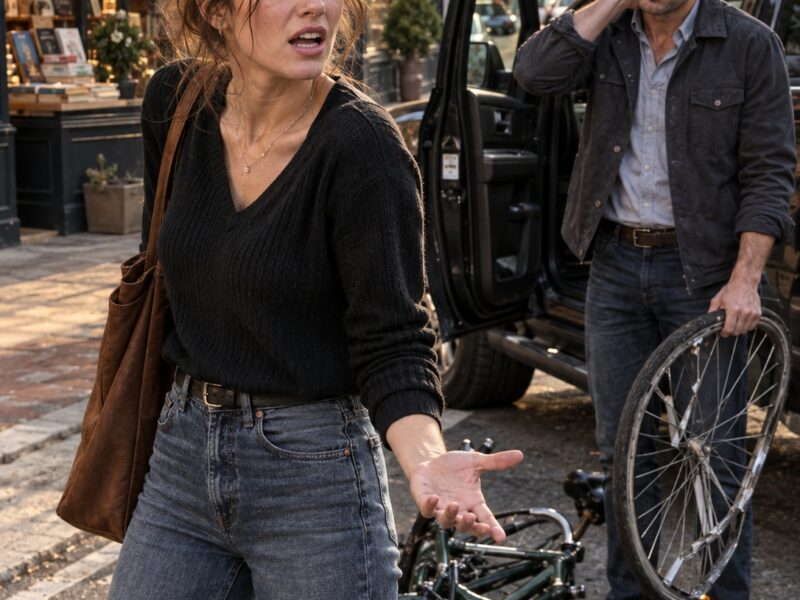
At 8:12 on a Tuesday morning, Allison Lynch watched four years of her carefully controlled life fold sideways beneath the open door of a black pickup truck.
There was no warning beyond the blur of metal swinging into the bike lane.
She grabbed both brakes.
Her back tire screamed against the pavement.
The front wheel struck the edge of the truck door with a sharp metallic crack, twisted nearly sideways beneath the frame, and threw Allison toward the street.
For two terrifying seconds, she saw nothing except gray asphalt coming up fast.
Then her left foot hit the ground.
Her right hand caught the handlebar.
Her shoulder slammed against the truck.
And somehow, impossibly, she stayed standing.
The bicycle did not.
It collapsed beneath her like something shot.
A paper coffee cup hit the sidewalk.
“Oh, God.”
The man who had opened the door came around it so quickly he nearly slipped.
He was tall, maybe thirty-eight, dark-haired, broad-shouldered, dressed in a navy work jacket and boots that looked expensive enough to be intentional but dirty enough to actually be used.
His face had gone pale.
“Are you hurt?”
Allison stared at the front wheel.
It was bent so badly it no longer looked round.
“You broke my bicycle.”
The man blinked.
“I was asking about you.”
“I’m standing.”
“Yes.”
“It isn’t.”
A horn exploded behind them.
Allison turned.
A delivery van was stopped in the lane, its driver waving one hand as though the inconvenience of almost witnessing a cyclist get flattened was primarily Allison’s fault.
The stranger grabbed her bicycle and dragged it toward the curb.
“I didn’t see you,” he said.
Allison gave him a flat look.
“Yes. That part is becoming clear.”
He crouched beside the bicycle and wrapped both hands around the wheel.
Allison narrowed her eyes.
“Don’t.”
He looked up.
“Don’t what?”
“Fix it.”
“I wasn’t—”
“You were absolutely about to try.”
His hands froze on the rim.
He glanced at them, as if betrayed by his own fingers.
“Okay.”
“You don’t know what’s broken.”
“That’s fair.”
“You could make it worse.”
He released the wheel.
“That also feels fair.”
Allison inhaled through her nose.
She was supposed to open Bellweather Books at nine.
She had twenty-seven minutes.
Her wrist hurt.
Her coffee was somewhere in the street.
And the savings account she had spent eight months protecting had exactly one purpose, and it was not replacing a bicycle because some man had decided to fling a truck door into a bike lane without looking.
The stranger stood.
“My name is Jay Kelly.”
“That doesn’t improve the bicycle.”
“No.”
He reached into his jacket.
“I have insurance.”
“That improves it slightly.”
He almost smiled.
Allison did not.
He handed her a business card.
JAMES KELLY.
Kelly Restoration Group.
Historic Commercial & Residential Construction.
“You own a construction company?”
“My family does.”
“That explains the instinct to touch broken things.”
Jay opened his mouth.
Closed it.
“Probably.”
“I’m Allison.”
“I know.”
Her eyes sharpened.
He pointed at the Bellweather Books employee badge clipped inside her coat.
“Allison Lynch.”
She glanced down.
“Right.”
“I can drive you wherever you’re going.”
“No.”
“I can call you a rideshare.”
“No.”
“At least let me—”
“No.”
Allison bent and lifted the bicycle.
The damaged front wheel detached from the fork and dropped.
Jay caught it one inch before it landed on his shoe.
They both stared at the wheel in his hand.
Jay cleared his throat.
“That seems worse.”
Allison closed her eyes.
It was going to be one of those days.
Eight blocks later, she was walking toward Bellweather Books with the broken bicycle beside her.
Jay was walking behind her carrying the front wheel.
“You don’t have to follow me,” she said.
“I currently have part of your transportation.”
“You could hand it over.”
“I could.”
He kept walking.
Allison glanced back.
“Why aren’t you?”
“I’m afraid another piece will fall off.”
She almost laughed.
That annoyed her more than anything else he had done.
Bellweather Books occupied the ground floor of a century-old brick building in Richmond, Virginia, wedged between a coffee shop and a stationery store on a block where parking cost more per hour than Allison liked to think about.
At the door, she took the wheel from him.
“Insurance information.”
Jay handed over another card.
“And I’ll pay for the repair.”
“Your insurance will.”
“If they don’t, I will.”
“You damaged one wheel.”
“I may have damaged more than one wheel.”
“That is not how bicycles work.”
“I’m learning.”
Allison unlocked the bookstore.
“Goodbye, Jay Kelly.”
His expression suggested he understood that as an instruction.
“Goodbye, Allison Lynch.”
By lunch, she had placed him firmly into the category of People I Hope Never to See Twice.
At 4:45 that afternoon, Allison locked the bookstore door, turned toward the street—
—and found Jay standing beside her bicycle.
The bicycle had both wheels again.
A mechanic in a charcoal work shirt stood beside him.
Allison stopped.
“Why are you here?”
Jay winced.
“Before you get angry—”
“That sentence has never improved anything.”
The mechanic crouched beside the bike.
“I’m Owen.”
Allison looked at him.
“Owen appears to be the only person here making good choices.”
“Thank you,” Owen said.
Jay sighed.
“Owen owns River City Cycles. I brought the bike over because we needed an estimate for insurance.”
“You took my bicycle?”
“With permission from Nina.”
Allison looked through the bookstore window.
Her coworker Nina suddenly found a stack of hardcovers extremely interesting.
Allison rubbed her forehead.
“Okay. What’s broken?”
Owen pointed to the front wheel.
“Wheel’s done. Derailleur took a hit. Fork might be salvageable.”
Then his finger moved.
“And there’s this.”
A thin crack sat near one of the frame joints.
Allison frowned.
“That wasn’t there this morning.”
“It probably was.”
Her stomach tightened.
Owen tapped the metal gently.
“Older fatigue. Not from today.”
“How old?”
“Long enough that I wouldn’t recommend putting serious money into this frame.”
For a moment, Allison said nothing.
She had bought the bicycle used four years earlier for two hundred and eighty dollars.
It had carried groceries through summer storms, survived two apartments, transported boxes of advance-review copies, and endured being chained outside more Richmond coffee shops than she could count.
It was ugly.
The bell stuck in cold weather.
One grip was held together with electrical tape.
The basket leaned slightly left because Allison had once tried transporting six hardcover cookbooks at the same time.
But it was hers.
More importantly, it was paid for.
Jay studied her face.
“I’ll replace it.”
“No.”
“Allison—”
“No.”
“I caused the accident.”
“You damaged the wheel.”
“The bicycle now has one safe wheel.”
“That’s fifty percent.”
Jay stared.
Owen coughed into his fist.
Allison kept a perfectly straight face for another second.
Then she looked back at the cracked frame.
The joke died.
Because the bicycle was not the real problem.
Money was.
Her younger sister Megan was moving to Denver in six weeks. The mobile bookstore project they had spent eight months planning suddenly sat on uncertain ground. Allison’s rent had increased in January. Bellweather was doing well enough to survive, but not well enough to hand out dramatic raises.
And every dollar Allison had saved belonged to a future she was trying very hard not to admit might already be disappearing.
“I’ll handle it,” she said.
Jay glanced at her.
She heard something unspoken in the silence.
Don’t.
Her gaze snapped toward him.
He lifted both hands.
“I didn’t say anything.”
“Your face did.”
“My face apparently gets me into trouble.”
“That and your truck door.”
Owen smiled.
Jay did not.
The insurance process required photographs, a written estimate, a statement, and three different signatures.
Allison assumed that would be the end of Jay Kelly.
Two days later, he walked into Bellweather carrying a folder.
She was kneeling beside a portable display shelf near the front window, wrestling with a caster that had jammed sideways.
She shoved it.
Nothing.
Jay stopped six feet away.
His eyes dropped toward the wheel.
Allison pointed at him.
“Don’t.”
“I didn’t move.”
“Your face did.”
“What did my face do?”
“That repair thing.”
“I have a repair face?”
“You absolutely have a repair face.”
He seemed strangely pleased.
“I didn’t know that.”
“It isn’t a compliment.”
Allison stood.
Jay held out the folder.
“Final estimate.”
“You could have emailed this.”
“I was nearby.”
“You keep being nearby.”
“It’s a city.”
“That isn’t an explanation.”
Jay looked around Bellweather.
The old pine floors creaked under every third step. Handwritten recommendation cards were tucked beneath dozens of titles. Near the register sat folding tables, storage bins, cardboard boxes of books, extension cords, banners, and signs labeled SATURDAY MARKET.
Jay nodded toward them.
“What’s Saturday?”
“Neighborhood book and art market.”
“You run it?”
“I help.”
The phone rang.
Allison checked the screen.
Megan.
Something inside her tightened.
She stepped behind the counter.
“Hey.”
Jay moved away toward the fiction section without being asked.
Megan skipped small talk.
“Calgary—sorry, Denver—is happening faster than we expected.”
Allison frowned.
“You said the first week of August.”
“Ryan’s company moved his start date up.”
“How far up?”
“Three weeks.”
Allison looked toward the boxes marked MOBILE STALL.
Megan kept talking.
“We found an apartment. We’re signing tomorrow.”
“That’s good.”
“Ally.”
Allison hated the tone immediately.
“What?”
“I don’t think I can do the book stall anymore.”
The bookstore suddenly felt too quiet.
Allison rested her palm on the counter.
“We can change dates.”
“It’s not dates.”
“I can handle the first few markets.”
“I’m moving almost seventeen hundred miles away.”
“I’m aware of where Denver is.”
“Then you understand.”
For eight months, they had saved toward a small mobile book operation they could bring to farmers markets, art walks, community events, breweries, neighborhood festivals.
Allison handled books, author relationships, programming, and event concepts.
Megan handled budgets, permits, suppliers, insurance research, and spreadsheets so intricate they made Allison feel personally attacked.
It had been their thing.
Not a fantasy.
Not anymore.
A plan.
“Megan.”
“I think you should let it go for now.”
Allison stared straight ahead.
“Why?”
“Because you can’t run the bookstore full-time and build this alone.”
“I can.”
Silence.
Then Megan asked quietly, “Can you?”
No sarcasm.
No cruelty.
That made it worse.
Allison’s fingers tightened around the phone.
“Apparently we’re both making decisions today.”
“Ally—”
“I have customers.”
“You don’t.”
Allison looked up.
Jay stood thirty feet away pretending to study a travel guide to Arizona with the intense concentration of a man defusing explosives.
“You don’t know that.”
“I know your voice.”
“I’ll call you later.”
“Allison.”
She hung up.
For several seconds, she stared at the screen.
Then she turned.
Jay was still studying Arizona.
He did not ask what happened.
He did not tell her things would work out.
He did not offer advice.
And Allison appreciated that so much she immediately resented noticing.
Saturday afternoon, a storm rolled over Richmond twenty minutes after the market opened.
One moment, sunlight hit the sidewalk.
The next, wind tore through the vendor tents.
A framed print flew from an artist’s table.
Rain slammed down.
Customers grabbed books, coffee cups, tote bags, children.
“All hardcover boxes inside!” Allison shouted.
Nina grabbed one.
Another volunteer pulled at a tablecloth.
A gust ripped it away.
Jay caught it before it reached a puddle.
Allison stared.
“What are you doing here?”
He held up a form.
“Insurance signature.”
Thunder cracked.
Jay looked around.
“Can I help?”
For one dangerous second, Allison almost said no out of habit.
Then another box tipped.
“Yes. Those.”
“Back room?”
“Yes.”
“Anything else?”
“Just what I tell you.”
His eyes met hers.
“Understood.”
He carried exactly the boxes she indicated.
Nothing more.
At one point, Allison watched him walk past the broken display caster.
He looked at it.
Paused.
Kept walking.
She nearly laughed.
By five, the storm had passed.
The market survived.
Allison stacked the final crate, stepped outside, and automatically looked toward the bike rack.
Empty.
She frowned.
Looked behind the tent.
Nothing.
Her heartbeat changed.
“Where’s my bicycle?”
Jay turned.
“What?”
“My bike.”
His expression answered before his mouth did.
“The repair shop picked it up.”
Allison went still.
“What?”
“Owen said the frame wasn’t safe. They were coming by and—”
“You told them to take it?”
“They were going to dispose of the damaged frame.”
“And I told you to do that when?”
Jay stopped.
Allison stepped closer.
“That bicycle belongs to me.”
“I know.”
“Apparently you don’t.”
“Allison—”
“You damaged it. You do not own it.”
“I was trying to save you the trouble.”
“What trouble?”
“Dealing with something you can’t use.”
There it was.
The sentence hit a place the accident had nothing to do with.
You should let it go.
Can you do it yourself?
You’d probably be relieved.
Allison’s throat tightened.
“You don’t get to decide when I’m finished with my own things.”
Jay stared at her.
Something in his expression changed.
He finally understood this was not about a bicycle.
But he did not know what it was about.
And for once, he didn’t try to guess.
He took out his phone.
Called Owen.
The bike was still at the shop.
“I’ll get it.”
“You don’t have to.”
“Yes.”
“No. You don’t.”
Jay looked directly at her.
“I do.”
Forty minutes later, he returned with the battered bicycle lying in the bed of his pickup.
Same bent wheel.
Same cracked frame.
Same scratched basket.
He lifted it down.
“Where?”
Allison pointed toward the bookstore storage room.
Jay carried it inside.
Placed it exactly where she indicated.
Then he stepped back.
No repair suggestions.
No replacement offer.
No explanation.
“Good night, Allison.”
She swallowed.
“Night.”
He left.
Allison stood alone in the storage room after the door closed.
The bicycle leaned crookedly between folding chairs and boxes of unsold paperbacks.
Useless.
Broken.
Still hers.
That mattered more than it should have.
And the fact that Jay had finally understood why made her more uneasy than when he hadn’t.
He came back Tuesday.
One signature.
Thursday, again.
Except this time two employees from Kelly Restoration were delivering custom shelving Bellweather had ordered months earlier.
Jay stood in the doorway holding a clipboard.
Allison stared at the company logo embroidered across his jacket.
“You work here?”
“With the company, yes.”
“You could have mentioned that.”
“When?”
“During one of your many appearances.”
“There have been three.”
“You’re counting?”
Jay considered.
“Unfortunately.”
The next Tuesday, the bell above the bookstore door rang.
Allison looked up automatically.
“Jay, what paperwork did you forget?”
“None.”
She paused.
“Then why are you here?”
He held up a cookbook.
“Apparently I’m allowed to shop.”
Allison took the book.
Simple Suppers for Two.
Her eyes lifted.
“Do you cook?”
“This feels judgmental.”
“It’s research.”
“I can cook.”
“What?”
Jay hesitated.
Allison nodded.
“That pause destroyed your credibility.”
He bought the cookbook anyway.
After that, his visits stopped requiring excuses.
Once or twice a week he came after work.
Sometimes he bought something.
Sometimes he sat in the cafe corner with coffee so black Allison suspected the beans had died angry.
He read slowly.
Painfully slowly.
Nine days after buying a mystery novel, he was on page forty-six.
Allison finally stopped beside his table.
“How?”
Jay looked up.
“How what?”
“You’ve owned that book for nine days.”
“I have a job.”
“So do I.”
“You work in a bookstore.”
“I don’t get paid to read.”
He looked around.
“That feels like false advertising.”
Bellweather’s handwritten recommendation cards became an ongoing argument.
For People Who Keep Canceling Vacations.
For Anyone Who Needs To Stop Texting Their Ex.
For Readers Who Say They Hate Romance But Are Obviously Lying.
Jay found the second one and carried it to the register.
“Do you have one for people who destroy bicycles?”
“Very specialized market.”
The next afternoon Allison made a new card.
FOR PEOPLE WHO SHOULD LOOK BEFORE OPENING CAR DOORS.
No book beneath it.
Friday, Jay saw it.
He pulled out his phone.
“Are you photographing evidence?”
“Yes.”
“For what?”
“Workplace harassment.”
“This isn’t your workplace.”
“I’m exploring jurisdiction.”
She smiled despite herself.
That was when things became dangerous.
Not the accident.
Not the anger.
The ease.
A week later, Jay noticed a sketch half hidden beneath supplier invoices.
A small cargo trailer.
One side folded upward.
Shelving opened outward.
A narrow counter sat near the back.
“What’s that?”
Allison hesitated.
Then she showed him.
She explained the weekend markets.
Local authors.
Pop-up readings.
Partnerships with cafes.
Neighborhood events.
Mobile book clubs.
“The plan was Megan handles numbers,” she said. “I handle books and programming.”
“Your sister?”
“Yes.”
“She’s moving.”
Allison looked at him.
“You heard more of that conversation than you pretended.”
“Very small bookstore.”
“She was supposed to handle budgeting.”
“And you?”
“Books. Authors. Partnerships. Events.”
Jay studied the drawing without touching it.
“So what don’t you know?”
Allison expected him to tell her it was brilliant.
Instead, she found herself answering.
“Logistics.”
“Specifically?”
“What kind of trailer. Insurance. Storage. Weight. Setup time. Power. Whether this is a viable business or an efficient way to bankrupt myself with charming signage.”
Jay nodded.
“That’s several things.”
“Thank you, Jay.”
“Sorry.”
Two days later, he texted her a link.
Used cargo trailer.
Burlington.
Good condition.
Cheap enough that Allison opened the listing immediately.
She measured the dimensions against her sketches.
Calculated storage.
Estimated renovation costs.
Ran numbers.
Then ran them again.
Saturday morning, she called the seller.
“Hi, I’m calling about the cargo trailer.”
“Oh. Allison?”
She paused.
“Yes?”
“Jay said you’d probably call. I’m holding it for you until Monday.”
Silence.
“He what?”
That afternoon, Jay walked into Bellweather.
Allison was waiting.
“You called the trailer seller.”
Jay stopped.
“I asked him to hold it.”
“I didn’t ask you to.”
“I know. There were two other buyers and I thought—”
He saw her face.
Stopped.
Allison folded her arms.
“You thought.”
“I wanted to give you time.”
“By taking away everyone else’s.”
“You could still say no.”
“I already did.”
His eyebrows lifted.
“You canceled it?”
“Yes.”
“That trailer was a good—”
He stopped himself.
Too late.
Allison leaned against the counter.
“You keep doing this.”
“Doing what?”
“Arranging things because you think you know what the right decision is.”
“I was helping.”
“No. You were deciding.”
“I didn’t buy it.”
“You reserved it under my name.”
Jay’s jaw tightened slightly.
“I thought you wanted it.”
“I did.”
He frowned.
“Then I’m confused.”
“That’s the problem.”
“What is?”
“You think wanting something means I want you to make it happen for me.”
Jay said nothing.
Allison felt the frustration rise.
“Stop arranging my life because you’re faster at making decisions.”
For one second, she saw the argument forming behind his eyes.
The practical explanation.
The financial logic.
The fact that he had probably saved her an opportunity.
Then Jay looked at the floor.
And let every argument die there.
“Okay.”
Allison blinked.
“What?”
“You’re right.”
That irritated her for an entirely different reason.
“I didn’t ask you to agree that fast.”
A faint smile touched his mouth.
“I’m trying something new.”
“Don’t joke.”
The smile disappeared.
“I’m sorry.”
This time, Allison believed him.
Which somehow made it harder.
Jay did not stay for coffee.
He didn’t come Sunday.
Or Monday.
Sunday evening, Megan arrived with twelve cardboard boxes in her SUV and enough stress in her face to make Allison know something was wrong before dinner.
They ate Thai food on Allison’s apartment floor between stacks of books.
Halfway through pad see ew, Megan put down her fork.
“There’s something else.”
Allison waited.
“I need my portion of the stall savings.”
The room seemed to tighten.
“How much?”
“Most of it.”
Allison stared.
“Most?”
“The apartment deposit is higher than we thought. Movers. Flights. Temporary storage. Ryan’s company reimburses some of it later.”
“When were you going to tell me?”
“Tonight.”
“No. When did you decide?”
Megan looked down.
“Yesterday.”
“You already transferred mentally before talking to me.”
“It’s my money too.”
“I didn’t say it wasn’t.”
“You’re acting like I’m stealing.”
“I’m acting like everyone in my life keeps deciding what happens next and informing me afterward.”
Megan’s expression changed.
“This isn’t about Jay.”
Allison’s head snapped up.
“I never said his name.”
“You didn’t need to.”
“Great.”
“Allison.”
“No, seriously. Great. Apparently I’m the last person to know my own patterns.”
Megan rubbed her forehead.
“You’d have to finance the project alone.”
“I know.”
“You’d be running everything.”
“I know.”
“You might lose money.”
“I know.”
“I thought you’d be relieved.”
Allison laughed once.
There was no humor in it.
“There it is.”
“What?”
“You keep thinking for me too.”
Megan went quiet.
Allison looked at her sister.
“I’m not angry that you’re moving.”
“You are.”
“I’m angry that everybody thinks the solution to my disappointment is making the next decision before I can.”
Neither sister finished dinner.
At eleven thirty, Allison went back to Bellweather.
The store was dark.
She switched on the storage-room light.
Her old bicycle was still leaning against the wall.
For a long time, she stood in front of it.
Then she crouched.
Removed the front basket.
One bolt fought her.
She found a wrench.
Ten minutes later, the basket came free.
Allison placed it on the worktable.
Measured the width.
Measured the depth.
Opened her notebook.
The original trailer design filled the page.
She turned to a blank one.
And started again.
No trailer.
No custom shell.
No huge investment.
Portable modular shelves.
Foldable units.
Stackable bins.
Something that could fit inside a rented van.
Something smaller.
Something hers.
Jay did not come Monday.
At 3:15, Allison made coffee and looked toward the door when the bell rang.
A woman returning a gardening book.
Tuesday, no Jay.
Wednesday, Allison caught herself staring through the front window.
Nina noticed.
“Waiting for somebody?”
“UPS.”
“UPS came at ten.”
“I’m aware.”
“You looked hopeful.”
“I was thinking near the door.”
“That’s not a thing.”
Allison walked away.
By Friday, Jay had officially gone one full week without appearing.
She did not text him.
She was not going to message a man simply because he had stopped showing up after she had explicitly accused him of showing up too much.
That would be insane.
At four, she checked her phone anyway.
Nothing.
The explanation came from a Kelly Restoration delivery crew.
One of the workers set down a box of trim.
“Jay still stuck at Ferguson?”
Allison looked up.
“What happened?”
“Water behind one of the masonry walls. Whole section’s worse than anybody thought.”
“Is it bad?”
“Expensive.”
He laughed.
“Jay’s basically living there.”
That evening, Allison found herself staring at a measuring tape in Bellweather’s workroom.
Black casing.
Metal clip.
For some reason, she convinced herself it belonged to Jay.
Twenty-five minutes later, she stood outside the Ferguson Building renovation site.
Jay was inside speaking with an electrician.
His sleeves were rolled up.
Dust covered one shoulder.
He looked exhausted.
Then he saw Allison.
Stopped speaking.
She lifted the tape.
“You left this.”
Jay took it.
Turned it over.
“That’s not mine.”
Allison frowned.
He flipped it around.
On the back, a faded strip of masking tape read BELLWEATHER.
She closed her eyes.
“Okay.”
Jay handed it back.
“Okay.”
Neither moved.
The electrician looked between them.
“I’m gonna… check the panel.”
He disappeared.
Jay rubbed the back of his neck.
“Did you need something?”
Allison had prepared absolutely nothing beyond the measuring tape.
“Coffee?”
Jay glanced down at himself.
“Now?”
“You can change.”
“I’m not changing for coffee.”
“Good.”
“Why is that good?”
“It would make this weird.”
Jay stared.
“It isn’t weird already?”
Allison turned toward the door.
“Come on.”
They found a cafe three blocks away.
Jay ordered black coffee.
Allison watched him take a sip.
“I still don’t understand why you punish yourself.”
“It tastes fine.”
“It smells like someone burned a fence.”
“You’ve never tried it.”
“I have survival instincts.”
They sat near the window.
Allison pulled a folded sheet from her bag.
Jay recognized the sketch.
Except everything had changed.
“No trailer.”
“No.”
“Modular shelves.”
“Rent a van when I need one. Fold everything flat. Build the base dimensions around standard bins.”
Jay studied it.
“You changed almost everything.”
“I don’t have Megan’s money.”
He nodded.
“And?”
“And the trailer was too much.”
Jay stayed silent.
Allison waited.
Nothing.
She frowned.
“You’re doing it.”
“What?”
“That thing.”
“What thing?”
“Not talking.”
“You yelled at me the last time I had ideas.”
“I did not yell.”
“You were extremely clear at medium volume.”
She tried not to smile.
Failed.
Jay tapped one finger against the page.
“Do you want ideas?”
“Two.”
He lifted an eyebrow.
“Exactly two.”
“Very specific.”
“Don’t get excited.”
Jay pointed to the base unit.
“Use folding hinges here. Setup time drops.”
Then the shelf spacing.
“Design around standard storage bins. Custom sizes will kill you every time something breaks.”
He leaned back.
Allison waited.
“That’s it?”
“You said two.”
“You actually counted?”
“I’ve been under observation.”
Outside, rain began falling.
Jay’s umbrella was too small for two adults.
He held most of it over Allison.
By the second block, one side of his shirt was soaked.
“You know you’re getting wet.”
“I’m aware.”
“Move it.”
“You’re shorter.”
“That is not how umbrellas work.”
Allison grabbed the handle.
Pulled it toward the middle.
Their shoulders bumped.
Neither spoke.
Half a block later, Allison released the umbrella first.
The next afternoon Megan called.
“I got an offer.”
Allison was reorganizing the front display.
“For what?”
“The stall concept.”
Allison’s hands stopped.
A regional bookstore chain had heard about their proposed event network through one of Megan’s contacts.
They wanted the vendor list.
Community partnerships.
Event formats.
Concept branding.
All of it.
“The money is decent,” Megan said. “Enough to cover the move and give most of your contribution back.”
Allison sat behind the register.
“And afterward?”
“What?”
“The project.”
A pause.
“They own it.”
Allison looked at her newest sketch.
Megan exhaled.
“It solves everything.”
“What does?”
“The money. The move. You having to finance this.”
“And the project?”
“Allison.”
“They own that too.”
“Yes.”
“Then it doesn’t solve everything.”
“I don’t understand why you’re making this harder.”
Allison rolled a pencil between her fingers.
“Because I still want it.”
Silence.
Traffic hummed through Megan’s phone.
Finally, her sister said quietly, “Okay.”
Not approval.
Not agreement.
But she had heard her.
That night, the supplier Allison planned to use for lightweight panels canceled.
The Richmond Summer Market application was due at nine the next morning.
The application required photographs of a functional display.
Allison had wood.
Hardware.
Hinges.
Tools.
She did not have a functional display.
At 8:10 p.m., Jay arrived.
He looked at the parts scattered across Bellweather’s workroom.
“What do you need?”
Allison pointed.
“Drill.”
He handed it to her.
She stared at him.
“And you?”
Jay waited.
She pointed to a six-foot panel.
“Hold that straight.”
“Okay.”
They worked until midnight.
One shelf went on backward.
Jay reached for the screws.
Allison blocked his hand.
“Don’t.”
“It’s upside down.”
“I know.”
“You want to leave it upside down?”
“For five minutes.”
“Why?”
“Because I want to understand how I did it.”
Jay stepped back.
Five minutes later, Allison unscrewed it herself.
She glanced at him.
“You can laugh.”
“I wasn’t going to.”
“You absolutely were.”
At 11:48, the first prototype stood.
Crooked.
Imperfect.
But standing.
Allison took photographs.
Submitted the application from her phone at 11:56.
Jay drove her home.
At the curb, he put the truck in park.
Allison unbuckled.
“Thank you.”
“You did most of it.”
“I know.”
Jay looked at her.
For some reason, that answer made her smile.
Then, before she could overthink it, Allison leaned across the console.
Kissed him.
Warm.
Quick.
Enough to make her heart slam once against her ribs.
She pulled away.
Jay stared.
“Don’t.”
“What?”
“That face.”
“What face?”
“The one where you’re about to analyze this.”
“I wasn’t.”
“You absolutely were.”
Allison opened the door.
“Good night.”
“Good night.”
She stepped out.
Then leaned back in.
“Your coffee is still terrible.”
“That feels unrelated.”
“It isn’t.”
She shut the door.
The acceptance email arrived Monday morning.
Allison read it three times.
Her thumb hovered over Megan’s number.
Instead of calling, she sent the screenshot.
Four minutes later:
I KNEW YOU’D GET IN.
Allison stared at the message.
Almost typed, Apparently everyone knows what I’m going to do before I do.
Deleted it.
Thanks.
The first Saturday at the Richmond Summer Market went better than expected.
The shelves survived setup.
People stopped.
They picked up books.
A local history title sold out before lunch.
Two parents asked whether Allison would return the following week.
A novelist invited her to host a launch.
By four, Allison had made enough to believe—carefully—that this might work.
Sunday corrected the fantasy.
Rain began before opening.
By eleven, water pooled along the tent edges.
Foot traffic vanished.
Between noon and one, Allison sold one paperback.
At 1:17, a cafe that had discussed hosting monthly pop-ups emailed.
Their event calendar was changing.
They would not be moving forward.
Allison read the email beneath the tent while rain hammered overhead.
Then she opened her spreadsheet.
Closed it.
Opened it again.
The numbers had not improved out of pity.
There was nobody to blame.
That almost made failure harder.
Megan had not caused the weather.
Jay had touched nothing.
The cafe had never promised a contract.
It was simply a bad day.
Unfortunately, bad days still cost money.
The following week Allison changed the model.
Outdoor markets alone could not support the project.
She added private book clubs.
Company events.
Neighborhood associations.
Author dinners.
School fundraisers.
Pop-ups for apartment communities.
By Friday, she had created enough budget versions to make Megan proud and possibly nauseous.
Saturday morning, the sun came out.
Jay appeared beside the stall.
He had been careful since the kiss.
Not distant.
Careful.
They had coffee twice.
He had kissed her once outside Bellweather after asking, awkwardly, “Is this still okay?”
Allison had answered by grabbing the front of his jacket and kissing him first.
Now Jay picked up a mystery novel.
Allison watched him approach the register.
“You don’t have to buy something.”
“I want the book.”
“You hate mysteries.”
“I’m expanding.”
“You’re terrible at lying.”
Jay tapped his card against the reader.
“Can I support a local business without being interrogated?”
“Not this one.”
He paid.
Put the book under his arm.
Did not ask about sales.
Did not suggest improvements.
Finally Allison said, “Last Sunday was bad.”
Jay looked at her.
“How bad?”
She told him.
He winced.
“That bad?”
“Yes.”
“What are you going to do?”
“I’m working on it.”
Jay nodded.
“Okay.”
Allison narrowed her eyes.
“You really have been training.”
“I have scars.”
She laughed.
Twenty minutes later, Megan appeared carrying a long folded wooden sign.
Allison groaned.
“No.”
Megan opened it.
LYNCH SISTERS BOOKS & STORIES.
The lettering slanted upward because they had painted it on Allison’s apartment floor after drinking too much wine.
“I thought you threw that out.”
“I tried.”
“You said it looked homemade.”
“It looks incredibly homemade.”
“It looks drunk.”
“We were.”
Jay inspected the sign.
“Is the word ‘stories’ supposed to be three inches higher?”
Both sisters turned.
Jay raised his hands.
“I’m going to look at books.”
“Excellent decision,” Allison said.
Megan leaned the sign against the stall.
Then her expression changed.
“I turned them down.”
Allison looked at her.
“The chain?”
Megan nodded.
“They wanted everything. Contacts. Formats. Branding. The name.”
“You could have taken the money.”
“I know.”
“And you still need yours.”
“I know.”
Megan opened her bag.
Handed Allison a folder.
Inside was their full contact list.
Cafes.
Schools.
Neighborhood groups.
Authors.
Art organizations.
Several had updated notes.
Allison looked up.
“You updated these.”
“Some numbers changed.”
“Megan—”
“They’re yours.”
“Ours.”
Her sister shook her head.
“Not anymore.”
The words hurt.
But they were honest.
Megan bumped Allison’s shoulder gently.
“I’m still allowed to buy from you.”
“No family discount.”
“I built half your spreadsheets.”
“You abandoned half my spreadsheets.”
“Fair.”
Behind them, Jay returned with another mystery novel.
Allison looked at the cover.
“Seriously?”
“I’m expanding.”
Megan looked between them.
Then her mouth opened slightly.
“Oh.”
Allison pointed at the crooked sign.
“Don’t you have something to fix?”
Megan smiled.
“Apparently that’s his department.”
Jay immediately stepped backward.
“I’m not touching anything.”
That made Allison laugh hard enough that a customer turned.
Later, when the market grew busy, Allison moved the old sign to the front.
The word Sisters remained.
She left it.
Three weeks later, Allison stood in a brick courtyard in Richmond’s Arts District watching forty-two folding chairs become forty-six.
Her first Friday Night Book Market began at five.
By six, the coffee vendor had sold out of cold brew.
A ceramic artist had returned to her car twice for additional inventory.
The reading corner filled.
Allison borrowed four chairs from the cafe next door.
Her shelves were still standing.
That mattered.
Jay had helped unload earlier.
He asked before moving every single box.
By the fourth one Allison snapped, “Jay. Move the box.”
“I’m confirming.”
“You’ve confirmed four times.”
“I’m protecting myself.”
At 8:30, the final reading ended.
Allison sat behind the register with a calculator.
The event had not made her rich.
But the numbers worked.
The courtyard manager stopped.
“If you want the next three Fridays, they’re yours.”
Allison looked at the sales sheet.
“Yes.”
“You want to check your calendar?”
“No.”
She paused.
“Actually, yes.”
She checked.
“Still yes.”
By nine, vendors were packing.
Allison was folding a table when she heard a bicycle bell.
Ring.
Her hands stopped.
She turned.
Jay stood at the courtyard entrance beside a bicycle.
Allison straightened.
“No.”
“You haven’t seen it.”
“We have discussed this.”
“You think I bought you a bicycle.”
“You’re standing beside a bicycle.”
“I can see why.”
He rolled it closer.
Then Allison saw the basket.
Her basket.
The scratched metal one from her old bike.
The faded bell sat on the left handlebar.
The rear rack was hers too.
But the frame was different.
Stronger.
Used, but well maintained.
A month earlier, after Owen confirmed the old frame could never safely be repaired, Allison had finally agreed to select a replacement at his shop.
She paid most of the price herself.
Jay’s insurance covered the components damaged in the collision.
Owen had asked if he could salvage parts of the original.
Allison had said yes.
She had not known why.
Until now.
Allison walked around the bicycle.
“You did this?”
“Owen did.”
“You told him what to do?”
Jay hesitated.
Her eyes narrowed.
“I made one suggestion.”
“Jay.”
“He rejected it.”
Allison smiled.
“Good man.”
“I paid exactly the accident-related portion.”
“You have documentation?”
Jay pulled an envelope from his jacket.
Allison stared at him.
“You brought receipts.”
“I know my audience.”
She pressed the bell.
Ring.
Jay nodded.
“That survived me.”
“Barely.”
Allison rode one loop around the courtyard.
The seat was too low.
The gears shifted smoothly.
She rode another loop anyway.
When she came back, Jay was carrying the last shelving unit toward storage.
Allison stopped beside him.
“You know you don’t have to keep showing up.”
He lowered the shelf.
“I know.”
She waited.
Jay rubbed his thumb across a scratch in the wood.
“Saturday?”
Allison smiled.
“Saturday’s fine.”
He looked up.
She leaned over the handlebars and kissed him.
This kiss lasted longer.
Long enough that a ceramic vendor carrying a plastic crate walked past them and said, “If you two are finished, that table isn’t putting itself away.”
Allison broke the kiss.
“We’re being supervised.”
Jay picked up the shelf.
“Apparently I need it.”
Ten minutes later, the courtyard was empty.
Allison locked storage.
Jay walked toward his truck while she adjusted the bike seat.
“You’re driving?” she called.
“Yes.”
“Coward.”
“I remember what happened the last time I got close to a bicycle.”
Allison pushed off.
“Good night.”
She rode half a block.
“Allison!”
She braked.
Looked back.
Jay stood beside his truck.
“Where are you going?”
“Home.”
“That’s the other direction.”
Allison looked ahead.
Then at the street sign.
Slowly, she turned the bicycle around.
“I knew that.”
Jay was trying extremely hard not to smile.
“Don’t.”
“I didn’t say anything.”
She rode past him.
“Friday. Seven.”
“Am I allowed to bring tools?”
“Absolutely not.”
She reached the intersection.
Stopped.
Thought about it.
Then turned back again.
Jay waited.
Allison rolled beside the truck.
“Actually…”
His eyebrows lifted.
“Bring the drill.”
His mouth opened.
She pointed at him.
“Don’t get excited.”
Jay closed it.
Allison rang the old bicycle bell once and rode away.
A moment later, his pickup pulled onto the street behind her.
Not beside her.
Not too close.
Far enough back that an entire bicycle could have fit comfortably between them.
Six months later, Allison would understand why that small distance mattered more than every bouquet Jay eventually bought her.
It meant he had learned.
And so had she.
The Friday markets became twice-monthly events.
Bellweather partnered with neighborhood associations and local writers. Allison created private reading nights for companies and apartment communities. The little mobile setup that had once been a drawing beneath unpaid invoices turned into something recognizable.
Not huge.
Not glamorous.
But hers.
Megan moved to Denver.
For the first few months, the distance hurt.
They fought twice about money and once about a spreadsheet Megan edited without asking.
Then Megan caught herself.
“Do you want me to fix the formulas,” she asked over FaceTime, “or do you want me to explain what I think is wrong?”
Allison stared at her.
“Who are you?”
“I’m evolving.”
“Terrifying.”
“Answer the question.”
“Explain first.”
So Megan did.
Jay’s evolution was slower.
Sometimes his hand still moved before his mouth.
A loose hinge.
A crooked table.
A struggling vendor carrying something too heavy.
Allison would see the instinct.
Then she would see him stop.
“Need help?”
Sometimes the answer was yes.
Sometimes no.
He learned that no was not rejection.
Allison learned that yes was not surrender.
One evening in November, they stayed late at Bellweather preparing a holiday market.
Rain tapped softly against the front windows.
Jay sat on the floor assembling cardboard display boxes.
Allison was reviewing vendor emails.
Her old bicycle basket now hung on the wall above the storage-room workbench when it was not attached to her bike.
Jay glanced toward it.
“Do you ever think about that morning?”
“The accident?”
“Yes.”
“Every time you open a car door.”
He smiled.
“I check mirrors.”
“You check mirrors, turn around, open the door four inches, check again, then apologize to the bike lane.”
“Trauma changes a man.”
Allison looked back at her laptop.
A minute passed.
Jay said, “I thought fixing things was the same as caring about people.”
Her fingers stopped.
He was no longer smiling.
“My dad was like that,” he continued. “Something broke, he fixed it. Roof. Furnace. Car. Money problem. Didn’t matter. He just handled it.”
“Sounds useful.”
“It was.”
Jay folded one cardboard tab.
“Until you realize people aren’t roofs.”
Allison closed the laptop.
He looked at her.
“I genuinely thought the kindest thing I could do was remove problems before somebody had to deal with them.”
“And then you met me.”
“And you threatened me over a bicycle.”
“I never threatened you.”
“You have aggressive eyebrows.”
She laughed.
Jay looked down again.
“You were right, though.”
“Careful. I could record this.”
“You were right that helping somebody without asking can become another way of telling them you don’t trust them.”
The laughter faded from Allison’s face.
She looked toward the rain.
“My sister wasn’t trying to control me either.”
“I know.”
“She was scared.”
“Probably.”
“So were you.”
Jay looked at her.
“Of what?”
“That I’d make a bad decision.”
“No.”
The answer came so quickly she frowned.
Jay leaned back against the wall.
“I was afraid you’d make a decision that made your life harder when I could see an easier one.”
“That sounds exactly like what I said.”
“It’s different.”
“How?”
“Because I eventually realized easier isn’t always better.”
Allison was quiet.
Jay’s voice softened.
“Sometimes the hard decision is the one that belongs to you.”
Something inside her moved.
Not dramatically.
Not like movies.
More like a lock turning after years of weather.
Allison closed the space between them.
Sat beside him on the floor.
Their shoulders touched.
“You know what my problem was?”
“I have several guesses, but I’ve been trained not to volunteer them.”
She nudged him.
“I thought accepting help meant the thing stopped being mine.”
Jay looked at her.
“The business?”
“Anything.”
She picked at the edge of a cardboard box.
“When Megan backed out, I felt like if I couldn’t do every piece myself, then maybe she was right. Maybe I couldn’t do it.”
“But you did.”
“No.”
She shook her head.
“I didn’t.”
Jay frowned.
Allison looked around the storage room.
“Nina covered Saturday mornings. Owen introduced me to the market coordinator. Megan gave me her contacts. You held shelf panels until midnight. Bellweather let me use storage. People helped.”
Jay waited.
Allison smiled faintly.
“I did it. But I didn’t do it alone.”
“That sounds healthier.”
“Don’t ruin the moment.”
“Sorry.”
She leaned her head against his shoulder.
Outside, tires hissed over wet pavement.
Inside, Bellweather smelled like old paper, coffee, cardboard, and the faint sawdust scent Jay seemed permanently incapable of removing from his clothes.
For the first time in a long while, Allison did not feel like she was defending her life from everyone who wanted to help her live it.
She just felt tired.
Happy.
And strangely safe.
Months later, when spring returned to Richmond, Allison stood at the entrance of Bellweather on a crowded Saturday morning.
The sidewalk market stretched halfway down the block.
Children sat on rugs listening to a local author.
A coffee cart had a line twelve people long.
The crooked LYNCH SISTERS sign leaned beside Allison’s stall.
Megan had flown in from Denver the night before.
She stood behind the register arguing with a payment app.
“I hate this.”
“You’re supposed to be the numbers person.”
“I’m numbers. Not technology.”
“There’s a difference?”
“Absolutely.”
Jay arrived carrying two coffees.
He held one toward Allison.
She looked at it suspiciously.
“Black?”
“Vanilla latte.”
“You remembered.”
“I’m capable of growth.”
He started to set the cup beside her notebook.
Then paused.
“Here okay?”
Allison stared at him.
“Jay.”
“What?”
“It’s coffee.”
“I’ve been conditioned.”
She took the cup and kissed his cheek.
Megan looked up from the register.
“That’s disgusting.”
“You’re staying in my apartment.”
“I retract my statement.”
A little boy rang the bell on Allison’s bicycle nearby.
His mother apologized.
Allison smiled.
“It’s fine.”
Jay looked toward the bike.
The salvaged basket was filled with bookmarks.
The old bell still worked.
The new frame had scratches now.
Real ones.
From use.
From markets.
From grocery runs.
From being knocked against a brick wall because Allison occasionally forgot kickstands existed.
Jay’s first mistake had cost Allison a bicycle.
His second mistake almost cost him the chance to know her.
For a long time, Allison thought the lesson was that Jay needed to stop fixing everything.
It wasn’t.
He still fixed things.
Broken shelves.
Loose hinges.
Leaking windows.
He was excellent at it.
What he had to learn was that love was not seeing a problem and making it disappear.
Sometimes love was standing beside someone while the problem remained.
Sometimes it was asking before touching.
Sometimes it was carrying exactly the box they pointed to and leaving the other six alone.
And sometimes it was watching the person you cared about choose a road you would never have chosen for them—and trusting them enough to let it be theirs.
Allison had her own lesson to learn.
Independence had once meant never owing anyone anything.
No favors.
No rescue.
No room for somebody to claim they had built her life for her.
But somewhere between the ruined bicycle, the crooked shelves, her sister moving west, a terrible rainy market, and a man learning to keep his hands in his pockets until asked, that definition changed.
Independence was not isolation.
It was ownership.
The right to choose.
The right to fail.
The right to change your mind.
And, when you wanted it, the right to say yes when someone asked, “What do you need?”
Near sunset, the market began closing.
Megan left for dinner with old friends.
Nina locked the bookstore.
Jay folded the last table.
Allison wheeled her bicycle onto the sidewalk.
“Dinner?” he asked.
“Maybe.”
“That sounds dangerous.”
“I want tacos.”
“I know a place.”
Allison narrowed her eyes.
“Did you already make a reservation?”
Jay froze.
Slowly, very slowly, he pulled his phone from his pocket.
Allison stared.
“Jay.”
“In my defense—”
“Jay.”
“It’s Friday.”
“Jay.”
“The place gets crowded.”
She folded her arms.
He looked at the phone.
Then at her.
And with visible pain, he canceled the reservation.
“There.”
Allison tried to remain serious.
Failed.
“You didn’t have to cancel it.”
Jay looked genuinely offended.
“You just made me cancel it.”
“I wanted to see if you would.”
“That is psychologically manipulative.”
“You survived.”
“Barely.”
She climbed onto the bicycle.
Jay headed toward his truck.
“Where are we going?”
Allison rang the bell.
“You tell me.”
His hand stopped on the door handle.
“That feels like a trap.”
“It is.”
Jay thought carefully.
Then smiled.
“What do you want?”
Allison looked down the warm Richmond street.
Cars moved slowly beneath the trees.
Restaurant windows glowed.
The evening smelled like pavement after rain and food from somewhere around the corner.
Once, she would have needed an answer immediately.
A plan.
A route.
Proof that nobody else was choosing for her.
Now she simply smiled.
“I don’t know yet.”
Jay nodded.
“Okay.”
He opened his truck door.
Allison pushed off.
He did not tell her which way to go.
He simply followed.
And this time, she knew exactly why he kept showing up.
Not because he thought she needed saving.
Not because he believed he could fix every broken thing in her life.
He kept showing up because, somewhere along the way, he had learned the difference between being needed and being invited.
And Allison had finally learned that opening the door for someone did not mean handing them the keys.
The bicycle bell rang once beneath the fading light.
Jay’s truck remained several car lengths behind her.
Enough room for her to choose the turn.
Enough room for her to change her mind.
Enough room, finally, for both of them.









