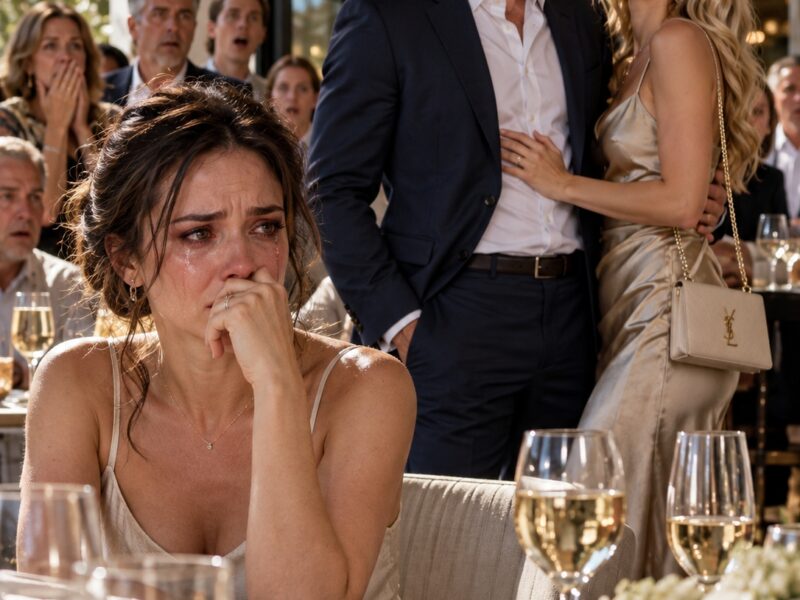
HE BROUGHT HIS MISTRESS TO OUR FAMILY LUNCH—THEN ASKED WHY I WASN’T CRYING

The moment my husband walked into our family lunch holding another woman’s hand, twenty-three people stopped talking.
I didn’t.
I didn’t scream.
I didn’t throw my wine.
I didn’t ask who she was, because somewhere deep inside me, in that quiet place where a woman stores the truths she isn’t ready to say aloud, I already knew.
What I didn’t know was that Austin intended to make me watch him announce her.
“This is Vanessa,” he said, smiling as if he had brought home an old college friend instead of the woman he had been sleeping with behind my back. “She’s someone very special to me.”
My mother’s hand flew to her mouth.
My father’s fork stopped halfway to his plate.
My younger sister, Beth, stared at Austin as if she had just watched a stranger peel off her brother-in-law’s face and step out from underneath it.
And Austin?
Austin squeezed Vanessa’s hand.
Then he looked directly at me.
For twelve years, I had known every version of that face.
I knew the little line beside his mouth when he was nervous. I knew the way his left eyebrow lifted when he was lying. I knew the tightness in his jaw when he felt cornered and the slight flare in his nostrils when he wanted to win an argument before it had even started.
But I had never seen the expression he wore that afternoon.
It was almost triumphant.
As if humiliating me required courage.
As if betraying me had somehow made him brave.
“No reaction, Miranda?” he asked.
That was when I understood something that changed the rest of my life.
He wanted me to break.
Not privately.
Not in our bedroom at midnight.
Not in the passenger seat of our car after a long drive home.
Here.
In front of everyone.
He wanted witnesses.
So I gave him nothing.
And that was the first thing that frightened him.
Three hours earlier, I had been standing barefoot in our kitchen in suburban Connecticut, cutting lemons for iced tea.
It was one of those bright late-spring Sundays that made everything look more innocent than it was. Sunlight came through the windows over the sink. The hydrangeas along the patio were beginning to bloom. Someone had opened the French doors, and every few minutes a warm breeze carried the smell of charcoal and freshly cut grass through the house.
My parents had driven up from New Jersey.
Austin’s mother, Eleanor, had brought her lemon cake.
Beth was there with her husband. Cousins, aunts, old family friends, people who had watched Austin and me build a marriage from our late twenties into our forties filled the house.
I had chosen the flowers.
I had ordered extra chairs.
I had remembered that Uncle Richard hated onions and that my father needed sparkling water without sodium.
That was the strange thing about being taken for granted.
You could become invisible while arranging everyone else’s comfort.
Austin had been unusually cheerful all morning.
Too cheerful.
He moved around the patio with a beer in his hand, laughing louder than necessary. Twice I caught him checking his phone. Both times, he turned the screen down when he noticed me looking.
Three months earlier, that would have made my stomach twist.
Six months earlier, I might have asked him who was texting.
A year earlier, I might have believed whatever answer he gave me.
That Sunday, I simply went back to slicing lemons.
At 1:17 p.m., the doorbell rang.
Austin stood so quickly his chair scraped against the stone patio.
“I’ll get it.”
I remember looking at him.
Not because the words were unusual.
Because of his face.
For one second, he looked excited.
Then he disappeared into the house.
I kept my hands around the glass pitcher in front of me.
Beth was telling our mother a story about a disastrous parent-teacher conference. My father was arguing baseball with Austin’s uncle. Someone laughed near the grill.
Everything was normal.
Then Austin returned.
With her.
Vanessa appeared to be in her early thirties, maybe thirty-two. Dark blond hair. Cream-colored dress. Small gold earrings. Expensive but understated handbag.
Beautiful in the careful, professional way of someone who understood exactly what every detail communicated.
She hesitated when she saw how many people were there.
Austin didn’t.
He reached for her hand.
That was the first moment the room began to die.
Conversation disappeared table by table.
My father lowered his fork.
Beth stopped midsentence.
Austin walked Vanessa into the center of the dining area and smiled.
“This is Vanessa.”
Nobody answered.
“She’s been working with me for about a year.”
Still nothing.
Austin glanced at me.
Then came the sentence that separated my life into before and after.
“She’s also become very important to me.”
My mother whispered, “Oh, God.”
Vanessa’s fingers shifted inside Austin’s hand.
She looked uncomfortable.
That detail mattered to me later.
At the time, almost nothing mattered.
I could hear the refrigerator running in the kitchen.
I could hear a dog barking two houses away.
I could hear the ice settling inside the pitcher I had filled twenty minutes earlier.
Strange what the mind notices while a marriage is being publicly executed.
Uncle Richard cleared his throat.
“Austin, maybe this isn’t the time.”
“Yes,” Austin said. “It is.”
His voice was firm.
Almost rehearsed.
“I’m tired of hiding.”
The sentence hung there.
I’m tired of hiding.
As though secrecy had been the cruelty.
Not the affair.
Not the lying.
Not bringing another woman into the home where his wife had spent all morning preparing lunch for people they loved.
Not taking my dignity and placing it in the center of a room like something everyone had been invited to inspect.
Vanessa released his hand.
“Austin…”
But he kept going.
“I think people deserve honesty.”
My cousin Julie stood.
“You call this honesty?”
Austin laughed.
Actually laughed.
“What would you call it?”
“Humiliation.”
“I’m not humiliating anyone.”
Julie stared at him.
“You brought your girlfriend to lunch with your wife’s parents.”
“I brought someone important to me.”
“Your wife is sitting right there.”
Austin finally looked at me again.
“I know.”
Something cold passed through the room.
Then he did what I think he had wanted to do from the beginning.
He compared us.
“Vanessa understands the pressure I’m under,” he said. “She understands my work. She’s ambitious. She’s spontaneous. She actually wants to go places and do things.”
Every sentence was shaped to sound as though it described Vanessa.
Every sentence was really meant to describe what he thought was wrong with me.
I was forty-one years old.
I had been married to him for twelve years.
I knew exactly what he was doing.
And, for one terrible second, it worked.
I felt small.
Painfully, violently small.
Then something inside me became still.
Not numb.
Clear.
There is a difference.
Austin looked at me.
“Well?”
I raised my eyes.
“Well what?”
“Aren’t you going to say anything?”
The room waited.
Perhaps everyone expected the same thing.
A slap.
A scream.
A glass breaking.
Maybe tears.
I could almost see the future Austin wanted to create from my reaction. He would tell people I had lost control. He would say our marriage had been impossible for years. He would point to my anger as evidence that leaving me had been inevitable.
I suddenly understood that he had already written the story.
All he needed was for me to perform my part.
So I folded my napkin.
Placed it beside my plate.
And said nothing.
His smile weakened.
“Miranda?”
Eleanor, his mother, came toward me.
“Honey, are you all right?”
I nodded.
Beth crouched beside my chair.
“Do you want me to call a car?”
“No.”
My voice surprised me.
It sounded calm.
“I’ll drive.”
Austin frowned.
“Where are you going?”
I stood.
The legs of my chair scraped across the hardwood.
It was not a dramatic sound.
But in that room, it sounded enormous.
“I’m leaving.”
“Miranda, come on.”
I picked up my purse.
“This is your house too.”
I looked at him.
He still didn’t understand.
He actually thought I was going upstairs.
Or driving around the block.
Or staying with my mother for a night before coming home and beginning the exhausting work of forgiving him.
Again.
“There’s no reason to make a scene,” he said.
I almost smiled.
“A scene?”
“You know what I mean.”
“No, Austin. I really don’t.”
He glanced around, suddenly aware of the people watching him.
“I’m trying to be honest.”
“Then be honest.”
“I am.”
“No.” I slipped the strap of my purse over my shoulder. “You wanted an audience.”
His face changed.
Only slightly.
But I saw it.
“You wanted me to scream. You wanted me to cry. You wanted me to give you something you could use later when you explained this to people. You wanted to say I was unstable, difficult, hysterical.”
“That’s ridiculous.”
“Maybe.”
I looked at Vanessa for the first time.
She immediately looked away.
Then I looked back at my husband.
“But I’m not giving you that script.”
“Miranda—”
“I’m just leaving.”
Four words.
Nothing theatrical.
Nothing clever.
I touched my mother’s shoulder as I passed her.
“I’m okay, Mom.”
“You don’t look okay.”
“I will be.”
That was the first promise I made to myself.
I walked through the foyer, opened the front door, and stepped outside.
Austin called my name once.
I did not turn around.
The door closed behind me.
And for the first time in twelve years, I made a decision about my marriage without wondering how Austin would feel about it.
Inside, he apparently stood staring at the door.
Vanessa touched his arm.
According to Beth, Austin said, “She’ll come back.”
Nobody answered.
“She always comes back.”
My mother was the next person to leave.
She stopped in front of him.
“You have no idea what you just did.”
Then she walked out.
One by one, everyone followed.
The lunch I had spent two days preparing ended in less than fifteen minutes.
The last person remaining besides Vanessa was Daniel Mercer, one of Austin’s oldest friends.
They had known each other since college.
Daniel picked up his jacket.
“I’ve known you fifteen years,” he said.
Austin folded his arms.
“If you’re going to lecture me—”
“I’m not.”
Daniel looked toward the door where I had disappeared.
“I just realized something.”
“What?”
“I think today was the first time I really saw Miranda.”
Then he left.
Austin slept well that night.
I know because he told me months later.
That detail hurt in a way I hadn’t expected.
While I lay awake in my mother’s guest room staring at a ceiling I had known since childhood, my husband slept in our bed believing I would eventually come home.
He had reasons for believing that.
I always had.
Austin withdrew; I waited.
Austin forgot; I reminded.
Austin hurt me; I found explanations.
Austin made decisions; I adjusted.
Over the years, compromise had slowly changed shape until neither of us noticed that most of it was happening on one side.
Austin mistook my patience for dependence.
Worse, I had sometimes mistaken it for love.
For the first three days, he didn’t call.
He later admitted he thought he was “giving me time to calm down.”
On the fourth day, he texted.
We need to talk.
I stared at those words for nearly a minute.
Then I turned my phone facedown.
On the fifth day, he called.
Voicemail.
On the sixth, he called three times.
On the seventh, he drove to my mother’s house.
Mom answered the door.
“I need to see Miranda.”
“She doesn’t want to see you.”
“Just give me one minute.”
My mother had loved Austin once.
She had defended him during arguments. Bought him ridiculous Christmas gifts. Called him son.
That afternoon, she looked at him through the narrow opening of the front door and said, “You had twelve years of minutes.”
Then she closed it.
That was when Austin began to understand that I might not be coming back.
But understanding arrived slowly.
First came irritation.
Then confusion.
Then inconvenience.
Only much later came grief.
He returned to the house and began noticing absences.
My shoes disappeared from the mudroom.
The toiletries vanished from my side of the bathroom.
A week later, several dresses were gone.
Then files.
Passport.
Birth certificate.
The jewelry box my grandmother left me.
He never saw me taking them.
Beth came with me while he was at work.
Every empty hanger became a message I never had to send.
I am leaving.
I am leaving.
I am leaving.
One night, Austin opened the bottom drawer of my bedside table.
There was a small blue notebook inside.
He picked it up.
Then put it back.
He didn’t open it.
Not yet.
He still believed privacy mattered.
The irony would haunt him later.
The house grew louder without me.
That was how he described it.
Not quieter.
Louder.
The refrigerator humming.
The furnace turning on.
Pipes clicking behind the walls.
His shoes hitting the hardwood.
The microwave beeping into an empty kitchen.
For years, I had filled those spaces without either of us noticing.
Coffee at 6:20.
A note on the refrigerator if I left early.
The bedroom curtains opened before he showered.
His blue travel mug beside the keys on days he had an early meeting.
The pillows arranged the same way every night.
Small things.
Insignificant things.
Until they stopped happening.
Vanessa began spending more time with him.
At first, that was what he thought he wanted.
They went to restaurants I had once suggested and he had been too tired to try.
They took a weekend trip to Boston.
They stayed out late.
They ordered expensive wine.
They laughed.
And still, every time Austin came home, the house was waiting for someone who no longer lived there.
One evening, Vanessa asked, “Shouldn’t you talk to her?”
Austin poured another drink.
“She’ll talk when she’s ready.”
“What if she’s already ready?”
“For what?”
“To leave you.”
He looked at her sharply.
“You don’t know Miranda.”
Vanessa studied him for a moment.
“Maybe you don’t either.”
He resented her for saying it.
Later, he would remember it.
The first real crack came from his mother.
Eleanor invited him to dinner alone.
No Vanessa.
No distractions.
Afterward, she put two coffee mugs on the kitchen table and sat across from her son.
“Do you know what Miranda did for you?”
Austin sighed.
“Mom.”
“I’m asking.”
“She was my wife.”
“That isn’t an answer.”
“She did what people do in a marriage.”
Eleanor’s face tightened.
“No, Austin. She did what Miranda did.”
Then she reminded him.
The year he lost his job at thirty-three and spent four months pretending he was “considering options” when he was actually too depressed and ashamed to send applications.
I had worked overtime.
Quietly.
I had cut expenses without telling him how frightened I was.
I had told friends he was consulting because I knew unemployment embarrassed him.
When his father developed pancreatic cancer, Austin became emotionally paralyzed.
I was the one who sat beside his father through chemotherapy.
I learned the nurses’ names.
I organized medication.
I brought Eleanor dinner.
I washed his father’s favorite sweatshirt after he got sick on it because he was ashamed for anyone else to see.
When Austin finally broke down in the hospital parking garage, I held him for forty minutes.
He had forgotten most of that.
I hadn’t.
Eleanor hadn’t either.
“She never made you feel weak for needing her,” Eleanor said.
Austin stared into his coffee.
“She never asked for recognition. That doesn’t mean she didn’t deserve it.”
“Mom, I know I screwed up.”
“No. I don’t think you do.”
He looked up.
Eleanor’s eyes were wet.
“You replaced a woman who knew how you took your coffee before you spoke in the morning with a woman who, as far as I can tell, doesn’t even know you hate cinnamon.”
“That’s unfair to Vanessa.”
“This isn’t about Vanessa.”
That silenced him.
“Vanessa didn’t make vows to Miranda. You did.”
He looked away.
Eleanor leaned back.
“Some women leave screaming, Austin. Some women leave quietly.”
“What does that mean?”
“It means you should be more afraid of the quiet ones.”
He frowned.
“Why?”
“Because sometimes silence means the argument ended a long time ago. You were simply the last person to notice.”
That night, Austin found an old anniversary photograph.
We were standing beside a lake in Vermont.
I had my cheek against his shoulder.
I was laughing.
He stared at the photograph for several minutes.
Then realized he couldn’t remember the last time he had seen me laugh like that.
Meanwhile, I was learning how strange freedom could feel.
It did not feel victorious.
Not at first.
It felt embarrassing.
At forty-one, I was sleeping in the bedroom where I had studied for my SATs.
My clothes hung beside boxes of old yearbooks.
My mother still had glow-in-the-dark stars on one corner of the ceiling because she had never bothered removing them.
Some mornings, I woke at five and forgot where I was.
Then I remembered.
And grief arrived before my feet touched the floor.
People imagine leaving betrayal feels empowering.
Sometimes it does.
Sometimes it feels like vomiting in your mother’s bathroom at 2:00 a.m. because you suddenly remember your husband saying another woman was more spontaneous.
Sometimes it is staring at yourself in a mirror and wondering when exactly you became someone a man could discard in front of your parents.
Sometimes dignity is not beautiful.
Sometimes dignity is simply refusing to crawl back to the person who broke you because loneliness hurts.
I started seeing Dr. Hannah Price months before the lunch.
Austin didn’t know.
The first time I sat in her office, I spent twenty minutes explaining why I probably had no reason to be there.
Then Hannah asked one question.
“Do you feel loved in your marriage?”
I began crying.
That was my answer.
I had suspected Vanessa long before Austin introduced her.
The late meetings.
The changed passwords.
A unfamiliar perfume on his coat.
His phone suddenly becoming something he carried from room to room.
The way he smiled at messages and then seemed irritated when I asked what was funny.
I never found a photograph.
Never saw an explicit text.
But betrayal has a temperature.
A marriage changes before the truth has a name.
I felt it.
For months, I prayed I was wrong.
Then I stopped praying and started preparing.
Not financially.
Our finances were stable and mostly separate enough that leaving was possible.
Emotionally.
I wrote letters to myself in the blue notebook.
Not because I wanted Austin to read them.
Because I needed evidence that my feelings existed.
March 12.
I feel like a guest in my own marriage.
April 4.
He asked why dinner wasn’t ready, then spent the entire meal texting someone.
April 19.
Tonight he touched my shoulder when he passed me in the hallway, and I realized it was the first affectionate touch between us in eleven days.
May 2.
I think the worst part is not that he may love someone else.
The worst part is that I have been disappearing beside him for years, and he has not noticed.
Then there was the entry that would eventually destroy him.
He still shares a bed with me, but he no longer shares a life.
Three years earlier, I had tried to tell him.
I remember the night exactly.
Austin was sitting against the headboard scrolling through his phone.
I said, “Can we talk?”
“Sure.”
“I’ve been feeling lonely.”
“Mm-hmm.”
“I mean really lonely, Austin.”
He kept looking at the screen.
“I’m right here.”
“That’s not what I mean.”
He sighed.
Not cruelly.
That almost made it worse.
Just tired.
Distracted.
“Can we talk about this tomorrow? I’ve got that presentation in the morning.”
I waited.
“Okay.”
He kissed my forehead.
“Thanks.”
Tomorrow never came.
The next morning I made coffee.
He went to work.
Life resumed.
But something inside me stopped asking.
That was the part Austin didn’t know.
By the time Vanessa entered our family lunch, I had already spent months grieving a marriage I technically still occupied.
So when Austin tried to publicly destroy me, he was attacking a structure already condemned.
He simply didn’t know it.
Weeks after I left, I ran into him at a grocery store.
Of all places.
I was holding a carton of eggs.
He was standing beside a display of cereal.
For a second, neither of us moved.
“Miranda.”
“Hi.”
“You look…”
He stopped.
“Different?” I offered.
“Tired.”
I almost laughed.
“So do you.”
“Can we talk?”
“We’re talking.”
“Not like this.”
I put the eggs into my cart.
“What do you want to talk about?”
“Us.”
“There isn’t an us anymore.”
His face tightened.
“You can’t erase twelve years because of one afternoon.”
That sentence did something to me.
Not anger.
Clarity.
“It wasn’t one afternoon.”
“You know what I mean.”
“No, Austin. You think what happened at lunch destroyed our marriage.”
“Didn’t it?”
“No.”
He stared at me.
“That was just the day you made it impossible for me to keep pretending.”
“I made a mistake.”
“No.”
“What?”
“A mistake is forgetting an anniversary. A mistake is sending an email to the wrong person. You made a decision.”
He said nothing.
“You chose Vanessa. You chose the day. You chose the place. You chose to hold her hand. You chose to compare us. And you chose to do it in front of my parents.”
“I was trying to be honest.”
“Honesty doesn’t require an audience.”
He flinched.
“You could have told me privately. You could have ended our marriage with some respect left between us. Instead, you wanted me to feel small.”
“That wasn’t—”
“Yes, it was.”
He looked down.
And for the first time since I had known him, Austin had no defense ready.
“It worked,” I said.
His eyes lifted.
“For about thirty seconds, you made me feel smaller than I have ever felt in my life.”
“Miranda…”
“And then I realized something.”
“What?”
“I didn’t have to stay anywhere that required me to become small.”
I pushed my cart past him.
He didn’t follow.
That night, he apparently sat in our kitchen until almost midnight.
But the revelation that changed him most came from Beth.
He asked her to meet him for coffee.
She refused twice.
The third time, she agreed.
“I’m not helping you get her back,” she said immediately.
“I know.”
“Do you?”
“Yes.”
Beth folded her arms.
“What do you want?”
“I need to understand.”
“You had twelve years to understand her.”
“I know.”
“No, you keep saying that. I don’t think you know anything.”
Austin accepted it.
Maybe that was why she stayed.
After a long silence, Beth asked, “Do you know why she didn’t cry at lunch?”
He shook his head.
“Because she had already cried.”
His expression changed.
“She knew, Austin.”
“Knew what?”
“About Vanessa.”
The coffee shop seemed to disappear around him.
“How?”
“The messages. Your schedule. The perfume. Your phone. Miranda isn’t stupid.”
“Why didn’t she confront me?”
“Because she wanted to be wrong.”
Austin looked down at the table.
Beth continued.
“She saw a therapist for months.”
“What?”
“She was preparing herself.”
“For what?”
“For you.”
He went still.
“She told me she had made a promise to herself. If your betrayal ever became public, she wouldn’t beg. She wouldn’t compete with another woman. She wouldn’t let you turn her pain into entertainment.”
Austin swallowed.
“She knew that day?”
“She didn’t know you were bringing Vanessa to lunch. But she knew something was coming.”
Then Beth hesitated.
“There’s something else.”
“What?”
“She wrote letters.”
“To who?”
“Herself.”
Austin immediately thought of the blue notebook.
“What did they say?”
Beth’s anger softened.
“They said she was afraid of becoming invisible.”
He stared at her.
“She wrote about getting older beside someone who had stopped seeing her. About wondering whether you were comparing her to younger women. About feeling ashamed that she cared. About being afraid that if she complained, you’d call her needy.”
Austin rubbed his face.
Beth looked at him for a long time.
“There was one night she wrote about more than any other.”
He knew before she explained.
Three years earlier.
Their bedroom.
His phone.
Her voice saying, I’ve been feeling lonely.
He closed his eyes.
“I remember.”
“She said that was the night she stopped trying to make you understand.”
“I told her we’d talk tomorrow.”
“You never did.”
“I forgot.”
“She didn’t.”
Those two words stayed with him.
You forgot.
She didn’t.
That night, Austin opened the blue notebook.
He knew he shouldn’t.
He did anyway.
The first pages were ordinary.
Appointments.
Thoughts.
Fragments.
Then he found the letters.
He read about himself through the eyes of the woman who had loved him.
It was devastating precisely because she did not write like someone who hated him.
She defended him.
He’s stressed.
He’s tired.
He doesn’t mean it.
Maybe I expect too much.
Maybe marriage simply becomes quieter.
Maybe this is normal.
Then the excuses grew thinner.
I miss being asked how I am.
I miss telling him things.
I miss the version of myself that didn’t rehearse conversations before speaking to my husband.
Finally, he reached the sentence.
He still shares a bed with me, but he no longer shares a life.
Austin read it once.
Then again.
Then a third time.
He sat on the floor beside the bed with the notebook open across his knees.
For years, he had believed our marriage deteriorated because passion faded.
Because routine arrived.
Because we became predictable.
Because Vanessa appeared at the right moment and made him feel alive.
The notebook showed him something uglier.
He had not been bored with me.
He had stopped being curious about me.
There is a difference.
One blames the marriage.
The other demands responsibility.
Vanessa noticed him changing.
“You’re thinking about her again.”
They were sitting in a restaurant when she said it.
“I’m not.”
“You are.”
“Vanessa—”
“You talk about Miranda even when you don’t say her name.”
He put down his glass.
“That doesn’t make sense.”
“It makes perfect sense.”
She looked tired.
Not jealous.
Tired.
“I thought once she left, we would finally have a real relationship.”
“We do.”
“No. We have the aftermath of your marriage.”
“That’s not fair.”
“Maybe not.”
She studied him.
“But it’s true.”
For several seconds, neither spoke.
Then Vanessa said something Austin never expected.
“I didn’t know you were going to bring me to that lunch.”
He looked up.
“What?”
“You told me you were finally going to tell people.”
“I did.”
“You told me your marriage was basically over.”
“It was.”
“Was it?”
He had no answer.
Vanessa shook her head.
“I should never have been involved with a married man. That’s mine to own. But what you did to her that day…”
She stopped.
“What?”
“It scared me.”
Austin frowned.
“Why?”
“Because I watched you hurt someone who had loved you for twelve years just so you could feel powerful for five minutes.”
The words landed hard.
“And ever since she left,” Vanessa continued, “you’ve been trying to understand why you miss her instead of asking why you needed to destroy her first.”
He stared at her.
Vanessa reached for her coat.
“Where are you going?”
“Home.”
“Vanessa.”
She stood.
“I don’t want to be another woman you learn to appreciate after she leaves.”
Then she walked away.
Their relationship ended that night.
Austin did not stop her.
Months earlier, he had believed choosing Vanessa meant choosing happiness.
Now he sat alone at a restaurant table with two untouched glasses of wine and understood that he had lost both women for the same reason.
He had been present only when losing something forced him to pay attention.
The house became unbearable after that.
One night, he found an old voice message from me.
It was nothing important.
That was what broke him.
“Hey, traffic on I-95 is terrible. I’m going to be maybe twenty minutes late. Don’t wait to eat if you’re hungry. Oh—and I got that coffee you like. Love you.”
Twenty-three seconds.
A woman worrying about traffic.
Coffee.
Dinner.
Love you.
He played it again.
Then again.
By the fourth time, he was crying.
Not the controlled tears of someone moved by nostalgia.
He folded forward in the patio chair and sobbed until his chest hurt.
He cried for the lunch.
For the notebook.
For the hospital nights he had forgotten.
For the coffees he had never thanked me for.
For the conversation he postponed for three years.
For every ordinary day when I had been loving him and he had assumed love was simply part of the furniture.
Eventually, he came to my mother’s house again.
This time, I opened the door.
He looked thinner.
Older.
“Miranda.”
“What do you want?”
“I need to talk to you.”
“We’ve talked.”
“Not like this.”
Something in his voice made me step aside.
We sat in my mother’s living room.
For several seconds, Austin said nothing.
Then he looked at me.
“I read the notebook.”
My entire body stiffened.
“You had no right.”
“I know.”
“That was private.”
“I know.”
“Stop saying you know.”
He lowered his head.
“You’re right.”
I waited.
“I understand now.”
“No, you understand more. That’s different.”
He accepted that too.
“I spent years treating you like something permanent.”
I said nothing.
“I thought because you stayed, you would always stay. I thought because you forgave me, forgiveness had no limit. I thought because you were strong, I didn’t have to protect you.”
His voice cracked.
“And when Vanessa wanted me, it made me feel…”
He stopped.
“What?”
“Young. Important. Chosen.”
I looked at him.
“And I hated that I needed that feeling.”
“Then why humiliate me?”
His eyes filled.
That was the question.
The one neither of us had been able to answer.
“I think I wanted power.”
“Over me?”
“Yes.”
The honesty hurt.
But I respected it more than another excuse.
“I had been feeling old. Stuck. Ordinary. And Vanessa made me feel like I was still someone people wanted.”
“So you needed me to feel unwanted.”
He closed his eyes.
“Yes.”
Silence.
For once, he did not run from it.
“I’m ashamed of that.”
“You should be.”
“I am.”
I looked toward the window.
Late-afternoon sunlight stretched across the carpet.
“I don’t think you understand the worst part.”
“What is it?”
“The worst part wasn’t Vanessa.”
His face tightened.
“It wasn’t finding out you wanted someone else. It wasn’t even watching you hold her hand.”
“Then what was it?”
I looked at him.
“The worst part was realizing I had lost my husband years before another woman found him.”
He inhaled sharply.
“At that lunch, you only made public what I had been living privately.”
“Miranda…”
“You had been treating me like I was invisible for years.”
“I know.”
“And I let you.”
He shook his head.
“No.”
“Yes.”
“That wasn’t your fault.”
“I didn’t say it was my fault.”
I took a breath.
“But I participated in my own disappearance. Every time I swallowed something because I was afraid you’d call me difficult. Every time I said I was fine because I didn’t want another argument. Every time I accepted half your attention and called it marriage.”
Austin wiped his face.
“I want another chance.”
I had known the words were coming.
They still hurt.
“No.”
He stared at me.
“Please.”
“No.”
“I’m different.”
“I believe you.”
That surprised him.
“You do?”
“I believe losing me changed you.”
“Then why—”
“Because your change does not obligate me to return.”
He stopped.
“I forgive you, Austin.”
Hope appeared in his face.
I hated having to extinguish it.
“But forgiveness isn’t reconciliation.”
His eyes lowered.
“I forgive you because I don’t want to carry you around inside my anger for the rest of my life. That doesn’t mean I’m going back to a place where I spent years disappearing.”
“I would never treat you that way again.”
“Maybe not.”
“Then give me a chance to prove it.”
“No.”
He stared at me helplessly.
And for a moment, I saw the man I had married.
Not the man at the lunch.
Not the arrogant husband.
Just Austin.
Flawed.
Afraid.
Human.
I still said no.
Because compassion is not the same as surrender.
“Do you know what the cruelest part is?” he whispered.
“What?”
“I think I only understood your value because you left.”
I nodded.
“I think so too.”
He looked shattered.
“If you had stayed,” I said softly, “you probably would have gone back to taking me for granted.”
“I hate that you’re right.”
“I’m not saying it to punish you.”
“I know.”
“This isn’t punishment.”
He looked at me.
“It feels like it.”
“It’s consequence.”
That word sat between us.
Consequence.
No screaming.
No revenge.
No public humiliation in return.
Just consequence.
Austin was silent for a long time.
Then he asked, “Do you still love me?”
That was harder.
I thought carefully before answering.
“I love parts of what we were.”
His eyes filled again.
“I love the twenty-nine-year-old man who danced with me barefoot in our first apartment because we couldn’t afford furniture.”
A tear slipped down his cheek.
“I love the man who drove four hours through a snowstorm when my grandmother died because I said I needed my mother.”
I swallowed.
“I love memories of you.”
“But me?”
I shook my head.
“Not the way you want me to.”
He looked down.
“What do you feel?”
“Affection. Sadness. Gratitude for some years. Grief for others.”
I paused.
“But romantic love?”
He waited.
“No.”
The word barely had sound.
It still seemed to break something.
He stood eventually.
At the door, he turned.
“One question.”
“Okay.”
“If I had handled it differently…”
I knew what he meant.
“If I had come to you privately before that lunch. If I had told you the truth. If I had apologized. If Vanessa had never walked through that door…”
He struggled to finish.
“Would we still be married?”
For a moment, I imagined another version of our lives.
Austin sitting across from me at the kitchen table.
His phone turned off.
My hands around a mug.
Truth without spectacle.
Pain with dignity.
Maybe counseling.
Maybe separation.
Maybe reconciliation.
Maybe not.
“I don’t know,” I said.
His face fell.
“And neither will you.”
He nodded.
“But I know this. That day, you had a choice between ending something with respect and ending it by hurting me as deeply as you could.”
He looked at the floor.
“You chose the second.”
“I know.”
“That’s the choice you have to live with.”
He opened the door.
Then I said the sentence that finally released both of us.
“You have to live with your choice, Austin. You don’t get to live with me.”
He left.
This time, I watched him walk to his car.
Not because I wanted him to turn around.
Because I wanted to know what it felt like to see the end clearly.
It felt sad.
And clean.
Austin started therapy two months later.
He once told Beth he had resisted the idea for years because therapy seemed like something people did when they couldn’t solve their own problems.
Then his therapist asked him a question he could not solve.
“Why did you need Miranda to feel small?”
Austin apparently sat in silence for nearly five minutes.
Finally he said, “Because I felt small.”
That became the beginning of his real work.
Not getting me back.
Understanding himself.
He began recognizing how deeply his identity had depended on being admired. Promotions. Money. Attention. Being needed. Being wanted.
Vanessa had not created that hunger.
She had simply fed it.
And I had not caused his betrayal by becoming ordinary.
I had become familiar.
There is nothing wrong with familiarity in love.
The tragedy was that Austin had mistaken intimacy for boredom because he had never learned that being truly known is rarer than being newly desired.
I had my own work to do.
Leaving him did not magically restore me.
For months, compliments made me uncomfortable.
When friends told me I looked happier, I wondered how unhappy I must have looked before.
I returned to painting.
I had studied art in college before practicality redirected my life.
The first canvas I bought sat untouched in my apartment for eleven days.
Then one Saturday morning, I opened the windows.
Made coffee.
Put on music.
And painted until sunset.
No masterpiece.
Just color.
But when I looked at my hands afterward, covered in blue and yellow paint, I cried.
Because I remembered them.
My hands.
My life.
Myself.
I moved into a small townhouse six months after leaving Austin.
Nothing luxurious.
Two bedrooms.
A narrow kitchen.
A back deck overlooking maple trees.
The first night, I slept on a mattress on the floor because the bed frame had not arrived.
I ordered Thai food.
Sat cross-legged beside an unpacked box.
And felt more at home than I had in years.
Mom visited the next morning.
She looked around.
“You’re smiling.”
“Am I?”
“You are.”
I poured coffee.
She hugged me from behind.
“I’m proud of you.”
“I didn’t leave because I was brave.”
“Why did you leave?”
I thought about it.
“Because staying finally scared me more.”
Austin eventually sold our house.
I signed the documents without seeing him.
There was no dramatic divorce battle.
No fight over money.
No attempt to destroy one another.
By then, destruction seemed childish.
We divided what had to be divided.
Furniture.
Accounts.
Photographs.
Twelve years reduced to lists on legal paper.
Somehow that was sadder than anger.
Almost a year after the lunch, a letter arrived.
Austin’s handwriting.
I considered throwing it away.
Instead, I made tea and opened it on my back deck.
Miranda,
I’m not writing to ask you to come back.
For the first time, I understand that asking would be another way of making my feelings your responsibility.
I need to tell you one thing.
You were not replaced by someone better.
You were traded for something new.
There is a difference, and understanding it will probably remain one of the greatest shames of my life.
I thought love was guaranteed once someone had given it to me long enough.
You taught me, by leaving, that love is a choice someone makes every day.
I’m sorry I noticed only when you stopped choosing me.
I hope the life you build is one where nobody ever makes you feel invisible again.
Austin.
I read it twice.
Then folded it.
I didn’t answer.
Not because I hated him.
Because some apologies do not require replies.
Sometimes their purpose is simply to acknowledge a debt that can never be repaid.
Years later, when I thought about that Sunday, I rarely remembered Vanessa’s dress.
I barely remembered what food was on the table.
I couldn’t remember whether the weather stayed sunny after I left.
What I remembered was the sound of my chair moving across the floor.
That ordinary scrape.
The moment I stood.
For Austin, the tragedy of that day was losing his wife.
For me, the tragedy had begun much earlier.
The victory was finally finding her again.
Once, months after the divorce was finalized, Austin and I ran into each other at a mutual friend’s retirement party.
He looked well.
Quieter.
There was something gentler about him.
We spoke for a few minutes.
Nothing painful.
Nothing intimate.
Then, before we separated, he asked, “Are you happy?”
A year earlier, the question might have made me angry.
That evening, it made me smile.
“I’m learning how to be.”
He nodded.
“That’s good.”
“It is.”
He hesitated.
“Were you ever happy with me?”
I looked across the room at people laughing beneath warm restaurant lights.
“Yes.”
His face softened.
“We had good years, Austin.”
“I’m glad you remember them.”
“I remember everything.”
That was the difference between us.
For a long time, Austin had survived by forgetting.
I had survived by remembering.
But neither of us needed to live there anymore.
Before he walked away, I touched his arm.
“Take care of yourself.”
“You too.”
Then he disappeared into the crowd.
I did not watch him leave.
I turned back toward my friends.
Someone called my name.
I laughed at something Beth said.
And that was it.
No revenge.
No miraculous reunion.
No punishment grand enough to equal the humiliation of that Sunday.
Life rarely gives endings that clean.
Austin had to live with knowing he finally learned how to value the woman he lost after she no longer needed his love.
And I had to live with the knowledge that I stayed too long in a place where love had slowly become habit.
But I no longer considered those truths tragedies.
They were simply the price of becoming honest.
Because the woman who walked out of that family lunch was not fearless.
She was terrified.
Her hands shook when she started the car.
She drove three blocks before pulling into a parking lot because she could barely breathe.
She cried so hard her chest hurt.
She called her sister and could not form a sentence for almost a minute.
She spent months questioning whether she had thrown away twelve years too quickly.
She woke in the night missing a man she knew she could never trust again.
She was not made of steel.
She was simply finished.
And sometimes being finished looks exactly like strength from the outside.
Austin once believed my silence meant I would tolerate anything.
In the end, he learned what it actually meant.
I had no argument left.
No case to make.
No love left to audition for.
No reason to convince a man of my value after twelve years of showing it to him every single day.
That was why I didn’t scream when he brought Vanessa into our home.
That was why I didn’t throw my glass.
That was why I didn’t ask him to choose.
He already had.
And so had I.
Austin made his choice when he reached for another woman’s hand in front of everyone I loved.
I made mine when I pushed back my chair.
His choice cost him a marriage.
Mine gave me back a life.
And years later, when I remember that door closing behind me, I no longer hear the sound of a woman losing her husband.
I hear something else.
I hear the quietest sound freedom ever made.









