HE BROUGHT HIS MISTRESS TO THE UNDERWORLD SUMMIT—THEN 43 POWERFUL PEOPLE REFUSED TO SIT DOWN UNTIL HIS WIFE ARRIVED
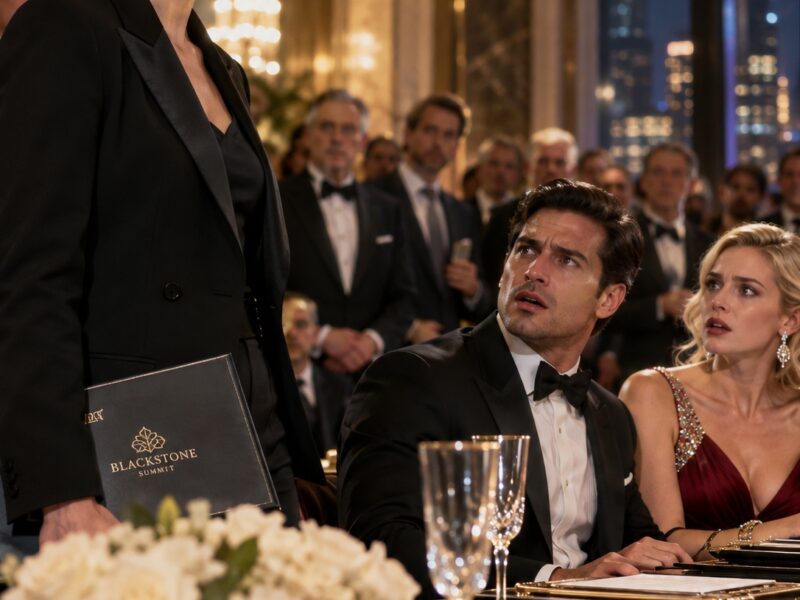
The first sign Damian Varela had made the worst mistake of his life was that nobody sat down.
Forty-three powerful men and women had gathered beneath the crystal chandeliers of the Blackstone Grand that night. Men who controlled shipping corridors, construction contracts, private security companies, warehouses, nightclubs, trucking routes, and businesses whose real purpose never appeared on tax filings.
Men who had crossed state lines because Damian Varela had summoned them.
Yet when Damian descended the grand staircase at 8:47 p.m., not one of them applauded.
Not one approached him.
Not one even lifted a glass.
They simply stared.
Damian mistook the silence for awe.
That was his second mistake.
His first was the woman holding his arm.
Celeste Moretti wore a burgundy evening gown that caught the chandelier light whenever she moved. Diamonds flashed at her throat. Her dark hair fell over one shoulder, and she carried herself with the effortless confidence of a woman accustomed to being watched.
She looked magnificent.
Damian had wanted her to.
Three weeks earlier, he had decided that eleven years of marriage to Saraphina Vale were enough. There had been no dramatic fight, no smashed glasses, no screaming in the hallway.
That would have required passion.
What Damian felt was something colder.
He had convinced himself that his marriage had become obsolete.
Saraphina was intelligent, composed, reliable—and, in Damian’s mind, increasingly irrelevant.
She managed their homes. She remembered birthdays he forgot. She attended dinners, funerals, weddings, and meetings when tradition required a wife beside him. She spoke little unless spoken to.
And Damian had confused quietness with insignificance.
Celeste was different.
Celeste entered a room and changed its temperature.
So tonight Damian had decided to make his future visible.
The Blackstone summit would be the perfect announcement.
He would arrive with Celeste.
Everyone would understand.
Everyone did understand.
Just not in the way Damian expected.
At the bottom of the staircase, Celeste’s fingers tightened almost imperceptibly around his arm.
“Damian.”
“What?”
“Something’s wrong.”
He smiled without looking at her.
“They’re surprised.”
“No.”
Her voice remained low.
“They’re waiting.”
That made him finally look across the ballroom.
She was right.
The long principal table remained untouched.
Seven chairs had been arranged beneath the tall windows, one for each leader whose organization formed the backbone of the eastern alliance.
Water waited in crystal glasses.
Folders rested beside expensive fountain pens.
Nobody had taken a seat.
Carmine Russo approached first.
Russo controlled much of the northeastern shipping corridor and possessed the thick neck and battered face of a man who had spent his youth solving problems physically before becoming wealthy enough to have other people solve them.
He stopped several feet from Damian.
His eyes flicked once toward Celeste.
Then back.
“Where is Saraphina?”
Damian’s smile faded slightly.
“Good evening to you too, Carmine.”
“Where is she?”
“She won’t be attending.”
Russo stared at him.
There was no visible judgment on his face.
Somehow that was worse.
“I see.”
Damian waited.
Russo turned and walked away.
Celeste watched him return to the bar.
“What was that?”
“Old men,” Damian said. “Old customs.”
But twenty minutes later, the summit still had not begun.
Forty minutes later, nobody had signed anything.
By 9:30, Damian’s irritation had hardened into anger.
He found Petrov, the event coordinator, near the kitchen entrance.
“Why are we waiting?”
Petrov swallowed.
“The principals aren’t ready.”
“They’ve been here for almost an hour.”
“Yes, sir.”
“So what exactly are they waiting for?”
Petrov glanced toward the windows.
“I think you should speak with Esteban Aguilar.”
That answer bothered Damian.
Not because of what Petrov had said.
Because of the relief on his face after saying it.
As though he had just transferred a dangerous object into somebody else’s hands.
Aguilar stood alone at the windows overlooking Manhattan.
At seventy-one, Esteban Aguilar had survived long enough to understand that the most powerful man in a room was often the one making the fewest movements.
Damian stopped beside him.
“Esteban.”
“Damian.”
“We need to start.”
“Yes.”
Aguilar continued looking through the glass.
“We do.”
Damian’s jaw tightened.
“Then why aren’t we?”
Only then did Aguilar turn.
“Where is Saraphina?”
There it was again.
Damian exhaled through his nose.
“She’s at home.”
“Why?”
“I’ve made some changes.”
“To the summit?”
“To my life.”
Aguilar’s gaze drifted briefly toward Celeste.
Understanding arrived immediately.
“What happens inside your marriage is your business,” he said.
“Exactly.”
“But this room is not your marriage.”
Damian stared at him.
“I’m the head of the Varela family. The Varela family called this summit.”
“Correct.”
“Then sit everyone down.”
Aguilar’s expression did not change.
“No.”
For several seconds, Damian genuinely believed he had misheard him.
“No?”
“The summit begins when Saraphina arrives.”
Damian gave a short laugh.
Nobody else did.
“You’re serious.”
“Completely.”
“Why?”
Aguilar turned back toward the city.
“Perhaps that’s a question you should have asked before tonight.”
Something cold touched the base of Damian’s spine.
He spent the next twenty minutes trying to prove Aguilar was alone.
He wasn’t.
Fedorov refused to proceed.
The Caribbean delegation refused.
Baltimore refused.
Chicago refused.
Carmine Russo refused.
Different men.
Different organizations.
Same answer.
Saraphina had to be there.
It wasn’t rebellion.
Rebellion could be punished.
It wasn’t conspiracy.
Conspiracies had leaders.
This was worse.
It was consensus.
When Damian finally returned to Celeste, she was standing near the bar with an untouched glass of wine.
“They won’t sign,” she said.
“They’ll sign.”
“Damian.”
“They will.”
She studied his face.
Then she asked the question he had spent the last hour avoiding.
“What exactly does your wife do?”
Damian opened his mouth.
Nothing came out.
Because the humiliating truth was simple.
He didn’t know.
Carmine Russo gave him the first real answer.
Eight years earlier, two organizations had nearly gone to war over overlapping distribution territory.
Damian vaguely remembered it.
What he didn’t remember was how it had ended.
“Saraphina made a phone call,” Russo said.
Damian frowned.
“To whom?”
“Both sides eventually.”
“And?”
“And nobody died.”
Russo sipped his water.
“She kept making calls.”
“What does that mean?”
“It means exactly what it sounds like.”
Over the years, Saraphina had become something rare in their world—a person with access to nearly every organization but no personal territory to defend.
Someone both sides trusted because she didn’t profit when either side lost.
Boundary disputes came to her.
Debt disagreements came to her.
Misunderstood shipments.
Broken agreements.
Insults that could become shootings if nobody corrected them quickly enough.
Damian stared at Russo.
“She never told me.”
Russo’s eyes lifted.
“Did you ever ask?”
The question landed harder than an accusation.
Damian thought of eleven years of breakfasts.
Eleven years of dinners.
Flights.
Hotels.
Late-night phone calls he had never asked about.
People greeting Saraphina at events with a warmth he’d dismissed as courtesy.
Times she had said, I need to handle something, and he’d nodded without looking up.
He had mistaken discretion for emptiness.
“I can run this summit without her,” Damian said.
Russo leaned back.
“No. You can host it without her.”
“What’s the difference?”
“Tonight?”
Russo’s eyes moved around the ballroom.
“You’re finding out.”
Then the main doors opened.
And the entire room changed.
Saraphina Vale stood beneath the archway.
She wasn’t wearing an evening gown.
She wore a charcoal suit, black heels, minimal jewelry, and her dark hair pulled back. She looked like someone who had been interrupted in the middle of work.
Four black vehicles waited outside behind her.
She stepped into the ballroom.
Nobody announced her.
Nobody needed to.
Carmine Russo moved first.
Then Aguilar.
Then Fedorov.
One by one, people who had ignored Damian for nearly two hours crossed the room toward his wife.
Damian stood motionless.
Saraphina listened as Russo spoke quietly to her.
She nodded.
Asked something.
Russo answered.
Then the man from Chicago approached and whispered four words into her ear.
Damian couldn’t hear them.
But he saw Saraphina’s expression change.
Barely.
A tightening around her eyes.
A pause.
Then she looked at Russo.
“How long?”
“Confirmed an hour ago.”
“Who found the courier?”
“Delgado’s people.”
“What courier?” Russo asked.
“The revised terms.”
Damian started walking toward them.
The Chicago representative continued.
“Someone intercepted him before delivery. The documents were copied.”
Saraphina’s gaze sharpened.
“And?”
“Altered.”
The word stopped Damian three feet from the circle.
Saraphina looked at him.
For the first time that night, husband and wife faced each other.
“What’s happening?” Damian asked.
“Not now.”
“This is my summit.”
Her voice stayed quiet.
“Then you should probably know the documents being signed at your summit have been compromised.”
That silenced him.
She explained quickly.
Several clauses in the northeastern shipping agreement had been changed. The alterations were small enough to look clerical but significant enough that three organizations would discover within weeks that the agreement harmed them.
The result would be accusations.
Retaliation.
Then blood.
“If we’d signed tonight,” Saraphina said, “we’d have thirty days before somebody decided somebody else had betrayed them.”
“What kind of conflict?”
Her eyes stayed on his.
“The kind I’ve spent years preventing.”
She turned away.
Damian didn’t.
Because that sentence had split something open inside him.
Years.
Not months.
Not tonight.
Years.
And before he could recover, Saraphina was already moving through the room issuing questions and receiving answers like a surgeon examining a patient whose bleeding wasn’t visible yet.
Ten minutes later, the problem became worse.
Brentano, the Baltimore representative, produced a letter.
“I received this six weeks ago.”
Damian unfolded it.
His signature appeared at the bottom.
Perfect.
Except Damian had never signed it.
“That’s forged.”
“Yes,” Saraphina said.
The room went silent.
Someone had not merely altered their documents.
Someone had been impersonating Damian Varela.
For at least six weeks.
Aguilar asked the obvious question.
“Who has access to your correspondence?”
Damian’s mind began assembling names.
His attorney.
Household personnel.
Saraphina.
And Marcus Creel.
His executive assistant.
Eight years at his side.
Eight years handling calendars, documents, signatures, schedules, invitations.
Then another thought entered Damian’s mind.
Saraphina had access too.
Total access.
And suddenly he was looking at his wife differently.
She saw it immediately.
“Don’t.”
“I’m looking at facts.”
“No.”
Saraphina stepped closer.
“You’re frightened, and you’re trying to make the problem small enough to understand. So you’re looking at me.”
“You knew about the courier.”
“Yes.”
“You arrived already knowing something was wrong.”
“Yes.”
“How?”
Her face hardened.
“The facts are that somebody forged your signature, manipulated agreements and attempted to engineer a war. Your decision to exclude me tonight nearly gave them exactly the opening they needed.”
She held his eyes.
“And now you’re wondering whether I’m the problem.”
Nobody spoke.
Damian still held the forged letter.
“What do you want me to say?”
“Nothing.”
Her answer was immediate.
“I want you to sit down and let me work.”
Then Brentano spoke.
“There’s something else.”
He produced a second sheet.
Names.
Times.
Addresses.
Positions around the Blackstone Grand.
Saraphina studied it.
Her face changed.
“What is it?” Damian asked.
She looked at her watch.
9:31 p.m.
Then at the first time printed on the sheet.
9:45.
“These aren’t delivery windows.”
Russo leaned over the table.
Saraphina looked up.
“Someone has teams positioned around this building.”
The air disappeared from the room.
“How many?” Damian asked.
“Eight positions. Probably sixteen to twenty-four people minimum.”
“For what?”
Saraphina folded the paper.
“That’s what we’re about to find out.”
The next revelation came with a scar.
Brentano described the man who had delivered the forged letter.
Mid-forties.
Six feet tall.
Dark hair graying at the temples.
Scar at the base of his left thumb.
Saraphina became still.
Damian noticed.
“You know him.”
“I know who he works for.”
“Who?”
“I need fifteen minutes.”
“Saraphina—”
“Fifteen minutes.”
Her voice dropped.
“And I need you to stay out of my way.”
For most of Damian’s adult life, people had moved when he told them to move.
Now his wife was asking him to do something he had almost never been required to do.
Trust somebody else’s judgment.
He said nothing.
She walked away.
During those fifteen minutes, Damian listened.
Really listened.
He heard conversations about Saraphina he had somehow never heard before.
How she had stopped a manufactured conflict two years earlier.
How three organizations had standing instructions during a summit emergency to wait for Saraphina’s assessment before reacting.
How she had quietly mediated problems across cities.
Then he heard one name.
Creel.
Damian went cold.
Marcus Creel.
The man who had managed his life for eight years.
The man who had asked casual questions about Saraphina’s schedule.
The man who knew about tonight before nearly anyone else.
The man who had been present when Damian decided to exclude his wife.
Twenty minutes after Saraphina left, she returned with Russo and a woman carrying a tablet.
“Sit down,” Saraphina said.
Damian did.
“Tell me about Creel.”
Saraphina looked at him.
Then she said the words that made eight years of Damian’s life rearrange themselves.
“His name isn’t Marcus Creel.”
She turned the tablet around.
A photograph filled the screen.
An older, heavyset man stood at a horse-racing event.
Damian recognized him.
“Harlon Voss.”
“Yes.”
Voss controlled money and networks across the Midwest, but he had never been accepted into the alliance.
He operated in unstable territory.
He profited when alliances collapsed.
And for four years, Saraphina had been tracking him.
“You never told me.”
“I did.”
“No.”
“Eighteen months ago.”
Then Damian remembered.
Saraphina entering his office.
Creel sitting beside him.
Her telling Damian she needed to discuss Harlon Voss.
And Damian barely looking up before saying:
You don’t need to involve yourself in external assessments.
The memory was so clear that he almost felt physically ill.
Saraphina continued.
“Six weeks after that conversation, I identified Creel as Voss’s internal channel.”
Damian stared at her.
“You’ve known for five months?”
“Approximately.”
“And you left him in my office?”
“I controlled what he saw.”
“He had my signature.”
“I know.”
“He had my schedule.”
“I know.”
“He had access to everything.”
“No.”
For the first time, anger entered her voice.
“He had access to everything I allowed him to believe he had access to.”
She leaned forward.
“I’ve spent five months feeding controlled information through him because removing him would have warned Voss. I needed the whole network, Damian. Not one frightened employee.”
Her control cracked another inch.
“I have been managing this while keeping six other disputes from escalating, maintaining relationships across seven organizations, protecting your family’s agreements and—”
She stopped.
The unfinished sentence was worse than if she’d shouted.
And being your wife.
Damian heard the words anyway.
Then the tablet chimed.
The woman beside Saraphina looked down.
Her face drained.
“North service corridor.”
A photograph appeared.
Something had been found against the concrete wall.
A device.
Damian recognized enough to understand its purpose.
Saraphina stared at the image.
“There are more.”
“How many?”
“Three that we know of.”
Damian looked at his watch.
9:41.
Four minutes.
Voss had never intended merely to start a disagreement.
If the documents worked, the families destroyed one another later.
If the documents failed—
He destroyed them tonight.
Every leader.
One building.
One blast of chaos large enough to erase the existing order.
And in the vacuum, Harlon Voss would rise.
Saraphina looked at Damian.
“I need you now.”
Those words should have comforted him.
They didn’t.
Because he understood exactly what she meant.
Not as a husband.
Not as a partner.
As a tool.
“You still have the Varela name,” she said. “They’ll move when you order them. Get everyone into the east corridor. Now.”
Damian nodded.
For the first time that night, he stopped trying to be important.
And tried to be useful.
He climbed onto the presentation platform.
“Listen to me.”
The ballroom quieted.
“We have a security situation. Every principal and immediate staff member moves through the east corridor. Leave coats. Leave drinks. Move now.”
For one terrible second, nobody moved.
Then Aguilar stood.
“Go.”
The room exploded into disciplined motion.
Chairs scraped.
Glasses tipped.
Expensive dinners were abandoned.
Forty people disappeared through the east doors.
Seconds later, a sharp sound cracked from the north side of the building.
Then another.
Damian ran.
In the service corridor, one man lay restrained on the floor.
Another—Torres, one of Saraphina’s people—sat against the wall pressing a bleeding shoulder.
The device beside him had been disabled.
“Barely,” Torres said.
Saraphina crouched beside him.
“You found it.”
“Two more.”
“Can you walk?”
“Yeah.”
“Then walk.”
No drama.
No comforting lies.
Only movement.
The second device was found in the basement mechanical room.
The third near the west stairwell.
By the time Damian reached Saraphina again, he had seen enough to understand something that eleven years of marriage had failed to teach him.
His wife wasn’t fearless.
She was disciplined.
There was a difference.
Fearless people ignored danger.
Saraphina measured it.
And kept moving anyway.
At the west stairwell, Russo met them.
“Third device is clear.”
Saraphina exhaled.
“Voss?”
“West private corridor.”
“How many?”
“Three with him.”
Saraphina looked toward the dark hallway.
“I go in.”
“No,” Russo said.
“Yes.”
“He wants you.”
“Exactly.”
Damian stepped forward.
“You’re not going alone.”
She turned.
Something passed through her expression.
Surprise, perhaps.
Or sadness that it had taken this much for him to stand beside her correctly.
“You don’t know this kind of work,” she said.
“I know.”
“Then stay behind me.”
“No.”
Her eyebrow lifted.
“Tell me what to do.”
For the first time that night, Saraphina looked at him not as an obstacle or an authority.
As a variable she might be able to use.
“Fine.”
They entered together.
Harlon Voss waited beneath three standing lamps in an abandoned reception room.
He was larger than Damian expected.
Silver-haired.
Expensively dressed.
Calm.
Two armed men stood behind him.
Voss smiled at Saraphina.
“I gave you fourteen minutes.”
“You should’ve given me less.”
His smile widened.
“I’ve been watching you for four years.”
“I know.”
“You’re exceptional.”
“This isn’t a conversation.”
“I disagree.”
His eyes moved to Damian.
“Though I admit I didn’t expect him. I assumed he’d be downstairs protecting his reputation.”
Damian said nothing.
Voss seemed disappointed.
Then he offered Saraphina a job.
Double her money.
Her own organization.
Her own authority.
Visibility.
A place where she would no longer be invisible behind the Varela name.
Saraphina almost smiled.
“What you’re offering is a leash with more slack.”
Voss’s face changed.
“You’ve spent eleven years being ignored.”
“That’s between Damian and me.”
“I’m offering you independence.”
“No. You’re offering me employment because I’m the one person who keeps ruining your plans.”
Silence.
“You don’t admire me, Harlon. You need me neutralized.”
Voss stopped smiling.
Behind Damian, the door opened.
Voss’s men shifted.
Saraphina didn’t turn.
“That’ll be Carmine.”
Russo entered.
Several men followed.
Voss stared at Saraphina.
“You said you’d come alone.”
“I said I’d come in first.”
She looked at him steadily.
“The devices are disabled. Your teams are contained or gone. Your documents were exposed. Creel will be found.”
Voss studied her.
Then something almost like respect appeared on his face.
“You planned this.”
“For five months.”
“You needed me to deploy everything.”
“Yes.”
“So you could map the network.”
“Yes.”
Voss laughed once.
Quietly.
Then he looked at Damian.
“You understand, don’t you?”
Damian didn’t answer.
“You didn’t build what happened downstairs. You didn’t preserve your alliance. You didn’t protect your family.”
His eyes shifted toward Saraphina.
“She did.”
Damian felt every instinct he’d ever had screaming at him to defend himself.
His pride.
His name.
His father’s voice.
Every lesson about never conceding weakness.
He ignored all of them.
“I know.”
Two words.
Nothing more.
And somehow they changed the room.
Russo’s men moved toward Voss.
Voss didn’t resist.
As he was taken away, he looked back at Saraphina.
“Four years.”
“Four years.”
Then he disappeared through the door.
Damian thought the night was over.
He was wrong again.
The gunshots came twenty minutes later.
Three cracks echoed through the marble corridors.
Saraphina was moving before the final echo faded.
“Creel.”
They reached the ballroom.
Marcus Creel stood near the abandoned dinner table with a gun in his hand.
One man was wounded.
A woman lay unconscious on the marble.
Damian recognized her as the woman who had carried Saraphina’s tablet.
Saraphina’s eyes found her.
For half a second, something broke across her face.
Then it vanished.
Creel looked at Saraphina.
“I was supposed to be gone by 9:40.”
“Marcus.”
“The devices were supposed to clear the building.”
“Nobody was supposed to survive,” she said.
“No.”
His voice cracked.
“That’s not what—”
“Put the gun down.”
He looked at Damian.
Then at the woman on the floor.
Then back at Saraphina.
“You knew about me.”
“For five months.”
His face collapsed.
“Why didn’t you stop me?”
“Because you weren’t the target.”
He flinched.
“I needed Voss.”
“You used me.”
“Yes.”
The honesty stunned him.
Creel swallowed.
“He had my family.”
Saraphina stopped moving.
“Your family is in Pittsburgh.”
Creel’s eyes widened.
“They’ve been under protection for three weeks.”
“What?”
“I knew that was how he controlled you.”
His gun lowered an inch.
Saraphina continued.
“Nobody has touched them.”
Another inch.
“Nobody will.”
The weapon reached his side.
Then fell onto the marble.
Russo’s men moved in.
Saraphina didn’t watch them.
She crossed immediately to the unconscious woman.
Two fingers against her neck.
One second.
Two.
Three.
Then Saraphina closed her eyes.
Only for a heartbeat.
“She’s breathing.”
The room breathed with her.
By 11:40 p.m., the ballroom looked almost normal again.
That was the strangest part.
Broken glass had been cleared.
Tables reset.
The wounded removed.
The devices neutralized.
Harlon Voss was gone.
Marcus Creel—whose real name would later prove to be Daniel Marsh—was gone.
And beneath the same chandeliers where Damian had walked in with his mistress three hours earlier, seven principals returned to their seats.
Because Saraphina asked them to.
She stood at the end of the table.
No throne.
No podium.
No ceremony.
She explained everything.
The forged signature.
The altered agreements.
Voss.
Creel.
The planted devices.
The intended conflict.
Then she placed corrected documents in front of them.
“The underlying agreement is still valid,” she said. “The manipulated language has been removed.”
Aguilar looked at the clock.
“Tonight?”
“It’s 11:40.”
Saraphina met his eyes.
“The work is still the work.”
Brentano picked up his pen first.
Twenty-two minutes later, the final agreement was signed.
Nobody toasted.
Nobody celebrated.
Aguilar simply said:
“Good.”
And somehow that single word carried more weight than applause ever could.
Damian stood near the wall.
Not at the head of the table.
For once, he understood why.
Celeste had left hours earlier.
Before going, she had asked Damian one question.
“Are you okay?”
He had answered honestly.
“No.”
She had nodded.
No accusation.
No scene.
No demand.
Whatever fantasy they had been building had died quietly the moment Saraphina walked through the doors.
There are betrayals that end with screaming.
Others end when two people realize the story they were telling themselves no longer survives contact with reality.
By 12:30 a.m., Damian found Saraphina near the windows.
The city glittered below them.
For several minutes, they stood together without speaking.
“Janna?” Damian finally asked.
“Concussion. Laceration. She’ll recover.”
“Good.”
Saraphina stared through the glass.
“That doesn’t erase my responsibility.”
“No.”
“What happens to Creel?”
“He talks.”
“And then?”
“His family gets relocated. He gets relocated.”
“That’s generous.”
“Probably.”
She looked at him.
“But useful information is worth more than satisfying punishment.”
Damian almost smiled.
That was Saraphina.
Even now.
Outcome before ego.
Reality before theater.
Everything he had failed to understand about her was contained inside that distinction.
“I owe you an apology.”
She said nothing.
“Not just for tonight.”
Still nothing.
“For eleven years.”
Her face remained calm.
Damian looked down.
“I told myself a story about you.”
That made her look at him.
“I decided what your role was. I decided what mattered. I decided what you were capable of without ever being curious enough to find out whether I was right.”
His throat tightened.
“I wasn’t partially wrong.”
A pause.
“I was completely wrong.”
Saraphina listened.
No rescue came.
No quick forgiveness.
He was grateful for that.
“I put everyone here in danger because I wanted to make a statement.”
“You did.”
“I gave Voss the opening.”
“Yes.”
“I humiliated you.”
“Yes.”
Each answer hurt.
Each answer was deserved.
Damian nodded.
“I don’t know what I’m asking for.”
“You’re not asking for anything.”
He looked at her.
“Then what am I doing?”
“Finally saying something true out loud.”
The words settled between them.
Saraphina looked toward the empty ballroom.
“I’ve been waiting for you to see it for a long time.”
“Why didn’t you make me?”
A tired smile touched her mouth.
“Because adults shouldn’t have to force other adults to notice them.”
That hurt more than anger would have.
Then she said it.
“I’m leaving the marriage.”
Damian had known.
Somewhere between the moment she walked through the ballroom doors and the moment forty-three people turned toward her instead of him, he had known.
Still, hearing it was different.
“Okay.”
Saraphina’s expression changed.
Barely.
She had expected resistance.
A negotiation.
Perhaps an order.
Damian gave her none.
After eleven years of failing to respect her choices, the least he could do was respect this one.
“The network doesn’t end with our marriage,” she said.
“What happens to it?”
“I’m formalizing it.”
She explained the structure.
An independent council.
Representatives from the seven organizations.
Its own operational staff.
Its own standing.
No longer Saraphina quietly carrying an entire architecture of peace on her shoulders while everybody pretended it maintained itself.
“And what will you do?” Damian asked.
For the first time all night, Saraphina hesitated over a question that had nothing to do with danger.
“I’ll sleep.”
He almost laughed.
She didn’t.
“For about two days.”
Then she looked toward the first hint of dawn beyond the buildings.
“After that, I want to find out what my life feels like when I’m not spending every hour solving everybody else’s problems.”
There was no accusation in it.
That made it unbearably sad.
“Saraphina.”
He didn’t know what came next.
Maybe there was nothing.
For eleven years, he had expected her to complete things for him.
Schedules.
Conversations.
Relationships.
Silences.
This time, he let her name remain unfinished between them.
She understood.
Of course she did.
“I know,” she said.
Then Aguilar approached.
Saraphina nodded to Damian once and walked away.
He watched Aguilar speak to her.
More importantly, he watched Aguilar listen.
Really listen.
And Damian suddenly thought of all the rooms where men had probably done exactly that while he remained unaware.
Carmine Russo appeared beside him.
“She asked us something two years ago.”
Damian turned.
“What?”
“Whether she could have formal standing with the principals. Not through you. Her own.”
“What did you tell her?”
“That the structure didn’t allow it.”
Russo watched Saraphina across the room.
“We were wrong.”
“Why?”
“Because structures are just decisions people have repeated long enough to mistake for laws.”
Russo buttoned his coat.
“We should’ve made room.”
Then he walked away.
Damian remained.
At three-thirty in the morning, he was alone.
The chandeliers had been dimmed.
The tables were bare.
Service workers had removed the remains of a dinner nobody ate.
Damian sat in the chair at the head of the table.
Hours earlier, he had entered this room believing power was something inherited.
A surname.
Money.
Fear.
The ability to summon forty-three people and have them appear.
Now he understood something more uncomfortable.
People had come because of the Varela name.
But they had stayed because of Saraphina.
They trusted agreements because she maintained them.
They trusted conversations because she remembered what had been promised.
They trusted restraint because she had spent years proving restraint would not be exploited.
Damian possessed authority.
Saraphina had earned trust.
He had spent his life believing they were the same thing.
They weren’t.
That difference had nearly killed everyone in the building.
He thought of Celeste.
He would speak to her.
There would be no dramatic cruelty.
No attempt to blame her for a choice he had made.
She had entered the ballroom believing Damian knew what he was doing.
So had Damian.
He thought of Creel.
Eight years.
A man standing three feet from him every day.
Invisible because Damian had stopped looking.
He thought of Saraphina.
Eleven years.
A woman standing even closer.
Invisible for exactly the same reason.
Perhaps that was the ugliest lesson of the night.
People didn’t always become invisible because they were small.
Sometimes they became invisible because someone had grown arrogant enough to stop seeing.
Damian stood.
Outside, dawn was beginning.
He crossed the marble floor toward the entrance.
Then he saw her.
Saraphina stood beside a black sedan thirty feet from the building, reading something on her phone.
Her breath appeared in small white clouds.
She looked exhausted.
Not powerful.
Not mysterious.
Not like the woman who had controlled a room full of dangerous people or dismantled a four-year conspiracy.
Just tired.
Human.
Alive.
Damian stopped on the steps.
For ten seconds, he simply watched her exist.
And perhaps that was the first time in eleven years he had looked at Saraphina without first asking what her existence meant for him.
She looked up.
Their eyes met.
No hatred.
No invitation.
No forgiveness.
Only recognition.
Three quiet seconds between two people who had shared eleven years and would not share the twelfth.
Then Saraphina looked away.
The driver opened the door.
She got into the car.
Damian came down the steps as the sedan pulled from the curb.
He reached the sidewalk just as its taillights disappeared around the corner.
For a moment, he considered calling her.
He didn’t.
The city was waking.
Delivery trucks moved through intersections. A cyclist passed. Somewhere, metal shutters rolled upward over a storefront. Office lights began appearing floor by floor in buildings that had no idea what had almost happened inside the Blackstone Grand.
Damian put his hands into his coat pockets.
His empire still existed.
His name still carried weight.
The agreements had been signed.
By every measure he once would have used, he had survived the night.
Yet the woman who had quietly held his world together was gone.
And for the first time, he understood that losing her was not the punishment.
The punishment was understanding her only after she no longer needed him to.
The eastern sky brightened between the buildings.
Damian Varela stood alone in the cold and watched darkness loosen its grip on the city one shade at a time.
Then he started walking.
Not toward Saraphina.
Not toward the life he’d had.
Toward whatever remained after a man finally discovered that the most important person in his empire had never been standing behind him.
She had been holding it up.
And by the time he learned the difference, she had already let go.









