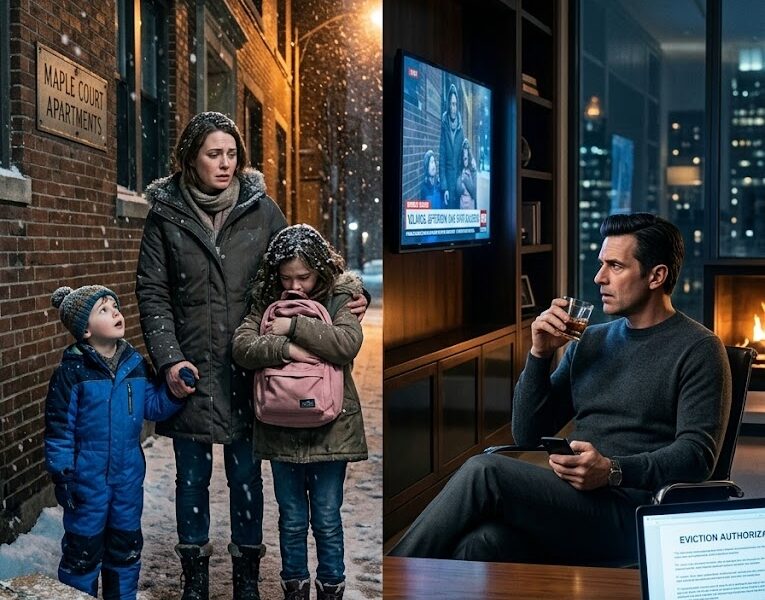
He Built an Empire by Treating Tenants Like Numbers—Then One Frozen Mother Appeared on His Television
Wesley Foster had evicted thousands of people without ever seeing a single one of their faces.
Then, on a freezing night in Philadelphia, one of them appeared on his television.
She was standing on a snow-covered sidewalk with two children beside her, trying not to cry while a reporter held a microphone toward her.
Behind them, movers carried the last pieces of their life out of an apartment building Wesley owned.
And when the woman looked directly into the camera and said, “I called them eleven times,” Wesley felt something inside him stop.
Eleven times.
Not once.
Not twice.
Eleven.
The number followed him long after the news segment ended.
Which was strange, because Wesley Foster had spent most of his adult life believing numbers were the only things that mattered.
That afternoon, less than six hours before he saw Yolanda Jefferson on television, Wesley had been sitting at the head of a polished walnut conference table forty floors above Manhattan.
The windows behind him framed the city like a kingdom he had purchased.
Executives sat around him with tablets, financial reports, occupancy charts, and the carefully controlled expressions of people who knew their careers could change depending on his mood.
Richard Hale, Wesley’s longtime operations chief, tapped the screen in front of him.
“This quarter’s occupancy rate hit ninety-seven percent, sir.”
Wesley barely looked up.
“And the other three percent?”
Richard hesitated.
“We’re handling it.”
“How fast?”
“As fast as legally possible.”
Wesley closed the report.
“Good.”
One of the younger executives shifted uncomfortably.
“There have been some complaints about aggressive enforcement.”
Wesley finally looked at him.
“Complaints from whom?”
“Tenants.”
A silence moved through the room.
Wesley leaned back.
“Sentiment is a luxury.”
Nobody spoke.
He had learned that sentence from his father.
His father had believed business became dangerous the moment emotion entered the room.
People became percentages.
Homes became units.
Late rent became delinquency.
Families became accounts.
And suffering became somebody else’s problem.
Wesley had spent twenty years proving his father right.
His real estate company controlled more than fourteen thousand residential units across several states. He had built an empire around efficiency, occupancy, predictable cash flow, and ruthless enforcement.
The numbers worked.
That was all he cared about.
“People are numbers,” Wesley said quietly. “If the numbers work, the company works.”
Richard nodded.
The meeting continued.
By seven that evening, Wesley had forgotten the conversation.
By nine, he would wish he could forget it forever.
He was alone in his penthouse when the local news began playing in the background.
He normally ignored television.
But then he heard Philadelphia.
Then Maple Court Apartments.
Then the word eviction.
Wesley turned.
Snow was falling under the harsh white light of a television camera.
A woman stood beside several black garbage bags and two battered suitcases.
Her coat looked too thin for the weather.
A little boy stood beside her wearing a blue knit hat, while an older girl hugged a backpack against her chest.
The reporter’s voice was solemn.
“Tonight in Philadelphia, a family was forcibly evicted from their home as freezing temperatures continue across the state.”
The footage changed.
Wesley saw a sheriff’s deputy standing near an apartment door.
The woman was pleading with him.
“Please. Just give me one more day.”
The deputy looked genuinely uncomfortable.
“I’m sorry, ma’am. Court order.”
“One day. I work tonight. I can make another payment Friday.”
“I can’t change the order.”
The little girl tugged at her mother’s sleeve.
“Mom?”
The woman turned immediately.
Her face changed.
The fear disappeared.
The humiliation disappeared.
She smiled.
It was the kind of smile parents used when they were terrified but refused to let their children see it.
“What, baby?”
“Are my school books still inside?”
“I got them all out.”
“All of them?”
“All of them.”
The girl nodded.
The little boy looked at the snow.
“Mom, are we going camping?”
For one second, the woman couldn’t answer.
Then she crouched in front of him.
“Yeah.”
Her voice nearly broke.
“Just a little adventure, sweetie.”
Wesley stopped breathing.
The camera cut again.
The family was now sitting near their belongings on the sidewalk.
The reporter crouched beside the mother.
“Ma’am, is there anything you want people to know?”
The woman stared toward the building.
“I called them.”
“The management company?”
She nodded.
“Eleven times.”
The reporter blinked.
“Eleven?”
“Nobody ever picked up.”
The screen changed to a wide shot of the apartment complex.
The reporter continued.
“Maple Court Apartments are owned by a large real estate corporation. Representatives from the property management company did not respond to our request for comment.”
Maple Court.
Wesley slowly stood.
Outside his windows, Manhattan glittered beneath him.
Warm.
Silent.
Untouchable.
On television, snow collected on a little boy’s hat.
The anchor moved to another story.
“Snowy weather continues across the state—”
“Maple Court.”
Wesley whispered the words.
Then louder.
“Maple Court.”
He grabbed his phone.
Richard answered on the fourth ring.
“Wesley?”
“It’s my building.”
“What?”
“The Maple Court building in Philadelphia.”
Richard was silent.
Wesley looked at the frozen image of the family still lingering in his mind.
“Send me the file on the family that was just evicted.”
“Tonight?”
“Right now.”
“Wesley, something this small—”
“I’m not asking for your opinion, Richard.”
Silence.
“Send it.”
The file arrived seventeen minutes later.
Wesley opened it expecting numbers.
He found a life.
Yolanda Jefferson.
Thirty-four years old.
Night-shift nursing assistant.
Two children.
Five years at Maple Court.
He kept reading.
Fifty-eight months of rental history.
Not a single late payment.
Then everything changed.
Reduced work hours.
A medical expense.
Two partial rent payments.
Six weeks later, eviction proceedings began.
Wesley scrolled faster.
The company had attempted contact through automated notices.
Yolanda had called the payment line eleven times.
Each call had been recorded in the system as “nonresponsive.”
Wesley stared at the word.
Nonresponsive.
She had called eleven times.
The system had called her nonresponsive.
He felt something cold move through his chest.
He opened another document.
Eviction initiated.
Notice issued.
Court filing.
Judgment.
Lockout.
Six weeks.
That was all it had taken.
Fifty-eight months of doing everything right had bought Yolanda Jefferson six weeks of mercy.
Wesley walked to the windows.
His reflection stared back at him.
He could hear his father’s voice.
People are numbers.
Wesley had repeated that philosophy so many times that eventually it had stopped sounding cruel.
It sounded efficient.
Professional.
Necessary.
Until tonight.
He looked again at the photograph attached to the file.
Yolanda.
Her daughter.
Her son.
“These kids aren’t numbers.”
The words came out before he realized he had spoken them.
He called his assistant.
“Nina.”
“Yes, sir?”
“Get the jet ready.”
There was a pause.
“For when?”
“Tomorrow morning.”
“Where are you going?”
“Philadelphia.”
Another pause.
“You’re going in person?”
“Yes.”
“Pinnacle confirmed your meeting at two.”
Pinnacle Property Management.
The company Wesley had hired to operate Maple Court and thousands of his other units.
“Keep the meeting.”
“Yes, sir.”
“But before that, I want to see the building.”
The next morning, Wesley Foster stepped out of a black SUV in front of Maple Court.
The building looked worse in person.
Much worse.
Brickwork was stained with water.
One exterior light flickered.
Trash had collected near a side entrance.
The front door didn’t close properly.
Wesley pulled it once.
The lock barely caught.
He stared at Nina.
“The front door lock is broken.”
“Yes, sir.”
They entered.
A sour smell filled the hallway.
Wesley stopped.
“What is that?”
Nina looked toward a stained section of ceiling.
“Leaking pipes, I think.”
A door opened.
An elderly man looked out.
“You from the company?”
Wesley hesitated.
“Yes.”
The man opened his door wider.
“My heater’s been broken for three weeks.”
“Did you report it?”
The man laughed.
Not because anything was funny.
“A dozen times.”
“What did they say?”
“They don’t say anything.”
He held up his phone.
“All they send back is automated messages.”
Another tenant appeared farther down the hallway.
Then another.
Suddenly Wesley wasn’t touring one malfunctioning property.
He was standing inside the consequences of his own business model.
A woman showed him a window frame.
“Every night I stuff towels in there to keep the wind out.”
A father showed him mold spreading behind a bedroom dresser.
An elderly tenant had been heating her apartment with the oven.
Every complaint had a ticket number.
Every ticket number had been “received.”
Very few had been resolved.
Then Wesley asked the question he had come to ask.
“Did anyone here know Yolanda Jefferson?”
The hallway went quiet.
An older woman stepped forward.
“You asking about Yolanda?”
“Yes.”
“She’s the best person on this floor.”
“You knew her well?”
“She took care of my mother when she was sick.”
The woman’s eyes narrowed.
“Never took a cent from me.”
Another tenant pointed upstairs.
“Unit 3B.”
Wesley climbed the stairs.
He stopped in front of the door.
The lock was new.
Shiny metal against old paint.
“They already changed it,” Nina said.
Wesley touched the lock.
Yesterday morning, Yolanda’s children had woken up behind this door.
Yesterday afternoon, another key had made it impossible for them to return.
He turned toward Nina.
“Call Pinnacle.”
“For the two o’clock meeting?”
“Move it.”
“To when?”
Wesley looked at the new lock.
“Right now.”
Thirty-five minutes later, Wesley sat across from Pinnacle executives.
The regional director greeted him with an enthusiastic smile.
“Mr. Foster, what an honor.”
Wesley didn’t shake his hand.
“Maple Court.”
The smile weakened.
“Sir?”
“Unit 3B.”
Nobody moved.
“Explain.”
The regional director glanced at his general counsel.
“Everything followed procedure.”
“Procedure.”
“Yes, sir. Two missed payments triggered the delinquency system. The notices were automatically issued, followed by the legally required filing.”
“She called eleven times.”
“The automated line records incoming payment interactions.”
“Interactions?”
“It doesn’t record what the calls are about.”
Wesley stared at him.
“Then why didn’t anyone answer?”
“We don’t staff that line for case management.”
“Why didn’t anyone knock on her door?”
The director seemed confused by the question.
“Because the contract doesn’t require it.”
Something about that answer made Wesley’s stomach tighten.
The man opened a binder.
“In fact, Mr. Foster, these are the rules your company approved.”
He slid a document across the table.
Wesley looked down.
Occupancy Optimization Agreement.
There were his initials.
His company’s seal.
Then he found the clause.
Accelerated removal of delinquent occupants to minimize vacancy exposure.
His signature sat beneath it.
Wesley stared at his own name.
For the first time since arriving in Philadelphia, nobody else could be blamed.
Not Pinnacle.
Not the automated system.
Not the lawyers.
Not some careless manager.
Him.
The regional director watched him carefully.
“We only did exactly what you wanted, Mr. Foster.”
Wesley said nothing.
Because the man was right.
An hour later, Wesley stood outside Hope Harbor Shelter on Spring Garden Street.
He couldn’t make himself enter.
Nina watched him.
“Are you okay?”
“No.”
It was perhaps the first truthful answer Wesley had given all day.
“But I have to see her.”
Inside, a volunteer approached him.
“Who are you looking for?”
“Yolanda Jefferson.”
“Are you family?”
“No.”
“Friend?”
Wesley swallowed.
“I own the building she used to rent in.”
The volunteer’s expression changed.
“The landlord.”
“Yes.”
“I’ll ask if she wants to see you.”
Wesley waited.
He had negotiated hundred-million-dollar acquisitions without feeling what he felt during those three minutes.
Finally Yolanda appeared.
She was wearing scrubs.
She had apparently come directly from work.
Her eyes found Wesley immediately.
“You’re Wesley Foster?”
“Yes.”
He stepped forward.
“I came to apologize.”
Her face remained still.
“I read your file. Fifty-eight months and you were never late once.”
“And two months was all it took to throw my kids onto the street.”
Wesley had prepared words.
None survived that sentence.
“I want to make this right.”
“How?”
“Whatever you need.”
Yolanda laughed softly.
“You think I need your charity?”
“No.”
“You came here with money?”
Wesley didn’t answer.
That was answer enough.
“You came here so I’d say thank you.”
“No.”
“So you could sleep tonight.”
The words landed harder than anger would have.
“I just want to help.”
“I don’t need a hero, Mr. Foster.”
Yolanda stepped closer.
“I need a system that doesn’t crush people because they stumble once.”
Wesley looked around.
Families filled the shelter.
A man asleep in a chair.
A mother helping her daughter with homework.
A toddler clutching a stuffed rabbit.
“There are dozens of families like mine in here,” Yolanda said. “Are you going to write every one of them a check?”
Wesley looked at her.
And something finally became clear.
He had spent his entire life believing money could solve whatever money had damaged.
But a check wouldn’t change the machine.
It would only make him feel better about owning it.
“You’re right.”
Yolanda folded her arms.
“A check doesn’t fix anything.”
“No.”
He looked directly at her.
“I’m going to fix the system.”
“Anyone can say that, Mr. Foster.”
“When I’ve done it, I’ll come back and show you.”
Before Yolanda could respond, her little boy approached.
“Mister?”
Wesley looked down.
“Yes?”
“Do you have a home?”
“I do.”
The boy thought about that.
“Is it warm?”
Wesley remembered his penthouse.
The heated floors.
The fireplace.
The windows overlooking Manhattan.
Yet he heard himself say something else.
“My home is very cold.”
The boy didn’t understand.
Yolanda did.
She took her son’s hand.
“Don’t make promises you can’t keep.”
The little boy nodded solemnly.
“Grown-ups do that a lot.”
Wesley looked at him.
“Then I’ll keep this one.”
He left the shelter and called Richard before reaching the SUV.
“Freeze every eviction.”
Richard went silent.
“What?”
“All fourteen thousand units.”
“Wesley—”
“Tonight.”
“You can’t be serious.”
“I am.”
“The board will have my head.”
“Then have the board call me.”
“We’ll lose millions.”
Wesley stopped walking.
“We’ve already lost more than that.”
Richard exhaled.
“What does that even mean?”
“It means nobody was counting the right things.”
Wesley looked back toward the shelter.
“Freeze them.”
Then he called Nina.
“Hire the best repair crews in Philadelphia.”
“How many?”
“Enough.”
“For Unit 3B?”
“For all of Maple Court.”
He began walking again.
“Heaters. Lights. Pipes. Windows. Locks. Everything.”
“Yes, sir.”
“And Unit 3B?”
“One week.”
Wesley paused.
“No.”
Nina waited.
“Faster.”
The following morning, Wesley received a call from his father.
The old man didn’t say hello.
“Have you lost your mind?”
“No.”
“You froze fourteen thousand eviction cases.”
“Yes.”
“Do you understand what you’ve done?”
Wesley looked at the photograph of Yolanda’s children on his desk.
“Yes.”
His father’s voice hardened.
“I taught you better.”
Wesley closed his eyes.
“No, Father.”
Silence.
“You taught me exactly this.”
“What is that supposed to mean?”
“You were wrong.”
Wesley ended the call.
For the first time in his life, it didn’t feel like rebellion.
It felt like adulthood.
Within days, Maple Court changed.
Repair vans filled the parking lot.
Boilers were serviced.
Broken lights were replaced.
Leaks were repaired.
Windows were sealed.
The elderly man who had lived without heat for three weeks stood beside Wesley when warm air finally came through his vent.
He held his hand over it.
Then laughed.
“First time in three weeks.”
Wesley looked at him.
“I’m sorry I made you wait that long.”
But Wesley knew apologies were easy.
Systems were harder.
Six days after visiting the shelter, he returned.
Yolanda looked surprised.
“You came back faster than I thought.”
“Unit 3B is ready.”
She stared at him.
“And every eviction has been stopped.”
“All of them?”
“All fourteen thousand.”
Yolanda searched his face.
“Why?”
“Because I promised you I would start fixing it.”
He handed her a folder.
“You and your children also have six months without rent.”
Her expression immediately hardened.
“I don’t want your pity.”
“It’s not pity.”
“Then what is it?”
Wesley held her gaze.
“What my company owes you.”
Yolanda looked down at the folder.
For several seconds, she said nothing.
Then she turned toward her children.
“Pack your things.”
Her daughter froze.
“We’re going home?”
Yolanda smiled.
“For real.”
The boy jumped up.
“We’re going home!”
When they reached Maple Court, Wesley let Yolanda unlock the door herself.
He handed her the key.
“A new lock.”
She turned it in her fingers.
“Your key,” Wesley said. “No one’s changing it on you again.”
The door opened.
The apartment looked familiar, but repaired.
Fresh paint.
Working lights.
Sealed windows.
A warm room.
Her daughter ran inside.
“Mom! Our home is so bright.”
The boy found a desk near the window.
“Is this mine?”
Wesley nodded.
“It’s yours.”
“For homework?”
“Study hard.”
The boy grinned.
“Okay.”
Yolanda stood near the doorway.
Her eyes filled, but she refused to let the tears fall.
“Thank you.”
Wesley looked at her.
“For what?”
“For actually listening.”
He shook his head.
“You’re the one who taught me how.”
Her son appeared beside them.
“Mister?”
“Yes?”
“We’re not going camping this time, right?”
Wesley crouched until they were eye level.
“No.”
He pointed toward the apartment.
“This is your home.”
But returning one family wasn’t enough.
Wesley knew that now.
Two days later, he fired Pinnacle.
Richard nearly exploded.
“They manage four thousand of our units.”
“Not anymore.”
“Who will?”
“We will.”
“That means hiring hundreds of people.”
“Then hire them.”
“Wesley—”
“No more hiding behind contractors.”
The board meeting became even worse.
Wesley stood before twelve furious directors.
“Rule one,” he said. “Any tenant who falls behind must be contacted by a human being and offered an in-person meeting.”
One director shook his head.
“That’s expensive.”
“Rule two. Thirty days to explain the circumstances before eviction procedures begin.”
Another director leaned forward.
“You’re turning a real estate company into a social service.”
“Rule three. We establish an emergency assistance fund for tenants experiencing temporary crises.”
The room erupted.
Wesley waited.
Eventually everyone stopped talking.
Then he placed several reports on the table.
“Legal fees.”
Another report.
“Vacancy costs.”
Another.
“Cleaning and repairs after eviction.”
Another.
“Court expenses.”
He looked around the room.
“Have any of you ever added these together?”
Nobody answered.
“Give me one year.”
The chairman stared at him.
“And if profits drop?”
“I’ll take the hit myself.”
“One year, Wesley.”
That year changed thousands of lives.
A property manager named Tasha knocked on Luis Alvarez’s door after his rent payment failed.
Luis opened it pale with fear.
“You’re behind this month,” she said.
His shoulders dropped.
“I know.”
“Is everything okay?”
“They cut my hours.”
He looked toward his children inside the apartment.
“I thought you came to evict me.”
Tasha shook her head.
“Not at all. You have thirty days, and the emergency fund may be able to help.”
Luis stared at her.
Nobody from a landlord’s office had ever asked him if he was okay.
Months passed.
Yolanda returned to school.
After night shifts, she studied at the desk beside her daughter.
Some evenings she fell asleep over textbooks.
Her children would cover her with a blanket.
“One page at a time,” she told them.
Then one afternoon, a supervisor found her at the hospital.
“Yolanda?”
“Yes?”
“Room twelve is asking for you again.”
She smiled.
“He says nobody else does it right.”
That evening Yolanda opened an envelope at her kitchen table.
Her daughter watched.
Her son bounced impatiently.
“Well?”
Yolanda read the paper again.
Then she covered her mouth.
“I passed.”
The children screamed.
Her son wrapped both arms around her.
“Mom’s a nurse now!”
For the first time in years, Yolanda cried without hiding it.
A year after Wesley changed the policies, the board gathered again.
Richard placed a report on the table.
“Evictions are down seventy-eight percent.”
One director crossed his arms.
“Fine. And profits?”
Richard looked toward Wesley.
“Legal costs fell.”
He turned the page.
“Vacancies dropped sharply.”
Another page.
“Turnover expenses decreased.”
The chairman leaned forward.
“And profits?”
Richard almost smiled.
“Up.”
Silence.
Wesley looked around the room.
“Turns out compassion is cheaper than cruelty.”
Eighteen months after the night Yolanda Jefferson sat on a frozen sidewalk, Wesley returned to Philadelphia for a company housing summit.
He stood backstage when someone approached.
“You came.”
Yolanda smiled.
“I made a promise too. Remember?”
She was wearing her nursing badge.
Her children sat in the front row.
“Are you ready?” Wesley asked.
Yolanda looked through the curtain at hundreds of property managers, executives, tenant advocates, and employees.
“Eighteen months ago, I was sitting on a sidewalk.”
She took a breath.
“Now I’m ready.”
When her name was announced, Yolanda walked onto the stage.
The applause began politely.
Then she spoke.
“I was once labeled.”
The room quieted.
“Delinquent.”
She looked toward Wesley.
“Nonresponsive.”
A few executives shifted in their seats.
“But I called eleven times.”
Silence.
“I wasn’t irresponsible. I wasn’t lazy. I wasn’t trying to cheat anybody.”
Her voice trembled slightly.
“I was a mother who stumbled.”
She looked toward her children.
“And what my family needed wasn’t pity.”
Then back toward the audience.
“We needed a chance to stand back up.”
The applause came slowly.
Then all at once.
People stood.
Wesley remained backstage, listening.
He realized something his father had never taught him.
A business could measure occupancy.
Revenue.
Losses.
Payments.
Vacancies.
But there were things no spreadsheet could measure.
The terror in a mother’s face when she didn’t know where her children would sleep.
The humiliation of asking for one more day.
The warmth of a repaired heater.
The weight of a new key in someone’s palm.
The difference between charity and dignity.
Later, outside the building, Yolanda’s son found Wesley.
He was taller now.
“Mister?”
Wesley smiled.
“You still call me that?”
The boy ignored the question.
“I figured out what a home is.”
Wesley crouched slightly.
“Yeah?”
“Yeah.”
“What is it?”
The boy thought carefully.
Then said:
“It’s a place where nobody makes you leave.”
Wesley couldn’t answer immediately.
Because somewhere inside those simple words was every mistake he had made.
Every eviction notice he had never seen.
Every family reduced to a row in a spreadsheet.
Every signature he had placed beneath a policy without asking what it looked like when applied to an actual human being.
The boy suddenly remembered something.
“Oh.”
“What?”
“My classmate Jada sleeps in a car with her mom.”
Wesley looked at him.
“Tonight?”
The boy nodded.
“They don’t have anywhere.”
Eighteen months earlier, Wesley Foster might have heard that story and asked which department handled it.
Now he asked only one question.
“Tell me her mom’s name.”
The boy smiled.
“Okay.”
Wesley stepped aside and pulled out his phone.
“Tasha?”
“Yes, Mr. Foster?”
“It’s Wesley.”
“What do you need?”
He watched Yolanda laughing with her daughter beneath the Philadelphia streetlights.
“There’s a family that needs help tonight.”
Tasha didn’t ask whether they were tenants.
She didn’t ask whether helping them was required by contract.
She didn’t ask for an account number.
“Send me the information.”
Wesley smiled.
“I will.”
He ended the call.
That evening, long after the summit was over, Wesley returned alone to Maple Court.
Snow had begun falling again.
Almost exactly like the night he first saw Yolanda on television.
But the building looked different now.
Every hallway light worked.
Warm yellow squares glowed behind apartment windows.
The front door locked properly.
Somewhere upstairs, someone was laughing.
Wesley stood across the street and stared at the building.
His phone rang.
Father.
For several seconds, he considered ignoring it.
Then he answered.
“Hello?”
His father’s voice had weakened over the past year.
Age had finally begun doing what no competitor had ever managed to do.
Slow him down.
“I watched the speech.”
Wesley said nothing.
“I heard the woman.”
“Yolanda.”
“Yes.”
Silence stretched between them.
Then his father said, “You embarrassed the company.”
Wesley almost smiled.
“Probably.”
“You admitted we were wrong.”
“We were.”
Another silence.
“Your profits increased.”
“So that’s what convinced you?”
“No.”
That answer surprised Wesley.
His father breathed slowly into the phone.
“I saw the boy.”
Wesley looked toward Unit 3B.
“What about him?”
“He reminded me of you.”
Wesley said nothing.
“When your mother died,” his father continued, “you were nine.”
Wesley closed his eyes.
He rarely spoke about those years.
“I thought if I made enough money, nothing could ever happen to us again.”
His father paused.
“I suppose somewhere along the way, I confused security with hardness.”
Snow collected on Wesley’s coat.
“You taught me people were numbers.”
“I know.”
“And I believed you.”
“I know.”
Wesley looked at the apartment windows.
A shadow crossed one.
Then another.
Lives moving behind glass.
Families eating dinner.
Children doing homework.
People worrying about bills.
People trying again tomorrow.
His father spoke once more.
“Wesley?”
“Yes?”
“I was wrong.”
Those were three words Wesley had spent most of his life believing his father was incapable of saying.
He looked up at the falling snow.
“Yeah.”
His voice softened.
“You were.”
His father laughed faintly.
Then came another silence.
“People aren’t numbers,” Wesley said.
This time his father didn’t argue.
“Thank you, sweetheart.”
Wesley froze.
His father had not called him that since childhood.
The line went quiet.
Wesley lowered the phone.
Across the street, the entrance to Maple Court opened.
A woman stepped outside carrying a hospital bag.
Yolanda.
She saw him and stopped.
“You planning to stand out there all night?”
Wesley smiled.
“Just looking.”
“At what?”
“The building.”
Yolanda crossed the street.
Snow caught in her hair.
“Looks different now.”
“It does.”
She followed his gaze.
“You know what the funny thing is?”
“What?”
“It was always somebody’s home.”
Wesley looked at her.
“You just couldn’t see it.”
He nodded.
That was the truth.
For years, Wesley had seen fourteen thousand units.
Fourteen thousand leases.
Fourteen thousand sources of revenue.
He had seen occupancy percentages.
Late-payment ratios.
Turnover costs.
Legal exposure.
He had seen everything except the people living behind the doors.
Until one mother called eleven times.
Until one little girl worried about her schoolbooks.
Until one little boy thought homelessness was camping because his mother loved him enough to disguise terror as adventure.
The snow continued falling over Philadelphia.
Wesley looked up at Unit 3B.
A small lamp glowed beside the study desk.
Tomorrow there would still be late payments.
There would still be difficult decisions.
Some tenants would leave.
Some would fail.
Some would abuse second chances.
Compassion had not transformed the world into something simple.
It had only forced Wesley to stop pretending people were simple.
Yolanda started toward the building.
“You coming inside?”
“In a minute.”
She nodded and crossed the street.
At the entrance, she stopped.
“Wesley?”
“Yeah?”
“Eleven calls.”
He smiled sadly.
“I remember.”
“Good.”
She disappeared inside.
The door closed behind her.
Wesley remained beneath the snow.
His phone buzzed.
A message from Tasha.
Jada and her mother are safe tonight.
Wesley read it twice.
Then he looked at the building his company once measured only by occupancy.
Ninety-seven percent.
Three percent.
Those numbers had once seemed like everything.
Now, behind fourteen thousand doors, there were names.
There were mothers studying after midnight.
Fathers working reduced shifts.
Children doing homework beneath repaired lights.
People losing jobs.
People getting sick.
People falling behind.
People getting back up.
And somewhere, another phone might already be ringing.
This time, someone would answer.









