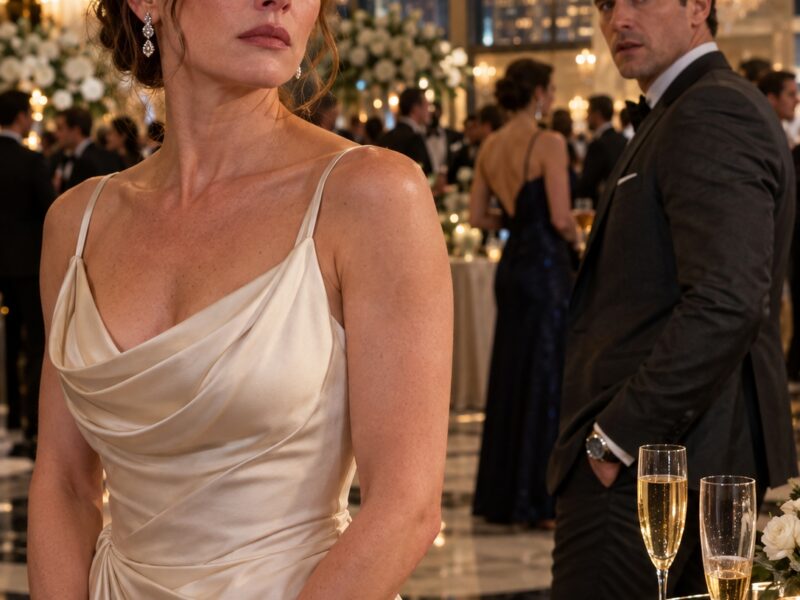
HE CALLED HIS WIFE “DIFFICULT” IN FRONT OF CHICAGO’S ELITE—THEN SHE QUIETLY STOPPED BEING HIS WIFE

The most expensive mistake Darius Cole ever made cost him nothing the night he made it.
No contract collapsed.
No investor walked away.
No headline appeared the next morning.
He lost no money, no company, no property, no influence.
All Darius did was make a room full of wealthy people laugh.
And three seconds later, when he turned and saw his wife standing behind him with an untouched glass of champagne in her hand, he realized he had never heard silence sound so much like a door locking.
The ballroom of Chicago’s Blackstone Hotel glittered beneath crystal chandeliers that made everything appear more beautiful than it really was.
Marble floors reflected tuxedos, evening gowns, silver trays, diamonds, polished shoes and the soft gold glow of money that had been accumulated over generations or earned aggressively in less than one.
The annual Whitmore Children’s Foundation gala was one of those events where generosity and ambition wore the same expensive suit.
Senators shook hands with developers.
Hospital executives laughed with hedge-fund managers.
Young founders stood straighter when old money walked past.
And when Darius Cole entered a room, people noticed without anyone announcing his name.
At forty-one, Darius had built Cole Meridian Logistics from three leased trucks and a borrowed warehouse into one of the largest privately held freight and distribution companies in the Midwest. His name appeared on terminals, scholarship programs, hospital wings and business-magazine covers.
He wore power quietly.
Charcoal suit. White shirt. Silver watch. No unnecessary display.
That restraint made people pay closer attention.
Beside him stood Vivien Hart Cole, his wife of seven years.
She wore ivory.
Nothing glittered except a pair of small diamond earrings Darius had given her on their fifth anniversary, and even those seemed deliberately understated against the elaborate gowns moving around them.
Vivien had never needed to fight for attention.
She remembered people instead.
That was her gift.
She remembered that Mr. Calloway’s wife had undergone knee surgery in June.
She remembered that one of Darius’s investors had a daughter applying to Northwestern.
She remembered which donor had recently lost his mother and which executive had just become a grandfather.
She remembered names of assistants, receptionists, spouses, children and people who rarely mattered to men like Darius until suddenly they did.
Many of Darius’s strongest relationships had become warmer because Vivien made powerful people feel seen before anyone asked them to sign anything.
Darius knew she was good at that.
He simply had not thought about how good in a very long time.
That evening, Vivien stood near an elderly donor named Eleanor Whitaker, asking about her recovery from surgery, when Darius joined a small group near the bar.
One of them was Marissa Vale.
Marissa was thirty-eight, sharp, elegant and professionally charming. She advised luxury brands on expansion strategy and seemed to know everyone worth knowing in New York, Los Angeles or Chicago.
She was not doing anything inappropriate.
Neither was Darius.
That would matter later.
Because betrayal did not always require an affair.
Sometimes humiliation could cut deeply enough on its own.
“Mr. Cole,” Marissa said, smiling as she lifted her champagne. “I spent two hours with three retail executives today, and I’m reconsidering every life decision that led me into consulting.”
Darius smiled.
“You get used to impossible people.”
A man beside them laughed.
Marissa tilted her head. “That sounds suspiciously personal.”
“Occupational hazard.”
“And here I thought logistics was just trucks and warehouses.”
“It is,” Darius said. “The trucks are easier.”
Another laugh.
The conversation loosened.
Someone made a joke about board members.
Someone else complained about clients who changed their minds after contracts were drafted.
Marissa rested one elbow lightly against the cocktail table.
“At least I’m probably easier than negotiating with your board.”
Darius lifted his glass.
He could have said almost anything.
Instead, he glanced toward the circle of amused faces and answered without thinking.
“You’re much easier than my wife.”
The laughter came immediately.
Automatic.
Polite.
Expected.
Darius laughed too.
Then Marissa stopped.
A man across from Darius lowered his eyes.
Someone else suddenly became very interested in the floral arrangement beside the bar.
Darius’s smile faded.
“What?”
Nobody answered.
Marissa’s gaze moved past his shoulder.
Darius turned.
Vivien stood six feet behind him.
Her right hand held a champagne flute by the stem.
Her left rested loosely against her waist.
She had clearly heard him.
Darius had seen Vivien angry before.
He had seen her frustrated, disappointed, exhausted and once furious enough to throw a dish towel onto the kitchen counter so hard that Nia had giggled from the breakfast table.
This was different.
There was no anger in her face.
That frightened him more.
She looked at him as if something had finally become clear.
“Vivien—”
She stepped forward.
Every person in the circle suddenly understood that they were standing too close to something private.
Vivien placed her untouched champagne beside Darius’s half-empty glass.
Crystal touched polished wood with the smallest click.
Darius would remember that sound months later.
She looked directly into his eyes.
“Enjoy the rest of your evening.”
Her voice was quiet.
Almost kind.
Then she turned.
“Vivien.”
She kept walking.
“Viv.”
She did not hurry.
She did not embarrass him.
She did not make a scene.
She passed beneath the chandeliers with the same composed posture she had carried into hundreds of rooms beside him.
The golden ballroom doors opened.
Then closed behind her.
Darius stood motionless.
A moment later, applause exploded from the opposite side of the ballroom as the auctioneer announced that a vacation property had sold for seventy-five thousand dollars.
The timing was almost obscene.
Marissa cleared her throat.
“I should probably—”
“You didn’t do anything,” Darius said.
“I know.”
But her expression suggested she knew that wasn’t the point.
She walked away.
Charles Benton, one of Darius’s oldest business associates, touched his arm.
“Everything okay?”
“Of course.”
The answer came instantly.
It had served Darius well for twenty years.
Everything okay?
Of course.
Are you worried?
No.
Can we handle it?
Absolutely.
Will the company survive?
Without question.
Confidence had become so instinctive that sometimes Darius answered before examining whether the answer was true.
Charles studied him for a second.
“All right.”
Darius turned toward the closed doors.
Vivien had never left an event without him.
Not once.
Even during the year his company had nearly lost a major federal contract and he had become impossible to live with, she had stayed beside him through every dinner, every fundraiser, every strained car ride home.
Darius looked down.
Their champagne glasses remained beside one another.
His was half empty.
Hers was untouched.
He set his glass down and left.
Outside, October air rolled between the buildings, cold enough to sharpen every breath.
Black SUVs lined the curb beneath the hotel awning.
Their driver, Marcus, saw Darius and immediately opened the rear door.
Vivien was already inside.
She sat on the far side of the vehicle, facing the window.
She wasn’t on her phone.
She wasn’t crying.
That bothered Darius.
He would have known what to do with crying.
He could apologize to crying.
He could hold crying.
He could explain himself to anger.
This calm gave him nothing to fight.
He climbed inside.
Marcus closed the door.
The SUV pulled away from the curb.
For four blocks, neither of them spoke.
Chicago passed outside in reflections of red brake lights, glass towers and wet pavement.
Darius loosened his tie.
“It was a joke.”
Vivien kept watching the window.
“People were laughing.”
Nothing.
“That’s what happens at those things. Everybody says stupid things.”
Still nothing.
Darius looked at her reflection in the glass.
“You know I didn’t mean it.”
Vivien blinked once.
Then she spoke.
“I know you meant to make them laugh.”
Darius waited.
She turned toward him.
“That’s different.”
He frowned.
“What does that mean?”
Her expression remained strangely gentle.
“Do you know what hurt?”
“Vivien—”
“Do you?”
He stopped.
She looked toward the city again.
“It wasn’t the sentence.”
“Then what was it?”
“How easily it came to you.”
Steel beams from the elevated train passed overhead, throwing moving bands of shadow through the SUV.
Darius leaned back.
“It was one stupid sentence.”
“Yes.”
“So why are we turning it into something bigger?”
Her lips pressed together.
There it was.
The first tiny reaction.
“You think I’m turning it into something.”
“That’s not what I said.”
“You said I’m making it bigger.”
“I’m saying you’re overthinking it.”
Vivien nodded once.
Not in agreement.
In recognition.
That reaction unsettled him.
Usually she would explain herself.
She would argue.
She would say, Let me finish, Darius.
She would insist that they not go to sleep angry.
She believed almost obsessively that problems should be spoken aloud before silence gave them roots.
Tonight she said nothing.
Darius leaned forward.
“Viv.”
“Maybe you’re right.”
He almost relaxed.
Then he saw her face.
She did not believe he was right.
She had simply decided convincing him no longer mattered.
The realization followed them all the way home.
Their estate sat north of the city on several acres surrounded by mature trees and high stone walls.
Warm light glowed through the windows as the SUV curved around the circular driveway.
Usually, Darius got out first.
Usually, he walked around and opened Vivien’s door.
It was a ridiculous little ritual considering Marcus was paid to do exactly that.
Vivien had once joked that Darius could negotiate nine-figure acquisitions but would still race his own driver to open her door.
That night, before the SUV fully stopped, she reached for the handle herself.
“Vivien.”
She stepped out.
“Thank you, Marcus.”
“Good night, Mrs. Cole.”
She walked toward the house alone.
Darius followed.
Inside, the grandfather clock in the foyer ticked steadily.
Family photographs lined the hallway.
Business Darius understood through numbers.
Relationships left no balance sheet.
Still, even he could feel something in the house had changed.
On the way upstairs, he stopped beside a photograph taken three summers earlier at Lake Michigan.
Nia, six then, stood between them in a yellow swimsuit, laughing with both front teeth missing.
Vivien held one of her hands.
Darius held the other.
He stared at the photograph for only a few seconds.
Then he continued upstairs.
The master bedroom door was closed.
He turned the handle.
Locked.
Darius stared at the knob.
He knocked.
“Vivien?”
Silence.
He knocked again.
“Come on. Don’t do this.”
Nothing.
He rested his palm against the wood.
“We can talk.”
No response.
He stood there long enough to become embarrassed even though nobody could see him.
Finally he walked to the guest room.
For the first time since their wedding, Darius Cole slept under his own roof with a locked door between himself and his wife.
But the locked door was not what frightened him most.
It was the possibility that Vivien had stopped believing there was anything left to discuss.
Morning arrived pale and cold.
Darius woke shortly after six in the guest bedroom, still wearing yesterday’s exhaustion like another layer of clothing.
He showered, dressed and stepped into the hallway.
The master bedroom door stood open now.
The bed was perfectly made.
Vivien was gone.
For years, Darius’s mornings had followed a rhythm so dependable he had stopped thinking of it as effort.
Coffee before seven.
Financial news playing softly.
Travel mug beside his briefcase.
His preferred yogurt stocked in the refrigerator.
Cufflinks placed on the dresser if he had an early meeting.
Umbrella in the SUV if rain was expected.
A handwritten reminder if Nia had a school event.
None of those things seemed significant individually.
That was precisely why he had never measured them.
He walked downstairs while reading emails.
The kitchen was spotless.
He stopped.
No coffee smell.
The machine sat dark.
No newspaper.
No travel mug.
No breakfast.
Darius lowered his phone.
He opened one cabinet.
Then another.
Coffee filters.
Where did she keep the filters?
He found them on the third try.
The beans were easier.
He had no idea which setting she normally used.
He pressed buttons until the machine finally began grinding.
The noise seemed aggressively loud in the quiet kitchen.
When the coffee finished, he took a sip.
Bitter.
“Dad?”
Nia entered wearing her navy school jumper, one backpack strap hanging down her arm.
At eight, she had Darius’s dark eyes and the unnerving ability to notice tension adults hoped children would miss.
“Morning, bug.”
“Why are you making coffee?”
He looked at the mug.
“Because adults are capable of making coffee.”
She smiled.
“Vivien says you burn water.”
“I do not burn water.”
“You burned spaghetti once.”
“That was different.”
“How?”
“I was taking a call.”
“So you burned water because you were working.”
Darius almost laughed.
Then Nia glanced around.
“Where’s Vivien?”
“Getting ready, probably.”
Nia climbed onto a stool.
“What are we having?”
Darius opened the refrigerator.
He had not considered breakfast.
“Cereal?”
Her face fell.
“We’re out of my cereal.”
Of course they were.
Because somebody had always known when they were running low.
Before Darius could answer, Vivien entered.
Light blue blouse. Cream trousers. Hair tied neatly at the nape of her neck.
She looked rested.
“Good morning.”
Nia jumped down.
“Viv!”
Vivien hugged her.
“Backpack.”
Nia groaned.
“What?”
“Your strap is twisted.”
“Oh.”
Vivien fixed it.
Then she crossed to the stove.
A covered plate sat warming near the oven.
She placed pancakes and sliced strawberries in front of Nia.
“Eat.”
Nia smiled.
“Thank you.”
Vivien poured her orange juice and prepared herself a small bowl of yogurt and fruit.
Darius waited.
A ridiculous instinct.
He waited for another plate.
Vivien sat down.
No plate appeared.
Nia looked between them.
“Dad, aren’t you eating?”
“I’ll grab something downtown.”
Vivien spooned yogurt quietly.
Darius stared at the empty counter.
It wasn’t punishment.
That almost made it worse.
She had made breakfast for the person who needed breakfast from her.
Nia.
She had simply stopped anticipating the needs of a grown man who had spent years treating her anticipation as background noise.
Darius checked his watch.
“I’ve got an early board meeting.”
Vivien nodded.
“Marcus is waiting.”
That was all.
No reminder about his presentation.
No question about lunch.
No Have you eaten?
No You forgot your—
Darius stood.
His briefcase wasn’t beside the door.
He frowned.
“Have you seen my briefcase?”
Vivien looked at him.
“No.”
He waited.
She returned to her yogurt.
Darius remembered leaving it in his study.
He retrieved it himself.
Thirty seconds.
It took thirty seconds.
Yet somehow those thirty seconds irritated him.
At the front door, Nia called, “Bye, Dad!”
“Bye, sweetheart.”
He looked toward Vivien.
She was wiping syrup from Nia’s fingers.
“Have a productive meeting,” she said.
Professional.
Polite.
Darius opened the door alone.
As the SUV pulled down the driveway, he looked back.
Through the kitchen window he could see Vivien helping Nia put strawberries into her lunch container.
Neither of them watched him leave.
That image stayed with him through his entire board meeting.
By Tuesday evening, Darius had almost convinced himself things were normal.
Vivien answered questions.
She coordinated Nia’s schedule.
She attended foundation calls.
She discussed household matters.
She slept in the master bedroom.
Darius slept in the guest room.
But there had been no dramatic declaration.
No separation.
No attorney.
No packed suitcase.
To everyone outside the house, nothing had happened.
Inside, Darius began noticing absence the way a person notices a missing tooth with his tongue.
He came home at 8:17 Tuesday night.
The dining room lights were on.
For seven years, that meant Vivien had waited.
He walked in.
The table was empty.
A covered plate sat on a warming tray in the kitchen.
Mrs. Alvarez, their longtime housekeeper, looked up.
“Good evening, Mr. Cole.”
“Where is everyone?”
“Mrs. Cole and Miss Nia ate about forty-five minutes ago.”
“Oh.”
“She asked me to keep your dinner warm.”
Darius glanced toward the stairs.
“They already went up?”
“Miss Nia is working on a school project. Mrs. Cole is helping.”
“Right.”
He carried his plate into the dining room.
Three chairs surrounded one end of the long table.
He sat in his usual chair.
Vivien’s chair across from him remained empty.
Halfway through dinner, he thought about a negotiation that afternoon.
A competitor had tried to force an aggressive price reduction.
Darius had outmaneuvered them.
Normally, he would have told Vivien.
Not because she understood every technical detail of logistics.
Because she understood him.
She would listen, ask one irritatingly perceptive question and somehow expose the part of the negotiation he was still thinking about.
Darius raised his head.
The chair was empty.
He finished dinner without speaking.
Upstairs, he found Nia and Vivien in the library.
Photographs covered the table.
Colored paper, glue sticks and markers formed a small disaster zone around them.
“Dad!”
Nia held up a poster board.
“Family timeline.”
“Looks serious.”
“It’s worth twenty percent of my grade.”
“At eight years old?”
“Yes.”
“That seems excessive.”
Vivien almost smiled.
Almost.
Nia pointed to a photograph.
“This was when I learned to swim.”
“Lake Geneva.”
“Viv remembered.”
Darius looked at Vivien.
She lowered her eyes to the ruler in her hand.
Nia pointed again.
“This one is Christmas.”
“I remember that.”
“You bought me the telescope.”
“I absolutely remember that.”
“You missed Christmas breakfast because you had to call Singapore.”
The sentence hit him unexpectedly.
Nia didn’t sound angry.
Children often delivered painful facts without accusation.
Darius glanced toward Vivien.
She didn’t rescue him.
“Yeah,” he said quietly. “I remember that too.”
Nia returned to her project.
“Viv says we need another picture from that day.”
“I’ll find one.”
Vivien slid a photograph into place.
“Thank you.”
Darius waited.
That was it.
No How was work?
No Did you eat?
No You look tired.
He walked out.
In the hallway, he passed a mirror.
Then stopped.
His tie was crooked.
He stared at it.
Vivien used to fix his tie constantly.
Before dinners.
Before meetings.
In elevators.
In parking garages.
Once during a television interview, she had reached up two seconds before the cameras rolled, straightened the knot and whispered, “Now you look like someone who knows what he’s doing.”
Darius had rolled his eyes.
He had forgotten that moment until now.
He raised both hands and adjusted the tie himself.
It still looked wrong.
On Thursday, the absence followed him into work.
He attended another charity luncheon at the Langham.
Vivien normally prepared him for events without ever calling it preparation.
“Ask Leonard about his granddaughter.”
“Don’t mention the merger to Sean until after dessert.”
“Mrs. Whitaker had surgery last month.”
“Remember, the Bakers are funding pediatric oncology now.”
Darius had occasionally teased her.
“You should work for intelligence.”
She would answer, “I do. I married you.”
That Thursday, he walked into the luncheon with only a printed seating chart.
Halfway through the first course, investor Graham Wallace asked, “How’s Vivien’s foundation project going?”
Darius paused.
“Which one?”
“The neighborhood arts program.”
“Right.”
Graham waited.
Darius realized he had no idea what stage the project was in.
“She’s been working hard on it.”
“I heard they secured the building.”
Darius smiled.
“Yes.”
Had they?
Graham continued talking, mercifully filling the gap.
For the first time in years, Darius felt unprepared in a room where he was expected to know everything.
That afternoon he searched the Hart Family Foundation website from his office.
Vivien’s photograph appeared under the board of directors.
Below it was an article about the youth arts center opening in South Chicago.
The project had taken fourteen months.
Darius had signed two donation approvals.
He had never asked to see the building.
His assistant knocked.
“Mr. Cole?”
Darius closed the browser instinctively.
“Yes?”
“Your four-thirty is here.”
“Send them in.”
But through the entire meeting, one sentence kept returning.
Fourteen months.
Vivien had spent fourteen months building something for children across the city.
And her husband had known less about it than Graham Wallace.
Friday afternoon, rain pressed against the windows of Cole Meridian headquarters.
Darius dismissed his final meeting early.
His chief operating officer looked surprised.
“We can finish the projections.”
“Monday.”
“You sure?”
“Yes.”
By four fifteen, Darius was on the road home.
He had no plan.
That annoyed him.
Darius planned everything.
Acquisitions had models.
Negotiations had contingencies.
Expansion had timelines.
Marriage, apparently, had none.
When he entered the estate, Nia was still at school.
The house felt unusually quiet.
Darius went upstairs.
At the end of the corridor, Vivien’s small private room stood slightly open.
He had always called it her reading room.
She called it her office.
That difference suddenly embarrassed him.
Darius stepped inside.
White shelves covered one wall.
The large window overlooked the autumn garden.
A worn chair sat near the glass beneath a knitted throw.
Nia’s drawings were framed beside foundation programs.
A photograph of Vivien and Nia at a volunteer event sat on the desk.
Darius picked it up.
Both were wearing paint-stained T-shirts.
He had never seen the photograph.
Beside it sat a dark blue notebook.
He touched the cover.
Stopped.
No.
He had no right to read her private journal.
He turned away.
Then he noticed several loose pages beneath it.
Not diary pages.
Lists.
Vivien’s handwriting.
Monday — confirm Nia’s dental appointment.
Tuesday — send flowers to Eleanor Whitaker after surgery.
Wednesday — remind Darius about his mother’s birthday before noon because he’ll feel terrible if he forgets again.
Thursday — umbrella in his SUV. Rain expected after five.
Friday — reserve his favorite table. He’ll forget until dinner.
Darius stared.
He lifted another sheet.
Order Colombian beans before current bag runs out.
Replace batteries in hallway clock. Darius notices uneven ticking when stressed.
Ask tailor to reinforce left jacket pocket. He keeps phone there.
Move pediatric fundraiser call because Nia has school conference.
Confirm Marcus has alternate route to O’Hare before Darius’s morning flight.
Call pharmacy for his allergy prescription.
He read page after page.
Hundreds of details.
His details.
His mother.
His preferences.
His routines.
His stress.
His schedule.
The invisible machinery of Darius Cole’s life sat in front of him in Vivien’s handwriting.
Not once had he asked how any of it happened.
He simply woke up and found his world arranged.
Darius sank into the chair.
Near the bottom of another page, several reminders had been crossed out.
One remained uncrossed.
Then beneath it, a single sentence.
Stop asking him to come home early. He already chose where he wants to be.
Darius stopped breathing.
No anger.
No dramatic declaration.
No accusation.
The sentence was worse because it sounded settled.
He read it again.
He already chose where he wants to be.
Rain tapped against the window.
A car door slammed outside.
Nia’s voice floated up from the driveway.
Darius quickly placed the papers exactly where he had found them.
At the doorway, he looked back.
He had entered the room hoping, perhaps, to find an explanation for Vivien’s behavior.
Instead, he had discovered an explanation for his own life.
And suddenly Darius was no longer afraid his wife was angry.
He was afraid she had learned to live peacefully without needing him to notice her.
Saturday morning, Darius canceled everything.
His assistant called at 6:14.
“Mr. Cole, the Whitmore group flew in from New York.”
“Move them to Monday.”
A pause.
“They’re expecting breakfast.”
“Tell them I had a family commitment.”
Another pause.
“Of course.”
Darius almost smiled.
His assistant had worked for him six years.
He could hear the shock she was trying professionally to hide.
At eight, he walked into the kitchen.
Vivien was slicing peaches.
Nia sat at the island, still wearing pajama pants, talking about a bird she had seen outside.
“Dad!”
Darius smiled.
“Morning.”
“You’re not at work.”
“I noticed.”
“Are you sick?”
“Nia.”
“What?”
Darius laughed.
“No. I’m staying home today.”
Nia’s whole face changed.
“Really?”
“Really.”
Vivien continued slicing peaches.
No congratulations.
No gratitude.
No visible reaction.
Darius understood.
One Saturday did not deserve applause.
He walked to the coffee machine.
Then stopped.
“Where’s the maple syrup?”
Vivien glanced over her shoulder.
“Second shelf in the refrigerator.”
He found it.
“Thanks.”
“You’re welcome.”
Darius pulled three plates from the cabinet.
Vivien noticed.
Said nothing.
At breakfast, Nia asked if they could eat outside.
“Please? Before it gets too cold?”
Vivien looked toward Darius.
Normally, Darius realized, Vivien would make the family decision automatically because she knew he would disappear into work.
This time she waited.
Darius put his phone face down.
“Outside sounds good.”
They carried breakfast onto the patio.
Nia talked about school.
A volcano project.
A girl named Emma who apparently cheated at four square.
A substitute teacher with “the weirdest eyebrows in Illinois.”
Darius listened.
His phone vibrated.
He ignored it.
Thirty seconds later, again.
Ignored.
Nia stopped mid-sentence.
“You’re not answering.”
“No.”
“Why?”
“Because you’re talking.”
She stared at him as if he had performed a magic trick.
Then continued.
Darius felt something inside him tighten.
How many times had his daughter learned to expect that a vibrating phone outranked her voice?
After breakfast, Vivien reached for the dishes.
“I’ll do it,” Darius said.
“You don’t have to.”
“I know.”
He carried them inside.
At the sink, he rolled up his sleeves.
He had washed dishes before.
Of course he had.
College.
His first apartment.
Years ago.
Yet the task felt strangely intimate now.
Plate.
Water.
Soap.
Dry.
Put away.
Nothing admirable.
Nothing worthy of praise.
Just work somebody had been doing while he did more visible work elsewhere.
Vivien entered carrying the serving bowl.
She stopped.
Darius continued washing.
She placed the bowl beside him.
“I can dry.”
He handed her a towel.
Their fingers almost touched.
Vivien withdrew first.
Darius noticed.
He said nothing.
That afternoon, Nia dragged a birdhouse kit from the garage.
“Dad, you promised we could do this.”
“When?”
“Two months ago.”
Vivien looked at him.
Darius rubbed his jaw.
“Then I’m late.”
“Very.”
“All right.”
For almost three hours, they built the birdhouse.
Darius measured.
Nia ignored the measurements.
Vivien painted small white flowers around the roof.
At one point, Nia installed a panel backward for the third time.
Darius laughed so hard he had to sit down.
“Stop laughing!”
“I’m sorry.”
“You’re not sorry.”
“I’m absolutely not sorry.”
Vivien laughed.
The sound caught Darius off guard.
He looked at her.
She immediately lowered her eyes to the paintbrush.
But the laugh had happened.
A tiny opening.
Darius did not reach for it.
That evening he announced he would cook.
Nia looked horrified.
Vivien said, “You don’t have to prove anything.”
“I’m aware.”
“Do you know how to use the oven?”
“Your confidence is inspiring.”
Vivien handed him one of her recipe cards.
He burned the vegetables.
Nia opened every window.
The smoke detector chirped twice.
Darius swore once.
Vivien laughed again.
Dinner was unevenly cooked and twenty minutes late.
Darius pulled out Vivien’s chair.
She placed a hand on it but didn’t sit.
“Darius.”
He looked up.
“Don’t be thoughtful tonight if you’re going to disappear again Monday.”
The warmth left the room.
Nia was washing her hands in the bathroom and had not returned yet.
Darius slowly released the chair.
“I understand.”
“Do you?”
“I think I’m beginning to.”
Vivien studied him.
“I don’t need a weekend version of you.”
“I know.”
“I don’t want flowers because you feel guilty. I don’t want some huge vacation. I don’t want you canceling the company.”
“I know.”
“No. You keep saying that.”
Her voice remained controlled, but emotion finally moved beneath it.
“I need you to understand that if this lasts four days, it will hurt more than if you had done nothing.”
Darius swallowed.
“Because it would prove I was right?”
“No.”
She looked directly at him.
“Because it would prove I was foolish enough to hope again.”
Nia’s footsteps sounded in the hallway.
Vivien sat down.
The conversation ended.
But that night, Darius lay awake in the guest bedroom staring at the ceiling.
He finally understood that Vivien was not waiting for an apology.
She was waiting for Monday.
Monday came.
At 7:42 a.m., Darius entered his office.
His calendar contained nine scheduled commitments, including an investor dinner at seven thirty.
He opened the appointment.
Moved it.
His assistant appeared fifteen minutes later.
“Mr. Cole, I saw the change.”
“Breakfast tomorrow.”
“They’re only in Chicago one night.”
“They have a plane that brought them here. Presumably it can leave tomorrow.”
She tried not to smile.
“Yes, sir.”
“And block Thursday from five onward.”
“For what?”
He looked at her.
“Nia’s school performance.”
“I’ll mark it personal.”
“Mark it unavailable.”
That afternoon, Darius left the office at noon.
He arrived at Nia’s school carrying a cafeteria visitor badge and absolutely no idea where he was supposed to sit.
Children filled the room.
Parents balanced trays on tiny tables.
Nia saw him first.
She froze.
Then ran.
“Dad?”
He laughed.
“Hi.”
“You came.”
“You told me parents could come to lunch.”
“I told you two weeks ago.”
“I’m late.”
“You remembered?”
“Yes.”
Nia grabbed his hand.
Her teacher approached.
“Mr. Cole. Nice to see you.”
“Thank you.”
Nia pulled him toward the table.
During lunch she talked so fast Darius barely ate.
Science fair.
Music practice.
Emma’s four-square scandal.
The birdhouse.
Then, casually, she asked, “Are you really coming Thursday?”
“Yes.”
“You promise?”
The question carried more caution than an eight-year-old’s voice should have needed.
Darius looked directly at her.
“I promise.”
That afternoon, investors called him three times.
He returned every call.
The company survived.
At 5:11, he shut his laptop.
At 5:14, his chief operating officer appeared.
“You leaving?”
“Yes.”
“Everything okay?”
Darius smiled at the familiar question.
This time he considered his answer.
“I’m trying to make it okay.”
He left.
At home, Nia ran into the foyer.
“You’re early!”
“Apparently I live here.”
“Very funny.”
Vivien walked from the kitchen carrying a bowl of soup.
She paused.
Not surprised.
Assessing.
“Dinner’s almost ready.”
“Can I help?”
Vivien looked toward the counter.
“Bring the bread.”
That was all.
Darius carried the bread.
Tuesday, he came home for dinner.
Wednesday, he called before six and told Vivien he would be twenty minutes late.
She said, “All right.”
He arrived eighteen minutes later.
Friday, he moved a dinner meeting.
The next Monday, he drove Nia to school.
None of it repaired anything quickly.
That began teaching him something.
Real damage did not always respond dramatically to repair.
Sometimes you did the right thing and nobody smiled.
Sometimes you kept a promise and received no reward except the knowledge that you had kept it.
Darius had spent his adult life in environments where achievement was recognized.
Revenue rose.
Contracts closed.
Deals were announced.
Markets reacted.
Marriage gave him no quarterly report.
Three weeks after the Blackstone gala, Chicago’s business community gathered again, this time inside a restored theater near the river.
Vivien agreed to attend.
When she came downstairs wearing a dark blue gown, Darius almost told her she looked beautiful.
He stopped himself.
Not because it wasn’t true.
Because he had begun recognizing the difference between saying something because he meant it and saying something because he wanted a reaction.
Vivien noticed him looking.
“What?”
“You look beautiful.”
“Thank you.”
No smile.
But no discomfort either.
They arrived together.
There was space between them as they walked.
Not coldness.
Caution.
Inside, familiar faces approached.
Cameras flashed.
Champagne circulated.
Then Darius saw Marissa Vale.
For half a second, an old instinct urged him to avoid her.
Instead, he stayed where he was.
Marissa approached.
“Darius.”
“Marissa.”
“It’s good to see you.”
“You too.”
She glanced toward Vivien, who stood several feet away speaking with an elderly donor.
“I hope life has become a little easier since the last gala.”
A few people nearby heard the comment.
One chuckled uncertainly.
The setup was almost identical.
Darius felt it.
So did Marissa.
He placed his untouched champagne on the table.
“My wife was never the difficult part of my life.”
The nearby conversation quieted.
Marissa’s expression changed.
Darius continued.
“The difficult part was realizing how much she carried while I treated it like background noise.”
No joke followed.
No charming smile.
“The truth is, I spent years benefiting from her thoughtfulness and then made her the punch line because I wanted five seconds of laughter.”
Across the room, Vivien turned.
Their eyes met.
Darius did not perform for her.
He looked back at Marissa.
“That wasn’t fair to her.”
Marissa nodded slowly.
“No, it wasn’t.”
Darius appreciated the answer.
She did not rescue him either.
Later, in the SUV, rain traced the windows.
Vivien watched the city.
Darius kept his phone in his pocket.
After several minutes she said, “You didn’t have to do that.”
“I know.”
“Then why did you?”
“Because it was true.”
She turned.
“That’s all?”
“That’s all.”
Vivien studied him before looking back outside.
The rest of the drive passed quietly.
But this silence felt different.
Not like a locked door.
Like a bridge neither of them trusted yet.
At home, Vivien stepped onto the porch.
Rain whispered against the roof.
Darius remained a few feet behind her.
For years, when tension appeared, he had moved toward her.
Touched her waist.
Taken her hand.
Kissed her forehead.
Physical reassurance came easily to him.
Now he understood that closeness he had not earned could become another form of pressure.
So he stayed where he was.
Vivien noticed.
“Do you know what hurt most?”
“No.”
The honesty surprised her.
“You’re not going to guess?”
“No.”
“Why?”
“Because I’ve done enough assuming.”
Something moved in her eyes.
She turned toward the rain.
“People think it was the sentence.”
Darius waited.
“It wasn’t.”
“You told me that in the car.”
“I know.”
She wrapped her arms lightly around herself.
“What hurt was that everybody laughed.”
Darius lowered his eyes.
“Because they thought it was funny?”
“Because they believed you.”
He looked at her.
Vivien continued.
“If you had said I was kind, they would have believed you. If you had said I was patient, or stubborn, or terrible at parking, they would have believed you.”
Despite himself, Darius almost smiled.
“You are terrible at parking.”
Her mouth twitched.
Then the moment disappeared.
“The point is, they believed whatever you said because you’re my husband.”
Darius nodded.
“And that night, your words told me something about the version of me that lives in your head.”
“I don’t think you’re difficult.”
“Maybe not consciously.”
“I don’t.”
Vivien looked at him.
“Then why was humiliating me easy?”
He had no answer.
She opened the door.
Inside, the house was dim.
Nia was asleep.
The birdhouse sat near a window because she had insisted on checking every morning for visitors.
Vivien walked into the family room instead of upstairs.
A framed photograph stood near the fireplace.
Lake Michigan.
Nia on Darius’s shoulders.
Vivien laughing beside them.
She picked it up.
“Do you know why I stopped asking you to come home?”
Darius shook his head.
“Because every reminder started feeling like begging for something that should have been freely given.”
He looked down.
“I wasn’t competing with your company.”
“I know.”
“I never wanted you to become less ambitious.”
“I know.”
“I was proud of you.”
Darius looked up.
Vivien’s eyes shone now, but she refused to cry.
“I just wanted to matter before everyone else did.”
“You did.”
She smiled sadly.
“I mattered in your heart.”
She touched the photograph.
“I stopped believing I mattered in your schedule.”
Darius took one step toward her.
Stopped.
Vivien noticed.
Something softened.
Not forgiveness.
Recognition.
He was listening.
“I’m sorry,” Darius said.
She looked at him.
It was the first direct apology he had given without explanation attached.
No but.
No I was joking.
No you misunderstood.
Just two words.
“I’m sorry.”
Vivien placed the photograph back.
“I know.”
He almost asked if that meant she forgave him.
He didn’t.
She walked toward the stairs.
At the first step she stopped.
“Nia’s performance is Thursday at six.”
“I’ll be there.”
Vivien remained still for one heartbeat.
Then continued upstairs.
Thursday arrived under a clear late-autumn sky.
At 4:48 p.m., Darius was still downtown.
An emergency conference call had begun forty minutes earlier.
A distribution partner in Ohio was threatening to pull from a contract.
Six executives sat around Darius’s conference table.
His phone showed 4:49.
Then 4:56.
At 5:03, his general counsel said, “If we keep them another hour, they’ll probably move.”
Darius stared at the clock.
Years of instinct spoke first.
Stay.
Finish.
Solve it.
This is what you do.
At 5:08, Darius stood.
His COO looked up.
“Where are you going?”
“My daughter has a performance.”
Everyone went silent.
His general counsel frowned.
“We’re close.”
“Then close without me.”
“Darius—”
“You have authority up to the number we discussed.”
“You want us to finalize it?”
“I pay you enough.”
A few people laughed.
Darius grabbed his coat.
His COO followed him into the hallway.
“This deal matters.”
Darius pressed the elevator button.
“Yes.”
“You could miss the first fifteen minutes.”
The elevator doors opened.
Darius looked at him.
“I’ve missed enough first fifteen minutes.”
He stepped inside.
At 5:44, his SUV hit traffic.
Red lights stretched down Michigan Avenue.
Darius checked the time.
“Marcus.”
“I’m doing what I can.”
At 5:51, they were still seven blocks away.
Darius called Vivien.
She answered.
“Hello?”
“I’m coming.”
A pause.
“All right.”
“I’m stuck downtown.”
Another pause.
Darius heard auditorium noise behind her.
“Don’t tell Nia I’m almost there.”
“Why?”
“Because I don’t want her waiting for a promise. I want her to see me.”
Vivien was silent.
Then she said, “Okay.”
Darius got out of the SUV three blocks from the school.
“Sir?”
“I’ll walk.”
“Three blocks?”
“Faster than traffic.”
He ran.
A forty-one-year-old CEO in a tailored overcoat ran down a Chicago sidewalk while strangers moved around him and his phone vibrated repeatedly in his pocket.
At 5:58, he entered the school.
At 5:59, he found the auditorium.
The lights were dimming.
Vivien sat in the reserved row.
The seat beside her was empty.
Darius lowered himself into it, breathing hard.
She stared at him.
“You ran?”
“Traffic.”
His hair was damp with sweat.
His tie had shifted.
Vivien reached toward it instinctively.
Then stopped.
Her hand hung between them for half a second.
Darius looked at it.
Vivien slowly straightened his tie.
Neither spoke.
The curtain opened.
Children filed onto the stage.
Nia searched the audience.
Her eyes moved over rows of parents.
Then she saw them.
Darius lifted one hand.
Nia’s entire face brightened.
She smiled so wide the girl beside her turned to see what she was looking at.
Darius felt something twist painfully inside his chest.
Not pride.
Grief for how easy that smile had been to earn.
All he had needed to do was show up.
Afterward, Nia ran into his arms.
“You came!”
“I promised.”
“I knew you would.”
Those four words almost broke him.
I knew you would.
Not I hoped.
Not I thought.
Knew.
Trust sounded ordinary when it returned.
On the drive home, Nia fell asleep with her music folder against her chest.
Vivien sat beside Darius.
Their hands rested on the seat between them.
At a turn, Nia shifted in the back.
Vivien reached around to adjust her coat.
When she settled again, her hand returned closer to Darius’s than before.
Neither moved.
Their little fingers almost touched.
Darius let the distance remain.
Two months earlier, he would have closed it.
Now he understood that restraint could also be love.
Weeks became months.
Darius did not become a different man.
He remained demanding.
Competitive.
Ambitious.
He still worked long hours when necessary.
He still took calls late at night during crises.
He still loved building the company he had sacrificed decades to create.
What changed was not his ambition.
It was his definition of what counted as immovable.
Friday dinner became immovable.
Monday school drop-off became immovable.
Nia’s events went onto his own calendar.
Vivien’s foundation openings went onto his own calendar.
His mother’s birthday went onto his own calendar.
When conflicts appeared, he stopped automatically moving his family first.
Sometimes he still failed.
One Wednesday he arrived home ninety minutes later than promised.
He found Vivien reading in the sunroom.
“I should’ve called.”
“Yes.”
“I’m sorry.”
She waited.
Darius did not explain the meeting.
Did not tell her who had delayed him.
Did not justify why it had mattered.
“I’ll do better.”
Vivien nodded.
The following week, he did.
That mattered more.
At another point, he discovered Vivien had a foundation dinner on the same night as an industry awards event where Darius was scheduled to receive an executive leadership prize.
His public-relations director assumed Vivien would attend his ceremony.
Darius looked at the calendar.
“She has an event.”
His PR director blinked.
“She’s your wife.”
“I’m aware.”
“The photographers expect both of you.”
“She has her own work.”
“Would she move it?”
Darius remembered the blue notebook.
Almost every square had belonged to someone else.
“No.”
That evening, Darius attended his awards ceremony alone.
Vivien opened a youth arts center in South Chicago.
At 10:17 p.m., she returned home.
Darius sat in the kitchen.
His award rested in the box beside him.
“How was it?” he asked.
Vivien took off her coat.
“The center?”
“Yes.”
She stopped.
Then told him.
Twenty-seven children had performed.
A local muralist had surprised them.
One donor had doubled a scholarship fund.
An eleven-year-old girl named Jasmine had given a speech.
Darius listened for twenty minutes.
Only afterward did Vivien notice the award box.
“Did you win?”
“Yes.”
She smiled.
“Congratulations.”
“Thank you.”
He smiled back.
Then asked, “What did Jasmine say?”
Vivien stared at him for half a second.
And continued the story.
By December, winter had settled over Chicago.
The garden disappeared beneath its first real layer of snow.
The old maple tree stood black against the morning sky.
At 6:40 one Friday, Darius came downstairs.
The kitchen lights were on.
He smelled coffee before entering.
He stopped in the doorway.
A ceramic mug sat beside his briefcase.
Steam curled from the surface.
Darius stared at it.
For months, he had made his own coffee.
It had become part of his morning.
Sometimes it was too strong.
Sometimes too weak.
He no longer minded.
Vivien stood near the window watering a row of herbs.
Darius approached the mug.
Colombian blend.
Exactly right.
He wrapped both hands around it.
Weeks earlier, he might not have noticed.
Months earlier, he would have carried it into the SUV without thinking.
Now the gesture felt almost unbearably generous.
“Vivien.”
She looked over.
“Thank you.”
Her gaze dropped to the mug.
“It’s cold outside.”
He smiled.
“That’s not what I meant.”
“I know.”
Silence.
Soft, comfortable.
Then Nia thundered down the hallway wearing her winter coat half zipped.
“Come look!”
She ran to the window.
“Look!”
Darius and Vivien followed.
A small bird landed on the wooden birdhouse beneath the maple tree.
The bird tilted its head.
Hopped across the little painted roof.
Then disappeared inside.
Nia gasped.
“It likes it.”
Vivien smiled.
“Looks like it.”
“We made that.”
Darius looked at the tiny house.
Paint had faded slightly around the edges.
One corner of the roof still sat crooked where Nia had refused to let Darius fix it.
“Yes,” he said.
“We did.”
Nia pressed both palms against the window.
Darius stood on one side of her.
Vivien stood on the other.
For a long moment nobody spoke.
There was no dramatic reconciliation.
No second wedding.
No perfect speech.
No promise that neither of them would ever hurt the other again.
Marriage was too human for that.
Vivien had not returned because Darius publicly defended her at a gala.
She had not trusted him again because he cooked one bad dinner.
She had not softened because he discovered her notebook.
Trust returned through Mondays.
Through school lunches.
Through phone calls when he was late.
Through Friday dinners.
Through uncomfortable apologies that contained no defense.
Through meetings moved instead of families.
Through a father running three blocks in dress shoes because his daughter had stopped believing promises automatically.
Through a husband learning that noticing someone after you hurt them was not enough.
You had to keep noticing when the crisis was over.
Darius looked at Vivien across Nia’s head.
She met his eyes.
Then, without ceremony, she reached over and straightened the collar of his coat.
Five seconds.
The old gesture.
Darius went completely still.
Vivien lowered her hand.
“Your driver’s waiting.”
He swallowed.
“Right.”
He picked up his coffee.
At the doorway, he stopped.
Months ago, he would have said, “See you tonight,” while checking his phone.
This time he turned.
“Nia, I’ll pick you up at three.”
She nodded.
“You remembered.”
“I remembered.”
Then he looked at Vivien.
“I’ll be home before six.”
She held his gaze.
“I know.”
Two ordinary words.
But Darius understood what they meant now.
Not I hope.
Not we’ll see.
I know.
He stepped outside into the cold.
Behind him, the front door closed gently.
Years earlier, Darius had believed power meant entering a room and changing its atmosphere.
He had believed success meant never needing anyone to rescue him.
He had believed love, once secured, remained waiting in the same place while everything else demanded his attention.
He had been wrong about all three.
Money could buy comfort.
Influence could open doors.
Authority could make hundreds of employees move when he spoke.
But none of it could force one woman to keep reaching for a man who had stopped reaching back.
That had been Vivien’s quiet power all along.
She had never needed to scream.
Never needed revenge.
Never needed to humiliate him publicly.
She simply stopped carrying what he had taught himself not to see.
And in the silence left behind, Darius finally discovered the weight of everything she had been holding.
That morning, as the SUV rolled through the gates and snow continued falling across the estate, Darius looked back once.
Through the kitchen window, he saw Vivien and Nia still standing together beside the glass.
The bird had emerged from the wooden house.
Nia pointed excitedly.
Vivien laughed.
Then, just before the trees blocked his view, she looked toward the driveway.
Toward him.
And lifted one hand.
Darius lifted his in return.
No audience watched.
No cameras flashed.
Nobody applauded.
For the first time in his life, that was exactly why the moment mattered.
Because the night Darius Cole nearly lost his wife had begun in a ballroom full of people listening to him.
But the marriage he slowly earned back was built only after he finally learned how to listen when nobody else was in the room.









