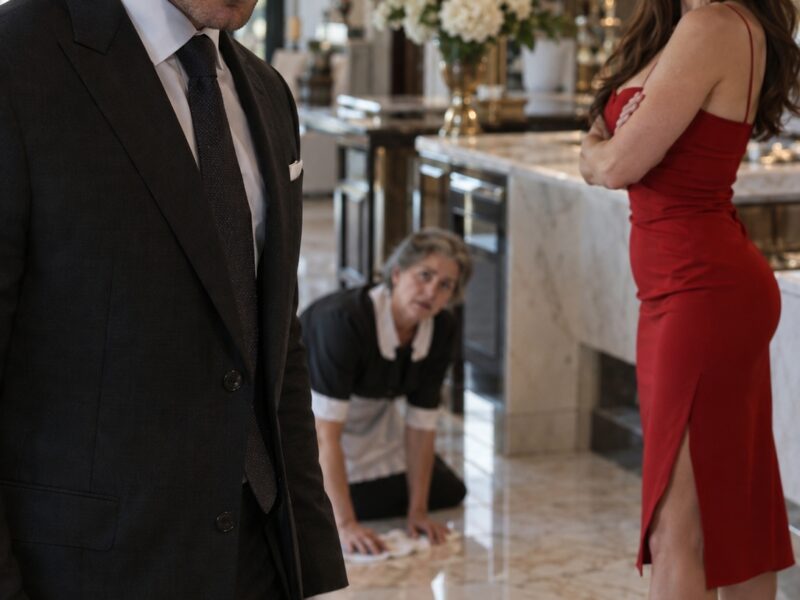
HE CAME HOME EARLY TO SURPRISE HIS FIANCÉE—THEN HE HEARD THE HOUSEKEEPER BEGGING HER NOT TO FIRE HER

Nathan Whitmore came home three days early because he wanted to surprise the woman he was going to marry.
Instead, he stood in the dark hallway of his own mansion and listened to an older woman beg his fiancée not to take money from her paycheck.
He still had the gift in his coat pocket.
A narrow velvet box. A diamond bracelet. Nothing extravagant by Nathan’s standards, but carefully chosen because Victoria Caldwell had once told him she preferred gifts with meaning over gifts with price tags.
Thirty feet away, in the marble kitchen of the home they were supposed to raise children in, Victoria’s voice cut through the afternoon silence.
“You have one job, Margaret.”
Nathan stopped breathing.
“I know, ma’am.”
The second voice was softer. Shaking.
“I’m sorry. My hand slipped.”
Something small rolled across the floor.
Nathan leaned just enough to see through the opening between the hallway and kitchen.
A crystal wineglass had shattered beside the island.
Red wine spread across the pale marble like a dark stain.
Margaret Hayes, the fifty-eight-year-old housekeeper who had worked in Nathan’s home for nearly seven years, was crouched on the floor gathering broken glass with trembling fingers.
Victoria stood above her in a fitted red dress, one hand resting against the counter.
Perfect hair.
Perfect makeup.
Perfect posture.
Nathan had seen that face across candlelit dinners, charity galas, Sunday mornings, delayed flights, hospital visits, Christmas photographs.
But he had never seen that expression.
Cold.
Not irritated.
Not stressed.
Cold.
Margaret reached for another shard.
“I’ll replace the glass.”
Victoria gave a humorless laugh.
“With what?”
Margaret looked up.
Victoria glanced deliberately at the faded shoes beneath Margaret’s uniform.
“Your paycheck?”
Nathan felt something tighten behind his ribs.
Margaret lowered her eyes.
“I said I’m sorry.”
“And I said apologies don’t repair expensive things.”
“It was an accident.”
“That word is becoming very convenient around here.”
Nathan’s fingers slowly curled around the velvet box inside his pocket.
He had spent his entire flight from Chicago imagining Victoria’s reaction when he walked through the door.
Maybe she would scream.
Maybe she would throw her arms around him.
Maybe they would cancel dinner and spend the evening alone, talking about the wedding that was now only six weeks away.
He had not called ahead.
His driver had taken his luggage directly to the side entrance, and Nathan had dismissed him before entering through the back door because he wanted the surprise to feel intimate.
For the first thirty seconds, it had.
Then he heard the glass break.
Now he was hidden in his own house, watching his future wife humiliate a woman who had held his mother’s hand at her funeral.
Victoria crossed her arms.
“The glass comes out of your pay.”
Margaret’s head snapped up.
“Please don’t do that.”
Nathan’s pulse jumped.
Victoria stared at her.
Margaret swallowed.
“My daughter’s medication went up again this month. I can replace the glass next paycheck, but if you deduct—”
“Margaret.”
Victoria’s tone sharpened.
“I don’t need your family history.”
Silence filled the kitchen.
Nathan saw Margaret’s mouth close.
The humiliation was subtle.
That almost made it worse.
Victoria had not shouted.
She had not thrown anything.
She did not need to.
She knew exactly where the power was.
And Margaret knew exactly where she stood.
Victoria bent slightly toward her.
“You should be grateful you work in a house like this.”
Nathan felt the sentence like a hand closing around his throat.
His mother used to clean houses.
Not houses this large, but large enough that ten-year-old Nathan understood the difference between the front door his mother’s employers used and the side entrance through which Grace Whitmore entered carrying a bucket and a bag of cleaning supplies.
Once, when he was eleven, he had accompanied her to work because school was closed.
He remembered a woman leaving a dirty coffee mug inches from his mother’s hand without looking at her.
He remembered his mother waiting until they were in the car before quietly saying, “Never become so impressed by what you own that you forget who you are.”
Nathan had built an entire life around never forgetting.
Apparently, he had fallen in love with someone who had.
Margaret whispered, “Yes, ma’am.”
Victoria stepped back.
“And clean this before the floor stains.”
Margaret nodded.
Nathan could have walked into the room then.
Every instinct told him to.
He could already imagine Victoria turning around, seeing him and realizing he had heard everything.
But something stopped him.
Not mercy.
Instinct.
The same instinct that had saved him in negotiations when another CEO talked too much because Nathan had allowed silence to remain in the room.
The same instinct that had helped him build Whitmore Systems from three laptops in a rented garage into a technology company valued at more than four hundred million dollars.
If Victoria behaved this way when she believed nobody important was watching, Nathan needed to know how far it went.
One ugly moment could be explained.
A pattern could not.
He stepped backward into the shadows.
And waited.
Less than four minutes later, the kitchen door opened.
Joseph Bennett entered with mud on his work boots and pruning shears in one hand.
Joseph was sixty-three, broad-shouldered despite his age, with skin weathered from decades spent outdoors.
He had managed the estate grounds since before Nathan purchased the property.
Victoria looked at the dirt near his shoes.
Her eyes hardened.
“Joseph.”
He immediately looked down.
“Sorry. Storm washed half the lower garden out. I was checking the drainage.”
“You’re tracking dirt across the floor.”
“I’ll clean it.”
“That’s what everyone says after they make a mess.”
Nathan watched Joseph glance at Margaret.
Something passed between them.
Not surprise.
Recognition.
That frightened Nathan more than Victoria’s words.
They were accustomed to this.
Victoria walked toward the window overlooking the east garden.
“And the roses look terrible.”
Joseph frowned.
“The wind broke six stems. I moved the healthiest bushes before the next storm comes through.”
“I asked for them to be arranged evenly.”
“If I arrange them evenly now, we’ll probably lose another four.”
Victoria turned.
“I didn’t ask what you thought would happen.”
Joseph went quiet.
“I asked you to do something.”
“Yes, ma’am.”
“Then do it.”
Nathan looked at Joseph’s face.
The man did not appear angry.
He appeared tired.
That distinction hurt.
Victoria was not provoking rebellion.
She had trained them not to resist.
Joseph left.
Nathan remained motionless.
A few minutes later, Caleb Moore appeared carrying two sealed boxes of imported tableware.
Caleb was twenty-two, attending community college three nights a week while working maintenance during the day.
Nathan had helped him adjust his schedule after learning Caleb wanted to earn an engineering degree.
Caleb placed one box beside the pantry.
Victoria pointed toward the staircase.
“Those go upstairs.”
Caleb hesitated.
“All of them?”
“Yes.”
“Could Daniel help me with the heavier ones?”
“Daniel’s not here.”
Caleb touched his right shoulder almost unconsciously.
Nathan noticed.
He remembered the injury.
Three weeks earlier, Caleb had strained the shoulder repairing a gate motor.
Nathan had personally told him not to lift anything heavy until a doctor cleared him.
Victoria noticed the hesitation too.
“What?”
Caleb cleared his throat.
“My shoulder’s still messed up.”
“Then carry one at a time.”
“The doctor said—”
Victoria’s eyebrows lifted.
Caleb stopped.
Nathan felt his jaw tighten.
Victoria moved closer.
“Are you telling me you cannot perform your job?”
“No.”
“Because there are a lot of people who would be grateful for your position.”
Nathan almost stepped forward.
Almost.
Caleb looked toward the floor.
“I’ll move them.”
Victoria smiled faintly.
“Good.”
Nathan turned away before Caleb reached for the first box.
He walked down the corridor, every step harder than the last.
Then Ruth Carter came through the kitchen door holding a white envelope.
Nathan stopped again.
Ruth had been cooking for his family for nearly a decade.
She had fed his father during the last months of Samuel Whitmore’s life when chemotherapy made almost everything taste metallic.
She remembered Nathan hated raw tomatoes.
She remembered Margaret took her coffee without sugar.
She remembered everybody’s birthdays.
Nathan had once joked that Ruth knew more about the family than the family knew about itself.
Now she held her paycheck like it was evidence.
“Ms. Caldwell?”
Victoria sighed before turning.
“What is it?”
“I think there’s been a mistake.”
Ruth opened the envelope.
“My check is short.”
Victoria barely looked.
“It isn’t a mistake.”
Ruth blinked.
“There’s almost four hundred dollars missing.”
“Deductions.”
“For what?”
Victoria turned toward the refrigerator and began scrolling through something on her phone.
“Excess food costs. Waste. Two ruined centerpieces after Saturday’s dinner. Replacement linens.”
Ruth stared at her.
“I didn’t order the flowers.”
“No, but you stored them improperly.”
“You told me to put them in the pantry.”
Victoria looked up.
“Are you arguing?”
Ruth fell silent.
Nathan felt his face go hot.
Ruth tried again.
“The grocery bill was exactly what you approved. I still have your menu.”
“I don’t have time for this.”
“I’m just asking where the money went.”
Victoria placed the phone on the counter.
“You are employed in a private estate with excellent working conditions.”
Ruth’s mouth parted slightly.
“You earn more here than you would in most kitchens.”
“That doesn’t mean—”
“You should be grateful.”
Again.
That word.
Grateful.
As if employment were charity.
As if wages were favors.
As if dignity were something Nathan’s wealth had purchased along with the furniture.
Ruth slowly folded the envelope.
“I understand.”
Victoria turned away.
Nathan did not.
He looked at Ruth until she disappeared through the service corridor.
Then he walked into his study and locked the door.
For the first time since entering the house, his hands were shaking.
He sat behind the walnut desk and took the velvet box from his pocket.
For nearly a minute, he simply stared at it.
Then he opened it.
The bracelet caught the late afternoon sunlight.
Beautiful.
Precise.
Useless.
Nathan remembered the night he proposed.
Victoria had cried before he finished the question.
They were standing under string lights on the back terrace while rain moved over the lake beyond the trees.
She had put both hands over her mouth.
“Nathan.”
He laughed nervously.
“I haven’t actually asked yet.”
“I know.”
“Victoria Caldwell, will you—”
“Yes.”
He had laughed again.
“You could at least let me get to the important part.”
She had knelt beside him then, forehead pressed against his.
“I don’t care about the ring,” she whispered. “I care about the man.”
Nathan had believed her.
He had believed her because he wanted to.
That realization hurt more than anything he had witnessed in the kitchen.
He closed the bracelet box.
His phone felt heavy in his hand.
He called Michael Reyes, his attorney and closest friend from college.
Michael answered on the fourth ring.
“Aren’t you supposed to be in Chicago?”
“I came back early.”
A pause.
Michael knew him too well.
“What happened?”
“I need you at my house.”
“What happened?”
Nathan stared at the locked study door.
“I don’t know yet.”
Another pause.
“How soon?”
“Now.”
“I’m downtown. Forty minutes.”
“And don’t call Victoria.”
Michael’s voice changed.
“I wasn’t planning to.”
Nathan ended the call.
His second call went to Rebecca Chen, Whitmore Systems’ director of internal audit.
When Rebecca answered, Nathan lowered his voice.
“I need you to review several personal household accounts.”
“Your accounts?”
“Yes.”
“Did the bank flag something?”
“No.”
“Then what am I looking for?”
Nathan looked at the bracelet box.
“Anything I should have noticed sooner.”
Rebecca hesitated.
“I’ll need authorization.”
“You have it.”
“And records?”
“I’ll send them.”
Nathan paused.
“Rebecca?”
“Yes?”
“Treat the household like one of our companies.”
She understood immediately.
“You think someone’s taking money.”
Nathan looked toward the window.
“I think someone may be taking more than that.”
By sunset, he was no longer investigating a bad afternoon.
He was investigating the woman he planned to marry.
And the first thing he found was taped inside a supply cabinet.
A handwritten sheet titled STAFF PENALTIES.
Broken dish: $50.
Late meal service: $75.
Unapproved overtime: unpaid.
Supply misuse: $40.
Dress-code violation: $25.
Guest complaint: discretionary.
Nathan read the page twice.
Then a third time.
There was no household policy authorizing any of it.
He knew because he had written the employment agreements himself years earlier after his mother’s death.
Every employee on the property was salaried or hourly through Whitmore Holdings. Any deduction had to pass payroll.
Yet someone had created a parallel system.
Nathan opened another cabinet.
More notes.
Warnings.
Initials.
Dates.
M.H. — careless with glassware.
J.B. — poor attitude re: landscaping instructions.
C.M. — complained about lifting duties.
R.C. — excessive food usage.
Beside several names were dollar amounts.
Nathan took photographs.
The study door opened softly behind him.
He turned sharply.
Margaret stood there.
When she saw him holding the sheet, the color drained from her face.
“I’m sorry, Mr. Whitmore.”
Nathan straightened.
“Why are you apologizing?”
Her eyes dropped.
“I didn’t mean for you to find—”
“Margaret.”
She stopped.
He had known her for seven years.
He had never seen her afraid of him.
Now, because Victoria had created an atmosphere in his house, Margaret appeared terrified simply because he was holding a piece of paper.
Nathan put it down.
“Look at me.”
Slowly, she did.
“You’re not in trouble.”
Margaret’s eyes filled.
Nathan felt something inside him crack.
“How long?”
She blinked.
“How long has this been happening?”
“I don’t want to cause problems.”
“The problem already exists.”
“She’s going to be your wife.”
Nathan swallowed.
“That doesn’t make this acceptable.”
Margaret’s lips trembled.
“You love her.”
It was not an accusation.
That made it worse.
“Yes,” Nathan said quietly.
The word felt different now.
“I do.”
Margaret wiped beneath one eye.
“Then maybe you should talk to her.”
“I will.”
Nathan stepped closer.
“But first I need the truth.”
Margaret looked toward the hall.
Nathan noticed.
“Victoria doesn’t know I’m home.”
Margaret stared at him.
“I came in through the back.”
Understanding moved across her face.
“You saw.”
“Yes.”
Her shoulders dropped.
Not dramatically.
Just slightly.
As if she had been carrying something heavy and had finally been allowed to lower it.
Nathan asked, “How long?”
Margaret sat in the chair beside the bookshelf.
“About eight months.”
Eight months.
Nathan felt cold.
Victoria had been living at the mansion regularly for ten.
“What started it?”
“Little things.”
Margaret twisted her hands together.
“She wanted everything a certain way. That wasn’t unusual. People have preferences.”
Nathan nodded.
“Then?”
“She started checking our schedules. Changed them without telling you. Told us not to bother you with household issues because you were busy.”
Nathan closed his eyes briefly.
That sounded plausible.
He had been busy.
Too busy.
“And then?”
“The deductions.”
“Who authorized them?”
“No one, as far as I know.”
“Were they coming through payroll?”
Margaret shook her head.
“She said we could pay directly or have it taken from cash bonuses and reimbursements.”
Nathan frowned.
“What cash bonuses?”
Margaret looked confused.
“The monthly household performance amount.”
Nathan stared at her.
“There is no household performance amount.”
Silence.
Margaret’s face changed.
“Then where was the money coming from?”
Nathan did not answer because he did not yet know.
His phone vibrated.
Rebecca.
He looked at the screen.
“Excuse me.”
He answered.
“What did you find?”
Rebecca didn’t waste time.
“There are irregular transfers.”
Nathan turned away from Margaret.
“How irregular?”
“Small enough that nobody looking at your overall financial picture would notice. Large enough that somebody should.”
“Explain.”
“Several household purchases were reimbursed at inflated values. Vendor invoices don’t match the amounts withdrawn from the property operations account.”
“How much?”
“I’ve only reviewed six months.”
“Rebecca.”
“Thirty-eight thousand, seven hundred and forty dollars.”
Nathan went still.
Margaret watched his face.
Rebecca continued.
“And that’s the clean number.”
“What’s the dirty one?”
“There are jewelry purchases categorized as event decor, personal travel marked as vendor coordination, designer clothing entered under staff presentation expenses.”
Nathan slowly sat down.
“Who approved them?”
“Victoria.”
The room seemed to become smaller.
Nathan looked at Margaret.
“And where did the difference go?”
“Mostly to an account belonging to Caldwell Lifestyle Consulting.”
Nathan knew the name.
Victoria had started the company years earlier.
It had never made much money.
Nathan asked, “How much?”
“Direct transfers? Another twenty-one thousand.”
His fingers tightened around the phone.
“Keep going.”
“Nathan.”
“Keep going.”
“I will.”
Rebecca’s voice softened.
“But you should know something.”
“What?”
“This doesn’t look accidental.”
Nathan said nothing.
Rebecca understood the silence.
“I’m sorry.”
After the call, Margaret sat quietly.
Finally she whispered, “Is it bad?”
Nathan looked down at the spreadsheet on his desk.
“Yes.”
“Will we lose our jobs?”
He looked up so quickly she flinched.
“No.”
Margaret’s eyes filled again.
“No one loses anything,” Nathan said. “Do you understand me?”
She nodded.
“Not a paycheck. Not a job. Not one dollar.”
He exhaled.
“Except maybe me.”
Margaret frowned.
Nathan stared at the bracelet box.
“I may be losing something I thought I had.”
That night, he slept in the guest wing so Victoria would not know he was home.
Or rather, he lay on top of the bed until four in the morning staring at the ceiling.
Sleep never came.
Memory did.
Victoria volunteering at the pediatric cancer fundraiser where they met.
Victoria leaving a hundred-dollar tip for a waitress who had been crying.
Victoria helping an elderly man pick up groceries after a paper bag tore in a parking lot.
Victoria sitting beside Nathan in the hospital while his father died.
Victoria crying at Grace Whitmore’s old photograph when Nathan told her how his mother had worked nights cleaning offices.
Had all of that been fake?
The possibility made him sick.
But there was another possibility he hated even more.
Maybe none of it had been fake.
Maybe people could be genuinely kind when kindness was easy.
Maybe character was not revealed by how someone behaved when they felt loving.
Maybe character was what remained when they felt powerful.
Nathan’s mother had always said that.
He had spent his life quoting her.
And somehow he had failed to apply the lesson to the person sleeping under his roof.
At five sixteen, his phone lit up.
Michael.
I’m here.
Nathan quietly went downstairs.
Michael Reyes was waiting in the library wearing yesterday’s suit and holding two coffees.
He handed Nathan one.
“You look terrible.”
“So do you.”
“I have two kids under six. I always look terrible.”
Nathan almost smiled.
Almost.
Michael sat down.
“I reviewed what you sent.”
“And?”
“Some of those wage deductions may violate state law depending on how they were processed.”
Nathan rubbed his face.
“I’ll repay everything.”
“That’s not what I’m worried about.”
Nathan looked at him.
“What are you worried about?”
“You.”
“Don’t.”
“I’m your attorney and your friend. I get to.”
Nathan turned toward the windows.
Dawn had started to lighten the sky.
“The wedding is in six weeks.”
“I know.”
“Two hundred and sixty people.”
“I know.”
“My board chairman is flying in from London. Her family booked half the resort. The invitations—”
“Nathan.”
He stopped.
Michael leaned forward.
“You’re talking about chairs.”
Nathan looked at him.
“What?”
“You’re talking about guests, flights, invitations, hotel rooms.”
Michael lowered his voice.
“You’re not talking about whether you trust the woman.”
Nathan said nothing.
“That’s the question.”
Nathan stared into his coffee.
“I don’t know.”
Michael nodded.
“Then postpone the wedding.”
“No.”
“No?”
Nathan looked at him.
“If I postpone it, she’ll know something’s wrong.”
Michael frowned.
“You’re still investigating.”
“Yes.”
“You’ve already got financial records.”
“I want to know how she treats everyone.”
“You saw enough.”
“I saw one day.”
Michael shook his head.
“Nathan—”
“I need to know whether I’m ending my future over the worst afternoon of Victoria’s life or whether I’ve been blind for months.”
Michael studied him.
Then he leaned back.
“All right.”
Nathan looked up.
“You think that’s stupid.”
“I think you’re hoping to find evidence that lets you forgive her.”
Nathan’s face tightened.
Michael continued.
“And I think if you don’t admit that to yourself, whatever comes next is going to hurt worse.”
Nathan looked away.
Because Michael was right.
He wanted an explanation.
Stress.
Wedding pressure.
Miscommunication.
A bookkeeping mistake.
Anything that would allow the woman from the kitchen and the woman he loved to occupy the same body without destroying his understanding of both.
By eight o’clock, Victoria came downstairs.
Nathan was gone.
At least that was what she believed.
He had moved to the detached office above the estate garage, where security feeds could be accessed without appearing inside the main house.
Nathan had never used interior cameras to watch employees.
He considered it invasive.
The cameras covered entrances, exterior corridors, storage areas, and several common rooms for security purposes, but there were blind spots throughout the private living spaces.
For the first time, Nathan reviewed archived footage.
He hated himself for it.
He hated what he found more.
Victoria yelling at a delivery driver for parking too close to the front steps.
Victoria ordering Margaret to change bed linens at eleven thirty at night because she disliked the scent of the fabric softener.
Victoria refusing Joseph a scheduled afternoon off because a photographer was visiting the property.
Victoria pointing at Caleb’s work boots and telling him not to enter through the main foyer because “guests don’t need to see maintenance people wandering around.”
Then Nathan found footage from six weeks earlier.
Ruth was standing near the pantry.
Victoria handed her an envelope.
Ruth counted the money.
She looked confused.
They argued.
No audio reached that camera, but Nathan could read body language well enough.
Ruth pointed toward the envelope.
Victoria pointed toward the door.
Ruth’s face fell.
Nathan paused the video.
The timestamp read 9:14 p.m.
He checked his calendar.
He had been in San Francisco.
He remembered calling Victoria that evening.
She had told him she was exhausted from spending the day finalizing wedding invitations.
Nathan sat in the quiet office, staring at the frozen image of his fiancée pointing toward the door while Ruth clutched an underpaid check.
He remembered ending that call by saying, “I wish I were home.”
Victoria had answered, “Me too.”
For the first time, Nathan wondered what home had become when he was not there.
Later that morning, he met Joseph near the greenhouse.
Joseph looked surprised.
“Mr. Whitmore?”
“Walk with me.”
They followed the gravel path beyond the rose garden.
Nathan kept his voice low.
“Margaret told me some things.”
Joseph’s expression immediately closed.
Nathan noticed.
“What did Victoria threaten you with?”
Joseph looked toward the house.
“Nothing I can’t handle.”
“That wasn’t my question.”
Joseph exhaled through his nose.
“My wife had surgery last year.”
Nathan remembered.
“How is she?”
“Better.”
“I’m glad.”
Joseph nodded.
“We had bills.”
Nathan waited.
“When Ms. Caldwell started cutting hours, I asked why.”
“And?”
“She told me maybe someone my age should be grateful to still have steady work.”
Nathan stopped walking.
Joseph continued another step before realizing.
Nathan’s voice dropped.
“She said that?”
Joseph looked uncomfortable.
“Mr. Whitmore—”
“Did she say that?”
“Yes.”
Nathan looked toward the mansion.
The house sat beyond the trees, enormous and white and beautiful.
For years he had considered it proof that his parents’ sacrifices had meant something.
Now it looked like a monument to everything his mother had warned him not to become.
“Why didn’t you call me?”
Joseph gave him a sad smile.
“You were getting married.”
“So?”
“So you looked happy.”
Nathan felt the answer land somewhere deep.
Joseph shrugged.
“We figured we could handle it.”
“We?”
“Most of us.”
“How many thought about leaving?”
Joseph did not answer immediately.
“That many?”
“Caleb filled out an application somewhere else.”
Nathan closed his eyes.
“Ruth?”
“Borrowed money from Margaret twice.”
“For what?”
“Her grandson’s asthma medication.”
Nathan looked away.
Joseph spoke quietly.
“She’d had three hundred and twenty dollars taken out that month.”
Nathan’s voice was barely audible.
“I didn’t know.”
“No.”
Joseph was not accusing him.
Again, that made it worse.
Nathan nodded slowly.
“But I should have.”
By noon, he knew enough.
By two, Rebecca knew more.
The “performance bonuses” Margaret mentioned came from a cash pool Nathan had approved years earlier for holiday gifts, emergency overtime and discretionary appreciation payments.
Victoria had changed the system.
She created monthly bonus envelopes, then deducted penalties from them.
Because the money technically was not base salary, she apparently believed she could control it however she wanted.
But she had also deducted reimbursements.
Delayed overtime approvals.
Shifted legitimate household expenses onto employees.
And in several cases, altered purchase reports.
Rebecca put the estimated total at sixty-three thousand dollars.
Nathan barely heard the number.
The theft bothered him.
The deception bothered him more.
But what haunted him most was an email Rebecca recovered from Victoria to an event consultant.
Once Nathan and I are married, I’ll finally be able to restructure the house properly. Right now everyone still thinks they work for him.
Nathan read the sentence again.
And again.
Everyone still thinks they work for him.
As though his employees were furniture changing ownership through marriage.
There was another email.
The staff has gotten spoiled because Nathan is too soft with them.
Another.
Margaret especially needs to understand the hierarchy.
Hierarchy.
Nathan leaned away from the laptop.
Rebecca sat across from him.
“I’m sorry.”
“Stop saying that.”
She looked at him.
Nathan softened.
“I’m sorry.”
Rebecca closed the file.
“What are you going to do?”
He stared toward the house.
“I’m going to give everyone back every dollar.”
“I meant about Victoria.”
Nathan did not answer.
Because the answer was no longer complicated.
It was simply painful.
The following morning, he gathered the staff in the library.
Margaret arrived first.
Then Joseph.
Caleb looked nervous.
Ruth came last, wiping flour from her hands onto her apron.
They stood near the doorway as though they expected to be dismissed.
Nathan hated that.
“Sit down.”
Nobody moved.
He looked around.
“Please.”
They sat.
Nathan remained standing.
There were envelopes on the table.
He had spent most of the night checking the amounts himself.
“I owe all of you an apology.”
Margaret shook her head immediately.
“Mr. Whitmore—”
“No.”
Nathan raised one hand.
“Please let me finish.”
She went quiet.
“I’ve spent years telling people that culture matters in a company. I’ve told managers that if people are afraid to speak honestly, leadership has already failed.”
He looked around the room.
“And somehow I allowed exactly that to happen in my own home.”
Joseph looked down.
Nathan continued.
“I didn’t know what was happening.”
Caleb shifted in his chair.
Nathan looked at him.
“But not knowing does not mean I had no responsibility.”
The room went still.
Nathan pushed the envelopes forward.
“Every dollar taken through unauthorized penalties, delayed reimbursements or improper deductions has been restored.”
Ruth stared at the envelope in front of her.
“This is too much.”
“No.”
Nathan shook his head.
“It is the amount you should have received.”
Ruth opened it.
Her eyes widened.
“This includes—”
“Everything we could document.”
Ruth’s mouth trembled.
Nathan continued.
“If we missed something, tell Rebecca directly.”
He handed them cards with her number.
“You do not need permission from anyone to contact her.”
Caleb looked at the card.
Nathan met his eyes.
“And your shoulder?”
Caleb stiffened.
“It’s okay.”
“Don’t lie because you think I want that answer.”
Caleb stared at him.
Then quietly said, “It’s worse.”
Nathan’s stomach turned.
“Doctor?”
“I stopped physical therapy.”
“Why?”
Caleb glanced toward the others.
“Couldn’t keep taking time off.”
Nathan closed his eyes for a second.
“You’ll restart today.”
“I can work—”
“I know you can.”
Nathan pulled a chair closer and sat.
“But proving you can tolerate pain is not the same thing as doing your job.”
Caleb swallowed.
“Your hours will be protected.”
“Mr. Whitmore—”
“And tuition next semester is covered.”
Caleb stared at him.
“No.”
Nathan almost smiled.
“No?”
“I mean—I appreciate it. I do. But I don’t want money because this happened.”
“It isn’t because this happened.”
Nathan looked at him.
“You’ve been working toward that degree for two years.”
Caleb blinked.
“You remembered?”
Nathan’s chest hurt.
“Of course I remembered.”
Then he understood what Caleb’s surprise meant.
Remembering from a distance was not enough.
Being generous when convenient was not enough.
Leadership required presence.
Protection required attention.
Ruth wiped her eyes.
Margaret quietly cried.
Nathan looked at the people sitting around the table.
“My mother cleaned offices at night.”
They knew the story, but nobody interrupted.
“She used to come home with her hands smelling like bleach no matter how many times she washed them.”
Nathan looked at his own hands.
“She told me something when I was a kid. She said you learn more about a person by watching how they treat someone who cannot advance their career, increase their status or give them something they want.”
His voice tightened.
“I thought I remembered that lesson.”
Margaret whispered, “You did.”
Nathan shook his head.
“Not well enough.”
He looked around.
“No one who works for me should have to calculate whether speaking honestly is worth losing groceries, medication, tuition or rent.”
Silence.
“So from this moment forward, every employee working in this house, on this property or through any company I control will have an independent reporting channel.”
Joseph nodded faintly.
“No retaliation. No unauthorized deductions. No private penalty systems.”
Nathan paused.
“And nobody needs to earn basic respect.”
Ruth pressed the envelope against her chest.
Nathan looked toward the doorway.
Victoria had no idea this conversation was happening.
But soon, she would.
He had delayed one final confrontation because Michael advised him to complete the financial review first.
By that afternoon, it was complete.
Nathan asked Victoria to meet him in the living room at six.
At five fifty-three, he stood beside the fireplace looking at the engagement photograph on the mantel.
Victoria was laughing in the picture.
Her hand rested against his chest.
He remembered that night perfectly.
He hated that good memories did not become fake simply because the future changed.
That was one of the cruelest parts of losing someone.
You could stop trusting them without being able to stop remembering why you once did.
At six oh-three, Victoria walked in carrying her tablet.
She wore cream trousers and a silk blouse.
She smiled when she saw him.
“There you are.”
Nathan looked at her.
Her smile widened.
“What?”
“You knew I was home?”
“Your driver told me yesterday.”
Nathan’s stomach dropped.
Victoria laughed softly.
“You’re terrible at surprises.”
Something inside him shifted.
“You knew since yesterday?”
“Of course.”
“And you didn’t come find me?”
“I assumed you were working.”
She walked toward him.
“I’m glad you’re back.”
She kissed his cheek.
Nathan did not move.
Victoria noticed.
“What’s wrong?”
He looked at her for several seconds.
“Did you know I was home when you spoke to Margaret in the kitchen?”
Her expression changed.
Only slightly.
But he saw it.
“What?”
“Did you know I was in the house?”
“No.”
“Did you know I could hear you?”
Victoria stared at him.
Then slowly lowered the tablet.
“So this is about Margaret.”
Nathan pointed toward the coffee table.
Four folders lay there.
Victoria followed his gaze.
“What are those?”
“Sit down.”
She did not.
“Nathan.”
“Sit down.”
His tone was quiet.
That seemed to disturb her more than shouting would have.
Victoria sat.
Nathan remained standing.
He opened the first folder.
“Unauthorized staff penalties.”
Victoria sighed.
“Oh, for God’s sake.”
Nathan froze.
That was not the reaction he expected.
Victoria leaned back.
“Is that what this is?”
Nathan opened the second folder.
“Altered reimbursements.”
The third.
“Inflated household purchases.”
The fourth.
“Transfers to Caldwell Lifestyle Consulting.”
Victoria’s face lost color.
There.
For the first time, fear.
Nathan sat across from her.
“Tell me I’m wrong.”
She looked down at the papers.
“How much did Rebecca show you?”
“All of it.”
Victoria closed her eyes briefly.
Nathan waited.
Finally she whispered, “I can explain.”
“Then explain.”
“The household account was chaotic.”
“It wasn’t.”
“There were no standards.”
“There were employment agreements.”
“They were too relaxed.”
Nathan stared at her.
Victoria straightened.
“Your staff takes advantage of you.”
“By doing what?”
“By making mistakes without consequences.”
“Breaking a glass?”
“That glass cost six hundred dollars.”
Nathan blinked.
“You deducted money from a woman supporting a daughter with a chronic illness over a six-hundred-dollar glass?”
“It wasn’t about one glass.”
“What was it about?”
“Standards.”
Nathan sat back.
There was the word.
Not cruelty.
Standards.
People rarely named their worst behavior honestly.
They dressed it in respectable language.
Victoria continued.
“You built an incredible life, Nathan. But you let people become too comfortable.”
“Comfortable?”
“They walk through rooms like they belong here.”
Nathan stared at her.
“They do belong here.”
Victoria’s expression tightened.
“You know what I mean.”
“No.”
Nathan leaned forward.
“I want to hear you say exactly what you mean.”
She hesitated.
He waited.
Victoria looked toward the window.
“I mean there has to be a distinction.”
“Between what?”
“Family and employees.”
“There is.”
“Not in this house.”
Nathan felt something cold move through him.
Victoria continued.
“Ruth speaks to you like an aunt. Joseph disagrees with you about landscaping. Margaret knows private details about your family. Caleb acts like this place is some kind of scholarship program.”
Nathan’s face hardened.
“That bothers you?”
“It’s inappropriate.”
“They’ve known me longer than you have.”
Victoria flinched.
Nathan saw it and hated himself for the satisfaction it produced.
He forced his voice level.
“Why did you take money?”
“I did not steal from you.”
“You moved money to your company.”
“For expenses.”
“Jewelry?”
“Event-related.”
“Four thousand dollars in designer shoes?”
“I wore them to donor events.”
“Weekend spa charges?”
“I was meeting planners.”
Nathan pushed a receipt toward her.
“At a resort in Asheville?”
Victoria went quiet.
“Alone?”
Still nothing.
Nathan exhaled.
“I’m not asking because the money matters.”
Victoria looked up sharply.
“Then why are we doing this?”
“Because you lied.”
She stood.
“So that’s it? I made some accounting mistakes and suddenly I’m being interrogated in my own home?”
Nathan looked at her.
“Your home?”
The words stopped her.
For the first time, she seemed to understand the ground beneath her was moving.
“I didn’t mean—”
“I know exactly what you meant.”
Victoria’s eyes filled with anger.
“And what about them?”
“Who?”
“The staff.”
Nathan’s expression went still.
Victoria gestured toward the service wing.
“They’ve obviously been filling your head with stories.”
“No.”
“Margaret has always resented me.”
“No.”
“Ruth questions everything.”
“No.”
“Joseph barely listens when I ask him to do something.”
“No.”
“And Caleb—”
“Stop.”
Nathan’s voice was quiet.
Victoria stopped.
He stood.
“You’re doing it again.”
“What?”
“You’re describing people as problems because they resisted being treated badly.”
Victoria stared at him.
“I was trying to make this house run properly.”
“This house ran perfectly well before you moved into it.”
Her eyes flashed.
“So now I’m an intruder?”
Nathan shook his head slowly.
“You were supposed to become my family.”
Victoria looked hurt.
For a second, he saw the woman he loved.
And that almost destroyed him.
Her voice softened.
“I am your family.”
Nathan looked down.
“No.”
She went still.
He forced himself to look at her.
“Not anymore.”
For several seconds, Victoria did not react.
Perhaps the sentence was too large to enter the room all at once.
Then she laughed once.
A confused sound.
“What are you talking about?”
“The wedding is canceled.”
Her face went completely blank.
Nathan heard the antique clock near the window ticking.
Once.
Twice.
Three times.
Victoria whispered, “No.”
Nathan said nothing.
“No.”
She stepped toward him.
“You’re angry.”
“I’m past angry.”
“You’re shocked.”
“Yes.”
“You need a few days.”
“I’ve had them.”
“Nathan.”
Her voice cracked.
He had heard Victoria cry before.
At his father’s funeral.
When he proposed.
The night she miscarried six months into their relationship, before either of them had even fully processed that she was pregnant.
That loss had tied them together in grief.
Nathan had held her on the bathroom floor while she shook against him.
Remembering it now felt unbearable.
Victoria reached for his hand.
He stepped back.
Her face crumpled.
“You’re ending our marriage because Margaret broke a glass?”
Nathan stared at her.
“That sentence is why I’m ending it.”
Victoria blinked.
“This is not about a glass.”
His voice remained calm.
“It isn’t about sixty thousand dollars.”
“Nathan—”
“It isn’t about flowers or schedules or grocery bills.”
He looked into the face he had once imagined growing old beside.
“It’s about what you became when you thought nobody powerful was watching.”
Victoria’s lips parted.
Nathan continued.
“You were kind to donors.”
“That’s not fair.”
“You were kind to my board members.”
“Stop.”
“You were kind to waiters when I was sitting beside you.”
“I said stop.”
“You were kind when kindness was visible.”
Tears gathered in her eyes.
“And when it wasn’t?”
Nathan shook his head.
“You made people afraid.”
“I was under pressure.”
“So was Margaret.”
“That’s different.”
“Why?”
Victoria opened her mouth.
Nothing came out.
Nathan stepped closer.
“Why is your stress an explanation, but Margaret’s sick daughter isn’t?”
Victoria looked away.
“Why is your wedding pressure important, but Caleb’s injured shoulder is weakness?”
Silence.
“Why do your mistakes deserve understanding while theirs cost them money?”
“Nathan.”
“Why?”
She looked back at him, tears running now.
“I don’t know.”
It was the first honest thing she had said.
Nathan felt the anger leave him.
Not forgiveness.
Something sadder.
He sat down.
Victoria remained standing.
After a long silence, she whispered, “I hated feeling like a guest here.”
Nathan looked up.
She wiped her face.
“Everything was already yours.”
“The house. The company. The staff. The traditions. Even the Christmas decorations had a system before I arrived.”
Nathan said nothing.
“I thought after the engagement, things would change.”
“They did.”
“No.”
Her laugh was bitter.
“Everyone still looked at you for permission.”
“Because I employ them.”
“I was supposed to be your wife.”
“And?”
“I wanted something to be mine.”
Nathan looked at her carefully.
“So you chose people.”
Victoria flinched.
He continued.
“You couldn’t own the house because it was mine. You couldn’t control the company because you didn’t work there. So you controlled the people who had less power than you.”
“That’s not what happened.”
“Isn’t it?”
She covered her mouth.
For the first time, Nathan saw not a villain, not a monster, but something almost more frightening.
A person who had allowed insecurity to turn into entitlement.
Someone who felt small and solved it by making other people feel smaller.
Victoria sat opposite him.
“I can fix it.”
Nathan’s chest tightened.
“I’ll apologize.”
“That’s not enough.”
“I’ll pay everything back.”
“That’s already done.”
“I’ll go to therapy.”
“I hope you do.”
She looked at him.
Hope entered her face.
Nathan hated what he had to say next.
“But not to save our wedding.”
Her shoulders collapsed.
“Nathan, please.”
He looked away.
“You don’t stop loving someone the exact second you stop trusting them.”
Victoria cried silently.
Nathan’s voice broke slightly.
“That’s what makes this so hard.”
She reached across the space between them but did not touch him.
“I love you.”
Nathan closed his eyes.
He believed her.
That was the worst part.
“I think you do.”
Victoria stared at him.
“Then how can you do this?”
Nathan opened his eyes.
“Because love does not make character irrelevant.”
“Nathan—”
“If we had children someday…”
He stopped.
The imagined future hurt almost physically.
Victoria lowered her gaze.
Nathan continued.
“What would I teach them if I stayed?”
“That people deserve second chances.”
“They do.”
“Then give me one.”
“I can forgive you.”
Her head lifted.
Nathan swallowed.
“But forgiveness doesn’t require me to marry you.”
Victoria’s face collapsed.
He hated that he had caused it.
But he did not take the words back.
She left the room twenty minutes later.
Not screaming.
Not throwing the ring.
Not threatening him.
That almost would have been easier.
She simply removed the engagement ring, placed it on the coffee table and stood staring at it.
“This was real to me.”
Nathan’s throat tightened.
“It was real to me too.”
She looked at him.
“Was?”
Nathan could not answer.
Victoria walked upstairs.
Michael arrived before she finished packing.
Nathan asked him to remain outside.
Whatever Victoria had become, Nathan would not turn her departure into a spectacle.
Two hours later, she came down carrying one suitcase.
Margaret was crossing the foyer.
Both women stopped.
For a moment, nobody moved.
Margaret’s face tightened with old fear.
Nathan almost intervened.
Then Victoria spoke.
“Margaret.”
Margaret waited.
Victoria looked at her for a long time.
“I’m sorry.”
Margaret said nothing.
Victoria nodded as though she understood silence was all she had earned.
Then she walked toward the door.
Margaret’s voice stopped her.
“Ms. Caldwell?”
Victoria turned.
Margaret folded her hands.
“My daughter is doing better.”
Victoria looked confused.
Then remembered.
The medication.
The paycheck.
Her face changed.
Margaret continued quietly.
“She got her prescription yesterday.”
Victoria nodded.
“I’m glad.”
Margaret’s eyes were not angry.
That seemed to hurt Victoria more.
“So am I.”
Victoria left.
Nathan watched the car disappear beyond the gate.
He expected relief.
None came.
There was only silence.
For weeks, the mansion felt haunted by a future that would never happen.
Wedding samples remained stacked in the downstairs office.
Ivory napkins.
Embossed menus.
Fabric swatches.
A seating chart with two hundred and sixty names.
Nathan could not bring himself to throw them away.
One morning, Ruth did it for him.
Not dramatically.
She simply entered the office with a cardboard box and began collecting them.
Nathan stood in the doorway.
“What are you doing?”
Ruth looked at the stack.
“Making room.”
He almost told her to stop.
Instead he helped.
They packed invitations, ribbon samples and photographs into the box.
At the bottom of one stack, Nathan found a menu with Victoria’s handwriting.
No shellfish. Nathan hates oysters.
His hand stopped.
Ruth noticed.
“You don’t have to hate every memory.”
Nathan looked at her.
“She did something terrible.”
“Yes.”
“She also sat in a hospital room with my father for six hours while I slept.”
Ruth nodded.
“People are complicated.”
“That would be easier if they weren’t.”
Ruth smiled sadly.
“Yes.”
Nathan placed the menu in the box.
“Do you think people change?”
Ruth considered the question.
“All the time.”
“For better?”
“Sometimes.”
“For worse?”
“Sometimes.”
Nathan leaned against the desk.
“How do you know which version is real?”
Ruth looked at him.
“Maybe they both are.”
He said nothing.
“That doesn’t mean you have to invite the worst version into your future.”
Nathan remembered that sentence for years.
The formal changes began the following month.
Whitmore Systems created a confidential reporting channel for all support workers, contractors and property employees.
Nathan established written rules against retaliatory scheduling, improper wage deductions and coercive management.
He required every executive overseeing assistants, drivers, cleaners, security teams or household staff to complete the same workplace conduct training used for corporate employees.
When someone asked why a technology company suddenly cared so much about domestic staff policies, Nathan answered simply.
“Because power does not become less dangerous when it leaves the office.”
He also created an emergency assistance fund.
Not charity, he insisted.
Support.
Short-term medical emergencies.
Family crises.
Unexpected transportation problems.
Tuition assistance for employees developing relevant skills.
Caleb was the first to use the education provision.
He resisted for three weeks.
Then one afternoon he appeared in Nathan’s study holding an enrollment form.
“I got accepted.”
Nathan looked up.
“Engineering?”
Caleb nodded.
Nathan stood.
For the first time in months, he smiled without effort.
“When do classes start?”
“August.”
“Good.”
Caleb hesitated.
“My shoulder’s almost back to normal.”
“Better.”
“I wanted to say thanks.”
Nathan shook his head.
“You earned the acceptance.”
“I mean for everything.”
Nathan looked at him.
“Finish the degree.”
Caleb grinned.
“That your condition?”
“No.”
Nathan returned to his desk.
“But if you drop out because calculus scares you, I reserve the right to be extremely annoying.”
Caleb laughed.
It was a small sound.
Yet Nathan noticed how strange it had once become to hear laughter inside the house.
Now it happened every day.
Joseph replanted the roses.
Not evenly.
Nathan noticed one morning and pointed toward them.
“The left side is higher.”
Joseph stared at him seriously.
“Nature is imperfect, sir.”
Nathan narrowed his eyes.
“Are you enjoying this?”
“Very much.”
Nathan laughed.
Ruth started testing new dishes and demanding everyone taste them.
Margaret stopped knocking before entering Nathan’s study because, as she informed him, “You ignore lunch unless someone interrupts you.”
The house became imperfect again.
Alive.
A year passed.
Nathan heard from Victoria only twice.
The first communication came through Michael regarding belongings placed in storage.
Professional.
Brief.
The second was an email.
Nathan almost deleted it unread.
Instead he opened it late one night.
Nathan,
I have rewritten this message more times than I can count.
I am not asking you to reconsider anything.
You were right to end the wedding.
I hated that sentence when my therapist first said it out loud because accepting it meant I could no longer organize what happened into a story where I was simply stressed, misunderstood or treated unfairly.
I was cruel.
I used authority I had not earned because I was terrified of feeling unimportant.
The strange thing is that I spent years wanting people to see me as powerful, and all I did was prove how insecure I was.
I have apologized privately to Margaret, Ruth, Joseph and Caleb. None of them owed me a response. Margaret sent one anyway.
She told me she hoped I became someone I could respect when no one else was in the room.
I think about that often.
I don’t know if you will ever forgive me.
I don’t know if I deserve to know.
But I wanted you to know I am trying to understand what I became.
Victoria
Nathan sat staring at the screen.
He did not reply.
Not that night.
He did not know whether Victoria would truly change.
Some consequences should not disappear simply because remorse arrives.
But he hoped she would.
That surprised him.
For months, Nathan had been afraid that wishing Victoria well somehow invalidated what she had done.
Eventually he understood the opposite.
He did not need her destruction to justify his decision.
He did not need public humiliation.
He did not need revenge.
The truth was enough.
Months later, Nathan attended a leadership fundraiser in downtown Charlotte.
He had been invited to discuss entrepreneurship.
The ballroom was filled with investors, executives, founders and local officials.
The host introduced Nathan using the usual numbers.
Company valuation.
Employees.
Acquisitions.
Philanthropic projects.
Nathan walked onto the stage listening to a list of achievements that once would have made his twenty-five-year-old self feel invincible.
He looked across hundreds of faces.
Then he noticed four people near the back.
Margaret.
Ruth.
Joseph.
Caleb.
Ruth waved.
Nathan smiled.
He reached the microphone.
“I was supposed to speak tonight about building companies.”
Polite laughter moved through the room.
“I had a presentation.”
He clicked the remote.
A complicated chart appeared behind him.
Nathan looked at it.
Then he clicked again.
The screen went black.
More laughter.
“I’m sure whoever spent six hours making that is furious with me.”
The audience relaxed.
Nathan rested both hands on the podium.
“A little over a year ago, I came home early.”
Margaret looked toward Ruth.
Nathan continued.
“I thought I was surprising the woman I planned to marry.”
The room quieted.
“Instead, I walked into a lesson about leadership that no MBA program, investor meeting or boardroom had ever managed to teach me.”
Nathan paused.
“My mother cleaned offices at night.”
He looked toward the back of the room.
“She taught me that character is not revealed by how you treat someone who can help you.”
His voice softened.
“It is revealed by how you treat someone when there is nothing to gain.”
The room became completely silent.
“I thought I understood that.”
Nathan looked down briefly.
“I didn’t.”
He told them about the broken glass.
Not Victoria’s name.
Not details that would identify her.
This was not about destroying someone who was not there to defend herself.
He spoke instead about Margaret’s fear.
About Joseph being made to feel replaceable because of his age.
About Caleb hiding an injury.
About Ruth counting a paycheck that did not contain the money she expected.
Nathan looked across a ballroom filled with powerful people.
“The most dangerous form of power is often the kind that feels too small to attract attention.”
Nobody moved.
“A manager changing someone’s schedule because they complained. A wealthy client humiliating a server because the food is late. An executive making an assistant afraid to go home before midnight. A homeowner reminding a cleaner that somebody else would gladly take the job.”
Nathan paused.
“These moments rarely make headlines.”
His gaze moved toward Margaret.
“But they can shape another person’s life.”
He thought of his mother’s swollen feet.
Twenty dollars pressed into his hand for a school project she could barely afford.
He thought of Victoria crying in his living room.
He thought of the woman he had loved and the woman he had discovered.
He thought of how badly he had wanted those women to be different people.
Maybe they never were.
“Money magnifies choices,” Nathan said.
“It lets generous people become more generous.”
A pause.
“It also lets cruel people make cruelty expensive for everyone else.”
The room remained silent.
“So if you lead a company, manage a team, employ someone in your home, or simply have authority over another human being, pay attention to the moments nobody applauds.”
He looked toward Caleb.
“The person repairing your building may be trying to finish college.”
Toward Joseph.
“The gardener outside your office may be paying hospital bills at home.”
Toward Ruth.
“The woman preparing dinner may be supporting a child or grandchild whose name you have never asked.”
Finally Margaret.
“And the person cleaning the room after everyone leaves may understand dignity better than anyone standing on the stage.”
Margaret’s eyes filled.
Nathan stepped back from the microphone.
Then he stopped.
“One more thing.”
The audience waited.
“For years, I thought success meant being able to walk into any room and know I belonged there.”
He looked at the people who worked in his home.
“I was wrong.”
“Success is creating a room where nobody has to wonder whether their dignity depends on their job title.”
He left the stage to a standing ovation.
Nathan barely noticed.
Near the back, Ruth hugged him first.
“You made me cry.”
Nathan smiled.
“You cry at insurance commercials.”
“That is irrelevant.”
Joseph shook his hand.
Caleb grinned.
Margaret waited until the others moved away.
“You didn’t have to invite us.”
Nathan looked at her.
“Yes, I did.”
“No.”
She smiled.
“You wanted to.”
Nathan considered the distinction.
Then nodded.
“Yes.”
Margaret glanced toward the ballroom.
“Your mother would’ve liked that speech.”
Nathan looked down.
“You think?”
“She would’ve complained it was too long.”
Nathan laughed.
“That sounds accurate.”
Margaret became quiet.
Then she said, “She’d still be proud.”
Nathan’s smile faded.
For a few seconds, he could not speak.
He looked toward the chandeliers overhead.
There had been a time when rooms like this made him feel successful.
Crystal.
Champagne.
Tailored suits.
Names important enough to be recognized.
Now none of it seemed particularly impressive.
“Margaret?”
“Yes?”
“I’m sorry you had to be the reason I learned it.”
She studied him.
Then shook her head.
“I wasn’t.”
Nathan frowned.
“You already knew.”
She touched his arm gently.
“You just had to decide whether knowing something mattered enough to cost you something.”
Nathan watched her walk back toward the others.
He remained there for a long moment.
That was the part people rarely said out loud.
Principles were easy when they demanded nothing.
Nathan had always believed in dignity.
But believing had cost him nothing until the day protecting someone else’s dignity meant losing the future he had planned for himself.
The wedding.
The woman he loved.
The children he had imagined.
The photographs that would never be taken.
The life that would never happen.
Years later, Nathan would occasionally find the diamond bracelet at the back of his safe.
He never gave it to anyone.
For a while, he considered selling it.
Then donating it.
Eventually he simply left it there.
Not because he still wanted Victoria.
Not because he regretted ending the engagement.
The bracelet remained because Nathan had come to see it differently.
It was no longer a gift meant for a bride.
It was a reminder of how close he had come to marrying an illusion.
And how illusions were rarely built entirely from lies.
That was what made them dangerous.
Victoria had loved him.
Nathan eventually accepted that.
She had also hurt people.
Both things could be true.
She had shown kindness.
She had shown cruelty.
Both were real.
And Nathan had learned the painful lesson that love was not a courtroom in which good memories erased damaging evidence.
One evening nearly four years after the canceled wedding, Nathan sat on the back porch while rain moved across the lake.
The house was quieter now.
Joseph had retired the previous spring but still came by twice a month to complain about how the new landscaping contractor trimmed the hedges.
Ruth worked only three days a week because her grandson had started high school and she wanted more time with him.
Caleb had graduated with his engineering degree and accepted a junior position at Whitmore Systems after insisting on going through the standard interview process.
Margaret still ran the household.
She appeared through the back door carrying two mugs.
“You’re brooding.”
Nathan accepted one.
“I’m thinking.”
“That’s what rich people call brooding.”
He smiled.
They sat together.
Rain struck the roof above them.
After a while Margaret asked, “Do you ever think about her?”
Nathan knew who she meant.
“Sometimes.”
“Do you miss her?”
He considered lying.
“No.”
Margaret raised an eyebrow.
Nathan sighed.
“Sometimes.”
“That’s different.”
“Is it?”
“Yes.”
She drank her coffee.
“You can miss a person without wanting the life they would’ve given you.”
Nathan looked toward the dark water.
“I heard she’s getting married.”
Margaret nodded.
“She told me.”
Nathan turned.
“You still talk?”
“Christmas. Birthdays.”
Nathan was surprised.
Margaret shrugged.
“She apologized.”
“That doesn’t erase what she did.”
“No.”
“Then why?”
Margaret looked at him.
“Because forgiveness isn’t pretending someone never hurt you.”
Nathan almost laughed.
“You stole that from me.”
“No.”
She smiled.
“You stole it from Ruth.”
They sat quietly.
Nathan asked, “Do you think she changed?”
Margaret watched the rain.
“I think she’s trying.”
“Is that enough?”
“For what?”
Nathan thought about it.
“I don’t know.”
Margaret nodded.
“Then maybe enough isn’t your question to answer anymore.”
Nathan looked at her.
Again, she had reached the truth before he had.
He leaned back.
The rain softened.
Inside the house, Ruth yelled something about somebody leaving a container open in her refrigerator.
Caleb’s voice answered from somewhere down the hallway.
“It wasn’t me!”
“It’s always you!”
Margaret laughed.
Nathan did too.
The sound drifted across a home that had once become so quiet employees were afraid to break a glass.
Nathan thought about the day he had come through the back door carrying a bracelet.
At the time, he believed the worst thing he discovered was that the woman he loved had been hiding something from him.
Years later, he understood the discovery had been larger than that.
He had discovered how easily comfort becomes blindness.
How authority can hide abuse in ordinary routines.
How good people can fail others simply by assuming everything is fine.
How apologies matter.
How consequences matter too.
How forgiveness and reconciliation are not synonyms.
How love can be real and still not be safe enough to build a life around.
And, perhaps most importantly, he learned that becoming a decent man was not one decision made in a dramatic moment.
It was a thousand smaller decisions made afterward.
Listening when nobody forced him to listen.
Changing systems instead of congratulating himself for being kind.
Protecting people who were easy to overlook.
Admitting when his own absence had created room for harm.
Refusing to let heartbreak turn him cruel.
Nathan had possessed millions before any of that happened.
People had already called him successful.
His picture had appeared in business magazines.
He owned property, investments, cars, art and more square footage than any person could reasonably need.
But on that rainy evening, sitting beside a woman who once had been afraid to tell him what was happening in his own home, Nathan understood wealth differently.
The most valuable thing inside the mansion was not the marble imported from Italy.
Not the paintings.
Not the wine cellar.
Not the technology hidden behind the walls.
It was the fact that someone could make a mistake there without becoming afraid.
A glass could break.
A meal could burn.
A rosebush could grow unevenly.
Someone could say, “No, I disagree.”
Someone could say, “I’m hurt.”
Someone could say, “That isn’t fair.”
And nobody had to calculate what honesty would cost them.
Margaret finished her coffee.
“You coming inside?”
“In a minute.”
She stood.
At the door she turned.
“Nathan?”
“Yeah?”
“You know what your mother would say about all this?”
He smiled faintly.
“What?”
Margaret looked around the porch, the lake, the enormous house beyond them.
“She’d tell you to stop staring at what you built and go help Ruth with the dishes.”
Nathan laughed.
“That sounds exactly like her.”
Margaret disappeared inside.
Nathan remained beneath the porch roof a few seconds longer.
The rain was almost gone.
Then he rose, carried both mugs toward the kitchen and opened the door.
Ruth immediately pointed at the sink.
“About time.”
Caleb was leaning against the counter.
“Careful. She charges penalties for late dish duty.”
The kitchen went silent.
For half a second, nobody knew whether to laugh.
Then Ruth threw a towel at him.
Caleb ducked.
Margaret burst out laughing.
Joseph, visiting for dinner, shouted from the dining room, “Put fifty dollars on his paycheck!”
Nathan stopped in the doorway.
The joke should have hurt.
Instead, something warm moved through his chest.
Because fear had once owned that room.
Now laughter did.
Nathan rolled up his sleeves.
“Move over.”
Ruth handed him a plate.
Outside, the last drops of rain slid from the roof.
Inside, someone dropped a spoon.
Nobody flinched.
And for Nathan Whitmore, that small sound became the quietest proof that he had finally built a home worth having.









