HE CAME HOME FROM HIS MISTRESS AT 5:14 A.M.—HIS WIFE, HIS TWINS, AND THE ONE BOOK THAT COULD DESTROY HIM WERE GONE
At 5:14 in the morning, Dominic Costello was still wearing another woman’s perfume when he discovered that his wife had erased herself from his life.
Not packed a suitcase.
Not gone to her mother’s.
Erased herself.
The first crib was empty.
The second crib was empty.
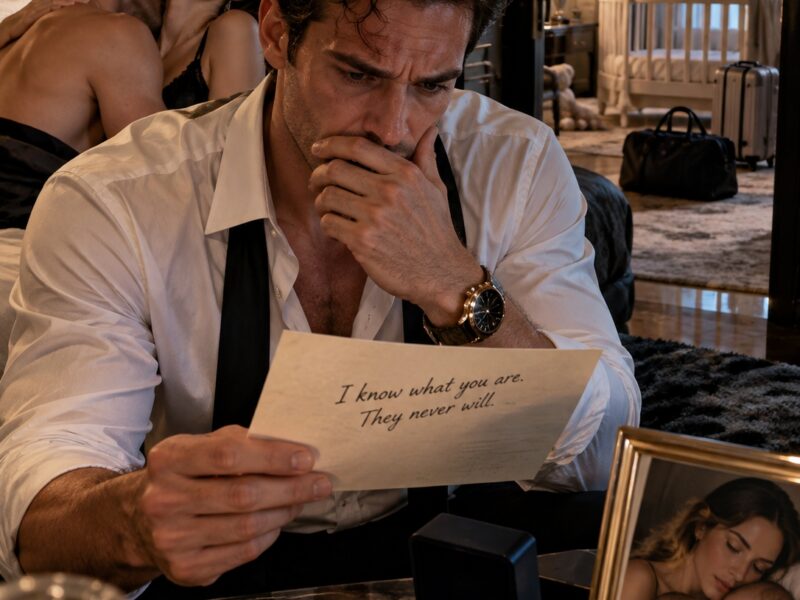
His wife’s wedding ring lay on the dresser beside her three-carat diamond, and beneath both rings was a cream-colored card containing nine words in Clara’s careful handwriting.
I know what you are. They never will.
For the first time in twenty years, Dominic Costello felt afraid.
Then he opened the hidden safe in his basement.
And fear became something much worse.
The black ledger was gone.
Less than an hour earlier, Dominic had believed he still owned everything that mattered.
Manhattan glittered behind him as his armored Mercedes G-Wagon crossed through the wet predawn streets. A brief rain had passed over the city, leaving the pavement black and reflective beneath traffic lights.
Dominic lowered the driver’s-side window.
Cold air rushed against his face.
It didn’t help.
Vivienne Laurent’s gardenia perfume still clung to the collar of his shirt.
He rubbed the side of his neck with his palm, then smelled his hand.
Damn it.
He loosened his silk tie and drove faster.
Vivienne had laughed when he’d left her SoHo penthouse.
“You always run home before sunrise.”
“I don’t run anywhere.”
“Of course not.”
She’d been standing barefoot beside the bed, wrapped in the hotel-white sheet she’d dragged around herself.
“You just happen to disappear whenever your wife might wake up.”
Dominic had turned at the bedroom door.
“Don’t talk about Clara.”
Vivienne’s smile had changed.
Only slightly.
But he’d seen it.
“Interesting.”
“What?”
“You’ll betray her. You’ll lie to her. You’ll leave her alone with two screaming babies while you come here and drink my whiskey.”
Her eyes had traveled over him.
“But I can’t say her name.”
Dominic hadn’t answered.
Vivienne had laughed softly.
“Men like you are fascinating.”
He’d left without kissing her goodbye.
Now, with dawn beginning to turn the horizon gray, her words irritated him more than they should have.
Men like you.
Dominic knew exactly what kind of man he was.
At forty-one, he controlled the Costello organization, an East Coast criminal empire disguised beneath shipping companies, commercial real estate, logistics firms, private clubs, restaurants, and a charitable foundation whose annual gala photographed extremely well.
Politicians returned his calls.
Police captains knew when not to answer theirs.
Judges had accepted favors they would spend the rest of their careers pretending they had never received.
Men who frightened other men lowered their voices around Dominic Costello.
He had survived an assassination attempt at twenty-nine.
A federal investigation at thirty-three.
A war with the Santoro crew at thirty-six.
He had buried enemies, rewarded loyalty, purchased influence and learned that almost every human being had a price.
Dominic’s mistake was assuming his wife did too.
Clara had never asked for diamonds.
That should have told him something.
She had never cared about the penthouse in Manhattan, the estate in Greenwich, the drivers, the private chef, the vacation homes or the invitations that arrived on embossed stationery.
She preferred old novels.
Black coffee.
Bare feet on hardwood floors.
Before the twins, she sometimes sat on the kitchen counter at midnight eating peanut butter from the jar while Dominic finished calls.
She had been beautiful in a way that didn’t seem designed for witnesses.
And twelve weeks earlier, she’d nearly died giving birth to their children.
Leo came first.
Sophia arrived eleven minutes later.
Dominic remembered standing beside the hospital bed, staring down at two impossibly small faces while Clara trembled from exhaustion.
He had cried.
Actually cried.
He hadn’t cried when his father died.
Hadn’t cried when his older brother was shot.
But when Clara placed Sophia against his chest and whispered, “That’s your daughter,” something inside him had broken open.
For perhaps three weeks afterward, Dominic had tried.
He came home before dinner.
Canceled meetings.
Held Leo at two in the morning.
Learned that Sophia liked being walked in circles and that Leo stopped crying if Dominic hummed badly enough.
Then the calls began again.
A shipment problem in Newark.
A casino dispute.
A union official demanding more money.
The Commission asking questions.
A prosecutor becoming ambitious.
Dominic returned to his world because he told himself that world paid for the safe one surrounding his wife and children.
Then Vivienne happened.
He called it stress.
He called it temporary.
He called it something that had nothing to do with Clara.
Men like Dominic were talented at changing the names of their sins until they sounded like necessities.
Tonight—last night—he had stayed too long.
Clara had texted him at 11:08.
Sophia has a fever. 100.6. Pediatrician says monitor it. Are you coming home?
Dominic had read the message while Vivienne poured Scotch.
He typed:
Meeting ran late. Soon.
He never came.
At 1:37 a.m., Clara sent another message.
A photograph.
Sophia asleep against her chest.
Leo curled beside them.
No caption.
Dominic stared at it for several seconds.
Then locked his phone.
Now guilt pressed somewhere beneath his ribs.
He could fix it.
That was another thing Dominic believed.
Everything could be fixed if you possessed enough money.
He’d send Clara away for a weekend.
No, a week.
Somewhere warm.
He’d hire another night nurse.
He’d buy the Cartier bracelet she’d paused to admire months earlier.
He would take Sunday off.
He would hold the twins.
He would be present.
By the time his G-Wagon turned toward the Costello estate in Greenwich, Dominic had almost convinced himself that remorse and repair were the same thing.
Then he saw the gate.
It wasn’t opening.
Dominic slowed.
The estate’s wrought-iron entrance rose from the morning mist, black bars anchored between stone pillars. Normally the night guard recognized his vehicle before he reached the keypad.
Nothing happened.
He tapped the horn twice.
Short.
Sharp.
The way he did everything.
No response.
“Sullivan.”
Dominic leaned forward.
The guardhouse appeared dark.
His irritation disappeared.
In his world, routine wasn’t convenience.
Routine was survival.
If a man who had opened the same gate five nights a week for three years suddenly didn’t open it, Dominic didn’t assume he’d gone to the bathroom.
He assumed someone had made him unable to.
Dominic reached beneath the driver’s seat.
His fingers closed around the grip of the handgun stored there.
He stepped from the SUV.
Mist settled against his suit.
“Sullivan!”
Nothing.
He approached the guardhouse.
The monitors were on.
Coffee sat beside the console.
The chair was empty.
Dominic’s pulse quickened.
He keyed his override code into the gate.
The motors engaged.
As the iron barriers swung apart, he returned to the Mercedes and accelerated up the long driveway.
Gravel sprayed behind him.
The mansion appeared between the trees.
Three stories of limestone, glass and old money Dominic’s grandfather had never possessed and his father had spent his entire life trying to imitate.
No security vehicles.
No men at the entrance.
No movement behind the windows.
Dominic stopped crooked across the circular drive and left the engine running.
He opened the front door.
“Clara?”
His voice traveled through the marble foyer.
No answer.
The chandelier was still lit.
A bottle rested on the console beside the stairs.
One of Leo’s tiny socks lay on the floor.
“Clara.”
Louder now.
Still nothing.
Dominic climbed the stairs two at a time.
He pulled his weapon.
The nursery door was half open.
A blue star projector scattered tiny points of light across the ceiling.
He pushed inside.
The first crib was empty.
He stared.
For one absurd second, his brain refused to understand what his eyes were showing him.
He moved to the second crib.
Empty.
The mattress was bare except for a neatly folded blanket.
“Clara!”
The name tore through the house.
He ran.
Their bedroom doors struck the walls when he shoved them open.
The bed was made.
Too perfectly.
He crossed to Clara’s side.
Cold.
She hadn’t slept there.
Dominic opened the bathroom.
Empty.
Then the closet.
His stomach tightened.
Clara’s practical clothes were missing.
Jeans.
Sweaters.
Sneakers.
The long charcoal coat she’d owned since before they married.
Maternity clothes.
The inexpensive brown leather bag Dominic had repeatedly offered to replace.
Gone.
What remained were the dresses he had bought for her.
Black tie gowns.
Silk.
Sequins.
Designer labels.
Clothes selected for the woman Dominic wanted the world to see standing beside him.
They hung untouched.
Dominic stared at them.
Something cold moved through him.
This wasn’t random.
Clara had made choices.
She had taken what belonged to her life.
She had left what belonged to his.
Then Dominic saw the dresser.
Her wedding band.
Her engagement ring.
A card beneath them.
He crossed the room slowly.
The handwriting was unmistakable.
Elegant.
Controlled.
I know what you are. They never will.
His hand began to shake.
Not because he didn’t understand.
Because he did.
“Clara…”
His voice was barely audible.
Three years of marriage rearranged themselves inside his mind.
Questions she’d stopped asking.
Nights she’d gone quiet.
Phone calls he’d ended when she entered rooms.
Blood on his cuff once, two years earlier, explained as a broken wineglass.
Men arriving after midnight.
A locked basement door.
The way Clara had looked at him six months ago when a news report mentioned the disappearance of a dockworker in Newark.
She had known.
How much?
Dominic’s fear transformed.
Heat flooded his chest.
He turned and drove his fist into the mirror.
Glass cracked outward.
Blood appeared across his knuckles.
Pain barely registered.
He called Vincent.
His underboss answered on the second ring.
“Boss?”
“Get everyone to Greenwich.”
Vincent’s voice sharpened immediately.
“What happened?”
“My wife is gone.”
Silence.
“The twins too.”
Another silence.
Then Vincent said, “Was she taken?”
Dominic looked at the rings.
“No.”
That word cost him something.
“No, she wasn’t.”
He ended the call.
Then he remembered the basement.
Dominic ran.
Behind the wine cellar stood a bookcase no guest had ever questioned. A biometric panel hidden beneath one shelf released a steel door.
Dominic pressed his thumb against it.
Green light.
The door opened.
His private operations room smelled of metal, paper and climate-controlled air.
He crossed directly to the safe.
Twelve digits.
A mechanical click.
He pulled the door open.
Cash.
Untouched.
Emergency passports.
Untouched.
Diamonds.
Gold.
A sealed envelope containing identities that did not officially exist.
All there.
Except one thing.
Dominic stopped breathing.
The black leather ledger was gone.
“No.”
He moved stacks of currency.
As if it could somehow be underneath them.
“No. No, no…”
The ledger wasn’t a diary.
It was the Costello organization’s insurance policy.
Account numbers.
Shell corporations.
Payoffs.
Judges.
Police officials.
Union contacts.
Shipping schedules.
Names of politicians who had accepted Costello money and businessmen who had purchased Costello protection.
Enough information to destroy Dominic.
Enough to destroy men far more powerful than Dominic.
If the FBI received it, prison was the optimistic outcome.
If the Commission discovered he’d lost it, he might never reach a courtroom.
Dominic stared at the empty space.
Then at the security system.
The primary recordings had been erased.
Every camera from midnight forward showed static.
His jaw tightened.
Clara could not have done this alone.
Then Dominic remembered something.
The secondary server.
A hardwired backup installed after the Santoro war.
Only Dominic and the technician who installed it knew it existed.
The technician had died three years ago.
Dominic pulled up the archive.
2:15 a.m.
The gate opened.
A black SUV entered.
2:19.
The front door opened.
Clara stepped outside.
Dominic leaned toward the screen.
She wore a dark coat.
Her hair was pulled back.
A duffel hung from one shoulder.
She wasn’t crying.
She wasn’t looking behind her.
She moved like someone walking through a plan she’d rehearsed a hundred times.
Then another figure emerged.
A man carrying both infant car seats.
Dominic froze.
The man turned toward the camera.
Infrared caught his face.
David Caldwell.
Dominic’s head of security.
The man who had stood three feet behind Dominic at his wedding.
The man who had driven Clara to prenatal appointments when Dominic was “working.”
The man Dominic had pulled bleeding from a Brooklyn warehouse five years earlier.
The man whose loyalty Dominic had never questioned.
David placed Leo and Sophia inside the SUV.
He took Clara’s bag.
Opened the passenger door.
Before getting in, Clara stopped.
She looked upward.
Directly at the hidden camera.
Dominic felt the hairs rise along his arms.
She knew.
She had known the camera was there.
And she’d left it untouched intentionally.
She wanted him to see her leave.
For two seconds, husband and wife were separated by time, distance and a black-and-white monitor.
Clara stared into the lens.
There was no fear in her face.
No apology.
No hesitation.
Then she got into the vehicle.
David drove away.
The gates closed behind them.
Dominic remained bent over the monitor.
“How long?” he whispered.
Weeks?
Months?
Had Clara been sleeping with David?
The thought arrived violently.
He rejected it almost as quickly.
No.
Not because Dominic trusted either of them.
Because the woman on that screen wasn’t running toward romance.
She was running from him.
Footsteps sounded behind him.
Vincent entered with three men.
“Boss.”
Dominic didn’t turn.
Vincent saw the blood on his hand.
The open safe.
The frozen image on the monitor.
“We found Sullivan and two others in the pool house,” Vincent said. “Alive. Drugged. Restrained. No gunshots. No forced entry.”
Dominic finally faced him.
“This wasn’t a kidnapping.”
Vincent’s eyes moved to David’s image.
“It was an extraction.”
Dominic pointed at the screen.
“Find him.”
Vincent stared.
“David?”
“Find all of them.”
“Boss, if Clara has the ledger—”
“I know what she has.”
“If the Commission hears—”
“I KNOW.”
The room went silent.
Dominic stepped close enough that Vincent could see the tiny shards of mirror embedded in his knuckles.
“Every camera. Every toll road. Every airport. Every private field from here to Canada. I want every favor called in.”
Vincent nodded.
“And when we find David?”
Dominic looked at the screen again.
Clara’s face.
His children disappearing into darkness.
“Bring Leo and Sophia home.”
“And Clara?”
For the first time, Dominic hesitated.
Only a fraction.
But Vincent noticed.
Dominic noticed too.
His voice hardened to compensate.
“Find her.”
For forty-eight hours, Dominic didn’t sleep.
The Greenwich mansion became a command center.
Men moved through rooms where Clara had once carried the babies at night.
Laptops covered the dining table.
Phones rang in the library.
Armed guards walked past framed photographs of Dominic holding his newborn daughter.
He stopped looking at the photographs.
The hunt produced almost nothing.
That was what terrified him.
David Caldwell was too good.
At first, the black SUV appeared to provide the break they needed.
It was discovered at JFK.
Terminal footage showed Clara wearing glasses and carrying Sophia.
David carried Leo.
Two suitcases.
Two boarding passes.
Geneva.
Dominic mobilized contacts in Switzerland within minutes.
Then Vincent came into the study.
“They never boarded.”
Dominic looked up.
“What?”
“They cleared security. Walked toward the international gates. Then exited through an employee corridor.”
“That’s impossible.”
“Security cameras in that section went offline for maintenance for eleven minutes.”
Dominic stood slowly.
“Coincidence?”
Vincent gave him a look.
Dominic hurled his glass into the fireplace.
The crystal exploded.
“Who is helping them?”
“That’s what we asked.”
Vincent placed a folder on the desk.
“We ran Caldwell again.”
“You ran him when I hired him.”
“We ran the identity he gave us.”
Dominic didn’t like the distinction.
Vincent opened the folder.
A photograph showed a younger David.
Shorter hair.
No beard.
Government tactical uniform.
Dominic’s eyes dropped to the document beneath it.
Department of Justice.
The name printed there wasn’t David Caldwell.
It was Jonathan Hayes.
Vincent spoke quietly.
“FBI Organized Crime Task Force.”
Dominic looked up.
“You’re wrong.”
“Five-year deep cover.”
“No.”
“His military record is real. The rest was built around it. He’s been inside the Costello organization since Brooklyn.”
Dominic stared at the photograph.
Five years.
Birthdays.
Meetings.
Dinners.
Security briefings.
David had been there when Dominic proposed to Clara.
He’d guarded the church on their wedding day.
He had stood outside the hospital room when Leo and Sophia were born.
Dominic suddenly remembered something.
Three weeks after the birth, he’d arrived at the nursery at 2:00 a.m.
Clara had been asleep in a chair.
David stood outside the door.
“You can go,” Dominic had told him.
David hadn’t moved.
“Mrs. Costello asked me to stay until you got home.”
Dominic had been irritated.
“Well, I’m home.”
David looked at him for one second too long.
Now Dominic understood that look.
It hadn’t been insubordination.
It had been judgment.
Dominic closed the file.
“If Hayes is FBI, they have the ledger.”
“That’s the strange part.”
Vincent sat across from him.
“They don’t.”
“How do you know?”
“Our contact in the U.S. Attorney’s office says there’s no movement. No emergency warrants. No coordinated arrests. No grand jury chatter. If federal prosecutors had that book, every Costello property would be surrounded.”
Dominic’s mind accelerated.
“Then Hayes didn’t deliver it.”
“No.”
“Why?”
Before Vincent could answer, Dominic’s private phone vibrated.
Only three people possessed that number.
Vincent saw Dominic’s expression.
“Who?”
The caller ID was scrambled.
Dominic answered.
“Speak.”
A woman’s voice came through.
“Hello, Dominic.”
His entire body became still.
Clara.
Not crying.
Not frightened.
Calm.
The calmness angered him more than screaming would have.
“Where are my children?”
“Our children are safe.”
“Where?”
“Somewhere you can’t reach.”
Dominic’s fingers tightened around the phone.
“You made a very serious mistake.”
“No, Dominic.”
“You ran away with a federal agent. You stole from me.”
“I took something that never should have existed.”
“You have no idea what you’ve done.”
A pause.
Then Clara said, “I’m looking at page forty-seven.”
Dominic went cold.
She continued.
“Judge Harrison. Cayman transfer. Three hundred thousand.”
“Clara.”
“Page eighty-two. Port Newark.”
“Stop.”
“Page one hundred and six is interesting.”
“STOP.”
Silence.
Vincent stared at him.
Dominic lowered his voice.
“Give me the book.”
“No.”
“You don’t understand this world.”
Clara laughed.
Not loudly.
That made it worse.
“You never asked about my father.”
Dominic frowned.
“What does your father have to do with this?”
“You remember what I told you?”
“Accountant. Chicago.”
“A bookkeeper.”
“Same thing.”
“No.”
Her voice changed.
“A bookkeeper in our world is never just an accountant.”
Our world.
Dominic felt something shift.
“My father’s name wasn’t Arthur Rossi because he happened to be Italian and good with numbers. Arthur Rossi kept the books for the Chicago Outfit.”
Dominic stopped moving.
He knew the name.
Everyone did.
Arthur Rossi had disappeared fifteen years earlier during a brutal internal purge.
“You said he died from a heart attack.”
“I said he died when I was seventeen.”
“Clara—”
“You supplied the heart attack yourself.”
Dominic said nothing.
“That was always your problem,” she continued. “You heard what supported the version of me you wanted.”
He sat down.
Images flashed through his memory.
Clara understanding coded financial language she’d supposedly never studied.
Clara once noticing a surveillance car before his security team did.
Clara refusing to tell him much about Chicago.
Her composure around dangerous men.
Dominic had interpreted all of it as intelligence.
He’d never considered training.
“My father taught me numbers,” Clara said. “My mother taught me exits. By fourteen, I knew never to sit with my back to a restaurant door. By sixteen, I knew how shell companies worked. By seventeen, I knew what men like you eventually do to everyone who loves them.”
“Then why marry me?”
For the first time, pain entered his voice before he could stop it.
Clara was silent.
When she answered, the steel was gone for just a moment.
“Because I loved you.”
That hurt more than anything she’d said.
“I thought you were different.”
“I am.”
“No. You’re exactly the same.”
“You knew what I did.”
“I knew your family was dangerous. I knew your businesses weren’t clean. I told myself there were lines you wouldn’t cross.”
“There are.”
“I found your ledger.”
Dominic closed his eyes.
“Nine months ago.”
His eyes opened.
Nine months.
Before the twins were born.
“Why didn’t you leave then?”
“I was pregnant.”
“You could have told me.”
“And what would you have done?”
“I would have protected you.”
Clara’s voice cracked for the first time.
“From whom, Dominic?”
He couldn’t answer.
“That’s when I understood. You kept telling me this house was a fortress. The gates. The cameras. The guards. The armored cars.”
She breathed in.
“But a fortress and a prison use the same architecture.”
Dominic looked toward the rain outside his window.
“Vivienne didn’t make me leave.”
His jaw tightened.
So she knew.
“She just made me stop waiting.”
“Clara—”
“I spent last night holding Sophia while she had a fever. Leo was crying. I called you.”
Dominic said nothing.
“You said you were working.”
“Clara.”
“I already knew where you were.”
A silence opened between them.
Huge.
Irreversible.
“I watched Sophia sleep,” Clara said. “And I realized that one day she would grow up and believe whatever she saw me tolerate was what love looked like.”
Dominic stood.
“Tell me where you are.”
“No.”
“I need to see you.”
“That can be arranged.”
He stopped.
“Midnight. Old Bethlehem Steel complex outside Allentown.”
Vincent leaned closer.
Clara continued.
“You and Vincent.”
“That’s it?”
“That’s it. No advance team. No drones. No tracking devices. No hidden convoy.”
“And if I refuse?”
“The ledger goes to three places simultaneously.”
“FBI?”
“Yes.”
Dominic waited.
“The press.”
His stomach tightened.
“And?”
Clara’s voice became almost gentle.
“Thomas Moretti.”
Dominic’s face drained.
The Commission.
“Don’t do this.”
“You’ve threatened me three times during this phone call.”
“I’m warning you.”
“No. You’re finally realizing I’m not asking permission.”
The call ended.
Dominic remained with the phone against his ear.
Vincent waited.
Finally he said, “Boss?”
Dominic lowered his hand.
“Get the car.”
Rain hammered the abandoned steel complex at midnight.
The Bethlehem ruins rose against the Pennsylvania darkness like the skeleton of some prehistoric animal.
Dominic’s headlights swept across rusted beams and broken concrete as he entered the loading bay.
Vincent sat beside him.
Neither man had spoken for twenty minutes.
Dominic stopped the vehicle.
“There.”
Clara stood beneath a single industrial floodlight.
Black coat.
Dark pants.
Hair tied back.
No jewelry.
David—Jonathan Hayes—stood several yards behind her.
Other figures remained in the shadows.
Dominic stepped into the rain.
Vincent followed.
“Where are Leo and Sophia?”
No greeting.
No accusation.
Only that.
Clara looked at him.
“They’re safe.”
“I want to see them.”
“No.”
“I’m their father.”
“And that used to mean something to me.”
Dominic took another step.
David shifted.
Dominic looked toward him.
“You.”
David’s expression remained neutral.
“Five years.”
“Five years,” David agreed.
“I saved your life.”
“You saved my cover.”
“I brought you into my home.”
“Yes.”
“You ate at my table.”
“Yes.”
“My children knew your voice.”
David’s jaw tightened.
“Which is why I helped their mother get them out.”
Dominic moved before he realized he had.
Vincent caught his arm.
“Boss.”
Dominic stared at David.
“You slept with her?”
Clara’s face changed.
Not guilt.
Disgust.
“Of course that’s where your mind goes.”
“Answer me.”
“No.”
David spoke.
“Nothing happened between us.”
Dominic looked between them.
Clara stepped forward.
“He was the first person in your house who saw me as someone worth protecting instead of something belonging to you.”
That silenced Dominic.
Clara reached beneath her coat.
Vincent’s hand moved toward his weapon.
“Don’t.”
She withdrew the black ledger.
Dominic stared at it.
Rain struck the leather cover.
“Give it to me.”
Clara looked down at the book.
“Do you know what I thought when I first found this?”
Dominic said nothing.
“I thought it would contain the reason.”
“The reason for what?”
“For you.”
She looked at him.
“I thought there would be something in here that explained why a man who could hold his newborn son like he was afraid to breathe too hard could also order someone’s father beaten over a debt.”
Dominic’s face hardened.
“Don’t pretend you understand business.”
“Business.”
Clara nodded slowly.
“That’s another word you use.”
She lifted the ledger.
“Like pressure. Protection. Necessity.”
Dominic’s gaze stayed on the book.
“How much?”
Clara almost smiled.
“What?”
“How much do you want?”
Something sad passed through her expression.
Even now.
After everything, this was the language he trusted.
“I don’t want your money.”
“Everyone wants something.”
“I do.”
“What?”
“My children get a life where nobody whispers their last name before deciding whether to be afraid.”
“You think you can erase who they are?”
“I can give them the chance to decide.”
“They’re Costellos.”
“They’re Leo and Sophia.”
“They’re my blood.”
Clara’s eyes hardened.
“They are not your inheritance.”
The words hit harder than Dominic expected.
He looked at the ledger.
“Give me the book, Clara. Take fifty million. A hundred. I’ll put it somewhere nobody can trace. You can live anywhere.”
“I already traded it.”
Dominic went still.
Vincent whispered, “Jesus.”
“To who?”
Headlights appeared behind them.
Dominic turned.
Three black Escalades entered the loading bay.
They stopped across the exit.
Doors opened.
Men in dark suits emerged.
Too many.
Too disciplined.
Then the rear door of the center SUV opened.
An older man stepped out beneath an umbrella.
Silver-tipped cane.
Gray hair.
A face that had appeared in almost no photographs despite influencing organized crime from Boston to Miami for decades.
Thomas Moretti.
Dominic felt something he had rarely experienced.
Not fear of death.
Fear of judgment.
Moretti approached slowly.
“Dominic.”
Dominic looked at Clara.
Then back at Moretti.
“No.”
Moretti stopped.
Rain drummed against the umbrella.
“You’ve had a difficult week.”
“Thomas, whatever she told you—”
“She didn’t tell me.”
Moretti held out one hand.
Clara walked toward him.
And placed the ledger into it.
Dominic felt the floor disappear beneath him.
Moretti examined the cover.
“She showed me.”
“That belongs to my family.”
“No.”
Moretti’s eyes lifted.
“This contains information belonging to every family.”
“She stole it.”
“From your house.”
“Yes.”
“While you were where?”
Dominic didn’t answer.
Moretti looked at Clara.
Then back at Dominic.
“That was rhetorical.”
Vincent shifted uncomfortably.
Dominic’s voice became low.
“You cannot allow a civilian to blackmail the Commission.”
Moretti’s expression barely changed.
“Clara Rossi is many things.”
He glanced toward her.
“But civilian is not one of them.”
Dominic stared.
Moretti continued.
“Arthur Rossi’s daughter.”
“I know who her father was.”
“Apparently not when you married her.”
Clara said nothing.
Moretti tapped the ledger lightly with his fingers.
“Your wife contacted me twenty-two hours ago.”
Dominic looked at her.
“What did you offer him?”
Clara answered.
“Everything he needed.”
“And what did you ask for?”
“Freedom.”
Dominic laughed once.
It sounded broken.
“From me?”
“From all of you.”
Moretti nodded.
“Mrs. Costello provided the ledger and all digital copies in exchange for Commission protection for herself and the children.”
“Those are my children.”
Moretti’s eyes turned cold.
“They are children, Dominic. Not territory.”
Dominic looked around.
At the armed men.
At Vincent.
At David.
At Clara.
The geometry of power had changed.
And for perhaps the first time in his adult life, Dominic occupied the weakest position in the room.
He hated the feeling.
“You need me,” he said.
Moretti sighed.
“Every man in our profession eventually says that.”
“I control Newark.”
“Not anymore.”
Dominic’s head snapped toward him.
Moretti continued.
“The Costello organization is dissolved effective tonight.”
Vincent inhaled sharply.
“You can’t—”
“I can.”
“Thomas.”
“Your shipping interests will be divided. Your legitimate holdings will remain subject to whatever legal ownership survives the next month. Your captains will report to me until reassigned.”
Dominic stared.
“I built that family.”
Moretti’s voice remained quiet.
“Your grandfather built it. Your father expanded it. You inherited it.”
That landed.
Dominic took a step forward.
Several weapons rose.
Red dots appeared across his chest.
Vincent reached instinctively toward his own weapon.
More dots found him.
“Don’t,” Dominic said.
Vincent froze.
Moretti watched him.
“You were careless, Dominic.”
“I made one mistake.”
Clara laughed softly.
Dominic turned toward her.
“One?”
Her eyes glistened now.
Not with weakness.
With years.
“You think this happened because you slept with Vivienne?”
Dominic said nothing.
“It happened because every day with you required me to become smaller.”
“That’s not true.”
“You chose where we lived.”
“To protect you.”
“You chose who drove me.”
“To protect you.”
“Who stood outside the door. Which restaurants were safe. Which friends had to be checked. Which calls couldn’t be made from the house.”
“Because people wanted to hurt me.”
“And eventually I realized that every explanation ended with you.”
Dominic’s voice dropped.
“I gave you everything.”
“No.”
Clara stepped closer.
“You gave me expensive things.”
Rain ran down her face.
“You gave me a house where every door had a camera. You gave me dresses I didn’t choose and guards I didn’t ask for. You gave me jewelry after disappearing for days.”
She looked at him for a long moment.
“The one thing I needed was a husband who came home.”
Dominic’s anger weakened.
Just slightly.
“You should have told me.”
“I did.”
“No, you didn’t.”
“I told you when Leo was born and I asked you to stay.”
Dominic remembered.
“I told you when Sophia wouldn’t sleep unless someone held her.”
He remembered that too.
“I told you when I stopped going to dinner with you because I couldn’t pretend in front of your friends.”
“Clara—”
“I told you every time I stopped arguing.”
That silenced him.
Clara’s voice became softer.
“You mistook my silence for surrender.”
She looked toward the ledger in Moretti’s hand.
“I was learning the layout of the prison.”
Dominic’s face tightened.
“So that’s what our marriage was?”
“No.”
That answer came immediately.
“Our marriage was real.”
Something in him broke.
Clara continued.
“That’s why this hurt.”
For a moment, the steel mill disappeared.
No Commission.
No guns.
No ledger.
Just a husband and wife standing in the rain at the end of something neither had believed would end this way.
Dominic looked at her.
“Come home.”
Vincent lowered his eyes.
Even Moretti seemed surprised.
Clara stared at Dominic.
“What?”
“Come home.”
His voice was quieter now.
“I’ll change things.”
Clara’s expression crumpled for half a second before she recovered.
“Don’t.”
“I’ll shut down the house.”
“Dominic.”
“I’ll get rid of the guards.”
“Stop.”
“I’ll leave New York.”
“Stop.”
“I’ll end it with Vivienne.”
Clara closed her eyes.
When she opened them, tears mixed with the rain.
“You still think Vivienne is the problem.”
“I can fix this.”
“No.”
“I can.”
“That is your disease.”
Dominic stared at her.
“You believe everything is fixable as long as you are the one deciding how.”
He had no response.
Clara looked at him for a long time.
“I loved you enough to keep hoping you would choose us without being forced.”
Her voice trembled.
“You didn’t.”
Dominic’s face changed.
The boss disappeared.
For one moment Clara saw the man she’d married.
The man who used to make terrible pancakes on Sunday mornings.
The man who’d once driven three hours because she’d casually mentioned missing a bakery from her childhood.
The man who cried when Sophia wrapped her newborn fingers around his thumb.
That man was still inside Dominic.
That was the tragedy.
He had simply spent years choosing every other version of himself.
“Let me see them,” he whispered.
Clara’s lips parted.
“Please.”
It was perhaps the first time Thomas Moretti had ever heard Dominic Costello use that word.
Clara looked away.
“I can’t.”
“One photograph.”
“No.”
“Clara.”
“If I give you a photograph, you’ll study the background.”
Dominic said nothing.
“You’ll look at the light. The windows. The furniture. You’ll ask what country. What climate. What time zone.”
His silence admitted it.
“You don’t know how to be their father without also being Dominic Costello.”
He lowered his head.
Moretti stepped forward.
“This is finished.”
Dominic looked at him.
“You have twenty-four hours to leave the United States.”
Vincent stared.
Dominic almost smiled.
“And if I don’t?”
“You know.”
Of course he did.
Moretti turned toward Vincent.
“Your loyalty contract ended when the Costello family ended.”
Vincent looked at Dominic.
Years passed in that glance.
Bodies.
Money.
Wars.
Celebrations.
Funerals.
Vincent slowly removed his weapon.
He placed it on the concrete.
“I’m sorry, Dom.”
Dominic’s eyes became empty.
Vincent walked away.
And suddenly Dominic understood the true shape of defeat.
It wasn’t death.
It was remaining alive while everything that once moved when you spoke learned it could move without you.
Moretti turned.
His men followed.
David remained beside Clara.
Dominic looked at him.
“You love her?”
Clara stiffened.
David answered after a moment.
“No.”
Dominic studied him.
David looked toward Clara.
“I respect her.”
Then he walked away.
Somehow that answer hurt Dominic too.
Clara remained.
Just a few feet between them now.
Dominic looked at her left hand.
Bare.
“Where are the rings?”
“On your dresser.”
“I saw them.”
“I know.”
“Why leave them?”
Clara’s gaze fell.
“Because they belonged to that house.”
Dominic swallowed.
“Did you ever love wearing them?”
She smiled sadly.
“At first.”
Thunder rolled somewhere beyond the ruins.
Dominic looked at the woman he’d once believed he understood completely.
“What am I supposed to do now?”
Clara’s eyes filled again.
That question, more than the threats, nearly destroyed her.
Because once, years earlier, she would have had an answer.
Come upstairs.
Hold me.
Feed the baby.
Turn off your phone.
Stay.
Choose us.
But there were some questions people only learned to ask after the answer no longer mattered.
“I don’t know,” she whispered.
Dominic nodded slowly.
Clara turned.
She took three steps.
“Clara.”
She stopped.
He wanted to say he loved her.
The words reached his throat.
But suddenly he understood how selfish they would sound.
So he said something else.
“Tell them…”
His voice failed.
Clara waited.
Dominic tried again.
“Tell Leo and Sophia their father loved them.”
Clara didn’t turn around.
“I’ll tell them their father had the chance to.”
Then she walked away.
Dominic stood motionless.
Her silhouette disappeared into darkness.
A vehicle door closed.
Engines started.
One by one, headlights moved through the ruins and vanished into the Pennsylvania night.
Dominic remained.
No soldiers.
No wife.
No children.
No empire.
Only rain.
At 4:38 the next afternoon, Dominic returned to Greenwich alone.
The estate looked different.
Nothing had physically changed.
That was the strange part.
Same gates.
Same trees.
Same limestone walls.
But without guards and black SUVs, the property looked less like a fortress.
More like what Clara had always wanted it to be.
A house.
Dominic entered.
His footsteps echoed.
For years, silence had been a luxury.
Now it felt like punishment.
He climbed the stairs.
The nursery door remained open.
Dominic stood outside for several seconds before entering.
Two empty cribs.
A stuffed elephant sat in Leo’s.
A small white rabbit lay in Sophia’s.
Dominic picked up the rabbit.
It fit in his palm.
He sat in the rocking chair.
And remembered the night Sophia had refused to sleep.
Clara had been exhausted.
Hair unwashed.
T-shirt stained with formula.
Dominic had been answering emails.
“Can you take her?” Clara asked.
“Give me five minutes.”
“You said that twenty minutes ago.”
“This matters.”
Clara had stared at him.
“So does she.”
Dominic remembered being angry.
Not because Clara was wrong.
Because she had interrupted him.
He closed his eyes.
Five minutes.
How many lives were destroyed by five minutes repeated often enough?
He stayed in the nursery until sunset.
Then he went to the bedroom.
The rings remained on the dresser.
Dominic picked up Clara’s wedding band.
Inside was an engraving.
He had forgotten about it.
Where you are, I am.
Their wedding date followed.
Dominic sat on the edge of the bed.
For the first time since childhood, he cried without making a sound.
By midnight, Dominic Costello was gone.
Private aircraft records showed a jet leaving Westchester County for Lisbon.
After that, the trail became uncertain.
Some said he lived briefly in Monaco.
Others claimed Moretti had quietly arranged his death six months later.
A rumor placed him in Argentina.
Another said he spent years moving between cities under false names, always paying cash, never staying anywhere long enough to become known.
No one knew.
The Costello empire disappeared faster than anyone expected.
Warehouses changed ownership.
Captains changed allegiance.
Restaurants were sold.
Politicians stopped returning calls.
Men who once toasted Dominic’s name began speaking of him as though he’d been dead for years.
Thomas Moretti kept his promise.
No one searched for Clara.
At least no one who wanted to remain alive.
Jonathan Hayes vanished too.
The FBI listed him as resigned.
Officially, that was all.
Three years later, on a bright October morning thousands of miles away, a woman stood beside a playground overlooking a gray-blue sea.
Her hair was shorter now.
She wore jeans, sneakers and a navy sweater.
No guards followed her.
No armored vehicle waited nearby.
No one watched from a black SUV.
“Mom!”
Clara turned.
Leo was running toward her with a red toy airplane.
Sophia followed behind him, furious about something involving a missing purple crayon.
Clara crouched.
Both children collided with her at once.
She laughed.
A real laugh.
The kind she hadn’t heard from herself in years.
“One at a time.”
“He took it!”
“I didn’t!”
“You did!”
“I found it!”
“Finding something in my backpack is stealing!”
Clara stared at them.
Dominic’s eyes in Leo.
Her smile in Sophia.
Sometimes genetics felt cruel.
Sometimes beautiful.
“Okay,” Clara said. “Court is now in session.”
Sophia crossed her arms.
Leo groaned.
Clara listened to both arguments with exaggerated seriousness.
Then her phone vibrated.
An unknown number.
She stopped smiling.
For three years, she had changed phones regularly.
Changed addresses.
Changed routines.
The Commission had honored the agreement, but old instincts did not disappear simply because danger had.
She looked at the screen.
A message.
No text.
Only an attachment.
Clara’s thumb hovered.
“Mom?”
She looked at Sophia.
“Everything okay?”
Clara forced a smile.
“Everything’s fine.”
The children ran back toward the playground.
Clara waited until they were several yards away.
Then opened the attachment.
A photograph.
For a moment she couldn’t breathe.
It showed a small stuffed white rabbit sitting on a café table.
Sophia’s rabbit.
No.
Not Sophia’s.
The identical rabbit from the Greenwich nursery.
The one Clara had left behind.
Beneath the photograph was one sentence.
I kept my promise. I never looked for you.
Clara stared at the screen.
Another message appeared.
I won’t contact you again.
Then a third.
Happy birthday, Sophia.
Clara’s hand began to tremble.
She looked toward her daughter.
Sophia was laughing.
Safe.
Happy.
Free.
Clara typed nothing.
She deleted the messages.
Then deleted the photograph.
For several minutes she stood facing the sea.
She didn’t know where Dominic was.
She didn’t know whether he had changed.
She didn’t know if men like him ever truly changed, or simply learned to live with what their choices had cost.
Part of her hated him.
Part of her probably always would.
And somewhere beneath that hatred was grief for the man he might have been.
Not the king.
Not the feared name.
Not the man with judges in his ledger and soldiers outside his door.
Just Dominic.
The man who once stood barefoot in their first apartment at two in the morning, holding her around the waist while pasta boiled over on the stove.
That man had existed.
She knew because she had loved him.
But loving someone’s best moments did not require surrendering your life to their worst ones.
Clara finally understood that.
“Mom!”
Leo waved from the playground.
“Watch me!”
“I’m watching!”
He climbed too high.
Clara instinctively started toward him.
Then stopped.
Leo looked down.
For one second, fear crossed his little face.
“You’ve got it,” Clara called.
He hesitated.
Then climbed.
Sophia cheered.
Clara smiled.
Above them, gulls crossed an enormous open sky.
No gates.
No cameras.
No guards.
Nothing between her children and the horizon.
That evening, after Leo and Sophia were asleep, Clara opened the small wooden box she kept at the back of her closet.
Inside were only three objects from her former life.
A photograph of her father.
A hospital bracelet from the twins’ birth.
And her wedding ring.
She hadn’t worn it since the night she escaped.
She picked it up.
Where you are, I am.
Clara ran her thumb over the engraving.
Once, she’d thought love meant staying.
Then she’d thought freedom meant forgetting.
Now she knew both ideas had been too simple.
Some people remained inside you long after you stopped belonging to them.
Some loves didn’t survive.
They became scars.
And scars were strange things.
They proved you had been wounded.
They also proved you had healed.
Clara returned the ring to the box and closed the lid.
Across an ocean, in a quiet apartment overlooking a city where nobody knew his real name, Dominic Costello sat alone beside a window.
There were no bodyguards outside his door.
No encrypted phones on the table.
No men waiting for orders.
His hair had begun to gray at the temples.
On the table beside him stood a cheap cup of coffee and the stuffed white rabbit from the photograph.
He had purchased an identical one years earlier after realizing Sophia’s had been left behind.
For three years, he’d kept his word.
He hadn’t searched.
Not really.
There had been opportunities.
A whispered name.
A bank transfer.
A former associate claiming he knew someone who knew something.
Dominic walked away from all of them.
It was the only promise to Clara he’d ever kept after she stopped believing him.
He looked at an old photograph.
Clara in the hospital bed.
Leo in her arms.
Sophia against Dominic’s chest.
All four of them exhausted.
All four smiling.
Before everything fell apart.
Before Dominic learned the difference between possessing a family and deserving one.
He turned the photograph facedown.
Outside, rain began tapping softly against the glass.
For years, Dominic had believed power meant making sure no one could take anything from him.
Clara taught him the truth too late.
Power was being trusted with something fragile…
and choosing not to destroy it.
He had ruled men.
Bought judges.
Terrified enemies.
Built walls around everything he called his.
And in the end, the most devastating punishment anyone could have given Dominic Costello was exactly what Clara gave him.
She lived.
The children lived.
They grew.
They laughed.
They became people.
And he had to live too—
knowing the beautiful life he once possessed had not been stolen from him.
He had been standing inside it the entire time.
He simply kept choosing to leave.









