HE CAME HOME THREE HOURS EARLY—AND HEARD HIS DAUGHTER CRYING BEHIND A DOOR THAT SHOULD HAVE BEEN OPEN

The crying didn’t stop when the front door opened.
That was the first thing Thomas Hartley noticed.
He stood inside the marble entryway of his Denver home with snow melting from the shoulders of his wool coat, one hand still wrapped around the handle of his briefcase. Outside, February wind pushed powder across the driveway in pale ribbons. Inside, the house looked exactly the way it always did—warm recessed lights, polished floors, an enormous vase of white tulips on the console, the faint smell of vanilla from the candle Rachel liked to burn near the stairs.
Everything looked expensive.
Everything looked peaceful.
And somewhere above him, his seven-year-old daughter was crying like she had forgotten anyone might come.
Thomas didn’t move at first.
He listened.
Not the loud, demanding cry of a child who had fallen down or been told no. This was smaller. Exhausted. Almost rhythmic.
A broken little inhale.
A muffled sob.
Silence.
Then another.
“Emma?”
The crying stopped.
Instantly.
Thomas felt something cold move through him.
Children didn’t usually stop crying that way when a parent called their name. They called back. They ran toward you. They explained what happened before you even reached the stairs.
This silence felt different.
It felt like someone had switched something off.
Thomas placed his briefcase carefully beside the front table instead of letting it drop. Years later, he would remember that absurd detail—the way he had worried about scratching the hardwood while something infinitely more important was happening twenty feet above him.
“Emma?”
No answer.
He was home three hours early.
That would become the most important accident of his life.
His quarterly meeting in Chicago had ended before lunch after a client postponed at the last minute. Thomas could easily have stayed. He usually did. There were always calls to make, dinners to attend, contracts that apparently could not survive unless he personally stared at them until midnight.
Instead, on the flight home, a man sitting beside him had shown him a picture of his three daughters.
“How old are yours?” the stranger had asked.
Thomas had opened his mouth.
And hesitated.
“Seven,” he had finally said. “And my son is… eighteen months.”
I think.
He had almost said it aloud.
The shame of that hesitation followed him all the way from Denver International Airport.
So instead of calling his office from the car, Thomas had driven directly home through worsening snow.
He had imagined surprising Emma.
Maybe picking Noah up from his crib before dinner.
Maybe proving to himself that missing one meeting wouldn’t bring Hartley Development crashing to the ground.
Now he took the stairs two at a time.
He found Emma on the second-floor landing.
She was on her hands and knees beside the large antique oak chest that normally sat flush against the wall. Somehow, it had been dragged several feet into the hallway. Her narrow shoulder was pressed against one corner as she tried to push it back.
“My back can do it,” she whispered.
Thomas stopped.
Emma didn’t seem to know he was there.
Her socks slid against the hardwood.
“I can do it. I’m trying.”
“Emma.”
She jerked so hard her elbow struck the floor.
Thomas crossed the distance in three strides.
“What are you doing?”
“I’m sorry.”
He stared at her.
“I didn’t ask if you were sorry.”
Her eyes immediately dropped.
Thomas put both hands against the chest and pushed. The heavy furniture rolled smoothly back toward the wall.
It took him perhaps three seconds.
Two grown movers had carried that thing upstairs after Clare bought it at an estate sale.
His seven-year-old daughter had been trying to move it alone.
“There,” Thomas said softly.
Emma looked at the chest.
Then she looked at him.
And something happened to her face that Thomas would remember more vividly than almost anything that came afterward.
She calculated.
Her gray eyes moved over his features carefully, searching his expression.
His daughter wasn’t wondering whether he was angry.
She was measuring how angry.
There was a difference.
It was the look Thomas saw across conference tables when executives knew a negotiation had shifted against them.
Assess.
Adjust.
Survive.
Except Emma was seven.
“Hi, Daddy,” she said.
The smile appeared too late.
“I was just cleaning.”
Thomas opened his mouth.
Before he could answer, footsteps sounded at the far end of the hallway.
Emma changed.
Her shoulders drew inward.
Her chin lowered.
Her hands became still.
Rachel Vance Hartley stepped around the corner carrying a laundry basket.
She wore cream slacks and a soft gray sweater. Her blond hair was tied loosely at the nape of her neck. To anyone looking through the windows, she would have appeared exactly as Thomas had always thought of her: composed, warm, effortlessly maternal.
Rachel stopped.
“You’re home.”
Thomas watched his daughter.
Emma watched Rachel.
“Honey,” Rachel said, recovering almost immediately. “You didn’t call.”
“I wanted to surprise you.”
Rachel gave an easy laugh.
“Well. You certainly did.”
She set the basket down and walked toward them.
Then she placed one hand on Emma’s shoulder.
The reaction lasted less than a second.
Emma flinched.
Not dramatically.
She didn’t pull away.
She didn’t make a sound.
It was barely more than a tightening of muscle beneath Rachel’s fingers.
Then Emma smiled.
A perfect little smile.
Thomas felt the same strange coldness again.
Rachel seemed not to notice.
“She’s been on one of her projects,” she said. “I swear this child wants to rearrange the whole house by herself.”
Emma nodded quickly.
Rachel gave her shoulder an affectionate squeeze.
“I keep telling her to ask for help, but you know Emma.”
“No,” Thomas said.
Rachel glanced at him.
“What?”
Thomas looked at his daughter.
“I’m starting to realize I don’t.”
Something passed through Rachel’s expression.
So quickly he almost doubted he had seen it.
Then she smiled.
“You’ve been working too much.”
The words were light.
True, even.
Thomas could have argued, but there was nothing to argue with.
Emma looked at the floor.
Rachel turned to her.
“Tell your father what we talked about.”
Emma swallowed.
“I’m sorry.”
Thomas waited.
“For?”
“I was being silly.”
There it was.
That sentence.
Not the chest.
Not the crying.
Not even the flinch.
I was being silly.
The words sounded polished from repetition.
Thomas knew people who lied for a living. He had negotiated with developers who buried liabilities under five hundred pages of contracts and politicians who could avoid answering a question while smiling directly into a camera.
He understood rehearsed language.
His daughter had rehearsed that apology.
Thomas smiled.
“All right,” he said.
Rachel seemed to relax.
He kissed Emma’s forehead and asked what was for dinner.
Then he went downstairs and pretended nothing had happened.
Inside him, something had begun to turn.
Slowly.
Like a key.
That evening Rachel made salmon, roasted vegetables and rice.
Thomas sat at the dining room table for the first family dinner he could remember attending on a weekday in months.
Noah sat in his high chair.
Emma sat opposite him.
Rachel talked about a charity auction.
Thomas listened with half of his attention while watching his children.
Emma ate almost nothing.
At least that was what he thought initially.
Then he realized she wasn’t refusing food.
She was eating in strange, tiny motions—one small bite, then a pause, then another whenever Rachel looked away.
“You don’t like the salmon?” Thomas asked.
Emma froze.
Rachel reached for her wine.
“She ate after school.”
“I did,” Emma said quickly.
“What did you have?”
Silence.
Rachel smiled.
“She forgets everything five minutes after it happens.”
Thomas returned his attention to Emma.
“What did you have, sweetheart?”
Emma’s fingers tightened around her fork.
“Crackers.”
“What kind?”
“Thomas.”
Rachel laughed softly.
“She isn’t being deposed.”
“No,” he said.
Something about his tone made Rachel stop smiling.
Thomas softened his expression.
“I just haven’t been around enough. I don’t even know what snacks she likes anymore.”
Emma stared at her plate.
“Cheese crackers.”
“See?” Rachel said. “Mystery solved.”
Thomas smiled.
But he watched Rachel remove Emma’s unfinished plate before Emma had asked to be excused.
He watched his daughter follow it with her eyes.
Later, Thomas stood in Noah’s nursery.
His son was asleep beneath a pale blue blanket, one arm tucked under his cheek.
Thomas had missed most of the milestones.
First crawl.
First word.
The transition from bottle to cup.
He had videos of them.
Hundreds of videos.
They lived in his phone beneath emails he answered faster.
At 11:42 p.m., Thomas lay in bed beside Rachel staring at the ceiling.
She slept easily.
He did not.
Instead he did what had made him very wealthy.
He assembled facts.
Fact: Emma’s pajamas were too large at the waist despite having been bought only six months earlier.
Fact: he could not remember the last time he had watched her finish a meal.
Fact: Noah had not cried once for attention since Thomas arrived home.
That bothered him.
Babies cried.
Babies demanded.
Babies made themselves inconvenient.
Yet Noah had learned how to lie quietly in a crib.
At 2:07 a.m., Thomas got out of bed.
Rachel stirred.
“Bathroom,” he whispered.
She rolled over.
Thomas crossed the hallway to Noah’s nursery and lifted his sleeping son carefully.
Noah woke.
His eyes opened.
But he didn’t cry.
Thomas carried him downstairs.
In the kitchen, he found formula still stored in a cabinet even though Rachel had told him Noah had mostly stopped drinking bottles.
He made one anyway.
The instant Noah saw it, something changed.
His small hands reached.
Thomas gave him the bottle.
Noah grabbed it with both fists.
And drank.
Not hungrily.
Desperately.
Milk ran down his chin because he swallowed too quickly. Tiny whimpers escaped between gulps. When Thomas tried lowering the bottle so the child could breathe properly, Noah made a frightened sound and clamped both hands around it.
“Hey,” Thomas whispered. “Easy, buddy.”
Noah stared at the bottle.
Not at him.
“There’s more.”
The baby didn’t understand.
Thomas sat down on the kitchen floor.
Noah finished six ounces.
Then two more.
Thomas’s chest felt tight.
He lifted his son and noticed the weight.
Or rather, the lack of it.
Noah felt light.
Too light.
A bird.
A bundle of warm pajamas and bones.
Thomas had held him dozens of times, but most of those moments had been brief—before rushing to a car, before boarding a plane, while posing for a family photograph.
He had never stopped long enough to notice his own child disappearing.
Noah rested his cheek against Thomas’s chest.
Thomas sat there until almost three in the morning.
The refrigerator hummed.
Snow tapped softly at the kitchen window.
His son slept.
And Thomas Hartley understood something terrible.
He was living inside a lie.
Worse, he had helped build it.
But suspicion was not proof.
Thomas knew the difference.
At seven the next morning, he made breakfast.
He burned the first batch of toast.
The eggs were uneven.
There was orange juice, butter, jam, strawberries and enough food for six children even though there were only two.
Emma stopped in the kitchen doorway.
Thomas looked up from the stove.
“Morning.”
She didn’t move.
“Come sit.”
Her eyes flicked toward the stairs.
“Rachel’s sleeping.”
Emma looked at him again.
“You made this?”
“I’m offended by your surprise.”
For one second, something almost normal crossed her face.
A tiny smile.
Thomas had forgotten what it looked like.
She sat.
He placed eggs and toast in front of her.
Emma ate quickly.
Head down.
Thomas turned away deliberately and pretended to wash a pan.
When he looked back, the plate was empty.
“More?”
Emma stopped moving.
“Can I?”
“Of course.”
He spooned more eggs onto her plate.
She stared at them.
“Can I really have more?”
Four words.
Thomas would hear them in dreams for years.
He sat down beside her.
“You can have as much as you want.”
Emma searched his face.
“Always?”
His throat tightened.
“Always. There’s always more food in this house.”
She began eating again.
Faster.
Thomas looked toward the stairs.
Something inside him hardened.
Noah woke a few minutes later.
Thomas placed him in the high chair and cut soft pieces of toast onto the tray.
When Thomas reached across the table for the salt, his sleeve moved quickly through Noah’s peripheral vision.
The baby threw both arms over his face.
Thomas stopped.
Noah stayed like that.
Protecting his head.
At eighteen months old.
Thomas slowly lowered his hand.
“Okay,” he whispered.
Emma had seen.
Her eyes were wet.
But she didn’t say anything.
That afternoon Thomas called his office.
“Cancel everything.”
His assistant, Melissa, went silent.
“Today?”
“This week.”
“Tom, you have the Benton closing Thursday.”
“Move it.”
“They flew in from—”
“Move it.”
She hesitated.
“Is everything okay?”
Thomas looked through the glass doors toward the backyard where Rachel was pushing Noah in a swing.
“No.”
He ended the call.
His next call was to Dr. Angela Ruiz.
Angela had been Clare’s college roommate before she became the children’s pediatrician. She was one of the few people in Thomas’s life who had known him before money, before Hartley Development, before six houses became one mansion and private terminals replaced airport gates.
“I need you at the house,” Thomas said.
“When?”
“Now.”
There was a pause.
“What’s wrong?”
“I don’t know yet.”
Angela heard something in his voice.
“I’ll be there in an hour.”
She arrived in eighty-six minutes carrying a black medical bag and wearing jeans under her winter coat.
Rachel met her at the door.
“This is unexpected.”
Angela smiled.
“Thomas asked me to check the kids. He said Noah’s been a little off.”
Rachel turned toward Thomas.
“Why didn’t you tell me?”
“I just did.”
Rachel stared at him for half a second.
Then she smiled.
“Of course.”
Angela examined Emma and Noah upstairs.
Thomas stayed in the study.
Rachel hovered twice near the staircase.
Both times Thomas gave her some administrative problem to discuss.
Forty-three minutes later, Angela came down alone.
Her face was different.
“Where’s Rachel?”
“Kitchen.”
“Good.”
Angela closed the study door.
“Sit down.”
“I’d rather stand.”
“Tom.”
He sat.
Angela remained standing.
“Emma is significantly underweight.”
Thomas said nothing.
“She has lost enough weight since her last full examination that it can’t be explained by a growth spurt.”
His fingers curled around the arm of the chair.
“Noah?”
Angela inhaled slowly.
“He has fallen almost entirely off his previous growth curve.”
Thomas looked at the books behind her.
He knew every object in that study.
The first real estate award he’d ever won.
A photograph of Clare laughing on a beach in Maine.
A framed newspaper article about Hartley Development.
They suddenly seemed like artifacts from another man’s life.
“There’s more,” Angela said.
Thomas looked at her.
“Emma has bruising on both upper arms.”
“How many?”
“Several.”
“From today?”
“No.”
Angela lowered her voice.
“They’re in different stages of healing.”
Thomas stared at her.
“Which means?”
“You know what it means.”
“Say it.”
Her jaw tightened.
“They happened on different days.”
Thomas felt his heartbeat become strangely slow.
“She also has tenderness across her upper back and shoulder. She flinched when I examined her.”
He looked toward the closed door.
“Did she tell you who did it?”
“No.”
“Did you ask?”
“Yes.”
“What did she say?”
Angela’s eyes filled, but her voice remained clinical.
“She apologized.”
Thomas blinked.
“For what?”
“For taking too long.”
He stood.
Angela caught his wrist.
“Don’t.”
He looked at her hand.
“If you’re thinking about walking into that kitchen right now, don’t.”
“She hurt my children.”
“You don’t know enough yet.”
“I know enough.”
“No,” Angela said firmly. “You know enough to protect them. That’s different from knowing enough to prove who did what.”
Thomas breathed through his nose.
Angela did not release his wrist.
“I’m a mandated reporter,” she continued. “I have to file this.”
“File it.”
“Thomas—”
“Photograph everything. Measurements. Weight. Bruises. Dates. Every observation.”
“I will.”
“I want copies.”
“You’ll get whatever legally can be released.”
He pulled his hand away gently.
“What happens after you file?”
“Child protection may investigate.”
The phrase brought a flash of fear.
“They’re not taking my children.”
“This isn’t about punishing you.”
Thomas laughed once.
There was no humor in it.
“Maybe it should be.”
Angela studied him.
“This is not the time to decide what punishment you deserve.”
“When is?”
“When they’re safe.”
That answer kept him from walking into the kitchen.
Rachel was cheerful that evening.
Almost aggressively cheerful.
She ordered Italian food and opened a bottle of expensive wine.
“So,” she said as she twirled pasta around her fork, “what did Angela say?”
Thomas drank water.
“Minor deficiencies.”
“Really?”
“Apparently I’ve been overreacting.”
Rachel smiled.
“That doesn’t sound like you.”
Thomas smiled back.
“Maybe I’m changing.”
Across the table, Emma watched them both.
Thomas realized she was afraid.
Not because Rachel had hurt her.
Because Thomas might tell Rachel what he knew.
That night, he knocked softly on Emma’s bedroom door.
“Can I come in?”
She was sitting beneath the covers reading.
“Okay.”
He sat on the edge of the bed.
Clare had decorated this room.
The pale green walls.
The white shelves.
The window seat overlooking the backyard.
After Clare died, Thomas had been unable to enter for weeks because every corner contained some small decision she had made.
Emma watched him carefully.
“Daddy?”
“Yeah?”
“Are you mad at Rachel?”
The question nearly stopped his breathing.
“Why would you ask me that?”
Emma looked down at her book.
“You were looking at her weird.”
Thomas had spent twenty years believing he possessed a nearly unreadable face.
Apparently his seven-year-old had become better at reading danger than any executive he knew.
“I’m not mad at you,” he said.
“I didn’t ask that.”
“No.”
Emma’s eyes lifted.
He chose every word carefully.
“Whatever happens in this house, you can tell me.”
Her body became still.
“I know.”
“You don’t get in trouble for telling me the truth.”
“I know.”
“I mean anything.”
She looked at the door.
Thomas saw it.
The fear.
Then it disappeared.
“I’m tired.”
He wanted to push.
Angela had told him not to.
So he kissed her forehead.
“Okay.”
As he stood, Emma grabbed his sleeve.
Thomas turned.
She seemed about to say something.
Instead she whispered, “Are you going to work tomorrow?”
“No.”
“When?”
“When what?”
“When are you going away again?”
His heart cracked quietly.
“I’m staying home for a while.”
She released his sleeve.
“Oh.”
He couldn’t tell whether that sound meant relief or disbelief.
As Thomas crossed the room, he glanced toward the window seat.
And suddenly remembered Clare laughing there years earlier.
Emma had been four.
Clare had lifted one of the wooden panels beneath the seat and shown their daughter a narrow space underneath.
“For treasures,” Clare had said.
Thomas stopped.
The memory came so clearly he could almost hear her voice.
A loose board.
A hiding place.
He waited until Emma was asleep.
At 11:16 p.m., he returned alone.
The panel lifted with gentle pressure.
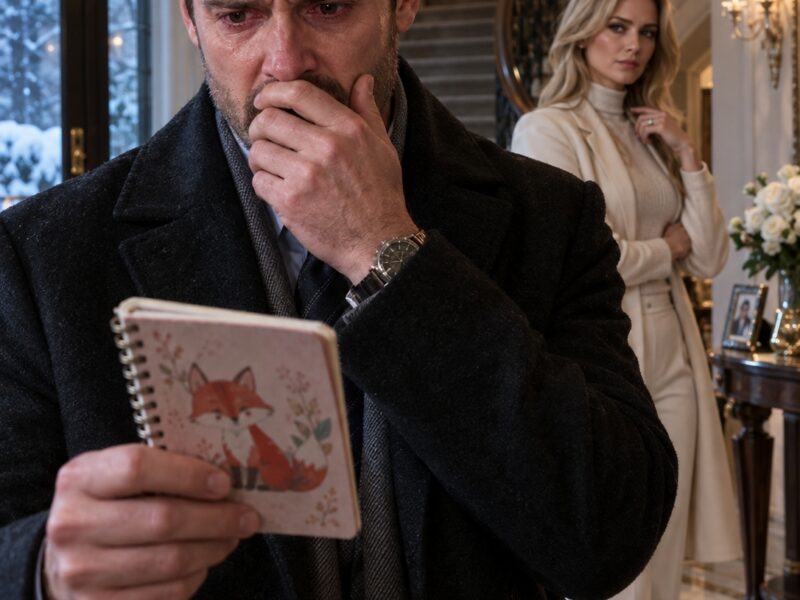
Inside was a faded friendship bracelet, two polished stones, an old photograph of Clare holding Noah as a newborn—
and a spiral notebook with a cartoon fox on the cover.
Thomas recognized it immediately.
Clare had bought that notebook three weeks before she died.
He carried it to his study.
Locked the door.
And began to read.
The first pages were ordinary.
A drawing of a horse.
A list of Emma’s favorite ice cream flavors.
A crooked picture of their family in which Clare had been drawn as an angel after her death.
Then Rachel’s name began appearing.
Rachel says I talk too much at dinner.
Thomas turned the page.
Today I didn’t get dinner because I interrupted. I wasn’t trying to.
Next page.
Noah cried so I gave him my bread. Rachel found it under his blanket. She was really mad.
Thomas’s fingers trembled.
He kept reading.
Emma’s spelling was inconsistent.
Some sentences ran uphill across the paper.
But the meaning was painfully clear.
Punishment.
Food withheld.
Long periods standing alone.
Objects she had been forced to carry or move.
Rules that changed depending on Rachel’s mood.
There were references to “the downstairs room.”
Thomas read one entry twice.
I don’t like the door at the bottom of the basement stairs because there is no window. Rachel says I have to sit there when I act like Mommy because Mommy spoiled me. I sing Mommy’s song quietly because Rachel says if Noah hears me he will cry.
Thomas covered his mouth.
Another entry.
Rachel said if I tell Daddy they might take Noah away and it will be my fault because Daddy believes grownups and I am only a kid.
Thomas shut his eyes.
For months, every time he called from another city, Emma had told him she was fine.
“How’s school?”
“Good.”
“Everything okay at home?”
“Yep.”
“Are you helping Rachel with Noah?”
“Yes.”
He had mistaken short answers for childhood distraction.
He had never asked why his daughter sounded relieved whenever a phone call ended.
He turned the page.
Mrs. Delgado asked why I was sleepy. I almost told her but Rachel was coming after school.
Another.
Daddy said he might come home Friday but he didn’t. Rachel said he probably forgot.
Thomas stopped breathing.
He remembered that Friday.
A dinner with investors in Manhattan.
Three hundred thousand dollars had depended on it.
Or at least that was what he’d told himself.
He continued.
The final entry had been written four days earlier.
The pencil marks were faint.
I think if I am perfect Daddy will stay home.
Beneath it:
I just have to be smaller and quieter and better.
Thomas read the sentence again.
Then again.
Smaller.
Quieter.
Better.
The notebook slipped from his hands.
Thomas Hartley had stood beside Clare’s grave two years earlier while snow fell onto black umbrellas.
He had not cried.
Everyone mistook that for strength.
It wasn’t strength.
It was shock.
He had saved grief for private places and then avoided every private place where grief could find him.
He had returned to work four days after the funeral.
Then Chicago.
New York.
Seattle.
Houston.
He expanded the company by thirty percent in the year following his wife’s death.
Business magazines called it remarkable resilience.
His daughter called it disappearing.
Thomas sat in a chair that cost more than some families’ cars and wept so violently he had to press both hands over his face to keep from making noise.
His daughter had been begging for rescue in pencil.
Beneath a floorboard.
Ten yards from the bedroom where he slept whenever he happened to be home.
And the person she had been waiting for was him.
At 1:03 a.m., Thomas stopped crying.
He called Frank Colbear.
Frank had handled Hartley Development’s ugliest litigation for eleven years.
He answered on the fourth ring.
“Someone better be dead.”
“Frank.”
Silence.
Frank immediately changed tone.
“What happened?”
Thomas told him.
For nine minutes, Frank did not interrupt.
When Thomas finished, Frank asked only one question.
“Are the children safe tonight?”
Thomas looked toward the ceiling.
“I’m here.”
“That isn’t what I asked.”
Thomas closed his eyes.
“Yes. Their doors are locked from the inside. I’m in the hallway if Rachel comes upstairs.”
“Good.”
“I want her gone.”
“She will be.”
“Tonight.”
“Not if you want it done in a way that protects your children long-term.”
Thomas stood and paced.
“You sound like Angela.”
“Angela is smart.”
“She hurt them.”
“I believe you.”
“Don’t believe me. Prove it.”
Frank paused.
“Tom, if you confront her without enough evidence and she denies everything, this becomes a custody war. You travel constantly. She has been their primary caregiver on paper for more than a year. She will say Emma is grieving, confused or being influenced by you.”
Thomas’s stomach turned.
“She can’t.”
“She can say anything. Our job is to make sure saying it doesn’t matter.”
Thomas stared at the notebook.
“What do you need?”
“Everything.”
Thomas thought.
Then he remembered the cameras.
After Clare died, Thomas had gone through a short period of irrational terror. He imagined break-ins. Kidnappings. Fires. Every disaster that might take another person from him.
He had hired a private security company to install cameras throughout common areas of the property.
Eventually his fear subsided.
The cameras became invisible pieces of the house.
He had never reviewed them.
Not once.
Thomas called the security company.
The archived cloud storage was still active.
Fourteen months.
The following morning, a technician helped Frank’s investigator access the recordings.
Thomas watched twenty-three minutes before vomiting into the wastebasket beside his desk.
He would never describe most of those recordings to anyone who did not legally need to see them.
There were things a father could witness once and carry forever.
Rachel’s public voice disappeared when Thomas wasn’t home.
So did her smile.
There were punishments.
There was humiliation.
There were threats.
There were moments when Emma physically placed herself between Rachel and Noah.
And there were long stretches of calculated neglect that Thomas found almost harder to watch because of how ordinary they looked.
A child waiting.
A plate removed.
A bedroom door closing.
A baby crying until he understood crying accomplished nothing.
Thomas watched timestamps.
He recognized nights when the footage recorded his children suffering while he was giving speeches at charity galas about community.
Frank eventually reached across the desk and closed the laptop.
“Enough.”
“No.”
“You don’t need to see everything.”
“Yes, I do.”
“You need to remain functional.”
“I need to know.”
“You know.”
Thomas reached for the computer.
Frank caught it first.
“Tom.”
Thomas looked at him.
Frank had known him more than a decade.
He was one of three people Thomas had allowed to see him at Clare’s funeral after everyone else left.
“Your children need their father more than you need to punish yourself.”
Thomas’s voice broke.
“I left them with her.”
“You did.”
The bluntness hurt.
Frank didn’t soften it.
“You made a catastrophic mistake. Now decide whether you’re going to spend the rest of your life staring backward at it or spend the next twenty-four hours protecting them.”
Thomas sat back.
Frank opened the laptop again.
“There’s another clip you need to see.”
The footage was from the living room.
No children were present.
Rachel stood beside the fireplace on her phone, holding a glass of wine.
Her voice was clear.
“Six more months. That’s all.”
Thomas leaned forward.
A pause.
Then Rachel laughed.
“No, he has no idea. Thomas barely knows what city he’s in half the week.”
Another pause.
“He’ll sign it. He signs anything his attorneys put in front of him if you frame it like family planning.”
Thomas stopped breathing.
Rachel wandered toward the window.
“Once the guardianship and custody paperwork clears, I get access to the trust structure. You know what Clare’s father put in there.”
Silence.
Then the sentence that changed everything.
“Two kids for two million? Please. I’ve done worse for less.”
Thomas watched the clip eleven times.
Not because he needed to understand it.
Because each repetition burned away another excuse.
Overwhelmed caregiver.
Depressed stepmother.
Grieving family.
Bad moment.
Mistake.
No.
This had a design.
Rachel had entered his grief and studied where the doors were unlocked.
She had comforted him at Clare’s funeral.
She had brought casseroles.
Helped with Emma.
Rocked Noah when Thomas couldn’t stand the sound of his infant son’s crying because it reminded him Clare would never hear it again.
Rachel hadn’t simply married him.
She had positioned herself.
Thomas shut the computer.
The grief that had ruled him for two years went quiet.
Something colder replaced it.
“I want everything,” he told Frank.
“We’ll get everything.”
“And Frank?”
“Yes?”
“Make sure she never gets close enough to scare them again.”
The next two weeks were the hardest performance Thomas Hartley ever gave.
He did not confront Rachel.
Instead, he became pleasant.
He came home early and called it a new schedule.
He asked about her day.
They ate dinner together.
He smiled when she touched him.
At night, Thomas slept beside the woman he now knew had terrorized his children.
Sometimes Rachel rolled against him in her sleep.
Thomas would stare into the darkness until morning.
Behind the performance, the investigation expanded.
Dr. Ruiz filed her report.
Frank obtained financial records.
A private investigator found Rachel’s bankruptcy filing from nineteen months before the wedding.
Then came the children’s household accounts.
Ninety-four thousand dollars had been removed.
Not all at once.
Small transfers.
Patient amounts.
The kind designed not to trigger attention.
Thomas stared at the printout.
“What was this account for?”
Frank answered quietly.
“Food, school expenses, childcare, clothing, medical incidentals.”
Thomas looked toward the dining room.
The account that should have fed his children had funded Rachel’s debt payments.
The investigator found emails.
Dozens.
In one, Rachel described Clare as the golden one.
In another:
She always got everything. The husband. The kids. The house. The life.
Rachel and Clare had known each other socially before Clare’s illness.
Thomas had believed Rachel’s loyalty during Clare’s final months came from friendship.
The emails painted something different.
Jealousy.
Resentment.
Calculation.
One line made Thomas stare for a long time.
At least the kids come with assets attached.
The investigator found a neighbor.
Eighty-one-year-old Margaret Abernathy lived three houses away.
She invited Thomas and Frank inside and made coffee neither man touched.
“I called someone,” she said.
“When?” Thomas asked.
“October.”
His chest tightened.
“Why?”
Mrs. Abernathy looked ashamed.
“I saw Emma taking the garbage bins to the curb. It was snowing.”
Thomas waited.
“She was wearing a summer dress.”
He closed his eyes.
“I called child services.”
Frank leaned forward.
“What happened?”
“A woman came a few days later.”
Thomas opened his eyes.
“To the house?”
Mrs. Abernathy nodded.
“She was there maybe forty minutes.”
“Did she speak to Emma alone?”
“I don’t know.”
Thomas already knew the answer.
The file confirmed it later.
The house had been immaculate.
Rachel had been articulate.
Emma had allegedly struggled with behavioral issues following her mother’s death.
The family was wealthy.
Well connected.
Stable address.
Excellent school.
No prior documented allegations.
Case closed.
Everyone had seen pieces.
Nobody had assembled them.
Then Frank called Thomas from Emma’s elementary school.
“You need to come here.”
Mrs. Delgado, Emma’s second-grade teacher, sat behind her desk clutching a folded square of notebook paper.
Her face was pale.
“I should have done more.”
Thomas sat opposite her.
“What is that?”
She handed him the paper.
Three sentences in Emma’s handwriting.
Please help me.
Rachel hurts me.
My brother is hungry.
Thomas felt the room tilt.
“When did she give you this?”
Mrs. Delgado started crying.
“November.”
Thomas looked at her.
“You had this since November?”
“I talked to Rachel that afternoon.”
Thomas went completely still.
“You did what?”
“I thought—I thought I was handling it correctly.”
“You told Rachel?”
“She was Emma’s legal guardian at pickup. I said Emma had given me a concerning note. Rachel looked devastated. She said Emma was having grief episodes and inventing stories about punishment because she resented the new marriage.”
Thomas looked down at the paper.
Mrs. Delgado wiped her face.
“She said Emma was already seeing someone.”
“She wasn’t.”
“I know that now.”
“But you believed her.”
“Yes.”
Thomas wanted to rage.
He wanted someone else to carry even a fraction of the blame he felt.
Then Mrs. Delgado said, “I read that note every morning.”
Thomas looked up.
“I kept it because something in me knew.”
“You knew?”
“I knew I wasn’t convinced.”
Her voice cracked.
“But I let myself be convinced anyway.”
Thomas understood that sentence better than he wanted to.
Because he had done the same thing.
Rachel had not survived by making every lie perfect.
She had survived by giving people the explanation they most wanted to accept.
The teacher wanted to believe a child was confused.
The social worker wanted to believe a wealthy, orderly family was safe.
Thomas wanted to believe that earning money and hiring help counted as parenting.
Rachel supplied each person with the lie that cost them the least.
Emma paid for all of them.
That evening, Thomas sat beside his daughter while she worked on multiplication tables.
“Seven times eight?” he asked.
“Fifty-six.”
“Nine times six?”
“Fifty-four.”
“Do you know you’re smarter than I was at your age?”
Emma rolled her eyes.
“You own a company.”
“That wasn’t the question.”
She smiled.
Thomas watched her erase an answer so violently the paper nearly tore.
“What happened?”
“I wrote it wrong.”
“So?”
“I should know it.”
“Everybody gets things wrong.”
Emma stared at him.
“You don’t.”
Thomas almost laughed.
“Emma, I have gotten bigger things wrong than you can imagine.”
Something in his voice made her put the pencil down.
“Like what?”
He looked at her.
“Thinking work was more important than being home.”
She didn’t answer.
“Thinking you were okay because you told me you were okay.”
Her eyes widened.
Thomas continued carefully.
“I found your notebook.”
All color left her face.
“No.”
“Sweetheart—”
“You weren’t supposed to!”
She jumped up so quickly the chair fell backward.
Thomas stood.
Emma backed away.
“You weren’t supposed to find it.”
“I’m sorry I read something private.”
“She’ll know.”
“Rachel doesn’t know.”
“She always knows!”
“No.”
Emma’s breathing became shallow.
“She’s going to take Noah.”
“No one is taking Noah.”
“She said—”
“I know what she said.”
Emma froze.
Thomas knelt.
For the first time, he allowed himself to say it.
“I believe you.”
Emma stared at him.
“She said you wouldn’t.”
“She was wrong.”
“She said grown-ups believe other grown-ups.”
“Sometimes we do.”
Thomas swallowed.
“And sometimes adults fail children because believing another adult is easier.”
Emma’s lower lip trembled.
“Are you mad?”
“At you? Never.”
“I gave Noah food when I wasn’t supposed to.”
“You protected your brother.”
“I lied to you.”
“You were scared.”
“I said everything was good.”
“You were surviving.”
The word seemed too large for her.
Thomas opened his arms but did not move closer.
Emma stared at him for several seconds.
Then she ran into him so hard he almost fell backward.
The sound she made against his shoulder was the same exhausted cry he’d heard from the bottom of the stairs.
This time it didn’t stop when he touched her.
Thomas held her while she cried.
And cried.
And cried.
He understood then why she had gone silent so quickly two weeks earlier.
Crying had become dangerous.
So he let her make as much noise as she needed.
Rachel knocked on the bedroom door.
Emma’s entire body stiffened.
Thomas looked toward it.
“Everything okay?”
Rachel’s voice.
Warm.
Sweet.
Thomas felt his daughter trembling against him.
He answered calmly.
“She’s fine.”
Rachel tried the handle.
Thomas had locked it.
There was a brief silence.
Then Rachel laughed lightly.
“Okay. Don’t stay up too late.”
Her footsteps moved down the hall.
Emma looked up.
“Daddy?”
“Yes?”
“When are you going away again?”
Thomas brushed hair from her face.
“I’m not.”
She waited.
He understood she needed more than reassurance.
So he told her the truth.
“I can’t promise I will never have to travel again.”
Emma’s expression fell.
“But I can promise this: I will never again build a life where you have to wonder whether your father is coming home.”
She stared at him.
“Really?”
“Really.”
For the first time, Emma seemed to believe him.
The case became ready on a Thursday in March.
Snow had begun melting from the lawns.
Frank arrived shortly before noon.
A detective from the Denver Police Department came separately and waited in the small adjoining conference room off Thomas’s study.
Emma and Noah were not in the house.
Angela had taken them to her sister’s home outside the city.
Thomas had told Rachel they were spending the afternoon at a playdate.
At 2:17 p.m., he sent Rachel a message.
Can you come to the study?
She entered five minutes later.
Black pants.
Cream blouse.
Diamond earrings Thomas had given her on their first anniversary.
She smiled.
“This sounds serious.”
Thomas sat behind the desk.
“Close the door.”
Rachel did.
Then she sat opposite him and crossed her legs.
“What did I do?”
The joking tone almost impressed him.
Thomas opened his laptop.
“I’ve been doing some reading.”
“About?”
He rotated the screen.
Rachel saw the paused security image.
Her smile disappeared.
Only for a fraction of a second.
Then returned.
“What is this?”
Thomas pressed play.
He watched Rachel instead of the screen.
First confusion.
Then recognition.
Then calculation.
The footage showed her standing over Emma in the upstairs hallway.
Thomas stopped it before the worst moment.
Rachel didn’t speak.
He opened another file.
The phone call.
Two kids for two million? Please. I’ve done worse for less.
Thomas paused the recording.
The room became silent.
Rachel looked at the computer.
Then at him.
Her face had changed.
Not broken.
Changed.
The warmth vanished.
The concerned-wife expression vanished.
Something flatter appeared.
“You recorded me.”
Thomas almost smiled at the absurdity.
“That’s what you got from this?”
“You can’t secretly record someone.”
“Common areas. My residence. Security system.”
Rachel leaned back.
“Frank told you that?”
Thomas said nothing.
Her eyes narrowed.
“You’ve been talking to Frank.”
Silence.
“How long?”
“Long enough.”
Rachel stood.
Thomas remained seated.
She walked toward the window.
“You were never here.”
Her voice had dropped.
There was no sweetness in it now.
“You have no idea what those children were like.”
Thomas felt heat move through him.
“Sit down.”
“No. You want the truth? You were gone.”
“Sit.”
“I raised them.”
Thomas stood.
“I said sit down.”
For the first time, Rachel saw something in him that made her pause.
But she did not sit.
Instead she laughed bitterly.
“You want to play father now?”
Thomas’s jaw tightened.
“You were on airplanes. You were closing deals. You were in hotel suites and boardrooms while I handled everything. Emma had tantrums. Noah screamed constantly. Your daughter manipulated every situation because Clare raised her to think the whole world existed for her.”
“She was six.”
“She knew exactly what she was doing.”
“She was six.”
“You weren’t there!”
Thomas stepped around the desk.
“No.”
The answer stopped her.
He did not defend himself.
“I wasn’t.”
Rachel blinked.
“I abandoned responsibilities that mattered more than the company I hid behind. That’s mine.”
She stared at him.
Thomas moved closer.
“But my absence did not make you starve a child.”
Rachel’s nostrils flared.
“I didn’t starve anyone.”
“It did not make you lock her in a dark room.”
“Discipline.”
“It did not make you take money from their accounts.”
Her face changed again.
There.
Fear.
Thomas saw it.
“And it certainly did not make you describe my children as an investment.”
Rachel looked toward the door.
Thomas knew the exact moment she understood.
This wasn’t a marital confrontation.
It was evidence.
“How much do you have?”
“Enough.”
Rachel’s eyes sharpened.
“You think you’re going to destroy me and walk away clean?”
“No.”
That answer confused her.
Thomas looked directly at her.
“I don’t walk away clean.”
His voice became quieter.
“I live with the fact that my daughter asked other adults for help because she stopped expecting it from me.”
Rachel’s lips curled.
“Good.”
Thomas said nothing.
“You should live with it.”
“I will.”
“I was there when Clare died.”
Her words landed harder.
“I held you together.”
“You did.”
“You couldn’t even walk out of the cemetery.”
“I remember.”
“Your children would’ve gone to pieces without me.”
Thomas felt sick hearing Clare’s name in her mouth.
Rachel stepped toward him.
“You needed me.”
“I thought I did.”
“You married me.”
“Yes.”
“You gave me authority.”
“Yes.”
“You left.”
“Yes.”
Each admission robbed Rachel of another weapon.
She had expected denial.
Rage.
Excuses.
Thomas gave her none.
“You want me to say you’re responsible?” Rachel asked.
“No.”
“Why not?”
“Because you already did it on camera.”
The adjoining door opened.
Rachel spun around.
Frank Colbear entered first.
Behind him stood Detective Lena Brooks.
Rachel looked from the detective to Frank.
Then to the thick file Frank placed on Thomas’s desk.
Bank statements.
Medical photographs.
Emails.
Reports.
The notebook copy.
The school note.
Rachel stepped backward.
“What is this?”
Detective Brooks spoke.
“Rachel Vance Hartley?”
Rachel’s face became white.
Frank said nothing.
He didn’t have to.
Thomas watched his wife’s expression change in real time as she understood that every exit she normally used had been closed.
Charm.
Money.
Narrative.
Blame.
All gone.
Detective Brooks approached.
“I need you to place your hands where I can see them.”
Rachel looked at Thomas.
“You planned this.”
Thomas’s voice was quiet.
“You planned it first.”
She was arrested in the front hall.
Ten feet from the place where Thomas had set down his briefcase the afternoon he came home early.
The symmetry made him feel ill.
At the open front door, Rachel turned.
The detective held one arm.
Rachel looked toward the staircase.
“They’ll remember me.”
Thomas didn’t answer.
“Emma will remember every time that room goes dark.”
His fists tightened.
“Noah will remember being hungry even if he doesn’t understand why.”
“Stop talking,” Detective Brooks warned.
Rachel smiled at Thomas.
“You can’t take me out of their heads.”
Thomas walked toward her.
“No.”
Rachel waited.
He looked directly at the woman who had used his guilt as a doorway into his family.
“But I can be there every time the dark scares them.”
Her smile faded.
“I can be there for every meal. Every nightmare. Every doctor. Every school morning. Every ordinary Tuesday.”
Thomas swallowed.
“For the rest of my life.”
The detective guided Rachel through the door.
Thomas watched the police vehicle disappear beyond the gates.
Then the house became silent.
He hated the silence now.
He wanted footsteps.
Toys.
Arguments.
Noah crying because he wanted juice.
Emma shouting because she couldn’t find a shoe.
Anything.
Thomas went upstairs to Emma’s room.
He sat on the floor beside the window seat.
And waited for his children to come home.
The criminal case took months.
The trial lasted eleven days.
Thomas hated every one of them.
There was medical testimony.
Financial testimony.
Video evidence.
There were bank transfers and emails and timelines.
There was a defense expert who described caregiver burnout.
Rachel’s attorney argued that she had been isolated, overwhelmed and unsupported by a husband who prioritized business over family.
Thomas sat behind the prosecution table and listened.
The words were painful.
Because some were true.
He had been absent.
He had been selfish.
He had treated fatherhood like another obligation that could be outsourced if he hired qualified people.
When Frank leaned toward him and whispered, “Don’t let that get inside your head,” Thomas shook his head.
“It belongs there.”
Frank looked at him.
“Some of it.”
Thomas kept watching the defense attorney.
“Enough of it.”
But Thomas also understood something now.
Responsibility was not a pie cut into pieces.
His failures did not reduce Rachel’s.
Rachel’s crimes did not erase his.
Both truths could exist.
On the seventh day, Margaret Abernathy testified.
She described Emma in the snow.
On the eighth, Mrs. Delgado walked to the witness stand carrying the guilt she’d been living with for months.
When the prosecutor unfolded Emma’s note, the teacher began crying before she was asked the first question.
Please help me.
Rachel hurts me.
My brother is hungry.
Thomas looked down.
Across the courtroom, Rachel did not.
On the evening before the ninth day, Emma came into Thomas’s bedroom.
She wore pajamas patterned with small blue stars.
“I want to tell them.”
Thomas put down his book.
“You don’t have to.”
“I know.”
“You really don’t.”
“I know.”
“You’ve already told the detectives. The videos are there. The doctors are there.”
Emma sat beside him.
“If I don’t tell them, can she do it to other kids someday?”
Thomas closed his eyes for one second.
“That isn’t your responsibility.”
“But can she?”
“I don’t know.”
Emma picked at a loose thread on the blanket.
“I want them to know I remember.”
Thomas felt fear.
Not for the case.
For her.
“You might be asked difficult questions.”
“Like what?”
“They may suggest you’re confused.”
“I’m not.”
“They might suggest you exaggerated.”
“I didn’t.”
“They might ask whether I told you what to say.”
Emma looked almost offended.
“You didn’t.”
“I know.”
She frowned.
“Then I’ll tell them.”
Thomas wanted to protect her from the courtroom.
But he was beginning to understand protection did not always mean choosing silence for someone else.
“Okay,” he said.
Emma nodded.
Then she climbed beneath the blanket beside him.
“Can I sleep here?”
Thomas turned off the lamp.
“Always.”
The next morning Emma wore a blue dress Clare had bought before she died.
The courtroom chair was too large.
Her feet did not touch the floor.
Thomas had to lock his hands together to stop them shaking.
The prosecutor kept the questions simple.
Her name.
Age.
School.
Then home.
Emma answered quietly.
When Rachel’s attorney stood, Thomas felt every muscle in his body tighten.
The man was professional.
Not cruel.
Thomas hated him anyway.
“Emma,” he said gently, “you love your father very much, correct?”
“Yes.”
“And you wanted him to stay home more?”
“Yes.”
“You were sad that he traveled?”
“Yes.”
“You were also sad that your mother died?”
Emma looked toward Thomas.
“Yes.”
The attorney nodded.
“Sometimes when people are very sad or frightened, things can feel worse than they actually were. Do you understand that?”
Emma thought about it.
“Yes.”
“And your father is taking care of you now?”
“Yes.”
“You want to stay with him?”
“Yes.”
“Of course you do.”
The lawyer moved closer.
“And you understand that saying bad things about Rachel could make it easier for you to remain with your father?”
The prosecutor stood.
“Objection.”
The judge considered.
“Rephrase.”
The attorney nodded.
“Emma, is it possible that some of what you remember happened differently because you were upset?”
The courtroom became perfectly still.
Emma looked at Rachel.
Rachel looked back.
For a moment Thomas saw his daughter become seven again in the worst possible way.
Shoulders inward.
Eyes measuring danger.
He wanted to stand.
He wanted to end it.
Then Emma pushed up the sleeve of her dress.
Faint marks remained along one arm.
Not dramatic.
Almost healed.
She looked at the jury.
“Being locked where it’s dark and being told nobody wants you isn’t discipline.”
The attorney said nothing.
Emma’s voice grew clearer.
“And taking Noah’s food isn’t discipline.”
The courtroom stayed silent.
“And telling me Daddy didn’t love me because he wasn’t home wasn’t discipline either.”
She lowered her sleeve.
“That’s just being mean.”
The defense attorney shifted.
Emma looked directly at him.
“And I’m not remembering it wrong.”
A pause.
“I was there.”
No one in the courtroom moved.
Thomas stared at his daughter.
Not because she sounded brave.
Because she sounded certain.
The defense attorney returned to his table.
“No further questions.”
The jury deliberated for six hours.
Guilty.
Every count.
At sentencing, Rachel received fourteen years.
Thomas expected relief.
Instead he felt something more complicated.
Finality, perhaps.
A door closing somewhere very far away.
Emma asked the judge if she could speak.
Nobody had planned it.
Thomas immediately leaned toward her.
“You don’t need to.”
“I know.”
She walked to the front.
The room seemed enormous around her.
Rachel sat beside her attorney wearing a dark suit.
For the first time since the arrest, Emma and Rachel looked directly at each other without a table, hallway or adult command between them.
Emma held a folded piece of paper.
Then she put it down.
“You told me my daddy didn’t want me.”
Thomas looked at the floor.
“But he does.”
Rachel did not move.
“You told me I had to be perfect or people would leave.”
Emma glanced back at Thomas.
“He loves me when I get math wrong.”
A few people smiled through tears.
“He loves me when I’m loud.”
Thomas pressed his lips together.
“He even loves me when I’m annoying Noah.”
Noah was too young to be in court, but Thomas could hear Emma saying it to him later.
Then her expression changed.
More serious.
“My mom used to say staying angry is like drinking poison and waiting for somebody else to get sick.”
Thomas remembered Clare saying it.
Emma had been barely five.
He had no idea she remembered.
“So I’m not going to stay angry at you.”
Rachel’s eyes flickered.
“But I don’t want to see you again.”
The courtroom became utterly quiet.
“And if you ever get out and you’re around children, I hope you get help before you hurt anybody.”
Emma picked up her paper even though she had not read from it.
Then she returned to her seat.
Thomas took her hand.
She squeezed twice.
Clare used to do that.
Twice meant I’m here.
Five years passed.
Thomas sold the Denver mansion.
People assumed it was because of the memories.
That was partly true.
Mostly, the house had become too large for the life he wanted.
He bought a smaller place fifteen minutes from Emma’s school.
Still comfortable.
Still far more expensive than Thomas liked admitting.
But the kitchen was close to the living room.
His office was down the hall from the laundry room.
If Noah shouted from upstairs, Thomas could hear him.
He stepped down as CEO and became chairman.
Three days a week.
Most meetings happened by video.
The company survived.
That surprised no one except Thomas.
For years, he had convinced himself the organization needed his constant physical presence.
It turned out his children had needed it more.
Emma was twelve now.
She played center midfield for her school soccer team.
Badly.
Joyfully.
Thomas attended every game.
Sometimes she missed the ball entirely and looked toward the sidelines laughing.
The first time it happened, Thomas nearly cried.
His daughter was no longer afraid of getting things wrong.
Some scars remained.
Emma still kept granola bars in her backpack.
Two, usually.
She rarely ate them.
Her therapist told Thomas not to make an issue of it.
“The body sometimes remembers danger long after the mind knows it’s safe.”
Thomas learned not to say, You don’t need that anymore.
Instead he bought whatever flavor Emma liked.
Noah was six.
He had no conscious memory of Rachel.
Thomas never decided whether that was luck or mercy.
Noah was loud.
Messy.
Hungry constantly.
He left Lego bricks in places designed to injure adult feet.
He woke Thomas at six on Saturday mornings because waiting until seven apparently violated some sacred childhood law.
Thomas loved every irritating second of it.
Not because guilt turned him into a perfect father.
There was no such thing.
He lost patience.
Forgot permission slips.
Burned dinner.
Missed a school email and once arrived for pajama day wearing a suit while Noah stood beside him in dinosaur pajamas asking why his father “didn’t understand themes.”
Thomas apologized when he got things wrong.
That, perhaps, was the biggest change.
In the old days, apologizing felt like losing authority.
Now it felt like teaching his children what safe adults did after mistakes.
One Saturday morning, Thomas made pancakes.
He was considerably better at them after five years.
Noah climbed onto a stool.
“Can I have extra chocolate chips?”
Thomas turned from the stove.
Before he could answer, Emma spoke from the kitchen table.
“Sure.”
She was reading a book.
She didn’t even look up.
“There’s always enough.”
Thomas stopped.
Spatula in hand.
Noah reached into the bag.
“Emma said.”
“I heard her.”
“You’re making a weird face.”
“I know.”
Emma finally looked up.
“Dad?”
He put the spatula down.
“Give me a minute.”
He walked into the laundry room and shut the door.
Then Thomas Hartley, a man who once thought providing money and providing a childhood were the same responsibility, leaned against the washing machine and covered his face.
Not because he was sad.
Not exactly.
Five years earlier, in a different kitchen, a starving little girl had stared at a second helping of eggs and whispered, Can I really have more?
Now that same child could say there’s always enough without even thinking about it.
That was healing, Thomas eventually learned.
Not forgetting.
Not erasing.
Not becoming the people they had been before everything happened.
Healing was when safety became so ordinary you no longer had to ask permission for it.
Thomas returned to the kitchen.
Emma glanced at him.
“You okay?”
He kissed the top of her head.
“Yeah.”
“Why are your eyes red?”
“Onions.”
Emma stared at the bowl of pancake batter.
“There are literally no onions.”
Thomas pointed the spatula at her.
“Do you want pancakes or an investigation?”
“Pancakes.”
“Good choice.”
Noah dumped far too many chocolate chips onto his plate.
Thomas pretended not to notice.
Outside, Denver sunlight filled the windows.
Shoes were scattered beside the back door.
A soccer bag blocked half the hallway.
Noah had left a toy truck beneath the kitchen table.
Nothing matched.
Nothing was immaculate.
Nothing was quiet.
Thomas had once thought success sounded like silence in expensive rooms.
Now he knew better.
He knew there were children who did not scream when they were drowning.
Some became quieter.
Some became agreeable.
Some learned to apologize before anyone accused them of anything.
Some ate too fast.
Some hid food.
Some watched adults’ faces before answering simple questions.
Some became so easy to manage that everyone congratulated themselves for raising such mature children.
And sometimes the most frightening sentence a child could say was not help me.
Sometimes it was:
I’m sorry.
Thomas never stopped thinking about the afternoon he came home three hours early.
He could have landed later.
The meeting could have continued.
The snow could have delayed his flight.
He could have called Rachel from the airport and given her time to prepare the house.
He could have walked through the door ten minutes after Emma finished moving the chest.
A hundred tiny accidents could have kept him from hearing her.
For years, people told Thomas he had saved his children.
He never accepted that description.
He had arrived late.
That was how he saw it.
Emma had survived long enough for him to finally notice.
There was a difference.
And maybe that was why Thomas never again asked his children only once if they were okay.
He asked when they were alone.
He asked when nothing seemed wrong.
He listened when answers came too quickly.
He learned that children often tell the truth sideways because saying it directly is terrifying.
And he learned something else that no boardroom, contract or billion-dollar project had ever taught him:
Children do not always tell you they’re drowning.
Sometimes they apologize for the water.
One evening years later, Thomas found the old fox notebook while unpacking a storage box.
He sat on the floor.
For a moment, he considered opening it.
Then Emma appeared in the doorway.
She was taller now.
Stronger.
Her soccer uniform was muddy.
“What’s that?”
Thomas held up the notebook.
Emma recognized it.
Her expression changed.
Not fear.
Something quieter.
“Wow.”
“I found it in an old box.”
She walked over.
Thomas offered it to her.
“You want it?”
Emma stared at the cartoon fox.
“No.”
“You sure?”
“Yeah.”
Thomas waited.
She sat beside him on the floor.
“I don’t think I need it anymore.”
He nodded.
“Okay.”
“Do you?”
The question surprised him.
Thomas looked at the notebook.
Maybe he had kept it because it was evidence.
Maybe because guilt was easier when it had an object.
Maybe part of him still believed putting it away would mean forgiving himself too much.
“I don’t know.”
Emma leaned against his shoulder.
“Mom would’ve told you to stop punishing yourself eventually.”
Thomas smiled faintly.
“She would’ve told me a lot of things.”
“She would’ve yelled at you first.”
He laughed.
“That too.”
Emma took the notebook.
For a moment Thomas thought she had changed her mind.
Instead she carried it downstairs.
He followed.
She went to the fireplace.
Then stopped.
“Actually, no.”
Thomas raised an eyebrow.
“No?”
Emma looked at the notebook again.
“I don’t want to burn it.”
“Why?”
She thought.
“Because it happened.”
Thomas nodded slowly.
Emma placed the notebook inside a cardboard box of old photographs.
“But it doesn’t have to sit under my floor anymore.”
Thomas felt that sentence land somewhere deep.
She closed the box.
Then went to the kitchen, where Noah was already shouting about pizza.
Thomas stayed beside the box for another moment.
He touched the lid once.
Then left it closed.
From the kitchen came Emma’s laughter.
Noah protesting loudly.
A cabinet slamming.
The refrigerator door opening.
Life.
Messy, imperfect, noisy life.
Thomas walked toward it.
He did not look back.
And for the first time since the afternoon he heard his daughter crying at the top of the stairs, he understood that being there did not mean standing guard over the past forever.
It meant walking into the next room when your children called.
So he did.









