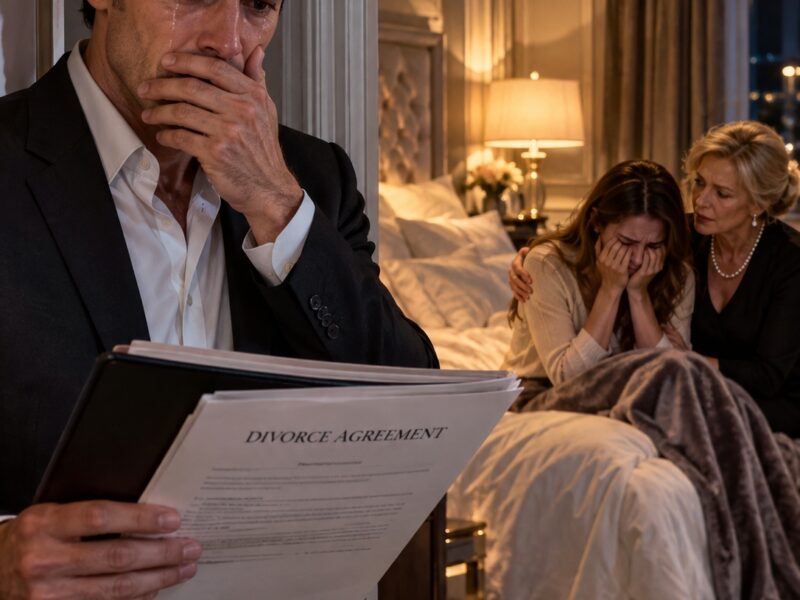
HE CAME HOME TO DIVORCE HIS WIFE—THEN HE HEARD HER TELL HER MOTHER THE ONE THING SHE’D NEVER TOLD HIM
The divorce papers were on the passenger seat when Nathaniel Brooks pulled into his driveway.
They were inside a black leather folder that had cost more than the first month’s rent on the apartment where he and Rebecca had once lived as newlyweds. His signature appeared on every page except the last.
One signature.
That was all that remained between six years of marriage and the clean, expensive ending his attorney had prepared for him.
Rain moved across the windshield in thin silver lines. Beyond the glass stood the house Nathaniel had spent four years designing and nearly three million dollars building—a limestone-and-glass estate tucked into the wooded hills outside Charlotte, North Carolina.
Every light on the first floor was dark.
Nathaniel sat behind the wheel with the engine running and stared at the front door.
He had rehearsed what he would say.
Rebecca, we can’t keep doing this.
Neither of us is happy.
I’ll make sure you’re taken care of.
You can keep the house.
He had even practiced the pauses.
Nathaniel was good at difficult conversations when the difficult thing was business. He had fired executives twice his age without raising his voice. He had walked away from multimillion-dollar negotiations while the other side threatened lawsuits. He had stood in rooms filled with bankers, developers, attorneys, and investors and made decisions that changed hundreds of lives before lunch.
But he had spent three weeks trying to figure out how to tell his wife that he wanted a divorce.
That should have told him something.
Instead, he reached for the leather folder.
His phone vibrated in the cup holder.
MARCUS HOLT — ATLANTA PROJECT.
Nathaniel watched it ring.
Three years earlier, he would have ignored it.
Two years earlier, he might have answered but kept the call short.
Now he picked it up automatically.
“Brooks.”
“Nate, sorry. I know it’s late, but we have an issue with the Midtown permits.”
Nathaniel closed his eyes.
“How bad?”
“Could delay demolition ten days.”
“Call Reeves.”
“Already did.”
“And?”
“He says the city wants revised traffic mitigation.”
Nathaniel glanced at the folder.
“Send it to me.”
There was a pause.
“You sure? It’s after eight.”
Nathaniel almost laughed.
People had started apologizing for calling him after eight because they knew he would answer.
That was the strange part.
He had trained everyone in his life to believe he was always available.
Everyone except his wife.
“Send it,” he said.
He ended the call.
For several seconds he sat motionless.
Then something made him turn the phone facedown.
Maybe it was exhaustion.
Maybe it was the house.
Maybe it was the memory of Rebecca standing at the kitchen island three weeks earlier, looking at him while he typed an email and asking quietly, “Do you ever wonder when we stopped talking?”
He had answered without looking up.
“We’re talking right now.”
Rebecca had stared at him for a long moment.
“No,” she’d said. “We’re really not.”
Then she had walked away.
Nathaniel had told himself that night that she was being dramatic.
Tonight, with divorce papers beside him, he wasn’t so sure.
He turned off the engine.
The sudden silence inside the car felt enormous.
Then Nathaniel picked up the folder and went inside to end his marriage.
He made it seventeen steps.
That was how close he came.
Seventeen steps from the front door to the hallway.
Then he heard his wife crying.
Nathaniel stopped.
Not ordinary crying.
Not the quiet sniffle someone might make watching a sad movie.
This was muffled, exhausted crying—the sound of someone who had spent too long trying not to break and had finally run out of strength.
It came from the guest bedroom.
Another woman’s voice followed.
Margaret.
Rebecca’s mother.
Nathaniel’s hand tightened around the leather folder.
He almost announced himself.
Then Margaret said something that stopped him.
“Rebecca, honey, you can’t keep pretending you’re fine.”
Silence.
Then Rebecca answered.
“I’m not pretending for me.”
Her voice shook.
“I’m pretending for him.”
Nathaniel didn’t move.
Margaret spoke more softly.
“Then tell him the truth.”
Rebecca gave a broken laugh.
“I think it’s too late.”
Nathaniel felt something cold move through his chest.
He should have walked away.
He knew that.
He should have stepped into the room, admitted he was home, given his wife the dignity of knowing he could hear her.
Instead, he stood in the dark hallway holding divorce papers and listened as Rebecca said the words that would destroy almost everything he believed about their marriage.
“I’m scared Nathaniel is going to leave me.”
Nathaniel forgot how to breathe.
Inside the room, Margaret said nothing.
Rebecca continued.
“And the worst part is I think he believes I want him to.”
Nathaniel looked down at the folder in his hand.
For months he had believed Rebecca’s silence meant she was finished.
For months he had mistaken the way she left rooms when he entered them, the way she stopped asking when he’d be home, the way she no longer argued when he canceled dinner, as proof that she no longer cared.
His attorney had asked him a simple question.
“Has your wife said she wants a divorce?”
Nathaniel had answered, “She doesn’t have to.”
He had been so certain.
Now, behind a half-closed door, his wife whispered:
“I don’t want his money, Mom.”
A pause.
“I want my husband back.”
And Nathaniel Brooks—the man who had spent fifteen years learning how to calculate risk—realized he might have made the most catastrophic assumption of his life.
Six years earlier, Rebecca Collins had not known Nathaniel was wealthy when she met him.
That was one of the reasons he fell in love with her.
Brooks Urban Development had been much smaller then, but Nathaniel was already doing well. He was thirty-two, ambitious, chronically overworked, and recently featured in a Charlotte business magazine as one of the region’s developers to watch.
He had gone into the Hawthorne Community Library one Saturday afternoon because his father had died six months earlier.
That was the part he rarely told people.
His father, Samuel Brooks, had been a public-school English teacher who owned almost nothing but books. After Samuel died, Nathaniel found a handwritten list tucked inside an old copy of Steinbeck’s East of Eden.
Books I Still Need to Read.
Twenty-three titles.
Nathaniel decided he would read them all.
The Hawthorne Library had one of the books his father had listed.
Rebecca was behind the circulation desk when he asked for it.
She wore jeans, white sneakers, and a green cardigan with one sleeve pushed higher than the other. A pencil was stuck through her hair. There was a streak of blue children’s paint near her wrist.
Nathaniel remembered noticing her eyes before anything else.
Hazel.
Direct.
Unimpressed.
“Do you have The Remains of the Day?” he asked.
Rebecca typed something into the computer.
“Probably.”
“Probably?”
She looked at him.
“It’s a library, not an operating room. Nobody’s going to die if I need thirty seconds.”
Nathaniel stared at her.
Then he laughed.
He hadn’t expected to.
Rebecca found the book.
When she handed it to him, she noticed the expensive watch beneath his cuff.
“You know,” she said, “you look exactly like someone who hates waiting thirty seconds.”
“Is that a compliment?”
“No.”
That should have been the end of it.
Instead, Nathaniel came back three days later.
Then again the following week.
By the fourth visit, Rebecca folded her arms across the desk.
“You’re reading unusually fast.”
“I’ve always been efficient.”
“That’s the least romantic sentence I’ve ever heard.”
“Who said I was trying to be romantic?”
She smiled.
That smile changed his life.
Nathaniel had spent years surrounded by people who reacted to what he had.
Rebecca reacted to who he was.
When he told her he owned a development company, she said, “So you’re the reason Charlotte has twelve thousand identical luxury apartments?”
When he took her to an expensive restaurant for their third date, she whispered that the portions looked like “food for emotionally complicated birds.”
When he bought her diamond earrings six months into their relationship, she kissed him, thanked him, and wore them exactly twice.
But she kept every note he wrote her.
Even stupid ones.
Milk. Eggs. Home by seven. Love you.
She kept them in a wooden box.
Nathaniel used to tease her about it.
“You know paper isn’t rare anymore.”
“Neither are diamonds.”
“Those earrings cost—”
“I know.”
Rebecca would smile.
“But you wrote this.”
Nathaniel didn’t understand why that mattered so much.
Not then.
They married two years after meeting.
Small church.
White roses.
Forty-seven guests.
At the reception, Nathaniel danced badly enough that Rebecca laughed into his shoulder.
“Promise me something,” she whispered.
“Anything.”
“If you become one of those terrifying rich men who takes phone calls during Christmas dinner, I’m leaving.”
Nathaniel laughed.
“Deal.”
“I’m serious.”
“So am I.”
She leaned back enough to look at him.
“I don’t need a huge life, Nate.”
He touched her cheek.
“I know.”
“I need ours.”
He kissed her forehead.
“You’ll always come first.”
He meant it.
That was perhaps the cruelest part.
People rarely destroy the things they love because they wake up one morning wanting to destroy them.
Sometimes they destroy them while believing they are protecting them.
Brooks Urban Development expanded rapidly.
Nathaniel landed an Atlanta contract.
Then Nashville.
Dallas followed.
Miami.
The company went from forty employees to three hundred and sixteen.
Nathaniel became the man magazines had predicted he would become.
Relentless.
Disciplined.
Self-made.
His face appeared beside headlines about urban redevelopment and commercial expansion. He bought his mother a house. He established a scholarship in his father’s name. He paid off debts he had carried since his twenties.
And every time Rebecca asked him to slow down, he heard something different from what she was actually saying.
“Nate, can you be home Friday?”
He heard: Your work isn’t important.
“Could you put your phone away during dinner?”
He heard: You’re failing me.
“I miss you.”
He heard: You’re not doing enough.
So Nathaniel did more.
That was his answer to everything.
When Rebecca said she felt lonely, he surprised her with a bracelet from Cartier.
When she said she wanted them to spend a weekend together, he booked a private villa in St. Barts.
He spent half the trip on conference calls.
When she asked him to accompany her to Margaret’s birthday dinner, he couldn’t go because a Dallas investor moved a meeting.
He sent a driver.
And flowers.
Three hundred dollars’ worth of roses.
When he called Rebecca later, she sounded tired.
“Did Mom like the flowers?” he asked.
“She did.”
“Good.”
Silence.
“Rebecca?”
“Yes?”
“What’s wrong?”
“Nothing.”
Nathaniel exhaled.
“Don’t do that.”
“Do what?”
“Say nothing when something is obviously wrong.”
Another silence.
Then Rebecca said, “I wanted you there.”
“I told you what happened.”
“I know.”
“So why are we having this conversation?”
That question became a weapon between them.
Why are we having this conversation?
Nathaniel used it whenever he felt accused.
Rebecca eventually stopped answering.
Six months before the divorce papers, things finally cracked.
Nathaniel had promised to attend a family dinner at their house.
Margaret was coming.
Rebecca’s cousin and his wife were driving in from Raleigh.
Nathaniel had promised—actually promised—that nothing would interfere.
Then a problem developed with a project in Miami.
One day became two.
He returned forty-eight hours late.
It was nearly eleven when he walked into the kitchen.
One plate remained on the table.
The food was cold.
Rebecca sat in front of it wearing the blue dress he liked.
She had removed her shoes.
One candle had burned almost to the bottom.
Nathaniel put down his suitcase.
“I’m sorry.”
Rebecca looked at him.
There was no anger in her face.
Nathaniel would later wish there had been.
Anger would have been easier.
“How was Miami?” she asked.
“Terrible.”
“I’m sorry.”
He frowned.
“That’s it?”
“What would you like me to say?”
“I don’t know. You look angry.”
“I’m not angry.”
“You clearly are.”
Rebecca stared at the candle.
“No. I think I passed angry a while ago.”
Something defensive rose inside him.
“I couldn’t abandon a seventy-million-dollar project.”
“I didn’t ask you to.”
“Then what are we doing?”
Rebecca looked up.
“I waited for you.”
“I called.”
“You called at eight-thirty and said you’d try.”
“I did try.”
“I know.”
There it was again.
That exhausted calm.
Nathaniel hated it because he couldn’t argue with it.
So he made the mistake people make when they feel ashamed but don’t know how to admit it.
He turned the shame into anger.
“Do you have any idea how many people depend on me?”
Rebecca’s expression changed.
“I depend on you.”
“That’s not what I meant.”
“I know.”
“Rebecca—”
“No, it’s okay.”
She stood.
Nathaniel followed her with his eyes.
“Where are you going?”
“Upstairs.”
“We’re in the middle of a conversation.”
Rebecca stopped at the doorway.
For one second he saw something raw in her face.
“No, Nate.”
Her voice was almost a whisper.
“I’ve been in the middle of this conversation for two years.”
Then she went upstairs.
Nathaniel slept in the guest room.
Neither of them apologized the next morning.
That was how marriages sometimes began dying.
Not with betrayal.
Not with screaming.
Not with a slammed door.
With two people waiting for the other person to cross ten feet of hallway.
Neither one did.
After that, their house became quiet.
Nathaniel noticed Rebecca stopped asking when he’d be home.
At first, he felt relieved.
No arguments.
No disappointment.
No pressure.
Then he noticed she stopped sending him photographs from the garden.
Stopped asking if he wanted coffee.
Stopped touching his shoulder when she passed behind his chair.
She still said good morning.
Still asked whether he needed anything from the store.
Still attended company dinners when necessary.
From the outside, they looked civilized.
Inside, they were disappearing.
One Sunday afternoon, Nathaniel came home unexpectedly.
Rebecca was asleep on the living-room sofa.
An old photo album rested open against her chest.
He almost woke her.
Instead, he lifted the album.
Their wedding.
Their first Christmas.
Rebecca wearing his sweatshirt while painting their first apartment.
A blurry photograph from a road trip through Tennessee.
Then Nathaniel found one taken beside a lake.
He remembered it instantly.
They had been broke by his current standards.
The motel air conditioner had leaked.
His car had overheated.
They had eaten gas-station sandwiches for dinner because the only restaurant nearby was closed.
Rebecca had called it one of the best weekends of her life.
In the photograph, she sat on the hood of Nathaniel’s old car, laughing with her head thrown back while he stood beside her.
He looked younger.
Not because his face was younger.
Because he looked unguarded.
Nathaniel looked from the photograph to his sleeping wife.
He tried to remember the last time she had laughed that way with him.
He couldn’t.
The fear that followed was immediate.
But Nathaniel had never been good at fear.
Fear made him seek control.
Three days later, he called a divorce attorney.
“I want it clean,” he said.
His attorney, Elaine Foster, studied him across her desk.
“Has Rebecca retained counsel?”
“No.”
“Have you discussed divorce?”
“No.”
Elaine removed her glasses.
“Then how do you know she wants one?”
Nathaniel looked toward the window.
“Trust me.”
Elaine waited.
He hated when attorneys did that.
Finally he said, “We’re done.”
“That’s different.”
“From what?”
“From knowing she wants a divorce.”
Nathaniel’s jaw tightened.
“Prepare the papers.”
Elaine did.
He arranged everything generously.
Rebecca could keep the house.
He would cover property taxes for five years.
She would receive a substantial settlement.
Nathaniel told himself this was kindness.
But somewhere beneath that story was another truth.
Money was the language he understood.
If the marriage failed, he could at least make the failure financially painless.
He never considered that the thing Rebecca might want couldn’t be transferred electronically.
Then came Thursday night.
The rain.
The leather folder.
The seventeen steps.
And Rebecca’s voice behind the guest-room door.
“I want my husband back.”
Nathaniel leaned against the hallway wall.
Inside, Margaret spoke.
“Have you told him that?”
Rebecca laughed softly through her tears.
“How?”
“With words.”
“I’ve tried words.”
“Try again.”
“I don’t think he hears me anymore.”
Nathaniel lowered his eyes.
Rebecca continued.
“Every time I tell him I’m lonely, he thinks I’m accusing him of being a bad husband. Every time I tell him I miss him, he hears that I don’t respect his work. Every time I ask him to stay home, he starts explaining payroll and investors and contracts.”
Her voice cracked.
“So eventually I stopped asking.”
Margaret was quiet.
Nathaniel remembered all those silences.
He had interpreted them as indifference.
Now he understood they might have been surrender.
Rebecca sniffed.
“I still watch for his headlights.”
Nathaniel’s fingers tightened around the folder.
“What?”
“When he’s away.”
Rebecca sounded embarrassed even saying it.
“I’ll hear a car on the driveway and look out the window. Sometimes I know he’s in another state and I still do it.”
“Oh, sweetheart.”
“And I hate myself for it.”
“Don’t.”
“He doesn’t do that for me.”
“You don’t know that.”
“Yes, I do.”
Nathaniel shut his eyes.
Rebecca continued.
“When he travels, sometimes I wake up around two or three and check my phone.”
“For messages?”
“Yes.”
“Does he send them?”
A pause.
“Not anymore.”
Nathaniel remembered hotel rooms.
Dark ceilings.
Televisions playing silently.
His phone charging beside the bed.
There had been nights he had wanted to text her.
Miss you.
Wish you were here.
Remember Tennessee?
He had thought the messages sounded sentimental.
Weak.
Unnecessary.
So he sent nothing.
Now Rebecca whispered, “I stopped smiling around him because smiling made me feel stupid.”
Margaret sounded confused.
“Why?”
“Because I still love him.”
Nathaniel opened his eyes.
“And if he knew how much,” Rebecca continued, “then he’d know how much power he still has to hurt me.”
Nathaniel pressed his knuckles against his mouth.
The folder slipped slightly beneath his arm.
Paper whispered against leather.
He froze.
No one inside reacted.
Margaret asked, “Do you think he’s seeing someone?”
“No.”
“You sound certain.”
“I am.”
“Then what are you afraid of?”
Rebecca took several seconds to answer.
“That work became the person he’d rather come home to.”
That sentence hit harder than an accusation of infidelity could have.
Because Nathaniel knew immediately that there was truth in it.
Work never told him he had hurt its feelings.
Work never looked disappointed.
Work rewarded control.
Work turned effort into numbers.
Marriage didn’t.
Marriage required him to sit inside discomfort without solving it.
To listen without defending himself.
To accept that someone could love him and still be hurt by him.
He had built skyscrapers because concrete was easier than vulnerability.
Margaret said, “If Nathaniel walked in right now and asked you what you wanted, what would you say?”
Rebecca’s answer came without hesitation.
“Not the house.”
Nathaniel looked around at the polished hallway.
“Not the cars.”
His throat tightened.
“Not the jewelry.”
He thought of the emerald necklace sitting in her dresser.
“I’d tell him I want Sunday breakfast.”
Nathaniel almost made a sound.
“I want him to sit across from me and drink terrible coffee because he forgot to buy the good kind. I want him to complain that I put too much cinnamon in French toast. I want him to leave his phone upstairs.”
Her voice trembled.
“I want him to ask me a question and stay long enough to hear the answer.”
Nathaniel bowed his head.
“And if he can’t give you that?”
Margaret asked it gently.
Rebecca didn’t answer for several seconds.
Then:
“I don’t know how much longer I can live beside someone I’m still in love with and feel this alone.”
That was the moment Nathaniel understood something terrible.
Rebecca had not been waiting for him to leave.
She had been waiting for him to return.
And he had come home carrying divorce papers.
Nathaniel almost entered the room then.
Almost.
But Rebecca spoke again.
“There’s something else.”
Nathaniel remained still.
Margaret asked, “What?”
“I haven’t told Nathaniel.”
“About what?”
“The money.”
Nathaniel’s head lifted.
Money.
The word changed something inside him.
Over the previous months, he had noticed withdrawals from the household account.
Nothing enormous by his standards.
Two thousand here.
Fifteen hundred there.
Four thousand once.
He had never confronted Rebecca.
But he had noticed.
And somewhere inside the ugly architecture of his resentment, he had used those withdrawals as evidence.
She doesn’t understand what it takes to earn this.
She has her own life.
Maybe she’s preparing to leave.
Now Margaret said, “You mean the library?”
Nathaniel stared at the door.
Rebecca sighed.
“I’ve almost finished the first room.”
The library.
Hawthorne.
The place where they met.
Nathaniel felt suddenly dizzy.
Margaret said, “You shouldn’t have paid for all of that yourself.”
“I wanted to.”
“Why?”
Rebecca hesitated.
“Because the children’s wing was falling apart. The roof leaked last winter. They had to close the back reading room.”
Nathaniel remembered Rebecca mentioning something about repairs.
He had been answering emails.
“And because…”
Rebecca’s voice became softer.
“I wanted to name the room after Samuel.”
Nathaniel stopped breathing.
His father.
Margaret said, “Does Nathaniel know?”
“No.”
“Why not?”
“It was supposed to be a surprise.”
Nathaniel covered his mouth.
Rebecca continued.
“His dad was the reason he walked into that library in the first place. Nathaniel told me once that Samuel used to take him to the public library every Saturday because they couldn’t afford to buy books.”
She laughed faintly.
“He said those Saturdays made him believe the world was bigger than their apartment.”
Nathaniel’s eyes burned.
He had forgotten telling her that.
Rebecca hadn’t.
“I thought if I restored the children’s room and put Samuel’s name above the door, maybe Nate would remember…”
Her voice disappeared.
Margaret waited.
“Remember what?”
Rebecca cried quietly.
“Who he was before everybody started calling him Mr. Brooks.”
Nathaniel turned away from the door.
That did it.
He walked blindly toward the staircase and sat down.
The leather folder landed beside him.
He stared at it.
Inside were pages describing marital assets, property rights, confidentiality, financial settlements.
Everything was precise.
Every possible material consequence had been anticipated.
There was no paragraph for a woman waiting beside a window for headlights.
No clause for Sunday breakfast.
No valuation for an old handwritten note.
No legal remedy for a husband who had become so busy building a life that he stopped living inside it.
Nathaniel sat there until his legs went numb.
Images arrived without permission.
Rebecca in the green cardigan.
Rebecca laughing at his restaurant portions.
Rebecca barefoot in their first apartment.
Rebecca waiting beside cold food.
Rebecca saying, I depend on you.
He remembered answering emails while she spoke.
He remembered sending flowers instead of himself.
He remembered every time he had interpreted her pain as criticism because admitting he had caused it was harder.
Then he remembered the withdrawals.
He had judged her silently.
Meanwhile she had been rebuilding the room where they met.
For children.
In his father’s name.
Nathaniel stared at the final unsigned page.
His name waited beneath a blank line.
All he had to do was sign.
He picked up the pen clipped inside the folder.
For a long time, he held it.
Then he heard the guest-room door.
Nathaniel stood quickly.
He took the folder and moved into his office before Rebecca and Margaret reached the hallway.
Through the cracked office door, he watched Margaret hug her daughter.
Rebecca looked smaller than he remembered.
Not physically.
Something in her posture.
She had always carried herself with quiet confidence.
Tonight her shoulders curved inward.
Margaret kissed her cheek.
“Call me tomorrow.”
“I will.”
“And talk to him.”
Rebecca gave a tired smile.
“I’ll try.”
Nathaniel looked at the divorce folder.
Margaret left.
Rebecca remained in the foyer for several seconds after the front door closed.
Then she turned.
Nathaniel stepped out.
Rebecca startled.
“Nate.”
“Hey.”
She wiped quickly beneath one eye.
“When did you get home?”
The question hung between them.
Nathaniel could have lied.
He almost did.
“A few minutes ago.”
Rebecca nodded.
“Okay.”
She looked toward the stairs.
“Did you eat?”
That nearly broke him.
After everything she had just said, her first instinct was still to ask whether he had eaten.
“No.”
“There’s soup.”
“Rebecca.”
She stopped.
Nathaniel looked at her.
For the first time in years, he tried not to prepare his next sentence.
He simply looked.
Her eyes were red.
There was a tiny crease between her eyebrows.
Her wedding ring remained on her finger.
He noticed that.
Why had he never noticed that?
“What?” she asked.
Nathaniel wanted to say everything.
I’m sorry.
I heard you.
I was about to leave you because I was too afraid to ask if you still wanted me.
Instead he said, “Nothing.”
The disappointment that crossed her face lasted less than a second.
“Okay.”
She went upstairs.
Nathaniel stood alone.
Then he hated himself for wasting another moment.
But he knew something else.
He couldn’t fix six years with a midnight confession born from something she had never intended him to hear.
He needed to tell her the truth.
All of it.
Including the folder.
Nathaniel didn’t sleep.
At 2:13 a.m., he went downstairs.
At 3:07, he opened his laptop.
At 3:09, he closed it again.
At 4:22, he found the wooden box Rebecca kept in her bedside drawer.
He did not open it.
He didn’t need to.
He knew what was inside.
At 5:40, Nathaniel walked into the kitchen.
He made coffee badly.
At 6:18, his phone started ringing.
He turned it off.
Not silent.
Off.
At 7:03, Rebecca entered the kitchen.
She stopped when she saw him.
Nathaniel was sitting at the table.
No laptop.
No tablet.
No phone.
Just two cups of coffee.
And the black leather folder.
Rebecca saw it immediately.
Her face changed.
Nathaniel felt physically sick.
“What’s that?”
He stood.
“Sit down.”
Rebecca didn’t.
“Nathaniel.”
“Please.”
Her eyes moved from him to the folder.
Something inside her seemed to understand before he spoke.
“No.”
The word was barely audible.
Nathaniel’s chest tightened.
“Rebecca—”
“No.”
She stepped backward.
“Please don’t do this before I’ve had coffee.”
He stared at her.
She laughed once, bitterly.
“That’s pathetic, isn’t it?”
“No.”
“I knew something was wrong.”
“Rebecca.”
“I knew it.”
Her breathing quickened.
“I kept telling myself I was imagining it, but you haven’t looked at me in weeks.”
Nathaniel’s eyes filled.
She saw that and became confused.
“What’s happening?”
He pushed the folder toward her.
Rebecca didn’t touch it.
“Open it,” he said.
She shook her head.
“Please.”
Finally she approached.
Her fingers trembled when she opened the cover.
She saw the first page.
PETITION FOR DISSOLUTION OF MARRIAGE.
Rebecca went completely still.
Nathaniel watched six years disappear from her face.
Not dramatically.
That made it worse.
Her expression simply emptied.
“Oh.”
Nathaniel had never hated a word more.
“Rebecca—”
“So that’s it.”
“No.”
She looked up.
“You already had them prepared.”
“Yes.”
“How long?”
“Three weeks.”
Rebecca nodded slowly.
Three weeks.
She closed the folder.
“Okay.”
“No. It’s not okay.”
“Clearly.”
“Rebecca, listen to me.”
She laughed again.
“Now?”
Nathaniel flinched.
She saw it.
Good, some part of her seemed to think.
Let it hurt.
“Now you want to talk?”
“I deserve that.”
“You deserve what?”
“Whatever you’re about to say.”
Rebecca’s jaw tightened.
“You don’t get to do that.”
“Do what?”
“Turn yourself into the reasonable one by agreeing with me.”
Nathaniel fell silent.
Rebecca’s eyes filled.
“You prepared divorce papers without asking me if I wanted a divorce.”
“I know.”
“You decided what I felt.”
“Yes.”
“You decided what I needed.”
“Yes.”
“You decided I would be happier without you.”
His voice broke.
“Yes.”
Rebecca stared at him.
“Why?”
Nathaniel looked at the folder.
“Because I was afraid to ask.”
That stopped her.
“What?”
“I saw how unhappy you were.”
“So you left?”
“No. I—”
“You did, Nate. Maybe not legally. Maybe not physically. But you left.”
Nathaniel swallowed.
“I know.”
Rebecca turned away.
“No, you don’t.”
“I heard you last night.”
Silence.
Rebecca slowly turned back.
Every trace of anger disappeared beneath shock.
“What?”
Nathaniel didn’t move.
“You and your mother.”
Her face went pale.
“How much?”
“Enough.”
“How much, Nathaniel?”
He forced himself to answer.
“All of it.”
Rebecca stared at him.
Then shame crossed her face.
Nathaniel hated himself for putting it there.
“You listened?”
“I came home. I heard you crying. I stopped.”
“You listened.”
“Yes.”
Rebecca looked away.
“God.”
“I’m sorry.”
“That wasn’t for you.”
“I know.”
“Those were things I wasn’t ready to say to you.”
“I know.”
“Stop saying you know!”
Her voice cracked through the kitchen.
Nathaniel went silent.
Rebecca pressed both palms against the countertop.
For a few seconds only the refrigerator hummed.
Then Nathaniel spoke carefully.
“I heard you say you were afraid I’d leave.”
Rebecca closed her eyes.
“I heard you say you still watch for my car.”
Her shoulders trembled.
“I heard what you said about my father.”
Rebecca turned sharply.
Nathaniel was crying now.
He didn’t hide it.
“Why didn’t you tell me about the library?”
Rebecca stared at him as if the question were absurd.
“When?”
He had no answer.
“When was I supposed to tell you?”
“Rebecca—”
“During the twelve minutes between your calls? In the car on the way to some dinner where you spend the whole night talking to investors? Maybe I could’ve put it in your calendar.”
“That’s fair.”
“No, it isn’t.”
She wiped her face.
“None of this is fair.”
Nathaniel nodded.
“No.”
Rebecca pointed at the folder.
“And now what? You heard me crying, so you feel guilty?”
“No.”
“You changed your mind overnight?”
“No.”
“Then what is this?”
Nathaniel opened the folder.
He removed the papers.
Rebecca watched.
He tore them in half.
Her eyes widened.
Then he tore them again.
And again.
He placed the pieces on the table.
Rebecca stared at them.
Nathaniel expected relief.
He got anger.
“Don’t.”
He looked at her.
“What?”
“Don’t make that dramatic.”
“I’m not.”
“You think tearing paper fixes this?”
“No.”
“Because it doesn’t.”
“I know.”
Rebecca laughed through tears.
“There you go again.”
Nathaniel nodded.
“You’re right.”
He sat down.
Not across from her.
Beside the table.
Then he said the sentence that frightened him more than any business decision he’d ever made.
“I don’t know how to fix this.”
Rebecca stared.
Nathaniel continued.
“I know how to negotiate. I know how to build things. I know how to solve problems with money and schedules and people.”
He looked at the torn papers.
“But I don’t know how to repair what I did to us.”
Rebecca said nothing.
“So I’m not going to tell you I can.”
His voice shook.
“I’m going to ask if you’ll let me learn.”
Rebecca’s face crumpled slightly.
Nathaniel took a breath.
“I spent years telling myself I was doing everything for you.”
He looked around the enormous kitchen.
“This house. The company. The accounts. The vacations.”
His voice dropped.
“But you kept asking me for time.”
Rebecca lowered her eyes.
“And I kept giving you things.”
Silence.
“I protected our future until there was almost no present left.”
Rebecca sat down.
For the first time that morning, she touched the coffee.
It was cold.
She took a sip anyway.
Nathaniel noticed.
Once, he would have stood up to make another cup.
This time he stayed.
“Are you still in love with me?” he asked.
Rebecca’s eyes snapped toward him.
The question seemed almost cruel.
Nathaniel didn’t look away.
“Last night doesn’t count. You weren’t talking to me. I’m asking you.”
Rebecca’s eyes filled again.
“Yes.”
The word came out angry.
“Yes, Nathaniel. That’s the problem.”
He nodded.
“I’m still in love with you too.”
“Then why did you prepare divorce papers?”
“Because loving you didn’t stop me from being afraid.”
Rebecca looked confused.
“Afraid of what?”
“That I’d already lost you.”
“You didn’t even ask.”
“I know.”
Nathaniel caught himself.
He almost apologized for saying it again.
Instead he continued.
“I thought if I ended it first, I wouldn’t have to hear you tell me you were done.”
Rebecca stared at him.
Something shifted.
Not forgiveness.
Recognition.
“You were going to leave me so I couldn’t leave you.”
Nathaniel gave a small, broken nod.
“When you say it like that, it sounds insane.”
“It is insane.”
“I agree.”
A tiny sound escaped her.
Not laughter exactly.
But close.
It was the first crack of light.
They talked for five hours.
Not beautifully.
Not gracefully.
There were accusations.
There were long silences.
Rebecca told him about birthdays he had ruined and evenings she had spent eating alone.
Nathaniel admitted there were nights he’d sat in hotel rooms wanting to call her but had convinced himself she didn’t want to hear from him.
Rebecca told him that every expensive gift after an argument had felt like payment for her silence.
That hurt him.
He let it.
He told her how deeply he had believed providing was the same as loving.
Rebecca told him providing mattered.
“But presence matters too.”
Nathaniel nodded.
“Why didn’t you tell me you thought I was staying for the money?”
Rebecca looked embarrassed.
“Because sometimes I thought you believed it.”
“Why?”
“The way you talked about everything.”
She hesitated.
“You’d say, ‘I gave you this house.’ Or, ‘You never have to worry about money.’ Or, ‘Do you know how hard I work for this life?'”
Nathaniel remembered saying all of those things.
Rebecca continued.
“You probably meant security.”
“I did.”
“But sometimes it sounded like a receipt.”
That sentence stayed with him.
A receipt.
He had been keeping score in a marriage that Rebecca thought was supposed to be a home.
At noon, Nathaniel’s phone remained off.
At one, Rebecca asked, “Don’t you have meetings?”
“Yes.”
“Aren’t people waiting?”
“Probably.”
She stared at him.
“You should call them.”
“No.”
“Nate.”
“If the company collapses because I’m unavailable for one morning, then I’ve built a terrible company.”
Rebecca looked at him for a long time.
Then she said quietly, “I used to tell you that.”
Nathaniel smiled sadly.
“I used to be an idiot.”
“Used to?”
He looked at her.
Rebecca almost smiled.
Almost.
That was enough.
But love did not magically return to normal because divorce papers had been torn apart.
The following week was awkward.
Nathaniel came home at six.
Rebecca didn’t know what to do with him.
For years she had built routines around his absence.
She read after dinner.
She gardened.
She visited Margaret.
She volunteered.
Suddenly Nathaniel was standing in the kitchen asking whether she needed help chopping onions.
“You don’t cook.”
“I can learn.”
“You nearly set fire to pasta.”
“That happened once.”
“Twice.”
“The second time was technically the sauce.”
Rebecca stared at him.
Then she laughed.
Nathaniel stopped chopping.
Rebecca noticed.
“What?”
“Nothing.”
“No. What?”
He looked at her.
“I missed that.”
Her smile faded.
Nathaniel wished he hadn’t said it.
Then Rebecca reached across the counter and took the knife from his hand.
“You’re cutting them too big.”
He smiled.
“Teach me.”
So she did.
There were setbacks.
One Tuesday, Nathaniel took a call at dinner without thinking.
Rebecca immediately went quiet.
Nathaniel spent four minutes discussing financing.
Then he looked across the table.
He saw the old Rebecca.
Not angry.
Gone.
Nathaniel stopped mid-sentence.
“Marcus, I have to call you tomorrow.”
“Nate, we need—”
“Tomorrow.”
He hung up.
Rebecca stared at her plate.
“I’m sorry.”
“It’s fine.”
“No.”
Nathaniel put the phone on the counter.
“It’s not.”
Rebecca looked at him.
“I don’t want you performing for me.”
“I’m not.”
“You can’t stop working every time I look disappointed.”
“I know.”
She raised an eyebrow.
Nathaniel smiled faintly.
“Bad phrase.”
Rebecca almost smiled.
Then he said, “I’m not trying to become a different person overnight. I’m trying to notice when I’m becoming the person who almost lost you.”
That stayed with her.
Two weeks later, they started marriage counseling.
Nathaniel hated the first session.
The therapist asked how he felt.
Nathaniel answered with explanations.
She stopped him.
“That’s what you think.”
Nathaniel frowned.
“I asked what you feel.”
He looked at Rebecca.
She was trying not to smile.
“This is entertaining to you?”
“A little.”
Their therapist said, “Rebecca, don’t rescue him.”
“I’m not.”
“You are with your face.”
Rebecca laughed.
Nathaniel looked between them.
“I suddenly feel outnumbered.”
It was the most normal twenty seconds they’d shared in years.
Then the therapist asked Nathaniel what he had felt the night he brought the divorce papers home.
He started to say, “I believed—”
She stopped him.
“Feeling.”
Nathaniel sat silently.
Finally:
“Terrified.”
Rebecca looked at him.
He stared at the floor.
“I was terrified she didn’t love me anymore.”
Rebecca’s expression softened.
Their therapist asked, “And what did you do with that fear?”
Nathaniel laughed without humor.
“I hired an attorney.”
Rebecca reached for his hand.
She didn’t seem to realize she’d done it until their fingers touched.
Neither pulled away.
That was how they rebuilt.
Not in one grand gesture.
In inches.
Nathaniel began leaving his phone outside the dining room.
Rebecca stopped saying “nothing” when something was wrong.
When Nathaniel traveled, he texted.
Not businesslike messages.
Real ones.
The hotel coffee is terrible.
I saw a woman wearing that ridiculous yellow hat you liked in Charleston.
Wish you were here.
Once, at 2:17 a.m., Rebecca woke and found a message.
Can’t sleep. Miss you.
She stared at it for a long time.
Then typed:
I miss you too.
Three dots appeared immediately.
Nathaniel was awake.
For some reason, that made her cry.
Not because everything was fixed.
Because he had reached back.
Three months after the night of the divorce papers, Nathaniel told Rebecca to get in the car.
“Where are we going?”
“Trust me.”
She folded her arms.
“Historically, that’s been a dangerous sentence.”
“Fair.”
They drove toward central Charlotte.
Rebecca realized where they were going several blocks before Nathaniel turned.
“Hawthorne?”
He said nothing.
The library looked different.
The aging brick had been cleaned.
The roof had been repaired.
New windows reflected the afternoon sun.
Rebecca stared.
“Nathaniel.”
“Come inside.”
Children’s voices echoed through the building.
The director met them near the entrance with tears in her eyes.
Rebecca looked from her to Nathaniel.
“What did you do?”
“Finished something.”
He led her down the corridor.
The children’s wing had been transformed.
New shelves.
Reading tables.
Computers.
Art supplies.
Soft chairs near tall windows.
A mural of an enormous tree stretched across one wall, its painted branches carrying tiny books instead of leaves.
Rebecca covered her mouth.
Nathaniel stood behind her.
She walked toward the doorway of the restored reading room.
Then she saw the plaque.
THE SAMUEL BROOKS READING ROOM
For every child who deserves a bigger world.
Rebecca touched the metal with trembling fingers.
“Nate.”
He couldn’t answer immediately.
“My father used to say books were the cheapest way to travel.”
Rebecca turned.
Nathaniel’s eyes were wet.
“You remembered.”
“You remembered first.”
She looked around.
“You paid for all this?”
Nathaniel smiled.
“We did.”
“What?”
“You started it.”
“Nathaniel, I put maybe—”
“It doesn’t matter.”
“It matters.”
“Okay.”
He approached.
“You paid for the first piece.”
He touched his chest.
“I just finally showed up.”
Rebecca stared at him.
Then she hugged him.
Not politely.
Not cautiously.
She threw both arms around him.
Nathaniel closed his eyes.
For several seconds, the millionaire developer, the disciplined executive, the man who had spent half his adult life calculating what everything cost, stood in the room bearing his father’s name and understood that the most important thing he had ever nearly lost had never asked him to purchase anything.
It had only asked him to be there.
Their marriage still wasn’t perfect.
That became important to both of them.
Perfection had been part of the problem.
Nathaniel had once believed a good life should look controlled.
Successful company.
Beautiful home.
Financial security.
Happy marriage.
No visible cracks.
But real marriages had cracks.
Rebecca got angry.
Nathaniel became defensive.
Sometimes they went to bed frustrated.
Sometimes work swallowed a week.
Sometimes Rebecca withdrew before catching herself.
Sometimes Nathaniel reached for his phone during conversations and saw her expression change.
The difference was that they noticed.
And then they returned.
“I’m doing it again,” Nathaniel would say.
“Yes.”
“Give me five minutes?”
“Take ten.”
Or Rebecca would become silent.
Nathaniel would ask, “Are you leaving the room because you need space or because you’re afraid to say something?”
She hated that question.
Mostly because it worked.
Eventually she would say, “I’m hurt.”
And Nathaniel learned not to answer with evidence proving why she shouldn’t be.
He learned to say, “Tell me.”
That two-word sentence changed their marriage.
Tell me.
Not let me explain.
Not that’s not what happened.
Not you’re misunderstanding me.
Tell me.
Rebecca changed too.
She learned that Nathaniel’s instinct to solve things wasn’t always arrogance.
Sometimes it was fear.
He had grown up watching his father count grocery money at the kitchen table.
Security meant love to him because insecurity had frightened him as a child.
Rebecca began understanding the frightened boy inside the successful man.
Understanding didn’t excuse him.
But it gave her somewhere to meet him.
Nathaniel changed his company.
That shocked almost everyone.
He delegated.
Promoted two senior executives.
Stopped answering nonemergency calls after seven.
His operations director asked whether he was retiring.
Nathaniel laughed.
“No.”
“Then what happened?”
Nathaniel thought about it.
“I realized being indispensable isn’t the same as being successful.”
The man stared at him.
“Rebecca tell you that?”
“Repeatedly.”
“Smart woman.”
Nathaniel smiled.
“Very.”
Rebecca expanded the library’s children’s program.
Saturday mornings became crowded.
Kids sat cross-legged on rugs while volunteers read stories.
Nathaniel occasionally came.
At first, children intimidated him.
They didn’t care about his company.
One six-year-old interrupted him halfway through a story to tell him he was doing the dragon voice wrong.
Rebecca laughed so hard she had to leave the room.
Nathaniel watched her go.
The old laugh.
The one from the photograph.
He lost his place in the book.
A little girl tugged his sleeve.
“Mister?”
Nathaniel blinked.
“Yes?”
“You’re supposed to keep reading.”
He smiled.
“Right.”
Ordinary moments returned to their house.
That surprised Nathaniel most.
He had spent years chasing exceptional things.
Bigger contracts.
Better properties.
More impressive numbers.
But the memories he began protecting were embarrassingly small.
Rebecca dancing barefoot while making pasta.
Rain against the windows.
Burned toast.
Her cold feet beneath his legs on the sofa.
Arguments about thermostat settings.
Coffee in mismatched mugs.
Sunday mornings when neither had anywhere to be.
One evening Rebecca fell asleep against his shoulder while they watched a movie.
Nathaniel’s phone buzzed.
He looked at it.
Then at her.
He left the phone where it was.
That decision lasted perhaps thirty seconds.
Nobody applauded.
No magazine wrote about it.
No investor noticed.
Yet Nathaniel felt more successful in those thirty seconds than he had the day Brooks Urban Development crossed its first hundred million in annual revenue.
A year after the night he came home with divorce papers, Nathaniel returned from work shortly before six.
Rebecca was in the garden.
Late sunlight moved through the oak trees.
She wore an old white shirt with dirt near one elbow.
Nathaniel walked outside.
“You know we employ people who can do this.”
Rebecca didn’t look up.
“Yes.”
“So why am I paying them?”
“To keep you humble.”
“That’s expensive humility.”
Rebecca smiled.
Then she remembered something.
“Wait.”
She removed her gardening gloves and picked up a small envelope from the bench.
“I found this today.”
Nathaniel opened it.
Inside was the photograph.
Tennessee.
The lake.
The broken-down car.
Rebecca laughing.
Nathaniel young and unguarded beside her.
He smiled.
“I thought we lost this.”
“So did I.”
He studied it.
Rebecca stood beside him.
“We looked happy.”
“We were.”
Nathaniel glanced at her.
“Are we happy now?”
Rebecca considered the question.
That mattered to him.
Once, he would have needed an immediate yes.
Now he waited.
Finally she said, “I think we’re more honest now.”
Nathaniel smiled.
“That wasn’t the question.”
“I know.”
She took the photograph from him.
“I think I used to believe happiness meant never being disappointed by someone.”
Nathaniel looked at her.
“And now?”
“Now I think it means being able to be disappointed and still know how to find each other afterward.”
Nathaniel was quiet.
“That’s annoyingly wise.”
“I work at a library.”
“Right.”
She leaned against him.
He put an arm around her.
For a while they stood without speaking.
The house behind them glowed in the evening light.
Nathaniel thought about the night one year earlier.
The rain.
The folder.
The final blank signature.
He could still picture himself sitting in the car believing he was about to do something merciful.
That frightened him now.
How easily certainty could be built from assumptions.
How convincingly silence could imitate indifference.
How two people could love each other and still become strangers because neither knew how to translate hurt into words.
Nathaniel had once believed marriages ended because something dramatic happened.
An affair.
A betrayal.
A lie.
A door slammed for the final time.
Now he knew some marriages died much more quietly.
A missed dinner.
A phone turned toward the table.
A question never asked.
An apology replaced with a gift.
A person saying “I’m fine” because explaining the truth has become too exhausting.
One inch at a time.
Until one day two people can sleep in the same house and feel continents apart.
But Nathaniel had learned something else.
Sometimes the distance could shrink the same way.
One dinner.
One honest answer.
One phone switched off.
One uncomfortable conversation that wasn’t abandoned halfway through.
One hand reaching across a therapist’s couch.
One person saying, Tell me.
One person deciding to answer.
One inch at a time.
Rebecca took the photograph back and slipped it into the envelope.
“Come inside,” she said. “Dinner’s almost ready.”
Nathaniel checked his watch.
“Six fifteen.”
Rebecca looked suspicious.
“What?”
“I’ve been home fifteen minutes and nobody from Atlanta has called.”
“Don’t summon them.”
He laughed.
They walked toward the house.
Halfway there, Nathaniel’s phone vibrated.
He stopped.
Rebecca stopped too.
They both looked at his pocket.
Nathaniel slowly pulled out the phone.
Rebecca raised an eyebrow.
He looked at the screen.
MARCUS HOLT — ATLANTA PROJECT.
For one second, Nathaniel simply stared.
Then he declined the call.
Rebecca smiled.
“Could’ve been important.”
“It probably is.”
“And?”
Nathaniel put the phone back into his pocket.
“He’ll call tomorrow.”
They continued walking.
At the back door, Rebecca reached for the handle.
Nathaniel caught her hand.
She turned.
“What?”
He looked at her wedding ring.
Then at her.
“Thank you.”
“For dinner?”
“For waiting.”
Rebecca’s expression softened.
“I almost didn’t.”
Nathaniel nodded.
“I know.”
She squeezed his hand.
“And you almost left.”
“I know.”
Neither of them tried to make those truths prettier.
They didn’t need to anymore.
Rebecca opened the door.
Warm light spilled onto the patio.
Nathaniel followed her inside.
Behind them, the garden settled into dusk, and somewhere inside the house a timer began ringing because Rebecca had forgotten bread in the oven.
She swore.
Nathaniel laughed.
She shouted at him to stop laughing and help.
He went.
Years earlier, Nathaniel Brooks had believed the measure of a man’s life could be found in what he built, what he owned, what he protected, and what he could provide.
He had built towers.
He had bought houses.
He had made enough money to ensure that Rebecca would never worry about a mortgage, a hospital bill, or an empty bank account.
Yet none of that had stopped her from being lonely.
The thing that finally began saving their marriage had cost nothing.
A chair pulled out beside her.
A phone left unanswered.
A question asked without preparing a defense.
Time.
Attention.
Presence.
Nathaniel never forgot the leather folder.
He never forgot how close his pen had come to that final line.
But what haunted him most wasn’t that he had nearly divorced the woman he loved.
It was why.
He had almost walked away because he had mistaken her silence for the absence of love.
And Rebecca had nearly let him because she had mistaken his absence for the same thing.
Neither had been right.
They had simply spent too long listening to their fears instead of listening to each other.
That night, after dinner, Rebecca fell asleep beside him on the sofa.
Nathaniel remained awake.
Rain had begun tapping lightly against the windows, almost exactly as it had one year earlier.
His phone lay facedown on the coffee table.
He looked at Rebecca.
A strand of hair had fallen across her cheek.
He gently moved it away.
She stirred but didn’t wake.
Nathaniel remembered something then.
A tiny piece of paper.
He carefully stood, went upstairs, and opened the drawer beside Rebecca’s side of the bed.
The wooden box was still there.
This time he opened it.
Inside were photographs, ticket stubs, dried flowers, birthday cards, and folded pieces of paper from years of a life he had once thought Rebecca no longer valued.
Nathaniel searched until he found the oldest note.
The paper was yellowed slightly at the folds.
His handwriting looked different.
You make me want to come home.
Nathaniel sat on the edge of the bed.
He read it again.
Then again.
Six words.
He had written them before the first Atlanta project.
Before magazines.
Before investors.
Before the house.
Before he started confusing being needed with being loved.
You make me want to come home.
Nathaniel closed his eyes.
For years, Rebecca had kept that note.
For years, he had forgotten the man who wrote it.
Downstairs, Rebecca called sleepily.
“Nate?”
Nathaniel opened his eyes.
“I’m here.”
“Where’d you go?”
He folded the note carefully.
“Coming.”
He placed it back inside the box.
Then he paused.
He took a blank card from Rebecca’s desk.
For a moment, Nathaniel didn’t know what to write.
The old version of him might have tried to make it impressive.
Something elegant.
Something worthy of an anniversary card.
Instead, he wrote the truth.
I spent years building you a beautiful house.
I’m sorry it took me so long to understand that what you wanted was for me to live in it with you.
Underneath, he added:
I’m home.
Nathaniel left the card beside the old note.
Then he returned downstairs.
Rebecca had fallen asleep again.
He sat beside her.
She shifted instinctively toward him, resting her head against his shoulder.
Nathaniel pulled the blanket over both of them.
Outside, the rain continued.
His phone vibrated once.
Then again.
Nathaniel didn’t look at it.
He held his wife’s hand instead.
And for the first time in a very long time, Nathaniel Brooks wasn’t thinking about tomorrow.
He wasn’t thinking about Atlanta.
Or Dallas.
Or contracts.
Or money.
Or the company that carried his name.
He was sitting inside the ordinary life he had almost thrown away.
And finally—before it was too late—he understood what it was worth.









