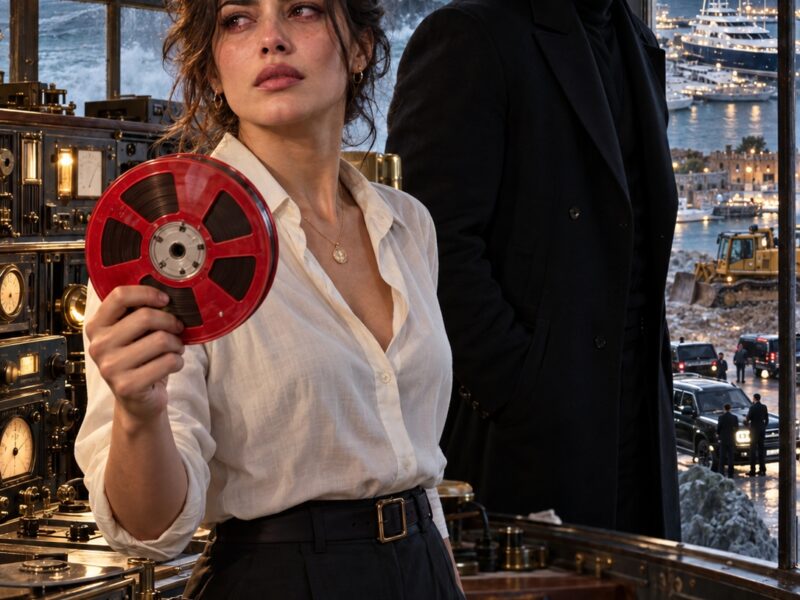
HE CAME TO DEMOLISH HER LIGHTHOUSE—THEN HIS DEAD MOTHER SPOKE THROUGH THE RADIO AND NAMED THE MAN WHO RAISED HIM
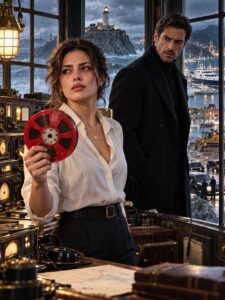
The dead were supposed to stay silent.
For twenty years, Isabella Vascari had.
Then, at 8:17 on a freezing November morning, her voice came through a rusted radio inside an abandoned lighthouse and accused the most powerful man in Raphael Vascari’s life.
Raphael had arrived at Station Seven with three black SUVs, twelve armed men, a demolition permit, and enough influence to make an entire stretch of harbor forget a building had ever existed.
Mara Bellini had one locked door.
One damaged recording reel.
And a secret that had already killed people.
Outside, the first bulldozer crawled toward the lighthouse.
Inside the radio room, Mara pressed the transmitter switch.
Static exploded across the harbor frequency.
Raphael stopped walking.
The demolition crew fell silent.
Fishing boats half a mile offshore heard it. So did the Coast Guard station, the customs office, and every dockworker whose radio happened to be tuned to Channel Sixteen.
For several seconds, there was only interference.
Then a woman began screaming through the speakers.
“This is the Lucerna. There’s a fire below deck. The passenger doors are locked. Please—”
Raphael went completely still.
He knew the voice.
He had not heard it since he was fourteen years old.
His mother had been dead for twenty years.
Yet Isabella Vascari was speaking again.
And then she said the name that changed everything.
“Vittorio changed the route. He knows what they loaded. Don’t let him shut down—”
The recording snapped into silence.
Nobody outside moved.
Mara could see Raphael through the salt-streaked window.
Tall. Black coat. Gray-green eyes. A man whose reputation could empty restaurants before he entered them.
But now one of his hands was trembling.
Mara opened the door.
Raphael stepped inside alone.
“Play the rest.”
“I can’t.”
His eyes lifted to hers.
Mara had spent months imagining this moment. In every version, she had been brave.
Now she could hear her own heartbeat.
“The rest of the channel is damaged,” she said. “I’m trying to restore it.”
“You had my mother’s voice.”
“Yes.”
“For how long?”
She hesitated.
That was enough.
Raphael moved closer.
“How long?”
“Four months.”
Something dangerous entered his expression.
“You listened to my dead mother for four months and said nothing to me?”
“I didn’t know whether telling you would protect the recording or bury it.”
“My family owns half this harbor.”
“That,” Mara said quietly, “was exactly the problem.”
For a moment, neither of them moved.
Then Raphael looked past her at the red reel mounted beside the restoration machine.
Vittorio Vascari.
His uncle.
His guardian.
The man who had pulled him from the wreckage of childhood and taught him how to survive the world that followed.
Vittorio had sat beside him at Isabella’s funeral.
Vittorio had taught him to drive.
Vittorio had given him his first office at Asterion Shipping.
Vittorio had told him, again and again, that the Lucerna disaster had been caused by the Orsini family.
And now Isabella’s final recorded words had placed Vittorio aboard the conspiracy.
Raphael looked back at Mara.
“How long do you need?”
“Seventy-two hours.”
His mouth tightened.
“After that?”
“I’ll either have the rest of the recording…”
She looked toward the bulldozers.
“…or you can tear the lighthouse down with me inside it.”
Something almost resembling respect moved through his face.
Almost.
Raphael stepped outside.
The demolition foreman approached him.
“Mr. Vascari?”
“No one touches the building.”
“Sir, the order—”
“I know who signed it.”
Raphael turned back toward Mara.
“I did.”
Every engine shut down.
Then Raphael locked the lighthouse door behind him.
“You have seventy-two hours,” he said.
Mara exhaled.
He leaned closer.
“But if you fabricated any part of that recording, the lighthouse will be the smallest thing you lose.”
Mara should have been afraid.
Instead she said, “If it’s real, Mr. Vascari, you’re about to lose something bigger than I ever could.”
His eyes narrowed.
“What?”
“The man you thought your uncle was.”
Neither of them knew someone was already listening.
And their seventy-two hours would last less than twelve.
Station Seven stood on a jagged cliff above the harbor, its white stone walls scarred by salt and thirty winters.
Mara had grown up there.
Her father, Tomaso Bellini, had been the lighthouse’s final official keeper before automation made men like him obsolete.
After his death, Mara stayed.
People called it obsession.
She preferred inheritance.
Every corroded receiver, handwritten frequency chart and repaired transmitter carried some trace of Tomaso’s hands.
Raphael followed her downstairs into the repair room.
“You live here alone?”
“Mostly.”
“Why?”
“People ask fewer questions when they think you’re crazy.”
“Are you?”
“About finding the truth?”
She met his eyes.
“Yes.”
Mara carefully removed the damaged reel.
Raphael watched her fingers.
“You’ve heard more than what you played.”
She froze.
He did not smile.
That was what made him frightening. Raphael rarely needed to accuse anyone. He simply waited until silence betrayed them.
“I restored fragments,” she admitted.
“What fragments?”
“Mostly noise.”
“Mostly?”
Mara sighed.
“There’s interference beneath your mother’s transmission. Repeating intervals. Too regular to be accidental.”
Raphael stepped beside her.
“Meaning?”
“Someone jammed the rescue frequency.”
“For how long?”
She enlarged the waveform.
“Eleven minutes.”
Raphael stared at the screen.
Eleven minutes.
On a burning passenger ferry, eleven minutes was an eternity.
He slowly removed the steel watch from his wrist and placed it beside the machine.
The gesture seemed strangely intimate.
“My mother gave me that watch aboard the Lucerna.”
Mara looked at him.
“I was on the ferry.”
She had not known.
Raphael touched the faint burn scar disappearing beneath his collar.
“I remember smoke. Emergency lights. Someone carrying me. I remember the water being so cold I couldn’t breathe.”
His voice remained controlled.
That made the pain worse.
“And Vittorio?”
“He told me the radio failed before the fire started.”
Mara looked at the waveform again.
“It didn’t.”
Raphael stared at his mother’s watch.
For twenty years he had lived inside a story.
Now a machine was telling him the story had been engineered.
Before either could speak, every lamp in the room flickered.
Once.
Twice.
Then the harbor receiver erupted.
“Station Seven, respond!”
Mara grabbed the microphone.
“Station Seven.”
“Navigation relay is down. We’ve lost the breakwater lights.”
Another voice cut in.
Panicked.
“We have two hundred fourteen passengers aboard. Visibility is nearly zero.”
Mara ran to the window.
Fog had swallowed the sea.
Somewhere inside it, the Santa Lucia sounded her horn.
One long blast.
Then another.
Closer.
Mara turned to Raphael.
“The ferry can’t see the breakwater.”
“Tell them to stop.”
“If they kill the engines now, the current turns them sideways.”
Another horn shook the windows.
Mara ran.
Raphael followed her up the spiral staircase.
At the lantern chamber, Mara tore open an emergency cabinet.
Station Seven had been automated years ago, but Tomaso Bellini had refused to remove the original mechanical controls.
Everyone had called him paranoid.
Now his paranoia was the only thing standing between two hundred fourteen passengers and a wall of rock.
Mara grabbed the activation lever.
It would not move.
Raphael stepped beside her.
“Tell me what to do.”
She stared at him.
Men like Raphael Vascari did not ask for instructions.
“Hold that release switch.”
He did.
“Hard.”
Raphael pressed his palm against it.
Mara pulled the lever with both hands.
Nothing.
Again.
The mechanism groaned.
“Again,” Raphael said.
Mara pulled until pain tore through her shoulders.
Then ancient gears moved.
Above them, the enormous Fresnel lens began to rotate.
Amber light sliced through the fog.
The ferry horn answered.
Mara sprinted downstairs.
“Santa Lucia, turn six degrees east. Half speed.”
“We can’t see you.”
“You don’t need to see the tower. Watch for the beam crossing your bridge. Count four seconds between passes.”
Raphael stood behind her.
He watched Mara calculate tide movement from a paper chart older than either of them.
Four seconds.
Three.
Too fast.
“Counter-steer two degrees.”
A scraping noise screamed through the radio.
Mara stopped breathing.
Silence.
Then—
“We cleared the outer reef.”
Her knees nearly gave out.
The captain returned.
“Station Seven… you saved us.”
Mara closed her eyes.
Only for a second.
When she opened them, Raphael was looking at her differently.
Not with suspicion.
With respect.
It lasted less than a minute.
Outside, Mara inspected the failed navigation relay.
The cable had been cut.
Cleanly.
Raphael crouched beside it.
Above them, the security camera continued blinking.
Mara pulled the footage.
The same thirty seconds repeated again and again.
A loop.
Raphael looked toward the lighthouse.
“This wasn’t meant to sink the ferry.”
Mara understood immediately.
“It was meant to get us away from the recording.”
His phone rang.
Giada, his cousin, was calling from the old customs archive.
Her voice came through sharp and breathless.
“Raphael, somebody broke into the Lucerna records.”
A fire alarm screamed behind her.
Then the call died.
Raphael looked across the harbor.
Black smoke was already rising.
Someone had waited twenty years to destroy the truth.
Now they were willing to burn an entire building to finish the job.
By the time Raphael and Mara reached the customs archive, flames had consumed the eastern wing.
A man burst from a side entrance carrying a steel case.
He ran toward a motorcycle.
Raphael reached beneath his coat.
Then Mara heard pounding.
Three people were trapped behind an upstairs window.
She ran toward the fire.
“Mara!”
She did not stop.
Raphael looked at the fleeing motorcycle.
Evidence.
Then at Mara disappearing into smoke.
For perhaps the first time in his adult life, Raphael Vascari chose a person over leverage.
“Let him go.”
He ran after her.
Inside, heat struck them like a physical wall.
Shelves burned.
Paper lifted through the air like black snow.
“The workers are upstairs!” Raphael shouted.
“The Lucerna files are twenty feet away.”
“They’re paper.”
“They’re why this building is burning.”
Mara pulled free.
A ceiling beam crashed behind them.
She reached a metal drawer beneath a fallen cabinet and grabbed it.
The steel burned through her palm.
She screamed.
Raphael wrapped his coat around her hand.
“Let go!”
“No!”
“Mara!”
Together they dragged the drawer free.
Inside was a half-burned ledger.
Another beam collapsed.
For one instant Mara saw something she had never expected to see on Raphael’s face.
Fear.
Not fear of fire.
Fear for her.
He lifted her over the wreckage.
They found the trapped employees upstairs beside an unconscious guard and forced their way toward a secondary exit.
Minutes later, Mara sat on the pavement while a paramedic wrapped her burned hand.
Raphael stood in front of her, soot across his face.
“You ran into a burning building for a file.”
“You abandoned the man carrying the other files.”
“I can find him again.”
His voice lowered.
“I cannot replace you.”
Mara looked up.
The sentence hung between them.
Too intimate to dismiss.
Too honest to misunderstand.
Giada approached carrying the rescued ledger.
“One page survived.”
Mara took it.
A payment.
Three days before the Lucerna disaster.
Sender: Vittorio Vascari.
Recipient: Tomaso Bellini.
Her father.
Beside it was a handwritten instruction.
Confirm rescue channel will remain silent.
Mara forgot about the pain in her hand.
Raphael read the line twice.
Then he looked at her.
For the first time since they met, suspicion returned.
Only now it was aimed at both their families.
By sunrise, the ledger page covered the main screen inside Asterion Shipping’s boardroom.
Twelve executives sat around the table.
Vittorio Vascari sat at the far end.
Silver-haired.
Elegant.
Calm.
He looked less like a criminal than someone’s favorite grandfather.
That was what made him dangerous.
“I knew your father,” Vittorio told Mara gently. “He was under tremendous financial pressure.”
“My father would never abandon a burning ship.”
“The evidence suggests otherwise.”
“The evidence also shows you paying him.”
Vittorio sighed.
“Because he demanded money.”
Raphael’s eyes sharpened.
“For what?”
“Silence.”
Vittorio explained it beautifully.
That was another thing dangerous men learned to do.
He claimed Tomaso had discovered unauthorized cargo aboard the Lucerna and attempted to blackmail Asterion. He accepted payment, interfered with the rescue channel, then blamed technical failure after the fire.
A complete story.
A believable story.
And Tomaso was dead.
Raphael finally spoke.
“Why wasn’t this in the official inquiry?”
For less than a second, Vittorio’s expression changed.
“My brother protected the Bellini family from prosecution.”
“My father?”
“Your father understood another scandal would destroy the port.”
Raphael stepped closer.
“And you let me spend twenty years believing the Orsini family murdered my mother.”
“We prevented a war.”
“No.”
Raphael’s voice became quiet.
“You gave me an enemy.”
Mara watched Vittorio.
Then Raphael turned toward her.
“Did your father ever explain where the money came from?”
“No.”
“Any equipment he couldn’t afford?”
The question hurt.
Because there was.
Portable transmitters.
Cash repairs.
Locked cabinets.
Nights when Tomaso had warned Mara never to trust official records.
For the first time in her life, doubt entered the sacred place where she kept her father.
Vittorio saw it.
“Before Miss Bellini accuses my family of murder,” he said, “perhaps she should decide whether she is searching for truth or trying to wash blood from her own name.”
Raphael slammed his palm onto the table.
Everyone fell silent.
“She remains under my protection until I know who burned that archive.”
Vittorio looked at Raphael.
Then at Mara.
Something changed in his eyes.
He understood before either of them did.
They had begun to matter to each other.
And that made Mara useful.
She left the boardroom shaken.
Her phone vibrated in the corridor.
Unknown number.
One photograph.
A man stood inside an abandoned dry dock holding a Lucerna cargo manifest.
Thinner.
Scarred.
Older.
But Mara knew him immediately.
Her brother.
Nico.
She had buried him three years earlier.
Six words appeared beneath the photograph.
Come alone if you want the truth.
Mara entered the dry dock alone.
“Nico?”
A chain moved overhead.
Then a man stepped between two rusted vessels.
His left leg dragged slightly.
A scar crossed his jaw.
Mara stared at him.
Then walked forward and slapped him.
Nico accepted it.
She slapped him again.
Then she threw her arms around him.
“You let me bury you.”
“I needed them to believe I was dead.”
“I buried an empty coffin.”
“And that’s why you’re still alive.”
Mara stepped back.
Nico placed documents on a workbench.
Cargo manifests.
The Lucerna had been carrying restricted chemical precursors worth millions on the black market.
“Isabella discovered them after departure,” Nico said. “She tried to alert Station Seven. Vittorio changed the route, jammed the channel and locked the lower passenger doors.”
Mara stared at him.
“How do you know?”
“I found these three years ago while working for Asterion.”
“Why didn’t you go to the police?”
“I tried.”
A truck forced Nico’s car from the road before he reached them.
The men who came afterward carried Vascari weapons.
“Raphael didn’t order that.”
Nico laughed bitterly.
“You’ve known him three days.”
“I watched him run into a burning building.”
“He runs the organization that started the fire.”
Footsteps sounded behind them.
Nico drew a pistol.
Raphael stepped into the light.
Mara spun around.
“You followed me?”
“I followed the man watching your lighthouse.”
Nico aimed.
Raphael did not reach for his weapon.
“If I wanted you dead,” he said, “we wouldn’t be having this conversation.”
Mara stepped between them.
“No one fires.”
For once, both men listened.
Nico produced another manifest.
It was dated four days in the future.
The same illegal cargo would pass through the harbor during the annual festival, when rescue crews would be spread thin.
The authorization carried Vittorio’s private code.
Raphael stared at it.
“He can’t move this shipment without starting a war.”
Nico’s expression hardened.
“That’s the idea.”
He believed Vittorio intended to frame the Orsini organization.
Raphael would retaliate.
The harbor would burn.
And Vittorio would inherit whatever remained.
Outside, an engine started.
Someone had been watching them.
By the time they reached Mara’s car, the watcher was gone.
But words had been carved into the driver’s door.
BRING THE RED REEL AND YOUR FATHER’S NAME WILL BE CLEARED.
Raphael looked at Nico.
Nico looked away.
And Mara suddenly understood that the next betrayal might not come from an enemy.
It might come from the brother she had prayed for three years to see again.
That night Nico slept at Station Seven.
Mara treated his injured knee and listened to stories about freight yards, cargo holds and anonymous towns.
She wanted to hate him.
She couldn’t.
Raphael could.
Or at least he could distrust him.
“Move the recording,” he told Mara privately.
“Nico risked his life for those manifests.”
“That doesn’t mean he trusts us.”
Mara noticed the word.
Us.
For a second, it felt dangerously good.
Then Raphael left.
Near midnight, Nico’s phone rang.
Vittorio.
“I have the original inquiry file,” he said. “It proves your father kept the rescue channel open.”
Nico stood.
“Send it.”
“Come alone.”
Nico looked toward his sleeping sister.
Three years of hiding.
Three years of guilt.
One chance to clear his father’s name.
He made the worst decision of his life.
Nico stole Mara’s access card.
Entered the radio room.
And took the red reel.
Vittorio waited inside a warehouse with a sealed folder.
Nico placed the reel on the table.
“Give me the file.”
Vittorio pushed the folder forward.
Nico opened it.
Blank paper.
The lights went out.
Men stepped from behind shipping containers.
Back at Station Seven, Raphael arrived carrying security footage.
One camera showed Nico entering the warehouse using Mara’s card.
Another showed Mara meeting him secretly at the dry dock.
Edited together, it looked deliberate.
Raphael entered the radio room.
The reel was gone.
Mara appeared behind him.
“Tell me you didn’t know.”
“I didn’t.”
“You met him alone.”
“He’s my brother.”
“You concealed his message.”
“I thought he was dead!”
“And now he has handed Vittorio the only recording of my mother.”
“He stole it from me.”
Raphael stared at her.
“Or both of you decided clearing your father mattered more than the truth.”
Mara’s face changed.
The accusation hurt because she could hear uncertainty beneath it.
Part of Raphael wanted her to convince him.
But she refused to beg.
She removed the lighthouse key from her pocket.
Placed it in his palm.
“You said you trusted me.”
“I said I was trying.”
“No.”
Her voice broke.
“You watched me. You protected me when it was easy. But the second my family looked guilty, you chose the story that hurt you less.”
She walked past him.
Raphael did not stop her.
Before dawn, Vittorio sent them a video.
The red reel burned inside a steel drum.
Nico knelt beside it, blood on his face.
Vittorio appeared.
“Your seventy-two hours are over.”
Behind him, demolition machines were climbing toward Station Seven.
This time Raphael had signed the order himself.
At sunrise, Mara began packing her father’s belongings.
The engines outside grew louder.
Raphael had doubted her.
Nico had betrayed her.
The recording was destroyed.
And perhaps her father really had been guilty.
Then something rattled inside Tomaso’s old portable transmitter.
Mara opened the wooden casing.
A tiny brass key fell into her hand.
Stamped into it were two characters.
L-7.
She remembered a locked drawer beneath her father’s workbench.
The key fit.
Inside was a receipt.
Tomaso had purchased a portable emergency transmitter two days after Vittorio paid him.
Beside it lay a handwritten tide log.
Mara read the first line.
Then the second.
Her knees weakened.
Seven fishing vessels had responded to a hidden emergency frequency on the night the Lucerna burned.
Her father had not silenced the rescue channel.
He had built another one.
The money Vittorio paid him had financed the equipment Tomaso used against him.
At the bottom of the log was one sentence.
Mirror stored above the light.
Mara ran upstairs.
The demolition machines reached the grounds.
Behind the lighthouse lens she found a second keyhole hidden beneath salt and corrosion.
The brass key turned.
A waterproof compartment opened.
Inside sat a blue recording reel.
A backup.
Mara almost laughed.
Instead she cried.
Downstairs, the lighthouse door opened.
Raphael entered.
“Stop!”
“I already stopped them.”
Mara looked at him.
His voice was different.
“I was wrong.”
“That doesn’t bring Nico back.”
“No.”
Raphael stepped closer.
“But I will.”
Mara mounted the blue reel.
Static filled the room.
Then Tomaso Bellini spoke.
“Main rescue channel compromised. Switching to auxiliary frequency. Any vessel hearing this, proceed toward the Lucerna.”
Fishing captains answered.
One.
Then another.
Then another.
Finally Isabella’s voice came through.
“Vittorio locked the lower deck. The cargo is burning. He ordered the official boats to wait.”
Raphael gripped the table.
Then his mother said the words that broke something inside him forever.
“If my son survives… keep him away from Vittorio.”
Raphael closed his eyes.
“He caused this.”
The recording continued until Station Seven lost power.
Tomaso Bellini had spent his final minutes trying to save strangers.
Isabella had spent hers trying to save her son from the man who would later raise him.
Raphael had inherited twenty years of lies.
He took out his phone.
“Giada.”
She answered immediately.
“Release every private Asterion ledger to Captain Kovacs.”
Silence.
“Raphael, those records could destroy the company.”
“I know.”
“They could expose half the organization.”
“I know.”
“You could go down with it.”
Raphael looked at Mara.
“I already chose the lie once.”
His eyes never left hers.
“I won’t choose it again.”
He ended the call.
Mara wanted that to repair everything.
It didn’t.
Trust did not return because someone finally made one correct decision.
Then every light in Station Seven died.
Outside, the entire harbor disappeared.
The radio screamed.
“Station Seven! Santa Lucia has changed course without command!”
Mara ran to the window.
A false beacon flashed near the reef.
The passenger ferry began turning toward it.
Raphael understood first.
“Vittorio.”
Mara checked the generator.
The fuel line had been cut.
“He planned this before the demolition.”
“If the ferry sinks,” Raphael said, “he blames Orsini. I retaliate. War starts.”
“And if you die?”
“He inherits Asterion.”
The Santa Lucia was twelve minutes from the reef.
A rescue boat waited below.
Raphael grabbed Mara.
“You’re coming.”
“No.”
“Mara.”
“The ferry doesn’t need another gun.”
She looked upward.
“It needs a lighthouse.”
“There’s no power.”
“My father operated it before there was electricity.”
Raphael caught her face between his hands.
It was the first time he touched her without anger or command.
“If someone comes through that door, you leave.”
“If I leave, those passengers die.”
“Mara—”
“Go.”
He wanted to argue.
Instead, finally, he trusted her.
Raphael boarded the rescue boat.
Mara climbed.
Every turn of the spiral staircase pulled against her burned palm.
She carried emergency fuel and signal flares.
On the Santa Lucia, Raphael found passengers trapped behind electronically sealed doors.
His men forced them open.
Then he entered the engine compartment.
Nico was there.
Bruised.
Bleeding.
Alive.
Vittorio had forced him to connect the navigation system to the false beacon.
Nico had sabotaged the steering relay to delay the final turn.
“I can hold the engines six minutes,” he told Raphael.
Outside, a speedboat raced toward Station Seven.
Vittorio stood aboard it.
Raphael watched him disappear into the rain.
The man who murdered his mother was escaping.
The man who had shaped his entire life was within reach.
Raphael could follow.
Or he could save two hundred fourteen strangers.
Twenty years earlier, Vittorio had made that choice.
Cargo over passengers.
Power over people.
Raphael turned away from the speedboat.
“Open every passenger door.”
At the top of Station Seven, Mara poured fuel into the manual lamp.
She struck a flare.
Amber light exploded across the sea.
The Santa Lucia began correcting course.
Then Mara connected Vittorio’s private radio frequency to the harbor emergency channel.
Every fishing vessel.
Every Coast Guard receiver.
Every ship in the harbor.
All of them could now hear what came through his radio.
The lantern-room door opened.
Vittorio entered.
Rain ran through his silver hair.
A pistol rested in his hand.
He saw the blue reel.
Then he locked the door.
“You should have let the dead remain silent.”
Mara slowly raised her hands.
What Vittorio did not see was the open microphone.
Outside, the Santa Lucia followed the real beacon.
Inside, Vittorio aimed at the recording.
“You killed Isabella because she discovered the cargo,” Mara said.
“I protected this family from a woman willing to destroy it.”
His confession traveled across the harbor.
Mara kept him talking.
“My father took your money.”
“Yes.”
“But he used it to build an auxiliary rescue channel.”
Vittorio’s face changed.
“He made himself a problem.”
“So you killed him.”
A faint smile.
“Roads are dangerous at night.”
Mara felt rage burn through her.
But she did not move.
“And Nico?”
“Your brother dies aboard the ferry with Raphael. Orsini takes the blame. By morning, the harbor needs a new leader.”
A voice came from the stairs.
“No.”
Vittorio turned.
Raphael stood in the doorway.
Soaked.
Bleeding from his side.
Alive.
Vittorio almost smiled.
“I raised you.”
“You raised me to hate the wrong man.”
“I gave you this city.”
“You gave me someone to blame so I would never look at you.”
Vittorio fired.
Raphael drove Mara to the floor.
Glass shattered behind them.
He crossed the room before Vittorio fired again.
They crashed into the railing.
The gun fell.
Raphael grabbed it.
Pointed it at Vittorio.
Twenty years of grief stood at the other end of the barrel.
His mother.
Tomaso.
Nico.
Mara.
Every lie.
Every body.
Every stolen year.
Vittorio waited.
Perhaps he even wanted Raphael to shoot.
Because then Raphael would become the man Vittorio had spent twenty years creating.
Mara said nothing.
Raphael’s finger rested against the trigger.
Then he lowered the gun.
“No more deaths to protect your lies.”
Coast Guard officers entered moments later.
Vittorio Vascari left Station Seven in handcuffs while his confession continued playing across the harbor.
The Santa Lucia returned safely.
Nico survived.
Giada’s evidence triggered investigations across Asterion and the Vascari organization.
Officials were arrested.
Accounts were frozen.
Contracts disappeared overnight.
Men who had once returned Raphael’s calls within seconds suddenly claimed they had never met him.
Raphael surrendered control of Asterion.
He testified.
He named names.
And when investigators asked about crimes committed under his own leadership, he did not hide behind Vittorio.
He accepted those too.
He did not ask Mara to wait for him.
That mattered.
Because for once, Raphael understood that love was not another thing powerful men were entitled to keep.
Six months passed.
Mara rebuilt Station Seven.
Not as a monument.
As an independent marine rescue center.
Nico repaired engines downstairs while his knee slowly healed.
Children from local schools visited the lantern room.
Fishermen donated old equipment.
On the wall beside the radio hung a photograph of Tomaso Bellini.
His name had finally been cleared.
Mara kept the blue reel locked away.
She rarely played it.
The dead had already said enough.
One evening in early spring, a car stopped at the bottom of the cliff road.
Only one.
No convoy.
No guards.
No men with weapons.
Raphael walked the rest of the way.
Mara saw him through the window.
She did not run outside.
She made him climb.
When he reached the lighthouse, he looked thinner.
Less polished.
More human.
They stood beneath the turning beam.
“I heard the rescue center received independent status,” he said.
“It did.”
“And Nico?”
“Still terrible at following instructions.”
A faint smile.
Then silence.
Raphael looked toward the sea.
“I don’t expect forgiveness.”
“Good.”
“I’m not asking for what we almost had.”
Mara waited.
“I came to ask whether we could begin again.”
She studied him.
Six months earlier, this man had arrived with bulldozers.
He had owned the road.
The harbor.
The company.
The men standing behind him.
He had believed power meant never having to ask permission.
Now he stood alone outside the lighthouse with nothing to offer her except the truth.
Mara remembered the moment he doubted her.
She remembered the pain of placing the lighthouse key in his hand.
She remembered him choosing innocent passengers instead of revenge.
She remembered him lowering Vittorio’s gun.
None of those moments erased the others.
Maybe that was what forgiveness really meant.
Not forgetting the wound.
Not pretending it had never happened.
Simply deciding whether the person who caused it had become someone different enough to approach again.
Mara held out her hand.
“One day at a time.”
Raphael looked at it.
Then at her.
“One day at a time,” he repeated.
He took her hand.
Far below, a fishing vessel sounded its horn.
The lighthouse beam moved across the dark water, disappeared, then returned.
For twenty years, Raphael Vascari had believed he inherited an empire.
What he had really inherited was a lie.
A lie that stole his mother.
Destroyed Mara’s father.
Separated a brother and sister.
Turned grief into hatred.
And taught a frightened fourteen-year-old boy to trust the very man responsible for his pain.
Raphael had arrived at Station Seven intending to tear it down because powerful men often destroy the places where inconvenient truths survive.
Instead, the lighthouse destroyed something inside him.
The certainty that power could protect him from knowing who he really was.
Mara never saved Raphael by excusing him.
She made him choose.
Revenge or innocent lives.
Control or trust.
The empire he inherited or the man he still had time to become.
And perhaps that was why, when she finally allowed him to return, she offered no promise of forever.
Only another day.
Another choice.
Another chance to prove that the man standing beside her was no longer the boy Vittorio had shaped.
Raphael looked toward the horizon.
“Your father knew, didn’t he?”
“Knew what?”
“That this place would survive.”
Mara smiled faintly.
“No.”
The beam crossed the sea again.
“He just knew the light mattered more when someone wanted it turned off.”
Raphael looked at her.
Neither spoke after that.
They did not need to.
Because for the first time in twenty years, Station Seven held no secret powerful enough to kill for.
The radio was quiet.
The harbor was safe.
And the dead had finally been heard.
Far offshore, another ship found the lighthouse beam and slowly corrected its course toward home.
Mara watched until it disappeared beyond the breakwater.
Then she closed the radio-room window against the cold.
Raphael waited beside the door.
Not leading.
Not commanding.
Just waiting.
Mara switched off the lamp and walked toward him.
Behind them, the great lens continued turning.
Once, that light had been a warning.
Then it became evidence.
Then a weapon against a lie.
And now, as its beam swept across the black water one more time, it seemed to mean something simpler.
A lighthouse never goes searching for a lost ship.
It does not promise the storm will end.
It does not erase the rocks beneath the water.
It simply remains where it is, burning through the darkness, giving whoever is lost enough truth to choose a different direction.
For twenty years, Raphael Vascari had been following the wrong light.
This time, when Mara opened the door, he knew enough to follow her home.









