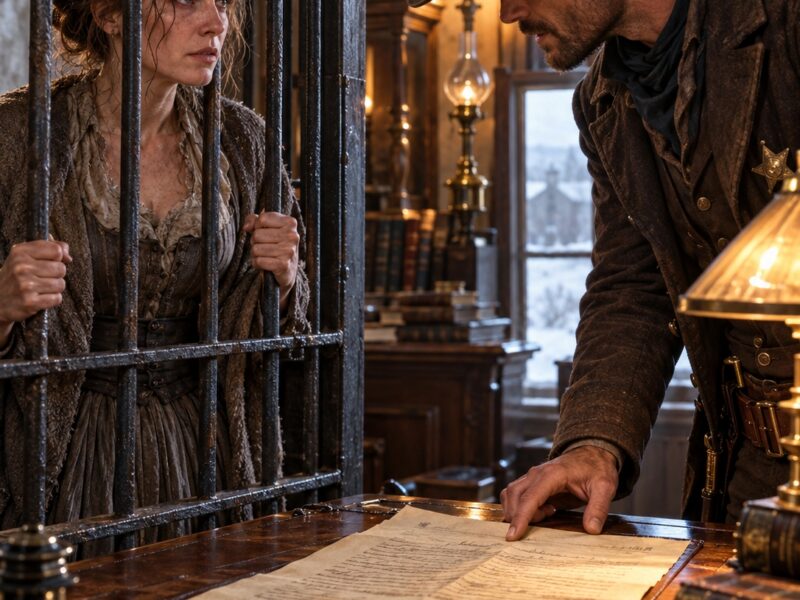
He Came to the Jail to Marry Her—But the Sheriff Saw What He Really Wanted Her to Sign

The man who claimed he loved Lena March brought a property deed to the jail before he brought her a blanket.
Sheriff Asa Mercer noticed that first.
It was eight minutes past seven on a bitter November morning in 1887, and frost had turned the corners of the jailhouse windows white. Lena had spent the night behind iron bars in the same damp traveling dress she had been arrested in, her hair half-fallen from its pins, her hands red from cold.
Deak Hollis did not ask whether she had slept.
He did not ask whether she was frightened.
He did not even look toward the cell when he entered.
Instead, he crossed the room, removed a folded document from inside his coat, and placed it beside Sheriff Mercer’s coffee.
“She’s ready to settle,” Deak said.
Asa looked at the paper.
Then he looked at Deak.
“Settle what?”
“The whole ugly business.”
Deak smiled as if they were two reasonable men discussing the sale of a horse.
“I’ll take responsibility for her.”
Behind the bars, Lena stood.
She had not slept for more than a few minutes at a time. Every time she closed her eyes, she saw Deputy Clem opening her valise and pulling out the missing envelope.
Money she had never seen.
Money Deak claimed she had stolen.
Money that had somehow appeared beneath two folded blouses in a locked hotel room.
By midnight, Lena had stopped telling anyone that she was innocent.
Not because she had changed her story.
Because no one seemed interested in hearing it.
Now Deak had arrived with paper.
And somehow, that frightened her more than the cell.
Asa unfolded the document.
His expression changed.
Not dramatically. Asa Mercer was not a dramatic man. At forty-four, he had acquired the habit of keeping most reactions behind his eyes.
But his coffee stopped halfway to his mouth.
The document transferred Lena March’s inherited forty-acre pasture to Deak Hollis.
The purchase price was almost insulting.
Asa read the number twice.
“You call this a settlement?”
Deak leaned one hand against the desk.
“We’re going to be married.”
“That wasn’t my question.”
“She’s in trouble. I’m offering her a way out.”
“For her land.”
“For our future.”
Asa lifted his eyes.
Deak’s smile remained, but something underneath it hardened.
“A husband ought to manage difficult matters,” Deak said.
The silence that followed felt different.
Lena stepped toward the bars.
“Sheriff.”
Asa turned.
Her voice was hoarse.
“Ask him what’s under the eastern fence.”
Deak spun toward her.
“Lena.”
“Ask him.”
“You’re making this worse.”
“No,” she said.
Her fingers wrapped around the cold iron.
“I think I’m finally making it inconvenient.”
Deak stared at her.
For one second, the patient fiancé disappeared.
What replaced him was so quick that another man might have missed it.
Asa did not.
He folded the deed.
Then he opened the top drawer of his desk and placed it inside.
“Wait outside, Hollis.”
Deak laughed once.
It was not amusement.
“Sheriff, I don’t think you understand—”
“I understand the door is behind you.”
The two men looked at each other.
Lena held her breath.
For the first time since she had arrived in western Kansas, she watched Deak Hollis receive an instruction from another man and realize he could not simply ignore it.
His jaw tightened.
Then he took his hat from the desk.
“This is a private matter between me and my future wife.”
Asa leaned back.
“The moment a theft accusation put her in my jail, it stopped being entirely private.”
Deak looked toward Lena.
His face softened instantly.
That frightened her most.
“Think carefully, darling.”
She said nothing.
Deak walked out.
The door shut behind him.
Only then did Asa look toward the cell.
“What’s under the eastern fence?”
Lena stared at him.
A bitter laugh almost escaped her.
“That’s your first useful question.”
The sheriff absorbed the insult without defending himself.
He deserved it.
He had been away the previous evening when Lena was arrested. Clem had received Deak’s written accusation, gone to the hotel, searched Lena’s valise, and found the envelope exactly where Deak said stolen money might be found.
To Clem, it had seemed straightforward.
Too straightforward, Asa was beginning to think.
He stood and took the ring of keys from the wall.
Lena stiffened.
He unlocked the cell.
“You can sit by the stove while I review this.”
She did not move.
Asa opened the door wider.
Lena remained where she was.
Then she asked the question she had apparently been carrying all night.
“If I don’t sign his paper, will you let him take me?”
Asa’s hand stopped on the cell door.
“No.”
She searched his face.
He understood that a simple answer was not enough.
“No marriage promise gives him authority over you,” Asa continued. “No deed gives him authority to remove you from custody. Your release will be decided on the accusation and the evidence. Nothing else.”
“What if he says he’s responsible for me?”
“You’re thirty-nine years old.”
Something almost resembling life returned to her eyes.
“So you noticed.”
“I’m a sheriff. Occasionally I notice things.”
“You didn’t notice enough yesterday.”
“No.”
That answer surprised her.
No excuse.
No wounded pride.
Just no.
Asa pulled a chair closer to the stove.
“I was away. Clem acted on a sworn complaint and the discovery of the money. That explains what happened. It doesn’t necessarily excuse how little was asked.”
Lena stepped slowly out of the cell.
She did not thank him.
Asa did not expect her to.
Outside, Deak was already speaking to two men near the hitching rail.
His voice carried through the window.
“My bride’s become hysterical.”
Lena stopped.
Asa crossed the room and opened the front door.
Deak turned.
“She has asked a sensible question,” Asa said. “Bring me the payroll account you claim she stole from.”
Deak’s smile thinned.
“What?”
“The account.”
“You have the money.”
“I have an envelope. I want the account.”
A long moment passed.
Then Deak mounted his horse.
Asa watched him ride away.
When he closed the door again, Lena was still standing beside the stove.
“So,” he said. “The eastern fence.”
She looked toward the frosted window.
“There’s a spring.”
That was the moment the story changed.
Because forty acres of poor Kansas grass were worth one thing.
Forty acres containing water that survived a dry summer were worth something else entirely.
And somebody had been counting on Lena March never understanding the difference.
The pasture had belonged to Lena’s aunt.
Most of it was unimpressive—hard soil, scrub, stone, and grass stubborn enough to survive because nothing had bothered killing it.
But along the eastern boundary, beneath a low bank crowded with roots, clear water pushed continuously from the earth.
Even in August.
Even when shallow wells nearby weakened.
Even when cattle downstream began walking farther each day to drink.
Lena had inherited the land six months earlier.
She had inherited almost nothing else.
For nineteen years she had worked in laundries, boardinghouses, and private homes. She knew what steam did to a woman’s hands in winter. She knew how rich people complained about stains as if fabric had personally betrayed them.
When her aunt died, the letter informing Lena of the inheritance had seemed almost absurd.
Forty acres.
A cabin.
A spring.
A place with her name attached to it.
Then came Deak Hollis.
He had answered a matrimonial notice through acquaintances back east.
His letters had been careful.
Respectful.
He wrote about church on Sundays, the price of cattle, Kansas sunsets, the difficulty of building a life alone.
He never promised wealth.
That had appealed to Lena.
Her father had died a hired hand. Poverty did not frighten her.
Cruelty did.
Entitlement did.
And Lena had lived long enough to know that ownership and decency did not always travel together.
Three weeks before her arrest, she arrived by train.
Deak met her with flowers wrapped in newspaper.
He had borrowed a buggy.
His coat was brushed carefully despite being old.
When he smiled, he looked embarrassed by his own happiness.
Lena remembered thinking that embarrassment was sweet.
Now she wondered how much of it had been practiced.
The trouble began with the fence.
Deak suggested moving part of the eastern boundary so cattle from Orin Blake’s neighboring ranch could reach the spring more easily.
“Just neighborly cooperation,” he had said.
Lena asked to see the proposed terms.
Deak laughed.
“Terms?”
“If cattle cross my property, yes.”
“Paper ruins neighborliness.”
“A clear agreement might preserve it.”
His face had changed.
Only slightly.
After that, he stopped calling her careful.
He began calling her suspicious.
Then difficult.
Then ungrateful.
Three days later, money disappeared.
And somehow it was found in her valise.
Asa listened to all of it.
When Lena finished, he did not immediately tell her he believed her.
Strangely, that made her trust him a little more.
He asked questions instead.
“Who handled your valise?”
“I did. Deak carried it once. The hotel porter carried it upstairs.”
“Who has a key to your room?”
“I have one. The proprietor has another.”
“Had you ever seen the envelope before Clem opened your bag?”
“No.”
“Was Deak at the hotel yesterday?”
“Yes.”
“When?”
“In the afternoon. Near the desk.”
Asa wrote the answers.
Then he called Clem inside.
The deputy entered looking as though he would have preferred a gunfight.
“Get the hotel register. Speak to the proprietor. Then find the ranch foreman and verify the payroll account.”
Clem nodded.
“And Clem?”
“Yes, Sheriff?”
“Don’t tell them what answer we need.”
Clem’s ears reddened.
Lena noticed.
“You could have asked those questions yesterday.”
The deputy opened his mouth.
Closed it.
“Yes, ma’am.”
By noon, Deak’s story had its first serious crack.
The money had not been payroll money.
The ranch foreman confirmed the workers had already been paid from a different account.
The envelope Deak claimed Lena stole contained funds intended for a proposed livestock purchase.
That did not prove Lena had not stolen it.
But it meant the sworn accusation was wrong about one of its central facts.
And once one fact became unreliable, Asa began pulling on every other loose thread.
By late afternoon, the county’s judicial officer had returned.
He reviewed the accusation.
The money.
The contradictory account.
And the deed Deak had carried into the jail that morning.
When the cell door opened again, Lena stood very still.
“You’re released while the matter is investigated,” Asa said.
She picked up her valise.
Outside, Deak waited with his horse.
“Come on,” he said.
As though she had inconvenienced him.
As though the previous night had been a misunderstanding between lovers.
Lena looked at him.
Then at Asa.
The sheriff stepped aside.
“She leaves with whomever she chooses.”
It was not a declaration of love.
It was not a heroic speech.
It was only a sentence.
But after a night in which every man around Lena seemed to believe somebody else should decide what happened to her, the words struck with almost physical force.
She walked past Deak.
Past Asa.
Past the staring men outside the jail.
And entered the hotel alone.
Only when she reached her room did her knees begin to shake.
She locked the door.
Then she sat on the floor with her back against it.
Freedom, she discovered, did not always feel like triumph.
Sometimes it felt like terror with the lock on your side.
The accusation reached town faster than news of her release.
By dinner, two women stopped talking when Lena entered the hotel dining room.
The proprietor asked for payment in advance.
She had enough money for four nights if she skipped proper dinners.
So she carried bread upstairs.
On the third bite, she began considering the eastbound train.
She could leave.
Return to familiar work.
Forget Kansas.
Forget Deak.
Forget the spring.
But leaving would mean surrendering the one thing he had tried to take from her.
And that realization made the bread difficult to swallow.
The following morning, Asa came to the hotel carrying her property receipt.
He remained in the public parlor.
Lena noticed that too.
He could easily have asked to speak privately.
He did not.
“Should I be grateful to you?” she asked.
Asa considered the question.
“No.”
That was not the answer she expected.
“My office put you in that cell,” he continued. “You shouldn’t have needed my permission to be treated properly.”
“You weren’t there.”
“My name was on the door.”
Lena folded the receipt.
“You say that as though responsibility can travel.”
“It ought to.”
She studied him.
“Would you have said all this before you met me?”
That question landed harder.
Asa thought about men he had known for years.
Complaints he had accepted because the complainant had a ranch, a business, a familiar face.
Travelers he had distrusted because nobody local could vouch for them.
He thought about how easily habit disguised itself as judgment.
“Not clearly enough,” he said.
Lena did not reward his honesty.
She merely nodded.
Good, Asa thought.
He was beginning to understand that she had spent enough of her life being expected to reward men for meeting minimum standards.
She told him she intended to move to the cabin on her land.
“It’s five miles outside town.”
“I know.”
“The roof leaks.”
“I know.”
“You don’t have a close neighbor.”
Lena’s eyes sharpened.
“Does a woman always have to choose between depending on somebody and being called foolish?”
Asa nearly answered too quickly.
Instead, he stopped.
“No.”
Then he gave her the name of a carpenter.
Nothing more.
Lena hired the man by selling a gold mourning pin that had belonged to her aunt.
She disliked parting with it.
But sentiment could not keep rain off a mattress.
The carpenter brought his wife, Mavis, who arrived with a basket, an opinion about everything, and no apparent understanding of the concept of silence.
By sunset, Lena and Mavis had cleaned the chimney, argued over the stove, patched two cracks, and become friends without either woman formally agreeing to it.
Near dusk, Asa rode past on county business.
Lena stood outside painting the cabin door brown.
He slowed.
“Lock work?”
She held up the key.
Asa nodded.
Then he continued riding.
Lena watched him disappear down the road.
She liked him more for leaving.
That night, every sound outside became a threat.
A branch scraped the roof.
Lena sat up.
Something moved near the wall.
She reached for the poker.
Wind pushed dry grass against the boards.
She checked the latch twice.
Then, angry at herself for being frightened in her own home, she lit the lamp and began writing a list.
Bucket.
Lamp oil.
Roof nails.
Flour.
Mouse trap.
Another blanket.
By the time she reached “decent broom,” she had stopped imagining hoofbeats.
Practical worries were not exactly comforting.
But they belonged to a future.
She placed the list beside the deed she still owned.
Then she slept.
The next threat came in daylight.
Three influential men entered Asa’s office two mornings later.
One was Deak’s employer.
Another owned considerable acreage.
The third controlled enough local business that Clem waited until the door closed before muttering, “That’s trouble.”
They had not come to threaten Asa.
Not openly.
They came to be reasonable.
That was worse.
“This has gone far enough,” Deak’s employer said. “A woman misunderstood a business proposal. A young cowboy spoke hastily. Nobody needs reputations destroyed over forty poor acres.”
Asa folded his hands.
“Whose reputation?”
The man frowned.
“I didn’t come here to be insulted.”
“You came here asking me to stop an investigation.”
“I came here asking you to use judgment.”
“So am I.”
They reminded Asa who had supported his election.
Not directly.
Nobody said, We put you in this chair.
They did not need to.
When they left, Clem stood at the window.
“You know what this could cost.”
“Yes.”
“You planning to run again?”
“I was.”
Clem looked at him.
Asa stared at the closed door.
For years, he had considered himself independent because nobody had ever explicitly ordered him to do something dishonest.
Now he wondered how many compromises had never needed to be spoken because he had understood them automatically.
It was an unpleasant discovery.
And Lena March had forced him to make it simply by asking why nobody had bothered asking questions.
That afternoon, Lena made a discovery of her own.
Wooden survey stakes had appeared near her spring.
She followed them along the eastern boundary.
A route had been marked through her pasture.
Someone had already begun planning cattle access.
Without her permission.
Lena pulled one loose stake from the ground and carried it into town.
The surveyor produced a note.
Deak Hollis had authorized the work.
Not as a neighbor.
As Lena’s agent.
She had never appointed him.
When Asa read the note, his face hardened.
“There,” Lena said. “Now you have him.”
“I have evidence.”
“You have his name.”
“On a note the surveyor needs to identify.”
“He tried to take my land.”
“I know.”
“He put money in my room.”
“We don’t yet have proof he placed it there.”
Lena stared at him.
“You put me in jail with less proof than this.”
Asa went silent.
“Yes.”
The answer disarmed her anger more effectively than an argument.
“That was wrong,” he said. “Repeating it in the other direction won’t make it right.”
Lena hated that he had a point.
She hated even more that he was willing to let her hate it.
So the investigation continued.
Slowly.
Painfully.
Correctly.
And that became its own form of tension.
Because every day justice took to become careful was another day Lena remained the woman some people believed had stolen money from the man she had promised to marry.
Then Orin Blake came to her property.
His cattle were the reason Deak wanted access to the spring.
Lena saw the herd beyond the fence.
Even from a distance, she could see ribs.
Orin removed his hat.
“I owe you an explanation.”
“You owe me several.”
He admitted he had expected Deak to control the pasture after the marriage.
He had hoped for cheap access to the water.
“Why?”
Orin looked embarrassed.
“Because I figured he’d understand ranch business.”
“And I wouldn’t?”
“I didn’t say that.”
“You didn’t have to.”
He looked toward his cattle.
Lena followed his gaze.
She was angry.
But the animals were thirsty.
They had not spread rumors.
They had not forged authority.
They had not put stolen money into her luggage.
So Lena opened the gate.
Not freely.
Not permanently.
And not because a man expected it.
She walked the land with Orin.
“How many cattle?”
“Thirty-two.”
“How often?”
“Every second day until the creek rises.”
“Which route?”
He pointed.
“No. That bank is soft. Use the north approach.”
Orin blinked.
“All right.”
“You pay for access. You repair damage. Your men close every gate.”
“You drive a hard bargain.”
“No. I’m making a clear one.”
By the end of the afternoon, they had the beginning of an agreement.
Lena took it for proper advice before signing.
When Asa learned what she had done, he frowned.
“Blake supported Deak’s account.”
“Yes.”
“You trust him?”
“No.”
“Then why—”
“Because his cattle need water.”
Asa stopped.
Lena crossed her arms.
“I can insist he tell the truth and still let his animals drink. Those are separate things.”
Asa considered this.
Then asked, “Who’s checking the bank after each use?”
Lena’s expression softened.
“That,” she said, “is a useful question.”
The first payment bought firewood.
The second bought feed.
More importantly, Orin followed the agreement.
Something began changing around Lena—not dramatically, not cleanly, but in small ordinary ways.
A hired boy learned where the ground near the spring collapsed easily.
The feed seller stopped lowering his voice when she entered.
Mavis brought preserves without pretending they were charity.
And eventually Orin admitted he had repeated rumors about Lena before knowing the facts.
“I was wrong.”
“Where did you say it?”
He hesitated.
“At the feed store. With some men.”
“Then that’s where you correct it.”
His apology was incomplete.
Lena accepted the part that existed.
She was learning that rebuilding a life did not require winning every argument.
Sometimes it required firewood.
A working latch.
A fair agreement.
And neighbors learning to ask one more question before believing the easiest story.
Then Clem found the hotel porter.
And the investigation changed again.
The porter had left the hotel after a wage dispute.
Clem found him working near a feed yard.
The young man remembered Lena’s valise.
More importantly, he remembered Deak.
Deak had paid him to move the valise from Lena’s room to the downstairs parlor, claiming Lena had asked for it.
The porter had not seen Deak place anything inside.
But for several minutes, Deak had been alone with the bag.
It was not perfect evidence.
Lena wanted perfect evidence.
She wanted somebody to say:
I saw him open it.
I saw the envelope.
I saw everything.
Instead, Asa told her something she would remember for years.
“Most people don’t know which minute they’re supposed to remember until long after it’s gone.”
That sentence unsettled her.
Because Lena remembered Deak’s flowers.
His awkward smile.
The borrowed buggy.
The careful letters.
But she could no longer remember exactly when he first asked about the spring.
Before he held her hand?
After?
Had there been curiosity in his voice?
Had she mistaken calculation for interest because she wanted the story to be kinder?
Then another witness emerged.
Deak’s cousin.
He had heard Deak brag that Lena would “sign anything to avoid a trial.”
At the time, he had dismissed it as ugly talk.
Then he learned she had actually spent a night in jail.
Suddenly the boast sounded different.
The cousin wanted anonymity.
Asa explained that evidence could not become invisible simply because telling the truth was uncomfortable.
The man asked for time.
Before he decided, Deak returned to Lena’s cabin.
She saw him from the window.
Her entire body went cold.
He remained on horseback outside the gate.
Smart enough not to cross.
“Lena.”
She stepped onto the porch.
“What?”
“We can still fix this.”
“No.”
“You haven’t even heard me.”
“I’ve heard enough to last a winter.”
His mouth tightened.
“I’ll still marry you.”
For a moment, she thought she had misheard him.
Then she laughed.
Not because anything was funny.
Deak leaned forward in the saddle.
“Respectable people will forget this once you carry my name.”
Lena descended one step.
The gate remained between them.
“They can learn mine.”
“You think these people are going to accept you? A woman alone? Accused of theft?”
“Accused by you.”
“You’ll regret choosing loneliness.”
Lena looked at him for a long time.
Then she said the words that ended whatever remained of the man she had traveled west to marry.
“You’ve already shown me a worse arrangement.”
Deak rode away.
Lena remained on the porch until he disappeared.
Then she went inside.
Her hands shook so violently that she spilled lamp oil across the table.
She stared at the spreading stain.
And suddenly she was furious.
Not afraid.
Furious.
Because refusing a cruel man was supposed to feel powerful.
Instead, it still cost her sleep.
It still made her check windows.
It still sent her walking to Mavis’s house before dark because she could not bear another night listening for horses.
Mavis opened the door.
One look at Lena’s face was enough.
“Come in.”
“I hate that I’m here.”
“I know.”
“I hate that he can still do this to me without touching me.”
“I know.”
Mavis returned to shelling beans.
She did not tell Lena she was brave.
She did not tell her courage should feel good.
She simply made room at the table.
The next morning, Asa came.
He did not demand that Lena remain in town.
He did not order a guard onto her property.
He asked what Deak had said.
He asked what she wanted formally recorded.
He asked whether Deak had threatened a specific act.
Then he explained what he could legally do and what he could not.
Lena began to understand something.
Protection and possession were not the same thing.
Deak had offered protection as a price.
Asa treated it as a responsibility with limits.
He did not claim her because he had helped her.
He did not turn concern into authority.
When he disliked one of her decisions, he said so.
Then he left the decision with her.
Lena was not ready to call that love.
But she stopped bracing herself every time his horse appeared on the road.
Winter slowed everything.
A witness was delayed by weather.
A lawyer requested time to examine documents.
The investigation dragged on.
Deak continued working cattle.
Lena continued carrying the accusation.
Justice, she discovered, could be painfully unequal even while moving in the right direction.
The accused person woke each morning inside the story.
Everyone else went to work.
So Lena wrote to the local newspaper.
The editor wanted to turn it into a broken-engagement scandal.
She refused.
“You can print that the theft accusation remains under inquiry and that I transferred no property to Mr. Hollis. Or you can print nothing from me.”
He printed the short factual notice.
It did not restore her reputation.
But it killed one rumor.
Deak did not own her pasture.
Meanwhile, Asa’s political opponents found their own version of events.
Sheriff Mercer had let a pretty woman turn him against respectable cattlemen.
When Lena heard that description, she almost laughed.
She was thirty-nine.
Her hands were weathered from years of laundry work.
There were faint lines beside her eyes and a burn scar near one wrist.
Apparently scandal had made her beautiful enough to threaten county government.
Then she saw Asa.
He looked exhausted.
She stopped laughing.
“You’re going to lose votes over this.”
“Maybe.”
“Because of me.”
“No.”
She frowned.
He set down his coffee.
“My choices belong to me.”
Lena considered him.
“Good.”
He blinked.
“Good?”
“Because mine already take enough looking after.”
Asa smiled.
It was tired.
But real.
That afternoon, Lena noticed two unopened letters sticking from his coat pocket.
“Your sister?”
He nodded.
“She wants me to visit Nebraska.”
“And?”
“I have work.”
“The county might survive seven days.”
“That sounds like something she’d say.”
“She sounds sensible.”
They began speaking about things that had nothing to do with Deak.
At first, those conversations felt almost forbidden.
As though Lena’s life had become so consumed by accusation that discussing weather, books, roofs, or Asa’s sister was irresponsible.
Then she realized the opposite was true.
Deak had already taken enough.
He did not deserve every conversation too.
One Sunday, Mavis invited them both to dinner.
Before the meal, Mavis’s husband read a short passage from the Gospel of John.
“Judge not according to the appearance, but judge righteous judgment.”
John 7:24.
Then he passed the potatoes.
Nobody turned the verse into a speech about Lena.
Nobody stared meaningfully at Asa.
Lena spilled gravy on her sleeve.
Asa lost an argument about fence repair.
For one hour, neither of them had to symbolize anything.
When he walked her to the wagon afterward, Asa rested one hand on the wheel.
“When this case is finished…”
Lena waited.
He cleared his throat.
“Would you consider having dinner with me?”
She studied him.
“After?”
“Yes.”
“Not before?”
“No.”
Something in his answer mattered.
“Then I might.”
It was not a promise.
But Asa rode home feeling as though the Kansas winter had shifted by one degree.
Then the case finally broke open.
Deak’s cousin testified.
The porter described the unattended valise.
The surveyor produced Deak’s note claiming authority over Lena’s property.
The ranch foreman confirmed Deak’s original payroll story had been false.
And Deak himself began changing details.
First, he changed when he claimed to have discovered the money missing.
Then why he had believed Lena took it.
Then why he had carried a deed into the jail.
Each new explanation might have survived alone.
Together, they collapsed.
Lena was called to speak.
Deak sat across the room.
She did not look at him.
“Miss March,” an attorney asked, “you once intended to marry Mr. Hollis?”
“Yes.”
“And then that relationship deteriorated?”
“Yes.”
“You were disappointed?”
Lena finally looked up.
She understood what the question was trying to build.
A rejected woman.
A bitter fiancée.
A private quarrel transformed into public revenge.
So she answered before the story could be dressed for her.
“I was disappointed when I learned what he wanted.”
A pause.
“But disappointment doesn’t make his paper mine.”
The room became very quiet.
The theft accusation against Lena was dismissed.
The official language was brief.
Almost offensively brief.
She asked for a copy.
She had imagined that the moment somebody formally declared the accusation unsupported, the night in jail would disappear.
It did not.
The document could establish a fact.
It could not return the hours she had spent wondering whether anyone would believe her.
The separate proceeding against Deak continued on its own evidence.
The findings went against him.
Restitution was ordered for documented losses and expenses.
It was less than Lena had lost in work.
Far less than she had lost in sleep.
Nobody pretended money could repair that.
Deak eventually left the county after satisfying the immediate terms imposed on him, with further obligations recorded instead of quietly forgotten.
Lena watched his wagon disappear from town.
She expected satisfaction.
Instead, she felt tired.
Mavis stood beside her.
“Want me to say something unkind?”
Lena considered it.
“Very.”
“I’ve been saving several things.”
Lena laughed.
And just like that, Deak Hollis left her life not with thunder, but with two women standing in cold wind making jokes he would never hear.
But the cost of the case had not finished arriving.
Two weeks later came the election.
Asa Mercer lost.
Narrowly.
There was no satisfying villain in the result.
Some voters disliked his handling of the Deak investigation.
Some simply wanted a new sheriff.
Some had complaints unrelated to Lena.
Democracy did not arrange itself into neat moral endings.
Asa packed his office.
Papers.
Two books.
A spare shirt.
An old chipped coffee cup.
On his last afternoon, Lena entered the jail to collect a certified document.
The bars had been repainted.
Clem would remain as deputy.
He handed Lena the paper.
“I ask more questions now.”
She looked at him.
“Before arresting people?”
His face reddened.
“Yes, ma’am.”
“Good.”
Clem looked toward the floor.
“I am sorry.”
Lena held the document against her coat.
“I hope the next stranger benefits.”
Outside, Asa carried his box toward the street.
Without the badge, he seemed strangely ordinary.
Lena realized she had never seen him that way.
Not Sheriff Mercer.
Just Asa.
She called his name.
He turned.
“Are you free Friday?”
He looked surprised.
“For what?”
“Supper.”
Asa nearly dropped the box.
And for the first time since Lena had met him, she enjoyed watching a man lose control of a situation involving her.
He arrived Friday wearing an ordinary coat.
Mavis and her husband joined them, partly for propriety and partly because Mavis claimed she had invested too much emotional labor in the matter to miss supper.
Asa was considering managing a livery.
“I know horses,” he said.
“Knowing horses isn’t the same as knowing accounts,” Lena replied.
“I was hoping you wouldn’t notice that.”
She brought out her feed calculations.
He discovered two errors.
She discovered three in his projected expenses.
Mavis later told her husband it was the least romantic courtship she had ever witnessed.
“Promising, though,” he said.
After the others left, Asa remained on the porch.
Lena carried out two cups of coffee.
“I wanted to call sooner,” he said.
“Why didn’t you?”
“The case.”
“It’s finished.”
“The office.”
“You don’t have it.”
He gave her a look.
She waited.
Finally he said, “I didn’t want you wondering whether helping you had purchased something.”
Lena became still.
There it was.
The thing she had not known she needed him to understand.
She sat beside him.
“Can I ask something?”
“Yes.”
“Can you stop deciding every difficult thing for me, even when your intentions are decent?”
Asa looked startled.
“You could tell me no.”
“I still can.”
For a second he stared at her.
Then he laughed.
Lena smiled into her cup.
He turned serious again.
“May I court you?”
She looked at him.
No badge.
No cell.
No accusation.
No debt.
Just a man asking.
“Yes,” she said. “You may.”
Courtship turned out to be more difficult than rescue.
That was probably why it mattered more.
Asa believed Lena should lease most of the pasture and find easier work in town.
Lena intended to raise sheep.
He worried about isolation.
She worried his idea of safety might slowly shrink her life until it fit entirely inside what he could supervise.
Their first real argument lasted nearly an hour.
Neither had the comfort of knowing who was morally right.
For three days, Asa did not visit.
Lena became furious.
“So that’s his answer?” she complained to Mavis. “Disappear because I disagreed?”
On the fourth day, a note arrived.
I was embarrassed and did not know how to return without pretending I wasn’t.
Lena read it twice.
Then wrote beneath it:
The road remains in the same place.
Asa arrived the following afternoon.
“Show me the sheep plan.”
She did.
They went through numbers.
Feed.
Fencing.
A shared ram.
Hired help during lambing.
Losses she could absorb.
Losses she could not.
The plan became possible.
Not easy.
Possible.
Asa did not secretly finance it.
Lena would have hated that.
Instead, before his livery job began, he helped repair fence for an agreed daily wage.
Later, Lena helped him inspect the livery books.
Their affection grew around tasks where either of them could be wrong.
By spring, Lena realized she no longer watched Asa’s face for the moment an offer became a demand.
That frightened her in a different way.
Because trust, once lost, was easier to reject than to rebuild.
Then the first lamb came during cold rain.
Lena found it weak beside its mother.
She carried it into the cabin wrapped in an old skirt and spent an hour beside the stove arguing with an animal too young to understand criticism.
Asa arrived with a borrowed warming pan.
“What happened?”
“It has poor judgment.”
“It was born an hour ago.”
“Then it should begin improving immediately.”
They worked through the night.
Near dawn, the lamb stood.
Its knees folded.
It tried again.
Lena laughed with exhausted relief.
Asa watched her.
Something in his face became so open that he looked away.
Lena noticed.
She had become very good at noticing the things he did not use to persuade her.
In June, beside the repaired gate, Asa asked her to marry him.
He brought no deed.
No conditions.
No plan for her spring.
No speech about protecting her from the world.
“I want to build a life with you,” he said. “One whose shape we decide together.”
Lena looked toward the eastern pasture.
“You understand I’m remaining stubborn about this land.”
“I’ve received some warning.”
“And my money.”
“Yours.”
“And yours?”
“Mine.”
“And if either of us wants to borrow against property?”
“We discuss it first.”
She narrowed her eyes.
“Discuss?”
“Agree.”
“Better.”
It was possibly the least romantic engagement conversation in western Kansas.
To Lena, it sounded like peace.
They married in September at Mavis’s house.
Lena wore a cream blouse purchased with money from her wool.
Asa wore the coat he had worn to their first supper.
Clem came with his wife.
The new sheriff sent a note.
Children endured the ceremony until cake became available.
Afterward, Asa carried Lena’s bag into the cabin.
At the threshold, he stopped.
“Where do you want my books?”
Lena pointed to a shelf.
“I cleared that one.”
Beside hers.
That was when she cried.
Not at the wedding.
Not during the vows.
Not when Mavis embraced her.
At a shelf.
A small empty shelf beside her own books.
Because once, a man had wanted marriage to mean her property became his.
Now another man stood in her doorway asking where his things belonged.
Asa put down the bag.
He waited.
Still careful.
Still afraid sometimes that concern could become pressure if he moved too quickly.
Lena reached for him before he could turn the moment into another formal question.
Their first evening as husband and wife was interrupted by an animal loose in the garden.
They chased it together.
Asa slipped in mud.
Lena laughed so hard she became useless.
By the time they sat down, supper was cold.
She did not care.
The house contained a man willing to help close a gate without believing the field beyond it was his reward for loving her.
For Lena, that distinction was everything.
Two years later, she drove a small flock through town with hired help and a list of wool prices folded inside her pocket.
The place had changed.
Or perhaps she had.
The jail still stood on the same street.
For a long time, Lena had avoided looking at it.
Now she passed it because ordinary business required passing it.
That was how some wounds finally became smaller.
Not because they vanished.
Because life grew around them.
A young woman sat outside the jail beside a bundle.
She looked frightened.
Lena slowed.
“Are you waiting for someone?”
“My brother. They detained him after a fight. I don’t know if I’m allowed to ask anything.”
Lena looked toward the office entrance.
“You’re allowed to ask.”
The young woman hesitated.
“What if they think I’m causing trouble?”
“Ask anyway.”
“Do you think he’s innocent?”
Lena looked at her.
There had been a time when she would have wanted to answer immediately.
Now she knew better.
“I don’t know your brother.”
The woman looked disappointed.
Lena continued gently.
“But fairness doesn’t require deciding he’s innocent before hearing what happened. It requires not deciding he’s guilty before hearing it either.”
She showed her the entrance.
Then continued toward the wool buyer.
At the livery, Asa was explaining to an impatient customer that a tired horse could not be made rested by anger.
Lena heard his familiar level voice.
She smiled without stopping.
Later, he had saved her a piece of pie beneath an overturned bowl.
“How was the offer?” he asked.
“Fair.”
“You taking it?”
“Yes.”
Asa looked suspicious.
“But?”
“I’ll bargain harder next year.”
“I would have been astonished by any other answer.”
They ate behind the stable in the shade.
The spring needed repair before winter.
Asa’s sister was coming from Nebraska.
The kitchen roof had begun leaking again.
One ewe had developed an alarming enthusiasm for escaping.
None of it was dramatic.
That was what made it precious.
Lena had once been offered marriage as a way to erase an accusation.
Now marriage was a place where she could tell the entire story of an ordinary day and know the person across from her was listening.
Before driving home, she stopped at the county office.
“I need a copy of the eastern boundary record.”
The clerk pulled out the register.
“Name?”
Lena answered clearly.
“Lena March Mercer.”
The clerk found the record.
He did not ask for her husband.
He did not ask whether Asa approved.
He did not ask why a woman needed boundary papers.
Lena paid the fee.
Outside, she unfolded the copy.
The eastern line was exactly where it belonged.
She folded the document again and put it safely inside her bag.
That evening, the spring ran steadily beneath the bank.
The same spring Deak had tried to control.
The same water that had revealed what he truly wanted.
The same forty acres people had once dismissed as poor grass and stone.
Lena stood at the gate when Asa rode home.
The sunset behind him had turned the prairie copper.
She opened the gate.
He led his horse through.
Then, without thinking, Asa reached back to close it.
Lena put her hand over his.
“I’ve got it.”
He released the latch immediately.
“All right.”
She closed the gate herself.
The small click echoed in the evening.
Years earlier, Lena might not have noticed the significance.
Now she did.
Asa did too.
Neither said anything.
They walked toward the cabin together.
Behind them, the pasture remained hers.
Ahead of them, the house belonged to the life they had chosen.
And beneath the eastern bank, water continued rising from the earth as it always had—quietly, stubbornly, asking permission from no one.
Lena had once believed safety meant finding a man strong enough to protect her.
Then one man tried to protect her by owning her.
Another taught her something different.
Love was not the hand that took the key because it promised to guard the door.
It was the person who stood beside you while the key remained in your hand.
Lena looked back once at the gate.
For years, she would remember another barrier instead—the iron bars of a jail cell, Deak Hollis standing beyond them with a deed in his hand, offering marriage in exchange for surrender.
Back then, she had thought her life was being reduced to two choices.
Sign.
Or lose everything.
She had been wrong.
There had always been a third choice.
Keep her name.
Keep the land.
Keep asking questions.
And wait, if necessary, for the kind of person who did not need her to become smaller in order to stand beside her.
Asa called from the porch.
“You coming in?”
Lena looked toward the spring one final time.
“Yes.”
She walked home.
And this time, when the gate closed behind her, it did not sound like a lock.









