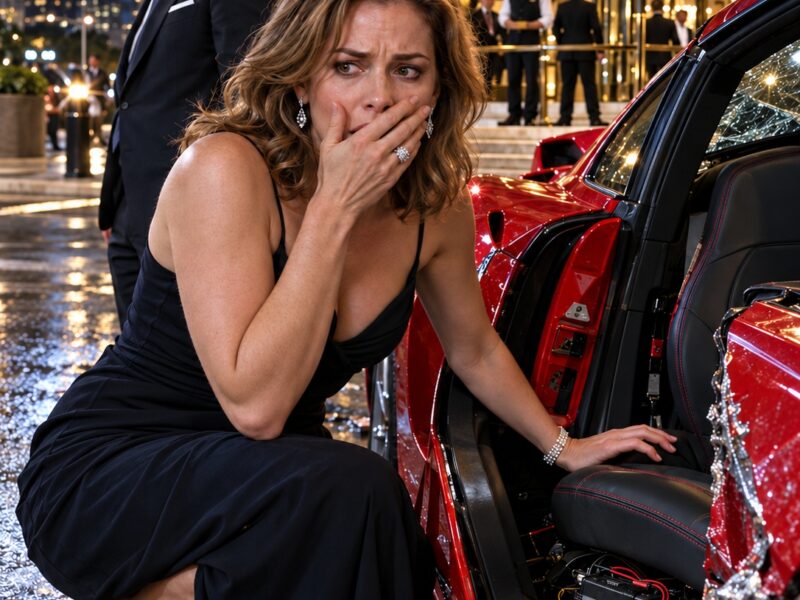
HE CRASHED INTO A BILLIONAIRE’S FERRARI—THEN SHE SAW WHAT WAS HIDDEN BENEATH HER SEAT
Nolan Pierce had less than six seconds to decide whether to destroy a stranger’s Ferrari or watch her die.
He chose the Ferrari.
The red car had barely cleared the underground parking structure when Nolan slammed his battered pickup into its passenger side at nineteen miles an hour.
Metal folded.
Glass exploded.
The Ferrari spun sideways across the exit lane and stopped ten feet short of the Chicago sidewalk.
For one second, everything went silent.
Then the driver’s door flew open.
Vivien Lockwood stepped into the cold night barefoot, one black heel clutched in her hand, fury burning through the shock on her face.
“What the hell is wrong with you?”
Nolan didn’t answer.
She stared at the crushed side of the car.
“Do you have any idea what you just hit?”
Still nothing.
Vivien looked at him then, really looked at him.
Forty-three. Work jacket. Grease beneath his fingernails. Blood at his temple from where his head had struck the steering wheel. The kind of man nobody at her company gala upstairs would have noticed unless something needed fixing.
His eyes weren’t on her.
They were fixed on the floor beneath her driver’s seat.
Nolan opened his door slowly.
“Don’t move toward the car.”
Vivien laughed once in disbelief.
“You just drove a pickup into me.”
“I know.”
“You could have killed me.”
“I know.”
“Then what are you looking at?”
Nolan pointed.
The collision had twisted one of the seat rails and pulled back the edge of the carpet.
Something black had fallen partly into view.
Flat.
Rectangular.
Industrial tape ran across one side of it.
A thin wire disappeared beneath the center console.
Vivien’s anger vanished so quickly it was almost frightening.
“What is that?”
Nolan’s voice dropped.
“I don’t know.”
That was the first lie he told her.
He knew enough.
And sometimes enough was worse.
“Walk away from the car,” he said.
Vivien didn’t move.
“Now.”
Something in his voice finally reached her.
She stepped backward.
Once.
Twice.
Then her phone buzzed on the cracked leather seat.
The screen illuminated.
No sender.
No number.
Only one sentence.
Next time, he won’t reach you in time.
Vivien read it twice.
Then she looked at Nolan.
“What’s your name?”
Before he could answer, the hotel doors burst open.
Three men came running.
The first was Preston Carle, head of executive protection for Lockwood Technologies.
And the moment Nolan saw him, he understood something that would take Vivien another twenty-four hours to learn.
The bomb beneath her seat was only the beginning.
Three hours earlier, Vivien Lockwood had been standing beneath three chandeliers listening to fourteen wealthy people explain why the truth needed better timing.
At thirty-eight, Vivien was CEO of Lockwood Technologies, the industrial engineering company her father had built from a rented warehouse into an empire.
The ballroom was filled with investors, directors, lawyers, champagne, and the particular kind of laughter people used when millions of dollars were nearby.
Vivien had barely touched her wine.
“At nine tomorrow morning,” she told the board, “the internal vendor audit goes to outside counsel.”
Silence followed.
Graham Kingsley sat near the center of the table.
Silver-haired. Fifty-nine. Immaculate.
He had been Alexander Lockwood’s closest business partner for twenty-two years.
After Alexander died, Graham had become something else.
Advisor.
Protector.
Surrogate father.
The steady hand beside Vivien when she inherited a company she had never expected to run so soon.
One director cleared his throat.
“Vivien, nobody is suggesting the audit disappear.”
“Good.”
“We’re suggesting you delay publication until the quarter closes.”
“That is a delay.”
“Three weeks.”
“A convenient three weeks.”
Graham raised a calming hand.
“Your father used to say timing is part of judgment.”
Vivien looked at him.
“My father also used to say if someone tells you the truth can wait, ask what they plan to do while it’s waiting.”
A few eyes dropped toward the table.
Graham smiled.
Not offended.
Almost proud.
“You sound like him.”
Vivien wished the compliment still felt good.
The audit had started as routine accounting.
Then her team found vendors whose work could not be verified.
Consultancies billing for engineering projects nobody remembered commissioning.
Payments split across entities that seemed designed to make simple questions expensive.
Nine years of them.
Tomorrow morning, those questions were leaving the building.
Vivien pushed back her chair.
“The audit goes out at nine.”
She left before dessert.
Seventy feet below her, Nolan Pierce was filling out paperwork beside a dead sedan.
He owned Pierce Auto Recovery on Chicago’s west side.
Two trucks.
One employee.
A failing coffee machine.
And a daughter named Tessa who was twenty and away at school.
He had been inside the service corridor eleven minutes when a valet emerged from the roped-off executive parking section.
Nolan barely saw his face.
It was the movement that bothered him.
The man removed his name badge without slowing down.
Slipped it inside his jacket.
Passed through an employee door.
Not running.
Not walking.
Moving at the exact speed of someone trying not to look like he was in a hurry.
Nolan watched the door close.
There are instincts people develop because of what they do for a living.
Firefighters notice exits.
Nurses notice breathing.
Mechanics hear sounds other people dismiss.
For eleven years, Nolan had reconstructed crashes for the state.
He could look at a broken suspension arm and tell which wheel failed first.
He could stand beside eighty feet of skid marks and know whether the driver had panicked.
He had spent enough nights studying the final seconds of strangers’ lives to understand one uncomfortable truth:
Disaster almost always announces itself.
People simply don’t recognize the language until afterward.
Nolan walked toward security.
A young officer sat beside the freight elevator.
“Guy just came out of the executive row,” Nolan said. “Valet uniform. Took off his badge before he went through that door.”
The officer glanced up.
“You a guest?”
“Contractor.”
“Executive parking has its own detail.”
“He took his identification off.”
“I heard you.”
The officer returned to his monitor.
Nolan stood there another second.
Then walked toward the roped-off section himself.
He made it fourteen steps.
“Sir.”
Nolan stopped.
Preston Carle approached from the opposite corridor.
Forty-six. Gray suit. Athletic. Controlled.
The kind of man who didn’t need to raise his voice because people were already trained to listen.
“This area is closed.”
Nolan explained what he had seen.
Carle listened without interrupting.
“I’ll look into it.”
“You might want to do that now.”
“I said I’ll look into it.”
Something about the answer bothered Nolan.
Not hostility.
Not defensiveness.
Nothing he could name.
Which was why he obeyed.
He returned to his pickup.
His hand had just reached the ignition when the Ferrari came up the ramp.
He saw Vivien for the first time through the windshield.
But it wasn’t her face that caught him.
It was the seat.
Too far forward.
The driver was tall enough that the position made no sense.
Then Nolan noticed the broken memory setting.
Somebody had moved the seat manually.
And failed to restore it.
The nameless valet.
The executive row.
The removed badge.
The moved seat.
Pieces came together inside Nolan’s head.
The Ferrari turned toward the avenue.
Four seconds.
Maybe six.
No time to explain.
No time to prove anything.
No time even to know whether he was right.
Nolan started his truck.
And hit her.
The technical unit worked on the Ferrari until nearly four in the morning.
What they eventually removed from beneath Vivien’s seat was a compact explosive device connected to a motion-trigger system and delayed activation mechanism.
It had not been designed to explode inside the garage.
Too many cameras.
Too much structure.
Too much evidence.
It had been designed for speed.
If Vivien had reached the avenue and accelerated, investigators estimated she would have died within several blocks.
The crash had saved her.
That should have made Nolan Pierce the hero of the night.
For roughly an hour, it did.
Then Preston Carle changed the story.
Not dramatically.
Quietly.
That made it worse.
At 1:20 a.m., he produced security footage.
Nolan walking through the service corridor.
Nolan approaching within several feet of the Ferrari.
Nolan stopping.
Looking at it.
The recovery call that had brought him to the hotel had been booked that afternoon by a customer police had not yet located.
Carle never accused him.
He simply presented facts.
Then somebody searched Nolan’s history.
And the entire room shifted.
Nine years earlier, Alexander Lockwood had died alone on a rural highway sixty miles south of Chicago.
Dry pavement.
No traffic.
A new vehicle.
No meaningful skid marks.
The official finding was loss of control.
Accidental death.
One investigator refused to sign it.
Nolan Pierce.
His supplemental report argued that the electronic steering system showed abnormalities inconsistent with ordinary collision damage.
There were tool marks where there should not have been tool marks.
Nolan requested a second teardown.
Before the request was approved, Alexander’s vehicle was released.
Then scrapped.
The supplemental report disappeared from the final file.
Nolan fought for four months.
He was transferred to records.
He resigned the following spring.
Suddenly the man who had saved Alexander Lockwood’s daughter looked less like a random tow-truck driver.
He looked like a man who had spent nine years obsessed with her family.
Graham Kingsley arrived before two.
He embraced Vivien.
“You’re alive. Nothing else matters tonight.”
But when someone said Nolan’s name, something changed in Graham’s eyes.
Tiny.
Gone almost immediately.
“He’s been circling this family for years,” Graham said.
Vivien looked through the glass.
Nolan sat beneath fluorescent lights with his hands on his knees.
She remembered the crash.
He had looked beneath her seat before he looked at her.
If he had planted the bomb, why would he destroy his own plan?
Unless saving her had always been the plan.
Create the danger.
Create the rescue.
Force the Lockwoods to reopen Alexander’s death.
Both explanations worked.
That was the problem.
Police took Nolan for a formal interview.
As they walked him past Vivien, he stopped.
“If I wanted you dead,” he said quietly, “I only had to let you drive away.”
Then he left.
Vivien stood there long after the door closed.
Because she hated that his sentence made sense.
Detective Mara Bennett hated convenient evidence.
Eighteen years on the job had taught her that evidence could be clean because someone was innocent.
Or because someone had cleaned it.
The electronic credential used by the false valet belonged to Pierce Auto Recovery.
Mara put the record in front of Nolan at six in the morning.
He stared at it.
“That card disappeared three weeks ago.”
“Convenient.”
“Extremely.”
“You reported it?”
“To the access vendor. Asked them to deactivate it.”
“Why didn’t you report it stolen?”
“Because I thought a temporary driver took it. He stole two impact wrenches last year. Compared to those, a plastic card didn’t feel urgent.”
Mara studied him.
“You understand how bad this sounds?”
“Yes.”
“You don’t seem worried.”
“I drove my truck into a Ferrari belonging to a woman whose father’s death destroyed my career. Somebody used my missing access card to plant a bomb beneath her seat. Worried stopped being useful around midnight.”
Mara almost smiled.
Almost.
Then she checked.
At 8:51 p.m., Nolan’s credential had entered the hotel.
At 8:49, a traffic camera recorded his pickup two and a half miles away.
At 8:53, a gas station camera captured Nolan paying at the counter.
He could not have used the credential.
Someone had stolen it three weeks earlier.
Not for access.
For attribution.
Nolan wasn’t merely being framed after the fact.
He had been selected in advance.
At 11:07 that morning, Vivien Lockwood entered her private archive.
She found her father’s death file.
She had read it once, years earlier, in a Denver hotel room.
She had never noticed the final index page.
One supplemental submission was listed but missing.
Investigator: Nolan Pierce.
Summary:
Insufficient basis to conclude event was accidental.
Vivien stared at the sentence.
Someone had decided she would never read what came after it.
By noon, Nolan was standing in her office.
She did not offer coffee.
He did not take the chair.
“Tell me what you found.”
Nolan looked at her.
“Do you want the short version or the version nobody wanted nine years ago?”
“The second one.”
He told her about the steering module.
Fresh tool marks.
A component opened on a nearly new vehicle.
A failure signature that did not match crash damage.
He had requested a teardown.
“Who stopped it?”
“I was told the family wanted the vehicle released.”
“My family?”
“That’s what I was told.”
“By whom?”
“Counsel.”
He gave her the attorney’s name.
Vivien went still.
That attorney had never represented the Lockwood family.
He had represented Graham Kingsley.
For twenty years.
Vivien dismissed Nolan without revealing what the name meant.
After he left, she stood at the window overlooking Chicago.
She still didn’t believe Nolan.
Not completely.
But for the first time since she was twenty-nine, she stopped automatically believing Graham Kingsley.
Sometimes betrayal doesn’t begin with proof.
Sometimes it begins with the first person you realize you no longer trust without proof.
At four that afternoon, Preston Carle announced that a secure location outside Chicago had been prepared.
Armored sedan.
Sanitized route.
Four people with access to the plan.
Nolan happened to be nearby collecting property taken during questioning.
He saw the sedan.
Stopped.
“Don’t get in.”
Vivien turned.
Her patience broke.
“I have spent twenty-four hours defending the possibility that you are not insane.”
“I appreciate that.”
“You are a tow-truck driver.”
“Yes.”
“Preston runs executive security for a multinational corporation.”
“Yes.”
“And now you’re telling me not to get into the vehicle he prepared because… what? You looked at it?”
“No.”
Carle motioned toward two security officers.
“Escort Mr. Pierce out.”
Nolan let them take his arms.
Then said, “How many people know the route?”
Carle’s expression hardened.
“Four.”
Nolan looked at Vivien.
“At 2:20 this afternoon, your phone received a traffic warning.”
She froze.
“A lane closure on State Highway 41,” Nolan continued. “Forty miles north.”
Carle stepped forward.
“That means nothing.”
“Then why does her evacuation route use that highway?”
Nobody answered.
Vivien ordered the route displayed.
Eleven miles along the exact highway mentioned in the anonymous alert.
She changed the plan.
Carle objected.
She ignored him.
Mara selected two officers.
Vivien left from another level in an unmarked vehicle.
The original convoy ran empty as a decoy.
Forty minutes later, it encountered an unauthorized checkpoint.
Three men.
High-visibility vests.
A truck carrying stolen plates.
They disappeared into the trees before police arrived.
Vivien stared at the photographs afterward.
Someone inside her protection structure knew where she was going.
Carle quickly blamed a junior logistics coordinator.
Suspended him.
Called it a vetting failure.
Nolan asked one question.
“Who selected the route?”
Carle answered with corporate language.
Collaborative process.
Threat assessments.
Multiple sources.
Vivien heard every meaningless word.
And something inside her changed.
Until then, she had believed she was being protected.
Now she understood she was being managed.
So Vivien Lockwood disappeared from her own security system.
No company phone.
No driver.
No penthouse.
No corporate vehicle.
Mara gave her a prepaid handset.
Nolan gave her the passenger seat of a fifteen-year-old pickup.
And that night, one of the richest women in Chicago vanished into a garage on the west side.
Pierce Auto Recovery smelled like cold metal, rubber, and coffee that had been sitting too long.
Vivien sat on an overturned milk crate wearing a four-thousand-dollar dress.
Nolan handed her a paper cup.
She tasted it.
“This is terrible.”
“It’s free.”
“I understand why.”
He almost smiled.
For the first time in years, Vivien was in a room where nobody needed anything from her last name.
At nine, Nolan’s phone rang.
Tessa.
He moved toward the roll-up door.
“Stay at school.”
A pause.
“No. Don’t come home this weekend.”
Another pause.
“Tess.”
Longer this time.
Then Nolan laughed once.
Tired.
When he returned, Vivien asked, “What did she say?”
“She asked if this was the kind of thing that makes me forget I don’t wear a badge anymore.”
That sentence told Vivien more about Nolan than his file had.
He eventually told her his wife died when Tessa was eight.
That he had raised his daughter alone.
That resigning from the state cost him his pension, insurance, and career.
He bought a used tow truck on credit.
Took overnight calls because they paid forty dollars extra.
Vivien had grown up watching her father buy buildings.
Nolan had kept a child fed with a tow hook and a telephone.
And for nine years, he had never sold his story.
Never called reporters.
Never sued the Lockwoods.
Never turned Alexander’s death into a grievance profitable enough to justify the word obsession.
Finally, Nolan crossed the garage.
Unlocked a steel cabinet.
Removed an old manila envelope.
“My copy.”
Vivien knew before he opened it.
The missing report.
Inside were photographs.
Alexander’s wrecked vehicle.
Tall grass.
Emergency lights.
A dead man’s final geography frozen in still images.
Vivien forced herself to look.
The third photograph stopped her.
A man stood across the road.
Dark jacket.
Watching.
The image was grainy.
But Vivien knew that face.
“No.”
Nolan said nothing.
“No.”
She brought the photograph beneath the work light.
Nine years younger.
Same jaw.
Same posture.
Same stillness.
Preston Carle.
“That’s impossible.”
“Why?”
“He joined Lockwood fourteen months after my father died.”
Nolan watched her carefully.
“He told me he never met my father.”
“Then he lied.”
Vivien looked back at the photograph.
Carle had been eighty yards from Alexander Lockwood’s body.
Not grieving.
Not helping.
Watching.
Nolan showed her his original field notebook.
Carle had presented credentials from a private risk consultancy.
The firm dissolved five months after Alexander died.
Vivien took the garage computer.
Three hours later, she found the consultancy buried inside old financial records.
Not directly paid by Lockwood Technologies.
Paid through an investment fund.
Two intermediaries.
One managing partner.
Graham Kingsley.
The largest payment cleared eleven days after Alexander’s funeral.
Vivien placed both palms against the workbench.
Her father’s closest friend had funded the company that employed the man photographed beside her father’s wreck.
Nolan broke the silence.
“This isn’t enough.”
She looked at him.
“What?”
“It proves a relationship. It doesn’t prove murder.”
“He lied.”
“Rich men survive lies.”
“He paid them.”
“Rich men survive payments.”
“My father is dead.”
“And if you walk into Kingsley’s office tomorrow accusing him with this, he’ll survive that too.”
Vivien hated him for being right.
“What do you suggest?”
Nolan leaned against the workbench.
“We let him think you believe him.”
At 11:40 p.m., Vivien called Graham.
Her shoes were off.
Cold concrete beneath her feet.
Nolan stood twenty feet away.
She made her voice tremble.
“I was wrong.”
Graham went quiet.
“Vivien?”
“Pierce got into my head.”
She closed her eyes.
“He wanted me thinking about Dad. I let him. God, Graham, I actually let myself wonder whether…”
She allowed the sentence to die.
Graham’s voice softened.
“You’ve been through trauma.”
“I’m sorry.”
“You have nothing to apologize for.”
“I want to come back.”
His relief came too quickly.
He requested an emergency board meeting at eight.
Then he asked that all investigative materials be transferred to Preston Carle beforehand.
Vivien agreed.
When the call ended, she lowered the phone.
Nolan looked at her.
“He picked the location for us.”
They spent the rest of the night building a lie.
The next morning, security footage of Nolan crashing into Vivien’s Ferrari appeared on every business channel.
Eleven seconds.
No bomb.
No technicians.
No threatening message.
Just a working-class man driving an old pickup into a billionaire CEO’s supercar.
The headline wrote itself.
By eight, Nolan Pierce had become the villain.
That was exactly what they needed.
Graham opened the board meeting beautifully.
He praised Vivien’s courage.
Then destroyed Nolan’s reputation.
Former investigator.
Disputed report.
Resignation.
Failing garage.
Nine-year fixation on Alexander Lockwood.
Graham used the word obsession four times.
Then played another video.
Nolan standing beside the Ferrari before the attack.
His hand outside camera view.
“What was he doing?” a director asked.
Graham sighed.
“That is precisely what concerns me.”
Then he proposed that Preston Carle assume control of the investigation.
And that Vivien take temporary medical leave.
Fourteen faces turned toward her.
Through the glass wall, Vivien could see Nolan in the corridor.
Two security officers stood beside him.
She rose.
Looked at him.
“Remove Mr. Pierce from this building.”
Nolan’s expression changed.
“Vivien.”
“Now.”
“You read the report.”
“Get him out.”
He let the guards take him.
“You know what you saw.”
She turned away.
The elevator doors closed.
Graham relaxed.
And every second of it had been theater.
Carle’s men took Nolan down through the service elevator.
Exactly as planned.
At the loading level, Nolan slipped away while his escorts argued about paperwork.
Two corridors east, he found an internal security room.
The door stood open.
A shredder was still warm.
Eleven drive slots were empty.
Someone was destroying evidence.
Nolan removed the final drive.
Behind him, the door clicked shut.
Preston Carle stood there.
Neither man spoke for several seconds.
Then Carle said:
“You should have let the Ferrari leave.”
Nine years of uncertainty ended in one sentence.
Carle lunged for the drive.
There was no gunfight.
No cinematic fistfight.
Only two middle-aged men fighting with the ugly efficiency of people who understood consequences.
A shoulder hit a fire door.
A cart overturned.
Nolan ran.
Carle chased him into the parking deck.
The gate began dropping.
Nolan dove beneath it with the drive inside his jacket.
Carle reached the pedestrian exit.
And vanished.
The drive changed everything.
It contained procurement records for the explosive components.
Surveillance of Vivien.
The stolen Pierce Auto Recovery credential.
False traffic alerts.
Route manipulation.
But the earliest entries were seven months old.
Vivien stared at the timestamps.
“My audit started three months ago.”
Mara nodded.
“This wasn’t because of your audit.”
Nolan understood first.
“The audit accelerated it.”
Someone had decided Vivien needed to disappear before she threatened anyone.
Then they found another folder.
Nine years old.
A. LOCKWOOD — CONTINGENCY.
Vivien stopped breathing.
Inside was the truth her entire adult life had been built to avoid.
Before Alexander Lockwood died, he had discovered a network of shell vendors draining money from his company.
He had traced the structure toward Graham Kingsley.
Alexander drafted a resolution removing Graham from the board.
He intended to refer the evidence to prosecutors.
The meeting was scheduled for June.
Alexander died in April.
Dry road.
No traffic.
No skid marks.
After his death, Graham stayed.
More than stayed.
He became indispensable.
He comforted Vivien at the funeral.
Advised her through succession.
Protected her from hostile directors.
Taught her how to negotiate.
Sat beside her every year on the anniversary of her father’s death.
Vivien had believed Graham preserved Alexander’s legacy.
Now she understood.
He had been living inside it.
Her audit had accidentally discovered the same vendor structure her father found nine years earlier.
History was repeating.
And Graham had prepared for the daughter the way he had prepared for the father.
Nolan’s role became clear too.
He had not wandered into the plot.
He had been chosen.
He was the only investigator who refused to call Alexander’s death accidental.
The perfect obsession.
The perfect grievance.
The perfect villain.
Steal his credential.
Book a fake recovery job.
Place him near Vivien.
Kill her.
Then give police the man who had supposedly hated the Lockwoods for nine years.
Two problems.
One grave.
Vivien looked at Nolan.
“You weren’t supposed to save me.”
“No.”
“You were supposed to take the blame.”
“Yes.”
For the first time since the Ferrari crash, Nolan looked afraid.
Not for himself.
For what came next.
Because men who spend nine years building a secret rarely surrender when someone finally opens the door.
At 10:04 the next morning, Vivien’s prepaid phone rang.
Nobody outside their small circle had the number.
She answered.
Graham Kingsley said, “I found something your father left behind.”
Vivien looked at Nolan.
“Where?”
“The old headquarters.”
The abandoned executive garage beneath Lockwood’s original south-side building.
“I think you should see it yourself.”
The line went dead.
Nolan understood immediately.
“He knows about the drive.”
Mara wanted time.
Vivien knew they had none.
“If I don’t go, he chooses the next place.”
Nolan looked at her.
“And if you do?”
“At least this time we choose what he doesn’t know.”
The old Lockwood headquarters had been empty six years.
Forty ceiling fixtures.
Only six still worked.
Vivien walked into the garage alone.
A transmitter rested in her palm.
A wire ran beneath her blouse.
Mara’s team waited four blocks away.
Graham stood beside a concrete column.
No folder.
Nothing from Alexander.
“You lied,” Vivien said.
“So did you.”
The paternal warmth was gone.
For the first time in her life, she saw him without the costume.
“You killed my father.”
Graham tilted his head.
“Your father believed companies were moral projects.”
“That isn’t an answer.”
“He believed doing the right thing and doing the sustainable thing were the same.”
“Did you kill him?”
“Alexander was a romantic.”
Graham stepped closer.
“Romantics build beautiful things, Vivien. Then they hand them to people willing to keep those things alive.”
“You mean people like you.”
“I mean adults.”
He never confessed directly.
He didn’t need to.
He spoke about the June board resolution.
The attorney.
The consultancy.
The vendors.
Facts only someone inside the conspiracy could know.
Then he removed two pages from his coat.
Temporary transfer of operational authority to the chairman.
“Sign.”
Vivien looked at the document.
“You tried to kill me.”
“I tried to preserve something your father nearly destroyed.”
“My father built it.”
“And I kept it.”
Graham offered her a pen.
“After what happened to you, no reasonable board will question a temporary leave. Sign this. Walk away. Live.”
Vivien almost laughed.
“You spent nine years teaching me never to sign anything under pressure.”
Something flickered across Graham’s face.
“Your father would want you protected.”
“No.”
Vivien pushed the papers back.
“My father wanted you removed.”
Footsteps sounded from the dark ramp.
Preston Carle emerged.
Vivien’s stomach tightened.
He hadn’t fled Chicago.
He had been waiting.
Nine years earlier, he had stood beside Alexander’s wreck.
Tonight, he stood beside Graham.
Same job.
Different Lockwood.
Graham’s voice became almost gentle.
“Don’t make this harder.”
Vivien tightened her hand around the transmitter.
Then another door opened.
Nolan Pierce walked into the garage.
The drive was in his hand.
Graham stared at him.
For the first time, his composure cracked.
“You were only supposed to be a name in a news cycle.”
Nolan stopped.
“You picked the wrong man to hang it on.”
Carle moved first.
Toward Nolan.
Graham moved toward Vivien.
She pressed the transmitter.
Three doors opened at once.
Mara Bennett came through the center entrance with officers behind her.
Carle made it as far as the exit gate.
Two officers slammed him against a parked van.
Graham did not run.
Men like Graham rarely imagine themselves running.
They imagine negotiations.
He straightened his cuffs.
“This is an extraordinary mistake.”
Mara approached.
“My counsel will be in contact within the hour.”
“I’m sure.”
“I’ve survived investigations conducted by better people than you.”
Vivien stepped forward.
“There’s something you should know.”
Graham looked at her.
“Everything you said since I walked in went out live.”
For the first time, silence frightened him.
“Not only to police,” Vivien continued. “Four independent directors heard it. So did outside counsel.”
Graham’s eyes changed.
Vivien watched him calculate.
The board.
The lawyers.
The drive.
Carle.
The recordings.
Every exit closing simultaneously.
For forty years, Graham Kingsley had survived because there was always another person to influence.
Another record to bury.
Another institution to enter before the truth did.
Not this time.
They walked him through the lobby of the first building Alexander Lockwood had ever owned.
Past the empty reception desk.
Past the terrazzo floor.
Past the doors he had entered like a king for twenty years.
He left between two officers whose names he had never bothered to learn.
Vivien watched until he disappeared.
She expected triumph.
Instead she felt grief.
Because betrayal by an enemy steals your safety.
Betrayal by someone you loved steals your memories too.
Suddenly every Christmas dinner had another meaning.
Every piece of advice.
Every hand on her shoulder.
Every time Graham had told her Alexander would be proud.
She would spend years wondering which moments had been real.
Maybe none.
Maybe some.
That uncertainty was the punishment Graham left behind.
The following weeks were quieter.
And more permanent.
Graham Kingsley and Preston Carle faced criminal and financial proceedings.
The shell-vendor network collapsed.
Eleven other names surfaced.
Alexander Lockwood’s death investigation was reopened.
This time Nolan Pierce’s supplemental report was placed exactly where it had always belonged.
Inside the file.
The public story changed too.
Vivien stood before reporters.
Cameras flashed.
“The man many of you called the Ferrari attacker saved my life,” she said. “He did so at considerable personal cost. For two days, I allowed evidence designed by other people to make me doubt what he had done.”
A reporter shouted a question.
Vivien ignored it.
“Nolan Pierce told the truth nine years ago when powerful people found that truth inconvenient. I will not participate in making that mistake twice.”
Nolan watched from the back.
He hated every second of being recognized.
Vivien later offered him a job.
Head of risk and security.
A salary large enough that he made her repeat it.
A team.
An office.
A budget.
Nolan said no.
Vivien stared at him.
“Most people negotiate before rejecting me.”
“I already spent eleven years being the honest man inside somebody else’s institution.”
“You’d run the institution.”
“Still somebody else’s.”
“So what do you want?”
Nolan thought about it.
“Independence.”
Pierce Auto Recovery became an outside security consultant to Lockwood Technologies.
On terms Nolan wrote.
Including one clause Vivien admired enough to keep permanently:
No finding produced by Pierce Auto Recovery could be edited, delayed, or suppressed before reaching the independent board.
When Tessa heard the value of the contract, she called her father.
“So let me understand this. You destroyed a Ferrari and somehow got rich?”
“I’m not rich.”
“You’re charging Lockwood Technologies more per month than you made in half a year.”
“That isn’t rich.”
“That sentence is exactly how I know you’re getting rich.”
Nolan smiled.
For the first time in a long time, the future felt ordinary.
He had missed ordinary.
October came gray and cold.
Vivien returned to the garage one afternoon without a driver.
Her clothes were simpler now.
No security detail visible.
No four-thousand-dollar dress.
The Ferrari remained beneath a tarp in the corner.
Evidence.
Still crushed where Nolan’s pickup had struck it.
Vivien lifted the tarp.
Looked at the folded metal.
“You know,” she said, “you still owe me a car.”
Nolan continued wiping his hands.
“I saved the driver.”
“You destroyed the vehicle.”
“Vehicle wasn’t part of the arrangement.”
“There was no arrangement.”
“Exactly. So I’m not liable.”
She stared at him.
Then laughed.
Not the controlled laugh she used at dinners.
A real one.
The sound surprised both of them.
Vivien reached into her coat pocket.
Placed a key on his workbench.
Nolan looked down.
His pickup key.
His truck had disappeared from impound three weeks earlier.
Now it was parked outside.
Straight frame.
Rebuilt front end.
New windshield.
Same scratches along the doors.
And 290,000 miles still showing on the odometer.
He looked at Vivien.
“You fixed my truck?”
“I replaced what you broke saving my life.”
“You could’ve bought me another one.”
“I suggested that.”
“And?”
“They told me this one was economically irrational to repair.”
Nolan nodded.
“They’re correct.”
“I know.”
“Then why repair it?”
Vivien glanced toward the truck.
“Because not everything worth saving makes financial sense.”
For a moment, neither spoke.
Nolan understood she wasn’t talking about the pickup.
Maybe she was talking about her father.
Maybe her company.
Maybe the parts of herself she had nearly surrendered to people who insisted survival required compromise.
Or maybe she meant an old truck with too many miles.
Some things were better left unanswered.
Vivien headed toward the door.
“Nolan.”
“Yeah?”
“Next time you decide to save my life, try calling first.”
He leaned against the workbench.
“Next time answer your phone.”
She smiled.
Then stepped outside.
The repaired pickup waited beneath the gray Chicago sky.
Behind Nolan, beneath a dusty tarp, sat the ruined Ferrari that had once looked like the most valuable thing in the room.
It wasn’t.
It never had been.
Nine years earlier, Nolan Pierce had lost his career because he refused to sign his name beneath a lie.
For almost a decade, that decision had looked like failure.
A lost pension.
A small garage.
Two old trucks.
A daughter raised on overtime calls and careful budgets.
Then one cold night, the same stubbornness that had cost him everything made him notice a moved seat.
A missing badge.
A detail everyone else dismissed.
And six seconds later, he drove straight into a Ferrari.
People would remember the crash because crashes are loud.
They would remember the arrests because justice photographs well.
They would remember Graham Kingsley being led from the building he once ruled.
But Vivien remembered something quieter.
A man sitting on the curb after saving her life, hands visible on his knees, while people with cleaner suits constructed reasons not to believe him.
Her father had once trusted the wrong man because that man looked like he belonged beside power.
Vivien had nearly made the opposite mistake for exactly the same reason.
After that, whenever someone entered her office with a perfect résumé, a polished explanation, and absolute certainty, she found herself thinking about a garage on the west side.
About terrible coffee.
About a man with grease beneath his fingernails telling her that evidence did not care who could afford better lawyers.
And sometimes, late at night, she thought about the final hours of her father’s life.
For years, the image had ended with Alexander alone on a dark road.
Now she pictured something else.
She pictured Nolan nine years younger, standing beside a wrecked car and refusing to write the word accident because the metal told him otherwise.
Alexander Lockwood had died without knowing that one stranger had noticed.
Maybe that mattered.
Maybe dignity sometimes survives only because somebody refuses to change one sentence.
And maybe justice does not always arrive looking like justice.
Sometimes it arrives nine years late.
Sometimes it owns a failing garage.
Sometimes it smells like motor oil and old coffee.
And sometimes, when there are only six seconds left and nobody will listen—
it comes driving straight at you in a battered pickup truck.









