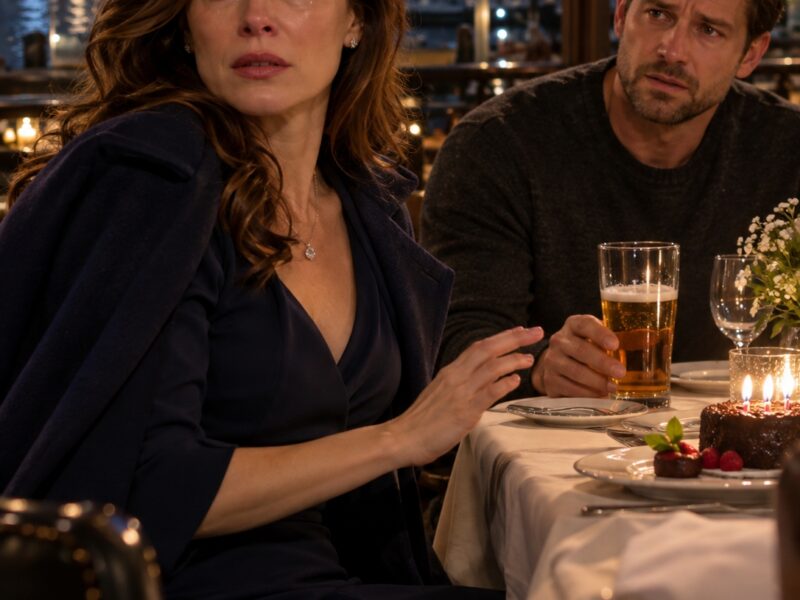
HE DARED ME TO ASK OUT THE MILLIONAIRE CEO—WEEKS LATER, ONE DRUNKEN SENTENCE DESTROYED EVERYTHING

The night Meredith Vale walked out of Tobin Mercer’s restaurant, she didn’t slap me.
She didn’t scream.
She didn’t throw her wine in my face or call me a liar loud enough for everyone in the room to hear.
She simply looked across the candlelit table and asked me one question.
“Was I ever going to find out if Tobin hadn’t said it?”
That was the moment I knew I had lost her.
Not when my best friend drunkenly announced the dare in front of half the restaurant.
Not when Meredith learned that our first conversation had begun because another man had challenged me to ask her out.
Not even when I admitted I had known for weeks that she didn’t know.
It was that question.
Because there was only one honest answer.
And honesty had arrived much too late.
“I don’t know,” I said.
Meredith stared at me.
Around us, people kept eating.
A fork touched a plate.
Someone laughed near the bar.
A waiter walked past carrying three bowls of chowder.
The anniversary candles on Tobin’s cake were still burning.
Everything in the restaurant continued as though the world had not just split open between the two of us.
Meredith slowly folded her napkin.
Then she stood.
“I wish you’d trusted me with the truth before I had something to lose.”
She put on her coat and walked toward the door.
I could have followed her.
Every frightened part of me wanted to.
Instead, I stayed beside the table and watched the woman who had taught me how dangerous hope could be disappear into the November fog.
And all I could think was that four weeks earlier, none of this had existed.
Four weeks earlier, Meredith Vale had been nothing more than a stranger drinking coffee at the next table.
And I had been stupid enough to believe the worst thing that could happen was that she might say no.
I was wrong.
The worst thing that could happen was that she could say yes.
And then trust me.
It began on a wet Friday evening in Portland, Maine.
The Atlantic wind had been pushing mist across the harbor since late afternoon, and by seven, the windows of Tobin’s restaurant were covered in tiny silver beads of rain.
I had spent ten hours at Wickham Boat Repair replacing weather-damaged planks on a thirty-two-foot fishing boat.
My shoulders hurt.
My hands smelled like cedar and marine varnish.
There was sawdust in my hair.
All I wanted was coffee, something hot to eat, and enough energy to drive home to my nine-year-old daughter, Willa.
Tobin Mercer had other plans.
“I dare you to ask her out.”
I kept my eyes on my coffee.
“No.”
“You didn’t even look.”
“I don’t need to.”
“Graham.”
“Tobin.”
“She’s beautiful.”
“So are thunderstorms. I don’t ask those to dinner either.”
He laughed.
Tobin had owned the waterfront restaurant for eleven years and had somehow survived all eleven without developing the ability to lower his voice.
“She’s been sitting alone for twenty minutes.”
“Maybe she enjoys sitting alone.”
“She’s Meredith Vale.”
That made me look.
Two tables away sat a woman in a camel-colored coat, one hand curved around a white coffee cup.
Chestnut hair touched her shoulders.
Her expression was composed in the particular way of people who had spent years learning not to reveal what they were thinking.
I recognized her.
Most people in Portland would have.
Meredith Vale, forty-one, CEO of Vale Maritime Group.
Cargo vessels.
Warehouses.
Shipping contracts.
Hundreds of employees across New England.
Her photograph occasionally appeared in business magazines beside headlines containing words like expansion, acquisition, leadership and growth.
I looked back at Tobin.
“Exactly why I’m not asking her out.”
“You’re thirty-nine, not dead.”
“I have a daughter.”
“That is not a terminal illness.”
“I have a job that starts before sunrise.”
“So?”
“I own two sweaters suitable for public use.”
Tobin leaned closer.
“You used to be charming.”
“I used to sleep eight hours.”
He grinned.
“Worst she can do is say no.”
I should have ignored him.
Instead, I made the mistake of glancing toward Meredith again.
And found her looking directly at me.
Tobin stopped smiling.
Meredith lowered her cup.
“Actually,” she said, “I’d like to hear his answer.”
For one extraordinary second, the restaurant seemed to go silent.
I wanted the floor to open.
Tobin looked delighted.
I stood because apparently humiliation was more dignified when performed vertically.
“Miss Vale, I apologize for my friend.”
Meredith glanced at Tobin.
“I gathered he was your friend. A stranger would probably have better survival instincts.”
Tobin raised both hands.
“I suddenly remembered something important in the kitchen.”
He disappeared.
Coward.
I looked at Meredith.
“You don’t owe anyone an answer because of a ridiculous dare.”
There.
The word had been spoken.
Dare.
Right there.
At the beginning.
I would think about that later.
I would replay it in my head and wonder whether I had technically told her enough.
I hadn’t.
Because Meredith smiled slightly and said, “And if I wanted you to ask?”
That should have been the moment.
I should have said, My idiot friend dared me to ask you out five minutes ago.
Instead, I looked at this powerful, beautiful stranger and saw something I hadn’t expected.
Curiosity.
Not amusement.
Not pity.
Not the detached politeness wealthy people sometimes used with men wearing faded work boots.
She was genuinely waiting.
So I asked.
“Would you like to have coffee with me sometime?”
“Somewhere quieter?”
“Preferably somewhere Tobin isn’t allowed.”
She laughed.
It changed her entire face.
“Saturday. Ten in the morning.”
I blinked.
“This Saturday?”
“Unless you’re planning to become unavailable between now and then.”
“No.”
“Good.”
She stood and buttoned her coat.
At the door, she looked back once.
I gave her a small nod.
She returned it.
Then she disappeared into the mist.
Tobin emerged from the kitchen almost immediately.
“She said yes?”
“Apparently.”
“You realize who she is?”
“Yes.”
“Then why do you look terrified?”
I stared through the rain-streaked window.
“Because I think she meant it.”
What I didn’t know was that Meredith was sitting in the back of her car thinking almost exactly the same thing.
She later told me that men reacted strangely to her name.
Some became nervous.
Some became performative.
Some started talking about investments before learning what kind of coffee she drank.
Others wanted photographs, introductions, opportunities.
I had apologized for embarrassing her.
That difference was small.
But small things would become important between us.
Saturday arrived beneath a pale October sky.
I got to the coffee shop twenty minutes early.
Then spent ten minutes pretending I had not arrived twenty minutes early.
My sweater was dark blue and worn at the elbows.
I had almost bought a new one the previous evening.
Then Willa reminded me she needed winter boots.
The sweater survived another season.
At 10:01, Meredith entered.
No driver.
No assistant.
No executive entourage.
Just Meredith.
“You’re early,” she said.
“So are you.”
“I’m one minute late.”
“I was trying to be polite.”
“You’re doing badly.”
That surprised a laugh out of me.
I pulled out her chair.
She looked at it, then at me.
“Do you always do that?”
“My mother would come back from the dead and hit me with a wooden spoon if I didn’t.”
“Your mother sounds terrifying.”
“She was five foot three.”
“That doesn’t answer my question.”
We ordered coffee and blueberry muffins.
For the first few minutes, Meredith seemed almost watchful.
I understood why only much later.
She was waiting for the questions.
How large is Vale Maritime?
What celebrities do you know?
How much money do you make?
Can you introduce me to someone?
Instead, I looked through the window toward the harbor.
“When was the last time you had a Saturday that belonged entirely to you?”
Meredith stopped moving.
“That’s a strange question.”
“You can refuse.”
“No. I’m trying to remember.”
She stared into her coffee.
“There was a conference in Boston last Saturday. The week before that I flew to Montreal. Before that…”
Her voice faded.
“I honestly don’t know.”
“That sounds exhausting.”
“Most people call it impressive.”
“Those aren’t always the same thing.”
She looked at me differently after that.
We talked for almost two hours.
Not about shipping.
Not about money.
We talked about New England winters.
Terrible roadside diners.
Childhood injuries.
Old radios.
Places we wanted to visit.
She had been to twelve countries.
I had never been farther west than Ohio.
“You’re judging me,” I said.
“I’m fascinated.”
“I went to Cleveland.”
“International man of mystery.”
“You laugh, but I survived airport parking.”
She smiled.
“I visited three countries in one week last year.”
“That sounds better than Cleveland.”
“I don’t remember one sunset.”
That shut me up.
There was something lonely in the way she said it.
Eventually, I knew I needed to tell her the most important thing about me.
“I have a daughter.”
Meredith waited.
“Her name is Willa. She’s nine.”
“All right.”
“She comes first.”
I watched her carefully.
“Always.”
Meredith didn’t hesitate.
“I’d be disappointed if she didn’t.”
I hadn’t expected that.
She noticed.
“What?”
“Nothing.”
“That was definitely something.”
“My last attempt at dating didn’t survive that sentence.”
“Then it probably saved both of you time.”
I smiled.
Meredith leaned back.
“I should probably warn you about me too.”
“Secret criminal history?”
“Worse. Corporate calendar.”
I laughed.
“My work is unpredictable,” she continued. “I cancel plans. I answer calls at terrible hours. I travel with almost no notice. I’m not particularly good at slowing down.”
“Then I guess we both come with scheduling problems.”
For the first time, neither of us laughed immediately.
Something had shifted.
Something small.
Something dangerous.
At the door, I helped her into her coat.
I wanted to ask when I could see her again.
I didn’t.
Instead I said, “You never finished the story about your grandmother’s radio.”
Meredith looked at me.
“You remembered that?”
“Of course.”
“If you want the ending, you may have to buy me another coffee.”
“I think I can afford coffee.”
“Careful. Portland prices.”
Then she left.
That evening, I was helping Willa organize her schoolbooks when my phone lit up.
Meredith.
I think we forgot to finish our conversation.
I read it three times.
Willa looked across the kitchen table.
“Why are you smiling?”
“I’m not.”
“You are.”
“Finish your math.”
“You’re definitely smiling.”
I turned the phone facedown.
She narrowed her eyes.
Nine-year-old girls miss nothing.
Over the next two weeks, Meredith became part of my ordinary life before I realized it was happening.
I sent her photographs of Casco Bay at sunrise.
She sent me photographs of ridiculous things she noticed between meetings.
A crooked painting.
A flower growing beside a parking garage.
A coffee cup on which someone had spelled Meredith as “Maredeth.”
I laughed for five minutes.
She called during lunch.
I called after Willa went to bed.
Sometimes we spoke for ten minutes.
Sometimes forty.
Once we spent half an hour arguing about whether pineapple belonged on pizza.
She was wrong.
She remained wrong.
Nothing about those conversations should have mattered.
That was why they mattered so much.
For four years, my life had been built around necessity.
Wake Willa.
Pack lunch.
Work.
School pickup.
Bills.
Laundry.
Dinner.
Homework.
Repeat.
I didn’t resent it.
After my wife died, routine had saved us.
Willa had been five.
Too young to understand why Mommy went into a hospital and never came home.
I had learned to braid hair badly.
Learned which stuffed animal had to be beside her pillow.
Learned that grief in children could arrive during breakfast because a cereal commercial reminded them of someone.
I stopped imagining a future beyond keeping us both standing.
Then Meredith appeared.
And suddenly there were messages I looked forward to.
Questions nobody had asked me in years.
What did you want before life changed?
One afternoon she called while I was sanding the railing of a fishing boat.
“Did you always want to repair boats?”
“I wanted to build them.”
“What happened?”
I looked across my workshop.
The building had belonged to my father.
There had once been plans.
Expansion.
Three employees.
Custom builds.
Maybe a second location.
“Life changed.”
“Willa?”
“Mostly.”
“Do you regret it?”
I thought about that.
“Sometimes I wonder what would’ve happened.”
“That sounds like regret.”
“No. Wondering and regretting aren’t the same thing.”
Meredith was silent.
“Willa only gets one childhood,” I said. “I can build boats when she’s older.”
“What if the opportunity is gone?”
“Then it’s gone.”
“You say that very easily.”
“No. I decided it very painfully.”
She didn’t answer for several seconds.
Later, she told me that conversation stayed with her.
Meredith had spent her adult life believing ambition meant moving.
More contracts.
More employees.
More cities.
More revenue.
Forward.
Always forward.
I had accidentally shown her another kind.
Sometimes ambition was knowing what you refused to sacrifice.
Our next date never happened.
Not the way we planned.
I had just locked the workshop when Willa’s school called.
The secretary told me she was crying in the office after receiving a poor grade on a science presentation.
I turned toward Meredith.
“I’m sorry.”
“What happened?”
“Willa.”
That was all I needed to say.
“Go.”
“We had plans.”
“Graham.”
She touched my sleeve.
“Go be her father.”
Then she surprised me.
“Would it help if I bought a new model? I remember building a solar system when I was a kid. I could have supplies delivered.”
The offer was generous.
But I shook my head.
“She needs to figure out what went wrong.”
Meredith looked confused.
“I can help her practice,” I explained. “I can’t do the learning for her.”
Something changed in Meredith’s expression.
“Of course.”
That evening, I found Willa staring at a cardboard Saturn with a crooked ring.
“Everybody else’s looked better.”
“Were you supposed to make the prettiest planets?”
“No.”
“What were you supposed to do?”
“Explain them.”
“Can you explain them?”
Her lower lip trembled.
“Not very well.”
I sat beside her.
“Then that sounds like the problem we fix.”
We spent an hour learning about storms on Jupiter.
Three days later, Willa presented again.
Not perfectly.
But better.
The following weekend, I took her to a community stargazing event.
Meredith met us there.
That was the first time she met my daughter.
I was more nervous about that than our first date.
Meredith handled it perfectly.
She didn’t force affection.
Didn’t arrive carrying expensive gifts.
Didn’t try to impress Willa.
She simply said hello.
Willa stared at her.
“Daddy says you run a big company.”
I nearly choked on my hot chocolate.
Meredith smiled.
“I do.”
“How many people?”
Meredith gave her an approximate number.
Willa thought about it.
Then asked the question that would haunt Meredith for days.
“Do you remember all their names?”
Meredith opened her mouth.
Closed it.
“No,” she finally said.
Willa nodded.
Then ran toward a telescope.
Meredith watched her go.
“That child is terrifying.”
“She gets it from my mother.”
“She asks difficult questions.”
“She asks honest ones.”
Meredith looked at me.
Under the cold Maine sky, with children running between telescopes and volunteers pointing toward distant planets, something softened between us.
I wanted to kiss her.
I didn’t.
Instead I handed her hot chocolate.
She smiled.
That was enough.
For the moment.
But while Meredith and I were moving closer, the secret I had dismissed as meaningless was changing shape.
Tobin noticed first.
He came to my workshop one rainy afternoon.
“How’s Portland’s strangest romance?”
“It isn’t a romance.”
“You’re smiling.”
“I smile.”
“Not like that.”
I kept working.
He leaned against the bench.
“I still can’t believe that dare worked.”
My hand stopped.
“Don’t call it that.”
“What?”
“The dare.”
Tobin frowned.
“Why?”
“Especially around Meredith.”
His expression changed.
“You haven’t told her?”
I set down my tool.
“No.”
“Graham.”
“I know.”
“It was a joke.”
“Not to her.”
“She heard me that night.”
“She heard enough to know you were being obnoxious. She doesn’t know I only walked over because you challenged me.”
Tobin stared.
“Then tell her.”
“I will.”
“When?”
I had no answer.
That was the problem.
There had always been a reason not to.
First date?
Too early.
Second date?
Why ruin something good over something meaningless?
After she met Willa?
Too important.
After I realized I cared about her?
Too dangerous.
The secret hadn’t grown because the truth changed.
It grew because my fear did.
That evening, Willa caught me staring at Meredith’s message without answering.
“Are you afraid she’s going to say no?”
I looked at her.
“What makes you think that?”
“You look like I did before science.”
I almost laughed.
Then didn’t.
“I’m afraid I haven’t given her every reason to say yes.”
Willa considered this with the seriousness children reserve for adult problems they understand better than adults do.
“Then tell her whatever you forgot.”
Whatever you forgot.
As though truth were a lunchbox left in the truck.
I kissed the top of her head.
“You’re right.”
I decided I would tell Meredith Saturday.
Tobin’s restaurant was celebrating its anniversary.
We would be there together.
I would explain before dinner ended.
No more waiting.
No more excuses.
Saturday night, Meredith arrived wearing a navy dress beneath her coat.
She looked beautiful.
Not CEO beautiful.
Not magazine beautiful.
Just Meredith.
“You look nervous,” she said.
“I was hoping for charming.”
“I can give you both.”
She took my hand.
That almost destroyed my resolve.
Almost.
For the next hour, she met people from my life.
Fishermen.
Mechanics.
Boat owners.
A retired captain who told her I was the only carpenter in Maine stubborn enough to argue with wood.
Nobody asked about Vale Maritime.
Nobody wanted anything.
I watched Meredith laugh and realized I had never seen her look more relaxed.
That made what I needed to say even harder.
After dinner, I leaned toward her.
“Meredith.”
She turned.
“There’s something about the night we met—”
Tobin appeared carrying a cake.
I closed my eyes.
Not now.
He thanked employees.
Customers.
Family.
Then someone handed him another beer.
And Tobin smiled toward our table.
“And speaking of good fortune, I still can’t believe my best friend actually won that dare.”
Everything inside me stopped.
A few people laughed.
Meredith didn’t.
Tobin continued.
“Remember? I told Graham he’d never have the nerve to ask Meredith Vale out. Best challenge I ever—”
“Tobin.”
My voice stopped him.
Too late.
Meredith slowly turned toward me.
“What dare?”
There are moments when lying feels almost physically possible.
You can see the escape route.
You can imagine the sentence.
He’s exaggerating.
It wasn’t really a dare.
He misunderstood.
I didn’t take him seriously.
Instead I looked at Meredith.
“Tobin challenged me to ask you out the night we met.”
Her face went still.
“Our first conversation happened because someone dared you?”
“The dare happened first.”
“But you asked me because of it.”
“Yes.”
Tobin had finally understood.
“Meredith, I swear, Graham wasn’t—”
She lifted one hand.
Tobin stopped.
Her eyes remained on me.
“You knew I didn’t know.”
“Yes.”
“After our first coffee?”
“Yes.”
“After all those conversations?”
I swallowed.
“Yes.”
“After I met Willa?”
The question nearly broke me.
“Yes.”
Meredith looked down.
When she looked back up, her eyes were wet.
“If it meant nothing, why didn’t you tell me?”
Every defense I had rehearsed disappeared.
Because Tobin started it.
Because I didn’t mean harm.
Because everything afterward was real.
All technically true.
All cowardly.
“Because I was afraid you’d walk away.”
Meredith nodded.
Slowly.
“So you made sure I never had the chance to decide.”
I couldn’t answer.
“I thought you were different,” she said.
“I am not asking you for anything.”
“That was why I trusted you.”
“I still don’t want anything from you.”
“That isn’t what I mean.”
Her voice cracked for the first time.
“I spend my life around people who decide what version of themselves I’m allowed to see. People who tell me what they think will get the answer they want.”
“I wasn’t trying to manipulate you.”
“Maybe not.”
That hurt more.
“Maybe you were just afraid.”
She stood.
“But fear doesn’t give you the right to decide which truth I can handle.”
I stood too.
“Meredith.”
“No.”
Not angry.
Just exhausted.
“I need to go.”
“I’m sorry.”
“I believe you.”
That surprised me.
She looked at me for another second.
“I believe you’re sorry, Graham.”
Then came the sentence I would hear every night for the next seventeen days.
“I just wish you’d been honest before I had something to lose.”
She walked out.
I didn’t follow.
Tobin stood beside me a minute later.
His face had gone pale.
“Graham, I had no idea.”
I stared at Meredith’s empty chair.
“Neither did she.”
The following morning, I woke before sunrise and reached for my phone.
Nothing.
No photograph.
No message.
No terrible joke.
Just 5:43 glowing against the darkness.
Downstairs, Willa wanted star-shaped pancakes.
Mine looked like potatoes.
She ate them anyway.
I made coffee.
Packed her school things.
Listened to her explain Saturn’s rings.
And did the hardest thing grief had taught me.
I kept living the day in front of me.
Monday, I returned to the workshop.
Tobin appeared with coffee.
“I should call her.”
“No.”
“Let me explain.”
“No.”
“I started it.”
I put down my measuring tape.
“You started the joke.”
He waited.
“I chose the silence.”
“Graham—”
“That part belongs to me.”
Tobin lowered his eyes.
“I never wanted anyone hurt.”
“I know.”
“Then why does it feel like I ruined everything?”
“Because good intentions don’t prevent damage.”
For once, he had no joke.
Across Portland, Meredith buried herself in work.
I learned that later.
She arrived before seven.
Stayed through lunch.
Filled every empty space in her calendar.
Her friend and operations director, Blair Fenwick, finally confronted her.
“You’re working yourself into the ground.”
“I have deadlines.”
“You always have deadlines.”
Meredith kept reading.
Blair sat opposite her.
“Do you miss Graham?”
No answer.
“Or do you miss having someone pay attention to you?”
Meredith looked up.
“That’s unfair.”
“Probably.”
Blair waited.
“But they’re different.”
Meredith stared through her office windows toward Casco Bay.
“I miss him.”
Saying it made her angry.
Not at Blair.
At herself.
“I don’t miss being admired. Everyone admires something.”
Her title.
Her company.
Her money.
Her access.
“I miss being ordinary with him.”
“Then call him.”
Meredith looked away.
“I don’t know how to trust someone who decided what I was allowed to know.”
Blair nodded.
“Then don’t call until you know what question you need answered.”
So Meredith waited.
And so did I.
I didn’t send flowers.
Didn’t ask Tobin to intervene.
Didn’t appear outside her office.
Didn’t use Willa as an excuse.
Wanting forgiveness did not entitle me to pursue someone until she surrendered.
That was the lesson I had learned too late.
Seventeen days passed.
On the seventeenth afternoon, I was sanding an oak plank when my phone vibrated.
Meredith.
My hands actually shook.
Graham, I would like to talk.
Not about starting over.
I need to understand what happened.
Would tomorrow afternoon work?
I read it twice.
Then a third time.
Every emotional sentence in me wanted to come out.
I miss you.
I’m sorry.
Please give me another chance.
Instead I typed:
Of course. You can come by the workshop around four if that works for you. Thank you for reaching out.
The next afternoon, Meredith arrived exactly at four.
Dark green coat.
Hair loosened by the wind.
No makeup I could notice.
No polished CEO armor.
Just a woman who looked as tired as I felt.
I had placed two chairs near the old iron heater.
She sat.
So did I.
For several seconds, rain tapped the windows.
Then Meredith asked the question.
“Was any of it real?”
I felt something inside me collapse.
“Every bit that mattered.”
She flinched slightly.
I corrected myself.
“No. That sounded like I’m choosing which parts matter again.”
I took a breath.
“Every conversation was real. Every time I wanted to see you was real. Every time I smiled at your messages. Every minute with you and Willa. Every stupid argument about pizza.”
A tiny change touched her mouth.
Gone instantly.
“Then why hide the beginning?”
“Fear.”
“That simple?”
“No.”
I looked at my hands.
“At first, I genuinely thought it didn’t matter. Then I realized it did. And by then I cared enough about you that telling you felt dangerous.”
“And every day you waited…”
“You trusted me more.”
“Yes.”
I nodded.
“Yes.”
I took out my phone.
Tobin had sent me screenshots from that first night.
They showed him daring me.
They showed me refusing.
I am not bothering a stranger because you think it’s funny.
That message made me look better.
But there were later messages too.
Messages where I admitted I still hadn’t told Meredith.
Those made me look worse.
I showed her all of them.
“You don’t have to—”
“Yes, you do.”
She looked at me.
“You need enough information to make your own decision. That was what I took from you before.”
I placed the phone between us.
“Read everything.”
Meredith did.
Slowly.
I watched her face as she found my initial refusal.
Then the messages where I admitted I was afraid.
Nothing there proved I was innocent.
That was the point.
When she finished, she placed the phone down.
“I want another chance,” I said.
Her eyes lifted.
“But wanting one doesn’t mean I deserve one.”
Silence.
“You don’t owe me forgiveness because I finally did what I should’ve done weeks ago.”
“I believed you were different.”
“I wanted to be the man you believed I was.”
“Maybe that was part of the problem.”
I nodded.
“Maybe.”
She stood.
My chest tightened.
But I stayed where I was.
At the doorway, Meredith looked back.
“I can’t give you an answer today.”
“I understand.”
“I can’t promise another date.”
“I know.”
She watched me as though waiting for the negotiation.
There wasn’t one.
“Thank you for telling me everything.”
Then she left.
And strangely, I felt different.
Heartbroken.
Terrified.
But lighter.
For the first time since the night we met, Meredith possessed the whole truth.
Whatever she decided next would actually be hers.
That mattered.
Even if her decision destroyed me.
Meredith later told me she had expected me to fight harder.
That surprised me.
She had expected promises.
Arguments.
Reminders of our happiest moments.
Maybe even the classic desperate declaration that love should matter more than one mistake.
Instead, I had let her leave.
That unsettled her.
Not because it proved I deserved forgiveness.
It didn’t.
But because I had finally stopped trying to control the outcome.
The next morning, Blair found her staring through the windows of Vale Maritime.
“How did it go?”
“He told me everything.”
“Everything?”
“Even things he could’ve left out.”
“And?”
“I’m still hurt.”
Blair waited.
“But I believe him.”
“Those can both be true.”
Meredith sat down.
“I always thought trust meant finding someone who wouldn’t disappoint me.”
Blair shook her head.
“Maybe that person doesn’t exist.”
“That’s depressing.”
“Maybe trust is finding someone who takes responsibility when they do.”
Meredith said nothing.
But that sentence followed her.
That evening, she opened her calendar.
Saturday afternoon was empty.
She remembered our first coffee.
When was the last time you had a Saturday that belonged to you?
She remembered Willa under the stars.
Do you remember all their names?
She remembered my workshop.
The smell of cedar.
The old heater.
My phone on the table between us.
You can read everything.
For years, Meredith had believed strength meant eliminating vulnerability.
Now she was beginning to wonder whether vulnerability was not the opposite of strength.
Maybe it was the price of caring about anything you couldn’t control.
Meanwhile, I found an old photograph.
My wife, Sarah, holding Willa as a baby.
Sarah had been gone four years.
There were days when the loss felt ancient.
Others when I could remember the exact smell of hospital antiseptic.
I sat on the edge of my bed with the photograph in my hands.
For years, I had convinced myself that keeping my heart closed was loyalty.
If I never loved anyone again, maybe that proved what Sarah had meant.
But Sarah had loved my laughter.
My optimism.
The stupid way I danced in the kitchen.
She had never asked me to turn grief into a life sentence.
Willa appeared at the bedroom door.
“Daddy?”
I wiped my eyes.
“Hey.”
She saw the photograph.
“Mommy.”
“Yeah.”
She climbed beside me.
For a while, we said nothing.
Then she asked, “Are you sad about Mommy or Meredith?”
I laughed quietly.
“Apparently both.”
“Can you be sad about two people?”
“I think so.”
She leaned against me.
“Did you tell Meredith the truth?”
“All of it.”
“Then she gets to decide.”
I looked at my nine-year-old daughter.
Sometimes adulthood is spending forty years complicating truths children understand instinctively.
“Yes,” I said. “She does.”
Five days later, Meredith drove to my workshop without warning.
I was finishing a cabinet when I saw her in the doorway.
My heart forgot its job.
“Meredith.”
“Hello, Graham.”
I set down the tool.
“Is everything okay?”
“I think so.”
That was not an answer.
She stepped inside.
“I’ve been thinking.”
I waited.
“I’m still angry.”
“Okay.”
“I’m still hurt.”
“I understand.”
“And if we try this again, I’m probably going to ask questions you wish I wouldn’t.”
“You should.”
She studied me.
“I’m not ready to pretend nothing happened.”
“I don’t want you to.”
“And I can’t promise trusting you will be easy.”
“I wouldn’t ask for easy.”
Meredith took a breath.
“But I would like to know if we can begin again.”
I didn’t move.
She almost smiled.
“Slowly, Graham.”
“Slow is good.”
“No challenges.”
“Definitely.”
“No secrets because one of us decides the other person is better off not knowing.”
“Yes.”
“And no trying to become whatever we think the other person wants.”
I looked at her.
“That might be the hardest one.”
“Probably.”
“I’d still like to try.”
Her eyes softened.
“I need honesty even when it’s uncomfortable.”
“You deserve it.”
“I’m not asking you to promise you’ll never make another mistake.”
“I can’t.”
“I know.”
I thought carefully before saying the next words.
“But I can promise I won’t use silence to avoid responsibility again.”
Meredith nodded.
Outside, the rain had stopped.
Silver light spread across the harbor.
Nothing was magically repaired.
She hadn’t forgotten.
I hadn’t been absolved.
Trust is not a broken plate.
You don’t glue it together once and declare the work finished.
It is closer to a boat.
Constant weather.
Constant pressure.
Tiny cracks that matter if ignored.
Maintenance nobody applauds.
Choices repeated when nobody is watching.
Meredith glanced toward the harbor.
“Would you like to have dinner sometime?”
I smiled.
“Let me check with Willa.”
Her eyebrows rose.
“That may be the least romantic answer I’ve ever heard.”
“You knew what you were getting into.”
“I’m beginning to.”
The following Friday, we returned to Tobin’s restaurant.
The same restaurant where we met.
The same restaurant where everything fell apart.
I wore the charcoal sweater from the anniversary dinner.
Not intentionally at first.
Then I noticed and decided not to change.
Some memories do not need to be avoided forever.
In my pocket was a note Willa had put in my lunch.
Have fun, Daddy.
Remember to smile.
Two crooked stars underneath.
Through the window, I saw Meredith waiting at our table.
Cream sweater.
Hair down.
No laptop.
No business folder.
Just two glasses of water and a candle.
When I approached, she smiled.
“You’re early.”
“So are you.”
“I learned from an exhausting man.”
“I’ve heard he’s charming.”
“Debatable.”
I remained standing.
Meredith noticed.
“What?”
“There’s something I want to do properly.”
Her expression became cautious.
I took a breath.
“Meredith Vale, would you like to have dinner with me?”
She stared.
Then amusement appeared.
“Are you asking because someone dared you?”
“No.”
“Because I’m CEO of Vale Maritime?”
“No.”
“Because you’re afraid I’ll leave if you give the wrong answer?”
I thought about it.
“No.”
“Then why?”
Weeks earlier, I would have searched for something impressive.
Now I knew better.
“Because I like who I am when I’m honest with you.”
Meredith stopped smiling.
“And I like who you are when you don’t have to be anyone for me.”
Her eyes glistened.
For a second, neither of us spoke.
Then she reached across the table.
“Yes, Graham.”
Her fingers touched mine.
“I’d like to have dinner with you.”
I sat.
Nobody applauded.
Nobody noticed.
That was perfect.
Tobin eventually approached with menus.
He had changed too.
No jokes.
No challenges.
Just a quiet, “Good evening. Can I get you something?”
I looked at Meredith.
“Coffee?”
She laughed.
“After everything we’ve been through, I think I deserve food.”
Tobin smiled.
“I’ll give you two a minute.”
As he walked away, Meredith noticed Willa’s folded note.
“What’s that?”
I showed her.
Her expression softened when she saw the crooked stars.
“She told me I’m not allowed to spend dinner worrying about her homework.”
“Smart child.”
“She’s with our neighbor.”
“And you’re surviving?”
“Barely.”
We talked.
About astronomy.
Boats.
Her grandmother’s radio.
A winter market.
Nothing extraordinary.
And that was exactly what made the evening beautiful.
Our future was not solved.
Willa would always come first.
Meredith would still run a company that sometimes demanded midnight calls.
I would still smell like varnish after work.
She would occasionally cancel.
I would occasionally become stubborn.
There would be misunderstandings.
There would probably be arguments.
Trust would have to become behavior rather than vocabulary.
Neither of us would abandon an entire life to prove love.
We would have to build something between our worlds.
Later, we stepped outside.
Fog moved across Casco Bay.
Harbor lights blurred in the mist.
Meredith put her hands into her coat pockets.
“Can I ask you something?”
“Always.”
“If Tobin had never dared you that night…”
I knew the question before she finished.
“Would you have asked me out?”
I considered lying.
Not because I wanted to deceive her.
Because I wanted the answer to be romantic.
Yes.
Of course.
I noticed you immediately.
Fate.
Destiny.
All the things people say when they want the beginning of love to look inevitable.
But we had already lost too much to beautiful answers.
“I don’t know.”
Meredith looked at me.
“I might’ve been too nervous.”
She smiled.
“I might’ve been too busy to notice you.”
“Probably.”
“That’s rude.”
“You’re the one who admitted it.”
She laughed.
Then her expression became thoughtful.
“I hate that the dare happened.”
“So do I.”
“But…”
She looked toward the water.
“I’m glad we noticed each other.”
I stepped beside her.
“So am I.”
We stood there listening to the water touch the docks.
For most of my life, I had thought second chances were about getting back what you lost.
They aren’t.
Sometimes what you lost cannot come back.
My wife could not.
The innocent version of Meredith’s trust could not.
The first weeks of our relationship could never again exist without the knowledge of how they began.
A second chance does not erase the first ending.
It asks whether two people can build something different from what broke.
That night, Meredith didn’t enter my world.
I didn’t enter hers.
We met somewhere between them.
Between the executive office overlooking Casco Bay and my cold workshop smelling of cedar.
Between her calendar and Willa’s school schedule.
Between ambition and enough.
Between grief and hope.
Between the truth we wish we had told sooner and the truth we finally become brave enough to tell now.
I offered Meredith my hand.
She looked at it for half a second.
Then took it.
We walked along the waterfront beneath the streetlights.
No promises about forever.
No declarations that everything would be perfect.
No certainty.
Just tomorrow.
And perhaps that was the thing I had misunderstood from the beginning.
Love had never required certainty.
It required choice.
The first time I asked Meredith Vale out, another man dared me.
The second time, nobody did.
And if you asked me which invitation mattered more, I could answer without hesitation.
Not because the second one was more romantic.
Not because she forgave me.
Not because I somehow proved I deserved her.
It mattered because this time she knew everything.
The foolish beginning.
The fear.
The silence.
The seventeen days apart.
The messages I was ashamed of.
The parts that made me look good.
The parts that didn’t.
She knew all of it.
And when Meredith slipped her fingers between mine beneath the cold Portland sky, I finally understood the difference between someone choosing the version of you that you carefully present…
…and someone choosing with their eyes open.
A fishing boat sounded its horn somewhere beyond the fog.
Meredith leaned slightly closer.
I thought of Willa’s crooked stars waiting in my pocket.
I thought of Sarah’s photograph beside my bed.
I thought of the first night in Tobin’s restaurant, when I had been afraid the powerful woman at the next table might reject me.
How small that fear seemed now.
Rejection was never the most frightening possibility.
Being loved was.
Because once someone loves you, you have something precious enough to damage.
Something important enough to require courage.
Something you cannot protect with silence.
We reached the end of the pier.
Meredith stopped.
“What?” I asked.
“Nothing.”
“You’re smiling.”
“I’m allowed.”
“Apparently.”
She looked toward the harbor.
Then back at me.
“Saturday morning?”
“What about it?”
“Coffee.”
I smiled.
“Ten?”
“Ten.”
“No business?”
“No dares.”
“No secrets?”
Her expression softened.
“No secrets.”
The wind moved her hair across her cheek.
I reached up, then hesitated.
Meredith noticed.
And smiled.
That small permission was enough.
I brushed the strand away.
We stood beneath the harbor lights for another moment before turning back toward the restaurant.
There would be difficult days ahead.
We both knew it.
But this time, neither of us needed to pretend otherwise.
Because sometimes love begins by accident.
Sometimes it begins with bad timing, an irresponsible joke, a dare nobody should have made, or two people who almost fail to notice each other.
But staying cannot be an accident.
Trust cannot be an accident.
Telling the truth when the truth might cost you the person you love cannot be an accident.
Those things are choices.
And perhaps the most beautiful second chance is not being welcomed back into the life you nearly lost.
Perhaps it is standing beside someone who finally knows the whole story and hearing them say:
We cannot go back.
But if we are careful…
if we are honest…
we can begin from here.
Meredith squeezed my hand.
I squeezed hers back.
Then we walked through the fog together—not toward some perfect ending, but toward an ordinary Saturday morning neither of us had been promised.
For once, ordinary was enough.









