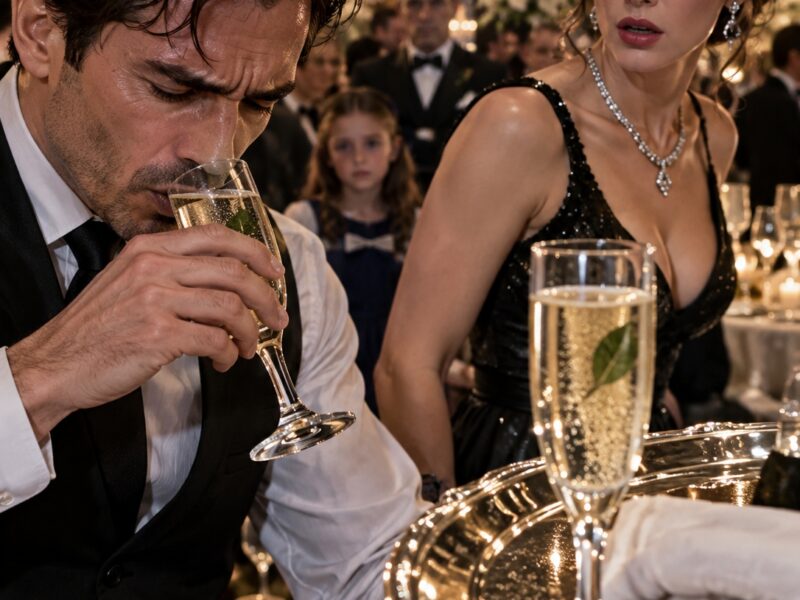
HE DRANK THE POISONED CHAMPAGNE MEANT FOR THE BILLIONAIRE—THEN SHE SAW WHAT WAS HIDDEN UNDER HIS SLEEVE
Glenn Cole knew the champagne was wrong three seconds before the woman beside him lifted her hand to take it.
He didn’t shout.
He didn’t call security.
He didn’t even look at the server.
He simply reached across Georgia Voss, took the crystal flute meant for her, and drank.
The champagne was cold.
Dry.
Expensive.
Then came the metallic bitterness.
Glenn lowered the empty glass.
Across the ballroom, his nine-year-old daughter was watching him.
And that was the moment he knew he might have just made her an orphan.
The opening banquet of the Voss Global Energy Summit glittered beneath twelve antique chandeliers inside the Halcyon Grand, a coastal hotel north of San Francisco where a single night’s presidential suite cost more than Glenn earned in three months.
Outside, rain streaked the enormous windows overlooking the Pacific.
Inside, money had made itself beautiful.
Cabinet ministers stood beside technology executives. Investors laughed beneath arrangements of white orchids. Photographers moved quietly between marble columns while a string quartet played near the windows.
At the center of it all stood Georgia Voss.
Forty-one years old.
Founder and CEO of Voss Meridian Energy.
The woman financial magazines called brilliant, ruthless, private, impossible.
Tonight, she wore an ivory silk gown beneath a tailored black jacket, no necklace except for a narrow brass key hanging from a chain against her wrist.
Glenn had noticed the key earlier.
He noticed everything.
That was why he had noticed the leaf.
It had been tucked against the inside rim of Georgia’s champagne flute, almost invisible beneath a twist of lime peel.
Small.
Waxy.
Gray-green.
To everyone else, it would have looked decorative.
To Glenn, it looked like a ghost.
Because twelve years earlier, his wife had drawn that exact leaf in a laboratory notebook.
Marbel had tapped the picture with the end of a pencil and told him, If you ever see something like this where it shouldn’t be, don’t assume it’s an accident.
He had laughed then.
Marbel hadn’t.
Three years later, she was dead.
And now the same marker was floating in Georgia Voss’s champagne.
“Mr. Cole.”
Georgia’s voice pulled him back.
She was staring at the empty flute in his hand.
Her expression wasn’t frightened.
It was furious.
“What exactly do you think you’re doing?”
Glenn placed the glass on a passing tray.
“Correcting a service issue.”
“You just drank my champagne.”
“Yes.”
“Why?”
Behind her, the master of ceremonies stepped toward the microphone.
“To cooperation,” he announced, raising his glass, “to innovation, and to a safer future.”
Hundreds of guests applauded.
Glenn looked at Georgia.
“It wasn’t fit for service.”
Her eyes narrowed.
“What does that mean?”
“It means you needed another glass.”
“That’s not an answer.”
“It’s the one I have.”
Georgia studied him.
Glenn could feel the first warmth spreading across his tongue.
Not alcohol.
Something else.
Something familiar.
Something wrong.
He curled his fingers against his palm so she wouldn’t see them tremble.
But Georgia Voss had built a billion-dollar company by noticing weakness before other people realized they had shown it.
Her gaze dropped to his hand.
Then returned to his face.
“Are you sick?”
“No.”
“You’re pale.”
“Bad lighting.”
“The chandelier cost eighty thousand dollars.”
“Then you overpaid.”
For half a second, something almost like disbelief crossed her face.
Then Glenn’s eyes moved past her.
Across the ballroom.
Tessa sat at a family table near the service corridor.
Nine years old, small for her age, dark hair tied with a blue ribbon. A hospital bracelet from that morning was still around her wrist because Glenn had forgotten to cut it off.
She caught him looking.
She smiled.
Glenn smiled back.
He didn’t let her see the fear.
Because Tessa had already lost one parent.
She wasn’t losing another tonight.
Not if he could help it.
A server approached Georgia carrying a replacement flute.
Glenn watched the man’s hands.
Clean gloves.
Correct posture.
Correct tray.
Correct seal.
Georgia reached toward the glass.
Glenn caught her wrist.
She froze.
So did the server.
“Don’t.”
Georgia’s eyes hardened.
“Take your hand off me.”
Glenn released her immediately.
“Have them open a new case.”
“This came from a new case.”
“Have them open another.”
“Why?”
Glenn looked at the glass.
Then at the server.
Then at the service door.
Because on the underside of the tray was a faint pearly smear.
The same kind Marbel had taught him to recognize.
And suddenly one poisoned drink wasn’t the problem anymore.
The whole room was.
Georgia followed his gaze.
“What did you see?”
“Nothing I can prove.”
“Then why are you looking at my staff like one of them is carrying a bomb?”
“Because somebody in this room knows your service schedule.”
The music continued.
Georgia’s expression changed.
Only slightly.
But Glenn saw it.
“What are you saying?”
“I’m saying don’t drink anything you didn’t watch being opened.”
For the first time that evening, Georgia Voss stopped looking annoyed.
She looked afraid.
Only for a second.
Then the CEO returned.
She raised two fingers.
Her head of security appeared almost immediately.
“Mr. Cole stays with me.”
The security chief frowned.
“Ms. Voss, he’s banquet staff.”
“Not anymore.”
Glenn stared at her.
“That’s a terrible idea.”
“I wasn’t asking.”
“I’m not security.”
“You recognized something my security team didn’t.”
“That doesn’t make me qualified.”
Georgia stepped closer.
“It makes you necessary.”
And that was how a temporary banquet captain with worn cuffs, unpaid medical bills and a nine-year-old daughter suddenly found himself walking beside one of the most powerful women in America.
Not because she trusted him.
Because someone wanted her dead.
And Glenn Cole might have been the only person in the building who understood how they were trying to do it.
Twenty minutes later, Glenn found the second mark.
Dinner service had begun.
Silver trays emerged from the kitchen beneath polished domes. Security checked every cart. The ballroom had been partially locked down without alarming the guests.
At least, that was the theory.
Glenn knew wealthy people could smell fear even when it wore a tuxedo.
He stood beside the service entrance as attendants passed.
One tray.
Two.
Three.
Then he saw it.
“Stop.”
The attendant froze.
Glenn leaned closer.
A faint gray crescent ran along the underside of the silver rim.
Not kitchen dust.
Not tarnish.
Something deliberate.
Georgia appeared behind him.
“Again?”
“Look.”
She did.
“I see a stain.”
“Exactly.”
“That’s your evidence?”
“No.”
Glenn pointed toward the glasses arranged on the tray.
“The placement is.”
There were twelve glasses.
Only four sat near the contaminated edge.
All four were assigned to the executive table.
Georgia’s table.
Her face tightened.
Glenn pulled a clean cloth from his pocket and folded it over the rim without touching the residue.
“Who prepared this tray?”
The attendant swallowed.
“The beverage station.”
“Who handled it after?”
“I don’t know.”
“You don’t know?”
“We work in sequence. Someone sets the glasses, someone else pours, then another attendant carries.”
Georgia looked at Glenn.
He could see the realization forming.
The system was the weapon.
Nobody needed to walk into the ballroom carrying poison.
They only needed to contaminate the correct point in a process everyone trusted.
Glenn’s phone vibrated.
He glanced at the screen.
COUNTY SCHOOL NURSE.
His stomach dropped.
Georgia noticed.
“Answer it.”
“I’m working.”
“Answer your phone.”
Glenn turned away.
“This is Glenn.”
The nurse’s voice was strained.
Tessa had experienced another breathing episode earlier that afternoon. Her medication wasn’t stabilizing her the way they had hoped. The doctor wanted her evaluated at County Medical before the clinic closed.
Glenn closed his eyes.
“Is she conscious?”
“Yes.”
“Breathing?”
“Yes, but—”
“I’ll authorize transport.”
“Mr. Cole, they need a parent.”
Glenn looked through the ballroom.
Georgia.
The contaminated tray.
Security officers.
Then Tessa, sitting only thirty yards away because he’d brought her to the summit after her sitter canceled.
She was reading beneath the tablecloth with a flashlight, completely unaware that her father was choosing between protecting her and protecting someone else’s mother.
Georgia had heard enough.
“Go.”
Glenn looked at her.
“What?”
“Take your daughter to the hospital.”
“I can’t.”
“You can.”
“The person who did this may still be inside.”
“Then my security team will find them.”
“They didn’t find the tray.”
That hurt.
He saw it.
Georgia’s jaw tightened.
“You cannot protect everyone.”
“No.”
Glenn folded the evidence cloth.
“But I can protect the person standing in front of me.”
Georgia said nothing.
Glenn turned toward Tessa.
That was when he saw the brass key beneath Georgia’s sleeve.
Three narrow lines had been engraved near its base.
Glenn stopped breathing.
The contaminated tray carried the same symbol.
Three lines.
Same spacing.
Same angle.
Georgia noticed where he was looking and closed her hand around the key.
Too late.
“What is that?”
“Nothing.”
“You don’t wear nothing around your wrist.”
“It belongs to me.”
“Where did you get it?”
Her eyes became cold.
“That’s none of your concern.”
Glenn stared at the key.
Marbel had drawn that symbol too.
Not once.
Dozens of times.
And suddenly the dead woman in Glenn’s memory wasn’t warning him about contamination anymore.
She was pointing directly at Georgia Voss.
By nine-thirty, Glenn had intercepted four glasses.
He tasted only enough of each to detect the bitterness before putting them aside.
Georgia finally caught him on the fourth.
She seized his wrist before the glass reached his mouth.
“What the hell are you doing?”
Guests nearby turned.
Georgia smiled at them.
“Everything’s fine.”
Then she dragged Glenn behind a marble column.
“Four glasses.”
Glenn said nothing.
“Four.”
“Lower your voice.”
“Every one of them was meant for me.”
“I noticed.”
“You noticed?”
“Yes.”
“And you’ve been tasting them?”
“Not drinking them.”
“That’s supposed to make me feel better?”
“It should.”
“Why?”
“Because you’re still standing.”
Georgia stared at him.
The arrogance in her face disappeared.
What replaced it was harder to look at.
Fear.
“How long have you known?”
“I don’t know anything yet.”
“Stop doing that.”
“Doing what?”
“Talking like a man who thinks silence is the same thing as control.”
Glenn’s jaw tightened.
“Sometimes silence keeps people alive.”
“And sometimes it gets them killed.”
That sentence hit somewhere she couldn’t see.
Because that was almost exactly what Glenn had told himself after Marbel died.
He had stayed quiet.
For Tessa.
For the custody hearings.
For the mortgage.
For the anonymous letters that appeared whenever he asked too many questions about Marbel’s laboratory accident.
He had convinced himself silence was protection.
Tonight, someone had followed that silence into a ballroom.
Georgia stepped closer.
“Why did you recognize the first glass?”
“My wife.”
“What about her?”
“She worked laboratory quality control.”
“Worked?”
“She’s dead.”
Georgia’s expression softened.
Glenn hated that.
He preferred suspicion.
Pity made everything harder.
“What happened?”
“Officially?”
“Yes.”
“Chemical exposure.”
“And unofficially?”
Glenn looked toward Tessa.
“I don’t know.”
That was the lie he had lived with for six years.
And Georgia knew it immediately.
Before she could push further, a server approached.
“Ms. Voss.”
Another glass.
Clear sparkling water this time.
Silver band around the stem.
Georgia’s assigned marker.
Glenn moved instinctively.
His hand closed around the stem.
One drop spilled across his knuckles.
The reaction was immediate.
Pain shot through his hand.
His fingers locked.
His breath vanished.
The ballroom tilted.
“Glenn?”
He gripped the table.
The chandeliers fractured into white stars.
His knees buckled.
A chair screamed across marble.
Then Tessa was shouting.
“Dad!”
Glenn hit the floor.
Georgia dropped beside him.
“Don’t touch the glass!”
Security moved.
Guests backed away.
The server who had delivered the drink did something Georgia would remember for the rest of her life.
He didn’t panic.
He stepped backward.
Slowly.
Carefully.
As if he had expected this.
Georgia looked toward the banquet captain.
He was watching the glass.
Not Glenn.
Near the musicians, a security officer quietly shifted his body across the nearest exit.
Three movements.
Three people.
One choreography.
Georgia finally saw what Glenn had seen from the beginning.
The threat wasn’t hiding inside chaos.
It was hiding inside order.
“Seal the room.”
Her security chief hesitated.
“Ms. Voss—”
“Seal. The. Room.”
Locks engaged.
The music stopped.
Two hundred guests turned toward her.
Glenn struggled for air.
Tessa tried to reach him.
Georgia caught the child gently.
“Don’t touch his hand.”
“He’s my dad!”
“I know.”
“Help him!”
Georgia looked down at Glenn.
For the first time in years, a woman accustomed to buying solutions discovered there were problems money could not solve quickly enough.
“Medical team!” she shouted.
Glenn grabbed her sleeve.
His voice was barely audible.
“Don’t trust…”
“What?”
“The first warning.”
Georgia leaned closer.
“What does that mean?”
But Glenn’s eyes had already closed.
And beneath Georgia’s fingers, the brass key began to feel impossibly heavy.
Glenn woke in a private medical suite forty-three minutes later.
Tessa was asleep in a chair beside him.
Georgia stood at the window.
“You should be at your summit,” he murmured.
She turned.
“You nearly died.”
“I’ve had worse shifts.”
“No, you haven’t.”
Glenn tried to sit.
Pain moved through his chest.
Georgia pushed the call button.
“Don’t.”
“That’s what it’s for.”
“I need to leave.”
“You need a doctor.”
“My daughter needs her medication.”
“Already handled.”
Glenn stopped.
“What?”
“County Medical sent it.”
“You called them?”
“I called everyone.”
He looked at Tessa.
Her hospital bracelet had been replaced.
A pharmacy bag sat beside her coat.
Something in Glenn’s expression changed.
“Thank you.”
Georgia nodded once.
Then held up the brass key.
“Now you talk.”
Glenn stared at it.
“Where did you get that?”
“My father.”
“When?”
“Before he died.”
“Why?”
“He said it opened something that belonged to the company.”
“What?”
“I never found out.”
Glenn looked away.
Georgia crossed the room.
“Your wife knew this symbol.”
He didn’t answer.
“Didn’t she?”
“Yes.”
Georgia’s face went still.
“How?”
“That’s what I’ve been trying to understand for six years.”
He told her.
Not everything.
But enough.
Marbel Cole had worked quality control for a chemical supplier contracted to one of Voss Meridian’s early renewable-energy projects.
She discovered discrepancies in contamination reports.
Missing batches.
Altered inspection numbers.
Emergency protocols that existed on paper but had never been implemented.
Then came the warnings.
First an envelope.
Then a break-in.
Then someone accessing Tessa’s medical information.
Marbel had started leaving notes around the farmhouse.
Codes.
Symbols.
Instructions.
One message appeared repeatedly:
Do not trust the first warning.
Three weeks later, Marbel died in what investigators called an accidental exposure.
Glenn never believed it.
“Why didn’t you come to me?” Georgia asked.
“You were on the board.”
“I didn’t run that division.”
“Your name was on the building.”
“So you assumed I was involved?”
“I assumed powerful people protect themselves.”
Georgia absorbed that without flinching.
“Fair.”
Glenn looked at her.
That wasn’t the answer he expected.
She continued.
“But if Marbel found something inside my company, I want to know.”
“Wanting to know and surviving what you learn aren’t always the same thing.”
“Is that supposed to scare me?”
“No.”
Glenn looked at Tessa.
“It’s supposed to explain me.”
Georgia followed his gaze.
Then Glenn remembered something.
The farmhouse.
Marbel’s floorboard.
He swung his legs off the bed.
Georgia stared at him.
“Absolutely not.”
“There’s something at home.”
“What?”
“I don’t know.”
“That’s becoming your favorite answer.”
“Marbel hid things.”
Georgia looked at Tessa.
Then back at him.
“Where?”
“Farmhouse kitchen.”
“Fine.”
“What?”
“We go together.”
“No.”
“You don’t get to drink four poisoned beverages for me and then suddenly become cautious.”
“Georgia—”
“If my key is connected to your wife’s death, I’m coming.”
Glenn looked at the woman who had spent the evening ordering ministers and millionaires around.
Then he looked at his sleeping daughter.
He realized the decision had already been made.
Rain followed them inland.
Near midnight, Georgia Voss stood in Glenn Cole’s kitchen wearing a coat worth more than his truck.
The farmhouse was small.
Old pine floors.
Yellow cabinets.
Tessa’s drawings taped to the refrigerator.
Marbel still existed everywhere without technically being anywhere.
Her coffee mug.
Her handwriting on freezer labels.
A photograph near the sink.
Georgia noticed Glenn never looked directly at it.
He moved the kitchen table.
Then pried up a loose floorboard.
Inside was an envelope.
Georgia saw the handwriting.
Glenn went pale.
MARBEL.
His fingers wouldn’t move.
Georgia picked it up.
On the front were five words.
DO NOT TRUST THE FIRST WARNING.
Inside was a laminated safety card.
Black triangle.
Red circle.
White line.
Three narrow marks.
Georgia’s breath caught.
“The key.”
Glenn nodded.
He turned the card over.
Marbel had written:
Protect the children first.
Record everything.
Never accept a sealed drink.
Tessa, awake now, sat at the table holding hot cocoa.
“Mom wrote that?”
Glenn swallowed.
“Yes.”
“Why?”
He didn’t know how to answer.
A noise came from the hallway.
Click.
The security monitor.
Glenn turned.
The old system had been installed after Marbel’s death.
A motion archive was blinking.
Three nights earlier.
Someone had entered the farmhouse.
Georgia leaned toward the grainy footage.
A figure in a dark raincoat moved through Glenn’s office.
Straight to the locked cabinet.
No searching.
No hesitation.
They knew exactly where to go.
The figure forced the lock and removed a folder.
Tessa’s medical file.
Then Marbel’s notes.
Before leaving, the intruder placed a small vial inside the cabinet.
Photographed it.
And pointed one gloved finger toward Glenn’s framed military photograph.
Georgia whispered, “They’re framing you.”
Glenn said nothing.
“They want investigators to believe the contamination came from you.”
Still nothing.
“Dad?” Tessa whispered.
Glenn turned.
His daughter looked terrified.
“They want people to think you hurt her?”
Glenn crossed the kitchen and knelt beside her.
“No one’s taking me away.”
“You don’t know that.”
Her words nearly broke him.
Because she was right.
On the desk beneath the monitor lay another document.
Georgia picked it up.
County archive access log.
Marbel Cole.
Glenn Cole.
Tessa Cole.
Medical history.
Emergency contacts.
Custody records.
Someone had requested all of it.
Georgia looked at Glenn.
“Why would they need custody records?”
He closed his eyes.
And Georgia knew.
There was another secret.
“Glenn.”
“Don’t.”
“What did you sign?”
He looked toward Tessa.
Georgia lowered her voice.
“What did they make you sign?”
Glenn stood.
For six years he had carried fear like a second skeleton.
Now it showed.
“A guardianship agreement.”
Georgia stared at him.
“For Tessa?”
“Temporary.”
“With whom?”
“A private foundation connected to the original investors.”
Georgia’s face drained.
“Why?”
“Because after Marbel died, somebody sent me photographs.”
“Of what?”
“Tessa.”
Silence.
“School. Playground. Doctor’s office.”
Georgia looked at the little girl holding her cocoa.
Glenn continued.
“They said if I kept asking about Marbel, they’d prove I was unstable. They’d use my finances, my military record, my work schedule. They’d make sure I lost her.”
“So you signed.”
“I bought time.”
Georgia stepped back.
Everything changed.
The struggling single father she had quietly judged wasn’t irresponsible.
He had been cornered.
The custody papers weren’t evidence that Glenn had failed Tessa.
They were evidence someone knew exactly how much he loved her.
Then Georgia looked at the brass key.
And finally understood what Marbel had been protecting.
Not a chemical formula.
Not a contamination protocol.
A chain of responsibility.
Names.
Contracts.
People.
And someone had just realized Georgia possessed the last key needed to expose them.
The final summit ceremony was scheduled for the following evening.
Georgia refused to cancel it.
Glenn called her insane.
She called it bait.
By six o’clock, the Halcyon Grand looked less like a hotel than a federal command center.
Security searched every delivery.
Every staff badge was reverified.
Every tray was photographed before entering the ballroom.
Federal investigators waited nearby, out of sight.
Georgia changed one rule.
The ceremonial service order.
Normally, the host received the first marked glass.
Tonight, the service sequence would be reversed.
Only six people knew.
Glenn stood beside her.
“You think they’ll adapt.”
“I think they already have.”
“Then cancel.”
“No.”
“You don’t have to prove you’re fearless.”
Georgia looked at him.
“I’m not fearless.”
That surprised him.
She glanced toward Tessa, seated safely beside a medical advocate.
“I’m terrified.”
“Good.”
Georgia almost smiled.
“Why is that good?”
“Means you’re paying attention.”
The ceremonial glasses arrived.
One by one.
Glenn inspected them.
The final glass looked harmless.
Pale amber liquid.
Perfect crystal.
Then chandelier light caught the base.
Three lines.
Broken circle.
Glenn stopped.
“Don’t move.”
Georgia followed his gaze.
“What?”
“The mark.”
A security specialist lifted the glass with tongs.
Glenn leaned closer.
The symbol wasn’t reversed.
It was completed.
Two circles.
Three lines pointing inward.
Like an eye.
A memory flashed through him.
Marbel at the kitchen table.
Pencil in hand.
Drawing the same symbol.
Georgia whispered, “You know it.”
Glenn stared at the glass.
“It was never marking the poison.”
“What?”
“It was marking the survivor.”
Georgia turned toward him.
“Explain.”
“They were testing reactions.”
The first glasses.
The small exposures.
The changing concentrations.
They hadn’t simply been trying to kill Georgia.
They had been measuring who recognized the contamination.
Who intervened.
Who survived.
Who knew Marbel’s protocol.
Glenn.
Georgia understood at the same moment.
“This isn’t only about me.”
“No.”
“They’ve been looking for you.”
“Yes.”
“Why?”
“Because Marbel told me something before she died.”
Georgia’s voice dropped.
“What?”
Glenn looked toward Tessa.
“She said if they ever came back, it meant someone had found the missing record.”
“What record?”
“The one proving who authorized the original cover-up.”
Georgia’s hand closed around the key.
The ballroom doors locked.
Glenn looked at the final glass.
“If this reacts the way I think it will, they’ll expose themselves.”
Georgia stepped in front of him.
“No.”
“They need to believe the test worked.”
“No.”
“Georgia.”
“Absolutely not.”
He reached around her.
She caught his arm.
“You have a daughter.”
“I know.”
“Then act like it.”
His eyes moved to Tessa.
That hurt more than the poison ever had.
Glenn whispered, “Everything I’ve done has been because I’m her father.”
Then he lifted the glass.
Georgia grabbed his wrist.
“Glenn.”
For the first time, he saw tears in her eyes.
“Don’t.”
He drank.
The glass hit the table.
His knees collapsed.
Tessa screamed.
“DAD!”
Georgia caught him before his head struck the marble.
The ballroom exploded into movement.
Security rushed forward.
Someone called the medical team.
Glenn lay motionless beneath the chandeliers.
Georgia pressed two fingers against his neck.
Pulse.
Weak.
Still there.
Then she looked up.
At the investors.
At the protocol director.
At the attorneys.
At the service staff.
One man was not watching Glenn.
He was watching the glass.
Silver-haired.
Perfect tuxedo.
Protocol director Warren Hale.
Georgia stood.
“Him.”
Hale froze.
Security surrounded him.
“I don’t understand.”
Georgia’s voice became frighteningly calm.
“You designed the ceremonial service.”
“Yes, but—”
“You selected the marked glasses.”
“Ms. Voss—”
“You changed the rotation after I reversed the order.”
His face changed.
Tiny.
Enough.
Georgia knew.
“Search him.”
They found nothing.
Hale smiled.
Then Georgia held up the black drive recovered from Glenn’s farmhouse.
“I don’t need what you’re carrying.”
The smile disappeared.
“I already have what you left behind.”
She connected the drive to the ballroom screen.
Security footage appeared.
Payments.
Access logs.
Altered custody records.
A recorded conversation from Glenn’s office.
Then Marbel Cole’s name.
The room went silent.
One investor stood.
“This is absurd.”
Georgia looked at him.
“No.”
She turned toward the cameras.
“This is evidence.”
The investor’s voice hardened.
“You’ll destroy the merger.”
“If the merger requires burying attempted murder, it deserves to be destroyed.”
“You don’t understand what you’re doing.”
“I finally do.”
Behind her, Tessa knelt beside Glenn.
She took his hand.
“Please wake up.”
Nothing.
“Dad.”
Her voice broke.
“You said you wouldn’t leave me.”
Glenn’s fingers moved.
Tessa gasped.
Georgia turned.
His eyelids trembled.
“Glenn.”
He opened his eyes.
The first thing he saw was his daughter.
“Tessa.”
She threw her arms around him.
He winced.
Then held her anyway.
“I’m here.”
Georgia knelt beside them.
“You found it?” he whispered.
“The recording.”
He closed his eyes.
Relief.
Then fear.
“Who ordered this?” Georgia asked.
Glenn looked toward Hale.
“No.”
“What?”
“Hale isn’t the top.”
The ballroom went silent again.
Glenn pointed toward the locked service corridor.
“The people who ordered it aren’t in this room.”
Georgia followed his finger.
“Where are they?”
“Downstairs.”
Federal investigators entered through the service level seven minutes later.
Three arrests followed.
Then five.
Warren Hale had been the operational link between a private investor group and contractors who had falsified contamination records years earlier.
Marbel Cole discovered the discrepancies.
She had copied enough evidence to frighten them.
But not enough to prosecute them.
After her death, they believed the evidence was gone.
Until Georgia inherited the brass key.
Until Glenn recognized the markers.
Until the old investigation began breathing again.
The conspiracy had survived for years because nobody involved needed to commit every crime.
One person changed a report.
Another approved a contract.
Someone altered a service chart.
Someone accessed a medical file.
Someone filed custody paperwork.
Everyone performed one small act.
Together, those small acts had nearly destroyed a family.
Georgia watched Hale being escorted across the ballroom.
She didn’t humiliate him.
Didn’t make him drink from the contaminated glass.
Didn’t need spectacle.
She simply placed the marked glass inside an evidence container.
“Make sure every fingerprint is preserved.”
Federal agents took it.
Then she walked back to Glenn.
He sat in a chair with an oxygen line beneath his nose.
Tessa leaned against him.
Georgia stopped several feet away.
“Why?”
Glenn looked up.
“Why what?”
“Every glass.”
He knew what she meant.
“Marbel.”
The name softened the room.
“She taught you?”
“She made me practice.”
“Practice what?”
“Seeing what other people ignore.”
Glenn looked toward the sealed evidence container.
“Certain residues leave a film. Different light catches them differently. She’d put harmless markers on glasses at home and make me find them.”
Georgia almost smiled.
“That sounds annoying.”
“It was.”
“Did you tell her?”
“Once.”
“What happened?”
“She contaminated my coffee mug for a week.”
Georgia laughed.
It surprised both of them.
Then Glenn’s smile faded.
“She used to say danger doesn’t always look dangerous. Sometimes it looks clean. Sometimes it arrives with paperwork. Sometimes it smiles.”
Georgia looked around the ballroom.
“She was right.”
“Usually was.”
“And you tasted the drinks because you knew what she’d taught you.”
“Partly.”
“What was the other part?”
Glenn looked at Tessa.
Then at the employees standing silently around the room.
“Because people were here.”
Georgia frowned.
“You nearly died for people you don’t know.”
“I didn’t plan to die.”
“That’s not an answer.”
Glenn considered her.
Then said quietly, “Marbel believed fear was never an excuse to abandon responsibility.”
Georgia looked down.
For years, responsibility had meant something different to her.
Contracts.
Payroll.
Shareholders.
Deadlines.
Numbers.
Tonight, a banquet worker earning hourly wages had shown her another definition.
Responsibility was seeing the danger.
And refusing to let it pass to the person beside you.
Even when nobody would know what you had done.
The custody hearing happened eleven days later.
Georgia did not attend.
Glenn asked her not to.
He wanted the courtroom to see him as Tessa’s father, not as the man standing beside Georgia Voss.
But Georgia’s attorneys submitted everything.
The altered records.
Threats.
Financial pressure.
Unauthorized access to Tessa’s medical files.
The guardianship agreement Glenn had signed under coercion.
The judge terminated the private guardianship petition.
Glenn kept his daughter.
When he walked out of the courthouse, Tessa was holding his hand.
She looked up.
“Are we going home?”
“Yeah.”
“Forever?”
Glenn stopped.
There are promises adults shouldn’t make.
He had learned that the hard way.
So he crouched beside her.
“I’m going to do everything I can to make sure home stays home.”
Tessa thought about that.
Then nodded.
“Okay.”
She hugged him.
And Glenn looked over her shoulder at the courthouse steps.
For the first time in six years, he wasn’t waiting for someone to appear behind him.
A month later, Georgia called him into Voss Meridian headquarters.
Glenn arrived wearing the only suit he owned.
Georgia noticed.
“That’s the summit suit.”
“It’s my suit.”
“You own one?”
“I own priorities.”
She slid a folder across the desk.
He didn’t touch it.
“What is this?”
“Employment offer.”
“I have a job.”
“You had a temporary banquet contract.”
“I was very good.”
“You poisoned yourself repeatedly.”
“Commitment.”
“Psychosis.”
Glenn smiled despite himself.
Georgia opened the folder.
Safety Oversight Division.
Independent authority.
Direct reporting access.
A salary large enough to make Glenn stare twice.
He closed the folder.
“No.”
Georgia blinked.
“No?”
“No.”
“Why?”
“Because I don’t want charity.”
Her expression changed.
“Good.”
She pushed another folder toward him.
This one contained reports.
Inspection failures.
Staff complaints.
Protocol inconsistencies.
“You see what other people overlook.”
Glenn looked through them.
“This is work.”
“Exactly.”
“You’d actually let me challenge executives?”
“I expect you to.”
“Even you?”
“Especially me.”
He looked at her.
Georgia looked back.
Trust still wasn’t easy between them.
Maybe it never would be.
That was fine.
Easy trust was what had nearly killed them.
Glenn signed.
Then Georgia placed one more document on the desk.
VOSS EMPLOYEE SUPPORT TRUST.
Every donation disclosed.
Every expense audited.
No hidden guardianship clauses.
No investor control.
No personal favors.
Tessa’s medical care would be covered alongside assistance for employees facing catastrophic family emergencies.
Glenn read every page.
Georgia waited.
“You did this because of Tessa?”
“She was the reason I noticed the problem.”
“That’s not what I asked.”
Georgia leaned back.
“No.”
She looked through the glass wall at hundreds of employees moving through the building.
“I did it because a company shouldn’t require someone to nearly die before it notices the people keeping it alive.”
Glenn said nothing.
Georgia smiled faintly.
“Was that sufficiently dramatic for you?”
“No.”
“Good.”
He signed.
By spring, Tessa was stronger.
Not cured.
Life rarely respected stories enough to give people miracles on schedule.
But stronger.
She walked farther.
Laughed louder.
Needed fewer emergency visits.
One afternoon, Glenn found her in the Voss Meridian garden chasing paper airplanes between rows of lavender.
Georgia stood nearby holding one.
“You throw terribly,” Glenn said.
Georgia stared at him.
“I run a multinational company.”
“Apparently without understanding aerodynamics.”
Tessa laughed.
“He’s right.”
“Traitor,” Georgia said.
Tessa handed her another sheet of paper.
“Try again.”
Georgia folded it badly.
Glenn fixed one wing.
Their hands touched.
Neither commented.
Some things didn’t need names immediately.
Inside the headquarters lobby, behind security glass, sat the champagne flute from the summit.
Empty.
Cleaned.
Sealed.
Evidence proceedings were over, but Georgia had requested permission to keep a replica of the marked glass beside a small plaque.
There were no heroic words on it.
No photograph of Glenn.
No mention of billionaires or poison.
Only one sentence.
NOTICE WHAT OTHERS OVERLOOK.
Glenn hated the plaque.
Tessa loved it.
Marbel would probably have mocked the font.
Sometimes Glenn imagined telling her everything.
The banquet.
The key.
The farmhouse footage.
The arrests.
The courtroom.
Tessa.
Especially Tessa.
He imagined Marbel sitting across the kitchen table, listening with that half-smile she used whenever he took too long to understand something she had known from the beginning.
But grief had changed over the years.
At first, it had been a room Glenn couldn’t escape.
Then it became something he carried.
Eventually, without realizing when, it became a window.
He could look through it without falling apart.
That evening, he stood in the garden while Tessa ran toward him holding a crooked paper airplane.
“Dad!”
He caught it.
“Georgia says mine flies farther than hers.”
“Most objects do.”
“I heard that,” Georgia called.
Tessa giggled.
Glenn looked at his daughter.
Sunlight touched her hair.
No hospital bracelet.
No courtroom.
No stranger watching from a parked car.
Just a child standing beneath a blue California sky, impatient for her father to throw a paper airplane.
“Ready?” he asked.
“Ready.”
Glenn drew his arm back.
For one strange second, he remembered the champagne flute.
The metallic taste.
The chandelier light.
The moment he’d wondered whether the next breath would be his last.
He remembered Marbel saying danger rarely announced itself.
But she had taught him something else too.
Something he’d forgotten while trying so desperately to survive.
Life rarely announced itself either.
Sometimes it was a quiet kitchen.
A daughter’s hand.
A badly folded airplane.
A second chance nobody promised you.
Glenn threw.
The paper plane climbed above the lavender, caught a warm current and sailed farther than any of them expected.
Tessa ran after it, laughing.
Georgia watched her.
Then she turned to Glenn.
“I never properly thanked you.”
“You did.”
“No.”
She shook her head.
“I paid you. Hired you. Helped fix things my company should have caught years ago. That’s not the same thing.”
Glenn looked toward Tessa.
“What do you want me to say?”
“Nothing.”
Georgia followed his gaze.
“I just wanted you to know.”
Glenn stood quietly for a moment.
Then nodded.
“Okay.”
That was all.
No grand speech.
No cameras.
No champagne.
Georgia smiled.
Tessa shouted from across the garden.
“Dad! Look!”
The airplane had landed beneath a young oak tree.
Glenn started toward her.
Then stopped.
He looked back once at Georgia, at the glass building behind her, and at the evidence case barely visible through the lobby doors.
For years, he had believed surviving meant staying ahead of the next threat.
Marbel’s death.
The bills.
Tessa’s illness.
The custody papers.
The men who wanted him silent.
But perhaps survival was something quieter.
Perhaps it was reaching the day when you no longer organized your life around what might be taken from you.
Glenn turned toward his daughter.
Tessa stood beneath the oak tree holding the paper airplane above her head like a trophy.
He walked toward her.
And behind him, locked safely beneath glass, the marked champagne flute caught the afternoon sun.
Once, it had been a weapon.
Then evidence.
Now it was only a reminder.
That danger could hide beneath polished silver.
That power could fail to see what ordinary people noticed.
That love sometimes looked less like a declaration than a man quietly stepping between another human being and a poisoned glass.
And that trust—the kind worth keeping—was almost never given in a single dramatic moment.
It was earned slowly.
Painfully.
Quietly.
One choice at a time.
Glenn reached the oak tree.
Tessa slipped her hand into his.
He held it tightly.
Then together, they walked home.









