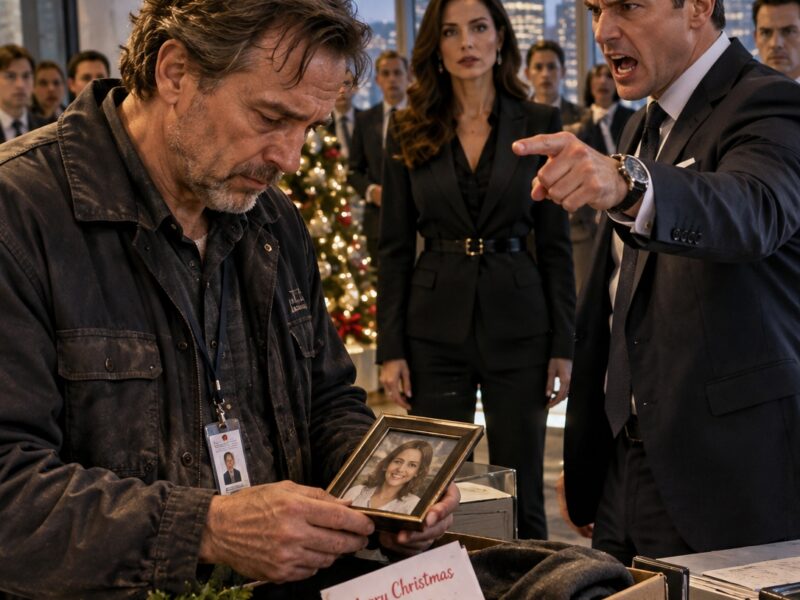
HE FIRED A QUIET TECHNICIAN IN FRONT OF EVERYONE—THEN THE CEO ASKED ONE QUESTION THAT DESTROYED HIS CAREER

“I’ll pack my things.”
Those were the only words Nolan Mercer said after Preston Blackwell III fired him in front of nearly forty people.
No shouting.
No begging.
No dramatic accusation.
Just four quiet words beneath the blinking Christmas lights of Westbridge Systems while two security guards waited beside the elevators and half the office pretended not to watch.
Nolan bent beneath his desk and picked up the cardboard box someone had already placed there for him.
That was when he understood something that hurt more than losing the job.
They had prepared the box before they had spoken to him.
His humiliation had been scheduled.
“Ten minutes, Mercer,” Preston said.
Nolan nodded.
Then the private elevator opened.
A woman stepped out.
She watched Nolan place twenty years of his life into a cardboard box.
Then she looked at the executive who had fired him.
“Put the box down, Nolan.”
The entire floor went silent.
Preston’s face changed.
Only slightly.
But Nolan saw it.
And when Audrey Witcom, CEO of Westbridge Systems, asked her next question, Preston Blackwell stopped looking like a man who had just won.
He looked like a man who had suddenly realized the wrong person had walked into the room.
“Preston,” Audrey said, “are you sure you want me to know why you’re firing him?”
Three days later, that question would threaten a $420 million contract.
It would tear open years of buried warnings.
It would bring a terrified HR executive into a Christmas morning board meeting carrying evidence in a folder.
And it would reveal that Nolan Mercer had not been fired because he had made a mistake.
He had been fired because he had found one.
At 5:40 p.m. on December 23, snow had nearly erased Chicago.
From the twenty-eighth floor of Hawthorne Tower, the river below had disappeared into a gray-white blur. Office windows reflected strings of Christmas lights, silver garland, paper snowflakes and an artificial tree someone in accounting had decorated with miniature circuit boards.
Most employees were pretending to work while waiting for the holiday party.
Nolan Mercer was actually working.
He stepped off the service elevator after twelve hours in the testing bay, carrying a folder of inspection logs beneath one arm and a coffee he had forgotten to drink beneath the other.
At forty-two, Nolan had the tired strength of a man who had spent most of his adult life repairing things.
Dark hair had begun turning silver around his temples.
His hands were broad, scarred and permanently rough from tools, wiring and machine housings.
His canvas work jacket had been repaired twice at the elbow.
His boots had been repaired more often.
Nolan noticed things like that because he repaired instead of replaced.
Machines.
Shoes.
Furniture.
Relationships, when people allowed it.
For years, he had believed almost anything could be saved if someone was willing to find the actual problem.
That belief had not saved his wife.
Ellen had died seven years earlier after cancer reduced their world to hospital rooms, insurance forms, whispered conversations after their daughter fell asleep and bills Nolan opened alone at the kitchen table.
Their daughter Clare had been sixteen.
Nolan had been thirty-five.
He had stopped pursuing promotions after that.
Some required travel.
Others meant nights away.
Clare had already lost one parent.
Nolan had refused to make her lose half of another one.
Now she was twenty-three and living in Denver, designing interiors for hotels and restaurants.
On his desk was the Christmas card she had mailed him.
The reindeer on the front was deliberately terrible.
Inside she had written:
Dad—
You’re legally required to take at least one day off this Christmas.
Love you.
Clare.
Nolan had smiled every time he read it.
That afternoon, all he wanted was to go home, call her and sleep without setting an alarm.
Then he saw Preston standing beside his desk.
Preston Blackwell III was sixty-one and looked like the kind of man whose clothing had never known an ordinary closet.
Silver hair.
Tailored charcoal suit.
White shirt without a wrinkle.
A watch Nolan knew cost more than his annual salary.
Beside Preston stood Graham Winslow from human resources, holding a thin cream envelope.
Behind them stood two security guards.
Neither looked Nolan in the eye.
That was when Nolan saw the cardboard box.
Empty.
Waiting beneath his desk.
Something cold moved through him.
Not fear.
Recognition.
“Mercer.”
Preston said his name loudly.
Too loudly.
Nearby conversations stopped.
Nolan put his inspection folder down.
“Mr. Blackwell.”
“Don’t bother taking your coat off.”
Nolan glanced toward Graham.
Graham looked at the carpet.
Preston stepped forward.
“Your employment with Westbridge Systems is terminated effective immediately.”
Someone near the break room inhaled sharply.
Nolan did not move.
“For what?”
“Failure to follow management directives. Obstruction of a critical delivery schedule. Conduct inconsistent with your responsibilities.”
Nolan looked around.
Dozens of people were listening.
Some had worked beside him for fifteen years.
“Can we talk somewhere private?”
“No.”
Preston almost smiled.
“If someone costs this company money, the people affected deserve to know why.”
There it was.
Not termination.
Punishment.
Nolan felt every eye in the room.
He remembered Clare at sixteen standing beside Ellen’s grave, holding his hand so tightly her fingernails left marks in his palm.
He remembered promising himself he would never let humiliation turn him into cruelty.
So he swallowed what he wanted to say.
Graham extended the envelope.
“I’m sorry, Nolan.”
Preston glanced at him.
Graham corrected himself.
“Your termination documents.”
Nolan opened them.
He read the disciplinary summary.
Once.
Then again.
It described an employee who had abandoned assigned duties.
Ignored repeated instructions.
Jeopardized the company’s largest industrial contract.
Refused to cooperate with supervisors.
Nolan looked up.
“That isn’t what happened.”
Preston cut him off.
“You’re a technician on a monthly salary, Mercer. Not a member of the executive team.”
His eyes dropped briefly to Nolan’s worn sleeve.
“You don’t get to decide what happened.”
A few people shifted uncomfortably.
Nobody spoke.
“Badge,” Preston said. “Then clear your desk. Ten minutes.”
Nolan stared at him.
There were things he could have said.
He could have mentioned the test results.
He could have mentioned the report he had refused to certify.
He could have mentioned the emails.
But suddenly he understood why this was happening publicly.
Preston did not want an explanation.
He wanted witnesses to Nolan’s disgrace.
If Nolan became angry, Preston would call him unstable.
If Nolan argued, Preston would call him insubordinate.
If Nolan accused him, Preston would call him bitter.
So Nolan gave him nothing.
“I’ll pack my things.”
Preston smiled.
“Finally. Something you understand.”
That hurt.
Nolan refused to let him see it.
He knelt.
A spare sweater went into the box.
Then the battered wrench his father had given him when Nolan was nineteen.
A photograph of Ellen laughing beside Lake Michigan.
A brass pin for ten years of service.
Then Clare’s Christmas card.
Nolan smoothed its bent corner before placing it carefully inside.
His hands were steady until he unclipped his employee badge.
The photograph was seventeen years old.
A younger Nolan stared back at him.
More hair.
Fewer lines.
A man who still believed hard work eventually became impossible to ignore.
Nolan almost laughed.
Apparently, people could ignore almost anything when ignoring it was profitable.
Behind him, an elevator chimed.
Nobody noticed at first.
The doors opened.
Audrey Witcom stepped onto the floor.
At forty-six, Audrey had spent six years as CEO of Westbridge Systems and most of those years cultivating a reputation for being difficult to surprise.
She had come downstairs because her final meeting had been canceled.
She expected an office party.
Instead, she saw two guards.
A silent crowd.
Preston Blackwell.
And a man holding a cardboard box as if it contained the remains of something.
Audrey stopped.
“Put the box down, Nolan.”
He turned.
Everyone did.
Preston’s smile disappeared for less than a second.
Then it returned.
“Audrey.”
“Preston.”
“This is routine. I’ll brief you after the holidays.”
Audrey looked at the guards.
Then at the employees.
Then at Nolan.
“A routine termination requires two security officers and an audience?”
Preston chuckled.
“You’re seeing the last five minutes of a much longer situation.”
“Then give me the first five.”
“This doesn’t require your involvement.”
That was his mistake.
Audrey’s expression changed.
Not dramatically.
But Nolan saw it.
So did Preston.
“I decide what requires my involvement.”
Preston lowered his voice.
“Nolan Mercer has been obstructing the Great Lakes Industrial Consortium project. He refused a direct instruction and jeopardized a contract worth four hundred twenty million dollars.”
Now Audrey looked at Nolan.
“Is that true?”
Preston answered for him.
“He refused to sign the verification report.”
Audrey’s gaze remained on Nolan.
“I asked him.”
Nolan put the box down.
“Yes. I refused.”
A murmur moved through the room.
Preston spread his hands.
“There you have it.”
Audrey ignored him.
“Why?”
Nolan hesitated.
Not because he did not know.
Because nobody that high in the company had ever asked.
“The system didn’t meet the contractual response thresholds consistently during testing.”
Preston laughed.
“A technician’s interpretation.”
Nolan continued.
“We ran several load conditions. The feedback delay exceeded the limit more than once. Not every time.”
“And that matters?” Audrey asked.
“It matters more.”
“Why?”
“Because consistent failures are easy to find.”
Nolan glanced at Preston.
“Intermittent failures are easy to explain away.”
The room became very still.
Audrey asked, “What did you request?”
“A retest.”
“And?”
“I was told the schedule couldn’t absorb one.”
Preston stepped in.
“What he was told was that qualified engineers had reviewed the results.”
Nolan turned toward him.
“I was the person being asked to certify them.”
“You are a technician.”
“A signature doesn’t make a machine safe.”
Preston’s jaw tightened.
Audrey noticed.
“Where’s the disciplinary file?”
Graham held it out.
Preston intervened.
“Audrey, there’s no reason—”
She took it.
Read the first page.
Then the second.
Her brow furrowed.
“Who verified these allegations?”
Graham opened his mouth.
Nothing came out.
Audrey looked up.
“Where is the supporting documentation?”
Preston said, “Operations reviewed it.”
“That wasn’t my question.”
“We have a four-hundred-twenty-million-dollar closing in days.”
“That also wasn’t my question.”
Preston’s voice hardened.
“You’re going to delay the largest contract in company history because one technician doesn’t understand commercial reality?”
Audrey closed the folder.
“No.”
For the first time, Nolan saw relief flash across Preston’s face.
Then Audrey continued.
“I’m delaying this termination because apparently nobody in this room understands what due process looks like.”
Preston froze.
“The termination is suspended pending review. Mr. Mercer’s salary and benefits continue in full.”
“Audrey—”
“Effective immediately, nobody connected to this project may alter inspection records, verification reports or testing logs.”
Now people were looking at Preston.
“All relevant emails, files and access histories will be preserved. Internal audit will review the matter beginning tomorrow morning.”
“Tomorrow is Christmas Eve.”
“Then we’ll all remember this Christmas.”
Preston’s face hardened.
“You’re undermining your own operations chief in front of the staff.”
“No.”
Audrey handed the folder back to Graham.
“I’m preventing the company from making a decision without evidence.”
She looked at Nolan.
“I’m not declaring you innocent, Mr. Mercer.”
“I didn’t ask you to.”
Something almost like approval moved across her face.
“Good. Because sympathy isn’t evidence either.”
She looked around the room.
“Every conclusion will be based on what can be proven.”
The guards stepped away.
The office slowly began breathing again.
Someone accidentally started the holiday playlist.
“Have Yourself a Merry Little Christmas” floated absurdly through the room.
Employees began drifting away.
Nolan picked up the box.
Preston stepped close to him.
Close enough that only Nolan was supposed to hear.
“You think she can protect you forever?”
Nolan looked at him.
“I didn’t ask her to.”
Audrey heard.
She said nothing.
Not yet.
She told Nolan to go home and report to internal audit at nine.
He thanked her.
Then he walked toward the elevator.
His box against his chest.
Clare’s card tucked inside.
His badge clipped back onto his coat.
As the doors closed, he saw Preston watching him.
Not angrily.
Carefully.
That frightened Nolan more.
Because angry men reacted.
Afraid men planned.
Upstairs, five minutes later, Graham Winslow’s phone vibrated.
A message from Preston.
Find out what Mercer copied before he leaves.
Graham stared at the screen.
Then deleted it.
But he could not delete the feeling that came with it.
For the first time in seventeen years at Westbridge, Graham wondered whether the most dangerous man in the company was the one who had just been escorted toward the elevator—
or the executive still standing comfortably inside it.
The next morning, Chicago was buried beneath fresh snow.
Nolan arrived forty minutes early.
He always arrived early.
Ellen used to tease him about it.
“You know clocks work both directions, right?”
“I like margins.”
“You like worrying.”
“Same thing.”
He could still hear her voice sometimes.
That morning, he found Audrey near the lobby elevators balancing two coffees and a leather portfolio.
She looked surprised.
“You’re early.”
“So are you.”
“I’m the CEO.”
“I’m unemployed.”
“Temporarily.”
Nolan almost smiled.
She offered him one of the coffees.
“This was for my assistant. She had the intelligence to take Christmas Eve off.”
He accepted it.
“Then I’m benefiting from good judgment.”
The elevator doors closed.
For several floors neither spoke.
Audrey noticed the stitching along Nolan’s boot.
Hand repaired.
Careful.
Neat.
She wondered how many things in his life he had repaired because replacement was a luxury.
Around the fifteenth floor, she asked, “Why are you still a technician?”
Nolan looked at her.
“That sounded worse than I intended.”
“No. It sounded accurate.”
“You’ve been here almost twenty years. You’ve worked on major industrial systems. Your records show specialized experience.”
He stared at the numbers above the door.
“My wife got sick.”
Audrey said nothing.
“Cancer. Clare was sixteen. Promotions meant travel. Nights away. Sometimes weeks.”
“So you turned them down.”
“Some.”
“Do you regret it?”
“No.”
The answer came instantly.
Then more quietly:
“I regret that I stopped asking myself what came after.”
The elevator continued upward.
“Clare needed me. Then one day she didn’t need me in the same way anymore.”
“That’s what children are supposed to do.”
“I know.”
“But?”
Nolan smiled faintly.
“But I think somewhere along the way I put my ambition in a drawer and forgot which drawer.”
Audrey studied him.
“You made a choice.”
He looked over.
“That doesn’t make you less capable.”
Nolan took a sip of coffee.
“Most people here don’t see it that way.”
The elevator opened.
“Then perhaps,” Audrey said, “we’ve been looking at the wrong things.”
Ellis Reed ran internal audit like a detective agency disguised as accounting.
Thirty-nine.
Lean.
Sleeves always rolled up.
A man who trusted timestamps more than titles.
He asked Nolan to begin at the beginning.
Nolan described the acceptance testing.
The controller system.
The feedback loops.
The inconsistent response delays.
He avoided jargon whenever possible.
“When the system is under certain loads, the response slows beyond the contract limit.”
“How often?” Ellis asked.
“Not predictably.”
“Could it be measurement noise?”
“Yes.”
“Could it be a real defect?”
“Yes.”
Audrey watched him.
“You don’t know which?”
“No.”
“Then why refuse certification?”
“Because certification says we know.”
That stopped her.
Nolan leaned forward.
“I wasn’t saying the system would fail. I was saying our tests hadn’t proven that it wouldn’t.”
Ellis nodded.
A distinction.
A very important one.
“What happened after you requested another test?”
“My supervisor escalated it.”
“To?”
“Operations.”
“Preston?”
“I don’t know.”
Audrey watched Nolan carefully.
“You think he was involved.”
“I know what changed.”
He met her eyes.
“I don’t know who ordered it.”
It would have been easy to accuse Preston.
Nolan did not.
That mattered.
He gave Ellis the location of the raw logs, software versions, quality-control emails and his formal request for retesting.
Everything was on company servers.
Nothing hidden on a personal drive.
Nothing smuggled home.
Ellis checked timestamps as Nolan spoke.
They matched.
At 11:47 a.m., Audrey thought the case had become troubling.
At 12:03, it became something else.
Ellis appeared in her doorway.
His face had lost color.
“We have a problem.”
“What?”
“The final verification report.”
He rotated his laptop.
“It’s signed.”
Audrey stared.
“Nolan’s signature?”
“Yes.”
They called Nolan back.
He looked at the screen.
His name.
His electronic credentials.
APPROVED.
Timestamped December 22, 11:52 p.m.
For several seconds he said nothing.
Then:
“I never signed that.”
Ellis began tracing the access history.
At 9:14 p.m. on December 22, Nolan had logged out.
His badge recorded him leaving through the parking garage.
Two hours and thirty-eight minutes later, an administrative session opened.
The report status changed.
Pending became approved.
Nolan’s credentials were attached.
Audrey felt something cold settle in her stomach.
“Can you identify who did it?”
“Not yet.”
“Can you prove Nolan didn’t?”
Ellis pointed at the records.
“His normal session was closed. His badge left the building. The approval came through administrative privileges.”
“Whose?”
“I’m tracing that now.”
Audrey stood.
“Make forensic copies. Lock them.”
“Already started.”
“Independent security verification.”
Ellis nodded.
“And Ellis?”
He paused.
“Nobody touches anything without a documented chain of custody.”
Because Audrey understood exactly what came next.
If this evidence implicated someone powerful, the first defense would not be innocence.
It would be contamination.
By lunchtime, Preston was sitting inside a private club on Michigan Avenue with two Westbridge directors.
Their fathers had known his father.
Their grandfathers had known his grandfather.
Preston never told them Audrey was incompetent.
He was smarter than that.
He merely expressed concern.
A four-hundred-twenty-million-dollar contract.
Holiday deadlines.
A disgruntled technician.
A CEO allowing emotion to interfere with commercial judgment.
By dessert, one director asked whether the board should become involved.
Preston lowered his eyes as though reluctant.
“I would never suggest undermining Audrey.”
Which was exactly what he was suggesting.
Back at Hawthorne Tower, Graham Winslow searched Nolan’s history for evidence of insubordination.
He found dozens of emails.
They were devastating.
Just not in the way Preston expected.
Request for additional testing.
Request for preventive maintenance.
Request for revised load procedure.
Request for safety review.
Every message was polite.
Specific.
Documented.
Graham sat alone staring at them.
For seventeen years, he had survived by understanding what powerful people wanted before they asked.
He had a mortgage.
A wife.
College tuition for his youngest son.
A career too advanced to restart and too fragile to risk.
He printed the emails Preston wanted.
Then left them on his desk.
He could not bring himself to send them.
At 4:18 that afternoon, Preston found Nolan outside the audit offices.
“Walk with me.”
“No.”
Preston smiled.
“Still difficult.”
“I’m waiting for Ellis.”
“I can solve this for you.”
Nolan said nothing.
“Generous severance. Excellent recommendation. Enough money to make the next year comfortable.”
“For what?”
“A statement.”
“What statement?”
“That the discrepancies were a technical misunderstanding. That reasonable engineers could interpret the data differently.”
“They can.”
Preston relaxed.
“Good.”
“But I won’t say the system passed tests it didn’t pass.”
Preston’s smile vanished.
“You’re forty-two, Nolan.”
“I’m aware.”
“Companies talk.”
“So?”
“No serious industrial firm will hire a technician known for obstructing a major contract.”
Nolan looked at him.
“Is that an offer or a threat?”
Preston adjusted his cuff links.
“Call it a Christmas gift.”
Nolan almost laughed.
“No.”
“You should think about your daughter.”
That did it.
Not visibly.
But something inside Nolan became very still.
“Do not use my daughter in this conversation.”
“I’m trying to help you.”
“No. You’re trying to make me afraid enough to help you.”
Preston leaned closer.
“You have no idea how insignificant you are.”
Nolan studied him.
Then said softly:
“If I’m insignificant, why are you here?”
For once, Preston had no immediate answer.
He walked away.
Nolan took a small notebook from his pocket.
Wrote the time.
Location.
Every sentence he remembered.
Fifteen minutes later, the account was filed with legal.
At 4:47 p.m., Audrey received an email.
EMERGENCY BOARD MEETING.
December 25.
9:00 a.m.
Agenda:
Review of executive judgment and contractual exposure.
Christmas morning.
Audrey read it three times.
Nobody called a board meeting at nine on Christmas morning to exchange opinions.
They called it because they already had knives out.
Ellis stood in her doorway.
“They’re coming for your authority.”
“I know.”
“You could pause the audit.”
Audrey looked at him.
“I could.”
“The board meeting might disappear.”
“Yes.”
“Preston knows that.”
“Yes.”
Ellis waited.
Audrey closed her laptop.
“Finish the audit.”
That evening Nolan returned to his small apartment on the North Side.
The cardboard box sat on his kitchen table.
He had not unpacked it.
He picked up his brass service pin.
Ten years.
There should have been another for fifteen.
Nobody had remembered.
His phone rang.
Clare.
“Hey, Dad. Merry almost Christmas.”
“Merry almost Christmas.”
“You sound tired.”
“I’m old.”
“You’re forty-two.”
“Ancient.”
She laughed.
Then asked, “Are you working tomorrow?”
“No.”
“Good. Miracles happen.”
Nolan looked at the box.
“Work is going through some changes.”
Silence.
Clare had inherited Ellen’s ability to hear the sentence behind the sentence.
“What happened?”
“Nothing I can’t handle.”
“Dad.”
“I’m okay.”
“You always say that.”
“Usually true.”
“Not always.”
Nolan closed his eyes.
Clare’s voice softened.
“You know you don’t have to be the strong one every minute, right?”
He stared at Ellen’s photograph.
“I know.”
“No, you know the words. That’s different.”
Nolan smiled despite himself.
“When did you become smarter than me?”
“Denver. Must be the altitude.”
After the call, he sat in darkness for a long time.
He had spent years believing endurance was dignity.
Maybe sometimes it was.
But perhaps there was another possibility.
Perhaps sometimes endurance was simply the habit of accepting what should have been challenged.
Across Chicago, Audrey was reading Nolan’s personnel file from page one.
Not the executive summaries.
The actual record.
Excellent evaluation.
Strong technical judgment.
Exceptional troubleshooting.
Indiana plant incident—identified feedback fault before potential shutdown.
Recommendation for recognition:
Blank.
Another report.
Another intervention.
Another recommendation.
Nothing.
Audrey called Mara Bennett, head of quality control.
Mara arrived carrying a binder thick enough to stop a door.
“Why wasn’t he recognized?”
Mara removed her glasses.
“That’s a complicated question.”
“Make it simple.”
Mara placed an old report on the desk.
Across the bottom, in her handwriting:
ESCALATED TO BLACKWELL.
NO CORRECTIVE ACTION APPROVED.
Audrey looked up.
“How many?”
“More than one.”
“Show me.”
They worked into Christmas Eve.
Three years of reports covered the conference table.
And gradually, the pattern emerged.
Nolan had repeatedly raised concerns about a weakness in the company’s controller approval method.
Not a proven catastrophic defect.
Something more inconvenient.
A testing gap.
Under unusual load conditions, certain response problems could appear intermittently.
Standard testing might miss them.
Nolan had proposed additional procedures.
Budget requests followed.
Every one passed through operations.
Every one stalled.
Audrey stared at the documents.
“So he’s been saying this for three years.”
Mara nodded.
“Not that the equipment was unsafe.”
“No.”
“That our testing wasn’t sufficient to say it was always safe.”
“Exactly.”
That distinction changed everything.
Close to nine, Audrey asked Nolan to meet her.
Not in the CEO suite.
A small twentieth-floor conference room with mismatched chairs.
She showed him the old reports.
“I read them.”
Nolan waited.
“I should have seen these.”
“You have thousands of employees.”
“That isn’t an excuse.”
“It’s an explanation.”
Audrey studied him.
“You’re surprisingly generous to people who failed you.”
“No.”
He rotated his coffee cup.
“I just think blaming the wrong thing is how problems survive.”
She looked at the reports.
“I relied on executive summaries.”
“Yes.”
“I should have asked more questions.”
Nolan looked toward the whiteboard.
“Questions are cheap.”
Audrey raised an eyebrow.
“Ignoring the answers is expensive.”
A laugh escaped her.
Small.
Unexpected.
For the first time, Nolan saw the woman beneath the title.
“You really like this work, don’t you?” she asked.
“The machines?”
“All of it.”
Nolan thought.
“My father repaired factory equipment. When I was twelve, he let me help with an old motor.”
“Did you fix it?”
“No. I made it worse.”
Audrey smiled.
“But eventually I learned something.”
“What?”
“A broken machine doesn’t care about your ego.”
He leaned back.
“If you’re wrong, it stays broken.”
Audrey’s smile faded into something warmer.
“Boardrooms could use more machines.”
Several floors above them, Preston was speaking to Graham.
“I need a written statement.”
Graham’s throat tightened.
“Saying what?”
“That Mercer’s previous proposals were informal.”
“They have intake numbers.”
“Informal recommendations can have intake numbers.”
“They were reviewed.”
“Graham.”
Preston leaned back.
“How long have you owned the house in Evanston?”
Graham stared at him.
“Excuse me?”
“Seventeen years here, isn’t it?”
“Yes.”
“Difficult age to start over.”
There it was.
No threat.
Nothing anyone could easily quote.
Just a mortgage transformed into a weapon.
Graham left with shaking hands.
At 11:08 p.m., Ellis called Audrey.
“We traced the administrative permissions.”
“To where?”
“The group is controlled by the COO’s office.”
Audrey looked through the window.
Church bells were beginning to ring across Chicago.
“Preston?”
“His office. But several people have access.”
“So we still can’t prove who used it.”
“No.”
Audrey looked at the city.
The evidence had reached Preston’s door.
But doors were not guilt.
They needed what was on the other side.
Christmas morning arrived bright and brutally cold.
Seven directors sat around the Westbridge boardroom table.
Two attorneys.
Ellis Reed.
Audrey.
Preston arrived last.
Perfect suit.
Perfect tie.
Perfect confidence.
Nolan had been invited for the technical portion.
Before they entered, Audrey stopped him.
“Only say what you know.”
“That was the plan.”
“If they provoke you?”
“They will.”
“Then?”
Nolan looked through the glass doors at Preston.
“I’ve had practice.”
Preston’s presentation was brilliant.
That was what made him dangerous.
He did not begin with the altered report.
He began with Nolan.
No advanced degree.
No executive training.
Two decades in a technician role.
History of challenging supervisors.
Then came the number.
$420,000,000.
Preston let it remain on the screen.
“This is the commercial exposure we are accepting because of the judgment of one employee.”
One director turned to Audrey.
“Are we placing too much weight on Mr. Mercer’s testimony?”
Audrey answered calmly.
“The value of evidence does not depend on the salary of the person who found it.”
Preston looked at Nolan.
“Stand up.”
Nolan did.
“Tell this board what qualifies you to challenge my judgment.”
There were a hundred satisfying answers.
Nolan chose none of them.
He walked to the screen.
Then explained the test.
Step by step.
No jargon.
No anger.
He showed where the results exceeded the contractual limits.
One director asked, “Does that prove the system is unsafe?”
“No.”
Preston smiled.
Nolan continued.
“It proves we haven’t completed enough testing to certify that it meets the requirement.”
The smile vanished.
Preston interrupted.
“You would risk hundreds of jobs over a handful of numbers?”
Nolan turned toward him.
“Those numbers are part of what protects those jobs.”
Ellis took over.
He showed the board Nolan’s logout time.
9:14 p.m.
Then the approval.
11:52 p.m.
Administrative access.
Two versions of the same report.
Independent backup confirmation.
Preston remained calm.
“Software errors happen.”
“They do,” Ellis said.
“Then this proves nothing.”
“Which is why we checked the backup archive.”
Ellis clicked.
Matching change history.
Matching timestamps.
Matching administrative session.
Preston shrugged.
“Several people have those permissions.”
A director nodded.
For one dangerous moment, Nolan realized that might be enough.
Not to prove Preston innocent.
Just enough to prevent action.
Then a chair moved.
Graham Winslow stood.
His face was gray.
“I need to say something.”
Preston turned.
“Sit down, Graham.”
Graham did not.
“The disciplinary report used to terminate Nolan Mercer was altered.”
Nobody moved.
Preston’s eyes narrowed.
“What did you say?”
Graham put a folder on the table.
“The first version did not accuse him of misconduct.”
He opened it.
“Mr. Blackwell instructed me to rewrite it.”
Preston stood.
“You lying son of a—”
Audrey’s voice cracked across the table.
“Sit down.”
Preston ignored her.
“After seventeen years? This company fed your family.”
“Stop threatening the witness.”
Silence.
Preston looked around.
For the first time that morning, nobody seemed eager to help him.
Ellis opened another document.
Three years old.
Nolan recognized it instantly.
His original proposal.
Additional load testing.
Revised verification procedures.
At the bottom:
Received—Office of Chief Operating Officer.
Attached was an email.
From Preston.
Keep this issue out of the board briefing until additional data is available.
One director frowned.
“Was additional data gathered?”
Mara, who had joined by video conference, answered.
“No.”
“Why?”
“The budget request was not approved.”
“By whom?”
Nobody needed the answer.
Audrey looked across the table at Nolan.
“I think we finally understand why he wanted you gone.”
And suddenly Nolan did too.
Not all of it.
But enough.
Preston had known about the weakness in the testing method for years.
Not proof of a guaranteed failure.
Something perhaps worse for an executive obsessed with deadlines:
Proof that more testing was justified.
Then came the consortium project.
The same testing weakness surfaced.
Nolan recognized it.
He requested another test.
If an audit followed, someone would eventually discover the old warning.
Then the old budget request.
Then Preston’s email.
Then the question that could destroy him:
Why had nothing been done?
So Preston had not merely needed Nolan quiet.
He needed Nolan discredited.
The public firing suddenly made terrible sense.
The guards.
The audience.
The accusations.
The ten-minute deadline.
The humiliating language.
It had not been a temper tantrum.
It had been groundwork.
Make Nolan look incompetent.
Create a disciplinary history.
Call him insubordinate.
Then if he spoke later, he would not be an experienced technician raising a documented safety concern.
He would be a bitter former employee seeking revenge.
Nolan felt sick.
Not because Preston hated him.
Because Preston barely thought about him as a person at all.
Nolan had been an obstacle.
A variable to remove.
Preston pushed back from the table.
“This is absurd.”
He pointed at Nolan.
“He’s a technician.”
Nobody answered.
“He has no idea what operating a company like this requires.”
Still nothing.
Preston turned toward Audrey.
“You’re willing to damage the entire organization because you’ve developed some sentimental attachment to an employee?”
Audrey’s face went still.
“No.”
She glanced at the evidence.
“I’m willing to damage a quarter’s results to avoid damaging the truth.”
“You’ll lose the contract.”
An attorney spoke.
“Not necessarily. The contract permits corrective testing and extended acceptance.”
“It’ll cost millions.”
“Yes,” Audrey said.
Preston laughed bitterly.
“And reputation.”
“Yes.”
“Then what exactly are you saving?”
Audrey looked directly at him.
“The company.”
Preston shook his head.
“By humiliating it?”
“No.”
Her voice softened.
“By making sure we deserve to survive the humiliation.”
The vote came soon afterward.
Preston Blackwell III was suspended pending independent investigation.
Nolan’s termination was rescinded.
His disciplinary record was ordered corrected.
All projects using the same approval procedure would be reviewed.
Outside counsel would examine the evidence.
The company would notify the consortium and request additional testing before certification.
A formal whistleblower protection program would be created.
Even the two directors Preston had met at the club raised their hands.
Preston stared at them.
Then at Nolan.
“You think you’ve won?”
Nolan looked exhausted.
Not victorious.
“I didn’t come here to beat you.”
“Then what did you come here for?”
“To tell the truth.”
The boardroom doors opened.
Two security officers waited outside.
The same two who had stood behind Nolan two nights earlier.
One stepped toward Preston.
“Your access badge, sir.”
Preston stared at the gold card in his hand.
For years, it had opened every important door in Hawthorne Tower.
He placed it slowly into the guard’s palm.
Nolan watched him leave.
He expected satisfaction.
Instead he felt something closer to grief.
Because perhaps the saddest kind of person was not someone who never had a chance to do right.
It was someone given chance after chance who kept choosing wrong.
When the room emptied, Audrey approached Nolan with a cream envelope.
He stared at it.
“I’ve had bad experiences with those recently.”
She almost smiled.
“This one is different.”
He reached for it.
She kept her hand lightly on the flap.
“Before you open it, I owe you something.”
They returned to the small conference room.
Audrey sat opposite him.
No board.
No lawyers.
No audience.
“I stopped your termination,” she said.
“You did.”
“But I’ve been thinking about that sentence.”
Nolan waited.
“I shouldn’t be proud that I happened to walk onto the twenty-eighth floor at the right moment.”
He frowned.
“The company shouldn’t need the CEO to accidentally witness something before an employee gets treated fairly.”
Nolan said nothing.
Audrey looked down.
“Preston built that culture while I was CEO.”
“You didn’t order what he did.”
“No.”
She met his eyes.
“But I oversaw a system where he could do it.”
Nolan had worked for executives his entire adult life.
He had heard explanations.
Defenses.
Strategic language.
He had almost never heard responsibility.
“I stopped what happened that night,” Audrey said. “But I should have built a company where it never could have happened.”
Nolan opened the envelope.
Rescission of termination.
Full restoration of benefits.
Correction of his personnel record.
A formal written apology.
An independent review of compensation related to retaliation.
Then one final page.
PROPOSED POSITION:
Lead, Technical Verification.
Nolan looked up.
Audrey raised a hand.
“I’m not giving it to you.”
He blinked.
“Interesting recruitment strategy.”
For the second time in days, she laughed.
“It will be competitively posted. Independent interview panel. Internal and external candidates.”
“Why?”
“Because if I hand you a promotion because I feel guilty, we’ve learned nothing.”
Nolan looked back at the paper.
“You can apply.”
“I might.”
“I think you should.”
“I’ll decide.”
“Fair.”
Nolan folded the documents.
“I don’t need you to give me a title.”
Audrey waited.
“I need a fair chance to earn one.”
Her smile came slowly.
“That’s what I was hoping you’d say.”
Then Nolan surprised her.
“What happens to everyone who stood there?”
“During the firing?”
He nodded.
“They watched.”
“Yes.”
“They said nothing.”
“Yes.”
“Are they going to be punished?”
Audrey studied him.
“No.”
“Good.”
“You agree?”
“Fear makes ordinary people quiet.”
He looked toward the window.
“Punishing them for being afraid won’t make them braver.”
“What would?”
“Give them somewhere safe to speak before it reaches a cardboard box.”
Audrey took out her notebook.
Nolan looked at her.
“You’re writing that down?”
“Yes.”
“That’s unnerving.”
“You should get used to it.”
They drafted the first rough idea that morning.
Protection for technical employees raising safety concerns.
Mandatory documentation.
Independent escalation channels.
Management training.
No retaliation.
No deletion of warnings into executive summaries.
No guarantee that the culture would magically change.
Only mechanisms that might make courage less expensive.
When they finally left Hawthorne Tower, snow was falling again.
Soft flakes drifted through the cold Christmas air.
“What are you doing now?” Audrey asked.
“Cooking.”
“Family coming?”
“No. Clare’s in Denver.”
“What are you cooking?”
“Something that will probably make Clare grateful she’s in Denver.”
Audrey laughed.
“And you?”
He asked.
“Spreadsheets.”
“On Christmas?”
“Quarterly projections.”
Nolan shook his head.
“That sounds worse than my cooking.”
She laughed loudly enough that the security guards looked over.
Then there was a pause.
An awkward one.
Unexpected.
“Someday,” Audrey said, “after the investigation is finished…”
Nolan waited.
“And after there’s no question about professional boundaries…”
“Yes?”
“We could get coffee somewhere that doesn’t have a conference table.”
He looked at her.
There were a dozen reasons to say yes immediately.
There was one reason not to.
The right one.
“After everything is settled properly.”
Audrey nodded.
“After everything is settled properly.”
Nolan pulled his collar up and started down the snowy steps.
“Nolan.”
He turned.
Audrey stood beneath the lights of Hawthorne Tower.
“I’m glad you didn’t disappear that night.”
Snow gathered on his shoulders.
“So am I.”
Six weeks later, the investigation ended.
Preston Blackwell III had directed efforts to conceal failed test results and retaliate against Nolan after his objections threatened to expose the earlier warnings.
His employment was terminated.
The findings were forwarded to the appropriate authorities for review.
His six-million-dollar executive bonus was not paid because contractual completion and compliance conditions had not been satisfied.
Graham Winslow was disciplined.
His cooperation mattered.
It did not erase what he had done.
That mattered too.
Westbridge paid for additional testing.
Repairs.
Delays.
Lawyers.
Consultants.
Independent reviews.
There was no magical reward for doing the right thing late.
No surprise billion-dollar bonus.
No newspaper headline declaring corporate honesty had made everyone richer.
Truth cost them money.
But the consortium remained after Westbridge disclosed the problem and provided an independent correction plan.
The contract survived.
Changed.
Delayed.
More expensive.
But honest.
Nolan applied for Lead of Technical Verification.
So did other candidates.
He interviewed before a panel that included nobody who owed him a favor.
Three weeks later, he got the job.
Not because Audrey rescued him.
Because he was qualified.
His first morning in the new role, Nolan wore new boots.
Clare had made him promise.
He kept the old pair in his closet.
Some things deserved replacement.
Others deserved remembering.
The greatest change did not come with the salary.
It happened on an ordinary Tuesday.
A young engineer named Tyler Brooks appeared at his doorway holding a test report.
“Mr. Mercer?”
“Nolan.”
Tyler hesitated.
“I found something.”
Nolan closed his laptop.
“Show me.”
“It might be nothing.”
“Then we’ll prove it’s nothing.”
“And if it isn’t?”
Nolan pulled out the chair beside him.
“Then we’ll be glad you asked.”
Tyler sat.
Nobody mocked him.
Nobody asked what his salary was.
Nobody asked whether he had enough authority to notice a number.
And for Nolan, that was when the victory finally felt real.
After his appointment became official and the new verification department had been structured independently, he met Audrey at a café overlooking the frozen edge of Lake Michigan.
No suits.
No security.
No board papers.
Audrey wore a gray sweater.
Nolan discovered she liked too much cinnamon in her coffee.
She discovered he could spend twenty minutes explaining why cheap screwdrivers were an insult to civilization.
They talked about Clare.
About Ellen.
About Audrey’s father repairing radios in Milwaukee.
About ordinary things.
Eventually Audrey asked the question she had carried for weeks.
“If I hadn’t come downstairs that night, would you have left?”
Nolan looked through the window.
Ice covered the shoreline.
“Westbridge?”
“Yes.”
He thought about the box.
The guards.
Preston’s smile.
“Yes.”
Audrey nodded.
Then Nolan added:
“But not the truth.”
She looked at him.
“I would have left the building.”
His voice was quiet.
“I don’t think I could have left that.”
Audrey smiled.
Then reached across the table.
Slowly.
Giving him time to move away.
Nolan looked at her hand.
Then took it.
No dramatic kiss.
No promise about forever.
Just two people old enough to know that sometimes the most meaningful beginnings arrive without music.
That evening, Nolan returned to his apartment.
The cardboard box was still there.
He had considered throwing it away.
Instead, he placed it on a shelf beside the window.
Inside were only two things now.
His old brass service pin.
And a card.
Not Clare’s Christmas card.
That was framed.
This was one Nolan had written himself.
Fourteen words in careful block letters:
NEVER LET SOMEONE ELSE’S POWER DECIDE YOUR WORTH.
Outside, snow fell over Chicago.
Cars moved slowly below.
Windows glowed across neighboring buildings.
Nolan stood there thinking about December 23.
He remembered how heavy that box had felt when he believed it contained the wreckage of twenty years.
He had thought he was carrying his career out of Hawthorne Tower.
In fact, he had been carrying evidence of how little a career meant when the people controlling it were allowed to define the person inside it.
Preston believed a public firing would make Nolan smaller.
It did the opposite.
It forced everyone to look.
At the technician whose warnings had been ignored.
At the executive whose power had gone unchecked.
At the CEO who had mistaken polished summaries for truth.
At the frightened employees who had learned silence was safer.
And, eventually, at the company they had all helped create.
Nolan had not saved Westbridge alone.
Audrey had not rescued Nolan alone.
Graham’s late courage did not erase his earlier cowardice.
Preston’s fall did not repair every person his decisions had damaged.
The additional testing did not return the money already lost.
And one new department could not erase years of a culture built around obedience.
That was not how broken things worked.
Nolan knew that better than anyone.
You did not fix them by pretending the damage had never happened.
You opened them.
You looked directly at what had failed.
You stopped blaming the warning light.
And then, carefully, imperfectly, sometimes painfully—
you rebuilt.
Nolan turned off the lamp.
For a moment, the apartment became dark except for the city beyond the glass.
His phone buzzed.
A message from Clare.
How’s the fancy new boss job?
Nolan smiled.
He typed:
Still mostly coffee and problems.
Three dots appeared.
So basically the same?
He looked at the cardboard box.
Then at the new employee badge resting beside his keys.
The photograph was current this time.
Silver at the temples.
More lines around his eyes.
No illusion that hard work always spoke for itself.
Some truths had to be spoken aloud.
Nolan typed one more reply.
Not quite the same.
Clare immediately answered.
Better?
He stood at the window while snow drifted over Chicago.
Six weeks earlier, he would have measured that question by salary.
Job title.
Security.
Whether people finally respected him.
Now he understood something different.
Worth was not the promotion.
It was not Audrey’s intervention.
It was not Preston losing his badge.
It was not even winning the argument.
It was knowing that if tomorrow another room fell silent while someone powerful demanded he betray what he knew to be true, he would no longer spend twenty years waiting for permission to speak.
Nolan looked at Clare’s message one last time.
Then he typed:
Better.
He set the phone down.
Across the room, the old cardboard box remained on the shelf.
He never threw it away.
Not because it reminded him of the night he was fired.
Because it reminded him of the night he finally stopped disappearing.









