He Fired the Janitor for Writing on a Professor’s Board—By Morning, the University Realized What He Had Done
The dean fired Gideon Ror at 10:47 on a freezing December night.
By 8:16 the next morning, one of Ashworth University’s most respected mathematicians was standing in front of the whiteboard Gideon had been ordered never to touch again, staring at his handwriting with both hands trembling.
By noon, she had locked the seminar room.
By evening, she had photographed every line.
And less than a week later, three researchers from three different universities would independently confirm something Ashworth had spent twelve years—and millions of dollars—failing to accomplish.
The janitor had been right.
But on the night Malcolm Vay fired him, nobody knew that yet.
Nobody even bothered to ask.
Snow had been falling over Ashworth University since late afternoon, thickening over the old brick buildings until the campus looked almost unreal beneath the yellow streetlights.
It was the night before Christmas.
The dormitories were nearly empty.
Most professors had gone home hours earlier, carrying laptops, bottles of wine, wrapped gifts, and the pleasant exhaustion of people who knew they would wake the next morning surrounded by family.
Gideon Ror was still working.
At forty-one, he had become accustomed to being the last person in buildings that belonged, in every meaningful way, to other people.
He pushed a gray custodial cart through the Department of Mathematics and Computational Science, listening to one wheel squeak every third rotation.
He had been meaning to oil it.
He kept forgetting.
Or, more accurately, he kept remembering things that mattered more.
The electric bill.
The grocery list.
The school notice taped to the refrigerator at home.
A pair of winter boots his child needed because the old ones had started letting snow in through a split near the sole.
His next paycheck.
His next shift.
The fragile arithmetic of a single father’s life.
Gideon understood arithmetic better than most people at Ashworth would ever know.
He simply no longer used it in ways they would recognize.
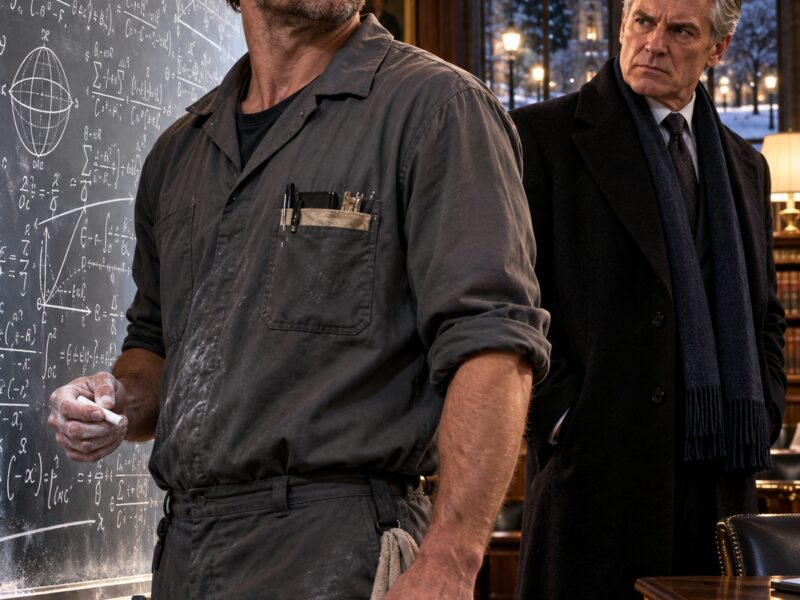
His gray uniform had been washed so many times that the fabric around the knees had faded lighter than the rest. Above the left pocket, his name had been stitched slightly crooked.
GIDEON ROR.
Thousands of students and professors had passed that name in three years.
Almost none remembered it.
That didn’t bother him as much as people might have assumed.
There were worse things than being invisible.
Gideon knew because he had experienced them.
Being seen and deliberately diminished was worse.
Being heard and deliberately disbelieved was worse.
Watching someone take something from you while everyone in the room quietly decided it was easier not to notice—that was worse.
So invisibility, in comparison, could almost feel peaceful.
He emptied a trash can outside Professor Ellison’s office.
Replaced the liner.
Wiped fingerprints from the glass panel beside the door.
He moved down the hallway.
Room 208.
Room 210.
Room 212.
Then he stopped outside Seminar Room 214.
The door was open.
Only a few inches.
Gideon frowned.
The senior research group used 214. They were obsessive about locking it because whiteboards were frequently left covered with work that hadn’t yet been published.
Someone rushing home for Christmas had apparently forgotten.
Gideon pushed the door wider with two fingers.
The lights were still on.
A half-empty paper coffee cup sat beside a laptop charger someone had forgotten. Crumpled pages surrounded the wastebasket instead of being inside it.
The front whiteboard was covered almost edge to edge with equations.
Gideon stopped.
For three years, he had cleaned around equations.
He had wiped away equations.
He had seen professors argue beneath them, graduate students photograph them, visiting scholars point at them with the ceremonial seriousness of priests interpreting scripture.
Usually Gideon never looked for more than a second.
Looking invited memory.
Memory invited questions.
And there were some questions he had spent years learning not to ask.
But this board was different.
His hand tightened around the handle of the cleaning cart.
He knew this problem.
Not the exact notation.
Not every symbol.
But the structure beneath it.
He stepped closer.
The research group had filled the board with increasingly elaborate attempts to repair a contradiction near the center of their model.
Gideon’s eyes moved from left to right.
Then back again.
His expression changed.
They were treating the contradiction as the problem.
It wasn’t.
The problem was eleven lines earlier.
A foundational assumption.
A beautiful one.
An elegant one.
And, under a narrow set of conditions almost everyone would overlook, a false one.
Gideon stared at it.
He could almost hear a voice from another lifetime.
You don’t attack the complicated part first. Find the thing everyone agreed not to question.
His chest tightened.
For a moment, Seminar Room 214 disappeared.
He remembered another room.
Another board.
Another version of himself.
No gray uniform.
No cleaning cart.
No cracked hands from industrial detergent.
Just coffee going cold beside notebooks, sunlight coming through laboratory windows, arguments about models and boundary conditions lasting until two in the morning because back then Gideon believed truth was enough.
If you were correct, eventually people would listen.
He had once believed that with the arrogance of a young man who had never yet learned what power could do to truth.
He looked away.
“Not your problem,” he whispered.
The empty room offered no disagreement.
Gideon took the trash bag from the wastebasket.
He tied it.
He wiped the table.
He straightened two chairs.
Then he looked at the board again.
The error was still there.
He exhaled.
“No.”
He knew what would happen if he started.
That was precisely why he shouldn’t.
He had a child waiting at home.
He had a job.
A modest job, but an honest one.
He needed stability more than he needed the satisfaction of correcting strangers.
Gideon picked up his rag.
Then he saw the final line on the board.
Someone had circled the contradiction three times.
Beside it, in angry handwriting, was one word:
WHY?
Gideon stared at it.
Something old moved inside him.
Not pride.
Not ambition.
Something more dangerous.
Curiosity.
He put the rag down.
There was a piece of chalk in the tray.
His fingers hovered over it.
He almost laughed.
“You’re an idiot,” he murmured.
Then Gideon Ror picked up the chalk.
The first mark he made was small.
A diagonal line through the assumption near the upper left corner.
He paused.
Nothing happened.
No alarm sounded.
No professor stormed in.
Snow continued tapping softly against the windows.
Gideon wrote underneath it.
One line.
Then another.
His hand remembered before the rest of him did.
The hesitation disappeared.
His shoulders changed.
His posture changed.
Even his breathing changed.
For the first time in years, he wasn’t cleaning someone else’s thinking from a board.
He was thinking.
Really thinking.
The sensation was almost painful.
He rewrote the boundary condition.
Simplified the next transformation.
Moved backward instead of forward.
The team’s tangled structure began opening beneath his hands.
What had looked like a wall became a doorway.
He crossed out four lines.
Added two.
Paused.
Changed one symbol.
Then kept going.
Ten minutes passed.
Then twenty.
The cleaning cart sat forgotten near the door.
Gideon stepped back.
There.
Not complete.
But close.
Closer than anyone working on the project had apparently gotten in years.
He saw one remaining assumption near the bottom that would need a separate proof, but the architecture was correct.
His heart was beating harder now.
He hated that.
Because he remembered this feeling.
The dangerous happiness of discovering something true.
He set down the chalk.
White dust covered his fingers.
He was wiping it against his uniform when a voice came from behind him.
“What exactly do you think you’re doing?”
Gideon closed his eyes for half a second.
Then he turned.
Dean Malcolm Vay stood in the doorway.
Fifty-six years old.
Tailored charcoal coat.
Cashmere scarf.
A small gold pin from the faculty holiday reception still fastened to his lapel.
Malcolm had spent thirty years learning the architecture of institutions.
Which committees mattered.
Which donors remembered names.
Which professors were worth courting.
Which battles could be won quietly before anyone else knew they had begun.
He understood hierarchy instinctively.
And in Malcolm’s hierarchy, Gideon occupied a very simple position.
Custodial staff.
The dean looked at the chalk.
Then at the board.
Then back at Gideon.
“What are you doing?”
Gideon’s voice remained level.
“Fixing an error.”
For one strange second, Malcolm seemed unsure whether he’d heard correctly.
“You’re doing what?”
“There’s a false assumption in the model.”
Malcolm stepped into the room.
His eyes moved over the board.
The symbols meant little to him. His academic background was adjacent to the work, not deep enough in this specialty to evaluate what Gideon had written.
That should have made him cautious.
Instead, it embarrassed him.
And embarrassment, in certain men, becomes anger faster than thought.
“You’re the janitor.”
Gideon looked at him.
It wasn’t phrased as a question.
So he didn’t answer.
Malcolm’s jaw tightened.
“You are employed by this university to maintain these rooms. Not to interfere with departmental research.”
“I wasn’t interfering.”
“You wrote all over a research board.”
“I corrected it.”
Malcolm gave a short, incredulous laugh.
“You corrected it?”
“Part of it.”
“Do you have any idea what this project is?”
“Yes.”
That answer irritated Malcolm more than anything else Gideon had said.
“You have no authorization to access this work.”
“The board was visible when I entered.”
“That is not the point.”
Gideon glanced toward the equations.
“It should be.”
Malcolm stared at him.
There was a long silence.
The radiator hissed beneath the windows.
Wind pressed snow against the glass.
Malcolm walked toward the board and pointed at the writing.
“Erase it.”
Gideon didn’t move.
“Excuse me?”
“I said erase it.”
“The original work is still visible.”
“I don’t care.”
“You should.”
Something shifted in Malcolm’s face.
Gideon recognized it immediately.
He had seen that expression before.
Years earlier.
Different man.
Different institution.
Same expression.
The moment authority realizes calm resistance is more threatening than anger.
Malcolm lowered his voice.
“You appear to have forgotten your position here.”
“No.”
Gideon looked down at his gray shirt.
“I know exactly what my position is.”
“Then act like it.”
That landed.
Not because Gideon hadn’t heard worse.
Because once, long ago, someone had said almost the same thing to him.
Know your place.
Different words.
Same message.
Gideon’s face went still.
Malcolm mistook the silence for surrender.
“You will erase that board. Then you’ll report to facilities tomorrow morning.”
“It’s Christmas tomorrow.”
“Then the day after.”
Gideon looked at the equations.
“No.”
Malcolm blinked.
“No?”
“I won’t erase it.”
“You don’t have a choice.”
“Then someone else can erase it.”
Malcolm took another step toward him.
“Mr. Ror, do you understand that I can terminate your employment?”
“Yes.”
“Immediately.”
“Yes.”
“And you’re still refusing?”
Gideon met his eyes.
“Yes.”
The answer was quiet.
That made it worse.
Malcolm’s face hardened.
“Fine.”
He pointed toward the hallway.
“You’re finished here. Effective tonight.”
For the first time, Gideon’s expression changed.
Not much.
Just enough.
A slight tightening around the eyes.
Malcolm saw it and thought he’d finally reached him.
“Turn in your keys before leaving.”
Gideon didn’t answer immediately.
His mind had already left the room.
Rent.
Electricity.
Groceries.
School lunch account.
The winter boots.
January.
February.
How long could his savings last?
Not long.
A single parent learns to translate catastrophe into numbers quickly.
Gideon swallowed.
“Understood.”
Malcolm seemed almost disappointed by the absence of argument.
“That’s all you have to say?”
Gideon picked up his rag.
“What would you like me to say?”
“An explanation might have helped before you decided to vandalize university research.”
Gideon looked toward the board.
“You never asked for one.”
Malcolm opened his mouth.
But Gideon had already turned away.
He pushed the cart into the corridor.
His keys felt heavier in his pocket than they had five minutes earlier.
At the supply closet, he removed them one by one.
Building access.
Faculty corridor.
Storage.
Seminar rooms.
Three years of his life reduced to metal on a ring.
He placed them in an envelope.
Then he took his coat from the hook.
His phone showed two missed messages.
The first was from his child.
Dad, are you still bringing the cinnamon rolls tomorrow?
The second came two minutes later.
Don’t forget 🙂
Gideon stared at the smiley face.
His throat tightened.
He typed:
Wouldn’t miss it.
He did not type:
I just lost my job.
He put the phone away.
Before leaving, Gideon looked once down the long corridor toward Room 214.
He could still see light spilling through the doorway.
The board remained untouched.
For years he had trained himself to stop caring whether anyone saw his work.
Tonight, for reasons he didn’t fully understand, he wanted someone to see it.
Not his name.
Not him.
Just the answer.
So Gideon walked out into the snow.
And left the equations behind.
At 8:16 the next morning, Dr. Celeste Maro nearly erased them.
Celeste was thirty-nine and had the peculiar relationship with Christmas common among researchers whose work did not respect calendars.
She liked the holiday.
She simply disliked unresolved problems more.
The Ashworth computational project had been unresolved for twelve years.
Celeste had personally given six of those years to it.
Two grants.
Three doctoral dissertations.
Dozens of conference presentations.
Hundreds of failed variations.
Millions of dollars in institutional funding.
They had gotten close.
Always close.
Never there.
She entered Seminar Room 214 carrying coffee and a folder thick with handwritten notes.
Then stopped.
“What the hell?”
The whiteboard was covered in unfamiliar handwriting.
Her first reaction was annoyance.
Someone had worked after her team left.
Someone had changed the model.
Without documentation.
Without leaving a note.
“Fantastic.”
She put her coffee down and reached for the eraser.
Then she saw the diagonal line through the foundational assumption.
Celeste froze.
“Who…”
She leaned closer.
The replacement condition beneath it was absurd.
Or at least it looked absurd.
Her team had treated that assumption as settled for more than a decade.
Every model depended on it.
Every publication referenced it.
Every grant renewal implicitly assumed it.
Changing it would mean—
Celeste stopped.
She read the next line.
Then the next.
Her hand slowly lowered.
“No.”
She put the eraser down.
Read it again.
The writer wasn’t trying to repair the contradiction.
He had moved the problem backward.
Celeste’s heartbeat changed.
She pulled out her phone.
Not to call anyone.
To photograph the board.
One image.
Two.
Five.
Nine.
She moved closer.
Photographed every section.
Graduate assistant Owen Mercer entered carrying a backpack and stopped.
“Professor Maro?”
She didn’t answer.
“Professor?”
“Who wrote this?”
Owen looked at the board.
“No idea.”
“Was anyone here after we left?”
“Maybe.”
“Who?”
“I don’t know.”
Celeste turned.
“Owen.”
Something in her voice made him straighten.
“Who was in this room?”
He thought.
“Facilities, probably.”
“Facilities?”
“The cleaning staff.”
Celeste stared at him.
Owen hesitated.
“Actually…”
“What?”
“There was some thing last night.”
“What thing?”
“Dean Vay fired somebody.”
Celeste’s face changed.
“Who?”
“The janitor.”
“What janitor?”
“I don’t know his name.”
She looked back at the board.
“What did he do?”
Owen shrugged.
“I heard he was writing on one of the research boards.”
Celeste slowly turned toward him again.
“You heard Malcolm fired a janitor for writing on a research board.”
“That’s what someone said.”
“And you didn’t think that was worth mentioning before now?”
“I thought he was just… you know.”
“No. I don’t know.”
Owen glanced at the equations.
Celeste stepped aside.
“Read the second transformation.”
He did.
His expression changed.
“Wait.”
“Keep going.”
He leaned closer.
Thirty seconds passed.
Then another thirty.
“That can’t work.”
“Why?”
“Because the initial assumption—”
“Forget the initial assumption.”
“But the whole model—”
“I know.”
Celeste’s voice dropped.
“Forget it.”
Owen followed the logic.
His face lost color.
“Oh.”
Celeste nodded.
“Exactly.”
“Whoever wrote this…”
“Yes.”
“Did they know about the boundary problem?”
“They didn’t just know about it.”
Celeste picked up her coffee, realized her hand was shaking, and set it back down.
“They understood why we’ve been asking the wrong question.”
She went immediately to Human Resources.
Christmas morning staffing was minimal.
A woman named Janet sat behind the front desk wearing a red sweater and the expression of someone who had already been asked too many questions before nine.
“I need the personnel file for a facilities employee terminated last night.”
Janet looked up.
“Today?”
“Yes.”
“Professor Maro, it’s Christmas.”
“I know what day it is.”
“Can this wait?”
Celeste placed her phone on the counter.
A photograph of Gideon’s equations filled the screen.
“No.”
Twenty minutes later, Celeste was holding the thinnest personnel file she had ever seen.
Gideon Ror.
Age forty-one.
Facilities employee.
Nearly three years at Ashworth.
Hourly wage.
Emergency contact.
Address.
Nothing else.
No academic credentials.
No publications.
No prior research appointments.
No explanation.
Celeste turned the page.
There wasn’t another page.
“This is it?”
Janet nodded.
“That’s it.”
Celeste looked at the file again.
A man who could see through twelve years of research failure had been reduced, institutionally, to six lines and an hourly rate.
Something about that made her furious.
But anger wasn’t proof.
Mathematics was.
So Celeste went back upstairs.
She locked Room 214.
Then she tried to destroy Gideon’s solution.
Not physically.
Intellectually.
She attacked it.
Every researcher knew the seduction of elegant wrong answers. Sometimes a beautiful argument survived twenty minutes precisely because people wanted it to be true.
Celeste refused to want anything.
She checked every transformation.
Found a section she distrusted.
Erased it from a copied board.
Rebuilt it using her team’s method.
Failed.
She tried again.
Failed.
She switched frameworks.
Failed.
Then she reconstructed Gideon’s route.
It worked.
Celeste sat down.
“No way.”
She stood again.
Tried another boundary case.
It held.
Another.
Held.
Then she found the remaining unproven assumption near the bottom.
Her pulse slowed.
There.
A weakness.
Maybe the whole thing collapsed after all.
She was examining it when Malcolm Vay entered.
“I want that board erased.”
Celeste didn’t turn.
“Good morning to you too.”
“I’m serious.”
“So am I.”
“That writing was made by an unauthorized employee.”
Celeste finally faced him.
“Have you read it?”
“That’s irrelevant.”
“No, Malcolm. At a university, whether an idea is correct is rarely irrelevant.”
“He violated policy.”
“Did you read it?”
“I don’t need to.”
Celeste stared at him.
“That’s an extraordinary sentence for a dean.”
His jaw tightened.
“Don’t make this personal.”
“You fired him.”
“For misconduct.”
“What misconduct?”
“He interfered with protected research.”
“By improving it?”
“You don’t know that.”
“Neither do you.”
Celeste pointed toward the board.
“But unlike you, I’m trying to find out.”
Malcolm’s eyes hardened.
“He is a janitor.”
“And?”
“And he had no business—”
“Stop.”
Celeste rarely interrupted senior administrators.
She did now.
“Say that sentence again and listen to yourself.”
Malcolm’s expression turned cold.
“Be careful.”
“About what?”
“About turning an employment matter into some kind of crusade.”
Celeste laughed once.
There was no humor in it.
“This department has spent twelve years on this problem.”
“I am aware.”
“We’ve burned through grants. We’ve lost researchers to MIT, Stanford, Carnegie Mellon, people who got tired of telling funding committees we were almost there.”
“Your point?”
“My point is that the man you fired may have walked into this room and identified our foundational error in less than an hour.”
For the first time, Malcolm said nothing.
Celeste stepped closer.
“You don’t have to believe me.”
She pointed at the board.
“But you should be terrified enough to check.”
Something flickered behind his eyes.
Not fear.
Not yet.
But uncertainty.
Malcolm looked at the board.
Then at Celeste.
“Erase it.”
He turned and left.
Celeste watched the door close.
Then whispered:
“Absolutely not.”
Finding Gideon took two days.
The address in his personnel file led to an apartment complex twenty minutes from campus, where snow had accumulated beside the stairs and a plastic Christmas wreath hung crookedly on the main entrance.
Celeste stood outside Apartment 2C with her phone in one hand.
She knocked.
Footsteps approached.
The door opened.
Gideon recognized her immediately.
“You’re the professor.”
“Celeste Maro.”
“I know.”
That surprised her.
“You know who I am?”
“I cleaned your office.”
She didn’t know what to say to that.
Of course he had.
She had probably walked past him dozens of times.
Maybe hundreds.
“Can I help you?”
Celeste raised her phone.
The whiteboard photograph glowed between them.
“I think you already did.”
Gideon’s face became unreadable.
From somewhere inside the apartment came a child’s voice.
“Dad?”
“One minute.”
He stepped partly into the hallway and pulled the door closer behind him.
Celeste noticed the gesture.
Protective.
Private.
She lowered her voice.
“I want to talk about what you wrote.”
“You shouldn’t be here.”
“Probably not.”
“Did Malcolm send you?”
“No.”
“HR?”
“No.”
“Then why?”
“Because I’ve spent six years working on that problem.”
Gideon said nothing.
“And you changed one assumption.”
Still nothing.
“And half the structure opened.”
His eyes shifted toward the phone.
Celeste continued.
“I need to know whether you understood what you were doing.”
Gideon almost smiled.
“That’s what he asked too.”
“No.”
She shook her head.
“He asked why a janitor was touching his board.”
That got his attention.
“I’m asking about the mathematics.”
A long silence passed.
Then Gideon opened the door.
“Five minutes.”
His apartment was small.
Clean.
Warm.
A child’s backpack hung from a chair.
Paper snowflakes had been taped to the window.
There was a Christmas tree in the corner, barely five feet tall, decorated with mismatched ornaments and lights that blinked unevenly.
Beside the kitchen sat a narrow desk.
Celeste noticed the books immediately.
Advanced computational theory.
Applied mathematics.
Nonlinear systems.
Several were editions more than fifteen years old.
Their spines were cracked.
Pages marked.
Used.
Not decoration.
Gideon noticed her looking.
“Five minutes,” he repeated.
Celeste sat at the kitchen table.
She opened the photograph.
“Is this correct?”
“Mostly.”
“Mostly?”
“Not complete.”
She zoomed in.
“Where?”
Gideon pointed.
“Here.”
“The limiting assumption?”
“Yes.”
“I tested it.”
“Under what conditions?”
She told him.
He shook his head.
“Those are the easy ones.”
Celeste stared.
“Easy?”
He pulled a scrap of paper from beside the refrigerator.
Then a pencil.
Three lines later, Celeste understood.
Her stomach dropped.
“Oh.”
“That’s why I stopped.”
“You knew this last week?”
“Yes.”
“How?”
Gideon set the pencil down.
Celeste looked at the books.
Then at him.
“Where did you study?”
His expression closed.
“Does it matter?”
“Yes.”
“Why?”
“Because people don’t accidentally know this.”
He leaned against the counter.
“People accidentally know things all the time.”
“Not this.”
Silence.
Celeste waited.
Gideon looked toward the living room.
His child was watching television quietly.
Finally he said:
“I worked in research.”
“When?”
“A long time ago.”
“Where?”
“It doesn’t matter.”
“What happened?”
His eyes came back to hers.
“That matters even less.”
Celeste knew when someone was telling her not to push.
She changed direction.
“Can you finish the proof?”
Gideon looked at the photograph.
“Yes.”
The answer was immediate.
No performance.
No hesitation.
Celeste felt something cold move through her.
“You’re certain?”
“Yes.”
“Then why didn’t you?”
“I was fired.”
“You know what I mean.”
Gideon looked toward the window.
Snow had begun falling again.
“Why didn’t I tell anyone before?”
“Yes.”
He was quiet for so long Celeste thought he wouldn’t answer.
Then he said:
“Because the last time I told people what I knew, they didn’t want to hear it.”
Celeste didn’t move.
There was no bitterness in his voice.
That was what made the sentence worse.
Bitterness meant the wound was still fighting.
Gideon’s sounded scarred over.
She looked at the worn books again.
“You never stopped.”
“Stopped what?”
“Working.”
“I stopped publishing.”
“That’s not what I said.”
Their eyes met.
For the first time, Gideon seemed almost uncomfortable.
Celeste stood.
“I won’t ask what happened.”
“Good.”
“But I’m going to ask you something else.”
“No.”
“You don’t know what I’m asking.”
“I have a pretty good idea.”
“Come back.”
He laughed softly.
Not because it was funny.
“No.”
“Not as an employee.”
“Still no.”
“Not for Malcolm.”
“No.”
“For the proof.”
Gideon looked at her.
Celeste placed her phone on the table.
“For the truth.”
His expression changed slightly.
She saw it.
A crack.
Small.
But there.
“It deserves to be finished,” she said.
Gideon looked at the photograph for a long time.
Then his child called from the other room.
“Dad, the movie started.”
Gideon picked up the phone and handed it back.
“You should go.”
Celeste walked toward the door.
Before leaving, she turned.
“I’m going to keep checking it.”
“I assumed you would.”
“And if it’s right?”
Gideon opened the door.
“Then it’s right.”
“That’s all?”
He looked at her.
“What else would it need to be?”
Celeste thought about that question all the way home.
She returned three days later.
Then again.
She never brought Malcolm.
Never brought administrators.
Never brought promises.
She brought questions.
The first time, Gideon answered through the doorway.
The second, he let her sit at the kitchen table.
The third, they argued for forty minutes over a boundary condition.
That was the first time Celeste saw him come alive.
He forgot to be guarded.
Forgot to be the quiet custodian Ashworth had trained itself not to notice.
He stood over the kitchen table drawing equations on the backs of grocery receipts.
“No,” Celeste said. “You’re assuming stability here.”
“I’m not.”
“You are.”
“Look again.”
She did.
“Damn.”
Gideon smiled.
It vanished quickly.
But she saw it.
A week later, he agreed to return to Ashworth after hours.
“No announcement,” he said.
“Agreed.”
“No faculty audience.”
“Agreed.”
“No photographs.”
“Agreed.”
“And Malcolm doesn’t get to turn this into some redemption ceremony.”
Celeste hesitated.
“Agreed.”
Gideon studied her.
“You agreed too quickly.”
“I really want this proof finished.”
That almost made him smile again.
They entered Seminar Room 214 shortly after nine.
The campus was silent.
Gideon stood in front of the board.
For several seconds, he didn’t move.
Celeste understood that she was watching something private.
A man returning to a place that had rejected him.
Not Ashworth.
Something older.
He picked up the chalk.
“Show me where you think the remaining assumption fails,” Celeste said.
Gideon began.
They worked for hours.
Celeste quickly realized that Gideon’s mind didn’t move like hers.
She had been trained to build upward.
Lemma.
Transformation.
Constraint.
Result.
Gideon moved sideways.
Sometimes backward.
He questioned definitions everyone else treated as permanent.
At one point he erased nearly a quarter of the board.
Celeste stared.
“We need that.”
“No.”
“We absolutely need that.”
“We need the result.”
“Which depends on this.”
“Only if you assume the previous structure is necessary.”
“It is necessary.”
“Why?”
She opened her mouth.
Stopped.
Gideon waited.
Celeste looked at the board.
Then at him.
“Oh, I hate you.”
He nodded.
“That usually means you’re about to see it.”
She did.
At 1:38 in the morning, the final obstruction disappeared.
Gideon wrote one last line.
Set down the chalk.
Neither spoke.
Celeste read from the beginning.
Slowly.
Every step.
Every condition.
Every transition.
She reached the end.
Then started over.
Gideon waited.
“Well?” he finally asked.
Celeste checked one final substitution.
Her eyes filled unexpectedly.
She laughed under her breath.
“Twelve years.”
Gideon said nothing.
“Twelve damn years.”
She turned.
“It’s correct.”
He looked at the board.
“Check it again.”
“I did.”
“Again.”
“Gideon.”
“Again.”
She did.
Nothing changed.
Celeste put both hands against the edge of the desk.
“We have it.”
Gideon lowered his head.
She expected triumph.
Instead she saw exhaustion.
The kind that had been waiting years to arrive.
Then the door opened.
Malcolm Vay stood there.
Gideon’s face became blank again.
Malcolm’s gaze moved from Celeste to Gideon.
Then to the board.
“What is he doing here?”
Celeste straightened.
“Finishing the proof.”
“I told you—”
“I heard what you told me.”
“This man is no longer an employee of this university.”
“Correct.”
“Then he has no authorization to be in this room.”
“He is here at my invitation.”
“You don’t have the authority—”
“Then fire me too.”
Malcolm stopped.
Celeste rarely raised her voice.
She didn’t now.
That made the sentence heavier.
Malcolm looked at Gideon.
“Did you write this?”
“Yes.”
“All of it?”
“Celeste contributed.”
Celeste almost laughed.
Even now.
Even after everything.
He shared credit instinctively.
Malcolm approached the board.
“Erase it.”
Celeste stared at him.
“What?”
“I want it erased.”
“Have you lost your mind?”
“This is unauthorized work produced through unauthorized access.”
“It’s mathematics, Malcolm.”
“It’s university property.”
“No. The board is university property.”
She pointed toward the equations.
“Truth isn’t.”
Malcolm turned to Gideon.
“You were explicitly told not to touch departmental research.”
Gideon nodded.
“I remember.”
“And yet you came back.”
“She asked me.”
“That does not give you authority.”
Gideon studied Malcolm for a moment.
Then said:
“Erase it.”
Celeste spun toward him.
“What?”
“If he wants it erased, erase it.”
“Gideon, no.”
He looked at her.
“If it’s correct, it’ll still be correct after the board is clean.”
Silence.
Celeste stared at him.
And suddenly she understood something fundamental.
Gideon wasn’t trying to win.
That was why Malcolm couldn’t understand him.
Men like Malcolm knew how to respond to ambition.
Ambition could be negotiated.
Rewarded.
Threatened.
Contained.
But Gideon wanted something Malcolm had no mechanism for controlling.
He wanted the work judged honestly.
Nothing more.
Nothing less.
Malcolm left.
Celeste waited until his footsteps disappeared.
Then she pulled out her phone.
“What are you doing?” Gideon asked.
“Making sure no one can erase the only copy.”
She photographed every inch.
That night she sent the proof to three researchers.
She did not include Gideon’s name.
She did not mention his job.
She did not mention Malcolm.
Her message was simple:
Please evaluate the attached argument independently. I need to know whether you can identify a structural error.
The first reply arrived the following afternoon.
No error identified.
The second came that evening.
The argument appears sound.
The third researcher took longer.
Dr. Nathan Cole was famous for destroying weak proofs with almost recreational cruelty.
Celeste trusted him precisely because he was difficult to impress.
His response arrived at 3:12 a.m.
She opened it in bed.
Read it once.
Then sat up.
Read it again.
I can’t break it. Who wrote this?
Celeste stared at the message.
Then whispered:
“Now we find out who you are.”
She began searching.
Not current databases.
Old ones.
Conference archives.
Dissertations.
Research repositories.
Names.
Initials.
Acknowledgments.
Nothing.
Gideon Ror seemed not to exist.
Then she found a paper from more than a decade earlier.
The subject made her stop immediately.
The methodology was different, but the conceptual fingerprints felt familiar.
She read the published version.
One lead author.
Two secondary authors.
Gideon’s name nowhere.
She almost closed it.
Then she noticed a repository link to an earlier draft.
Celeste opened it.
Scanned.
Compared.
The acknowledgment section had changed.
She zoomed in.
There.
An early conceptual contribution credited to:
Gideon Ror.
Celeste sat completely still.
She pulled up the final publication.
The wording remained.
The name did not.
Someone else had replaced him.
She searched deeper.
Old conference programs.
Archived faculty pages.
Cached biographies.
Fragments appeared.
A younger Gideon.
Research assistant.
Computational mathematics.
Promising preliminary work.
Then nothing.
He hadn’t failed out.
He hadn’t drifted away.
He had disappeared immediately after a paper built partly on his ideas was published under someone else’s name.
Celeste felt sick.
When she brought the documents to his apartment, Gideon didn’t look surprised.
He looked tired.
“I found it,” she said.
“I know.”
“You knew this archive existed?”
“Yes.”
“Why didn’t you fight?”
“I did.”
Celeste went quiet.
Gideon sat at the kitchen table.
“For a while.”
“What happened?”
“They had seniority. Funding. The principal investigator had spent twenty-five years building relationships. I had a temporary research contract and a child coming.”
Celeste stared.
“You were already a father?”
Gideon nodded.
“I complained internally.”
“And?”
“They investigated.”
His mouth tightened.
“You know how institutions investigate themselves when the answer they want is already obvious?”
Celeste did.
“They said attribution had been handled appropriately.”
“But your name was removed.”
“Yes.”
“That’s not appropriate.”
“No.”
“Did you have the drafts?”
“Yes.”
“Emails?”
“Yes.”
“Then how—”
“Celeste.”
His voice stopped her.
“Being right and being able to survive proving you’re right aren’t the same thing.”
She said nothing.
“I was offered another short contract,” he continued. “On the condition that I stop making the dispute public.”
“You refused?”
“At first.”
He looked toward the room where his child slept.
“Then life got expensive.”
Celeste understood.
Not completely.
Maybe nobody who hadn’t lived it could.
But enough.
“I left.”
“And mathematics?”
“I didn’t leave mathematics.”
He glanced toward the worn books.
“I left academia.”
Celeste placed the archived paper between them.
“We can restore your name.”
“No.”
She stared at him.
“Gideon.”
“No.”
“They stole your work.”
“I know.”
“You deserve—”
“I know what I deserved.”
There was no anger in the sentence.
Just finality.
“Then what do you want?”
Gideon looked at her.
“The new proof recognized as correct.”
“That’s it?”
“That’s it.”
“What about credit?”
“My name can be attached to the proof.”
“But the old paper—”
“No.”
“Why?”
He was quiet.
Then:
“Because I spent years thinking getting my name back would give me those years back.”
Celeste didn’t move.
“It won’t.”
He pushed the paper toward her.
“My child was little when that happened. I spent half those years angry at people who probably forgot my name before I forgot theirs.”
He looked at the old publication.
“I don’t want to give them another decade.”
Celeste lowered her eyes.
“The new work matters.”
He tapped the paper once.
“This doesn’t anymore.”
But at Ashworth, it mattered.
Not because Gideon demanded revenge.
Because the university now had to confront a much more uncomfortable question.
How many times had this happened before?
The emergency review was convened four days later.
Senior faculty filled the conference room.
Administrators attended remotely.
Legal counsel sat near the end of the table.
Malcolm Vay arrived early.
Gideon arrived exactly on time.
He wore a plain dark sweater.
No gray custodial uniform.
Celeste noticed people looking at him differently without the uniform.
That irritated her more than she expected.
Same face.
Same mind.
Different shirt.
Suddenly they could imagine him belonging in the room.
Malcolm began.
“This situation originated from a serious breach of research protocol.”
Celeste almost smiled.
Of course it did.
Not twelve years of failure.
Not a potentially major mathematical breakthrough.
Not a man being fired without a single question.
Protocol.
Malcolm continued.
“Mr. Ror was employed in a custodial capacity and accessed restricted academic material without authorization—”
“He walked into an unlocked room to empty a trash can,” Celeste said.
Malcolm looked at her.
“You’ll have your opportunity.”
“I’m saving everyone time.”
The committee chair, Dr. Evelyn Hart, raised one hand.
“Let him finish.”
Malcolm did.
He described boundaries.
Policy.
Security.
Intellectual property.
He used Gideon’s job title repeatedly.
Custodian.
Facilities employee.
Nonacademic staff.
When he finished, Evelyn turned to Celeste.
Celeste didn’t give a speech.
She gave them evidence.
Photographs of the original board.
Time stamps.
Her reconstruction.
The completed proof.
Independent verification from three researchers.
Then the archived paper.
The room changed when she projected Gideon’s old name onto the screen.
She explained only what she could prove.
No accusations beyond the record.
No dramatic language.
She didn’t need it.
Finally, she said:
“The person who identified the structural failure in this project was not a visiting scholar.”
Silence.
“Not a senior professor.”
She looked toward Gideon.
“And not someone this university considered academically qualified to enter the conversation.”
Malcolm shifted.
Celeste continued.
“He was the man emptying our trash.”
Nobody moved.
“And we fired him before asking what he knew.”
Dr. Hart removed her glasses.
“Mr. Ror.”
Gideon looked up.
“Would you come forward?”
He did.
A senior professor named Whitmore spoke.
“I’ve reviewed the proof.”
Gideon waited.
“I have a question regarding step seven.”
“Go ahead.”
Whitmore asked.
Gideon answered.
No hesitation.
Another professor interrupted.
“What if the stability condition fails before the second transformation?”
“It doesn’t.”
“Why?”
Gideon walked to the board.
He picked up a marker.
Three lines.
“Because you’re measuring the wrong variable.”
The professor frowned.
Gideon added another line.
The professor’s expression changed.
“Oh.”
A third question came.
Then a fourth.
Soon the meeting stopped being about Gideon’s employment.
It became mathematics.
Exactly what he had wanted from the beginning.
People leaned forward.
Not because they felt sorry for him.
Because they needed to understand him.
For nearly forty minutes Gideon answered questions.
Sometimes he said, “I don’t know.”
Sometimes, “I haven’t tested that.”
Once he told a professor flatly, “You’re right. That notation is sloppy.”
Celeste hid a smile.
There was no performance.
No attempt to make them regret overlooking him.
The absence of revenge made their mistake somehow more visible.
Finally Evelyn Hart asked:
“Mr. Ror, where did you learn this?”
Gideon put the marker down.
“A long time before I became a janitor.”
Nobody laughed.
The room went very quiet.
Evelyn nodded.
Then turned to Malcolm.
“Dean Vay.”
Malcolm’s hands were folded on the table.
For the first time since Celeste had known him, he looked older than fifty-six.
The committee reviewed his decisions.
He had terminated Gideon without investigating what had been written.
He had refused to evaluate the work.
He had ordered the board erased.
He had attempted to treat an intellectual question as an issue of hierarchy before determining whether the contribution was valid.
Nobody called Malcolm evil.
That would have been easier.
Evil lets everyone else feel innocent.
The truth was more uncomfortable.
Malcolm had done something ordinary.
He had looked at a uniform and assumed it told him how much the man inside it could know.
And almost everyone in that building had been making a quieter version of the same assumption for three years.
Eventually Evelyn asked:
“Dean Vay, do you have anything you’d like to add?”
Malcolm looked at Gideon.
A week earlier, he had ordered him from a room.
Now Gideon sat while Malcolm had to explain himself.
“I believed I was protecting the department.”
Celeste spoke softly.
“From what?”
Malcolm looked at her.
“From disorder.”
“An incorrect proof is disorder.”
She nodded toward Gideon.
“A correct one isn’t.”
Malcolm lowered his eyes.
Several seconds passed.
Then he looked directly at Gideon.
“I was wrong.”
Nobody moved.
It was the sentence everyone had been waiting for.
But Gideon didn’t look satisfied.
He didn’t smile.
Didn’t lean back.
Didn’t make Malcolm repeat it.
He simply said:
“Then fix it.”
Malcolm blinked.
“What?”
“Fix it.”
“What would you like me to do?”
Gideon thought about the question.
He could have asked for money.
A title.
Public recognition.
An apology in writing.
He could have demanded Malcolm’s resignation.
Maybe some people in the room expected exactly that.
Instead Gideon said:
“Make sure the next person doesn’t need the right title before anyone asks what they know.”
Malcolm stared at him.
Gideon continued.
“You fired me because you saw a janitor holding chalk.”
The room remained silent.
“You didn’t ask why I understood the problem.”
He looked around the table.
“Nobody did.”
Celeste felt the words land beyond Malcolm.
Exactly where they belonged.
“That can’t be fixed by giving me an office.”
Gideon paused.
“It gets fixed when the next person isn’t invisible.”
No one applauded.
Gideon was grateful for that.
Applause would have made the moment smaller.
The university’s response unfolded over months rather than in one dramatic afternoon.
Policies changed.
Cross-department research forums were opened to staff.
A formal process was created allowing contributions to be evaluated without credential screening at the first stage.
The mathematics department instituted independent review requirements before research material could be destroyed during a dispute.
Malcolm remained at Ashworth, though something about him changed.
Not magically.
Not completely.
People rarely transform because of one humiliation.
But Celeste noticed he began asking more questions before giving orders.
Sometimes that was all change looked like at first.
A pause where certainty used to be.
As for Gideon, Ashworth offered him a research consultancy.
He refused the first version.
Too ceremonial.
Too much language about “exceptional circumstances.”
He hated that phrase.
It suggested the university had discovered a miracle rather than admitted a failure of perception.
Celeste rewrote the proposal.
Research consultant.
Flexible hours.
Access to the department.
Independent project work.
No teaching requirement.
No demand that he perform gratitude.
She slid it across the table.
Gideon read it twice.
“Do I have to wear a vest?”
Celeste stared.
Then laughed so hard the administrative assistant outside looked through the glass.
“No.”
“Do I have to let graduate students call me Professor Ror?”
“Only if you enjoy watching them panic.”
“I don’t.”
“Then no.”
He looked at the salary.
It wasn’t spectacular.
But it was more than custodial work.
Enough to make the arithmetic of his life less frightening.
Enough for groceries without calculating every item twice.
Enough for new winter boots without waiting until the next paycheck.
Enough to breathe.
He signed.
His new office was small.
Almost insultingly small.
Gideon loved it.
One desk.
One chair.
One whiteboard.
A narrow window overlooking the eastern edge of campus.
He brought his old books from the apartment.
Nothing else.
For the first several weeks, he still arrived before most faculty.
Still stayed late.
Still instinctively picked up abandoned coffee cups when he passed them.
Once Celeste found him wiping a conference table.
She leaned against the doorway.
“You know we employ people for that.”
Gideon looked at the rag in his hand.
Then at her.
“Old habits.”
He set it down.
But the strangest adjustment wasn’t Gideon’s.
It was everyone else’s.
People who had walked past him for years now stopped.
“Mr. Ror, do you have a minute?”
“Gideon, could you look at this?”
“Can I ask you something?”
At first, he found it irritating.
Then sad.
Then, eventually, ordinary.
One afternoon Owen Mercer stood outside Gideon’s office holding three pages of calculations.
“Can I ask you a stupid question?”
Gideon looked up.
“Probably.”
Owen hesitated.
“How do you know which assumption to question?”
Gideon leaned back.
“You don’t.”
“That’s helpful.”
“You question the one everyone gets angry about when you touch it.”
Owen laughed.
Gideon didn’t.
“I’m serious.”
The graduate student slowly stopped smiling.
Gideon pointed at his pages.
“Show me.”
Outside, winter became spring.
Spring became summer.
The completed proof entered formal publication review with Gideon’s name where it belonged.
Gideon Ror.
Not “custodial contributor.”
Not “nonacademic assistant.”
Not a footnote.
His name.
Celeste asked once whether seeing it felt good.
Gideon stared at the draft.
“Strange.”
“Good strange?”
“Just strange.”
She didn’t push.
Some wounds do not turn into triumph simply because the ending improves.
Sometimes the best you get is that they stop bleeding.
The following December, snow returned to Ashworth.
Christmas Eve came quietly.
Most of the campus emptied again.
Lights disappeared from dorm windows.
Cars left the faculty lot one by one.
By eight that evening, the mathematics building was nearly silent.
Exactly one year had passed.
Celeste found Gideon in Seminar Room 214.
Of course she did.
He stood in front of the board.
The completed proof remained preserved in a framed photographic print on the side wall now.
Gideon hated that.
Celeste had insisted.
“Academic history,” she’d called it.
“Decorative clutter,” he’d replied.
But he hadn’t taken it down.
Celeste entered carrying two coffees.
“You’re working on Christmas Eve again.”
“So are you.”
“I’m here because you’re here.”
“That’s a poor excuse.”
She handed him a cup.
Outside the tall windows, snow drifted through the light.
For a while, neither spoke.
Celeste looked at the framed proof.
Then at Gideon.
“Do you know what still bothers me?”
“A long list comes to mind.”
“You could have solved it years earlier.”
“Possibly.”
“And you never tried to prove you were smarter than anyone here.”
Gideon took a sip of coffee.
“That would’ve been exhausting.”
“I’m serious.”
“So am I.”
She looked toward the old photograph.
“Twelve years.”
Gideon nodded.
“Do you ever think about that?”
“The department’s twelve years?”
“Yours.”
He became still.
Celeste immediately regretted asking.
But Gideon didn’t shut down.
Not anymore.
He looked through the window.
“When my child was younger, I used to think about everything I should have fought harder for.”
Celeste waited.
“The paper. My career. My name.”
Snow collected against the glass.
“I thought if I could go back and win one argument, everything afterward would be different.”
“Would it?”
“Probably.”
He smiled faintly.
“But that’s the problem with imaginary lives. You only imagine the parts that improve.”
Celeste looked at him.
Gideon continued.
“If I’d stayed, maybe I’d have published more. Maybe I’d have gotten tenure somewhere. Maybe I’d have become exactly like the people I hated.”
“You wouldn’t.”
“You don’t know that.”
She had no answer.
He turned back toward the board.
“My kid remembers me making breakfast.”
A pause.
“That’s not nothing.”
“No.”
Celeste’s voice softened.
“It isn’t.”
Gideon placed the coffee on the desk.
There was fresh chalk on the tray.
He picked up a piece.
Celeste watched.
“What are you doing?”
“Working.”
“On Christmas Eve?”
He glanced at her.
“You came here voluntarily.”
“Fair.”
Gideon turned to the board.
For a moment, he simply stared at the blank surface.
A year earlier, he had stood in that same room wearing a gray uniform, wondering whether correcting one equation was worth risking the small stability he had built for his child.
He had lost his job.
His past had been dragged into the light.
A dean had been forced to admit he was wrong.
A university had learned, painfully, that intelligence did not arrive with permission from Human Resources.
And Gideon had been given something he hadn’t realized he missed until it returned.
Not prestige.
Not revenge.
Not even recognition.
Room.
Room to think.
Room to ask.
Room to be wrong.
Room to be right.
Room to exist without someone deciding beforehand how much his mind was allowed to contain.
Celeste leaned against the desk.
“You’re smiling.”
“I’m not.”
“You are.”
“Must be the lighting.”
She laughed.
Gideon raised the chalk.
Then stopped.
“Celeste.”
“Yeah?”
“Thank you.”
She stared at him.
It was the first time he’d said it.
Not because he wasn’t grateful before.
Because Gideon was careful with gratitude.
He hated when gratitude became debt.
“For what?”
He looked at the board.
“For asking.”
Celeste swallowed.
“That’s a pretty low bar.”
“You’d be surprised.”
She looked toward the corridor beyond the open door.
A year earlier, people had passed Gideon without asking anything.
What did he think?
What did he know?
Why was he looking at the board that way?
Who had he been before the uniform?
What had happened to him?
What might he see that they couldn’t?
Sometimes the cruelty wasn’t that people were openly cruel.
Sometimes it was that they never became curious enough to discover they were wrong.
Celeste turned back.
“So what are you writing?”
Gideon placed the chalk against the board.
A small white mark appeared.
Then another.
“The next question.”
Celeste smiled.
He began writing.
Outside, snow fell over Ashworth University exactly as it had one year before.
It covered the stone steps.
The empty quad.
The footprints disappearing beneath fresh white.
The same streetlights burned in the same places.
The same old radiators clicked inside the same old building.
From the outside, almost nothing had changed.
But in Seminar Room 214, Gideon Ror stood in front of a whiteboard with a set of university keys resting beside his coffee.
A year earlier, those keys had been taken from him because someone believed a man wearing a janitor’s uniform had no right to touch an equation.
Now they opened an office with his name on the door.
Yet the thing that mattered most wasn’t the door.
It wasn’t the salary.
It wasn’t the published proof.
It wasn’t even his name finally appearing where someone else’s had once been allowed to stand.
It was the question.
Because Gideon had learned something long before Ashworth learned it.
People can take credit.
They can take jobs.
They can take titles.
They can decide which room you belong in and which doors you are allowed to open.
For a while, they can even convince the world that your silence means you have nothing to say.
But they cannot make a false equation true.
And they cannot make a true one false simply because they dislike the person holding the chalk.
Celeste watched the first few lines appear.
“That’s not related to the old model.”
“No.”
“New project?”
“Maybe.”
“Do you know where it leads?”
Gideon shook his head.
“Not yet.”
She smiled.
“Doesn’t that bother you?”
This time, Gideon smiled too.
“No.”
He turned back to the whiteboard.
And in the quiet building, long after everyone who once thought they knew his place had gone home, the former janitor wrote another line.
Then another.
Then stopped.
Not because he was finished.
Because for the first time in years, there was no one standing behind him telling him where he was supposed to belong.
Only a blank board.
A piece of chalk.
Falling snow.
And enough silence to hear the next question.









