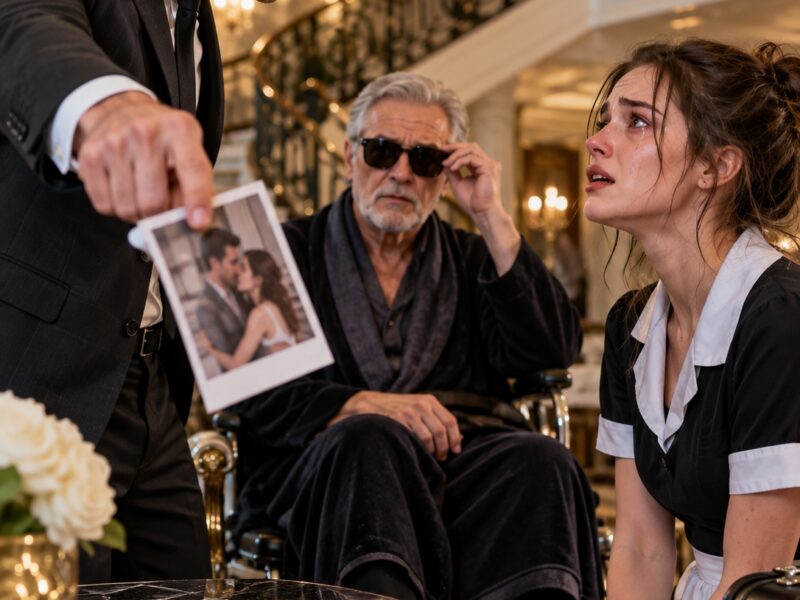
He Fired the Maid for Betraying Him—Then His Blind Father Stood Up and Said, “Son… I Can See.”

The fifty-thousand-dollar check landed at Sophie Collins’s feet.
For several seconds, nobody moved.
Outside the floor-to-ceiling windows of Logan Whitmore’s Boston mansion, freezing rain struck the glass like handfuls of gravel. Thunder rolled somewhere beyond the Charles River, low and distant, but inside the marble foyer the silence felt even louder.
Sophie stared at the check.
Then she looked at Logan.
He stood ten feet away in a charcoal suit, his tie loosened, his face pale with the kind of anger that came from somewhere much older than the moment itself.
On the screen of his phone was a photograph.
Sophie.
Another man.
His arms around her.
Her face turned toward his chest.
Intimate enough to destroy everything Logan had almost allowed himself to believe.
“So that’s why you were always smiling,” Logan said.
His voice was frighteningly calm.
Sophie’s lips parted.
“Logan—”
“Don’t.”
He had never allowed her to call him Logan before.
Not once.
For three months she had been “Sophie,” and he had been “Mr. Whitmore” or “sir.”
Now, on the night he had planned to tell her he loved her, the distance between them had somehow become greater than it had been the first day she walked through his door.
Logan pointed toward the check.
“Take it.”
Sophie looked down.
$50,000.
Her eyes lifted slowly.
“What is that?”
“What you came here for.”
Something changed in her face.
Not guilt.
Not fear.
Pain.
Real pain.
But Logan had spent half his life learning that pain could be performed.
His mother had taught him that.
Brooke had confirmed it.
And now Sophie had apparently perfected it.
“I don’t want your money.”
“Of course you do.”
“Logan, please listen to me.”
“I listened for three months.”
His voice cracked despite his effort to control it.
“I listened when you told me you didn’t have a boyfriend. I listened when you told me you weren’t interested in my money. I listened when you stood in my kitchen pretending you were different.”
“I wasn’t pretending.”
He held up the phone.
“Then explain him.”
Sophie looked at the photograph again.
Her face went white.
“That’s Kyle.”
Logan laughed once.
There was no humor in it.
“You even know his name.”
“Because he approached me outside.”
“And you told me you’d never had a boyfriend.”
“He is not my boyfriend.”
“Stop.”
“Please—”
“I said stop.”
Across the room, Harold Whitmore sat motionless in his chair, dark glasses covering his eyes.
For months everyone in that house had believed Harold could see nothing.
At that moment, however, the old man was watching everything.
He saw Sophie’s trembling hands.
He saw his son’s jaw tighten.
He saw the check on the floor.
And most painfully, he saw the terrified thirteen-year-old boy Logan had once been hiding behind the face of a thirty-seven-year-old millionaire.
Sophie bent down.
Logan’s expression hardened.
For one terrible second, he thought she was going to pick up the money.
Instead, she picked up the check, tore it cleanly in half, then tore it again.
Four pieces fell onto the marble.
“I never wanted your money.”
Her voice was barely above a whisper.
“I wanted you to believe me.”
Logan said nothing.
Sophie swallowed.
“If my leaving gives you peace, I’ll leave.”
She turned toward the staircase.
Then stopped.
Without facing him, she said quietly:
“But one day, Mr. Whitmore, you’re going to discover something worse than being betrayed.”
Logan stared at her back.
“What?”
She finally looked over her shoulder.
Her eyes were wet.
“Being loved honestly and being too afraid to recognize it.”
Then she walked upstairs to pack.
And Harold Whitmore knew the experiment had gone far enough.
Because the blindest man in that house had never been him.
Three months earlier, Logan Whitmore had been standing on the eighteenth hole of a private golf club outside Boston when his best friend Ryan tossed his club into the bag and checked his watch.
“I’m done.”
Logan glanced at him.
“You’re losing by six.”
“I’m losing by five.”
“Six.”
“Whatever. Jenna promised the kids I’d be home for dinner.”
Logan smirked.
“Domestic captivity.”
Ryan laughed.
“You say that because nobody’s waiting for you.”
“Exactly.”
Logan drove the ball cleanly down the fairway.
“Freedom.”
Ryan watched the ball disappear into the distance.
“Still the best swing in Boston.”
“I know.”
“And still the loneliest man in Massachusetts.”
Logan looked at him.
Ryan lifted both hands.
“I’m just saying.”
“Then stop saying.”
They had known each other since college, which meant Ryan was one of the few people wealthy enough in history with Logan to ignore the Whitmore name.
Most people saw Logan Whitmore as the founder and CEO of Whitmore Capital, the man financial magazines described as “aggressively disciplined,” “emotionally unreadable,” and occasionally “brilliant.”
Ryan remembered the kid who used to eat vending-machine dinners beside his father’s hospital bed.
There was a difference.
“You ever think about getting married?” Ryan asked.
“No.”
“Kids?”
“No.”
“Someone who actually knows what you eat for breakfast?”
“I have employees for that.”
Ryan shook his head.
“That sentence alone should concern you.”
Logan smiled faintly.
“Marriage works for you. Congratulations.”
“It could work for you.”
“No.”
“You don’t even date.”
“I date.”
“You hire companionship.”
Logan’s eyes cooled.
“That’s different.”
“Exactly my point.”
Logan rested both hands on his club.
“No expectations. No lies. No pretending forever means something. Everyone understands the arrangement.”
Ryan studied him.
“Love isn’t a business transaction.”
“Everything is a transaction.”
“That’s depressing.”
“That’s accurate.”
Ryan was about to answer when Logan’s phone rang.
DAD.
Logan almost ignored it.
Harold Whitmore lived in Vermont and called frequently enough that Logan had developed the habit of answering on the second or third ring.
That afternoon, something made him answer immediately.
“Dad?”
At first, there was only breathing.
Then Harold said:
“Logan…”
His voice sounded wrong.
Logan straightened.
“What happened?”
“I woke up and everything was dark.”
The golf course disappeared around him.
“What?”
“I can’t see.”
Logan dropped the club.
“Dad, don’t move.”
“Son—”
“Don’t move. Call an ambulance. I’m coming.”
“You’re three hours away.”
“Then I’ll be there in three hours.”
He was already walking toward the cart.
Ryan followed.
“Logan?”
Logan looked at him, and for the first time that day Ryan saw fear.
“My dad can’t see.”
Three hours later, Logan stood inside a private medical office in Vermont while Dr. Alan Mercer examined Harold’s eyes.
Alan had been Harold’s friend for almost thirty years.
That should have reassured Logan.
Instead, it made him suspicious when Alan refused to give him a direct answer.
“How serious?”
Alan removed his glasses.
“It’s complicated.”
“Does he need surgery?”
“Not yet.”
“Medication?”
“Vitamins. Better nutrition. Reduced stress. Monitoring.”
Logan frowned.
“That’s it?”
“And someone with him every day.”
Harold sat nearby wearing dark glasses.
Logan looked at him.
“You’re coming to Boston.”
Harold smiled slightly.
“You didn’t ask.”
“I’m not asking.”
Alan cleared his throat.
“And keep the glasses on.”
Harold nodded.
“Always.”
Logan looked between the two older men.
Something felt strange.
But fear made people overlook details they would normally notice.
And Logan was afraid.
He had already watched his father lose almost everything once.
He wasn’t going to watch him disappear too.
On the drive back to Boston, Harold sat in the passenger seat while Logan handled conference calls through the car’s Bluetooth system.
Acquisition.
Legal review.
Quarterly projections.
Singapore.
New York.
London.
By the fourth call, Harold sighed.
“You ever stop working?”
“No.”
“Healthy.”
“Says the man who just went blind.”
Harold smiled.
“That mouth is why you need a wife.”
“Here we go.”
“I’m serious.”
“Then stop.”
“You’re thirty-seven.”
“I’m aware.”
“Successful.”
“Also aware.”
“Handsome, according to women who still have functioning eyesight.”
Logan almost laughed.
“Dad.”
“And emotionally constipated.”
“That’s not a medical diagnosis.”
“It should be.”
Logan tightened his hands on the steering wheel.
“Can we establish one rule while you’re staying with me?”
“One?”
“No lectures about marriage.”
Harold leaned back.
“What about love?”
“Especially love.”
“Still because of your mother?”
The temperature inside the car seemed to drop.
Logan stared straight ahead.
“Don’t.”
Harold was quiet.
Ten years had passed since Evelyn Whitmore left.
But the real wound was older.
Much older.
Logan had been thirteen the first time his father’s business collapsed.
For almost two years, Harold went from being a respected businessman to a man selling assets to pay medical bills after a serious illness.
Logan remembered the house shrinking.
The cars disappearing.
The whispered arguments behind closed doors.
And then he remembered his mother standing in the hallway with two suitcases.
“Mom, please.”
She had looked irritated rather than heartbroken.
“Your father is sick.”
“I know.”
“He lost the company.”
“I know.”
“He needs us.”
Evelyn had looked at her son for several long seconds.
Then she said the sentence that would become the foundation of Logan’s adult life.
“I never loved your father.”
Logan had stared at her.
“What?”
“I married security. I married a future. That future is gone.”
“You’re leaving because he lost his money?”
“I’m leaving because I’m done pretending.”
He had followed her toward the door.
“Mom.”
She turned.
“You can come with me.”
Logan looked toward the bedroom where his father lay recovering.
“No.”
Evelyn’s expression hardened.
“Then you’ve chosen.”
The door closed.
And thirteen-year-old Logan learned a lesson he would spend twenty-four years refusing to question:
People stayed while staying was profitable.
So when Harold asked him in the car why he had never seriously loved another woman, Logan gave the answer he had polished into armor.
“Love doesn’t exist, Dad.”
Harold turned toward him.
“When I want company,” Logan continued, “I pay for it.”
Harold was silent for a long time.
Then he said:
“My story doesn’t have to become yours.”
Logan looked toward the highway.
“It already did.”
He didn’t see Harold remove his dark glasses for half a second.
And he certainly didn’t see his father looking directly at him.
The Whitmore house stood in Beacon Hill behind black iron gates, five stories of restored brick, limestone, glass, and money.
Harold hated it immediately.
“Why does this place sound empty?”
“It’s a house.”
“It sounds like a museum.”
“You’ve been here before.”
“I could see then.”
Logan led him into the living room.
Harold tapped his cane against the hardwood.
“Why is every person working here a man?”
Logan paused.
“What?”
“Your driver is a man. Your assistant is a man. Your house manager is a man. Even your chef is a man.”
“They’re qualified.”
“So are women.”
“Dad.”
Harold smiled.
“There it is.”
“What?”
“The panic.”
“I don’t panic.”
“You practically built a monastery.”
Logan walked toward the bar.
“You need a caregiver. I called an agency.”
“Wonderful.”
“They’re sending someone tomorrow.”
“A man?”
Logan hesitated.
Harold’s smile widened.
“Oh.”
“The agency doesn’t have a male caregiver available.”
“So?”
“They’re sending a woman temporarily.”
Harold leaned back.
“Maybe God is answering my prayers.”
“She’s temporary.”
“How temporary?”
“Until they find a man.”
“And if she’s excellent?”
“One mistake and she’s gone.”
Harold chuckled.
“Let’s see who wins.”
Across Boston, Sophie Collins was sitting at the edge of her bed staring at another rejection email.
Thank you for your interest.
We have decided to move forward with other candidates.
She closed the laptop.
Her roommate, Maya, looked over from the tiny kitchen.
“Another one?”
Sophie nodded.
“Seven this week.”
“You’ve only been here two months.”
“That’s supposed to make me feel better?”
“Maybe.”
Sophie rubbed her forehead.
She had moved from Ohio to Boston with a business administration degree from Ohio State, $3,700 in savings, and the stubborn belief that starting over was supposed to feel exciting.
Instead, Boston had given her rent she could barely afford, interviews that led nowhere, and a growing fear that she had made the biggest mistake of her life.
“I should go back to Ohio.”
Maya set down her coffee.
“No.”
“My savings are disappearing.”
“You’ll find something.”
“When?”
Maya picked up her phone.
“Actually…”
Sophie narrowed her eyes.
“What?”
“I saw something.”
“Those words never end well.”
Maya showed her an advertisement.
LIVE-IN CAREGIVER.
ELDERLY VISUALLY IMPAIRED GENTLEMAN.
EXCELLENT PAY.
Sophie stared.
“I have a business degree.”
“You also cared for your grandmother for three years.”
“That doesn’t make me a professional caregiver.”
“You can cook.”
“Barely.”
“You’re patient.”
“Sometimes.”
“You need money.”
Sophie sighed.
“How much?”
Maya smiled.
“Enough that you suddenly look interested.”
The next morning, Sophie walked into the Whitmore residence wearing the best outfit she owned: a cream blouse, navy skirt, simple heels, and the smile her grandmother used to tell her could convince winter to become spring.
Logan Whitmore was waiting in the library.
Sophie stopped when she saw him.
That was unfortunate.
Because she had spent the elevator ride imagining a rude, middle-aged trust-fund heir with thinning hair and an expensive watch compensating for his personality.
Instead, Logan was tall, dark-haired, broad-shouldered, and unfairly handsome.
Then he looked at her.
The fantasy died instantly.
“Name?”
“Sophie Collins.”
“Education?”
“Business administration. Ohio State.”
His eyebrow lifted.
“A business degree.”
“Yes.”
“And you want to be a caregiver.”
“I want to work.”
“That wasn’t my question.”
“It’s my answer.”
Something flickered in his eyes.
Not amusement exactly.
Maybe surprise.
He glanced at her résumé.
“Experience?”
“I cared for my grandmother for three years after her stroke.”
“Professional experience?”
“No.”
“Medical certification?”
“No.”
“Then why should I hire you?”
Sophie could have lied.
Instead she said:
“Because I need the job badly enough to learn everything I don’t know, and because I cared for someone I loved when it was exhausting and inconvenient and nobody was paying me.”
Logan looked up.
For a moment, neither spoke.
Then his eyes traveled over her clothes.
“Nothing more formal?”
Sophie glanced down.
“I thought this was decent.”
“It’s not an office.”
“I noticed.”
His gaze sharpened.
Sophie immediately regretted it.
Logan closed the résumé.
“Let me be clear about something, Miss Collins. I didn’t request you. The agency sent you because no male caregiver was available.”
Sophie blinked.
“You specifically wanted a man?”
“Yes.”
“May I ask why?”
“No.”
“Okay.”
“You’ll stay until the agency finds one.”
“All right.”
“You manage my father’s medication schedule, meals, appointments, walks, anything he reasonably needs.”
“Yes.”
“You do not interfere in my business.”
“Of course.”
“You do not enter my office without permission.”
“Understood.”
“You do not ask questions about my personal life.”
“I wasn’t planning to.”
“And you stay away from me.”
Sophie stared at him.
That one was harder not to react to.
“I’m sorry?”
“Your job is my father. Nothing else.”
She nodded slowly.
“All right.”
“Four thousand a month.”
Her composure nearly collapsed.
Four thousand.
Food and lodging included.
At that rate, she could rebuild her savings, pay down part of her student debt, and stop waking at three in the morning calculating how long she had before she had to return home defeated.
“Thank you.”
“Don’t thank me yet.”
“You won’t regret hiring me.”
“I already told you. It’s temporary.”
Sophie smiled.
Logan frowned.
“What?”
“Nothing.”
“Why are you smiling?”
“I smile when I’m nervous.”
“Stop.”
She tried.
It lasted approximately two seconds.
That afternoon, Harold met her.
“Good afternoon, Mr. Whitmore.”
Harold tilted his head toward her voice.
“Come closer.”
Sophie did.
“I’m Sophie Collins.”
“Nice voice.”
She laughed softly.
“Thank you.”
“Pretty too?”
Sophie glanced at Logan.
He looked annoyed.
“Dad.”
“What? I’m blind, not dead.”
Sophie laughed again.
Harold smiled.
“I like her.”
“She’s been here thirty seconds.”
“That’s twenty-nine seconds longer than I needed.”
Logan sighed.
“He can’t see you smiling, Sophie.”
Harold turned toward his son.
“No. But I can feel when a happy person walks into a room.”
Something about that sentence silenced Sophie.
Then Harold held out his hand.
She took it.
His grip was warm.
“Welcome to the house, Sophie.”
For the first time since she arrived in Boston, somebody said the word welcome as though he meant it.
Within hours, the mansion began changing.
Not dramatically.
At first, it was almost invisible.
Fresh flowers appeared in the breakfast room.
Harold began eating at the table instead of in his bedroom.
Music played softly in the kitchen.
Sophie learned that Harold liked cinnamon in his oatmeal, hated overcooked eggs, preferred jazz before noon, and could identify terrible coffee from across the room.
She also learned that Logan left before sunrise, returned after dark, slept too little, drank his coffee black, and treated happiness as though it were an inefficient use of time.
On Sophie’s third day, she met Brooke.
The bell rang just after seven.
Sophie opened the door to find a striking blonde woman in a white coat, diamond earrings, and heels designed for a life without sidewalks.
The woman looked Sophie up and down.
“Who are you?”
“Sophie. Mr. Whitmore’s caregiver.”
“Since when does Logan hire women?”
“I’m caring for his father.”
“Where is Logan?”
“He isn’t home.”
The woman smiled.
“I didn’t come to see him.”
Sophie hesitated.
“Then—”
“I came to see my future father-in-law.”
Sophie felt something strange in her chest.
Ridiculous.
She barely knew Logan.
“Of course.”
She led Brooke into the living room.
“Mr. Whitmore, there’s a lady here who says she’s Logan’s fiancée.”
Harold nearly choked on his tea.
“His what?”
Brooke rushed forward.
“Harold, I hope you don’t mind. I just couldn’t stay away.”
Harold extended his hand.
“Come closer, my dear.”
Brooke sat beside him.
“I really care about Logan.”
“Do you?”
“He’s just so cold sometimes.”
Harold smiled faintly.
“He’s been cold a long time.”
“I think I can change that.”
From the doorway, Sophie listened.
She had no reason to feel disappointed.
So she told herself she didn’t.
That night, Logan came home.
Sophie stepped forward.
“Welcome back, sir. Can I take your briefcase?”
He stopped.
“Didn’t I tell you to stay away from me?”
She froze.
“I was only trying to help.”
“I can carry my own briefcase.”
“Yes, sir.”
He walked past.
Sophie watched him.
Something about the way he moved bothered her.
Not arrogance.
Not exactly.
He looked exhausted.
Like a man who had spent years running toward something that never got closer.
The words escaped before she could stop them.
“Why are you always so angry?”
Logan turned.
The entire foyer seemed to tighten.
“What did you say?”
Sophie’s stomach dropped.
“I’m sorry.”
“No. Repeat it.”
She should have apologized.
Instead, perhaps because she was tired of interviews and rejection emails and people deciding her worth from a résumé, she said:
“You have this beautiful house. A successful company. Your father loves you. You have everything most people spend their lives chasing.”
Logan stared at her.
“And?”
“You never smile.”
His face hardened.
“Who gave you permission to analyze me?”
“No one.”
“Exactly.”
“I just meant—”
“Pack your things.”
Sophie went still.
“What?”
“You’re fired.”
“Mr. Whitmore—”
“Upstairs. Pack.”
“I’m sorry.”
“If you needed this job badly enough, you should have remembered your place.”
That sentence hurt more than Sophie expected.
She lowered her eyes.
“Yes, sir.”
Twenty minutes later, she came downstairs carrying her suitcase.
Harold heard the wheels.
“Who’s leaving?”
“Sophie.”
“Why?”
Logan appeared behind her.
“She forgot she works for me.”
Harold frowned.
“What happened?”
“She questioned me.”
“What did she say?”
Logan crossed his arms.
“That I’m angry.”
Harold was silent.
Then:
“She’s right.”
Sophie bit her lip.
Logan stared at his father.
“You’re taking her side?”
“If you don’t like being called angry, try smiling once every fiscal quarter.”
“Dad.”
“Sophie.”
She turned.
“Yes?”
“Apologize to your employer.”
Sophie looked at Logan.
“I’m sorry, Mr. Whitmore. It won’t happen again.”
Harold pointed toward the staircase.
“Good. Now take your suitcase back upstairs.”
Logan stared at him.
“Do I have any authority in my own house?”
“Normally.”
“And now?”
“Not this time.”
Harold settled back.
“Since Sophie arrived, I’ve eaten better, slept better, and laughed more than I have in months.”
Logan looked at Sophie.
She tried desperately not to smile.
“And stop smiling,” he muttered.
“Yes, sir.”
She turned away.
Harold grinned behind his dark glasses.
Later that night, Harold casually asked:
“So Brooke tells me you’re engaged.”
Logan nearly dropped his drink.
“She told you what?”
“Engaged.”
“I’m not engaged.”
“Dating?”
“No.”
“Then who is she?”
Logan poured another inch of bourbon.
“Someone I met at a club.”
Harold waited.
“She keeps me company.”
“For six months?”
“When I call.”
“And?”
“And I pay her.”
Harold removed his glasses halfway before remembering himself.
“You pay her?”
“No emotions. No expectations.”
Harold shook his head.
“You refuse to love a woman because you think women want your money, so you deliberately choose women who are there because you pay them.”
Logan frowned.
“When you say it like that—”
“How else should I say it?”
“They’re honest about what they want.”
“And Sophie?”
Logan’s gaze shifted involuntarily toward the staircase.
Harold noticed.
“Sophie works for us.”
“So does your accountant. You don’t look toward the stairs when I mention him.”
“Good night, Dad.”
Harold smiled.
“You let one woman judge every woman, Logan.”
Logan stopped.
“A locked heart doesn’t prevent pain.”
He turned slightly.
“It only guarantees loneliness.”
Logan walked away.
But the words followed him upstairs.
Weeks passed.
Then the chef resigned.
He was getting married.
“I want time for a family,” he explained.
Logan surprised Sophie by shaking his hand.
“Then go. Family should never be sacrificed for work.”
After the chef left, Harold asked loudly at breakfast:
“Who cooks better? Sophie or the chef?”
“Dad.”
“I’m asking.”
Logan glanced at the pancakes.
“Sophie.”
She looked up.
Harold grinned.
“Interesting.”
“It’s food.”
“Of course.”
Logan looked at Sophie.
“You’ll cover meals temporarily.”
She raised an eyebrow.
“Two jobs?”
“I’ll double your pay.”
Her expression changed.
“No.”
Logan looked surprised.
“No?”
“I’ll cook because Mr. Whitmore needs to eat. You don’t need to double my salary.”
“Why wouldn’t you take more money?”
“Because not everything requires a price.”
Their eyes met.
Something uncomfortable moved through Logan’s chest.
He looked away first.
“Take the raise.”
“Half.”
“Full.”
“Half.”
“This isn’t a negotiation.”
Sophie smiled.
“Then why are we negotiating?”
From across the table, Harold hid his grin behind his coffee.
Two months after Sophie arrived, Logan woke at two in the morning with his cheek against a stack of contracts in his office.
A blanket covered his shoulders.
He sat up.
He hadn’t put it there.
On the desk beside him was a glass of water and two aspirin.
He knew immediately.
Sophie.
The next evening, he found her checking Harold’s medication.
“Did you come into my office last night?”
She looked up.
“You were asleep.”
“That wasn’t my question.”
“Yes.”
“I told you not to enter.”
“You were freezing.”
“I wasn’t.”
“You were.”
“You put the blanket on me?”
“Yes.”
“Why?”
Sophie stared at him as if the question made no sense.
“Because you were cold.”
There it was again.
Something done without negotiation.
Without leverage.
Without a request.
Logan hated how much it unsettled him.
“Don’t do it again.”
“All right.”
She turned away.
“Sophie.”
She looked back.
“Thank you.”
Her smile appeared slowly.
For once, Logan didn’t tell her to stop.
That was when Harold knew his plan was working.
Because Harold Whitmore had never been blind.
Dr. Alan Mercer had helped him create the deception.
The original eye problem had been real but minor—a temporary inflammation accompanied by blurred vision.
It had given Harold an idea.
A ridiculous one.
Perhaps even a cruel one.
But after years of watching his son build emotional walls higher than his financial empire, Harold had become desperate.
So he pretended the condition was worse.
Dark glasses.
Cane.
Caregiver.
Dependence.
He wanted to see how Logan behaved when he believed nobody was watching.
More importantly, he wanted Logan to encounter someone who did not know she was being observed.
Sophie had no idea Harold could see her.
So Harold saw everything.
He saw her quietly return part of the grocery money when the cashier overcharged.
He saw her cry after calling her mother in Ohio because she missed home.
He saw her studying job listings late at night, still hoping to use her business degree.
He saw her cover Logan with a blanket when he fell asleep at his desk.
He saw her pause outside Logan’s office when she heard him cough.
And he saw something else.
His son was changing.
At dinner, Logan began staying at the table longer.
He laughed.
Once.
Then twice.
He started coming home before nine.
He asked Harold how his day had been.
Sometimes he asked Sophie too.
Then he would seem surprised by his own question.
One Saturday, Ryan visited.
Sophie made lunch.
After one bite, Ryan stared at Logan.
“This is ridiculous.”
“What?”
“You have a beautiful woman cooking like this in your house and you’re still single.”
Sophie nearly dropped a plate.
Logan’s expression froze.
“She’s my employee.”
Ryan looked at Sophie.
Then Logan.
Then Harold.
Harold smiled innocently behind his dark glasses.
Ryan understood immediately.
“Oh.”
Logan narrowed his eyes.
“What does ‘oh’ mean?”
“Nothing.”
“It meant something.”
Ryan ate another bite.
“Nothing at all.”
That evening, after Sophie went upstairs, Ryan cornered Logan in the library.
“You like her.”
“No.”
“You absolutely like her.”
“She works here.”
“That wasn’t an answer.”
Logan poured himself a drink.
Ryan watched him.
“When was the last time you brought Brooke here?”
“Why?”
“Answer.”
Logan thought.
Six weeks.
He hadn’t even noticed.
Ryan smiled.
“That’s what I thought.”
“She’s not relevant.”
“Exactly.”
Logan glared.
Ryan lowered his voice.
“Sophie isn’t your mother.”
Logan’s hand stopped around the glass.
“Don’t.”
“You’re scared.”
“I’m not.”
“You are.”
Ryan leaned against the desk.
“You built your entire adult life around never needing anyone. Then this woman walked in and suddenly you’re coming home for dinner.”
“I come home because my father is here.”
“Sure.”
Logan looked away.
Ryan smiled.
“My brother is finally in love.”
“Don’t be ridiculous.”
“What happens when she leaves?”
Logan had no answer.
And that frightened him more than anything Ryan had said.
A week later, Logan developed a fever.
He tried going to work anyway.
Sophie blocked the front door.
“You’re sick.”
“I have a meeting.”
“You have a temperature of 102.”
“I’ve worked with worse.”
“You’re staying home.”
Logan stared at her.
“Do you remember who employs you?”
“Yes.”
“Move.”
“No.”
Harold sat nearby pretending to listen to the radio.
Logan lowered his voice.
“Sophie.”
She folded her arms.
“Fire me tomorrow.”
He almost smiled.
Almost.
Six hours later, he was in bed while Sophie placed a cold cloth on his forehead.
“Why do you care so much?”
She paused.
“About what?”
“Me.”
Her hand stopped.
The room became strangely quiet.
“I don’t want anything bad to happen to you.”
“Is that all?”
Sophie looked into his eyes.
For one suspended moment, neither of them had anywhere to hide.
Then she stood.
“I’ll bring your soup.”
“Sophie.”
“You need to eat before your medicine.”
She left.
Logan stared at the doorway.
Across the hall, Harold smiled.
He didn’t need eyesight to know what had just happened.
But eyesight certainly helped.
That evening, Sophie brought the soup.
Logan was sitting upright.
“I’m not hungry.”
“You need to eat.”
“No.”
She held out the spoon.
He stared.
“What are you doing?”
“Feeding you.”
“I can feed myself.”
“Then do it.”
He made no move.
Sophie sighed.
“You’re acting like a five-year-old.”
“I have a fever.”
“Apparently it erased thirty-two years.”
He finally laughed.
Sophie froze.
Logan froze too.
Neither had expected it.
“You should do that more often,” she said.
“What?”
“Smile.”
He looked at her.
“You’re supposed to be watching the soup.”
Her cheeks warmed.
“I am.”
“No, you’re not.”
She looked down quickly.
From the hallway came Harold’s voice.
“I may be blind, but I’m not deaf.”
Sophie nearly dropped the spoon.
Logan groaned.
“Dad.”
“When Sophie talks,” Harold called, “your voice changes.”
“Go to bed.”
“I am in bed.”
“Then stay there.”
Harold laughed.
Sophie tried not to.
Logan looked at her.
She lost the battle.
And somehow, watching her laugh in the quiet bedroom, Logan felt something he had not felt in years.
Peace.
That should have made him happy.
Instead, it terrified him.
Because peace gave you something to lose.
Brooke noticed the change before Logan admitted it.
She arrived unannounced one evening.
Sophie and Logan were in the kitchen laughing about Harold’s claim that his pancakes were better than every diner in Vermont.
Brooke stood in the doorway.
Her face changed.
“I’ve never seen you laugh like that.”
Logan immediately became guarded.
“Why didn’t you call?”
Brooke looked at Sophie.
“So this is what you’ve been doing.”
Sophie stepped back.
“I should check on Mr. Whitmore.”
She left.
Brooke waited until she was gone.
“You’re sleeping with her?”
Logan’s eyes turned cold.
“Watch your mouth.”
Brooke laughed.
“Oh my God.”
“What?”
“You care about her.”
“No.”
“You just defended her.”
“I told you not to insult an employee in my house.”
“Employee?”
Brooke moved closer.
“Since when do you look at employees like that?”
Logan said nothing.
Her expression hardened.
“Everything between us was clear.”
“It still is.”
“No. It isn’t.”
She touched his chest.
He stepped away.
That movement told her everything.
Brooke’s eyes filled with anger.
“I love you.”
Logan stared at her.
“No, you don’t.”
“You don’t get to decide that.”
“We had an arrangement.”
“Six months, Logan.”
“An arrangement.”
“You paid for dinners. Trips. Jewelry. My apartment.”
“And you agreed.”
Brooke’s face flushed.
“Because I thought eventually you’d realize I was the woman who stayed.”
“You stayed because I paid you.”
Her expression broke.
Logan immediately regretted the cruelty, but the truth remained.
Brooke whispered:
“And she doesn’t?”
“No.”
“You pay her too.”
“She works for my father.”
Brooke laughed bitterly.
“You really think the little Ohio maid doesn’t know exactly what she’s doing?”
“Never call her that again.”
Silence.
Brooke stared at him.
Then she understood.
Sophie had already taken her place.
Not in Logan’s bed.
Somewhere much more dangerous.
Inside the part of him Brooke had never been allowed to reach.
“You’ll regret this,” she said.
Logan opened the door.
“We’re done.”
Brooke walked past him.
At the threshold, she turned.
“You think she’s different because she smiles at you like you’re not rich.”
Logan said nothing.
Brooke’s voice softened.
“What happens when you discover she knows exactly how rich you are?”
Then she left.
And for the first time, a seed of doubt entered the place where hope had started growing.
Three months.
Sophie had never asked him for anything.
Not jewelry.
Not clothes.
Not favors.
She still wore the same inexpensive coat she arrived in.
She saved most of her salary.
She still applied for business jobs because she wanted a career of her own.
All of that should have reassured Logan.
Instead, Brooke’s words activated the oldest voice in his head.
Maybe she’s patient.
Maybe she’s smarter than the others.
Maybe she knows the biggest reward comes to the woman who waits.
So one afternoon Logan handed Sophie an envelope.
“What’s this?”
“Grocery money.”
She opened it.
“There’s too much.”
“The rest is yours.”
“For what?”
“You’ve done more than your job.”
She counted it.
Then removed the extra cash and placed it on the table.
“No.”
Logan stared.
“You don’t want it?”
“I didn’t earn it.”
“I’m giving it to you.”
“I know.”
“Then take it.”
She smiled.
“No.”
His suspicion collided with confusion.
“You know most people don’t refuse money.”
“Maybe you spend time with the wrong people.”
She walked away.
And Logan smiled.
He couldn’t help it.
Sophie saw.
Her entire face lit up.
“You smiled.”
“It happens.”
“Rarely.”
“Don’t make it a thing.”
“Too late.”
He shook his head.
But that night, alone in his bedroom, Logan realized he had spent hours remembering the way she looked when he smiled.
That was when he finally admitted it.
He was falling in love.
Unfortunately, Brooke had already decided Sophie needed to disappear.
The opportunity arrived outside a small grocery store three blocks from the house.
Sophie had just loaded Harold’s vitamins into a tote bag when a man approached.
He was around thirty, casually handsome, wearing a leather jacket.
“I’ve seen you around.”
Sophie kept walking.
“Okay.”
“I’m Kyle.”
“Nice to meet you.”
“Wait.”
She stopped.
He smiled.
“Have coffee with me.”
“No, thank you.”
“One coffee.”
“I’m not interested.”
“Boyfriend?”
“No.”
Kyle grinned.
“Then why not?”
“Because ‘no’ is a complete sentence.”
He stepped closer.
Sophie immediately stepped back.
“Please move.”
Kyle lifted his hands.
“Relax.”
“I said no.”
He reached toward her arm.
She pushed his hand away.
Across the street, a phone camera captured several frames.
Kyle leaning close.
Sophie turning.
His arm near her shoulders.
Her hand against his chest.
Later, in a parked car, Brooke studied the images.
“Can you make it look like she’s hugging him?”
The man beside her zoomed in.
“With editing? Easily.”
“Do it.”
“And then?”
Brooke looked toward the Whitmore house.
“Then we find out how much Logan really trusts his little maid.”
Meanwhile, Logan was standing on a golf course with Ryan.
He missed an easy putt.
Ryan stared.
“You missed.”
“It happens.”
“You’re smiling.”
Logan looked away.
Ryan’s mouth opened.
“Oh, no.”
“What?”
“There’s someone.”
“No.”
“There absolutely is.”
Logan sighed.
Ryan waited.
Finally:
“Sophie.”
Ryan threw both hands up.
“I knew it.”
“I don’t know what it is.”
“It’s called love. People have written about it.”
“I feel…”
Logan struggled.
Ryan’s teasing disappeared.
“What?”
“At peace.”
Ryan smiled.
“That sounds terrifying for you.”
“It is.”
“Tell her.”
Logan stared across the green.
“What if I’m wrong?”
“What if you’re right?”
“What if she leaves?”
Ryan was quiet.
There it was.
The real fear.
Not betrayal.
Abandonment.
“You can’t make someone stay by refusing to need them,” Ryan said.
Logan looked at him.
“Sophie isn’t your mother.”
Logan swallowed.
Ryan put a hand on his shoulder.
“Tell her before fear tells you another story.”
That evening, Harold announced he planned to return to Vermont.
Logan looked up sharply.
“So soon?”
“I’ve accepted the situation.”
“We can see another specialist.”
“No.”
Harold smiled.
“You’ve taken care of me long enough.”
“What about Sophie?”
“I’ll tell her she needs another job.”
Logan answered too quickly.
“No.”
Harold hid his satisfaction.
“No?”
“She can stay.”
“Why?”
“The chef hasn’t been replaced.”
“Ah.”
“She cooks.”
“Of course.”
“And I…”
Logan stopped.
Harold waited.
“What?”
“Nothing.”
“You were saying?”
Logan exhaled.
“Tonight I’m going to tell her.”
Harold’s heart lifted.
“Tell her what?”
“You know exactly what.”
“Humor a blind old man.”
Logan smiled.
“I’m going to tell Sophie I love her.”
Harold sat very still.
For years, he had waited to hear his son say those words about anyone.
“Good.”
Logan looked toward the hallway.
“I just hope I’m not making the biggest mistake of my life.”
Harold smiled sadly.
“Love always feels like that before you know the ending.”
The following morning, Sophie nearly walked into Logan in the hallway.
“Good morning.”
“Morning.”
He smiled.
Sophie stopped.
“Did the boss just smile at me?”
“Don’t get used to it.”
“Too late.”
She walked away.
Logan watched her.
Harold appeared beside him with his cane.
“Maybe stop making her wear that ridiculous uniform before declaring your love.”
Logan glanced at him.
“You’re blind.”
“I still have taste.”
Logan laughed.
“No games tonight.”
“Good.”
“I’ll just tell her.”
“Tell her what?”
Logan looked toward Sophie.
“That I love her.”
His phone rang.
Unknown number.
He almost ignored it.
Then answered.
“Logan Whitmore.”
A male voice replied.
“You think money can buy my girlfriend?”
Logan’s smile disappeared.
“Who is this?”
“Kyle.”
“I don’t know a Kyle.”
“But Sophie does.”
Logan’s chest tightened.
“What did you say?”
“Sophie Collins. She’s been my girl since before she started working for you.”
Logan went completely still.
“You’re lying.”
Kyle laughed.
“Check your messages.”
The call ended.
Seconds later, Logan’s phone vibrated.
Three photographs.
Sophie in another man’s arms.
The hallway seemed to tilt.
All the warmth of the previous three months vanished beneath a single memory.
His mother.
Suitcases.
I married his money.
Now the money’s gone.
And so am I.
Logan stared at Sophie’s smiling face in the photograph.
Suddenly every breakfast became evidence.
Every blanket.
Every laugh.
Every refusal of money.
Every touch.
Maybe Brooke had been right.
Maybe Sophie had simply been better at the game.
“So that’s why she was always smiling,” he whispered.
Harold heard him.
“What?”
Logan walked toward the staircase.
“Sophie!”
She appeared moments later.
“Sir?”
He turned the phone toward her.
“I almost believed you were different.”
Her smile disappeared.
“What?”
“Explain that.”
She looked.
“That’s Kyle.”
The name hit him like confirmation.
“You know him.”
“He approached me outside the grocery store.”
“You said you’d never had a boyfriend.”
“He isn’t my boyfriend.”
“Then why is he holding you?”
“He wasn’t.”
“The picture is right there.”
“Logan, listen—”
“Fifty thousand dollars.”
She stared.
“What?”
He pulled out his checkbook.
Harold rose slightly.
“Son.”
Logan wrote the amount.
$50,000.
Signed.
Tore it out.
And threw it toward Sophie.
“For the smiles.”
She looked at the check at her feet.
“For the dinners. The concern. The little performance.”
Tears filled her eyes.
“You think I did all of this for money?”
“I think everyone eventually tells you their price.”
“I never asked you for anything.”
“That was the strategy, wasn’t it?”
Her face changed.
The accusation cut deeper than anger.
“Do you know what the worst thing about you is?”
Logan’s jaw tightened.
“Careful.”
“You think money makes you impossible to love.”
He laughed bitterly.
“No. Money makes people very good at pretending.”
Sophie looked at him for a long moment.
Then bent down.
She tore the check into pieces.
“I never wanted your money.”
Logan said nothing.
“I wanted your trust.”
“You lied.”
“No.”
“You expect me to believe some stranger created those pictures?”
“I expect you to let me explain what happened.”
“I’ve heard enough explanations in my life.”
There.
Sophie heard it.
Not her.
Someone else.
A wound she had never created was deciding her guilt.
“If my leaving gives you peace,” she whispered, “I’ll go.”
She turned.
Then stopped.
“One day you’ll understand that some people love with a genuine heart.”
Logan’s breathing changed.
Sophie looked directly at him.
“I’m one of them.”
She walked upstairs.
Harold waited until her footsteps disappeared.
Then he stood.
Without the cane.
Logan barely noticed.
“Son.”
“I don’t want to hear it.”
“You need to look at those pictures again.”
“I looked.”
“No.”
Harold removed his dark glasses.
“You saw what you were afraid of seeing.”
Logan turned.
Then froze.
His father was looking directly at him.
Not vaguely.
Not toward the sound of his voice.
At him.
Their eyes met.
Logan’s face emptied.
“Dad?”
Harold said nothing.
Logan stepped backward.
“You can see.”
“Yes.”
The room seemed to lose all sound.
“How long?”
Harold lowered the glasses.
“Almost the entire time.”
Logan stared at him.
“You lied to me.”
“Yes.”
“Why?”
“Because I needed to know why a man with everything had become incapable of recognizing love.”
“You pretended to be blind?”
“I needed you to let someone into this house.”
“You manipulated me.”
“I did.”
Logan laughed in disbelief.
“You and Alan?”
“Yes.”
“What the hell were you thinking?”
“That my son was disappearing behind his anger.”
“You had no right.”
“Probably not.”
Harold stepped closer.
“But look at what happened.”
“What happened?”
“You fell in love.”
Logan’s face hardened.
“And look how that ended.”
“It hasn’t ended.”
“You saw the pictures.”
“I saw Sophie for three months.”
“So did I.”
Harold’s voice sharpened.
“And unlike you, I was actually watching.”
Logan said nothing.
“I saw her return money you didn’t know was missing. I saw her cry because she thought she might have to leave Boston. I saw her study job listings because she wants her own career. I saw her cover you with a blanket when she thought nobody could see.”
“That doesn’t prove anything.”
“No.”
Harold stepped closer.
“But it proves more than three photographs from a stranger.”
Logan looked away.
Harold asked quietly:
“Did you ever tell Sophie you loved her?”
Silence.
“Did you?”
“No.”
“Did you ever ask whether she loved you?”
“No.”
“Then why have you already convicted her of betraying something neither of you had the courage to name?”
Logan’s eyes flashed.
“Because I know how this ends.”
“No.”
Harold’s voice softened.
“You know how it ended with your mother.”
That stopped him.
“Your mother betrayed me, Logan.”
Harold touched his chest.
“Me.”
Then he pointed toward his son.
“But you’re the one who has carried the wound for twenty-four years.”
Logan looked away.
Outside, the storm intensified.
Harold picked up the phone.
“Nobody leaves tonight.”
“What?”
“The roads are terrible.”
“I have nothing to say to Sophie.”
“Tomorrow you will.”
“No.”
Harold looked directly into his son’s eyes.
“The blind one in this house was never me.”
Then he walked away.
Logan remained alone in the foyer.
For the first time, he had no anger left to hide behind.
Only fear.
Upstairs, Sophie packed quietly.
She folded the uniform first.
Then the few dresses she owned.
Her hands shook.
She had known Logan was difficult.
Cold.
Suspicious.
Damaged.
She had never expected him to trust easily.
But she had believed, foolishly perhaps, that three months of small truths mattered.
Apparently they did not.
Maya called.
Sophie answered.
“You sound terrible.”
“I’m coming home.”
“To the apartment?”
“No.”
Silence.
“Ohio?”
“Maybe.”
“What happened?”
Sophie sat on the bed.
“I forgot something.”
“What?”
“That women like me don’t get happy endings in houses like this.”
“Sophie—”
“He thought I wanted his money.”
“Did you tell him?”
“He didn’t want an explanation.”
“Then he’s an idiot.”
Sophie wiped her cheek.
“I think he’s scared.”
“That doesn’t give him permission to destroy you.”
“I know.”
Downstairs, Logan sat alone with the photographs.
Harold’s words would not leave him.
Look again.
So he did.
The first image showed Kyle leaning toward Sophie.
The second appeared to show her against him.
The third looked like an embrace.
Logan zoomed in.
Something felt wrong.
He didn’t know what.
He enlarged the second photograph.
Sophie’s hand.
Her fingers weren’t curved around Kyle.
They were flat.
Pushing.
Logan sat straighter.
He looked at the shadows.
Kyle’s shadow angled left.
Sophie’s body cast another direction.
Impossible under the same streetlight.
His heartbeat accelerated.
He opened the metadata.
Compressed.
Re-exported.
Edited.
Logan stood so fast the chair fell backward.
He ran to the security office.
The Whitmore property had cameras covering the gate and part of the sidewalk.
He pulled the footage.
11:43 a.m.
Sophie appeared carrying grocery bags.
Kyle approached.
They talked.
Kyle moved closer.
Sophie stepped away.
He reached for her.
She pushed him back.
Hard.
Then walked toward the gate without looking behind her.
Logan stared at the screen.
Once.
Twice.
Three times.
His stomach turned.
He had done exactly what Sophie said.
He had never let her explain.
Then his phone displayed another notification.
A voicemail.
Unknown caller.
He played it.
Brooke’s voice.
Faint, apparently recorded accidentally through Kyle’s phone.
“I need an update on the situation. If he’s still there, get rid of him.”
Logan closed his eyes.
Brooke.
Of course.
But knowing who had created the lie did not erase what he had done with it.
Brooke had handed him a match.
He had burned the house himself.
Morning arrived gray and cold.
Sophie came downstairs carrying her suitcase.
Harold stood by the window.
No dark glasses now.
She stopped.
“You can see.”
Harold turned.
“I owe you an apology.”
She stared.
“You were pretending?”
“Yes.”
Despite everything, Sophie laughed once in disbelief.
“This family is unbelievable.”
Harold smiled sadly.
“Fair.”
She looked toward the hallway.
“Where is he?”
Before Harold could answer, Logan appeared.
He had not slept.
Sophie’s expression closed.
“I left the uniform upstairs.”
“Sophie—”
“And I wrote down your father’s medication schedule, although apparently his eyesight isn’t something I need to worry about.”
Harold cleared his throat.
“I deserved that.”
Sophie picked up her suitcase.
“Thank you for the warmest months I’ve had since coming to Boston, Mr. Whitmore.”
Harold’s face softened.
“And thank you for taking care of him.”
She looked toward Logan.
“Both of you.”
Then she headed toward the door.
“Sophie, wait.”
She stopped.
Logan approached slowly.
“I saw the gate footage.”
Silence.
“You pushed him away.”
Her eyes filled.
“And the photographs were edited.”
She said nothing.
“Brooke arranged it.”
Still nothing.
Logan swallowed.
“You were telling the truth.”
Sophie finally looked at him.
“I know.”
Two words.
They hurt more than anger would have.
“I’m sorry.”
She shook her head.
“You accused me of selling affection to you.”
“I know.”
“You threw money at me.”
“I know.”
“You didn’t give me thirty seconds.”
“I know.”
“Stop saying you know.”
Her voice broke.
“Because you don’t.”
Logan went silent.
Sophie stepped closer.
“You don’t know what it feels like to spend months caring about someone who treats every kindness like evidence in a criminal investigation.”
He lowered his eyes.
“You don’t know how many times I told myself not to fall for you because I knew you would never believe a woman could love you without wanting something.”
“Sophie…”
“And the worst part?”
She wiped a tear angrily.
“I was right.”
Logan’s face tightened.
“No.”
“Yes.”
“You were right about who I was.”
He took a breath.
“But I don’t want to be that man anymore.”
Sophie looked at him.
He had rehearsed a hundred speeches the night before.
Every one disappeared.
So he gave her the only thing left.
The truth.
“Yesterday I came home early because I was going to tell you I loved you.”
Sophie stopped breathing.
Logan continued.
“I had spent my entire life believing love was a contract people broke when the numbers changed.”
His voice lowered.
“Then you walked into this house and started doing things nobody paid you to do.”
Sophie’s eyes filled again.
“You made my father laugh.”
A faint smile touched Harold’s face.
“You made this place feel like a home.”
Logan stepped closer.
“And somehow, you made me want to come home.”
Sophie looked down.
“I was terrified.”
“I know.”
“No.”
Logan almost smiled.
“You were right. I keep saying that.”
Despite herself, she gave a tiny laugh through her tears.
Logan’s voice broke.
“I judged you for my mother’s sins.”
Sophie looked at him.
“And I’m sorry.”
He didn’t touch her.
That mattered.
He simply stood there and waited.
For once in his life, Logan Whitmore did not try to buy an outcome.
Did not command one.
Did not negotiate.
Sophie studied his face.
Then whispered:
“Smile, Mr. Whitmore.”
He stared.
“What?”
“You heard me.”
Slowly, uncertainly, Logan smiled.
Sophie stepped forward.
“I love you too.”
His breath caught.
She touched his face.
“But if you ever throw a check at me again…”
“I know.”
Her eyebrow lifted.
He corrected himself.
“You’ll probably kill me.”
“Better.”
He laughed.
Then pulled her into his arms.
“Don’t ever walk away from me again.”
Sophie leaned back.
“That’s not how this works.”
His smile faded slightly.
“What?”
“You don’t get to make me responsible for staying.”
He listened.
“If you want this to work, you have to learn that loving someone doesn’t mean controlling whether they leave.”
Logan looked at her.
“And you have to trust me enough to let me choose you.”
A long silence passed.
Then he nodded.
“Okay.”
“Okay?”
“I’ll learn.”
Harold cleared his throat.
“You two realize there’s an elderly man standing here?”
Sophie looked over.
“A supposedly blind elderly man.”
Harold smiled.
“Technicality.”
For the first time in years, the Whitmore house filled with laughter.
It should have been the ending.
For several weeks, Logan believed it was.
Sophie stopped wearing the caregiver uniform.
Harold eventually returned to Vermont, though not before admitting the entire fake-blindness scheme to Sophie over breakfast.
She stared at him.
“You manipulated both of us.”
“Yes.”
“That’s terrible.”
“Yes.”
“Completely unethical.”
“Probably.”
She poured him more coffee.
“Your pancakes are still terrible.”
Harold smiled.
“You’re definitely right for my son.”
Sophie continued interviewing for business positions.
Logan offered her a job at Whitmore Capital exactly once.
She refused.
“Absolutely not.”
“You haven’t heard the salary.”
“That is exactly why I’m saying no.”
“You’re qualified.”
“I know.”
“Then why not?”
“Because if we argue at breakfast, I don’t want you reviewing my quarterly performance at lunch.”
Logan considered it.
“Fair.”
She eventually accepted an entry-level operations position at a technology firm in Cambridge.
The salary was lower than Logan could have paid her.
He never mentioned that.
He was learning.
Slowly.
Some evenings, Sophie came home exhausted and found Logan cooking.
Badly.
The first time, she stared at the smoke.
“What happened?”
“Dinner.”
“Dinner fought back.”
“I followed the recipe.”
“Did the recipe say set the pan on fire?”
“That was implied.”
She laughed.
Logan watched her.
Three months earlier, her smile had made him suspicious.
Now it made the house feel alive.
But healing was not a straight line.
Some nights he still woke remembering suitcases.
Sometimes Sophie’s phone rang and an unfamiliar male name appeared, and Logan felt the old fear rise before logic arrived.
He never accused her.
He learned to ask.
She learned that his silence sometimes meant fear rather than anger.
And Harold was right about something neither of them wanted to admit:
Finding the truth was easier than trusting it.
One rainy evening, Sophie and Logan sat together in the library.
Her feet rested across his lap.
He was reading financial reports.
She was reading a novel.
Without looking up, Sophie said:
“Who are you?”
Logan frowned.
“What?”
“And what did you do with my cold boss?”
“I was never your boss.”
“You absolutely were.”
“For three months.”
“You fired me twice.”
“Once.”
“You tried twice.”
“That’s different.”
She smiled.
He looked at her.
“What?”
“Nothing.”
“That smile usually means trouble.”
“You used to hate it.”
“I was stupid.”
“Yes.”
“You’re supposed to disagree.”
“No.”
He laughed.
Then Sophie became quiet.
“What?”
She closed her book.
“Can I ask you something?”
Logan’s body tightened automatically.
She noticed.
“See?”
“What?”
“You prepare for questions like they’re attacks.”
He exhaled.
“I’m working on it.”
“I know.”
She reached for his hand.
“Do you ever wonder whether you love me…”
She paused.
“…or whether you love that I stayed?”
Logan’s expression changed.
Sophie continued before he could answer.
“Because sometimes I wonder.”
He stared at her.
She looked down.
“You were alone for so long. Your father came. I came. Suddenly the house changed.”
“Sophie.”
“I know you love me.”
“Do you?”
“I think so.”
“That doesn’t sound convincing.”
“That’s why I’m asking.”
Logan was silent.
The old version of him would have been offended.
The new version understood something.
Sophie was allowed to be afraid too.
He squeezed her hand.
“I don’t know how to trust anyone perfectly.”
She looked at him.
“I don’t think anyone does.”
“But I know this.”
He leaned closer.
“I don’t want you here because you stay.”
Her eyes searched his.
“I want you here because you’re you.”
Before Sophie could answer, the doorbell rang.
Neither moved.
It rang again.
Logan frowned.
“Are we expecting anyone?”
“No.”
He stood.
The house manager was off that evening, so Logan walked toward the foyer.
Sophie followed several steps behind.
He opened the door.
A woman stood beneath the stone portico.
Elegant.
Silver beginning to appear in her blonde hair.
Expensive coat.
Designer suitcase.
Logan stopped breathing.
Twenty-four years vanished.
He was thirteen again.
Standing in a hallway.
Watching luggage roll toward a door.
The woman smiled uncertainly.
“Hello, Logan.”
Sophie looked from her to him.
Logan’s face had gone completely white.
The woman’s eyes filled.
“Ten years since you’ve seen me in person.”
Logan said nothing.
“Aren’t you going to hug your mother?”
Sophie’s heart dropped.
Evelyn Whitmore.
The woman who had taught Logan that love disappeared when money did.
Standing on his doorstep.
Logan’s hands curled at his sides.
“You lost the right to ask for that the day you walked out.”
Evelyn flinched.
“I know you’re angry.”
“You don’t know anything about me.”
“I know more than you think.”
“No.”
He started closing the door.
Evelyn stopped it with one sentence.
“Your father lied to you too.”
Logan froze.
Sophie looked at him.
“What?”
Evelyn’s eyes moved toward Sophie.
Then back to her son.
“You think Harold told you the whole story about why I left?”
Logan’s face hardened.
“I watched you leave.”
“You watched the ending.”
“That was enough.”
“No.”
Evelyn stepped closer.
“You were thirteen. You saw suitcases. You heard one conversation.”
“I heard you say you married him for money.”
Pain crossed her face.
“I said many terrible things that day.”
“You meant them.”
“Some.”
“Which part am I supposed to forgive?”
“I didn’t come here for forgiveness.”
“Then why are you here?”
Evelyn looked past him into the house.
“Because your father called me.”
Silence.
Logan stared at her.
“He what?”
“He said you finally fell in love.”
Sophie’s fingers went cold.
Evelyn continued.
“And he said if I ever intended to tell you the truth, I needed to do it before you built your future on a lie about your past.”
Logan’s expression became unreadable.
“Get out.”
“Logan—”
“Get out.”
Sophie touched his arm.
He pulled away instinctively.
She froze.
Logan saw it.
Immediately regretted it.
But Evelyn saw it too.
“That,” she whispered.
Logan turned.
“What?”
“The way you pulled away.”
“Don’t analyze me.”
“You’re exactly like Harold.”
Logan laughed bitterly.
“Don’t insult him.”
“I’m not.”
Evelyn’s eyes filled.
“Your father loved me more than anyone ever has.”
“Then why did you leave him?”
She was silent.
Too long.
Logan opened the door wider.
“Go.”
Evelyn picked up her suitcase.
Then she looked directly at Sophie.
“Ask him one question.”
Sophie stiffened.
Evelyn said:
“Ask him whether he loves you…”
Logan’s jaw tightened.
“…or whether he simply needs someone who won’t leave.”
Then she walked into the rain.
The door closed.
Nobody spoke.
Sophie looked at Logan.
He stared at the wood as if he could see twenty-four years through it.
“Logan.”
“Don’t.”
His voice wasn’t angry.
It was frightened.
Sophie moved closer.
“Look at me.”
He didn’t.
“Please.”
Slowly, he turned.
For the first time since Sophie had known him, Logan Whitmore looked completely defenseless.
“What if she’s right?”
Sophie’s heart tightened.
“What if love is just another deal,” he whispered, “and I’m the one who eventually pays?”
She reached for his hand.
He let her take it.
“Then stop treating love like something you can insure against.”
He looked at her.
“There are no guarantees.”
“I know.”
“No, Logan.”
She stepped closer.
“You still think trust means knowing I’ll never hurt you.”
His eyes stayed on hers.
“It doesn’t.”
“Then what does it mean?”
“It means knowing I could…”
She touched his chest.
“…and loving me without demanding proof that I won’t.”
The room went quiet.
Logan thought about his father.
His mother.
Brooke.
Kyle.
The photographs.
The fifty-thousand-dollar check torn across the marble floor.
He thought about a woman from Ohio who had walked into his house because she needed a paycheck and somehow taught him that money could purchase service, comfort, appearances, even companionship—
but never the one thing he had actually wanted.
Someone choosing to stay while remaining free to leave.
Logan covered Sophie’s hand with his.
“I don’t know how to do this.”
“I know.”
“I may get it wrong.”
“You will.”
He almost smiled.
“That wasn’t very reassuring.”
“I’m going to get things wrong too.”
He nodded.
Outside, rain slid down the windows.
Inside, the mansion no longer felt like a museum.
There were Sophie’s shoes near the stairs.
Two coffee mugs on the table.
A half-dead plant she refused to throw away.
A photograph of Harold laughing in the kitchen.
Small evidence of a life money had not designed.
Logan looked toward the front door.
“Do you think I should go after her?”
Sophie knew he meant Evelyn.
“I think you should decide whether you want answers.”
“What if I don’t like them?”
“You probably won’t.”
He looked at her.
She smiled gently.
“But truth doesn’t become less true because it hurts.”
Logan breathed out.
Then he reached for his coat.
At the door, he stopped.
Sophie waited.
He turned toward her.
There was still fear in his eyes.
Maybe there always would be.
But this time he didn’t hide it.
“Will you be here when I get back?”
Months earlier, Logan would have made that question sound like a command.
Now it sounded exactly like what it was.
A hope.
Sophie looked at him for a long moment.
Then she smiled.
“I’ll decide.”
Logan stared.
She laughed softly.
“That’s trust, Mr. Whitmore.”
His mouth curved.
He opened the door.
Cold rain blew into the foyer.
Somewhere beyond the gate, the woman who had broken his childhood was still walking away.
Behind him stood the woman who had taught him that staying meant nothing unless leaving remained possible.
And upstairs, on a guest-room dresser, Harold Whitmore’s dark glasses still rested where he had abandoned them.
For months, everyone had believed they belonged to the blind man in the family.
They never had.
Logan stepped into the rain.
For the first time in his life, he wasn’t chasing someone to stop her from leaving.
He was chasing the truth.
And behind him, Sophie did not promise to wait forever.
She simply left the light on.









