He Followed His Father to a Roadside Food Stand—Then Learned Why the Old Man Had Been Pretending to Be Homeless

The first time Damian Cross followed his father after midnight, he thought he was about to discover something shameful.
An illness Richard was hiding.
A gambling problem.
Maybe a woman.
Anything would have made more sense than what Damian saw through the windshield of his black Mercedes.
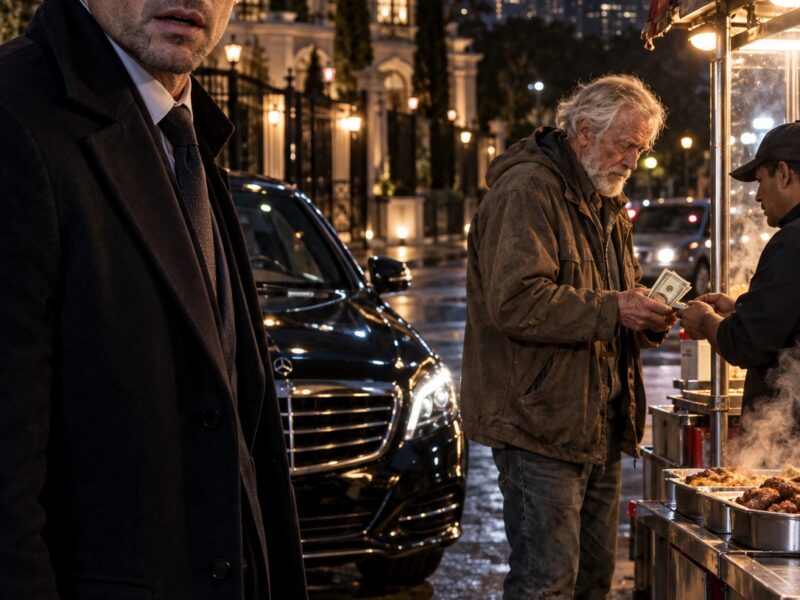
His seventy-two-year-old father—the same Richard Cross whose name appeared on hospital wings, university buildings, and charitable foundations across Chicago—was sitting on a cracked plastic chair beneath a flickering streetlight, wearing a faded brown jacket Damian had never seen before.
And a woman Damian didn’t know was placing a steaming plate of food in front of him.
“Careful,” she said. “It’s hot.”
Richard smiled up at her.
“Thank you, Clara.”
Damian tightened his hands around the steering wheel.
Across the street, the woman pushed a paper cup of water toward his father, then leaned against the side of her small food stand.
“You came hungry again?”
Richard gave a guilty little shrug.
“Maybe.”
Clara sighed.
“You can’t keep doing this.”
“I knew you’d feed me.”
“That’s not the point.”
Something about the exchange disturbed Damian more than it should have.
There was familiarity there.
Not romance.
Not exactly friendship either.
Something softer.
Something Damian no longer trusted when he saw it between people.
He watched Clara disappear behind the counter and return with a second piece of bread.
She slipped it onto Richard’s plate.
“No charge.”
Richard looked at her.
“You already gave me enough.”
“You’re still hungry.”
“You don’t know that.”
“Yes, I do.”
“How?”
Clara smiled.
“Because you looked at the bread three times.”
Richard laughed.
Damian hadn’t heard his father laugh like that in months.
Maybe years.
His suspicion sharpened.
Richard Cross had a private chef at home.
There was a refrigerator inside their Gold Coast mansion stocked with food flown in from places Damian himself couldn’t pronounce correctly.
His father owned watches worth more than that entire food stand.
So why was he dressed like a man who had slept at a bus station?
Why was he accepting free food from a woman who clearly didn’t have much herself?
And why had he been coming here every night?
Damian had noticed the pattern almost two weeks earlier.
At first, he’d ignored it.
Richard had always valued his independence. Even after moving into Damian’s home following a minor heart scare three years earlier, he refused to behave like a guest who needed permission to leave.
But every night around ten-thirty, Richard disappeared.
Same old jacket.
Same worn shoes.
No driver.
No security.
No explanation beyond the same sentence.
“Just taking a drive.”
Damian knew his father too well.
Richard Cross could negotiate a hundred-million-dollar deal without blinking, but he had never been a particularly convincing liar.
Tonight, Damian had finally followed him.
Now he wished the answer made more sense.
Across the street, Richard finished eating and stood.
Clara reached into a plastic container near the register.
“Wait.”
She handed him something.
Damian leaned forward.
Cash.
His father immediately shook his head.
“No.”
“Take it.”
“Clara, you fed me.”
“And now I’m giving you bus money.”
“I can walk.”
“It’s late.”
“I said no.”
“And I said take it.”
Richard stared at her.
Damian couldn’t hear his next words, but he saw Clara close Richard’s fingers around the money.
Then she said something that made Richard go completely still.
Damian would learn the words later.
Because you might need it.
That was all.
No lecture.
No questions.
No request for repayment.
She simply turned around and began wiping down the counter.
Richard remained there another moment.
Then he walked away.
Damian should have followed him home.
Instead, he stayed inside the Mercedes, staring at the woman beneath the cheap fluorescent light.
He had spent the last four years believing there was always a reason behind kindness.
Money.
Status.
Access.
Influence.
Need.
People wanted something.
They always wanted something.
He had learned that lesson from the two people he once trusted most.
And it had cost him far more than money.
Now some woman running a food stand in a neighborhood Damian rarely visited had just given his billionaire father her own cash because she believed he couldn’t afford the bus.
Damian turned off the engine.
Then he crossed the street.
He didn’t know it yet, but that walk would take him directly toward the part of himself he had spent four years trying to bury.
And it had begun with a betrayal he still couldn’t say aloud without feeling something cold move through his chest.
Before Victoria Hale, Damian had been different.
Not naive.
He hated that word.
Naive made it sound as though he had been stupid.
He hadn’t been.
At thirty-eight, Damian had already built Cross Meridian Group into one of the largest privately held real-estate and logistics companies in the Midwest. He negotiated acquisitions, read people for a living, and had survived boardroom battles that destroyed men twice his age.
But in his personal life, he believed trust should be given until someone proved they didn’t deserve it.
Richard had taught him that.
“Don’t become rich in the wrong ways,” his father used to say.
Damian would laugh.
“What does that even mean?”
“It means if your bank account grows while your heart shrinks, you made a bad trade.”
Richard had grown up poor in western Pennsylvania, the son of a mechanic and a school cafeteria worker. By the time Damian was born, Richard had already made his first fortune in commercial construction.
But money never impressed him much.
Character did.
He taught Damian to tip well.
Remember names.
Look people in the eye.
Never humiliate someone who worked for you.
Never assume expensive meant valuable.
And never mistake someone needing help for someone being weak.
For most of Damian’s life, those lessons stayed with him.
So did Richard.
Their relationship was unusually close.
They fought, certainly.
Richard thought Damian worked too much.
Damian thought Richard gave too much unsolicited advice.
But they talked.
Really talked.
Business.
Politics.
Regrets.
Women.
The strange loneliness of success.
Some evenings, they would sit on the stone terrace behind Richard’s old Lake Forest house with two glasses of bourbon between them and argue until midnight about whether ambition made people happier or merely busier.
Richard knew his son’s strengths.
He also knew his weaknesses.
Especially the biggest one.
When Damian loved someone, he didn’t know how to do it carefully.
Victoria entered his life at a charity dinner.
She was elegant without seeming impressed by elegance, funny without performing for attention, and clever enough to challenge Damian without turning every conversation into competition.
At least that was how she appeared.
Richard liked her immediately.
“You should call her,” he told Damian two days later.
Damian looked up from his phone.
“You’re matchmaking now?”
“I’m observing.”
“You spoke to her for twelve minutes.”
“Thirteen.”
“That changes everything.”
Richard smiled.
“You liked her.”
Damian looked away.
Richard’s smile widened.
“You really liked her.”
Damian eventually called.
One dinner became three.
Three became weekends.
Weekends became toothbrushes left at each other’s apartments.
For the first time in years, Damian began rearranging his calendar around another person.
Victoria seemed to notice small things about him.
How he took his coffee.
Which meetings exhausted him.
When he was pretending not to be worried about his father.
She knew when to speak and when to sit beside him in silence.
Damian fell in love with that silence.
He fell in love with her laugh.
Her confidence.
The way she would slip her hand into his during crowded events.
The way she said his name when they were alone.
And because Damian loved through attention, he remembered everything.
Victoria once mentioned that white peonies reminded her of her grandmother.
Three weeks later, Damian filled her apartment with them on the anniversary of her grandmother’s death.
She once complained that her car broke down whenever Chicago temperatures dropped below freezing.
Two months later, Damian handed her the keys to a new Range Rover.
She stared at him.
“Damian.”
“What?”
“This is insane.”
“You hate your car.”
“I was complaining.”
“I know.”
“You actually listened?”
He laughed.
“I always listen to you.”
She threw her arms around him.
“You spoil me.”
“I like seeing you happy.”
He meant it.
That was what made what came later so difficult to separate from the memories.
Damian had never thought of gifts as transactions.
He wasn’t buying affection.
He believed love meant noticing.
If he had more than someone he loved, why wouldn’t he share it?
Trips to Paris.
A weekend in Napa.
A last-minute villa in St. Barts because Victoria said Chicago winters made her miserable.
Jewelry she admired and forgot mentioning.
A studio lease when she talked about starting a consulting business.
Damian gave without keeping score.
Victoria accepted without asking him to.
At least that was what he believed.
There was another man who occupied the same unquestioned territory in Damian’s life.
Ethan Mercer.
His best friend since high school.
They had met at sixteen after Ethan punched a senior who had shoved Damian into a locker.
Damian had asked why.
Ethan had shrugged.
“He was annoying me.”
“He was hitting me.”
“That was the annoying part.”
From then on, they were nearly inseparable.
College.
First apartments.
Bad investments.
Funerals.
Breakups.
Damian’s first major business deal.
Ethan’s mother’s cancer diagnosis.
When Damian’s company nearly collapsed during the financial crisis, Ethan stayed in the office with him until sunrise for three consecutive nights.
Damian never forgot loyalty like that.
He called Ethan his brother.
Richard treated him almost like a second son.
So when Victoria and Ethan became friendly, Damian felt relieved.
The two most important people he had chosen for himself liked each other.
What could be better?
Sometimes Damian would enter a room and find them laughing.
He never wondered what the joke was.
Sometimes Victoria would mention Ethan had stopped by.
Damian never asked why.
Sometimes Ethan knew things about Victoria Damian didn’t remember telling him.
He assumed Victoria had.
Trust made every suspicious detail look harmless.
Until one Thursday evening in October.
Damian’s meeting ended two hours early.
Victoria had been complaining all week about deadlines, so he stopped at her favorite Italian restaurant and picked up dinner.
He also bought white peonies.
He didn’t call.
He wanted to surprise her.
He drove to her apartment in Lincoln Park shortly after seven.
Her lights were on.
He called anyway.
No answer.
He tried again.
Nothing.
Damian sat inside his car, wondering whether she was in the shower.
Then a silver Audi pulled into the parking lot.
He recognized it instantly.
Ethan.
Damian frowned.
His first thought was not betrayal.
That mattered later.
His first thought was concern.
Maybe something had happened.
Maybe Victoria had called Ethan because Damian was unavailable.
Maybe—
Ethan got out.
No laptop.
No folder.
No urgency.
He walked toward Victoria’s building with the relaxed familiarity of someone who knew exactly where he was going.
Damian’s stomach tightened.
Still, his mind protected the people he loved.
There’s an explanation.
Victoria opened the door before Ethan knocked.
She was smiling.
Not surprised.
Waiting.
Ethan stepped inside.
Victoria wrapped both arms around his neck.
And kissed him.
The flowers slid from Damian’s hand onto the passenger-side floor.
He didn’t move.
He didn’t shout.
He didn’t get out of the car.
He simply stared.
There are moments when the human mind refuses to understand something because understanding it would require destroying too much at once.
Damian knew what a kiss looked like.
He knew what desire looked like.
He knew how Victoria held a man she loved because she had held him that exact way.
Still, some desperate part of his brain searched for another explanation.
So he called Ethan.
Through Victoria’s open window, Damian heard the ringtone.
Ethan pulled his phone from his pocket.
Looked at Damian’s name.
Then silenced it.
That tiny movement hurt more than the kiss.
Because it meant awareness.
Concealment.
Choice.
Ethan knew exactly what he was doing.
Damian sat in his car for nearly forty minutes.
Dinner cooling beside him.
Peonies crushed near his shoes.
By the time he drove away, something inside him had become terrifyingly calm.
He didn’t confront either of them that night.
Instead, he went to his office.
He stayed until sunrise.
And he started looking.
Once suspicion entered his mind, details that had seemed unrelated began arranging themselves into a pattern.
Victoria had access to one of Damian’s secondary personal accounts. It had originally been set up for household and travel expenses because Damian hated wasting time approving routine purchases.
There were transfers he didn’t recognize.
Not small ones.
$18,000.
$32,500.
$47,000.
A series of payments routed through a consulting entity Damian had never heard of.
He pulled corporate records.
The entity traced back to an address connected to Victoria.
Then came credit-card charges.
Hotel rooms.
Jewelry.
Trips Damian hadn’t taken.
One reservation made him physically sick.
A resort in Cabo.
Two guests.
The dates matched a weekend Ethan had supposedly spent visiting his sister in Denver.
Damian sat alone inside his forty-third-floor office as dawn spread over Chicago.
The city below him looked unchanged.
That felt insulting.
He had discovered that the woman he intended to marry had been sleeping with his best friend.
He had discovered that she had been quietly moving money from his accounts.
And somewhere below, trains still ran.
Coffee shops opened.
People went to work.
The world had the nerve to continue.
He confronted Victoria first.
She arrived at his penthouse the following evening.
She saw the documents on the dining table.
Then she saw Damian’s face.
Her expression changed.
“How long?” he asked.
She didn’t answer.
“Don’t insult me by lying now.”
“Damian—”
“How long?”
Victoria looked away.
“Months.”
The word entered him like a blade.
“How many?”
“What?”
“How many months?”
“Does it matter?”
He stared at her.
“Yes.”
She swallowed.
“Seven.”
Seven months.
Damian thought of birthdays.
Flights.
Dinners.
Her head on his shoulder.
The Range Rover.
The night she cried because she said she was afraid he would eventually get bored with her.
Seven months.
“You stole from me.”
Victoria’s face hardened slightly.
“I didn’t steal.”
“You moved money without telling me.”
“You gave me access.”
“For expenses.”
“I thought—”
“No. Don’t tell me what you thought. Tell me what you did.”
She crossed her arms.
That gesture ended something.
Not the affair.
Not the relationship.
Something deeper.
Remorse, Damian realized, was not coming.
“Did Ethan know about the money?”
Victoria hesitated.
That was enough.
Damian laughed once.
It sounded unfamiliar.
“You two really did everything together.”
“Damian, it wasn’t supposed to happen this way.”
He looked at her.
“How was it supposed to happen?”
Silence.
“You were going to keep sleeping with my best friend until what? Until you’d moved enough money? Until you decided which one of us was more useful?”
“That’s not fair.”
“Fair?”
His voice remained quiet.
That frightened Victoria more than shouting would have.
“You walked into my life, let me love you, let my father love you, sat at my table with a man I called my brother, and both of you looked me in the face for seven months.”
Victoria began crying then.
Too late.
Damian felt nothing.
Or perhaps he felt so much that his body had stopped translating it.
“Get out.”
“Please—”
“Get out.”
He confronted Ethan the next morning.
Ethan looked worse.
That almost made Damian hate him more.
They stood inside the private conference room where, years earlier, Damian had offered Ethan an executive position.
Ethan had declined because he wanted to build his own career.
Damian had admired him for that.
Now Ethan couldn’t meet his eyes.
“Say something,” Damian told him.
“I’m sorry.”
Damian waited.
“That’s it?”
“What do you want me to say?”
“The truth would be interesting.”
“It started by accident.”
Damian’s jaw tightened.
“Did you trip?”
Ethan closed his eyes.
“Damian.”
“No. Explain the accident. I want to understand the physics.”
“It wasn’t planned.”
“The first time?”
“No.”
“The second?”
Ethan said nothing.
“The tenth?”
Silence.
“Seven months, Ethan.”
“I know.”
“You knew I loved her.”
“I know.”
“You knew I was thinking about proposing.”
Ethan’s face crumpled.
“I know.”
Damian stepped closer.
For one violent second, he imagined hitting him.
Instead, he asked the only question that mattered.
“Was there ever a moment when you were with her that you remembered I existed?”
Ethan looked up.
Tears filled his eyes.
“Yes.”
That answer destroyed the last excuse.
Damian nodded slowly.
“Then it wasn’t a mistake.”
He walked out.
He never spoke to Ethan again.
He never spoke to Victoria again either.
Lawyers handled the money.
Documents handled the rest.
The affair ended a relationship.
The deception ended something larger.
Damian’s belief that intimacy could be safe.
Afterward, his life became efficient.
Efficiency was easier than happiness.
He worked.
He acquired companies.
He expanded Cross Meridian into three new states.
He appeared on magazine covers.
He attended fundraisers.
He donated millions.
He shook hands.
He smiled when cameras required it.
But he stopped letting people close enough to disappoint him.
Women still entered his orbit.
Some were interested in his wealth.
Some probably weren’t.
Damian no longer believed he could tell the difference.
Once, during dinner at an expensive restaurant in New York, a woman named Natalie put down her wineglass and asked him quietly, “Why won’t you give me a chance?”
Damian looked at her.
“Because I already gave someone everything I had to give.”
Natalie glanced at his watch.
She misunderstood.
“I’m not asking for your money.”
Damian almost smiled.
“I know.”
He meant trust.
Richard watched all of it.
He watched his son become more successful and less alive.
He saw the easy laughter disappear.
Saw conversations become shorter.
Saw Damian retreat into work whenever anything emotional came near him.
And Richard carried his own guilt.
He had encouraged Victoria.
He had been the one who said, Call her.
The one who told Damian she seemed genuine.
Damian never blamed him.
That almost made it worse.
One winter evening, Richard entered Damian’s home office.
It was after ten.
“Still working?”
Damian looked up from his laptop.
“There’s always something to finish.”
“You’ve been saying that for four years.”
“Because it’s been true for four years.”
Richard sat opposite him.
Damian immediately recognized the expression.
“What?”
“Are you happy?”
Damian leaned back.
“I have nothing to complain about.”
“That wasn’t my question.”
“I’m fine.”
“That wasn’t my question either.”
Damian’s eyes moved toward the window.
Chicago glittered below.
“I don’t know what you want me to say.”
“The truth.”
“The truth is I have a good life.”
“A good life can still be lonely.”
Damian’s expression hardened.
“Dad.”
Richard stopped.
There were boundaries now.
He hated them.
“Do you think you’ll ever love someone again?” Richard asked.
Damian stared at him for a long time.
Then he gave a small, exhausted smile.
“I don’t think that’s for me anymore.”
Something inside Richard broke.
“Don’t say that.”
“I’m not sixteen. I’m not being dramatic.”
“You’re forty-two.”
“Exactly.”
“That’s not old.”
“I didn’t say it was.”
“Then what are you saying?”
Damian closed his laptop.
“I’m saying some people learn.”
Richard understood.
Victoria had betrayed Damian once.
But every day since, Damian had been allowing her betrayal to make decisions for him.
Richard wanted to say that.
He didn’t.
He knew his son would hear it as pressure.
So he stood.
“Good night.”
“Dad.”
Richard turned.
Damian’s expression softened.
“I’m okay.”
Richard nodded.
But when he left the room, he whispered to himself, “No, you’re surviving.”
That night Richard made a decision.
He would not choose another woman for his son.
He would not introduce anyone.
He would not arrange dinners or manipulate encounters.
He had interfered once.
He would never do it again.
But he wanted to prove something to Damian.
Not that love existed.
That was too large.
He wanted to prove that kindness existed without motive.
For weeks, Richard thought about how.
Then the idea came.
It was ridiculous.
Possibly humiliating.
Definitely something Damian would call insane.
Richard did it anyway.
He removed his watch.
Left his wallet.
Changed out of his tailored clothes.
Found an old jacket in a storage closet.
Wore scuffed shoes.
Then he drove to a neighborhood where no one would recognize him, parked several blocks away, and walked.
The first night taught him more than he expected.
People avoided eye contact.
A restaurant manager asked him to move away from the entrance.
A woman offered him three dollars without stopping.
A teenager gave him half a sandwich.
Richard went home thinking about all of them.
The second night, he tried another neighborhood.
Then another.
He wasn’t looking for beauty.
Or education.
Or money.
He wasn’t even looking for someone for Damian.
At least that was what he told himself.
He was looking for proof.
Proof that a person could see someone who appeared useless to them and still choose compassion.
On the fifth night, he smelled garlic and grilled onions before he saw the stand.
It sat beneath an old awning on a corner near a laundromat.
Three plastic tables.
A handwritten menu.
Steam rising from metal pans.
Behind the counter stood a woman in her early thirties with dark hair tied loosely behind her head.
She was cleaning.
Richard almost kept walking.
Instead, he stopped.
“Excuse me, ma’am.”
She looked up.
“Yes?”
“I’m sorry to bother you.”
“You’re not bothering me.”
“Do you have anything left to eat?”
She glanced at the pans.
“A little.”
Richard reached into his pocket.
He had deliberately brought only a few coins.
“I don’t think I have enough.”
The woman looked at the money.
Then at him.
Richard prepared for embarrassment.
Instead, she reached for a plate.
“Come here.”
“I said I can’t—”
“I heard you.”
She spooned rice onto the plate.
Added chicken.
Vegetables.
Bread.
Richard stared.
“What are you doing?”
“Feeding you.”
“But I can’t pay.”
“I didn’t ask you for money.”
She pointed at a chair.
“Sit.”
Richard didn’t move.
The woman raised an eyebrow.
“Do you want the food to get cold?”
He sat.
She placed the plate before him.
“Eat first. We’ll worry about everything else later.”
Richard looked at her.
“Why would you do that for a stranger?”
She shrugged.
“Because you’re hungry.”
No performance.
No moral speech.
No expectation.
Richard ate.
She continued cleaning.
Several minutes later, she brought him water without being asked.
“What’s your name?” he asked.
“Clara Bennett.”
“I’m Richard.”
“Nice to meet you, Richard.”
“You do this often?”
“Feed people?”
“People who can’t pay.”
Clara shrugged.
“When I can.”
“That can’t be good for business.”
She smiled.
“It’s terrible for business.”
Richard laughed.
Clara laughed too.
When he finished, he thanked her and started walking away.
“Richard.”
He turned.
“Do you have money to get home?”
He hesitated.
“I’ll manage.”
“That means no.”
She pulled several folded bills from the pocket of her apron.
Richard shook his head.
“No.”
“Take it.”
“You already fed me.”
“And?”
“You don’t have to do this.”
“I know.”
“Then why?”
Clara pushed the money into his hand.
“Because you might need it.”
Richard stared at the bills.
It was only fifteen dollars.
He had spent more than that on a glass of wine.
But standing beneath that flickering light, fifteen dollars suddenly felt heavier than millions.
Because Clara believed he had nothing.
And she gave anyway.
Richard returned the next night.
Then again.
He told himself he needed to be certain.
In truth, he enjoyed talking to her.
Clara never asked for his last name.
Never asked where he lived.
Never tried to discover whether he had anything she could use.
She simply remembered he liked extra pepper.
One evening, she scolded him for not eating during the day.
Another night, she packed leftovers for him.
“You’re giving away your profit,” Richard said.
“I’ll survive.”
“How?”
“By charging annoying customers extra.”
“Am I annoying?”
“Extremely.”
Richard smiled all the way home.
Damian noticed.
That was the beginning.
Then Damian noticed the old clothes.
Then the late-night exits.
Then the vague answers.
Until eventually he followed his father.
And now he stood across from Clara.
She was wiping the counter when she noticed him.
“Can I help you?”
Damian glanced toward the street where Richard had disappeared.
“Yes.”
Clara waited.
“The man who was just here.”
“What about him?”
“How long have you known him?”
Her eyebrows lifted slightly.
“Not long.”
“He comes here often?”
“A few times.”
“And you always give him food?”
“When he’s hungry.”
Damian studied her.
“You know where he lives?”
“No.”
“His family?”
“No.”
“His last name?”
Clara paused.
“Actually, no.”
“And you give him food anyway.”
She frowned.
“Is that a problem?”
“I’m asking.”
“No, you’re investigating.”
That surprised him.
“I’m not investigating you.”
“You have the face of someone investigating me.”
“What face is that?”
“That one.”
Against his will, Damian almost smiled.
He looked around the modest stand.
“You don’t know anything about him.”
“I know he’s polite.”
“That’s enough?”
“I know he’s hungry when he comes here.”
Damian’s voice sharpened.
“And if he’s lying?”
Clara stopped wiping the counter.
“About being hungry?”
“About anything.”
She looked directly at him.
“Do I need someone’s entire life story before I give them a plate of food?”
Damian had no answer.
Clara watched him another second.
Then her expression softened.
“You ask a lot of questions.”
“I’ve been told.”
“Are you a cop?”
“No.”
“Reporter?”
“No.”
“Debt collector?”
Damian laughed quietly.
“No.”
“Good. You look expensive for a debt collector.”
He stared at her.
“Expensive?”
“The coat.”
Damian glanced down at the custom Italian wool coat he had forgotten he was wearing.
Clara pointed.
“That thing probably costs more than my refrigerator.”
He almost said she was wrong.
She wasn’t.
“Are you hungry?” she asked.
Damian blinked.
“What?”
“You’ve been standing there interrogating me for five minutes. Are you hungry?”
“Maybe.”
She pointed at the chair his father had just left.
“Then sit down.”
Damian sat.
It felt absurd.
He was accustomed to restaurants where reservations took months and wine lists arrived in leather-bound books.
Now he was sitting on a plastic chair beside a street, listening to buses and car horns while Clara put a plate in front of him.
“Try it.”
“What is it?”
She stared.
“Food.”
“I can see that.”
“Then stop asking questions.”
He took a bite.
Paused.
Clara crossed her arms.
“Well?”
“This is actually good.”
“Actually?”
“Very good.”
“Better.”
He smiled.
It happened before he could stop it.
A real smile.
Clara returned to work.
Damian watched her move around the stand.
There was confidence in the way she occupied the small space.
Nothing embarrassed about it.
Nothing apologetic.
“You run this alone?”
“Mostly.”
“That’s a lot of work.”
“It is.”
“Why do it?”
“Because it’s mine.”
Something in her tone caught him.
“You’re proud of it.”
“Of course.”
She glanced around.
“It isn’t much.”
Damian expected embarrassment.
Instead, she added, “But I built it.”
Those four words stayed with him.
I built it.
Damian understood that pride.
He had heard executives describe billion-dollar companies with less ownership in their voices.
“What do you do?” Clara asked.
“Business.”
“That sounds intentionally vague.”
“It’s also accurate.”
“What kind?”
“Several.”
She narrowed her eyes.
“You’re one of those men who never gives a straight answer.”
“Maybe.”
“Definitely.”
They talked for nearly an hour.
Food.
Chicago.
Travel.
Childhood.
Clara told him she had grown up outside Milwaukee and moved to Chicago after her mother died. She had worked restaurant jobs for years, saved everything she could, and bought the stand from a retiring owner.
Damian told her almost nothing about his wealth.
Not because he wanted to deceive her.
Because he liked the version of himself that existed there.
To Clara, he was simply Damian.
A man who worked “in business.”
A man who asked too many questions.
A man whose coat was too expensive.
She didn’t know his net worth.
She didn’t know his company.
She didn’t know Forbes had once estimated his personal fortune at $4.8 billion.
And for the first time in years, Damian enjoyed not being recognized.
Then a boy approached the counter.
Maybe twelve.
He held a few crumpled dollars.
“What can I get for this?”
Clara counted the money.
“Not much.”
The boy’s face fell.
She reached for a container.
“But luckily I’m terrible at math.”
She filled it.
The boy smiled.
“Thank you.”
“Go home before your mom worries.”
He ran away.
Damian watched.
“You do that a lot?”
Clara glanced at him.
“What?”
“Give food away.”
“He was hungry.”
“You said this place barely makes money.”
“It makes enough.”
“That isn’t what I asked.”
She leaned against the counter.
“Why does kindness confuse you so much?”
The question landed harder than she knew.
Damian looked down at his plate.
“It doesn’t.”
“It does.”
“You don’t know me.”
“No.”
She smiled slightly.
“But you don’t know me either, and you’ve spent the entire night trying to figure out what I want.”
Damian looked up sharply.
Clara had seen through him.
“What do you want?” he asked.
She thought about it.
“Right now?”
“Yes.”
“I want you to finish eating so I can wash the plate.”
He laughed.
Really laughed.
Clara smiled.
Something moved inside him.
Small.
Dangerous.
Alive.
When Damian finally stood to leave, Clara handed him a container.
“What’s this?”
“Food.”
“I’ve heard that joke.”
“For tomorrow.”
“I can buy lunch.”
“I’m sure you can.”
“Then why give me this?”
“Because you liked it.”
Damian looked at her.
No one had done something that simple for him in years without turning it into something bigger.
“Thank you.”
“You’re welcome.”
He returned two nights later.
Then again.
At first, he told himself he wanted answers about Richard.
Soon, he stopped lying to himself.
He wanted Clara.
Not possession.
Not romance, he insisted.
Just her presence.
He liked sitting near her while she worked.
Liked the way she teased him.
Liked that she disagreed without fear.
Liked that she never asked about his car.
Once, she saw the Mercedes and said, “That yours?”
Damian braced himself.
“Yes.”
Clara nodded.
“Parking there is illegal.”
That was all.
He laughed for five minutes.
Richard noticed the change before Damian did.
One morning over coffee, Richard asked, “Going out tonight?”
Damian looked over his newspaper.
“Maybe.”
“Taking a drive?”
Damian froze.
Richard sipped his coffee.
Damian slowly lowered the newspaper.
“You know.”
“Know what?”
“You’re enjoying this.”
“I have no idea what you mean.”
“You absolutely do.”
Richard smiled into his cup.
Damian stared at him.
“Why were you there?”
Richard’s smile disappeared.
Damian waited.
Richard sighed.
“That’s complicated.”
“Try me.”
“Not yet.”
Damian’s eyes hardened.
“Dad.”
“Trust me.”
The words changed the room.
Richard realized it immediately.
Damian looked away.
Trust me.
Two simple words.
Four years earlier, Damian would have accepted them without hesitation.
Now they sounded like a warning.
Richard reached across the table.
“I’m sorry.”
“For what?”
“For forgetting that those words cost you more now.”
Damian said nothing.
Richard withdrew his hand.
“I’ll explain. Soon.”
Damian hated secrets.
But he let it go.
Because Clara was waiting that evening.
Days became weeks.
Damian learned she hated olives.
Loved old soul music.
Had a scar near her left thumb from cutting herself during her first restaurant job.
Sent money every month to an aunt in Wisconsin.
Wanted someday to open a small sit-down restaurant where no one would be rushed out because they couldn’t afford another drink.
Clara learned Damian hated sleeping on airplanes.
Could cook exactly three meals.
Called his father every morning even though they lived in the same house.
And became strangely quiet whenever relationships came up.
She noticed the wall.
She simply didn’t force him to explain it.
That made him trust her more.
Which terrified him.
Some nights Damian would drive home and hear Victoria’s voice in his memory.
You actually listened.
I always listen to you.
Then he would remember Ethan silencing his phone.
His body would tighten.
He would decide not to return to Clara.
The next evening, he would find himself driving there anyway.
One rainy Thursday, Clara looked at him across the counter.
“You disappear inside your head a lot.”
Damian frowned.
“What?”
“You’re here, then suddenly you’re somewhere else.”
“Occupational hazard.”
“No.”
Her voice was gentle.
“That isn’t work.”
He looked at her.
Clara didn’t push.
She just handed him coffee.
Damian realized that was why he kept returning.
She noticed pain without demanding ownership of it.
Then everything nearly ended.
Richard arrived unexpectedly while Damian was there.
Clara looked up.
“You’re back.”
Richard smiled.
“I am.”
Damian, sitting at the far table, went still.
His father hadn’t noticed him yet.
Clara prepared Richard’s usual meal.
“Extra pepper?”
“You remembered.”
“I remember everyone.”
Richard sat.
Damian watched them.
He could leave.
He almost did.
Then Richard looked up.
Their eyes met.
Clara followed Richard’s gaze.
She looked at Damian.
Then Richard.
Something in Richard’s expression changed.
Clara saw it.
“Wait.”
Neither man spoke.
She looked at Damian.
“You know him.”
Damian stood.
“Clara—”
She turned toward Richard.
“Who is he?”
Richard lowered his eyes.
“My son.”
Silence.
Clara looked at Damian again.
“Your son?”
“Yes.”
Richard’s voice was barely audible.
The hurt on Clara’s face appeared slowly.
Not anger yet.
Understanding.
Pieces connecting.
Damian’s clothes.
His car.
His vague answers.
Richard’s strange nighttime appearances.
The old jacket.
The coins.
The free meals.
She stepped backward.
“Who are you?”
Damian swallowed.
“My name is Damian Cross.”
Clara stared.
She knew the name.
Everyone in Chicago knew the name.
Cross Meridian.
Buildings.
News.
Money.
Her eyes moved to Richard.
Then back.
“You’re Damian Cross.”
“Yes.”
“And you…”
She looked at Richard.
“You’re Richard Cross.”
Richard nodded.
Clara’s face changed.
“You’re not homeless.”
“No.”
“You never needed food.”
Richard stood.
“Clara, let me explain.”
“You had money.”
“Yes.”
“You had somewhere to go.”
“Yes.”
Her eyes dropped toward the counter.
“You had a home.”
“Yes.”
A long silence followed.
Then she asked the question Richard had feared.
“Was this a joke?”
“No.”
“A bet?”
“Never.”
“Then what?”
Richard looked at Damian.
Damian suddenly understood before his father said it.
Richard had been searching for something.
For him.
“No,” Damian whispered.
Richard looked at his son.
“Damian—”
“You did this because of me?”
Clara turned sharply toward him.
Richard closed his eyes.
“Yes.”
Damian felt humiliation flare through him.
“What the hell were you thinking?”
“I was trying to help.”
“By pretending to be homeless?”
“I needed to know—”
“Know what?”
Richard looked at Clara.
“Whether kindness could still be genuine.”
Clara’s expression hardened.
Richard continued carefully.
“My son was betrayed badly. Years ago. He stopped trusting people. I thought if I could find someone who helped a person she believed had nothing…”
He stopped.
Clara understood.
“You were testing me.”
Richard’s face fell.
“I suppose I was.”
“You suppose?”
“I’m sorry.”
Clara stared at him.
Every meal.
Every dollar.
Every conversation.
Reframed.
She wasn’t angry because Richard was rich.
She wasn’t angry because she had given away food he could easily afford.
She was hurt because something sincere had been placed beneath a microscope.
“You watched me,” she said.
Richard nodded.
“Yes.”
“You came here again and again to see if I was good enough.”
“No, Clara. It wasn’t—”
“That’s exactly what it was.”
Richard had no answer.
Clara’s eyes glistened.
“Kindness shouldn’t be tested.”
The street seemed suddenly quiet.
“When someone is hungry, you feed them,” she continued. “When someone needs help, you help them. You don’t secretly grade people for it.”
“You’re right.”
“I gave you money.”
“I know.”
“I worried about you getting home.”
“I know.”
“And all that time you were watching me?”
Richard lowered his head.
“Yes.”
Clara inhaled slowly.
“I don’t regret helping you.”
Richard looked up.
“But I hate knowing that something I did because I thought you needed me became some kind of audition.”
Damian flinched.
Audition.
That was exactly what it had become.
His father had tried to protect him by turning another human being into evidence.
Richard stepped forward.
“I was wrong.”
Clara said nothing.
“I spent years watching my son become someone who no longer believed goodness existed without a motive. I became desperate. That doesn’t excuse what I did.”
“No.”
“It doesn’t.”
Richard’s eyes filled.
“I’m sorry.”
Clara looked at him for a long moment.
Finally, she nodded.
“I forgive you.”
Richard exhaled.
“But promise me something.”
“Anything.”
“Never do this to another person.”
“I won’t.”
“And don’t help someone just because you think they passed your test.”
Richard’s voice broke slightly.
“I promise.”
He left them alone.
Damian remained standing beside the table.
Clara began cleaning.
Her movements were sharper than usual.
“I should have told you,” he said.
She didn’t look up.
“Yes.”
“I didn’t know everything at first.”
“But you knew who your father was.”
“Yes.”
“And you knew I didn’t.”
“Yes.”
Damian swallowed.
“I liked that you didn’t know who I was.”
Clara stopped.
There it was.
The truth.
He continued.
“People change when they know.”
“So you decided for me.”
“No.”
“Yes, Damian.”
She faced him.
“You decided the version of me who didn’t know about your money was more trustworthy.”
He couldn’t deny it.
Clara’s voice softened.
“Do you understand how close that is to what your father did?”
The question hurt.
Because she was right.
Damian sat slowly.
“I was afraid.”
Clara’s expression changed.
“Of me?”
“Of what knowing might change.”
She leaned against the counter.
“How much money do you have?”
Damian almost laughed at the absurd directness.
“A lot.”
“I gathered.”
“Enough that it complicates things.”
“For you.”
“Yes.”
Clara studied him.
“I don’t care how much money you have.”
Damian looked at her.
“Then what do you care about?”
“Who you are when nobody’s looking.”
He went still.
Clara sat across from him.
“Who hurt you?”
Damian stared at the table.
He had avoided that story for years.
Therapists had heard pieces.
His father knew.
Lawyers knew facts.
But Damian had never told the whole thing to someone whose opinion could hurt him.
That was the problem.
Clara’s opinion mattered.
So he told her.
Victoria.
Ethan.
The apartment.
The kiss.
The phone ringing inside.
The money.
Seven months.
The confrontation.
The friend he had called a brother admitting that yes, he remembered Damian while sleeping with the woman Damian loved.
When he finished, Clara was quiet.
Damian stared toward the street.
“I lost two people in one night.”
“You lost more than that.”
He looked at her.
“You lost the version of yourself that trusted them.”
His throat tightened.
“Yes.”
Clara reached across the table and rested her hand over his.
Damian looked down.
It had been years since a touch that gentle made him want to stay rather than retreat.
“I’m not Victoria,” she said.
“I know.”
“I’m not Ethan.”
“I know.”
“And I’m not the one who broke you.”
Damian’s jaw tightened.
“I know.”
“I can’t spend my life proving I won’t do what they did.”
He looked up.
Clara’s eyes were kind, but firm.
“And I can’t heal something I didn’t break.”
Damian felt the wall inside him crack.
Not collapse.
Walls built over four years don’t disappear because of one beautiful sentence.
But they crack.
And sometimes a crack is enough for light.
“What am I supposed to do?” he asked.
Clara squeezed his hand.
“Stop asking every new person to pay for what the old ones stole.”
Damian looked away because his eyes had begun to burn.
He had spent years calling his isolation wisdom.
Calling fear experience.
Calling avoidance standards.
But beneath all those respectable words was a simpler truth.
He was terrified.
Victoria and Ethan had betrayed him once.
Damian had been repeating the betrayal ever since by refusing to let anyone else reach him.
“I don’t know how to do this anymore,” he admitted.
“Do what?”
“Trust someone.”
Clara thought about it.
“Then don’t start with forever.”
He looked at her.
“Start with tomorrow.”
That became their rule.
Tomorrow.
Not marriage.
Not promises.
Not destiny.
Tomorrow.
Damian returned the next evening.
Clara let him help close the stand.
He was terrible at stacking containers.
She told him so.
He returned after that.
He began arriving earlier.
Sometimes he brought coffee.
The first time he brought an expensive bouquet, Clara stared at it.
“No.”
Damian blinked.
“No?”
“Too much.”
“They’re flowers.”
“They look like they have a mortgage.”
He laughed.
The next week he brought grocery-store daisies.
Clara approved.
Richard kept his distance.
For once, he understood that love could not be managed like a business merger.
He apologized to Damian too.
They sat together one Sunday morning on the terrace.
“I wanted to fix what I helped break,” Richard said.
Damian stared at the lake.
“You didn’t break it.”
“I encouraged you to trust Victoria.”
“I chose her.”
“I still feel responsible.”
Damian turned toward him.
“Dad, you made one bad judgment about a person. So did I.”
Richard nodded.
“Clara was right.”
“About what?”
“Kindness shouldn’t be tested.”
Damian smiled faintly.
“She’s right annoyingly often.”
Richard laughed.
“I like her.”
“I know.”
“I’m not interfering.”
“You already disguised yourself as a homeless man.”
“Which is exactly why I’m retiring from interference.”
Damian shook his head.
Then, unexpectedly, he reached over and hugged his father.
Richard froze.
Their relationship had never fully broken.
But something between them had been waiting for forgiveness anyway.
Weeks became months.
Damian learned that healing was less cinematic than people pretended.
There was no morning when he woke up cured.
No speech that erased fear.
Sometimes Clara’s phone would buzz late at night and his body would remember Victoria.
Sometimes Clara would cancel dinner because the stand was busy and Damian’s mind would invent explanations before reason caught up.
Sometimes he hated himself for it.
One evening, after he became quiet during dinner, Clara put down her fork.
“Where did you go?”
“Nowhere.”
“Damian.”
He exhaled.
“You got a message.”
“Yes.”
“From someone named Marcus.”
“My cousin.”
“I know.”
Clara waited.
Damian rubbed his face.
“I hate this.”
“What?”
“That part of me still reacts.”
Clara reached for his hand.
“Reacting isn’t the same as accusing.”
He looked at her.
“You didn’t do anything wrong.”
“Neither did you.”
“I’m suspicious.”
“You’re scared.”
“Same thing.”
“No.”
Clara shook her head.
“Suspicion says I’m guilty. Fear says you remember being hurt. Those aren’t the same.”
Damian stared at her.
“How do you do that?”
“Do what?”
“Make everything sound obvious.”
“I run a food stand. We specialize in emotional clarity and chicken.”
He laughed.
That laugh became more common.
People at Cross Meridian noticed.
His assistant noticed he stopped scheduling meetings past eight every night.
Richard noticed music coming from Damian’s kitchen again.
Damian noticed himself buying ingredients because Clara had taught him a fourth meal.
Then came the offer that tested them in a different way.
A property became available two blocks from Clara’s stand.
Small restaurant.
Good kitchen.
Affordable lease.
Damian could have bought the entire building with less thought than most people gave to buying a coat.
He almost did.
Instead, he told Clara.
“I found something.”
She looked at the listing.
Her eyes widened.
“This is perfect.”
“I thought so.”
Then she looked at him suspiciously.
“You bought it.”
“No.”
“Damian.”
“I didn’t.”
“Swear.”
“I swear.”
She relaxed.
“I can introduce you to the owner.”
“That’s all?”
“That’s all.”
“No secret deal?”
“No.”
“No billionaire discount?”
“I don’t think that’s a thing.”
“No buying the building behind my back?”
He smiled.
“No.”
Clara studied him.
“You’re learning.”
“Slowly.”
She applied.
Negotiated.
Used her own savings.
Secured a small-business loan.
Damian helped only when she asked.
That was harder for him than writing a check.
But he understood why it mattered.
Months later, Clara opened Bennett’s Table.
Nothing enormous.
Thirty-eight seats.
Warm lights.
Simple food.
A small handwritten sign near the register said:
IF YOU’RE HUNGRY AND CAN’T PAY, TELL US.
NO QUESTIONS.
Damian stood outside on opening night staring at it.
Clara came beside him.
“You hate the sign?”
“No.”
“What?”
“I was thinking about my father.”
Clara smiled.
“Your extremely weird father?”
“My extremely weird father.”
Richard arrived fifteen minutes later wearing an expensive navy suit.
Clara looked him up and down.
“Who are you?”
Richard laughed.
“This is the real me.”
“I liked the jacket.”
“I burned it.”
“You should have.”
They hugged.
No tests.
No disguises.
Just forgiveness that had become ordinary enough to laugh about.
Damian and Clara never became a perfect couple.
That mattered.
Perfect love would have taught Damian nothing.
He needed something real.
They argued.
Clara hated when Damian tried to solve emotional problems with logistics.
Damian hated when Clara worked while sick.
She accused him of being controlling.
He accused her of being stubborn.
They were both right.
Once, after a particularly bad argument, Damian left her apartment and drove three blocks before fear whispered the old solution.
Disappear.
End it first.
Leave before she can.
He stopped at a red light.
Clara’s voice came back to him.
You don’t get to disappear whenever you’re scared.
Stay.
Damian turned the car around.
When Clara opened the door, her eyes were still angry.
“I’m not done being mad at you.”
“I know.”
“Then why are you here?”
“Because I said I’d stay.”
Something in her face softened.
Not everything.
Enough.
“Come inside.”
That was how Damian learned love again.
Not through grand gestures.
Through returning.
Through uncomfortable conversations.
Through apologies that didn’t erase consequences.
Through discovering that trust was not certainty that someone would never hurt you.
It was the willingness to stop treating pain as inevitable.
A year after Damian first followed his father, he found himself standing outside Bennett’s Table after closing.
Autumn had returned to Chicago.
Clara locked the door and turned.
“You’re quiet.”
“I’m thinking.”
“Dangerous.”
He smiled.
Richard had already gone home.
The street was almost empty.
Damian looked toward the corner where Clara’s old food stand had once stood.
The stand itself had been sold to a young couple.
But Damian could still picture his father sitting there in that ridiculous old jacket.
He could still picture himself across the street, suspicious of everything.
He had believed Richard was hiding something shameful.
Instead, his father had been searching for proof that goodness still existed.
Richard had gone about it badly.
Clara had been right about that.
But somehow, three flawed people had collided in exactly the place they needed to.
“What?” Clara asked.
Damian looked at her.
“The first night I saw you, I thought you wanted something.”
Clara smiled.
“I did.”
His eyebrow lifted.
“Really?”
“Yes.”
“What?”
“For you to stop asking questions and finish your food.”
Damian laughed.
Clara stepped closer.
He took her hand.
“I spent years believing love was what destroyed me.”
Her expression softened.
“And now?”
Damian looked toward the empty street.
“Now I think love had nothing to do with it.”
Victoria had betrayed him.
Ethan had betrayed him.
Love hadn’t.
That distinction had taken him four years to understand.
“I trusted the wrong people,” he said.
Clara squeezed his hand.
“And then?”
He looked at her.
“Then I almost punished everyone else for it.”
Clara said nothing.
She didn’t need to.
Damian had once imagined healing would feel triumphant.
Like winning.
It didn’t.
It felt quieter.
Like being able to hear a phone ring without assuming the worst.
Like watching someone leave without believing they were abandoning you.
Like saying I’m scared instead of I don’t care.
Like coming back after an argument.
Like accepting that the future could hurt you and walking toward it anyway.
Clara rested her head against his shoulder.
“You ready?”
“For what?”
“To go home.”
Damian looked down at their joined hands.
Home.
Once, that word had meant architecture.
Security gates.
Marble floors.
Staff.
Silence.
Now it meant something far less expensive.
Someone waiting.
Someone knowing the ugliest version of your fear and not using it against you.
Someone who did not promise never to hurt you, because only liars could make promises that impossible.
Someone who simply promised to stay honest.
Damian smiled.
“Yeah.”
They started walking.
After several steps, he stopped.
Clara turned.
“What?”
“Thank you.”
She groaned.
“Not this again.”
“I mean it.”
“For what?”
Damian looked toward the place where that plastic chair had once sat beneath the streetlight.
“For feeding an old man who didn’t deserve the free meal.”
Clara smiled.
“He was hungry.”
“He was pretending.”
“He still ate everything.”
“That’s my father.”
“And you?”
“What about me?”
She stepped closer.
“You were hungry too.”
Damian’s smile faded.
Because she wasn’t talking about food.
“No,” he said quietly. “I was starving.”
Clara touched his face.
He leaned into her hand.
Four years earlier, he had sat outside Victoria’s apartment holding flowers for a woman who was betraying him with the man he trusted most.
That night had taught him how quickly a life could split into before and after.
For a long time, Damian thought the “after” was permanent.
He thought survival meant never giving anyone enough access to hurt him again.
Then his father put on an old jacket.
A stranger gave away a plate of food.
Fifteen dollars changed hands.
And somewhere inside a small act no one else would have noticed, Damian’s life divided again.
Before Clara.
And after.
She kissed him beneath the streetlight.
There were no photographers.
No expensive flowers.
No orchestra.
No perfect speech.
Only passing traffic, the faint smell of food from the restaurant behind them, and Richard’s old lesson returning to Damian after all those years.
If your bank account grows while your heart shrinks, you made a bad trade.
Damian had nearly made that trade permanent.
He had billions.
He had buildings.
He had employees in cities across the country.
He had spent years acquiring things people called valuable.
But the thing that returned him to himself had cost Clara one plate of food and fifteen dollars.
Not even given to him.
Given to his father.
To a man she believed had nothing.
Damian took Clara’s hand.
They continued walking.
He didn’t know what their life would look like ten years from then.
He didn’t know whether every promise would survive every season.
He no longer needed to know.
That was another thing fear had stolen from him—the ability to walk toward something without demanding proof of how it would end.
At the corner, Clara squeezed his fingers.
“You’re doing it again.”
“What?”
“Thinking too much.”
Damian smiled.
“I’m working on it.”
“Tomorrow?”
“Tomorrow.”
They crossed the street together.
Behind them, the restaurant lights went dark one by one.
For a moment, the old corner became quiet again.
Just a sidewalk.
A streetlight.
An empty place where a cheap plastic chair had once stood.
No monument marked what had happened there.
No plaque said that a wealthy old man had once dressed like someone with nothing because he was desperate to save his son from a life without trust.
No sign said that a woman with barely enough money for herself had fed him anyway.
No one passing that corner would know that a billionaire once stood across the street believing he was witnessing his father’s secret.
Or that the secret would eventually expose his own.
Damian had thought Richard was the one sneaking away at night.
In truth, Damian had been the one disappearing for years.
Behind work.
Behind wealth.
Behind suspicion.
Behind the convenient belief that everyone eventually wanted something.
Clara never fixed him.
She never tried.
She simply refused to become another defendant in a trial that Victoria and Ethan should have faced alone.
And eventually Damian understood the difference.
The person who changes your life is not always the person who heals your wound.
Sometimes it is simply the person who stands beside you long enough for you to realize the wound no longer deserves to control you.
At the next corner, Clara looked at him.
“Coming?”
Damian glanced once over his shoulder at the empty streetlight.
Then he turned away from it.
For years, the worst night of his life had been the moment he watched two people he loved disappear behind a closing door.
Now, as Clara waited for him beneath the Chicago night, Damian finally understood that some doors closing were not the end of the story.
Sometimes they were only the reason you eventually noticed another one standing open.
He caught up with her.
And this time, when she reached for his hand, he didn’t wonder what she wanted.
He simply held on.









