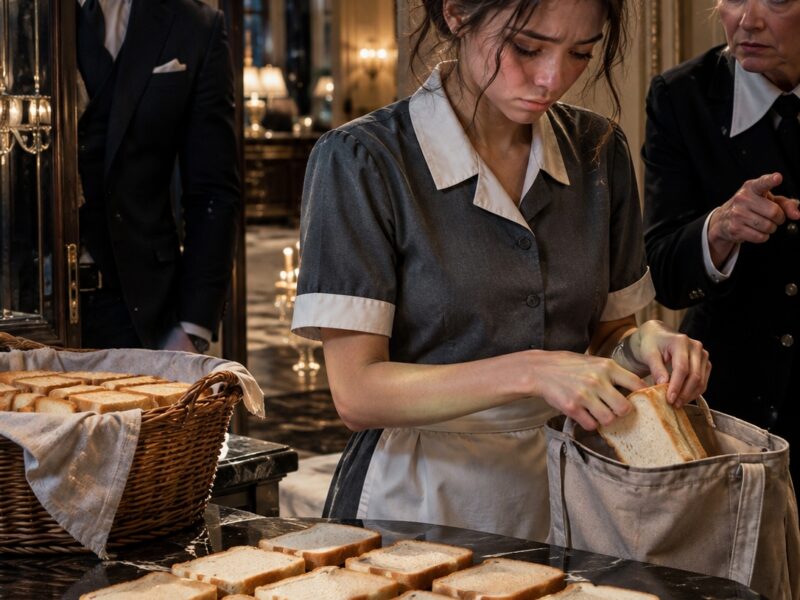
He Followed His Maid to Catch Her Stealing—Then the 14th Door Exposed the Secret He’d Buried for 25 Years

The first thing Callum Hail noticed was that June Ellery never stole anything expensive.
Not the antique crystal in the west dining room.
Not the watches left carelessly on marble counters.
Not the cash his guests occasionally forgot inside jacket pockets.
She stole bread.
Every night.
Exactly fourteen pieces.
And according to Agatha Pemrook, the head housekeeper who had served the Hail family for nearly twenty years, that was precisely why Callum should be worried.
“People don’t begin with the silver, Mr. Hail.”
Agatha stood at the end of the enormous kitchen island, hands folded over her gray uniform.
“They begin with something nobody will miss.”
Callum glanced at the security footage playing on the tablet.
There was June.
Twenty-six years old. Dark hair twisted into a loose knot. Cheap white sneakers. Plain black work pants.
She waited until the kitchen staff had finished.
Then she opened the bread basket.
One slice.
Two.
Three.
She counted carefully.
Fourteen.
Then she wrapped the bread in clean paper, slipped it into a canvas bag, and left through the service entrance.
Callum looked up.
“Bread?”
“Every night.”
“You called me down here because somebody is stealing leftovers?”
Agatha’s expression didn’t change.
“Today it’s bread.”
She tapped the screen.
“Tomorrow it could be silver.”
Callum almost laughed.
He had just spent thirteen hours negotiating a financing package worth more than most people earned in several lifetimes. Somewhere upstairs, two attorneys were waiting for his signature on documents involving hundreds of millions of dollars.
And here he was discussing fourteen pieces of stale bread.
“How long has she worked here?”
“Three weeks.”
“Her name?”
“June Ellery.”
“Fire her?”
Agatha asked it too quickly.
Callum noticed.
“No.”
For the first time, the housekeeper’s expression shifted.
“Sir?”
“I want to know where the bread goes.”
Agatha stared at him.
Then she gave a small, polite nod.
“As you wish.”
That should have been the end of it.
Instead, twenty minutes later, Callum Hail did something he had not done in years.
He canceled his driver.
Put on an ordinary black coat.
And followed his maid into the cold.
“June.”
Benny caught her near the service entrance.
“You want a ride? It’s freezing.”
June pulled her scarf tighter.
“No, thanks.”
“You always take that ridiculous bus.”
“I like the bus.”
“You like a bus that takes forty minutes longer than necessary?”
June smiled.
“The long one goes where I need.”
She walked away.
Thirty yards behind her, Callum heard every word.
He followed her to a bus stop.
He watched her greet the driver by name.
“Same stop tonight, June?”
“Same stop, Frank.”
She pulled something from her bag.
A sandwich.
“For your break.”
Frank smiled.
“You spoil me, girl.”
Callum sat near the back.
Nobody recognized him.
That felt strange.
Callum Hail was accustomed to entering rooms where people already knew his net worth.
His name appeared on towers, construction fences, charity galas, business magazines.
Yet on Bus 47, he was simply a man in a coat that was too expensive for the neighborhood.
June got off twelve stops later.
Callum followed.
The neighborhood changed immediately.
Luxury storefronts disappeared.
Streetlights became farther apart.
Brick apartment buildings leaned into the winter darkness.
A laundromat buzzed beneath a flickering fluorescent sign.
Somewhere a dog barked.
June crossed Maple Street.
Callum stopped.
Something about the name bothered him.
Maple Street.
He knew it.
But from where?
June entered an old four-story brick building.
Callum waited.
Then followed.
She climbed to the second floor and knocked.
An elderly woman opened the door.
“June.”
June reached into the bag.
“Mrs. Kim. Thin slices, just how you like them.”
The woman took the bread with both hands.
Her smile transformed her face.
“Nobody else knocks anymore.”
June touched her shoulder.
“I do.”
Then she walked to the next apartment.
Knock.
An elderly man answered.
“Is it Tuesday already?”
“It’s Thursday, Mr. Delgado.”
“Same bread?”
“Same bread.”
“Tell your grandmother I want my rematch.”
“She says you cheat at cards.”
“She lies.”
“You both cheat.”
The old man laughed.
June moved on.
Third door.
Fourth.
Fifth.
Callum stayed in the shadows of the stairwell.
By the seventh door, he understood.
She wasn’t stealing dinner.
She was delivering it.
By the tenth, something inside him had become uncomfortable.
Not guilt.
Not yet.
Something harder to name.
At apartment twelve, a man complained that his radiator had stopped working again.
“The landlord wants us gone anyway,” he said.
June frowned.
“Nobody’s going anywhere, Mr. Abbott.”
“How do you know?”
“Because I’m still knocking.”
She tapped the remaining bread inside her bag.
“Two more.”
Callum shifted his weight.
A voice came from behind him.
“You lost, son?”
Callum turned.
An elderly man sat on a folding chair near the stairwell.
Gray beard.
Suspicious eyes.
“Something like that.”
The old man looked him up and down.
“Fancy coat.”
Callum glanced at it.
“Is it that obvious?”
“Nobody in this building owns a coat like that.”
Callum almost smiled.
“I’m just curious.”
“About June?”
Callum said nothing.
The old man leaned back.
“What do you do?”
“I build things.”
“Then be curious quietly.”
The man’s eyes moved toward June.
“She is the only person who still knocks.”
Callum looked down the hallway.
June reached the fourteenth door.
She knocked.
An elderly woman opened it.
“Is that my June?”
“It’s me, Grandma.”
June disappeared inside.
Callum remained frozen.
Fourteen doors.
Fourteen pieces of bread.
Every night.
And suddenly Agatha’s accusation seemed obscene.
He turned to leave.
The old man called after him.
“Come back in daylight, son.”
Callum looked over his shoulder.
“We could use the help.”
The next morning, Callum walked into Hail Development’s executive conference room and found a rendering of a glass tower covering the entire wall.
Dorian Vale was standing beneath it.
“Morning.”
Callum ignored him.
His eyes had gone to the address printed beneath the rendering.
MAPLE STREET REDEVELOPMENT.
His stomach tightened.
“Dorian.”
“Hmm?”
“Maple Street.”
“What about it?”
Callum stepped closer.
The rendering showed forty-eight floors of glass and steel.
Luxury residences.
Retail.
Private rooftop club.
Projected value upon completion:
$400 million.
“What is currently there?”
Dorian barely looked up.
“Old residential building.”
“How many units?”
“Fourteen.”
Callum turned slowly.
“Fourteen apartments?”
Dorian finally noticed his expression.
“Yes.”
“People live there.”
“That’s usually what apartments are for.”
“Don’t.”
Dorian sighed.
“Old leases. Mostly elderly tenants. They’ve received notices for almost a year.”
“When does demolition start?”
“Thirty days.”
Callum stared at the tower.
Two years earlier, he had signed the development authorization.
He remembered the maps.
Parcel numbers.
Traffic studies.
Zoning projections.
He remembered colored blocks representing properties to acquire.
What he did not remember were doors.
Faces.
Mrs. Kim wanting her bread sliced thin.
Mr. Abbott’s broken radiator.
A man sitting on a folding chair telling him to be curious quietly.
“I signed this?”
“Two years ago.”
“I signed a map.”
Dorian frowned.
“What difference does that make?”
Callum looked at him.
“There were no people on the map.”
Dorian laughed once.
“Callum, this tower is worth four hundred million dollars.”
“Then it can wait.”
The room went silent.
Dorian stared at him.
“Excuse me?”
“Push demolition.”
“The crews are booked.”
“Unbook them.”
“The board won’t approve that.”
“Find another location.”
“Over an old building?”
Callum’s jaw tightened.
“Over fourteen homes.”
Dorian studied him.
“What happened to you last night?”
Callum looked again at Maple Street.
“I followed my bread.”
Dorian blinked.
“Your what?”
But Callum was already walking out.
June was polishing the breakfast room when he found her.
She straightened immediately.
“Good morning, Mr. Hail.”
“June.”
“Yes, sir?”
He realized with some embarrassment that until the previous night, he had never spoken her name.
“Do you like working here?”
She looked suspicious.
“That sounds like a dangerous question.”
He almost smiled.
“It isn’t.”
“I like the kitchen.”
“The kitchen?”
“And the bread.”
There it was.
Callum leaned against the table.
“What happens to the leftover bread?”
Her fingers tightened around the polishing cloth.
“It gets thrown away.”
“Does it?”
June looked at him.
For a moment neither spoke.
Then she asked quietly:
“Did you see where it goes?”
Callum nodded.
“I did.”
Her face changed.
Not fear.
Defiance.
“If you’re going to fire me, I’d rather you do it before lunch. I have class at two.”
“Class?”
“Pastry school.”
Callum absorbed that.
Then he looked toward Agatha, who was standing in the doorway.
“June can take the bread.”
Agatha stiffened.
“Sir, rules are rules.”
Callum’s voice stayed calm.
“Then here’s the new rule.”
He looked at June.
“She takes it every night.”
June stared at him.
“Fourteen?”
“All fourteen.”
Something almost like relief crossed her face.
“Thank you.”
Callum nodded.
Then walked away.
Behind him, June called:
“Mr. Hail?”
He turned.
“Mrs. Kim likes the crust.”
For the first time in days, Callum laughed.
What neither of them saw was Dorian Vale standing beyond the hallway.
Watching.
That afternoon, Dorian closed the office door behind Agatha Pemrook.
“He’s going to kill Maple Street.”
Agatha frowned.
“Over the maid?”
“Not because of her.”
Dorian walked to the window.
“Because of what she showed him.”
“He hasn’t canceled anything.”
“Yet.”
Dorian had spent two years assembling that project.
Investors.
Political consultants.
Land purchases.
Architects.
Bonuses.
His compensation package alone would change his life.
He wasn’t going to watch it disappear because a housemaid had handed stale bread to old people.
“If she disappears,” Dorian said, “he stops going there.”
Agatha’s eyes narrowed.
“You want me to dismiss her?”
“I want him to stop trusting her.”
“And what do I get?”
Dorian turned.
“Enough to retire.”
Silence.
Agatha looked toward the door.
“When is he leaving?”
“Chicago. Tomorrow. Two days.”
She swallowed.
“I’ll need a reason.”
Dorian smiled.
“Then let her steal something real.”
Two nights later, June counted the bread.
Twelve.
Thirteen.
Fourteen.
She slipped the wrapped pieces into her canvas bag.
“Stop right there.”
Agatha’s voice came from behind her.
June turned.
“Mrs. Pemrook?”
“Put the bag on the counter.”
June frowned.
“Mr. Hail said—”
“Put it down.”
June did.
“Empty it.”
“It’s only bread.”
“Then you have nothing to worry about.”
June emptied the bag.
Bread landed on the marble.
Then something struck the counter with a metallic clang.
June froze.
A silver serving spoon.
Antique.
Engraved with the Hail family crest.
Her face drained of color.
“That isn’t mine.”
Agatha picked it up.
“Dining-room silver.”
“I’ve never touched that.”
Dorian stepped into the kitchen.
June stared at him.
“Mr. Vale, please call Mr. Hail.”
“He’s in Chicago.”
“Then call him.”
“Mr. Hail trusts his staff.”
“So do I.”
June’s voice cracked.
“That’s why I’m asking you to call him.”
Agatha folded her arms.
“You are dismissed. Effective immediately.”
June stopped breathing.
“My grandmother needs medication.”
“That should have occurred to you before you stole.”
“I didn’t steal anything.”
“Leave.”
June looked at the bread.
“Can I at least take—”
“No.”
Agatha swept it away.
“You’ve taken enough.”
That sentence hurt more than the accusation.
June slowly removed her apron.
Folded it.
Set it on the counter.
She walked outside with an empty bag.
For the first time in three weeks, Bus 47 carried her toward Maple Street without fourteen pieces of bread.
Frank noticed immediately.
“No bread tonight?”
June sat behind him.
“Not tonight.”
When she reached Maple Street, Mrs. Kim opened her door and looked at June’s empty hands.
“Oh, sweetheart.”
June tried to smile.
“I lost my job.”
Mrs. Kim didn’t ask about the bread.
She reached forward and took June’s hand.
“Then tonight we knock on your door.”
By the time June reached her grandmother’s apartment, she was crying.
“They said I stole a spoon.”
Her grandmother, Ruth Ellery, sat at the kitchen table.
“A silver spoon.”
June nodded.
Ruth’s expression didn’t change.
“Ellery women don’t steal.”
June wiped her face.
“Grandma—”
“We bake.”
June looked up.
Ruth slowly smiled.
“Walt still has the key.”
“To what?”
“The bakery.”
June stared at her.
“Grandma, that place has been closed for years.”
“Then it’s rested long enough.”
Ruth pushed herself upright.
“If Joe were alive, he’d light that oven himself.”
Callum returned from Chicago the next morning.
“Where’s June?”
Agatha hesitated.
“Gone.”
He stopped.
“Gone where?”
“Dismissed.”
“Why?”
“She was caught stealing silver.”
Callum stared at her.
“June?”
“Yes.”
“Stealing silver?”
“I have the spoon.”
Agatha produced it.
Callum barely looked.
“Who witnessed it?”
“Mr. Vale.”
“And what did June say?”
Agatha exhaled.
“What they always say.”
Callum’s eyes hardened.
“What did she say?”
“That it wasn’t hers.”
Callum took the spoon.
Then he handed it back.
“Then it wasn’t.”
Agatha blinked.
“Sir?”
But he was already walking toward the door.
Because he knew exactly where to find her.
The old bakery smelled like dust, yeast, burnt sugar and memory.
June was covered in flour when Callum walked through the door.
She stared at him.
“Mr. Hail.”
A voice came from behind the counter.
“Well, look who came back in daylight.”
Callum recognized the old man from the hallway.
Walt.
June folded her arms.
“How did you find this place?”
“I followed you.”
“When?”
“The first night.”
Her mouth fell open.
“You followed me?”
“I thought you were stealing bread.”
“I was stealing bread.”
“Fair point.”
“And now?”
“Mrs. Pemrook says you upgraded to silver.”
June’s face closed.
“Do you believe her?”
Callum didn’t hesitate.
“No.”
“Why?”
He looked at the flour on her cheek.
“I don’t think a woman who knocks on fourteen doors every night needs a spoon.”
For several seconds, June said nothing.
Then Ruth called from the back.
“If you’re going to stand there looking pretty, young man, at least make yourself useful.”
Callum turned.
Ruth tossed him an apron.
“Roll up your sleeves.”
“I’ve never baked anything.”
“Then you’re thirty-two years late.”
June laughed despite herself.
That morning, Callum Hail learned how to knead dough.
Badly.
“You’re strangling it,” June said.
“It started it.”
Walt nearly choked laughing.
And for the first time in years, Callum forgot to check his phone.
The bakery had belonged to June’s grandfather, Joe Ellery.
For sixty years, Joe and Ruth had baked there.
Every winter morning, Ruth explained, Joe had given bread to children who came hungry.
“No questions.”
Ruth pressed her palm into the dough.
“No paperwork.”
Fold.
Turn.
“Just bread.”
Callum listened.
Something in the story bothered him.
A feeling beneath memory.
Ruth watched him strangely.
“You have the same eyes.”
June looked at her.
“Same as who?”
Ruth turned quickly.
“The bread is burning.”
But Callum had heard her.
He returned the next morning.
And the morning after that.
At five.
He brought coffee.
June taught him to shape loaves.
He repaired a broken cabinet.
He carried flour upstairs.
Together they baked fourteen loaves every morning and knocked on fourteen doors.
Mrs. Kim ordered Callum to slice hers thin.
Mr. Abbott made him look at the radiator.
Walt called him “bread guy.”
And gradually, the man whose name was printed on skyscrapers became something else on Maple Street.
Useful.
One morning, June showed him an old notebook.
“What is that?”
“Grandma’s list.”
“How old?”
“Fifty years.”
Pages of names filled it.
Families.
Children.
Dates.
Small notes.
Extra crust.
No coat.
Mother sick.
Father laid off.
Callum turned toward the last page.
June snapped it shut.
“Not that page.”
“Why?”
“Grandma says not yet.”
He smiled.
“Your family is strange.”
“You followed your maid onto a city bus because she stole bread.”
“Fair.”
June looked at him.
“Why did you really follow me?”
Callum thought about it.
“Because nobody steals fourteen pieces of bread for themselves.”
“And now?”
He looked at her longer than he should have.
“Now I don’t want to stop following you.”
June lowered her eyes.
“You’re my boss.”
“Technically, you got fired.”
She threw flour at him.
He laughed.
And from the doorway, Ruth watched them with tears she refused to explain.
Because she knew what was written on the last page.
And she knew neither of them was ready.
At Hail Development, Dorian was becoming desperate.
“Cancel Maple Street,” Callum told him.
Dorian stared across the desk.
“No.”
“I wasn’t asking.”
“You don’t own the company alone.”
“I’ll personally cover the penalties.”
“This isn’t about penalties.”
Dorian slapped the financial projection onto the desk.
“Four hundred million dollars.”
Callum didn’t look at it.
“Find another site.”
“The board votes next week.”
“Then I’ll make my case.”
Dorian leaned closer.
“You’re destroying two years of work because you’ve developed feelings for a maid.”
Callum stood.
“Don’t call her that.”
Dorian smiled.
There.
He had his answer.
That evening, he made another phone call.
“Schedule the tenant meeting.”
A voice asked:
“Why?”
“Because everybody has a price.”
“And June?”
Dorian looked at the rendering.
“Tomorrow she finds out who signed the demolition papers.”
The meeting was held in Maple Street’s lobby.
June arrived carrying bread.
She heard the voices before she reached the door.
Dorian stood beside a large presentation board.
“Hail Development is prepared to relocate every tenant.”
Mrs. Kim stared at him.
“Relocate where?”
“Modern apartments.”
“Where?”
“A little farther outside downtown.”
Mr. Abbott shook his head.
“I was born in this building.”
“You’ll be more comfortable.”
“Who decided that?”
Dorian paused.
“Our CEO.”
June stepped into the room.
“Who?”
Dorian turned.
Then smiled.
“Callum Hail.”
Silence.
June looked past him.
Callum had just entered through the opposite door.
Their eyes met.
“June.”
She looked at the paperwork.
Then at him.
“You signed this?”
“Two years ago.”
“You signed it.”
“Before I knew who lived here.”
Her voice rose.
“You followed me.”
“June—”
“You stood outside their doors.”
“I know.”
“You ate with them.”
“Yes.”
“You helped me bake for them.”
“Yes.”
“And the entire time this building belonged to you?”
Callum swallowed.
“I didn’t know at first.”
Dorian spoke quietly.
“He came because he wanted to inspect his property.”
“Shut up, Dorian.”
June stared at Callum.
“Fourteen doors.”
“I am going to save every one.”
“Don’t.”
“June—”
“Don’t promise me something just because you feel guilty.”
She placed the bread on the table.
Then walked away.
Callum followed.
She turned.
“Leave me alone.”
“I can fix this.”
“You signed the paper.”
“I signed a map.”
“And people like you always say that.”
That stopped him.
June’s eyes were wet.
“You see parcels. Numbers. Returns. We see homes.”
Callum had no answer.
So June gave him one.
“Just leave.”
And she walked away.
Dorian appeared behind Callum.
“Told you.”
Callum turned.
“Told me what?”
“They’ll never love you here.”
Callum stepped closer.
“You should be very careful what you say next.”
Dorian smiled.
“Demolition starts in two weeks.”
That night June sat at Ruth’s kitchen table.
“Why do you trust him?”
Ruth looked at her.
“Who?”
“Callum.”
“You know who.”
Ruth closed her eyes.
“Because I’ve known him longer than you have.”
June frowned.
“What does that mean?”
Ruth stood slowly.
Walked to the cabinet.
Removed the old notebook.
She placed it in front of June.
Then turned to the final page.
There was a name.
CALLUM.
Age 7.
No coat.
Likes crust.
Every morning.
June stopped breathing.
Below it were dates.
Three winters of dates.
“Grandma…”
“His mother cleaned offices at night.”
Ruth’s voice softened.
“She couldn’t always afford food.”
June stared at the page.
“He came to Grandpa’s bakery?”
“Every morning before school.”
“Callum?”
“Your grandfather never asked questions.”
Ruth smiled through tears.
“He just gave the boy bread.”
June looked again at the handwriting.
Likes crust.
“He doesn’t remember?”
“Not with his head.”
Ruth touched June’s chest.
“But maybe something else remembered.”
June thought about the first night.
Callum following the bus.
Following her into Maple Street.
Returning at five every morning.
Learning to knead dough.
Standing in the bakery as if some invisible thread had pulled him there.
Ruth closed the notebook.
“Bread finds its way home.”
June stood.
“I need to see him.”
“Take a loaf.”
“Why?”
Ruth smiled.
“He always liked the crust.”
Callum wasn’t at the mansion.
Benny answered.
“He went to Maple Street.”
June turned to leave.
Then Benny caught her arm.
“Wait.”
“What?”
“I found something.”
He led her toward the security office.
“Pemrook deleted footage.”
June froze.
“From when?”
“The night you were fired.”
“Why would she—”
“Because she doesn’t understand the system.”
Benny sat at the computer.
“She deleted the local files.”
He opened another window.
“But everything backs up to the cloud.”
June’s heart began pounding.
“Show me.”
The video loaded.
7:03 p.m.
Empty kitchen.
Then Dorian Vale entered.
June leaned closer.
Agatha followed.
Dorian opened the silver drawer.
Removed a serving spoon.
Handed it to Agatha.
Agatha placed it inside June’s canvas bag.
June covered her mouth.
“Oh my God.”
Benny whispered:
“I knew it.”
June stared at the screen.
“Save it.”
“Already did.”
“Send it to Callum.”
Benny looked at her.
“He needs more than that.”
“What?”
“The board meets tomorrow.”
June found Callum sitting on the steps of Maple Street.
Alone.
He looked exhausted.
“You came.”
She held out the loaf.
“Grandma showed me the last page.”
His face changed.
“You know?”
“I know.”
He looked down.
“I didn’t.”
“I believe you.”
Callum reached inside his coat and removed an old photograph.
Joe Ellery stood outside the bakery.
Beside him was a skinny seven-year-old boy in an oversized sweater.
Callum.
“My mother kept this.”
His voice broke.
“I found it last night.”
June sat beside him.
“Grandpa fed you.”
“Three winters.”
Callum stared across the street.
“And I signed papers to destroy his oven.”
“You didn’t know.”
“I should have known what I was signing.”
“Yes.”
He looked at her.
She didn’t soften it.
“You should have.”
He nodded.
“But not knowing who lived behind those doors doesn’t make you evil.”
June handed him the bread.
“It means you finally have to decide what you’ll do now that you know.”
Callum broke off the crust.
A faint smile appeared.
“I still like this part.”
“Grandma remembered.”
For a moment, neither spoke.
Then June said:
“There’s something else.”
The boardroom was full when Callum walked in.
Dorian was already speaking.
“The financial consequences of abandoning Maple Street would be catastrophic.”
Callum didn’t sit.
“Before anyone votes, watch this.”
Benny connected the video.
The room went silent.
On the screen, Dorian entered Callum’s kitchen.
Opened the silver drawer.
Handed Agatha the spoon.
Then watched her put it into June’s bag.
Dorian’s face went white.
One board member leaned forward.
“Is that you?”
Dorian said nothing.
Callum stared at the screen.
Not because he needed to see it again.
Because he needed to remember what greed looked like when it stopped seeing people.
When the video ended, Callum stood.
“The Maple Street project is canceled.”
Dorian shot to his feet.
“You can’t do that.”
Callum looked around the table.
“Anyone disagree?”
Nobody spoke.
“Effective immediately.”
Dorian stared at him.
“You’d throw away four hundred million dollars for an old bakery?”
Callum’s expression didn’t change.
“No.”
He picked up the photograph of Joe.
“For the bakery that fed me.”
The demolition crews arrived Friday morning anyway.
Paperwork moved slower than bulldozers.
At 8:47 a.m., fourteen tenants were standing on the sidewalk.
Mrs. Kim held bread.
Mr. Abbott carried a folding chair.
Walt planted himself on the front step.
A supervisor approached.
“Sir, you need to move behind the line.”
Walt stared at him.
“I’ve stood on this step for eighty years.”
“We begin demolition at nine.”
“You’ll have to carry me.”
Then June arrived.
Fourteen loaves.
“Anybody hungry?”
Mrs. Kim raised her hand.
“Thin slices.”
Even the construction workers laughed.
At 8:55, Dorian Vale arrived.
He saw the tenants.
Saw June.
Saw the cameras.
Then Callum stepped from a black SUV.
Dorian stormed toward him.
“Tell them to move.”
Callum checked his watch.
“No.”
“The permit is active.”
“Not anymore.”
“The board—”
“Saw the video.”
Dorian stopped.
“What video?”
Callum looked toward Agatha.
She had arrived behind him.
Her face collapsed.
“The kitchen camera,” Callum said.
“The night of the spoon.”
Agatha began crying.
“He paid me.”
Dorian spun around.
“Shut up.”
“He said she’d only lose her job.”
“Agatha!”
Callum’s voice cut through both of them.
“Enough.”
He looked at Agatha.
“You watched June every night.”
She nodded.
“Did you ever once follow her?”
Agatha wiped her face.
“No.”
“Did you ever ask where the bread went?”
“No.”
June stepped forward.
Agatha looked at her.
“I’m sorry.”
June studied the woman who had humiliated her.
She could have said a hundred cruel things.
Instead she said:
“Come knock on a door with us someday.”
Agatha began crying harder.
Callum turned to Dorian.
“You’re finished at Hail Development.”
Dorian laughed bitterly.
“Four hundred million dollars.”
Callum said nothing.
“You’re throwing away four hundred million dollars because some old man gave you bread?”
Callum looked at Maple Street.
At fourteen doors.
At June.
At the bakery window where Joe Ellery had once seen a freezing little boy and decided hunger mattered more than questions.
“Yes.”
Dorian shook his head.
“You’ve lost your mind.”
“Maybe.”
Callum turned to the demolition supervisor.
“You still need your crew Monday?”
The man frowned.
“For what?”
Callum pointed toward the building.
“Radiators.”
Mr. Abbott shouted from the steps:
“Fourteen of them!”
Everyone laughed.
Callum looked toward June.
She was crying.
So was Ruth.
And for the first time in twenty-five years, Callum remembered the smell of warm bread on a winter morning.
Not as an image.
As a feeling.
Safety.
Six months later, the building on Maple Street still stood.
But something fundamental had changed.
Hail Development transferred ownership into a resident-controlled housing trust.
The tenants weren’t being displaced.
The radiators worked.
The roof no longer leaked.
And downstairs, behind restored windows and the original brick facade, the bakery had reopened.
ELLERY’S.
At 4:58 one morning, June was pulling the first crust loaves from the oven.
The bell above the door rang.
She didn’t turn around.
“You’re late.”
Callum looked at his watch.
“It’s five-oh-two.”
“Exactly.”
Ruth called from the corner:
“Leave the boy alone.”
June laughed.
“He’s thirty-two, Grandma.”
“To me, that’s a boy.”
Callum put on an apron.
Mrs. Kim arrived ten minutes later.
“Thin.”
“I remember.”
Mr. Abbott came after her.
“The radiator works.”
“Told you.”
“Bread guy keeps his promises.”
Agatha came through the door carrying a box.
She had not returned to work for Callum.
But she had started volunteering twice a week.
She now knew all fourteen names.
“Morning, Mr. Abbott.”
“You’re late.”
“Yes, sir.”
“Cut thin today.”
“Yes, sir.”
Benny entered behind her.
“One crust loaf for the boss.”
June rolled her eyes.
“He’s already eaten two.”
Callum shrugged.
“Quality control.”
At six-thirty, Frank the bus driver stopped by.
“Same bread?”
June handed him a loaf.
“Same bread.”
The bakery filled with voices.
Not customers.
Neighbors.
Ruth sat near the window with her old notebook.
She opened it.
The original fourteen names were still there.
Then she turned to a fresh page.
“June.”
“Yes, Grandma?”
“We need another name.”
June walked over.
“Why?”
“Fourteen isn’t enough anymore.”
She looked around the bakery.
“Who’s number fifteen?”
Ruth smiled toward Callum.
“Him.”
Callum laughed.
“I’ve been here for months.”
“Every morning,” Ruth said.
“Exactly.”
She wrote his name.
Number fifteen.
A year later, the bakery opened before sunrise on a snowy December morning.
June was standing at the counter when Callum came through the door.
He was carrying no coffee.
No briefcase.
No phone.
Just a small paper bag.
June narrowed her eyes.
“What did you do?”
“Nothing.”
“That is the face you make when you’ve done something.”
“I have a face?”
“You have several. That’s the guilty one.”
He put the bag down.
“Open it.”
Inside was a single piece of crust.
June looked up.
“You brought me bread from my own bakery?”
“Technically, I stole it yesterday.”
“Callum.”
“Fourteen pieces seemed excessive.”
She laughed.
Then noticed something underneath it.
A ring.
The bakery became silent.
Even Ruth stopped moving.
Callum came around the counter.
He didn’t give a speech about destiny.
He didn’t talk about skyscrapers or money.
He simply took June’s flour-covered hand.
“Before you,” he said, “I thought building something meant making it taller.”
June’s eyes filled.
Callum glanced around the room.
“You taught me sometimes it means making sure something doesn’t disappear.”
Ruth was already crying.
Benny whispered:
“Finally.”
June laughed through her tears.
Callum looked at her.
“June Ellery…”
He swallowed.
“Will you marry the bread guy?”
June stared at the man who had once followed her through the cold because he thought she was a thief.
The man who had stood outside fourteen doors without understanding that one of those doors led backward into his own childhood.
The man her grandfather had fed when he had nothing.
And the man who nearly destroyed that same place because somewhere along the road to becoming powerful, he had learned to see buildings without seeing the people inside them.
“Yes.”
Ruth slapped the table.
“Thank God. I’m too old to wait another year.”
The bakery erupted in laughter.
Callum kissed June.
Outside, snow covered Maple Street.
Inside, fifteen names remained written in an old notebook.
Fourteen belonged to the people June had refused to forget.
The fifteenth belonged to a hungry little boy who had grown into a wealthy man and nearly demolished the place that once kept him alive.
Years later, people would tell the story differently.
Some said June Ellery saved an apartment building.
Others said Callum Hail saved a bakery.
Ruth always corrected them.
“No,” she would say.
Then she would point toward the front door, where every morning someone new eventually appeared.
“That’s not what happened.”
Because Joe Ellery had understood something long before any of them did.
Bread was never really the important part.
The important part was noticing when someone was hungry.
Remembering their name.
Returning tomorrow.
And knocking on the door.
On the wall beside the bakery entrance, Ruth eventually hung a small handwritten sign.
No corporate logo.
No mention of Hail Development.
No explanation of the four-hundred-million-dollar tower that was never built.
Only six words:
IF THE LIGHT IS ON, KNOCK.
And every winter morning, before the city fully woke, Callum still arrived at five.
Sometimes 5:02.
June still complained.
Mrs. Kim still demanded thin slices.
Mr. Abbott still inspected the radiators as if personally responsible for them.
Frank still stopped his bus outside.
Agatha still carried bread upstairs.
And Ruth’s notebook kept getting thicker.
Sixteen doors.
Then seventeen.
Then eighteen.
One new name whenever somebody needed one.
Because bread, Ruth Ellery liked to say, always finds its way home.
But only if someone is willing to carry it there.
And somewhere beneath the glass towers, money, mistakes and years people thought they had forgotten, a seven-year-old boy without a winter coat finally found his way back to the door where someone had once fed him without asking what he could give in return.
This time, he wasn’t hungry.
This time, he was carrying the bread.









