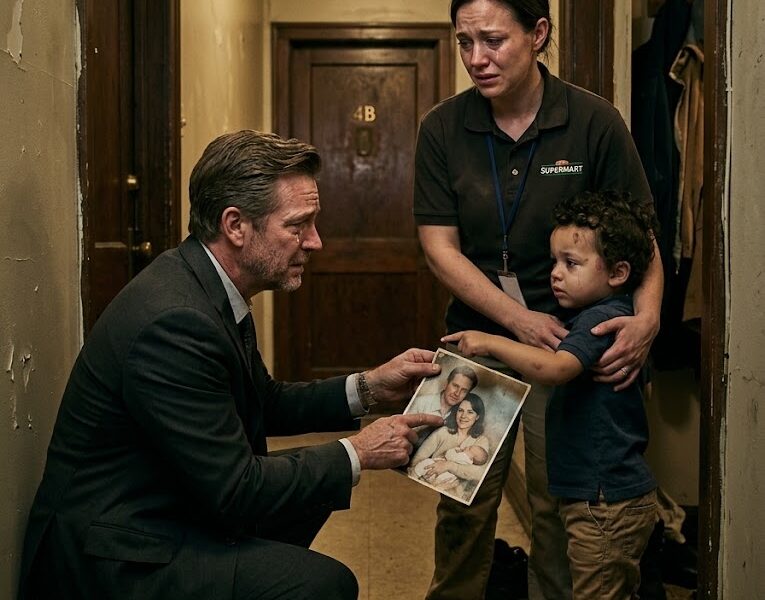
HE FOUND HIS KIDNAPPED SON AFTER TWO YEARS—THEN THE BOY HID BEHIND THE WOMAN HE CALLED MOM
The first time Daniel Whitmore saw his missing son after two years, the boy screamed and hid behind another woman.
Not a police officer.
Not a social worker.
Not one of the private investigators Daniel had paid millions of dollars to search across three states.
A woman in faded jeans stood barefoot in the doorway of a small apartment on the west side of Chicago, one hand gripping the door and the other reaching instinctively behind her.
Behind her legs was a little boy.
Daniel stopped breathing.
Two years.
Seven hundred and thirty-four mornings.
Seven hundred and thirty-four nights of waking up believing his phone had rung.
Millions spent.
Hundreds of tips.
Thirty-nine children personally checked.
Six times Daniel had flown across the country because someone claimed to have seen his son.
Six times he had returned alone.
And now—
There he was.
Older.
Taller.
His dark hair curling slightly above his ears.
A faint crescent-shaped birthmark near his hairline.
The same serious brown eyes Daniel had once watched slowly close against his chest when the boy was still small enough to fit between his elbow and his wrist.
Daniel’s knees nearly gave out.
“Ethan.”
The name came out broken.
The little boy stared at him.
Nothing.
No recognition.
No smile.
No sudden cry of Daddy.
Instead, Ethan grabbed the woman’s jeans with both hands and pressed his face against her leg.
Daniel felt something inside him collapse.
The woman immediately stepped between them.
“Can I help you?”
Her voice was controlled, but Daniel saw fear flash across her face.
Behind him stood his investigator, Michael Grant, and a security officer Daniel had insisted on bringing because after two years of searching, he had stopped trusting miracles.
But suddenly the two men behind him felt like a terrible mistake.
Daniel raised both hands.
“I don’t want to scare him.”
“Then tell me who you are.”
Daniel looked past her again.
Ethan peeked around her leg.
His son.
His child.
Alive.
Daniel swallowed.
“I’m his father.”
The woman’s face changed.
Not dramatically.
That would have been easier.
Instead, the color simply drained from it.
Her fingers tightened around the edge of the door.
“No.”
Daniel had imagined this moment thousands of times.
He had imagined running.
Crying.
Holding Ethan.
He had imagined his son somehow remembering him despite being barely a toddler when he disappeared.
He had imagined justice.
He had imagined rage.
He had never imagined having to convince another person that his own child belonged to him.
“My name is Daniel Whitmore.”
Still nothing.
“I’ve been looking for him for two years.”
The woman’s lips parted.
Daniel watched her eyes move toward Ethan.
Then back to him.
“No,” she whispered again.
This time, it didn’t sound like disbelief.
It sounded like prayer.
Daniel reached slowly into his coat.
She immediately moved backward.
“Don’t.”
“It’s okay.”
He removed a photograph.
Not a weapon.
Not paperwork.
A photograph.
Daniel held it toward her without stepping closer.
The picture showed him sitting on the floor of a nursery two years earlier.
A much younger Ethan was asleep against his chest.
Behind them stood a white crib.
Above it hung three wooden airplanes Daniel had painted himself during the final month of his wife’s pregnancy.
The woman stared at the photograph.
Then she looked at the child behind her.
Daniel watched the truth arrive.
It did not arrive gently.
Her knees seemed to weaken.
She caught herself against the doorframe.
“Oh my God.”
Daniel wanted to cross the space between them.
He wanted to grab Ethan.
He wanted to hold him until every terrible night of the previous two years disappeared.
But Ethan was staring at him like Daniel was the danger.
And then the boy whispered one word.
“Mommy?”
Daniel’s heart stopped.
The woman turned immediately.
“I’m right here, baby.”
Baby.
The word struck Daniel harder than anything else had.
Ethan reached for her.
She picked him up automatically.
He wrapped both arms around her neck.
Daniel watched his son bury his face against another person’s shoulder.
That was when he finally understood the cruelty of getting exactly what he’d prayed for.
His son was alive.
His son was safe.
And his son had no idea who he was.
The woman looked at Daniel over Ethan’s shoulder, tears beginning to fill her eyes.
“He doesn’t know you.”
Daniel closed his eyes for half a second.
“I know.”
“You can’t just come here and—”
“I know.”
“You can’t take him.”
Something in Daniel’s face must have changed, because she stopped.
He slowly lowered himself onto one knee.
Not toward her.
Toward Ethan.
The boy tightened his arms around her neck.
Daniel’s voice nearly failed him.
“Hey, buddy.”
Ethan wouldn’t look at him.
Daniel tried again.
“You don’t remember me.”
Silence.
“That’s okay.”
His throat burned.
“You don’t have to.”
The woman stared at him.
Daniel looked up at her.
Two years of money, influence, anger and grief suddenly meant nothing.
He had found his child.
But someone else had become his home.
Daniel whispered the only thing that mattered.
“I’m not here to rip him away from you.”
She blinked.
“I don’t know how to be his father anymore.”
For the first time, the powerful Daniel Whitmore—the man who could make executives wait outside his office for hours, the man newspapers called ruthless, the man who had spent two years commanding everyone around him to find my son—looked completely helpless.
“Can you help me?”
And Maya Carter realized that the knock she’d feared for two years had finally come.
But the man standing outside her door wasn’t demanding his son back.
He was asking her to teach him how to love the child he had lost.
And neither of them yet understood that finding Ethan was going to be easier than deciding who his family was.
Two years earlier, Maya Carter had almost kept walking.
That was the part she would remember later.
Not the police station.
Not the lawyers.
Not Daniel.
Not the reporters.
The walking.
Because if the train hadn’t been delayed that night, she never would have been there.
If her supervisor hadn’t asked her to clean one extra floor, she would have caught the earlier train.
If she hadn’t stopped to retie the lace on her worn sneaker, she might have passed through the station before the crying began.
Lives rarely announce the moment they’re about to change.
Sometimes they hide inside delays.
Sometimes they sound like a child crying in an almost empty station at eleven o’clock at night.
At thirty-one, Maya had become very good at being alone.
She worked mornings and afternoons at Henderson Market, a neighborhood grocery store where customers frequently looked through her rather than at her.
Three nights a week, she cleaned offices downtown.
On Saturdays, she sometimes took an extra shift stocking shelves.
It wasn’t ambition.
It was arithmetic.
Rent.
Electricity.
Transit.
Groceries.
The credit-card balance left from her mother’s final months of treatment.
Every dollar already had somewhere to go before Maya earned it.
Her mother had died six years earlier.
Cancer had taken almost everything slowly—her strength, her appetite, her hair, then eventually her voice.
Afterward, Maya’s boyfriend of four years stayed for exactly three months.
Then one evening he told her he couldn’t spend his life “surrounded by sadness.”
Maya never forgot the sentence.
Not because it broke her heart.
Because it taught her something.
Some people loved you only while loving you remained convenient.
After that, she stopped expecting rescue.
She worked.
She paid bills.
She came home.
She reheated dinner.
She sat beside the window of her one-bedroom apartment and watched other people’s lives happening below.
Couples carrying groceries together.
Parents pulling sleepy children from car seats.
Friends laughing outside the corner restaurant.
Maya wasn’t miserable.
That was what she told herself.
There was a difference between loneliness and misery.
At least she believed there was.
Then came that rainy Thursday night.
Her train arrived forty minutes late.
By the time Maya stepped into the main hall, most of the station had emptied.
Rain struck the tall windows.
The fluorescent lights made everything look colder.
Her feet hurt.
Her back hurt.
She had twelve dollars in her checking account until payday.
All she wanted was a shower.
Then she heard the crying.
Maya walked another six steps before stopping.
Even years later, that detail haunted her.
Six steps.
She could have continued.
Someone else would handle it.
Security.
Police.
A parent.
Someone whose life wasn’t already barely holding together.
Then the child cried again.
Not angry.
Afraid.
Maya turned.
A little boy sat alone on a metal bench near the far wall.
He couldn’t have been much older than one.
Maybe eighteen months.
His clothes were damp.
His cheeks were red from crying.
His tiny fists rubbed his eyes.
No stroller.
No bag.
No adult.
Maya looked around.
“Hello?”
Nobody answered.
She approached slowly.
“Hey, sweetheart.”
The boy looked at her and immediately cried harder.
Maya crouched.
“Okay. Okay. I’m not going to touch you.”
She scanned the hall.
“Where’s Mommy?”
The boy couldn’t answer.
“Daddy?”
Nothing.
Maya stood.
“Is anyone here with this little boy?”
Several people looked.
Nobody moved.
A man wearing headphones walked straight past them.
A woman on another bench glanced up and returned to her phone.
Something about that made Maya angry.
Not rationally.
Just deeply.
How could an entire station see a terrified child and decide he belonged to somebody else’s conscience?
Maya crouched again.
“Hey.”
She offered her hand.
The boy stared at it.
Then suddenly he grabbed her sleeve.
Hard.
Maya froze.
His tiny fingers curled into the fabric as if he’d been falling and had finally found something solid.
“Oh, sweetheart.”
A security guard eventually approached.
Together they searched the nearby platforms and restrooms.
Announcements were made.
No one came.
The guard checked the child’s clothing.
No identification.
No emergency tag.
Nothing.
“We’ll call child services.”
Maya looked at him.
“How long will that take?”
The guard sighed.
“Tonight? Could be a while.”
The boy had stopped crying.
Now he was leaning against Maya.
She looked down.
His eyes were half closed.
“Where does he go?”
“Emergency placement.”
“With who?”
“Depends who’s available.”
Maya knew she should leave.
She had work in seven hours.
She had no crib.
No diapers.
No children’s food.
She had barely enough money for herself.
The logical decision was obvious.
Then the boy’s fingers tightened around her sleeve.
“Could I keep him tonight?”
The guard stared at her.
“Ma’am—”
“Just tonight.”
“That isn’t normally how this works.”
“I know.”
Actually, she didn’t.
“But you have my identification. Take my address. Take my number. I’ll bring him to the police station tomorrow morning.”
The guard hesitated.
Maya expected him to refuse.
Instead, after calls, questions and warnings, temporary arrangements were made while authorities tried to determine where the boy belonged.
Maya carried him into the rain beneath her jacket.
Halfway home, he fell asleep against her shoulder.
His breath warmed the skin beneath her ear.
Maya looked down at him.
“You’ve really messed up my night, you know that?”
He slept.
For the first time in years, Maya laughed while walking home.
She had no idea that somewhere else in Chicago, Daniel Whitmore was about to walk into his son’s nursery and find an empty crib.
Daniel had already lost one person he loved.
His wife, Rachel, died only hours after giving birth.
Complications.
That was the clinical word.
Daniel hated it.
There was nothing clinical about holding his wife’s hand while doctors stopped looking him in the eye.
Nothing clinical about leaving a hospital carrying a newborn and an empty car seat beside him where Rachel should have been.
He named the boy Ethan, just as they had agreed.
Then he tried to become two parents at once.
Daniel failed in all the ordinary ways wealthy men sometimes fail while believing they’re succeeding.
He provided everything.
The safest crib.
The best pediatrician.
A carefully vetted nanny.
Security.
A college fund before Ethan could walk.
A house large enough that his son’s crying could disappear down hallways.
And Daniel worked.
He told himself the company was Ethan’s future.
Whitmore Industries had been built by Daniel’s grandfather, expanded by his father and transformed by Daniel.
Thousands of employees depended on decisions he made.
He couldn’t simply stop.
So he trusted people.
The nanny.
The house staff.
Security.
Then someone studied those routines.
Someone learned when the gate changed shifts.
Someone learned when the nanny carried laundry downstairs.
Someone learned that for several minutes every afternoon, the nursery corridor could be empty.
One afternoon, that person entered Daniel’s house.
Minutes later, Ethan was gone.
By the time Daniel arrived home, police cars covered the driveway.
The nanny was hysterical.
Daniel ran upstairs.
He remembered opening the nursery door.
He remembered seeing the crib.
Empty.
He remembered someone trying to stop him as he walked toward it.
Then almost nothing.
The kidnapping consumed his life.
Investigators reconstructed every vehicle.
Every employee.
Every contractor.
Every camera.
The kidnapper had planned carefully.
But one thing hadn’t been planned.
Ethan.
A frightened toddler doesn’t understand strategy.
He cries.
Loudly.
Continuously.
By the time the person carrying him reached a crowded station, Ethan’s screaming had begun drawing attention.
The kidnapper panicked.
The plan collapsed.
The child was abandoned on a bench.
Then the person disappeared.
By an extraordinary failure of timing, jurisdiction, incomplete records and a child too young to identify himself, the abandoned toddler was not immediately connected to Daniel’s kidnapping case.
Daniel searched one direction.
The child entered another system.
And Maya Carter woke the next morning with a stranger’s son asleep on her couch.
She kept her promise.
She brought him in.
Photographs were taken.
Reports were checked.
Questions were asked.
Nothing immediately connected the boy to an active case.
Temporary care was discussed.
A social worker asked whether Maya would consider fostering him while the investigation continued.
Maya looked down.
The boy was holding her finger.
She thought about her bank account.
Her job.
Her apartment.
Her complete lack of preparation.
Then she remembered the station bench.
“I’ll keep him.”
“For now?”
Maya looked at him.
“For now.”
Those two words lasted two years.
At first, Maya refused to buy anything permanent.
A borrowed portable crib.
Secondhand clothes.
A stroller from a coworker.
Because surely someone was coming.
Every knock at the door made her heart jump.
Every unknown number made her stomach tighten.
Weeks passed.
Then months.
Maya began calling the child Ethan after someone from her childhood who had once made her feel safe when safety was rare.
The name stuck.
She didn’t know it was already his.
Life became harder immediately.
And better.
Diapers were expensive.
Daycare was brutal.
Fevers always seemed to happen the night before Maya’s earliest shifts.
Ethan threw food.
He hated peas.
He loved bananas.
He screamed during thunderstorms unless Maya held him against her chest.
He developed an obsession with a stuffed rabbit missing half its left ear.
Maya learned how to function on four hours of sleep.
She learned how to check a fever with her lips.
She learned the difference between Ethan’s hungry cry and his frightened cry.
She learned that children could destroy a clean room in under ninety seconds.
She also learned something nobody had warned her about.
Love could make poverty feel frightening in an entirely new way.
Before Ethan, Maya worried about losing her apartment.
After Ethan, she worried about failing him.
She took extra shifts.
Sometimes she ate toast for dinner so Ethan could have fruit and chicken.
Sometimes she stood in the grocery aisle calculating whether she could afford both diapers and laundry detergent.
One night, after finding her asleep at the kitchen table beside a stack of bills, her coworker Denise shook her head.
“You can’t keep doing this.”
Maya rubbed her eyes.
“Doing what?”
“Everything.”
“Very specific advice.”
“I’m serious. You’re working yourself sick.”
Maya looked toward the bedroom.
Ethan was asleep.
“I’ll figure it out.”
“You always say that.”
“Because I always do.”
Denise softened.
“You love him.”
Maya didn’t answer.
“You know you do.”
“I shouldn’t.”
“Why?”
“Because he isn’t mine.”
Denise studied her.
“Does he know that?”
Maya looked away.
That was the problem.
Neither did her heart.
The first time Ethan called her Mommy, Maya cried in the bathroom where he couldn’t see her.
She sat on the closed toilet seat, covered her mouth and cried until her chest hurt.
Because it was the most beautiful word anyone had ever called her.
And because somewhere, theoretically, another woman might deserve to hear it.
Maya never stopped wondering.
Every few months, she posted a carefully blurred photograph in small local parenting groups.
Does anyone recognize this sweet boy?
She never showed enough of his face to endanger him.
Every time she pressed “post,” she felt noble for approximately ten seconds.
Then she secretly prayed nobody would answer.
Across the city, Daniel’s life had become a museum of waiting.
Ethan’s nursery remained untouched.
Daniel refused to allow anyone to pack it away.
On Ethan’s birthday, he bought a small cake.
Every year.
Nobody knew except his housekeeper.
Daniel would sit in the nursery alone.
The first year, he lit one candle.
The second year, three.
He never ate the cake.
His sister eventually told him what everyone else was afraid to say.
“Daniel, you might have to consider that Ethan isn’t coming home.”
He looked at her.
“Get out.”
“I’m trying to help you.”
“Then don’t bury my son while I’m still looking for him.”
“It’s been two years.”
“I know exactly how long it’s been.”
“Daniel—”
“Get out.”
Afterward, he sat beside Ethan’s bed until sunrise.
He knew people thought he was becoming irrational.
Maybe he was.
But a father doesn’t measure hope statistically.
He measures it by whether he can survive one more day without surrendering.
Daniel could.
So he did.
Then, on an ordinary Tuesday afternoon, Michael Grant walked into his office holding a photograph.
Daniel barely looked up.
“If this is another Oklahoma tip—”
“It isn’t.”
Something in Michael’s voice stopped him.
Daniel raised his eyes.
Michael placed the photograph on the desk.
A little boy.
Blurred.
Profile turned partially away.
Daniel stared.
His heartbeat changed.
“Where?”
“Local parenting group.”
Daniel picked up the photograph.
“It’s too blurry.”
“I know.”
“You can’t see his face.”
“No.”
“Then why are you here?”
Michael leaned over and pointed.
“Here.”
Near the hairline.
A mark.
Daniel stopped breathing.
“No.”
“Daniel—”
“No. We’ve done this before.”
“The ear shape matches.”
Daniel pushed back from the desk.
“Don’t.”
“The age fits.”
“I said don’t.”
“I traced the account.”
Silence.
Daniel stared at him.
Michael continued.
“It’s local.”
“How local?”
“Twenty minutes.”
Daniel was already reaching for his coat.
The knock came just after dinner.
Maya opened the door.
And two years of borrowed time ended in a single sentence.
I’m his father.
Daniel didn’t take Ethan that night.
That surprised everyone.
Including Maya.
Especially Maya.
Michael quietly told him DNA testing could be arranged immediately.
Daniel refused to discuss it in front of Ethan.
Instead, he sat on Maya’s living-room floor.
The billionaire CEO of Whitmore Industries sat cross-legged beside a coffee table with one leg repaired using duct tape.
Ethan watched him from behind a pile of blocks.
Daniel didn’t reach for him.
Maya remained on the couch.
“What happened?”
Daniel looked at her.
“He was kidnapped.”
Maya’s face tightened.
“From where?”
“My home.”
“When?”
Daniel told her.
The dates aligned.
Maya closed her eyes.
“Oh God.”
“I searched everywhere.”
“I took him to the police.”
“I believe you.”
“They checked.”
“I believe you.”
“I didn’t steal him.”
“I know.”
Maya’s eyes snapped open.
“How?”
“Because someone who stole my son wouldn’t spend two years posting photographs hoping somebody recognized him.”
Maya stared at him.
Michael had apparently told Daniel everything.
“I stopped posting them sometimes.”
Daniel waited.
Maya looked ashamed.
“Because I was afraid someone would answer.”
Daniel’s jaw tightened.
She saw it.
“I know how that sounds.”
“No.”
“You can be angry.”
“I am.”
Maya flinched.
Daniel looked toward Ethan.
“But I don’t know who I’m angry at anymore.”
That answer frightened her more than shouting would have.
Daniel stayed forty-three minutes.
Before leaving, he stood by the door.
“Can I come tomorrow?”
Maya held Ethan against her hip.
“For what?”
“To see him.”
Her expression hardened.
“You’re his biological father. You don’t need my permission.”
Daniel looked at Ethan.
“Yes, I do.”
Maya didn’t understand.
“He’s afraid of me,” Daniel said. “He isn’t afraid of you.”
His voice dropped.
“So right now, I need your permission.”
Maya said nothing for a long time.
Then—
“Four o’clock.”
Daniel nodded.
At 3:47 the next afternoon, he was outside.
He came the next day too.
And the next.
The DNA test confirmed what both adults already knew.
Ethan was Daniel’s son.
On paper, that should have simplified everything.
Instead, it made everything harder.
Daniel had every resource imaginable.
A mansion in Lake Forest.
Drivers.
Security.
Private schools waiting years in advance.
Maya had a one-bedroom apartment where the radiator knocked all winter.
But Ethan didn’t understand net worth.
He understood presence.
Daniel discovered that painfully.
The first time he tried to help Ethan put on his shoes, Ethan pushed him away and ran to Maya.
The first time Daniel brought an expensive remote-control car, Ethan played with the cardboard box.
Maya tried not to laugh.
Daniel caught her.
“You think this is funny?”
“A little.”
“I researched that car.”
“He’s three.”
“It said ages three and up.”
“He likes boxes.”
Daniel stared at the two-hundred-dollar toy.
“You could have mentioned that.”
“You didn’t ask.”
That was the first time Daniel heard Maya laugh.
Not politely.
Actually laugh.
Something shifted.
Daniel stopped bringing expensive toys.
He started bringing himself.
He learned Ethan ate cereal dry.
He learned the stuffed rabbit was named Mr. Hop.
He learned Ethan hated socks with seams across the toes.
He learned thunderstorms required the hallway light to remain on.
He learned that when Ethan became frightened, explaining didn’t help.
Sitting nearby did.
So Daniel sat.
Day after day.
Children understand consistency before they understand history.
Three weeks after Daniel arrived, Ethan was building a tower.
Daniel sat nearby reading emails on his phone.
Without speaking, Ethan picked up a blue wooden block.
He held it toward Daniel.
Daniel stared.
Maya saw the moment from the kitchen.
“Take it,” she whispered.
Daniel looked at her.
“Take the block.”
He slowly accepted it.
Ethan pointed toward the tower.
Daniel placed the block on top.
Ethan immediately knocked the entire structure down.
Then he laughed.
Daniel laughed too.
Maya turned toward the sink before either of them saw her wipe her eyes.
That night, Daniel stayed for coffee after Ethan went to bed.
“You could have told me he’d knock it over.”
“That would’ve ruined it.”
“He destroyed my contribution.”
“He’s a harsh project manager.”
Daniel smiled.
Maya noticed he looked younger when he smiled.
Less like the man whose photograph appeared in business magazines.
More like somebody who had forgotten how to be ordinary.
“You’re different than I expected,” she said.
Daniel looked over his cup.
“What did you expect?”
“A billionaire.”
“I am one.”
“I noticed the coat.”
He almost laughed.
“What does a billionaire act like?”
“Like he’s never checked whether there’s enough money in his account before buying milk.”
Daniel’s smile disappeared.
Maya immediately regretted it.
“Sorry.”
“No.”
He looked around her apartment.
The secondhand furniture.
The stack of coupons.
Ethan’s drawings taped to the refrigerator.
“How hard has it been?”
Maya stiffened.
“We’re fine.”
“That wasn’t what I asked.”
“We’ve managed.”
“Maya.”
“I don’t want your pity.”
Daniel leaned back.
“I don’t pity you.”
“Good.”
“I envy you.”
She stared at him.
“You got two years I would give everything I own to have.”
Maya couldn’t answer.
Daniel quietly began helping.
Never cash.
Maya would have refused it.
Groceries appeared.
A safer car seat replaced the old one.
Ethan suddenly had winter boots that fit.
When Maya confronted him, Daniel didn’t pretend.
“You can’t buy your way into his life.”
“I know.”
“Then stop.”
“No.”
She folded her arms.
“Excuse me?”
“I lost two years of supporting my son. I’m not losing another day because you’re too proud to let me buy him shoes.”
Maya’s eyes narrowed.
“They’re eighty-dollar shoes.”
Daniel blinked.
“Is that expensive?”
Maya stared at him.
Then burst out laughing.
Daniel eventually laughed too.
Those moments were dangerous.
Because somewhere between fear and logistics, Maya started seeing the man rather than the threat.
And Daniel started seeing Maya as more than the woman who had raised his son.
Then Ethan changed everything with one word.
They were building another tower.
Daniel deliberately placed a block sideways.
Ethan frowned.
“No.”
Daniel moved it.
“Here?”
“No.”
“There?”
Ethan sighed with the theatrical exhaustion only a three-year-old could manage.
“Daddy, no.”
Silence.
Daniel froze.
Maya froze.
Ethan didn’t.
He grabbed the block and corrected Daniel himself.
Daniel looked toward Maya.
His eyes were already wet.
Maya smiled.
“Don’t make a big deal out of it.”
Daniel nodded.
“I won’t.”
His voice cracked.
Ethan looked at him suspiciously.
“Daddy sad?”
Daniel wiped his face.
“No, buddy.”
“Why crying?”
Daniel laughed helplessly.
“Because Daddy’s weird.”
Ethan considered that.
“Okay.”
Maya laughed.
Daniel laughed.
And for one ordinary minute, nothing about their family felt complicated.
That was exactly when the outside world discovered them.
The headline appeared Thursday morning.
BILLIONAIRE’S KIDNAPPED HEIR FOUND LIVING WITH GROCERY STORE CASHIER
By noon, reporters were outside Maya’s building.
By evening, strangers online had decided who she was.
Hero.
Kidnapper.
Opportunist.
Saint.
Gold digger.
Some claimed Maya had known Ethan’s identity all along.
Others claimed Daniel had abandoned him.
Neither was true.
Truth rarely traveled as fast as outrage.
Daniel’s family reacted worse.
His uncle requested an emergency meeting.
Company counsel became involved.
Advisers used words like exposure, legacy, security and appropriate environment.
Daniel listened until one attorney said:
“The woman has served her purpose.”
Daniel slowly looked up.
“Her purpose?”
The attorney shifted.
“I simply mean that now Ethan has been recovered—”
“Recovered.”
“Yes.”
“Like stolen property.”
“That isn’t what I meant.”
“Then choose better words.”
Daniel’s aunt spoke next.
“Daniel, nobody is attacking her. But Ethan is a Whitmore.”
“He’s three.”
“He is your heir.”
“He likes dry cereal and dinosaurs.”
“This isn’t funny.”
“I agree.”
She leaned forward.
“He needs stability.”
Daniel stared at her.
“He has stability.”
“In that apartment?”
There it was.
Not concern.
Contempt.
Daniel’s voice cooled.
“Be careful.”
“She isn’t family.”
Daniel didn’t answer.
Because technically, they were right.
And that frightened him.
A private hearing was scheduled to formalize custody.
Maya understood what that meant.
Daniel tried to reassure her.
“I won’t let them erase you.”
“You can’t promise that.”
“Yes, I can.”
“No, Daniel.”
She stood in her kitchen.
Ethan was asleep down the hall.
“You’re his father.”
“And?”
“And I’m nobody.”
Daniel’s expression hardened.
“Don’t say that.”
“Legally.”
“I don’t care.”
“Courts do.”
“Maya—”
“What happens if someone decides I’m confusing him? What happens when your lawyers say he needs a clean transition?”
“They already have.”
Maya went still.
Daniel regretted saying it immediately.
“They said that?”
“I told them no.”
“But they said it.”
“Yes.”
Maya turned away.
“Maya.”
“Please leave.”
“No.”
“Daniel.”
“Look at me.”
She wouldn’t.
Daniel walked closer.
“I spent two years imagining getting my son back.”
Her shoulders tightened.
“In every version, I brought him home.”
Maya finally turned.
Daniel’s voice softened.
“I didn’t understand that he might already have one.”
Her eyes filled.
“That doesn’t change the law.”
“No.”
“So what are you going to do?”
Daniel looked toward Ethan’s room.
“I don’t know yet.”
It was the first answer he’d given her that terrified her.
The hearing took place three weeks later.
Maya wore the nicest dress she owned.
Navy blue.
Twenty-nine dollars from a clearance rack.
She had almost returned it twice because twenty-nine dollars could buy groceries.
Daniel noticed her hands shaking when she arrived.
“You okay?”
“No.”
“Good.”
She stared at him.
“Good?”
“Because I’m terrified too.”
“You don’t look terrified.”
“I’ve had expensive training.”
Despite herself, Maya smiled.
Then they entered the room.
Daniel’s relatives sat behind a line of attorneys.
Ethan played with a small red car.
People discussed custody.
Housing.
Security.
Financial resources.
Education.
Blood relationship.
Maya listened to strangers reduce two years of her life into terminology.
Temporary caregiver.
Non-relative custodian.
Unrelated third party.
Every phrase felt like somebody removing her one piece at a time.
Then she was asked to speak.
Maya stood.
Her knees nearly failed her.
She looked at Ethan.
He rolled his car across the carpet.
She remembered the station.
The rain.
His tiny hand gripping her sleeve.
“I never planned to become his mother.”
The room quieted.
“I was tired that night.”
Her voice shook.
“I had worked two jobs. I had almost no money. I wanted to go home.”
She swallowed.
“I heard him crying.”
Ethan looked up briefly at the sound of her voice.
“I kept walking.”
Daniel watched her.
“Six steps.”
Nobody understood why she said it.
Maya did.
“I walked six steps before I turned around.”
Her eyes filled.
“I’ve thought about those six steps for two years.”
She pressed her lips together.
“Because everything I love most in this world was behind me.”
Daniel lowered his eyes.
“I didn’t keep him because I wanted someone else’s child. I kept him because every time somebody talked about moving him somewhere temporary, he held my hand tighter.”
Her voice broke.
“And eventually temporary became breakfast. And fevers. And rent I couldn’t afford. And bedtime stories I knew by heart.”
Someone across the table shifted.
Maya continued.
“I know Daniel is his father.”
She looked at him.
“He’s a good father.”
Daniel’s jaw tightened.
“And if the court decides Ethan needs to live with him, I won’t turn that little boy into a battlefield.”
Daniel looked up sharply.
Maya was crying now.
“I won’t make him choose between the people who love him.”
Her next words almost destroyed Daniel.
“If letting him go is what’s best for him, I’ll let him go.”
“Maya—”
Daniel started to stand.
His attorney touched his arm.
Maya continued before she lost the courage.
“I only want one thing.”
She looked around the room.
“Please don’t punish him for loving me.”
Silence.
“Don’t tell him the first two years he remembers weren’t real because I don’t share his blood.”
Ethan abandoned his car and walked toward her.
Maya’s voice cracked completely.
“Please make sure somebody knows he hates the dark after thunderstorms. Make sure Mr. Hop goes through the washing machine in a pillowcase or the stuffing comes out. He won’t eat cereal with milk, even if he tells you he will. And when he’s sick, he wants the hallway light on.”
Ethan reached her.
She picked him up.
“I don’t need his money. I don’t need Daniel’s name. I don’t need anything.”
She kissed Ethan’s hair.
“I just need him to be loved when I’m not there.”
Daniel stood.
This time nobody stopped him.
His uncle frowned.
“Daniel—”
“Enough.”
The room went silent.
Daniel looked at his relatives.
At the lawyers.
At the advisers who had turned his son’s life into a succession problem.
“You keep calling him my heir.”
Nobody answered.
“You keep talking about the Whitmore name.”
His gaze moved around the table.
“You want to give him a name.”
Then he looked at Maya.
“She gave him a home.”
His aunt stood.
“No one is denying what she did.”
“You’ve spent three weeks doing exactly that.”
“We are protecting Ethan.”
“From what?”
Daniel’s voice sharpened.
“From the woman who worked two jobs to feed him?”
“Daniel—”
“From the woman who sat beside him when he was sick while I was searching the wrong neighborhoods?”
His uncle rose.
“This is emotional.”
Daniel laughed once.
“He’s my son. What exactly did you expect it to be?”
He walked toward Ethan.
The boy reached for him.
Daniel lifted him.
Ethan immediately put one arm around Daniel’s neck.
Then reached his other hand toward Maya.
That tiny gesture ended the argument more clearly than any lawyer could.
Daniel looked at Ethan’s two outstretched hands.
Then at everyone else.
“Look at him.”
Nobody spoke.
“He already answered the question.”
Daniel walked to Maya.
He placed Ethan back into her arms but kept one hand against his son’s back.
“I lost two years because somebody took my child.”
His voice dropped.
“I will not get him back by taking his mother.”
Maya stopped breathing.
Daniel looked directly at the attorneys.
“She’s staying.”
His uncle shook his head.
“You can’t make decisions like this based on sentiment.”
Daniel turned.
“Watch me.”
“Daniel, think about what you’re saying.”
“I have.”
He looked at Maya.
“I’m not choosing between them.”
Then back at his family.
“Both or neither.”
The room went silent.
Maya stared at him through tears.
Ethan reached across the small space between them and put one hand against Daniel’s cheek.
“Daddy.”
Then he touched Maya.
“Mommy.”
Daniel closed his eyes.
For two years, he had believed finding his son would restore the life stolen from him.
He had been wrong.
That life was gone.
Rachel was still dead.
Ethan’s infancy was still missing from Daniel’s memory.
The first steps.
The first sentences.
The nights someone else had comforted him.
Nothing could restore those things.
But perhaps love wasn’t always about restoration.
Sometimes it was about refusing to destroy what survived.
Six months later, Daniel’s mansion still existed.
So did Maya’s apartment.
For a while, they moved between both worlds.
Daniel refused to force another sudden transition on Ethan.
He also refused to rush Maya.
Something had changed between them, but neither named it.
Family dinners happened more often.
Daniel learned to make pancakes badly.
Maya learned that expensive coffee still tasted terrible if Daniel forgot to clean the machine.
Ethan learned he could fall asleep on either shoulder and wake up safe.
One evening, after Daniel burned dinner for the third time, Maya leaned against the counter.
“You employ a chef.”
“Yes.”
“And yet you continue doing this.”
Daniel looked at the blackened chicken.
“I find your lack of confidence discouraging.”
“I find the smoke alarm convincing.”
Ethan laughed from his booster seat.
Daniel pointed at him.
“Your mother is mean.”
The room went quiet.
Daniel hadn’t planned the word.
Neither had Maya.
Ethan continued eating.
Maya stared at Daniel.
He slowly put down the spatula.
“Sorry.”
“For what?”
“I don’t know.”
Maya looked away.
Daniel stepped closer.
“Maya.”
“Don’t.”
“Why?”
“Because I don’t know what this is.”
Daniel understood immediately.
Not dinner.
Not parenting.
Them.
He leaned against the opposite counter.
“I don’t either.”
“You’re Daniel Whitmore.”
“So I’ve been told.”
“You live in a house with more bathrooms than my entire apartment building.”
“Most of them are unnecessary.”
She almost smiled.
“Your family already thinks I’m after your money.”
“My family thinks sparkling water is a personality.”
That made her laugh.
Daniel smiled.
Then the humor faded.
“I don’t care what they think.”
“I do.”
“Why?”
“Because Ethan has already survived enough chaos.”
Daniel looked toward his son.
“So have you.”
Maya’s eyes returned to him.
That was the problem.
Daniel saw her.
Not the foster mother.
Not the cashier.
Not the woman newspapers had turned into a headline.
Her.
And Maya was beginning to see him too.
Not the billionaire.
Not the biological father who had arrived like a storm at her door.
The man who sat on the floor for three weeks waiting for a frightened little boy to hand him one wooden block.
Love didn’t arrive dramatically.
It hid inside groceries.
Coffee.
Folded laundry.
Burned pancakes.
Shared exhaustion.
The way Daniel automatically checked Ethan’s bedroom before leaving.
The way Maya started leaving a second mug on the counter before he arrived.
The way silence between them slowly stopped feeling uncomfortable.
Then one evening Daniel asked her to take a walk.
“Where?”
“You’ll see.”
“I hate when rich people say that.”
Daniel smiled.
“Trust me.”
Maya raised an eyebrow.
“That has historically gone badly for women.”
He laughed.
“Fair.”
They drove downtown.
When Maya recognized the station, she stopped.
“No.”
Daniel took her hand.
“Come on.”
Rain wasn’t falling this time.
The station was brighter than Maya remembered.
Busier.
Smaller somehow.
Trauma had enlarged it in her memory.
They walked toward the far wall.
The bench was still there.
Maya stared at it.
Two years earlier, a crying child had been sitting there alone.
She had been tired.
Broke.
Lonely.
She had believed the greatest accomplishment of her life was needing nobody.
Then a frightened little hand grabbed her sleeve.
Daniel stood beside her.
“This one?”
Maya nodded.
“That bench.”
Daniel looked at it for a long time.
“My investigators checked this station.”
“I know.”
“They checked it repeatedly.”
Maya looked at him.
“I was here.”
His voice changed.
“Probably days after you found him.”
Maya squeezed his hand.
Daniel stared at the bench.
“I might have walked right past where he’d been sitting.”
“You didn’t know.”
“I should have.”
“You didn’t.”
“I was his father.”
“And you were looking.”
Daniel looked at her.
“I spent two years thinking I failed him.”
Maya said nothing.
“Then I found him.”
Daniel’s eyes filled.
“And he was happy.”
Maya swallowed.
“That hurt more than I expected.”
She started to pull her hand away.
Daniel held it.
“Not because I wanted him unhappy.”
“Daniel—”
“Because it proved something.”
“What?”
“He could survive without me.”
Maya understood.
Daniel continued.
“And then I realized something else.”
He turned toward her fully.
“He survived because of you.”
Maya looked away.
“You don’t owe me anything.”
“I know.”
“You don’t have to turn gratitude into—”
“I’m not grateful.”
She frowned.
“That came out wrong.”
“A little.”
Daniel smiled nervously.
For perhaps the first time since Maya had known him, Daniel Whitmore looked genuinely afraid.
“I will spend the rest of my life being grateful for what you did for Ethan.”
He stepped closer.
“But this isn’t about Ethan.”
Maya’s heart began pounding.
“Daniel.”
“I brought you here because this is where my son found the safest person he’d ever know.”
Her eyes filled.
Daniel reached into his coat.
“And apparently, it’s where I found her too.”
“Daniel.”
He lowered himself onto one knee.
People moved around them.
Announcements echoed above.
Somewhere a train arrived.
Maya heard almost none of it.
Daniel opened a small box.
The ring inside wasn’t enormous.
That surprised her.
It was simple.
Elegant.
Something chosen for Maya rather than for Daniel Whitmore’s reputation.
“I’m not asking you because you raised my son.”
Tears spilled down Maya’s cheeks.
“I’m asking because somewhere between the building blocks, the terrible coffee, your refusal to accept help and the approximately fourteen thousand times you’ve insulted my cooking—”
Maya laughed through her tears.
“Your cooking deserves worse.”
“Probably.”
His eyes didn’t leave hers.
“I fell in love with you.”
Maya covered her mouth.
“Not Ethan’s mother.”
Daniel shook his head.
“You.”
He took a breath.
“Maya Carter, will you marry me?”
For one second, Maya saw two versions of herself.
The woman who had entered this station exhausted and alone.
And the woman standing there now.
She remembered those six steps.
The six steps she’d taken away from Ethan before turning around.
Her whole life had been hidden behind her.
Sometimes the difference between losing everything and finding it was simply turning around.
“Yes.”
Daniel’s shoulders dropped.
Maya laughed.
“Yes.”
He stood.
“Are you sure?”
“Don’t ruin it.”
“Right.”
She wrapped her arms around him.
“Yes.”
A few weeks later, they married in a backyard.
No magazine exclusives.
No ballroom.
No society spectacle.
Daniel invited only people who had stayed when there was nothing glamorous about staying.
Maya wore a simple ivory dress.
Ethan refused the tiny jacket Daniel had bought him and removed it ten minutes before the ceremony.
Maya let him.
Daniel pretended not to care.
During the vows, Ethan stood between them holding both their hands.
When the officiant told Daniel he could kiss the bride, Daniel looked at Maya.
Then at Ethan.
He bent down first.
“Come here, troublemaker.”
Ethan laughed as Daniel lifted him.
Maya wrapped her arms around both of them.
For a moment, nobody moved.
The photographers waited.
The guests laughed softly.
Daniel closed his eyes.
Once, he had stood inside a silent nursery staring at an empty crib.
Once, Maya had sat alone beside an apartment window convincing herself that independence was the same thing as happiness.
Once, Ethan had been a terrified little boy on a cold metal bench with no idea whether anyone was coming back for him.
None of those versions of them had known the others existed.
Yet somehow, every loss had been moving them toward the same place.
Years later, Maya would still occasionally wake during storms.
Not because she feared thunder.
Because some part of her remembered a rainy station and the tiny hand that had grabbed her sleeve.
Sometimes she would walk quietly into Ethan’s room.
Daniel would already be there.
Neither would speak.
They would simply stand in the doorway watching their son sleep.
One night, Daniel whispered, “Do you ever think about what would’ve happened if you hadn’t stopped?”
Maya leaned against him.
“Yes.”
“What do you think?”
She watched Ethan breathe.
“I don’t anymore.”
Daniel looked at her.
“Why?”
“Because I did stop.”
Outside, rain touched the windows.
Ethan shifted beneath his blanket.
Mr. Hop lay beside his pillow, older now, patched twice, still missing half an ear.
Maya crossed the room and pulled the blanket over her son’s shoulder.
Daniel waited at the doorway.
Before leaving, Maya looked back once.
She thought about the woman she’d been that night.
Exhausted.
Broke.
Certain nobody was coming to rescue her.
She understood now what she’d misunderstood then.
Nobody had.
Instead, she had stopped to rescue someone else.
And somehow, without intending to, she had found her own way home.
On that first rainy night, Maya believed she was giving a frightened little boy somewhere safe to sleep.
Daniel believed for two years that he was searching for the child who would make his broken family whole again.
They had both been wrong.
Ethan wasn’t the missing piece of either life.
He was the small hand that reached into two lonely worlds and pulled them together.
And maybe that was why, even years later, Maya could never pass a train station without looking at the benches.
Because she knew better than most people that the most important moment of your life might not look important when it arrives.
It might not come with music.
It might not come with warning.
It might come after a long shift when your feet hurt and your bank account is almost empty.
It might look like an inconvenience.
A delay.
Six unnecessary steps.
A stranger’s problem.
Or a crying child sitting alone beneath a flickering light.
And sometimes the only thing separating the life you know from the life waiting for you—
is whether you keep walking.
Or turn around.









