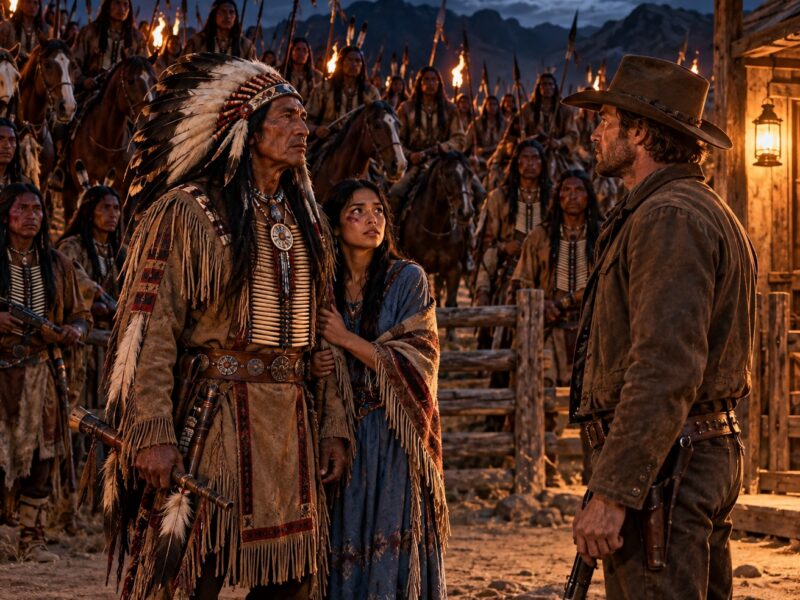
HE FREED A CHAINED APACHE WOMAN WITHOUT ASKING FOR A PENNY—THEN 100 WARRIORS SURROUNDED HIS RANCH, AND THEIR CHIEF REVEALED WHY SHE HAD BEEN TAKEN
He broke the iron chains around a stranger’s wrists without asking for her name.
By midnight, a hundred Apache warriors had surrounded his lonely Arizona ranch.
And the chief standing at their head was about to ask one question that could cost the rancher his life.
PART 1 — THE WOMAN WHO REFUSED TO BE OWNED
The first thing Jake Carter noticed was the blood. It had dried along the young woman’s temple and stained the collar of her torn blue dress. The second was the iron chain around her wrists, short enough to force her shoulders forward whenever the wagon hit a stone. The third was the way she watched him, not pleading for help but measuring whether he would become another man she needed to survive.
It was October 1882, and the Arizona Territory had turned cold after sunset. Jake was repairing a loose porch step when the sound of wagon wheels came grinding up the rocky trail. His ranch sat several miles from the nearest settlement, with a narrow creek, a weathered barn, and a house he had built for a family that no longer lived there. Visitors rarely came without a reason.
Three armed men accompanied the wagon. Two rode on horseback while the third handled the reins, his broad shoulders stretching the seams of a dusty brown coat. The horses were exhausted, and one had blood beneath its saddle strap. Jake noticed that before he noticed the rifle resting across the driver’s knees.
“Evening,” Jake called.
The driver looked at the house, then the barn, then the rifle leaning against the porch. “Need water for the horses,” he said. “We’ll be gone before dark.”
Jake stepped into the yard. “Creek’s behind the cottonwoods.”
The man nodded toward the water barrel beside the well. “That’ll do.”
Jake did not move. His gaze had settled on the woman sitting in the back of the wagon, where she held her bound hands close to her stomach.
“Why’s she chained?”
The man on the gray horse gave a short laugh. “Because she runs.”
“From whom?”
“Men who paid good money for her.”
Something inside Jake went still.
He had spent enough years watching men excuse cruelty with a contract, a uniform, or an order. He had heard people describe other human beings as cargo, labor, prisoners, and property. He knew how easily one word could make the person beneath it disappear.
“Take those irons off her,” he said.
The driver slowly turned toward him. “You have a name?”
“Jake Carter.”
“Silas Rourke.” The man tapped the barrel of his rifle. “Now that we’re acquainted, Carter, mind your own affairs.”
Jake looked at the young woman. She appeared to be in her early twenties, with dark hair tangled around her face and bruises beginning to yellow beneath one eye. Her bare ankles were dusty and scraped. When their eyes met, she gave the smallest shake of her head.
It was a warning.
Jake understood it. He simply could not bring himself to obey.
“Ma’am,” he said, keeping his distance, “do you want to go with these men?”
Her lips parted.
Rourke struck the wagon’s side with the butt of his rifle. The woman flinched so sharply that Jake saw the chain pull against the skin around her wrists.
“She doesn’t speak unless I say,” Rourke snapped.
Jake’s right hand moved closer to his holster. “Then I suggest you stop speaking for her.”
The rider on the gray horse shifted in his saddle. Jake saw his fingers close around the revolver at his hip.
“Don’t,” Jake warned.
The rider drew anyway.
Jake fired first.
His bullet struck the wagon lantern’s iron bracket, sending the lantern crashing into the dirt. Glass shattered, and the startled horses surged sideways. The rider’s pistol discharged harmlessly into the ground as his mount threw its head upward.
Jake fired a second shot into the dirt beside the driver’s boot.
“Hands where I can see them.”
For several seconds, nothing moved except the frightened horses. Then Rourke raised his hands, his eyes narrowing as he studied Jake’s face.
“You’re willing to die over a woman you don’t know?”
“No,” Jake said. “I’m willing to keep you from taking her another mile.”
Rourke looked toward the woman. A flicker of recognition passed across his face, followed by something less certain. He glanced at the mountains behind the ranch and seemed to make a calculation Jake could not understand.
“Fine,” Rourke said at last. “Keep her.”
He climbed down, handed the reins to one of his companions, and mounted the spare horse tied behind the wagon. Neither of the other men objected. That troubled Jake more than their anger would have.
Rourke gathered his reins. “You should’ve asked who she was before you interfered.”
“I asked whether she wanted to leave with you.”
“That won’t matter when they come.”
The three men turned their horses toward the western ridge. Jake held his revolver until they disappeared, then waited another minute to make certain they weren’t circling back.
Only then did he approach the wagon.
The woman drew away when he reached for the chain.
Jake stopped immediately. “I’ll need tools to get those off. You’re welcome to sit right where you are.”
She looked toward the place where the men had vanished. “They left the wagon.”
“Apparently.”
“They do not leave what they believe belongs to them.”
Jake followed her gaze. Three fresh horse tracks stretched westward through the dust, but the wagon remained in his yard, its empty driver’s seat facing the darkening trail.
“I know,” he said quietly. “I noticed.”
He fetched a hammer, a cold chisel, and a thick piece of leather from the barn. Before touching the shackles, he placed the leather between the iron and her skin.
“This is going to be loud.”
She held still.
The first shackle broke after three hard blows. The second required five. When the final piece fell onto the wagon floor, she stared at her wrists and slowly opened her fingers.
Jake stepped back.
“You’re free.”
She looked at him for a long moment. “What do you want?”
“Nothing.”
“No money?”
“No.”
“No work?”
“You don’t owe me anything.”
Her face tightened, not with relief but with disbelief. “Men always want something.”
Jake set the hammer down. “Some do.”
He offered her a hand to help her climb from the wagon. She studied it, then carefully took hold of his forearm rather than his palm. Her legs nearly failed when her feet touched the ground, but she steadied herself before he could move closer.
“My name is Naya,” she said.
“Jake.”
“I heard.”
He almost smiled.
Inside the house, Jake set a pot of beans on the stove and poured drinking water into a clean tin cup. The woman stood beside the doorway, examining the room with careful attention. She noticed the rifle above the mantel, the spare boots beneath the chair, and the two doors leading away from the kitchen.
Jake noticed her noticing.
“Bedroom’s through there,” he said. “The door has a latch on the inside. I’ll sleep out here.”
She looked toward the bedroom, then back at him. “Why?”
“Because you’ll probably rest better with a door you can close.”
He brought out an old quilt and placed it on the bed. Then he returned to the kitchen without asking her to follow.
When she finally sat down to eat, she held the spoon awkwardly. Her fingers were swollen where the shackles had cut into them. Jake pretended to be occupied with the stove while she took the first few bites.
“You’re hurt,” he said after a while. “There’s a cut above your eye. I’ve got clean cloth and water if you’ll let me look at it.”
Naya studied him, then nodded.
He washed the cut carefully, keeping his movements slow. When she winced, he drew his hand away until she gave him permission to continue. He had treated wounds before, most of them his own, but he understood that this injury needed something more than bandages.
When he finished, Naya looked toward the window.
“Do you live here alone?”
“Most days.”
“Where is your family?”
Jake folded the bloody cloth and laid it beside the basin. His eyes moved toward the small wooden cross beneath the cottonwood tree outside.
“My wife, Sarah, died six winters ago,” he said. “Our boy lived another three days.”
Naya lowered her gaze.
Jake hadn’t intended to say so much. He was not accustomed to speaking their names aloud.
“I am sorry,” she said.
He nodded once. “Thank you.”
For a long time, the only sound came from the stove.
Then Naya asked, “Did you bury them here?”
“Yes.”
“You stayed.”
Jake glanced around the room. The shelf where Sarah had kept her dishes was still above the table. A child’s height marks remained penciled into the kitchen doorframe, the highest barely reaching his waist.
“I didn’t know where else to go,” he admitted.
Naya looked at the marks but said nothing.
After supper, she rose from the table and walked toward the window. The last daylight had vanished. Beyond the fence, the mountains stood black against the stars.
“My father will come,” she said.
Jake carried the empty plates to the sink. “Then I’ll tell him what happened.”
She shook her head. “He has been searching.”
“For you?”
“For many days.”
Jake turned toward her.
“My father is called Gray Eagle.”
He recognized the name. Ranchers, traders, soldiers, and stagecoach drivers told stories about the Apache leader who knew every pass through the eastern mountains. Some described him as ruthless. Others said he had kept his people alive by knowing exactly when to fight and when to disappear.
“Gray Eagle is your father?”
Naya nodded.
“Does he know where you are?”
“He knows men took me. He does not know what happened afterward.”
Jake looked through the window at the empty wagon.
“Rourke said someone would come looking.”
“Yes.”
“How many?”
Naya’s face lost what little color had returned.
“My father has nearly a hundred warriors traveling with him.”
Jake let out a slow breath.
A hundred warriors.
He had a small ranch, three horses, and enough ammunition to make one determined defense. He did not have enough men to survive a battle. Worse, he had no reason to believe the approaching riders would know that the woman standing beside him had been freed rather than taken.
“We’ll tell him you’re safe,” he said.
Naya shook her head again.
“You do not understand. My father only knows a white man has me.”
Before Jake could answer, a sound came from beyond the creek.
Hooves.
One horse, then several.
Jake moved to the window.
Dark shapes appeared along the ridge, barely visible beneath the moonlight. More emerged between the cottonwoods, followed by riders spreading slowly across the open ground.
Naya pressed her hand against the glass.
“They found us.”
Jake reached for his rifle.
Then he looked at her bruised wrists and placed the weapon back above the mantel.
Outside, a hundred mounted warriors closed the roads leading away from his ranch.
And at their center rode a tall, gray-haired man who was carrying something Jake had not seen in six years.
A small piece of blue cloth.
The same blue cloth that had once belonged to his dead wife.
PART 2 — THE CHIEF’S QUESTION
Jake stepped onto the porch with both hands visible.
The night smelled of damp earth and woodsmoke. Beyond the fence, men sat silently on their horses, their faces and weapons catching pieces of moonlight. None had fired a shot, but every trail leading away from the ranch was guarded.
Naya came to the doorway behind him.
“Stay inside,” Jake said softly.
“No.”
He turned. “They might misunderstand.”
“They already misunderstand.”
She stepped past him before he could argue.
A horse moved forward from the line of riders. Its rider was an older Apache man with silver strands in his long hair and a weathered face that had learned to conceal emotion. He sat straight in the saddle, his eyes fixed on Naya.
She spoke a single word in Apache.
“Father.”
The old man’s expression changed.
For one breath, the commanding presence vanished. He was simply a father staring at a daughter he had believed might already be dead.
He dismounted and walked toward her.
Naya hurried down the steps, but her injured legs betrayed her. She stumbled, and the older man caught her before she reached the ground.
He held her tightly.
Jake looked away.
After a moment, Gray Eagle gently took her wrists into his hands. He examined the raw marks left by the chains. His face hardened, and he spoke several sharp words to the warriors behind him.
A ripple of anger moved through the riders.
Naya answered quickly, gesturing toward Jake.
Gray Eagle turned.
“Who is this man?” he asked in careful English.
“Jake Carter.”
The chief studied him. “You brought my daughter here?”
“Three men arrived with her. I stopped them.”
“How?”
“They had her chained. I made them release her.”
Gray Eagle looked at the discarded wagon.
“Where are the men?”
“They rode west.”
The chief’s jaw tightened.
Then he asked the question Jake had never expected.
“How much did you pay?”
Jake frowned. “Pay?”
“For my daughter.”
“Nothing.”
Gray Eagle remained silent.
“I did not buy her,” Jake continued. “I broke the chains. She can leave whenever she chooses.”
The older man’s gaze moved to Naya. She spoke to him in Apache, slowly at first, then with growing urgency. Her father listened without interrupting. When she finished, he looked back at Jake with an expression the rancher could not read.
“Many men say they are kind,” Gray Eagle said. “Then they name a price.”
“I don’t have a price.”
“Even for food and shelter?”
“No.”
Gray Eagle took a step closer.
“You stood against three armed men. You knew nothing of her family. You had no promise of reward.”
Jake glanced at Naya.
“I knew she wanted to get away from them.”
The chief held his gaze.
Then, to Jake’s astonishment, he extended his hand.
“You have done something my people will remember.”
Jake accepted the handshake.
He thought the encounter was over.
Then Gray Eagle reached beneath his coat and produced a folded piece of blue cloth, faded almost gray along its edges.
“Do you know this?”
Jake stared.
The cloth had once been part of a child’s blanket, sewn by Sarah during her last pregnancy. She had used blue fabric from an old dress because they couldn’t afford anything new.
He recognized the uneven stitching along one corner.
“Where did you get that?”
Gray Eagle watched him closely. “You know it.”
“My wife made it.”
Naya looked between them.
Jake took a step forward. “Why do you have it?”
The chief unfolded the cloth.
Inside was a little wooden button, smooth from years of handling.
Jake felt the night tilt beneath him.
He had carved that button himself.
It belonged to the coat Sarah had worn the winter she died.
“Six years ago,” Gray Eagle said slowly, “a woman traveled through the eastern pass with an infant.”
Jake couldn’t speak.
“The winter storms came early. Men followed her. She carried a child who was very sick.”
Jake’s hands began to tremble.
“No,” he whispered.
Gray Eagle’s expression softened, but he did not look away.
“She told us her name was Sarah Carter.”
Jake grabbed the porch railing.
Sarah had died after leaving their home to visit a doctor in the settlement. A neighbor had brought word that the stage wagon had overturned during a storm. Later, searchers had found the wreckage and two bodies.
Jake had buried what they brought him beneath the cottonwood.
He had never seen Sarah’s face after the accident.
“What are you saying?”
Gray Eagle looked toward Naya.
“Tell him.”
The young woman stepped closer.
“Your wife did not die on that road.”
Jake stared at her.
“She reached our people.”
His voice came out hoarse. “And my son?”
Naya’s eyes filled.
Gray Eagle answered before she could.
“The child was alive when she came.”
Jake took an unsteady step backward.
For six years, he had lived beside two graves. He had spoken to them in the evenings, repaired the little wooden crosses each spring, and kept a pair of baby shoes wrapped in cloth beneath his bed.
Now a stranger stood in his yard with a piece of Sarah’s blanket and told him that the story of their deaths was wrong.
“Where are they?” he demanded.
Gray Eagle looked down.
The silence was unbearable.
Finally, the chief said, “Your wife died three days after we found her.”
Jake closed his eyes.
For one terrible moment, hope broke against the old grief.
But Gray Eagle had not finished.
“Before she died, she made my daughter promise something.”
Naya reached beneath the collar of her dress and drew out a small silver locket.
Jake recognized it immediately.
He had given it to Sarah on their wedding day.
Naya placed it in his hand.
Inside was a faded photograph of Sarah smiling in the sunlight.
Jake stared at the picture, his thumb shaking against the silver.
“What promise?” he whispered.
Naya swallowed.
“She asked me to protect her son until his father could be found.”
Jake looked up.
The riders, the wagon, the chains, the warning from Rourke—all of it suddenly seemed connected to something far larger than he had understood.
“Where is my boy?”
Gray Eagle turned toward the mountains.
And with a grief-stricken voice, he said, “That is why we came with a hundred men.”
PART 3 — THE BOY WHO NEVER KNEW HIS NAME
The kitchen lamp burned low while Gray Eagle told Jake the truth.
Naya sat beside her father at the wooden table, a blanket covering her shoulders. Outside, the warriors kept their horses quiet near the creek. Jake had offered them water, and Gray Eagle had accepted, though neither man seemed to notice the gesture.
Six winters earlier, Sarah Carter had survived the stage accident.
The driver had lost control of the wagon in a narrow pass. Sarah had been thrown clear with her infant son in her arms, but she had suffered a terrible injury to her side. Two passengers had died, and another had gone for help.
The rescuers who arrived later had found a ruined wagon and clothing belonging to Sarah. They had concluded that the bodies recovered nearby were those of the missing passengers, including Jake’s wife.
No one had known she had crawled into the snow with the baby.
“She walked until she could no longer stand,” Gray Eagle said. “My daughter found her near the old cedar trail.”
Naya remembered the woman clearly.
Sarah had been feverish, shivering beneath a blanket, and clutching a small boy whose breathing had become weak from the cold. She had begged Naya to save him before asking for help herself.
“I was seventeen,” Naya said quietly. “I did not know much English. But I understood what she wanted.”
Jake stared at the locket lying open on the table.
“Why didn’t anyone tell me?”
Gray Eagle’s face tightened.
“Your home was far away. There were soldiers between our camp and the settlements. We sent two men with messages. Neither reached the ranch.”
Naya lowered her eyes.
“Your wife gave us your name. She told us you had a place by the creek with a cottonwood tree in front.”
Jake remembered planting that tree with Sarah during their first spring together.
“She said you would never stop looking,” Naya continued.
Jake swallowed hard.
“I did stop,” he whispered.
Naya shook her head.
“You searched where they told you to search. You believed the people who brought the bodies home.”
He stared at his hands.
“Every winter,” he said, “I thought about going back up that pass. But I didn’t know what I was looking for.”
Gray Eagle leaned forward.
“Your son lived.”
Jake looked up so quickly his chair scraped across the floor.
“Where is he?”
Naya exchanged a glance with her father.
“His name among our people is Little Hawk,” she said. “He is six years old now. He laughs easily. He likes horses. And he asks questions until everyone grows tired.”
Jake pressed his fist against his mouth.
“He is alive?”
“Yes.”
The word should have healed something.
Instead, Jake felt six years of grief and disbelief rise together until he could scarcely breathe.
“Then bring him home.”
Gray Eagle’s face darkened.
“That is what we are trying to do.”
The chief explained that three weeks earlier, men working for Silas Rourke had raided a small camp while Gray Eagle’s warriors were away. They had taken livestock, supplies, and several people, including Naya and Little Hawk.
Rourke had learned that the child was white.
He had also learned that the boy’s father was a rancher living near the eastern creek.
“Rourke knew your name,” Gray Eagle said. “He knew where you lived.”
Jake remembered the strange smile on the man’s face when he introduced himself.
“Why bring Naya here?”
“To see whether you were the man Sarah described,” Naya said.
Jake looked at her bruised wrists.
“You let him bring you here?”
Her eyes hardened.
“I did not let him do anything.”
Gray Eagle placed a hand over his daughter’s.
“Rourke was told there might be money if he returned a white child to his father. But he discovered something else.”
“What?”
Naya answered.
“He knows where our winter camp is. He has been selling information to men who want the grazing land around our springs.”
Jake felt his stomach tighten.
For months, rumors had circulated about a wealthy cattleman named Charles Whitcomb, who wanted control of the valleys east of the mountains. Whitcomb had been pressing territorial officials for new grazing leases and supporting armed patrols that drove Native families away from water sources.
Jake had never paid much attention.
He owned only a few acres and wanted nothing from the land beyond his fence.
“Rourke works for Whitcomb,” Gray Eagle said. “He took my daughter because he believed she knew where our families had moved. He took your son because he thought the boy could bring him money.”
Jake stared at the scarred tabletop.
“Where is my son now?”
“We believe he is being held at the abandoned military supply station near Coyote Pass.”
Jake knew the place.
It lay nearly twenty miles northeast, where an old trail crossed a dry canyon. The army had abandoned the station years earlier, leaving a stone storehouse and several ruined outbuildings.
“Then why are we sitting here?”
Gray Eagle studied him.
“Because if we ride with a hundred warriors, the men holding him may kill the child before we reach the gate.”
Jake stood.
“Then I’ll go.”
Naya rose too.
“You will not go alone.”
He looked at her damaged wrists.
“You’re barely able to stand.”
“I know where they took him.”
Gray Eagle spoke sharply in Apache.
Naya answered, her voice rising.
The exchange lasted several moments.
When it ended, the chief looked exhausted.
“My daughter believes you can enter the station as a man willing to pay for the boy,” he told Jake. “Rourke expects you to come.”
Jake considered the plan.
He could pretend to negotiate. He could approach openly, without a hundred mounted warriors at his back. But he knew Rourke had already proven he could use a helpless person as leverage.
“How many guards?” Jake asked.
“Seven, perhaps eight.”
“Armed?”
“Yes.”
Jake walked to the mantel and took down his rifle.
Gray Eagle watched him.
“You understand that you may not return.”
Jake checked the weapon, then lowered it.
“I spent six years burying my boy in my mind every morning,” he said. “I’m not leaving him out there another night.”
Naya stepped toward him.
“He calls me his sister.”
Jake turned.
She smiled sadly.
“When he was very small, he could not say my name. He followed me everywhere. When he had bad dreams, I was the one he called.”
Her words cut deeper than Jake expected.
He suddenly understood that this woman had not simply saved his son. She had helped raise him. She knew the boy’s favorite food, his fears, his laughter, and the things that made him feel safe.
She had lived the childhood Jake had missed.
“Then you need to come,” he said.
Gray Eagle closed his eyes for a moment.
When he opened them, he looked at Jake with the expression of a father who understood that love could make people brave and foolish in equal measure.
“Four of my men will follow at a distance,” he said. “The others will remain here until we know where the child is.”
Jake nodded.
Then Gray Eagle reached into his coat and withdrew a tiny leather pouch.
Inside was a lock of light brown hair tied with blue thread.
“Sarah gave this to my daughter before she died.”
Jake took the pouch.
The blue thread matched the blanket.
For a moment, he could see Sarah sitting by the window, sewing tiny clothes while morning sunlight fell across the kitchen floor.
He remembered her humming.
He remembered their son sleeping beside her.
And for the first time in six years, Jake allowed himself to believe there might still be someone waiting to come home.
But as he prepared his horse, one of the Apache scouts rode into the yard at full speed.
He spoke urgently to Gray Eagle.
The chief’s face went pale.
Naya translated.
“Rourke is leaving Coyote Pass before dawn.”
Jake grabbed his saddle.
“Then we ride now.”
Naya caught his arm.
“There is more.”
She struggled to say the words.
“The scout saw a boy in the wagon. Rourke was taking him north.”
Jake stared at her.
“North to where?”
Naya’s voice dropped.
“To Fort Mercer. He is going to tell the soldiers that my father kidnapped your son.”
And if Rourke reached the fort first, the boy who had survived six years without his father might become the excuse for a war that neither family could survive.
PART 4 — THE ROAD TO FORT MERCER
Jake rode through the darkness with Naya beside him.
The country northeast of the ranch was a wilderness of low ridges, scattered juniper, and dry washes cut into the earth by seasonal floods. The moon was bright enough to reveal the trail, but the cold bit through Jake’s coat. Every mile carried him closer to a child he had already mourned.
Naya rode a small chestnut mare belonging to her father. Her wrists were wrapped in clean cloth, and she held the reins carefully to spare the swollen skin. Jake watched her whenever the trail narrowed, but she never asked him to slow down.
Behind them, four Apache scouts moved through the hills, appearing and vanishing among the rocks.
Near midnight, they reached the ridge overlooking Coyote Pass.
The abandoned supply station stood below them, dark except for a fire burning beside the old stone storehouse. Two wagons were parked near the gate. Men moved between the buildings.
Jake dismounted and crouched behind a boulder.
“That is not a party preparing to leave,” he whispered.
Naya studied the station.
“No.”
A horse whinnied from the far side of the compound.
Then they heard a child crying.
Jake moved before he could stop himself.
Naya seized his sleeve.
“Wait.”
He stared at her.
She pointed toward a narrow passage between two rocks. A man stood there with a rifle, almost invisible in the shadows.
“They want you to rush in.”
Jake forced himself to breathe.
He watched the compound again.
A second guard moved near the gate. A third sat beside the fire.
And beneath the covered porch of the old storehouse stood Silas Rourke.
The man was smoking a cigar.
He looked entirely at ease.
Jake tightened his jaw.
“He’s waiting for me.”
Naya nodded.
“Then let him believe he controls what happens next.”
They waited until one of the Apache scouts returned from examining the rear wall. A section of the old structure had collapsed, leaving a narrow opening behind a stack of loose stones.
Jake could enter through the front while Naya and the scouts slipped behind the building.
It was dangerous.
It was also the only way to reach the boy without starting a fight.
Jake removed his ammunition belt and handed it to Naya.
“Keep this.”
She looked at him.
“You will need it.”
“I need Rourke to think I’ve come to bargain.”
He kept a small revolver tucked beneath his coat.
Then he took the silver locket from his pocket and closed his fingers around it.
“Sarah,” he whispered, “help me bring him home.”
He walked down the ridge alone.
The guard at the gate saw him first.
“Stop right there!”
Jake raised his hands.
“Tell Rourke Jake Carter is here.”
The guard hesitated, then shouted toward the storehouse.
Rourke emerged a moment later.
A slow smile spread across his face.
“Well,” he said. “Look who finally figured it out.”
Jake stepped into the firelight.
“Where’s my son?”
Rourke’s smile widened.
“So she told you.”
“Where is he?”
“Easy, Carter. A man should learn to ask politely when he wants something.”
Jake stared at him.
Rourke gestured toward the building.
A guard opened the door.
Inside, sitting on a wooden crate, was a small boy with light brown hair and a thin face. He wore a patched wool shirt and held a little carved horse in both hands.
Jake stopped breathing.
The child looked up.
His eyes were Sarah’s.
For six years, Jake had dreamed of seeing those eyes again.
Now they were staring at him from across a dirty room.
The boy looked frightened but curious.
“Who are you?” he asked.
Jake tried to answer.
No sound came.
Rourke laughed softly.
“That’s touching.”
Jake swallowed.
“My name is Jake.”
The boy studied him.
“Are you the man from the creek?”
Jake knelt slowly.
“Yes.”
The boy’s fingers tightened around the wooden horse.
“Naya said my father lives near a creek.”
Jake felt tears burn behind his eyes.
“She was right.”
The child leaned forward.
“Are you my father?”
Jake nodded.
“Yes, son.”
The boy stared at him.
For one extraordinary second, the entire world seemed silent.
Then Rourke stepped between them.
“That’ll cost you.”
Jake slowly rose.
“Name it.”
“Five thousand dollars.”
Jake looked at him in disbelief.
“I don’t have five thousand dollars.”
“Then Whitcomb gets the ranch, the water rights, and your signature on a statement identifying Gray Eagle’s people as kidnappers.”
Jake understood at last.
This had never been only about the boy.
Whitcomb wanted the water flowing through Jake’s property because the creek connected to a larger spring system used by ranchers and Apache families alike. With Jake’s signature and the child’s story twisted into an accusation, Whitcomb could claim the land was unsafe and seek armed support to clear the area.
“You’ll take my land and use my son to start a fight,” Jake said.
Rourke shrugged.
“People believe a frightened white father.”
Jake looked toward the open doorway.
The boy was watching.
Jake lowered his voice.
“He’s six years old.”
“Then he’s young enough to forget most of this.”
Jake felt his hand move toward the hidden revolver.
But he stopped.
A shot would bring the guards running.
His son was still inside.
Instead, Jake looked at Rourke and said, “Bring me the paper.”
Rourke smiled.
“Now you’re being sensible.”
A guard fetched a folded document and placed it on a crate near the fire.
Jake bent over it, pretending to read.
He saw his own name at the bottom of a prepared statement accusing Gray Eagle of kidnapping and demanding military action. Another paper transferred his ranch to a company owned by Charles Whitcomb.
Jake’s jaw tightened.
He reached for the pen.
Then, from somewhere inside the storehouse, a woman’s voice called softly.
“Little Hawk.”
The boy’s head lifted.
“Naya?”
A guard spun toward the building.
Jake moved.
He seized the crate and threw it into Rourke’s knees.
The man fell backward.
Jake drew his revolver.
“Nobody moves!”
The first guard reached for his rifle.
A shot cracked from behind the storehouse.
The guard’s weapon flew from his hands.
Another man shouted.
Horses screamed.
And suddenly, Apache scouts appeared along the ruined wall.
Naya rushed through the doorway and gathered the boy into her arms.
“Little Hawk!”
He clung to her.
Jake backed toward them, keeping his revolver trained on Rourke.
“Come here, son.”
The boy looked at Naya.
She spoke gently in Apache, then pointed toward Jake.
“He is the one I told you about.”
The child hesitated.
Jake knelt again.
“I know you don’t remember me,” he said. “That’s all right. You don’t have to.”
The boy studied his face.
Then he stepped forward.
Jake held out his hand.
Small fingers closed around his.
The touch nearly brought him to his knees.
“Your mother loved you,” Jake whispered.
The boy looked up.
“Naya says she sang to me.”
Jake nodded, unable to speak for a moment.
“She did.”
Behind them, Rourke groaned and reached toward his gun.
Naya saw it first.
“Jake!”
Jake turned.
Rourke fired.
The bullet struck Jake high in the shoulder.
Pain tore through him.
He stumbled backward, nearly losing his grip on the boy’s hand.
A second shot rang out.
Rourke fell against the wagon wheel, his gun dropping into the dirt.
One of Gray Eagle’s scouts stood beyond the gate with his rifle raised.
Jake clutched his shoulder.
Blood spread across his coat.
The boy began to cry.
Naya caught Jake before he collapsed.
“Stay with me,” she whispered.
Jake looked at his son.
The child’s little hand was still reaching for him.
And before darkness closed around the edges of his vision, Jake heard the boy say a word he had waited six years to hear.
“Papa.”
PART 5 — THE PRICE OF BRINGING SOMEONE HOME
Jake woke to the smell of woodsmoke.
His shoulder throbbed beneath a thick bandage, and the room around him was familiar. He was lying in his own bed, beneath the quilt Sarah had sewn during their first winter on the ranch.
For a moment, he thought the entire journey had been a dream.
Then he heard a child’s laughter coming from the kitchen.
Jake closed his eyes.
The sound was real.
He tried to sit up.
Pain shot down his arm.
“Do not be foolish.”
Naya stood in the doorway holding a cup of water.
Jake looked at her.
“Where is he?”
She stepped aside.
A small boy appeared behind her.
He wore one of Jake’s old shirts, cut down and stitched to fit. His light brown hair had been combed neatly, and his cheeks were pink from the warmth of the kitchen.
The boy stared at Jake.
“You’re awake.”
Jake smiled despite the pain.
“Seems that way.”
The child took a cautious step into the room.
Naya rested a hand on his shoulder.
“Go on.”
The boy approached the bed.
Jake held out his good hand.
The child placed his carved horse in it.
“This is for you.”
Jake looked at the little wooden animal.
“Did you make it?”
“Gray Eagle helped.”
“It’s a fine horse.”
The boy climbed carefully onto the edge of the mattress.
“Naya said you got hurt because you came for me.”
Jake looked at the bandage.
“That’s one way to tell it.”
“Did it hurt?”
“A little.”
The boy frowned.
“You’re lying.”
Jake laughed.
The sound surprised him.
“You’re right. It hurt quite a bit.”
The child considered this, then leaned against Jake’s uninjured side.
Jake wrapped his arm around him.
For a long time, neither spoke.
Outside, the morning wind moved through the cottonwoods.
At last, the boy whispered, “Do I have to leave Naya?”
Jake looked toward the doorway.
Naya stood very still.
The question had been waiting for them since the rescue.
Jake understood that his son did not remember the home where he had been born. He remembered Naya, Gray Eagle, the people who had fed him, sheltered him, and loved him through six winters.
Those people were his family too.
Jake kissed the boy’s hair.
“No, son,” he said quietly. “You don’t have to stop loving anyone to come home with me.”
The child looked up.
“Can they visit?”
“I hope they will.”
“Can I visit them?”
Jake glanced at Naya.
“If they want us.”
Naya smiled.
“We do.”
Three days later, Gray Eagle returned with several warriors.
They brought news.
Silas Rourke was dead, but two of his men had survived the confrontation at Coyote Pass. They had been disarmed and released after agreeing to leave the area.
More importantly, the papers Rourke had prepared were now in Jake’s possession.
They contained Charles Whitcomb’s name, the proposed land transfer, and a written statement designed to accuse Gray Eagle’s people of kidnapping.
Jake sent copies to a territorial judge he trusted.
He also wrote an account of the rescue, witnessed by Naya and the men who had accompanied them.
The judge’s clerk arrived weeks later to collect sworn statements. Whitcomb denied directing the kidnapping, but the documents and testimony were enough to bring official scrutiny to his attempted land acquisition.
His effort to seize Jake’s ranch failed.
The larger conflict over the grazing lands did not vanish. Jake knew that no single document could mend years of broken promises and violence. But the papers made it harder for Whitcomb to use a kidnapped child as an excuse for driving families from the valley.
Winter settled over the mountains.
Jake’s shoulder healed slowly.
The boy, whose birth name had been Samuel, began learning the life his father had once imagined for him. He helped scatter feed for the chickens, fell asleep beside the stove, and asked Jake to tell stories about Sarah.
Sometimes Jake told him about the way she laughed when the bread burned.
Sometimes he described her singing while she worked.
And sometimes he could say nothing at all.
On those nights, Samuel would sit beside him and quietly hold his hand.
Naya remained at the ranch until spring.
At first, she stayed because Jake could barely lift a bucket. Then she stayed because Samuel had nightmares and reached for her in the dark. By the time Jake’s shoulder had healed, the house had begun to feel different.
There were three plates on the table.
Three coats near the door.
And voices in rooms that had been silent for years.
One morning, Jake found Naya outside beneath the cottonwood tree.
She stood before the two wooden crosses, her hands folded.
“I did not know what you buried here,” she said when he approached.
Jake looked down.
“Neither did I.”
He had learned that the bodies brought from the accident had been misidentified amid the storm’s confusion. The graves had held strangers, people whose real families had perhaps never known where they were buried.
Jake had contacted the authorities to correct the records.
He had left the crosses standing until the names could be properly established.
For six years, those graves had represented the end of his life with Sarah and their child.
Now they reminded him how easily grief could be built upon a terrible mistake.
“Naya,” he said quietly, “I never thanked you properly.”
She turned.
“You thanked me when you went after Samuel.”
“That wasn’t enough.”
Her eyes searched his face.
“Jake, I did not care for him because I expected something.”
“I know.”
She smiled faintly.
“You told me the same thing about my chains.”
He looked at the pale scars around her wrists.
“They still hurt?”
“Sometimes.”
He nodded.
“Mine too.”
She glanced toward the house, where Samuel was trying to carry a basket of firewood much too large for him.
“He is happy here,” she said.
Jake followed her gaze.
“He is.”
Naya’s smile faded.
“My father wants me to return with him when the spring rains come.”
Jake felt the words settle inside him.
He had known this day would arrive.
Naya belonged to her family and her people. She had stayed longer than anyone had asked her to, and Jake refused to mistake gratitude for a claim upon her future.
“You should do what you want,” he said.
She looked at him.
“And what do you want?”
Jake was silent.
Across the yard, Samuel dropped half the wood and began laughing at himself.
Jake watched him.
Then he turned back to Naya.
“I want my son to grow up knowing everyone who loved him when I couldn’t be there.”
Naya lowered her eyes.
“And you?”
Jake took a breath.
“I think I’ve spent too many years believing that if I loved somebody again, I’d be betraying the people I lost.”
The wind moved through the cottonwood leaves.
Naya stepped closer.
“Sarah asked me to keep her son safe,” she said. “She did not ask either of us to stop living.”
Jake looked at her.
There was no sudden promise, no demand that she choose between him and her father, no attempt to turn everything they had survived into a debt.
Only the possibility of a future neither had expected.
“I’d like you to stay,” he said. “But only if it’s the life you want.”
Naya reached for his hand.
“I do not know yet where all of my life will be.”
“Then we’ll take our time.”
She smiled.
“For a man who nearly got himself killed twice in one week, you are learning patience.”
Jake laughed.
It came easily now.
That evening, Gray Eagle arrived at the ranch.
He found Jake repairing the fence, Naya tending the garden, and Samuel running through the yard with his wooden horse.
The chief dismounted slowly.
For a long moment, he watched the boy.
Then Samuel saw him.
“Grandfather!”
He ran across the yard.
Gray Eagle bent and lifted him into his arms.
Jake stood beside the fence, suddenly uncertain whether to speak.
Gray Eagle approached him.
“My daughter tells me she may remain for another season.”
Jake nodded.
“If she wants.”
“She says you have not asked her to repay what you did.”
“She doesn’t owe me anything.”
Gray Eagle studied him.
Then the older man placed one hand on Jake’s shoulder.
“That is why I am not afraid to leave her here.”
Jake looked toward Naya.
She was standing on the porch, watching them with a quiet smile.
Gray Eagle followed his gaze.
“When we rode to this ranch, I thought I would find another man who believed he could own my child.”
Jake said nothing.
“Instead, I found a man who had lost his son and still chose to help someone else’s daughter.”
The chief paused.
“And because of that choice, I was able to return a son to his father.”
Jake swallowed.
Gray Eagle extended his hand.
This time, Jake took it without hesitation.
Spring came slowly to the Arizona mountains.
The creek rose with snowmelt, green grass spread along the banks, and Samuel turned seven beneath the cottonwood tree.
Naya’s family came for the celebration.
Jake baked a crooked cake, burned one side of it, and pretended it had been intentional. Samuel laughed so hard he spilled his cup of milk.
Gray Eagle brought the boy a small saddle.
Naya brought him a new blue shirt.
When the guests had gone and evening settled over the ranch, Samuel climbed onto Jake’s knee beside the porch.
“Papa?”
“Yes, son?”
“Why did Naya bring me here?”
Jake looked across the yard.
Naya was standing by the garden gate, watching the last light leave the mountains.
“Because she knew I was waiting for you,” he said.
Samuel thought about that.
“Did you know she was coming?”
“No.”
“Then how did she find you?”
Jake smiled.
“Sometimes people find their way into your life when you’ve stopped believing anyone will.”
The boy rested his head against his father’s chest.
Jake held him close.
Six years earlier, he had believed the graves beneath the cottonwood were all that remained of his family.
Now there was a boy asleep in his arms, a woman laughing softly near the kitchen doorway, and the memory of another woman whose final act of love had reached across six winters to bring her child home.
He had broken a stranger’s chains without asking for anything.
He had not expected her to give him back a life.
And in the quiet of that spring evening, Jake finally understood that some debts of kindness are not repaid.
They are carried forward.









