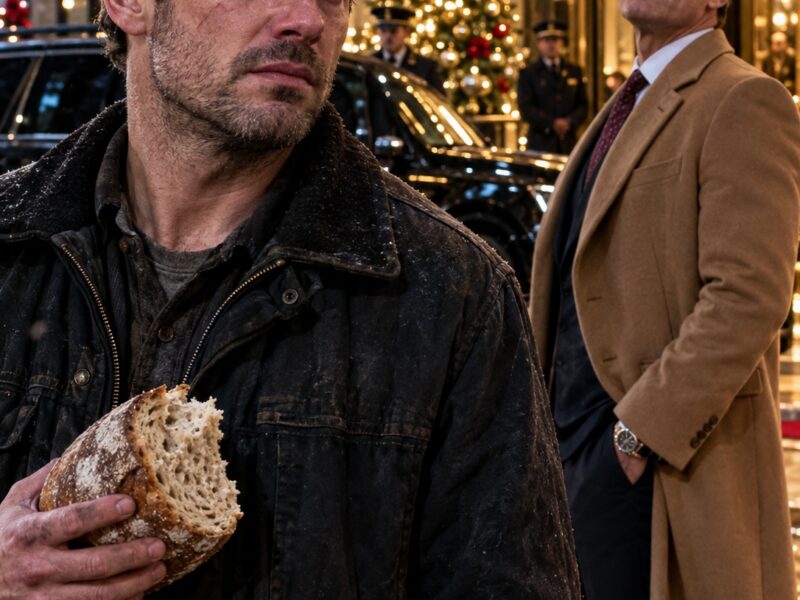
HE GAVE HALF HIS LAST LOAF TO A HOMELESS WOMAN—TWO DAYS LATER, SHE WALKED INTO THE BOARDROOM AND EVERYONE STOOD UP
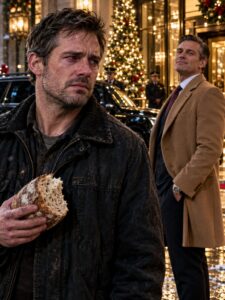
Nolan Mercer had fourteen dollars left in the world when he tore his dinner in half and gave the warmer piece to a woman he believed had nowhere to sleep.
Two minutes later, a millionaire stepped out of a black SUV, looked at them standing beneath the broken light outside Reed’s Corner Bakery, and laughed.
“Two broke people splitting dinner,” Preston Worthington IV said. “How touching.”
Nolan didn’t answer.
He simply moved one step sideways, placing his body between the woman and the wind.
What Nolan didn’t know was that the woman beside him wasn’t homeless.
What Preston didn’t know was far worse.
Across the street, a dark sedan had been idling for nearly an hour.
And it was waiting for her command.
The evening of December 23 had turned Bell Haven, Pennsylvania, into the kind of Christmas postcard that lied beautifully.
Downtown storefronts glowed beneath wreaths and strings of white lights. Families hurried between restaurants carrying shopping bags. A brass quartet played beneath the awning of the Grand Bell Haven Hotel while snow settled softly over luxury cars.
Old Harbor looked different.
There, Christmas lights ended three blocks too soon.
Streetlamps buzzed over cracked sidewalks. Half the storefronts were dark. The river wind came between the brick buildings hard enough to make a person lower his head and reconsider every decision that had brought him there.
Nolan knew that wind well.
At forty-one, he had spent most of his adult life working in places where heat, water, pressure, electricity, and machinery were noticed only when they stopped working.
That day he had spent nine hours beneath an empty warehouse trying to resurrect a boiler that should have been replaced years earlier.
At 5:17 p.m., the boiler finally held pressure.
At 5:22, the staffing agency called to tell him his payment was being delayed.
“Paperwork issue,” the woman said.
“I completed the work.”
“I understand.”
“You have my signed service ticket.”
“I understand, Mr. Mercer.”
“My rent doesn’t understand.”
Silence.
Then the corporate phrase people used when they wanted to end a conversation without helping.
“We’ll do everything we can.”
The call disconnected.
Nolan sat inside his twelve-year-old Ford pickup and counted his money.
Fourteen dollars.
He counted again, although numbers did not become kinder the second time.
Fourteen.
His truck chose that moment not to start.
He rested his forehead against the steering wheel.
“Perfect.”
For several seconds, he remained there while sleet clicked against the windshield.
Eleven years earlier, after his wife Clare died suddenly from an aneurysm, Nolan had learned something about bad days.
They were rarely dramatic.
Usually nothing exploded.
Nobody screamed.
A bad life could arrive through small things: an unpaid invoice, a dead battery, a canceled shift, a medical bill, a landlord’s envelope under the door.
Eventually there were enough small things that you looked around and realized you were standing somewhere you never imagined you could reach.
Nolan grabbed his tool bag and started walking.
Reed’s Corner Bakery was closing when he arrived.
Vivien Reed saw him through the glass.
She was fifty-three, sharp-eyed, broad-shouldered, and one of the few people in Bell Haven who understood that pity could sometimes humiliate a man more effectively than cruelty.
She held up a loaf of rye.
“Day-old.”
Nolan opened the door.
“How old?”
“Old enough to be half price. Young enough not to break your teeth.”
He smiled.
“How much?”
Vivien named a number low enough that Nolan knew she was lying.
He didn’t challenge her.
That was their arrangement.
He paid.
She handed him the brown paper bag.
“Merry Christmas, Nolan.”
“Not Christmas yet.”
“Then bring it back tomorrow.”
He stepped outside.
Vivien locked the door behind him.
That was when he saw the woman.
She sat against the bakery’s side wall with her knees pulled toward her chest.
Her wool coat was soaked along the hem. A faded scarf covered most of her chestnut hair. Her hands were red from the cold.
But something about her didn’t fit.
She wasn’t holding a cup.
She didn’t ask for money.
She wasn’t looking at pedestrians the way people did when they needed something from strangers.
She was simply watching.
“Excuse me.”
Her voice stopped Nolan.
“Do you know anywhere around here that’s still open?”
“For food?”
“For warmth.”
He pointed east.
“Dock Street shelter. Three blocks.”
“Closed.”
Nolan frowned.
“Since when?”
“This afternoon.”
“Why?”
“They didn’t say.”
He looked at her more carefully.
Gray-blue eyes.
Pale face.
No makeup.
Exhaustion.
And beneath all of it, a stillness Nolan recognized immediately.
Hunger.
He had not eaten since breakfast himself.
He looked down at the paper bag.
For one second, practicality spoke.
Fourteen dollars had become eleven and change.
No guaranteed work tomorrow.
No working truck.
No groceries waiting upstairs.
He opened the bag anyway.
The woman watched as he broke the loaf.
He handed her the larger half.
She stared at it.
“Are you sure?”
“It’s bread.”
“You bought it for yourself.”
“Bread doesn’t taste any better when you eat it alone.”
For the first time, something changed in her face.
Not gratitude exactly.
Something sadder.
Almost surprise.
She accepted it.
“Thank you.”
“Nolan.”
“Marin.”
He nodded.
“Nice to meet you, Marin.”
That was when tires hissed through the slush.
A black SUV stopped at the curb.
The rear door opened.
A tall man stepped out wearing a camel-colored overcoat that probably cost more than Nolan’s truck.
Preston Worthington IV.
Nolan recognized him immediately.
Anyone connected to Old Harbor would have.
Worthington Capital controlled development contracts, warehouses, residential properties, and much of the proposed $480 million Old Harbor redevelopment.
Another man followed.
Thinner.
Clipboard under one arm.
Grant Pembroke.
Grant had signed Nolan’s termination letter eight months earlier.
He saw Nolan.
Then the bread.
Then Marin.
His smile widened.
“Well, look who survived.”
Nolan’s shoulders tightened.
Preston glanced between them.
“One has no home,” he said, “and the other can’t afford dinner.”
Grant laughed.
Preston adjusted his gloves.
“Bell Haven really is attracting outstanding residents.”
Marin said nothing.
Nolan felt her become very still beside him.
Grant looked at the bread.
“Merc, I thought we taught you something. If you want to get ahead, you keep your mouth shut.”
Nolan met his eyes.
“You taught me plenty.”
The smile disappeared briefly.
Preston chuckled.
“Splitting your poverty in half won’t make either of you richer.”
Nolan could have answered.
He had spent eight months imagining answers.
Instead, he stepped sideways.
Between Marin and Preston.
Between Marin and the wind.
It was such a small movement that Preston almost missed it.
Marin did not.
Preston looked at Nolan for another moment, then turned away.
“Come on, Grant.”
They returned to the SUV.
Red taillights disappeared through the snow.
For several seconds, Marin stared after them.
“You know those men?”
“I used to work for people connected to them.”
“They always treat you like that?”
Nolan tucked his half loaf beneath his jacket.
“Only when somebody’s watching.”
“Who was the thinner one?”
“Grant Pembroke.”
She repeated it softly.
“Grant Pembroke.”
As if memorizing it.
Nolan didn’t notice.
He also didn’t notice the pale line around Marin’s finger where an expensive ring had once rested.
Or the way her gaze had locked onto the silver Worthington Capital emblem on the SUV.
“Try St. Matthew’s,” he said. “Church basement on Fourth. They sometimes keep the side door open during cold alerts.”
“And you?”
“I’ve got a bus.”
“You gave me half your dinner.”
“I still have half.”
She looked down at the bread.
“Merry Christmas, Nolan.”
“Not Christmas yet.”
That made her smile.
He walked toward the bus stop.
Marin waited until he disappeared around the corner.
Then her expression changed.
She slipped two fingers through a tear in the lining of her coat and removed a slim phone.
Not a prepaid flip phone.
Encrypted.
She typed one sentence.
Confirm Preston Worthington’s authorization on the harbor closure.
She sent it.
Across the street, the dark sedan switched on its headlights.
And somewhere inside Bell Haven, a man who believed himself untouchable had just made the first mistake that would cost him everything.
The next morning, Nolan went looking for money he had already earned.
Grant Pembroke made sure he left without it.
Three contractors were waiting outside the Old Harbor operations trailer when Nolan arrived.
Grant sat behind a folding table.
“Mercer.”
“My payment.”
Grant opened a folder.
“Your work failed inspection.”
“Show me the report.”
Grant paused.
“Excuse me?”
“The inspection report.”
Grant shuffled papers.
“There were deficiencies.”
“Signed by whom?”
“You’re in no position to interrogate me.”
“Then show me the engineer’s signature.”
There wasn’t one.
Nolan knew it.
Grant knew Nolan knew it.
So Grant changed tactics.
He removed a check.
Held it between two fingers.
Then dropped it into the mud.
“Pick it up.”
Nobody moved.
Grant smiled.
“That’s what you need, isn’t it?”
Nolan looked down.
The check was enough to keep his electricity on.
Enough for groceries.
Enough to get his truck looked at.
He could bend over.
Take it.
Walk away.
Grant was counting on exactly that.
Nolan looked back at him.
“I work to get paid,” he said. “I don’t perform for your entertainment.”
He wrote a formal payment request on the back of a business card and placed it on the table.
Then he walked away.
His hands were shaking by the time he reached the bus shelter.
Not from cold.
Pride was expensive.
That was the part people with money rarely understood.
They liked to say dignity cost nothing.
It did when you were poor.
Sometimes dignity cost dinner.
Sometimes rent.
Sometimes a job.
“Nolan?”
He turned.
Marin stood beneath the bus shelter.
Same coat.
Same canvas bag.
“Any luck?” she asked.
“With what?”
“Getting paid.”
He stared at her.
“How did you know?”
“You said you worked around here.”
“Right.”
Her answer was plausible.
Barely.
She asked about a warming station.
Nolan looked at the eleven dollars in his wallet.
Ten minutes later they were sitting inside Dot’s Diner with two coffees between them.
Marin wrapped both hands around her cup.
Nolan asked where she had slept.
“Print shop doorway.”
“Last night?”
She nodded.
“And before that?”
“Dock Street shelter.”
“How long?”
“Almost three weeks.”
Something in his expression changed.
“You were living there before it closed?”
“Yes.”
“Did the heat work?”
“Sometimes.”
That answer irritated him more than if she had said no.
Heat either worked or it didn’t.
“Which building?”
“South block.”
Nolan leaned back.
“South block had problems years ago.”
“What kind?”
She sounded casual.
But her questions were not casual.
Nolan explained.
Cheap replacement valves.
Incorrect pressure sensors.
Parts listed as installed that he had never physically seen.
Maintenance requests repeatedly delayed because shutdowns interfered with redevelopment deadlines.
“When I pushed for a full safety shutdown,” he said, “Grant told management I was deliberately delaying the project.”
“And then?”
“Two weeks later I was fired.”
“Did you document it?”
Nolan laughed once.
“Of course I documented it.”
“Do you still have the report?”
“My copy.”
“Why?”
“Because Clare taught me never to trust a signature I couldn’t defend.”
“Clare?”
“My wife.”
Marin saw his face change and didn’t ask the obvious question.
Nolan appreciated that.
He stared into his coffee.
“Nobody cares about a maintenance guy’s report anyway.”
“I care.”
He looked up.
Her answer had come too quickly.
Before he could question it, the diner door opened.
Grant walked in.
He had seen them through the window.
“Beautiful.”
Several customers turned.
“The fired foreman and his homeless girlfriend.”
Nolan stood.
“Walk away, Grant.”
Grant ignored him.
His phone buzzed.
He checked the screen and smiled.
“Perfect timing.”
He answered on speaker.
Preston’s voice filled the diner.
Grant made sure everyone heard as Preston instructed him to remove Nolan Mercer from every approved contractor list in the Worthington network.
Marin placed her cup down.
“Mr. Pembroke?”
Grant looked at her.
“Did Old Harbor receive final safety certification before the housing blocks were closed?”
Silence.
Grant’s eyes narrowed.
“What did you say?”
“The safety certification.”
He laughed.
“Sweetheart, worry about finding a shower before you worry about certifications.”
Nolan moved between them.
“Leave her alone.”
Grant raised his hands.
“Hero again.”
He left smiling.
But Marin wasn’t watching him anymore.
She was watching Nolan.
“You didn’t have to do that.”
“Yes, I did.”
“Why?”
Nolan frowned.
“Because he was being an ass.”
The simplicity of the answer seemed to affect her.
Then Marin quietly repeated the classification number of the defective valve Nolan had mentioned earlier.
And cited the exact code section it violated.
Nolan stared at her.
“How do you know that?”
A beat.
“I used to work around buildings.”
“What did you do?”
“Enough to know cheap valves become expensive funerals.”
That was not an answer.
Nolan knew it.
She knew he knew it.
Neither pushed further.
Yet.
By one that afternoon, Nolan was called back into Old Harbor.
The distribution center’s heating plant was failing.
Danny Shaw, a supervisor Nolan had trained years earlier, sounded desperate.
“You’re the only guy I know who can read that system blind.”
Nolan arrived during heavy snow.
Grant blocked the front entrance.
“Contractors use the loading dock.”
Nolan looked through the glass at employees moving equipment in winter jackets.
“You want it fixed?”
Grant’s jaw flexed.
Then he stepped aside.
Twenty minutes later, Nolan found the fault.
A pressure sensor.
Wrong specification.
Cheap substitute.
Exactly the kind of substitution Nolan had warned about before losing his job.
A young technician stared at the panel.
“Three shifts couldn’t find that.”
“Luck,” Grant snapped.
Then the mechanical-room doors opened.
Preston Worthington entered wearing a tuxedo beneath his overcoat.
His Christmas Eve gala was starting in a few hours.
Danny explained what Nolan had found.
Preston listened.
Then asked the question that told Nolan exactly what kind of man he was dealing with.
“How much does he want to keep quiet?”
Nolan wiped grease from his hands.
“I want the amount in my contract.”
Preston smiled.
“And?”
“I want the defective parts replaced.”
The smile disappeared.
“Poor people have an interesting habit of confusing necessity with authority.”
He placed a folded document on the workbench.
Ten thousand dollars.
Transferred that night.
All Nolan had to do was sign a statement saying the failure had been caused by operator error.
Nolan read it.
Ten thousand dollars.
He imagined his truck repaired.
January rent paid.
Groceries.
Debt.
For one terrible second, he imagined peace.
Then he looked at Danny.
At the young technician.
At the pipes overhead.
He slid the paper back.
“No.”
Preston blinked.
“You should think carefully.”
“I did.”
“Ten thousand dollars.”
“I heard you.”
“You don’t have ten thousand dollars.”
“No.”
“Then perhaps poverty has affected your judgment.”
Nolan leaned closer.
“No. It clarified it.”
Preston’s expression hardened.
“Cancel his service agreement.”
Grant smiled.
Security escorted Nolan out through the loading dock.
Marin was standing near the gate.
He almost laughed when he saw her.
“You have incredible timing.”
“So I’ve been told.”
She noticed blood across his knuckles.
“What happened?”
“Pipe flange.”
“No. Inside.”
“They offered me ten grand.”
“For what?”
“To lie.”
“And?”
“I said no.”
She stared at him.
“Why?”
That irritated him.
“Why does everybody keep asking me that?”
“Because ten thousand dollars would change your winter.”
“Yes.”
“And you still refused.”
Nolan reached into his tool bag and removed an old wool scarf.
He wrapped it around her neck.
“A lie like that might keep someone else from making it through winter.”
Marin said nothing.
Nolan walked away.
She stood there long after he was gone.
Later, inside a laundromat, surrounded by the mechanical thunder of dryers, Marin opened an encrypted message from Elliot Harper.
Seventeen invoices.
$8.6 million.
Replacement equipment supposedly purchased and installed across Old Harbor.
She checked Nolan’s component number.
Then another.
Then another.
The records claimed new equipment existed.
Nolan had just physically proven at least part of it did not.
Marin stared at the screen.
This was no longer bad maintenance.
Someone might be stealing millions.
That evening, the Grand Bell Haven Hotel glittered over the city.
Preston’s Christmas reception filled the ballroom with investors, champagne, crystal chandeliers, and conversations about the $480 million redevelopment that would supposedly “transform” Old Harbor.
Nolan wanted nothing to do with it.
Unfortunately, an insurance investigator did.
The owner had filed a claim regarding the distribution-center failure.
Nolan had been asked to explain his report.
So he wore his only suit.
The black one.
The one he had worn to Clare’s funeral.
He carried his notes in a worn manila envelope and entered the hotel.
Preston spotted him before he reached the elevators.
“Mercer!”
The string quartet kept playing.
Conversations stopped anyway.
Preston lifted his champagne.
“Did you come for the free food?”
Grant appeared beside him.
Nolan showed the appointment on his phone.
“I’m meeting your insurer.”
The claims representative stepped forward.
Preston immediately told her Nolan had been fired for incompetence.
Then another figure entered through the service corridor.
Marin.
Same worn coat.
Same canvas bag.
Preston laughed.
“Oh, this is perfect.”
People turned.
“The most pitiful Christmas couple in Bell Haven reunited.”
Grant signaled security.
Marin looked directly at Preston.
“Are you sure you want to do that?”
“I don’t require permission from someone who can’t afford a hotel room.”
Nolan stepped forward.
“If you want me gone, talk to me.”
Preston moved closer.
“You think you’re rescuing her?”
Nolan didn’t move.
“You can’t even rescue yourself.”
Something changed in Marin’s eyes.
Nolan had defended her again.
Not because he wanted anything.
Not because he knew anything.
Simply because he believed humiliation was wrong.
The guards approached.
Then stopped.
A silver-haired man had appeared on the mezzanine.
One quiet sentence from him sent security backward.
He touched Marin’s elbow.
Nolan heard only fragments.
“…documents…”
“…board…”
And something that sounded like:
“Miss Hollis.”
Nolan turned.
But Marin was already walking upstairs.
Before leaving, she looked back.
“Keep your reports.”
“What?”
“They matter more than you think.”
Then she disappeared.
Nolan stood beneath a twenty-foot Christmas tree wondering why a homeless woman knew a lawyer powerful enough to stop hotel security with a whisper.
Upstairs, the silver-haired man closed the boardroom door.
Elliot Harper placed a thick file on the table.
HOLLIS MERIDIAN HOLDINGS — EMERGENCY BOARD REVIEW
Below it:
PRESTON WORTHINGTON IV
“We know who authorized the payments,” Elliot said. “We know where much of the money moved.”
Marin removed Nolan’s scarf slowly.
“What are we missing?”
“Physical proof that the invoiced equipment was never installed. Ideally recorded before anyone involved knew there was an investigation.”
Marin looked toward the floor below.
Toward Nolan.
Toward the creased manila envelope.
“I think,” she said, “I know who has it.”
Later that night, she found Nolan at a bus stop.
Snow drifted beneath the streetlight.
He was reading his reports.
Again.
“Why keep carrying them?” Marin asked.
Nolan shrugged.
“Clare.”
He finally told her.
His wife had been a quality inspector.
She used to tell him that signatures were invisible until something went wrong.
Then suddenly every signature became a question.
Who knew?
Who approved it?
Who lied?
Who could have stopped it?
“She died eleven years ago,” Nolan said.
“I’m sorry.”
“Our daughter was seventeen.”
He looked toward the empty road.
“I worked doubles after that. Got her through school. She lives in Oregon now. Calls Sundays.”
Marin watched him.
“So you lost your job because of a signature.”
Nolan shook his head.
“No.”
He folded the report.
“I lost my job because I wouldn’t put my signature in the wrong place.”
Marin became quiet.
Then she asked him something strange.
“If somebody gave you enough money tomorrow that you never had to work again, what would you do?”
Nolan considered it.
“Pay my debts.”
“And then?”
“Buy my tools back.”
“And then?”
“Find a maintenance job.”
She almost laughed.
“You’d still work?”
“I like fixing broken things.”
For reasons Nolan couldn’t understand, that answer seemed to matter enormously to her.
His phone buzzed.
He read the message.
January contract canceled.
Negative performance review submitted by Grant Pembroke.
Marin saw his face.
“What?”
“Nothing.”
“Nolan.”
“My January work disappeared.”
“I might know someone who needs your experience.”
He looked at her.
“I’m not taking a pity job.”
“You haven’t even heard what it is.”
“Then they can interview me.”
Marin laughed.
A genuine laugh.
“Fair enough.”
They boarded the same bus.
Got off at different stops.
Nolan went home to a cold apartment above a hardware store.
Marin went to a rented apartment where Elliot Harper was waiting with two laptops, bad coffee, and worse news.
Preston had scheduled an emergency committee meeting for December 26.
Thirty-two million dollars was about to be moved into an escrow vehicle connected to entities Worthington controlled.
If it moved before the audit expanded, tracing it would become harder.
“How long?” Marin asked.
“Maybe thirty-six hours.”
She folded Nolan’s scarf over a chair.
“Then the meeting won’t go the way Preston expects.”
Christmas morning brought Nolan no miracle.
Only an email.
Worthington Capital’s attorneys accused him of illegally possessing proprietary technical information.
They threatened litigation if he contacted the press, insurers, or third parties.
Nolan read the email three times.
He knew the reports were his.
He also knew lawyers cost money.
Truth might be free.
Defending it was not.
At ten, Grant invited him to coffee.
Nolan went because traps were easier to understand when you could see them.
Grant slid a document across the table.
Ten thousand dollars.
Again.
This time accompanied by confidentiality language broad enough to erase Nolan’s entire history with Old Harbor.
Withdraw the reports.
Certify the equipment.
Stay quiet.
Grant leaned back.
“You’re not rich enough to keep your pride, Mercer.”
Nolan folded the agreement.
“This isn’t a settlement.”
“What is it?”
“A request to lie.”
Grant hit the table.
“Do you understand what ten thousand dollars means to someone like you?”
Nolan looked at him.
“Yes.”
That answer pleased Grant for half a second.
Then Nolan continued.
“That’s how I know whatever you’re trying to buy must be worth a lot more.”
Grant’s smile vanished.
He told Nolan his upcoming interview had also been canceled.
He suggested Preston could make sure nobody in Bell Haven hired him again.
Nolan left.
He walked home through snow because the buses had stopped running.
Past Christmas lights.
Past church volunteers serving soup.
Past Dock Street shelter, its locked doors covered by an official closure notice.
He reached his apartment with fewer than nine dollars.
No January work.
No interview.
A lawsuit threat.
A dead truck.
He sat on his bed without removing his coat.
And for the first time since Clare died, Nolan Mercer allowed himself to admit something.
He was scared.
Not of being poor.
He knew how to be poor.
He was afraid that doing the right thing might destroy what little life he had left.
Across Bell Haven, Marin learned about the legal threat.
Her first instinct was simple.
One phone call.
Crush it.
Elliot stopped her.
“If you interfere now, Preston’s attorneys will say you manipulated witnesses during an active audit.”
“He’s destroying Nolan’s livelihood.”
“I know.”
“He helped us.”
“That is exactly why we cannot contaminate his evidence.”
Marin hated the answer because it was correct.
So she did something harder than using power.
She waited.
She sent Nolan information for an emergency legal-aid attorney and his union representative.
Rachel Dunn met Nolan that afternoon.
She examined every document.
Halfway through, she stopped.
“What is this number?”
“Lot number.”
“Why did you write it?”
“I write everything.”
Rachel searched public corporate records.
The supplier connected to the component was controlled through a holding company.
Its managing member was Grant Pembroke’s brother-in-law.
Nolan stared at the screen.
He had not investigated fraud.
He had done something far more dangerous to dishonest people.
He had kept accurate records.
Meanwhile, Hollis Meridian’s internal procurement review found another transaction.
$4.2 million.
Emergency safety upgrades.
Certificate of completion dated December 20.
The buildings had closed December 18.
Elliot placed the evidence before Marin.
“Now?”
Marin stared at the dates.
“Now.”
December 26 arrived brutally cold.
At nine o’clock, Preston Worthington entered Hollis Meridian headquarters believing he was about to secure $32 million.
At 9:20, Nolan Mercer entered the same building believing he had been invited only as a technical witness.
Grant saw him in the marble lobby.
“You again?”
Preston turned.
“This is an investor meeting, Mercer. Not a charity program.”
“I was invited by Elliot Harper.”
“Harper represents stockholders.”
Preston stepped closer.
“That does not make you one of us.”
Nolan looked around the lobby.
Polished marble.
Security desk.
Men in expensive coats.
People who had spent years teaching him which entrances he was permitted to use.
Preston smiled.
“Do you know the difference between us?”
Nolan said nothing.
“I own buildings you have to ask permission to enter.”
Nolan held his gaze.
“But you don’t own the truth inside them.”
Nobody laughed.
Elliot appeared moments later and escorted Nolan to a waiting room.
Upstairs, Preston began his presentation.
Momentum.
Growth.
Opportunity.
Transformation.
Words expensive men used when they wanted destruction to sound visionary.
Then the board secretary stood.
“Our controlling stockholder has arrived.”
Preston turned toward the doors.
He smiled automatically.
The doors opened.
A woman entered wearing a tailored navy suit.
Chestnut hair pinned neatly behind her head.
Gray-blue eyes steady.
No faded scarf.
No wet coat.
No canvas bag.
Every director stood.
Preston didn’t.
He couldn’t.
Marin stopped at the head of the table.
“Do you remember me, Mr. Worthington?”
His face lost color.
Elliot spoke.
“Marin Hollis. Chair and controlling stockholder of Hollis Meridian Holdings.”
Preston stared.
The woman he had mocked outside a bakery.
The woman he had called homeless.
The woman he had ordered removed from his hotel.
Her fortune was estimated at $6.4 billion.
For three weeks, she had been living on twenty dollars a week inside the shelters her corporation was supposedly funding.
Preston finally whispered:
“I didn’t know.”
Marin looked at him.
“That is exactly the problem.”
Silence.
“You thought your behavior was acceptable because you didn’t know who I was.”
She placed both hands on the table.
“You don’t need to know someone’s name, Preston, before deciding they deserve dignity.”
Nobody moved.
Then Marin sat.
“But arrogance is not a crime. So let’s discuss what may be.”
Elliot distributed the files.
Seventeen equipment invoices.
$8.6 million.
No matching installed systems.
Altered shelter closure records.
$4.2 million in safety work certified after the buildings were already closed.
A proposed $32 million transfer into entities tied to Worthington’s network.
And Nolan Mercer’s reports.
Preston’s lawyer leaned forward.
Preston ignored him.
“You’re going to destroy a $480 million redevelopment based on a repairman?”
“No,” Marin said.
“I’m suspending approval because the financial records do not reconcile.”
She read the resolution.
The $32 million transfer was frozen.
Related financial authority suspended.
Independent forensic audit authorized.
Records preserved.
Potential evidence referred to appropriate state and federal investigators.
Grant stood.
“You’re letting some fired nobody destroy a company!”
Marin turned.
“He didn’t destroy anything.”
She looked at the reports.
“He wrote down what you hoped nobody would notice.”
Then the doors opened again.
Nolan entered.
Through the main doors this time.
He saw Marin.
Stopped.
For several seconds, nobody spoke.
“Hello, Nolan,” she said.
Same voice.
Same gray-blue eyes.
Same woman from the bakery wall.
“Marin?”
She nodded.
Nolan looked at Preston.
Then Elliot.
Then her.
Understanding arrived slowly.
Not wonder.
Not joy.
Something more complicated.
Preston stood.
“If I had known—”
Nolan cut him off.
“That’s her point.”
Preston stared at him.
“You should apologize,” Nolan continued, “to the people who lived in buildings where you cut safety to save money.”
Preston’s face tightened.
Then he smiled.
A desperate man’s smile.
“Ask your hero about the second report.”
The room changed.
Marin turned toward Nolan.
“What second report?”
Nolan went still.
Because there was one.
Months before his termination, he had written a separate report concerning a steam line beneath the housing blocks.
The engineering plan required repairs before winter.
Management wanted a different conclusion.
Nolan had refused.
He sent a copy to his union representative.
He had given it to Rachel Dunn the previous day.
Elliot confirmed the document had already been logged and timestamped.
Preston’s trap collapsed.
And then became worse for him.
Nolan’s report estimated repairs at roughly $740,000.
Worthington Capital had represented the buildings as economically beyond repair.
Demolition had been recommended.
Land clearance had been incorporated into the redevelopment.
The room became silent again.
Now the question was larger.
Had the buildings truly become unusable?
Or had somebody needed them to become unusable?
Marin ordered an independent engineering review.
Displaced residents would receive safe temporary lodging.
Repairs would take priority if inspectors found them feasible.
Preston attempted to renegotiate.
Marin refused.
Before noon, he had been removed from control of the project.
Grant’s contracts were frozen pending review.
Nobody was dragged away in handcuffs.
There was no theatrical arrest.
Real accountability was slower.
Auditors.
Subpoenas.
Lawyers.
Investigators.
Preservation orders.
Civil claims.
The machinery simply began turning.
Afterward, Nolan found Marin alone in an office overlooking the river.
“You knew.”
She didn’t pretend otherwise.
“Yes.”
“You knew who Preston was.”
“Yes.”
“You knew who owned the project.”
“Yes.”
“And you sat beside me while my work disappeared.”
Her face tightened.
“Yes.”
Nolan looked away.
“I don’t care that you’re rich.”
“I know.”
“I care that I didn’t know who I was trusting.”
That landed harder.
Marin explained the undercover investigation.
Two months earlier, her family foundation received complaints from residents freezing inside buildings the company records described as renovated.
She entered Dock Street under her mother’s maiden name.
Cheap phone sewn into her coat.
Security one block away.
No intervention unless her life was in danger.
If Preston discovered she was there, records could disappear before auditors reached them.
“I should have told you sooner,” she said.
“When?”
“When it stopped being only an investigation.”
Nolan looked at her.
“When was that?”
She didn’t answer.
She didn’t need to.
Marin handed him an envelope.
His expression hardened.
“If that’s money—”
“It isn’t.”
Inside was an interview invitation.
Technical supervisor.
Keystone Housing Trust.
Independent nonprofit.
Three counties.
“No guaranteed job,” Marin said. “Three interviews and a field assessment.”
“No special treatment?”
“None.”
“Then why me?”
“Because you’re qualified.”
He waited.
“And?”
Marin smiled faintly.
“Because sometimes a person deserves the fair chance he should have gotten the first time.”
Six weeks later, Bell Haven still had snow piled against the curbs.
But winter had started to break.
Independent inspectors found one Old Harbor housing block repairable.
The steam line was restored for less than Nolan’s estimate.
Residents received the option to return.
Contracts connected to Grant were terminated.
Hollis Meridian pursued recovery of improper payments and filed civil claims against Worthington Capital.
Investigators continued examining Preston’s conduct.
Nolan did not become rich.
That mattered.
There was no magical check.
No mansion.
No billionaire handing him a new life because he had been kind once.
He completed all three interviews at Keystone.
He passed the field assessment.
He got the job.
Maintenance supervisor.
Steady salary.
Health insurance.
Regular hours.
Most importantly, when Nolan identified a safety problem, somebody listened.
With his first paycheck, he went to a pawn shop on Fourth Street.
His old toolbox was still there.
The clerk placed it on the counter.
Nolan ran his fingers across the scratched metal.
Clare had given it to him on their fifth anniversary.
He bought it back.
That evening he sat in his truck for several minutes with the toolbox beside him.
Not crying.
Not smiling.
Just breathing.
Sometimes getting your life back did not feel like victory.
Sometimes it felt like finally putting down something heavy.
In early February, Nolan returned to Reed’s Corner Bakery.
Vivien looked up.
“The usual?”
“Two.”
She raised an eyebrow.
“Two loaves?”
“Planning ahead.”
He turned.
Marin stood near the window.
Cream wool coat.
Dark gloves.
No security visible.
No navy suit.
No canvas bag.
Just Marin.
For perhaps the first time.
“Do you mind if I sit?”
Nolan looked at the empty chair.
“As long as you’re not planning to buy the bakery.”
She laughed.
“Coffee only.”
Vivien brought two cups.
Then disappeared with the suspicious efficiency of a woman who had already decided what should happen next.
Marin wrapped her hands around the coffee.
“I owe you another apology.”
“One was enough.”
“I’m still sorry.”
“I know.”
“Do you trust me?”
Nolan considered the question.
“More than six weeks ago.”
She smiled sadly.
“I’ll take that.”
She told him about a new housing safety fund.
Independent board.
Public expenses.
Transparent contracts.
She wanted him involved.
“I’m not running it.”
“I didn’t say—”
“You were about to.”
Marin laughed.
“Fine.”
“I’ll review systems. Look at designs. Inspect completed work.”
“That’s what I want.”
“And I want to know how many boilers you actually fix.”
“Agreed.”
“Not how many charity dinners you hold.”
Her smile widened.
“That,” she said, “is exactly why I want you involved.”
They left the bakery together.
Snow had started falling again.
Soft this time.
Marin looked at the paper bag beneath Nolan’s arm.
“The first time we met, you gave me half your bread.”
“I ate the other half.”
“You still don’t understand.”
“Understand what?”
“What it meant.”
Nolan stopped beneath a streetlight.
Marin looked down the street.
“For three weeks I watched people change when they thought I had nothing.”
Her voice became quieter.
“Some looked through me. Some talked around me. Some spoke to me like I was stupid. Some were kind only when somebody else could see them.”
She looked at Nolan.
“You had fourteen dollars.”
He blinked.
“How do you know that?”
“I notice things.”
“That’s unsettling.”
She smiled.
“You had fourteen dollars, you hadn’t eaten all day, and you still gave me the warmer half.”
Nolan looked at the snow.
“It was bread.”
“No.”
Marin stepped closer.
“It was proof.”
“Of what?”
“That my father might have been right.”
Nolan waited.
“He used to say you can learn more about someone by watching what they do when there is nothing to gain than by watching what they do when an entire room is applauding.”
The city seemed quieter around them.
Nolan looked at her.
“Your father sounds exhausting.”
Marin laughed.
“He was.”
“Good man?”
“He tried to be.”
Nolan nodded.
“Then maybe you can tell me about him over dinner.”
Her smile faded into surprise.
“Dinner?”
“Food people eat around six.”
“I know what dinner is.”
“Just checking.”
“Is that an invitation?”
“Depends.”
“On?”
“You don’t make me wear a suit.”
Marin looked at him for a long second.
Then she slipped her gloved hand into his calloused one.
“Deal.”
They began walking.
There was no black sedan waiting across the street.
No security guard stepped from a doorway.
No Preston Worthington watching from a luxury SUV.
Just two people beneath falling snow.
Each carrying a warm loaf of bread.
The woman with billions did not walk ahead.
The man who once had fourteen dollars did not walk behind.
They walked beside each other.
And perhaps that was why Nolan would remember that winter differently from every difficult winter that came before it.
Not because a billionaire eventually learned his name.
Not because powerful men finally faced consequences.
Not even because he got his job back in another form.
He remembered a freezing sidewalk outside a bakery.
A paper bag.
A stranger.
A decision that lasted less than ten seconds.
He had believed he was dividing what little he had left.
In reality, he had revealed the one thing Preston Worthington’s money could never purchase and Marin Hollis’s fortune could never guarantee.
Character.
Months later, Nolan would still sometimes pass Old Harbor after work.
Lights had returned to windows that had once been dark.
Steam rose from vents above repaired buildings.
People went home after their shifts.
Most of them would never know his name.
That was fine with him.
Clare had been right.
A signature mattered because somewhere beyond the paper was a human being expecting to make it home safely.
And kindness worked much the same way.
Its value was never measured by the size of what was given.
Only by what it cost the person who gave it.
That December night, Nolan Mercer had almost nothing.
Fourteen dollars.
A broken truck.
An uncertain job.
Half a loaf of bread.
And yet somehow, standing in the snow beside a woman whose real name meant billions, he had still been the richer man.
Not because he had more.
Because when life had stripped almost everything else away—
he still had something left to give.









