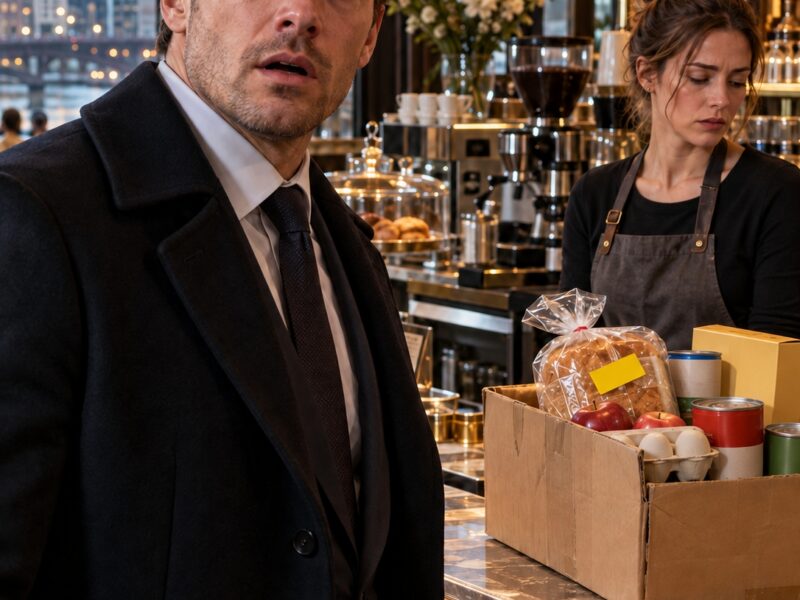
He Heard His Ex-Fiancée’s Voice in a Coffee Shop After 8 Years—Then He Saw What She Was Hiding Behind the Counter

Ethan Cole had exactly ten minutes before the most important meeting of his month when a woman behind him said five ordinary words.
“Your coffee is ready, sir.”
His hand stopped above his phone.
The screen was still glowing with an email from his chief operating officer. A black SUV was waiting two blocks away. Three executives were already sitting in a conference room downtown, expecting him to walk through the door at nine-thirty with numbers, projections, and the calm certainty everyone associated with Ethan Cole.
But suddenly none of that existed.
Not the meeting.
Not the company.
Not the eight years he had spent convincing himself that the past was dead.
There was only that voice.
Ethan slowly lifted his head.
For one impossible second, he was thirty years old again, standing in a tiny apartment kitchen at midnight while snow pressed against the windows and a woman in an oversized Northwestern sweatshirt laughed because he had burned grilled cheese for the third time that week.
Then reality returned.
Hard.
He turned around.
The woman behind the counter was holding a ceramic mug with both hands.
She looked older.
So did he.
Her dark blond hair was shorter now, pulled loosely behind her head. There were faint lines beside her eyes that had not existed eight years earlier. Her uniform was simple—black pants, white shirt, faded brown apron—and beneath it she wore the same expression Ethan had imagined a thousand times but never expected to see again.
Shock.
Then fear.
Then something far more painful.
Recognition.
The mug trembled slightly between her fingers.
“Ethan?”
Nobody had said his name like that in eight years.
His chest tightened.
“Clare.”
The coffee shop continued moving around them.
A blender roared.
Someone laughed near the entrance.
A delivery driver dragged two cardboard boxes across the floor.
A woman in a gray coat complained about oat milk.
Yet Ethan heard none of it.
He stared at the woman he had once planned to marry.
The woman who had disappeared from his life with one handwritten note and no forwarding address.
The woman he had searched for until searching began to feel like another form of humiliation.
The woman he had eventually forced himself to stop loving.
Or at least that was what he had told himself.
Clare placed the mug on the counter.
“You look…”
She stopped.
Ethan almost smiled.
“What?”
“Different.”
“So do you.”
The words came out colder than he intended.
Clare looked down.
And that was when Ethan noticed the cardboard box behind the counter.
It was partly hidden beneath a small shelf.
Inside were two cans of soup, a loaf of discount bread, pasta, a carton of eggs, generic cereal, and several bruised apples.
A yellow clearance sticker was stuck across the bread.
Ethan stared at it longer than he should have.
Eight years ago, Clare had sometimes bought groceries exactly like that.
Not because she liked them.
Because they were cheaper.
He looked back at her.
“What happened to you?”
The moment the question left his mouth, he regretted it.
Clare’s expression changed.
Not anger.
Something worse.
A wall.
“You have a meeting,” she said quietly.
Ethan glanced at the phone in his hand.
9:21.
Nine minutes.
For most of his adult life, nine minutes had been enough to make him leave anyone.
His father.
His friends.
Clare.
He put the phone facedown on the counter.
“Not anymore.”
And for the first time in eight years, Clare looked genuinely afraid of what he might ask next.
Eight years earlier, Ethan Cole had been broke enough to know exactly how many miles his Honda could travel after the fuel light came on.
He was thirty, exhausted, and running a technology company from a rented room above a printing shop on Chicago’s North Side.
Calling it a technology company had been generous.
There were three employees.
One worked part-time.
Their largest client owed them $14,000.
Their office heater made a grinding noise every forty minutes, and whenever it snowed heavily, water leaked through the ceiling beside Ethan’s desk.
Clare Bennett loved him anyway.
She worked mornings at a neighborhood bakery called Maple & Rye and spent evenings taking accounting classes.
She smelled like cinnamon most days.
Sometimes vanilla.
She had flour on her sleeves more often than not, and when Ethan stayed at the office until midnight, she would arrive carrying whatever the bakery had been unable to sell.
Croissants.
Muffins.
Cinnamon rolls.
Once, when Ethan’s checking account dropped to $47.18, Clare silently slipped forty dollars into the pocket of his winter coat.
He found it the next morning.
He confronted her that evening.
“I’m not taking your money.”
“You already did.”
“I’m serious.”
“So am I.”
“Clare.”
She crossed her arms.
“You need gas.”
“I can figure it out.”
“With what? Positive thinking?”
“I’ll get paid Friday.”
“You said that last Friday.”
He stared at her.
She smiled.
“Buy gas, Ethan.”
“I hate this.”
“I know.”
“I’m supposed to be taking care of you.”
“No.”
She stepped closer and touched his cheek.
“We’re supposed to be taking care of each other.”
That sentence stayed with him.
Unfortunately, Ethan understood its meaning eight years too late.
They became engaged on a freezing February night beside Lake Michigan.
The ring cost less than $900.
Ethan apologized for it before Clare had even answered.
She stared at him as though he had said something ridiculous.
“You think I care what this costs?”
“I wanted to give you something better.”
“You did.”
She held out her hand.
“You asked.”
She said yes before he could finish the speech he had rehearsed.
For several months, they were happy in the careless way people can be happy when they believe hardship is temporary.
Then Ethan’s father collapsed.
Robert Cole had spent thirty-five years repairing industrial electrical systems. He rarely went to doctors and treated pain like an inconvenience.
By the time Ethan convinced him to get examined, the illness was serious.
Everything changed.
Hospital corridors replaced date nights.
Insurance statements covered Ethan’s kitchen table.
Phone calls came at two in the morning.
Ethan began measuring life in invoices.
$4,800.
$7,200.
$11,600.
Every number felt like a threat.
So he worked.
Then he worked harder.
Then work became the only thing he knew how to do.
Clare understood at first.
She brought food to the hospital.
She sat with Robert when Ethan had client meetings.
She washed Ethan’s clothes when he forgot.
She answered his mother’s calls.
She slept in plastic waiting-room chairs.
But grief has a strange way of disguising itself.
Ethan’s grief looked like ambition.
He convinced himself that if he earned enough money, worked enough hours, signed enough clients, and solved enough problems, he could somehow outrun death.
He started missing dinners.
Then birthdays.
Then promises.
Clare would wait at restaurants alone.
Ethan would text thirty minutes late.
Then an hour late.
Then not at all.
“I’m sorry,” became the phrase he used most often.
And because Clare loved him, she kept answering with the phrase that eventually destroyed them both.
“It’s okay.”
Until one night, it wasn’t.
Chicago was buried under snow.
Clare had made dinner in their apartment.
Two plates sat on the table.
Two candles had burned nearly to the bottom.
Ethan arrived at 11:43 p.m.
He was still talking on his phone when he opened the door.
“No, move the call to Thursday,” he said, kicking snow from his shoes. “Tell Harrison we’ll eat the implementation cost if we have to.”
Clare was sitting at the kitchen table.
Still wearing the blue dress she had bought for that night.
Ethan barely looked at her.
“I’ll call you back.”
He ended the call.
“Hey.”
Clare said nothing.
Ethan noticed the candles.
Then the plates.
Then her dress.
His stomach dropped.
“Oh, God.”
She looked at him.
“Do you know what tonight was?”
“Clare—”
“Do you?”
He closed his eyes.
Their engagement anniversary.
“I forgot.”
“Yes.”
“My dad had another appointment, and then Harrison threatened to cancel, and—”
“I know.”
“I can make this up to you.”
“How?”
“We’ll go somewhere tomorrow.”
“I work tomorrow.”
“Friday.”
“You’re meeting investors Friday.”
“Saturday.”
“You promised your mother Saturday.”
Ethan exhaled sharply.
“Then tell me what you want me to do.”
The silence afterward should have warned him.
Clare looked at him for a long time.
“I want you to stop asking me that.”
“What?”
“I don’t want to schedule a place in your life like I’m another meeting.”
“That’s not fair.”
“Isn’t it?”
“My father is sick.”
“I know.”
“My company is barely surviving.”
“I know.”
“I’m doing all of this for us.”
Clare’s eyes filled.
“No, Ethan.”
He stared at her.
“You’re doing it because you’re terrified.”
The accusation hit exactly where she intended.
His jaw tightened.
“You don’t know what you’re talking about.”
“I know you think if you keep moving, you won’t have to feel anything.”
“Stop.”
“And I know every time you’re scared, you disappear into work.”
“I said stop.”
“And eventually, Ethan…”
Her voice broke.
“…you disappeared from me too.”
He looked away.
That was his mistake.
He should have crossed the room.
He should have taken her hands.
He should have admitted she was right.
Instead, he looked at his phone.
Clare saw him do it.
Something inside her changed.
“I don’t need a perfect life,” she whispered. “I don’t need money. I don’t need some huge house someday. I don’t need you to fix everything.”
Ethan finally looked at her.
“What do you need?”
“You.”
Her eyes were wet.
“I just need you to be there.”
He promised.
Of course he promised.
People make beautiful promises when they believe tomorrow is guaranteed.
“I’ll change.”
Clare nodded.
“I want to believe you.”
“I will.”
But the next morning Robert’s condition worsened.
Ethan spent two days at the hospital.
Then a major client threatened to walk.
Then payroll came due.
Then another crisis appeared.
And the promise became one more thing Ethan intended to keep later.
Four days after that argument, he returned to the apartment and found Clare’s key on the kitchen counter.
Beside it was a folded note.
He still remembered every word.
Ethan,
I love you enough to know that staying like this will make us hate each other.
You have people who need you right now.
Maybe I need to learn how to stop waiting for someone to choose me.
I’m sorry.
Please don’t follow me.
Clare.
He followed her anyway.
Or tried to.
Her phone had been disconnected.
She had quit the bakery.
Her landlord said she had given notice.
Her closest friend claimed she did not know where Clare had gone.
Ethan called hospitals.
Old classmates.
Former coworkers.
He drove to places she had once mentioned wanting to visit.
Milwaukee.
Madison.
Indianapolis.
Nothing.
Three weeks became three months.
His father died that spring.
At the funeral, Ethan kept looking toward the church doors.
Some irrational part of him believed Clare would appear.
She didn’t.
Afterward, he stopped searching.
Not because he stopped caring.
Because he no longer knew whether finding her would be love or selfishness.
His company survived.
Then grew.
The tiny room above the printing shop became a real office.
Three employees became twenty.
Twenty became sixty.
By thirty-eight, Ethan had everything his younger self believed would make him feel safe.
A successful technology company.
A comfortable apartment overlooking the river.
A car that started every winter morning.
A savings account large enough that grocery prices no longer mattered.
People called him successful.
He smiled when they said it.
Nobody knew he still hated cinnamon rolls.
Not because he disliked cinnamon.
Because the smell reminded him of Clare.
Now she was standing six feet away from him in a coffee shop.
Alive.
Real.
And apparently struggling.
“Ethan.”
He realized she had said his name twice.
“What?”
“You should go.”
“No.”
“I’m working.”
“I can see that.”
Her mouth tightened.
“That wasn’t meant as an insult.”
“It sounded like one.”
“I didn’t mean it that way.”
“You asked what happened to me while staring at my groceries.”
Ethan looked toward the box.
“I’m sorry.”
Clare folded a towel.
Then folded it again.
“You always apologize after saying something painful.”
That landed harder than he expected.
He lowered his voice.
“Where did you go?”
Clare stopped moving.
“Eight years ago.”
“I know what you meant.”
“Then answer me.”
A customer approached the counter.
Clare immediately changed.
Professional smile.
Straight shoulders.
“Good morning. What can I get started for you?”
Ethan stepped aside.
He watched her make a cappuccino.
She moved efficiently, but he noticed tiny things.
The stiffness in her shoulders.
The way she rubbed her left wrist.
The exhaustion beneath her eyes.
When the customer left, Ethan tried again.
“Clare.”
“My manager is here.”
“I don’t care.”
“I do.”
That shut him up.
She looked toward the kitchen.
“I get a break at ten.”
Ethan checked the time.
9:28.
His meeting.
His phone had already begun vibrating.
He rejected the call.
Clare noticed.
“You don’t have to do that.”
“Yes, I do.”
“Why?”
“Because eight years ago, you asked me to be there.”
Her face changed.
“And I wasn’t.”
He pulled out a chair.
“I can be thirty-two minutes late.”
Clare stared at him.
“No,” she said softly. “You can’t fix eight years with thirty-two minutes.”
Then she walked into the kitchen.
Ethan sat down anyway.
At ten, Clare emerged carrying two coffees.
She placed one in front of him.
Black.
No sugar.
Ethan stared at it.
“You remembered.”
“I remember a lot of things I wish I didn’t.”
She sat across from him.
For several seconds, neither spoke.
Finally Ethan asked, “Where did you go?”
“Wisconsin.”
“Why?”
“My mother got sick.”
Ethan frowned.
“Your mother?”
Clare nodded.
“She called me a few days after our argument. She’d been hiding how bad things were.”
Ethan remembered Clare’s mother, Evelyn Bennett.
Proud.
Stubborn.
Living alone outside Madison after Clare’s parents divorced.
“What was wrong?”
“Cancer.”
Ethan’s breath caught.
“She didn’t want anyone to know.”
“So you left Chicago.”
“I thought I’d be gone a few weeks.”
Clare looked into her coffee.
“It became years.”
“Why didn’t you call me?”
Her fingers tightened around the cup.
“You were losing your father.”
“I would’ve come.”
“That was exactly why.”
Ethan stared at her.
Clare continued.
“Your father was dying. Your company was collapsing. Your mother needed you. And every time I looked at you, I could see you drowning.”
“So you decided for me?”
“I decided I couldn’t ask you to carry one more dying parent.”
“I loved you.”
“I loved you too.”
“Then why did you disappear?”
Clare’s eyes flashed.
“Because loving someone doesn’t always mean staying until there’s nothing left of you.”
Ethan leaned back.
The words hurt because they were true enough to be cruel.
“I searched for you.”
“I know.”
His eyes narrowed.
“What?”
Clare looked away.
“I knew.”
“How?”
“Rachel told me.”
Rachel.
Clare’s old roommate.
The same woman who had told Ethan repeatedly that she had no idea where Clare was.
“She lied to me.”
“I asked her to.”
Ethan pushed his chair back slightly.
“You knew I was looking for you?”
“Yes.”
“For months?”
“Yes.”
“And you did nothing?”
Clare swallowed.
“My mother was going through chemotherapy.”
“You could have sent one message.”
“I almost did.”
“But you didn’t.”
“No.”
“Why?”
Clare looked directly at him.
“Because every message you left was about finding me.”
He frowned.
“What does that mean?”
“Not one was about what I had been asking you for before I left.”
“That’s insane.”
“Is it?”
“I was terrified.”
“So was I.”
“I thought something happened to you.”
“Something had happened to me, Ethan.”
Her voice remained quiet.
“I finally understood that I had spent years making myself smaller so your emergencies could always be bigger.”
The café suddenly felt too warm.
Ethan wanted to defend himself.
Eight years ago, he would have.
Instead, he asked, “Did you hate me?”
Clare’s expression softened.
“That would have been easier.”
His phone vibrated again.
He ignored it.
Clare glanced at the screen.
“You really should answer.”
“No.”
“Ethan.”
“I spent eight years answering the wrong calls.”
That almost made her smile.
Almost.
Then the kitchen door opened.
A man wearing a manager’s badge looked toward them.
“Clare?”
She stood immediately.
“Coming.”
Ethan rose too.
“Can I see you again?”
She hesitated.
“Why?”
“Because I have more questions.”
“That sounds like your problem.”
Despite himself, Ethan smiled.
There she was.
For half a second, he saw the Clare he remembered.
Then the smile disappeared from his face.
“I also owe you an apology that takes longer than thirty-two minutes.”
Clare studied him.
“Saturday.”
“What?”
“My shift ends at two.”
“I’ll be here.”
She walked away.
Ethan looked down at his untouched coffee.
Beside it was the receipt.
On the back, Clare had written one sentence.
Don’t mistake seeing me again for getting me back.
Saturday arrived with rain.
Ethan reached the café at 1:35.
Clare noticed him and shook her head.
“You’re early.”
“I’m improving.”
“By twenty-five minutes?”
“It’s a start.”
At two, they walked through Lincoln Park.
They talked about safe things first.
Work.
Chicago.
Old restaurants that had closed.
Mutual acquaintances.
Then Clare told him about her mother.
The chemotherapy had worked temporarily.
Then the cancer returned.
Clare spent nearly seven years caring for her.
She worked wherever she could.
A bakery.
A hotel kitchen.
A grocery store.
Bookkeeping from home.
When Evelyn became too weak to live alone, Clare stopped working full-time.
Medical expenses accumulated.
So did credit-card balances.
After her mother died eleven months earlier, Clare sold the small house to settle what remained.
She came back to Chicago with two suitcases and less than $3,000.
“Why Chicago?” Ethan asked.
Clare gave him a sideways glance.
“It was home once.”
He wondered if she meant him.
He was afraid to ask.
Instead, he said, “I’m sorry about your mother.”
“Thank you.”
They reached a bench.
Clare sat.
Ethan remained standing.
“Can I ask you something?”
“You’ve been doing that all afternoon.”
“Are you okay?”
She laughed softly.
It wasn’t a happy sound.
“That’s a dangerous question.”
“Why?”
“Because people usually want you to say yes.”
“I don’t.”
She looked up.
Ethan sat beside her.
“I want the real answer.”
Clare was quiet.
Finally she said, “No.”
One word.
No performance.
No smile.
No attempt to soften it.
“I’m tired.”
Ethan listened.
“I’m forty dollars away from missing my electric payment. The café cut hours last month. I’ve applied to eleven bookkeeping jobs and heard back from two. My car needs brakes. I’m living in a studio apartment with a radiator that sounds like somebody throwing silverware down a staircase.”
She smiled weakly.
“So no. I’m not exactly thriving.”
Ethan’s instinct was immediate.
“How much do you need?”
Clare stood.
He knew instantly he had made a mistake.
“No.”
“I was only asking—”
“That’s exactly what I was afraid of.”
“What?”
“That you’d see me like this and decide money could solve everything.”
“I didn’t say that.”
“You didn’t have to.”
“Clare, if you’re struggling and I can help—”
“I’m not a problem for you to solve.”
“I know.”
“Do you?”
She stepped backward.
“Because I remember this version of you.”
“What version?”
“The one who sees pain and reaches for a calculator.”
That silenced him.
Rain tapped against the trees.
Ethan put his hands into his coat pockets.
“What am I supposed to do, then?”
Clare’s eyes softened.
“Nothing.”
“That doesn’t feel right.”
“Maybe that’s something you need to learn.”
She walked away.
Ethan stood beside the empty bench and understood that having the power to help someone did not automatically give him the right to decide how they should be helped.
But three days later, he discovered something Clare had not told him.
The coffee machine at the café was failing.
He knew because he stopped in before work and watched Clare smack the side panel twice before steam finally hissed from the wand.
Her manager cursed under his breath.
“If this thing dies again, we’re done.”
Clare noticed Ethan watching.
“Don’t.”
“I didn’t say anything.”
“Your face did.”
He raised both hands.
“I’m drinking coffee.”
“Good.”
The next morning, a technician arrived.
By Friday, the café had a refurbished commercial espresso machine.
Not new.
Not extravagant.
The owner believed it came through a local small-business equipment program.
Technically, that was true.
Ethan had quietly funded the program two years earlier through a neighborhood development nonprofit.
Clare figured it out in less than forty-eight hours.
She called him Saturday morning.
“Did you buy us a coffee machine?”
“No.”
“Ethan.”
“I didn’t.”
“You arranged it.”
Silence.
“That is different.”
“It is absolutely not different.”
“The café qualified.”
“You made sure it qualified.”
“It needed a machine.”
“You promised you weren’t going to fix me.”
“I didn’t fix you. I fixed a machine.”
Clare went silent.
Ethan waited.
Then he heard something unexpected.
A laugh.
Small.
Reluctant.
But real.
“You’re impossible.”
“I’ve heard that.”
“Mostly from me.”
“Mostly from you.”
That Saturday they had coffee again.
Then the next Saturday.
And the one after that.
Ethan did not ask Clare to come back.
He did not tell her he still loved her.
He did not buy her an apartment or offer her a job.
He simply appeared.
Every Saturday.
Nine in the morning.
Same table.
Sometimes Clare joined him for ten minutes.
Sometimes forty.
Sometimes she was too busy and only waved.
Ethan stayed anyway.
For the first time in his adult life, he learned that being present could mean doing absolutely nothing impressive.
Then one Thursday, Clare called him.
She was furious.
“You paid my grocery balance.”
Ethan closed his office door.
“I don’t know what you mean.”
“Don’t insult me.”
He sat down.
“How did you find out?”
“The store manager mentioned a ‘community hardship account’ when I asked why my balance disappeared.”
Ethan said nothing.
“Ethan.”
“Yes.”
“You did it.”
“Yes.”
“Why?”
“Because you were choosing between groceries and electricity.”
“That was my choice.”
“It shouldn’t have to be.”
“But it was mine.”
Her voice shook.
“You don’t get to come back after eight years and secretly rearrange my life because you feel guilty.”
“This isn’t guilt.”
“Then what is it?”
Ethan opened his mouth.
Nothing came.
Clare waited.
“What is it?”
He looked through the glass wall of his office.
People moved beyond it.
Employees.
Meetings.
Schedules.
The life he had built.
And suddenly he was tired of hiding behind all of it.
“Because I still care about you.”
Clare went silent.
Ethan continued.
“And I don’t know what to do with that.”
“Then sit with it.”
“I’ve been sitting with it for eight years.”
“That doesn’t make me responsible for it.”
“I know.”
“Do you?”
“Yes.”
His voice softened.
“I’m not asking you for anything.”
“Then why help me?”
Ethan closed his eyes.
“Because kindness shouldn’t come with a debt.”
Clare stopped breathing for a moment.
Ethan remembered exactly when she had taught him that.
Twelve years earlier.
Forty dollars in his coat pocket.
Gas money.
He had told her he would pay it back.
Clare had laughed.
You don’t owe people for loving you.
Now Ethan heard a faint sound through the phone.
“Clare?”
“I’m here.”
“Are you crying?”
“No.”
“You’re a terrible liar.”
“So are you.”
He smiled.
Then Clare whispered, “I thought you forgot me.”
His smile disappeared.
“I never forgot you.”
“Eight years is a long time.”
“I know.”
“I wondered sometimes if you got married.”
“No.”
“Why?”
Ethan looked down at his desk.
There were several answers.
None sounded safe.
So he chose the true one.
“I dated.”
Clare waited.
“I met good women. Smart women. Kind women.”
“And?”
“And every time things became serious, I found a reason to leave.”
“Why?”
He swallowed.
“Because apparently I became very good at leaving before someone could leave me.”
Clare said nothing.
Ethan laughed bitterly.
“Turns out you weren’t the only one who needed therapy.”
That earned another tiny laugh.
Then she asked the question he had feared.
“Did you blame me?”
“For leaving?”
“Yes.”
“For years.”
Clare inhaled.
“And now?”
“Now I think I blamed you because it was easier than admitting why you left.”
“What do you think the reason was?”
Ethan stared at the photograph of his father on the shelf.
“Because I loved you like a future.”
Clare was silent.
“But I treated you like an inconvenience in the present.”
The line went quiet for so long Ethan thought the call had disconnected.
Then Clare whispered, “I have to go.”
“Clare—”
“Saturday.”
And she hung up.
Saturday changed everything.
Clare was already sitting at their table when Ethan arrived.
There was an envelope in front of her.
Old.
Yellowed at the edges.
Ethan removed his coat.
“What’s that?”
“Something I never sent.”
He sat down.
Clare pushed the envelope toward him.
His name was written across the front.
In her handwriting.
Ethan looked at her.
“When?”
“Eight years ago.”
His chest tightened.
“You wrote to me?”
“More than once.”
“How many?”
“Seven letters.”
“Where are the others?”
“I destroyed them.”
“Why keep this one?”
“I don’t know.”
He touched the envelope.
“Can I read it?”
“That’s why I brought it.”
Inside were three pages.
The first line made his throat tighten.
Dear Ethan, I heard about your father.
He looked up.
“You knew?”
Clare nodded.
“Rachel told me.”
“You knew he died.”
“Yes.”
“And you still didn’t come?”
Pain crossed her face.
“I drove to Chicago.”
Ethan froze.
“What?”
“The day of the funeral.”
The café seemed to tilt.
“You were there?”
“Across the street.”
His hands went cold.
“I saw your mother. Your employees. Your cousins.”
Clare’s eyes filled.
“And I saw you.”
“Why didn’t you come inside?”
“Because you looked destroyed.”
“So?”
“And I thought…”
She wiped at her cheek.
“I thought walking into that church would make the worst day of your life about me.”
Ethan stared at her.
“You should have come.”
“I know.”
“I looked for you.”
“I know.”
“I kept looking at the doors.”
Clare began crying.
“I know.”
“How could you possibly know that?”
“Because I stood outside until everyone left.”
Ethan pushed back from the table.
Eight years of anger shifted inside him.
Not disappeared.
Shifted.
All this time, he had imagined Clare hundreds of miles away, moving forward without him.
She had been across the street.
Watching him bury his father.
“I hated you,” he whispered.
“I know.”
“No, you don’t.”
His voice cracked.
“I hated you because I thought you didn’t care.”
“I cared too much.”
“That doesn’t make it better.”
“I know.”
“You keep saying that.”
“Because there’s nothing else I can say.”
Ethan stood and walked toward the window.
Rain blurred the street outside.
Behind him, Clare spoke.
“My mother was in the hospital again two days later.”
He said nothing.
“I went back to Wisconsin.”
Still nothing.
“She almost died that week.”
Ethan closed his eyes.
Two people.
Two sick parents.
Two frightened adults.
Both trying to protect the other by disappearing.
And somehow they had turned love into silence.
When Ethan finally turned around, Clare was holding the old letter against her chest.
“I’m sorry,” she said.
Not dramatically.
Not as a request for forgiveness.
Simply as truth.
Ethan sat down again.
“So am I.”
They did not kiss.
They did not embrace.
There was no cinematic reunion.
Instead, two people in their late thirties sat across from each other in a noisy Chicago coffee shop and cried quietly over eight years neither could recover.
It was more intimate than a kiss would have been.
After that, something between them changed.
Not repaired.
Not yet.
But opened.
Clare started telling Ethan things she had never told him.
About resentment.
About watching friends marry while she cared for her mother.
About feeling guilty for resenting the responsibility.
About being terrified after the funeral because she no longer knew who she was if nobody needed her.
Ethan told her things too.
About panic attacks after his father died.
About sleeping in his office.
About building the company partly because success gave him an excuse never to be emotionally available.
About the engagement ring he had kept for six years before finally putting it in a safe-deposit box.
Clare stared at him.
“You still have it?”
“Yes.”
“Why?”
“I couldn’t throw it away.”
“You could have sold it.”
“For what? Nine hundred dollars?”
She laughed.
“That was expensive to us.”
“It was everything I had.”
“I know.”
Then her smile faded.
“Don’t bring it here.”
“I wasn’t planning to.”
“I mean it.”
“I know.”
“I’m not the woman you proposed to.”
Ethan nodded.
“And I’m not the man who proposed.”
Clare studied him.
“Maybe that’s the only reason we can sit here now.”
Months passed.
Saturday coffee became occasional dinners.
Occasional dinners became phone calls during the week.
But Ethan noticed Clare still resisted anything that felt like rescue.
So he stopped trying to rescue her.
Instead, when she mentioned wanting to open a bakery someday, he asked questions.
“What would you sell?”
“Bread first.”
“What kind?”
“Sourdough. Brioche. Cinnamon rolls.”
Ethan groaned.
She laughed.
“You still hate cinnamon rolls?”
“I have complicated feelings.”
“Trauma?”
“Severe.”
She smiled.
“And coffee?”
“Good coffee.”
“Location?”
“Neighborhood. Not downtown.”
“Employees?”
“Eventually.”
“Name?”
Clare hesitated.
“I used to think Bennett Bakery.”
“Used to?”
“My mother always wanted to call it Second Rise.”
Ethan looked at her.
“Like bread?”
“Like people.”
He smiled.
“That’s better.”
For the first time in years, Clare began talking about a future without sounding afraid of it.
She started selling pastries to the café on weekends.
Customers asked for more.
Then a local restaurant placed an order.
Then an office.
Then another café.
Ethan did not invest.
That mattered.
Instead, Clare found two partners through people she had met at the coffee shop.
She qualified for a small-business loan.
The café owner introduced her to a retired baker willing to sell used equipment cheaply.
Ethan helped when she asked.
And only when she asked.
Sometimes the help was surprisingly ordinary.
Driving boxes across town.
Holding a ladder.
Reviewing a lease.
Carrying fifty-pound bags of flour into a basement.
One night, while they painted the future bakery after midnight, Clare looked over and laughed.
Ethan had white paint across his cheek.
“What?”
“You look ridiculous.”
“You gave me the roller.”
“I assumed you understood how walls work.”
“I run a software company.”
“That explains nothing.”
He looked at her.
She was wearing old jeans and one of his sweatshirts because she had spilled paint on her shirt.
For a second, the room disappeared.
They were thirty again.
Broke.
Tired.
Building something.
Except this time Ethan understood how fragile moments were.
He did not reach for his phone.
He did not think about tomorrow.
He simply looked at her.
Clare noticed.
“What?”
“Nothing.”
“That’s not nothing.”
“I was thinking.”
“Dangerous.”
“I was thinking I wasted a lot of time.”
Her smile faded.
“Ethan.”
“I know we can’t get it back.”
“No.”
“I’m not asking to.”
“Good.”
He put the roller down.
“But I need to say something.”
Clare became still.
“I loved you then.”
Her eyes dropped.
“And part of me probably never stopped.”
“Ethan—”
“But I don’t want the old relationship back.”
She looked up.
He stepped closer, stopping far enough away that the choice remained hers.
“That relationship failed.”
Clare’s eyes shimmered.
“We failed.”
“Yes.”
“So what are you saying?”
“I’m saying…”
He took a breath.
“If there is ever anything between us again, I don’t want it because we’re trying to recover something.”
“What do you want?”
“Something new.”
Clare looked at him for a long time.
Then she crossed the space between them.
She kissed him.
It was not the kiss Ethan remembered.
It was slower.
More cautious.
Sad in places.
Hopeful in others.
When they separated, Clare rested her forehead against his.
“That doesn’t mean we’re engaged again.”
Ethan laughed.
“I wasn’t going to propose beside the paint cans.”
“Good.”
“I was thinking near the industrial mixer.”
She shoved him lightly.
And for the first time in eight years, laughter filled a room they were building together.
Second Rise Bakery opened on a cold Saturday morning in October.
By seven-thirty, a line had formed outside.
Clare stood behind the counter wearing a clean white apron.
Her hands shook.
Ethan noticed.
“Nervous?”
“Terrified.”
“You’ve got this.”
“You say that because you’re emotionally compromised.”
“True.”
Her mother’s photograph stood near the register.
Beside it was a handwritten card.
Some things need time before they can rise again.
Clare had cried when she placed it there.
At eight, the doors opened.
Customers poured in.
Cinnamon rolls disappeared first.
Ethan pretended to be offended.
By eleven, the first batch of sourdough was gone.
At noon, Clare stood in the kitchen staring at empty trays.
“We sold out.”
“You sound surprised.”
“I am surprised.”
“You’ve been baking since four in the morning.”
“That doesn’t mean people have to buy it.”
Ethan smiled.
“Apparently they disagree.”
The last customer left shortly after three.
Clare locked the door.
For the first time all day, the bakery was quiet.
Golden afternoon light stretched across the wooden floor.
Clare disappeared into the kitchen.
When she returned, she was holding one cinnamon roll on a small plate.
Ethan frowned.
“Absolutely not.”
“You have to.”
“I’ve supported you emotionally and physically. There are limits.”
She tore off a piece.
“Open.”
“Clare.”
“Eight years and you’re still difficult.”
“Eight years and you’re still controlling.”
She held the piece closer.
Ethan surrendered.
He ate it.
Warm.
Soft.
Too much cinnamon.
Exactly as he remembered.
Clare watched him.
“Well?”
“I hate it.”
“You’re lying.”
“It’s terrible.”
“You ate the whole piece.”
“Evidence tampering.”
She laughed.
Then the laughter slowly disappeared.
“You know something strange?”
“What?”
“You stopped for coffee that day.”
Ethan nodded.
“For ten minutes.”
“You almost left.”
“I know.”
“You had a meeting.”
“I remember.”
Clare looked around the bakery.
“If you hadn’t heard my voice…”
“Don’t.”
“What?”
“I don’t like that version of the story.”
“Why?”
“Because in that version, I keep walking.”
Clare became quiet.
Ethan looked through the front window at the Chicago street outside.
People hurried past carrying bags, checking phones, chasing trains, meetings, appointments and lives that always seemed to be happening five minutes too fast.
He had spent years believing success meant never stopping.
His father’s illness had taught him to fear running out of money.
Losing Clare had taught him something harder.
People could run out of time.
There was no account large enough to buy back an ordinary Tuesday night.
No promotion could recover a dinner left untouched on a table.
No apology could completely erase the memory of someone asking you to stay while you looked at your phone.
Some losses could not be repaired.
But occasionally, if life was impossibly generous, they could become something else.
A warning.
A lesson.
A second beginning.
Clare moved beside him.
“I used to think you forgot me,” she said.
Ethan looked at her.
“I forgot a lot of things.”
“What mattered?”
“Yes.”
She slipped her hand into his.
“But not you.”
Clare leaned against his shoulder.
Outside, snow had begun falling lightly.
The first snow of the year.
Eight years earlier, another Chicago winter had helped tear them apart.
Now neither of them moved.
After a moment, Clare whispered, “Do you ever wish we had done everything differently?”
Ethan thought about it.
His father.
Her mother.
The years apart.
The anger.
The letter.
The woman standing across the street from a funeral because she loved him and believed love meant not making his grief heavier.
The man inside that church staring at the doors because he loved her and believed her absence meant she had stopped caring.
Two people.
Two versions of the same heartbreak.
“No,” Ethan finally said.
Clare lifted her head.
“No?”
“I wish I had been better.”
He squeezed her hand.
“I wish I had listened. I wish I had shown up. I wish you had called. I wish we hadn’t lost eight years.”
“Those sound like a lot of things you’d change.”
“They are.”
He smiled sadly.
“But if you’re asking whether I wish I could erase everything between then and now…”
He looked around the little bakery.
At Evelyn’s photograph.
At the empty trays.
At Clare’s flour-covered apron.
At the life she had built without being rescued.
“No.”
“Why?”
“Because I would probably try to turn us back into the people we were.”
Clare’s expression softened.
“And those people didn’t know how to love each other yet.”
For a moment, neither spoke.
Then Clare rested her head against him again.
They watched the snow.
There was no proposal that afternoon.
No enormous diamond hidden inside a pastry.
No dramatic declaration in front of strangers.
Ethan had spent enough of his life believing important things needed impressive gestures.
The truth was quieter.
The most important thing he did that afternoon was stay.
When his phone vibrated, he did not reach for it.
When another notification appeared, he let it disappear.
Clare noticed.
“You can answer that.”
“I know.”
“You might actually need to.”
“Probably.”
She looked up at him.
“Then why aren’t you?”
Ethan smiled.
“Because I’m here.”
Clare’s eyes filled.
Eight years earlier, those were the words she had been begging him to understand.
Not fix me.
Not save me.
Not give me everything.
Just—
Be here.
She tightened her hand around his.
And Ethan finally understood that kindness was not always a check.
Love was not always rescue.
Success was not always moving forward.
Sometimes kindness was remembering how someone took their coffee.
Sometimes love was sitting across from someone while they told you the truth you did not want to hear.
Sometimes forgiveness was not forgetting what happened, but refusing to let the worst thing that happened become the only thing that defined you.
And sometimes the most important second chance of your life arrived without warning, wearing a faded brown apron and standing behind a coffee counter on a morning when you thought you were too busy to stop.
Ethan had walked into that café believing he had ten minutes to spare.
He had been wrong.
Those ten minutes had not been spare time at all.
They had been the moment his life returned to him.
Months later, on another Saturday morning, Ethan sat at the corner table inside Second Rise while Clare worked behind the counter.
The bakery was crowded.
Someone had brought a baby.
Two college students shared a cinnamon roll.
An elderly man read the newspaper by the window.
Clare caught Ethan watching her.
“What?”
He shook his head.
“Nothing.”
“You’re staring.”
“I’m allowed.”
“According to whom?”
“Management.”
“I am management.”
“Then I’d like to file an appeal.”
She rolled her eyes.
A customer approached.
Clare turned away.
Ethan smiled and returned to his coffee.
Then something small caught his attention.
Beside the register sat a glass jar.
It was labeled:
COFFEE FOR SOMEONE WHO NEEDS ONE.
Customers could pay for an extra drink.
Anyone who could not afford one could take a small wooden token from the jar.
Ethan watched a teenage boy drop two dollars inside.
A few minutes later, an older woman quietly removed a token.
No questions.
No embarrassment.
No debt.
Ethan looked toward Clare.
She had seen it too.
Their eyes met.
Neither needed to say anything.
Twelve years earlier, Clare had slipped forty dollars into the pocket of a frightened young man because he needed gas.
She had not asked for repayment.
She had not made him feel poor.
She had simply helped.
Years later, Ethan had needed eight years of regret to understand the lesson.
Kindness should not create a debt.
Love should not create ownership.
And second chances should never become excuses to repeat the first mistake.
Clare walked over during a quiet moment and placed a cinnamon roll beside Ethan’s coffee.
“I didn’t order this.”
“On the house.”
“I thought kindness shouldn’t come with debt.”
“It doesn’t.”
“What’s the catch?”
She leaned down.
“No catch.”
Then she kissed his cheek.
Ethan watched her walk away.
His phone remained facedown beside his coffee.
Outside, Chicago moved at full speed.
Cars rushed through intersections.
People hurried along sidewalks.
Somewhere, someone was probably late for something they believed could not wait.
Ethan understood that feeling.
He had built half his life around it.
But now he knew something his younger self had not.
Most of life’s biggest losses do not announce themselves as big losses.
They begin as one dinner you miss.
One phone call you do not return.
One promise you postpone.
One person you assume will still be there when your schedule finally clears.
And most second chances do not arrive with trumpets either.
Sometimes they sound like five ordinary words spoken from across a crowded room.
Your coffee is ready, sir.
Ethan lifted the cinnamon roll.
Clare looked over from behind the counter.
He took a bite.
She raised an eyebrow.
He smiled.
Still too much cinnamon.
Still perfect.
And this time, he was there to taste it.









