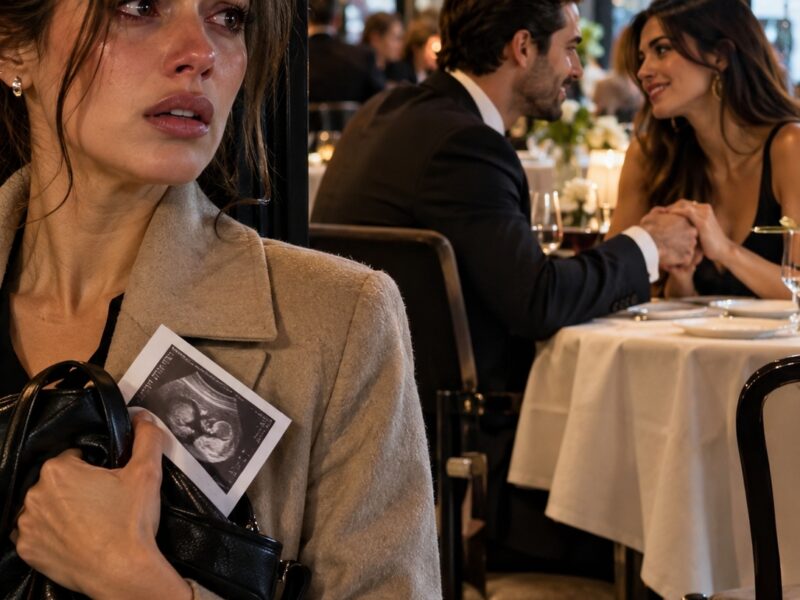
HE HELD ANOTHER WOMAN’S HAND AT LUNCH—SIX YEARS LATER, HE LEARNED WHAT HIS WIFE HAD BEEN ABOUT TO TELL HIM

Renata Hayes did not scream when she saw her husband holding another woman’s hand.
She did something far more terrifying.
She disappeared.
At 12:43 on a rainy Thursday afternoon in Chicago, Renata stood just inside the entrance of Bellamy’s, an expensive restaurant overlooking the river, with one hand still wrapped around the strap of her purse and the other resting unconsciously against her stomach.
Inside that purse was a small white envelope.
Inside the envelope was a photograph.
And printed beneath a grainy gray shape were three words she had already read so many times that morning she could see them whenever she closed her eyes.
Six weeks pregnant.
After eleven years of marriage, after appointments and blood tests and whispered disappointments, after learning how to smile when friends announced pregnancies and then cry quietly in the shower where Alejandro could not hear her, Renata had finally received the news she had almost stopped believing would ever come.
She was going to have a baby.
Their baby.
She had left her architecture firm early because she could not wait until dinner.
She wanted to tell him over lunch.
She had even imagined how it would happen.
Alejandro would complain that she had dragged him away from work. She would pretend she had something serious to discuss. Then she would slide the ultrasound photograph across the table.
He would stare at it.
He would understand.
And maybe, for one beautiful second, she would see the man she had married eleven years earlier—the man who used to kiss her forehead before leaving for work, who once drove through a snowstorm because she had the flu and wanted soup from one particular restaurant twenty miles away.
Instead, she saw him sitting beside the window.
And he was not alone.
Across from him sat Mireya Collins.
Renata’s closest friend since college.
Mireya was laughing.
Alejandro was smiling.
Not the polite smile he gave clients. Not the exhausted half-smile he had been giving Renata for months.
This one reached his eyes.
Renata stopped walking.
A hostess said something to her, but the words dissolved beneath the low murmur of the restaurant.
For several seconds, Renata simply watched.
Maybe it was business.
Mireya worked in public relations. Alejandro ran Hayes & Mercer Construction. Their professional circles crossed occasionally.
Maybe Renata had misunderstood.
Maybe—
Then Alejandro reached across the table.
His hand settled over Mireya’s.
Mireya turned her palm upward.
Their fingers closed together.
And Renata understood.
There are betrayals that arrive like explosions.
This one arrived quietly.
No broken glass.
No shouting.
No dramatic confession.
Just one hand resting inside another.
Renata felt something inside her become still.
Not broken.
Still.
That frightened her more.
Her fingers tightened around the purse containing the ultrasound photograph.
She looked at Alejandro one final time.
Then she turned around.
The hostess called after her.
“Ma’am? Your table?”
Renata pushed through the door and stepped into the rain.
She never let Alejandro see her.
And by midnight, she was gone.
What Alejandro would spend years failing to understand was that his wife had not walked out of that restaurant carrying only a broken heart.
She had walked out carrying his daughter.
And by the time he discovered that truth, another man would already be the one she called Dad.
Alejandro Hayes was thirty-eight years old and had spent most of his adult life believing that every problem could be solved if a man worked hard enough.
Money problems required more money.
Business problems required leverage.
Difficult clients required charm.
Competition required aggression.
Marriage, he assumed, would somehow maintain itself.
Hayes & Mercer Construction had begun fifteen years earlier with Alejandro and his college friend, Esteban Mercer, working from a rented office above a tire shop.
Now they employed more than eighty people.
Their name appeared on apartment towers, hotels and commercial developments across Chicago.
Alejandro loved telling the story.
He loved saying they had built everything from nothing.
What he rarely mentioned was who had been beside him while he did it.
Renata.
When Alejandro was twenty-seven and sleeping four hours a night, Renata packed dinners for him because he forgot to eat.
When the company nearly failed during its third year, she covered most of their household expenses with her architecture salary.
When Alejandro mortgaged their condo to keep twelve employees paid, Renata signed the papers without asking whether she was afraid.
Of course she was afraid.
She simply believed in him more than she feared losing money.
Over time, Alejandro began mistaking that loyalty for permanence.
Renata would always be there.
Sunday mornings with coffee.
Her reading glasses abandoned beside the bed.
Her hand finding his beneath the blankets in winter.
The quiet “Drive safe” she said every morning.
Things that happened every day eventually became invisible.
Mireya Collins was the opposite.
She made everything feel visible.
She had known Renata since Northwestern. They had shared an apartment for two years and remained close afterward.
Mireya remembered birthdays.
She bought expensive gifts.
She knew exactly when to compliment someone and exactly which insecurity to touch when she wanted something.
Renata loved her like family.
That trust gave Mireya access.
At first, there was nothing Renata could have reasonably questioned.
A coffee after a charity planning meeting.
A text about a restaurant opening.
A joke about a difficult client.
Then Mireya began messaging Alejandro directly.
You would have handled that presentation better.
Another message arrived two nights later.
Renata says you’re impossible when you’re working. I think she secretly likes it.
Alejandro smiled.
He should have stopped there.
Instead, he answered.
The conversations became longer.
Mireya listened to his complaints about Esteban, employees, contracts, taxes, investors.
Renata listened too, but differently.
Renata asked questions.
“Did you read the revised financing terms?”
“Are you sure that project isn’t overleveraged?”
“Maybe you should sleep before making that decision.”
Mireya said what Alejandro wanted to hear.
“You’re the smartest person in that room.”
“They’re lucky you even agreed to meet them.”
“You built this company. Trust yourself.”
He called it admiration.
It was actually appetite.
But Alejandro did not yet understand the difference.
The first time he touched Mireya’s hand, he told himself it meant nothing.
The second time, he did not bother lying to himself.
Then came the Thursday lunch.
And somewhere behind him, unseen, his marriage ended.
Renata drove north without knowing where she was going.
Rain struck the windshield so hard the city became a watercolor of red brake lights and gray buildings.
Her phone rang at 1:17.
Alejandro.
She watched his name appear.
She did not answer.
Another call came twenty minutes later.
Then a message.
Meeting running late. Dinner tonight?
Renata stared at it.
Meeting.
The word almost made her laugh.
Instead, she pulled into a parking lot and vomited beside her car.
Whether it was pregnancy or grief, she could not tell.
She sat behind the steering wheel afterward, trembling.
Her purse lay on the passenger seat.
Eventually, she opened it.
The ultrasound photograph was still inside.
Renata held it between both hands.
For the first time since leaving the restaurant, she cried.
Not because Alejandro had betrayed her.
Not entirely.
She cried because that morning she had believed her child was arriving inside a marriage.
By afternoon, she understood she would probably raise that child outside one.
“I’m sorry,” she whispered.
She pressed the photograph against her chest.
“I’m so sorry.”
Then another thought came.
Clearer.
Stronger.
“No.”
Renata wiped her face.
“You have nothing to be sorry for.”
She started the car.
Her mother lived several hours away in a small town outside Madison, Wisconsin.
Renata drove there.
She arrived after dark.
Her mother, Evelyn, opened the door wearing slippers and an old cardigan.
One look at her daughter’s face was enough.
“What happened?”
Renata stepped inside.
She removed the ultrasound photograph from her purse and handed it to her mother.
Evelyn looked down.
Her expression changed instantly.
“Oh, sweetheart.”
Then she saw Renata’s face.
The joy disappeared.
“What did he do?”
Renata swallowed.
“He chose someone else.”
“Who?”
Renata hesitated.
“Mireya.”
Evelyn closed her eyes.
For several seconds, neither woman spoke.
Then Evelyn opened her arms.
Renata collapsed against her.
Only then did the sobs come.
Deep, ugly, uncontrollable.
Eleven years of marriage came apart in her mother’s hallway while rainwater dripped from her coat onto the hardwood floor.
But sometime before dawn, the crying stopped.
And when Renata finally spoke again, her voice had changed.
“I’m not going back.”
Evelyn studied her.
“You don’t have to decide tonight.”
“I already did.”
“And the baby?”
Renata placed both hands over her stomach.
“That’s why I’m not going back.”
Alejandro arrived home at 9:20 that night.
The apartment was dark.
“Renata?”
No answer.
He switched on the kitchen lights.
Her coffee mug from that morning sat beside the sink.
Everything looked normal.
At first, he was irritated.
He called her.
Voicemail.
He texted.
Where are you?
Nothing.
At 10:05:
Renata, this isn’t funny. Call me.
At 11:16:
I know things have been weird lately. We’ll talk when you get home.
At midnight, he checked the closet.
Several clothes were missing.
So was her suitcase.
That was when irritation became unease.
He called Mireya.
“She’s gone.”
A pause.
“Gone where?”
“I don’t know.”
“Did you two fight?”
“No.”
Another pause.
Then Mireya asked, “Do you think she knows?”
Alejandro looked toward the bedroom.
“What exactly would she know?”
Neither spoke for a moment.
That silence contained the truth neither wanted to name.
Three days later, Renata still had not returned.
Her firm told Alejandro she had requested indefinite leave.
He drove to Evelyn’s house.
He knocked for nearly ten minutes.
Finally, Evelyn spoke through the closed door.
“She doesn’t want to see you.”
“Evelyn, open the door.”
“No.”
“I need to talk to my wife.”
“You should have remembered she was your wife before now.”
Alejandro stiffened.
“What did she tell you?”
“Enough.”
“Nothing happened.”
Evelyn laughed once.
It was not amused.
“That may be the saddest part, Alejandro. You still think betrayal begins in a bedroom.”
His jaw tightened.
“I want to speak to Renata.”
“You won’t.”
“This is between me and her.”
“It stopped being only between you and her when you brought someone else into your marriage.”
Alejandro stared at the door.
For the first time in years, he stood before something he could not negotiate open.
“Tell her to call me.”
Evelyn said nothing.
He left furious.
Not frightened.
Furious.
That distinction would haunt him later.
Because at the moment his marriage was collapsing, Alejandro was still more offended by Renata’s refusal to speak with him than ashamed of what he had done.
He hired a private investigator named Saul Brennan.
Saul was sixty, quiet and unimpressed by wealth.
Two weeks later, he placed a thin folder on Alejandro’s desk.
“She’s safe.”
“Where?”
“She doesn’t want you to know.”
“I’m paying you to find her.”
“You paid me to determine whether your wife was safe.”
Alejandro stared at him.
Saul slid the folder closer.
“She changed her number. She has requested that relatives not disclose her location.”
Alejandro flipped through the pages.
Bank withdrawals.
Employment information.
A forwarding address that led nowhere useful.
Then one line caught his eye.
Medical appointment—women’s health clinic—three days before disappearance.
Alejandro barely paused.
“Routine?”
“I don’t know.”
He turned the page.
That was it.
The detail that could have changed everything was right in front of him.
He ignored it.
Six months later, Alejandro filed for divorce.
Renata signed.
No fight.
No request for the apartment.
No demand for half the business interests she could have pursued.
Nothing.
When the documents came back, Alejandro stared at her signature.
He felt strangely insulted.
“She didn’t even fight,” he told Mireya.
Mireya poured wine into two glasses.
“Maybe she never loved you the way you thought.”
It was precisely the answer his pride needed.
So he accepted it.
And somewhere hundreds of miles away, Renata sat at a small kitchen table with one hand resting on a growing belly and signed away a marriage she had once believed would last forever.
By the following spring, Mireya had moved into Alejandro’s apartment.
She changed the curtains first.
Then the furniture.
Then the art.
Within months, almost nothing in the home looked like Renata had ever lived there.
Alejandro liked that.
At least initially.
Mireya was exciting.
She wanted restaurants with waiting lists, weekends in Miami, private events, designer clothes.
She encouraged Alejandro to buy a new Mercedes.
“You own a major construction company,” she told him. “You need to look like it.”
His accountant, Harold Bell, disagreed.
“You’re spending too much personally.”
“I can afford it.”
“Today.”
Alejandro looked up.
“What does that mean?”
“It means your company is expanding faster than its cash reserves.”
Alejandro leaned back.
“We’ve handled worse.”
Harold closed the ledger.
“You used to listen when Renata told you the same thing.”
The room went quiet.
Alejandro’s expression hardened.
“Don’t bring her into this.”
Harold nodded.
But the sentence remained.
Mireya began attending company events.
Then meetings.
Then “brand strategy sessions.”
Esteban seemed particularly enthusiastic about those.
Alejandro noticed nothing.
Or perhaps he noticed and refused to interpret it.
People rarely become blind all at once.
Usually they practice.
A year after the divorce, Alejandro attended dinner at his mother’s home.
Consuelo Hayes was seventy-one and possessed the particular kind of honesty that made people uncomfortable.
She had never liked Mireya.
After dinner, when Mireya went outside to take a call, Consuelo looked directly at her son.
“Did you ever ask yourself why Renata left without asking you for anything?”
Alejandro sighed.
“Mom.”
“I’m asking.”
“She wanted out.”
“Women who want money fight over money.”
“She didn’t care.”
Consuelo shook her head.
“You still don’t understand.”
“Understand what?”
“A woman who screams may still hope you’ll hear her. A woman who goes silent has usually heard enough.”
Alejandro stared at his wine.
Consuelo continued.
“Renata loved you when you had nothing. Mireya arrived when everyone knew your name.”
“That doesn’t prove anything.”
“No.”
His mother looked toward the patio, where Mireya was laughing into her phone.
“But one day you may discover the difference.”
That night, Alejandro could not sleep.
At 2:10 a.m., he opened a storage closet.
There was one cardboard box of Renata’s things he had never thrown away.
Photographs.
Old architectural sketches.
A Christmas ornament.
Receipts.
At the bottom was a thin medical folder.
Alejandro opened it.
A clinic appointment.
Obstetrics and gynecology.
The date was three days before Renata disappeared.
He stared at it.
Something uncomfortable moved through him.
Then Mireya called from the bedroom.
“Are you coming back to bed?”
Alejandro closed the folder.
“Yeah.”
He put the box away.
Once again, the truth had placed itself directly in his hands.
Once again, he chose not to look.
The first serious cracks in his new life appeared during the second year.
Mireya’s spending escalated.
When Alejandro questioned a $14,000 credit-card bill, she looked genuinely offended.
“You said you wanted this life.”
“What life?”
“This.”
She gestured around the penthouse they had recently leased.
“The events. The connections. The image.”
“I didn’t say we needed to burn money.”
Her expression cooled.
“Renata never asked you for anything, did she?”
Alejandro froze.
Mireya smiled slightly.
“That’s what you liked about her.”
“What’s that supposed to mean?”
“Nothing.”
“No. Say it.”
Mireya picked up her wine.
“You could feel important around her because she expected so little.”
“That isn’t true.”
“Isn’t it?”
She walked away.
Alejandro remained in the kitchen.
For some reason, he remembered Renata sitting beside him on the floor of their first apartment, eating Chinese takeout because they could not afford furniture yet.
She had raised a paper cup of cheap wine.
“To the empire,” she had joked.
“What empire?”
“The one you’re going to build.”
Back then, he had laughed.
Now the memory hurt.
He did not yet understand why.
Hayes & Mercer’s financial trouble began quietly.
A luxury development outside Chicago ran into permit delays.
Costs increased.
Investors became nervous.
Esteban recommended borrowing aggressively to keep construction moving.
Five years earlier, Alejandro would have challenged him.
Now he signed.
His attention was fractured.
Mireya.
Money.
Sleeplessness.
A marriage he claimed not to regret but increasingly remembered.
The project failed.
Millions disappeared.
And then, at a wedding in Lake Geneva, the past finally cracked open.
Alejandro was standing near the bar when a woman approached him.
“Alex?”
He turned.
Yolanda Pierce.
She had worked with Renata years earlier.
They exchanged polite conversation.
Then Yolanda smiled.
“I heard Renata’s doing really well.”
Alejandro’s grip tightened around his glass.
“You talk to her?”
“Not directly. A mutual friend saw her.”
He tried to sound indifferent.
“Good.”
“And her little girl is adorable.”
Everything stopped.
Alejandro looked at her.
“What little girl?”
Yolanda’s smile vanished.
“I—”
“What did you just say?”
“I’m sorry. I assumed you knew.”
“Knew what?”
Yolanda stepped backward.
“I may have confused her with someone else.”
“You said Renata.”
“Alejandro, forget I said anything.”
He caught her wrist, then immediately released it when he saw her alarm.
“Please.”
His voice was different now.
Smaller.
“How old is the girl?”
Yolanda hesitated.
“I really shouldn’t—”
“How old?”
“Maybe six.”
Six.
Alejandro heard nothing else.
He drove home that night with one thought repeating in his mind.
Six.
Renata had disappeared almost seven years earlier.
There had been a clinic.
A medical folder.
A specialty he had ignored.
Six.
When he reached the penthouse, Mireya was asleep.
Alejandro went directly to the storage closet.
He found the box.
The folder.
This time, he read every line.
Then he sat on the floor until sunrise.
He did not immediately search for Renata.
Cowardice rarely feels like cowardice from the inside.
It feels like needing time.
Needing certainty.
Needing to think.
But Alejandro knew.
Somewhere beneath all the excuses, he knew.
And while he avoided one betrayal, another was happening directly beneath his nose.
Several months later, he opened Esteban’s company email while searching for documents connected to a financing agreement.
A message appeared.
From Mireya.
Thursday works. Same hotel?
Alejandro stared at the screen.
He searched.
More messages.
Nothing explicitly sexual.
Everything intimate.
Inside jokes.
Private dinners.
Comments about Alejandro.
Then one from Esteban:
He still thinks you’re doing all this for him.
Alejandro waited for Mireya that night.
She entered the apartment at 8:40.
He placed printed emails on the kitchen counter.
“What is this?”
She looked at them.
Then at him.
No panic.
That frightened him.
“Where did you get those?”
“Answer me.”
“Nothing happened.”
Alejandro laughed bitterly.
He had heard those words before.
From himself.
Years earlier.
“Nothing happened?”
Mireya crossed her arms.
“You really want to lecture me about loyalty?”
His face changed.
She stepped closer.
“You destroyed an eleven-year marriage for me.”
“I did not destroy my marriage for you.”
“No?”
“You—”
“What, Alex? I seduced you? Forced you?”
He fell silent.
Mireya’s voice lowered.
“You held my hand.”
The sentence struck harder than she intended.
Or perhaps exactly as hard.
“You chose me.”
Alejandro stared at her.
For the first time, he saw the restaurant from another angle.
Not his.
Renata’s.
The table.
The window.
His hand covering Mireya’s.
He imagined Renata standing somewhere behind him.
Watching.
And suddenly he wondered—
Had she?
“Did Renata see us?”
Mireya blinked.
“What?”
“That day at Bellamy’s.”
“I don’t know.”
But something in her face shifted.
Alejandro saw it.
“You know something.”
“No.”
“Mireya.”
She grabbed her purse.
“I’m not doing this.”
He blocked the doorway.
“Did she see us?”
“Move.”
“Answer me.”
Mireya stared at him.
Then she said quietly, “Maybe she did.”
Alejandro went still.
“What does that mean?”
“I saw someone leaving when we were sitting there.”
“Someone?”
“I thought it might have been her.”
“And you never told me?”
Mireya’s expression hardened.
“What difference would it have made?”
For once, Alejandro had no answer.
Because the truth was unbearable.
It might have made no difference at all.
The man he had been then would probably have lied.
Minimized.
Defended himself.
Blamed Renata for overreacting.
That realization frightened him more than Mireya’s confession.
Three weeks later, Alejandro called Saul Brennan.
“I need you to find Renata.”
Saul was quiet.
“You asked me that years ago.”
“This time I need everything.”
“Why?”
“There may be a child.”
Another silence.
Then Saul said, “I wondered when you’d notice.”
Alejandro’s blood ran cold.
“What?”
“That clinic visit.”
“You knew?”
“I knew she had been to a clinic. I didn’t know why.”
“Find her.”
It took seven weeks.
When Saul returned, he placed a new folder on Alejandro’s desk.
“Renata Hayes now uses Renata Bennett professionally.”
“Bennett?”
“Not legally. Professional choice.”
“Where?”
“Madison area.”
Alejandro opened the folder.
Small architecture studio.
Modest house.
School information.
Then a photograph.
A little girl.
Dark hair.
Brown eyes.
Six years old.
Alejandro stopped breathing.
“What’s her name?”
“Emilia.”
“Last name?”
“Hayes-Bennett on some records. Bennett on school paperwork.”
“Who’s Bennett?”
Saul hesitated.
“Thomas Bennett.”
Alejandro looked up.
“Her husband?”
“Partner. They married four years ago.”
The photograph shook slightly in Alejandro’s hand.
“Is Emilia his?”
“I can’t answer that.”
Alejandro stared at the child.
He did not need Saul to answer.
He could see his father’s eyes.
His own chin.
And suddenly the six years between them felt like a physical thing.
A wall he had built brick by brick without knowing someone was growing up on the other side.
Then his phone rang.
Harold Bell.
Alejandro almost ignored it.
Something made him answer.
“Alex.”
Harold sounded strange.
“You need to come to the office.”
“What happened?”
“The bank’s auditors found something.”
“What?”
A pause.
“Esteban has been stealing from you.”
Alejandro closed his eyes.
Harold continued.
“And he wasn’t doing it alone.”
The audit took eleven days.
Eleven days to dismantle fifteen years.
Esteban had diverted company funds into private investments.
Shell entities.
Property purchases.
Transfers disguised as consulting fees.
Mireya’s name appeared repeatedly.
Accounts.
Contracts.
Properties.
Authorizations.
Alejandro sat across from the forensic accountant while documents accumulated on the conference table.
“How much?”
The accountant gave him the number.
Alejandro stared.
“That’s impossible.”
“It isn’t.”
He called Esteban.
No answer.
He called Mireya.
She answered on the fourth ring.
“Where are you?”
“Alex—”
“Where are you?”
She hung up.
When Alejandro reached home, two suitcases stood near the door.
Mireya was packing a third.
He dropped the audit report on the bed.
“You stole from me.”
She continued folding a dress.
“You should speak to your attorney.”
“You stole from my company.”
“Esteban handled the finances.”
“Your name is on the accounts.”
She finally looked at him.
“You really want honesty now?”
His face tightened.
“Was any of it real?”
Mireya studied him.
Then something in her expression softened.
Not affection.
Pity.
“No.”
The word barely had volume.
Yet it destroyed whatever remained.
Alejandro looked away.
“Not even at the beginning?”
“I liked you.”
“That wasn’t my question.”
She zipped the suitcase.
“I liked what being with you felt like.”
“Money.”
“Access.”
“Status.”
“Opportunity.”
Each word landed cleanly.
“You’re unbelievable.”
Mireya almost smiled.
“No, Alex. I’m exactly who I’ve always been. You just preferred the version of me that made you feel important.”
He stepped closer.
“And Esteban?”
“He has what you stopped having.”
“What?”
“Momentum.”
Alejandro laughed bitterly.
“My company is collapsing because he robbed it.”
“And yet you never saw it happening.”
She pulled the suitcase from the bed.
At the doorway, she stopped.
“You know what your real problem is?”
He said nothing.
“You think people leave you because they fail to appreciate you.”
Her eyes met his.
“Renata left because she finally understood you.”
Alejandro’s face drained.
“And I’m leaving because there’s nothing left worth taking.”
The door closed.
No screaming.
No shattered glasses.
No dramatic farewell.
Just a quiet click.
Alejandro stood alone.
And for the first time, he understood how loud silence could be.
Within six months, he sold the penthouse.
Then the Mercedes.
Then an investment property.
Half the company’s employees were laid off.
Esteban disappeared into litigation.
Mireya’s name circulated through lawsuits and financial investigations.
The invitations stopped.
People who once returned Alejandro’s calls within minutes suddenly needed days.
At business dinners, conversations changed when he entered.
His empire had not vanished completely.
But the illusion around it had.
He moved into a two-bedroom apartment overlooking a parking garage.
One evening, Consuelo visited.
She walked through the small living room.
Alejandro expected criticism.
Instead, she sat.
“I found Renata.”
Consuelo looked at him.
“And?”
“There’s a girl.”
His mother became completely still.
“Mine.”
He handed her the photograph.
Consuelo stared at Emilia.
Her fingers trembled.
“My granddaughter?”
“I think so.”
She looked at Alejandro.
“Does Renata know you know?”
“No.”
“Then why are you sitting here?”
He swallowed.
“I don’t know if I have the right to go.”
Consuelo returned the photograph.
“No.”
Alejandro looked at her.
“No?”
“You don’t have the right.”
The answer visibly hurt him.
His mother continued.
“But perhaps you have a responsibility.”
Those words stayed with him.
Three days later, Alejandro drove six hours north.
Renata lived on a quiet street lined with maple trees.
Alejandro parked across from the address Saul had given him.
He remained inside the car.
Five minutes.
Ten.
Twenty.
Then the front door opened.
Renata stepped outside.
Older.
Different.
Still unmistakably Renata.
Her hair was shorter.
She wore jeans, boots and a cream sweater.
A little girl ran behind her carrying a purple lunchbox.
“Mom!”
Renata turned.
Alejandro gripped the steering wheel.
Emilia.
The photograph had not prepared him.
She was alive in a way photographs could not capture.
She moved quickly.
Talked with her hands.
Tilted her head when listening.
Alejandro knew that gesture.
His father had done it.
So did he.
Then a man emerged carrying a backpack.
Thomas Bennett.
Ordinary-looking.
Gray jacket.
Work boots.
No expensive watch.
He crouched to zip Emilia’s coat.
She said something.
Thomas laughed.
Then Emilia threw her arms around his neck.
“Dad!”
One word.
Alejandro’s entire body went numb.
Thomas kissed the top of her head.
“Love you, bug.”
“Love you too.”
Alejandro looked away.
He had imagined discovering a daughter.
He had never imagined discovering she already had a father.
That night he checked into a motel.
He sat on the edge of the bed.
For years, Alejandro had believed losing Renata was the consequence.
Then losing Mireya.
Then his company.
His money.
His reputation.
He finally understood none of those had been the worst punishment.
The worst punishment was watching his daughter run into another man’s arms with the absolute certainty that children reserve for the people who have always been there.
Alejandro covered his face.
And cried.
The following afternoon, he waited outside Renata’s architecture studio.
At 5:18, she emerged.
She saw him immediately.
Renata stopped.
There was no shock on her face.
No anger.
Only recognition.
“I wondered how long it would take.”
Alejandro stepped toward her.
“Renata.”
“Don’t.”
He stopped.
She looked at him for several seconds.
“You look different.”
“So do you.”
“I had to become different.”
He lowered his eyes.
“I know about Emilia.”
Renata’s expression did not change.
“I assumed that was why you came.”
“I need to know.”
“You already know.”
“Please.”
Renata exhaled.
Then she said the words he had traveled six hours to hear and somehow still was not prepared for.
“She’s yours.”
Alejandro closed his eyes.
For one second, the parking lot seemed to tilt.
“How?”
Renata almost smiled at the absurdity.
“You know how.”
“No. I mean—when?”
“I was six weeks pregnant when I saw you at Bellamy’s.”
His eyes opened.
Renata continued.
“I found out that morning.”
Alejandro stopped breathing.
“I was coming to tell you.”
The years collapsed.
The restaurant.
The purse.
The medical appointment.
The folder.
Every ignored clue aligned at once.
“I had the ultrasound in my bag,” Renata said. “I thought I was going to surprise my husband with the happiest news of our lives.”
Her voice remained steady.
“Instead, my husband surprised me.”
Alejandro looked physically ill.
“Why didn’t you tell me?”
For the first time, anger entered her eyes.
“Do you really want that answer?”
“Yes.”
“I didn’t know what your relationship with Mireya was yet. I didn’t know how far it had gone. But I knew what I saw.”
“It wasn’t—”
He stopped himself.
Renata noticed.
“Go ahead.”
“No.”
“Say it.”
Alejandro looked at the pavement.
“I was going to say it wasn’t what it looked like.”
“And?”
“It was exactly what it looked like.”
Silence.
Renata nodded once.
“That is the first honest thing you’ve said about that day.”
He swallowed.
“But Emilia was my child.”
“She still is.”
“I had a right to know.”
Renata’s jaw tightened.
“You had responsibilities before you had rights, Alejandro.”
“That’s not fair.”
“No?”
“No. Whatever happened between us, you kept my daughter from me.”
Renata stepped closer.
“And you replaced her mother before you knew she existed.”
He went silent.
“You want to know why I didn’t call you?”
Her voice trembled now, but she did not raise it.
“Because I knew exactly what would happen. You would apologize. You would say Mireya meant nothing. You would promise it would never happen again. Then you would stay because I was pregnant.”
“You don’t know that.”
“I knew you.”
The sentence cut him cleanly.
Renata continued.
“I had spent eleven years learning you. You would have stayed because you believed staying made you honorable. And every time we fought, every time you looked at me with resentment, every time you wondered what your life might have been with Mireya, our daughter would have grown up watching it.”
“I could have changed.”
“You didn’t.”
Alejandro flinched.
“You had years after I left. What did you do?”
He had no answer.
“You divorced me.”
Silence.
“You moved Mireya into our home.”
Silence.
“You built the life you thought you wanted.”
Renata’s eyes filled, but the tears did not fall.
“You had every opportunity to become the man you’re telling me you could have been.”
She shook her head.
“You just didn’t become him until losing everything made the old version impossible.”
Alejandro stared at her.
Then asked the only question that mattered.
“Can I meet her?”
Renata looked away.
When she answered, her voice was softer.
“That isn’t entirely my decision anymore.”
“What does that mean?”
“It means Emilia has a life.”
“I understand.”
“No. You don’t.”
Renata looked back at him.
“She has a father.”
The words hurt.
“Thomas.”
“Yes.”
“But biologically—”
“Do not.”
Her voice sharpened instantly.
“Do not come here and reduce six years of his life to biology.”
Alejandro said nothing.
“He held her through pneumonia when she was two. He slept on the floor beside her bed because she was scared after her first nightmare. He taught her to ride a bike. He packed lunches. He went to parent-teacher conferences. He knows she hates bananas but loves banana bread. He knows which stuffed animal she needs when she’s sick.”
Renata stepped closer.
“He was there.”
Alejandro’s eyes lowered.
“You weren’t.”
“I didn’t know.”
“I know.”
Those three words somehow hurt more.
Renata’s voice softened.
“And that is the tragedy of it, Alejandro.”
He looked at her.
“You didn’t know.”
She paused.
“But every choice that made you not know was still yours.”
Three weeks passed before Renata called.
Alejandro answered before the second ring.
“Hello?”
“You can meet her Saturday.”
He stood.
“When?”
“Two.”
“Where?”
“A park near our house.”
“Does she know who I am?”
“No.”
His excitement dimmed.
“Renata—”
“This happens my way or it doesn’t happen.”
He closed his eyes.
“Okay.”
“You’re a friend from Chicago. Nothing more yet.”
“Okay.”
“And Thomas will be there.”
Alejandro hesitated.
Then said, “Okay.”
Saturday arrived.
Alejandro got there forty minutes early.
He brought no gifts.
He had purchased three the night before, then returned all of them.
For once, he understood money was the wrong language.
Emilia arrived holding Thomas’s hand.
She looked at Alejandro suspiciously.
“Are you Mom’s friend?”
“I am.”
“From work?”
“Sort of.”
“That means no.”
Thomas hid a smile.
Alejandro almost laughed.
“You’re right.”
Emilia sat opposite him at a picnic table.
“Do you have kids?”
The question hit so suddenly Alejandro looked toward Renata.
She gave no rescue.
“I…”
Emilia waited.
Alejandro chose his words carefully.
“There’s someone I hope to know better.”
“That’s weird.”
“Yes.”
“Do you have a dog?”
“No.”
“Cat?”
“No.”
“Fish?”
“No.”
Emilia frowned.
“What do you do at home?”
Alejandro laughed.
For the first time in months, genuinely.
“Apparently not enough.”
She decided she liked that answer.
They spent forty-five minutes together.
Emilia talked about school, dinosaurs, a girl named Harper who cheated at kickball and why mint chocolate-chip ice cream was “objectively better” than vanilla.
Alejandro listened.
He barely spoke.
At the end, Emilia stood.
“You’re kind of weird.”
“I’ve been told.”
“But I like you.”
Something tightened in his throat.
Then Thomas called her.
“Bug, time to go.”
Emilia ran toward him.
She threw herself into his arms.
Thomas lifted her.
“Dad, can we get ice cream?”
“Before dinner?”
“Yes.”
“Your mother will kill me.”
Renata called from behind them, “Correct.”
Emilia laughed.
Alejandro watched.
There it was again.
A whole family operating in a language built from thousands of ordinary moments.
He was not part of it.
Not yet.
Perhaps never in the way he wanted.
Renata approached him after Thomas and Emilia walked toward the car.
“If we continue this, you need to understand something.”
Alejandro nodded.
“You start at the bottom.”
“I know.”
“No, Alejandro. Listen.”
He did.
“You don’t enter her life as her father because biology gives you the title.”
Renata looked toward Thomas fastening Emilia’s seat belt.
“You enter as a stranger.”
The word hurt.
“You become trustworthy first.”
Alejandro swallowed.
“And then?”
“Then Emilia decides what you become.”
Months passed.
Then a year.
Alejandro rebuilt slowly.
Not the company.
Himself.
Hayes Construction survived after restructuring, though it never returned to its former size.
He learned to work without Esteban.
He learned to say no to contracts that looked impressive but made no financial sense.
He learned to drive an ordinary car.
He learned to eat dinner alone.
Most importantly, he learned to arrive.
Every Saturday he was supposed to see Emilia, he arrived early.
When she canceled because of a birthday party, he did not complain.
When she preferred Thomas at her school concert, Alejandro sat three rows behind him.
When she scraped her knee at a playground and ran past Alejandro directly to Thomas, Alejandro stayed where he was.
It hurt every time.
He stayed anyway.
One summer afternoon, Emilia was swimming at a community pool.
Alejandro and Thomas stood several feet apart near the fence.
For months, their conversations had consisted mostly of greetings.
That afternoon, Thomas spoke first.
“I don’t hate you.”
Alejandro looked at him.
“I wouldn’t blame you.”
Thomas watched Emilia swim.
“I’m not doing this for you.”
“I know.”
“I’m doing it because one day she’ll be old enough to ask questions.”
Alejandro nodded.
“And I don’t want the answer to be that I kept her from knowing someone who was willing to show up.”
“Thank you.”
Thomas finally looked at him.
“Don’t thank me yet.”
Alejandro waited.
“She already has a father.”
“I know.”
“I’m not stepping aside.”
“I’m not asking you to.”
Thomas studied him, perhaps searching for competition.
Alejandro gave him none.
Then Emilia shouted.
“Dad!”
Both men instinctively looked toward the pool.
A strange silence followed.
Emilia was looking at Thomas.
Thomas walked toward her.
Alejandro remained by the fence.
Years earlier, that moment might have filled him with jealousy.
Now it filled him with something quieter.
Acceptance.
The hardest lesson Alejandro ever learned was that remorse did not entitle a person to restoration.
Sometimes remorse only teaches you how to live correctly with what cannot be restored.
Renata never came back to him.
Not emotionally.
Not romantically.
Not even briefly.
One evening after Emilia’s tenth birthday, Alejandro helped carry folding chairs into the garage.
Renata followed him outside.
“Thank you for coming.”
“I wouldn’t miss it.”
“I know.”
He paused.
That small sentence meant more than she probably intended.
Four years earlier, Renata would never have said I know about his reliability.
Now she could.
Alejandro looked through the open garage toward the house.
Thomas was helping Emilia assemble a telescope.
“You’re happy,” Alejandro said.
Renata followed his gaze.
“Yes.”
“I’m glad.”
She looked at him.
“Are you?”
He smiled sadly.
“I’m learning.”
They stood quietly.
Then Alejandro said, “I owe you an apology.”
“You’ve apologized.”
“Not for cheating.”
Renata waited.
“For thinking your silence meant you didn’t care.”
Her expression softened slightly.
“When you signed the divorce papers without asking for anything, I told myself it proved you had never really loved me.”
Renata looked down.
“I loved you enough that leaving almost destroyed me.”
Alejandro closed his eyes.
“I know that now.”
“No.”
She looked at him.
“You know the consequences now.”
The distinction landed.
Renata continued.
“I don’t hate you, Alejandro.”
He nodded.
“But I don’t love you anymore either.”
“I know.”
“What I felt for you ended that afternoon.”
He looked toward the driveway.
“At Bellamy’s.”
“Yes.”
For years, he had imagined love as something dramatic enough to survive anything.
Now he understood it could die in complete silence.
One hand.
One look.
One decision.
Renata touched his arm briefly.
“You became better.”
Alejandro looked at her.
She continued.
“I’m glad Emilia gets that version of you.”
There was no cruelty in it.
That made it hurt more.
Because buried inside the kindness was an unavoidable truth.
Renata had loved the unfinished version.
Someone else received the man who finally learned.
Years continued moving.
Emilia became a teenager.
The first time she called Alejandro “Dad,” it happened accidentally.
She was fifteen.
He was driving her home from soccer practice because Thomas was stuck at work.
Emilia was staring at her phone.
“Dad, can we stop at—”
She stopped.
Alejandro’s hands tightened around the steering wheel.
Emilia looked up.
Neither spoke.
Her cheeks reddened.
“I meant Alex.”
Alejandro stared ahead.
“Okay.”
“You’re making it weird.”
“I’m not saying anything.”
“You have that face.”
“What face?”
“That emotional old-person face.”
He laughed.
She rolled her eyes.
They drove another block.
Then Emilia looked back at her phone.
“You can be Dad too, I guess.”
Alejandro blinked rapidly.
“Emilia—”
“Don’t make it a whole thing.”
“I won’t.”
“Promise?”
“Promise.”
He drove the rest of the way without speaking because he knew his voice would betray him.
That night, alone in his apartment, Alejandro sat at his kitchen table and cried.
Not from grief this time.
From gratitude.
It had taken nearly a decade.
No shortcuts.
No gifts.
No legal threats.
No demands.
Just birthdays.
Soccer games.
Homework.
Phone calls.
Showing up.
Again.
Again.
Again.
He finally understood that love was rarely proven by the grand moment.
It was built from ordinary moments repeated until another person trusted they would continue.
Renata had known that all along.
Alejandro never became wealthy again in the way he once had been.
His company stabilized.
It remained respectable.
Smaller.
So did his life.
Strangely, he stopped seeing that as failure.
He owned fewer things.
Received fewer invitations.
People no longer turned their heads when he entered restaurants.
He discovered he liked it that way.
Esteban eventually faced criminal and civil consequences connected to the stolen funds.
Mireya disappeared from Alejandro’s world almost completely.
Years later, someone mentioned seeing her in Los Angeles.
Alejandro felt nothing.
That surprised him.
For so long, he had imagined Mireya as the woman who destroyed his marriage.
Eventually, he understood that interpretation was simply another way to escape responsibility.
Mireya had opened a door.
Alejandro had walked through it.
No one had moved his hand across that restaurant table.
No one had forced his fingers around hers.
That choice belonged to him.
And so did everything that followed.
On Emilia’s eighteenth birthday, the family gathered in Renata and Thomas’s backyard.
Alejandro arrived carrying a small box.
Inside was not jewelry.
Not money.
Not anything expensive.
It was a framed architectural sketch.
Renata had drawn it decades earlier.
Their first apartment.
Alejandro had found it in the old cardboard box he once searched while looking for clues.
On the back, Renata had written:
Someday we’ll build something better.
Emilia turned the frame over.
“Mom drew this?”
Alejandro nodded.
“Before you were born.”
Renata stared at the handwriting.
For a moment, her eyes glistened.
Emilia smiled.
“I want it.”
“It’s yours.”
Later, after cake, Alejandro stood alone near the fence.
Emilia came beside him.
“You okay?”
“Yeah.”
“You always get weird at birthdays.”
“I do not.”
“You absolutely do.”
He smiled.
She leaned against him.
For several seconds, neither spoke.
Then Emilia said, “Mom told me everything.”
Alejandro’s smile disappeared.
“When?”
“A while ago.”
He swallowed.
“How much?”
“All of it.”
He looked toward Renata.
She was across the yard beside Thomas.
“What do you think?”
Emilia shrugged.
“I think you were an idiot.”
Alejandro laughed despite himself.
“Fair.”
“I think Mom did what she thought she had to do.”
He nodded.
“And Thomas is my dad.”
“I know.”
Emilia looked at him.
“But so are you.”
Alejandro could not speak.
She nudged him.
“Just later.”
His eyes filled.
“Yeah.”
“Very late.”
“I get it.”
“Like embarrassingly late.”
“Emilia.”
She laughed.
Then hugged him.
Alejandro closed his eyes.
Across the yard, Renata saw them.
Their eyes met.
No regret passed between them.
No invitation.
No fantasy of another life.
Only acknowledgment.
Something broken had never been repaired.
Something entirely different had been built beside it.
Perhaps that was the closest thing life offered to redemption.
Not getting back what you destroyed.
Becoming someone who would no longer destroy it.
Late that night, Alejandro returned home alone.
His apartment was quiet.
He loosened his tie and poured a glass of water.
On the bookshelf stood an old photograph.
Not of Renata.
Not of Mireya.
Emilia at sixteen, laughing at a baseball game.
Alejandro picked it up.
Then, as happened less often now but still happened, he remembered Bellamy’s.
That table beside the window.
Rain sliding down the glass.
Mireya sitting across from him.
His hand moving forward.
Her fingers turning upward.
Such a small movement.
A few inches.
A few seconds.
That was all.
He had once believed lives were destroyed by enormous decisions.
Bankruptcy.
Divorce.
Death.
Betrayal.
But sometimes a life changed because of something almost invisible.
A hand reaching across a table.
A wife standing behind you.
An ultrasound photograph inside a purse.
A door closing before you realized someone had been standing in it.
For years, Alejandro wondered what would have happened if he had looked up.
If he had seen Renata.
If he had pulled his hand away.
If she had walked to the table.
If she had opened her purse and placed that photograph in front of him.
He could imagine it perfectly.
Renata crying.
Him standing.
The ultrasound between them.
Their daughter existing as a tiny shadow on glossy paper.
Perhaps he would have chosen differently.
Perhaps not.
That was the cruelty of regret.
It offered infinite versions of a past that could never be tested.
Alejandro placed Emilia’s photograph back on the shelf.
He no longer asked himself whether Renata should have told him.
Whether Mireya had manipulated him.
Whether Esteban had betrayed him first.
Whether life had punished him too severely.
Those questions belonged to the man he used to be.
Now there was only one truth he could live with.
He had made a choice.
Renata had made hers.
And Emilia had grown up between the consequences.
Alejandro turned off the kitchen light.
Before going to bed, he looked once more at his daughter’s photograph.
He had lost her first six years.
He would never recover them.
He had lost Renata forever.
No apology could change that.
He had lost the company he once worshiped, the status he mistook for worth, the friends who disappeared when the money did, and the certainty that he was always the smartest man in the room.
But he had gained one thing he had never possessed when his life looked perfect.
Clarity.
Renata had understood the truth on the afternoon everything ended.
Alejandro needed years.
He needed betrayal.
Humiliation.
Bankruptcy.
Loneliness.
He needed to sit across from the daughter he had never known and hear her say another man was her father.
He needed to stand outside a swimming pool and watch her run into that man’s arms.
He needed to earn, one ordinary Saturday at a time, the privilege of being more than a stranger.
Only then did he understand what Renata had known from the beginning.
The most valuable things in a life rarely announce themselves as valuable while you still have them.
They look ordinary.
A wife waiting for you to come home.
Coffee on Sunday morning.
Someone listening while you complain about work.
A hand reaching for yours beneath the blankets.
A woman who believes in you before anyone else knows your name.
And sometimes, by the time you understand what those things were worth, someone else has already learned how to cherish them.
Alejandro never knew, in the moment, exactly when he destroyed the life he thought would last forever.
But Renata did.
She knew the restaurant.
She knew the table.
She knew the minute.
She knew the woman sitting across from him.
Most of all, she remembered his hand.
Because while Alejandro was reaching across that table to hold Mireya’s fingers, Renata was standing only a few yards away with a photograph of their unborn daughter inside her purse.
One hand was being offered to him.
Another was already his.
And without ever realizing he had been asked to choose between them—
Alejandro let go of the wrong one.









