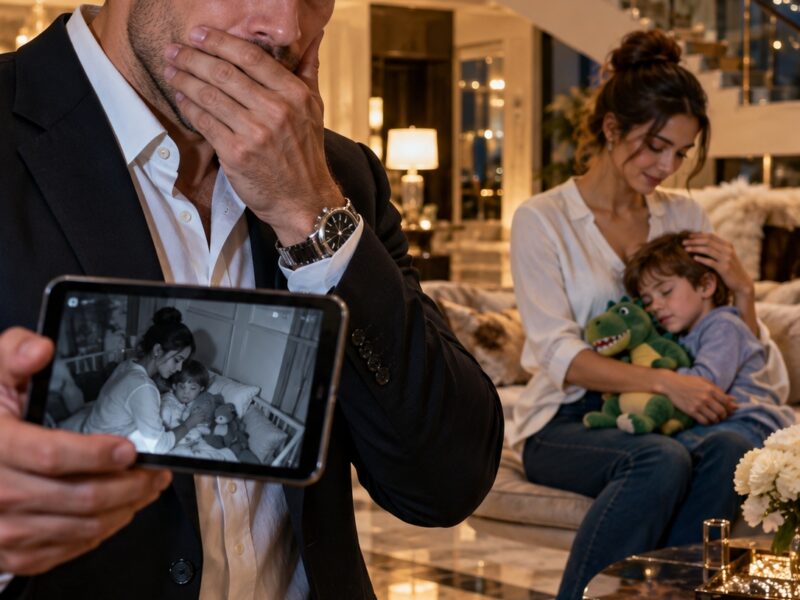
He Hid Cameras to Catch the New Nanny Lying—What He Saw His 3-Year-Old Son Do Instead Broke Him

Marcus Delgado installed the cameras because he was certain the new nanny would eventually betray his trust.
He had been wrong about twelve women before her, although Marcus would never have described it that way. In his version, the first nanny had been careless. The second had arrived late twice. The fourth had let Ben eat chocolate before lunch. The seventh had spent too much time on her phone. The tenth had hugged his son too often.
By the time Pia McKenzie walked through the front door, Marcus had already decided there had to be something wrong with her.
He simply hadn’t found it yet.
So he placed cameras inside smoke detectors, clocks, ceiling corners, the kitchen, the living room, the garden, the hallways—even his three-year-old son’s bedroom.
Eight tiny windows appeared on his laptop.
Eight places where nothing could happen without Marcus seeing it.
He told himself it was about safety.
He told himself any responsible father would do the same.
Then, three weeks later, sitting alone in his office before sunrise, Marcus opened one of the recordings and watched his son draw three people in chalk.
A woman.
A little boy.
And a man standing so far away from the child that there was a wide strip of empty concrete between them.
Pia crouched beside Ben.
“Who is that?”
Ben pointed.
“Me.”
“And him?”
“My daddy.”
Pia was quiet for a moment.
“Why is Daddy so far away?”
Ben didn’t hesitate.
“Because he doesn’t want to be close to me.”
Marcus stopped breathing.
Then Ben said the sentence that made him reach for the screen as if he could somehow climb through it and undo the last eight months.
“I think I remind him of Mommy.”
Marcus paused the recording.
His reflection stared back from the black screen.
And for the first time since his wife died, he understood something terrifying.
The cameras had never been watching the nanny.
They had been watching him.
Eight months earlier, Marcus Delgado had been thirty years old and living the kind of life people liked to call complete.
A three-story mansion.
Imported cars.
A company that made more money each year than Marcus had once believed he could earn in a lifetime.
A beautiful wife named Victoria.
And Ben.
Then one phone call had divided Marcus’s life into before and after.
Victoria had died in an accident.
There had been a funeral Marcus barely remembered, flowers he couldn’t smell anymore, hands touching his shoulder, people saying things like she’s in a better place and you have to be strong for your son.
That last sentence stayed.
Be strong for Ben.
So Marcus became strong.
At least, that was what he called it.
He returned to work.
He stopped crying.
He packed Victoria’s belongings into boxes.
He stopped talking about her.
And whenever three-year-old Ben looked at him with the same hazel eyes Victoria had possessed, Marcus found a reason to leave the room.
He loved his son desperately.
That was the problem.
Loving Ben felt dangerous now.
Because Marcus had learned what life could do to the things you loved.
So he became a provider instead.
Providers could write checks.
Providers could hire excellent staff.
Providers could make sure the refrigerator was full, the mortgage didn’t exist, the school fund was untouched, the gates were locked, and every sharp corner in a child’s life was padded.
Providers didn’t have to sit on a bedroom floor and explain why Mommy wasn’t coming home.
Marcus didn’t know how to do that.
Victoria had known.
Victoria had known everything.
Or so grief had convinced him.
The morning Pia arrived, Marcus went upstairs before work and found Ben sitting on the rug surrounded by wooden blocks.
He was building a tower.
“Morning, buddy.”
Ben looked up.
“Morning, Daddy.”
Marcus sat on the bed instead of the floor.
There were perhaps four feet between them.
It might as well have been four miles.
“A new nanny is coming today.”
Ben placed another block carefully on the tower.
“What is her name?”
“Pia.”
“Okay.”
No complaint.
No excitement.
No question about how long this one would stay.
That bothered Marcus more than a tantrum would have.
“You’ll behave?”
Ben looked confused.
“I’m always good.”
Marcus swallowed.
“Yes. You are.”
Ben had become unnaturally easy after Victoria died.
He didn’t scream.
Didn’t throw toys.
Didn’t demand attention.
Didn’t climb into Marcus’s bed at midnight.
Didn’t even cry much anymore.
Marcus had mistaken silence for resilience because the alternative would have required him to ask what his son was holding inside.
Instead he stood.
“I’ll see you tonight.”
“Okay.”
Marcus reached the door.
Behind him, Ben said, “Daddy?”
Marcus turned.
For half a second he thought Ben might ask him to stay.
Instead the boy smiled faintly.
“Have a good work.”
Marcus smiled back.
“You too.”
Only after closing the door did he realize how absurd his answer had been.
He leaned against the hallway wall.
His chest hurt.
Then he walked downstairs.
The doorbell rang at 9:30.
Pia was thirty minutes early.
Marcus opened the door already irritated.
She looked about twenty-nine, with brown hair tied back, clean jeans, a plain white shirt and a worn backpack over one shoulder.
No designer handbag.
No elaborate makeup.
No nervous smile.
“Mr. Delgado?”
“Yes.”
“I’m Pia McKenzie.”
“You’re early.”
“I know.”
The directness caught him off guard.
“The appointment was at ten.”
“The bus came earlier than expected. I thought waiting here was better than wandering around a neighborhood I don’t know.”
She met his eyes when she spoke.
Not aggressively.
Not submissively either.
Marcus stepped aside.
“Come in.”
Most people reacted to the house.
Pia didn’t.
She glanced at the marble staircase, high windows and carefully curated artwork with the same expression someone might use entering a library.
Observation without awe.
That irritated Marcus for reasons he couldn’t explain.
He pointed toward the sofa.
“References?”
Pia removed a folder from her backpack.
Marcus read through three letters.
Two years with one family.
Excellent with young children.
Reliable.
Patient.
“Why did you leave this family?”
“They moved to Spain.”
“They didn’t offer to take you?”
“They did.”
“And you refused?”
“I have responsibilities here.”
“What responsibilities?”
Something changed in her face.
Not fear.
Pain.
“My mother is sick.”
Marcus lowered the folder.
“I’m sorry.”
“Thank you.”
He didn’t ask more.
“My son is three. His name is Ben. His mother died eight months ago.”
Pia’s expression softened.
“I’m sorry.”
“He’s quiet.”
“How quiet?”
Marcus frowned.
“What does that mean?”
“Children are rarely quiet without a reason.”
“He’s well behaved.”
“That wasn’t my question.”
Marcus stared at her.
She had been inside his house for less than ten minutes.
Already she was getting dangerously close to places people usually avoided.
He pulled a printed sheet from the table.
“These are the rules.”
Pia read them.
Wake time.
Meals.
No sweets between meals.
Limited television.
No tablet.
Structured educational activities.
Nap schedule.
Outdoor time.
Bedtime routine.
Emergency contacts.
No unauthorized visitors.
Professional boundaries.
Pia reached the bottom and looked up.
“May I ask something?”
“Go ahead.”
“Can I hug him?”
Marcus blinked.
“What?”
“If Ben falls, becomes frightened or is upset, am I allowed to hug him?”
“Of course, if necessary.”
“And if it isn’t necessary?”
Marcus felt his shoulders tighten.
“Why would you hug him if it wasn’t necessary?”
“Because sometimes children want affection for no particular reason.”
The answer came gently.
That somehow made it worse.
“They’re children,” she added.
Marcus heard his own voice become colder.
“Do what you consider appropriate. But you’re here to take care of my son. You’re not here to replace his mother.”
Pia didn’t flinch.
“I wouldn’t try.”
“Good.”
“But there is a difference between replacing his mother and caring about a child who lost one.”
Silence filled the room.
Marcus should have ended the interview.
Instead he asked, “Do you always speak this freely to employers?”
“Only when children are involved.”
“You need this job, don’t you?”
“Yes.”
“Then perhaps you should be more careful.”
Pia’s eyes changed.
For the first time Marcus saw steel beneath the calm.
“With respect, Mr. Delgado, needing a paycheck doesn’t make me willing to care for a child badly.”
Marcus said nothing.
“If affection is against your rules,” she continued, “then I’m probably not the right nanny.”
She closed the folder.
Marcus stared at her.
Twelve nannies.
Eight months.
A son upstairs who barely spoke.
He heard Victoria’s voice in his memory.
Marcus, sometimes being right matters less than being kind.
He hated when memories sounded like accusations.
“You’re hired.”
Pia paused.
Then she smiled.
A small, genuine smile.
“Thank you.”
“Start today.”
Marcus stood.
As he reached the front door, he stopped.
“Pia.”
“Yes?”
“Ben is all I have left.”
She studied him for a second.
Then her voice softened.
“I know.”
“If anything happens—”
“Nothing will happen to him because I wasn’t paying attention.”
Her certainty surprised him.
“You have my word.”
Marcus nodded and left.
He lasted seventeen minutes before calling the security company.
By that evening, the cameras were being installed.
Marcus stood behind the technicians as they worked.
“Kitchen.”
A tiny lens disappeared into a smoke detector.
“Living room.”
Another inside a clock.
“Garden.”
“Playroom.”
“Hallways.”
Then the technician looked at the floor plan.
“The child’s bedroom?”
Marcus hesitated.
That felt different.
Wrong, even.
But fear was good at dressing itself as responsibility.
“Yes.”
“Audio?”
Marcus hesitated again.
“Yes.”
Two hours later, his laptop showed eight feeds.
The house.
The kitchen.
The garden.
The hallway.
Ben’s room.
Everything.
“Thirty days of recording,” the technician explained. “You can watch live from your phone.”
“Perfect.”
After they left, Marcus poured whiskey.
He sat alone in his study staring at the screens.
“It is for his safety,” he said aloud.
The empty room didn’t answer.
But somewhere in his memory, Victoria did.
Is it?
Marcus closed the laptop.
The following morning, he checked the cameras from his car before he had even reached the office.
At 8:20, Pia entered Ben’s bedroom.
Marcus increased the volume.
“Good morning, Ben.”
Ben hugged his green dinosaur.
Pia didn’t approach immediately.
“Sleep okay?”
A nod.
“Hungry?”
Another nod.
“I made scrambled eggs.”
Ben finally spoke.
“Mommy put cheese.”
Marcus stiffened.
This was the moment.
He had seen it before.
Adults became uncomfortable when Ben mentioned Victoria.
Some changed the subject.
Some said, “Mommy’s in heaven now.”
Others tried too hard.
Pia simply said, “I don’t know how your mommy made them.”
Ben looked at her.
“But if you teach me, I can try.”
“Really?”
“Really. You’re the expert.”
Something flickered across Ben’s face.
A smile.
Small.
Quick.
But real.
Marcus leaned closer to his phone.
“She put yellow cheese.”
“How much?”
“A lot.”
Pia gasped dramatically.
“A lot? That’s very scientific.”
Ben giggled.
Marcus froze.
He couldn’t remember the last time he had heard that sound.
“Come downstairs,” Pia said. “You can supervise.”
“I can help?”
“Obviously. I don’t trust myself with this much cheese.”
They walked into the hallway.
Pia didn’t carry him.
Didn’t force his hand into hers.
She simply walked beside him.
At breakfast, she placed Ben on a stool.
“All right, boss. Instructions?”
“More cheese.”
“You’re demanding.”
“Mommy did more.”
“Then more it is.”
Ben watched her stir the eggs.
Then he asked, “Do you have a mommy?”
“I do.”
“Where?”
“At home.”
“Is she old?”
Pia laughed softly.
“She’d be offended by that question.”
Ben considered this.
“Is she sick?”
Pia’s hands slowed.
“Yes.”
“Is she going to die like my mommy?”
Marcus nearly dropped the phone.
Pia crouched so she and Ben were eye level.
“I don’t know.”
Ben stared at her.
“I hope she doesn’t. But she’s very sick.”
“Are you sad?”
“Sometimes.”
“Daddy says I have to be strong.”
Pia became very still.
Marcus felt something tighten inside him.
Then she said, “You can be strong and sad at the same time.”
Ben frowned.
“How?”
“Being strong doesn’t mean you never cry. It means you keep loving people even when loving them hurts.”
Marcus looked away from the screen.
Ben whispered, “I miss Mommy every day.”
“I know.”
“How?”
“Because I can see it.”
Ben’s lower lip trembled.
Marcus instinctively wanted Pia to change the subject.
Instead she said, “You don’t have to hide missing her from me.”
Ben blinked rapidly.
Then came the question.
“Can I hug you?”
Pia swallowed.
“Of course.”
Ben climbed off the stool and threw himself against her.
He didn’t hug her politely.
He clung.
His tiny hands grabbed the back of her shirt.
His face disappeared against her shoulder.
Pia closed her eyes and held him.
Marcus shut off his phone.
His hand was shaking.
He had installed cameras because he expected to discover negligence.
Instead he had watched a stranger give his son something Marcus had been too frightened to give him.
Permission to hurt.
That evening, Marcus arrived home earlier than usual.
Laughter came from the living room.
He followed it.
A fortress made of cushions occupied half the floor.
Ben’s face appeared between two pillows.
“Daddy!”
The excitement in his voice startled Marcus.
“Look!”
“I see.”
“It’s a castle.”
Pia emerged behind him.
“Apparently I’m a dragon.”
“A good dragon,” Ben corrected.
“The best kind.”
Ben crawled out and ran toward Marcus.
Then he grabbed his father’s hand.
“Come inside.”
Marcus looked at the ridiculous pillow fort.
For one second, something inside him wanted to kneel.
To crawl in.
To be foolish.
To let his expensive suit wrinkle.
Then fear whispered that he didn’t know how.
“I have work.”
Ben’s fingers loosened.
“Oh.”
It was only one syllable.
No tantrum.
No tears.
Just resignation.
Marcus almost changed his mind.
“Maybe later.”
Ben nodded.
“Okay.”
They both knew there would be no later.
Marcus went upstairs.
He opened his laptop.
Downstairs, Pia sat beside Ben.
“I don’t need things,” Ben told her.
Marcus increased the volume.
“What do you mean?”
“Daddy works because he loves me.”
“Yes.”
“But I don’t need more things.”
Pia waited.
“I need him.”
The sentence hit harder than anything Marcus had heard since the hospital called about Victoria.
Pia touched Ben’s shoulder.
“I think he needs you too.”
“Does Daddy love me?”
Marcus closed his eyes.
“Completely,” Pia said.
“How do you know?”
“Because I’ve seen the way he looks at you when he thinks you aren’t watching.”
Ben looked doubtful.
Pia smiled sadly.
“He looks at you like you’re the most important thing in the world.”
Marcus sat motionless.
Because she was right.
That was exactly how he looked at Ben.
From doorways.
Across rooms.
Through cameras.
Always from somewhere safe.
Never close enough to risk being needed.
That night, Marcus found Pia washing dishes.
“Maria can do that.”
“I know.”
“Then why are you doing it?”
“It helps me think.”
Water ran between them.
Marcus leaned against the counter.
“Ben seemed happy today.”
“He was.”
“You’ve only been here two days.”
“Children don’t always need a long time to recognize safety.”
Marcus bristled.
“You’re implying he wasn’t safe before?”
“Physically? Absolutely.”
Pia dried her hands.
“Emotionally?”
She let the question hang.
“You don’t know me.”
“No.”
“You don’t know what I’ve been through.”
“No.”
“You’ve been employed here for two days.”
“Yes.”
“Then don’t analyze my relationship with my son.”
Pia met his eyes.
“I’m not analyzing you.”
“Sounds like you are.”
“I’m telling you what I see in Ben.”
Marcus gripped his glass.
“And what exactly do you see?”
“A three-year-old trying to behave like a forty-year-old because he thinks the adults around him can’t survive his grief.”
Marcus stared at her.
Pia’s voice softened.
“He shouldn’t have to protect you from how much he misses his mother.”
“You’re out of line.”
“Probably.”
“Good night, Pia.”
“Good night, Mr. Delgado.”
She walked away.
Marcus remained in the kitchen.
Furious.
Humiliated.
And beneath both emotions, terrified that she was right.
He went upstairs.
Opened the cameras.
Ben was awake.
Pia sat beside his bed.
“I can’t sleep,” he said.
“What are you thinking about?”
“Mommy.”
“Want to tell me?”
Ben stared at the ceiling.
“Do you think she sees me?”
“I hope so.”
“Is she proud?”
“I can’t imagine why she wouldn’t be.”
Ben hesitated.
“Sometimes I do bad things.”
Pia leaned forward.
“What kind?”
Ben lowered his voice.
“Sometimes I wish somebody else was my mommy.”
Marcus stopped breathing.
“Because I want a mommy.”
His son’s voice cracked.
“Does that mean I don’t love my real mommy anymore?”
Pia’s eyes filled.
“No.”
“Are you sure?”
“Completely.”
“But what if Mommy thinks I’m replacing her?”
Pia took his hands.
“Ben, loving another person doesn’t erase someone you lost.”
“It doesn’t?”
“No. Hearts aren’t rooms where only one person fits.”
Ben listened.
“They can get bigger.”
“Really?”
“Really.”
Ben looked toward the door.
“Sometimes I like you like a mommy.”
Pia wiped one tear quickly.
“I’m honored.”
“Are you going to leave?”
The question was almost inaudible.
Pia took a breath.
“I don’t know what life will do, little one. But while I’m here, I’ll take care of you the best I can.”
“A real promise?”
“A real promise.”
Ben closed his eyes.
Pia remained until he fell asleep.
Marcus sat behind his laptop long after the room went quiet.
The cameras had given him proof.
Just not the proof he’d wanted.
Pia wasn’t manipulating his son.
She wasn’t careless.
She wasn’t trying to replace Victoria.
She was simply there.
And Marcus wasn’t.
Three weeks passed.
Marcus began watching the cameras compulsively.
At work.
In the car.
At lunch.
Between meetings.
Sometimes during meetings.
His business partner Daniel eventually asked, “Are you okay?”
“Fine.”
“You’ve checked your phone six times in ten minutes.”
“Home security.”
Daniel raised an eyebrow.
Marcus ignored him.
The truth was worse.
He was watching the life he should have been living.
Pia and Ben chasing butterflies.
Pia reading stories.
Ben laughing over spilled juice.
The two of them lying in the grass looking for shapes in clouds.
And Marcus watched all of it from screens.
Then came the chalk drawing.
Pia and Ben were in the garden.
Ben drew three stick figures.
“This is my family before.”
“Your mommy, daddy and you?”
“Yes.”
“What about now?”
Ben drew again.
This time the boy stood on one side.
Marcus on the other.
Nothing between them except empty concrete.
“Like this.”
Pia looked at the drawing.
“Why are you so far apart?”
“Daddy doesn’t want to be close.”
Marcus’s chest tightened.
“Did Daddy tell you that?”
“No.”
“Then why do you think it?”
Ben shrugged.
“Because I look like Mommy.”
Pia waited.
“When Daddy looks at me, his eyes get sad.”
Marcus felt suddenly sick.
“And then he goes away,” Ben finished.
Pia sat beside him.
“I think your daddy loves you so much that he’s scared.”
“Of me?”
“No.”
“Then what?”
“Of losing you.”
Ben frowned.
“That doesn’t make sense.”
“No,” Pia said quietly. “Fear often doesn’t.”
“If he loves me, why doesn’t he stay?”
Marcus paused the recording.
He couldn’t hear another word.
Not yet.
At six the following morning, a scream came from upstairs.
Marcus ran.
Ben sat upright in bed, tangled in blankets, sobbing.
“Daddy!”
Marcus didn’t think.
For once, he didn’t calculate.
He crossed the room and grabbed his son.
Ben wrapped himself around him.
“I dreamed you left.”
“I’m here.”
“You went away like Mommy.”
Marcus held him tighter.
“No.”
“You won’t?”
“No.”
“Promise?”
Marcus closed his eyes.
“Promise.”
Pia appeared at the door.
“I heard him.”
Marcus looked over Ben’s head.
For the first time there was no competition in his expression.
No suspicion.
Just fear.
“He had a nightmare.”
Pia nodded.
“Do you need me?”
Marcus looked at his son.
“No.”
Pia smiled faintly.
“Okay.”
She left them alone.
Marcus held Ben until the child’s breathing slowed.
Then until his body became heavy with sleep.
Then longer.
When Marcus finally placed him down, he whispered, “I’m sorry.”
Ben slept.
“I’m sorry I wasn’t here.”
Outside the bedroom, Pia waited.
“Thank you,” Marcus said.
“For what?”
“For leaving.”
“That moment wasn’t mine.”
Marcus leaned against the wall.
“Why do you make everything sound obvious?”
“Because some things are.”
She studied him.
“Can I ask something?”
Marcus almost laughed.
“You always do.”
“Why do you keep hiring nannies if what Ben really wants is you?”
There it was.
The question he’d spent eight months avoiding.
Marcus stared at the floor.
“Because I don’t know how.”
Pia said nothing.
“Victoria knew.”
His voice broke on her name.
“She knew what food he liked. She knew which cry meant he was tired. She knew which stories calmed him. She knew how to make ordinary days feel… alive.”
Marcus swallowed.
“I worked.”
“You loved him.”
“I provided.”
“You loved him.”
“I don’t know how to do what she did.”
“You don’t have to.”
Marcus looked at her.
“Ben doesn’t need another Victoria.”
Pia stepped closer.
“He needs Marcus.”
The words landed somewhere grief hadn’t managed to numb.
“He needs his father.”
“What if I’m bad at it?”
“You will be sometimes.”
Marcus blinked.
Pia smiled.
“So will every parent.”
“What if I fail him?”
“You already have.”
The honesty hurt.
Then she added, “And tomorrow you can do better.”
Marcus stared at her.
“No perfection?”
“No.”
“No rules?”
“Some rules.”
Despite himself, he laughed.
Pia smiled.
“He needs presence.”
Over the next two weeks, Marcus began trying.
Badly.
He came home for dinner.
The first meal was almost painfully awkward.
Ben talked mostly to Pia.
Marcus asked questions that sounded like job interviews.
“What did you do today?”
“Played.”
“What did you learn?”
“About bugs.”
“Which bugs?”
Ben stared at him.
Pia kicked Marcus gently under the table.
Marcus frowned at her.
She mouthed, Relax.
So Marcus tried again.
“Did any bug poop on you?”
Ben’s eyes widened.
Then he laughed.
“No!”
“Good. Successful day.”
The next night Marcus read a bedtime story.
His voice sounded like he was presenting quarterly earnings.
Ben didn’t care.
“Again.”
Marcus read it again.
Soon he began leaving the office earlier.
He pushed Ben on the swing.
The first time, his hands shook.
“Higher!” Ben shouted.
“You sure?”
“Higher!”
Marcus pushed.
Ben flew forward, laughing.
Something cracked open inside Marcus.
“Again!”
He pushed again.
Fifteen minutes later Ben jumped down and hugged him.
“Can we do this tomorrow?”
Marcus looked over Ben’s shoulder.
Pia stood by the house watching.
“Yeah,” he said.
“Tomorrow too.”
That night Marcus found Pia outside Ben’s room.
“I have to tell you something.”
She waited.
“There are cameras in the house.”
“I know.”
Marcus stared.
“What?”
“I found one on my second day.”
“How?”
“The smoke detector in the kitchen blinks differently.”
“You knew?”
“Yes.”
“And you stayed?”
“Yes.”
“Why didn’t you confront me?”
Pia folded her arms.
“Would it have changed anything?”
“You should be furious.”
“Part of me was.”
“Then why—”
“Because I realized the cameras weren’t about me.”
Marcus went still.
“They were about you.”
Pia’s voice softened.
“You were trying to control something because the thing you loved most had been taken from you without warning.”
Marcus’s throat tightened.
“That doesn’t make spying on you right.”
“No.”
“Why stay?”
“Because Ben needed me.”
She paused.
“And I think you did too.”
Marcus looked away.
The first tear fell before he could stop it.
He wiped it angrily.
Another followed.
“I don’t know how to fix this.”
Pia didn’t tell him not to cry.
She didn’t tell him everything would be okay.
She simply said, “Then don’t fix everything.”
Marcus looked at her.
“Fix tomorrow.”
The next morning he called the security company.
“Remove them.”
“All cameras?”
“All of them.”
“Is there a system problem?”
Marcus looked at the little camera icon on his phone.
“Yes.”
“What kind?”
“Me.”
That afternoon, he watched each lens disappear.
The smoke detector.
The clock.
The hallway.
Ben’s room.
When the technicians left, the house felt strangely exposed.
Then Marcus realized exposure wasn’t always danger.
Sometimes it was trust.
That Sunday Ben asked to go to the park.
Marcus knew immediately which one.
The park with the ducks.
Victoria’s park.
They had gone there while dating.
Then after Ben was born.
Marcus hadn’t returned since her death.
Pia noticed his hands tighten around the steering wheel when they arrived.
“We can go somewhere else.”
Marcus looked in the rearview mirror.
Ben was practically vibrating with excitement.
“No.”
He exhaled.
“It’s time.”
Near the lake, Ben pointed at a mother duck and five ducklings.
“Daddy!”
“I see them.”
“Can we feed them?”
Marcus checked his pockets.
“I forgot bread.”
Ben’s expression fell.
“Mommy always brought bread.”
The old Marcus would have redirected him.
The new Marcus crouched.
“You’re right.”
Ben looked surprised.
“Your mommy never forgot.”
“She remembered everything.”
“Almost everything.”
“Do you miss her?”
Marcus’s chest hurt.
“Yes.”
“Every day?”
“Every day.”
“Then why didn’t we talk about her?”
Marcus looked toward the water.
“Because I thought talking would make it hurt more.”
“Did it?”
“Yes.”
Ben waited.
Marcus smiled sadly.
“But not talking hurt more.”
Ben sat beside him.
“Can we talk now?”
“Anytime.”
“Do you remember when Mommy fell in the lake?”
Marcus stared at him.
Then laughed.
A real laugh.
“She didn’t fall.”
“She fell!”
“She was trying to rescue your ball.”
“And she got wet.”
“Completely soaked.”
“And she laughed.”
Marcus’s eyes burned.
“Yes.”
“She laughed.”
For the next hour, Marcus told Ben stories.
Victoria burning dinner.
Victoria singing the wrong lyrics.
Victoria falling asleep during movies she’d chosen.
Victoria crying the first time Ben said Mama.
The pain didn’t disappear.
But something changed.
It became memory instead of a weapon.
That night, Pia and Marcus sat at the kitchen table drinking coffee.
“Why did you stay?” Marcus asked.
“I told you.”
“No. The real reason.”
Pia stared into her cup.
“My father died when I was four.”
Marcus said nothing.
“My mother broke afterward. She worked constantly because she had to support us, but emotionally… she disappeared.”
Pia traced one finger around the cup.
“She was alive, but grief took her somewhere I couldn’t follow.”
Marcus felt the words.
“How long?”
“Years.”
“And then?”
“She came back.”
“When?”
“When I was seventeen.”
Marcus winced.
“That long?”
“Yes.”
“We lost most of my childhood.”
Pia looked at him.
“When I saw Ben, I recognized that child.”
Marcus’s throat tightened.
“And when I saw you, I recognized my mother.”
There was no accusation.
That made it worse.
“I didn’t want you two to lose those years.”
Marcus looked down.
“How is your mother now?”
“Dying.”
He looked up sharply.
“The doctors gave her six months.”
“When?”
“Eight months ago.”
“Pia…”
“Every extra day is borrowed.”
“Is that why you need the job?”
“Her medication isn’t cheap.”
Marcus thought of money.
The absurd amount sitting in accounts.
Money that had bought cars and walls and cameras.
“If you need help—”
“No.”
“Let me finish.”
“I know what you’re offering.”
“Then let me help.”
“I don’t want charity.”
“It isn’t charity.”
“What is it?”
Marcus thought about Ben laughing.
About himself holding his son through a nightmare.
“Gratitude.”
Pia shook her head.
“I need to earn what I have.”
“You already have.”
She looked at him for a long time.
Then smiled faintly.
“Thank you, Marcus.”
It was the first time she’d used his first name.
That night he couldn’t sleep.
Without cameras to watch, the study seemed unnaturally quiet.
Marcus opened a closet.
At the back sat a box.
Victoria.
He had packed it after the funeral and never opened it.
Inside were photographs.
Movie tickets.
A napkin from the restaurant where he’d proposed.
The pregnancy test Victoria had kept after learning Ben was coming.
Then Marcus found an envelope.
His name was written across it.
In Victoria’s handwriting.
His hands began shaking.
He opened it.
The first words nearly destroyed him.
My love, if you’re reading this, something happened to me.
Marcus stopped.
Read again.
Then continued.
Victoria had known him better than anyone.
She wrote that he would want to close himself off.
That he would mistake numbness for strength.
That fear would tell him distance was protection.
Then came the sentence that made Marcus cover his mouth with one hand.
Don’t let fear steal our son from you.
He read on through tears.
Victoria wanted Ben to have his father.
The real Marcus.
The man who laughed.
The man who burned pancakes.
The man who cried at movies and denied it.
The man she had loved.
And then Victoria wrote something Marcus wasn’t prepared for.
If someone new ever entered their lives—someone who made Ben smile, someone who made Marcus feel alive—he was not to confuse happiness with betrayal.
She didn’t want him worshiping grief.
She wanted him living.
Marcus cried until almost four in the morning.
For Victoria.
For Ben.
For eight months he could never recover.
Then he walked into his son’s bedroom.
Ben slept surrounded by dinosaurs.
Marcus sat in the chair.
The chair Pia usually occupied.
“I promise,” he whispered.
Ben stirred.
“I’m going to be here.”
Marcus reached out and touched his son’s hair.
“Not just in this house.”
His voice cracked.
“With you.”
Morning sunlight woke him.
His neck hurt.
Ben was sitting upright staring at him.
“Daddy?”
“Morning.”
“Did you sleep here?”
“Apparently.”
“Why?”
Marcus smiled.
“Because I wanted to be close.”
Ben’s entire face changed.
Then he launched himself into Marcus’s arms.
“I love you, Daddy.”
Marcus held him.
“I love you too.”
Downstairs, Pia was making coffee.
She looked up as Marcus and Ben entered holding hands.
Something passed through her eyes.
Hope, perhaps.
“What are we eating?” Marcus asked.
Ben answered immediately.
“Mommy pancakes.”
Marcus stopped.
Then smiled.
“All right.”
Pia raised an eyebrow.
“Can you cook?”
“No.”
“Excellent.”
The first pancakes burned.
The second tore.
The third was raw.
Ben thought the entire disaster was hilarious.
When the fifth pancake finally resembled food, he lifted both hands.
“We did it!”
Marcus looked at the imperfect pancake.
Then at his son.
“Yes.”
They had.
Six weeks later, Ben turned four.
Marcus canceled an important meeting to be there.
Months earlier, he would have considered that irresponsible.
Now he understood something money had never taught him.
Meetings could be rescheduled.
Childhood couldn’t.
The house filled with balloons and children.
Ben ran everywhere.
Marcus ran with him.
Cake ended up on his shirt.
He didn’t care.
At the end of the party, Ben brought him a handmade card.
“Close your eyes.”
Marcus obeyed.
“Open.”
Three figures were drawn on the front.
A tall man.
A small boy.
A woman.
Marcus’s heart tightened.
But unlike the chalk drawing from weeks before, there was no empty space between them.
Their hands touched.
“That’s you,” Ben explained.
He pointed.
“That’s me.”
Then the third figure.
“And Auntie Pia.”
Marcus looked toward Pia.
She was standing several feet away.
Her eyes were wet.
“Open it,” Ben demanded.
Inside, in crooked letters, were words Marcus would remember for the rest of his life.
Thank you for coming back, Daddy.
Marcus couldn’t stop the tears.
Ben became worried.
“Are you sad?”
“No.”
Marcus pulled him close.
“I’m very happy.”
That night, after Ben fell asleep, Pia stood in the doorway.
“He had a perfect birthday.”
Marcus shook his head.
“No.”
“No?”
“Perfect isn’t real.”
He looked at his sleeping son.
“But it was good.”
Pia smiled.
“It was.”
Marcus stepped into the hallway with her.
“Pia.”
Something in his voice made her stop.
“You’ve become part of this family.”
Her smile faded slightly.
“I know.”
“And I…”
Marcus exhaled.
“I’ve started feeling something I don’t know what to do with.”
Pia looked down.
“Marcus.”
“I know.”
“This is complicated.”
“I know.”
“Victoria—”
“Left me a letter.”
Pia looked up.
Marcus told her.
Not every word.
Just enough.
“She told me to live.”
Pia’s eyes filled.
“She sounds like an extraordinary woman.”
“She was.”
Marcus paused.
“And I think she’d like you.”
Pia looked away.
“Please don’t ask me for anything right now.”
“I’m not.”
“My mother…”
“I know.”
“I don’t have room for another loss.”
Marcus nodded.
“I understand.”
“No, I don’t think you do.”
“Maybe I do.”
Pia wiped her cheek.
“I need time.”
“You have it.”
“How much?”
“All of it.”
She walked away.
Marcus remained there, heart exposed.
Strangely, vulnerability no longer felt like weakness.
Two weeks later, at an hour when nothing good comes from a ringing phone, Marcus heard Pia crying downstairs.
He found her in the living room.
Her phone hung loosely from one hand.
“What happened?”
Pia tried to answer.
Nothing came.
Marcus stepped closer.
“My mom.”
His stomach dropped.
“She died.”
Pia covered her face.
“An hour ago.”
Marcus moved toward her.
“I wasn’t there.”
She collapsed against him.
“I fell asleep.”
“Pia—”
“I was exhausted and I fell asleep, and she died while I was here.”
Marcus held her.
“I wasn’t there to say goodbye.”
He knew that guilt.
He knew its teeth.
“Your brother was with her.”
“But I wasn’t.”
“You gave her months.”
Pia sobbed.
“I wanted one more minute.”
“I know.”
“One minute.”
Marcus held her tighter.
“The last minute isn’t the whole relationship.”
Pia cried against his chest.
“Then why does it feel like it is?”
Marcus closed his eyes.
“Because grief lies.”
For once, he was the person holding someone else together.
The funeral came.
Then paperwork.
Then silence.
Pia returned to the house afterward looking like someone had turned down the light inside her.
Marcus made tea.
“How did you survive after Victoria?”
“I didn’t.”
Pia looked at him.
“I avoided surviving.”
He pushed the cup toward her.
“You showed me there was another way.”
“I don’t know if I can do what you did.”
“You don’t have to.”
“What do I do?”
Marcus remembered her words.
“One moment at a time.”
Several days later, Pia said she needed to leave.
Not forever.
Maybe.
She didn’t know.
“I can’t take care of Ben while I can’t take care of myself.”
Marcus’s first instinct was panic.
He swallowed it.
“Take whatever time you need.”
“What if I don’t come back?”
The question hurt.
But love, Marcus was learning, wasn’t ownership.
“Then we’ll miss you.”
Pia’s eyes filled.
“And we’ll be grateful you came at all.”
Three weeks passed.
Ben asked about her every day.
“When is Auntie Pia coming home?”
“I don’t know.”
“Do you think she forgot us?”
“No.”
“How do you know?”
Marcus thought carefully.
“Because people can go away without stopping loving you.”
Ben seemed to consider that.
Then one afternoon Marcus went into his study.
He opened an old folder.
Before removing the cameras, he’d saved one recording—the conversation in which Ben confessed his guilt about wanting another mother.
There was another video in the folder.
Marcus didn’t remember saving it.
He clicked.
The date was from Pia’s first week.
Ben sat alone in his bedroom building a tower.
“Mommy?”
Marcus froze.
Ben placed one block on another.
“I met somebody today.”
Marcus leaned toward the screen.
“Her name is Pia.”
Another block.
“She isn’t like you.”
Ben frowned.
“Nobody is.”
Another block.
“But she’s nice.”
Marcus covered his mouth.
“Daddy is still sad.”
Ben carefully balanced another block.
“I’m sad too.”
Then he whispered, “Pia says it’s okay.”
Marcus felt tears coming.
“She says I don’t have to hide.”
Ben’s tower grew.
“Mommy, is it okay that I like her?”
Marcus’s vision blurred.
“I don’t want you to think I forgot you.”
The tower wobbled.
Ben steadied it.
“I just don’t feel so alone when she’s here.”
Marcus was crying now.
Ben added the final block.
“This is for you.”
He pointed upward.
“So you can see me.”
Then came the sentence Marcus would never forget.
“It’s okay if I’m happy again, right?”
The little boy stared toward the ceiling.
“Because sometimes being happy feels like I’m leaving you behind.”
Marcus stopped the recording.
He couldn’t breathe.
Ben had been fighting the same war.
Father and son had both believed grief was loyalty.
Both had been afraid happiness might be betrayal.
And Pia had entered their house and quietly taught them otherwise.
Marcus called her.
She answered after several rings.
“Hello?”
Her voice sounded exhausted.
“Pia.”
“Marcus?”
“I found something.”
“What?”
“A recording.”
Silence.
“I think you need to see it.”
“I don’t know if I’m ready to come back.”
“I’m not asking you to.”
“Then why?”
“Because this isn’t about me.”
An hour later, Pia sat in his study.
Marcus played the video.
She cried silently.
When Ben asked his dead mother for permission to be happy, Pia pressed both hands over her mouth.
The video ended.
For a long time, neither spoke.
Finally Pia whispered, “He has such a beautiful heart.”
“He learned something from you that I couldn’t teach him.”
“Marcus—”
“And so did I.”
Pia looked at him.
“I didn’t bring you here to convince you to stay.”
He swallowed.
“I don’t care whether you come back as Ben’s nanny. I don’t care whether you and I become something or nothing.”
Pia’s eyes glistened.
“I needed you to know what you did.”
“What did I do?”
“You saved my family.”
Pia shook her head.
“No.”
“Yes.”
“You did the changing.”
“You showed me what needed changing.”
Marcus moved closer.
“And when you think about your mother, when you wonder whether you did enough for her, remember this.”
Pia was crying again.
“Her love created you.”
Marcus’s voice cracked.
“And your love reached my son.”
Pia closed her eyes.
“She would have loved Ben.”
“I know.”
“She would’ve spoiled him terribly.”
Marcus laughed through tears.
“I suspect he’d survive.”
Pia laughed too.
It was small.
Fragile.
But alive.
Then she looked toward the hallway.
“Is he awake?”
“Yes.”
“Can I see him?”
Marcus nodded.
Ben was in bed with his dinosaur when Pia entered.
“Auntie Pia?”
The dinosaur hit the floor.
Ben ran.
Pia dropped to her knees just in time to catch him.
“I missed you!”
“I missed you too.”
He buried his face against her.
“Are you leaving again?”
Pia looked over his head at Marcus.
Marcus said nothing.
No pressure.
No expectation.
Her decision.
Pia looked back at Ben.
“I think…”
Ben held his breath.
“I think I’d like to stay.”
Three months later, they returned to the park.
The same lake.
The same path.
The same trees that had once felt haunted.
But grief had changed shape.
Victoria was still there in stories.
In Ben’s eyes.
In the way Marcus remembered bread for the ducks now.
She wasn’t a ghost standing between them.
She was part of them.
Ben ran ahead chasing butterflies.
“He’s happy,” Pia said.
Marcus watched him.
“He is.”
“Don’t say because of me.”
Marcus smiled.
“I was going to.”
“Then don’t.”
“All right.”
He looked at her.
“Because of us.”
“Better.”
Marcus reached for her hand.
He moved slowly enough for her to pull away.
She didn’t.
They stood that way watching Ben.
“I used to think love was limited,” Marcus said.
Pia looked at him.
“What do you mean?”
“That if I stopped hurting for Victoria, maybe it meant I loved her less.”
Pia squeezed his hand.
“And now?”
“Now I think love expands.”
Ben suddenly came running toward them.
“Daddy!”
He held something carefully between his palms.
“Auntie Pia!”
“What did you find?”
He opened his hands.
A blue feather.
Pia crouched.
“That’s beautiful.”
Ben stared at it with complete seriousness.
“Mommy sent it.”
Marcus’s throat tightened.
“She did?”
“Yes.”
“How do you know?”
“Because blue is sky color.”
Ben looked upward.
“She wants me to know she’s okay.”
Marcus watched his son.
“And she’s happy we’re happy.”
Marcus didn’t know whether the feather had fallen from a bird, blown across the park, or traveled from some place no camera could ever see.
It didn’t matter.
He knelt and hugged his son.
“I think you’re right.”
Ben smiled.
Pia placed a hand on his back.
Marcus looked at them.
At the woman who had entered his house as employee number thirteen.
At the little boy he’d nearly lost while living only rooms away.
At the sky.
At the life that had continued without asking his permission.
Once, Marcus believed love meant preventing pain.
So he built walls.
Rules.
Schedules.
Cameras.
Distance.
Anything that might protect him from losing someone again.
But the cameras had taught him the opposite.
They had shown him a child crying in another person’s arms because his father was afraid to hold him.
They had shown him empty space drawn in chalk.
They had shown him a little boy asking his dead mother for permission to keep living.
And eventually, Marcus understood the cruelest truth of all.
You could lose someone by death.
But you could also lose the living by being too frightened to love them.
“Daddy?”
Marcus looked down.
Ben was holding the feather toward him.
“You keep it.”
“Why me?”
“So you don’t forget.”
Marcus smiled.
“Forget what?”
Ben looked toward the sky, then at Pia, then back at his father.
“That Mommy wants us happy.”
Marcus took the feather carefully.
“I won’t forget.”
They began walking.
Ben moved between them and grabbed one of Marcus’s hands and one of Pia’s.
For a moment, Marcus remembered the birthday card.
Three figures.
No empty space.
He felt Victoria’s absence.
He always would.
But absence no longer meant emptiness.
There were memories inside it now.
Gratitude.
Pain.
Ben’s laughter.
Pia’s hand.
A blue feather.
A future no one had promised them.
Marcus looked at his son.
Then at Pia.
Then at the road ahead.
He had spent months watching life through hidden cameras because watching felt safer than participating.
Now there were no screens.
No recordings.
No guarantees.
Only the terrifying, beautiful risk of being present.
And Marcus finally understood why Victoria’s last request had not been remember me.
She knew he would.
Her request had been harder.
Live.
So Marcus did.
Not perfectly.
Not without grief.
Not without days when fear returned and whispered that everything he loved could still disappear.
But when that happened, he no longer ran.
He stayed.
He held his son’s hand.
He allowed Pia to hold the other.
And beneath an enormous blue sky, carrying a tiny feather from a woman they would never stop loving, three wounded people walked toward a life none of them had planned.
It wasn’t the family Marcus once had.
It wasn’t a replacement for what had been lost.
It was something new growing beside the grief.
Something imperfect.
Something fragile.
Something real.
And for the first time since Victoria died, Marcus no longer needed a camera to prove that love was still inside his house.
He could feel it.









