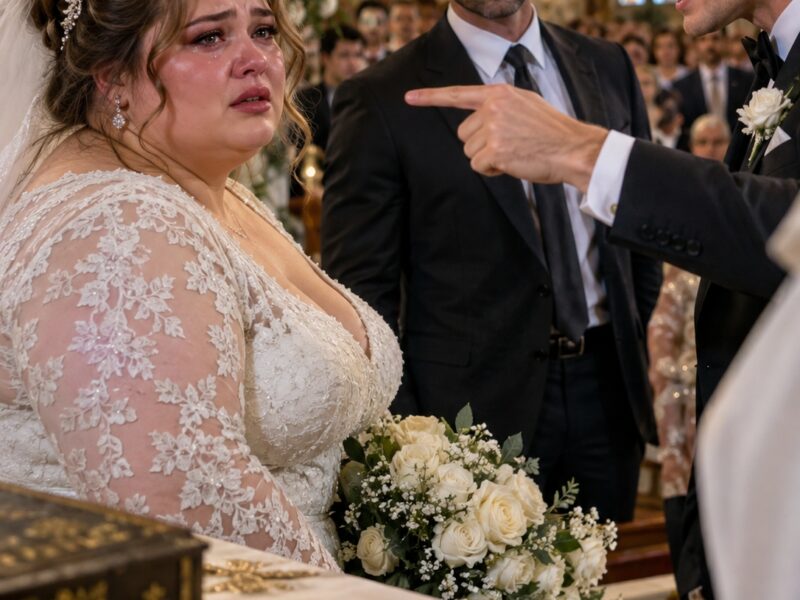
He Humiliated His Bride at the Altar—Then the Stranger in the Last Row Stood Up and Said Something No One Expected
“I can’t marry her.”
The words landed so cleanly that for one terrible second, nobody inside St. Matthew’s understood what had happened.
The pianist stopped with her fingers still resting on the keys.
A baby somewhere near the back made a small restless sound.
And standing beneath an arch of white roses that had cost nearly four thousand dollars, Marigold Tanner stared at the man she had traveled eleven hundred miles to marry.
“What?”
Her voice barely carried.
Chester Vaughn looked at her.
Not into her eyes.
At her.
His gaze moved slowly from the lace sleeves of her wedding gown to her waist, her hips, then back up again.
There were eighty-six people in the church.
Goldie would remember that number for the rest of her life.
Eighty-six witnesses.
Chester gave a short laugh.
“I said I can’t do this.”
The pastor lowered the leather folder in his hands.
“Chester…”
“No. I’m sorry.”
He didn’t sound sorry.
That was the part Goldie noticed first.
He sounded irritated.
Like someone had delivered the wrong sofa.
Chester turned slightly toward the pews, almost as if he needed an audience before he could become truly cruel.
“The pictures weren’t exactly honest.”
A few people shifted uncomfortably.
Goldie stopped breathing.
Chester looked back at her.
“You knew what I expected.”
Her fingers tightened around the stems of her bouquet.
“Expected?”
“You sent me pictures from the shoulders up.”
A whisper moved through the church.
Goldie felt heat crawl from her throat into her cheeks.
“Chester, please.”
“I’m just telling the truth.”
“No,” she whispered. “You’re humiliating me.”
His mouth hardened.
“Then maybe you should have been honest before I paid for all this.”
And there it was.
The sentence that would eventually destroy him.
Not because Goldie screamed.
She didn’t.
Not because somebody attacked him.
Nobody did.
It destroyed him because phones were already recording.
Because people were watching.
And because in the very last row of the church, a man Goldie had never seen before slowly stood up.
But Goldie didn’t notice him yet.
She was still looking at Chester.
Still trying to understand how nine months of phone calls, late-night messages, promises, plane tickets, wedding plans, and whispered I love yous had somehow ended with her standing in a white dress while the man who had asked her to cross half the country looked at her as though she had cheated him.
Nine months earlier, Chester Vaughn had seemed like the answer to a question Goldie had almost stopped asking.
She was twenty-nine then.
She lived outside Columbus, Ohio, worked alterations at a bridal boutique during the week, and took private sewing jobs from her apartment at night.
Her mother had died four years earlier.
Her father had disappeared from her life long before that.
Goldie wasn’t lonely every day.
That would have been easier.
She was lonely unpredictably.
Sunday mornings.
Grocery stores.
When a customer picked up a wedding dress and said, “My fiancé is going to cry when he sees me.”
When she cooked too much pasta and automatically reached for a second plate.
When the apartment became so quiet at night that the refrigerator sounded like company.
She met Chester through a dating app.
He lived in Prairie Rose, Kansas, a wealthy little town outside Wichita where his family owned Vaughn Agricultural Supply.
His profile showed a clean-cut man with sandy hair, expensive boots, a restored Ford Bronco and the kind of smile that suggested life had rarely told him no.
His first message wasn’t clever.
That helped.
You have kind eyes.
Goldie stared at it longer than she wanted to admit.
Men usually told her she had beautiful hair.
A pretty face.
A great smile.
Compliments with invisible borders.
Chester said kind eyes.
She answered.
One conversation became twenty.
Then video calls.
Then flowers delivered to the boutique.
He called her Goldie after hearing her mother had used the nickname.
He remembered her coffee order.
He asked about her mother’s recipes.
He told her he wanted children.
He said he was tired of shallow women.
Once, at nearly two in the morning, he told her, “I want someone who feels like home.”
Goldie had cried after they hung up.
Not because the sentence was extraordinary.
Because she had spent years secretly wondering whether anyone would ever associate her with the word home.
She was a size eighteen.
She knew that fact the way some people knew their blood type.
Not because she hated herself.
Not anymore.
But because the world kept reminding her.
Dating apps reminded her.
Clothing stores reminded her.
Strangers with opinions reminded her.
Her mother’s voice had always fought back.
Never apologize for occupying space, sweetheart.
After her mother died, that voice became harder to hear.
Chester made it louder again.
At least she thought he did.
They met twice in person before becoming engaged.
Both times Goldie noticed something she would later hate herself for ignoring.
Chester liked controlling photographs.
“Stand behind me.”
“Turn a little.”
“Let me take it from up here.”
Once she posted a full-body photograph of them at a restaurant.
He asked her to remove it.
“The lighting makes both of us look weird.”
She believed him because love often begins by teaching us which doubts to silence.
Three months later, Chester proposed during a weekend in Chicago.
By Christmas, Goldie had given notice at her apartment.
By February, she had resigned from the bridal boutique.
By April, everything she owned fit inside a rented moving trailer.
She arrived in Prairie Rose twelve days before the wedding.
Chester changed the moment he saw her step from her SUV.
Not dramatically.
That would have saved her.
Cruelty rarely introduces itself honestly.
He simply hugged her for less time than usual.
Then he looked down.
Then back up.
“You look different.”
Goldie smiled uncertainly.
“Different good?”
He opened the passenger door instead of answering.
Over the next eleven days, he touched her less.
He stopped initiating sex.
He suggested she skip dessert at dinner.
He asked whether stress had made her gain weight.
When she reminded him that they had video-called hundreds of times, he shrugged.
“Video isn’t the same.”
She should have left.
Goldie knew that later.
But leaving twelve days before your wedding after moving eleven hundred miles does not feel like making one decision.
It feels like detonating your entire life.
So she told herself he was nervous.
She told herself marriage frightened people.
She told herself love had awkward seasons.
Then she walked into St. Matthew’s on a Saturday morning wearing a wedding gown she had altered herself.
And Chester finally stopped pretending.
“I wanted a wife,” he said before eighty-six people. “Not somebody I’m going to have to lie to every time she asks if she looks good.”
Someone gasped.
Goldie’s maid of honor, Rachel, stepped forward.
“You son of a—”
Goldie lifted one hand.
Rachel stopped.
Not because Goldie wanted to protect Chester.
Because Goldie suddenly understood something.
There are humiliations so complete that fighting inside them only gives the person hurting you more material.
She would not beg.
Not here.
Not for him.
Goldie carefully removed the engagement ring.
Chester watched.
For the first time that morning, uncertainty flickered across his face.
She placed the ring on the white Bible beside the pastor.
Then she set down her bouquet.
Her hands were shaking violently.
But when she turned toward the aisle, her back was straight.
She made it three steps.
Then a wooden pew creaked near the rear of the church.
Goldie looked up.
A man had risen from the last row.
Tall.
Broad-shouldered.
Maybe thirty-five.
Dark suit, no tie.
Weathered face.
Brown hair slightly too long around the collar.
He looked spectacularly out of place among Chester’s polished friends.
The stranger stepped into the aisle.
Someone whispered, “Who is that?”
Nobody answered.
He started walking toward her.
Chester frowned.
“Excuse me?”
The stranger kept walking.
Not toward Chester.
Toward Goldie.
Every phone in the church seemed to follow him.
He stopped several feet from her.
Close enough that Goldie could see a thin scar beside his right eyebrow.
Close enough to notice that he looked nervous.
That surprised her.
Men trying to play heroes usually enjoyed the audience.
This man looked like he would rather face a wildfire than eighty-six strangers.
“Ma’am,” he said quietly.
Goldie stared at him.
“I don’t know you.”
“No.”
“Then what are you doing?”
His jaw tightened.
“Something I should probably think through longer.”
A strange laugh escaped somebody in the pews.
The man didn’t smile.
His eyes remained on Goldie.
Then he said, “But I think everybody in this room has been thinking too long already.”
The church went silent again.
He finally turned toward Chester.
“I’ve heard enough.”
Chester blinked.
“Who the hell are you?”
“Nobody you know.”
“Then sit down.”
The stranger studied him.
“No.”
One word.
No anger.
No raised voice.
Somehow that made Chester look smaller.
“This is a private wedding.”
The stranger glanced at the dozens of raised phones.
“Doesn’t look very private anymore.”
A few people laughed.
Chester flushed.
“You need to leave.”
“I will.”
The stranger looked back at Goldie.
“But she shouldn’t have to walk out of here thinking every man in this room agrees with you.”
Goldie’s throat tightened.
The stranger took one slow breath.
“I don’t know anything about you,” he told her. “I don’t know where you’re from. I don’t know what makes you laugh. I don’t know whether you snore or hate country music or put ketchup on steak.”
A startled ripple of laughter passed through the pews.
Goldie’s mouth almost moved.
Almost.
“But I know what I just watched.”
His voice softened.
“I watched a woman stand here while the man who was supposed to protect her dignity tried to destroy it for applause.”
Chester stepped forward.
“That’s enough.”
The stranger turned.
“No. You had enough.”
Something changed in the room.
Goldie felt it.
The balance of shame was moving.
Chester felt it too.
“Get out.”
“You first.”
Chester took another step.
The pastor finally intervened.
“Gentlemen.”
The stranger raised his hands slightly.
“I didn’t come here to fight.”
“Then why are you here?” Chester demanded.
The man looked at Goldie again.
And what he said next would be replayed online more than twelve million times before the month was over.
“Because if she’s walking out of this church alone after what you just did, then every decent man in here should be ashamed.”
Silence.
Goldie couldn’t move.
Then the stranger did something even stranger.
He offered her his arm.
Not his hand.
His arm.
No touching unless she chose it.
“You want someone to walk you out?”
Goldie stared at him.
Behind him were eighty-six faces.
Behind her was the man she had almost married.
And somewhere beneath the shock, another feeling stirred.
Choice.
For the first time that morning, somebody was giving her one.
Goldie placed her fingertips lightly against the stranger’s sleeve.
“Yes.”
Chester laughed bitterly.
“Oh, this is unbelievable.”
Goldie stopped.
The stranger stopped with her.
Chester looked at the crowd.
“She’s known this guy five seconds and she’s leaving with him?”
Goldie slowly turned around.
Something inside her had finally stopped shaking.
“No, Chester.”
Her voice carried all the way to the last pew.
“I’m leaving myself.”
Then she walked out.
The stranger simply made sure she didn’t have to do it alone.
Outside, bright Kansas sunlight hit Goldie’s face.
She barely reached the church steps before her knees weakened.
The stranger caught her elbow, then immediately released it when she steadied herself.
“Sorry.”
Goldie laughed once.
It came out broken.
“You’re apologizing?”
“I touched you without asking.”
She looked at him.
Then she started crying.
Not gracefully.
Not cinematic tears sliding down flawless makeup.
Her shoulders folded.
Mascara ran.
She covered her face and sobbed so hard she couldn’t breathe.
The stranger stood beside her without telling her not to cry.
That mattered.
People always told grieving women not to cry because crying made everyone else uncomfortable.
He simply waited.
Eventually Goldie lowered her hands.
“What’s your name?”
“Beau Callahan.”
“Why were you at my wedding, Beau Callahan?”
Something flickered in his eyes.
“Long story.”
“I suddenly have time.”
That almost made him smile.
Before he could answer, the church doors opened.
Rachel came rushing out carrying Goldie’s purse.
Behind her came guests.
And behind them came Chester.
“Goldie!”
Beau shifted slightly.
Not in front of her.
Beside her.
Goldie noticed.
Chester stopped halfway down the steps.
“You’re seriously going to make me the villain here?”
Rachel made a sound of disbelief.
Goldie stared at the man she had loved.
That question hurt almost more than the insult.
Because Chester genuinely believed humiliation was something that had happened to him.
“The photographer is paid,” he said. “The reception is paid. My parents have people here from Dallas.”
Goldie said nothing.
“You could have told me you’d gained that much weight.”
Rachel lunged forward.
Goldie caught her wrist.
“No.”
She looked at Chester.
“Say it again.”
He hesitated.
“What?”
“Say exactly what you’re thinking.”
“Goldie—”
“No. You wanted honesty.”
She took one step toward him.
“Give me all of it.”
Chester glanced at the gathering crowd.
Suddenly he understood that the audience no longer belonged to him.
“I think marriage requires attraction.”
“So do I.”
“I don’t feel it.”
Goldie nodded.
“That would have been painful.”
His shoulders relaxed slightly.
Then she continued.
“But survivable.”
His expression changed.
“You could have told me privately. Yesterday. Last week. Three months ago.”
“Goldie—”
“You waited until I was standing at an altar.”
He said nothing.
“You didn’t want honesty, Chester.”
Her voice cracked.
“You wanted an audience.”
Nobody moved.
Goldie swallowed.
“And now you’ve got one.”
She turned away.
That should have been the end.
It wasn’t.
Because by Sunday morning, somebody had uploaded the video.
By Sunday afternoon, it had three hundred thousand views.
By Monday, Goldie’s humiliation belonged to the internet.
Strangers analyzed her body.
Strangers analyzed Chester’s face.
Strangers tried to identify Beau.
People called Goldie brave.
Others called her desperate.
Some said Chester had every right to reject a woman he wasn’t attracted to.
Others said he had engineered the humiliation intentionally.
Goldie read seventeen comments.
The eighteenth said:
He did her a favor. Nobody wants to wake up next to that for forty years.
She shut off her phone.
Then she threw up.
Rachel found her sitting on the bathroom floor of the Airbnb they had rented for the wedding party.
“You’re done reading comments.”
“I shouldn’t care.”
“That’s nonsense.”
Goldie looked up.
Rachel sat beside her.
“People always say don’t care what strangers think,” Rachel said. “Meanwhile entire industries exist because people care what strangers think.”
Goldie laughed weakly.
Then came a knock.
Rachel stiffened.
“If that’s Chester, I’m going to prison.”
It wasn’t Chester.
Beau stood outside holding a cardboard drink carrier.
“I didn’t know what you drink.”
He lifted it slightly.
“So I brought coffee, tea, hot chocolate, and something the girl at Starbucks called a pink drink.”
Rachel stared at him.
Goldie stared too.
Beau cleared his throat.
“This looked less ridiculous in my truck.”
For the first time since the altar, Goldie laughed.
Really laughed.
And Beau looked at her as if he had just heard something he wanted to hear again.
That frightened her more than it should have.
She stepped outside and closed the door behind her.
“You didn’t have to come.”
“I know.”
“Then why did you?”
“To check on you.”
“You’ve known me less than twenty-four hours.”
“I know that too.”
Goldie folded her arms.
“Are you always like this?”
“No.”
“That’s not reassuring.”
His mouth twitched.
She studied him.
“You still haven’t told me why you were there.”
Beau looked toward the parking lot.
“I had a meeting with the pastor.”
“About?”
“My mother.”
Goldie’s expression softened.
“She died?”
“Six years ago.”
“I’m sorry.”
He nodded.
“She grew up here. St. Matthew’s was her church before she moved to Oklahoma. Pastor Daniels knew her family.”
Beau paused.
“I was picking up some documents.”
“What kind?”
He hesitated.
Goldie noticed.
Then he said, “Things she left behind.”
It wasn’t a lie.
But it wasn’t the whole truth either.
Goldie had spent nine months loving a man who edited reality.
She recognized an unfinished sentence now.
Still, she didn’t push.
Beau held out the drinks.
“You want one?”
Goldie looked at them.
“Which one is yours?”
“Black coffee.”
“Of course.”
“What does that mean?”
“You look like a man who considers cinnamon an unnecessary luxury.”
That smile appeared again.
Slow.
Unexpected.
It changed his whole face.
Goldie hated that she noticed.
She took the hot chocolate.
“Thank you.”
They stood quietly.
Then Beau said, “For what it’s worth, I’m sorry about what I said in there.”
Goldie frowned.
“You defended me.”
“I know.”
“Then why apologize?”
“Because I made you part of another spectacle.”
She went still.
“I was angry. I saw what he was doing and reacted. But everybody’s talking about me standing up like I’m some damn hero.”
He looked directly at her.
“You were the person standing at that altar. You were the one who walked out.”
Goldie had received hundreds of messages calling Beau heroic.
Not one person had considered that being rescued could become another cage.
Until him.
She looked down at her cup.
“Thank you.”
He nodded.
Then Goldie asked the question that had been bothering her.
“Why did it make you so angry?”
Beau’s face changed.
There.
Gone.
But she saw it.
“Another long story.”
“You seem to have several.”
“Most people do.”
He started to leave.
“Beau.”
He stopped.
Goldie didn’t know why she said it.
Maybe because her old life had already burned down.
Maybe because she wanted one thing in the ashes that belonged entirely to her.
“Coffee.”
He glanced at the cup in his hand.
She shook her head.
“With me.”
His eyebrows lifted.
“Not today.”
“Oh.”
“And definitely not because you feel sorry for me.”
His expression became serious.
“I don’t.”
“You don’t know me.”
“No.”
“So you can’t possibly know whether you want me.”
He said nothing.
Goldie stepped closer.
“If you meant what you said yesterday—about not letting me leave believing every man agreed with Chester—then fine. Thank you.”
She swallowed.
“But I will not become your charity project.”
Something almost painful crossed Beau’s face.
“Understood.”
“If you want coffee with me, ask again next week.”
“Next week?”
“Yes.”
“And if you say no?”
“I say no.”
He nodded.
“Fair.”
Goldie expected him to leave.
Instead he asked, “Tuesday?”
She blinked.
“What?”
“Next week. Tuesday. Seven?”
Despite herself, she smiled.
“You’re impossible.”
“Is that a no?”
“Ask me Tuesday.”
So he did.
At exactly 9:04 Tuesday morning, Goldie’s phone buzzed.
Coffee tonight?
She stared at the message.
Then typed:
You waited four minutes too long.
Three dots appeared.
I was trying not to look desperate.
She laughed.
Rachel leaned over the kitchen counter.
“Is that Church Cowboy?”
“Don’t call him that.”
“Oh, it’s definitely Church Cowboy.”
Goldie ignored her.
Seven works.
Their first date lasted fifty-three minutes.
Goldie timed it accidentally because she had promised herself an hour maximum.
Beau didn’t ask about Chester.
That surprised her.
Instead he asked why she sewed.
“My mother taught me.”
“What did she make?”
“Everything. Curtains. Halloween costumes. Prom dresses. Once she reupholstered a couch because my father said it couldn’t be done.”
“Did it look good?”
“Terrible.”
Beau laughed.
Goldie smiled.
“She kept it twelve years out of spite.”
“I think I’d have liked her.”
“You would.”
The certainty in her own voice hurt.
Beau noticed.
He didn’t say he was sorry again.
He simply let the silence exist.
Goldie noticed that too.
Their second date was dinner.
Their third was a walk beside a lake.
Their fourth was at a county fair, where Beau lost forty dollars trying to win her a stuffed bear and Goldie finally paid five dollars to a teenager leaving the fairgrounds for his.
“You cheated,” Beau said.
“I solved the problem.”
“You’ve destroyed the integrity of competitive carnival gaming.”
“You lost forty dollars throwing baseballs at milk bottles.”
“I was establishing dominance.”
“With whom?”
“The bottles.”
Goldie laughed so hard she had to stop walking.
Beau watched her.
She caught him.
“What?”
“Nothing.”
“No. What?”
He hesitated.
Then answered simply.
“You’re beautiful when you forget somebody might be looking.”
The laughter vanished.
Goldie’s stomach tightened.
Beau saw it immediately.
“Too much?”
She looked away.
“No.”
But it was.
Not because she disliked the compliment.
Because she wanted to believe it.
And wanting to believe someone had become dangerous.
The viral attention eventually faded.
The town did not.
Prairie Rose had fewer than fifteen thousand residents, which meant people knew things before the people involved knew them themselves.
Goldie found temporary work at a tailoring and formalwear shop owned by sixty-eight-year-old Patricia Perkins.
Patricia had been sitting in the third pew during the wedding.
She had not laughed.
Goldie remembered that.
Patricia remembered something else.
“You didn’t run.”
Goldie looked up from the hem she was pinning.
“Excuse me?”
“That day.”
Patricia adjusted her glasses.
“You walked.”
“I don’t understand.”
“Running means somebody is chasing you.”
The older woman returned to her paperwork.
“You walked out like you were leaving something behind.”
Goldie carried those words home.
Within six weeks, customers were asking for her by name.
She could rescue gowns other seamstresses refused to touch.
She remembered children’s names.
She quietly altered one teenage girl’s homecoming dress for free after hearing the girl’s mother whisper that they couldn’t afford the additional work.
The mother cried.
Goldie pretended not to notice.
For the first time since moving to Kansas, she began imagining a life that did not depend on whether any man chose her.
And that was when Chester began trying to destroy it.
At first it was gossip.
Beau was broke.
Beau’s ranch was failing.
Beau had anger problems.
Goldie had known Beau before the wedding.
The whole church scene had been staged.
Then anonymous reviews appeared on Patricia’s business page.
One accused Goldie of ruining a $2,000 dress.
Another called her “unstable.”
Patricia deleted them.
“They’re from new accounts,” she said.
Goldie’s stomach tightened.
“You think Chester?”
“I think insecure men are remarkably energetic.”
Goldie tried to ignore it.
Then someone sent Beau photographs.
Goldie leaving Chester’s house three weeks before the wedding.
Goldie hugging him outside a restaurant.
Goldie kissing him beside his truck.
Old photographs.
Cropped to remove dates.
The message underneath said:
Ask her how quickly she changes men.
Beau showed Goldie immediately.
That mattered more than the photographs.
“I don’t think they’re real evidence of anything,” he said.
“They’re real.”
“I know.”
“They’re from before the wedding.”
“I figured.”
Goldie stared at his phone.
“Why show me?”
“Because whoever sent them wants secrecy between us.”
He placed the phone on the table.
“So I’m removing the secrecy.”
Goldie looked at him for a long moment.
Chester would have hidden the message.
Stored it.
Used it later.
Beau brought poison into daylight before it could ferment.
“Doesn’t it bother you?”
“That you kissed your fiancé?”
“No.”
“Should it?”
She almost smiled.
Then Beau’s expression hardened.
“What bothers me is somebody trying to make you ashamed of having had a life before me.”
He deleted the message.
Goldie’s chest tightened.
That night, lying alone, she realized something terrifying.
She was falling in love with him.
And love was no longer romantic to Goldie.
Love was leverage.
Love meant somebody eventually acquired enough information to know exactly where to cut you.
So she pulled away.
She answered messages later.
Canceled dinner once.
Then twice.
Beau didn’t accuse her.
He didn’t demand explanations.
That somehow made it worse.
Finally, he appeared outside the tailoring shop one evening.
Goldie locked the front door.
“You can’t keep showing up whenever you want.”
“I know.”
“Then why are you here?”
“Because you’ve canceled three times.”
“I’ve been busy.”
“Okay.”
She stared at him.
“Okay?”
“If you’re busy, you’re busy.”
His calm irritated her.
“But if you’re scared, that’s different.”
Goldie froze.
Beau leaned against his truck.
“I can wait on busy.”
“And scared?”
“I can wait on that too.”
Her anger vanished so quickly she almost hated him for it.
“Why?”
He looked at her.
And this time, when he answered, the pain didn’t disappear quickly enough.
“Because somebody once needed people to wait for her.”
Goldie remembered the church.
A woman I loved.
The wrong yardstick.
The sentence he had never finished.
“Your mother?”
Beau looked toward the road.
“Yes.”
He drove Goldie to his ranch the following Sunday.
It was nothing like Chester’s descriptions.
Not failing.
Not extravagant.
Eight hundred acres of pasture and wheat bordered by cottonwoods, with a renovated white farmhouse sitting on a low hill.
Two horses watched from a fence.
An old Labrador named Gus immediately leaned against Goldie’s legs as though they were lifelong friends.
“This is the dangerous financial disaster I’ve been warned about?” she asked.
Beau smiled.
“We had a bad year.”
“How bad?”
“Bad enough I sold some equipment.”
“But you’re okay?”
“We’re okay.”
Goldie looked at him.
“You didn’t tell me.”
“You didn’t ask.”
“That sounds evasive.”
“Fair.”
He opened the porch door.
“I also didn’t want money becoming evidence.”
“Evidence of what?”
“That I’m worth trusting.”
Goldie stopped.
Beau turned.
She realized he understood her more than she wanted him to.
Chester had used money as theater.
The wedding.
The house.
The restaurant reservations.
The engagement ring.
Every gift eventually became a receipt proving she owed him gratitude.
Beau had deliberately kept his finances out of their relationship.
“Come on,” he said. “There’s something I want to show you.”
Inside the farmhouse, one photograph sat on the fireplace mantel.
A heavyset woman in her forties stood laughing beside a teenage Beau.
Goldie knew immediately.
“Your mother.”
“Evelyn.”
“She was beautiful.”
“She was.”
Not was to me.
Not in her own way.
Simply was.
Goldie moved closer.
Evelyn had Beau’s eyes.
“She raised me here.”
“Alone?”
“Mostly.”
“What happened to your father?”
“Left when I was eleven.”
Goldie turned.
Beau’s jaw tightened.
“He liked thin women.”
The sentence was so unexpected Goldie almost thought she had misheard.
Beau sat down.
“My mother gained weight after she had me. Thyroid problems. Stress. Probably genetics too. Didn’t matter.”
His hands clasped between his knees.
“My father started making jokes.”
Goldie said nothing.
“First privately. Then around friends. He called it motivation.”
Beau’s voice flattened.
“Eventually he started cheating.”
Goldie’s chest tightened.
“When she found out, he told her nobody else would want her anyway.”
Beau stared at the floor.
“She believed him.”
Goldie sat beside him.
“Not immediately. That’s the thing people don’t understand. Cruelty doesn’t always break somebody in one swing.”
He looked at the photograph.
“It takes pieces.”
His mother stopped going swimming.
Stopped wearing bright clothes.
Stopped being photographed.
Stopped going to church because somebody once asked whether she was expecting.
“She used to have this laugh,” Beau said. “You could hear it from outside.”
Goldie looked at the photograph again.
“What happened?”
“She died at fifty-three.”
Goldie’s breath caught.
“Heart attack?”
Beau nodded.
“She’d been having symptoms for two days.”
“Why didn’t she go to the hospital?”
His eyes filled, though no tears fell.
“Because she’d gained weight again.”
Goldie understood before he explained.
“She didn’t want the doctors to judge her.”
Beau nodded.
“She kept saying she’d go after she lost twenty pounds.”
Silence filled the room.
Then Beau said, “When I saw Chester look at you that morning…”
He stopped.
Goldie waited.
“I was seventeen again.”
There it was.
The truth she had been waiting for.
And instead of comforting her, it terrified her.
Because suddenly her worst fear had evidence.
“You didn’t stand up because of me.”
Beau frowned.
“What?”
“You stood up because of her.”
“Goldie—”
“I reminded you of your mother.”
“At that moment? Yes.”
She stood.
His face changed.
“That isn’t what I meant.”
“But it’s true.”
“I saw somebody being humiliated in exactly the way she was.”
Goldie’s eyes burned.
“So you rescued me.”
“I interrupted him.”
“You rescued me.”
“Goldie.”
She stepped backward.
“I told you from the beginning I would not be anybody’s charity.”
“You aren’t.”
“How do you know?”
“Because I know what I feel.”
“Do you?”
Her voice broke.
“Or are you trying to rewrite what happened to her?”
Beau stood.
“That isn’t fair.”
“I know.”
The admission stopped him.
Goldie wiped her cheek angrily.
“But fear isn’t always fair.”
She looked at Evelyn’s photograph.
“You look at me and maybe somewhere inside you, you’re fixing something.”
“No.”
“You can’t know that.”
“I can.”
“How?”
Beau opened his mouth.
Nothing came.
That silence shattered her.
Goldie nodded.
“Exactly.”
She left.
Beau didn’t chase her.
That hurt too.
Three days passed.
Then five.
On the sixth evening, Chester appeared outside Patricia’s shop.
Goldie saw him leaning against his Mercedes and nearly turned around.
“Don’t.”
He straightened.
“I haven’t said anything.”
“I’d like to preserve that streak.”
“Can we talk?”
“No.”
“You’re making a mistake with Callahan.”
Goldie unlocked her car.
Chester stepped closer.
“He has a savior complex.”
Her hand stopped.
Chester noticed.
And smiled.
Small.
Satisfied.
That was when Goldie realized something even uglier.
He knew.
“How?”
“What?”
“How do you know about his mother?”
Chester’s expression changed.
Goldie turned fully toward him.
“You’ve been digging into him.”
“He inserted himself into my life.”
“No. He walked me out of a church.”
“With cameras everywhere.”
“Answer me.”
Chester shrugged.
“People talk.”
“Who?”
“Does it matter?”
“Yes.”
Chester stepped closer.
“He doesn’t love you, Goldie.”
Her stomach twisted.
“He feels sorry for women like you because he couldn’t save his mother.”
“Women like me.”
Chester realized the mistake too late.
Goldie laughed softly.
There was no humor in it.
“That’s incredible.”
“I’m trying to help.”
“No. You’re trying to get inside a wound you heard about and make it bigger.”
“You think he wants you?”
Chester’s voice sharpened.
“He wants redemption.”
Goldie unlocked her car.
Chester grabbed her wrist.
“Listen to me.”
Goldie looked down at his hand.
Then up at him.
“Take your hand off me.”
Something in her voice made him release her.
“You had a woman standing in front of you wearing a dress she made with her own hands,” Goldie said.
Chester’s face hardened.
“You had nine months to decide whether you loved her.”
“Goldie—”
“And when you decided you didn’t, you could have ended it privately.”
She stepped closer.
“But that wasn’t enough for you.”
He looked away.
“You needed me smaller.”
His jaw tightened.
“Because making me small made you feel bigger.”
“That’s ridiculous.”
“No.”
Goldie’s voice was almost gentle now.
“It’s the first thing about you that finally makes sense.”
Chester stared at her.
Then said the cruelest thing he had left.
“He’ll get tired of pretending.”
Goldie’s breath caught.
Chester saw the hit.
So he pushed harder.
“Maybe not next month. Maybe not next year. But eventually he’ll wake up beside you and realize kindness isn’t attraction.”
The old Goldie would have carried those words home.
She would have put them under her pillow.
Fed them.
Let them grow teeth.
Instead she looked at Chester for a long time.
Then she said, “You know something?”
“What?”
“You were right at the altar.”
His eyebrows lifted.
“There was someone standing there who wasn’t good enough to marry.”
Goldie opened her car door.
“It just wasn’t me.”
She got in.
And drove away.
Her hands started shaking two blocks later.
Strength, she discovered, did not mean words stopped hurting.
It meant they no longer got to make decisions for you.
That night she drove to Beau’s ranch.
Rain had begun falling by the time she arrived.
He opened the door wearing jeans and a gray T-shirt.
Surprise flashed across his face.
“Goldie?”
“I need you to answer something.”
He immediately stepped aside.
She shook her head.
“Here.”
Rain tapped against the porch roof.
Beau waited.
Goldie’s heart hammered.
“If I had been thin that morning…”
His face tightened.
She continued.
“If I’d looked exactly like whatever Chester wanted, and he’d humiliated me about something else, would you still have stood up?”
Beau was quiet.
Too quiet.
Goldie’s stomach dropped.
“Answer me.”
“I don’t know.”
It hurt.
But she had asked for truth.
Beau stepped closer.
“I don’t know what hypothetical version of you I would’ve noticed.”
Goldie swallowed.
“But I know what I noticed.”
“What?”
“You didn’t beg.”
Rain blew across the porch.
“You were breaking apart in front of everybody, and you still put your ring down carefully.”
Goldie’s eyes filled.
“You put your flowers down because you didn’t want to throw them. You thanked the pastor before you turned around.”
Beau’s voice grew rough.
“Then you started walking through a room full of people who’d just watched somebody try to erase your dignity.”
He took another step.
“I stood because of my mother.”
The truth landed.
Then he continued.
“But I came back with four stupid drinks because of you.”
Goldie stared at him.
“I asked you for coffee because of you.”
Another step.
“I went to that ridiculous county fair because of you.”
Goldie’s mouth trembled.
“I have listened to you explain the structural importance of darts in women’s clothing for forty-five minutes because of you.”
A laugh escaped her through tears.
Beau didn’t smile.
“I know you hate raw tomatoes but like tomato soup. I know you sleep with the television on when you’re anxious. I know you pretend not to cry at dog videos.”
“Beau…”
“I know you say you’re fine when you’re furious, but when you’re actually fine you say okay.”
He was close now.
Not touching her.
Never touching her first.
“I know you keep safety pins in every purse you own.”
Goldie laughed again.
“I know you call your mother sometimes when you think nobody can hear you.”
That broke her.
Her face folded.
Beau’s voice softened.
“I know you.”
Goldie wiped her eyes.
“And yes. Seeing what Chester did reminded me of my mother.”
He looked directly at her.
“But Evelyn Callahan is not the reason I haven’t slept properly in two months.”
Goldie’s breath stopped.
“She isn’t the reason I check the road when I hear tires on gravel.”
He stepped closer.
“She isn’t the reason I bought strawberry jam even though I hate strawberry jam.”
Goldie whispered, “Why did you buy strawberry jam?”
“Because you said once it’s your favorite.”
Something inside her cracked open.
Beau shook his head.
“Pity doesn’t do that.”
Goldie looked at him through the rain.
“Then what does?”
Beau’s voice dropped.
“You really need me to say it?”
“Yes.”
He breathed out.
“I love you.”
No music.
No audience.
No eighty-six witnesses.
Just rain.
A porch light.
And one frightened woman discovering that the sentence she had wanted all her life was almost impossible to accept when someone finally meant it.
Goldie cried quietly.
Beau waited.
She stepped closer.
“Why aren’t you kissing me?”
His eyes widened slightly.
“You told me not to touch you until you said so.”
Goldie stared at him.
“You remember that?”
“I remember everything you’ve asked me to respect.”
She lifted her hand.
Touched his cheek.
“I’m saying so.”
Beau kissed her.
And Goldie understood immediately that Chester had been wrong about something else.
There was nothing charitable about it.
Beau kissed her like a man who had spent weeks holding a locked door shut with both hands and had finally been told he could let go.
When they separated, Goldie’s forehead rested against his.
Neither spoke.
Then Beau whispered, “I need to tell you something else.”
Goldie pulled back.
“What?”
“The documents I was picking up from the church that morning.”
Her stomach tightened.
“What about them?”
“I didn’t tell you everything.”
She went still.
Beau walked inside and returned with an old envelope.
Inside was a photograph.
Evelyn Callahan.
Much younger.
Standing outside St. Matthew’s.
Beside Patricia Perkins.
Goldie frowned.
“You knew Patricia?”
“My mother did.”
Beau turned over the photograph.
Handwriting covered the back.
He handed it to Goldie.
She read.
If Beau ever becomes the kind of man who judges a woman’s worth by the space she occupies, Patricia, remind him who raised him.
Goldie’s hand flew to her mouth.
“Your mother wrote this?”
“Twenty-seven years ago.”
“Why did Patricia have it?”
“She and Mom were best friends in high school.”
Goldie stared at him.
“That was why you came to Prairie Rose?”
Beau nodded.
“Patricia called me. She was clearing old boxes after her sister died. She found letters and photographs Mom had left with her.”
“And you went to the church…”
“To meet Pastor Daniels because some of Mom’s things were stored there.”
Goldie looked toward the rain.
“So you weren’t supposed to be at the wedding.”
“No.”
“You just happened to walk in?”
“I heard music. Pastor was busy. He told me to sit down.”
Beau smiled faintly.
“I almost left.”
Goldie looked at the photograph again.
One random decision.
One empty seat.
One man waiting ten extra minutes.
Her entire life had pivoted on something so small nobody would have noticed it happening.
Then Beau said, “There’s one more thing.”
Goldie laughed nervously.
“You really need to stop saying that.”
He reached into the envelope.
Another document.
This one was newer.
A property deed.
Goldie frowned.
“What’s this?”
“The building Patricia’s shop is in.”
She looked at him.
“What about it?”
“My mother’s trust owns it.”
Goldie’s head snapped up.
“What?”
“Patricia has a lifetime lease for almost nothing. Mom bought half the property with her years ago.”
Goldie stared at the page.
Then at Beau.
“You own the building where I work?”
“Technically the trust does.”
“Oh my God.”
“I didn’t know when we met.”
“But you know now.”
“Yes.”
“And you didn’t tell me?”
“I found out last week.”
Goldie stepped away.
The timing was almost absurd.
Just as she had begun believing there were no hidden doors between them, another opened.
“Goldie.”
“No.”
“Listen.”
“Why didn’t you tell me immediately?”
“Because Patricia asked me not to.”
“Why?”
Beau’s jaw tightened.
“Because she’s selling.”
Goldie stopped.
“What?”
“Her arthritis is getting worse.”
Patricia had hidden it well.
Goldie remembered the dropped scissors.
The increasingly frequent breaks.
The way she flexed her fingers when she thought nobody watched.
“She wants to retire.”
Goldie’s chest tightened.
“So I’m losing my job.”
“No.”
Beau looked at her.
“She wants you to buy the business.”
Goldie actually laughed.
“I have twelve thousand dollars.”
“She knows.”
“Then she also knows I can’t buy it.”
“The business isn’t worth what you think.”
“What does that mean?”
“She doesn’t want market value.”
Goldie stared.
Beau continued carefully.
“She wants enough to retire comfortably. The trust can keep the rent where it is.”
Understanding came slowly.
Then suspicion.
“You arranged this.”
“No.”
“You’re helping me.”
“Patricia made the offer.”
“And you own the building.”
“I don’t control whether she sells you her business.”
“But you control the rent.”
“Yes.”
Goldie stepped backward.
“This is exactly what I was afraid of.”
Beau’s face fell.
“Goldie—”
“I don’t want my future handed to me because somebody feels sorry for me.”
His expression hardened for the first time.
“Stop.”
She froze.
Beau rarely raised his voice.
He hadn’t now.
But something in it had changed.
“Stop calling every good thing that happens to you charity.”
Goldie’s eyes widened.
“You don’t get to—”
“No. Maybe I don’t.”
His jaw flexed.
“But somebody needs to say it.”
Rain hammered the roof.
“Patricia watched you work for two months. She watched customers come back because of you. She watched you fix dresses other people ruined. She watched you stay late.”
He pointed toward the document.
“She wants to sell you that business because you earned her respect.”
Goldie said nothing.
“And yes, I can keep the rent reasonable.”
His voice softened.
“But I will not apologize for being able to help someone I love.”
Goldie’s eyes filled.
“There’s a difference between being rescued and being supported.”
Silence.
That sentence followed Goldie home.
Three weeks later, she signed the purchase agreement.
Not because Beau paid for it.
He didn’t.
Goldie used her savings, a small-business loan, and a seller-financing agreement Patricia insisted upon.
The sign outside changed from PERKINS FORMALWEAR & ALTERATIONS to GOLDIE’S.
On opening morning, Goldie stood beneath it crying.
Patricia handed her a tissue.
“Don’t get sentimental. You still owe me money.”
Goldie laughed.
“You’re terrible.”
“I know.”
Then Patricia looked toward the parking lot.
Beau was unloading boxes.
“You know his mother once thought she was too big to wear red?”
Goldie turned.
Patricia’s eyes had gone somewhere far away.
“I bought Evelyn a red dress for her twenty-first birthday. She wouldn’t wear it.”
“Why?”
“Some idiot told her red made her look like a fire truck.”
Goldie winced.
Patricia smiled sadly.
“Beau was six when he found that dress in her closet. Asked why she never wore it.”
“What did she say?”
“She told him she was saving it.”
Patricia looked at Goldie.
“After she died, he buried her in red.”
Goldie’s throat closed.
“He remembered.”
“He remembers everything.”
Across the parking lot, Beau looked up.
Found Goldie watching him.
Smiled.
And something in her settled.
Not completely.
Healing rarely announces completion.
But enough.
Then Chester made his final move.
The video that had once humiliated Goldie had become an embarrassment to him instead.
Vaughn Agricultural lost a major local contract after one of its customers recognized Chester.
His father removed him from management.
Friends stopped inviting him places.
A woman he began dating broke things off after seeing the wedding clip.
Chester blamed Goldie.
One Friday afternoon, he entered her shop.
Goldie looked up from the register.
“Leave.”
“I need five minutes.”
“You have five seconds.”
“I can sue you.”
“For what?”
“Defamation.”
Goldie almost smiled.
“I’ve never spoken publicly about you.”
“Your boyfriend has.”
“No, he hasn’t.”
“The video—”
“Was uploaded by one of your cousins.”
Chester stopped.
Goldie knew from his face that he hadn’t known.
“You should probably talk to Brandon.”
His anger shifted.
Then something else appeared.
Exhaustion.
For the first time, Chester looked less like a villain and more like a man who had discovered consequences were not persecution.
“I lost everything.”
Goldie studied him.
“No.”
His eyes hardened.
“You don’t know anything about it.”
“You still have your family. Money. Health. A house.”
“You know what I mean.”
“Yes.”
She folded the receipt in front of her.
“You lost the version of yourself other people believed.”
Chester said nothing.
“That isn’t everything.”
“It feels like it.”
Goldie almost pitied him.
Almost.
Then he said, “I made a mistake.”
She waited.
“I was angry that day.”
“Why?”
Chester looked away.
“Because my friends had been making comments.”
There it was.
Not an excuse.
Something smaller and sadder.
“What comments?”
“That you were bigger than your pictures.”
Goldie felt an old blade slide against an old scar.
Chester continued.
“I felt embarrassed.”
“Of me.”
He couldn’t answer.
Goldie nodded.
“You loved how I made you feel when nobody else was watching.”
Chester looked at her.
“But the moment other men made you feel ashamed of choosing me, you needed to prove you hadn’t.”
His silence answered.
“So you sacrificed me.”
His eyes dropped.
“For eighty-six people.”
“Goldie…”
“You could have protected me.”
“I know.”
“No.”
Her voice softened.
“You know now.”
Chester looked older than he had four months earlier.
“What do you want me to say?”
“Nothing.”
“Nothing?”
Goldie shook her head.
“I used to think I needed an apology.”
She looked around the shop.
At dresses waiting for alterations.
At her name on the window.
At a photograph of her mother beside the register.
“I don’t.”
“Then what do you want from me?”
“Nothing.”
That was the answer Chester could not tolerate.
Hatred would have kept him important.
Revenge would have connected them.
Even anger would have meant he still occupied a room inside her.
Nothing meant the door was gone.
He looked toward the window.
Beau’s truck had just pulled into the lot.
Chester laughed bitterly.
“Of course.”
Goldie followed his gaze.
Beau climbed out carrying two coffees.
“What?”
“He always shows up.”
Goldie smiled.
“Yes.”
Chester looked at her.
And maybe that was when he finally understood what he had lost.
Not a woman nobody else would want.
A woman someone else was delighted to keep choosing.
He walked toward the door.
Then stopped.
“Goldie.”
She waited.
“I am sorry.”
She studied him.
For once, there was no audience.
No camera.
No performance.
Maybe he meant it.
Maybe he didn’t.
It no longer mattered.
“I hope someday you become the kind of man who understands why you should be.”
Chester left.
Beau entered thirty seconds later.
He watched Chester drive away.
“Everything okay?”
Goldie took one of the coffees.
“Okay.”
Beau looked at her.
She smiled.
“Actually okay.”
His shoulders relaxed.
Six months after the wedding that never happened, Beau asked Goldie to marry him.
He did it privately.
No restaurant.
No photographer hiding nearby.
No family waiting around the corner.
They were sitting on the back porch of his farmhouse while Gus slept beneath Goldie’s chair.
Beau reached into his jacket.
Goldie immediately said, “Don’t.”
His hand stopped.
Fear flashed across his face.
She laughed.
“No, don’t kneel.”
“What?”
“Sit.”
“Goldie, I’ve had a plan.”
“I don’t care.”
“I practiced.”
“That makes this worse.”
He laughed nervously and sat again.
Goldie took his hand.
“Ask me sitting beside me.”
Understanding softened his face.
Because Chester had stood opposite her.
Judging.
Measuring.
Deciding.
Goldie didn’t want another man positioned like a judge while she waited for a verdict disguised as a proposal.
She wanted a partner beside her.
Beau understood without making her explain.
He opened the ring box.
The ring was simple.
Vintage.
Warm gold.
Goldie’s breath caught.
“My mother’s,” Beau said.
She looked at him.
“I had it resized. But if you don’t want—”
“Yes.”
Beau froze.
“I haven’t asked.”
“You talk too slowly.”
“Goldie.”
She laughed through tears.
“Ask.”
He took both her hands.
“Marigold Tanner, will you marry me?”
She looked at the man who had once crossed a church aisle toward her when everyone else had been staring.
But that wasn’t why she said yes.
She said yes because he had come back Tuesday.
Because he had brought four drinks.
Because he listened.
Because he kept boundaries even when nobody would have blamed him for testing them.
Because he showed her uncomfortable truths instead of hiding them.
Because when she became afraid, he didn’t demand that she heal faster for his convenience.
Because he wanted her.
And, perhaps most importantly, because she had finally learned that being wanted was not the same thing as having value.
She possessed value before Beau.
She possessed it at the altar.
She possessed it when Chester rejected her.
She possessed it when strangers mocked her online.
She possessed it when she cried on a bathroom floor.
Beau hadn’t given her worth.
He had simply loved her without asking her to shrink first.
“Yes,” she whispered.
Then smiled.
“Yes.”
They married the following spring.
At St. Matthew’s.
When Goldie told Rachel the location, Rachel nearly dropped her wineglass.
“You’re kidding.”
“No.”
“Why there?”
Goldie thought about it.
“Because I don’t want Chester owning the geography.”
So on a bright April morning almost exactly one year after the worst day of her life, Goldie stood again behind the same wooden doors.
The church looked smaller.
That surprised her.
Trauma had enlarged it in memory.
She had remembered the aisle as endless.
Now she could see Beau standing at the other end.
Twenty yards away.
Maybe less.
Patricia sat in the front row wearing red.
Rachel stood beside Goldie.
“You ready?”
Goldie looked down at herself.
She had made the dress.
Not because she couldn’t afford another.
Because she wanted every stitch to belong to her.
The gown followed her curves instead of disguising them.
No compression garment.
No apology.
No attempt to become smaller for photographs.
Her mother’s tiny gold thimble had been sewn inside the lining over her heart.
Goldie touched it.
Then the doors opened.
Everyone stood.
For one second, memory attacked.
Chester stepping backward.
His eyes traveling down her body.
Laughter.
Silence.
Phones.
Shame.
Goldie’s breath caught.
Rachel whispered, “You okay?”
Goldie looked down the aisle.
Beau saw something in her face.
His smile disappeared.
He started toward her.
Goldie’s eyes filled.
Of course he did.
The first time, he had walked the aisle because she was alone.
Now, before anyone could stop him, Beau walked toward her again.
The guests murmured.
Goldie laughed through tears.
“You’re supposed to wait down there.”
“I know.”
“What are you doing?”
He stopped beside her.
“Walking with you.”
“You’re ruining the ceremony.”
“I’ve got experience.”
She laughed.
The church laughed with her.
Not at her.
With her.
And that difference contained an entire year.
Goldie slipped her arm through his.
Together they walked toward the altar.
Halfway down, she realized she wasn’t thinking about Chester anymore.
Not even a little.
The place where he had broken her no longer belonged to him.
They had taken it back one step at a time.
The pastor smiled when they reached him.
“I believe we tried something similar last year.”
More laughter.
Goldie looked at Beau.
“Better groom.”
“Low bar.”
The ceremony was short.
Their vows weren’t.
Beau had written his.
His hands shook while he unfolded the paper.
“Goldie, the first time I saw you, I thought you needed someone to stand up for you.”
He paused.
“I was wrong.”
Goldie’s eyes filled.
“You were already standing.”
Silence filled the church.
“I’ve spent the year since then learning that loving you doesn’t mean rescuing you. It means standing beside you while you rescue yourself when you need to.”
Goldie pressed her lips together.
“And sometimes it means carrying boxes.”
People laughed.
“Sometimes killing spiders.”
“You don’t kill them,” Goldie whispered.
“I relocate spiders.”
More laughter.
Beau smiled.
“But mostly it means remembering that your life belongs to you.”
His voice cracked.
“And being grateful every day that you keep choosing to share some of it with me.”
Goldie cried openly.
When it was her turn, she didn’t unfold paper.
“I spent most of my life believing love was something a woman earned by becoming easier to choose.”
Beau’s eyes never left hers.
“Prettier. Thinner. Quieter. Less complicated. Less afraid.”
She shook her head.
“I thought if I could become enough of the right things and little enough of the wrong ones, nobody would leave.”
A tear slipped down Beau’s cheek.
“Then somebody left anyway.”
Goldie smiled.
“And somehow that became the beginning of my life.”
The church was completely silent.
“I don’t promise never to be afraid.”
She squeezed Beau’s hands.
“I promise not to confuse fear with truth.”
His mouth trembled.
“And I promise never to ask you to complete me.”
She smiled.
“My mother raised me better than that.”
Soft laughter.
“I was whole when you found me.”
Beau nodded.
“I just didn’t know it yet.”
When the pastor pronounced them husband and wife, Beau waited.
Goldie raised an eyebrow.
“Well?”
“You didn’t give permission.”
She laughed.
“Permission granted.”
He kissed her.
The room erupted.
Months became years.
Goldie’s shop expanded.
Then expanded again.
She hired two seamstresses.
Then four.
She began designing custom bridal gowns for women who had spent their entire lives being told wedding dresses weren’t made for bodies like theirs.
Goldie decided that was the problem of the dresses.
Not the women.
Her work appeared in a regional magazine.
Then a national bridal publication.
A photograph accompanied the article.
Goldie nearly rejected it.
Old instinct.
Then she looked at the picture.
She was standing in her shop wearing jeans and a cream blouse, measuring tape around her neck, laughing at something outside the frame.
She remembered Beau’s words from their fourth date.
You’re beautiful when you forget somebody might be looking.
Goldie approved the photograph.
Beau framed it.
“Absolutely not.”
“Too late.”
“Beau.”
“It belongs in the house.”
“I look ridiculous.”
He gave her a look.
Goldie stopped.
Then smiled.
“Old habit.”
“I know.”
She let him hang it.
They had two children.
A daughter first.
Evelyn Rose.
Then a son, Matthew.
When Evelyn was six, she came home crying because another girl had called her chubby.
Goldie felt time collapse.
For one second she was standing at St. Matthew’s again.
White dress.
Eighty-six faces.
Chester’s voice.
Then she looked at her daughter.
“What did you say?”
Evelyn sniffed.
“Nothing.”
Goldie sat beside her.
“Did it hurt?”
A nod.
Goldie didn’t tell her not to care.
Didn’t say the other girl was jealous.
Didn’t immediately insist she was beautiful.
Instead she said, “You know what bodies do?”
Evelyn shook her head.
“They carry us.”
She touched her daughter’s knee.
“Those legs let you race your brother.”
A small smile.
“Your arms hug me.”
Another smile.
“Your belly digests approximately four hundred pancakes every Saturday.”
“Not four hundred.”
“Three hundred?”
“Mom.”
Goldie smiled.
“Your body belongs to you. Other people can have opinions about it.”
She tapped her daughter’s chest gently.
“But they don’t get voting rights.”
From the kitchen doorway, Beau watched silently.
Later that night, after the children were asleep, he found Goldie standing at the bathroom mirror.
“You okay?”
She nodded.
Then corrected herself.
“No.”
He waited.
“I hated that it happened to her.”
“I know.”
“I wanted to protect her from ever feeling that.”
“I know.”
Goldie looked at herself.
“Then I realized I can’t.”
Beau stepped beside her.
“No.”
“I can only teach her what to do when it happens.”
He took her hand.
Goldie looked at their reflections.
Two people getting older.
Two bodies changing.
Two lives nobody had promised would remain easy.
“Do you still think I’m beautiful?”
Beau sighed.
Goldie narrowed her eyes.
“That was the wrong reaction.”
“No, I was preparing a legally safe answer.”
She elbowed him.
He laughed.
Then looked at her seriously.
“You want to know what I see?”
“Yes.”
“The woman who made my daughter believe pancakes are a unit of human anatomy.”
Goldie laughed.
Then he touched her cheek.
“And the woman whose face I still look for first in every room.”
Her laughter disappeared.
“That’s what I see.”
Years later, Patricia died at eighty-one.
She left Goldie the old photograph of Evelyn Callahan in front of St. Matthew’s.
Goldie framed it and placed it in the shop.
Underneath, she put no inspirational quote.
No explanation.
Just two women smiling in a photograph taken decades before either could know how their lives would echo forward.
Chester eventually left Prairie Rose.
Goldie heard pieces.
Marriage.
Divorce.
Texas.
Then Arizona.
Another business.
Another failed relationship.
She never searched for details.
That surprised her.
For years she’d imagined healing would mean hearing that Chester was miserable and feeling satisfied.
Instead healing meant forgetting to wonder.
One winter evening, nearly thirty years after Beau first walked down that church aisle, Goldie stood in the kitchen watching snow gather against the windows.
Their children were grown.
Evelyn had children of her own.
Matthew lived in Colorado and called every Sunday.
Beau had gone silver at the temples.
Goldie’s hair had too.
She carried weight differently now.
Age had softened some places and stiffened others.
Her knees complained about stairs.
Beau needed reading glasses but kept losing them.
Ordinary time had happened to them.
Beautiful, merciless, ordinary time.
Goldie crossed the kitchen carrying two mugs.
Beau was staring at her.
She stopped.
“What?”
“Nothing.”
“You’re staring.”
“I know.”
“Why?”
He smiled.
And suddenly Goldie was twenty-nine again, sitting across from him during one of those first awkward dates.
“You’ve got the kind of face a man could warm his hands at in January.”
Goldie stared at him.
“You remember saying that?”
“I remember everything important.”
She sat beside him.
Outside, snow moved sideways across the pasture.
For a while neither spoke.
Then Goldie said, “Do you ever think about that day?”
“The wedding?”
“The first one.”
“Sometimes.”
“I do too.”
Beau took her hand.
Goldie looked toward the fire.
“I used to wish it hadn’t happened.”
“That makes sense.”
“I don’t anymore.”
Beau frowned.
She smiled.
“Not because it brought me you.”
His eyebrows rose.
“That was going to be extremely romantic for a second.”
Goldie laughed.
“No.”
She leaned her head against him.
“I don’t wish it away because that would mean wishing away the woman who survived it.”
Beau kissed her hair.
Goldie closed her eyes.
For years, she had remembered the woman in the white dress as weak.
A humiliated woman.
A rejected woman.
A woman somebody had to rescue.
She finally understood how wrong that memory had been.
That woman had stood beneath eighty-six pairs of eyes while the man she loved turned her body into a public joke.
And she had removed her ring.
Set down her flowers.
Straightened her spine.
Then started walking.
Beau had joined her halfway.
That was different.
That distinction had taken Goldie half a lifetime to understand.
Nobody had rescued her from that church.
She had already chosen the door.
Someone kind had simply walked beside her.
And perhaps that was what love had been all along.
Not somebody arriving to tell you what you were worth.
Not somebody repairing every wound.
Not somebody standing between you and every cruel thing the world might say.
Love was the person who could see you standing on your own two feet and never mistake your strength for evidence that you didn’t need tenderness.
The person who didn’t need you smaller to feel large.
The person who could help without owning the help.
Stay without demanding gratitude.
Desire you without measuring you.
And walk beside you without insisting they had saved you.
Goldie looked down at Beau’s weathered hand wrapped around hers.
The same hand he had once offered without touching her.
The same choice.
Thirty years later.
She squeezed it.
Beau looked over.
“What?”
“Nothing.”
She smiled.
“I’m just glad you stood up.”
He shook his head.
“No.”
Goldie frowned.
Beau brought her hand to his lips.
“I’m glad you walked.”
Outside, the snow kept falling.
Inside, Goldie watched the man beside her turn back toward the fire.
And somewhere very far behind them was a church, a discarded engagement ring, a room full of strangers, and a frightened young woman in white who had once believed rejection was proof that she had been measured correctly.
Goldie wished she could reach through all those years and touch that woman’s shoulder.
She wouldn’t tell her that another man was coming.
She wouldn’t tell her she would marry Beau.
She wouldn’t tell her about the ranch, the shop, the children, or the snowy evenings still waiting for her.
She would tell her something far more important.
Walk.
Even while they’re watching.
Even while you’re shaking.
Even when the person who promised to love you has convinced you that leaving means nobody else ever will.
Walk.
Because sometimes the most important person waiting beyond the humiliation isn’t the stranger who will eventually love you.
It’s the version of yourself you haven’t met yet.
And she has been waiting for you to come find her.









