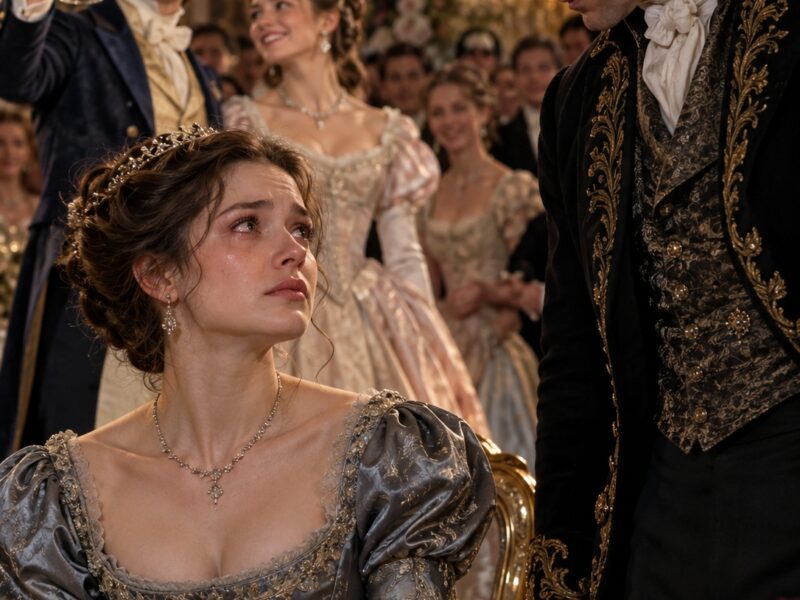
He Humiliated His Bride Before 300 Guests—But the Duke Watching From Across the Ballroom Knew Something He Didn’t
Harry Vance announced that he was marrying another woman in front of three hundred guests, then raised his glass as though he expected his abandoned fiancée to join the toast.
Lady Aina Winterborne did not cry.
But across the crowded ballroom, the Duke of Hargate was watching her with an expression that suggested her humiliation was only the beginning of something far more dangerous.
The ballroom at Deville House glittered beneath a hundred chandeliers that cold November evening in 1813. Candlelight shimmered across polished floors, jeweled necklaces, and the carefully arranged smiles of England’s fashionable society. Hothouse roses filled enormous porcelain vases, their heavy fragrance mingling with perfume and the heat of three hundred bodies gathered beneath one magnificent ceiling.
Outside, frost had settled over the carriage steps.
Inside, a young woman’s future was being dismantled in public.
Aina stood beside a marble column in a gown of muted pewter silk, her gloved fingers resting lightly around the stem of a champagne glass. At twenty-four, she had learned the advantages of being overlooked. She knew how to listen without appearing curious, how to observe without drawing attention, and how to keep her face composed when she wished desperately to leave a room.
Those talents had served her in ways no one at the ball could have imagined.
For four years, through contacts established by her late uncle, she had quietly translated coded dispatches for the Home Office. Her work was painstaking, frequently exhausting, and almost entirely unacknowledged. Yet more than one piece of sensitive British intelligence had been recovered because she noticed a pattern that trained men had dismissed.
She had never told Harry Vance the full extent of it.
She had believed that some part of herself could remain private even within marriage.
Standing in that ballroom, she understood how thoroughly she had misjudged the man she intended to marry.
Harry stood beneath the gilded archway near the musicians, handsome and confident in a blue superfine coat. At twenty-eight, he had the easy manner of a gentleman who had never been required to explain himself for very long.
He was the nephew and heir presumptive of Sebastian Vance, the fourth Duke of Hargate.
And he was holding another woman’s hand.
Miss Cecilia Roare stood beside him in pale blue silk, her dark curls arranged beneath a delicate spray of diamonds. She was the daughter of a Bristol merchant whose fortune had recently expanded with alarming speed through the shipping trade.
Aina had met her twice.
Both times, Cecilia had been perfectly civil.
Now Harry lifted his glass.
“My friends,” he began, smiling broadly, “there appears to have been a small misunderstanding regarding my future.”
The musicians fell silent.
The conversation nearest him faded, followed by the soft hush that spreads through a crowded ballroom when the guests realize someone is about to say something worth repeating.
“My betrothal to Lady Aina Winterborne,” Harry continued, “was, I’m afraid, a misunderstanding of some duration.”
Aina felt the cold stem of her glass press against her palm.
“I trust she will forgive the confusion.”
He turned toward Cecilia.
“Miss Roare has done me the considerable honor of accepting my hand.”
For a heartbeat, the room remained utterly still.
Then someone laughed.
Another guest followed.
Soon a ripple of uneasy amusement moved through the gathering, gathering strength from the relief of people who were grateful the humiliation belonged to someone else.
Aina recognized Lady Pembroke’s high, breathless laugh near the windows. She heard a gentleman murmur something about unexpected changes of fortune. Several women turned to locate her.
The worst of it was not that Harry had chosen another woman.
It was that he had arranged for her to discover it alongside everyone else.
He had given her no private explanation, no apology, not even the dignity of a warning.
Only that morning, she had received a brief note from him suggesting they speak after supper.
She had carried it in her reticule.
For one absurd moment, she wondered whether she should take it out and read it again.
Instead, she placed her untouched glass on a passing servant’s tray.
Her hand did not shake until the servant had turned away.
“Aina.”
She looked toward the voice.
Lord Ashcombe, an elderly acquaintance of her father’s, had approached with an expression of painful sympathy.
“My dear girl, I had no idea.”
“Neither did I, my lord.”
He glanced helplessly toward Harry.
“A dreadful way to conduct oneself.”
“Yes.”
She could offer nothing more.
Across the ballroom, Harry was accepting congratulations.
Aina watched him laugh at something Cecilia’s father said. She remembered that same smile in the drawing room at Winterborne House, when Harry had asked whether she had finished a particularly complicated translation.
He had called her his clever little scholar.
The words had seemed affectionate then.
Now they made her feel vaguely ill.
For months, she had been trying not to examine certain memories too closely.
A dispatch delivered in March.
A lie about its translation.
A familiar family seal.
And the terrible possibility that the man she loved had stolen something far more consequential than her work.
Near the great marble hearth stood a gentleman who had not laughed.
Sebastian Vance, Duke of Hargate, watched his nephew from beneath dark, severe brows.
At forty-one, he possessed the composed authority of someone who had never needed to raise his voice to be heard. His evening clothes were immaculate but unadorned, his expression cool, and his pale gray eyes had acquired a reputation for making even seasoned politicians reconsider careless statements.
He disliked crowded celebrations.
He disliked unnecessary conversation even more.
Nine years earlier, he had buried his young wife after a fever carried her away before she could bear him a living child. Since then, his household had grown orderly, quiet, and almost painfully efficient.
His sister’s son was expected to inherit his title.
Sebastian had accepted that arrangement for years.
Recently, however, he had begun to question whether blood alone was sufficient reason to trust a man.
He had not forgotten the dispatch Harry had presented in March.
It had allegedly exposed a source of leaked intelligence within Colonel Winterborne’s regiment. But the translation had ended abruptly, leaving several numerical sequences unresolved.
Harry had dismissed the omissions as corruption in the original cipher.
Sebastian had accepted that explanation only long enough to have the document examined.
What troubled him most was one partial reference to the family’s seal and an unexplained route along the Dover Road.
Within two weeks, he had quietly stationed three trusted men along the coast to observe shipments traveling under Hargate authority.
Their reports had initially been routine.
Then increasingly vague.
By September, all three men had stopped reporting altogether.
No resignations.
No instructions recalling them.
Nothing.
Sebastian had spent the following weeks examining his nephew’s conduct with a patience born of growing dread.
Harry’s gaming debts had increased.
His explanations had become less convincing.
And now he had abruptly abandoned an intelligent, modestly situated fiancée for a woman whose father’s fortune could settle his obligations several times over.
Sebastian looked from Harry to Aina.
Then he crossed the ballroom.
People made way for him before realizing they had moved.
“Lady Aina.”
She turned.
“Your Grace.”
His bow was precisely measured.
“I believe we have matters to discuss.”
Her cheeks warmed.
“I would rather not discuss this evening, if you please.”
“Neither would I.”
Something in his tone made her look directly at him.
He lowered his voice.
“I wish to discuss the dispatch you translated in March.”
Aina felt every sound around her diminish.
Sebastian continued.
“Specifically, I should like to know how much of it you never showed my nephew.”
She stared at him.
The question was impossible.
She had told no one that the dispatch was complete.
Not Harry.
Not the officials who received the partial translation.
Not even her father.
“Your Grace,” she said carefully, “I don’t know what you believe.”
“I believe Harry brought me half a translation and represented it as the whole. I believe the missing portion concerns my family’s seal. And I believe three men I stationed near Dover have vanished because of something connected to that document.”
He paused.
“I also believe my nephew’s financial affairs are considerably worse than he has admitted.”
Beyond Sebastian’s shoulder, Harry laughed.
Aina heard it with dreadful clarity.
For weeks she had kept the completed dispatch hidden beneath a false panel in her father’s writing desk. Each night, she had told herself she needed more evidence before accusing anyone.
She had mistaken delay for caution.
Now the Duke stood before her, and she could no longer sustain the distinction.
“You are not mistaken,” she whispered.
A muscle tightened in Sebastian’s jaw.
“Then this is not the room for our conversation.”
His eyes briefly moved toward Harry.
“My carriage will call at Winterborne House tomorrow at eleven. Whether you choose to receive me is entirely your decision.”
He inclined his head.
“But understand something, Lady Aina. Whatever you believe you are protecting by remaining silent, my nephew has demonstrated tonight that he has no intention of protecting you.”
He bowed and withdrew.
Aina remained beside the column.
The ballroom continued around her, brilliantly lit and intolerably cheerful.
Harry had publicly discarded her.
But the conversation she had just endured frightened her far more than his betrayal.
Because the Duke of Hargate had asked the one question she had hoped never to answer.
And he had done so as though he already knew what the answer would cost them both.
She found her father near the card room.
Colonel Edmund Winterborne had once been a formidable figure in his regiment, respected for his discipline and stubborn integrity. Now his uniform hung a little loose across his shoulders, and worry had deepened the lines around his mouth.
The disappearance of military stores and the suspicion of compromised communications had aged him more severely than any campaign.
He took Aina’s hand.
“You bore that remarkably well.”
“I don’t feel as though I did.”
“No one ever does while it is happening.”
He looked toward the ballroom doors.
“I trusted that young man.”
“So did I.”
Her father gave her fingers a gentle squeeze.
“That is the trouble with trust. It requires so little effort from the person receiving it.”
Aina almost smiled.
Then he studied her face more closely.
“The Duke spoke with you.”
“Yes.”
“About Harry?”
“About the March dispatch.”
Her father’s hand went still.
For a long moment, he said nothing.
Then, very quietly, “Aina, tell me you never completed the remainder.”
She could not answer.
The silence between them changed.
Her father released her hand, not in anger, but as though he needed a moment to steady himself.
“Good God,” he whispered.
He understood.
Perhaps he had suspected for months.
And now they both knew that the truth Aina had concealed was no longer safely contained within a locked drawer.
That night, she did not sleep.
At Winterborne House, the fires burned low while wind pressed against the windows. The servants retired, and the familiar sounds of the household gradually disappeared.
Aina remained in her father’s old study.
She withdrew the false bottom of the writing desk and laid the dispatch across the green leather surface.
The pages were crowded with figures, painstaking substitutions, and a cipher key reconstructed from incomplete patterns.
Near the bottom was the sentence she had checked a dozen times.
The ledger travels south by the Dover Road under the family seal.
She had translated those words in March.
She had spent the intervening months wishing she had been wrong.
The seal referred to Hargate.
A trusted heir could authorize shipments beneath it with very little scrutiny. A customs officer confronted with that impression would be far less inclined to inspect every parcel.
And the intelligence stolen from her father’s regiment had reached French hands.
She had given Harry only the first portion of the translation, claiming the remainder was corrupted.
He had accepted it.
Worse, he had taken her work to his uncle and allowed Sebastian to believe he had deciphered it himself.
Aina remembered waiting for him to ask whether she might finish the remaining lines.
He never had.
At the time, she had interpreted his indifference as impatience.
Now she wondered whether he had already known precisely what those lines would expose.
A soft knock interrupted her thoughts.
Mrs. Pritchard, her longtime companion, stood in the doorway wearing a wool shawl over her nightdress.
“Still awake, my lady?”
Aina slid the papers beneath a ledger.
“I was thinking.”
“I imagine you’ve had enough to think about.”
Mrs. Pritchard came farther into the room.
“That young man ought to be ashamed of himself. Making a spectacle of you like that.”
“He seemed rather pleased with the result.”
“That is because he has not yet learned the difference between being admired and being respected.”
Aina lowered her eyes.
Mrs. Pritchard glanced at the desk, noticing the ink on her fingers.
“The Duke’s carriage has been discussed downstairs.”
“Has it?”
“Twice. The servants are rather curious.”
“Then I hope they won’t be disappointed.”
Mrs. Pritchard studied her.
“Will you receive him?”
Aina looked at the closed drawer.
She had spent months trying to protect everyone from a truth she could not prove.
Tomorrow, she would have to decide whether her silence had protected anyone at all.
“Yes,” she said.
“I believe I must.”
At precisely eleven the following morning, the Duke’s carriage stopped before Winterborne House.
Sebastian descended himself.
He did not send a servant to summon her.
Nor did he attempt to conduct the conversation beneath her father’s roof, where curious ears might be listening.
Instead, he escorted her to Hargate House.
The journey passed in near silence.
Aina watched bare branches pass beyond the carriage window while Sebastian reviewed a small stack of correspondence.
Once, he looked up.
“You may still refuse to discuss the matter.”
“Would you truly permit me to leave without asking again?”
“Yes.”
She studied him.
“Even knowing what may be at stake?”
“Especially then. I have no wish to learn the truth through coercion. It would leave me uncertain which parts of it I could trust.”
Aina turned back toward the window.
Harry had always demanded answers with the impatience of a man who considered her intellect useful only when it served him.
Sebastian’s restraint unsettled her more deeply than an interrogation might have done.
His study was paneled in dark oak, with tall windows overlooking frost-darkened gardens. A fire burned beneath a carved mantelpiece. Books stood in orderly rows, and a brass clock measured the silence from a shelf.
Sebastian offered her a chair.
Then he placed a sheet of paper before her.
Aina recognized the handwriting instantly.
Harry’s signature appeared beneath a translation written in her own hand.
“This is what my nephew submitted,” Sebastian said. “I had a government cryptographer examine it. He has worked with such material for twenty years.”
“And?”
“He considers the work accurate.”
Aina said nothing.
“But he also believes the sequence ends too neatly to have been corrupted by accident.”
Sebastian took the opposite chair.
“He suggested that the person who deciphered it either could not continue or chose not to.”
His gaze settled on hers.
“Which was it?”
“The second.”
The admission came more easily than she expected.
She drew a breath.
“I completed it within a fortnight. I have known since March what the remainder says.”
“And you told no one.”
“No.”
“Why?”
She had rehearsed explanations for months.
Now none of them seemed adequate.
“Because it named your house. I knew intelligence was leaving my father’s regiment, and I knew the Hargate seal was being used to transport it. But I did not know who had authorized the shipments.”
She looked down at her hands.
“It could have been a servant. A steward. Someone with access to family papers.”
“Or Harry.”
“Or Harry.”
Sebastian’s expression barely changed.
Yet something in his stillness made her understand that hearing the words aloud had hurt him.
“I was going to marry him,” Aina said. “I could not place evidence in his hands that might lead to his hanging. Nor could I accuse him without understanding precisely what had happened.”
“And so you kept the document.”
“I told myself I was gathering certainty.”
“Perhaps you were.”
“Perhaps I was afraid.”
Sebastian did not contradict her.
She found herself grateful for that.
He rose and walked toward the window.
“By keeping the completed dispatch, you have made yourself dangerous to whoever is responsible.”
Aina followed him with her eyes.
“If Harry suspects you know more than you admitted, his decision to abandon your engagement may not have been entirely romantic.”
“Miss Roare’s fortune is substantial.”
“So are his debts.”
He turned.
“I don’t believe in coincidences that arrive so conveniently, Lady Aina. Not when three of my men have disappeared and my nephew has suddenly discovered an urgent preference for a wealthy bride.”
Aina remembered Harry’s laughter.
The realization that his cruelty might have concealed fear left her cold.
“Do you believe he means me harm?”
“I believe he has already demonstrated his willingness to injure you when doing so serves him.”
Sebastian returned to the desk.
“What worries me is that we do not yet know how much further that willingness extends.”
For several moments, the only sound was the fire.
Then Sebastian placed both hands on the back of his chair.
“I asked you here to offer my protection.”
“I am grateful, Your Grace.”
“And something else.”
He hesitated.
It was such a small movement that she might have missed it had she not spent years studying people who believed themselves unreadable.
“I did not expect ever to make this offer again,” he said.
Aina looked at him uncertainly.
“Lady Aina, I should like you to marry me.”
She stared.
The clock continued ticking.
For a moment, she thought she had misunderstood him.
“Your Grace?”
“I am aware that it is an extraordinary suggestion.”
“That would be one description.”
He almost smiled.
“I will not insult you by claiming some sudden romantic attachment. We scarcely know one another.”
“Indeed.”
“But you possess information that may expose someone within my family. You also possess the ability to interpret the evidence accurately. As my wife, you would have a security and position that neither your former engagement nor your father’s present circumstances can provide.”
Aina looked toward the fire.
“You would marry me to obtain my assistance?”
“I am asking for your assistance whether you marry me or not.”
He spoke with deliberate care.
“Marriage would allow me to protect you while we investigate. It would also make it impossible for my nephew to dismiss your knowledge as the invention of a rejected woman without simultaneously challenging my own judgment.”
She considered that.
It was practical.
Audacious.
Almost offensively sensible.
“Your proposal is not especially romantic.”
“No.”
Sebastian paused.
“But neither is it entirely without admiration.”
She looked up.
“I watched you last night,” he continued. “You were treated with a cruelty no honorable gentleman would have inflicted. You had every reason to make a scene.”
“I was too shocked.”
“Perhaps. Yet you retained your dignity when everyone around you seemed willing to treat it as entertainment.”
His voice softened.
“I have not met many people who understand what it means to have dignity left to them when so much else has been taken away.”
Aina felt something shift inside her.
Not love.
Not yet.
But the unfamiliar sensation of being accurately seen.
She folded her hands.
“If the evidence leads to your nephew, will you still permit it to be brought forward?”
Sebastian answered without hesitation.
“If Harry has betrayed this family and endangered the Crown, I will not protect him from the consequences.”
“Even though he is your heir?”
“Especially then.”
Aina held his gaze.
“And if the truth damages your own standing?”
“Then I shall have to bear it.”
“Your family’s reputation?”
“Is worth nothing if it exists only because we conceal our crimes.”
Silence followed.
Sebastian extended his hand across the space between them.
“I am asking you to help me discover the truth, wherever it leads. And I am offering to stand beside you when that truth becomes dangerous.”
Aina looked at his open hand.
Harry had once closed her fingers around promises he never intended to keep.
Sebastian offered his without attempting to take hers.
She placed her hand in his.
“Then I accept.”
Eleven days after the ball at Deville House, Lady Aina Winterborne became the Duchess of Hargate.
The ceremony was small.
A special license had been obtained through the appropriate ecclesiastical arrangements, allowing the marriage to proceed without the usual delay. Only a handful of trusted witnesses attended.
There were no extravagant flowers.
No crowded breakfast.
No carefully cultivated spectacle.
Aina wore ivory silk and a modest pearl necklace that had belonged to her mother.
Sebastian waited beside the altar in a dark coat, his face composed until she entered.
Then his expression changed so slightly that no one else appeared to notice.
Aina did.
When he took her hand, his fingers were warm.
He did not promise her a life without difficulty.
Nor did she mistake their arrangement for the love she had once imagined with Harry.
But when they spoke their vows, Sebastian looked directly into her eyes.
For the first time in months, she did not feel as though she were giving her future to a man who wanted only the parts of her that were convenient.
Hargate House received its new Duchess quietly.
Sebastian had deliberately avoided any grand announcement.
Harry, he knew, would hear the news from someone else.
Four days later, he did.
His arrival announced itself through raised voices in the entrance hall.
Aina was in the morning room when she heard the front door open and a familiar voice demand to see the Duke.
She stood.
By the time she reached Sebastian’s study, Harry had already entered without waiting for permission.
“You married her?”
Harry’s face was flushed beneath the elegant arrangement of his dark hair.
Sebastian remained seated behind his desk.
“Good morning, Harry.”
“My former fiancée. My discarded bride.”
“Lady Aina is now my wife. I suggest you remember how to address her.”
Harry gave a sharp, humorless laugh.
“Have you considered how this appears?”
“Quite thoroughly.”
“Uncle—”
“It appears that you publicly rejected a woman of intelligence and character, only to discover that I recognized her qualities rather more clearly than you did.”
Sebastian closed the document before him.
“I find I am entirely at peace with the arrangement.”
Harry’s eyes shifted toward Aina.
She stood beside the doorway.
His gaze lingered on her wedding ring.
For a moment, anger gave way to something colder.
Calculation.
“I wonder,” he said, “whether my former fiancée has been filling your head with stories.”
Aina felt the familiar sting.
Harry continued.
“Women do not always take rejection gracefully.”
Sebastian’s expression hardened.
“Then perhaps we should discuss the March dispatch.”
Harry stopped.
“The what?”
“The translation you brought me, bearing your signature.”
“Yes, of course.”
“Remind me how you decoded it.”
Harry gave an impatient shrug.
“I did the greater part myself. Aina assisted with a few conventions.”
“How interesting.”
Sebastian opened a drawer.
“Every other translation prepared by my wife has been complete. Yet the one you claimed as your own ended halfway through the cipher.”
“The original was damaged.”
“So you told me.”
“It was.”
“Then you will be pleased to learn that the remainder has since been translated.”
The color slowly left Harry’s face.
Aina watched him struggle to recover.
“Then you know it is nonsense.”
“I know it identifies the Hargate seal as a means of transporting intelligence along the Dover Road.”
Harry said nothing.
“I also know the dates correspond closely with certain financial obligations you have neglected to mention.”
“Coincidence.”
“And that three men assigned to observe our coastal shipments have disappeared.”
Harry’s jaw tightened.
“You cannot seriously suggest—”
“I am suggesting nothing,” Sebastian interrupted. “I am collecting evidence.”
He leaned back.
“And it is accumulating rather faster than you might prefer.”
Harry looked toward Aina.
There it was.
Not hurt pride.
Not the wounded vanity of a man whose former fiancée had married above his expectations.
Fear.
For the first time, she understood how much he had depended upon her silence.
“You would take her word over mine?” he demanded.
“I would take proof over either of your words.”
Harry stood motionless.
Then he turned and left.
Aina heard his footsteps retreat through the hall.
Moments later, a horse was brought around with unusual haste.
She moved toward the window.
Harry rode away without looking back.
“He will not accept this quietly,” she said.
Sebastian came to stand beside her.
“No.”
“He will look for another way to protect himself.”
“Then we must find the evidence before he can destroy it.”
His hand settled beside hers on the windowsill.
After a moment, she turned her palm upward.
He took it.
It was a small gesture.
Neither of them spoke about it.
But when Aina returned to her work that afternoon, she discovered that Sebastian had prepared a writing desk for her in a bright room adjoining his study.
There were fresh pens.
Clean paper.
An orderly set of reference books.
And a key.
She held it up.
“What is this?”
“The desk locks.”
“Naturally.”
“But you need not use it to conceal your work from me.”
Aina examined the room.
Sunlight fell across the writing surface, illuminating every inch.
For four years, she had worked at night, hiding her papers whenever footsteps approached.
Now her work had a place in daylight.
She had to look away before Sebastian noticed how deeply that affected her.
The investigation unfolded slowly.
There were no dramatic confessions in the first days, no convenient letters openly admitting betrayal.
Instead, Aina compared dates.
Sebastian examined shipping records.
Together they studied the remnants of coded correspondence, estate accounts, customs entries, and bills settled through intermediaries.
Some leads led nowhere.
One shipment registered under Hargate authority proved entirely legitimate.
Another apparent discrepancy came from a clerk’s arithmetic error.
A third connection brought them to a coastal steward named Price.
He had worked for the Hargate family for eleven years.
His reputation had been dependable, if unremarkable.
That, Sebastian suspected, was precisely why Harry had chosen him.
Price was summoned to the Duke’s study on a cold afternoon.
The older man entered clutching his cap.
“Your Grace.”
“Sit down, Price.”
“I would rather stand, if you please.”
Sebastian did not insist.
Aina remained at her desk with the ledgers arranged before her.
She watched the steward’s eyes move across the documents.
He recognized them.
Sebastian noticed.
“You have supervised shipments traveling under my family’s seal.”
“Yes, Your Grace.”
“Some were authorized by my nephew.”
“Yes.”
“And several occurred on dates that correspond with unexplained payments.”
Price swallowed.
“I only followed instructions.”
“Whose instructions?”
“His lordship’s.”
“Harry’s?”
The steward lowered his eyes.
Sebastian waited.
Aina had learned that silence could reveal more than the cleverest question.
At last Price spoke.
“I was paid to see that certain parcels passed through without inconvenience.”
“What did they contain?” Aina asked.
“I don’t know, Your Grace.”
“Did you ever open one?”
“No.”
“Did you suspect they contained something improper?”
Price gripped the cap more tightly.
“I suspected it was something I would be better off not knowing.”
Sebastian’s expression grew severe.
“Your continued silence may result in dismissal without a character reference and, should the evidence justify it, prosecution as an accomplice.”
The steward’s breathing changed.
“Please, Your Grace. I have a family.”
“Then tell us the truth while you still have the opportunity.”
Price stared at the floor.
Finally, his shoulders sagged.
“He paid well. More than I’d ever seen for work so little trouble. When I considered refusing, he made it plain that doing so would be unwise.”
Aina leaned forward.
“Who received the parcels?”
“A wine merchant near Dover. French by birth, though he conducted business under an English name.”
“Do you know where his correspondence was kept?”
Price hesitated.
Then he gave them the address.
It was the first substantial break in their investigation.
Through the records Price identified and correspondence recovered from the coastal arrangements, Aina began reconstructing the scheme.
The truth was worse than she had feared.
Harry had not merely taken desperate measures to settle gambling debts.
He had been selling increasingly sensitive information to a French agent posing as a wine merchant for nearly two years.
His first payments predated his serious gambling losses.
He had begun because the arrangement seemed profitable and relatively safe.
Only later had his debts made him more dependent upon it.
Aina laid the evidence before Sebastian one evening.
He had removed his coat and sat with his shirtsleeves rolled back, studying a list of payments.
“The first transaction occurred well before his largest losses,” she said.
Sebastian looked up.
“How much earlier?”
“Nearly a year.”
He examined the dates.
“So the debts did not drive him to it.”
“No.”
Aina touched the earliest entry.
“He did not enter this arrangement because he was drowning. He stepped into it because it appeared easy. By the time he realized how deep the water was, he could no longer climb out.”
Sebastian stared at the paper.
For the first time, Aina saw how deeply this investigation had wounded him.
Harry was not merely an irresponsible nephew.
He was the boy Sebastian had helped raise.
The child he had taught to ride.
The young man he had defended when others criticized his carelessness.
There was a difference between suspecting someone you loved and knowing what they had done.
Sebastian closed his eyes briefly.
“Then there is no mercy I can extend by concealing it.”
Aina remained silent.
“Only consequences.”
He opened his eyes.
“None of this would have come to light without your work.”
“I concealed the most important portion for months.”
“You also prevented Harry from discovering what you knew.”
“Out of fear.”
“Out of uncertainty,” Sebastian corrected gently. “And perhaps fear as well. Those are not the same as dishonor.”
She looked at him.
He continued.
“You should have had someone you trusted enough to tell. You should not have been left to carry it alone.”
Aina felt her throat tighten.
No one had said that to her before.
He reached across the desk.
“Aina.”
It was the first time he had used her given name without a title.
One quiet word.
Yet it warmed her more than any extravagant compliment Harry had ever offered.
Over the following weeks, they learned what had become of Sebastian’s missing men.
Price admitted, under further questioning, that each had been approached and paid to abandon his coastal post.
There had been threats as well.
Harry had implied that refusal would lead to consequences far worse than unemployment.
The men had fled inland.
They had not been murdered, as Sebastian and Aina had feared.
That knowledge brought relief, though it did nothing to diminish the seriousness of the betrayal.
By then, the relationship between the Duke and Duchess had changed in ways neither had anticipated.
Their conversations no longer concerned only documents.
They sometimes worked until the fire burned low, then ate supper together in the small dining room.
Sebastian began asking about her childhood.
Aina learned that his late wife had loved gardening and that, for years after her death, he had avoided walking through the rose garden because he could not bear the memory of her there.
He did not speak about his grief often.
When he did, Aina listened without trying to improve it.
One evening, he told her that the household had seemed particularly silent after his wife died.
“I believed I had become accustomed to it.”
“And had you?”
“I had become skilled at not noticing.”
Aina considered the answer.
“I think I know something about that.”
He looked at her.
“Being overlooked?”
“Being useful only when no one notices how much effort it takes.”
Sebastian rested his glass on the table.
“I notice.”
Aina lowered her gaze, but she smiled.
Their marriage was still young.
Love had not arrived in a sudden declaration.
It came in smaller ways.
A fresh candle placed beside her desk before she realized the old one was nearly spent.
A question asked because he genuinely wanted her answer.
The habit of looking for one another when entering a room.
The relief of sharing silence without being required to fill it.
And the growing recognition that neither of them wished to return to the lives they had led before.
The investigation, however, was becoming impossible to conceal.
One gray afternoon, Miss Cecilia Roare arrived at Hargate House.
Aina received her in the drawing room.
Cecilia looked exhausted. Beneath her fashionable bonnet, her face was pale, and she twisted her gloves between her fingers.
“Your Grace,” she began, “I must apologize for arriving without an appointment.”
“You are welcome to sit, Miss Roare.”
Cecilia sat.
For several moments, she seemed unable to decide where to begin.
At last, she said, “Harry has changed.”
Aina remained still.
“He scarcely sleeps. He is angry over the smallest things. My father has asked him about some financial arrangements, and he becomes evasive.”
Cecilia stared down at her gloves.
“He speaks of traveling abroad. Suddenly. Without explaining where.”
Aina felt a small chill.
“Has he made arrangements?”
“I do not know.”
Cecilia looked up.
“I came because I am afraid of what I might discover.”
Her voice shook.
“I was unkind to you without intending to be. I should have asked whether you knew what he planned that evening.”
Aina studied her.
Cecilia had enjoyed the attention of a handsome aristocrat. Perhaps she had allowed herself to believe an engagement could be broken without injuring the woman left behind.
But she had not engineered Harry’s cruelty.
And now she faced a danger of her own.
“You did not make his announcement,” Aina said.
“No. But I stood beside him.”
“Yes.”
Cecilia accepted the answer without protest.
Then she asked the question she had clearly come to ask.
“Is Harry in danger, Your Grace?”
Aina looked toward the window.
Beyond the glass, rain gathered on bare branches.
“Or,” Cecilia added, almost whispering, “is he the danger?”
Aina turned back.
She could not reveal an active investigation.
But she could not bear to leave another woman trusting Harry with her future.
“I cannot tell you everything,” she said.
Cecilia’s fingers tightened around her gloves.
“But I strongly advise you not to marry him until certain matters have been resolved.”
Cecilia was silent.
Then she drew herself upright.
“Thank you.”
Her voice was steadier.
“I would rather hear an unpleasant truth than be comforted with something false.”
She rose.
“I shall wait. And I shall pay closer attention.”
After Cecilia left, Aina remained in the drawing room for several minutes.
She thought of the night at Deville House.
Of Cecilia standing beside Harry beneath the chandeliers.
Of the laughter.
It would have been easy to resent her.
But Aina had learned that the wrong person could cause immense suffering without everyone near him becoming an enemy.
Cecilia did not return.
When the scandal eventually became public, she would send Harry’s ring back through a messenger.
Neither her hand nor her father’s fortune would remain available to him.
By then, Harry had grown desperate.
Three nights after Price’s confession, word of the steward’s cooperation reached him through a disloyal member of the Hargate household.
Shortly after midnight, Aina woke to the sound of breaking glass.
The noise came from the east wing.
For a heartbeat, she lay still beneath the covers, listening.
Then a door slammed in the distance.
Beside her, Sebastian was already rising.
“What was that?”
“The study, I believe.”
He reached for the pistol kept in a locked bedside drawer.
“Stay here.”
Aina threw back the covers.
“No.”
“Aina—”
“If someone has come for the correspondence, we have very little time.”
Sebastian stopped.
She reached for her dressing gown.
“The false drawer in the study is empty. I moved everything into the locked box in your dressing room last week.”
His expression changed.
“You did?”
“Yes. I was concerned someone might search the study.”
He looked toward the door.
“Then whoever entered will discover the mistake.”
“Precisely. And I would rather not leave you to discover alone what he does afterward.”
Sebastian studied her for a moment.
Then he held out his hand.
“Stay behind me.”
They hurried along the corridor.
The house was dark except for a few wall lamps. Cold air moved through the passage near the east wing.
As they approached the study, Aina heard wood splinter.
Sebastian entered first.
The window stood broken inward.
Glass glittered across the carpet.
Harry Vance stood beside the desk, a letter opener clenched in one hand.
With the other, he was forcing the concealed drawer from its fittings.
He turned at the sound of their arrival.
His face was unrecognizable.
The handsome charm that had persuaded a ballroom to laugh at another person’s humiliation was gone.
In its place was exhaustion, terror, and furious resentment.
“Harry,” Sebastian said.
His voice was low.
“Put down the blade.”
Harry looked at the pistol.
Then at his uncle.
“You’ve ruined me.”
Sebastian did not move.
“You entered my house through a window at midnight with a blade in your hand.”
“You brought me to this.”
“No.”
Harry’s breathing quickened.
“All over some parcels? Some money? You would destroy your own family because she couldn’t keep her clever little head out of matters that didn’t concern her?”
Aina felt the words strike.
Once, she might have lowered her eyes.
Not now.
“Those parcels carried military intelligence,” she said. “Men were forced to abandon their lives because of them.”
Harry gave a bitter laugh.
“You always did imagine yourself terribly important.”
“Enough.”
Sebastian’s voice cut through the room.
“Your quarrel is not with my wife. It is with what you have done.”
Harry turned back toward the desk and wrenched the hidden drawer free.
It came loose with a violent crack.
Empty.
He stared.
For several seconds, he did not move.
Then his shoulders seemed to fold inward.
“Where is it?”
Neither answered.
“Where is the correspondence?”
“Somewhere you cannot reach it,” Aina said.
Sebastian raised a hand to prevent her moving closer.
She stayed where she was.
“It is finished, Harry.”
He looked at her.
For the first time that night, she saw not arrogance but something horribly young beneath it.
Fear stripped of every defense.
“I never wanted it to become this.”
Aina said nothing.
Harry’s grip weakened.
“It was supposed to be one payment. Then another.”
His voice broke.
“I thought I could settle what I owed and stop.”
“You began before the debts became serious,” Aina said quietly.
Harry flinched.
The lie had survived for so long that hearing someone deny it seemed to disorient him.
“You don’t understand.”
“I understand more than you think.”
“No,” he whispered.
His gaze shifted toward Sebastian.
“I couldn’t come to you.”
“Why not?”
Harry gave a desperate, breathless laugh.
“Because you would have looked at me exactly as you are looking at me now.”
For the first time, Sebastian’s expression changed.
Grief crossed his face.
Not anger.
Something far more painful.
“I would have helped you.”
Harry stared.
“If you had come to me with gambling debts, I would have been furious. I would have paid what was necessary, lectured you for a fortnight, and expected you to repay every penny you could.”
Sebastian swallowed.
“And I would have loved you regardless.”
Harry’s eyes filled.
“But you did not come to me with debts.”
Sebastian’s voice steadied.
“You came to me with stolen intelligence. With another person’s work passed off as your own. With threats made against innocent men. And now with a blade in your hand, in my house, in the middle of the night.”
The letter opener slipped from Harry’s fingers.
It struck the floor with a small metallic sound.
No one moved.
“There is no way for me to conceal this,” Sebastian said.
“Uncle, please.”
“There is only the law now. And whatever mercy the law may still extend.”
Harry lowered his face into his hands.
Aina watched him and felt no triumph.
She had loved him once.
Or perhaps she had loved the man he had allowed her to imagine.
The distinction no longer seemed important.
What mattered was that his actions had endangered people who would never attend an elegant ballroom or have a Duke to speak for them.
Aina stepped toward Sebastian.
She did not look away when the servants entered.
Nor when Harry was taken into custody.
Before dawn, the magistrates arrived.
Harry Vance, once the presumed future Duke of Hargate, was led from the house in restraints as the first pale light touched the frost-covered gardens.
Aina watched from an upstairs window.
The scene was quiet.
No crowd gathered to laugh.
No one raised a glass.
The difference struck her with uncomfortable force.
Society had found her humiliation entertaining.
It would find Harry’s treason unforgivable.
Yet both had grown from the same conviction that other people’s lives existed chiefly for his convenience.
Sebastian stood beside her.
For several moments, neither spoke.
Then Aina took his hand.
He held it tightly.
The trial took place in the new year.
By then, the correspondence had been recovered and examined by government officials. Price agreed to testify, as did others whose involvement could be established through the shipping records.
Harry’s handwriting appeared on documents bearing the Hargate seal.
The transactions were traced through the accounts.
The coded dispatches were examined.
The case against him rested not on gossip, suspicion, or a former fiancée’s wounded pride, but on evidence he could no longer explain away.
Aina was called to testify.
The courtroom was colder than the ballroom at Deville House had been.
There were no roses.
No chandeliers reflecting from jeweled hair.
Only the scrape of chairs, the rustle of legal papers, and the solemn attention of men who understood that the case concerned more than a family’s scandal.
When asked to explain her work, Aina spoke plainly.
She described the cipher.
The partial translation.
The sequence that identified the Hargate seal.
And the reasoning by which she had reconstructed the missing lines.
She did not attempt to appear clever.
She simply answered each question.
Harry did not meet her eyes.
For years, she had allowed her work to circulate beneath other men’s names.
Now she spoke in her own voice.
The court convicted Harry of treason.
The sentence was transportation rather than execution, a measure of mercy influenced in part by Sebastian’s testimony and the family’s cooperation in bringing the evidence forward.
Harry would be sent across the ocean.
He would not return to England.
The morning the sentence was confirmed, Sebastian stood alone in his study for a long time.
Aina found him beside the window.
He held a small, worn riding glove.
She recognized it as a child’s.
“Harry’s?” she asked.
Sebastian nodded.
“He was nine when I first taught him to ride properly.”
Aina approached quietly.
“He was afraid of the horse,” Sebastian continued. “Wouldn’t admit it. Insisted the animal was badly trained.”
Despite herself, Aina smiled faintly.
“That sounds familiar.”
“He fell twice.”
Sebastian looked down at the glove.
“The third time, he stayed on. I remember how proud he was.”
His voice thickened.
“I have spent months remembering the man he became. Today, for some reason, I can only remember the boy.”
Aina stood beside him.
She did not tell him that Harry deserved his punishment.
Sebastian knew that.
She did not suggest he should cease grieving someone still alive.
Instead, she rested her hand on his arm.
“You loved him.”
“Yes.”
“And now?”
Sebastian stared at the glove.
“I suppose that is what makes it so dreadful.”
Aina leaned gently against him.
They remained by the window until the light changed.
Spring arrived slowly.
The frost retreated from the lawns, and the gardens began to regain their color. Along the Dover Road, which had carried Harry’s illicit shipments for nearly two years, green shoots emerged beside the hedgerows.
The Hargate succession was redirected to a distant cousin whose steadier character gave Sebastian some reassurance about the family’s future.
Colonel Winterborne’s name was cleared of the suspicions that had shadowed his regiment.
The Home Office, in private correspondence rather than public ceremony, acknowledged the importance of Aina’s work and the contribution her careful translations had made to exposing the intelligence network.
Much of what she had accomplished would never be widely known.
The people whose lives had been protected might never learn her name.
There had been a time when that would have troubled her.
Not because she craved applause, but because invisibility had too often been used as an excuse to deny her worth.
Now she understood the difference between secrecy and disregard.
Some work required discretion.
But discretion need not demand that the person doing it be diminished.
At Hargate House, she continued her translations.
Her desk remained in the bright adjoining room.
Sebastian consulted her about matters beyond intelligence, from estate affairs to the education of younger members of the household.
He listened when she disagreed.
Occasionally, he even admitted she was right without making the admission sound like a personal defeat.
Mrs. Pritchard, who had accompanied Aina into her new household, observed the arrangement with undisguised satisfaction.
“His Grace asks more questions than he used to,” she remarked one afternoon.
“Does he?”
“And appears much happier with the answers.”
Aina laughed.
She had not realized how easily laughter had returned to her life.
One mild evening, Sebastian suggested they walk along the cliffs above the coast.
The air smelled of salt and newly warmed earth. Below them, the sea rolled against the rocks in long silver folds.
They walked without attendants.
For a while, they spoke about ordinary things.
A repair needed near the western fields.
A book Aina had been reading.
The possibility of visiting her father before summer.
Then Sebastian fell quiet.
Aina glanced at him.
“Is something troubling you?”
“No.”
He considered.
“At least, not in the way you mean.”
She waited.
They stopped near a low stone wall overlooking the water.
Sebastian rested one hand upon it.
“When I asked you to marry me, I told you it was not a love match.”
Aina felt her heartbeat quicken.
“I remember.”
“I believed I was offering you protection. And perhaps a measure of freedom in which to continue your work.”
“You did.”
“But I did not understand how much I was asking you to give me in return.”
She turned toward him.
“Sebastian—”
He took her hand.
“I spent nine years believing that the part of my life in which I might love someone had ended.”
His voice was quiet.
“After my wife died, I built a tolerable existence around duties I understood. I imagined dignity was something I could preserve, even if happiness was no longer available to me.”
Aina’s fingers tightened around his.
“Then you came into my study with your dispatches and your stubborn insistence upon telling the truth.”
She smiled.
“I recall being rather frightened of you.”
“I suspected as much.”
“You were very severe.”
“I was trying not to say something foolish.”
“And did you succeed?”
“Not entirely. I proposed marriage.”
She laughed softly.
Sebastian smiled.
Then his expression grew tender.
“I did not fall in love with you in that ballroom, Aina.”
She looked into his eyes.
“I admired you there. I was angered by what Harry had done. And I knew you had courage.”
He drew a breath.
“But I fell in love with you afterward, watching you work beside me, watching you choose what was right when silence would have been easier, and discovering that the quiet parts of my life were no longer empty when you were there.”
The wind lifted a strand of hair against her cheek.
Sebastian brushed it gently aside.
“I had convinced myself that dignity and love were separate inheritances, and that a man in my position should be content with the first.”
His thumb moved lightly across her knuckles.
“You have shown me that I was simply fortunate enough, at last, to be offered both.”
Aina’s eyes shone.
But she did not cry.
She had never been a woman who found tears easily.
Instead, she stepped closer and placed her free hand against his chest.
“Do you know what frightened me most after Harry broke our engagement?”
Sebastian shook his head.
“That everyone would remember me only as the woman he did not want.”
He frowned.
“Aina—”
“I know. It sounds foolish now.”
“No. It sounds painful.”
She looked toward the sea.
“I had spent years keeping my work hidden. I told myself that being overlooked was a kind of safety. But when Harry humiliated me, I thought perhaps I had been invisible for so long that there was nothing about me worth seeing.”
Sebastian lifted her hand to his lips.
“I saw you.”
“I know.”
She looked back at him.
“And what made me love you was that you did not merely see what I could do for you.”
Her voice softened.
“You allowed me to be uncertain. Afraid. Sometimes wrong. You never made me feel smaller for any of it.”
Sebastian’s expression changed.
He placed his hand against her cheek.
“I love you, Aina.”
She smiled through the fierce warmth gathering in her chest.
“And I love you.”
He kissed her.
There was nothing hurried or theatrical about it.
No witnesses waiting to approve.
No announcement to make.
Only the wind moving over the cliffs and the sea stretching endlessly beyond them.
When they drew apart, Aina laced her fingers through his.
They stood together as the afternoon light softened over the water.
Months earlier, she had watched Harry take another woman’s hand before three hundred people, believing her own future had been publicly erased.
Now she understood that the worst moment of her life had not revealed how little she mattered.
It had revealed the difference between a man who valued appearances and one who understood her worth.
She had not needed the ballroom to applaud her.
She had needed the freedom to stand in her own light.
And beside her stood a husband who had never once asked her to become less visible so that he might appear greater.
Aina looked out toward the silver water.
For the first time in many years, she did not wonder whether anyone was watching.
She simply felt herself fully present in her own life.
Sebastian squeezed her hand.
And together, they walked home.









