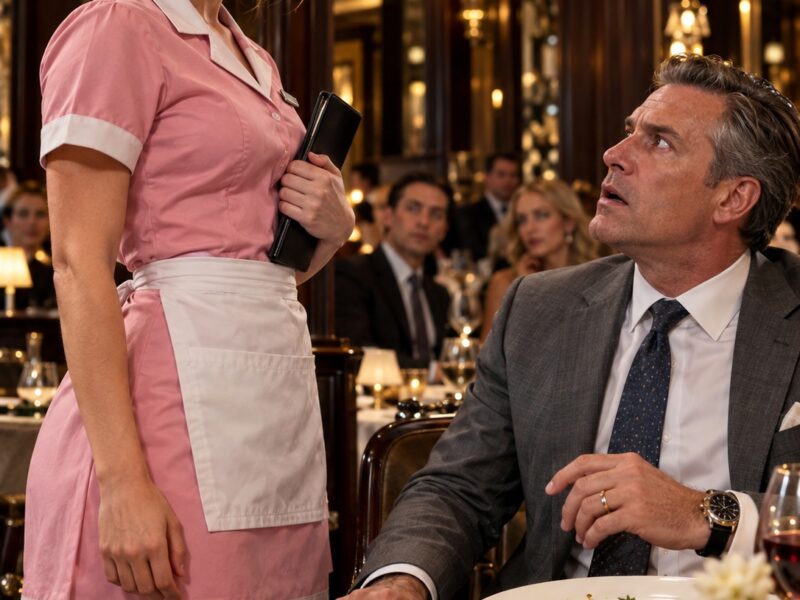
HE HUMILIATED THE WAITRESS IN GERMAN—THEN SHE ANSWERED IN PERFECT GERMAN AND EXPOSED THE MISTAKE THAT WOULD CHANGE BOTH THEIR LIVES

The fork slipped from Marcus Sterling’s hand and struck the porcelain plate with a sharp metallic crack.
For the first time since he had walked into the Bibong Beastro, the millionaire businessman had absolutely nothing to say.
Around him, conversations faded.
A woman at the next table stopped with her wineglass halfway to her lips. A waiter froze near the kitchen doors. Mark, the restaurant manager, stood behind the counter holding a stack of receipts he had forgotten to put down.
And Khloe Harrison—the waitress Marcus had spent two visits treating as if she were barely intelligent enough to carry his water—stood beside his table with her notepad pressed calmly against her apron.
She had just answered him in flawless German.
Not hesitant German.
Not a memorized sentence.
Not the clumsy pronunciation of someone who had practiced one clever comeback for revenge.
Fluent German.
Precise. Controlled. Effortless.
Marcus stared at her.
“What did you say?”
His English sounded strangely small now.
Khloe met his eyes.
Then, still speaking German, she repeated herself.
“The fish is prepared exactly as you ordered it, Mr. Sterling. Well done. The quality is excellent. There is no mistake.”
Marcus’s face changed.
Khloe watched recognition arrive slowly, then all at once.
Because the problem wasn’t that she spoke German.
The problem was that she had understood him all along.
Every joke.
Every insult.
Every smug comment he had made about the restaurant.
Every cruel assumption he had made about her.
Including the sentence he had spoken only moments earlier, certain she could not understand:
People like her never achieve anything in life.
Marcus leaned back.
“You speak German?”
“Yes.”
“How long?”
“Long enough.”
His eyes narrowed.
“Then you understood what I said?”
Khloe could have smiled.
She didn’t.
“Every word.”
And suddenly the man who had entered the restaurant believing he was the most powerful person in the room looked as though someone had quietly removed the floor beneath his chair.
But what Marcus Sterling did not know was that humiliating Khloe Harrison would become one of the most expensive mistakes of his life.
And one of the most important.
Because seven days earlier, he had walked through that same restaurant door and seen nothing more than a waitress.
He had no idea who she had been before the pink uniform.
He had no idea what she could do.
And he certainly had no idea that the woman he had chosen to humiliate was carrying the exact skill his company desperately needed.
A week earlier, Friday night had begun like hundreds of other nights for Khloe.
The Bibong Beastro was packed.
Forks clicked against plates. Glasses chimed. The espresso machine hissed behind the counter while conversations overlapped beneath the warm restaurant lights.
Khloe had already been on her feet for six hours.
Her arches burned.
Her lower back ached.
Her smile remained perfect.
At twenty-eight, she had mastered the strange physical discipline of service work—the ability to hurt without looking hurt, to be exhausted without appearing tired, to absorb another person’s impatience without returning it.
Her pink uniform was spotless.
Her white apron was tied neatly.
Her dark hair was pulled into a careful bun.
Everything about her appearance was controlled because control had become one of the few luxuries she could still afford.
Her rent was overdue.
Her refrigerator contained half a carton of milk, eggs, mustard, and leftovers she had been pretending were still good.
The electricity company had already sent another warning.
But nobody at table six needed to know that.
Nobody ordering barramundi cared.
So Khloe smiled.
“Anything else for you?”
The couple shook their heads.
“Enjoy.”
She turned toward the kitchen.
That was when the front door opened.
Three men entered.
Khloe noticed them immediately.
Everyone did.
Their suits announced money before their mouths had the chance.
Tailored jackets. Expensive watches. Leather shoes polished enough to catch the overhead lights.
They walked with the unconscious confidence of men accustomed to doors opening before they reached them.
The man in the middle was older than Khloe, broad-shouldered, with perfectly combed gray hair and a square jaw.
His eyes moved through the restaurant not with curiosity but evaluation.
As though he had already decided the place was beneath him and was now gathering evidence.
He pointed toward the center table.
Of course he did.
People who needed to be noticed rarely chose corners.
Khloe finished clearing table six and approached.
“Good evening, gentlemen. Do you know what you’d like to order, or would you like a few minutes?”
The gray-haired man looked up.
His gaze moved from her face to her uniform and back.
Not desire.
Not interest.
Assessment.
Then he smiled.
Khloe knew that smile.
She had seen versions of it before.
It was the smile people wore immediately before deciding another human being was safe to disrespect.
The man turned slightly toward his companions.
And spoke in German.
Slowly.
Deliberately.
One of his friends laughed.
Khloe kept her notepad open.
Another comment came.
More laughter.
They were discussing the restaurant.
The quality.
The prices.
Then her.
Marcus Sterling—although Khloe did not yet know his name—watched her carefully while speaking.
He was waiting for confusion.
Waiting for her eyes to shift.
Waiting for the embarrassed little smile people gave when they realized someone was speaking a language they could not understand.
Khloe gave him nothing.
Because she understood every word.
She had spent four years speaking with international guests at the Regent Melbourne.
German businessmen.
French honeymooners.
Italian families.
Spanish travelers.
Japanese couples.
Portuguese tourists.
She had collected languages the way some people collected degrees.
One conversation at a time.
One embarrassing mistake at a time.
One sleepless night at a time.
Marcus knew none of that.
He saw an apron.
And built an entire biography around it.
Khloe closed her notepad slightly.
“I’ll give you gentlemen a few more minutes.”
In English.
Marcus’s mouth twitched.
His companions laughed again after she turned away.
Khloe heard them.
She understood them.
And she kept walking.
Sarah was waiting near the kitchen.
“Who are those guys?”
“Customers.”
“That middle one looks unbearable.”
Khloe placed her notepad on the counter.
“He is.”
“You want me to take them?”
“No.”
Sarah raised an eyebrow.
“You sure?”
Khloe glanced toward the center table.
Marcus was laughing again.
“Tomorrow I won’t remember him.”
It was a lie.
Some people disappeared from your memory the moment they left.
Others left fingerprints.
Five minutes later, she returned.
“Have you decided?”
Marcus leaned back.
Again, German.
“Do they have anything good here?”
His companion replied that it was hard to believe they did.
Khloe wrote something meaningless on her pad simply to give her hand somewhere to put its anger.
Then she looked up.
“I recommend the barramundi with lemon myrtle. It’s our most popular dish.”
They ordered three.
She confirmed the drinks and walked away.
Behind her, Marcus spoke louder.
“People like her never leave places like this.”
Khloe’s fingers tightened around the notepad.
“They don’t even bother to understand the world.”
She kept walking.
That sentence followed her for the rest of the night.
Marcus asked for colder water even though the water was already cold.
He took the jug from her without looking at her.
He called her “Miss” despite the name tag pinned clearly to her chest.
When the bill came, he left no tip.
Then, before leaving, he finally looked at her directly.
“Thanks,” he said.
His tone turned the word into an insult.
“You tried your best.”
The three men walked out laughing.
Khloe stood beside the table holding dirty dishes.
Her hands trembled.
Mark appeared next to her.
“What a jerk.”
Khloe stared at the door.
“Yes.”
Mark began stacking glasses.
“Forget him.”
“He’ll come back.”
Mark looked at her.
“How do you know?”
Khloe picked up the empty water glass Marcus had complained about.
“Because men like that usually do.”
She carried the dishes toward the kitchen.
“And if he does?”
Khloe stopped.
For several seconds she said nothing.
Then she looked over her shoulder.
“Then maybe next time I won’t let him leave thinking he was right.”
That night, she climbed three flights of stairs to her apartment and unlocked a door that stuck whenever the weather changed.
The room beyond was silent.
Peeling paint.
Secondhand furniture.
A sofa whose left cushion sagged.
One bedroom.
One narrow window overlooking distant city lights.
Khloe dropped her bag and went straight to the shower.
Hot water struck her shoulders.
She closed her eyes.
And heard Marcus again.
People like her never leave these places.
She hated that the sentence hurt.
Not because Marcus knew anything about her.
Because he didn’t.
It hurt because somewhere inside her lived a frightened voice that sometimes said exactly the same thing.
What if this was it?
What if six months became six years?
What if the woman who had once solved problems for international travelers eventually became nothing more than the waitress at table six?
She opened her eyes.
Water ran down her face.
Four years earlier, she had been twenty-four and terrified on her first night behind the reception desk at the Regent Melbourne.
The hotel lobby had gleamed with marble.
Five stars.
International guests.
Everything moving faster than she could process.
A German traveler asked her a question.
She didn’t understand.
A French couple needed help.
She stumbled through school-level French.
A Japanese guest tried to explain a transportation problem using gestures.
Khloe went home humiliated.
The next day she bought a notebook.
That changed everything.
Whenever she heard a phrase she didn’t know, she wrote it down.
During lunch breaks, she studied.
At night, she watched language videos.
Guests became teachers without realizing it.
She made ridiculous mistakes.
Once she used the wrong German word and accidentally asked a businessman whether he wanted to “marry” a taxi instead of “take” one.
He laughed for five minutes.
Then he corrected her.
Khloe never made that mistake again.
A Japanese elderly couple stayed at the Regent for three weeks and taught her basic expressions each morning.
Italian families corrected her pronunciation.
Spanish came faster.
Portuguese followed.
Mandarin nearly defeated her.
German did not.
After four years, people at the hotel knew that if a foreign guest had a problem, they should find Khloe.
Then the Regent Melbourne closed.
Debt.
Economic pressure.
Thirty days’ notice.
Khloe sent résumés everywhere.
Hotels.
Travel companies.
International businesses.
Translation services.
The replies were polite.
We’ll keep your CV on file.
No positions currently available.
University qualification required.
Minimum five years professional translation experience.
Skills, Khloe discovered, were not always enough to get through a door.
Sometimes you needed the correct piece of paper merely to be allowed to knock.
Savings disappeared.
Rent accumulated.
The electricity was disconnected twice.
Then she saw the Bibong Beastro advertisement.
WAITRESS NEEDED. EXPERIENCE NOT REQUIRED.
Mark hired her that afternoon.
She never mentioned the languages.
Why would she?
Nobody needed Japanese to deliver coffee.
Nobody cared that she could negotiate a hotel complaint in German while carrying three dinner plates.
The restaurant paid enough to keep her barely afloat.
For six months, barely had been enough.
Until Marcus Sterling walked in and mistook survival for mediocrity.
Khloe sat on the edge of her bed after the shower.
She opened the German learning app on her phone.
347-day streak.
C1.
Her thumb rested against the screen.
She remembered studying at three in the morning.
Remembered practicing pronunciation into a bathroom mirror.
Remembered whispering vocabulary on buses.
Remembered wanting to quit.
She opened a job-search website.
Translator.
Interpreter.
Bilingual assistant.
International relations.
Degrees.
Certifications.
Experience requirements she could not prove on paper.
She closed the browser.
The city glowed beyond her window.
“Maybe he’s right,” she whispered.
The words frightened her.
Then she looked down at the phone in her hand.
“No.”
The word was quieter.
But stronger.
Three days passed.
Marcus did not return.
By Thursday, Khloe began wondering whether she had imagined the significance of the encounter.
Then Friday came.
Two o’clock.
The restaurant door opened.
Marcus Sterling walked in alone.
Gray suit.
Leather briefcase.
Phone against his ear.
He chose the same center table.
Mark looked at Khloe.
“That guy’s back.”
“I know.”
“You want someone else to serve him?”
Khloe took a breath.
“No.”
“Khloe.”
“I said I’d serve him.”
She approached.
Marcus remained on his call.
“Yes, I understand the concern, but Monday is the deadline.”
Pause.
“No. Put more pressure on them.”
Khloe waited.
Ten seconds.
Twenty.
Thirty.
Finally Marcus ended the call.
He looked up.
Recognition.
“Ah. You again.”
No hello.
“Bring the menu.”
“You already know the menu, sir. Would you like a recommendation?”
Marcus studied her.
“You remember customers?”
“I remember the ones who return.”
Something flickered behind his eyes.
“Well, then you remember I don’t like lukewarm food or slow service.”
“I remember.”
He ordered barramundi, rice, chips, sparkling water.
Khloe turned away.
German followed her.
“This place is still miserable.”
She stopped.
One heartbeat.
Two.
Then kept walking.
Not yet.
Fifteen minutes later she returned with his meal.
The fish was perfect.
She knew because she had personally checked.
Marcus cut one piece.
Chewed.
His face twisted theatrically.
“Dry.”
Khloe looked at the fish.
“Would you like another?”
“I don’t have time.”
He took another bite anyway.
“Next time, pay attention. It isn’t complicated for someone in your position.”
Khloe felt heat rise into her throat.
“Yes, sir.”
Marcus looked at her.
“Have you always been this dull?”
That one landed.
Perhaps because it was unnecessary.
Perhaps because cruelty that served no purpose was always more revealing than cruelty born from anger.
Khloe remained expressionless.
“I don’t understand the question.”
Marcus waved her away.
“Forget it. Bring me more water. Cold this time.”
She turned.
Then came the German.
Louder.
Careless.
Confident.
“People like her never achieve anything in life.”
Khloe stopped.
“They remain trapped forever. No ambition. No dreams. Just mediocrity.”
Something inside her went completely still.
Not broken.
Still.
She remembered her apartment.
The unpaid bills.
The hotel closing.
The applications nobody answered.
Her mother, gone five years now.
Her father disappearing when she was ten.
Every hour spent studying.
Every person who had seen her current circumstances and assumed they were evidence of her maximum potential.
Khloe turned around.
Marcus was still eating.
She walked back.
He looked up impatiently.
“What now? I told you to get water.”
Khloe inhaled.
Then answered in German.
Perfectly.
“The fish is prepared exactly as you ordered it, Mr. Sterling. Well done. The quality is excellent.”
His fork stopped.
“What?”
She repeated herself.
The fork fell.
And that was how the restaurant went silent.
“You speak German?”
“Yes.”
“Who taught you?”
“I did.”
Marcus stared.
“So you understood everything?”
“Yes.”
“The other night?”
“Yes.”
His cheeks reddened.
Instead of shame, anger appeared first.
“Why the hell didn’t you tell me?”
Khloe almost laughed.
Not because it was funny.
Because even now, somehow, he was trying to make his behavior her responsibility.
“You never asked.”
“What?”
“You assumed.”
Marcus leaned forward.
Khloe continued.
“You assumed I was ignorant. You assumed I couldn’t understand you. You assumed my uniform told you everything worth knowing about me.”
Nearby customers had stopped pretending not to listen.
“That was your decision, Mr. Sterling. Not mine.”
Marcus’s jaw tightened.
Then he switched to German.
A test.
“So the waitress has hidden tricks.”
Khloe answered immediately.
“They aren’t tricks.”
His eyes sharpened.
“They are skills I spent four years developing.”
“How many sentences can you actually say?”
“As many as necessary.”
A few people nearby smiled.
Marcus noticed.
His humiliation deepened.
“How many languages?”
Khloe looked directly at him.
“Seven fluently.”
Marcus blinked.
“And basic conversational Mandarin.”
Silence.
“Seven?”
“English. German. French. Italian. Portuguese. Japanese. Spanish.”
“You’re lying.”
“I’m not.”
“Prove it.”
There it was.
Another insult disguised as a challenge.
Khloe could have walked away.
Instead, she thought about six months of hiding.
“Fine.”
Marcus grabbed his phone.
He typed a sentence in French and turned the screen toward her.
Khloe read it.
Translated it.
He tried Italian.
She answered.
Japanese.
Again.
Portuguese.
Again.
Each language removed another piece of certainty from Marcus’s face.
By the end, he no longer looked angry.
He looked stunned.
“My God.”
Khloe handed back his phone.
Marcus stared at her.
“How is this possible?”
“What part?”
“How does a waitress speak seven languages?”
Khloe’s expression hardened.
“I wasn’t always a waitress.”
Then she told him.
Regent Melbourne.
Four years.
Night shifts.
International guests.
Self-study.
The hotel closing.
Job applications.
No degree.
No opportunity.
Bills.
Necessity.
“Life puts people in places they didn’t choose,” she finished. “That doesn’t tell you what they’re capable of.”
Marcus said nothing.
Then, quietly:
“You’re wasted here.”
Khloe felt irritation before gratitude.
“If a better job were easy to find, I would already have one.”
Marcus looked down.
For perhaps the first time, he appeared embarrassed without trying to defend himself.
He paid.
Then placed several extra banknotes on the table.
A tip large enough to matter.
“Khloe.”
She froze.
It was the first time he had used her name.
“Yes?”
“I’m coming back tomorrow.”
“Why?”
“I have something to discuss with you.”
She narrowed her eyes.
“What?”
“A proposal.”
“What kind?”
Marcus picked up his briefcase.
“One that might finally give you a reason to use everything you just showed me.”
He walked toward the door.
Then stopped.
Turned.
“And Khloe?”
“Yes?”
“I’m sorry.”
The restaurant remained quiet.
Marcus swallowed.
“I was an arrogant jerk. There is no excuse for the way I treated you.”
Then he left.
Khloe looked down at the money in her hand.
Enough to cover overdue bills.
Enough to breathe.
But what frightened her wasn’t the money.
It was hope.
Because hope was expensive when you had been disappointed enough times.
The following afternoon Marcus returned at exactly two.
This time, no phone call.
No performance.
No entourage.
They sat at a corner table.
Marcus opened a folder.
“I own an international consulting firm. Sterling and Associates.”
Khloe listened.
“Our clients operate across Europe, Asia, and America. Three weeks ago my executive assistant resigned and joined a competitor.”
He paused.
“She handled international communication, translation, coordination, client relationships. I have Japanese, German, and French meetings coming up, and right now I have a serious problem.”
Khloe understood before he said it.
“You need someone who speaks those languages.”
“I need more than that.”
Marcus leaned closer.
“I need someone who understands people.”
He slid a document toward her.
“I want you to become my executive assistant.”
Khloe stared at him.
He continued.
“Starting salary: three times what you earn here. Benefits. Performance bonuses. Your own office.”
For several seconds Khloe could hear nothing except her pulse.
“Three times?”
“Yes.”
“Why me?”
“Because yesterday I watched you stay composed while I behaved terribly.”
Marcus did not look away.
“You taught yourself seven languages without formal instruction. You learned through discipline. You read people. You listen. And you had every opportunity to humiliate me publicly, yet you simply told me the truth.”
Khloe looked at the document.
“What’s the catch?”
“One test.”
Of course.
Marcus opened another file.
“Friday. Japanese clients. Two-million-dollar contract. If we lose it, my company takes a serious hit.”
Khloe’s stomach tightened.
“I need you in the room. Translate when necessary. Take complete notes. Help prevent misunderstandings. Then prepare a report.”
“And if I fail?”
“I pay you for your time, thank you, and you return here.”
“No consequences?”
“None.”
Khloe looked across the restaurant.
At the tables.
The trays.
The uniform she was wearing.
Then at Marcus.
She heard his old sentence again.
People like her never achieve anything.
“I’ll do it.”
For the next three days, Khloe barely slept.
She worked restaurant shifts and studied after midnight.
Japanese business terminology.
Technical vocabulary.
Executive names.
Contract history.
Cultural etiquette.
She listened to recordings Marcus sent until she recognized each speaker’s cadence.
Thursday night she tried on the only business suit she owned.
Secondhand.
Slightly tight.
Worn at the elbows.
She stared at herself in the mirror.
“You belong in the room,” she whispered.
She wasn’t sure she believed it.
But Friday morning, she put on the suit anyway.
At 9:15, a taxi carried her toward 4567 Elizabeth Street.
Sterling and Associates occupied Level 12.
Glass.
Steel.
Marble.
Panoramic city views.
Khloe stepped from the elevator and heard fragments of French and German drifting between offices.
Something inside her hurt.
Not painfully.
Recognition.
This was the kind of place she had imagined while standing behind the Regent reception desk at three in the morning.
Marcus met her in the conference room.
“Nervous?”
“Yes.”
“Good.”
Khloe frowned.
He smiled.
“Nervous means you understand the stakes.”
At 10:30, the Japanese executives arrived.
Mr. Takahashi.
Miss Yamamoto.
Mr. Sato.
Marcus introduced Khloe as his executive assistant.
She bowed correctly.
Then greeted them in Japanese.
Mr. Takahashi’s eyebrows lifted.
“You speak Japanese very well.”
Khloe answered modestly that she was still learning.
A subtle exchange passed between the executives.
Marcus noticed it.
So did Khloe.
The meeting began.
Within twenty minutes, the difference between speaking a language and understanding communication became obvious.
Miss Yamamoto raised concerns about delivery time.
Six months instead of eight.
Khloe translated the words.
But she also recognized what sat underneath them.
Their own launch schedule depended on the deadline.
Delay was not an inconvenience.
It threatened the entire deal.
Then Mr. Sato challenged the penalty clause.
Five percent per week.
Too dangerous.
Khloe listened.
Clarified.
Translated.
Marcus countered.
Three percent with a one-week grace period.
The Japanese executives consulted quietly.
Mr. Takahashi nodded.
Accepted.
The meeting continued for two and a half hours.
Khloe became the bridge.
Words crossed through her.
But so did tone.
Intent.
Respect.
Concern.
She softened phrases that would sound unnecessarily confrontational.
She stopped misunderstandings before they became arguments.
She noticed when Mr. Takahashi hesitated before agreeing to a condition.
She noticed when Miss Yamamoto exchanged a look with the legal adviser.
She recorded numbers Marcus missed.
And when the meeting finally ended, Mr. Takahashi stood.
“I believe we have an agreement.”
After the executives left, Marcus shut the door.
Then leaned against it.
“My God.”
Khloe looked up from her laptop.
“What?”
“You just saved a two-million-dollar contract.”
“I translated.”
“No.”
Marcus shook his head.
“You negotiated without negotiating.”
Khloe stared at him.
“You saw tension before I did. You understood what they meant, not just what they said.”
She looked back at her notes.
“I still owe you a report.”
Marcus laughed.
“Write the report.”
Two hours later, Khloe emailed him eight pages.
Every term.
Every concession.
Every unresolved concern.
Even observations about the executives’ reactions during key moments.
Marcus summoned her to his office.
His expression was unreadable.
Khloe sat.
He closed the laptop.
“This report is perfect.”
She exhaled.
“You passed.”
Marcus opened a drawer.
A contract waited inside.
KHLOE HARRISON — EXECUTIVE ASSISTANT.
“Monday,” Marcus said. “If you want it.”
Khloe touched the paper.
For a moment she saw her old apartment.
The warning notices.
The restaurant floor.
The German learning app glowing at midnight.
Her mother.
Her younger self behind the Regent desk, terrified of making mistakes.
Tears filled her eyes.
Marcus smiled.
“Say yes.”
Khloe looked up.
“There’s something you need to understand first.”
His smile disappeared.
“I’m listening.”
“When you insulted me in German, you hurt me.”
Marcus lowered his eyes.
“Khloe—”
“Let me finish.”
He did.
“It hurt because part of me already feared the things you said. I was scared I had become invisible. Scared that everything I learned meant nothing because I didn’t have the right degree.”
She placed one hand on the contract.
“But I’m not taking this job because you rescued me.”
Marcus looked at her.
“I’m taking it because I earned the ability to do it before you ever walked into that restaurant.”
A slow smile appeared on his face.
“Fair enough.”
“I accept.”
Marcus extended his hand.
“Welcome to Sterling and Associates.”
Khloe shook it.
Then, before leaving, she stopped at the door.
“One more thing.”
“Yes?”
“Never underestimate me again.”
Marcus nodded.
“Understood.”
“Not just me.”
Khloe held his gaze.
“The next waitress you decide is beneath you might know something you desperately need.”
Marcus’s expression became serious.
“That,” he said, “is a lesson I won’t forget.”
Six months later, Khloe had her own office.
Small.
But hers.
A window overlooked the city.
Her title had already changed to Senior Executive Assistant.
She had traveled to Tokyo twice.
Berlin once.
Paris for a conference.
Her debts were gone.
Her apartment no longer had peeling paint.
She had savings.
She sent money to her aunt.
None of it came easily.
There were fourteen-hour days.
Eleven-p.m. emergencies.
Impossible clients.
And nights when the old voice returned.
You don’t belong here.
Whenever it did, Khloe remembered carrying plates.
Not with shame.
With gratitude.
Survival had taught her things comfort never could.
Then one Tuesday afternoon, Marcus knocked on her office door.
“Got a minute?”
“Always.”
He closed the door.
Khloe immediately knew this wasn’t routine.
“I need to change your position.”
Her stomach tightened.
“What happened?”
“The company grew.”
Marcus sat opposite her.
“The international contracts you helped close created a problem.”
“What kind?”
“A good one.”
He placed a proposal on her desk.
“I’m creating a Linguistic Services and Cultural Consulting department.”
Khloe stared at the title.
“We’ll help clients navigate international markets—not just translate words, but understand culture.”
“That makes sense.”
“I know.”
Marcus leaned back.
“And I want you to run it.”
Khloe looked up.
“What?”
“Director.”
She actually laughed.
Not because it was funny.
Because the alternative was crying.
“Marcus, I don’t have a university degree.”
“I’m aware.”
“A director without a degree?”
“A director whose clients specifically request her.”
He began counting on his fingers.
“The Japanese want you. The Germans trust you. The French adore you. You’ve demonstrated leadership, judgment, adaptability, emotional intelligence and results.”
Marcus pushed the proposal closer.
“I hired people with impressive degrees before you arrived.”
He tapped the document.
“I’ve never hired anyone who changed the way this company operates as quickly as you did.”
Khloe’s eyes filled.
“Say yes,” Marcus said.
She smiled through the tears.
“Yes.”
Three months later, Khloe had five employees.
Two translators.
An international relations specialist.
A project coordinator.
An administrative assistant.
International contracts rose forty percent.
Other companies began asking whether Sterling and Associates would sell Khloe’s department’s services separately.
Then her phone rang.
“Khloe Harrison?”
“Yes.”
“This is Carmen Davies from the Regent Melbourne.”
Khloe stopped breathing for a second.
“The Regent?”
“It reopened under new ownership.”
Memories flooded back.
Marble floors.
Night shifts.
Foreign accents.
Her first German notebook.
“We’re looking for a Director of International Relations,” Carmen continued. “Your former manager gave us your name. He called you the best employee he ever had.”
A year earlier, Khloe might have cried at the offer.
Now she looked through the glass wall of her office.
Her team was working beyond it.
Something new existed because she had built it.
“Thank you,” she said softly. “That means more than you know.”
“So can we discuss the position?”
Khloe smiled.
“I’m very happy where I am.”
After hanging up, she sat quietly.
For years, she had imagined returning to the Regent as proof that she had recovered what life took from her.
Now she understood something better.
Not every door from your past needed to reopen.
Sometimes you were supposed to build another door.
Nine months after Khloe joined Sterling and Associates, Marcus gathered the company.
Thirty employees stood in the conference room.
He raised a glass.
“I want to recognize someone.”
Khloe saw him looking at her.
Her stomach tightened.
“Nine months ago, I met Khloe Harrison under circumstances I’m not proud of.”
A few employees laughed softly.
Marcus did not.
“I judged her by the job she had at that moment instead of asking who she was.”
He walked toward her.
“And I nearly missed one of the most talented people I have ever worked with.”
Khloe lowered her eyes.
Marcus continued.
“She helped save critical contracts. She opened markets. She built a department from nothing.”
Then his voice changed.
“But more importantly, she changed this company.”
Silence filled the room.
“She taught us that talent doesn’t always arrive with the résumé we expect. Sometimes it arrives wearing an apron.”
Khloe’s throat tightened.
“And she taught me personally that arrogance makes you blind long before it makes you powerful.”
Marcus raised his glass.
“To Khloe Harrison.”
Applause filled the room.
Khloe cried.
This time, she let herself.
Later that night, she walked alone through Melbourne.
Without planning to, she found herself outside the Bibong Beastro.
The restaurant looked almost exactly the same.
Warm lights.
Crowded tables.
Servers carrying trays.
A life continuing without her.
Mark stepped outside.
He saw her.
“Khloe?”
She laughed.
He hurried over and hugged her.
“What are you doing here?”
“Just walking.”
“Right. And somehow your feet carried you here?”
“Apparently.”
Mark looked through the window.
“You know I tell new employees about you?”
Khloe groaned.
“No.”
“Yes.”
“Please don’t.”
“Too late.”
He grinned.
“I tell them the best waitress I ever had spoke seven languages and now runs her own department.”
Khloe looked through the glass.
At a young waitress balancing plates.
At the counter where she had once stood counting tips.
“This place saved me,” she said.
Mark shook his head.
“It gave you a paycheck.”
“That mattered.”
“Yes.”
Then he looked at her.
“But you saved yourself.”
They stood quietly.
Finally Khloe smiled.
“Want to know the strange part?”
“What?”
“If Marcus hadn’t walked in here acting like an arrogant jerk, I might never have stopped hiding.”
Mark laughed.
“Sometimes terrible people give useful lessons.”
“He changed.”
“Did he?”
Khloe considered it.
“Yes.”
Then she added, “Or he started changing. I think that’s probably more accurate.”
Mark nodded.
“Better answer.”
They hugged goodbye.
Khloe walked home.
Her apartment was different now.
Safe neighborhood.
New furniture.
A view she still wasn’t accustomed to.
She made tea and sat beside the window.
The city glittered below.
Khloe opened her language apps.
More than five hundred consecutive days.
She smiled.
Director or waitress, she was still studying.
She opened a notebook.
For several minutes she stared at the blank page.
Then she wrote:
Life owes you nothing.
She stopped.
Crossed it out.
Started again.
The place where someone meets you is not the whole story of who you are.
That felt better.
She thought of Marcus looking at her pink uniform and deciding she had no ambition.
She thought of herself looking at that same uniform and secretly fearing he might be right.
Maybe that was the part she would never forget.
Marcus’s cruelty had hurt.
But the deepest wound had come from recognizing her own doubt inside his insult.
And perhaps that was why answering him in German had changed so much.
She had not merely revealed herself to Marcus.
She had revealed herself to herself.
Khloe continued writing.
Degrees matter. Opportunities matter. Luck matters. But none of them can fully measure the quiet work a person does when nobody is watching.
She paused.
Outside, thousands of windows glowed.
Thousands of lives she knew nothing about.
A cleaner might be studying law after midnight.
A cashier might be writing a novel between shifts.
A delivery driver might be building a company in his apartment.
A waitress might speak seven languages.
You could never know.
Not from the uniform.
Not from the paycheck.
Not from the table someone was serving tonight.
Khloe closed the notebook.
For years, she had wanted the world to recognize her value.
Now she understood something quieter.
Recognition was beautiful.
But it could not be the foundation.
Because there would always be another Marcus Sterling somewhere.
Another person ready to decide who you were before asking your name.
You could spend your life begging those people to see you.
Or you could keep building until their blindness stopped mattering.
Khloe lifted her tea.
Far below, traffic moved through Melbourne.
Somewhere across the city, the Bibong Beastro was closing for the night.
Someone was stacking chairs.
Someone was counting tips.
Someone was wiping down the table where Marcus Sterling had once dropped his fork after discovering that the woman he considered invisible had understood every cruel word he said.
Khloe smiled at the thought.
Not because she had defeated him.
Marcus had eventually become an ally.
Not because she had escaped being a waitress.
There had never been anything shameful about honest work.
She smiled because she finally understood the difference between where a person stood and who that person was.
A year earlier, Khloe Harrison had stood beside restaurant tables wearing a pink uniform while strangers decided what she was worth.
Tonight, she sat beside her own window as the director of a department she had built from nothing.
Tomorrow would bring difficult clients.
New negotiations.
Mistakes.
More studying.
More uncertainty.
Maybe bigger dreams.
She did not know.
And for once, not knowing did not frighten her.
Khloe turned off the lamp.
The room darkened, leaving only the city lights reflected in the glass.
For a moment, she could see herself in the window.
Not the waitress.
Not the executive assistant.
Not the director.
Just Khloe.
The woman who had once been insulted in a language a stranger assumed she could not understand.
The woman who had waited until the exact right moment before answering.
And perhaps the greatest revenge had never been watching Marcus Sterling’s face when she spoke perfect German.
Perhaps it was this:
She no longer needed anyone to be shocked by what she could do.
She already knew.
And this time, that was enough.









