HE INHERITED A CABIN SEALED SINCE 1959—THEN HE FOUND A SECOND FRONT DOOR HIDDEN BEHIND THE WALL
The first thing Brendan Hayes found inside the cabin was a newspaper dated October 14, 1959.
The second thing he found was proof that the cabin was fifteen feet wider on the outside than it was on the inside.
But the third thing was what changed his life.
Behind a wall that had not been opened in more than sixty years, Brendan found another front door.
Not an interior door.
Not a closet.
A front door.
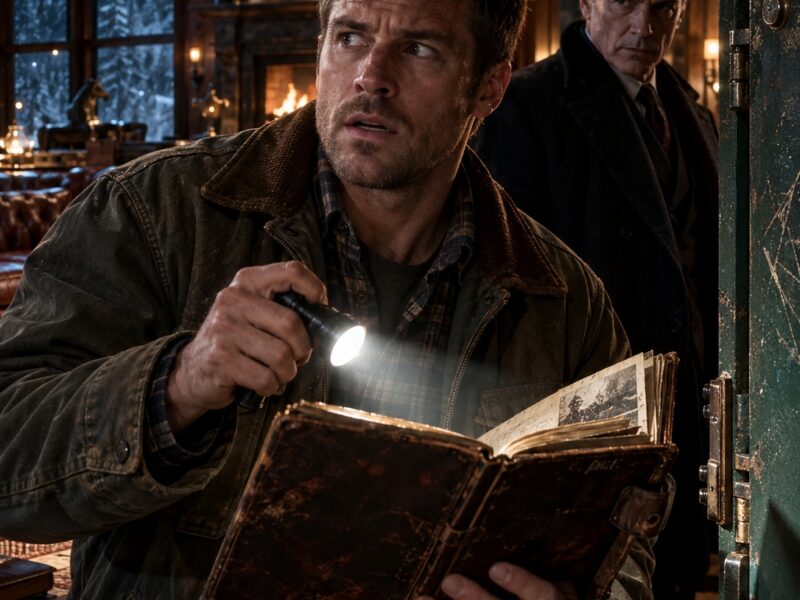
Heavy steel. Hunter green. Three deadbolts. A blackened brass knocker.
And deep scratches near the bottom.
Scratches made from the other side.
As if someone had once been trapped behind it.
Trying desperately to get out.
Four days earlier, Brendan had arrived in Montana believing the worst thing waiting for him was poverty.
At thirty-four, poverty was something he understood.
Grief was something he understood better.
His wife, Rachel, had been dead for eleven months.
Sometimes that number felt impossible.
Eleven months.
Other times it felt like she had been gone for a decade.
Cancer had entered their marriage quietly, disguised at first as exhaustion. Then came the blood tests, the specialists, the diagnosis, and two years of hospital rooms where every clock seemed louder than it should have been.
Leukemia.
Brendan learned to pronounce medications he had never heard of. He learned which vending machine at Sacred Heart Medical Center occasionally gave two bags of chips instead of one. He learned how to sleep sitting upright with his forehead against the edge of a hospital mattress.
Mostly, he learned how quickly hope could become expensive.
By the time Rachel died, almost everything they had built together had been converted into bills.
There were bills from doctors.
Bills from laboratories.
Bills from imaging centers.
Bills from people Brendan couldn’t remember meeting.
The envelopes kept coming even after Rachel stopped breathing.
He once opened one while sitting at the kitchen table and laughed.
Not because anything was funny.
Because the invoice had arrived addressed to Rachel.
AMOUNT DUE: $4,782.16.
He stared at her name for almost a minute.
Then he folded the paper carefully and placed it back inside the envelope.
Harper had walked into the kitchen holding her stuffed rabbit.
She was seven.
She had Rachel’s blue eyes.
“Daddy?”
Brendan wiped his face before turning around.
“Yeah, bug?”
“Are we poor?”
Children had a talent for asking questions adults spent entire lives avoiding.
Brendan looked at her.
“What makes you ask that?”
“Because you don’t eat breakfast anymore.”
That nearly broke him.
He smiled anyway.
“I’m just not hungry in the mornings.”
Harper considered this.
Then she tore her piece of toast in half and pushed one piece across the table.
“You can have some of mine.”
Brendan ate it.
He ate every crumb.
Three weeks later, the bank sent the final foreclosure notice.
Their little house outside Spokane wasn’t impressive. Two bedrooms, one bathroom, vinyl siding that needed replacing, and a backyard Rachel had once insisted was large enough for tomatoes.
They had planted twelve tomato plants the summer before she became sick.
Brendan hadn’t planted anything since.
Now the house had a date attached to it.
A date when it would stop belonging to them.
He was working fifty-five, sometimes sixty hours a week at Kessler Auto Repair, taking every overtime shift his boss offered. His hands were permanently stained along the cuticles with engine grease.
It wasn’t enough.
Nothing was enough.
Then, on a gray Tuesday afternoon, a certified letter arrived.
The return address belonged to Ross & Abernathy, Attorneys at Law, Missoula, Montana.
Brendan almost threw it away.
He assumed it was another collector.
Instead, he opened it standing beside the mailbox.
By the time he reached the second paragraph, he read the first one again.
Then a third time.
His great-uncle Winston Carmichael was dead.
Ninety-eight years old.
Brendan barely remembered the man.
Winston was one of those relatives whose name surfaced occasionally at Christmas after someone drank too much.
His grandmother had called him strange.
His father had called him crazy.
Nobody seemed to know exactly where Winston lived.
Apparently, he had spent his final years in a state-run care facility outside Missoula.
And apparently Brendan Hayes was his closest surviving male relative.
The next morning, Brendan called the number on the letter.
A man named Mitchell Ross answered.
“Mr. Hayes?”
“Yes.”
“My condolences.”
Brendan looked at the foreclosure notice sitting beside his coffee.
“I didn’t know him.”
There was a pause.
“Nevertheless, you’ve been named beneficiary of the estate.”
Brendan sat straighter.
Estate.
For one dangerous second, that word sounded like rescue.
“How much?”
Another pause.
“There are no liquid assets.”
The hope disappeared immediately.
“No money?”
“Not according to the accounts we’ve located.”
Brendan closed his eyes.
Of course.
“But there is property.”
He opened them again.
“What kind?”
“Twenty acres in Ravalli County. Bitterroot Mountains. And a structure.”
“A house?”
“Technically.”
Something about the lawyer’s tone bothered him.
“What does technically mean?”
“The county records describe it as a timber residence.”
“And what do you describe it as?”
Mitchell Ross gave a dry little laugh.
“I’ve never personally seen it.”
“When was somebody last living there?”
This time, the silence lasted longer.
“Our records suggest 1959.”
Brendan thought he’d misheard him.
“Nineteen fifty-nine?”
“Yes.”
“You’re telling me I’ve inherited an abandoned cabin nobody’s lived in for almost seventy years?”
“Sixty-seven, based on the documentation.”
Brendan leaned back.
A worthless cabin in the middle of nowhere.
Perfect.
Even his miracles came broken.
Then Mitchell said something that made him reconsider.
“The land itself may have value.”
“How much?”
“I wouldn’t speculate without an appraisal.”
“But enough to sell?”
“Possibly.”
That one word was all Brendan had.
Possibly.
By Friday morning, everything he and Harper still owned was packed into the bed and back seat of his battered Ford F-150.
His plan was desperate but simple.
Drive to Montana.
Inspect the property.
Clean it.
Make whatever repairs he could.
Sell it fast.
Pay enough of the debt to keep himself from drowning.
Find a cheap apartment somewhere.
Start again.
He didn’t tell Harper they were losing their house.
He told her they were going on an adventure.
Children deserved a few beautiful lies before life taught them the ugly truths.
The drive east and then south toward the Bitterroot Valley gave Brendan too much time to think.
Mountains rose around them, enormous and indifferent.
Harper slept for part of the drive with her stuffed rabbit tucked beneath her chin.
Rachel had bought that rabbit.
Brendan sometimes hated the thing.
Then hated himself for hating it.
Because every time he saw Harper holding it, he remembered Rachel in the hospital gift shop, wearing a knit cap over her bald head and insisting that their daughter needed something “ridiculously soft.”
Brendan tightened his hands around the steering wheel.
“You okay, Daddy?”
He glanced over.
Harper was awake.
“Yeah.”
“You were doing the face.”
“What face?”
“The sad face.”
He forced a smile.
“Mountains make me emotional.”
Harper looked through the windshield.
“They’re just rocks.”
Brendan laughed.
For the first time in days, it was real.
Route 93 eventually gave way to a narrow county road.
Then gravel.
Then dirt.
Finally Brendan turned onto what appeared to be an abandoned logging track.
Branches scraped along the sides of the Ford.
The road climbed deeper into the mountains.
One mile.
Three.
Five.
There were no houses.
No power lines.
No mailboxes.
His phone lost signal.
Eventually even the GPS stopped pretending it knew where they were.
“Are we lost?” Harper asked.
“No.”
“You looked at your phone five times.”
“I’m making sure we’re not lost.”
“That’s different?”
“Very.”
She seemed unconvinced.
Nearly eight miles from the highway, the trees finally opened.
Brendan stopped the truck.
For several seconds neither of them spoke.
The cabin stood in the center of the clearing.
Calling it a cabin felt wrong.
It was enormous.
Dark hand-hewn logs formed two stories beneath a steep metal roof. A wide porch stretched across the front. Pine trees towered behind it like a wall.
But Brendan barely noticed the size.
He noticed the chains.
The front door was wrapped in thick iron logging chain.
Not one loop.
Several.
At their center hung an industrial padlock large enough for a warehouse.
Every ground-floor window had been boarded from the outside with heavy lumber.
Some boards were doubled.
Others were cross-nailed.
Brendan turned off the engine.
The silence that followed felt unnatural after hours of road noise.
Harper leaned toward the windshield.
“Is this our new house?”
There was excitement in her voice.
And fear.
Brendan looked at the structure.
It didn’t resemble a home somebody had abandoned.
It looked like something somebody had sealed.
“Just for a little while.”
“Why are the windows covered?”
“Probably storms.”
“Why is there a chain?”
Brendan reached behind his seat for his toolbox.
“Because Great-Uncle Winston apparently didn’t trust door locks.”
“Did you know him?”
“Not really.”
“Was he nice?”
Brendan looked at the padlock.
“I guess we’re about to find out.”
He took the thirty-six-inch bolt cutters from the truck.
The porch groaned beneath him.
The padlock was worse up close.
Heavy steel.
Rust-covered but intact.
Whoever had secured this place hadn’t wanted casual visitors.
Brendan positioned the jaws around the shank.
He squeezed.
Nothing.
Again.
His shoulders tightened.
Still nothing.
“Daddy?”
“I’m fine.”
“You made the angry face.”
“Tools require intimidation.”
He adjusted his grip and put his entire weight into the cutters.
The metal snapped.
The sound cracked through the forest.
Birds exploded from a nearby pine.
Harper jumped.
Brendan did too, though he pretended otherwise.
He removed the chains.
They dropped onto the porch boards with a heavy metallic clatter.
Then he put one hand against the door.
For some reason, he hesitated.
Sixty-seven years.
Nobody had opened this door in sixty-seven years.
He pushed.
The hinges screamed.
Cold air rolled outward.
Not autumn air.
Older air.
Dry.
Stagnant.
Carrying the smells of pine resin, paper, mildew, dust and something Brendan couldn’t identify.
He switched on his Maglite.
The beam entered the darkness.
And time stopped.
Furniture sat exactly where someone had left it.
A floral sofa faced a massive stone fireplace.
A boxy Zenith television occupied one corner.
A wool coat hung from a peg beside the door.
An ashtray contained the pale remains of cigarettes.
Dust covered everything.
Not a film.
An entire layer.
Brendan stepped inside.
His boot left a perfect print.
“Whoa,” Harper whispered.
“Stay behind me.”
“Why?”
“Because the floor might be weak.”
That was partly true.
The other truth was that the place frightened him.
They moved toward the dining table.
A ceramic coffee cup sat there.
Inside it was a rusted spoon.
Beside it lay a newspaper folded neatly in half.
Brendan wiped dust from the masthead.
THE MISSOULIAN.
Then he saw the date.
October 14, 1959.
His skin prickled.
Winston hadn’t gradually emptied the cabin.
He hadn’t packed.
He hadn’t covered the furniture.
He hadn’t removed his belongings.
Everything suggested he’d simply gotten up one day…
and left.
Then chained the house from the outside.
Brendan stared at the old cup.
Why would a man preserve his own home like a tomb?
And if Winston had been the person who chained the front door…
what exactly had he been afraid would come through it?
That first night, Brendan slept badly.
Harper didn’t.
He set up their little pop-up camping tent in the living room, spread sleeping bags inside and positioned a Coleman lantern nearby.
There was no electricity.
No cell service.
The plumbing didn’t work.
At eleven forty-three, Harper fell asleep clutching her rabbit.
Brendan remained awake.
The cabin made noises.
Old buildings always did.
He knew that.
Wood contracted.
Pipes settled.
Wind pressed against roofs.
He knew all of this.
Still, sometime after midnight, he heard a soft knock.
Three taps.
Somewhere inside the eastern wall.
Brendan sat up.
Silence.
He waited.
Nothing.
Eventually he convinced himself it had been a branch.
There were no trees touching that side of the cabin.
He didn’t let himself think about that.
For the next three days, he worked.
Work had always been Brendan’s preferred form of denial.
He removed the boards from the windows.
Sunlight entered the cabin for the first time in decades.
He hauled out ruined mattresses, swept dust, cleared brush and inspected the roof.
The structure was surprisingly solid.
Winston had built it to last.
Maybe too well.
Brendan managed to revive an old cast-iron kitchen pump.
After several minutes of violent squeaking, freezing water finally surged from the spout.
He cupped some in his hand.
It smelled faintly metallic.
Harper tasted it and made a face.
“It tastes like pennies.”
“Don’t drink it yet.”
“You drank it.”
“I’m bigger.”
“That’s not science.”
Brendan stared at her.
“Who taught you that?”
“Mom.”
The word landed softly.
Harper looked down.
Brendan crouched.
“Your mom was right.”
“I know.”
He touched her hair.
For a moment neither said anything.
Then Harper pointed toward the hallway.
“Why is it colder over there?”
Brendan turned.
She was right.
That became the first thing he couldn’t explain.
The hallway connecting the living room and kitchen was always colder.
Not slightly.
Dramatically.
The second thing was the sound.
Brendan had worked construction in his twenties before becoming a mechanic. He understood framing. He understood load-bearing walls. He understood how buildings occupied space.
And this building felt wrong.
Whenever he crossed the eastern section of the living room, his footsteps changed.
Solid.
Solid.
Solid.
Then—
Hollow.
He stopped one afternoon and stepped backward.
Solid.
Forward.
Hollow.
He looked at the enormous floor-to-ceiling oak bookshelf covering the eastern wall.
“What’s wrong?” Harper asked.
“Nothing.”
That was becoming his favorite lie.
On the fourth day, rain came.
Not ordinary rain.
A mountain storm rolled across the Bitterroots just before sunset, swallowing the peaks in black clouds.
Thunder shook the windows.
Lightning turned the forest white for fractions of a second.
By eight, water hammered the metal roof so loudly Brendan and Harper had to raise their voices.
He tucked her into the tent.
“You’re not scared, right?” she asked.
“Of thunder?”
“Yeah.”
“Absolutely terrified.”
She smiled.
“You’re lying.”
“Completely.”
“Stay until I fall asleep.”
So he did.
He sat beside her.
She held Rachel’s rabbit.
“Daddy?”
“Yeah?”
“Are we going to stay here forever?”
“No.”
“Where are we going?”
He looked toward the dark window.
“I don’t know yet.”
Harper’s small face tightened.
“Do we have a home?”
The question hurt more than the foreclosure notice.
Brendan swallowed.
“Wherever you are, that’s my home.”
“That’s cheesy.”
“Your mother liked cheesy.”
“Mom liked pancakes.”
“Also true.”
Harper closed her eyes.
Ten minutes later she was asleep.
Brendan remained beside her for another five.
Then he stood.
He poured a small amount of whiskey from a flask and sat in Winston’s rocking chair.
Rain hammered the roof.
His eyes drifted toward the eastern wall.
The bookshelf.
Something about it had bothered him from the beginning.
Tonight, he finally understood what.
Brendan set down the flask.
He looked toward the southern window.
Then the fireplace.
Then the bookshelf.
He stood.
“No.”
He walked to the window and stared toward the edge of the porch.
His construction experience returned in fragments.
Exterior footprint.
Interior dimensions.
Wall thickness.
Alignment.
He grabbed his flashlight.
Outside, rain hit him immediately.
He ran to the truck, retrieved his hundred-foot Stanley tape measure and came back inside soaked.
Thirty-two feet.
That was the interior width.
He measured again.
Thirty-two.
Then Brendan stepped outside.
He hooked the tape against the western corner of the cabin.
Pulled.
Walked.
Rain streamed down his face.
Forty feet.
Forty-five.
Forty-seven.
He stopped.
Brendan stared at the tape.
“No.”
He measured again.
Forty-seven.
Inside: thirty-two.
Outside: forty-seven.
Fifteen feet.
Fifteen feet of missing space.
He stood in the rain while thunder rolled through the mountains.
That wasn’t insulation.
It wasn’t framing.
It wasn’t an unusually thick wall.
There was enough missing space for an entire room.
Brendan returned inside.
He locked the door.
Then immediately wondered why.
The danger, if there was one, wasn’t outside.
He approached the bookshelf.
Up close, the craftsmanship was remarkable.
Oak panels.
Hand-cut trim.
Every seam designed to appear permanent.
But now Brendan could see it differently.
Not as craftsmanship.
As camouflage.
He removed one book.
Then another.
Soon he was pulling entire rows from the shelves.
Books struck the floor.
Dust filled the air.
Harper stirred inside the tent.
Brendan froze.
She remained asleep.
He continued.
When the shelves were empty, he knocked against the backing.
Thunk.
He moved several inches.
Knocked again.
Boom.
Hollow.
His heart accelerated.
Brendan retrieved a crowbar and framing hammer.
For a moment, he hesitated.
He needed to sell this place.
Destroying built-in oak cabinetry was exactly the opposite of increasing property value.
Then another draft touched his face.
Freezing.
Coming through a wall that supposedly bordered the outdoors.
Curiosity won.
He drove the crowbar into a seam.
The oak cracked.
He pulled.
Nails screamed from the studs.
A section of paneling tore loose.
Behind it was gray plaster.
Brendan frowned.
Why put plaster behind decorative cabinetry?
He raised the hammer.
One strike.
The plaster cracked.
Second.
A chunk fell away.
Third.
A dark opening appeared.
Cold air poured through.
Brendan enlarged it.
Three feet.
Maybe four.
He dropped the hammer and raised his flashlight.
The beam entered the cavity.
He expected studs.
Insulation.
Maybe stone.
Instead, he saw wooden siding.
Brendan stopped breathing.
He leaned closer.
Weathered cedar boards.
Exterior siding.
Not the inside of a wall.
The outside of another building.
“What the hell?”
Thunder answered.
For the next hour Brendan dismantled enough of the false wall to understand what Winston had done.
The cabin was a shell.
A structure built around another structure.
A house inside a house.
The outer cabin had been constructed to conceal something older.
And in the middle of the exposed cedar siding stood a door.
Hunter green.
Steel.
Three deadbolts.
Brass knocker.
Brendan climbed through the opening.
The space between the two structures was freezing.
His breath became visible.
Then his flashlight reached the bottom of the steel door.
Scratches.
Deep ones.
Long parallel grooves had cut through the green paint to bare metal.
Brendan crouched.
He ran one finger near them without touching.
His mechanic’s brain automatically examined the direction.
The gouges weren’t made from this side.
They had been made from behind the door.
Something had scratched outward.
He should have stopped.
He knew that later.
He should have picked up Harper, driven back toward the highway and called somebody.
Sheriff.
Lawyer.
Anybody.
Instead, Brendan stood.
Because poverty did something dangerous to fear.
It made almost every risk look negotiable.
He wrapped his hand around the knob.
Turned.
Click.
Brendan stared at it.
The door was unlocked.
He pulled.
It opened silently.
That frightened him more than a squealing hinge would have.
The room beyond was black.
Brendan lifted the flashlight.
The beam crossed concrete.
Metal cabinets.
Recording equipment.
A steel desk.
A rotary telephone.
An old ham radio.
Reel-to-reel machines.
He stepped inside.
It looked less like part of a home than a Cold War command post.
Then the flashlight illuminated a rifle lying across the desk.
A Winchester Model 70.
A box of ammunition beside it.
Brendan’s unease sharpened.
But that wasn’t what made him stop.
The far wall was covered with photographs.
Hundreds.
Black-and-white images.
They were pinned in rows and connected with red thread.
Brendan approached.
Forest.
Trees.
The cabin.
Again.
Forest.
Trees.
Cabin.
Then he noticed something in one photograph.
A shape.
Tall.
Standing among the trees.
He moved to another photograph.
Another shape.
Another.
Men.
At least he thought they were men.
Every picture had been taken at night using a flash.
And in image after image, blurred figures stood among the pines beyond the clearing.
Watching the cabin.
Brendan’s mouth went dry.
On the desk lay a leather journal.
He picked it up.
One sentence had been written across the cover in jagged handwriting.
THEY ONLY COME WHEN IT RAINS.
Thunder exploded directly overhead.
And beneath Brendan’s boots—
something moved.
A metallic grind vibrated through the concrete.
Brendan jumped backward.
The sound came again.
Heavy gears.
Turning.
Somewhere below him.
His eyes went to the Winchester.
He grabbed it.
Checked the chamber.
Loaded.
“Jesus Christ.”
The grinding continued beneath the desk.
Brendan kicked aside a thick wool rug.
There it was.
A square steel hatch set into the concrete floor.
At its center was an iron wheel like something from a submarine.
And while Brendan watched…
the wheel began turning by itself.
Clack.
Clack.
Clack.
He backed away.
The rifle remained pointed toward the hatch.
The wheel completed one rotation.
Stopped.
A heavy mechanism released.
Then came a hiss of air.
Brendan waited for the hatch to rise.
Nothing happened.
Nobody climbed out.
Nobody was underneath trying to escape.
The storm continued roaring overhead.
Then Brendan remembered the journal.
He opened it.
The first pages were mundane.
Dates.
Weather.
Supplies.
Fuel.
But as Brendan read deeper, the entries changed.
Names appeared.
Places.
Numbers.
Then one name repeated again and again.
Harrison Bradley.
Brendan skimmed faster.
The story emerged in fragments.
Winston Carmichael hadn’t been a lunatic hiding from imaginary creatures.
He had been an accountant.
In the late 1940s and 1950s, Winston worked for Harrison Bradley, a ruthless regional industrialist whose influence stretched through Montana’s copper and silver trade.
Bradley’s public books were clean.
His private ones weren’t.
Winston had managed the hidden money.
Off-book profits.
Cash.
Physical assets.
Transactions designed never to reach federal investigators.
For years Winston had been useful.
Then he became expendable.
By 1958, Bradley was facing scrutiny.
Someone needed to take the fall.
Winston discovered that Bradley intended to make him that man.
The evidence would point toward Winston.
The tax crimes.
The missing assets.
Everything.
If convicted, Winston believed he would never survive prison.
And if he talked first, Bradley’s people would kill him.
So Winston made a third choice.
He stole from the man who intended to destroy him.
Not money sitting conveniently in a bank.
Assets that couldn’t easily be traced.
Then Winston disappeared into the Bitterroot Mountains.
Bradley sent men after him.
The blurred figures in the photographs weren’t monsters.
They were hired hunters.
Mercenaries.
Men searching the mountains.
Men who sometimes used storms as cover.
Brendan looked at the journal cover.
THEY ONLY COME WHEN IT RAINS.
But as he continued reading, he realized he’d misunderstood even that.
The final entries weren’t describing Bradley’s men.
They were describing the house.
More specifically, what was underneath it.
Winston had engineered a hydromechanical locking system.
Rainwater from the surrounding watershed fed into underground pipes.
During heavy storms, sufficient hydrostatic pressure activated a turbine beneath the cabin.
The turbine turned gears.
The gears released the steel hatch.
No rain meant no access.
No electricity required.
No combination to steal.
No key to find.
Nature itself was the lock.
Brendan slowly lowered the journal.
The hatch beneath him had just opened because of the storm.
Which meant whatever Winston had protected for more than sixty years…
was accessible now.
He looked toward the hole leading back into the living room.
Harper was sleeping less than thirty feet away.
He should leave.
Every responsible part of him knew that.
But another thought arrived.
The bank.
The medical bills.
Harper dividing toast because she knew her father wasn’t eating.
Brendan approached the hatch.
He pulled.
It opened.
An iron staircase spiraled downward into darkness.
He aimed the flashlight.
Nothing.
Only stairs.
Then the distant roar of water.
Brendan slung the rifle over his shoulder.
He told himself he would go down for one minute.
Just look.
That was all.
One minute.
He descended.
Ten feet.
Fifteen.
Twenty.
The air became damp and cold.
At the bottom was a concrete tunnel.
Water rushed through an enormous iron pipe to his left, spinning an old turbine.
To his right was a short corridor.
At its end stood an open vault.
Brendan forgot to breathe.
He walked toward it.
Water covered his boots.
The vault was perhaps ten feet by ten.
His flashlight swept across steel shelving.
And stopped.
Rows of dull yellow bars filled the shelves.
Brendan stood motionless.
“No.”
He approached one.
Touched it.
Cold.
Heavy.
Stamped.
Gold.
Actual gold.
Below it were waxed canvas bags.
Brendan cut one open with his pocketknife.
Silver coins spilled across the concrete.
Morgan dollars.
Another bundle contained old gold certificates.
He laughed once.
A stunned, broken sound.
Then he sat down.
For almost a year Brendan had measured his life in debts.
Four thousand dollars.
Eleven thousand.
Thirty-two thousand.
Mortgage.
Hospital.
Interest.
Late fees.
Numbers representing everything he’d failed to save.
Now he was sitting underground surrounded by wealth Winston had hidden from the world.
Millions.
Possibly far more.
Brendan picked up a gold bar.
The flashlight reflected against it.
For one impossible second he saw Rachel.
Not literally.
He remembered her sitting in a hospital bed three weeks before she died.
She had been painfully thin.
Harper was asleep in a chair beside her.
Rachel had looked at him and whispered, “Promise me something.”
“Anything.”
“Don’t spend the rest of your life apologizing to her.”
“For what?”
“For not being able to fix everything.”
He’d been angry.
“You’re going to be here.”
Rachel had smiled sadly.
“Brendan.”
“No.”
“Listen to me.”
“No.”
“Some things aren’t fixable.”
He’d looked away.
She touched his wrist.
“That doesn’t mean you failed.”
Standing in Winston’s vault, Brendan closed his eyes.
“I know,” he whispered.
For the first time, he almost believed her.
Then metal screamed behind him.
Brendan spun.
Water surged into the corridor.
The turbine was spinning too fast.
The storm above had intensified.
The underground drainage system couldn’t handle it.
Water that had barely covered Brendan’s boots moments earlier climbed toward his knees.
Then he saw the vault door.
Moving.
Slowly closing.
“No.”
He lunged toward it.
The mechanism groaned.
Water rose.
If the vault sealed, the entire system might reset.
He would be trapped underground.
Harper would wake up alone.
That thought erased the gold instantly.
“Think.”
He couldn’t carry the bars.
Too heavy.
He removed his mechanics jacket.
Tied the sleeves.
Created a crude sack.
Silver coins.
Gold certificates.
He shoved them inside.
The door moved another few inches.
Water reached his thighs.
Brendan grabbed one small gold bar.
Then another.
A third.
Too much weight.
He nearly dropped the bundle.
“Enough.”
He turned toward the exit.
Then looked back.
Shelves of gold.
A fortune.
Enough money to transform Harper’s entire life.
He took one step back toward it.
The vault door groaned.
And suddenly Brendan understood the choice.
Gold or Harper.
He turned away.
He ran.
The water fought him.
The sack dragged at his shoulder.
The narrowing doorway was only a few feet ahead.
“Come on.”
The gap shrank.
Brendan threw himself sideways.
The sack caught.
He yanked.
For one terrifying second it wouldn’t move.
“Come on!”
The canvas ripped slightly.
Then released.
Brendan fell into the corridor.
Behind him—
BOOM.
The vault door slammed shut.
The sound punched through the tunnel.
Brendan didn’t look back.
Water reached his waist.
The turbine disappeared beneath a violent brown surge.
Something ruptured behind the wall.
A torrent blasted across the corridor.
Brendan reached the stairs.
He climbed.
One step.
Another.
His boots slipped.
The makeshift sack felt as if somebody were hanging from his shoulder.
He thought about dropping it.
Then climbed again.
Halfway up, the entire staircase shook.
“Harper!”
He climbed faster.
At the top, Brendan dragged himself through the hatch and collapsed onto the command-room floor.
The building groaned.
Not normal settling.
Something structural.
Something enormous.
He staggered upright.
The journal.
He still had it.
The rifle no longer mattered.
Neither did Winston.
Neither did Bradley.
Only Harper.
Brendan ran through the green door.
Squeezed through the opening he’d smashed into the plaster.
Entered the living room.
“Harper!”
The tent shook.
She sat upright.
“Daddy!”
He ran to her.
Her face was wet with tears.
“What’s happening?”
“We’re leaving.”
“Why is the house moving?”
“No questions right now.”
He grabbed her.
Harper wrapped both arms around his neck.
The cabin groaned again.
A crack appeared near the eastern wall.
Brendan snatched the treasure bundle.
Too heavy.
For one instant he almost left it.
Then he imagined the foreclosure notice.
He lifted it.
Ran.
The front door flew open under his shoulder.
Rain hit them.
Harper screamed as freezing water soaked her pajamas.
Brendan reached the Ford.
He threw the sack inside.
Buckled Harper into the middle seat.
Jumped behind the wheel.
“Rabbit!”
“What?”
“My rabbit!”
Brendan looked toward the cabin.
The stuffed rabbit was still inside.
Rachel’s rabbit.
The house shifted.
The porch tilted.
“Daddy!”
Brendan’s hand went to the door handle.
For half a second he almost went back.
Then Harper grabbed his arm.
And Brendan realized something Rachel had tried to teach him.
Objects carried memories.
But they weren’t people.
He turned the key.
The Ford started.
“Mom would understand,” he said.
Harper was crying.
Then, slowly, she nodded.
Brendan shifted into reverse.
Mud sprayed from the tires.
The truck fishtailed.
He corrected.
Turned toward the logging road.
His headlights swept across the cabin.
And the eastern wall collapsed.
A thunderous crack ripped through the clearing.
The outer timber shell folded inward.
Part of the roof dropped.
For the first time since 1959, the hunter-green steel wall of Winston Carmichael’s hidden fortress was exposed directly to the outside world.
Lightning flashed.
For a fraction of a second, Brendan saw the impossible architecture clearly.
A house built around a secret.
A fortress built around fear.
A fortune buried beneath both.
Then darkness returned.
Brendan drove.
He didn’t stop.
The logging road had become mud.
Branches struck the windshield.
Harper sat beside him shaking.
The sack containing Winston’s forgotten fortune was strapped into the passenger seat.
Brendan almost laughed at the absurdity of it.
His daughter was beside him.
Gold was wearing a seat belt.
And somewhere behind them, sixty-seven years of secrecy were collapsing into a Montana hillside.
They reached the paved highway just before dawn.
The storm weakened behind them.
Harper had fallen asleep against Brendan’s arm.
He drove until they reached a gas station with lights.
He parked beneath the canopy.
For a while he simply sat there.
Normal life surrounded them.
Fluorescent lights.
Coffee advertisements.
A delivery truck.
Someone cleaning a windshield.
After the cabin, ordinary things felt miraculous.
Harper woke.
“Where are we?”
“Safe.”
She looked at the unfamiliar bundle beside her.
“What’s in there?”
Brendan looked at it.
He could have told her gold.
Money.
A new house.
No more collection notices.
No more pretending he wasn’t hungry.
But after everything that had happened, those answers seemed strangely small.
“A second chance,” he said.
Harper frowned.
“That’s not a thing you can put in a bag.”
Brendan smiled.
“Apparently it is.”
She looked at the empty space where her stuffed rabbit should have been.
Her smile disappeared.
Brendan saw it.
“I’m sorry.”
“I know.”
“We can get another one.”
“It won’t be Mom’s.”
“No.”
He wouldn’t lie to her.
Harper looked through the windshield.
Morning light was beginning to appear behind the mountains.
“Do you think Mom would’ve liked Montana?”
Brendan thought about Rachel.
Her terrible pancakes.
Her ridiculous optimism.
The garden she never got to replant.
The hospital room.
Her hand on his wrist.
Some things aren’t fixable.
That doesn’t mean you failed.
“Yeah,” he said. “I think she would’ve loved it.”
Harper leaned against him.
Brendan watched dawn spread across the Bitterroot Valley.
He didn’t know what would happen when lawyers became involved.
He didn’t know who legally owned assets stolen nearly seventy years earlier, whether Harrison Bradley’s empire still existed in some corporate descendant, whether the government would care, or whether Winston had left enough evidence in that journal to turn the discovery into another nightmare.
He knew only what was sitting beside him.
Three gold bars.
Old certificates.
Silver coins.
Enough to breathe.
Maybe enough to begin again.
For years Brendan had believed salvation would mean getting his old life back.
Keeping the house.
Paying the bills.
Saving Rachel.
Returning everything to the way it had been before cancer walked through their door.
But sitting beneath the fluorescent lights of a Montana gas station, he finally understood the cruelty in that wish.
There was no old life waiting for him.
Rachel was gone.
The Spokane house would never become the home it had been when she was alive.
Harper would never again be the little girl who believed her mother would always come home from the hospital.
Some doors only opened one way.
Maybe the point wasn’t to go backward.
Maybe it was to carry what mattered through the next one.
Harper fell asleep again.
Brendan took Winston’s journal from his jacket.
Rainwater had warped the leather.
He opened it randomly.
One sentence had been underlined so violently that Winston’s pen had nearly torn through the paper.
A man can spend his whole life protecting something and forget to ask whether it is protecting him back.
Brendan read the sentence twice.
Then he looked at the sack of gold.
Winston Carmichael had possessed enough wealth to live like a king.
Instead, he had spent decades running from men who wanted it.
Eventually dementia had taken even the memory of where he’d hidden it.
He died in a state facility.
Alone.
His fortune remained underground.
His cabin remained chained.
His secret survived him.
Brendan closed the journal.
For the first time since discovering the vault, the gold frightened him.
Not because he didn’t want it.
Because he did.
Desperately.
And desperation had already made one man build a house around another house and bury his life beneath concrete.
Brendan reached across the seat.
He touched Harper’s hair.
That was the line.
Whatever came next, the money would serve their life.
Their life would never serve the money.
Outside, the storm clouds began breaking apart.
Sunlight touched the mountains.
Brendan started the truck.
“Where are we going?” Harper murmured without opening her eyes.
He looked toward the highway.
For eleven months, every answer to that question had frightened him.
Hospital.
Funeral home.
Bank.
Lawyer.
Montana.
Anywhere except home.
This time, Brendan didn’t need an address.
“Forward,” he said.
Harper opened one eye.
“Forward isn’t a place.”
“I know.”
“You’re being cheesy again.”
Brendan smiled.
“Your mother liked cheesy.”
A tiny smile appeared on Harper’s face.
Then she closed her eyes.
Brendan pulled onto the highway.
Behind them, somewhere deep in the Bitterroot Mountains, rainwater continued pouring through Winston Carmichael’s ruined fortress.
Mud filled the underground corridor.
The turbine disappeared beneath the flood.
The vault sealed itself again.
Hundreds of gold bars remained trapped behind steel and concrete, perhaps waiting for another storm, another generation, another desperate person willing to tear open a wall because the dimensions of his life no longer made sense.
But three bars were gone.
So were some coins.
Some certificates.
And one journal.
Enough to prove that Winston’s secret had been real.
Enough to change two lives.
Not enough to make Brendan Hayes forget what nearly mattered more.
As the mountains disappeared in his rearview mirror, Brendan thought about the rusty padlock he had cut only four days earlier.
He had believed it was keeping people out.
Then he found the second door and believed Winston had been keeping something in.
Then he found the photographs and believed Winston had been hiding from killers.
Then he found the vault and understood the final truth.
The chains had never really been protecting the cabin.
They had been protecting Winston’s secret from the world.
And perhaps protecting the world from what men were willing to become for it.
Brendan glanced at his daughter.
Harper was sleeping peacefully now.
Morning sunlight warmed her face.
He reached over and turned down the heater.
Then he drove east toward a future he could not yet see.
Behind him stood a collapsing house filled with the dead man’s fear.
Beside him sat enough gold to buy almost anything.
But for the first time since Rachel died, Brendan wasn’t looking at what he had lost.
He wasn’t even looking at what he’d found.
He was looking at the road.
And when Harper’s small hand drifted across the seat in her sleep and wrapped around two of his fingers, Brendan held on.
Not tightly.
Just enough.
Outside, the last rain finally stopped.
And somewhere behind them, beneath sixty years of earth and concrete, the vault locked itself again.
This time, Brendan let it.









