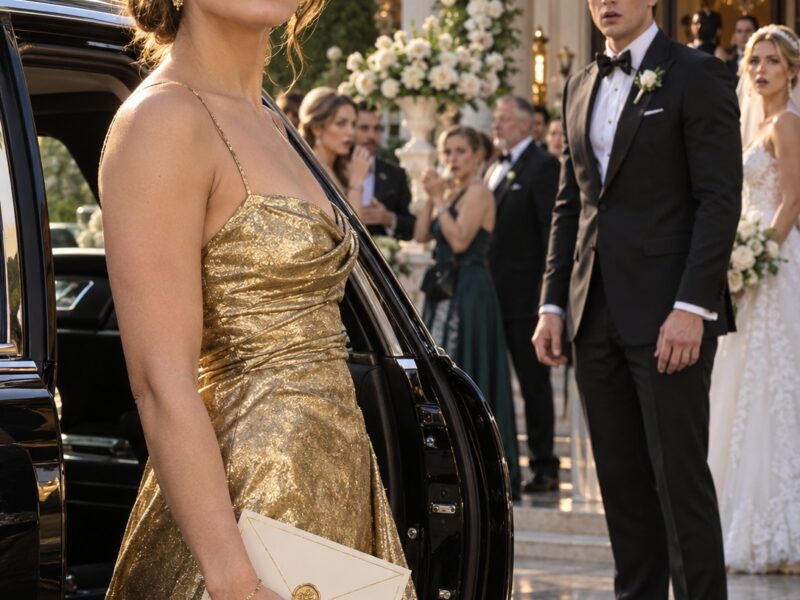
He Invited His “Poor” Ex to Humiliate Her at His Wedding—Then She Stepped Out of a Millionaire’s Limousine

The black limousine had barely stopped in front of Matthew Caldwell’s mansion when the wedding went quiet.
Not completely quiet. Somewhere behind the white flower arches, a string quartet was still playing. Champagne glasses still touched crystal trays. A fountain still whispered beneath the September sun.
But the people had stopped talking.
Heads turned toward the circular driveway.
Matthew noticed the silence before he noticed the car.
He had been standing near the entrance with one hand resting lightly against the waist of his bride, Bethany Reynolds, smiling for a photographer and pretending he had not checked the driveway at least six times in the last twenty minutes.
Then someone behind him murmured, “Is that Hail’s car?”
Matthew’s smile froze.
The limousine was long, black, polished to a mirror shine. The kind of car that did not merely arrive somewhere. It announced that whoever sat inside had never needed permission to enter.
The chauffeur stepped out.
Matthew felt Bethany shift beside him.
“Who is that?” she asked.
“I don’t know.”
He did.
Or at least he knew who he expected to see.
Lydia Bennett.
His former girlfriend.
The woman Matthew had invited to his wedding for one reason he had been careful never to say aloud in front of Bethany.
He wanted her to see what she had lost.
For weeks, he had imagined Lydia arriving alone in a rideshare or perhaps in the aging Honda she used to drive when they were together. He had imagined her stepping onto the estate and staring at the Italian stone, the imported flowers, the valet line filled with Bentleys and Mercedes.
He had imagined the small flicker of regret in her eyes.
That was all he wanted.
One moment.
One look that said he had been right to leave her behind.
The chauffeur opened the rear door.
A woman’s gold heel touched the pavement.
Matthew forgot to breathe.
Lydia stepped out.
For one second, even he did not recognize her.
It was not because she looked like someone else.
It was because she finally looked like herself without apologizing for it.
Her dress was gold, simple and elegant, shaped cleanly at the waist and falling softly to her ankles. There were no oversized diamonds at her throat, no designer logo intended to announce what she had paid, no desperate attempt to compete with the women surrounding her.
Her dark hair rested loosely over one shoulder.
Her face was calm.
That was what hurt him most.
She did not scan the crowd to see who was watching.
She did not search for Matthew.
She simply stood beneath the afternoon sunlight as though she had not come to prove anything to anyone.
Whispers moved through the guests.
Matthew heard his mother inhale sharply somewhere behind him.
Then another shoe appeared from inside the limousine.
A man stepped out.
Tall. Silver beginning at his temples. Dark suit without a visible label. The kind of relaxed confidence that came from knowing people recognized you before you introduced yourself.
Matthew knew him immediately.
Christopher Hail.
Investor.
Philanthropist.
Chairman of Hail Meridian Group.
A man whose investment portfolio was worth more than Matthew’s entire company several times over.
Christopher looked at Lydia, not at the crowd.
He offered her his hand.
She accepted it.
Then, with a gesture so natural it almost seemed private, he placed one hand gently at the middle of her back as they began walking toward the mansion together.
Bethany looked from Christopher to Lydia.
Then to Matthew.
“You told me she was struggling.”
Matthew said nothing.
His mother whispered behind him, “What on earth is she doing with Christopher Hail?”
But Matthew barely heard her.
Because Lydia was walking toward him now.
And for the first time in years, Matthew Caldwell understood what it felt like to be the person in the room who did not belong.
One year earlier, Lydia Bennett had stood outside a luxury hotel in downtown Chicago with a cardboard box pressed against her stomach and rain dripping from the ends of her hair.
Inside the box were two coffee mugs, a framed photograph, three notebooks, a phone charger, and a dying succulent she had forgotten to water for almost a month.
It was not everything she owned.
It only felt that way.
Behind the glass doors, people moved through a lobby filled with white marble and soft golden light. Men in tailored suits checked their watches. A woman in a fur-lined coat laughed near the bar. Somewhere upstairs, Matthew Caldwell was attending an investment dinner Lydia had helped him prepare for.
But Lydia no longer had a seat at his table.
Six hours earlier, Matthew had ended their relationship.
Not during a fight.
Not after a betrayal.
Not because either of them had stopped understanding what the other wanted.
He had ended it with the cold efficiency of a man closing an account.
“I think we’ve grown in different directions.”
Lydia had stared at him from across his penthouse living room.
Rain streaked the windows behind him.
“What does that mean?”
Matthew had loosened his tie.
“You know what it means.”
“No,” she said. “I don’t.”
His silence stretched long enough for humiliation to creep into the room.
Lydia stood.
“Say it.”
“Lydia.”
“Say what you mean.”
Matthew exhaled.
“I’m going places where everything matters.”
She almost laughed.
“What does that even mean?”
“The people in the room. Their families. Their education. Their connections. What they wear. How they speak. Who they know.”
Her face changed.
Only slightly.
But Matthew saw it.
He continued anyway.
“I need someone who fits naturally into that world.”
“And I don’t?”
“That’s not what I said.”
“It’s exactly what you said.”
She looked around the penthouse.
Two years earlier, Matthew had lived in a one-bedroom apartment with a heater that clicked all night and a refrigerator that leaked onto the kitchen floor.
Lydia had helped him move into that apartment.
She had also helped him move out.
Now Italian leather covered the sofa. A bottle of wine worth more than her monthly grocery budget sat open on the marble counter.
She looked back at him.
“Three years,” she whispered.
Matthew rubbed his jaw.
“Please don’t do this.”
“Do what?”
“Turn this into a courtroom.”
“I’m asking you a question.”
“You want me to list everything?”
The cruelty came so casually that Lydia almost missed it.
Then she understood.
“There’s a list?”
Matthew looked away.
That was answer enough.
Lydia folded her arms against herself.
“Go ahead.”
“Your clothes.”
She nodded once.
“My clothes.”
“You never make an effort at events.”
“I wore the blue dress you bought me to your last event.”
“That’s not what I mean.”
“What do you mean?”
“My mother introduced you to Margaret Cullen, and you told her you work at a nonprofit.”
“I did work at a nonprofit.”
“You could have said you were in community development.”
“I wasn’t ashamed of my job.”
“That’s the problem.”
Lydia stared at him.
Matthew seemed to hear his own words too late.
He stepped forward.
“That came out wrong.”
“No. I think it finally came out right.”
She walked past him toward the small desk near the window.
Her bracelet caught the light as she moved.
Matthew had given it to her during their first Christmas together, when he had barely been able to afford it.
A thin silver chain with a tiny star.
He had apologized at the time because it was not expensive.
Lydia had cried because she loved it.
She unclasped it now.
“Lydia, don’t.”
She placed the bracelet on the desk.
“You once told me this was all you could afford.”
Matthew’s expression tightened.
“I remember.”
“And I told you it was enough because it came from you.”
She pushed the bracelet toward him.
“I wish you had believed me when I said that.”
Then she picked up the cardboard box containing the things she had left in his apartment.
Matthew followed her toward the door.
“This doesn’t have to be ugly.”
That made her stop.
For the first time that evening, anger broke through her pain.
“Ugly?”
She turned.
“You just told the woman who worked doubles so you could spend your evenings pitching a company that she doesn’t look expensive enough to stand next to you.”
“I never asked you to work doubles.”
“No. You just ate the groceries they bought.”
“Lydia—”
“I proofread your first proposal.”
“I know.”
“I drove you to meetings because your transmission was broken.”
“I know.”
“I sat outside the emergency room with you when you thought your first investor was going to sue.”
“I said I know.”
“And every time somebody laughed at your idea, I was the one who told you to try again.”
Matthew’s jaw tightened.
“I’m grateful for that.”
She looked at him for a long moment.
“Gratitude isn’t love.”
“No.”
His answer came quietly.
That one word hurt more than everything else.
Lydia’s eyes filled, but she refused to let the tears fall.
“Then I hope the woman you choose understands the version of you I spent years helping you become.”
She opened the door.
Matthew did not stop her.
Only after the elevator doors closed did Lydia finally press one hand over her mouth and begin to cry.
By the time she reached the street, Chicago was drowning in rain.
She stood beneath the hotel awning because she could not remember where she had parked.
For several minutes, she simply held the box and watched strangers run through the storm.
Her phone buzzed.
Her younger sister, Emily.
Lydia answered.
“Hey.”
Emily heard one syllable.
“What happened?”
“Nothing.”
“Lyd.”
The tears came again.
“He doesn’t want me anymore.”
There was silence.
Then Emily said softly, “Where are you?”
Lydia gave her the address.
“Stay there.”
“I’m fine.”
“You sound like somebody died.”
Lydia looked through the glass doors at the life she had thought she would share.
“Something did.”
The months that followed were not dramatic.
That almost made them worse.
There was no villain standing outside Lydia’s apartment every morning. No grand confrontation waiting each time she turned a corner. No music swelling while she rebuilt her life.
There were bills.
There was insomnia.
There was the humiliation of explaining to friends that she and Matthew were no longer together.
There were photographs she could not delete and memories she could not stop replaying.
There were mornings when she woke and forgot for three beautiful seconds that he had left her.
Then she remembered.
Lydia rented a small second-floor apartment in Oak Park above a retired piano teacher named Mrs. Alvarez, who complained about Lydia’s washing machine but delivered homemade soup whenever she heard her crying.
The apartment had one bedroom, uneven hardwood floors, and a radiator that hissed like it was arguing with itself.
It was not impressive.
Lydia loved it.
Nobody there evaluated whether she belonged.
She started working at the Westbridge Community Center, a brick building squeezed between a public library and a laundromat.
The salary was less than what Matthew spent on dinner.
Lydia knew that because he had once complained about a $600 tasting menu.
At Westbridge, six hundred dollars could keep emergency groceries stocked for twelve families.
The first week, Lydia met a woman named Marisol Vega who had recently lost her husband and was raising two grandchildren while trying to understand a stack of housing assistance forms.
“I feel stupid,” Marisol whispered.
Lydia looked up.
“Why?”
“Because I don’t understand any of this.”
Lydia pushed the papers aside.
“You’re not stupid. The forms are badly written.”
Marisol laughed.
It was a small sound.
But that sound stayed with Lydia all day.
Later, she helped a teenager named Devon write his first college application essay.
She found a donated winter coat for a man sleeping in his car.
She learned which children pretended they were not hungry so their mothers would not feel embarrassed.
At night, she still thought about Matthew.
But gradually, the pain had to compete with other things.
People needed her.
Not the version of her wearing the right dress.
Her.
One Wednesday in February, Lydia noticed a man carrying folding tables through the center’s rear entrance.
He was wearing jeans, work gloves, and a faded Northwestern sweatshirt.
“Excuse me,” Lydia called. “Deliveries go around front.”
The man looked at the table in his arms.
“Then I’ve made a terrible strategic error.”
She almost smiled.
“Who are you?”
“Christopher.”
“Christopher who?”
“Hail.”
The name meant nothing to her at first.
He shifted the table.
“Can I put this down before the interrogation continues?”
Lydia laughed despite herself.
“Gymnasium.”
“Thank you.”
Twenty minutes later, her supervisor, Helen Barker, rushed into the office.
“Do you know who is setting up tables in our gym?”
“Christopher.”
Helen stared at her.
“Christopher Hail.”
“Yes.”
“Christopher Hail.”
Lydia frowned.
“You keep saying it like there’s supposed to be thunder.”
Helen pulled out her phone and showed Lydia a photograph from a financial magazine.
The man in the picture wore a dark suit and stood beside the headline:
CHRISTOPHER HAIL: THE INVESTOR WHO WALKED AWAY FROM WALL STREET’S RULES.
Lydia looked toward the gym.
“You’re kidding.”
“No.”
“He’s carrying folding chairs.”
“He donated half the money for our renovation.”
Lydia blinked.
“He didn’t mention that.”
“That’s why he comes here on Wednesdays.”
“What?”
“He asked us not to announce the donations.”
Lydia looked through the office window.
Christopher was helping Devon tape extension cords to the floor.
For some reason, that interested her more than the magazine article.
She met him properly that evening.
Westbridge hosted a community dinner every Wednesday, and Christopher stayed afterward to stack chairs.
Lydia was wiping tables when he came beside her.
“I believe I owe you an apology.”
“For ignoring the delivery entrance?”
“For failing to provide thunder when I said my last name.”
She smiled.
“Helen explained.”
“Unfortunately?”
“Mostly.”
He leaned against the table.
“You looked disappointed.”
“I was hoping you were secretly a furniture mover.”
“I’m devastatingly versatile.”
That was the beginning.
Not romance.
Not even close.
Friendship arrived first, so quietly neither of them noticed it taking shape.
Christopher volunteered twice a month. He never arrived with photographers. He did not give speeches. He learned children’s names and remembered which elderly residents needed rides home.
One snowy evening, Lydia found him repairing a broken cabinet door in the kitchen.
“You’re terrible at that,” she said.
Christopher looked at the crooked hinge.
“I’m aware.”
“Why didn’t you call maintenance?”
“Because Mr. Ellis said he could fix it, and Mr. Ellis is eighty-two with arthritis.”
“So the billionaire decided to become a carpenter?”
Christopher looked at her.
“You said billionaire very judgmentally.”
“Was I supposed to bow?”
“I’d rather you hold this screwdriver.”
She did.
Over time, he learned pieces of her story.
Not all at once.
Lydia did not sit down and explain Matthew Caldwell as though giving a presentation.
Christopher noticed things.
The way she became quiet whenever people talked about wealth as evidence of character.
The way she stiffened when a donor once criticized a young mother’s clothing.
The way she refused invitations to expensive restaurants but happily spent two hours eating tacos from a food truck.
One night, after a fundraising meeting, Christopher asked if she wanted dinner.
Lydia hesitated.
“As friends.”
“You say that like I was about to propose.”
“I’m setting expectations.”
“Excellent. My expectations currently involve noodles.”
They ended up in a small Vietnamese restaurant with plastic menus and a heater blasting too much warm air.
Halfway through dinner, Christopher asked, “Who taught you to read people like that?”
Lydia looked up.
“Like what?”
“You know when someone is ashamed before they say anything.”
She traced her finger along the edge of her water glass.
“Experience.”
Christopher waited.
That was something Lydia had begun to notice about him.
He did not fill silence just because it made other people uncomfortable.
So she told him.
Not every detail.
Enough.
Matthew.
College.
His company.
The sacrifices.
The breakup.
The sentence that had lived in her head for months.
I need someone who fits naturally into my world.
Christopher listened.
When she finished, she expected anger.
He only asked, “Do you believe him?”
“What?”
“That you didn’t fit.”
Lydia looked down.
“I don’t know.”
“I think you do.”
Her eyes lifted.
He continued.
“I think part of you still believes that if you had dressed differently, talked differently, wanted different things, he might have stayed.”
The accuracy irritated her.
“You’ve known me six months.”
“Six months is long enough to notice you apologize every time someone does something nice for you.”
She stared at him.
Christopher leaned back.
“You don’t have to earn kindness, Lydia.”
“I know that.”
“Knowing something and believing it aren’t always the same.”
She hated him a little for saying it.
She remembered it for months.
Spring came.
Then summer.
Christopher never tried to rescue Lydia.
That was one of the reasons she trusted him.
He did not offer her a better apartment.
He did not try to arrange a higher-paying job.
When he discovered her car needed repairs, he gave her the number of a mechanic instead of offering her another vehicle.
When Westbridge needed a new scholarship fund, he asked Lydia to design the criteria.
“You understand the families better than I do,” he said.
The sentence moved something inside her.
Matthew had spent years telling Lydia she needed to learn his world.
Christopher entered hers and asked what he could learn.
By August, rumors about Matthew reached Lydia less frequently.
His company had expanded into commercial property development.
He appeared in business magazines.
His mother had begun chairing charity events where guests paid thousands of dollars to attend dinners that raised less money than they cost to host.
And Matthew was engaged.
Bethany Reynolds came from the kind of family Dorothy Caldwell had once described as “established.”
Her father owned hotels.
Her mother sat on museum boards.
Her Instagram photographs showed ski resorts, yachts, galas, and rooms that looked too perfect to live in.
Lydia felt something when she first saw Bethany’s face online.
Not jealousy exactly.
More like recognition.
So that was what Matthew had meant.
Bethany looked like the future he wanted.
Lydia closed the page and went back to reviewing scholarship applications.
Three weeks later, the wedding invitation arrived.
It was waiting inside Lydia’s mailbox on a Thursday afternoon.
Heavy cream paper.
Gold embossed lettering.
A monogram pressed into the envelope.
She knew who had sent it before she turned it over.
Her name had been handwritten across the front.
Ms. Lydia Bennett.
Not Lydia and Guest.
Just Lydia.
She stood in the hallway staring at it.
Mrs. Alvarez opened her door.
“Bad news?”
“I’m not sure yet.”
“That means yes.”
Lydia carried the envelope upstairs.
For almost an hour, she left it on the kitchen counter.
Then she opened it.
Matthew Caldwell and Bethany Reynolds request the pleasure of your company…
Lydia read the date.
September nineteenth.
Caldwell Estate.
Lake Forest, Illinois.
She laughed once, but there was no humor in it.
Why?
Matthew had not spoken to her in nearly a year.
There had been no apology.
No attempt at friendship.
No reason.
The answer arrived the following afternoon.
Lydia was leaving work when someone called her name.
“Lydia?”
She turned.
Rachel Monroe stood near the sidewalk, an old acquaintance from Matthew’s early business years.
They hugged awkwardly.
“I haven’t seen you forever,” Rachel said.
“I’ve been around.”
“I heard you’re working here.”
Lydia noticed something in Rachel’s expression.
“What?”
Rachel hesitated.
“Did you get the invitation?”
There it was.
“Yes.”
Rachel looked embarrassed.
“Are you going?”
“I haven’t decided.”
“Don’t.”
Lydia studied her.
“Why?”
“Because he’s being an ass.”
Lydia felt her stomach tighten.
“What did he say?”
Rachel glanced toward the building.
“You really want to know?”
“Yes.”
“At a dinner last week, somebody asked why he invited you.”
Lydia waited.
Rachel sighed.
“He said you should see how everything turned out.”
“What does that mean?”
“You know what it means.”
“No. I want to hear what he said.”
Rachel looked miserable.
“He said some people only understand what they lost when they see it in front of them.”
Lydia went still.
Rachel continued carefully.
“Then somebody joked about whether you’d even come.”
“And?”
“Matthew said you would.”
“How could he know?”
“He said curiosity would beat pride.”
Lydia swallowed.
Rachel touched her arm.
“That’s not all.”
Of course it wasn’t.
“What else?”
“He said you’d probably arrive in that little Honda you used to drive.”
Lydia looked away.
“People laughed?”
Rachel did not answer.
That was answer enough.
By the time Lydia reached home, the old humiliation had returned with frightening precision.
She was back in Matthew’s penthouse.
Her clothes.
Her job.
Her apartment.
Her lack of connections.
I need someone who fits naturally into that world.
She threw the invitation into the trash.
Then she took it out.
Then she threw it away again.
At ten that night, she called Emily.
“I’m not going.”
“Good.”
There was a pause.
“Why did you say it like that?”
“Like what?”
“Too quickly.”
Emily sighed.
“Because I don’t want you walking into a room full of people who think cruelty is entertainment.”
“I don’t care what they think.”
“Then don’t go.”
Lydia stared at the invitation.
“That feels like letting him decide what rooms I’m allowed to enter.”
Emily was silent.
Lydia leaned back against the couch.
“Grandma used to say something.”
“Oh God.”
“Never allow another person’s cruelty to decide who you become.”
“She also said never buy seafood from a place attached to a gas station.”
“She was complicated.”
Emily laughed.
The sound helped.
Then she asked, “What do you want?”
Lydia thought about it.
Not what Matthew wanted.
Not what would impress the guests.
Not what would make people talk.
What did she want?
“I want to know that I can walk into that house and not become the woman he made me feel like.”
Emily’s voice softened.
“Then go.”
Christopher found out three days later.
He saw the invitation lying beneath a stack of papers on Lydia’s desk.
“That looks expensive.”
“It probably cost more than my microwave.”
He read the names.
His expression changed.
“This Matthew?”
“Yes.”
“And you’re going?”
“Yes.”
“Why?”
She looked at him.
“To prove something.”
Christopher frowned.
“To him?”
Lydia shook her head.
“To me.”
That answer satisfied him.
Mostly.
“When?”
“Saturday.”
“How are you getting there?”
“My car.”
“The Honda?”
She glared.
He smiled.
“Sorry.”
“You’re not sorry.”
“I’m a little sorry.”
He turned the invitation over.
“You have a plus-one?”
“No.”
“Interesting.”
“What?”
“Nothing.”
She narrowed her eyes.
“Christopher.”
“He invited the ex-girlfriend he humiliated, but made sure she couldn’t bring anyone.”
Lydia stared at the card.
She had noticed that too.
She simply had not allowed herself to analyze it.
Christopher handed it back.
“Very subtle.”
“I’m going anyway.”
“I know.”
On Friday afternoon, Christopher appeared in the community center parking lot holding two coffees.
Lydia accepted one.
“You’re bribing me.”
“I’m asking you something.”
“That’s usually how bribery starts.”
He leaned against her car.
“Let me take you tomorrow.”
She blinked.
“To the wedding.”
“No.”
“That was fast.”
“I’m not arriving in one of your ridiculous cars so Matthew thinks I borrowed a rich man to make him jealous.”
Christopher nodded.
“Fair.”
She expected an argument.
He took a sip of coffee.
“That’s it?”
“That’s it.”
She stared at him.
“You’re irritatingly reasonable.”
“So I’ve been told.”
He began walking away.
Then stopped.
“For the record, I wasn’t offering because I care what Matthew thinks.”
Lydia folded her arms.
“Why were you offering?”
“Because I know what it costs to walk back into a place where someone taught you to doubt yourself.”
Something in his voice changed.
Lydia had never asked about Christopher’s marriage.
She knew only that he was divorced.
Suddenly, she wondered what kind of rooms he had once been afraid to enter.
He continued.
“You don’t need my car. You don’t need my money. You definitely don’t need me to perform some dramatic rescue.”
“Good.”
“But you also don’t have to prove your independence by doing every hard thing alone.”
Lydia looked at him.
He smiled slightly.
“Think about it.”
That night, Lydia stood in front of her closet for almost forty minutes.
Nothing felt right.
Every dress became an argument with Matthew.
Too plain.
Too cheap.
Trying too hard.
Not trying enough.
Eventually, she sat on the edge of her bed.
This was exactly what she had promised herself would not happen.
Her phone rang.
Christopher.
“Are you busy?”
“No.”
“Come downstairs.”
She walked to the window.
He was parked outside.
“You’re becoming intrusive.”
“I brought Mrs. Alvarez cannoli.”
Lydia glanced toward the hallway.
“That traitor.”
Twenty minutes later, Christopher drove her to a small boutique in the Gold Coast.
Lydia stared through the windshield.
“No.”
“Before you object, the owner owes me a favor.”
“That sentence has never ended cheaply.”
“You can borrow something.”
“I’m not wearing a ten-thousand-dollar dress.”
“Then don’t.”
Inside, an older woman named Camille greeted Christopher with a hug and ignored every attempt Lydia made to mention price.
She walked around Lydia once.
“No red.”
“I didn’t ask for red.”
“Good. Red says you came to be seen.”
She pulled a gold dress from a rack.
“This.”
Lydia shook her head.
“Too much.”
“Try it.”
“I don’t—”
“Try it.”
Ten minutes later, Lydia stood before a mirror.
The dress was not flashy.
That was what surprised her.
The fabric caught the light without shouting for it. The neckline was elegant. The waist fit perfectly.
She looked older than the woman Matthew had left.
Not in years.
In certainty.
Christopher stood several feet behind her.
“Well?”
Lydia met his eyes in the mirror.
“I look expensive.”
He shook his head.
“No.”
Her smile disappeared.
“You look like Lydia.”
For reasons she could not explain, that almost made her cry.
The following afternoon, Christopher’s limousine arrived outside her building.
Lydia stared at it from the sidewalk.
“You said you were giving me a ride.”
“I am.”
“This has a refrigerator.”
“It came with the car.”
Mrs. Alvarez opened her upstairs window.
“Lydia!”
Lydia looked up.
The old woman gave her a thumbs-up.
Christopher laughed.
“She likes me.”
“She likes your cannoli.”
“Still counts.”
Lydia hesitated before entering the car.
Christopher noticed.
“We can take yours.”
She looked at the limousine.
Then at the gold dress.
Then at her reflection in the window.
For one dangerous second, she heard Matthew again.
You don’t fit naturally into that world.
Lydia opened the car door.
“No.”
Christopher waited.
She smiled faintly.
“I think I’m done choosing smaller things just so nobody accuses me of trying to look big.”
The drive to Lake Forest took almost an hour.
Lydia was quiet for most of it.
As the city disappeared behind them and the roads widened between enormous homes, she felt her chest tighten.
Christopher noticed.
“You can still turn around.”
“No.”
“You can also go in for ten minutes and leave.”
“I know.”
“You don’t owe anyone endurance.”
She looked at him.
“Did somebody teach you that?”
“Yes.”
“Who?”
“A therapist who charged more per hour than my first attorney.”
Lydia laughed.
The tension loosened.
Then the gates appeared.
Caldwell Estate.
Two attendants checked invitations beside stone pillars wrapped in white roses.
Beyond them stretched the driveway.
Dozens of luxury vehicles lined the approach.
Lydia looked down at her hands.
Christopher spoke gently.
“You’re not going back to the night he left you.”
She swallowed.
“It feels like I am.”
“No.”
He waited until she looked at him.
“You’re taking the woman you became back to the place where he underestimated the woman you were.”
The limousine slowed.
Guests began turning.
Lydia heard nothing for several seconds except her own heartbeat.
Then the door opened.
And one year of healing was tested in a single step.
She emerged into the sunlight.
The whispers began immediately.
Lydia heard her name.
Then Christopher’s.
Then Matthew’s.
She almost looked toward the mansion.
Almost.
Instead, she straightened.
Christopher stepped out behind her.
“Ready?”
“No.”
He smiled.
“Good answer.”
She took his arm.
They walked.
Matthew was standing at the entrance.
Bethany beside him.
Dorothy Caldwell behind them.
Lydia saw the exact moment Matthew recognized Christopher.
His expression changed so sharply that she almost felt sorry for him.
Almost.
Matthew recovered first.
“Lydia.”
“Matthew.”
His eyes moved toward Christopher.
“Mr. Hail.”
Christopher offered his hand.
“Christopher is fine.”
Matthew shook it.
“I didn’t realize you two knew each other.”
Lydia felt the question beneath the sentence.
Christopher answered casually.
“We volunteer together.”
Dorothy blinked.
“You volunteer?”
Christopher looked at her.
“Frequently.”
Something about the simplicity of the answer made Dorothy’s expression stiffen.
Bethany stepped forward.
She was beautiful.
More beautiful, Lydia thought, than photographs had suggested.
Her wedding gown was structured and expensive, with delicate beading across the bodice.
But her smile looked uncertain.
“You must be Lydia.”
There was no hostility in her voice.
Lydia’s defenses shifted.
“Yes.”
“Thank you for coming.”
Matthew glanced at Bethany.
Lydia noticed.
So did Bethany.
A question passed silently between the women.
How much did she know?
Before Lydia could answer it, Dorothy approached.
Her smile was flawless.
“Lydia. What a surprise.”
Lydia almost laughed.
“You invited me.”
“Of course. I meant—”
Dorothy glanced toward the limousine.
“Your arrival.”
Christopher said nothing.
Lydia smiled.
“It was a nice drive.”
For the first time, Dorothy Caldwell had no reply.
Christopher leaned toward Lydia.
“Champagne?”
“Yes.”
They walked inside.
Lydia did not see Matthew watching them.
But Bethany did.
The ceremony began twenty minutes later.
Lydia sat near the back.
Christopher beside her.
She expected memories to attack her.
Instead, something stranger happened.
She watched Matthew marry Bethany and felt… sadness.
Not because she wanted him.
She did not.
She was sad because she remembered the young man he had been.
Matthew at twenty-three, eating vending-machine crackers outside an investor meeting.
Matthew laughing when his old car refused to start.
Matthew asleep with his head on Lydia’s lap while she highlighted his presentation notes.
That man had wanted success because he believed it would give them freedom.
Somewhere along the way, success had become a room he wanted to enter alone.
At the altar, Matthew repeated his vows.
His voice faltered once.
Bethany noticed.
Lydia lowered her eyes.
Christopher whispered, “You okay?”
“Yes.”
And she meant it.
After the ceremony, guests moved toward the reception tent beside the mansion.
It looked more like a ballroom than a tent.
Chandeliers hung beneath silk draping. Thousands of flowers climbed mirrored columns. A live jazz band played near a dance floor polished enough to reflect shoes.
Lydia recognized several people from Matthew’s early business years.
Some greeted her warmly.
Others stared at Christopher before becoming unusually enthusiastic.
Lydia noticed.
Christopher noticed her noticing.
“Fun, isn’t it?”
“What?”
“Watching people decide your value based on who you walked in with.”
Her smile faded.
“You hate these events too.”
“I hate what some people become at them.”
That sentence stayed with her.
Across the room, Matthew watched Lydia speaking with an elderly couple.
He remembered them.
George and Eleanor Walsh.
Early investors.
At Matthew’s first fundraising dinner, Lydia had spent half an hour listening to Eleanor talk about her sister’s cancer diagnosis.
Matthew had been furious afterward.
“You had access to George Walsh for thirty minutes, and you talked to his wife about hospitals.”
Lydia had stared at him.
“She was scared.”
“He controls eighty million dollars in private capital.”
“His wife was still scared.”
Now Eleanor embraced Lydia.
George smiled.
Matthew looked away.
Bethany appeared beside him.
“You’ve been staring at her for twenty minutes.”
“I haven’t.”
“Matthew.”
He took a drink.
“She looks different.”
Bethany followed his gaze.
“No.”
“What?”
“She looks comfortable.”
Matthew frowned.
Bethany turned toward him.
“There’s a difference.”
He said nothing.
She lowered her voice.
“Why did you invite her?”
Matthew’s stomach tightened.
“I told you. We ended things peacefully.”
Bethany stared at him.
“Did you?”
“Yes.”
Across the room, Lydia bent down to help the flower girl, whose sash had come loose.
The little girl looked close to tears.
Lydia fixed the bow.
“There.”
“Is it ruined?”
“Absolutely.”
The child’s eyes widened.
Lydia smiled.
“We’ll have to cancel the entire wedding.”
The little girl giggled.
Matthew remembered another night.
A charity dinner.
A waiter had spilled red wine near their table.
Matthew had snapped at him.
Lydia had spent the next five minutes helping clean the floor.
In the car afterward, Matthew had said she embarrassed him.
She had asked, “By helping?”
He had replied, “By acting like staff.”
The memory made his face burn.
A crash sounded near the catering station.
Several guests turned.
A young server had dropped a tray of champagne glasses.
Shards scattered across the floor.
The girl froze.
A supervisor rushed toward her.
“I’m so sorry,” the waitress whispered.
Before anyone else moved, Lydia crossed the room.
“Don’t touch those.”
The girl stared at her.
“You’ll cut yourself.”
Lydia picked up a linen napkin and crouched.
The catering supervisor hurried over.
“Ma’am, please, you don’t have to—”
“It’s okay.”
Christopher joined her with another napkin.
The two of them gathered the larger pieces while staff brought a broom.
A woman near Matthew whispered, “Is that Christopher Hail cleaning broken glass?”
Matthew heard it.
Something inside him shifted.
The woman he had once considered too unsophisticated for his world was kneeling on the floor in an expensive dress because someone else looked embarrassed.
And the richest man at the wedding had knelt beside her without hesitation.
Matthew looked around at the room he had spent months perfecting.
Crystal.
Flowers.
Imported champagne.
A seven-tier cake.
Everything was expensive.
None of it made him feel wealthy.
Dinner began.
Lydia and Christopher were seated with George and Eleanor Walsh, two nonprofit directors, and a pediatric surgeon.
Matthew had not arranged that table.
His mother had.
He wondered whether Dorothy regretted it now.
During the first course, Christopher leaned toward Lydia.
“Your ex keeps looking over here.”
“I know.”
“You haven’t looked once.”
“I know.”
“How?”
“Eleanor keeps telling me.”
Eleanor Walsh smiled over her soup.
“He’s doing it again.”
Lydia laughed.
George raised his glass.
“To better decisions.”
“George,” Eleanor warned.
“What? I’m old. People expect me to be inappropriate.”
Christopher nearly choked on his drink.
For the first time that day, Lydia forgot why she had been afraid to come.
Then Dorothy approached the table.
“Lydia, could I speak with you?”
The laughter died.
Lydia placed her napkin beside her plate.
“Of course.”
Christopher glanced at her.
She nodded.
I’m fine.
Dorothy led Lydia onto a stone terrace overlooking the lawn.
For several seconds, neither woman spoke.
Then Dorothy said, “You look well.”
“Thank you.”
“I heard you’re working at a community center.”
“I am.”
“That must be… rewarding.”
Lydia smiled faintly.
“It is.”
Dorothy clasped her hands.
“I owe you an apology.”
Of all the things Lydia expected, that was not one of them.
Dorothy looked toward the reception tent.
“I was not kind to you.”
“No.”
The older woman blinked at the direct answer.
Lydia continued.
“You weren’t.”
Dorothy nodded.
“I thought Matthew needed someone who could help him move in certain circles.”
“So did he.”
“Yes.”
A long silence.
Then Dorothy said something Lydia had never expected.
“I think I taught him that.”
Lydia watched her.
Dorothy’s face seemed older outside the flattering ballroom light.
“When Matthew was young, his father lost almost everything. People we thought were friends stopped calling us. Invitations disappeared. I spent years believing money was the reason.”
“Wasn’t it?”
“Perhaps.”
Dorothy looked down.
“But somewhere along the way, I decided the lesson was that we should become the kind of people others could never exclude.”
Lydia understood.
“And instead?”
“We became the kind of people who excluded others first.”
Neither woman spoke.
From inside, music changed.
Dorothy looked at Lydia.
“I don’t expect forgiveness.”
“I already stopped hating you.”
“That isn’t the same thing.”
“No.”
Lydia held her gaze.
“But it’s enough for me.”
She turned to go.
Dorothy stopped her.
“Christopher Hail.”
Lydia almost smiled.
“What about him?”
“Are you together?”
There it was.
Lydia shook her head.
“We’re friends.”
Dorothy looked genuinely surprised.
“He brought you here as a friend?”
“Yes.”
“Why?”
Lydia thought about Christopher holding the screwdriver at Westbridge.
About him carrying tables.
About the mechanic instead of a new car.
About the sentence in the limousine.
You don’t have to prove your independence by doing every hard thing alone.
“Because some people don’t need something from you before they show up.”
Dorothy had no response.
When Lydia returned to the table, Christopher slid a plate of dessert toward her.
“You were gone long enough that I protected this.”
“From whom?”
“George.”
George looked offended.
“I was protecting it from waste.”
The evening continued.
Toasts.
Music.
Photographs.
But Matthew’s composure deteriorated with each passing hour.
He watched Lydia dance once with Christopher.
Nothing intimate.
Nothing theatrical.
Christopher asked.
Lydia hesitated.
Then took his hand.
They moved slowly beneath the chandeliers.
Matthew remembered teaching Lydia to dance in his first apartment because they had been invited to a business gala and she was nervous.
“You’re going to make me look stupid,” she had laughed.
“No,” Matthew had told her. “We’ll look stupid together.”
That had once been enough.
Now he stood in a mansion surrounded by hundreds of guests and realized he had spent years trying not to look stupid beside anyone.
He had forgotten how to be happy beside them.
Bethany found him near the bar.
“We need to talk.”
“Tonight?”
“Yes. Tonight.”
Her voice was quiet.
That frightened him more than anger.
They walked into the library.
Bethany closed the door.
“Did you invite Lydia here to hurt her?”
Matthew looked away.
“Who told you that?”
“That isn’t an answer.”
“People gossip.”
“Did you?”
He rubbed his forehead.
“I was angry.”
“At what?”
“I don’t know.”
“Try.”
Matthew stared at the shelves.
“At the way she left.”
Bethany looked incredulous.
“You broke up with her.”
“I know.”
“Then what exactly was she supposed to do?”
He had no answer.
Bethany folded her arms.
“You told me she couldn’t keep up with your life.”
“She couldn’t.”
Even as he said it, the words sounded hollow.
Bethany looked toward the reception through the glass doors.
“She seems to be keeping up fine.”
“That’s because she’s with Hail.”
“No.”
Matthew turned.
Bethany’s expression was sad now.
“Everyone else is paying attention to Christopher Hail. Lydia barely mentions him unless someone asks.”
Matthew stayed silent.
Bethany stepped closer.
“I need to know something.”
“What?”
“When you asked me to marry you, were you choosing me?”
“Of course.”
“Or were you choosing the kind of woman Lydia wasn’t?”
The question landed with terrifying accuracy.
Matthew opened his mouth.
Nothing came out.
Bethany’s eyes filled with something between anger and humiliation.
“That’s what I thought.”
“Bethany—”
“This is our wedding day.”
“I know.”
“And you have spent half of it watching a woman you supposedly outgrew.”
“I don’t want her back.”
Bethany laughed bitterly.
“That almost makes it worse.”
“What does that mean?”
“It means this isn’t love.”
She stepped toward the door.
“It’s ego.”
Matthew caught her wrist gently.
“Please.”
Bethany stopped.
“I married you today.”
“I know.”
“So be married to me.”
She pulled her hand free.
“And stop trying to win a breakup that ended a year ago.”
Then she left him alone in the library.
For several minutes, Matthew remained there.
Outside, the wedding continued without him.
He saw his reflection in the dark window.
The suit.
The mansion.
The room full of expensive objects.
Everything he had once wanted.
He had never felt smaller.
Lydia found him later near the garden.
She had stepped outside for air.
Christopher was speaking with an old colleague near the terrace, and Lydia wanted five minutes alone before leaving.
The garden behind Caldwell Estate was illuminated by small lights threaded through the trees.
She heard footsteps.
“Lydia.”
She stopped.
Matthew stood behind her.
His tie was loosened.
For the first time that day, he did not look like the man in the magazine photographs.
He looked tired.
“Can we talk?”
Lydia considered saying no.
Then she thought about all the conversations she had rehearsed in her head for a year.
“You have five minutes.”
Matthew nodded.
They walked toward a stone bench.
Neither sat.
He looked at her.
“You came.”
“You invited me.”
“I didn’t think you would.”
“That’s not what I heard.”
His face tightened.
“Rachel?”
“It doesn’t matter.”
“Yes. I thought you’d come.”
“Why?”
He looked toward the mansion.
There were hundreds of ways he could have lied.
He chose none of them.
“Because I wanted you to see this.”
Lydia waited.
“The house?”
“All of it.”
“The flowers?”
He flinched.
“My life.”
She studied him.
“And what did you think would happen?”
“I don’t know.”
“You know.”
Matthew closed his eyes briefly.
“I wanted you to regret leaving.”
Lydia stared at him.
Then something almost funny occurred to her.
“You left me.”
“I know.”
“You wanted me to regret being left?”
His face reddened.
“When you say it like that—”
“How else should I say it?”
He looked down.
“I wanted to feel like I had made the right choice.”
Lydia’s anger softened.
Not because his answer excused anything.
Because suddenly she understood.
All of this.
The invitation.
The jokes.
The expectation that she would arrive poor and alone.
Matthew had not invited her because he believed he had won.
He had invited her because some part of him feared he hadn’t.
“So you needed me to look miserable.”
He did not answer.
“That would have made you feel successful?”
“I’m not proud of it.”
“No.”
Lydia looked back toward the reception.
Bethany was visible through the windows.
Beautiful.
Alone.
“This isn’t just cruel to me.”
Matthew followed her gaze.
“I know.”
“Does she?”
His jaw tightened.
“Yes.”
Lydia sighed.
“Matthew.”
He looked at her.
“For months after you left, I wondered what was wrong with me.”
His eyes lowered.
“I stood in dressing rooms wondering whether a different dress would have saved us.”
“Lydia—”
“I took a job I loved and felt embarrassed every time someone asked what I did because you made me think my salary was proof that I lacked ambition.”
“I never meant—”
“You did mean it.”
He went quiet.
“That’s the part I had to accept.”
Lydia’s voice remained steady.
“You meant it when you said it. Maybe you regret it now. Maybe you’d say it differently now. But that night, you believed my value could be measured by how useful I was to your image.”
Matthew’s eyes were wet.
He turned away.
“I was an asshole.”
“Yes.”
A broken laugh escaped him.
“You’re not going to make this easy.”
“I spent a year making excuses for you. I think I’m done.”
He nodded.
Then he looked at her again.
“But you’re okay now.”
It was not a question.
Lydia thought about her apartment.
Westbridge.
Marisol.
Devon.
Mrs. Alvarez.
Emily.
Christopher.
Her own reflection in the gold dress.
“Yes.”
Matthew swallowed.
“Because of him?”
She knew who he meant.
“No.”
His surprise irritated her.
“Christopher didn’t save me.”
“I didn’t mean—”
“I did.”
Matthew stared.
Lydia continued.
“He was kind to me. He helped me. He reminded me of things I had forgotten. But he didn’t rebuild my life.”
Her voice softened.
“I did that.”
The words were not for Matthew.
Not really.
They were for the woman who had stood in the rain holding a cardboard box.
Matthew nodded slowly.
“You always were stronger than I thought.”
Lydia shook her head.
“No.”
He frowned.
“I was exactly as strong then as I am now.”
That silenced him.
“The difference is that now I believe it.”
For several seconds, neither moved.
Then Matthew asked the question Lydia had once imagined hearing every night.
“Can you forgive me?”
A year ago, she would have wanted him to suffer first.
She would have wanted a speech.
A confession.
Tears.
Regret.
Some proof that the scale had finally balanced.
Now she only felt tired.
“I already have.”
Matthew looked shocked.
“You have?”
“Yes.”
“Then why does it feel like you’re still angry?”
“Forgiveness doesn’t erase memory.”
He swallowed.
“I thought maybe…”
He stopped.
Lydia waited.
“Maybe what?”
He laughed softly at himself.
“I don’t know.”
“Yes, you do.”
Matthew looked at her.
There it was.
A tiny door opening.
The old possibility.
The question of whether enough regret could turn time backward.
Lydia closed it.
“Forgiving you doesn’t mean returning to you.”
His face changed.
She continued.
“It means I don’t want to carry what you did into the rest of my life.”
Matthew looked down.
“And Christopher?”
Lydia smiled slightly.
“Christopher has nothing to do with this conversation.”
“I saw the way he looks at you.”
Her smile disappeared.
“That’s another thing you never understood.”
“What?”
“My life doesn’t have to be defined by which man chooses me.”
Matthew closed his eyes.
“You’re right.”
“I know.”
That made him laugh again.
For one brief second, she saw the boy she had loved.
Not the businessman.
Not the groom.
Matthew.
That hurt in a completely different way.
Because sometimes the person who wounds you is not a monster.
Sometimes they are simply someone who became worse while you were still loving the memory of who they used to be.
Lydia stepped back.
“I should go.”
“Lydia.”
She stopped.
“I’m sorry.”
This time, there was nothing polished in his voice.
No excuse.
No qualification.
She looked at him.
“I know.”
Then she walked away.
Christopher was waiting near the terrace.
He did not ask what Matthew had said.
He simply held out her coat.
“Ready?”
“Yes.”
They said goodbye to George and Eleanor.
Bethany stood near the dance floor.
Lydia hesitated.
Then walked toward her.
Bethany saw her coming.
Matthew was still outside.
For a moment, the two women faced each other beneath the chandeliers.
Lydia spoke first.
“You look beautiful.”
Bethany gave a tired smile.
“Thank you.”
“I mean it.”
“I know.”
A pause.
Then Bethany said, “I’m sorry.”
Lydia frowned.
“For what?”
“For being part of something I didn’t understand.”
“You weren’t.”
Bethany looked toward the garden.
“I think I was.”
Lydia followed her gaze.
Then she looked back at the bride.
“His mistakes with me aren’t yours to carry.”
Bethany’s eyes filled.
Lydia touched her arm.
“But don’t ignore them either.”
Bethany nodded.
It was all that needed to be said.
Near the exit, a young waitress struggled with two overloaded trays.
Lydia recognized her as the woman who had dropped the champagne earlier.
“Here.”
Before Christopher could react, Lydia lifted one tray.
The waitress stared.
“Ma’am, you don’t have to.”
“I know.”
They carried the trays together toward the service hallway.
Christopher followed, smiling.
From the garden doors, Matthew watched.
Lydia did not know that.
She never turned around.
Outside, the limousine waited under the lights.
The chauffeur opened the door.
Lydia paused before getting in.
The mansion glowed behind her.
One year ago, she might have looked back to see whether Matthew was watching.
Tonight, she didn’t care.
Christopher entered after her.
For several minutes, they rode in silence.
The gates disappeared behind them.
Lake Forest gave way to dark roads.
Lydia slipped off her heels.
Christopher looked at them.
“Defeated by shoes.”
“Completely.”
He opened the small refrigerator.
“Water?”
“Yes.”
He handed her a bottle.
Lydia leaned back.
“I thought I’d feel better.”
Christopher waited.
“I thought walking in there looking like this would feel like winning.”
“Didn’t it?”
“No.”
“What did it feel like?”
She thought about it.
“Like closing a door.”
Christopher nodded.
“Those usually feel quieter.”
She looked through the window.
“Matthew apologized.”
“That’s good.”
“He regretted it.”
Christopher took a drink of water.
“That’s probably good too.”
She studied him.
“You really don’t care?”
“About whether another man regrets losing you?”
“Yes.”
“No.”
“Why?”
He considered the question.
“Because his regret doesn’t determine your value.”
Lydia smiled faintly.
“You practice these speeches?”
“Every morning.”
She laughed.
Then Christopher became serious.
“You know what I think the best revenge is?”
“I’m afraid to ask.”
“It isn’t making someone regret losing you.”
She looked at him.
“It’s building a life peaceful enough that eventually you don’t need them to.”
Lydia turned back toward the window.
Chicago’s lights appeared in the distance.
For the first time, she understood something that had taken her a year to learn.
Healing was not the moment the person who hurt you finally suffered.
Healing was the moment their suffering stopped mattering.
Three months after the wedding, Lydia sat at a folding table inside Westbridge Community Center surrounded by budget sheets.
Christopher entered carrying coffee.
“Good news.”
She did not look up.
“You learned to fix cabinets?”
“No.”
“Then I’m busy.”
He placed a document in front of her.
She read the first page.
Then read it again.
“What is this?”
“A foundation.”
She looked up.
“Hail Community Opportunity Fund?”
“Temporary name.”
She flipped through the pages.
Scholarships.
Emergency rental assistance.
Meal programs.
Job training.
After-school tutoring.
All the things Lydia had spent months arguing communities needed.
She looked at him.
“How long have you been working on this?”
“Six weeks.”
“And you want Westbridge involved?”
“I want you involved.”
Lydia’s expression changed.
Christopher sat opposite her.
“You built half these programs already with no money.”
“That’s not true.”
“Fine. With almost no money.”
“What are you asking?”
“For you to help run it.”
She leaned back.
“Christopher.”
“I’m not offering charity.”
“I know.”
“I’m not trying to rescue you.”
“I know.”
“And I’m not asking because we’re friends.”
She studied him.
“Why are you asking?”
“Because you’re good at this.”
The sentence was so simple that Lydia almost missed what it did to her.
Matthew had praised her beauty.
Her loyalty.
Her patience.
Christopher praised her work.
Not because he wanted her to become someone else.
Because he had paid attention to who she already was.
Lydia looked down at the proposal.
“How big?”
“Initially? Two million.”
She stared at him.
“Initially?”
He shrugged.
“I have ambitions.”
“You’re insane.”
“I’ve been told.”
She turned another page.
“What happens if I say no?”
“I ask somebody less qualified and complain about it for years.”
She smiled.
Then she noticed the line near the bottom.
Executive Director: Lydia Bennett.
Her smile vanished.
“You already put my name in.”
“Draft document.”
“Very confident.”
“Optimistic.”
She looked at him.
“Arrogant.”
“That too.”
Lydia picked up a pen.
Christopher raised an eyebrow.
“Is that a yes?”
“No.”
She crossed out HAIL COMMUNITY OPPORTUNITY FUND.
Then she wrote:
OPEN DOOR FOUNDATION.
Christopher read it.
“Open Door.”
Lydia nodded.
“Nobody who asks us for help should feel like they’re begging to be allowed into somebody else’s world.”
He looked at her for a long moment.
Then smiled.
“That’s better.”
The foundation opened the following spring.
They started small.
Meals.
Scholarships.
Emergency grants.
Legal-aid partnerships.
Childcare assistance.
A program that helped single mothers finish professional certifications.
A transportation fund for people who had jobs but no reliable way to reach them.
Lydia insisted on one rule.
No donor photographs during direct assistance.
“If somebody is asking for grocery money,” she told the board, “they are not a prop for somebody else’s generosity.”
Christopher supported her immediately.
So did the board.
Within two years, Open Door expanded across Illinois.
Lydia’s name appeared in newspapers.
She received invitations to conferences.
People began asking her to speak at the kind of events where Matthew had once been embarrassed to introduce her.
Sometimes she accepted.
Sometimes she didn’t.
She still preferred Wednesday dinners at Westbridge.
Mrs. Alvarez complained that Lydia worked too much.
Emily complained that Lydia never answered her phone.
Christopher complained that Lydia continued driving the Honda long after it began making a noise everyone agreed sounded medically concerning.
“It has character,” Lydia insisted.
“It has organ failure.”
“It starts.”
“Usually.”
Their friendship changed slowly.
There was no limousine confession.
No dramatic kiss under a chandelier.
One evening, nearly a year after the wedding, they were locking the Westbridge building after a scholarship dinner.
Christopher was carrying leftover food toward Lydia’s car.
He placed the containers in the back seat.
Then he looked at her.
“Dinner tomorrow?”
“We just ate.”
“Tomorrow, Lydia.”
“Oh.”
She paused.
Something in his expression was different.
Not nervous exactly.
But careful.
“Is this friend dinner?”
“No.”
Her heart shifted.
Christopher continued.
“If you say no, I will behave with extraordinary maturity and complain privately for no more than six months.”
She laughed.
Then she looked at him.
This man had seen her wounded and never treated her like a broken thing.
He had seen her afraid and never called her weak.
He had money but had never once used it to tell Lydia what she should become.
“Tomorrow,” she said.
His smile widened.
“Tomorrow.”
Several miles away, Matthew Caldwell sat alone in his office.
His marriage to Bethany had survived the wedding.
Barely.
They went to counseling.
They fought.
They stayed.
Bethany demanded honesty Matthew had spent years avoiding.
She refused to become another accessory in the life he performed for other people.
Some days, they were happy.
Some days, they were not.
Marriage, Matthew discovered, could not be fixed with the same logic he used to acquire companies.
There was no strategy for forcing another person to trust you.
There was only behavior.
Repeated.
Quiet.
Unphotographed.
On the second anniversary of his wedding, Matthew received an invitation to an Open Door Foundation fundraiser.
He almost declined.
Then he saw Lydia’s name.
Not beside Christopher’s.
At the top of the page.
Executive Director Lydia Bennett.
Matthew attended alone.
He stood near the back while Lydia spoke.
She did not tell the story of their breakup.
She did not mention the limousine.
She did not turn her pain into entertainment.
Instead, she talked about a woman who had once felt stupid because she did not understand a housing form.
“A system that humiliates people for needing help,” Lydia said, “does not teach responsibility. It teaches shame. And shame has never fed a child, paid a medical bill, or kept a family housed.”
The room stood and applauded.
Matthew did too.
Later, Lydia noticed him.
For a moment, both froze.
Then she walked over.
“Matthew.”
“Lydia.”
“You came.”
“I did.”
He looked around.
“This is incredible.”
“Thank you.”
Christopher appeared across the room.
He saw Matthew.
Then he saw Lydia.
He did not approach.
Matthew noticed.
“He still does that.”
“What?”
“Lets you decide what you need.”
Lydia followed his gaze.
“Yes.”
Matthew smiled sadly.
“I’m trying to learn.”
“How’s Bethany?”
“Better.”
“And you?”
He considered lying.
Instead, he said, “Working on it.”
Lydia nodded.
There was nothing else to fix between them.
Nothing else to settle.
No final punishment.
No final victory.
Sometimes closure was simply reaching the point where the person who once controlled your emotions became somebody you could wish well and walk away from.
Matthew looked at her.
“I used to think that wedding was the day you embarrassed me.”
Lydia frowned.
“I didn’t embarrass you.”
“I know.”
His voice softened.
“That’s what took me so long to understand.”
Across the room, someone called Lydia’s name.
She looked over.
Christopher stood beside Marisol Vega, who was laughing with both hands wrapped around a coffee cup.
Devon, now attending college on scholarship, was telling a group of donors something with animated gestures.
Mrs. Alvarez was attempting to steal pastries from the dessert table.
Emily had already caught her.
Lydia smiled.
Matthew followed her gaze.
“You built a good life.”
She looked at him.
The old Lydia might have heard the sentence as validation.
Proof.
See? You were wrong about me.
But she did not need that anymore.
“I did.”
Matthew nodded.
“I’m glad.”
And Lydia believed him.
She walked away.
Christopher met her halfway across the room.
“What did he want?”
“To say hello.”
Christopher studied her face.
“You okay?”
Lydia looked around at the room.
At the people.
At the life that had grown from one of the most painful years she had ever survived.
“Yes.”
This time, the word carried no effort.
“I’m good.”
Christopher reached for her hand.
She let him take it.
Years later, Lydia would barely remember the exact price of the gold dress she wore to Matthew’s wedding.
She would forget which flowers had decorated the mansion.
She would forget the name of the champagne and the song playing when she entered the ballroom.
But she would remember the moment the limousine door opened.
Not because Matthew’s face changed.
Not because the guests whispered.
Not because Christopher Hail stepped out behind her.
She remembered it because, for one final second before her shoe touched the pavement, Lydia Bennett had been afraid she was still the woman Matthew had rejected.
Then she stood up.
And discovered she wasn’t.
The truth was, she had never been too poor for Matthew’s world.
She had never been too ordinary.
Too unsophisticated.
Too small.
Matthew had simply become the kind of man who needed other people to feel smaller so he could believe he had grown.
And Lydia’s greatest transformation was not becoming connected to a millionaire.
It was not wearing a beautiful dress.
It was not arriving in a limousine.
It was not watching the man who had rejected her finally understand what he lost.
Her transformation happened much earlier, in a small apartment with uneven floors, at a community center where nobody cared what labels were sewn into her clothing, in long evenings spent helping strangers who could never repay her.
That was where Lydia learned the difference between being admired and being valued.
That was where she learned that kindness did not make her naive.
That humility did not make her insignificant.
That earning less money did not make her less ambitious.
That loving someone through their struggle did not mean she was obligated to follow them after they began mistaking cruelty for success.
And most importantly, she learned that being rejected by someone who could no longer recognize her worth did not reduce that worth by a single dollar.
One summer evening, years after the wedding, Lydia and Christopher left Westbridge after another community dinner.
The center had expanded into the building next door.
Children were still playing basketball inside.
Someone was laughing in the kitchen.
Christopher unlocked the passenger door of his car.
Lydia stopped.
“You know, you used to send limousines.”
“I was trying to impress you.”
“You told me you weren’t.”
“I lied.”
She laughed.
“You’re admitting that now?”
“I feel secure in the relationship.”
She slid into the passenger seat.
Christopher walked around the car and got in beside her.
Before starting the engine, he looked toward the community center.
“Do you ever think about that wedding?”
“Sometimes.”
“Regret going?”
Lydia considered it.
“No.”
“Because you got your dramatic entrance?”
She smiled.
“No.”
“Because Matthew apologized?”
“No.”
Christopher waited.
Lydia looked at the glowing windows of Westbridge.
“Because I spent so long thinking I needed to become impressive enough that people like him couldn’t reject me.”
“And?”
She turned toward Christopher.
“I finally understood I didn’t.”
He reached for her hand.
Lydia looked down at their fingers.
Then out at the ordinary street.
There was no mansion waiting beyond the windshield.
No photographers.
No crowd watching.
No one to impress.
And somehow, after everything, that felt richer than anything Matthew had ever promised her.
Christopher started the car.
They pulled away from the curb.
Behind them, the community center lights remained bright against the dark.
Lydia did not look back.
She had already learned that some doors were meant to close.
Not because nothing beautiful had ever happened behind them.
But because sometimes the only way to discover how wide the world really was…
was to stop begging someone else to let you belong in theirs.









