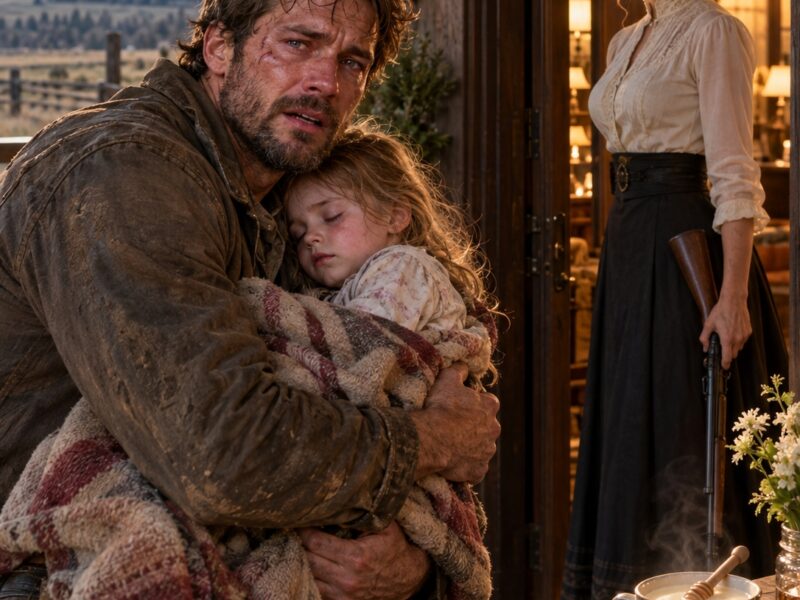
HE KNOCKED ON A WIDOW’S DOOR WITH HIS DYING DAUGHTER—THEN SHE MADE HIM AN OFFER THAT CHANGED EVERYTHING
By the time Garrick Hale knocked on Eleanor Cross’s door, his daughter had stopped asking whether she was going to die.
That frightened him more than the fever.
Four-year-old Lydia had always asked questions.
She asked why rain smelled different from creek water. Why horses slept standing up. Whether stars were holes in heaven. Whether her mother could still hear them when Garrick spoke her name.
For fourteen months after Rose died, Lydia’s questions had been the one sound that kept Garrick from believing the world had gone completely empty.
But beneath the Wyoming sun that August afternoon, Lydia said nothing.
She lay against his chest with her cheek pressed to his torn gray shirt, burning so hot that every breath she took felt borrowed.
Garrick had been walking since before sunrise.
His left boot had a hole through the heel.
His last coins had gone to a doctor six weeks earlier.
His farm in Nebraska was gone.
His wife was buried.
His wagon had been sold.
Most of his tools were gone.
And the child in his arms weighed so little that he sometimes woke in terror because he could no longer remember how heavy she had been before she got sick.
The doctor’s words had followed him across every mile.
She needs clean water. Rest. Food. Milk if you can get it.
As if those things were simple.
As if a man who had already lost his wife, his crops, his land, his money and nearly every possession he owned could reach into an empty pocket and pull out nutrition.
Garrick had tried.
God knew he had tried.
Now there was only one place left.
Cross Ranch.
A widow named Eleanor Cross owned it.
Three different people in Cutters Creek had warned him about her.
One said she disliked strangers.
Another said she had run the ranch alone since her husband died six years earlier.
A boy sweeping a storefront had given Garrick the most useful information.
“She won’t run you off with a shotgun if you got a reason to be there.”
Garrick had looked down at Lydia.
He had a reason.
So he walked.
The ranch appeared beyond a rise like something imagined by a starving man.
Straight fence posts.
A turning windmill.
Cattle.
A barn with fresh boards along one wall.
A kitchen garden still green despite the August heat.
Water.
Life.
Garrick stopped at the gate.
For one dangerous second, hope entered him.
Then Lydia stirred.
“Papa?”
Her voice was barely there.
He lowered his head.
“I’m here.”
“Thirsty.”
His throat closed.
“I know, sweetheart.”
He opened the gate.
“We’re going to fix that.”
He had crossed half the yard when the front door opened.
The woman who stepped onto the porch carried a rifle.
She did not point it at him.
That somehow made her more intimidating.
She held it the way Garrick held a hammer—comfortably, without ceremony, as though its usefulness required no explanation.
Eleanor Cross was younger than he expected, perhaps thirty-five. Tall. Dark auburn hair pinned back. Plain work dress. No jewelry. No nervousness.
Her face gave him nothing.
Then she saw Lydia.
Everything about her attention changed.
“What’s wrong with the child?”
No greeting.
No demand to know who he was.
Just the child.
“Fever,” Garrick said. “Eleven days.”
“How long since she ate?”
“Yesterday morning. A little.”
“How long since you ate?”
“That’s not important.”
“I didn’t ask what was important.”
Her eyes met his.
“I asked when you ate.”
Garrick swallowed.
“Day before yesterday.”
Something shifted in her expression.
Not pity.
He would have hated pity.
It was more like a calculation had changed.
“Come inside.”
She turned away.
Garrick stood there for half a second.
“You heard me,” Eleanor said without looking back. “Bring her in.”
The kitchen nearly broke him.
Not because it was beautiful.
It wasn’t.
It was simply intact.
A wood stove. Oak table. Shelves of flour, beans, salt and preserved vegetables. Clean cups. A pitcher of water. Biscuits covered with cloth.
Ordinary things.
Garrick had forgotten how brutal ordinary things could look to someone who had lost them.
“Sit.”
He sat with Lydia in his arms.
Eleanor poured water and crouched beside the child.
Her voice changed.
“Hello.”
Lydia’s eyes opened slowly.
“Who are you?”
“Eleanor. Who are you?”
“Lydia Rose Hale.”
Even half-conscious, she gave her full name.
Eleanor almost smiled.
“That’s a very fine name. Lydia, I need you to drink a little water.”
“Cold?”
“Cool enough.”
Lydia managed four sips.
Then she turned her face against Garrick’s chest.
Four sips.
Garrick stared at the cup like he had just watched a miracle.
“I have a milk cow,” Eleanor said. “She’s producing well. Warm milk with honey might stay down.”
“I can pay you with work.”
Eleanor looked at him.
“I didn’t ask for payment.”
“I am.”
She straightened.
Garrick forced himself to meet her eyes.
“I can repair fence. Handle cattle. Carpentry. Hauling. Whatever you need. I don’t want charity.”
“You think accepting food for a dying child is charity?”
His jaw tightened.
“I think owing people is dangerous.”
For the first time, Eleanor looked genuinely interested in him.
Not offended.
Interested.
“That sounds learned.”
“It was.”
She studied him another moment.
Then she asked his name.
“Garrick Hale.”
“Where from?”
“Nebraska.”
“What happened?”
“Drought. Two bad crops. Debt.”
“And your wife?”
His eyes moved to Lydia.
“Dead fourteen months.”
Eleanor said nothing for several seconds.
Then she walked to the window.
“I need another ranch hand.”
Garrick looked up.
“The north fence needs repair. Pete Yarrow works for me, but one man can’t cover a thousand acres. I can pay standard wages. They aren’t generous.”
“I don’t need generous.”
“Room and board.”
Garrick stared at her.
“For both of us?”
“For both of you.”
He almost answered immediately.
Then Eleanor turned around.
“There is something else.”
The room changed.
Garrick felt it before she spoke.
“You can refuse,” Eleanor said. “If you refuse, the work and room remain yours. I want that understood.”
“All right.”
She folded her hands.
For the first time since he had met her, Eleanor Cross seemed uncertain.
Then she said the last thing Garrick expected.
“I want to be her mother.”
He thought he had misheard her.
“What?”
“Not legally. Not on paper. Not unless things eventually become something different. I mean practically.”
Garrick stared.
Eleanor continued because apparently retreat was not a habit she possessed.
“I mean I cook for her. Sit with her when she’s sick. Teach her. Braid her hair if she’ll allow it. Make sure she grows up with a woman who is there.”
“You don’t know her.”
“No.”
“You don’t know me.”
“No.”
“Then why?”
That stopped her.
Eleanor looked toward the stove.
“I had a daughter.”
The words came quietly.
“She died three years ago. Fever. She was two.”
Garrick felt something cold move through him despite the heat outside.
“I’m sorry.”
“So am I.”
There was no performance in it.
No invitation for comfort.
Just fact.
“I’m not trying to replace her,” Eleanor continued. “I know dead children aren’t replaced. I know that better than most.”
Her voice tightened once.
Only once.
“But I have this house. This land. Food. Time. Knowledge. And no one to give any of it to.”
She looked at Lydia.
“And you have a little girl who needs more than one exhausted man can give her.”
Garrick flinched.
Eleanor noticed.
“I’m not insulting you.”
“You don’t have to. I already know.”
For fourteen months, he had been father and mother, nurse and provider, cook and protector.
He had failed at several of those jobs daily.
But Lydia was alive.
Until eleven days ago, he had believed alive was enough.
Now he understood how narrow that definition could become.
Eleanor’s gaze softened by a fraction.
“You’ve been trying to hold the whole world together with your bare hands,” she said. “It doesn’t appear to be working.”
Under different circumstances, he might have been angry.
Instead, he looked at Lydia.
Rose would have known what to do.
The thought came so fast it hurt.
He shut it down.
He could not ask a dead woman for permission to save their living child.
“What do you get?” he asked.
“Company.”
“That’s all?”
“It isn’t a small thing.”
No.
Garrick supposed it wasn’t.
Twenty minutes later Eleanor returned with warm milk and honey.
She spoke to Lydia like a person, not a fragile object.
Halfway through the cup, Lydia opened her eyes.
“Do you have a cat?”
Eleanor blinked.
“I do.”
“What’s her name?”
“Margaret.”
Lydia frowned.
“That’s a funny name for a cat.”
“She has a funny personality.”
That earned the smallest ghost of Lydia’s old expression.
Garrick saw it.
And that was when he surrendered.
Not to Eleanor.
Not even to the arrangement.
To hope.
“Yes,” he said.
Eleanor looked at him.
“Yes to what?”
“Your proposal.”
She nodded as though they had just agreed on the price of hay.
“All right. Then we need terms.”
Garrick almost laughed.
Of course they did.
“You are not my husband,” Eleanor said.
“Understood.”
“This is a working arrangement. You work the ranch. I run the household. We raise Lydia as best we can figure out.”
“All right.”
“If people ask, you’re a widowed hired hand.”
“Which is true.”
“Exactly.”
She stood.
“I’m putting clean sheets on the spare bed. Put Lydia there. Then come back and eat.”
“I’m fine.”
Eleanor looked him up and down.
“You look like a fence post after a bad winter.”
Despite everything, something nearly resembling laughter moved in Garrick’s chest.
“Is that your medical opinion?”
“No. My medical opinions are kinder.”
That night, Garrick woke in darkness.
For one terrifying instant, he didn’t know where he was.
Then he heard Lydia through the wall.
“Mama used to say stars are people in heaven.”
Silence.
Then Eleanor’s voice.
“That’s a nice way to think about them.”
“Do you think it’s true?”
A longer silence.
Garrick sat upright.
“I think your mother must have been someone who found nice ways to think about things,” Eleanor said. “That’s a good thing to inherit.”
Lydia was quiet.
Then—
“Are you going to be here tomorrow?”
Eleanor answered without hesitation.
“I’ll be here tomorrow.”
“With milk?”
“With milk.”
“And biscuits?”
“Biscuits too.”
“And Margaret?”
“If you feel better, I’ll introduce you.”
“I’ll feel better.”
The certainty in Lydia’s voice sounded so much like the child Garrick remembered that he pressed his wrist against his mouth.
He did not cry.
He had become very skilled at not crying.
But in the darkness of a stranger’s house, listening to a stranger promise his daughter she would still be there in the morning, Garrick realized something terrifying.
He wanted to believe her.
And wanting to believe anyone again felt almost as dangerous as losing them.
The fever broke four mornings later.
Garrick knew before touching Lydia’s forehead.
He heard her arguing.
“You said three weeks.”
“I said approximately three weeks,” Eleanor replied.
“How approximate?”
“That depends on whether you continue interrogating me about Margaret’s kittens.”
“If it’s very approximate, it could be two and a half.”
“It could become three and a half.”
Garrick stopped outside the bedroom.
His daughter was negotiating.
He put one hand against the wall.
For eleven days, he had imagined a small grave.
He had imagined digging it himself because there would have been no one else.
Now Lydia was bargaining over kittens.
He entered.
“Papa, Eleanor is being unreasonable.”
“I doubt that.”
“You weren’t here.”
“True.”
“So you don’t know.”
“Also true.”
Lydia gave him a look inherited entirely from her mother.
Garrick touched her forehead.
Cool.
Actually cool.
He looked at Eleanor.
She gave him one small nod.
That was all.
He turned his face away before either of them could see what the nod had done to him.
Life settled into routine.
Garrick rose before dawn.
Eleanor was usually already awake.
Pete Yarrow turned out to be a compact, weathered man in his fifties who wasted neither words nor time.
“You know cattle?”
“Ran sixty head.”
“Fence?”
“Enough.”
“Can you use a post-hole digger without letting it use you?”
“Yes.”
Pete handed him the tool.
“You’ll do.”
That was apparently the entire interview.
They repaired the north fence together.
Five posts, not three.
Two sections of wire.
One post snapped completely at ground level.
Garrick noticed the discrepancy.
“Eleanor said three posts.”
Pete shrugged.
“She has a habit of describing problems as smaller than they are.”
“Why?”
“She dislikes appearing overwhelmed.”
“Is she?”
“Always.”
Pete pulled the wire tight.
“She just doesn’t consider that a reason to stop.”
On the wagon ride back, Pete told him about Eleanor’s daughter.
Not to satisfy curiosity.
As a warning.
“She trusts easier than she thinks she does,” Pete said. “Then if someone disappoints her, she behaves like she expected it.”
Garrick watched the road.
“But she didn’t.”
Pete glanced at him.
“No.”
“I’m not going to take advantage of her.”
“I know.”
“You know me one morning.”
“I’ve known men one morning before.”
Pete faced forward again.
“Sometimes that’s plenty.”
When Garrick returned, Lydia sat at the kitchen table studying a mail-order catalog while Eleanor worked on ranch accounts.
“There’s a dress,” Lydia announced.
Garrick bent over the page.
White fabric.
Green sash.
“Pretty.”
“Impractical,” Eleanor said without looking up.
Lydia sighed.
“Something can be pretty and impractical.”
“That is unfortunately true.”
“And Margaret has kittens.”
“Yes.”
“And I can hold them in three weeks.”
“Approximately.”
Lydia pointed accusingly.
“She keeps saying approximately.”
Garrick looked at Eleanor.
Eleanor looked at him.
Something passed between them.
Not romance.
Not yet.
Something smaller and more dangerous.
Belonging.
Weeks passed.
Lydia gained weight.
Color returned to her face.
She followed Eleanor everywhere.
The kitchen.
Garden.
Barn.
She learned which hens could be trusted and which ones would peck her shoes.
She learned Margaret the cat considered everyone beneath her.
She learned to collect eggs.
She learned that Eleanor did not tolerate whining but had endless patience for questions.
And one morning, without warning, Lydia called from the yard—
“Mama Eleanor!”
Everything stopped.
Garrick was repairing a gate hinge.
Eleanor was carrying a basket.
Lydia seemed not to notice what she had done.
“There’s something under the porch!”
Eleanor stood frozen.
Garrick saw her fingers tighten around the basket.
Lydia pointed.
“Mama Eleanor, come look.”
Eleanor closed her eyes for half a second.
Then she walked toward her.
“What kind of something?”
“I don’t know. That’s why you have to look.”
Eleanor crouched.
Together they investigated the mystery.
It was a lizard.
Lydia was delighted.
Eleanor managed the entire episode without breaking.
But that evening Garrick found her alone behind the barn.
“You all right?”
“Yes.”
“That answer came fast.”
“I usually answer efficiently.”
He leaned against the fence.
“You don’t have to explain.”
“Good.”
Silence.
Then Eleanor said, “I thought it would hurt differently.”
He waited.
“When she called me that.”
Her voice was almost inaudible.
“I thought it would feel like stealing something from Rose. Or from my daughter.”
“Did it?”
“No.”
She looked toward the house.
“It felt like being given something.”
Garrick knew exactly what she meant.
And that frightened him.
Because the ranch had stopped feeling temporary.
By October, he knew the land well enough to recognize its moods.
He knew where water collected after rain.
Which cattle would challenge a weak fence.
Which barn board groaned when the temperature dropped.
He knew Eleanor took her coffee strong.
He knew she rubbed the bridge of her nose when accounts worried her.
He knew Lydia could get Eleanor to smile by pretending Margaret had opinions about ranch management.
He knew Pete’s silences had different meanings.
And he knew people in Cutters Creek were talking.
Eleanor had warned him.
A widowed woman living with an unmarried man—however innocent the arrangement—was material enough.
But gossip was only the beginning.
Carl Dunore arrived one afternoon.
County assessor.
Broad shoulders softening with age.
Carefully maintained mustache.
A man who carried official authority the way some men carried a pistol—visible enough that nobody forgot it.
Garrick was repairing the porch railing when Dunore entered the house.
The conversation stayed quiet for several minutes.
Then Eleanor’s voice sharpened.
“My property arrangements are not county business, Carl.”
Dunore answered too softly to hear.
“The deed is in my name.”
Another reply.
“The livestock is registered in my name.”
Silence.
“Who I employ is my concern.”
A longer silence.
Then—
“No. We’re finished.”
The door opened.
Dunore stepped out.
His eyes settled on Garrick.
“You’re the hired man.”
“I am.”
Dunore looked at him longer than necessary.
Then mounted his horse and rode away.
Eleanor came outside still holding a dish towel.
“He’s fishing.”
“For what?”
“Leverage.”
She stared after Dunore.
“He’s wanted the east pasture for three years. I’ve refused him three times.”
“And now?”
“Now he thinks having a strange man living here gives him something he can use.”
Garrick set down his hammer.
“He’ll find somebody else to do the dirty part.”
Eleanor looked at him.
“What?”
“Men like that rarely start with the thing they actually want.”
He told her about a Nebraska neighbor pressured to sell land.
Officials appeared.
Rumors started.
Then came a false cattle-rustling accusation.
Eleanor’s expression hardened.
“You think Dunore would do that?”
“I think a man who wants something badly enough eventually decides wanting it makes him entitled to it.”
“And if he tries?”
Garrick looked toward the house.
Lydia’s laughter floated through an open window.
“Then we find out how far he’s willing to go.”
They didn’t have to wait long.
November came cold.
One morning Garrick was repairing the water trough when two riders appeared.
Sheriff Dale Kums.
And a deputy.
Garrick straightened slowly.
He had been expecting trouble.
Just not this shape.
“Garrick Hale?”
“Yes.”
“I need you to come with me.”
“Why?”
Kums produced a folded paper.
“Warrant.”
Garrick took it.
The words blurred for one second.
Armed robbery.
Meridian Stage Line.
Outside Laramie.
September 14.
Two suspects.
One matching Garrick’s description.
The world became very still.
“September fourteenth?”
“That’s right.”
“I was here.”
“We’ll sort that out.”
“I worked the northwest fence with Pete Yarrow from before sunrise until evening.”
Kums’s expression didn’t change.
“Then that will help you.”
“You’re arresting me anyway?”
“I have a signed warrant.”
The deputy shifted.
Garrick understood immediately.
Resistance would accomplish nothing.
Worse—it would frighten Lydia.
“Give me two minutes.”
Kums considered him.
Then nodded.
Garrick entered the kitchen.
Eleanor looked up once and stood immediately.
“What happened?”
“Sheriff.”
Her eyes changed.
“They’re arresting me.”
Lydia stopped cutting paper.
“For what?”
“Robbery near Laramie. September.”
Eleanor’s face went absolutely still.
Garrick stepped closer.
“Listen.”
“I am.”
“Pete was with me September fourteenth. All day.”
“I know.”
“Get him.”
“I will.”
“Eleanor—”
“I said I will.”
Lydia climbed down from her chair.
“Papa?”
He turned.
Her face made the entire room hurt.
“What are the men outside doing?”
Garrick crouched.
“They need me to go answer some questions.”
“Are you coming back?”
The question hit harder than the warrant.
He could have lied.
Instead he said, “I’m going to do everything I can.”
Lydia’s eyes filled.
“No.”
“Sweetheart—”
“You said we were staying.”
Garrick could barely breathe.
Then Eleanor crouched beside them.
“He is coming back.”
Garrick looked at her.
She didn’t look at him.
She looked only at Lydia.
“I’m going to make sure of it.”
There are promises people make because children need comfort.
Then there are promises that become declarations of war.
Garrick knew which kind Eleanor had just made.
The Cutters Creek jail smelled of stone, sweat and old despair.
Kums removed Garrick’s handcuffs and locked him in a cell.
“I’ve never been to Laramie,” Garrick said.
Kums said nothing.
“Who gave the description?”
“I’m not required to tell you.”
“Carl Dunore?”
The sheriff paused.
Only briefly.
But long enough.
Then he left.
Garrick sat on the narrow cot.
He allowed himself sixty seconds of anger.
He had learned that lesson during the worst months after Rose died.
Ignore anger and it chooses its own moment.
Give it a place and sometimes it becomes useful.
So Garrick gave himself one minute.
The handcuffs.
The humiliation.
Lydia’s face.
Dunore.
The knowledge that one powerful man’s statement could put another behind bars.
Sixty seconds.
Then Garrick opened his eyes.
And began thinking.
Before noon, he heard Eleanor’s voice in the sheriff’s office.
She had brought Pete.
And Pete’s seventeen-year-old son Caleb.
“What I’m telling you, Sheriff,” Eleanor said, “is that you have the wrong man.”
Kums replied.
Garrick couldn’t hear every word.
He heard Eleanor.
“Pete Yarrow and Caleb Yarrow both saw Garrick on September fourteenth. He was on my property before five in the morning and remained there until after sundown.”
“The magistrate signed the warrant.”
“Based on false information.”
“The witness gave a sworn statement.”
“Then either your witness is mistaken or your witness lied.”
Her tone never rose.
That made it more powerful.
“You can ride to the northwest fence yourself. The work still exists.”
Then Pete spoke.
He remembered everything.
The wagon.
The section of fence.
The broken tooth on the post-hole digger.
Where they stopped for lunch.
What they ate.
What Garrick said.
Details nobody inventing an alibi would think to invent.
Then Caleb confirmed it.
By midafternoon, Kums stood outside Garrick’s cell.
“I’m releasing you.”
Garrick stood.
“What changed?”
“The evidence.”
“Whose statement?”
Kums hesitated.
Then perhaps because he was tired of being used by men who thought a sheriff’s badge made him their private weapon, he said:
“A man claimed he saw someone matching you near Laramie.”
“Who?”
“You already know.”
“Dunore.”
Kums’s jaw shifted.
“The statement is being reviewed.”
“Meaning?”
“Meaning I don’t like being made a fool of.”
The cell door opened.
Eleanor stood beyond it.
Garrick had imagined what he might say when he saw her.
Thank you.
You shouldn’t have had to do that.
I’m sorry.
None came.
She looked at him.
“You look terrible.”
He almost laughed.
“I spent half a day in jail.”
“Yes. Apparently it doesn’t suit you.”
Pete coughed into his fist to hide a smile.
Outside, Lydia was waiting in the wagon with Martha Yarrow.
The moment she saw Garrick, she launched herself at him.
He caught her.
“You came back.”
He held her so tightly she protested.
“You came back,” she repeated.
“I did.”
Over Lydia’s shoulder, Garrick looked at Eleanor.
She stood a few feet away.
Wind pulling loose strands of auburn hair around her face.
Tired.
Angry.
Unshaken.
Something inside Garrick changed.
And he knew immediately that it was dangerous.
Because gratitude could be repaid.
Debt could be settled.
But this was neither.
That night, after Lydia slept, Garrick sat across from Eleanor at the kitchen table.
“Sit down,” he said.
She frowned.
“I am sitting.”
“I mean—stay sitting.”
“That sentence usually precedes bad news.”
He looked at his hands.
“I think I should leave.”
The silence was immediate.
Eleanor stared at him.
“Not tomorrow. I’ll give you notice. Two weeks. Three. I’ll write down the maintenance schedule, the drainage work, which cattle—”
“Stop.”
He stopped.
“Why?”
“Because I’m a liability.”
“The arrest was Dunore.”
“He came after me because of you.”
“He came after you because he wants my land.”
“I gave him leverage.”
“You were convenient.”
“I’ll keep being convenient.”
Her eyes hardened.
“The town talks because I’m here. Dunore uses me because I’m here. Before I came, you had a name people respected.”
“I still have a name.”
“I’ve made it harder to carry.”
Eleanor leaned back.
Something almost like exhaustion crossed her face.
“I am a grown woman running a thousand-acre cattle operation in a territory where half the men I meet assume my judgment disappeared when my husband died.”
“Eleanor—”
“I have survived six years of people advising me what is best for me.”
He fell silent.
“So do not,” she continued, “walk into my kitchen and announce that you are leaving for my benefit.”
“I’m trying to protect you.”
“Then ask me what I want protected.”
He stared.
“All right.”
His voice softened.
“What’s better for you?”
Eleanor answered immediately.
“You staying.”
Garrick forgot how to breathe.
She looked toward the hallway where Lydia slept.
“This ranch is better with you here.”
“That isn’t enough reason.”
“You didn’t let me finish.”
He closed his mouth.
“Lydia is better here.”
He nodded.
“I’m better with Lydia here.”
Another pause.
“And I am better with you here.”
There it was.
Not love.
Neither of them was ready to call it that.
But something had crossed a line.
Garrick lowered his eyes.
“People will keep talking.”
“People talk when weather is good because they’re bored.”
“Dunore—”
“Lost.”
“For now.”
“Then if he comes again, we deal with him again.”
We.
Garrick heard it.
Eleanor apparently didn’t.
Or pretended not to.
He stayed.
Winter came.
The ranch narrowed into cold, work and endurance.
Snow covered fence lines.
Water froze.
Hay disappeared faster than Eleanor’s calculations preferred.
Lydia learned letters.
She drew horses that looked like large dogs and insisted the problem was everyone else’s imagination.
Garrick repaired equipment by lamplight.
Eleanor sewed.
Some nights they talked.
Some nights they didn’t.
Neither required the other to fill silence.
That became one of Garrick’s favorite things about her.
He had spent too much of his life around people terrified of quiet.
Eleanor understood that silence could mean peace.
One February evening he found her bent over the ledger.
“Problem?”
“Winter cost more than I projected.”
“How bad?”
“Manageable.”
“That’s not a number.”
She gave him a look.
“Hay was expensive. Spring will be tight.”
“What do we need?”
She listed it.
Healthy cattle.
Good calves.
No major equipment failures.
The east pasture drainage to hold.
Then she closed the ledger.
“And Dunore to stay wherever he’s been hiding.”
“Pete says he’s quiet.”
“Quiet isn’t gone.”
Garrick sat across from her.
“He waited six years and failed.”
“He could try again.”
“He’ll be trying against a stronger ranch.”
She looked up.
“Better fences. Better drainage. Healthy herd. Two witnesses who destroyed his accusation. A sheriff who knows he was manipulated.”
He leaned forward.
“And a woman who walked into the sheriff’s office and took apart his lie without raising her voice.”
Eleanor looked down.
“You sound confident.”
“One of us has to be.”
“That’s not how anxiety works.”
“I know.”
For a moment, she almost smiled.
March brought calves.
Twelve in five days.
Then fourteen.
Then fifteen.
Healthy.
Strong.
Eleanor stood beside the pasture fence one cold morning watching newborn calves wobble beside their mothers.
“Fifteen,” she said.
“If the Henderson cow drops today.”
“She will.”
“You always say that.”
“I’m usually right.”
“You’ve been right twice.”
“Beginning of a pattern.”
She looked at him.
Then back at the herd.
“We’re going to be all right.”
It wasn’t a question.
Garrick heard something underneath the words.
Permission.
As if Eleanor had finally allowed herself to imagine a future she did not have to defend every hour.
“Yes,” he said.
“We are.”
That Thursday, the weather warmed enough to sit outside after supper.
Lydia was asleep.
Stars sharpened over the Wyoming sky.
Eleanor held coffee between both hands.
Garrick had been rehearsing the words for weeks.
Every version sounded foolish.
So he chose the truth.
“Eleanor.”
She turned.
“I want to marry you.”
She became perfectly still.
He continued before courage deserted him.
“Not because of Lydia. Not because of the ranch. Not because Cutters Creek would find it easier to understand.”
Nothing moved in her face.
“I want to marry you because somewhere along the way this stopped being a place I worked and became home.”
Her eyes lowered.
“And because I love you.”
That made her look at him.
“I’ve known for a while.”
“How long?”
“That’s not the important part.”
“It seems moderately important.”
Despite himself, he smiled.
“I’m not offering to rescue you. You don’t need rescuing.”
“No.”
“I know.”
He looked down at his rough hands.
“I’m offering what I have. Which is me.”
She said nothing.
“A man who will work this land as long as his body allows. Who will raise Lydia with you. Who will probably fail you in several creative ways because I have a documented history of being imperfect.”
That finally pulled the faintest smile from her.
“But I’ll keep trying.”
He met her eyes.
“That’s the offer.”
Eleanor carefully placed her coffee on the railing.
“You said you love me.”
“Yes.”
“Plainly?”
“As plainly as I know how.”
She was silent for so long Garrick could hear the windmill.
Then—
“I love you too.”
He stared.
“I’ve known since November.”
“November?”
“Yes.”
“It’s March.”
“I’m careful.”
“That’s four months.”
“I said careful. I didn’t say fast.”
He laughed.
Actually laughed.
Eleanor watched him as if surprised by the sound.
Then she smiled too.
“Yes,” she said.
“Yes?”
“I’ll marry you.”
They married in April.
Small ceremony.
Pete and Martha Yarrow.
Caleb.
Sheriff Kums.
And Lydia.
Lydia wore a white dress with a green sash.
When Eleanor had shown it to her, Lydia stared for ten full seconds.
Then she turned with the triumphant expression of a child who had been storing evidence for months.
“You said it was impractical.”
“For ordinary days.”
“So you were wrong.”
“I said special occasions are different.”
“This is a special occasion.”
Eleanor’s expression softened.
“Yes.”
“Very special?”
“Very.”
Lydia walked into the ceremony holding Eleanor’s hand.
She left holding Garrick’s.
Halfway through, she positioned herself between them and took both.
Nobody told her that wasn’t how ceremonies worked.
Because everyone in the room understood that Lydia had accidentally arranged the most accurate picture possible.
Three people.
None replacing anyone.
Rose was still Lydia’s mother.
Eleanor’s little girl was still dead.
The losses had not disappeared.
They had simply stopped being the only things in the room.
As Sheriff Kums left, he pulled Garrick aside.
“The circuit judge has Dunore’s matter.”
“What happens?”
“Fine. Formal reprimand, probably.”
“That’s all?”
“In a place like this, reputation is currency.”
Kums put on his hat.
“The magistrate isn’t pleased that his court was used.”
Garrick nodded.
“No.”
Kums looked back toward Eleanor and Lydia.
“You built something worth building.”
Then he left.
Dunore was formally censured in May.
He never returned to Cross Ranch.
Maybe he learned something.
Maybe he simply recalculated the cost.
Garrick didn’t care which.
The east pasture remained Eleanor’s.
The drainage held.
The grass came thick.
The herd strengthened.
And in July, Lydia turned five.
Eleanor baked a cake with real sugar.
Caleb gave Lydia a small wooden horse he had carved himself.
Its legs were uneven.
Lydia loved it instantly.
Garrick gave her a leather journal.
“What’s this?”
“For writing things down.”
“I can already write.”
“When you know more words.”
“I know words.”
“Then write the ones you know.”
She opened the journal.
Blank pages.
Possibility.
“I’m going to write everything.”
“Everything?”
“Everything that happens.”
“That could take a while.”
She looked at him seriously.
“Papa?”
“Yes?”
“When I’m old, will I remember all this?”
The question stopped him.
He looked at his daughter.
At the green sash she had insisted on wearing even though Eleanor had declared Thursdays ordinary days.
At the carved horse in her hand.
At Eleanor beside her.
He thought of Rose.
The Nebraska farm.
The drought.
The doctor.
A scorched road.
A door.
A rifle.
Four sips of water.
A cup of warm milk.
A jail cell.
A woman’s voice outside it saying, You have the wrong man.
He thought about memory.
What it kept.
What it changed.
What it mercifully allowed to fade.
“Not everything,” Garrick said.
Lydia frowned.
“But the things that matter will stay.”
She considered this.
Then looked at her journal.
“I’m writing them down anyway.”
“Why?”
“Just to be safe.”
Eleanor made the small sound that was as close to an unguarded laugh as she usually allowed.
Summer moved forward.
There were no miracles.
That mattered.
A calf got sick.
A bull broke fence.
The east well filled with silt.
Equipment failed.
Accounts worried Eleanor.
Garrick made mistakes.
Lydia occasionally behaved like a small dictator with access to livestock.
Margaret the cat remained convinced she owned the property.
Nothing became perfect.
But perfection had never been what Garrick wanted.
He wanted ordinary difficulty.
There had been a time when his problems were graves and hunger and fever.
Now his problems were fence posts.
Water.
Hay.
A child who talked too much at supper.
A wife who corrected his cattle estimates.
He had never understood how beautiful manageable problems could be.
One August evening, four months after the wedding, Garrick and Eleanor sat on the porch.
Lydia was inside writing in her journal.
The Wyoming sunset spread orange and red behind the mountains.
“The Hendersons offered the south quarter again,” Eleanor said.
“I heard.”
“I’m considering it.”
He looked at her.
“That’s more land.”
“I know.”
“We’d need another hand.”
“I know.”
“You have somebody in mind?”
“Pete knows two men.”
Garrick smiled.
“What?”
“Nothing.”
“That’s clearly something.”
He looked toward the pasture.
“When I came here, I owned what I could carry.”
Eleanor said nothing.
“Now you’re discussing buying more land.”
“Technically I would be buying it.”
“There she is.”
“Accuracy matters.”
“It does.”
They watched the sunset.
After a while, Eleanor spoke.
“I used to sit here alone.”
Garrick looked at her.
“It wasn’t terrible,” she said. “I want to be accurate about that too.”
“Of course.”
“I had work. Pete and Martha. The ranch.”
She thought.
“It was a life.”
Then she paused.
“But it was a life I was maintaining.”
He waited.
“There wasn’t much growing.”
From inside came Lydia’s voice.
Apparently she had decided writing required narration.
“No, that word is wrong,” Lydia announced to herself. “I’m changing it.”
Eleanor listened.
Her face changed.
It always did when she heard Lydia.
All the defenses disappeared.
“Now,” Eleanor said, “I have a daughter who will probably fill that journal before fall.”
“Definitely.”
“A husband who insists on giving me cattle reports before coffee.”
“The cattle don’t adjust their schedule for coffee.”
“They should.”
“And?”
“And we may buy more land.”
She looked toward the pasture.
“Things are growing.”
Garrick nodded.
“Yes.”
“That’s different.”
Lydia came through the door carrying her journal under one arm and Caleb’s wooden horse in the other.
She sat on the step below Eleanor.
Then looked at the sky.
“There.”
“What?” Garrick asked.
“The first star.”
Eleanor followed her finger.
“There it is.”
Lydia leaned backward until her shoulders rested against Eleanor’s knees.
Without looking, she reached one hand behind her.
Her fingers searched.
Found Garrick’s hand.
Closed around it.
Nobody spoke.
The stars appeared one by one.
Then dozens.
Then too many to count.
The cattle shifted in the lower pasture.
The windmill turned.
From the barn, Margaret issued one brief, authoritative complaint about the universe.
Lydia smiled.
Garrick looked at the two people beside him.
He had spent a long time believing suffering was supposed to teach something.
People liked saying that.
Loss makes you stronger.
Pain has a purpose.
Everything happens for a reason.
Garrick no longer believed any of it.
Rose’s death had not improved him.
Lydia’s fever had not been a lesson.
Losing his farm had not secretly been a gift.
Suffering was suffering.
Sometimes it destroyed people.
Sometimes there was no hidden meaning.
What mattered was what you did with whatever remained afterward.
Garrick had walked.
That was all.
When his land disappeared, he walked.
When the money disappeared, he walked.
When his daughter grew too weak to walk herself, he carried her.
When his boots wore through, he kept walking.
Until there was a door.
Then he knocked.
Eleanor had done something equally ordinary.
She opened it.
Nothing required her to.
There was no destiny forcing her hand.
She could have looked at a filthy stranger carrying a sick child and decided his tragedy was not her responsibility.
Nobody would have blamed her.
Instead, she opened the door.
Then the next morning she stayed.
And the morning after that.
And when Lydia called her Mama, she stayed.
When Cutters Creek talked, she stayed.
When Dunore threatened her property, she stayed.
When Garrick was taken away in handcuffs, she walked into the sheriff’s office and fought for him.
When Garrick tried to leave for her own good, she refused to let him make that choice for her.
There had been no single grand moment in which they became a family.
That was the secret.
Families were not always created by blood or vows.
Sometimes they were created by repetition.
Breakfast.
Fence repairs.
Fever checks.
Strong coffee.
Bedtime questions.
Arguments about kittens.
A child reaching backward for a hand without needing to look.
Garrick squeezed Lydia’s fingers.
She squeezed back.
“You’re missing one,” she said.
“One what?”
“Star.”
She pointed.
“Behind the cloud.”
“I can’t see it.”
“It’s still there.”
Eleanor looked at Garrick.
Something about that sentence struck all three of them differently.
Lydia meant a star.
Eleanor perhaps thought of the daughter she had buried.
Garrick thought of Rose.
Things did not stop existing simply because you could no longer see them.
Love did not have to erase old love to become real.
A new family did not prove the old one had mattered less.
Sometimes the heart did something stranger.
It expanded around absence.
The night deepened.
There were still people in Cutters Creek who had opinions about Cross Ranch.
There probably always would be.
Some thought Garrick had been lucky.
Some thought Eleanor had behaved recklessly.
Some whispered that she had taken in a desperate stranger because grief had weakened her judgment.
Others said Garrick had married well.
As if they had not seen him arrive with holes in his boots carrying everything he loved in both arms.
Garrick had stopped caring.
He had learned that other people’s opinions occupied exactly as much space in your life as you allowed them.
He had no space left.
Lydia needed most of it.
Eleanor claimed a considerable amount.
The ranch took the rest.
That was enough.
Years later, Lydia would not remember every detail of that first summer.
She would forget the exact taste of honey in the milk.
She would forget how fever had distorted the ceiling above Eleanor’s spare bed.
She would forget which kitten she held first.
She would forget some names.
Some faces.
Some winters.
Memory was like that.
But she would keep the journal.
And somewhere among its earliest crooked sentences would be an account of a green-sash dress.
A cat named Margaret.
A father who came home after men took him away.
A woman who promised she would be there in the morning and kept the promise for the rest of her life.
And perhaps that was enough.
Because the moments that change a life rarely announce themselves.
There is no music.
No voice telling you to pay attention.
No sign saying:
This is the door.
This is the person.
This is the day everything changes.
Sometimes you are simply a desperate man walking beneath a merciless Wyoming sun.
Your wife is dead.
Your land is gone.
Your daughter is burning with fever in your arms.
Your boots are worn through.
You have nothing impressive left to offer the world except your labor and the fact that you have not stopped walking.
Then you see a house.
You approach.
You knock.
And someone on the other side has their own grief.
Their own empty rooms.
Their own dead child.
Their own reasons to keep the door closed.
But they open it anyway.
That was what happened to Garrick Hale.
He had arrived at Cross Ranch believing he was searching for milk.
Then he believed he had found work.
Later he thought he had found shelter.
He had been wrong every time.
What he had actually found was a woman who understood that broken things were not always meant to be repaired back into what they had been.
Sometimes they became something else.
Something imperfect.
Something nobody had planned.
Something worth staying for.
The stars were fully out now.
Lydia rested against Eleanor’s knees.
Her hand remained inside Garrick’s.
The wind moved softly through the grass.
Behind them stood the house whose door had once opened for a stranger.
Ahead of them lay fields they might buy, calves not yet born, winters they had not yet endured, arguments they had not yet had, losses they could not predict and ordinary mornings none of them knew enough to treasure in advance.
Nothing was guaranteed.
That was another thing Garrick had learned.
Love did not make the future safe.
Family did not protect you from grief.
A home could burn.
Land could disappear.
People could die.
Doors could close.
But fear of losing something was not a reason to refuse it while it was here.
Once, Garrick had believed courage meant carrying everything alone.
Now he knew better.
Sometimes courage was admitting the weight was too much.
Sometimes it was accepting the cup of water.
Sometimes it was letting another person hold your child.
Sometimes it was staying when leaving would hurt less.
And sometimes courage was nothing more dramatic than knocking on one more door after every other door in your life had already closed.
Lydia tilted her head against Eleanor.
“Papa?”
“Yes?”
“Do you think Mama Rose can see the stars too?”
The question might once have broken him.
Now it simply hurt in the clean way love sometimes hurt.
“I hope so.”
Lydia considered that.
“I think she can.”
Eleanor’s hand settled gently over Lydia’s hair.
No jealousy.
No fear.
No attempt to occupy a dead woman’s place.
Just love beside love.
Garrick looked up.
The Wyoming sky stretched farther than any human sorrow had a right to.
Huge.
Indifferent.
Beautiful.
He thought of the road that had brought him here.
The miles.
The heat.
The child burning against his chest.
The gate.
The rifle in Eleanor’s hand.
Her first question.
What’s wrong with the child?
Not who are you.
Not what can you pay.
Not why should I help you.
The child.
Perhaps that had been the moment.
Or perhaps there had never been one moment.
Maybe a life changed the way night became morning—so gradually that you could never point to the exact second darkness ended.
Lydia yawned.
Eleanor looked down.
“Bed.”
“I’m not tired.”
“You just yawned.”
“I was breathing deeply.”
“That was a yawn.”
“Papa?”
“Definitely a yawn.”
“Both of you are very difficult.”
Eleanor stood.
“That’s unfortunate, because we intend to remain so.”
Lydia sighed dramatically and headed toward the door.
At the threshold, she turned.
“You’re coming?”
Eleanor glanced at Garrick.
Then back at Lydia.
“Yes.”
Garrick stood.
“All of us?”
“All of us,” Eleanor said.
Satisfied, Lydia disappeared inside.
Warm lamplight spilled across the porch boards.
Garrick paused before following.
Once, he had stood outside this house with nothing.
Now someone inside was waiting for him.
Eleanor stopped beside him.
“What?”
“Nothing.”
“That expression is not nothing.”
He looked at her.
“I was thinking about the first day.”
“The day you looked like a fence post?”
“A particularly bad fence post.”
“Yes.”
“You had a rifle.”
“You were an unknown man approaching my house.”
“Fair.”
“With a child.”
“That changed things?”
Eleanor looked through the doorway where Lydia was loudly announcing that she could remove her own shoes without supervision.
“Yes.”
Garrick nodded.
“Changed everything.”
Eleanor slipped her hand into his.
It was not dramatic.
That was why he loved it.
They went inside.
Behind them, the ranch settled beneath the stars.
The gate remained where it had always been.
The road disappeared into darkness beyond it.
And the door—the same door a desperate father had once approached carrying a dying little girl—closed softly against the Wyoming night.
Not to shut the world out.
Just because everyone who belonged inside had finally come home.









