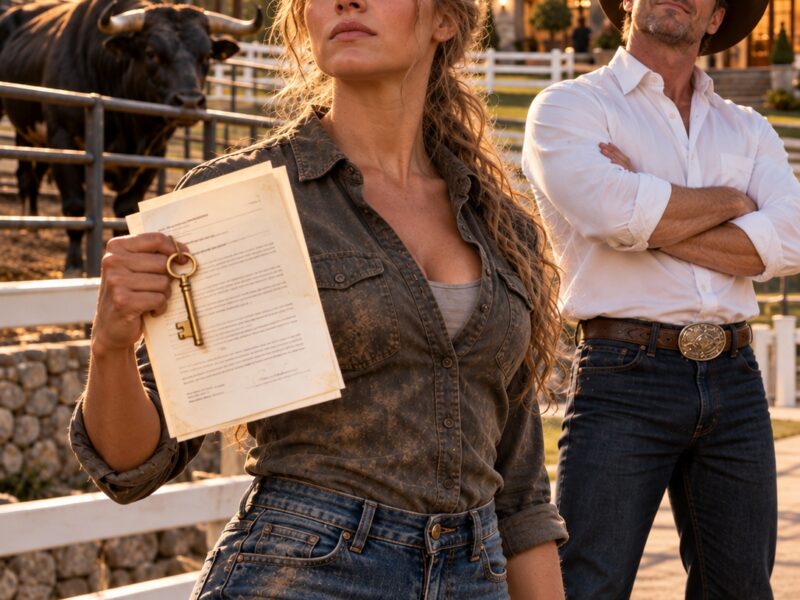
HE LAUGHED AND BET HER 600 ACRES SHE COULDN’T SAVE HIS DYING BULLS—TEN DAYS LATER, HE REALIZED WHAT HE’D GIVEN AWAY
“No degree. No ranch. And you’re standing here telling three specialists what they missed?”
Clayton Mercer said it loudly enough for every ranch hand in the yard to hear.
That was deliberate.
Twenty-one-year-old Aaliyah Carter stood ten feet from him with dust on her jeans, sweat drying beneath the collar of her work shirt, and seven of the most expensive breeding bulls in Oklahoma deteriorating behind the steel rails.
One of them was already on the ground.
Atlas.
The bull was worth more than every car Aaliyah’s family had ever owned combined.
Clayton pointed toward him.
“Three veterinarians. Blood panels. Feed consultants. Medication. Thousands of dollars in testing.” His mouth bent into a humorless smile. “But the seasonal girl filling water troughs figured it out?”
A few men looked at the ground.
Nobody laughed.
That seemed to irritate Clayton more.
Aaliyah looked past him toward the pasture beyond the holding pens.
“They’re treating seven problems,” she said.
Clayton folded his arms.
“And?”
“I think there’s only one.”
The yard went still.
Aaliyah could hear Atlas breathing.
Slow.
Heavy.
Wrong.
Clayton stared at her for several seconds, then gave a short laugh.
“Fine.”
He reached into his back pocket, pulled out his phone, and nodded toward the distant northern boundary of Mercer Crown Ranch.
“You know the North Prairie?”
“Six hundred acres.”
That made him look at her differently.
Only for a second.
Then the smile returned.
“Save all seven bulls. Ten days. Independent veterinary clearance.” He stepped closer. “You do that, those six hundred acres are yours.”
Someone behind Aaliyah muttered, “Clayton…”
He raised one hand.
“I’m not finished.”
His eyes stayed on hers.
“If even one fails clearance, you get nothing. And when this is over, you’re done here.”
Aaliyah felt every face in the yard turn toward her.
Clayton expected embarrassment.
He expected her to retreat.
Instead, she said, “Put it in writing.”
His smile disappeared.
And for the first time that morning, Clayton Mercer stopped looking amused.
Mercer Crown Ranch had been in Clayton’s family for three generations, although anyone driving through its iron gates would have assumed it had been built for him personally.
Everything about the place announced money.
White fencing stretched across rolling Oklahoma pasture. Black trucks bearing the Mercer Crown logo moved between immaculate barns. The main breeding facility had climate-controlled veterinary rooms, digital scales, polished steel chutes, and an office with windows overlooking cattle worth millions.
Clayton had inherited land, bloodlines, contracts, and a name buyers already trusted.
Aaliyah had inherited none of those things.
Her father, Marcus Carter, had worked cattle wherever someone needed an extra pair of hands. Small ranches. Lease pastures. Auction yards. Places where equipment was repaired instead of replaced and nobody called a veterinarian until every home remedy had failed.
He taught Aaliyah something textbooks sometimes taught later.
Animals whispered before they screamed.
A cow shifting her weight.
A bull drinking at the wrong hour.
A steer separating itself from the herd.
Tiny things.
“Most people wait until the animal tells them something is wrong,” Marcus used to say. “By then, it’s been telling them for days.”
He died when Aaliyah was seventeen.
Four years later, she still heard him whenever she watched cattle.
That was why the seven bulls bothered her.
Not because they were sick.
Because they were sick differently.
One had lost weight.
Two had stopped eating normally.
Another had developed stiffness.
One breathed poorly during the hottest part of the afternoon.
Atlas—the crown jewel of Mercer Crown’s breeding program—had begun refusing to leave shade.
Three specialists saw seven sets of symptoms.
Aaliyah saw seven animals making different versions of the same complaint.
She had been at Mercer Crown less than a month when she noticed something else.
Every affected bull had recently grazed the same section.
Nobody had asked her to investigate.
So she hadn’t.
Until Atlas collapsed.
Now Clayton was sitting behind his desk while the ranch attorney drafted a contract he still believed he would never have to honor.
“Last opportunity,” Clayton said.
Aaliyah read the agreement.
Ten calendar days.
All seven bulls independently cleared by Dr. Samuel Hayes.
Six hundred acres transferred free and clear.
Failure meant no land.
Her seasonal employment terminated at the conclusion of the challenge.
“You understand what you’re signing?” Clayton asked.
“Yes.”
“You’re risking your job.”
“It’s seasonal.”
“That supposed to make losing it easier?”
Aaliyah looked up.
“No. It makes the risk honest.”
Something flickered across his face.
Then vanished.
He signed.
She signed beneath him.
Clayton slid the paper toward her.
“Congratulations,” he said. “You just bought yourself ten days of humiliation.”
Aaliyah folded her copy carefully.
“No.”
She stood.
“I bought ten days.”
And she intended to use every hour.
She spent the first day with records instead of cattle.
That annoyed Clayton.
By noon, he appeared in the office doorway.
“I thought you were saving bulls.”
“I am.”
“You’ve been reading transfer sheets for four hours.”
“Five.”
Clayton stared.
“You planning to bore them back to health?”
Aaliyah kept writing dates.
“When did Atlas enter East Section Twelve?”
Clayton shrugged.
“Ask operations.”
“I did.”
She tapped a sheet.
“May third.”
“So?”
“Ranger entered May seventeenth. Boone on the eighteenth. Hawkeye on the nineteenth.”
She spread seven transfer records across the desk.
Clayton stepped closer despite himself.
The first symptoms had appeared in almost the same sequence.
Atlas first.
Then Ranger.
Then Boone.
Then the others.
Not perfectly.
But close enough.
Aaliyah circled the dates.
“The longer they were there, the earlier they declined.”
Clayton’s expression tightened.
“That proves correlation.”
“Exactly.”
“Not cause.”
“Exactly.”
He looked almost disappointed she agreed.
Aaliyah stood.
“That’s why I need grass samples.”
An hour later she met Dr. Samuel Hayes beside East Section Twelve.
Hayes was in his late fifties, careful, gray-haired, and notably uninterested in Clayton’s ego or Aaliyah’s confidence.
He listened.
Then asked, “What are you proposing?”
“Move all seven.”
“Where?”
“West pasture. Shade access. Clean supplemental feed. Fresh water source.”
“And treatment?”
“Whatever you recommend medically.”
Hayes studied her.
“You’re not a veterinarian.”
“No.”
“You understand removing them from the pasture doesn’t prove the pasture caused this.”
“Yes.”
“And if their condition worsens?”
“You treat them.”
Hayes nodded slowly.
“What exactly are you trying to prove?”
Aaliyah looked through the fence at Atlas.
“That everyone keeps asking what’s wrong with each bull.”
She turned back.
“I want to know what happened to all of them.”
Hayes authorized the move.
Samples went to a lab.
Then came the waiting.
And waiting was where confidence became expensive.
By the second day, nothing miraculous happened.
That mattered.
Because miracles make good stories, but livestock recovery usually does not look like one.
It looks like water consumed.
Feed left unfinished.
Temperature logged.
Breathing counted.
Movement watched.
Manure examined.
Notes written.
Then written again.
Aaliyah slept four hours.
On the third morning, Ranger ate without coaxing.
By afternoon, Boone followed.
Hayes made no promises.
“Improvement isn’t clearance.”
“I know.”
Clayton appeared beside the fence.
“How’s my land?”
Aaliyah continued filling a water trough.
“Still yours.”
“Glad we agree.”
She looked at him.
“For now.”
Clayton walked away.
But he came back the next morning.
And the next.
The lab results arrived on Day Four.
Hayes read them twice.
Tall fescue.
More specifically, the pasture contained a significant presence of endophyte-infected tall fescue capable of producing compounds associated with fescue toxicosis under the right environmental conditions.
Heat stress could amplify the problem.
Different cattle could show different signs.
Reduced intake.
Poor weight gain.
Elevated body temperature.
Circulatory issues.
Rough coat.
Reduced performance.
Behavioral changes around shade and water.
Hayes lowered the report.
“This fits.”
Aaliyah exhaled.
Not triumph.
Relief.
Clayton stood across the veterinary room.
“You’re saying grass did this?”
“I’m saying the exposure is consistent with the clinical pattern,” Hayes replied. “And their improvement after removal strengthens the case.”
Clayton looked toward Aaliyah.
She expected anger.
Instead, he asked quietly, “How did three people miss it?”
Hayes answered before she could.
“Because they weren’t necessarily incompetent.”
Clayton frowned.
“They looked at the animals individually. She looked at the timeline collectively.”
That landed harder than an insult.
Clayton said nothing.
Six bulls continued improving.
Atlas did not.
And suddenly the discovery that had made Aaliyah look brilliant threatened to make her lose anyway.
Day Six.
Six bulls were walking comfortably.
Atlas remained weak.
Day Seven.
His appetite improved, but not enough.
Day Eight.
He stood without assistance and crossed the pen.
The ranch hands cheered.
Hayes did not.
“He’s improving,” Aaliyah said.
“Yes.”
“Then?”
Hayes closed his notebook.
“If today were the evaluation, I wouldn’t clear him.”
Four words erased every sound around her.
Wouldn’t clear him.
Clayton was waiting near his truck.
“How’s my land looking?”
Aaliyah hated the question now.
Not because it was cruel.
Because technically, he was right.
“Like yours,” she said.
Clayton opened the truck door.
“Twenty-four hours.”
Then he drove away.
That night, Aaliyah sat alone outside Atlas’s pen.
The ranch had become almost completely quiet.
A light buzzed above the barn door.
Somewhere in the dark, metal shifted as a horse leaned against a gate.
Her phone showed 11:43 p.m.
Then midnight.
Then 1:18.
She went through the records again.
Dosages.
Temperatures.
Feed.
Water.
Bloodwork.
Exposure dates.
Nothing.
At 1:41 a.m., she called her mother.
Denise answered on the fourth ring.
“Baby?”
“I’m sorry.”
“Aaliyah?”
“I woke you.”
“You sound like you’re crying.”
“I’m not.”
“You inherited lying from your father, and neither one of you was good at it.”
Aaliyah covered her eyes.
“Six are okay.”
Silence.
“Atlas isn’t.”
“Okay.”
“I need seven.”
“I know.”
“If he doesn’t clear tomorrow, I lose everything.”
“No.”
Aaliyah dropped her hand.
“What?”
“You lose the land.”
“That’s everything.”
“No, baby. It isn’t.”
Her mother’s voice softened.
“Six or seven doesn’t decide whether you were smart enough to see what everybody else missed.”
“That’s not how the contract works.”
“I’m not talking about the contract.”
Aaliyah stared through the bars at Atlas.
Denise continued.
“Do you think there’s something you missed?”
“I don’t know.”
“Then figure out whether you missed something.”
“And if I didn’t?”
“Then stop changing the answer because you’re scared of the clock.”
After they hung up, Aaliyah sat motionless.
Then she opened the transfer records again.
May third.
May seventeenth.
May eighteenth.
May nineteenth.
She stopped.
Atlas had entered the pasture nearly two weeks before the others.
Two weeks.
He wasn’t recovering more slowly because the diagnosis was wrong.
He was recovering more slowly because his exposure had been longer.
She had been treating his slower recovery like contradictory evidence.
It wasn’t.
It was confirming evidence.
Aaliyah stood so quickly her chair fell backward.
She did not invent a desperate treatment.
She did not change everything on the final night.
She did something much harder.
She trusted the evidence.
By noon on Day Ten, workers had begun gathering around the holding pens.
Nobody announced it.
Nobody needed to.
Hayes arrived at 1:07 p.m.
Clayton arrived five minutes later.
He wore a white shirt with the sleeves rolled neatly to his elbows.
“Ready?” he asked.
Aaliyah nodded.
Hayes examined Ranger.
Cleared.
Boone.
Cleared.
Hawkeye.
Cleared.
One after another.
Five.
Six.
Then Atlas.
The bull stood in the center of the pen.
Aaliyah pressed her fingers against the rail.
Hayes listened to his heart.
Checked temperature.
Respiration.
Movement.
Weight bearing.
He asked a handler to walk Atlas.
The bull moved across the pen.
Turned.
Stopped.
The entire yard seemed to hold its breath.
Hayes wrote something.
Clayton stepped forward.
“Well?”
Hayes signed the bottom of the evaluation sheet.
Then looked at him.
“Seven out of seven.”
For half a second, nobody moved.
Then someone behind Aaliyah clapped.
Another joined.
Soon half the crew was applauding.
Aaliyah did not.
She simply lowered her head and pressed her forehead against the steel rail.
Her father should have been there.
That thought arrived without permission.
She could almost hear him.
Animals whisper before they scream.
When she looked up, Clayton was watching her.
There was no smile now.
“Office,” he said.
An hour later, he signed the transfer documents.
Six hundred acres.
Aaliyah Carter, owner.
Clayton placed an old brass gate key on the desk.
“Don’t celebrate too hard.”
She picked it up.
“Why?”
“Because you won the argument.”
He leaned back.
“You didn’t win anything valuable.”
Aaliyah looked at the key.
“Then you shouldn’t miss it.”
Clayton almost smiled.
Almost.
“Good luck figuring out what to do with land nobody wants.”
Aaliyah left without answering.
She thought the story had ended.
She had no idea the real mistake Clayton Mercer had made wasn’t underestimating her ability to save seven bulls.
It was giving her the one piece of his ranch he should never have let go.
The North Prairie looked abandoned from the road.
Broken fence posts leaned into weeds.
No modern watering system crossed the acreage.
No improved pasture rolled out in perfect green carpets.
No expensive infrastructure.
Clayton had called it worthless.
At first glance, Aaliyah understood why.
Then she climbed through the fence.
And stopped.
The land felt different.
Not manicured.
Alive.
Different grasses grew together instead of in uniform rows.
Wildflowers pushed through uneven ground.
Some patches appeared dry on the surface, but when she dug her fingers several inches into the soil, she found moisture.
She walked farther.
Then heard a voice.
“Clayton really gave you this?”
An older Black man stood outside the fence wearing faded denim and a straw hat that had seen better decades.
“Apparently.”
He stared at her.
“You know what this is?”
“Six hundred acres I can’t afford to improve.”
The man laughed.
Not cruelly.
“Name’s Silas Boone.”
“Aaliyah Carter.”
“I know.”
That surprised her.
Silas looked across the prairie.
“I worked for Clayton’s daddy.”
Aaliyah waited.
Silas nodded toward the grass.
“You ought to come see something.”
His barn sat on neighboring property.
Inside, he pulled an old cardboard archive box from beneath a workbench.
Photographs.
Breeding records.
Handwritten grazing rotations.
Rainfall notes.
Calving percentages.
Weights.
Aaliyah sat on his truck tailgate reading until the afternoon light turned gold.
The North Prairie had not been abandoned because it was useless.
Clayton’s father had protected it.
Native grasses with deep root systems had carried cattle through dry years.
Seasonal diversity gave animals varied forage.
Some of the strongest foundation cattle in Mercer Crown history had spent their formative years there.
Silas tapped one photograph.
“That bull changed their program.”
“Raised here?”
“Mostly.”
Another photograph.
Another champion.
Same land.
Aaliyah looked across the fence.
“Why did Clayton stop using it?”
“Same reason people stop doing a lot of good things.”
Silas closed the box.
“Something faster came along.”
Improved pasture produced more visible growth.
Higher stocking rates looked better on paper.
Modern systems promised efficiency.
The North Prairie was slow.
And Clayton Mercer did not like slow.
Aaliyah felt something strange settle inside her.
Clayton had looked at this land and seen something obsolete.
He had looked at her and done exactly the same thing.
Neither judgment had been based on what was actually there.
A week later, a developer offered to buy the property.
The number made Aaliyah sit down.
It was enough to erase years of uncertainty.
Enough for a house.
Enough to help her mother.
Enough to go back to school without worrying about rent.
Silas read the offer.
“Nobody would blame you.”
Aaliyah looked across the prairie.
“No.”
“No what?”
“I’m not selling.”
Silas smiled.
“What are you going to do with six hundred acres?”
She looked down at the old Mercer records.
“I’m going to listen.”
She repaired the fence first.
Mostly herself.
She bought used equipment.
Some worked.
Some lied about working until she got it home.
She started with cattle larger operations overlooked.
Not glamorous animals.
Not catalog stars.
Sound feet.
Good structure.
Moderate frames.
Adaptability.
Animals capable of converting forage without being pampered into profitability.
Silas helped.
Then one afternoon a skinny nineteen-year-old named Noah Brooks appeared at the gate.
“You hiring?”
“Do you know cattle?”
“No.”
“Fence?”
“No.”
“Tractor?”
“Not really.”
Aaliyah stared.
“Why exactly should I hire you?”
Noah swallowed.
“Because nobody else will teach me.”
She recognized that sentence.
Not the words.
The feeling beneath them.
“When can you start?”
His eyes widened.
“Today.”
“Then quit standing there.”
She named the operation Carter Prairie.
For months, almost nobody cared.
That became its own education.
Success stories usually skip the seasons when nothing impressive happens.
Aaliyah lived inside them.
Frozen water lines.
Broken equipment.
Vet bills.
Feed prices.
Loan payments.
Calves that did not develop the way she hoped.
Pastures that needed rest precisely when money told her to graze them harder.
There were nights when she sat at her kitchen table moving numbers between columns that refused to cooperate.
But the soil improved.
Then the cattle did.
Slowly.
Quietly.
Almost invisibly.
A year after she acquired the land, Clayton Mercer made a decision that changed Carter Prairie again.
He sold Atlas.
The health crisis had damaged the bull’s reputation.
Not his genetics.
Not his actual condition.
His story.
Buyers remembered the animal that had collapsed.
They did not remember as clearly that he had fully recovered.
At the regional livestock auction, Atlas entered the ring beneath bright lights.
Aaliyah felt her stomach tighten.
Silas sat beside her.
“Don’t.”
“I haven’t done anything.”
“You’re thinking loud.”
The auctioneer opened bidding.
The number was low.
Too low.
Aaliyah lifted her paddle.
Silas turned.
“Aaliyah.”
Another bidder answered.
She bid again.
“You need operating cash.”
“I know.”
“Winter’s coming.”
“I know.”
The price climbed.
Then stalled.
The auctioneer scanned the room.
Aaliyah lifted her paddle one final time.
“Sold.”
Her hands began shaking.
Silas stared at her.
“You just spent nearly every dollar you saved.”
“Yes.”
“On a bull everyone remembers being sick.”
Aaliyah watched Atlas being led from the ring.
“Ten days into that challenge, everybody thought he was worthless.”
She stood.
“They were wrong then too.”
Atlas became the foundation of Carter Prairie’s breeding program.
And for the next two years, almost nobody outside the operation noticed.
That hurt more than Aaliyah expected.
She had imagined proving Clayton wrong would feel like a door opening.
Instead, she discovered something brutal about business.
Being right does not guarantee anyone will care.
Reputation takes longer than evidence.
Buyers trust names they recognize.
Banks trust revenue.
Markets trust history.
Carter Prairie had almost none.
Three years after Clayton signed away the North Prairie, Aaliyah finally received the opportunity she had been waiting for.
A regional cattle organization was considering Carter Prairie for a major supply agreement.
There was one condition.
Independent performance evaluation at the national livestock expo.
Publicly.
If Carter Prairie performed, serious buyers would finally have numbers they could not ignore.
If it failed, there would be nowhere to hide.
Aaliyah borrowed money.
Upgraded handling facilities.
Completed genetic evaluations.
Organized veterinary records.
Compiled pasture-performance data.
Booked transportation.
Every dollar was a wager on three years of work.
Then Clayton Mercer gave an interview.
The reporter asked him about changing cattle markets, legacy operations, and competition from smaller producers.
Eventually, Aaliyah’s name surfaced.
Clayton did not insult her.
That would have been easier.
He smiled and said, “Saving seven bulls was an interesting story. Running a breeding operation is something else entirely.”
Then he added:
“The market sorts these things out when buyers actually have to write checks.”
The quote spread.
A buyer postponed negotiations.
Another stopped returning calls.
Then the bank called.
Without meaningful revenue after the expo, Carter Prairie’s operating loan would not be extended.
That night Aaliyah stood inside the barn staring at Atlas.
Noah found her there.
“What happens if nobody bids?”
She did not answer.
He leaned against the stall.
“Aaliyah?”
“We reduce the herd.”
His face changed.
“How much?”
“A lot.”
“And me?”
She looked at him.
That was answer enough.
Noah nodded slowly.
“Okay.”
“I’m sorry.”
“Don’t be.”
“I brought you into this.”
“You gave me a job when I couldn’t do anything.”
“You can do plenty now.”
“Because you taught me.”
He glanced toward Atlas.
“So tomorrow we find out.”
Aaliyah looked at the bull.
For three years she had told herself she was building Carter Prairie.
But standing there, she understood something uncomfortable.
Part of her had been building an argument.
Every healthy calf.
Every pasture improvement.
Every performance record.
Some invisible part of her was still standing in Clayton Mercer’s yard at twenty-one, trying to make a powerful man regret laughing.
She was exhausted from winning a conversation that had ended years ago.
Her mother’s words returned.
Someone failing to see your value doesn’t make it disappear.
Tomorrow was not a verdict on Aaliyah Carter.
It was not even revenge.
It was simply the day the work would become visible.
Or it wouldn’t.
Either way, the work existed.
That realization allowed her to sleep.
For three hours.
Mercer Crown occupied prime space near the main corridor at the expo.
Large banners.
Professional displays.
Expensive lighting.
Clayton’s new breeding program looked exactly like something designed to reassure buyers that money already lived there.
Carter Prairie occupied a smaller section.
No giant screens.
No polished campaign.
Records.
Veterinary documentation.
Grazing data.
Genetic evaluations.
And cattle.
Clayton walked past midmorning.
He stopped.
“Good luck.”
His tone made the words sound like a period at the end of a sentence.
Aaliyah nodded.
“You too.”
He walked away.
Noah whispered, “I hate when you’re polite to him.”
Aaliyah almost laughed.
“Watch the cattle.”
Then Carter Prairie’s lot was called.
The screen displayed Atlas.
Then his first-generation offspring.
Performance numbers appeared.
Calving ease.
Weight.
Structural evaluations.
Efficiency.
Results from cattle developed on low-input native grazing.
The auctioneer opened bidding.
The first offer was lower than Aaliyah had projected.
Her stomach dropped.
Silence followed.
One second.
Two.
Three.
Noah stopped breathing beside her.
Aaliyah stared at the floor.
Maybe Clayton had been right about one thing.
The market did decide when someone had to write a check.
Then a paddle rose.
Texas.
The auctioneer called the number.
Another paddle.
Oklahoma.
A third buyer entered.
The number jumped.
Then jumped again.
Eight hundred thousand.
Aaliyah looked up.
One million.
People walking through the corridor slowed.
$1.2 million.
Clayton turned toward the auction block.
$1.7 million.
Silas gripped the back of a chair.
Noah whispered, “Oh my God.”
Two million.
The bidding became a contest between buyers who had stopped evaluating whether Carter Prairie belonged in the room and started worrying someone else might own what it had produced.
$2.4 million.
$2.7 million.
$2.9 million.
Aaliyah could hear her heartbeat.
Then:
“Three million one hundred thousand.”
Silence.
The auctioneer searched the room.
“Three-one once.”
Aaliyah saw Clayton standing beneath the Mercer Crown banner.
“Three-one twice.”
His face was unreadable.
“Sold.”
The hammer struck.
$3.1 million.
For breeding rights to the Carter Atlas line.
Noah grabbed Aaliyah by both shoulders.
“They see it.”
She looked at him.
Tears had filled his eyes.
Around them, buyers were already moving toward the Carter Prairie section.
Phones appeared.
Questions started.
Reservations for the following season.
Partnership discussions.
Requests for data.
Aaliyah turned toward the screen where Atlas’s image remained visible.
“No,” she said.
Noah frowned.
“What?”
“They didn’t make it valuable today.”
She looked through the crowd toward Silas.
Toward the records.
Toward the cattle.
“They just finally saw what was already there.”
Across the hall, Clayton Mercer stood completely still.
And for the first time since Aaliyah had known him, he was the one watching while somebody else’s work spoke louder than his name.
Carter Prairie did not become enormous after that.
Aaliyah did not want it to.
She bought more acreage over time, but expansion was never the point.
Protection was.
Native grazing.
Healthy soil.
Sound cattle.
Patience.
Buyers returned.
Then returned again.
That mattered more to Aaliyah than the $3.1 million headline ever did.
One spectacular sale could be luck.
Five years of repeat customers could not.
Noah eventually managed his own section.
Aaliyah created a training program for young people who had no family name in ranching, no expensive degree, and no connection capable of opening the first door.
She never promised them success.
She promised them a chance to learn.
Years later, she returned to the same national expo.
This time, the Carter Genetics booth was impossible to miss.
A young woman in Aaliyah’s training program stood beside her, watching buyers wait to speak with the team.
“Can I ask you something?”
“Sure.”
“Is it true you started as a seasonal worker?”
Aaliyah smiled.
“Water troughs and cattle transfers.”
“No way.”
“Way.”
“And you owned none of this?”
“Not an acre.”
The young woman looked around.
“Did you know?”
“Know what?”
“That you’d end up here.”
Aaliyah started to answer.
Then she saw someone across the hall.
Clayton Mercer.
Older now.
More gray in his hair.
Mercer Crown still operated.
He had not been destroyed.
She had never needed him to be.
Their eyes met.
For a moment, Aaliyah remembered everything.
Atlas on the ground.
The laughter.
The contract.
Ten sleepless days.
A brass key placed on a desk like an insult.
Six hundred acres Clayton believed nobody wanted.
Clayton gave her a small nod.
Nothing dramatic.
No apology.
No surrender.
Just acknowledgment.
Aaliyah returned it.
Then she turned toward the young woman.
“No,” she said. “I didn’t know I’d end up here.”
The girl waited.
Aaliyah looked at the Carter Prairie cattle standing calmly beneath the lights.
“I just knew I wasn’t what they said I was.”
That was the part people often misunderstood about Clayton Mercer.
He had been wrong about Atlas.
Wrong about the North Prairie.
Wrong about Aaliyah.
But not because he was some simple villain.
Clayton’s failure was more ordinary than cruelty.
And perhaps more dangerous.
He had learned to judge everything by what it could give him immediately.
A sick bull looked broken.
Slow land looked worthless.
An inexperienced young worker looked replaceable.
He understood price.
Aaliyah understood potential.
Years earlier, he had laughed while handing her a contract because he believed the outcome was already obvious.
Ten days later, he handed her a key because he still believed he had lost nothing.
Neither of them understood then that the small brass key would open far more than a rusted gate.
It opened six hundred acres of forgotten prairie.
It opened a breeding program built around a bull everyone else remembered for falling down.
It opened a job for a nineteen-year-old nobody wanted to teach.
Then jobs for others.
Then doors for people whose names meant nothing until their work did.
Late that evening, after the expo floor emptied, Aaliyah drove home.
She turned off the highway and followed the familiar road toward Carter Prairie.
The headlights swept across native grass moving beneath the Oklahoma wind.
She stopped beside the original North Prairie gate.
The fence had been replaced years ago.
The old brass lock was gone.
But Aaliyah still kept Clayton’s key.
It hung from the rearview mirror of her truck.
Not as a trophy.
Not even as a reminder of him.
She reached up and held it between two fingers.
Her father had once taught her that animals whispered before they screamed.
The land, she had learned, did something similar.
So did people.
Value often existed quietly long before anyone powerful enough to name it bothered to notice.
Aaliyah released the key.
It swung once beneath the mirror.
Then again.
Beyond the windshield, cattle moved slowly through grass Clayton Mercer had once considered useless.
Aaliyah watched them disappear into the dark.
And she smiled—not because she had finally proved him wrong.
But because somewhere along the way, she had stopped needing to.









