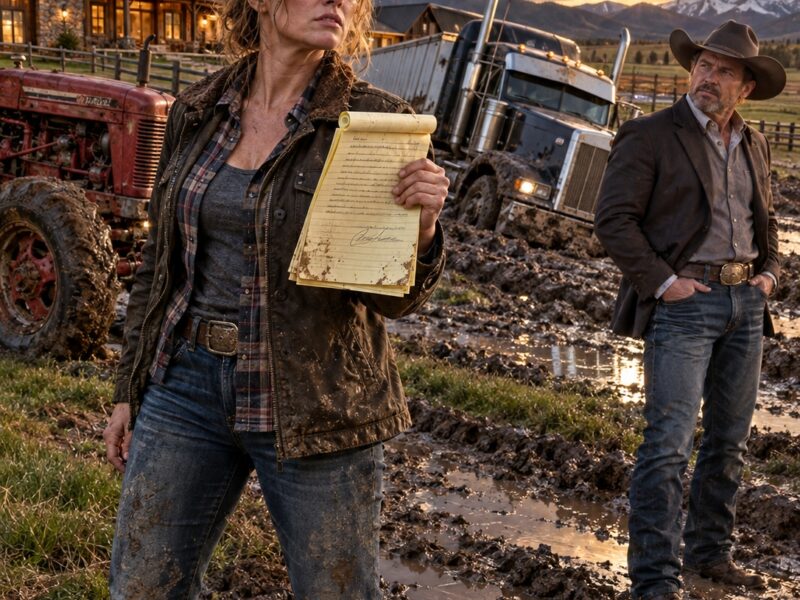
HE LAUGHED AT HER 50-YEAR-OLD TRACTOR—THEN BET 50 COWS SHE COULDN’T MOVE A 69,000-POUND TRUCK
“That thing, lady?”
Wade Kesler pointed toward the faded red tractor sitting beneath the open side of the barn.
For a second, nobody said anything.
Rainwater dripped from the brim of Brena Ror’s cap. Behind her, a 69,000-pound semi sat buried axle-deep in her east pasture, its trailer tilted just enough to make every experienced recovery man on the property nervous.
Water was already spreading around its wheels.
Not ordinary standing water.
Water that was supposed to be somewhere else.
Wade looked from the tractor to Brena and laughed.
“That machine is older than your mortgage.”
Two of his men smiled.
Brena didn’t.
She was watching the water.
Wade shoved his gloves into the pocket of his work jacket and turned toward Nolan Voss, the Redstone Pipeline Services supervisor who had created the mess in the first place.
“I’m bringing in an excavator,” Wade said. “We cut an approach through here, pull the truck from the north side, everybody goes home.”
Brena finally looked at him.
“You cut through there, you destroy my drainage line.”
Wade shrugged.
“Landowner problems.”
Nolan shifted uncomfortably.
Wade must have noticed, because he softened his voice without softening the insult.
“Look, I feel for her. I do. But that truck isn’t moving itself.”
Brena wiped rain from her cheek.
“There’s another way.”
Wade glanced at the old Farmall again.
Then at his crew.
That was when the smile came back.
“You get that truck out without cutting my approach?”
He nodded toward her tractor.
“With that?”
“Yes.”
Wade laughed once.
“Lady, if you move that truck your way, fifty cows are yours.”
The laughter around him grew louder.
Brena’s expression didn’t change.
“Your cows?”
That made Wade pause.
“All fifty.”
“Breeding cows?”
“Yes.”
“Health records and ownership papers included?”
The laughter faded a little.
Wade stared at her.
Brena reached through the open window of her pickup, pulled out a yellow legal pad, and held it toward him.
“Put it in writing.”
That was the moment Wade Kesler should have stopped laughing.
He didn’t.
And before the next morning was over, he would understand that the most expensive mistake he had made in twenty years of business had not been betting fifty cattle.
It had been assuming the quiet woman standing in the rain didn’t know exactly what she was doing.
Sixteen months earlier, Brena Ror had owned exactly three things she considered entirely hers: a gray pickup with 118,000 miles on it, the furniture in a one-bedroom apartment outside Tulsa, and a life that made sense.
She liked that life.
At thirty-seven, she had stopped apologizing for liking predictable things.
Her alarm went off at 5:40 every morning. She drank coffee from the same chipped green mug. She worked as a maintenance coordinator for a regional warehouse operation, where her job was essentially to notice problems before expensive machines turned them into disasters.
She understood bearings, hydraulic systems, preventive maintenance schedules, concrete loading limits, forklift traffic patterns, cooling failures, electrical faults, and the peculiar arrogance people developed around equipment they did not personally have to repair.
Her coworkers sometimes teased her for keeping handwritten backup notes when everything existed digitally.
Brena always gave the same answer.
“Computers forget things too.”
Her father would have approved.
Gordon Ror had never trusted anything that couldn’t survive rain.
Then, on a Tuesday morning in October, Gordon had a stroke.
By Thursday, everything Brena owned was packed into the bed of her pickup.
Eleven days later, her father was dead.
He left behind Ror Creek Farm in southern Missouri: 137 acres, fourteen breeding cows, several miles of tired fencing, an aging barn, machinery that required negotiation before starting, and $28,600 in operational debt.
He also left behind silence.
That was the part nobody listed during probate.
No more boots beside the back door.
No coffee already brewing when Brena came downstairs.
No voice from the shop asking whether she had checked the weather before deciding what she thought she was doing.
For the first few weeks after the funeral, she kept expecting to hear him.
Sometimes she caught herself opening the kitchen door and listening.
Nothing.
The farm had never felt large when Gordon was alive.
Without him, 137 acres felt enormous.
People began offering advice almost immediately.
Sell the north pasture.
Lease the cattle ground.
Auction the equipment.
Sell the entire property before debt swallowed what sentiment had preserved.
And then there was Wade Kesler.
Wade owned Kesler Recovery, a heavy-equipment extraction company with enough county contracts and private work to make his name familiar within fifty miles.
He also ran cattle.
He had money, employees, newer trucks, and the confidence of a man who had spent two decades entering other people’s emergencies after everyone else had run out of ideas.
He had approached Gordon about buying part of Ror Creek before.
After Gordon died, he approached Brena about buying all of it.
His first offer arrived before she had finished sorting her father’s medical bills.
She rejected it.
His second offer was higher, but not by much.
She rejected that too.
Wade had leaned against the hood of his truck that afternoon and looked toward the barn.
“You’re sentimental.”
“I’m careful.”
“Same thing when the bank starts calling.”
Brena remembered folding his written offer once, then again.
“You drove over here to insult me into selling?”
“No. I drove over here because eventually numbers beat feelings.”
She handed the paper back.
“Then come back when you have better numbers.”
He smiled.
“I’ll come back when you’re tired.”
She watched his truck disappear down the gravel road.
Then she went inside and cried where nobody could see her.
Not because Wade frightened her.
Because part of her wondered whether he was right.
The farm did not care that she was grieving.
Fence broke anyway.
Pumps failed anyway.
Cattle got sick anyway.
Diesel still cost money.
So did feed, seed, insurance, property tax, veterinary care, and every small repair that became a large repair if ignored for another week.
Brena learned quickly that grief was expensive when mixed with agriculture.
But she stayed.
And slowly, she began remembering things she had not realized she knew.
Her father had taught without announcing lessons.
When Brena was twelve, Gordon would push a shovel into wet soil and ask, “What does that tell you?”
At fourteen, he showed her tire impressions after a loaded hay wagon crossed a field.
At sixteen, he made her trace a drainage problem uphill instead of staring at the puddle.
“Water lies about where the problem is,” he told her.
At seventeen, he taught her that equipment had limits and that respecting those limits was not fear.
“Anybody can make a machine work hard,” Gordon had said. “The trick is knowing when working it harder makes you stupid.”
The old red Farmall was where most of those lessons happened.
It was a 1975 machine Gordon had bought used.
The paint had faded toward rust in places. The seat had been replaced twice. The steering had enough play to frighten anyone unfamiliar with it.
But Gordon knew every sound it made.
Eventually, so did Brena.
She knew how long to let it warm on a cold morning.
She knew which vibration was harmless and which one meant shut it down.
She knew what it could pull.
More importantly, she knew what it could not.
That distinction would matter.
By Brena’s second full season running Ror Creek alone, the farm was not thriving, but it was surviving.
Then it rained for four days.
The trouble arrived Wednesday morning.
Brena heard diesel engines before she saw the vehicles.
A white Redstone Pipeline Services pickup came first.
Two support vehicles followed.
Then came the semi.
The trailer carried drilling equipment and enough weight to make the ground tremble faintly as it rolled along the road.
Nolan Voss stepped out of the lead truck holding a folder.
He introduced himself as the site supervisor and told Brena Redstone had right-of-way access along the eastern edge of her property.
“Let me see it.”
He glanced toward the convoy.
“We’re already behind schedule.”
“That doesn’t change what I asked.”
Nolan exhaled.
He opened the folder and showed her a project map bearing survey markings and approval stamps.
Brena studied it.
“I want copies.”
“We can get those to you.”
“Before you leave the road.”
Nolan looked past her toward the field.
A section of the designated service road farther ahead had been damaged by the rain.
“We just need to bypass that section.”
“Then wait.”
“For what?”
“For me to confirm where you’re allowed to drive.”
His jaw tightened.
“Ms. Ror, we have crews waiting.”
“And I have land underneath them.”
That should have ended the conversation.
It didn’t.
Brena walked back toward the barn to call the attorney who had handled Gordon’s property records.
Before she reached it, she heard the semi engine change pitch.
She turned.
Nolan was standing beside the road, arm extended.
The driver was turning into her field.
“No!”
She ran.
But a loaded semi does not undo a decision quickly.
The truck traveled perhaps thirty feet before the rear wheels began sinking.
The driver stopped.
Too late.
The ground beneath the trailer compressed.
Then something below the surface collapsed with a muffled, ugly sound.
The trailer dropped several inches.
Brena stopped running.
She knew that sound.
Her eyes moved past the wheels.
Water began bubbling through the grass.
“No.”
Nolan approached.
“What happened?”
Brena looked at him as though he had asked why rain was wet.
“You crossed the drainage channel.”
“What drainage channel?”
“The one you would have known about if you had waited.”
Within twenty minutes, the problem became obvious even to people who knew nothing about the property.
A secondary channel Gordon had maintained for decades had collapsed beneath the trailer.
Water that normally moved underneath the pasture had nowhere to go.
It began backing up.
The east field was turning soft from below.
Fourteen cows stood beyond the fence, restless and confused as water spread through their grazing area.
Nolan called for recovery equipment.
The first crew arrived before noon.
They walked the truck, checked the trailer angle, tested the soil, and refused the job.
Their safest pull direction would put too much torque through the trailer.
The second crew arrived later.
Their operator inspected the ground where he would need to deploy outriggers.
He shook his head.
“Not putting my rig there.”
Then he left too.
That was when Nolan called Wade Kesler.
Wade arrived as if he had been waiting his whole life for the invitation.
He spent less than ten minutes assessing the site before announcing his solution.
Tracked excavator.
New approach.
Cut through the compromised section.
Pull from a better angle.
Fast.
Simple.
Expensive.
And catastrophic for Brena’s drainage.
“There’s another route,” she said.
Wade barely looked at her.
“No, there isn’t.”
“My father built an equipment corridor through this pasture.”
That got Nolan’s attention.
Brena continued.
“Compacted stone base. It hasn’t been used in years, so it’s grown over.”
“Where?”
“About twenty feet north of where you told your driver to turn.”
Nolan’s face changed.
Only slightly.
But she saw it.
Brena went into the barn and returned with an old maintenance map protected inside a cloudy plastic sleeve.
Gordon’s handwriting crossed the page in pencil.
Dates.
Drainage lines.
Fence changes.
Buried utility routes.
And one old equipment corridor.
Wade studied it for perhaps three seconds.
Then he looked toward the Farmall.
That was when he laughed.
That was when he made the bet.
And that was when Brena handed him the legal pad.
“Write exactly what you said.”
Wade’s smile thinned.
“You serious?”
“You offered fifty cows.”
“If you recover the semi without excavating that drainage line.”
“And my tractor assists in the recovery.”
“Fine.”
“Full ownership documentation.”
“Fine.”
“Health records.”
“Fine.”
“Successful recovery means the truck reaches the service road under the plan I organize.”
Wade stared at her.
“Anything else?”
“Yes.”
She nodded toward Nolan and then toward Curtis Bell, the contract driver sitting inside the semi cab.
“They witness it.”
Wade looked around at his crew.
Pride made the decision for him.
He wrote the terms.
Signed them.
Nolan signed as witness.
Curtis climbed down, read the page twice, and added his name.
Wade handed the pad back.
“Hope you’ve got room for fifty imaginary cows.”
Brena folded the sheet and put it inside her jacket.
Then she walked toward the pasture.
Wade called after her.
“Thought you were going to fire up that antique.”
Brena kept walking.
“The tractor isn’t the first thing I need.”
“What is?”
She looked down at the ground.
“The truth.”
For the next forty minutes, she barely spoke.
She followed the semi’s tire tracks.
Every few yards she pressed her boot heel into the soil.
Some places accepted her weight immediately.
Others resisted.
She watched water.
Grass.
Depressions.
The subtle difference between saturated topsoil and ground carrying a firmer base beneath it.
Wade eventually grew impatient.
“You planning to walk the truck out?”
Brena ignored him.
Twenty feet north of the semi’s entry path, something changed.
Nothing visible.
Same grass.
Same rain.
Same brown-green field.
But when she pressed her heel down, the soil resisted.
She stepped sideways.
Soft.
Back again.
Firm.
Her heart beat faster.
She walked another ten feet.
Firm.
Another twenty.
Still firm.
The buried corridor.
Her father had been right.
More importantly, his records were right.
She returned to the barn and spread the maintenance map across Gordon’s old workbench.
For one painful second, she could almost see his hands resting beside hers.
Broad knuckles.
Grease embedded near the nails.
A pencil behind one ear.
She swallowed.
Then she went to work.
Reduce the trailer load.
Move detachable drilling equipment onto support vehicles.
Lay road plates across the damaged section.
Create a bridge between the semi and the buried stone corridor.
Use the Farmall not as the primary pulling machine—which would have been foolish—but to maintain lateral tension and control the trailer’s tracking angle while Curtis supplied controlled forward power.
The tractor did not need to overpower 69,000 pounds.
It needed to prevent 69,000 pounds from moving the wrong way.
When Brena explained it, Nolan stared at the map.
Wade folded his arms.
“You’re adding hours.”
“I’m preventing another mistake.”
“Unloading means labor.”
“Yes.”
“More plates mean rental.”
“Yes.”
“Who’s paying?”
“I’ll cover what I need beyond what Redstone has available.”
Wade laughed.
“Out of what? Your emergency fund?”
Brena met his eyes.
“Yes.”
That answer seemed to bother him more than defensiveness would have.
Wade pointed toward the semi.
“Pull it with what’s here.”
“No.”
“You’re the one who took the bet.”
“And the agreement says I organize the recovery.”
“You’re stalling.”
“I’m refusing to turn one damaged field into two.”
Nolan rubbed the back of his neck.
“How many plates?”
Brena told him.
“How much unloading?”
She told him that too.
Nolan looked at the truck, then at the spreading water.
“Do it.”
Brena spent $1,150 from an operational reserve that had not been large enough before that morning.
She called two local workers she trusted.
By early afternoon, steel road plates were arriving.
Then the Farmall gave her another problem.
The temperature gauge began creeping upward.
Not dramatically.
That was what made it dangerous.
Brena watched the needle for twenty seconds.
Then shut the tractor down.
Wade noticed immediately.
“Oh, that’s perfect.”
Brena opened the side panel.
“Problem?”
“Coolant.”
One of Wade’s men chuckled.
Wade called toward Nolan, “Rescue operation needs a rescue.”
A few people smiled.
Brena was already on her knees.
She found moisture around a coolant-line joint.
Slow leak.
Manageable.
Ignored long enough, it could cook the engine.
She had the replacement fitting in the shop.
The repair took ninety minutes.
Wade used every one of them to become more confident she would fail.
Brena used them differently.
While the engine cooled, she put Gordon’s maintenance map beside the Redstone paperwork Nolan had shown her.
She aligned the property boundaries.
Then she stopped.
Looked again.
The semi’s entry point was wrong.
Not a little wrong.
Approximately twenty feet wrong.
Outside the marked access corridor.
Brena felt something inside her become very still.
She found Curtis near the truck.
“Can I ask you something?”
“Sure.”
“Who told you to turn where you did?”
Curtis glanced toward Nolan.
Brena waited.
Curtis lowered his voice.
“Nolan.”
“Why?”
“Service road was slowing us down. Said cutting the field would save time.”
“Did he tell you that route was inside the approved access?”
“He said we were good.”
Brena took out her phone.
“Would you repeat that if somebody asked later?”
Curtis looked at the sunken trailer.
Then at the flooded pasture.
“I’m not taking the fall for his call.”
That was enough.
Brena photographed everything.
The tire tracks.
Entry point.
Drainage collapse.
Standing water.
Survey markings.
Then she called Audra Fenwick.
Audra had handled Gordon’s land documents for fifteen years.
She listened without interrupting.
When Brena finished, Audra asked one question.
“Do you still have Gordon’s full easement and survey files?”
“Everything.”
“Don’t sign anything.”
“I wasn’t planning to.”
“I mean anything, Brena.”
Forty minutes later, Audra called back.
Her voice had changed.
“The document Nolan showed you—did you see all pages?”
“No.”
“Because what Redstone has on file appears to be an expired survey authorization.”
Brena sat down slowly on the edge of the workbench.
“What does that mean?”
“It means what I just said. Survey authorization. Foot traffic and light vehicles for route assessment. Based on what I’m reading, it did not authorize a loaded semi to cross that field.”
Brena looked through the barn doors.
Nolan was speaking with Wade.
“Are you sure?”
“I’m sure enough that I’m already making calls.”
Brena’s eyes moved toward the stuck truck.
For one angry second, she imagined walking outside and stopping everything.
No recovery until Redstone paid.
No movement until they admitted fault.
No cooperation until Wade wiped that smile off his face.
Then she heard Gordon’s voice in memory.
Solve the problem you have.
Not the one your anger wants.
“What should I do?” Brena asked.
“Document. Don’t waive anything. And don’t use the truck as a hostage.”
“I wasn’t going to.”
“Good.”
Brena ended the call.
Then she returned to work.
That decision mattered more than she understood at the time.
By finishing the recovery cleanly, she would separate two questions Redstone desperately wanted blurred together.
Could she remove their truck?
And had they trespassed and damaged her property?
One had nothing to do with the other.
By sunset, however, she had a new problem.
The road plates were positioned.
The trailer load had been reduced.
The buried corridor was confirmed.
But the transition between the plates and the old stone base remained too soft.
Brena ordered a low-load test.
The nearest plate shifted two inches.
“Stop!”
Everything froze.
Wade looked at her.
“That’s it?”
“For tonight.”
“You said you could do it.”
“I said I could recover the truck. I didn’t say I’d destroy my plan to protect my ego.”
“Ground’s not getting better.”
Brena looked toward the water.
That bothered her.
It should have been draining faster.
Something was wrong.
But darkness was coming, and she did not yet know what.
Nolan approached carrying a document.
He laid it across the tailgate of his pickup.
“We can simplify this.”
Brena read the first paragraph.
Then the second.
By the time she reached the bottom, she understood exactly what “simplify” meant.
The document stated that she acknowledged Redstone’s right of access across the affected portion of her property.
It also released Redstone from future claims arising from the day’s operations.
In return, Redstone would arrange recovery the following morning.
Wade stepped beside her.
“Sign it.”
Brena looked up.
“No.”
“The excavator will be here in the morning.”
“No.”
Wade tapped the paper.
“You’re done, Brena.”
She said nothing.
“The bet was for you to recover it. Another contractor takes over, agreement’s dead.”
There it was.
The real pressure.
Her pasture was flooded.
Her operational reserve was nearly empty.
Her fourteen cows had been moved temporarily.
A 69,000-pound truck was still buried on her land.
An excavator was coming at dawn.
And fifty cows—enough value to change the financial future of Ror Creek—would disappear if somebody else touched the recovery.
Nolan pushed a pen toward her.
“This protects everybody.”
Brena stared at him.
“No. It protects Redstone.”
“Brena—”
“You drove outside your corridor.”
Nolan’s face went blank.
Only for half a second.
But that was enough.
Wade looked between them.
“What’s she talking about?”
Brena folded the waiver and put it back on the tailgate.
“Ask Nolan.”
Then she walked away.
That night, Brena sat alone at the kitchen table.
Rain tapped softly against the windows.
Gordon’s maintenance binders covered nearly every inch of the table.
She had grown up seeing them on the third shelf of the shop.
Brown binders.
Black binders.
One cracked green binder held together with silver tape.
Her father updated them in pencil.
Never beautifully.
Always precisely.
Brena was exhausted enough that the words began blurring.
At 8:43 p.m., she almost quit.
Not forever.
Just for the night.
Then she remembered the road plate shifting.
Two inches.
Why?
The buried corridor itself was firm.
The plates were adequate.
The load had been reduced.
So why was the transition failing?
She found a folder marked:
DRAINAGE / HAUL ROUTES — DO NOT DISCARD.
Her breath caught.
Inside were notes from the late 1980s.
Gordon had reinforced part of the old equipment corridor after an unusually wet season.
Additional stone base.
Extended culvert.
Improved runoff.
Then Brena found one sentence in her father’s block handwriting.
CHECK AFTER HEAVY RAIN. BRUSH/DEBRIS COLLECT AT MOUTH. BACKS UP FAST.
Brena stared at it.
Then at the rain outside.
“Oh, Dad.”
She was moving before she consciously made the decision.
Boots.
Coat.
Flashlight.
Truck.
The culvert mouth was roughly forty yards from the transition point.
She found it beneath six inches of standing water.
Dead grass.
Branches.
Leaves.
Mud.
The opening was completely blocked.
Brena crouched in the cold water and aimed her flashlight into the debris.
There was her answer.
Water that should have been draining east had backed against the buried corridor, saturating the exact section where her road plates ended.
The problem was not that her plan had failed.
The problem was that the drainage system had been trying to tell her something.
She called her two workers.
One answered on the fourth ring.
“Brena?”
“I found it.”
“Found what?”
“Why the ground won’t hold.”
A pause.
“What time is it?”
“Almost nine.”
Another pause.
Then:
“I’ll get my boots.”
They cleared the culvert by hand.
Mud to their knees.
Cold water inside their gloves.
Branches fighting every pull.
Then, at 9:47 p.m., water moved.
Just a trickle at first.
Then more.
The debris released with a sucking sound, and a dark stream rushed through the opening.
Nobody cheered.
They were too tired.
Brena simply stood in the rain watching the water leave her field.
By midnight, the standing pool had dropped by more than half.
At three in the morning, she returned to the transition point.
Pressed her boot into the ground.
The soil held.
She did it again.
Held.
For the first time all day, Brena smiled.
But Gordon’s binder had one more thing to give her.
Back at the kitchen table, she found the complete Redstone access document.
Four pages.
Nolan had shown her one.
Page three contained the language Audra had suspected.
Survey only.
Light access.
Expiration date clearly printed.
No mechanized equipment authorization.
Brena photographed all four pages and sent them to Audra.
Then she made another phone call.
Not to Wade.
To neighboring cattle operators.
Because if she won fifty cows the next morning, Wade was going to discover something else about her.
She had no intention of waiting until after victory to decide what victory was worth.
At 6:45 a.m., Audra texted.
Redstone’s legal department had been contacted.
The liability waiver was withdrawn.
All existing property damage would be documented independently.
The excavator had been stopped at the staging area.
Brena would have until noon to complete her recovery attempt.
She read the message twice.
Then finished her coffee.
At seven, the crews arrived.
Curtis stood beside his cab holding a thermos.
“How’s it look?”
“Better.”
“How much better?”
“Enough to find out.”
She walked the transition.
Six test points.
All held.
Wade arrived at 7:20.
He looked toward the pasture.
Then at the old Farmall.
Then at Brena.
No jokes this time.
She gathered everyone.
“No jerking. No sudden throttle. Curtis, you provide controlled forward drive. I maintain lateral tension from the left side. If I raise my hand, you stop. If anybody sees a plate move, yell. We reset before we force anything.”
Curtis nodded.
Wade stood apart from the group.
Brena climbed onto the Farmall.
The seat felt cold beneath her.
For a moment, her hands rested on the wheel exactly where her father’s hands had rested thousands of times.
She turned the key.
The old tractor came alive.
Not dramatically.
No roar fit for a movie.
Just the familiar mechanical rhythm of an engine that had spent half a century doing work nobody applauded.
At 7:31, they took tension.
The chain tightened.
Brena increased throttle slightly.
Curtis eased forward.
The semi moved.
One foot.
Two.
Then—
“STOP!”
A road plate shifted sideways.
Everything froze.
Wade said something quietly to one of his employees.
The man did not answer.
Four minutes later, the plate was reset.
Brena checked the chain.
Checked the angle.
Climbed back onto the tractor.
Curtis leaned from his window.
“You good?”
She nodded.
“Again.”
The second attempt began.
Two feet.
Four.
Six.
The rear wheels reached the transition.
Then stopped.
The Farmall’s engine note deepened.
Brena felt the load through the steering wheel.
For three seconds, nothing moved.
Three seconds was long enough for every doubt she had carried since her father died to return at once.
Maybe Wade had been right.
Maybe numbers did beat feelings.
Maybe she had mistaken memory for competence.
Maybe keeping the farm had simply been grief wearing work boots.
Then she remembered Gordon’s voice.
Don’t ask the machine for what the ground hasn’t given you.
The ground had given it.
She held steady.
Did not increase throttle.
Did not panic.
“Easy!” she called.
Curtis maintained pressure.
The rear axle climbed.
An inch.
Another.
Then the tires rolled over the edge of the stone base.
Resistance dropped.
The semi moved.
Someone shouted.
Brena barely heard it.
“Keep it straight!”
Curtis held his line.
The front axle crossed the plates.
The trailer settled onto the buried corridor.
Firm ground.
From there, the truck moved under its own power.
Slowly.
Carefully.
Almost anticlimactically.
But nobody on that field looked away.
Curtis followed the old corridor, turned in a long arc, and brought the semi back toward the service road.
When the last rear tire touched pavement, he stopped.
Air brakes hissed.
Silence followed.
Brena looked at her watch.
Forty-seven minutes.
From first movement to pavement.
Forty-seven minutes to solve a problem two professional recovery crews had refused and Wade Kesler had been ready to solve by cutting through her farm.
Curtis climbed down.
He walked across the field toward her.
Brena shut off the Farmall.
Without the engine, the morning suddenly seemed strangely quiet.
Curtis extended his hand.
“Truck’s clear.”
She shook it.
“Thank you for listening.”
He smiled.
“Wasn’t my idea.”
“No. But you listened.”
Wade approached before she had climbed completely off the tractor.
He did not congratulate her.
Instead, he named a dollar amount.
Brena looked at him.
“What’s that?”
“Cash equivalent.”
“For?”
“The cattle.”
The amount was low.
Not insultingly low enough to be absurd.
Just low enough to favor him.
Wade explained it as though he were helping.
No transport.
No veterinary checks.
No feed complications.
No integration problems.
No paperwork.
“Take the money,” he said. “Cleaner for everybody.”
Brena climbed down.
“We agreed on fifty cows.”
“You don’t have pasture for fifty additional head right now.”
“Correct.”
“Your east field is torn up.”
“Correct.”
“You’re already stretched.”
“Also correct.”
“So I’m doing you a favor.”
Brena walked to her pickup.
For the first time, Wade looked uncertain.
She reached into the cab and returned with one sheet of paper.
Placed it on the tailgate.
Wade looked down.
Eighteen cows.
Those were the animals Brena intended to keep, selected by age and breeding record.
Thirty-two cows.
Those had already been discussed with two neighboring operations.
Tentative sale arrangements.
Transport windows.
Veterinary contact.
Intake checks.
Everything organized.
Wade read the page once.
Then again.
“When did you do this?”
“Last night.”
“You didn’t know you’d win.”
“No.”
“Then why—”
“Because if I did win, I needed to know what happened next.”
Curtis was nearby completing paperwork.
He lowered his head, but Brena saw the corner of his mouth move.
Wade stared at her.
And finally, the thing Brena had been waiting for since the previous afternoon happened.
He stopped treating her like a woman who had accidentally found herself standing in his business.
He understood that she had beaten him before the truck ever moved.
Not because she owned better machinery.
Not because she had more money.
Because while he had been imagining her failure, she had been planning beyond her success.
“You really want the cattle?”
Brena met his eyes.
“No.”
Wade blinked.
She tapped the agreement.
“I want what you promised.”
There was nothing left to negotiate.
He had signed.
His crew had witnessed it.
Nolan had witnessed it.
Curtis had witnessed it.
The recovery had been completed exactly under the terms.
Within two weeks, fifty breeding cows transferred from Wade Kesler’s operation to Brena Ror with health records and ownership documentation.
She kept eighteen.
She sold thirty-two through the arrangements she had already begun preparing.
The money did something Brena had not allowed herself to imagine.
It erased the $28,600 operational debt Gordon had left behind.
Not his memory.
Not the grief.
The debt.
There was a difference.
She paid for repairs to the water system.
Rebuilt part of her working reserve.
Replaced fencing she had been patching one section at a time.
And for the first time since coming back to Missouri, she opened the farm account without feeling her stomach tighten.
Redstone’s settlement came separately.
Audra made certain of that.
The company paid for pasture restoration and drainage reconstruction related to the unauthorized crossing.
Future access requests would begin with a new negotiation.
No assumptions.
No shortcuts.
No supervisor pointing at a wet field and deciding that twenty feet did not matter.
Nolan Voss never apologized to Brena in any meaningful way.
Months later, she realized she no longer needed him to.
Wade never apologized either.
That surprised her even less.
But the story traveled.
Not the version Brena would have chosen.
In town, people simplified it.
Woman wins fifty cows with old tractor.
Funny headline.
Good diner story.
It made it sound as though the Farmall had somehow dragged a 69,000-pound semi from the mud through raw mechanical strength.
That was not what happened.
Brena knew that.
Curtis knew it.
Even Wade knew it.
The tractor had been one small part of a much larger solution.
The real machinery had been preparation.
Maps.
Soil.
Drainage.
Load reduction.
Angles.
Patience.
Documentation.
Knowing when not to pull.
Knowing when not to sign.
Knowing that a piece of paper could matter as much as a chain.
Knowing that the water beneath your boots might be telling you more than the loudest man standing beside you.
And knowing what you would do after you won.
The following spring, a neighbor brought Brena an aging tractor with a hydraulic problem.
She fixed it in Gordon’s shop.
Then another farmer brought a skid steer.
Then someone else called about a baler.
Brena did not advertise.
She did not need to.
People with old equipment tend to talk to other people with old equipment.
Especially when someone fixes the problem instead of selling them a new machine.
She turned one corner of the barn into a proper service area.
Then expanded it.
Nothing dramatic.
Nothing financed beyond reason.
One repair at a time.
One customer at a time.
Three years after the morning the semi rolled back onto pavement, Ror Creek Farm carried itself.
The herd was smaller than Wade’s had been, but chosen carefully.
The debt was gone.
Three seasonal workers helped during busy months.
The equipment service business filled hours the farm did not.
And the old 1975 Farmall still sat inside the barn.
Its paint had not magically become new.
There was still rust beneath the fenders.
The seat still complained when someone shifted weight.
The steering still had play.
One afternoon, a young helper named Caleb was replacing a hydraulic line on a neighbor’s tractor when he looked across the shop at the Farmall.
“Can I ask you something?”
Brena was sorting fittings.
“You just did.”
Caleb smiled.
“Why do you keep that thing?”
She glanced over.
“Because it runs.”
“You could buy something newer.”
“I have newer equipment.”
“You know what I mean.”
Brena did.
Outside, late-afternoon light stretched across the pasture.
The rebuilt drainage channel was almost invisible now.
Grass had returned.
Water moved where it was supposed to move.
The buried stone corridor was still beneath the field too.
Most people would never know it existed.
Brena put down the wrench in her hand.
For a moment she remembered another night.
Cold water around her boots.
A flashlight trembling across a blocked culvert.
Her father’s pencil marks on yellowing paper.
CHECK AFTER HEAVY RAIN.
She remembered the hospital too.
Gordon looking smaller beneath white sheets than he had ever looked beneath a tractor.
Eleven days.
That was all she had been given between the phone call and goodbye.
For years afterward, Brena had thought the farm was what he left her.
The acreage.
The cattle.
The barn.
The debt.
The tractor.
She understood now that those were only objects.
What Gordon had really left behind was a way of seeing.
Caleb was still waiting for an answer.
Brena nodded toward the Farmall.
“My father taught me what that machine could do.”
Caleb smiled.
“That why?”
“Partly.”
“What’s the other part?”
Brena picked up her wrench.
“He taught me when to stop.”
Caleb frowned slightly, as if the answer was less sentimental than he had expected.
Maybe it was.
Brena returned to the hydraulic line.
A few minutes later, Caleb did too.
Neither of them said anything else.
Outside, water moved quietly through the drainage line Gordon had once dug and Brena had later rebuilt.
The sound was too soft to hear from the shop.
But she knew it was there.
That evening, after everyone had gone home, Brena stood alone at the barn doors.
The Farmall sat behind her.
Beyond it was Gordon’s workbench.
His original binders still occupied the third shelf.
Brena had digitized every page years earlier.
She could have thrown the paper copies away.
She never did.
Some histories deserved to remain in the form they were written.
She walked out into the pasture as sunset settled over Ror Creek.
There was no audience now.
No Wade.
No Redstone convoy.
No buried truck.
No men laughing at an old tractor.
Just cattle grazing beyond the fence and wind moving through grass that had once been underwater.
Brena stopped near the place where the semi had sunk.
You could not tell anymore.
That struck her as strange.
Some of the days that divide your life into before and after leave almost no visible scar on the ground where they happened.
She looked toward the buried corridor.
Twenty feet.
That was all the semi had missed it by.
Twenty feet between firm ground and disaster.
Twenty feet between an authorized route and an unauthorized one.
Twenty feet between a man’s confidence and a woman’s knowledge.
But Brena knew the story had never really been about twenty feet.
It had been about all the things nobody saw beneath them.
Stone laid forty years earlier.
A culvert hidden beneath weeds.
A father’s pencil note.
A daughter’s years inside industrial maintenance buildings.
An expired permit buried on page three.
A contract folded inside a jacket.
A plan for thirty-two cows made before anyone knew whether she would own even one.
Preparation was like that.
Invisible right up until the moment everyone else needed what you had prepared.
Brena pushed her hands into the pockets of her jacket.
For years, she had thought returning to Missouri meant she had abandoned the life she built in Tulsa.
Sometimes she still missed that apartment.
The predictable paycheck.
The clean floors.
The mornings when nobody called because a fence was down or a pump had failed.
But standing there, she finally understood something Gordon had never managed to say directly.
A life did not become yours because you planned every part of it.
Sometimes it became yours because something broke, and everyone else decided the broken thing had no value.
Then you stayed long enough to learn what was underneath.
The farmhouse lights came on automatically behind her.
Brena turned toward them.
Halfway back, she stopped.
The barn door was still open.
Through it, she could see the nose of the old red Farmall in the fading light.
For one impossible second, she could almost picture Gordon beside it.
Not as he had looked in the hospital.
As he had looked years earlier.
Work shirt.
Dirty cap.
Pencil behind one ear.
Waiting for her to notice something before he told her the answer.
Brena smiled.
Then the image was gone.
She walked back toward the barn and switched off the lights one row at a time.
The last light illuminated the tractor.
Her hand rested on the switch.
“Good night, Dad.”
Click.
Darkness filled the shop.
And beneath the pasture outside, unseen beneath roots and soil and years of weather, the old stone road was still there.
Holding.









