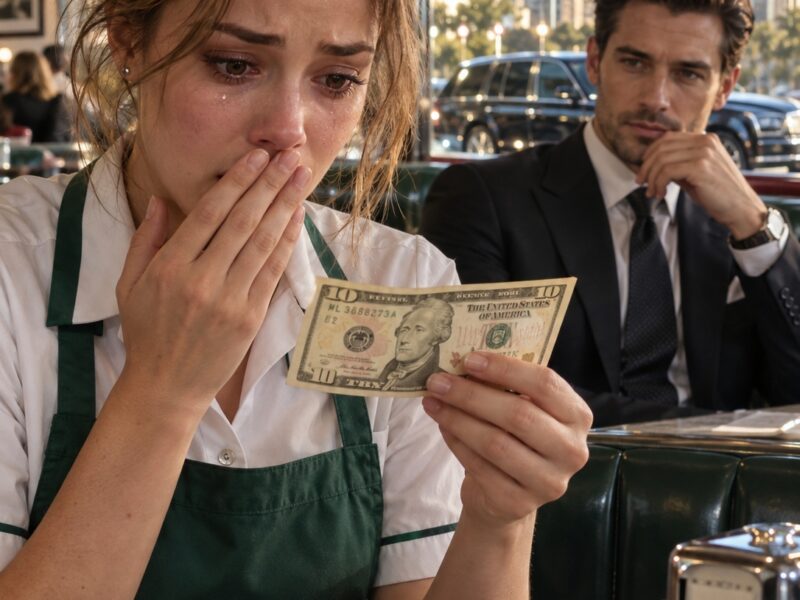
HE LEFT EXACTLY $10 EVERY MORNING FOR A YEAR—WHEN THE WAITRESS FINALLY ASKED WHY, HIS ANSWER CHANGED EVERYTHING
“Mr. Carter, you’ve been leaving me exactly ten dollars every morning for almost a year.”
Olivia Parker stood beside Table Seven with the bill pinched between two fingers.
Not nine.
Not twelve.
Not whatever happened to be left in his wallet.
Ten dollars.
Always crisp. Always placed beside the empty coffee cup. Always folded once through the center as if the ritual mattered more than the money itself.
The breakfast rush had not started yet at Maple Street Diner. Outside the rain-darkened windows, Chicago was waking beneath a gray October sky. A city bus hissed at the curb. Somewhere behind the counter, the old refrigerator rattled. From the kitchen came the faint scrape of a spatula over the grill.
But at Table Seven, the whole room suddenly felt silent.
Olivia smiled, trying to make the question sound lighter than it felt.
“So I have to ask.”
Across from her, Ethan Carter slowly lifted his eyes.
“Why exactly ten dollars?”
For the first time since Olivia had known him, Ethan did not have an answer ready.
The faint smile disappeared from his face.
His hand, halfway toward his coffee, stopped.
Olivia immediately regretted asking.
She had expected a joke.
Maybe ten was his lucky number.
Maybe he hated carrying small bills.
Maybe there was no reason at all.
Instead, something changed behind his eyes.
Something old.
Something painful.
Something Olivia had never seen during hundreds of quiet mornings when Ethan sat at that same window table wearing expensive suits, reading the newspaper, and pretending the world outside could not reach him.
He looked down at the ten-dollar bill.
Then at her.
“You really want to know?”
Olivia’s smile faded.
“I wouldn’t have asked if I didn’t.”
For several seconds, Ethan said nothing.
Then he reached for his coat.
“I’ll tell you.”
“Now?”
His eyes moved toward the windows.
“No.”
Olivia frowned.
“Tomorrow.”
He stood, leaving the coffee unfinished.
“Seven fifteen.”
That was the exact time he had walked into Maple Street Diner almost every morning for eleven months.
Olivia watched him button his coat.
“Why tomorrow?”
Ethan looked at her as though there were a hundred answers and none of them were easy.
“Because some stories deserve more than twenty minutes.”
Then he walked out.
The bell above the door chimed once.
Cold air swept through the diner.
Olivia remained beside the empty table, the ten-dollar bill still in her hand.
On the other side of the glass, Ethan stepped into the back seat of a black SUV waiting at the curb.
A second SUV pulled away behind it.
Olivia stared after them.
She had learned only twenty-four hours earlier that the quiet businessman who ordered black coffee and buttered toast every morning was one of the wealthiest men in America.
But somehow, standing there with that ten-dollar bill between her fingers, she understood that his money was not the biggest secret Ethan Carter had been keeping.
Not even close.
Eleven months earlier, Olivia had barely noticed him.
Back then, Ethan Carter had simply been another customer who arrived too early.
Maple Street Diner opened at six thirty every morning, and Olivia’s shift usually started fifteen minutes before that.
At twenty-four, she lived according to alarms.
5:12 a.m.
Wake up.
5:18.
Coffee.
5:31.
Bus.
6:14.
Apron tied around her waist.
6:30.
Doors unlocked.
Then eight hours of orders, coffee refills, spilled syrup, impatient customers, crying toddlers, tired construction workers, retired couples, office employees staring into phones, and people who somehow believed their eggs becoming cold was a personal tragedy.
At three in the afternoon, Olivia changed in the diner’s tiny employee restroom.
At four, she attended nursing lectures.
At six thirty, labs.
At nine, she rode the bus home with anatomy flash cards balanced on her knees.
Then she studied until her eyes burned.
The next morning, she did it again.
She had been doing some version of that routine for almost two years.
Whenever people asked why she wanted to become a nurse badly enough to live half-awake, Olivia gave them the simple answer.
“I like helping people.”
It was true.
It just wasn’t the whole truth.
What she rarely told anyone was that she had wanted to work with children since she was twelve years old, when her younger cousin spent weeks in the hospital after a serious infection.
Olivia remembered very little about the doctors.
She remembered the nurse.
A woman named Denise who knew how to explain frightening things without making them sound terrifying.
Denise had never spoken down to Olivia’s cousin.
She had crouched beside the hospital bed, looked him in the eye, and told him exactly what was happening.
When he cried, she didn’t tell him to be brave.
She told him it was okay to be scared.
Olivia never forgot that.
Years later, when tuition bills arrived and exhaustion made the dream feel foolish, she remembered Denise.
Sometimes kindness was not dramatic.
Sometimes it was simply refusing to let someone feel alone.
That was the kind of person Olivia wanted to become.
The trouble was that dreams were expensive.
Maple Street Diner paid enough to cover rent on the small apartment she shared with an aging radiator and a kitchen window that refused to close completely.
Nursing school took most of what remained.
She owned exactly two pairs of work shoes, drove no car, bought textbooks used whenever possible, and had developed a talent for turning leftovers into three different meals.
But she almost never complained.
Complaining took energy.
Olivia preferred to spend hers moving forward.
The first morning Ethan Carter entered Maple Street Diner, he came in at exactly 7:15.
Olivia remembered because she had just looked at the clock.
The bell chimed.
He stepped through the door wearing a charcoal suit beneath a dark wool coat.
Tall.
Clean-cut.
Somewhere in his early thirties.
He had the kind of quiet confidence Olivia associated with men who spent their days in glass conference rooms making decisions involving numbers with too many zeroes.
But unlike many businessmen who stopped at Maple Street, he never walked while talking on his phone.
He never snapped his fingers.
Never said, “I’m in a hurry,” as though the rest of the room existed specifically to slow him down.
He simply looked around.
Then chose Table Seven beside the window.
Olivia approached with a menu.
“Morning.”
“Good morning.”
“Coffee?”
“Black, please.”
“Anything else?”
“Buttered toast.”
She waited.
“That’s it?”
He gave her a faint smile.
“That’s it.”
Olivia scribbled the order.
“You know we have eggs.”
“I’m aware.”
“Pancakes.”
“I saw those too.”
“French toast.”
“You’re very committed to this.”
She smiled.
“I get paid more if I sell the expensive stuff.”
That wasn’t true.
Ethan seemed to know it.
The corner of his mouth lifted.
“Black coffee and toast.”
“Your loss.”
Twenty minutes later, he paid his check and left.
Olivia cleared the table.
Beside the receipt was a crisp ten-dollar bill.
She blinked.
His breakfast had cost less than that.
“Nice tip,” said Marissa, another waitress.
Olivia shrugged.
“Maybe he’s trying to impress me.”
Marissa looked through the window at Ethan walking down the sidewalk.
“With that suit? Honey, I think he already knows how.”
Olivia laughed and slipped the bill into her apron.
She assumed she would never see him again.
The next morning, the bell chimed at 7:15.
Ethan entered.
Same table.
Same order.
Same quiet thank-you.
Same ten-dollar tip.
On the third morning, Olivia walked toward Table Seven carrying coffee before he had spoken.
“Black.”
Ethan looked amused.
“You remembered.”
“You’re becoming predictable.”
“That sounds dangerous.”
“Extremely.”
She poured his coffee.
“Toast?”
“Buttered.”
“I continue to be disappointed in your lack of imagination.”
“I’ll try to live with that.”
Ten dollars appeared beside his receipt again.
The fourth day, the same thing happened.
Then the fifth.
Then an entire week.
By the end of the month, Olivia no longer needed to ask his order.
By the end of the second month, Ethan no longer opened the menu.
By the third, Table Seven had quietly become his.
Regular customers understood the invisible rules of diners.
Mr. Douglas sat near the kitchen because he liked talking baseball with the cook.
Mrs. Alvarez took the booth beneath the framed photograph of Wrigley Field.
A retired teacher named Donna sat at the counter because she said booths encouraged loneliness.
And Ethan Carter sat beside the east window at 7:15 every morning.
Black coffee.
Two slices of buttered toast.
Sometimes strawberry jam.
Never orange marmalade.
And exactly ten dollars left behind.
Olivia noticed because she noticed everything.
It was part of being good at her job.
She knew which customers wanted conversation and which wanted silence.
She knew Mr. Douglas took his medication after breakfast and sometimes forgot.
She knew the little boy who came in every Tuesday with his grandfather hated eggs but loved pretending to read the newspaper.
And she knew Ethan always folded his ten-dollar bill once.
Never twice.
One morning, curiosity finally got the better of her.
She held up the tip after he stood.
“You know you don’t have to do this.”
Ethan glanced at the money.
“I know.”
“You tip more than your breakfast costs.”
“I know that too.”
“So either you’re very generous or terrible at math.”
He smiled.
“I’m reasonably good at math.”
Olivia slipped the bill into her apron.
“That leaves generous.”
“Maybe.”
But the way he said it made her think there was another answer.
She just didn’t know what it was.
Their conversations grew slowly.
Neither of them seemed to notice when polite exchanges became familiar ones.
At first, Ethan knew nothing about Olivia except her name.
Then he noticed a pharmacology textbook beneath the register.
“Nursing?”
Olivia followed his gaze.
“Eventually.”
“What does that mean?”
“It means nursing student currently trapped in waitress form.”
He smiled.
“What kind of nursing?”
“Pediatrics.”
“Kids?”
“That’s generally what pediatrics means.”
“You’re sarcastic this early?”
“Only before eight.”
He laughed.
It was the first time Olivia heard him laugh properly instead of giving the quiet, controlled chuckle he used with everyone else.
She liked the sound more than she expected.
“Why pediatrics?” he asked.
Olivia hesitated.
Most customers asked questions because they were making conversation.
Ethan asked as though he actually wanted the answer.
She told him about her cousin.
About the nurse who had known that kindness sometimes mattered just as much as medicine.
Ethan listened without interrupting.
When she finished, he said, “You’ll be good at it.”
Olivia gave him a look.
“You’ve known me for eight weeks.”
“I’ve seen enough.”
“You’ve seen me pour coffee.”
“I’ve seen you remember that Mr. Douglas needs decaf even though he keeps ordering regular. I’ve seen you cut pancakes into smaller pieces for a woman whose hands shake too much to use a knife. Yesterday, you spent ten minutes listening to a five-year-old explain dinosaurs while three people were trying to get your attention.”
Olivia stared at him.
“You notice a lot.”
“So do you.”
Something shifted between them.
Not romance.
Not yet.
Just recognition.
The kind that made both people more careful because suddenly the other person mattered.
A week later, Ethan asked about an exam she had mentioned.
Olivia nearly dropped his coffee pot.
“You remembered?”
“Anatomy.”
“Tuesday.”
“You said Thursday.”
She frowned.
Then laughed.
“You’re right.”
“How did it go?”
Olivia tried to appear casual.
“I passed.”
Ethan smiled immediately.
“I knew you would.”
“You seem very confident for someone who has never seen my grades.”
“I’ve seen how hard you work.”
“That doesn’t guarantee anything.”
“No.”
His expression softened.
“But people who keep showing up have a strange habit of getting somewhere.”
Olivia carried those words with her all day.
That evening, when she stared at a list of medications she could no longer remember and considered closing the textbook, she heard Ethan’s voice in her head.
People who keep showing up have a strange habit of getting somewhere.
So she kept studying.
The next morning, she told him.
“You caused me to lose two hours of sleep.”
Ethan looked concerned.
“How?”
“You gave me inspirational advice.”
“That sounds irresponsible.”
“Very.”
“I apologize.”
“You should.”
He took a sip of coffee.
“Did you learn the material?”
Olivia sighed.
“Yes.”
“Then I’m not that sorry.”
She tried not to smile.
She failed.
From behind the counter, Marissa watched them with exaggerated interest.
When Olivia returned, Marissa whispered, “He likes you.”
“He likes coffee.”
“He can buy coffee anywhere in Chicago.”
“He likes the diner.”
“He comes seven days a week.”
“Six.”
“You counted?”
Olivia froze.
Marissa grinned.
“That’s what I thought.”
“I did not count.”
“You just corrected me.”
“Because Maple Street is closed Sundays.”
Marissa leaned closer.
“He asks about your classes.”
“So?”
“He knows when your exams are.”
“So?”
“He looks at you like the room gets quieter when you walk over.”
Olivia shoved a stack of menus into Marissa’s arms.
“Table Three needs these.”
“You’re changing the subject.”
“Table Three is waiting.”
“Coward.”
Olivia turned away before Marissa could see her smile.
She told herself Ethan was simply kind.
She told herself regular customers became familiar.
She told herself nothing about those mornings meant more than coffee.
Then one Wednesday, Ethan did not come.
At 7:15, Olivia glanced toward the door.
Nothing.
At 7:18, she poured coffee for another customer.
At 7:22, she checked the clock again.
At 7:31, Table Seven remained empty.
By 7:40, she had looked toward the entrance enough times for Marissa to notice.
“Your boyfriend’s late.”
“He’s not my boyfriend.”
“Your billionaire secret agent?”
Olivia frowned.
“What?”
“I don’t know what he does.”
“Exactly.”
Marissa shrugged.
“He’s mysterious.”
“He’s probably in a meeting.”
“Did he tell you that?”
“No.”
“So now you’re inventing meetings for him.”
Olivia turned toward the kitchen.
“I hate you.”
“No, you don’t.”
At 8:05, Olivia stopped pretending she wasn’t worried.
Ethan had never been late.
That was ridiculous, she knew.
People had lives.
Traffic happened.
Meetings changed.
Phones died.
But routine created expectations, and expectations created fear when they suddenly broke.
At 8:17, the bell chimed.
Olivia looked up so quickly she nearly spilled coffee.
Ethan entered, slightly breathless, his tie loosened beneath his coat.
He saw her.
His face immediately softened.
“I’m sorry.”
The relief that moved through Olivia annoyed her.
“You’re apologizing to me?”
“I’m apologizing to my breakfast.”
“Your table was beginning to take it personally.”
He laughed.
“A meeting ran long.”
“I figured.”
“So you noticed?”
Olivia set his coffee down more sharply than necessary.
“You arrive at the same time every morning for ten months. Of course I noticed.”
Ethan’s smile became quieter.
“I’m touched.”
“Don’t be.”
“You were worried.”
“I was not.”
“You were.”
“Your toast is coming.”
“Olivia.”
She stopped.
“Yes?”
“Thank you.”
“For what?”
“For noticing.”
The sentence should have been ordinary.
It wasn’t.
Something about the way he said it made Olivia wonder how many rooms Ethan Carter had entered in his life without anyone truly noticing whether he was there.
She wondered where that loneliness came from.
For the first time, she wanted to know more than why he left ten dollars.
She wanted to know him.
That realization frightened her more than she expected.
The weeks moved forward.
Winter softened into spring.
Olivia finished another semester.
Ethan continued arriving at 7:15.
Sometimes their conversations lasted thirty seconds.
Sometimes ten minutes.
He told her very little about his work.
“Meetings.”
“Contracts.”
“Travel.”
Once, Olivia asked what company he worked for.
Ethan looked almost amused.
“Carter Holdings.”
“What do they hold?”
“A little bit of everything.”
“That sounds suspicious.”
“It probably is.”
She laughed.
“What are you, some kind of corporate spy?”
“Much less interesting.”
Olivia believed him.
Or perhaps she simply didn’t care enough about money to investigate.
Ethan was Ethan.
The man who never put sugar in his coffee.
Who hated people talking loudly on speakerphone.
Who always read the business section last.
Who knew the name of the dishwasher.
Who tipped exactly ten dollars.
Who once stopped eating breakfast to help an elderly customer pick up medication bottles that had spilled across the floor.
Olivia liked that version of him.
She had no reason to imagine there was another.
Then, one afternoon, everything changed.
Olivia’s shift ended early.
She had three hours before nursing class and planned to study at the downtown library.
Her backpack was heavy with books as she stepped outside Maple Street Diner into bright April sunlight.
Traffic on the avenue suddenly slowed.
A police vehicle moved through the intersection.
Then came two black SUVs.
A third stopped in front of the forty-story Carter Tower across the street.
Olivia barely paid attention until several men in dark suits hurried toward the vehicle.
One opened the rear door.
Ethan stepped out.
Olivia stopped walking.
At first, her brain refused to connect the man across the street with the man from Table Seven.
This Ethan looked different.
Not because of his clothes.
She had seen the suits before.
It was everyone around him.
People moved when he moved.
A security officer opened the building door.
Two executives hurried down the steps to greet him.
A silver-haired man shook Ethan’s hand with both of his.
Someone carrying a folder leaned toward him, speaking urgently.
Ethan answered without slowing.
The quiet diner customer had disappeared.
In his place was a man who seemed capable of changing the direction of an entire building merely by entering it.
Two women stood nearby.
One nudged the other.
“That’s Ethan Carter.”
Olivia looked at them.
The second woman lifted her phone.
“The tech guy?”
“Not just tech. Carter Holdings. Real estate, medical systems, logistics. He took over after his mother died and turned it into some insane empire.”
Olivia felt her fingers tighten around her backpack strap.
The first woman lowered her voice.
“He’s worth billions.”
Olivia nearly laughed.
Not because it was funny.
Because it was absurd.
Billions?
Ethan?
The man who ate six-dollar toast?
Across the street, Ethan stopped.
For half a second Olivia thought he had seen her.
Their eyes almost met through the traffic.
Then a city bus rolled between them.
By the time it passed, Ethan was gone inside the tower.
Olivia remained on the sidewalk.
Suddenly she remembered every detail she had dismissed.
His watch.
His suits.
The occasional SUV.
The way people sometimes recognized him before deciding not to approach.
Carter Holdings.
Carter Tower.
She felt unbelievably stupid.
But beneath the embarrassment was something else.
A sting.
Not because Ethan was wealthy.
Because he had known so much about her.
Her work.
Her school.
Her dreams.
Her exams.
Her exhaustion.
And she had known almost nothing real about him.
The next morning, Olivia considered asking Marissa to serve Table Seven.
That thought lasted twenty seconds.
At 7:15, the bell chimed.
Ethan walked inside.
He immediately noticed something was different.
Olivia approached with his coffee.
“Good morning, Mr. Carter.”
His eyebrow lifted.
“Mr. Carter?”
“That is your name.”
“Yesterday it was Ethan.”
“Was it?”
He studied her.
“You found out.”
Olivia folded her arms.
“You could have mentioned that the building across the street has your last name written thirty feet high.”
Ethan glanced toward the window.
“I assumed someone might eventually notice.”
“One of the youngest billionaires in the country?”
He winced.
“I hate that description.”
“Why?”
“Because it makes me sound unbearable.”
Olivia tried not to laugh.
It slipped out anyway.
Ethan smiled.
The tension eased, but only slightly.
“You never told me.”
“You never asked.”
“That’s a terrible defense.”
“It’s the truth.”
“You said you worked in meetings and contracts.”
“I do.”
“You said Carter Holdings held ‘a little bit of everything.’”
“It does.”
Olivia stared at him.
“You let me think you were some midlevel executive.”
“I never said that.”
“You absolutely implied it.”
“Did I?”
“Yes.”
Ethan leaned back.
“Would you have treated me differently if you knew?”
The question caught her off guard.
“No.”
“Exactly.”
“That doesn’t mean you get to decide what I should know.”
His expression changed.
The teasing disappeared.
“You’re right.”
Olivia had expected him to argue.
Instead, he said it again.
“You’re right.”
She looked down at the coffee pot.
“I don’t care how much money you have.”
“I know.”
“I care that I told you things.”
“I know.”
“You knew I was working double shifts to pay tuition.”
“Yes.”
“You knew I was worried about exams.”
“Yes.”
“And every morning you sat here knowing I had no idea who you were.”
Ethan was quiet.
Then he said, “That’s why I sat here.”
Olivia frowned.
“What?”
“For twenty minutes every morning, nobody wanted anything from me because of my name.”
His eyes moved around the diner.
“Frank argues with me about whether the Cubs will ever stop disappointing him. Marissa complains when I take too long ordering. You make fun of my breakfast.”
“That is because your breakfast is boring.”
“Exactly.”
Something in his voice made her look at him differently.
“At the office,” he continued, “every conversation begins with what someone knows about me. Here, it didn’t.”
Olivia’s anger softened against her will.
Ethan looked at her.
“I’m sorry I let you feel foolish. That wasn’t my intention.”
“I don’t feel foolish.”
“You do a little.”
“A lot, actually.”
“Then I’m sorry a lot.”
She laughed.
“Coffee refill?”
“Please.”
Olivia filled his cup.
For a moment, neither spoke.
Then Ethan said, “Are we okay?”
She met his eyes.
“I haven’t decided.”
“That seems fair.”
Twenty minutes later, he stood.
Olivia brought the check.
Ethan paid.
Then he reached into his wallet.
A crisp ten-dollar bill appeared.
Olivia stared at it.
Suddenly the mystery felt stranger than ever.
A billionaire leaving ten dollars.
Not fifty.
Not a hundred.
Not enough to impress anyone.
Ten.
Always ten.
She picked it up before he could leave.
“Can I finally ask you something?”
Ethan paused.
“You can ask me anything.”
“Why this?”
She held the bill between them.
“Why exactly ten dollars every single morning?”
Ethan’s face changed.
The warmth disappeared first.
Then the practiced calm.
His eyes lowered toward the money.
Olivia had seen Ethan negotiate phone calls while people around him looked terrified.
She had seen him remain calm when a customer accidentally spilled orange juice on his suit.
She had watched him read headlines about financial markets without reacting.
But now a ten-dollar bill seemed capable of taking all the strength out of his face.
“Ethan?”
He inhaled.
“That ten dollars changed my mother’s life.”
Olivia lowered her hand.
“What do you mean?”
He glanced at the clock.
7:39.
Then toward the growing line at the door.
“I don’t want to tell this story while you’re carrying six coffee orders.”
“I can listen.”
“You deserve the whole thing.”
“So tell me tonight.”
Ethan looked toward the window.
“No.”
“Tomorrow?”
He nodded.
“Tomorrow.”
“At seven fifteen?”
A sad smile touched his face.
“Earlier.”
Then he left.
Olivia watched him go.
For the first time, the money in her hand felt heavy.
That night, she studied almost nothing.
At midnight she was still awake, staring at the ceiling.
She kept thinking about the sentence.
That ten dollars changed my mother’s life.
How?
Ethan’s mother had apparently built or inherited enough of a business to create Carter Holdings.
Had she been poor before that?
Had someone helped her?
Was the ten dollars symbolic?
A debt?
A promise?
At 2:00 a.m., Olivia finally forced herself to sleep.
At 6:42 the next morning, Ethan was already waiting outside the diner.
Olivia saw him through the glass while she stacked mugs.
No SUV.
No assistant.
No newspaper.
Just Ethan with his hands in his coat pockets.
He looked strangely younger standing alone beneath the streetlamp.
More vulnerable.
Olivia unlocked the door.
“You’re thirty minutes early.”
“You said I should tell you.”
“I didn’t think billionaires followed instructions.”
“I’m trying something new.”
She stepped aside.
“Come in.”
The diner would not officially open for another fifteen minutes.
Frank was preparing the grill in back.
Marissa had not arrived.
Olivia poured Ethan’s coffee and sat across from him for the first time.
Not beside the table.
Across from him.
The position felt unexpectedly intimate.
Ethan wrapped both hands around the mug.
“My father died when I was eight.”
Olivia said nothing.
“Heart attack. No warning. He was thirty-nine.”
Ethan’s gaze remained fixed on the steam rising from his coffee.
“One morning he was complaining because I had left my baseball glove in the hallway. That night my mother was standing in a hospital corridor trying to understand how she was supposed to raise a child alone.”
Olivia’s chest tightened.
“I’m sorry.”
“So was everyone.”
He gave a faint, humorless smile.
“That’s one of the strange things about grief. People apologize for it as though somebody made a mistake.”
Olivia lowered her eyes.
Ethan continued.
“My father didn’t leave much. There was some insurance, but there were debts too. More than my mother knew about.”
“Your mother worked?”
“She started working.”
His eyes lifted.
“Two jobs.”
Olivia already knew what was coming before he said it.
“One was at a diner.”
She looked around Maple Street.
“A place like this?”
“Almost exactly.”
He smiled faintly.
“Red booths instead of green. Terrible coffee. The front door stuck whenever it snowed.”
Olivia smiled.
“That does sound like a diner.”
“My mother worked breakfast there. Nights at a hotel laundry.”
“How did she sleep?”
“She didn’t.”
His answer landed quietly.
Ethan looked down at his hands.
“I didn’t understand how bad things were. Kids usually don’t. I knew we moved into a smaller apartment. I knew cable disappeared. I knew we stopped buying certain groceries.”
His jaw tightened.
“But my mother made poverty feel like a temporary inconvenience instead of a disaster.”
Olivia imagined a tired woman coming home late, smiling for an eight-year-old boy because he was too young to understand overdue notices.
“One winter was especially bad,” Ethan said. “I remember the heat being turned down because she was afraid of the bill. We slept in sweatshirts.”
He swallowed.
“There were nights she said she’d already eaten at work.”
Olivia knew where the sentence was going.
“She hadn’t?”
Ethan shook his head.
“She was saving food for me.”
The kitchen sounds behind them suddenly seemed very far away.
“Then one morning,” he continued, “a man came into the diner where she worked.”
“Who?”
“We never found out.”
Ethan smiled.
“He ordered coffee and eggs. His check was a few dollars. Before he left, he put ten dollars under the cup.”
Olivia looked at the bill beside Ethan’s hand.
“Ten dollars.”
“Ten.”
“The next morning?”
“He came back.”
“And left another?”
Ethan nodded.
“Ten dollars.”
Olivia felt goose bumps rise along her arms.
“How long?”
“Almost three months.”
Her eyes widened.
“Every morning?”
“Every morning.”
“Did your mother know him?”
“No.”
“Did he know what she was going through?”
“She never knew.”
Ethan leaned back, remembering.
“She told me once that maybe he had overheard something. Maybe he noticed her counting coins during a break. Maybe someone told him. Or maybe he tipped everyone that way.”
“But she never asked?”
“She wanted to.”
“Why didn’t she?”
Ethan looked directly at Olivia.
“Because she was afraid the answer would make the kindness harder to accept.”
Olivia’s throat tightened.
The sentence felt aimed at more than the past.
Ethan looked out the window.
“Ten dollars wasn’t much to him, I imagine.”
“But it was to her.”
“It was groceries.”
His voice cracked slightly.
“Bus fare. Medicine when I got sick. A few dollars toward rent.”
He paused.
“One night she came home with a bag of food and a box of hot chocolate. I thought we were celebrating something.”
Ethan smiled through the memory.
“I asked what happened.”
“What did she say?”
“She held up the tip and said, ‘Somebody reminded me today that the world isn’t finished with us yet.’”
Olivia blinked quickly.
Ethan continued.
“I never forgot that.”
His mother eventually found better work.
She took bookkeeping classes at night.
Then accounting.
Years later, she joined a small logistics company.
She proved unusually good at recognizing businesses that were failing for fixable reasons.
She saved money.
Invested.
Bought a small ownership stake.
Then another.
The company grew.
Eventually it became the foundation of what would later be Carter Holdings.
“So she built it,” Olivia whispered.
“She did.”
“And you?”
“I inherited part of it and expanded the rest.”
Ethan’s expression became distant.
“People write articles about how I built an empire. My mother built the first brick while wearing a diner apron and surviving on four hours of sleep.”
Olivia thought of the tower across the street.
The motorcades.
The headlines.
All of it beginning with a woman trying to keep her son warm.
“What happened to the man?”
“The customer?”
She nodded.
“We never found him.”
“Your mother tried?”
“For years.”
Ethan smiled.
“She called the diner after she moved away. Asked old employees. Looked through records that didn’t exist. Nobody remembered his full name.”
“So she never got to thank him.”
“No.”
Ethan’s fingers touched the ten-dollar bill.
“She hated that.”
His voice dropped.
“When she got sick, we talked about him again.”
Olivia watched his face.
Cancer, she realized before he said it.
“My mother was diagnosed eight years ago. By the time they found it, treatment bought us time, not a cure.”
“I’m sorry.”
He nodded.
“She wasn’t afraid of dying.”
A sad smile.
“She was furious about leaving unfinished work.”
“That sounds like her.”
“You didn’t know her.”
“I think I’m beginning to.”
Ethan laughed softly.
“So did she.”
Olivia smiled.
“What did she tell you?”
“She said, ‘Ethan, people will tell you generosity is about how much you give. Don’t believe them.’”
He looked at the bill.
“Then she said, ‘What matters is whether you remember what it feels like to need it.’”
Olivia’s eyes filled.
Ethan continued carefully.
“A few weeks before she died, she made me promise something.”
“What?”
“If life continued to be good to me, I had to keep leaving ten dollars.”
Olivia frowned through her tears.
“At the same diner?”
“At diners. Cafes. Anywhere ordinary people were working hard while the world walked past them.”
He gave a small smile.
“She said not to leave hundreds.”
“Why?”
“Because then it becomes a story about money.”
His eyes met Olivia’s.
“Ten dollars keeps it a story about remembering.”
Olivia looked down.
The bill suddenly seemed enormous.
“How long have you been doing this?”
“Since she died.”
“Every day?”
“Most mornings.”
“And Maple Street?”
“I came in almost a year ago because I had a meeting nearby.”
“And then?”
He smiled.
“You made fun of my toast.”
Olivia laughed through the tears.
“I did not.”
“You absolutely did.”
“Your breakfast deserved criticism.”
“I came back the next morning.”
“For the abuse?”
“For the coffee.”
“That coffee is terrible.”
“It is.”
“Then why?”
Ethan looked at her for several seconds.
“At first?”
“Yes.”
“The promise.”
Olivia’s heartbeat shifted.
“And after that?”
Ethan’s expression softened.
“You.”
Neither moved.
The old clock above the counter clicked loudly.
Olivia looked away first.
“Ethan…”
“I didn’t leave the money because I thought you needed saving.”
She turned back.
“I know.”
“No, I need you to understand this.”
His voice had become firmer.
“I saw how hard you worked. I knew you were paying for school. But I never looked at you and thought you needed a rich man to rescue you.”
Olivia remained silent.
“The ten dollars was never pity.”
“Then what was it?”
“A promise.”
He looked around the empty diner.
“And eventually, a reminder that there was somewhere in my life where I could be simply Ethan.”
Olivia’s eyes burned again.
Ethan smiled.
“My mother would have liked you.”
“How can you know that?”
“Because she had a weakness for women who worked too hard and refused help.”
“That does sound inconvenient.”
“She was extremely inconvenient.”
Olivia laughed.
Ethan glanced at the clock.
The diner would open in three minutes.
He reached for his wallet.
Olivia stared at him.
“You are not seriously about to tip me after that story.”
He placed a crisp ten-dollar bill on the table.
“I made a promise.”
She picked it up.
Then, before she could think better of it, she reached across the table and placed her hand over his.
Ethan went still.
“Your mother would be proud of you.”
For a second, he looked as though the sentence had hurt him.
Then his fingers turned beneath hers.
He held her hand.
Not tightly.
Just enough.
“You have no idea how badly I wanted to hear that.”
The bell over the door chimed.
Marissa entered.
She froze.
Her gaze moved from Olivia to Ethan to their joined hands.
“Well.”
Olivia pulled away so quickly she nearly knocked over the coffee.
Marissa smiled.
“This seems like a terrible time to mention that we open in two minutes.”
Ethan laughed.
The moment broke.
But not completely.
Some moments never returned to what they had been before.
After that morning, the ten-dollar bill was no longer a mystery.
The mystery became something else.
What exactly were Olivia and Ethan becoming?
Neither of them rushed to answer.
Maybe because naming things gave them power.
Maybe because both were afraid of losing what already existed.
Ethan still arrived at 7:15.
Olivia still poured his coffee.
He still left ten dollars.
But now there were moments when conversation stopped and neither looked away quickly enough.
There were accidental touches that no longer felt accidental.
There were questions too personal to ask casual friends.
“Do you ever get lonely?” Olivia asked one morning.
Ethan looked surprised.
“What brought that on?”
“You spend all day surrounded by people.”
“That wasn’t an answer.”
“I know.”
He stirred coffee he never sweetened.
“Yes.”
Olivia nodded.
“Me too.”
“You?”
“I’m surrounded by people too.”
He understood immediately.
Loneliness was not always an empty room.
Sometimes it was spending all day being useful to others and reaching midnight without anyone asking how you were doing.
Ethan began asking.
Not politely.
Really asking.
“How did your clinical go?”
“Did you eat?”
“When did you last sleep?”
“Why are you limping?”
Olivia hated the last one.
“My shoes are trying to kill me.”
“Buy new ones.”
“With what?”
Ethan reached for his wallet.
Olivia pointed a finger at him.
“Don’t even think about it.”
He slowly removed his hand.
“I was getting my credit card.”
“Exactly.”
“You need shoes.”
“I can afford shoes.”
“You just asked ‘with what?’”
“That was rhetorical.”
“Olivia.”
“Ethan.”
They stared at each other.
Finally, Ethan sighed.
“You are impossible.”
“So I’ve been told.”
He bought her nothing.
The next morning, however, a pair of inexpensive gel insoles appeared inside a drugstore bag beside her textbook.
No luxury brand.
No extravagant gift.
Eleven dollars and forty-nine cents according to the receipt.
Olivia marched toward Table Seven.
“You cheated.”
Ethan looked innocent.
“I have no idea what you’re talking about.”
She dropped the bag beside his coffee.
“Eleven dollars and forty-nine cents.”
“That’s not exactly a financial rescue.”
“You cannot solve my problems with money.”
“I solved one problem with foam.”
Olivia fought a smile.
“That is not the point.”
“Do your feet hurt?”
“Yes.”
“Then wear them.”
She stared at him.
“You’re infuriating.”
“My mother said that too.”
Olivia took the bag.
“Fine.”
Ethan smiled.
“But I’m paying you back.”
“No.”
“Yes.”
“No.”
The following morning, his check arrived with eleven dollars and forty-nine cents removed from the usual tip.
Ethan stared at the eighty-one cents she left him.
Olivia smiled sweetly.
“Have a wonderful day, Mr. Carter.”
He looked at the coins.
“This is financial warfare.”
“Consider your debt settled.”
He laughed so loudly the man at the next booth turned around.
Those were the mornings Olivia remembered most later.
Not the grand moments.
Not the expensive buildings or black cars.
The ridiculous ones.
The small ones.
Because life was becoming more difficult.
Final exams approached.
Clinical hours increased.
Olivia slept less.
One afternoon she made a mistake during a simulation—not dangerous, not real, but enough to shake her confidence.
She forgot a step she knew.
Her instructor corrected her in front of the group.
Olivia smiled as if it didn’t matter.
Then she went into a bathroom stall and cried silently for four minutes.
That night she considered whether she was good enough.
The next morning, Ethan knew something was wrong before she spoke.
“What happened?”
“Nothing.”
“Olivia.”
“Coffee?”
“What happened?”
She set the pot down.
“I messed up.”
“At work?”
“Clinical simulation.”
“Was anyone hurt?”
“No.”
“Did you learn what you did wrong?”
“Yes.”
“Will you make the same mistake again?”
“No.”
“Then you didn’t fail.”
Olivia’s eyes narrowed.
“That is a very billionaire answer.”
“What does that mean?”
“You think everything can become a lesson.”
“No.”
Ethan’s expression changed.
“I think you’re punishing yourself because you believe becoming a good nurse means never making mistakes.”
Olivia looked away.
“It means not making stupid ones.”
“Good people make mistakes.”
“Patients pay for medical mistakes.”
“Yes.”
His voice softened.
“Which is exactly why you care enough to be terrified by one during training.”
She folded her arms.
“What if I’m not ready?”
Ethan studied her.
“Do you remember what I told you months ago?”
“You say many annoying things.”
“When you become a nurse.”
Her face softened.
“Not if.”
“When.”
Olivia stared at him.
“When,” she whispered.
“Exactly.”
Three weeks later, she passed her final exams.
She called Ethan before she called anyone else.
The realization struck only after his voice answered.
“Olivia?”
“I passed.”
There was a second of silence.
Then Ethan shouted.
Actually shouted.
“I knew it!”
Olivia burst out laughing.
“You sound more excited than I am.”
“That’s because you’re still in shock.”
“I passed.”
“You passed.”
She leaned against the hallway wall outside the classroom.
Students moved around her, celebrating.
“I’m going to graduate.”
“I know.”
Her eyes filled suddenly.
“I’m really going to do it.”
Ethan’s voice became gentle.
“You already did.”
At graduation, Olivia told herself she did not care whether Ethan came.
He had a board meeting in New York.
He had warned her two weeks earlier.
“I’m trying to move it.”
“Don’t.”
“I want to be there.”
“You run a company.”
“Several.”
“Exactly.”
“That doesn’t make this less important.”
Olivia had smiled.
“If you make it, great. If you don’t, I’ll survive.”
But when the ceremony began, she searched the crowd.
No Ethan.
She told herself she had expected it.
When her name was called, Olivia walked across the stage beneath bright auditorium lights.
“Olivia Parker. Bachelor of Science in Nursing, magna cum laude.”
Applause rose.
Her classmates cheered.
Olivia took the diploma holder and turned toward the audience.
Near the back, a man stood clapping.
Dark suit.
No tie.
Hair slightly disordered.
Ethan.
Olivia almost missed a step.
He had made it.
After the ceremony, she found him near the doors holding white lilies.
“You came.”
“I said I would try.”
“You were in New York.”
“This morning.”
“What did you do, teleport?”
“Plane.”
“Normal people say congratulations.”
He smiled.
“Congratulations.”
Olivia accepted the flowers.
“You didn’t need to do this.”
“I know.”
There was that answer again.
The same one he had given the first time she mentioned the ten-dollar tips.
You don’t have to do this.
I know.
Maybe that was the difference between obligation and love.
Doing something after knowing you didn’t have to.
Olivia looked at him.
“You’re staring.”
“So are you.”
The crowd moved around them.
Families took photographs.
Students hugged professors.
Somewhere nearby, a child cried because a balloon had escaped to the ceiling.
Ethan stepped closer.
“I’m proud of you.”
Olivia’s smile faded into something softer.
Those four words affected her more than the diploma.
“Thank you.”
He touched her cheek.
Very gently.
Enough to give her time to move away.
She didn’t.
Ethan kissed her.
It wasn’t cinematic.
Nobody nearby applauded.
No music started playing.
He simply kissed her slowly among hundreds of strangers while Olivia held lilies against her chest and forgot every clever thing she had ever learned to say.
When they separated, Ethan looked almost uncertain.
Olivia smiled.
“Took you long enough.”
He laughed.
“You could have kissed me.”
“I was busy.”
“For a year?”
“Nursing school is demanding.”
Their relationship began without announcement.
There was no dramatic conversation where either asked what they were.
Ethan started picking Olivia up after hospital orientation.
They ate dinner.
Walked through Lincoln Park.
Argued over movies.
Olivia discovered Ethan could build billion-dollar companies but was incapable of properly loading a dishwasher.
Ethan discovered Olivia owned seventeen pens and trusted none of them.
She met people from his world.
Executives.
Lawyers.
Board members.
People who wore watches worth more than Olivia’s old apartment building.
At first, she felt like an intruder.
At a charity dinner, a woman in diamonds asked Olivia where she had met Ethan.
“At a diner.”
The woman blinked.
“Oh.”
One syllable.
But Olivia heard everything inside it.
How quaint.
How surprising.
How temporary.
Later that night, Olivia stood on the balcony outside the ballroom, breathing cold air.
Ethan found her.
“You disappeared.”
“I needed a minute.”
“What did someone say?”
“Nothing.”
“Olivia.”
She sighed.
“Do you know what people think when they see us?”
“Yes.”
“You do?”
“I run a company filled with people who believe they are subtle.”
She laughed despite herself.
“They think I’m with you because you’re rich.”
“Some do.”
“And other people think you’re with me because I’m…”
She stopped.
“Because you’re what?”
“The waitress.”
Ethan’s expression hardened.
“No.”
“That isn’t what I meant.”
“You’re a nurse.”
“I was the waitress when you met me.”
“You were Olivia when I met you.”
The words stopped her.
Ethan stepped closer.
“I don’t love your job description.”
Olivia’s breath caught.
It was the first time either of them had used the word.
Ethan seemed to realize it too.
Neither spoke.
Finally Olivia whispered, “You love me?”
Ethan looked terrified.
Which was funny, considering she had once watched him enter a room where hundreds of millions of dollars were apparently being negotiated without changing expression.
“Yes.”
Olivia’s eyes filled.
“That’s unfortunate.”
His face fell slightly.
Then she smiled.
“Because I love you too.”
Ethan exhaled.
“You’re cruel.”
“You survived.”
“Barely.”
She kissed him beneath the city lights.
But love did not erase every difference between them.
Olivia still refused extravagant gifts.
Ethan occasionally forgot that normal people could not cancel a workday because they wanted to fly somewhere for lunch.
Olivia once became furious when a driver appeared outside the hospital every night after a series of late shifts.
“I can take the train.”
“It’s midnight.”
“I have been taking public transportation since I was sixteen.”
“And I worry.”
“That doesn’t mean you get to rearrange my life.”
“I didn’t.”
“You sent a car.”
“A car is not your life.”
“It is when the car makes me feel like you think I can’t take care of myself.”
Ethan went quiet.
Olivia expected an argument.
Instead, he nodded.
“Okay.”
The car stopped appearing.
A week later, Ethan waited outside the hospital himself with two coffees.
Olivia stared at him.
“This is absolutely the same thing.”
“No.”
“How?”
“I’m not a car.”
She laughed so hard she had to sit down.
They learned each other slowly.
That was how love became real.
Not through perfection.
Through correction.
Through arguments neither person used as an excuse to leave.
Through choosing again after disappointment.
Months passed.
Olivia began working in pediatric care.
The first time a frightened seven-year-old squeezed her hand during an injection, she thought of Denise, the nurse from her childhood.
The first time a mother cried against Olivia’s shoulder because her son’s test results were finally good, Olivia went into the medication room afterward and cried too.
She texted Ethan.
I understand now.
He replied within seconds.
Understand what?
Why I wanted this.
His response came back.
I always did.
One autumn morning, almost two years after Ethan first entered Maple Street Diner, Olivia met him there before her hospital shift.
She no longer worked at Maple Street, but she visited often.
Marissa was now assistant manager.
Frank still claimed nobody appreciated proper hash browns.
Table Seven remained beside the window.
Ethan was already seated when Olivia walked inside.
“You beat me here.”
“That was the plan.”
She narrowed her eyes.
“Why are you wearing a suit at seven in the morning on Saturday?”
“I often wear suits.”
“Not Saturdays.”
Ethan looked suddenly nervous.
Olivia stopped.
“Are you okay?”
“Perfect.”
“That answer sounded suspicious.”
“Sit down.”
She slid into the booth.
There was coffee waiting.
And beside it—
a crisp ten-dollar bill.
Olivia laughed.
“Of course.”
Ethan smiled.
“You knew I had to.”
“You don’t even have a waitress yet.”
“I’m planning ahead.”
Olivia picked up the bill.
“Do you remember when I finally asked?”
“Every word.”
“You looked like I’d accused you of murder.”
“It was a difficult story.”
“I thought you were hiding something terrible.”
“I was.”
She frowned.
“What?”
Ethan reached across the table.
“Feelings.”
Olivia rolled her eyes.
“That was awful.”
“I practiced that.”
“You should ask for your money back.”
“I paid a consultant.”
“No, you didn’t.”
“No.”
They laughed.
Then Ethan became serious.
He took the ten-dollar bill from her and laid it flat between them.
“This was the first thing my mother taught me about money.”
Olivia listened.
“She taught me that a number can mean something completely different depending on which side of the table you’re sitting on.”
His voice was quieter now.
“To one person, ten dollars is nothing.”
He touched the bill.
“To another, it’s dinner.”
Olivia remembered the story.
The cold apartment.
The groceries.
The hot chocolate.
“To my mother, it was hope.”
Ethan reached for Olivia’s hand.
“To me, it became a promise.”
Her eyes filled before she understood why.
“And then I met you.”
“Ethan…”
“I spent years keeping that promise because I was afraid success would make me forget where I came from.”
He smiled.
“But you reminded me of something else.”
“What?”
“That remembering the past isn’t enough if you forget to build a life in the present.”
Olivia’s heart began pounding.
Around them, the diner had grown strangely quiet.
She glanced toward the counter.
Marissa immediately looked away.
Frank disappeared into the kitchen.
Olivia turned back.
“Oh my God.”
Ethan stood.
“Don’t.”
“You’re doing something.”
“I’m trying to.”
“Ethan.”
He stepped around the table.
Olivia covered her mouth.
Customers began smiling.
A woman near the counter lifted her phone.
Ethan stopped beside Olivia.
“I’ve shared a lot of mornings with you.”
His voice shook slightly.
That frightened Olivia more than anything.
Ethan Carter did not shake.
“I’d like every tomorrow too.”
He lowered himself onto one knee.
Olivia started crying before the box opened.
“Ethan…”
He pulled a small velvet box from his coat.
Inside was a ring.
Elegant.
Simple.
Beautiful.
Very Ethan.
Very Olivia.
“Olivia Parker.”
She laughed through tears.
“Yes.”
“You’re supposed to let me ask.”
“Ask faster.”
The diner erupted in laughter.
Ethan smiled.
“Will you marry me?”
“Yes.”
“You’re sure?”
“Ethan.”
He laughed.
“Right. Sorry.”
“Yes.”
This time she said it clearly.
“Yes, I will marry you.”
Applause filled Maple Street Diner.
Marissa cried openly behind the counter.
Frank came out of the kitchen holding a spatula like he had forgotten to put it down.
Regular customers cheered.
Ethan slid the ring onto Olivia’s finger and stood.
She wrapped her arms around him.
For several seconds, neither noticed anything else.
Then Olivia saw the ten-dollar bill still resting on Table Seven.
She pulled back.
“Wait.”
Ethan looked worried.
“What?”
She reached for the bill.
“This one.”
“What about it?”
“We’re keeping it.”
He smiled.
“You’ve kept hundreds.”
“Not this one.”
She folded it once through the center.
Exactly the way Ethan always had.
“This one is ours.”
Years later, that ten-dollar bill would sit inside a simple frame in their home.
Not because it had become valuable.
It was still worth ten dollars.
That was the point.
Whenever people visited, they sometimes noticed it.
Some assumed it was Ethan’s first dollar earned.
Others guessed it was memorabilia from some famous business deal.
A few thought it was a joke.
Olivia and Ethan never corrected people immediately.
They liked allowing the mystery to exist for a moment.
Because once, a mystery had existed between them too.
A waitress had wondered why a quiet customer kept leaving the same tip.
A boy had once wondered why his mother suddenly brought home enough groceries to last the week.
A tired widow had wondered why a stranger kept returning to her diner each morning and placing ten dollars beneath his coffee cup.
None of them knew his name.
Perhaps they never would.
But that anonymous man had done something he probably never imagined.
He had not simply helped a struggling waitress buy groceries.
He had shaped the values of a child sitting at home waiting for his mother.
That child had grown into a man with more money than he could reasonably spend.
And because of one stranger’s quiet kindness, he had learned that wealth meant very little if it did not remember hunger.
Years after Ethan and Olivia married, Maple Street Diner remained part of their lives.
They still ate breakfast there sometimes.
Ethan still ordered black coffee.
Olivia still criticized his toast.
And whenever Ethan left, there was always a crisp ten-dollar bill beneath the cup.
One morning, a new waitress noticed.
She was young.
Tired.
Probably nineteen or twenty.
She picked up the money.
“Sir?”
Ethan turned.
She held up the bill.
“You accidentally left this.”
He smiled.
“No accident.”
She looked confused.
“That’s a really big tip for coffee.”
Ethan glanced toward Olivia.
She was standing near the door wearing hospital scrubs beneath her coat.
For a moment, husband and wife simply looked at each other.
Olivia knew what he was remembering.
A cold apartment.
A hardworking mother.
An unnamed stranger.
Table Seven.
A question asked almost a lifetime ago.
Why exactly ten dollars?
The young waitress smiled awkwardly.
“Can I ask why?”
Ethan looked at the bill in her hand.
Then at Olivia.
Olivia smiled.
This time, Ethan did not need to wait until tomorrow.
“Because once,” he said, “ten dollars meant everything to someone I loved.”
The waitress’s expression changed.
She looked down at the bill.
Ethan opened the door for Olivia.
Cold morning air moved through the diner.
Outside, the city was rushing exactly as it always did.
Cars.
Phones.
Deadlines.
People hurrying toward lives too busy to notice one another.
Olivia slipped her hand into Ethan’s.
They walked toward the sidewalk together.
Behind them, the young waitress was still standing beside the table, holding the ten-dollar bill as if it had suddenly become something more than money.
Maybe one day she would leave ten dollars for somebody else.
Maybe she wouldn’t.
That had never been the point.
Kindness was not a debt.
It was not something given so that it would return.
Sometimes it disappeared completely.
Sometimes the person who changed your life never learned your name.
Sometimes a small act crossed years, cities, losses, marriages, and generations before anyone understood how far it had traveled.
And sometimes the smallest amount of money on the table carried the largest story in the room.
Ethan squeezed Olivia’s hand.
“You’re smiling.”
“So are you.”
“I asked first.”
She looked back through the diner window.
Table Seven was empty again.
Two coffee cups remained.
A little sunlight had begun breaking through the clouds.
“I was just thinking about your mother.”
Ethan’s smile softened.
“What about her?”
“She was right.”
“About what?”
Olivia looked at him.
“How little it can take to change someone’s life.”
Ethan kissed her forehead.
Then they disappeared into the morning crowd together.
Behind them, Maple Street Diner opened its doors to another ordinary day.
And on an ordinary table beside an ordinary cup of coffee, a ten-dollar bill waited to become part of someone else’s story.









