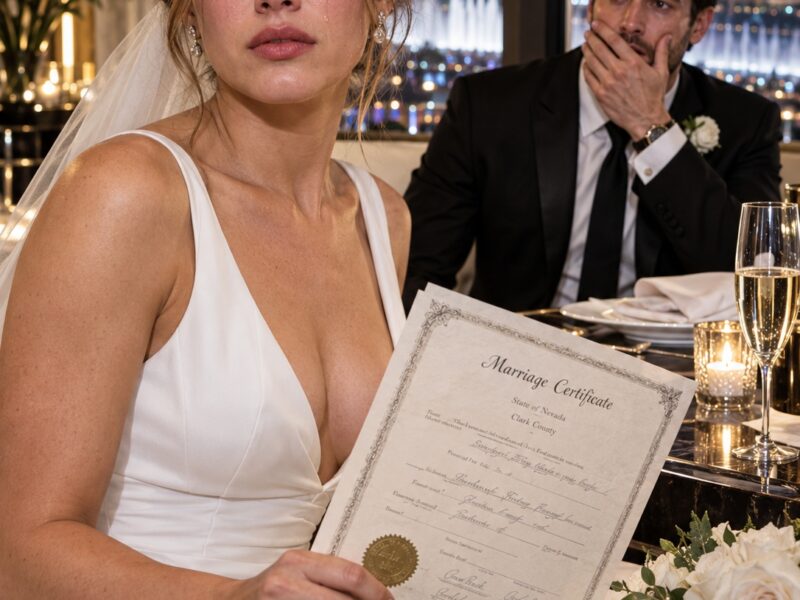
HE LEFT ME WAITING ON OUR WEDDING DAY—BY SUNSET, I WAS MARRIED TO THE MAN HE NEVER SAW COMING
At 1:07 on the afternoon I was supposed to become Ethan Walker’s wife, I discovered that my fiancé had spent our wedding morning pretending to be another woman’s boyfriend.
I was still wearing the white dress he had chosen.
My bouquet was beginning to wilt beside an empty chair.
And the engagement ring on my finger suddenly felt less like a promise than proof of how long I had been willing to wait for a man who had learned that I always would.
The Instagram story lasted only fifteen seconds.
That was all it took to end seven years.
On my phone screen, Ethan sat in a sunlit apartment in Henderson, sleeves rolled to his elbows, peeling an orange for an elderly woman in a floral robe. Beside him stood his executive assistant, Maya Reed, one hand curled possessively around his forearm.
There were white roses on the kitchen counter.
A luxury gift basket sat near the sofa.
Maya was smiling.
Ethan was smiling.
The caption was worse.
Family pressure got intense. Thank you to the world’s kindest boss for stepping in as my fake boyfriend and meeting Grandma. She finally agreed to take her medicine.
I read it twice.
Then a third time.
Around me, the Clark County Marriage License Bureau continued operating as if nothing had happened.
Numbers were called.
Couples laughed.
A baby cried near the entrance.
A woman in a blue dress whispered to her fiancé that she wanted tacos after they got married.
Normal life kept moving while mine quietly split open beneath fluorescent lights.
At nine that morning, I had arrived early because Ethan always teased me about being early.
“You know they’re not going to give the license to someone else if we’re ten minutes late,” he had said the night before.
“I know.”
“You checked the documents again, didn’t you?”
“Twice.”
“Claire.”
“Three times.”
He laughed and kissed my forehead.
“Tomorrow,” he whispered, “you finally become Mrs. Walker.”
That had been less than fourteen hours ago.
At 8:21 that morning, he texted me.
On my way. Don’t be nervous.
At 9:30, he wasn’t there.
At ten, I told myself traffic on I-15 was terrible.
At ten-thirty, I blamed a last-minute crisis at Northbridge.
At eleven, when the civil ceremony office called and asked whether we wanted them to release our reserved slot, I said, “Please give us a little longer.”
At eleven-fifteen, I called Ethan for the fourteenth time.
Straight to voicemail.
At noon, sunlight shifted across the floor until it touched the toes of my shoes.
I called Northbridge Technologies.
The receptionist sounded confused.
“Mr. Walker isn’t in today, Ms. Bennett.”
His driver told me Ethan had taken his own car.
His office manager gave me three explanations in four minutes.
Maybe he had gone to a client meeting.
Maybe he had stopped at the office without anyone noticing.
Maybe his phone had died.
Maybe.
Maybe.
Maybe.
Seven years of loving Ethan had trained me to build bridges out of maybes.
At 1:07, Maya’s Instagram story burned them all down.
A clerk approached carefully.
She had been watching me for hours.
“Ms. Bennett?”
I locked my phone.
“Yes?”
“Your co-applicant still hasn’t appeared.”
Her voice was kind enough to humiliate me.
“If you’d like, we can cancel the pre-application. We also need to release the ceremony time.”
My hand closed around the small velvet ring box inside my purse.
For seven years, I had pictured Ethan sliding that band onto my finger.
Seven years earlier, I had been a frightened college freshman crying behind the university bleachers because several girls in my residence hall had learned exactly which words hurt most.
Foster kid.
Charity case.
Replacement daughter.
Bennett family project.
Ethan found me there.
He didn’t ask why I was crying.
He sat beside me, handed me a tissue, and waited until I could breathe.
Then he said, “As long as I’m around, nobody gets to make you feel like you don’t belong.”
I fell in love with him partly because he had seen me when I was trying desperately not to be seen.
Later, when he started Northbridge Technologies, I believed in him before anyone respectable did.
We lived in an apartment where the heater rattled all winter.
I rewrote investor presentations at two in the morning.
I built financial models during weekends.
When his first major pitch failed, I sat on the kitchen floor beside him while he said he might close the company.
When he needed money, I invested savings I had earned before I touched a dollar of Bennett family wealth.
When clients wouldn’t return his calls, I introduced him to people who eventually did.
When business reporters began calling him a self-made visionary, I smiled from the edge of photographs and told myself that love did not need credit.
We had survived lean years.
Failed pitches.
Bad leases.
Hospital scares.
Investor rejections.
Seven years of postponing vacations, dinners, photographs, anniversaries.
I had thought that morning was the reward for all that waiting.
Ethan apparently believed it was something we could reschedule.
Maya needed him now.
I could wait again.
“Cancel it,” I told the clerk.
She hesitated.
“Are you certain?”
I removed my engagement ring.
For a moment, the pale indentation around my finger looked shockingly intimate.
Then I placed the ring in its velvet box and snapped it shut.
“Yes.”
Behind me, a man said my name.
“Claire Bennett.”
I knew the voice before I turned.
Adrian Hayes stood ten feet away in a black overcoat, one hand holding a paper bag from my mother’s favorite café.
He had flown in from New York that morning.
I knew that because my mother had mentioned it during Sunday dinner. Adrian had been splitting his time between Manhattan and Las Vegas since taking control of the international investment division of Hayes Group.
He looked exactly as he always did when he returned from the East Coast—controlled, immaculate, faintly tired, as if his schedule had personally offended him.
His assistant stopped near the entrance.
Adrian did not.
He walked toward me.
His gaze went first to my face.
Then to the empty chair beside me.
Then to the bouquet.
Finally, to my phone.
He saw the frozen image before I could turn the screen over.
Ethan.
Maya.
Flowers.
Grandmother.
Adrian’s jaw tightened.
“He didn’t come?”
I hated the question because of how simple it was.
No explanations.
No excuses.
Just the truth.
“He wanted to be someone else’s boyfriend.”
Adrian looked at the photograph again.
He did not call Ethan an idiot.
He did not tell me I deserved better.
He did not say he had warned me.
Instead, he put the food in front of me.
“Your mother thought you might forget to eat.”
I almost laughed.
“Of course she did.”
“Eat.”
“I’m not hungry.”
“I know.”
“Then why—”
“Because you haven’t eaten since this morning, and humiliation is worse on an empty stomach.”
I stared at him.
“That may be the least romantic comfort anyone has ever offered a woman in a wedding dress.”
“Good. I wasn’t trying to be romantic.”
That was Adrian.
When I was twelve and first entered the Bennett home as a foster child, everyone treated me as though one wrong word might shatter me.
Adrian was seventeen.
He found me hiding behind an arbor in the garden during a family gathering, because smiling at strangers who knew I had lost my aunt felt impossible.
He sat on the stone bench beside me and said, “If you don’t want to smile, don’t.”
I looked at him, horrified.
“My social worker said I should try.”
“She didn’t say you had to perform gratitude every minute.”
“What if they think I’m rude?”
“Then they can survive disappointment.”
I never forgot that.
Neither, apparently, had he.
Now he slid the food closer.
“Eat something. After that, I’ll take you home.”
Home.
The word hit strangely.
I looked at him.
Then I remembered a conversation at the Bennett estate a month earlier.
His grandfather, Henry Hayes, had spent half of Sunday dinner complaining that Adrian was thirty-one, unmarried, and apparently determined to end the Hayes bloodline through excessive work.
Adrian had finally put down his wineglass.
“If everyone stops arranging introductions for me,” he said dryly, “I promise not to marry a stranger out of spite.”
Henry narrowed his eyes.
“Then marry someone you trust.”
“That sounds very romantic.”
“It sounds efficient.”
Adrian had looked toward the ceiling.
“If the pressure continues, maybe I will. A practical marriage. Separate property. Fair agreement. One year. Everyone stops interfering.”
Everyone had laughed.
Except me.
Now, sitting in the marriage bureau with Ethan’s ring hidden in my bag, I heard myself ask, “Do you still need a wife?”
Adrian went completely still.
His assistant looked sharply away.
The clerk behind the desk stopped typing.
“Claire.”
“Yes?”
“You’re hurt.”
“I’m aware.”
“That isn’t an answer.”
“I’m thinking clearly.”
“You are wearing the dress you intended to marry another man in three hours ago.”
“Two hours ago.”
His expression darkened.
“That distinction is not helping.”
I stood.
My knees shook, which made me angry.
“I’m not asking you to help me make Ethan jealous.”
“Good.”
“I’m not asking you to rescue me.”
“Better.”
“I’m asking because I spent seven years building my life around someone who believed my time had no cost. You need your family to stop managing your personal life. I need to stop behaving as if ending one relationship means my life has stopped.”
“That does not require marriage.”
“No.”
“Then why marriage?”
Because I wanted to choose something before fear chose for me again.
Because I wanted one decision in my life that had not been shaped around Ethan’s schedule.
Because something inside me had broken when I saw that photograph, and beneath the grief was a terrifying clarity.
“I waited seven years,” I said quietly. “I’m not giving him an eighth.”
Adrian studied my face.
I continued before courage disappeared.
“We keep our careers separate. We keep premarital assets separate. We don’t interfere with each other’s companies. If after one year this is a disaster, we walk away without destroying each other.”
His eyes stayed on mine.
“And what do I get?”
“Your grandfather stops inviting women to Sunday dinner.”
“That is admittedly tempting.”
Despite everything, I almost smiled.
Then his face became serious again.
“Last chance, Claire.”
I swallowed.
“Are you asking whether I’m sure?”
“Yes.”
I reached into my bag, pushed Ethan’s ring to the very bottom, and closed the zipper.
“I’m sure.”
Adrian did not smile.
He did not take advantage of the moment.
Instead, he turned to his assistant.
“Find an independent family-law attorney. No connection to Hayes Group or the Bennett family office.”
I blinked.
“What?”
“If you’re going to make a reckless decision, you’re at least going to understand it.”
“I am standing right here.”
“I know.”
“That sounded insulting.”
“It was meant to be responsible.”
Forty minutes later, I was in a private conference room speaking by video with a Nevada attorney I had never met.
Adrian was not allowed inside.
The attorney explained marital property.
Potential divorce consequences.
Debts.
Business interests.
Inheritance issues.
The fact that emotional distress could impair decision-making.
Then she looked directly into the camera.
“Ms. Bennett, is anyone pressuring you to marry Mr. Hayes?”
“No.”
“Has Mr. Hayes threatened you?”
“No.”
“Has he promised you financial benefits in exchange?”
“No.”
“Do you understand that marriage is legally significant even if you intend to review the relationship after one year?”
“Yes.”
“Do you want time?”
The question nearly undid me.
For seven years, time had been the one thing everyone expected me to give.
More time.
Be patient.
Understand.
Wait.
Suddenly someone was offering it back.
I thought of Ethan laughing beside Maya’s grandmother.
I thought of an empty chair.
“No,” I said. “I’m ready.”
The afternoon unfolded with surreal efficiency.
A canceled ceremony slot became available.
Adrian and I completed the paperwork.
We stood together at the counter.
For the first time all day, there was another person occupying the chair beside mine.
When the officiant asked us to move closer for the photograph, Adrian looked at me before touching me.
“May I?”
It was such a small question.
I nearly cried.
I nodded.
His shoulder touched mine.
Nothing more.
The camera flashed.
At 3:47 p.m., I held documents confirming that the marriage had happened.
Adrian placed the photograph on top of them.
“You can reconsider every choice after today,” he said.
I looked up.
“But while this marriage exists, no one gets to treat you like the person who will wait forever.”
For the first time since 9:30 that morning, I could breathe.
Ethan arrived at six.
We were supposed to have dinner together on the Strip before driving to my parents’ estate.
Instead, I sat alone near a restaurant window while Adrian stepped outside for a business call.
Ethan entered looking frantic.
His tie was crooked.
There was sweat at his temples.
“Claire.”
He rushed to the table.
“Oh my God. I’m sorry.”
He bent and reached for my hand.
I moved it away.
His fingers stopped over the tablecloth.
“You weren’t late,” I said.
He frowned.
“What?”
“You never came.”
“Claire, please. Maya’s grandmother became sick.”
I said nothing.
He sat.
“This morning she refused her medication until Maya brought home the man she was dating.”
“The man Maya isn’t dating.”
“Exactly. That’s why she panicked.”
“So you volunteered.”
“She asked me.”
“You volunteered.”
He exhaled.
“Yes. For a few hours.”
“You told her grandmother you were Maya’s boyfriend.”
“It was acting.”
“What part?”
He stared at me.
“What?”
“The flowers? The gift basket? Holding her hand? Sitting beside her in a photograph while your fiancée waited downtown in a wedding dress? Which part was acting?”
His expression hardened in that familiar way it did whenever my feelings threatened the version of himself he preferred.
“You’re deliberately making it ugly.”
“I’m describing what happened.”
“She is an elderly woman.”
“And I was supposed to marry you.”
“We can still get married.”
My chest went quiet.
Ethan reached across the table again.
“Tomorrow.”
I looked at his hand.
Seven years of history sat between us.
“Tomorrow?”
“Yes. We’ll go back. We’ll get the license. We’ll do exactly what we planned.”
He smiled as though offering me a reasonable compromise.
“You’ve always been compassionate, Claire. You can’t seriously resent a sick old woman.”
There it was.
The trick.
If I was hurt, I was selfish.
If I objected, I was cruel.
If Maya needed something and I needed something at the same time, the moral choice always seemed to require me to disappear.
“There’s no need to go tomorrow.”
His smile faded.
“What does that mean?”
I opened my purse.
The marriage documents lay inside.
For a second, my hand hovered over them.
Then I placed them on the table.
Ethan stared.
“What is this?”
“Read.”
He scanned the first page.
His eyes stopped at the names.
Claire Bennett.
Adrian Hayes.
His face changed so quickly I almost felt sorry for him.
Then came disbelief.
Then anger.
Then fear.
He laughed.
It sounded wrong.
“Where did you get these?”
“At the marriage bureau.”
“Fake documents?”
“No.”
“Claire, this is insane.”
I slid the photograph toward him.
His eyes moved from my white dress to Adrian beside me.
His chair scraped backward.
“You married him?”
“Yes.”
“Today?”
“Yes.”
“Because I was gone for a few hours?”
I stared at him.
“No, Ethan. I married him because for the first time in seven years, I understood what those few hours meant.”
His face flushed.
“You found the first available man and married him?”
The restaurant door opened.
Adrian returned.
He noticed immediately that I was cold and placed my wrap over my shoulders.
“The air conditioning is ridiculous,” he said.
Then he saw Ethan.
“Mr. Walker.”
Ethan’s eyes narrowed.
“Adrian Hayes.”
Adrian pulled out the chair beside me but remained standing.
Ethan looked from him to me.
“You planned this.”
“No.”
“You were already involved.”
“No.”
“You expect me to believe you married him within hours?”
“The timeline is documented.”
I heard how calm my own voice sounded.
“At nine this morning, I intended to marry you. At one, I discovered you were pretending to be Maya’s boyfriend. You still had not appeared. Our application was canceled. After that, Adrian and I submitted another application.”
“This is revenge.”
“No.”
“Then what is it?”
I stood.
“An ending.”
His expression cracked.
“Seven years, Claire.”
His voice dropped.
“You’re throwing away seven years.”
I picked up my purse.
“I didn’t throw them away. I lived them. I loved you through them. You decided they guaranteed you an eighth.”
His lips parted.
Nothing came.
“Tomorrow, I’ll collect my belongings from the apartment. My attorney will review my Northbridge equity, my employment agreement, and the licensing relationship between Northbridge and Astra Data.”
That frightened him more than the marriage certificate had.
I saw it instantly.
“Don’t do that.”
“Do what?”
“Mix business with this.”
I almost smiled.
“Interesting.”
“What?”
“You just discovered I married another man, and the first thing you’re truly afraid of losing is the company.”
“That isn’t fair.”
“No. It’s accurate.”
Adrian opened the door for me.
Ethan stepped around the table.
“Claire.”
I stopped.
He looked at Adrian.
Then at me.
“She doesn’t love you.”
Adrian’s expression did not change.
“That is for her to decide.”
“You stole her.”
This time, Adrian’s eyes went cold.
“No.”
His voice remained quiet.
“You left her waiting. She walked away. Don’t confuse the consequences of your choices with theft.”
Then we left.
On the drive to my parents’ estate in Summerlin, I held the marriage documents hard enough to crease them.
Now that anger was fading, terror arrived.
I was twenty-six years old.
Before that afternoon, the most rebellious thing I had ever done was insist on continuing to date Ethan after my father expressed doubts about him.
Now I was going home to announce I had married Adrian Hayes without warning anyone.
The car passed through the gates.
Red Rock Canyon burned rust-red beyond the property.
Adrian unfastened his seatbelt.
I didn’t move.
“Regret it?”
“No.”
“Then what?”
I stared at the front doors.
“They’re going to think I created another problem.”
Adrian was silent long enough that I turned.
“Claire.”
His voice had changed.
“You are not a problem the Bennetts have to manage.”
I looked away before he could see my eyes fill.
That fear had lived in me since I was twelve.
My aunt, the last biological relative who had cared for me, died suddenly.
I entered Nevada’s foster system.
The Bennett Foundation funded youth programs, including services for children aging out of care.
That was how Eleanor Bennett met me.
People later whispered that she noticed me because I resembled her biological daughter, Madeline, who had died years earlier.
That part was probably true.
I had Madeline’s dark eyes.
Similar cheekbones.
But the Bennetts had not simply brought me home.
They visited for months.
Completed licensing.
Passed background checks.
Accepted home studies.
Became foster parents.
Later, they adopted me through the courts.
They gave me security.
Schools.
Doctors.
A bedroom overlooking the garden.
Everything except certainty.
Richard praised my grades.
Eleanor took me shopping.
Neither demanded much.
Neither raised their voice.
Neither made me feel unwanted.
But their carefulness created a different kind of distance.
I spent years assuming they loved the girl I reminded them of more than the girl I actually was.
So I tried never to become difficult.
Never demanding.
Never ungrateful.
Never a problem.
When we entered the living room, Richard and Eleanor were waiting.
So was Henry Hayes.
The moment Adrian stepped inside, Henry stood and raised his cane.
“You kidnapped Claire from the marriage bureau and married her?”
Adrian removed his coat.
“She asked me.”
The cane lowered.
Everyone looked at me.
My stomach tightened.
I placed the documents on the coffee table.
“It was my idea.”
My father’s jaw hardened.
“Where was Ethan?”
“With Maya Reed.”
Silence.
“He didn’t come?”
“No.”
“How long did you wait?”
“More than four hours.”
Richard’s teacup hit the saucer.
I flinched.
His eyes closed.
For one awful second, I expected disappointment.
Instead he said, “When you told us you intended to marry him, I disagreed. But you were our daughter, and it was your choice.”
My throat tightened.
He continued.
“The Bennett family office had been conducting due diligence on a possible strategic investment in Northbridge.”
I stared.
“What?”
“We were preparing to support the company because it mattered to you.”
He looked toward the window.
“Thank God nothing was signed.”
Eleanor came to me.
Her hand touched my cheek.
“Why didn’t you call?”
The question was softer than anything she had said all evening.
“Why didn’t you call us to come get you?”
I swallowed.
“I thought you’d be disappointed.”
Her face crumpled.
“Claire.”
She pressed her fingers to her lips.
“We are disappointed that he failed to value you.”
Tears filled her eyes.
“Not that you believed someone you loved.”
Something inside me shifted.
“You don’t need to decide anything else tonight,” she said. “Your room is ready. It has always been ready. If you want to stay here, stay here. If you want to live with Adrian, do that. If tomorrow you realize this marriage was a mistake, we’ll help you find independent counsel.”
Henry cleared his throat.
Everyone turned.
He pointed his cane at Adrian.
“A completed marriage is not a joke merely because it happened quickly.”
“I agree.”
“Good. Then listen carefully.”
Henry’s voice hardened.
“Claire is not a convenient solution to your family pressure. You have a wife for exactly as long as she freely chooses this marriage. If she wants out, you do not use the Hayes name, Bennett loyalty, business leverage, money, affection, guilt, or my age to keep her.”
Adrian nodded.
“Understood.”
Henry looked at me.
“And if my grandson behaves like an idiot, call me.”
Despite everything, I laughed.
That night, Eleanor walked with me upstairs.
She opened the bedroom I had used since childhood.
The same lamp glowed beside the bed.
Low.
Warm.
Exactly as I had needed it when I first arrived because total darkness made me panic.
Eleanor remained in the doorway.
“Claire?”
I turned.
“Wherever you sleep tonight,” she said, “this remains your home.”
After she left, I sat on the edge of the bed until nearly midnight.
Then my phone vibrated.
Ethan.
Thirty-one missed calls.
Nine messages.
The last one said:
We need to fix this before it goes too far.
I looked at the wedding band Adrian had given me.
It was simple.
Unfamiliar.
Quiet.
Then I deleted Ethan’s message without answering.
The next morning, I went to his apartment.
My suitcase rolled behind me.
When my key opened the door, I expected silence.
Instead, I saw silver heels near the entrance.
Not mine.
The guest bedroom door opened.
Maya Reed stepped into the hall.
She wore an oversized men’s shirt.
One I recognized.
I had bought it for Ethan’s birthday.
Navy cotton.
Hand-stitched collar.
He had promised to wear it after our ceremony when we went to dinner with my parents.
Now it hung from Maya’s bare shoulder.
Her eyes widened.
“Claire.”
I stared.
“Why are you here?”
I almost laughed.
The primary bedroom door opened.
Ethan appeared.
“Claire.”
He stopped when he saw my suitcase.
“Let me explain.”
“You don’t need to.”
I walked past Maya.
“I came for my things.”
His relief lasted less than a second.
“Maya’s grandmother went to the hospital last night.”
I kept walking.
“Maya nearly fainted in the hallway because her blood sugar dropped. I brought her back here.”
I entered our bedroom.
My dresses still hung beside his suits.
The wedding itinerary was still on the dresser.
“There’s nothing going on.”
I opened my suitcase.
“She got sick on her clothes,” Ethan continued. “She borrowed a shirt. She slept in the guest room. I slept here.”
Maya appeared at the doorway.
Tears formed immediately.
“I’m sorry. I had no idea you bought the shirt.”
Her fingers went to the buttons.
“I’ll take it off.”
Ethan grabbed her wrist.
“Stop.”
His voice turned protective.
“What is she supposed to wear?”
Then he looked at me.
“You married somebody else yesterday. Now you’re going to create a scene over a shirt?”
I froze.
Not because the accusation hurt.
Because suddenly seven years rearranged themselves inside my memory.
Maya missing the last train.
Ethan driving her home.
Maya catching a fever.
Ethan staying at the hospital overnight.
A client insulting Maya.
Ethan defending her in front of an entire department.
Every time I expressed discomfort, he had said the same things.
She has no one here.
I’m her boss.
You know how hard her life has been.
You’re stronger than she is.
Be generous.
I had spent years believing the problem was that I lacked compassion.
Now I understood.
Ethan didn’t necessarily love Maya.
That almost made it worse.
He loved being needed.
And he had decided I was strong enough to survive whatever remained after he finished being someone else’s hero.
I packed in silence.
“Claire.”
I folded sweaters.
“This marriage is revenge.”
Books.
“You cannot seriously want Adrian Hayes.”
Documents.
“You barely know him.”
Shoes.
“I know you, Claire.”
I zipped the suitcase.
Ethan’s voice softened.
“You don’t love him.”
I turned.
“I never said I did.”
Hope flashed across his face so quickly it was almost cruel.
“But I know I don’t love you anymore.”
The hope vanished.
At the entryway, I placed my spare key beside an envelope.
Ethan picked it up.
“What is this?”
“My resignation.”
His face tightened.
“And notice regarding Astra Data’s license.”
He ripped the envelope open.
Northbridge’s forecasting platform relied heavily on a predictive system developed by Astra Data, a company I had founded with two technical partners after college.
The intellectual property had never belonged to Northbridge.
Two years earlier, when Ethan’s company needed the technology and couldn’t afford commercial pricing, Astra granted Northbridge a fixed-term, non-transferable license at a symbolic rate.
I had joined Northbridge as chief strategy officer.
I helped build client relationships.
Northbridge grew.
Astra remained small.
I never resented it because I believed we were building a future together.
The license was scheduled to expire at the end of the quarter.
Long before Ethan abandoned me at the marriage bureau.
“I will not renew it,” I said.
He looked up.
“You’re trying to destroy Northbridge.”
“No.”
“You know what happens without Astra.”
“I know Northbridge has two months to transition.”
“That’s nothing.”
“It’s the contract you signed.”
“You’re doing this because of Maya.”
“No. I’m resigning because I no longer want my work tied to your company. I’m allowing the license to expire because Astra owns the technology.”
“You’re punishing me.”
“I’m not ending it early.”
His grip tightened around the pages.
“I’m not taking employees. I’m not taking proprietary Northbridge information. I’m not interfering with existing contracts.”
I met his eyes.
“But you do not get to spend seven years minimizing my work and then demand permanent access to it because you suddenly remember its value.”
Maya stepped forward.
“Northbridge is everything Ethan has.”
I looked at her.
“Then help him save it.”
The elevator doors closed between us.
For the first time, Ethan looked frightened.
Not angry.
Not offended.
Frightened.
And I realized he had never truly imagined a world in which I stopped cushioning his falls.
Adrian’s house overlooked Red Rock Canyon from the western edge of Summerlin.
I had expected us to continue living separately.
He disagreed for one surprisingly practical reason.
“If Grandfather learns we got married and then discovers we went to separate houses within twenty-four hours, he’ll move into my office.”
“That sounds extreme.”
“You haven’t seen him weaponize blood pressure readings.”
The house manager showed me a room at the end of the upper hallway.
I stopped in the doorway.
There was a broad desk near the window.
Mystery novels lined one shelf.
White orchids stood beside a warm lamp.
The curtains overlooked the canyon.
My chest tightened.
“This looks like the reading room I described once.”
Adrian’s expression barely changed.
“When?”
“Years ago. At dinner.”
“I remembered.”
I turned.
“Why?”
He glanced toward the shelves.
“The house was renovated two years ago. I needed a guest room.”
“With my exact taste?”
“A good idea remains good regardless of who suggested it.”
I laughed softly.
There were no clothes waiting.
No cosmetics.
No slippers.
Nothing that implied he had expected me.
Only evidence that he had listened.
That evening, he placed a postnuptial agreement on the dining table.
Separate attorneys had reviewed it.
Our premarital assets remained separate.
Our companies remained separate.
Shared expenses could be negotiated.
Either person could request separate residences.
Most importantly, the agreement prohibited using family influence or business relationships as leverage if either of us wanted to end the marriage.
I read the final page.
“No house?”
“No.”
“No shares?”
“No.”
“No guaranteed settlement?”
“No.”
I frowned.
“That is not a very impressive billionaire marriage contract.”
“I’m devastated.”
“Why structure it this way?”
His answer came immediately.
“Because gratitude is not consent.”
I looked up.
“I don’t want you staying because you believe leaving would make you ungrateful.”
The room went quiet.
He signed first.
I signed second.
That night, there was a glass of water beside my bed and a note beneath it.
I don’t know whether you sleep with the curtains closed or slightly open. Your choice.
I woke after midnight from a nightmare.
For several seconds, I didn’t know where I was.
Then I heard typing downstairs.
Adrian sat in his study.
When he saw me, he closed his laptop.
“Can’t sleep?”
“No.”
He didn’t ask what I dreamed.
He went to the kitchen and warmed milk.
Halfway through the cup, I asked, “Did you know Ethan wouldn’t come?”
Adrian’s eyebrows drew together.
“No.”
“Then why were you at the marriage bureau?”
“Eleanor called.”
“My mother?”
“She couldn’t reach Ethan. She knew you were waiting. She wanted to come herself but worried you would feel embarrassed if she appeared.”
“So she sent you with lunch.”
“Yes.”
I studied his face.
“You didn’t arrange any of this?”
His expression hardened.
“I am glad you asked me to marry you.”
My heart skipped.
“But no, Claire. I would never push you into a hole so I could impress you by pulling you out.”
He walked me back upstairs.
At my door, he stopped.
“Good night.”
I waited.
A faint amusement appeared in his eyes.
“Good night, Mrs. Hayes.”
The words did something unexpectedly dangerous to my heartbeat.
Three days later, Ethan blocked the elevator outside Astra’s downtown office.
He looked terrible.
Good.
That thought surprised me.
Then ashamed me.
Then I decided I was allowed one ugly thought.
“We need to talk.”
“Legal handles Northbridge.”
“This isn’t business.”
“Then we have even less to discuss.”
He stopped the elevator doors.
“Maya’s grandmother is worse.”
I waited.
“The doctors say she could end up in intensive care again.”
“I’m sorry to hear that.”
“Maya says her grandmother’s greatest wish is to see her in a wedding dress.”
A pressure formed behind my ribs.
“No.”
Ethan frowned.
“What?”
“No.”
“Claire, listen.”
“You are not seriously about to ask me what I think you’re about to ask.”
“It isn’t a real wedding.”
I laughed once.
Nothing about it was funny.
“She doesn’t have a boyfriend,” he continued. “Her grandmother believes I’m the person Maya is seeing. We’re planning a symbolic ceremony.”
“When?”
“This weekend.”
I stared at him.
For three years, Ethan and I had been trying to schedule our wedding.
Venue tours postponed.
Engagement photos postponed.
Dinners postponed.
Once because Maya went to the hospital.
Once because Maya’s project failed.
Once because an investor meeting moved.
Yet somehow, Ethan could organize an entire symbolic wedding for Maya within seventy-two hours.
“Did you come here to invite me?”
“No.”
He shifted.
“I need you not to announce your marriage to Adrian yet.”
For a moment, I thought I had misunderstood.
“What?”
“Northbridge is entering Series C negotiations.”
His words came faster.
“Investors have always associated me with the Bennett family. If they learn you married Adrian immediately after our engagement ended, and then photographs appear of me at Maya’s ceremony, they may question my judgment.”
At last, the absurdity became complete.
“You want to marry Maya in public while pretending privately that you’re still going to marry me?”
“It isn’t marriage.”
“Then why do you need me to hide mine?”
His face tightened.
“You’re angry right now.”
“I’m married right now.”
“A man like Adrian doesn’t marry for love.”
I stared at him.
“He needed an appropriate wife. You were hurt. Eventually, when you calm down, the two of you can end this.”
“And then?”
“We talk.”
“About?”
“Us.”
I laughed.
People near reception glanced over.
“So your plan is that you hold a wedding with your assistant, I conceal my legal marriage so you can continue benefiting from the Bennett name, your financing closes, her grandmother recovers, and then you return to me?”
“You’re making it sound manipulative.”
“I’m repeating it slowly.”
His jaw clenched.
“It doesn’t count.”
I stepped closer.
“Every time you sacrifice me for her, Ethan, that part counts.”
He went pale.
I pressed the elevator button.
He caught my wrist.
“You truly feel nothing?”
Security moved immediately.
Two guards separated us.
Adrian appeared from a conference room down the hall.
His expression turned lethal when he saw Ethan’s hand leaving my wrist.
“Don’t touch her.”
Ethan gave a bitter laugh.
“So Hayes controls who she speaks to now?”
Adrian took one step forward.
I stopped him.
“Enough.”
Ethan left.
The guards watched him until he disappeared through the lobby.
I rubbed my wrist.
Then something occurred to me.
I looked at Adrian.
“How did security know?”
He said nothing.
“When did you instruct them?”
“Yesterday.”
Anger rose quickly.
“You told security not to let Ethan near me?”
“I saw the bruising after he grabbed you outside the apartment.”
“You didn’t ask me.”
“He had already—”
“No.”
Adrian stopped.
“Protecting me does not mean deciding who I’m allowed to see.”
His expression changed.
The anger disappeared.
He looked at my wrist, then at me.
“You’re right.”
I had expected an explanation.
Instead, he took out his phone.
He called the head of security in front of me.
“My personal instruction regarding Ethan Walker is canceled. Follow Ms. Bennett—Mrs. Hayes’s instructions and normal building policy.”
He ended the call.
“I crossed a boundary.”
“Yes.”
“I’m sorry.”
No justification.
No request for credit.
No accusation that I was ungrateful.
He simply changed.
Something about that unsettled me more than perfection could have.
Because for years I had believed love meant learning to tolerate someone’s mistakes.
Adrian showed me another possibility.
Love might also mean expecting the person who hurt you to correct them.
Over the next two months, Astra separated from Northbridge piece by piece.
Slowly.
Legally.
Carefully.
We honored the existing license until expiration.
Accounts were reviewed individually.
Employees who wanted to remain at Northbridge remained.
Anyone who independently applied to Astra had to complete full confidentiality review.
No client lists crossed systems.
No proprietary documents left Northbridge.
Adrian never used Hayes Group to crush Ethan.
A software procurement contract that Northbridge had earned remained active.
Only a proposed strategic investment disappeared.
“Why keep the procurement deal?” I asked.
“Because the team earned it.”
“You could cancel.”
“I could also punish hundreds of people for a decision they didn’t make.”
He looked at me.
“I assumed you didn’t want that.”
He was right.
Astra moved into a larger office.
I raised financing without Bennett or Hayes money.
The winning investor was a San Francisco fund with no connection to either family.
When the documents closed, my father texted:
Well done.
Five minutes later:
Come Sunday. Your mother is baking the apple pie you like.
I stared at the messages longer than I should have.
I was beginning to understand my parents in pieces.
Their silence had not meant absence of love.
Sometimes it meant fear.
Sometimes awkwardness.
Sometimes two people who had already buried a child were terrified that loving another one loudly might somehow hurt her.
Ethan, meanwhile, discovered what Northbridge looked like when I stopped quietly stabilizing it.
Investors revalued the company after learning Astra’s technology license would expire.
A major project supervised by Maya generated inconsistent results.
A client suspended testing.
Ethan called.
At first politely.
Then desperately.
Finally angrily.
“Renew the license for one year.”
“Why?”
“Claire.”
“Why?”
“You know the answer.”
“Say it.”
Silence.
He couldn’t.
Because the truth sounded ugly.
Because you loved me, I assumed your work belonged to me.
Because you helped me once, I assumed you would help forever.
Because you stayed seven years, I assumed staying had become your responsibility.
I ended the call.
That evening, I found Adrian in the kitchen inspecting a salmon fillet with tweezers.
I stared.
“What are you doing?”
“Looking for bones.”
“Why?”
“You won’t eat fish if you find small bones.”
I leaned against the counter.
“How do you know that?”
He paused.
“Your mother told me.”
Later, I asked Eleanor.
She frowned.
“I did?”
Apparently not.
The suspicion inside me grew.
Then came cilantro.
After an Astra event, Adrian took me to a Mexican restaurant in the Arts District.
He ordered tacos for me.
“No cilantro,” he told the server.
I stared again.
“Did my mother tell you that too?”
“Tell me what?”
“That I hate cilantro.”
His expression became suspiciously neutral.
“We ate together three years ago. You picked it out of everything.”
“You remember what I removed from tacos three years ago?”
“I remember useful information.”
“That sounds like something a spy says.”
“I’m in investment management. The distinction is mostly regulatory.”
I laughed so hard the server looked over.
Across town, Maya’s symbolic wedding had grown into something no longer remotely symbolic.
A small chapel became a luxury Strip resort.
A borrowed dress became a designer gown.
A few relatives became a reception.
Flowers.
Music.
Photographers.
Videos.
Maya messaged me.
Claire, please come. Grandma will believe the ceremony if she sees you supporting us.
I deleted it.
On the same afternoon, Astra held a product launch at another hotel.
The date had been booked weeks earlier.
During the event, we announced our financing.
Reporters shifted from the wedding to our launch.
Not because I had planned revenge.
Because Ethan had never cared enough about my work to know the schedule.
By evening, social media filled with wedding clips.
Maya in white.
Ethan beneath an arch of roses.
Her grandmother in a wheelchair.
At one point, an officiant asked whether the grandmother approved of her new grandson-in-law.
The old woman looked confused.
Maya quickly took the microphone.
“She’s emotional.”
At 7:14, Ethan sent me a photograph.
He and Maya stood beneath the floral arch.
You can see this and feel nothing?
I stared at the screen.
Then Adrian gently lowered my phone.
“Your launch is over.”
I looked at him.
“So?”
“So we are not spending dinner discussing Ethan Walker.”
“What are we discussing?”
His eyes narrowed with exaggerated severity.
“The fact that you promised me dinner and accepted another twenty-minute interview.”
“Oh.”
“Mrs. Hayes has violated the schedule.”
“And the penalty?”
“You’re paying for dessert.”
I smiled.
At ten that night, everything changed.
A Las Vegas gossip account posted wedding footage with a headline suggesting Northbridge’s founder had abandoned his fiancée of seven years and married his executive assistant.
Investors panicked.
Northbridge’s financing institutions demanded explanations.
Ethan finally discovered that a “fake” wedding containing a bride, vows, professional photographs, guests, a reception, and thousands of online viewers looked remarkably real to everyone except the man insisting it wasn’t.
Then the hospital called.
The truth was worse.
Maya’s grandmother was not dying.
No doctor had given her weeks to live.
She had experienced a serious complication, but her medical team had never described her condition as terminal.
And she had never demanded to see Maya married.
When she recovered enough to understand what had happened, she confronted Maya in the hospital hallway.
Ethan was there.
The old woman tore the pulse monitor from her finger and pointed at her granddaughter.
“When did I ask you to marry your boss?”
Maya began crying.
“Grandma—”
“The first day you brought him to my apartment, I asked whether he had a fiancée.”
Ethan turned.
Maya’s face collapsed.
“You told me,” the grandmother continued, “that they had already separated.”
Maya whispered, “I was scared.”
“Of what?”
“Losing you.”
“You lied about me dying because you were afraid of losing me?”
Maya covered her face.
“I love him.”
The words fell into the corridor.
Ethan stared.
She looked at him.
“I thought if you kept choosing me, then maybe you cared too.”
For once, Ethan did not comfort her.
He left the hospital and came straight to Astra.
A rare summer storm rolled through Las Vegas that evening.
When I left the office, he was waiting in the lobby with rain darkening his suit.
Reception had refused to send him upstairs.
He hurried toward me.
“Claire.”
I stopped.
“Maya lied.”
I said nothing.
“Her grandmother never demanded a wedding. She exaggerated the medical situation. The first morning—the day we were supposed to get married—she lied about the medication too.”
He sounded almost relieved.
As if Maya’s deception had handed him a key to our past.
“She manipulated me.”
“I see.”
“I suspended her.”
“That seems appropriate.”
“Claire.”
He stepped closer.
“You understand what this means?”
“Yes.”
“We can fix this.”
“No.”
His face changed.
“You just said she lied.”
“Maya’s lies belong to Maya.”
“Exactly.”
“Your choices belong to you.”
He stared.
“The morning we were supposed to marry, maybe you believed her story.”
“I did.”
“But you knew I was waiting.”
Silence.
“At the fake wedding, maybe you believed her grandmother wanted it.”
He swallowed.
“But you knew we had spent three years trying to plan ours.”
“Claire—”
“When Maya came out of your guest room in your shirt, maybe everything you said was true.”
I stepped closer.
“But you still looked at me and told me I was unreasonable for hurting.”
Rain struck the glass doors behind him.
His face slowly emptied.
“You keep waiting for one lie from Maya to erase a thousand decisions you made yourself.”
He looked down.
Then finally he said the thing I had needed to hear seven years earlier.
“I thought you would never leave.”
The lobby went still.
Not literally.
People continued moving.
Phones rang.
The elevator chimed.
But inside me, there was complete silence.
There it was.
The truth.
He had always known I would be hurt.
He simply believed my love made that hurt affordable.
I stepped back.
“Now you know better.”
His eyes reddened.
“What about Adrian?”
I said nothing.
“Do you love him?”
“That is between Adrian and me.”
“You don’t.”
Relief entered his face.
“You don’t love him. I know you.”
“You knew me once.”
“You’re using him to forget me.”
I looked toward the doors.
Adrian’s car waited outside.
He stood under the awning.
He could see us.
He did not enter.
He did not send security.
He did not interrupt.
He waited for me to choose when the conversation ended.
I looked back at Ethan.
“Even if I never fall in love with Adrian, he has taught me something you never did.”
“What?”
“I can say no without being punished for it.”
Ethan flinched.
I walked away.
Behind me, he called my name.
Then louder.
“Claire Bennett!”
I stopped for half a heartbeat.
“I can wait for you!”
I smiled sadly.
Seven years earlier, he had found me crying behind university bleachers and promised no one would hurt me while he was around.
Seven years later, I finally understood that I did not need another man to save me from him.
I kept walking.
Living with Adrian became dangerous in quieter ways.
He knew my coffee order.
He kept heating patches in his car because an old running injury hurt when temperatures dropped.
He always said my name before approaching from behind because I hated being startled.
He remembered the mystery writers I liked.
The songs I skipped.
The fact that after difficult meetings I preferred silence for ten minutes before talking.
None of it felt performative.
That frightened me.
Because Ethan had once known those things too.
Love did not fail because someone forgot how you took your coffee.
It failed when remembering you stopped mattering.
One night, I returned from San Francisco after a delayed flight.
My company’s travel system automatically notified my registered emergency contact.
At one in the morning, Adrian stood outside arrivals.
“You came.”
“Yes.”
“You didn’t have to.”
“I know.”
He took my suitcase.
“The system only informed you of the delay.”
“Yes.”
“It didn’t ask you to pick me up.”
“No.”
“Then why are you here?”
He looked at me as if the answer were embarrassingly obvious.
“I wanted to be.”
I looked away before he saw what that did to me.
The truth about Adrian came from a leaking pipe.
A month later, water began dripping through a wall in his study.
The house manager asked me to move a few things from a cabinet.
An old wooden box slipped from the top shelf.
It hit the floor.
The lid opened.
A photograph slid out.
Me.
Seventeen years old.
High school track uniform.
Terrible ponytail.
Then a paper crane.
A faded bookmark.
And a handwritten note.
My handwriting.
Thank you for telling me I don’t have to smile when I don’t want to. When I become powerful someday, I’ll protect you too.
I sat on the floor.
I had forgotten writing it.
Adrian had kept it nine years.
At the bottom of the box lay an interior renovation plan dated two years earlier.
Beside the guest room overlooking Red Rock Canyon, someone had written:
Use reading-room layout Claire once described. Mystery shelves. Warm lamp. White orchids.
Underneath, in Adrian’s handwriting:
Keep as long-term guest room.
Not Claire’s room.
Not future wife.
Not someday.
Guest room.
He had remembered me without assuming he would have me.
When he came home, I placed the plan on the dining table.
Adrian stopped.
The color drained slightly from his face.
“How long?”
He loosened his tie.
“Claire.”
“How long have you loved me?”
Silence.
No joke.
No escape.
“Since you were seventeen.”
My heart slammed once.
“You loved me while I was with Ethan?”
“Yes.”
“Why didn’t you tell me?”
“Because you loved him.”
“You could have said something.”
“Yes.”
“Why didn’t you?”
His gaze stayed on mine.
“Because my feelings were my responsibility.”
I forgot how to breathe.
“If I told you while you loved Ethan, then my love would become another thing you had to manage.”
He looked toward the papers.
“I didn’t want that.”
“So at the marriage bureau—”
“I didn’t agree impulsively.”
I stared.
“You let me believe this was practical.”
“It was practical.”
“Adrian.”
“And selfish.”
There it was.
A crack in his control.
“I wanted to say yes.”
His voice lowered.
“I had wanted to say yes for years.”
Something warm and terrifying moved through me.
Then fear overwhelmed it.
I stood.
“I can’t.”
He did not move.
“I just escaped one relationship where love gradually became permission for someone to occupy more and more of my life.”
“I know.”
“You’ve loved me for nine years.”
“Yes.”
“That’s enormous.”
“Yes.”
“I don’t know what to do with that.”
“You don’t have to do anything.”
“It doesn’t feel like that.”
His face tightened.
For a long moment, neither of us spoke.
Then Adrian went to his briefcase.
He removed a folder.
He placed it on the table.
Divorce papers.
Signed.
My stomach dropped.
“What is this?”
“Our original arrangement was one year.”
“It hasn’t been a year.”
“No.”
“Then why—”
“Because an agreement is not a sentence.”
He pushed the folder toward me.
“If staying here feels like pressure, leave.”
My throat closed.
“You’re serious.”
“Yes.”
“The house?”
“Not leverage.”
“The companies?”
“Not leverage.”
“Our families?”
“Not leverage.”
His eyes reddened, but his voice remained steady.
“I love you because I chose to love you.”
He tapped the papers.
“That does not make my love a debt you owe.”
I took the divorce papers.
That night, I returned to the Bennett house.
Adrian arranged a car.
He did not call afterward.
He did not send paragraphs about how much he had done for me.
He did not ask me to reconsider.
Eleanor saw my suitcase.
She said nothing.
She simply turned on the lamp in my old bedroom.
After a while, she touched it.
“When you first came here, you used to leave this on all night.”
“I remember.”
“The first time Adrian stayed with us after college, he noticed.”
I looked at her.
“He did?”
“Every time he came back to Las Vegas afterward, he asked whether it still worked.”
I stared at the lamp.
“You knew?”
“About his feelings?”
She sighed.
“I suspected.”
“Why didn’t you tell me?”
“He asked us not to.”
My father entered holding an old file.
Inside were my adoption records.
Trust documents.
Estate plans.
Everywhere I looked, my name appeared beside Madeline’s.
Not beneath.
Not replacing.
Beside.
Daughter.
Beneficiary.
Family member.
I turned pages with shaking hands.
Eleanor sat next to me.
“You looked like Madeline when I first saw you.”
I went still.
She continued before I could retreat emotionally.
“That is why I noticed you.”
Her eyes filled.
“But that is not why we loved you.”
“Then why were you always so careful with me?”
She looked broken.
“Because I was afraid.”
“Of me?”
“Of hurting you.”
She wiped her cheek.
“I thought if I loved you too loudly, you would believe I was trying to replace her. So I kept my grief away from you.”
Her mouth trembled.
“I didn’t understand that I was also keeping part of my love away.”
Richard sat across from us.
“We asked almost nothing from you because we never wanted you to believe adoption came with conditions.”
He looked directly at me.
“But having no conditions did not mean having no love.”
I started crying.
Not elegantly.
Not quietly.
At twenty-six years old, I cried like the twelve-year-old who had spent fourteen years trying to earn a place already given to her.
Richard opened another document.
It was an email.
From Adrian.
Five years earlier.
Claire has the right to choose her own life. If she ever chooses me freely, I will treasure that choice. If she does not, the Hayes family must never use its relationship with the Bennetts to influence her.
I read it twice.
Then folded it carefully.
For the first time, I understood the difference between patience and entitlement.
Ethan had waited for my forgiveness because he believed time guaranteed my return.
Adrian had waited without expecting anything at all.
I stayed with my parents for two weeks.
During those weeks, Astra’s new product exceeded early forecasts.
Hayes Group entered our procurement process like everyone else.
Adrian’s team negotiated hard.
One of my directors complained.
“Your husband’s people are impossible.”
I smiled.
“Good.”
“He made them negotiate two rounds over pricing.”
“Better.”
“He said a contract won because of marriage would damage us both.”
That sounded exactly like Adrian.
One rainy evening, I left the office last.
For months, whenever Adrian picked me up, his car waited in the same place.
No horn.
No repeated calls.
Just headlights.
That night, the space was empty.
I stood beneath the awning longer than necessary.
And finally understood something.
I didn’t miss being driven home.
I missed him.
I took out my phone.
Are the divorce papers still valid?
His response arrived almost immediately.
Always.
My heart hurt.
I typed again.
What about our marriage?
This time, several minutes passed.
Then:
As long as you want it, that is valid too.
I drove to his house.
When he opened the door, he looked at my suitcase.
His face became carefully neutral.
“Did you leave something here?”
I held up the divorce papers.
“No.”
His shoulders tightened.
I tore them in half.
Adrian stared.
Then I tore them again.
“I can’t promise I love you the way you’ve loved me for nine years.”
He said nothing.
“I don’t want to come back because you waited.”
Silence.
“Or because you rescued me.”
His eyes never left mine.
“Or because you built me a reading room, remembered cilantro, removed fish bones, or stood in airports.”
My voice shook.
“I want to come back because when I’m with you, I don’t have to become smaller to keep the peace.”
His eyes turned red.
“I can tell you that you’re wrong.”
I stepped closer.
“And you still see me as someone worth loving.”
His breath caught.
“I want to try.”
He whispered my name.
“Not because I owe you.”
I smiled through tears.
“Because I started missing you.”
For the first time, I hugged him first.
Adrian’s hands stopped inches from my back.
Even then.
Even after nine years.
He waited.
I nodded.
Only then did he hold me.
“Claire.”
His voice broke against my hair.
“Are you sure this isn’t gratitude?”
I laughed softly.
“It isn’t.”
“How do you know?”
“Because gratitude doesn’t make me want to kiss you.”
He froze.
I leaned back.
“That was permission, Mr. Hayes.”
For once, Adrian Hayes stopped thinking.
And kissed me.
Northbridge’s problems did not end with Maya’s grandmother.
An internal audit discovered unauthorized transfers of testing data to a California competitor.
Maya claimed she had been conducting compatibility testing.
Emails showed something else.
She had been negotiating employment there.
Preparing an escape plan.
Then the investigators discovered that footage from the fake wedding had not simply leaked.
Maya had sent clips directly to gossip accounts.
Her plan was brutally simple.
If the public believed she and Ethan were married, he would be socially trapped.
Even if he denied it, she could portray herself as the granddaughter who had only wanted to fulfill a dying woman’s wish.
When Ethan confronted her, he expected tears.
Instead, Maya finally stopped pretending.
“I wanted one chance.”
“One chance?”
“Claire has everything.”
Her voice shook.
“The Bennett family. Money. Talent. A company. Seven years of your love.”
Ethan stared at her.
“She didn’t need you.”
“So you lied?”
“I needed someone to choose me.”
“You destroyed my relationship.”
Maya laughed bitterly.
“No.”
He went still.
She stepped closer.
“I lied. I manipulated. I did terrible things.”
Her eyes filled.
“But every time you chose me over Claire, I wasn’t holding a gun.”
Ethan said nothing.
“You liked being needed by me.”
Maya’s tears fell.
“And you liked believing Claire would always be there afterward.”
The words landed harder than any accusation I could have made.
“You wanted two women circling you,” Maya said. “So you called every betrayal kindness.”
Northbridge terminated her employment.
The company filed civil claims related to unauthorized data disclosure and referred relevant evidence for further review.
Her grandmother refused to defend her.
Before leaving Las Vegas, the older woman told Maya one sentence.
“Loving someone does not give you the right to step on another person to reach him.”
The Northbridge board eventually demanded Ethan resign as chief executive.
Not because the Bennetts attacked him.
Not because Hayes Group destroyed him.
Not because I sabotaged the company.
Governance failures.
Personnel decisions.
Risk management.
Investor distrust.
Those were his.
On the day the board voted, Ethan sent me one final email.
I almost deleted it unopened.
Instead, I read.
There were no demands.
No accusations.
No request for another chance.
He apologized.
He wrote that for seven years, I had never stood behind him.
I had stood beside him.
He had simply become accustomed to standing where the light was brightest and treating everything I contributed as part of the background.
Then he confessed something I had always suspected.
The morning of our wedding, his phone had not been dead all day.
He had seen some of my calls.
He had seen my messages.
Maya was crying.
Her grandmother was distressed.
He told himself he would stay only one more hour.
He knew I was waiting.
He simply assumed I would understand.
Because I always had.
I closed the email.
For several minutes, I felt nothing.
Then peace.
Not triumph.
Not revenge.
Peace.
Some apologies matter even when they arrive too late to reopen a door.
I never replied.
On the first anniversary of our courthouse marriage, Adrian came home early.
No ballroom.
No roses covering the house.
No private orchestra.
He attempted to cook noodles.
They were terrible.
I ate them anyway.
After dinner, he placed our original agreement on the table.
“The year is over.”
I raised an eyebrow.
“So?”
“So you choose again.”
“Choose what?”
He looked nervous.
Actually nervous.
“Continue.”
He paused.
“Or end it.”
I stared at him.
We had already said I love you.
Already built routines.
Already fought.
Already apologized.
Already chosen each other in a hundred ordinary ways.
Yet he still would not treat my staying as something he owned.
I opened a drawer.
“I have something for you too.”
I placed an envelope on the table.
Adrian stared at it.
“What is that?”
“Open it.”
For once, his hands were not completely steady.
Inside was a reservation confirmation.
A small chapel on Mount Charleston.
He looked up.
“Claire.”
“Our first wedding belonged to a terrible day.”
His eyes stayed on mine.
“I don’t regret marrying you.”
“Neither do I.”
“But I don’t want the story of us to begin only with the story of Ethan failing to show up.”
I touched the reservation.
“This chapel belongs to us. We passed it together. We both liked it.”
He remained silent so long I became nervous.
“Adrian?”
“Yes.”
“You hate the idea?”
He stood abruptly.
Then lifted me off the floor.
I grabbed his shoulders.
“Adrian!”
He laughed.
Actually laughed.
“I’ve waited nine years. I am trying very hard not to appear overly enthusiastic.”
“You failed.”
“Completely.”
Snow fell lightly on Mount Charleston the day we married again.
My father walked beside me beneath pine branches and white flowers.
Halfway down the aisle, Richard stopped.
I looked at him.
“Dad?”
His hand tightened around mine.
“When we brought you into our family, it was never so you could replace anyone.”
My vision blurred.
“And today I am not giving you away.”
His voice trembled.
“You can always come home.”
For years, I had wanted to hear those words.
That day, I finally understood I always had.
“I know, Dad.”
Adrian waited at the end of the aisle.
He didn’t come rushing forward.
He didn’t reach for me until I finished walking.
One step.
Then another.
My choice.
My pace.
When I reached him, he leaned close.
“Nervous?”
“A little.”
“Tell me if you need to stop.”
I took his hand.
“I don’t.”
The ceremony began.
When Adrian placed the ring on my finger, I remembered another ring hidden at the bottom of my purse one year earlier.
I had once believed that leaving Ethan meant admitting seven years had been wasted.
I was wrong.
Those years taught me what I had mistaken for loyalty.
What I had mistaken for strength.
What I had mistaken for love.
The greatest thing I lost that day at the marriage bureau was not Ethan Walker.
It was the version of myself who believed she had to wait indefinitely to prove she was worthy of being chosen.
Two years later, Astra acquired a Canadian risk-analysis company and became a major independent player in North American logistics technology.
During an interview, a reporter asked whether marrying Adrian had been the turning point that changed my life.
I thought about it.
Then shook my head.
“No.”
She seemed surprised.
“What was?”
“The day before I married him.”
“That was the same day, wasn’t it?”
I smiled.
“Technically.”
She waited.
“The real turning point was sitting alone at the Clark County Marriage License Bureau and realizing another person’s absence wasn’t evidence of my failure.”
The reporter lowered her pen slightly.
“I thought if I left after seven years, those years would become meaningless. But time already spent is not a debt you owe the future.”
Outside the studio, Adrian waited.
He took my briefcase.
“What time are you finishing?”
“Six.”
“Do you want me to pick you up?”
I pretended to think.
“Yes.”
He nodded.
No assumptions.
Even now.
That afternoon, a message appeared on my phone at exactly six.
A photograph.
Adrian’s car outside the office.
Underneath it:
Your appointment has arrived.
I laughed and shut my laptop.
Years earlier, I had sat in a white dress beside an empty chair and believed being left waiting meant I had not been worth arriving for.
I knew better now.
Adrian had not won me from Ethan.
I had never been a prize between two men.
Ethan had not lost me because another man was richer, calmer, or more powerful.
He lost the privilege of standing beside me when he decided my loyalty made my pain harmless.
And Adrian did not earn my love merely because he waited longer.
I chose him because when he moved too close, he listened when I asked him to step back.
Because when he was wrong, he apologized.
Because his love made room instead of taking it.
Because beside him, I could stay entirely myself.
I walked through the lobby and saw his headlights beyond the glass.
He got out when I approached.
“You’re two minutes late,” he said.
“File a complaint.”
“I intend to.”
“With whom?”
“My wife.”
“She sounds difficult.”
“Extremely.”
I smiled.
He held out his hand.
Not pulling.
Not demanding.
Simply offering.
I took it.
Then we walked toward the car together.
Side by side.
The way love should have felt all along.









