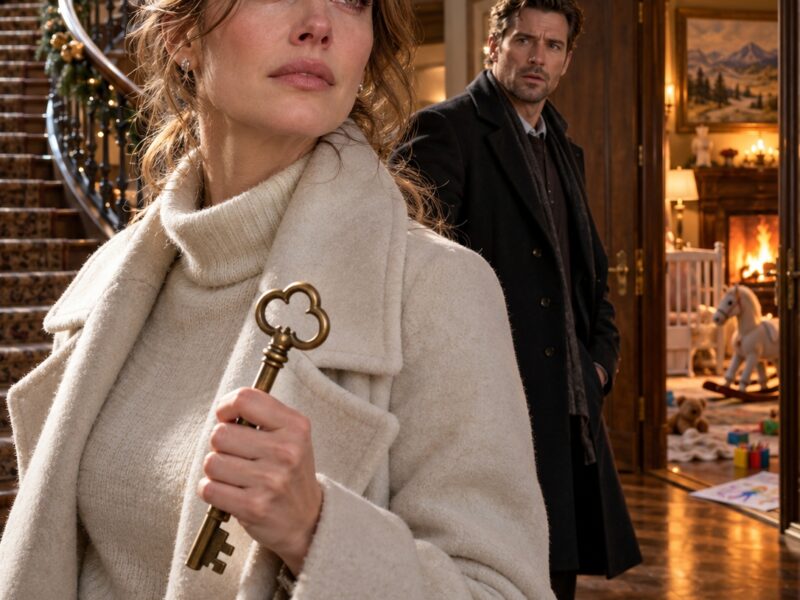
HE LEFT TOWN THE WEEK HIS FUTURE WIFE ARRIVED—THREE WEEKS LATER, HE CAME HOME AND HEARD HIS DEAD WIFE’S HOUSE LAUGHING AGAIN

The first thing Adrian Blackwood heard when he came home was his son laughing.
He stopped with one hand still wrapped around the front door handle.
For a few seconds, he didn’t move.
Didn’t breathe.
Didn’t even step fully inside.
Because four-year-old Oliver had not laughed like that in almost two years.
Not since the winter his mother died.
And certainly never when Adrian was home.
The sound came again from somewhere upstairs—bright, breathless, uncontrolled.
Then a woman’s voice followed it.
“Oliver, if you jump from there, I’m going to have to explain to your father why his son thinks he’s Superman.”
Another burst of laughter.
Adrian slowly lifted his eyes toward the staircase.
His house wasn’t supposed to sound like this.
For two years, the Blackwood home outside Jackson, Wyoming, had been a place where doors closed softly, footsteps softened automatically, and adults lowered their voices without being asked.
Now sunlight poured through curtains he had ordered kept shut.
A pair of tiny snow boots lay crooked beside the entryway.
Crayons were scattered across the coffee table.
Someone had put pine branches in the old ceramic vase near the stairs.
And from the second floor came another sound Adrian had almost forgotten.
His daughter’s voice.
“Dad?”
Seven-year-old Amelia stood halfway down the stairs.
She stared at him.
Adrian’s chest tightened.
He hadn’t seen his children in three weeks.
Three weeks he had spent traveling between company properties in Montana under the excuse of resolving a land dispute that could easily have been handled by attorneys.
Three weeks he had spent avoiding the woman he was supposed to marry.
But Amelia wasn’t looking at him the way a daughter should look at a father returning home.
She looked uncertain.
Almost cautious.
Like she wasn’t sure whether she was allowed to be happy he was there.
Then a woman appeared behind her.
She was carrying Oliver.
Her dark blond hair had partly escaped the loose knot at the back of her head. There was a streak of blue finger paint near the cuff of her cream sweater. Oliver had one arm around her neck and was clutching a wooden horse in the other.
Adrian knew immediately who she was.
Evelyn Hartley.
The woman he had agreed to marry.
The woman he had never bothered to meet.
For one suspended second, none of them spoke.
Then Oliver saw his father.
The laughter vanished.
His little body stiffened.
And before Adrian could say his son’s name, Oliver turned his face into Evelyn’s shoulder.
Hiding from him.
Adrian felt something inside his chest break so cleanly it almost felt physical.
Evelyn’s eyes met his across the staircase.
There was no anger in them.
Somehow, that made it worse.
“You’re home,” she said.
He had rehearsed an apology during the final hundred miles of the drive.
He had constructed careful sentences about unforeseen complications, difficult negotiations, delayed inspections.
All of them suddenly sounded pathetic.
“I’m sorry I wasn’t here when you arrived.”
Evelyn studied him for a moment.
Then she adjusted Oliver against her hip.
“You’re here now.”
That was all.
No accusation.
No demand for an explanation.
No performance of wounded pride.
Which left Adrian with nothing to defend himself against.
Amelia came down another step.
Evelyn looked at Oliver.
“Your dad drove a very long way today.”
Oliver remained buried against her shoulder.
Evelyn continued casually.
“I wonder if his horse—”
Adrian almost corrected her. He had driven an SUV.
Then he realized she was talking about the carved horse Oliver was holding.
“—needs something to eat.”
Oliver peeked up.
Adrian looked at the toy.
Then at his son.
“Apples,” he said quietly. “Horses like apples.”
Oliver hesitated.
“Red ones?”
Adrian swallowed.
“Especially red ones.”
For the first time in months, his son looked directly into his eyes.
It lasted perhaps three seconds.
But three seconds was enough to show Adrian something he had spent two years refusing to see.
His children hadn’t simply lost their mother.
Somewhere along the way, they had lost their father too.
And apparently it had taken a stranger three weeks to make him notice.
Two years earlier, Adrian Blackwood had believed himself to be an extraordinarily lucky man.
At thirty-nine, he had built the kind of life magazines liked photographing.
He owned a successful engineering and land-development company. He lived with his wife and two children on forty acres outside Jackson, in a renovated stone-and-timber house his grandfather had purchased decades earlier.
But none of that had been the reason he considered himself lucky.
The reason had been Clara.
Clara Blackwood could turn grocery shopping into an adventure and make terrible coffee seem charming because she laughed whenever Adrian complained about it.
She loved winter.
Adrian hated winter.
Every December they had the same argument about opening the bedroom windows.
“It’s twelve degrees outside.”
“It’s fresh air.”
“It’s attempted murder.”
“It’s Wyoming.”
She would laugh, and Adrian would close the window, and ten minutes later Clara would open it again.
That was marriage.
Or at least, that had been theirs.
Until one January morning Clara woke with a fever.
At first they thought it was the flu.
By evening, she could barely stand.
The infection moved frighteningly fast.
Hospital.
Tests.
Doctors.
A transfer to Salt Lake City discussed and then abandoned because her condition deteriorated too quickly.
Four days after telling Adrian she felt tired, Clara died with his hand wrapped around hers.
She was thirty-five.
Adrian walked out of the hospital a widower with a seven-month-old son and a five-year-old daughter.
People told him grief changed with time.
They were right.
They simply never told him that sometimes it changed into something worse.
At first Adrian cried constantly.
Then he stopped.
He returned to work.
He removed Clara’s clothes from their bedroom but couldn’t bring himself to donate them, so he boxed everything and moved it into storage.
He stopped playing music in the kitchen.
He stopped taking the children into town on Saturdays.
He stopped going to the little hillside cemetery where Clara was buried.
And eventually he stopped saying her name.
The upstairs playroom had been Clara’s favorite room.
She had painted one wall herself with mountains, trees and badly proportioned woodland animals while pregnant with Oliver.
After her death, Adrian locked it.
The explanation he gave everyone was that seeing it upset him.
The truth was uglier.
Everything upset him.
Clara’s mug.
Clara’s scarf.
The lavender lotion she had kept beside the bathroom sink.
The recipe cards in her handwriting.
Amelia’s eyes, because sometimes they looked exactly like her mother’s.
Oliver’s smile, because Clara had never lived long enough to see most of it.
Adrian began confusing avoidance with survival.
He thought if he removed enough reminders, grief would eventually starve.
Instead, the house starved.
So did his children.
Amelia learned first.
She stopped asking questions about her mother because whenever she did, her father’s face changed.
She stopped laughing loudly at dinner.
She stopped running into Adrian’s office without knocking.
She became polite.
Adrian mistook that for maturity.
It was actually fear.
Oliver learned something different.
He learned not to reach.
Whenever Adrian picked him up, he held the boy stiffly, almost carefully, as though affection itself might tempt fate.
Because somewhere inside Adrian’s grief lived a conviction he never admitted aloud:
Everything I love disappears.
So he began loving from a distance.
He told himself distance was safer.
He never asked what it was doing to the people on the other side.
Margaret Blackwood finally confronted him.
She was Adrian’s father’s older sister, seventy-two years old, sharp-eyed, wealthy enough not to care whom she offended, and one of the few people Adrian couldn’t intimidate into silence.
She came for dinner one November.
Halfway through the meal, Amelia accidentally knocked over her water.
The glass hit the table.
Amelia flinched.
Not because Adrian had yelled.
He hadn’t.
That was the problem.
The child had become afraid of disturbing anything.
Margaret noticed.
After the children went upstairs, she carried her coffee into Adrian’s study and closed the door.
“You are disappearing.”
“I’m working.”
“You’re hiding.”
Adrian stared at his laptop.
Margaret shut it.
His jaw tightened.
“Don’t.”
“Then look at me.”
He did.
“You think grief gives you permission to abandon those children?”
The words landed harder than a slap.
“I have never abandoned my children.”
“You’re standing ten feet away from them every day and calling that parenting.”
“That’s enough.”
“No. Enough was eighteen months ago.”
Adrian rose.
Margaret remained seated.
“Clara died,” she said quietly. “You didn’t.”
His face hardened.
“Don’t use her name to make your point.”
Margaret stared at him.
Then something in her expression changed.
Pity.
Adrian hated that more than anger.
“That’s exactly the problem,” she said. “No one in this house is allowed to use her name anymore.”
Silence.
“Amelia barely remembers how to behave like a child. Oliver reaches for the nanny before he reaches for you. And you’ve convinced yourself this is mourning.”
Margaret stood.
“It isn’t.”
“What is it?”
“A mausoleum.”
Adrian looked away.
Margaret softened only slightly.
“You need help.”
“I’m not remarrying because you think the house needs redecorating.”
“This isn’t about curtains, Adrian.”
“I loved my wife.”
“I know.”
“I’m still married to her in every way that matters.”
“No. You’re grieving her. There’s a difference.”
Adrian turned toward the window.
Margaret had already mentioned Evelyn Hartley twice.
Thirty-four.
Widowed mother had died years earlier.
Former elementary-school counselor.
Daughter of an old family friend.
Intelligent.
Kind.
Apparently uninterested in Adrian’s money.
It sounded like a résumé for a position nobody should have been hiring for.
“I’m not asking you to replace Clara,” Margaret said.
“That’s exactly what you’re asking.”
“I’m asking you to consider whether your children deserve another adult in this house who isn’t afraid to love them.”
That silenced him.
Months of pressure followed.
Conversations.
Arguments.
One awkward phone call with Evelyn that lasted eleven minutes.
Then another.
Eventually, an agreement emerged that was less romantic than some corporate mergers Adrian had negotiated.
They would meet.
They would spend time together.
If the arrangement felt workable, they would marry.
Margaret called it practical.
Adrian called it insanity.
But he agreed.
Then, three days before Evelyn was due to arrive for an extended stay, Adrian left Wyoming.
He told everyone he had business in Montana.
Margaret called him a coward.
Adrian hung up on her.
And Evelyn arrived anyway.
The first person she met at the Blackwood house was Amelia.
The girl stood behind the housekeeper, staring at Evelyn’s suitcase.
“Hi,” Evelyn said.
Amelia said nothing.
Oliver was farther back in the hallway, holding a stuffed rabbit by one ear.
Evelyn crouched.
She didn’t reach for him.
“That’s a serious rabbit.”
Oliver looked at the rabbit.
Then at Evelyn.
“He bites.”
“Good. I respect an animal with boundaries.”
The housekeeper covered a smile.
Oliver didn’t.
Not yet.
Evelyn spent her first afternoon walking through the house.
It was beautiful.
And unbearably sad.
The architecture wasn’t the problem.
The silence was.
Everything looked preserved.
Not lived in.
Family photographs ended almost exactly two years earlier.
Clara existed everywhere and nowhere.
Her face was in framed pictures.
Her presence was absent from conversation.
On the second floor, Evelyn noticed a locked door.
“What’s in there?”
The housekeeper hesitated.
“The children’s old playroom.”
“Why is it locked?”
Another hesitation.
“Mr. Blackwood’s orders.”
Evelyn looked at Amelia.
The girl was staring at the door.
“Did you used to play in there?”
Amelia nodded.
“With Mom.”
That was the first time Evelyn heard Clara’s name.
And the way the housekeeper immediately looked nervous told her everything she needed to know.
Evelyn didn’t open the door that day.
She waited.
She watched.
At dinner Amelia barely spoke.
Oliver ate upstairs.
The following morning Evelyn found Amelia sitting alone on the landing outside the locked room.
“What are you doing?”
“Nothing.”
Evelyn sat beside her.
They remained there together.
After several minutes, Amelia whispered, “Dad doesn’t like that room.”
“Why?”
“Because Mom painted it.”
Evelyn looked at the locked door.
“Do you like it?”
A pause.
“I don’t remember.”
That answer made the decision.
Evelyn asked the housekeeper for the key.
The woman nearly dropped the dish towel she was holding.
“Miss Hartley, Mr. Blackwood specifically—”
“I know.”
“He will be furious.”
“Probably.”
The housekeeper lowered her voice.
“Then why?”
Evelyn looked toward the staircase where Amelia had disappeared.
“Because there’s a difference between protecting children from grief and teaching them that grief is dangerous.”
The key turned reluctantly.
The door opened.
Dust floated through a narrow blade of hallway light.
The room smelled closed.
Heavy curtains covered the windows.
A child’s easel stood in one corner.
Wooden blocks remained inside a basket.
Along the far wall were Clara’s painted mountains.
Amelia appeared behind Evelyn.
She didn’t enter.
Evelyn opened the curtains.
Winter sunlight flooded the room.
Then she opened the windows for ten freezing seconds.
The housekeeper protested immediately.
Evelyn laughed and shut them.
“Your mother apparently liked cold air,” she told Amelia.
Amelia stared.
“How do you know?”
“I found a note taped behind the curtain.”
She showed her.
In faded handwriting:
ADRIAN WILL COMPLAIN. IGNORE HIM. FRESH AIR IS GOOD FOR CHILDREN.
Amelia read it twice.
Then she laughed.
A tiny sound.
Almost guilty.
Evelyn’s heart broke.
So she laughed too.
Louder.
Nothing terrible happened.
That mattered.
They cleaned the room.
They lit the fireplace.
Oliver eventually wandered inside.
Within three days, toys were everywhere.
Within a week, Amelia had stopped whispering.
Within two, Oliver climbed voluntarily into Evelyn’s lap.
And three weeks after Evelyn arrived, Adrian came home to discover that the forbidden room had smoke rising from its chimney.
At first he thought something was wrong.
He didn’t yet understand that for the first time in two years, something was finally right.
That evening, Adrian stood in the doorway of the reopened playroom.
Evelyn was downstairs.
The children were bathing.
He was alone.
His eyes moved across the room.
Clara’s mountains.
The bookshelf.
The old rocking chair.
His breathing changed.
He could see her.
Not literally.
But memory had a cruel way of becoming almost physical.
Clara barefoot.
Seven months pregnant.
Paint on her cheek.
Adrian laughing because one of her deer looked like a dog.
Her throwing the brush at him.
Then the hospital.
Her skin too pale.
Machines.
Four days.
Adrian gripped the doorframe.
“You opened it.”
Evelyn’s voice came from behind him.
He didn’t turn.
“You knew I had ordered it kept locked.”
“Yes.”
“Everyone knew.”
“Yes.”
“Then why?”
Evelyn came closer but stopped several feet away.
“Because Amelia was sitting outside it.”
Adrian finally turned.
“That doesn’t give you the right.”
“No.”
Her agreement surprised him.
“You don’t know what happened in this house.”
“No.”
“You don’t know what Clara meant to us.”
“No.”
His anger rose.
“Then why are you acting like you do?”
“I’m not.”
Silence.
Evelyn looked into the room.
“I know what the room means to your daughter.”
Adrian said nothing.
“She thought loving it would hurt you.”
His anger faltered.
“She told you that?”
“Not exactly.”
“Then you’re assuming.”
“Children rarely explain their fear in complete sentences.”
Adrian’s jaw tightened.
Evelyn continued.
“She watches your face every time she says her mother’s name.”
That hit him.
Hard.
“You’ve been here three weeks.”
“And she’s been doing it for two years.”
He stared at her.
For the first time, Evelyn’s voice sharpened.
“I’m not trying to replace your wife, Adrian.”
“You couldn’t.”
“I know.”
The answer came without hesitation.
Something about it dismantled his anger more effectively than an apology would have.
Evelyn looked toward Clara’s painted wall.
“Maybe that’s what everyone has gotten wrong.”
“What?”
“Nobody needs to replace her.”
Adrian looked away.
“You can love someone who’s gone without making everyone who’s still here live like ghosts.”
Then she left him standing there.
Adrian remained in the doorway long after her footsteps disappeared.
Because beneath his anger was something much harder to survive.
The possibility that she was right.
Over the next few weeks, Adrian began noticing things.
Small things.
Amelia knew far more astronomy than he realized.
Oliver hated peas.
Amelia bit the inside of her cheek when nervous.
Oliver woke around two in the morning after nightmares.
His daughter loved mystery novels.
His son wanted every story to contain a bear.
These were ordinary facts.
A father should know them.
Adrian didn’t.
Evelyn did.
And she had learned them in less than a month.
One afternoon, Adrian passed the playroom and heard Amelia speaking.
“I don’t want another mom.”
He stopped.
Inside, Evelyn was sitting on the rug beside her.
Adrian couldn’t see Amelia’s face.
He could see Evelyn’s.
There was no offense.
No disappointment.
“Good,” Evelyn said.
Amelia looked confused.
“You already have a mother.”
“But she’s dead.”
“That doesn’t mean she stopped being your mother.”
Amelia’s chin trembled.
“Dad gets sad when I talk about her.”
Evelyn paused.
Adrian closed his eyes.
“Your dad gets sad because he loved her very much.”
“So I shouldn’t talk about her.”
“No.”
Evelyn’s answer was immediate.
“You should never have to make someone else less sad by pretending someone you love didn’t exist.”
Amelia began crying.
Quietly at first.
Then harder.
Evelyn opened her arms.
Amelia fell into them.
“I miss her.”
“I know.”
“I don’t remember her voice.”
Evelyn held her tighter.
“I know.”
“What if I forget everything?”
“Then we’ll ask people who remember.”
Adrian opened his eyes.
“We’ll collect stories,” Evelyn whispered. “Pictures. Things she liked. Things she hated. Funny things she did. We’ll make sure you don’t lose her.”
Amelia pressed her face against Evelyn.
“Will you help me?”
“Always.”
Adrian walked away before either of them could see him.
He made it as far as his study.
Then he locked the door.
Sat behind his desk.
And cried into both hands.
Because for two years he had believed speaking about Clara would keep his children trapped in grief.
Now he understood the opposite might be true.
His silence had been stealing their mother a second time.
The next change began with Oliver.
One night Adrian heard him screaming.
He stepped into the hallway at the same moment Evelyn came from the opposite direction.
Oliver was sitting upright in bed, sobbing.
Evelyn reached him first.
She didn’t ask what the nightmare had been.
She simply picked him up.
“You’re safe.”
Oliver clung to her.
“You’re safe.”
She paced slowly.
“You’re here. I’m here. You’re safe.”
Adrian stood in the doorway.
Oliver’s eyes opened briefly.
“Daddy.”
Adrian froze.
Evelyn looked at him.
Not demanding.
Inviting.
Adrian crossed the room.
Oliver reached.
It was such a small gesture.
Two arms.
Nothing more.
But Adrian felt terrified.
Because accepting those arms meant accepting everything attached to them.
Love.
Responsibility.
Fear.
The possibility of loss.
Evelyn watched him hesitate.
Then she said quietly, “He’s not asking you to promise nothing bad will ever happen.”
Adrian looked at her.
“He’s asking you to hold him now.”
So Adrian did.
Oliver collapsed against his chest.
And Adrian discovered something devastating.
His son fit perfectly there.
He always had.
Evelyn never asked Adrian about Clara.
Not directly.
Instead, she waited until he was ready.
It happened in January.
They were walking near the small cemetery outside town when Adrian slowed.
Evelyn knew Clara was buried there.
Everyone knew.
What few people knew was that Adrian had not visited the grave since the funeral.
Evelyn stopped beside him.
Snow creaked beneath their boots.
“She loved winter,” Adrian said suddenly.
Evelyn didn’t speak.
He looked toward the cemetery gates.
“Which made no sense. She was always cold.”
A faint smile touched Evelyn’s mouth.
Adrian continued.
“She’d open windows in January.”
“That explains the note.”
He looked at her.
“What note?”
Evelyn told him.
For a second Adrian simply stared.
Then he laughed.
It came out broken.
Half laugh.
Half sob.
“Of course she left a note.”
And suddenly the words wouldn’t stop.
He told Evelyn about Clara.
The real Clara.
Not the dead woman everyone treated like fragile porcelain.
The woman who burned pancakes.
The woman who danced barefoot in the kitchen.
The woman who loved amber-colored flowers.
The woman who once drove forty miles because Amelia had forgotten a stuffed animal.
The woman who swore during labor and apologized to the nurse afterward.
Then he told Evelyn about the hospital.
The fever.
The final night.
How Clara had squeezed his hand.
How Adrian had promised her the children would be okay.
His voice cracked.
“I lied.”
Evelyn turned toward him.
“I told her I’d take care of them.”
“You did.”
“No.”
He shook his head.
“I kept them alive.”
His eyes filled.
“That’s not the same thing.”
Evelyn didn’t contradict him.
He appreciated that.
“I couldn’t love them properly after she died.”
“You loved them.”
“From another room.”
His voice broke completely.
“Because every time Oliver reached for me, I remembered holding Clara’s hand when it went cold.”
Evelyn’s eyes filled too.
“And every time Amelia laughed like her, I thought—what if something happens to her too?”
He covered his face.
“I thought distance would make it hurt less if I lost them.”
Evelyn stepped closer.
“Did it?”
Adrian lowered his hands.
“No.”
“Because fear doesn’t make love smaller.”
She looked toward the cemetery.
“It just makes the time you have with someone lonelier.”
Adrian stood very still.
Then Evelyn said the words that changed something fundamental inside him.
“Your heart isn’t a house with a limited number of rooms, Adrian.”
He looked at her.
“You don’t have to throw Clara out to let anyone else in.”
His breath caught.
“You can carry her for the rest of your life.”
Evelyn touched his coat lightly over his chest.
“And still have room.”
That was the moment Adrian realized he was falling in love with her.
And the realization terrified him.
He fought it for weeks.
Badly.
He found reasons to enter rooms where Evelyn was.
He began having breakfast with the children because she did.
He volunteered to drive her into Jackson.
At a winter market, he bought Amelia a carved wooden bird and Oliver a horse.
Then he bought Evelyn a blue scarf.
“Why?” she asked.
Adrian looked genuinely uncomfortable.
“You said you liked blue.”
“I said Amelia’s drawing needed more blue.”
“Close enough.”
Evelyn laughed.
Adrian stared at her.
“What?”
“Nothing.”
But it wasn’t nothing.
He liked her laugh.
That frightened him.
Later that night he sat alone in his study and finally admitted it.
“I love her.”
The words sounded almost obscene in the quiet room.
Clara’s photograph stood on the bookshelf.
Adrian looked at it.
Guilt arrived instantly.
“I’m sorry.”
He didn’t know whom he was apologizing to.
Clara.
Evelyn.
Himself.
Maybe all three.
But the next morning Amelia came running into the kitchen.
“Dad, come outside!”
Adrian almost said he had work.
Then he saw Evelyn watching him.
Not judging.
Just watching.
He closed his laptop.
“Give me five minutes.”
Amelia’s face fell.
Adrian corrected himself.
“Actually, forget the five minutes.”
Her face lit up.
Outside, she grabbed his hand.
Oliver demanded to be carried.
Adrian lifted him.
Evelyn walked behind them.
And for twenty minutes, Adrian forgot to be afraid.
That was how healing happened.
Not dramatically.
Not all at once.
In twenty-minute pieces.
Then winter came for him again.
The snow started before dawn.
By noon, the mountains had disappeared behind white.
Adrian stood at the living-room window watching it accumulate.
His breathing became shallow.
Same color.
Same silence.
Same season.
Clara had died during a storm exactly like this.
Evelyn noticed.
She didn’t ask questions.
Instead she sat with Amelia and Oliver beside the fireplace and began telling them a story about a fox who hated snow.
Adrian listened from across the room.
“The fox thought winter only meant losing things,” Evelyn said.
Amelia frowned.
“What did he lose?”
“Everything he thought made the forest beautiful.”
“Did it come back?”
“Some of it.”
“And the rest?”
Evelyn looked briefly at Adrian.
“He learned beauty could look different after loss.”
Adrian turned back toward the window.
That evening, after the children slept, Evelyn found him in the kitchen.
“Clara died during a storm like this,” he said.
“I know.”
“I still hate snow.”
“You don’t have to stop.”
He looked at her.
Evelyn smiled faintly.
“Maybe someday we can give it another memory too.”
Something moved through Adrian.
He reached out.
Touched a loose strand of hair near her cheek.
Evelyn didn’t move away.
He almost said it.
I love you.
Three words.
He could negotiate contracts worth millions without hesitation.
But he couldn’t say three words to a woman standing six inches away.
Tomorrow, he decided.
Tomorrow he would tell her.
But morning came with Oliver burning with fever.
And Adrian’s entire world collapsed backward two years.
“How high?”
“One-oh-three point eight.”
Adrian stared at the thermometer.
“No.”
Evelyn looked up.
“What?”
“No.”
It wasn’t denial of the number.
It was denial of history.
No.
Not again.
The pediatrician arrived within an hour.
Viral infection, most likely.
Lungs clear.
Monitor him.
Fluids.
Medication.
Call if his breathing changed.
All ordinary instructions.
Adrian heard none of them properly.
By evening Oliver’s fever climbed higher.
Adrian stood beside the bed watching his son’s flushed face.
Suddenly he wasn’t in Oliver’s bedroom.
He was in Clara’s hospital room.
Four days.
That was all it had taken.
Four days.
“Adrian.”
Evelyn touched his arm.
He jerked away.
“Don’t.”
She stopped.
“I’m fine.”
“No, you’re not.”
“He’s getting worse.”
“The doctor said—”
“The doctors said Clara would probably be fine too.”
Silence.
Adrian’s eyes were wild.
“You don’t understand.”
Evelyn didn’t retreat.
“Then tell me.”
“I can’t lose him.”
His voice cracked.
“I can’t.”
Evelyn stepped closer.
“Then stay.”
“What?”
“Stay here.”
She pointed toward Oliver.
“Don’t disappear into what happened two years ago while your son is right here needing you.”
Adrian stared at her.
The words were cruel.
Necessary.
He sat.
And stayed.
The first night passed.
Then the second.
Evelyn barely slept.
She cooled Oliver’s forehead.
Coaxed him to drink.
Changed his pajamas when sweat soaked through them.
Adrian watched her at three in the morning, hair loose, eyes exhausted, whispering nonsense stories to keep his frightened son calm.
Nobody was watching her.
Nobody was praising her.
There was nothing to gain.
She was doing it because Oliver needed her.
That was when Adrian understood she was already family.
No wedding certificate could make it more true.
Then Oliver began crying in his sleep.
“Mommy.”
Adrian went rigid.
“Mommy…”
The word destroyed him.
He stood beside the bed helplessly.
Evelyn reached across Oliver.
Took Adrian’s hand.
This time he didn’t pull away.
“Please,” he whispered.
He didn’t know whether he was speaking to Evelyn, Clara, God or the universe.
“Please don’t take him too.”
Near dawn on the third morning, Evelyn suddenly sat upright.
“Adrian.”
He woke in the chair.
“What?”
“Come here.”
Fear hit him instantly.
“What happened?”
“Touch him.”
Adrian reached for Oliver’s forehead.
Cool.
He stared at his son.
Touched him again.
The fever had broken.
Oliver’s breathing was soft.
Regular.
Peaceful.
Adrian made a sound Evelyn had never heard from him.
Then he collapsed forward.
He cried with both hands over his face.
Not quietly.
Not with dignity.
Two years of terror finally tore through him.
Evelyn wrapped her arms around him.
Adrian held on.
And somewhere between the first gray light of morning and the sound of his son’s steady breathing, Adrian Blackwood stopped running.
When he finally looked at Evelyn, his face was wet.
“I don’t want the arrangement.”
She froze.
He saw the hurt immediately.
“No.”
He caught her hand.
“That’s not what I mean.”
Evelyn said nothing.
“I don’t want to marry you because Margaret arranged it.”
His voice shook.
“I don’t want you here because my children need somebody.”
He moved closer.
“I want you here because I need you.”
Evelyn’s eyes filled.
“And because I love you.”
Silence.
Adrian glanced toward Oliver.
Then back at her.
“I loved Clara.”
“I know.”
“I still love her.”
“I know.”
“I think I always will.”
Evelyn squeezed his hand.
“I hope you do.”
That almost broke him again.
Adrian whispered, “And I love you.”
Evelyn cried.
He gave a weak, frightened laugh.
“Please tell me those are good tears.”
She laughed through them.
“I’ve loved you since the staircase.”
Adrian stared at her.
“The staircase?”
“The day you came home.”
“I barely spoke to you.”
“I know.”
“I was rude.”
“You were terrified.”
He looked down.
Evelyn touched his face.
“Everyone else saw a cold man.”
Her thumb brushed the edge of his cheek.
“I saw someone drowning who was too proud to call for help.”
Adrian closed his eyes.
“And I thought,” she whispered, “maybe he doesn’t need someone to rescue him.”
He opened them.
“Maybe he just needs someone willing to stay until he decides to swim.”
Adrian kissed her.
Softly.
Carefully.
Beside them, Oliver slept.
And for once, Adrian didn’t interpret happiness as a warning.
There was one person Adrian spoke to before announcing the wedding.
Amelia.
They sat together in the reopened playroom.
“Can I ask you something?”
Amelia looked suspicious.
“Is it a dad question?”
“What does that mean?”
“The kind where you already know the answer.”
Adrian smiled.
“Probably.”
She waited.
“I love Evelyn.”
Amelia looked toward the window.
“I know.”
“You do?”
“You’re bad at hiding it.”
Adrian laughed.
Then became serious.
“I want to marry her.”
Amelia was silent.
His heart sank.
Finally she asked, “Do you still love Mom?”
Adrian felt the old instinct.
Avoid.
Change the subject.
Protect himself.
This time he didn’t.
“Yes.”
“More than Evelyn?”
He considered lying.
Instead he told his daughter the truth.
“It’s not like that.”
Amelia frowned.
“I loved your mother when she was alive. I love her now. I will love her when I’m old.”
“Then how can you love Evelyn?”
Adrian looked at Clara’s painted mountains.
“Because Evelyn taught me something I should’ve known.”
“What?”
“Love doesn’t need somebody else to disappear before it has room.”
Amelia thought about that.
Then Evelyn entered quietly.
Amelia looked at her.
“Are you going to be my new mom?”
Evelyn knelt.
“I’d like to be your stepmom.”
“What’s the difference?”
“Your mom will always be your mom.”
Evelyn smiled.
“I’ll just be Evelyn, unless someday you want to call me something else.”
Amelia’s eyes filled.
“Can we still talk about Mom?”
“Every day if you want.”
“Even at the wedding?”
Evelyn looked at Adrian.
“Especially at the wedding.”
Amelia crossed the room.
Then wrapped her arms around Evelyn.
Adrian turned his face away.
Not because he was ashamed of crying anymore.
Because some moments deserved privacy even when they happened in front of you.
Before the wedding, Adrian had one final place to go.
Clara’s grave.
He asked Evelyn to come.
They walked through the snow together.
For two years, Adrian had avoided this path.
Now every step hurt.
But he kept walking.
They stopped before the stone.
CLARA BLACKWOOD.
BELOVED WIFE AND MOTHER.
Adrian stared at the dates.
Too close together.
Always too close.
Evelyn remained several feet behind him.
Giving him space.
Adrian crouched.
For a long time, he couldn’t speak.
Then:
“Hi, Clara.”
His voice broke immediately.
He laughed once at himself.
“I’ve apparently become terrible at this.”
Wind moved through the trees.
Adrian swallowed.
“I failed for a while.”
Evelyn lowered her eyes.
“I thought loving the kids less openly would protect me.”
He shook his head.
“It just hurt them.”
He looked at the headstone.
“Amelia talks about you now.”
His mouth trembled.
“Oliver doesn’t remember you, but we’re going to make sure he knows you.”
He breathed slowly.
“And there’s someone.”
He looked back at Evelyn.
She was crying silently.
“Her name is Evelyn.”
A faint smile.
“You’d like her.”
Another pause.
“Actually, you’d probably gang up on me.”
Evelyn laughed softly through her tears.
Adrian turned back.
“She loves the children.”
His voice thickened.
“She loves me.”
He touched the cold stone.
“And I love her.”
For years he had believed saying that sentence here would feel like betrayal.
It didn’t.
It felt like truth.
“I still love you.”
His forehead lowered.
“I finally understand those things can both be true.”
When he stood, Evelyn reached for his hand.
Adrian took it.
He looked at Clara’s grave one final time.
“Goodbye isn’t the right word.”
He squeezed Evelyn’s fingers.
“So I’ll just say… we’re going home.”
And for the first time in two years, Adrian walked away from Clara without feeling like he was abandoning her.
He was simply continuing.
The wedding was small.
No magazine photographers.
No enormous reception.
No business partners Adrian barely knew.
Just family.
Friends.
People who had watched the Blackwood house survive two winters of silence.
Amelia wore pale blue and carried amber-and-gold flowers because those had been Clara’s favorite colors.
Nobody found that strange.
That was the point.
Oliver interrupted the vows.
“Are you married now?”
Everyone laughed.
The officiant smiled.
“Almost.”
Oliver sighed dramatically.
“This is taking forever.”
Even Adrian laughed.
Especially Adrian.
When he looked at Evelyn, he remembered their first meeting.
Oliver hiding against her shoulder.
Amelia watching him from the staircase.
His own house feeling foreign.
He had believed Evelyn was entering his life.
Now he understood what had actually happened.
She had opened a door.
The rest of them had eventually chosen to walk through it.
Years passed.
Not magically.
There were difficult anniversaries.
There were days Adrian still woke remembering the hospital.
There were moments Amelia cried because she couldn’t remember her mother’s voice.
There were moments Evelyn wondered whether loving a widower meant accepting that another woman would always occupy certain rooms in his heart.
But they learned to speak about those things.
That was the difference.
No more locked doors.
No forbidden names.
No grief disguised as silence.
Oliver grew into a fearless little boy who launched himself at Adrian whenever his father came home.
Amelia filled notebooks with constellations and questions.
She stopped apologizing for knowing answers.
Clara’s photographs remained throughout the house.
So did Evelyn’s.
Neither woman erased the other.
One winter evening, years after that first strange homecoming, snow began falling over the property.
Amelia and Oliver were asleep near the fireplace after insisting they weren’t tired.
Evelyn sat beside Adrian on the couch.
She watched the snow through the window.
“Can I ask you something?”
Adrian smiled.
“Is it a wife question?”
She elbowed him.
Then became serious.
“Do you ever regret that I came here?”
Adrian looked at her.
He remembered Montana.
Three weeks of hiding.
The excuses.
The locked playroom.
His son’s frightened face.
His daughter’s careful silence.
The man he had once been.
“My only regret,” he said, “is that it took me so long to come home.”
Evelyn rested her head against his shoulder.
Outside, snow covered the same mountains it had covered the winter Clara died.
For years, Adrian had believed winter was proof that beautiful things ended.
Now Amelia slept beneath a blanket near the fire.
Oliver’s socked foot hung off the couch.
Evelyn’s hand rested inside his.
Clara’s photograph stood on the bookshelf behind them.
Nothing had been erased.
That was what Adrian had misunderstood about healing.
Healing wasn’t getting back the life you had before.
It wasn’t forgetting the hospital.
It wasn’t loving Clara less.
It wasn’t pretending his children had never spent two years learning how to become quiet around their own father.
Healing was being able to remember all of it without allowing the worst moment of your life to dictate every moment afterward.
Adrian looked toward the upstairs hallway.
Years earlier, one door there had remained locked because he believed pain could be contained behind wood and brass.
Now it stood open.
It was always open.
Sometimes Amelia still sat in that room and looked at the mountains her mother had painted.
Sometimes Evelyn joined her.
Sometimes Adrian did.
Sometimes nobody said anything.
And silence no longer frightened them.
Because there were different kinds of silence.
There was the silence of people afraid to speak.
And there was the silence of people who no longer needed to.
Adrian leaned back.
Evelyn’s head remained against his shoulder.
The fire shifted softly.
A log collapsed into glowing embers.
Outside, snow continued falling.
The same snow.
The same winter.
The same house.
But not the same family.
Adrian had spent two years believing survival meant keeping his heart empty enough that nothing could ever be taken from it again.
Evelyn had taught him the opposite.
A heart did not become safer by becoming empty.
It simply became empty.
Clara had been the great love of one part of his life.
Evelyn had become the great love of another.
His children belonged to both stories.
And somehow those truths could sit beside one another without competing.
Adrian looked down when Oliver shifted in his sleep.
The blanket had slipped from the boy’s shoulder.
He rose, crossed the room, and pulled it back over him.
Oliver stirred.
“Dad?”
“I’m here.”
The boy’s eyes never opened.
“Okay.”
One word.
Then sleep reclaimed him.
Adrian remained beside him for a moment.
I’m here.
Such a simple promise.
Once, it had been the hardest promise Adrian Blackwood could make.
Now it was the easiest.
He returned to Evelyn.
She reached for his hand without looking.
Adrian took it.
And beyond the windows, winter covered the world in white.
Once, snow had meant a hospital room.
A cold hand.
A grave.
An ending.
Now it meant children sleeping beside a fire.
A woman breathing softly against his shoulder.
A photograph that no longer had to be hidden.
A playroom door standing open upstairs.
A house where his first wife’s name could be spoken without fear and his second wife’s laughter could fill the same rooms without guilt.
Adrian finally understood that the miracle had never been Evelyn replacing what he lost.
She hadn’t.
No one could.
The miracle was smaller than that.
And infinitely greater.
What had been lost stayed lost.
What had been loved stayed loved.
And somehow, the people who remained had found enough courage to love one another anyway.
Outside, the snow kept falling.
Inside, nobody was afraid of winter anymore.









