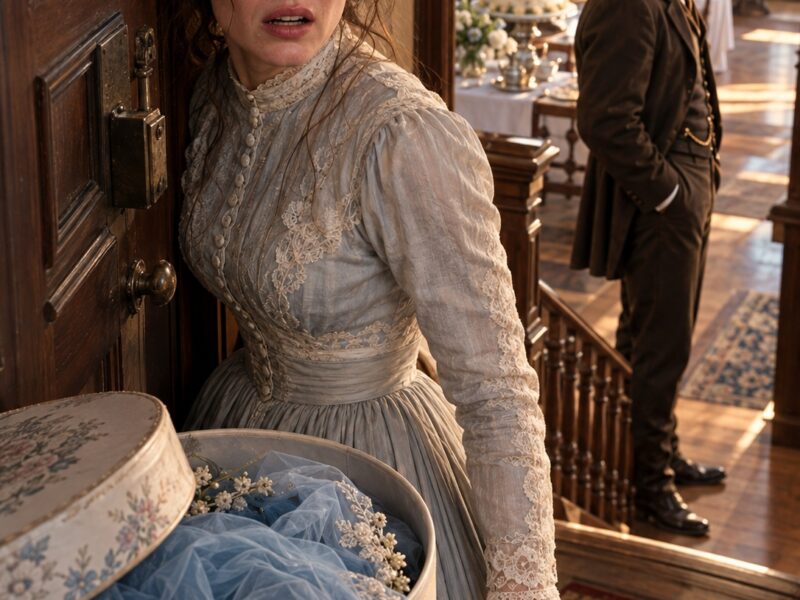
He Locked His Mail-Order Bride Upstairs on Their Wedding Day—Then the Woman He Planned to Marry Instead Heard Three Knocks

The wedding cake was cooling downstairs when Ruth Bell heard the bolt slide into place.
It was such a small sound.
Metal against metal.
A click no louder than a spoon being set beside a plate.
Yet Ruth would remember it for the rest of her life.
She stood in the upstairs storage room of Silas Trent’s Oregon ranch, a length of blue ribbon still looped around her fingers. Silas had sent her up to fetch it for the cake.
“Top shelf,” he had told her.
He had even smiled.
Less than twenty-four hours earlier, he had held her left hand beneath the kitchen lamp and wrapped a piece of string around her ring finger so he could have a wedding band properly sized.
Now Ruth turned toward the door.
“Silas?”
No answer.
She tried the handle.
It did not move.
For one foolish second, she blamed the swollen wood. The September air had been dry, but the old house shifted strangely with the seasons.
Then she heard boots crossing the landing.
His boots.
The polished black pair she had cleaned that morning.
Ruth hit the door with her palm.
“Silas, open this.”
The footsteps stopped.
Through the narrow gap beneath the door, she could see the toes of his boots.
She waited.
He sighed.
Not angrily.
Almost impatiently.
That frightened her more.
“Ruth, don’t make this difficult.”
Her fingers tightened around the ribbon.
“Open the door.”
“Mrs. Vane is coming.”
Ruth stared at the wood.
She knew the name.
Everybody around Ash Creek knew Beatrice Vane.
Widowed.
Forty-eight.
Owner of the freight business her late husband had left behind.
Comfortable, people said when they wanted to be polite.
Wealthy, they said when Beatrice wasn’t in the room.
Ruth swallowed.
“Why is Mrs. Vane coming?”
Silas waited just long enough to make the answer unbearable.
“We’re discussing a marriage settlement.”
The room seemed to tilt.
Ruth put one hand against the wall.
“What marriage?”
Another silence.
Then Silas spoke in the same calm voice he used when discussing cattle prices.
“Mine.”
Ruth could hear her own breathing.
Yesterday he had measured her finger for a ring.
Six weeks ago she had arrived from Missouri after months of letters in which Silas Trent had described his ranch, his loneliness, and his desire for a respectable wife.
A woman of thirty-six, he had written, deserved a household of her own.
A woman of thirty-six should not have to apologize for no longer being twenty.
He had told her there was dignity waiting in Oregon.
She had believed him.
Not because she was stupid.
Because she was tired.
Her sister had died in May. The boardinghouse where Ruth worked had replaced her with a younger woman who accepted lower wages. Ruth had no parents living, no brothers, no property, and less than twenty dollars to her name.
Silas knew all of it.
He had asked.
He had listened.
And apparently, he had calculated.
“What am I doing upstairs?” Ruth whispered.
Silas shifted outside.
“You’ll remain there until Mrs. Vane leaves.”
“And then?”
“I’ll arrange passage east.”
Ruth laughed once.
The sound came out broken.
“With what money?”
“You’ll manage.”
“You borrowed eleven dollars from me.”
“Ruth—”
“I want my trunk and my eleven dollars.”
His voice hardened.
“Don’t make yourself troublesome.”
The boots moved away.
Ruth struck the door.
“Silas!”
Nothing.
She hit it again.
“Silas Trent!”
Downstairs, the cook stopped moving for a moment.
Then a pan clattered.
Someone began arranging chairs.
Ruth stood with her palm against the door, listening to another woman being welcomed into the house where Ruth had spent six weeks cooking for eight ranch hands, washing sheets, mending shirts, cleaning floors, and sitting beside Silas’s bed through a fever because she believed she was building a home.
Now he was preparing to sell that same future to someone richer.
And Ruth was locked above the kitchen so she wouldn’t interrupt the negotiation.
She turned slowly.
The room contained winter blankets, a cracked pitcher, a broken washstand, two boxes of harness leather and one narrow window.
She dragged the washstand beneath it.
The window opened only halfway.
Even if she broke the frame, her shoulders would never fit through.
Below lay the ranch yard, bright beneath the September sun. A wagon stood near the gate. Two men worked beside the corral.
“Help!”
Neither looked up.
The kitchen chimney rose beside the window, carrying voices, pans and smoke upward.
Ruth shouted again.
Nothing.
She climbed down.
Her eyes searched the room.
A bent brass pin lay on the washstand.
Ruth snatched it up and knelt before the lock.
She had never picked a lock in her life.
She tried anyway.
Once.
Twice.
Again.
The brass cut her thumb.
She ignored it.
Downstairs, a woman’s laughter floated upward.
Ruth’s hands shook.
She pushed harder.
The pin snapped.
Half remained between her fingers.
The other half disappeared inside the lock.
Then she heard the woman’s voice.
“Where is Miss Bell?”
Ruth froze.
She pressed her ear to the floorboards.
Silas answered easily.
“Gone back to her people.”
Ruth closed her eyes.
“She misunderstood the arrangement,” Silas continued. “It was unfortunate.”
Gone back to her people.
Ruth had no people waiting.
Silas knew that.
Perhaps that was why he had chosen the lie.
A chair scraped below.
The woman said nothing for several seconds.
Then:
“That is curious.”
Silas’s voice changed slightly.
“How so?”
“I received a letter from Miss Bell yesterday.”
Ruth opened her eyes.
The veil.
Of course.
She had written to Beatrice Vane because Silas had said there was no reason to waste money ordering bridal things from Portland.
Ruth had heard that Mrs. Vane owned a beautiful blue wedding veil packed away from her first marriage.
So Ruth had written a humiliatingly careful note.
She had not asked for money.
She had not asked for charity.
Only whether Mrs. Vane might lend the veil for one day.
She had promised to return it cleaned.
Yesterday, Ruth had been embarrassed by the request.
Now that letter was the only evidence downstairs that she existed.
And Beatrice Vane had brought the veil herself.
She set the hatbox on Silas Trent’s table and studied him across it.
“When did Miss Bell leave?”
“This morning.”
“Which stage?”
“The northbound.”
Beatrice’s eyes shifted toward the kitchen doorway.
Owen Pike stood there holding the hamper he had carried from her buggy.
At forty-two, Owen had spent enough years hauling freight to know nearly every stage schedule through Ash Creek.
He frowned.
“I met the northbound at the office.”
Silas looked toward him.
Owen continued.
“No woman boarded there.”
The room became very still.
Silas smiled.
“Perhaps yesterday, then. Business has been rather confused.”
Beatrice slowly removed one glove.
Then the other.
She had managed freight schedules for nearly twenty years.
She knew the difference between confusion and a lie.
Silas was asking her to choose the polite explanation because politeness would protect him.
Then three blows sounded overhead.
Everyone looked up.
Three knocks.
A pause.
Three more.
The cook lowered her eyes.
Beatrice stood.
“What was that?”
“Nothing.”
Another blow.
Beatrice moved toward the hall.
Silas rose quickly.
“Beatrice.”
She reached the staircase.
He stepped in front of it and extended one arm across the opening.
He did not touch her.
He simply claimed the space.
Owen set down the hamper.
“Move your arm, Trent.”
Silas looked at him.
For the first time that afternoon, the rancher’s pleasant expression disappeared.
“This is my house.”
Owen’s face did not change.
“Then you ought to know what’s happening upstairs.”
Behind Silas, the cook stared at the floor.
Beatrice looked from her to the ceiling.
Then back to Silas.
“Who is in that room?”
“Nobody who concerns you.”
That answer ended the conversation.
“Get the key.”
“Beatrice—”
“Get. The. Key.”
Upstairs, Ruth heard footsteps.
Several.
Her heart began pounding so hard she became dizzy.
She backed away from the door.
A key entered the lock.
The bolt moved.
The door opened.
Ruth had imagined rescue differently.
She had imagined relief.
Instead, shame flooded through her.
Her hair had fallen loose. Dust covered her knees. Her thumb was bleeding. She still held half a broken brass pin.
A wealthy widow she barely knew stood in the doorway.
Behind her stood Silas.
And below waited witnesses to exactly how powerless Ruth Bell had become.
Beatrice looked at the broken pin.
Then at Ruth.
She did not ask whether Ruth was hysterical.
She did not ask what she had done to provoke Silas.
She simply lifted the hatbox slightly.
“I brought your veil.”
Ruth’s mouth trembled.
Beatrice continued.
“Would you like to come downstairs with me?”
Silas immediately began explaining.
“She became overwrought when I told her our arrangement could not continue. I was concerned she might—”
Ruth let him finish.
That surprised even her.
Then she stepped toward the doorway.
“Agnes?”
The cook looked up from below.
“Please bring my trunk.”
Ruth’s voice was thin.
But it held.
“And my letters. They’re tied with green thread.”
Beatrice moved aside.
She let Ruth walk first.
She did not take Ruth’s arm.
She did not guide her like an invalid.
That small courtesy was nearly enough to make Ruth cry.
She reached the kitchen without doing so.
Her wedding cake stood on the table.
White icing.
Blue trim unfinished.
The sight of it was almost obscene.
Agnes brought the trunk.
Silas surrendered it.
The eleven dollars were another matter.
“You’ve lived here six weeks,” he said. “If anything, you owe me for board.”
Owen looked at him.
“Does that include the cooking?”
Silas said nothing.
“Laundry?” Owen continued. “Cleaning? Nursing you through that fever?”
Ruth looked at Silas.
She remembered holding cool cloths against his neck while he shook beneath blankets.
He had called her an angel.
Now apparently angels owed room and board.
“Leave the money,” Beatrice said quietly.
Ruth turned.
Beatrice’s expression was kind.
The offer was generous.
Ruth shook her head.
“Eleven dollars won’t ruin him.”
“No.”
“It could strand me.”
That silenced the room.
Ruth described the money.
Four dollars after Silas said a ranch payment had arrived late.
Six when he needed supplies.
One for postage.
Agnes glanced up.
“I remember the dollar.”
Silas looked at her.
Agnes immediately lowered her eyes.
Beatrice reached for her purse.
“I’ll advance it.”
Again Ruth shook her head.
“That would make his debt your expense.”
She looked around.
“May I have paper?”
Nobody moved for a second.
Then Owen pulled a sheet from a drawer.
Ruth sat at the table beside the wedding cake that would never be served at her wedding.
Her hand shook as she wrote.
Silas Trent owes Ruth Bell eleven dollars.
She listed the payments.
Then she pushed the paper toward him.
“Sign it.”
Silas stared at her.
“No.”
Ruth waited.
He did not move.
Finally she folded the paper and placed it with the letters tied in green thread.
She understood something then that would take months to fully name.
Leaving safely mattered more than winning every argument in one afternoon.
She picked up her coat.
And walked out.
Only after Silas Trent’s ranch disappeared behind them did Ruth begin to shake.
She sat beside Beatrice in the buggy with the blue veil boxed between them.
Owen had secured her trunk behind the seat without opening it.
Beatrice offered Ruth water.
Ruth drank.
Beatrice looked toward the fields while she did.
She asked no questions.
That kindness felt stranger than interrogation.
At dusk they reached Ash Creek.
Beatrice owned a modest house behind the freight office. There was an unused room upstairs.
“You can stay a week,” she told Ruth. “Long enough to decide what comes next.”
“I can wash.”
“No.”
“Cook, then.”
“No.”
Ruth stiffened.
Beatrice’s voice softened.
“You may help tomorrow if you wish. Tonight you’re a guest.”
Guest.
Ruth had almost forgotten the word could mean something without obligation attached.
Owen carried her trunk upstairs.
He set it inside and stopped at the threshold.
Ruth looked at him.
“Thank you for what you said at the ranch.”
He seemed uncomfortable with the gratitude.
“It shouldn’t have needed saying.”
Then he left.
He did not linger.
He did not turn rescue into a claim.
Ruth noticed.
By breakfast the next morning, half of Ash Creek had heard what happened.
Unfortunately, none of them had heard the same story.
Beatrice had stolen another woman’s wedding.
Ruth had attacked Silas.
Silas had discovered his mail-order bride was unstable.
Two jealous women had quarreled over a wealthy rancher.
By noon, Ruth barely recognized herself in the rumors.
Then Silas rode into town wearing his best coat.
He bought tobacco.
Shook hands.
Asked after someone’s sick mother.
And told the postmaster loudly enough for three customers to hear that he hoped poor Miss Bell would soon recover her composure.
Ruth watched through the freight office window.
Her stomach turned.
Beside her, Beatrice held an unpaid invoice.
Silas had asked her to settle it days earlier as a token of affection.
“He counted on us never comparing stories,” Beatrice said.
Ruth looked at her.
“Why?”
“Because embarrassed women are useful women.”
Ruth slowly set down her coffee.
Something inside her changed.
Fear had occupied nearly every inch of her since the bolt slid shut.
Now anger demanded room.
But Ruth did not want revenge to become her entire future.
She did not want to spend the rest of her life being introduced as the woman Silas Trent locked upstairs.
She wanted work.
An address.
Money with her own name attached.
And a chair she could sit in without wondering when someone would take it away.
Her week with Beatrice was nearly finished when Ruth noticed the unused rooms above the freight office.
“What are those for?”
“Mostly dust.”
Ruth looked toward the yard.
Freight drivers passed through Ash Creek constantly. When the hotel filled, some slept in the stable. Meals came from the saloon, where the kitchen closed long before the drinking stopped.
Ruth knew boardinghouses.
She knew food.
She knew what tired travelers would pay for clean sheets, hot stew and coffee before daylight.
Beatrice knew freight.
That evening, two women sat at a kitchen table with a pencil.
They calculated blankets.
Beef.
Flour.
Firewood.
Soap.
Lamp oil.
The numbers were terrible.
Neither woman lied about that.
Owen arrived carrying two repaired bed frames.
“Found them behind the hardware store.”
Ruth stared.
“We haven’t agreed to buy furniture.”
“They aren’t bought.”
Owen rested them against the wall.
“The owner said you could inspect them.”
“We don’t even know whether the rooms will pay.”
“Then don’t buy them.”
Ruth waited for persuasion.
It never came.
Owen simply carried the frames away again.
The following morning he returned with another message.
The owner would rent them by the month.
That stayed with Ruth.
Silas had treated every objection as the beginning of an argument he intended to win.
Owen treated no as information.
Beatrice eventually proposed a written partnership.
She would provide the rooms and initial expenses.
Ruth would manage lodging and meals.
Every contribution would be recorded.
Profits would be divided according to the agreement.
Ruth read the document three times.
Then she picked up the pencil.
Beatrice raised an eyebrow.
“Problem?”
“One.”
Ruth added a sentence.
Her wages for managing the house would be paid before profits were divided.
Beatrice read it.
Then smiled.
“Get the ink.”
Their first evening was a disaster.
Five guests came.
The stove smoked.
Ruth burned one edge of the pie.
A teamster complained about the coffee.
Another man paid for a room and disappeared before supper.
By midnight, Ruth’s feet hurt so badly she could feel her pulse in them.
But there was money in the till.
Stew remained for tomorrow.
And no one could lock Ruth out of what she had earned.
Owen repaired the stovepipe while she scrubbed pans.
“What are you calling this place?” he asked.
“Haven’t decided.”
“Bell’s Table.”
Ruth laughed.
It was the first real laugh since the ranch.
Beatrice looked up from the receipts.
“Absolutely not.”
Owen frowned.
“Why?”
“Because I’m difficult about my share.”
Eventually a painted sign appeared outside.
Bell & Vane — Rooms and Table.
That night Ruth slept above a door that locked from her side.
She checked it twice.
Then sat on the bed in darkness.
For reasons she could not explain, she cried.
Not because she was afraid.
Because the key was beside her.
Three days later, a woman arrived on a late stage carrying a sleeping boy.
Her purse contained more buttons than coins.
Ruth quoted the price.
The woman’s face changed.
Ruth knew that expression.
The frantic calculation of how little a person could eat, use or require before someone decided she was too expensive to help.
Ruth offered the smallest room at a reduced rate for one night, breakfast included.
A regular guest objected.
“I pay full price.”
Ruth continued folding a napkin.
“You do.”
“I’d prefer not to share a respectable house with charity cases.”
The old Ruth might have apologized.
The Ruth who had heard a bolt slide behind her did not.
“Your room rate is between you and me, Mr. Colter. Hers is also between her and me.”
He stared.
“If you’d like to discuss your account privately, I’ll be available after supper.”
The woman carried her sleeping child upstairs.
Mr. Colter stayed.
Later, Beatrice confronted Ruth.
“We cannot run a business on sympathy.”
“And we cannot become the sort of people who leave a woman outside with a child.”
“Those are not the only choices.”
Their voices rose.
For one sharp minute, Ruth looked across the table and saw an opponent.
Beatrice probably saw one too.
Ruth stopped.
That frightened her more than the disagreement.
Beatrice had given Ruth shelter without turning shelter into obedience.
Ruth owed her the same respect.
“Show me the figures.”
Beatrice did.
Together they calculated how many reduced-rate rooms the business could survive each month.
They created a small emergency allowance.
When it was gone, it was gone.
Compassion would have a budget.
Dignity would not require financial dishonesty.
Six weeks later, a postal order arrived.
The woman had sent the balance.
Her note contained only one personal sentence.
Her boy was well.
Ruth read it twice.
Beatrice entered the payment properly in the ledger.
Neither woman pretended this proved everyone would repay kindness.
That wasn’t why they had offered it.
Something else happened.
People began returning.
Even Mr. Colter rented another week.
He never apologized.
He simply stopped commenting on other people’s rooms.
Ruth gave him clean linen anyway.
She was learning that not every victory required humiliation.
Then Silas found another way to reach her.
The flower merchant refused to sell on an account bearing Ruth’s name.
“There have been questions.”
“About what?”
“Your honesty.”
“What did I steal?”
He hesitated.
“I didn’t say steal.”
“What did I take?”
“That’s not the point.”
“Then what is?”
He cleared his throat.
“A respectable man has expressed concerns.”
Ruth walked away before anger made the decision for her.
Back at Bell & Vane, she sat at the kitchen table.
Then she began writing.
Not accusations.
Facts.
She described the blue ribbon.
The locked door.
The lie about the stage.
The eleven dollars.
Beatrice wrote her own account separately.
Owen did the same.
Their details differed slightly.
That reassured Ruth.
Honest memories often did.
Then came Agnes.
She arrived after dark.
The cook stood in the doorway twisting her hands.
Ruth remembered Agnes looking at the floor while she was trapped upstairs.
For one ugly second, Ruth wanted to close the door.
Instead she pulled out a chair.
Agnes sat.
Silas had told her Ruth suffered fits.
He had warned her not to answer.
“Did you believe him?”
“At first.”
“And later?”
Agnes’s eyes filled.
“I heard you asking for your money.”
Ruth waited.
“I knew you sounded perfectly clear.”
“Why didn’t you help me?”
Agnes looked at her hands.
“I have two grandchildren.”
The answer did not erase anything.
But Ruth understood it.
Fear did not make Agnes’s silence harmless.
It did explain why Silas found silence so easy to buy.
“Will you tell a lawyer what you saw?”
Agnes looked up.
After several seconds, she nodded.
The complaint reached a hearing in November.
Ruth wore the same gray dress she had worn west.
Beatrice offered the blue veil as a scarf against the cold.
Ruth smiled faintly.
“No.”
“Why?”
“That thing has done enough work.”
Silas’s representative described the locked room as a precaution.
Silas had supposedly feared Ruth might harm herself after learning their engagement was over.
“Were you upset?” Ruth was asked.
“Yes.”
“Did you strike the door?”
“Yes.”
“Did you demand money?”
“Yes.”
Each answer felt dangerous.
She understood what they wanted.
A perfectly calm victim.
A woman so reasonable no one could imagine disliking her.
Ruth refused to manufacture one.
“I was angry,” she said. “I had been locked in a room while Mr. Trent told another woman I had left town.”
Then Beatrice testified.
Owen testified.
Agnes came last.
Her voice was so quiet she was asked to repeat herself.
“The door was locked before anybody said Miss Bell was sick.”
Silas looked at her.
Agnes shrank.
Then straightened.
“And Mr. Trent told me not to answer her.”
Ruth would remember that movement almost as long as she remembered the bolt.
The hearing did not destroy Silas.
No crowd applauded.
No judge delivered a grand speech.
Life was less theatrical than justice stories liked to pretend.
But his version of events no longer belonged only to him.
Outside, Silas approached Ruth.
People were nearby, so his voice remained pleasant.
“I’ll give you the eleven dollars.”
“You owe me eleven dollars.”
“If you withdraw the complaint.”
Ruth looked at him.
Months earlier, eleven dollars had been enough to strand her.
Now he was trying to purchase her silence with money that already belonged to her.
“Repayment isn’t a bargain.”
Silas’s jaw tightened.
The money was paid through the lawyer.
The complaint continued.
Months later, Silas accepted the penalty imposed through the proceedings.
Ruth never had to meet him privately.
She never signed away her account.
Some neighbors apologized.
Others simply returned to Bell & Vane and ordered dinner as though they had never repeated anything cruel.
The flower merchant smiled at Ruth one afternoon.
“Glad that misunderstanding got cleared up.”
Ruth looked at him.
“It wasn’t a misunderstanding.”
His smile weakened.
“It was a locked door.”
She bought flowers elsewhere.
That evening, Owen arrived carrying a small jar.
“From June.”
His seventeen-year-old daughter.
Ruth opened it.
Apple butter.
Very little sugar.
Exactly how Ruth had once mentioned she liked it.
She stared at the jar.
“What?”
Owen asked.
Ruth shook her head.
For weeks she had existed in people’s minds as an injured woman.
Poor Ruth.
Unstable Ruth.
Brave Ruth.
Silas Trent’s Ruth.
A small gift chosen because somebody remembered how she liked apples nearly undid her.
Owen sat across from her.
He did not ask why her eyes had filled.
Instead he told her about a mule that had spent forty minutes refusing to cross a perfectly good bridge.
By the end, Ruth was laughing.
Winter came.
Bell & Vane began paying its expenses.
Ruth learned which drivers needed breakfast at four-thirty and which men could sleep through a church bell.
Their first profit was embarrassingly small.
Ruth held her share as though it were gold.
Part repaid Beatrice.
The rest went into a bank account.
Under one name.
Ruth Bell.
Owen accompanied her because they were walking afterward.
He waited outside.
When Ruth emerged, he did not ask how much she had deposited.
She found him helping an elderly man retrieve a glove.
That was when Ruth realized she was falling in love with him.
The realization frightened her.
Because once, wanting to be chosen had nearly destroyed her.
Owen’s wife, Ellen, had died seven years earlier.
He spoke of her without turning grief into a shrine Ruth was expected to compete with.
“Ellen hated cold potatoes,” he once said.
Ruth smiled.
“Reasonable woman.”
“She cheated at cards.”
“You told me she loved cards.”
“Both can be true.”
His daughter June visited at Christmas.
She and Ruth disagreed about curtains.
Beatrice solved the dispute by announcing that there were two windows and therefore twice as much opportunity for everyone to be unhappy.
They hung both sets.
The room looked ridiculous.
Owen loved it.
Watching him, Ruth wondered how long he had wanted a home where disagreement did not mean abandonment.
In February, he asked her to marry him.
They were walking beside the mill race.
Ice cracked around the stones.
Owen did not kneel.
He did not remind Ruth that he had stood at Silas’s staircase.
He did not describe himself as the man who had saved her.
“I want the ordinary part,” he said.
Ruth looked at him.
“What does that mean?”
“Breakfast. Bad weather. Your accounts. My dislike of your accounts. The mornings you’re too busy to speak to me. June arriving without warning. Me forgetting things.”
“You do forget things.”
“I thought honesty might improve my chances.”
Despite herself, Ruth smiled.
Then she became serious.
“I keep the business.”
“I assumed you would.”
“I won’t automatically move into your house because I’m your wife.”
“All right.”
His easy answer irritated her.
“You haven’t thought about it.”
“I have.”
“And?”
“My house is small. It’s close to the stable. Ellen lived there. June grew up there.”
Ruth waited.
Owen looked toward the water.
“Which means it matters. It doesn’t mean you owe it anything.”
They walked farther.
No solution was forced.
No decision had to be completed simply because a man had proposed.
Then Ruth asked the question she had avoided for months.
“Owen?”
“Yes?”
“If Beatrice hadn’t been at Silas’s house that afternoon… would you have come upstairs?”
He stopped.
Ruth’s heart tightened.
This was the moment when a lesser man could have made himself a hero.
Owen did not.
“I hope so.”
Ruth waited.
He rubbed one hand over his jaw.
“But I don’t know.”
The answer hurt.
He continued.
“I don’t know what story I might’ve believed before I heard you.”
Ruth looked away.
Silas would have known the correct answer.
Silas had always known the words a woman wanted.
Owen had just given her the truth when a lie would have made him look better.
“I need a month,” Ruth said.
Owen nodded.
“A month.”
He did not ask what he could do to convince her.
During that month he worked.
Visited.
Forgot an appointment.
Apologized without blaming the weather.
Argued once about the price of lumber.
Lost the argument.
Returned the next morning exactly as before.
Ruth watched him become ordinary.
And that was what finally made her trust herself.
She said yes on a Tuesday.
Owen was eating a biscuit.
He nearly choked.
They married in May, eight months after the day Ruth had been locked upstairs.
Beatrice arrived carrying a familiar hatbox.
Ruth stared at it.
Beatrice rested one hand on the lid.
“May I?”
The question mattered.
Ruth nodded.
Inside lay the blue veil.
For months Ruth had imagined that fabric permanently attached to humiliation.
But when she lifted it, another memory came instead.
A woman arriving at a ranch with a gift.
A lie that did not survive comparison.
A door opening.
“I’ll wear it.”
June pinned it into Ruth’s hair.
Agnes adjusted the hem of her dress.
No one made speeches about second chances.
Downstairs, two people argued about how many pies were required for a wedding.
Ruth listened.
Nobody sounded frightened.
During the ceremony, the minister spoke about promises.
Ruth had once believed a promise became beautiful according to how desperately you needed it.
Now she knew better.
Promises were measured in mornings nobody witnessed.
In February mud.
In unpaid bills.
In apologies.
In whether someone still respected a locked door when no one else was watching.
At supper, Owen stood to toast his wife.
Ruth stood before he could become sentimental.
Everyone laughed.
She thanked Beatrice for bringing the veil.
Then she turned toward Agnes.
“And I want to thank someone who told the truth when telling it cost her something.”
The room quieted.
Agnes looked down.
But this time she was smiling.
Late that night, after everyone left, Owen found Ruth counting clean plates.
“Want help?”
She handed him a towel.
That was all.
They stood beside each other washing wedding dishes.
No music.
No grand declaration.
No promise that Ruth would never be hurt again.
There was simply a husband who stayed until the dishes were finished.
A business that paid Ruth wages.
Money deposited under her own name.
And a key resting in her pocket.
Those were substantial things.
A year later, a young woman stepped from the afternoon stage carrying a carpetbag.
She entered Bell & Vane and asked for work before asking whether there was a room.
Ruth recognized the careful voice immediately.
The voice of someone trying to make herself inexpensive.
Her intended husband had failed to meet the stage.
She had little money.
There were no kitchen positions available.
Ruth told her the truth.
Then offered supper and the small back room for one night.
“We can visit the dressmaker tomorrow.”
“I can scrub floors,” the woman said quickly. “I can wash. I won’t be trouble.”
Ruth went still.
For an instant she was thirty-six again.
Standing beside a wedding cake.
Asking for eleven dollars that belonged to her.
Trying to prove that her existence was worth the expense.
“Eat first,” Ruth said.
The young woman blinked.
“We’ll discuss work after you’ve eaten.”
That evening Beatrice arrived arguing about the cost of replacing the roof.
Ruth disagreed.
Beatrice produced figures.
Ruth produced different figures.
The young woman at the table watched them.
Neither raised a hand.
Neither threatened to leave.
Neither demanded obedience.
They disagreed, wrote down their numbers and decided to obtain another estimate.
Something in the young woman’s shoulders loosened.
Ruth saw it.
A home could contain disagreement without turning disagreement into danger.
Owen came home late from the freight yard.
He kissed Ruth’s cheek.
Looked down.
“Mud.”
“Yes.”
“I’ll be back.”
He went outside to scrape his boots.
Through the window Ruth watched him stop to help a child lift a parcel.
He was grayer now.
His left knee hurt when it rained.
He still postponed difficult letters.
Sometimes he left socks where she had specifically asked him not to.
Ruth loved him in particulars.
That was better than loving a man for what she hoped he might rescue her from.
After closing the kitchen, Ruth climbed upstairs.
The young woman’s door was shut.
Ruth knocked once.
“I left a clean towel outside.”
She did not enter.
She continued down the hallway.
At the end stood a small cupboard containing spare blankets and a broken lamp waiting to be repaired.
Ruth stopped before it.
For a moment she saw another room.
September sunlight.
A broken brass pin.
Blue ribbon around her fingers.
Polished boots disappearing beneath a door.
She touched the cupboard handle.
There was no bolt on the outside.
Ruth smiled.
Then she joined Owen in their sitting room.
He was reading.
When she entered, he moved the chair beside him closer to the window.
Ruth sat.
Below them, the painted Bell & Vane sign swung gently in the evening breeze.
Beatrice’s laughter floated from the freight office.
Somewhere farther down the road, the afternoon stage began rolling away.
Ruth rested her tired hands in her lap.
Beatrice Vane had gone to Silas Trent’s ranch years earlier believing she was meeting a man who might become her husband.
Instead she found a woman behind a locked door.
Opening that door had taken seconds.
Everything important afterward had taken much longer.
The testimony.
The wages.
The business.
The bank account.
The courage to disagree.
The courage to love.
The slow, stubborn work of trusting her own judgment again.
Owen closed his book.
“How’s our guest?”
“Frightened.”
“Staying?”
“Tonight.”
He waited.
Ruth told him the rest.
As always, he listened until she finished.
Outside, the stage disappeared beyond the last buildings of Ash Creek.
Ruth heard its wheels fading into the distance.
Once, she had believed safety meant finding the right person who would never close a door on her.
She knew better now.
Safety was knowing the door belonged to you.
Knowing you could open it.
Knowing you could leave.
Knowing the person on the other side would knock before entering.
Ruth slipped one hand into her pocket.
Her fingers closed around her key.
And somewhere downstairs, beneath the roof she had helped pay for, a frightened young woman finished a hot meal without having to earn the first bite.
The stage rolled farther away.
Nobody in Bell & Vane hurried after it.









