He Made His Mail-Order Bride Wait 30 Days Before He’d Marry Her—On Day 23, She Did Something He Never Expected
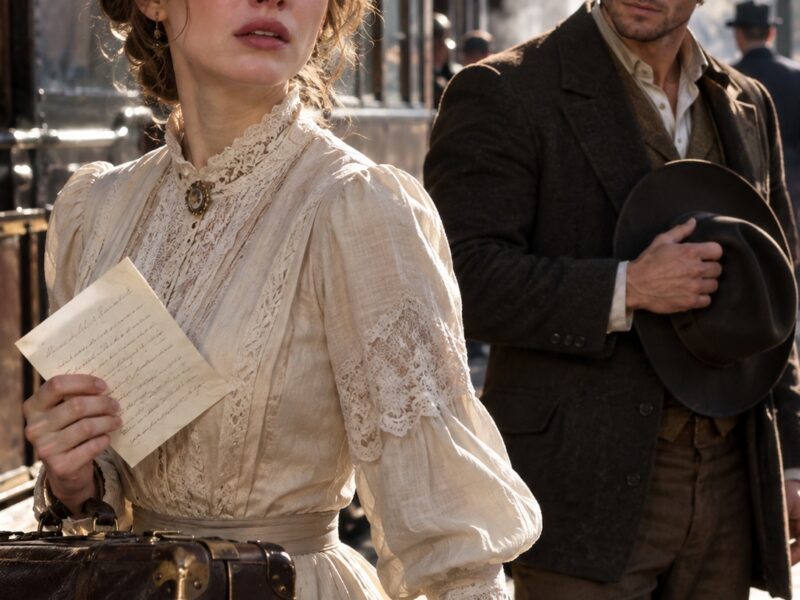
Tamsen Webb had crossed nearly two thousand miles to marry a man she had never touched.
Royce Lyndon was waiting for her on the platform when the train finally hissed into Cash Valley.
He was taller than she had imagined from his letters. Broad through the shoulders. Sun-browned. Serious. The sort of man who seemed to measure his words before allowing them into the world.
For one foolish, breathless second, Tamsen thought he looked relieved to see her.
Then Royce removed his hat.
And instead of asking her to become his wife, he asked her to wait.
Thirty days.
Thirty days before the wedding.
Thirty days for him to decide whether marrying her was truly the right thing to do.
Tamsen stood perfectly still.
Behind her, the locomotive groaned. Steam drifted across the platform. A porter dragged her battered trunk from the baggage car while strangers hurried past carrying parcels, children, newspapers, entire lives.
But Tamsen heard almost none of it.
She heard only one sentence.
“I thought we might give ourselves thirty days.”
Royce said it gently.
That almost made it worse.
She stared at him.
“Thirty days for what?”
His jaw tightened slightly.
“To know one another properly.”
“We have been writing for seven months.”
“I know.”
“You asked me to come.”
“I did.”
“You wrote that you were looking for a wife.”
“I am.”
“And I crossed the country because I believed you had found one.”
Royce glanced toward the tracks.
That tiny movement told her everything her frightened heart was already prepared to believe.
He wasn’t sure.
Of course he wasn’t.
Men never were.
Tamsen Webb had spent twenty-six years becoming very familiar with almost.
Almost pretty enough.
Almost desirable enough.
Almost the woman a man chose.
There had been Thomas Ellery when she was nineteen, who walked her home after church for an entire summer before becoming engaged to her prettier friend.
Then Samuel Price, who had spoken seriously about marriage until the daughter of a prosperous merchant arrived in town with pale blue eyes and a dowry.
Tamsen had been the sensible woman.
The dependable woman.
The woman men respected.
The woman they nearly loved.
And when she had found Royce Lyndon’s advertisement seeking a wife willing to make a life in the West, she had allowed herself one dangerous thought.
Maybe this time, someone had chosen her first.
He had read her letters.
He had asked questions about books, children, weather, faith, loneliness, ranch life.
He had told her about Cash Valley.
He had described the cottonwoods beside the creek and the mountains turning purple at sunset.
Finally, he had written:
Come west, Miss Webb. I believe we could make a good life together.
She had sold what little she owned.
Packed two dresses, her mother’s Bible, three books, a silver hairbrush, and everything else worth keeping into one trunk.
Then she had traveled across a continent toward a man she believed was waiting to marry her.
Now she stood in front of him while he asked for an inspection period.
Tamsen slowly pulled her gloves tighter over her fingers.
“I see.”
Royce frowned.
“I don’t think you do.”
“Oh, I think I understand perfectly.”
“Tamsen—”
“You’d like to look me over.”
His face changed.
“That isn’t what I said.”
“No?”
“No.”
She gave him a thin smile.
“Make certain the goods match the advertisement before you purchase them?”
Royce flinched.
Good.
She wanted him to.
“Tamsen, please.”
She lifted one hand.
“Don’t.”
There were tears burning somewhere behind her eyes, but she would have died before letting this stranger see them.
Royce lowered his voice.
“I meant no insult.”
“I believe you.”
“I have reasons.”
“So do I.”
Something in her tone stopped him.
Tamsen looked directly into his eyes.
“I did not travel two thousand miles to be a thing on trial, Mr. Lyndon.”
People moved around them.
Neither noticed.
“I came west because you asked me to become your wife. If you have changed your mind, say so now.”
“I haven’t.”
“Then marry me.”
The words landed between them.
For the first time, the careful rancher looked genuinely shaken.
Tamsen waited.
Royce said nothing.
And that silence hurt more than any answer could have.
She nodded slowly.
“There it is.”
“No. Tamsen—”
“There is what I needed to know.”
She turned toward the train.
For one wild moment, she meant to climb back aboard.
Then reality struck.
She had nearly no money left.
There was no home waiting for her in the East.
No father.
No mother.
No position.
No fiancé.
No comfortable room to return to and laugh about her foolish western adventure.
She had gambled nearly everything she possessed on Royce Lyndon’s promise.
And suddenly she understood the final humiliation.
She could not even afford to reject his thirty-day trial.
Royce must have seen something change in her face.
“Tamsen.”
She turned back.
“What?”
“I truly do have reasons.”
“I’m certain you do.”
“They aren’t about your worth.”
“That is very easy for the person doing the judging to say.”
His mouth tightened.
She regretted the cruelty immediately.
But not enough to apologize.
Royce picked up her trunk.
“Come to the ranch.”
Tamsen looked at him.
“If after thirty days you wish to leave, I’ll pay your passage anywhere you want to go.”
“And if after thirty days you wish me to leave?”
His grip tightened around the trunk handle.
“The same.”
There it was again.
That terrible possibility spoken calmly aloud.
Tamsen lifted her chin.
“Very well.”
They rode toward the Lyndon ranch mostly in silence.
Cash Valley stretched around them in immense, beautiful emptiness—gold grass, distant mountains, cottonwoods along narrow water, sky so large it made Tamsen feel smaller than she wanted to feel.
Royce drove the wagon.
Tamsen sat beside him.
Between them lay thirty days.
Somewhere during that long ride, humiliation hardened into something more useful.
Pride.
If Royce Lyndon intended to spend a month deciding whether Tamsen Webb was worthy of being his wife, then she would give him nothing false to judge.
She would not charm him.
She would not beg him.
She would not compete with some imaginary better woman.
She would simply be herself.
And when those thirty days ended, whatever decision Royce made, she would meet it standing upright.
What Tamsen did not know was that Royce’s strange request had almost nothing to do with her.
It had everything to do with a dead woman named Rhoda.
Royce had been twenty-two the first time he married.
At twenty-two, he had believed certainty was the same thing as wisdom.
Rhoda Bell had been beautiful, impulsive, lively, and completely unlike him.
He loved that at first.
She filled silences Royce did not know how to fill. She laughed loudly. She loved dances, company, town, music, pretty things and spontaneous plans.
Royce loved land.
Routine.
Quiet.
Promises kept.
A house where two people could sit for an hour without needing to speak.
They married quickly.
Everyone called it romantic.
Within a year, they were lonely.
Not cruel.
Not hateful.
Just wrong.
Rhoda hated the isolation of the ranch.
Royce hated seeing her unhappy but had no idea how to make her happy without becoming someone else.
When she cried, he tried to solve the problem.
When he withdrew, she interpreted silence as rejection.
The more desperately she needed warmth, the more overwhelmed Royce became.
The more he retreated, the lonelier she felt.
They stayed married because vows were vows.
From outside, the marriage looked respectable.
Inside, two decent people slowly discovered that loving someone did not automatically mean knowing how to live beside them.
Then, in their sixth year, Rhoda developed a fever.
She died within days.
Royce buried her beneath a cottonwood on a hill overlooking the ranch.
He mourned her.
But he also mourned something he was ashamed to admit.
The marriage they should never have rushed into.
For years afterward, guilt lived beside grief.
He remembered being twenty-two and absolutely certain.
He remembered dismissing every warning.
He remembered thinking love would solve incompatibility.
So Royce made himself a promise.
If he ever married again, he would be careful.
No rushing.
No romantic blindness.
No confusing desire with suitability.
Thirty days.
That seemed reasonable.
Responsible.
Kind, even.
Until Tamsen Webb stepped off the train.
Royce had prepared himself for a nervous woman.
Perhaps a timid one.
Perhaps someone prettier in photographs than in person.
He had not prepared for gray-green eyes that seemed capable of seeing straight through excuses.
He had not prepared for dignity.
And he certainly had not prepared for the realization, less than an hour after meeting her, that his brilliant plan had hurt her deeply.
But Royce Lyndon had another flaw.
Once he made a rule, he found it extremely difficult to admit the rule might be wrong.
So the thirty days began.
Tamsen was given the room at the east end of the farmhouse.
It was clean but plain, with a narrow iron bed, a washstand, a pine wardrobe and a window overlooking the lower pasture.
She unpacked carefully.
Two dresses.
Books.
Bible.
Brush.
Letters.
Royce’s letters.
She held the bundle for a long moment.
Then she placed them at the bottom of the trunk.
That evening they ate supper across from one another.
Royce cleared his throat.
“The potatoes are good.”
Tamsen looked at him.
“They’re boiled.”
“Yes.”
“I’m relieved they meet your standards.”
He nearly choked.
Tamsen continued eating.
A moment later she heard something she had not expected.
A laugh.
Small.
Almost reluctant.
But definitely a laugh.
She looked up.
Royce was trying not to smile.
“You have a mean streak, Miss Webb.”
“Only when provoked.”
“I’ll remember that.”
“You have twenty-nine days to study it.”
His smile disappeared.
Tamsen immediately hated herself for caring.
The following morning she woke before sunrise.
By the time Royce came inside after checking the horses, coffee was ready.
He stopped in the doorway.
“You didn’t have to do that.”
“I wanted coffee.”
“There was enough for me.”
“I miscalculated.”
He looked at her.
She looked back.
Something almost like amusement passed between them.
Then disappeared.
The ranch foreman, Harl Bennett, met Tamsen that afternoon.
Harl was nearly sixty, bowlegged, permanently sunburned and apparently born without any instinct for politeness.
He looked Tamsen up and down once.
“So you’re the woman Royce has put on probation.”
Royce, standing ten feet away, nearly dropped a saddle.
“Harl.”
“What?”
“Go mend something.”
Harl grinned.
Tamsen surprised both men by laughing.
“I suppose I am.”
Harl squinted at her.
“You planning on passing?”
“No.”
Royce looked at her.
Harl scratched his beard.
“No?”
“I intend to determine whether he passes.”
Harl stared at Royce.
Then he laughed so loudly a horse in the nearest stall raised its head.
Royce did not speak to Harl for the next hour.
But that evening, Tamsen caught him smiling to himself.
The days found a rhythm.
And that became dangerous.
Tamsen could cook, but she did not behave as if cooking were the entire measure of a woman.
She knew accounts.
She reorganized a stack of receipts Royce had been meaning to sort for months and discovered a supplier had charged him twice for fencing wire.
She repaired a torn curtain instead of replacing it.
She listened when Harl complained about a lame mare and correctly noticed the animal favored its left foreleg only after turning.
She read in the evenings.
Sometimes aloud.
Sometimes Royce sat across the room pretending not to listen.
On the sixth evening, she stopped halfway through a chapter.
Royce looked up immediately.
“Why did you stop?”
Tamsen lowered the book.
“I thought you weren’t listening.”
“I wasn’t.”
“Then you won’t mind.”
She closed it.
Royce stared at the book.
Tamsen waited.
After several seconds he sighed.
“What happened to the brother?”
Her mouth twitched.
“I knew it.”
“I was listening accidentally.”
“Of course.”
She reopened the book.
Something was happening between them.
Neither wanted to name it.
Tamsen had expected Royce to examine her.
Instead, she found herself examining him.
He was quiet, but not cold.
There was a difference.
He noticed small things.
If she left her shawl over a chair before walking outside, somehow it appeared over her shoulders five minutes later without comment.
When a hinge on her bedroom window squeaked, he repaired it before supper.
When she mentioned once that she liked apples, a bowl appeared on the kitchen table after Royce’s next trip into town.
He never said they were for her.
She never thanked him.
They both knew.
Then she began noticing the sadness in the house.
A drawer Royce never opened.
A faded blue ribbon tucked behind a photograph.
A woman’s initials scratched faintly into the underside of a wooden sewing box.
R.B.L.
Rhoda Bell Lyndon.
Tamsen learned the name from Harl.
They were shelling peas on the back porch when she finally asked.
“Who was Rhoda?”
Harl’s hands stopped.
For once, the old man’s face lost its humor.
“Royce’s wife.”
Tamsen stared at him.
“He was married?”
“Six years.”
“He never told me.”
“He will.”
“When?”
“When he stops believing silence is the same thing as strength.”
Harl resumed shelling peas.
Tamsen waited.
Finally he said, “She died.”
The resentment inside Tamsen shifted.
Not vanished.
Shifted.
“What happened?”
“Fever.”
“Did he love her?”
Harl looked toward the barn where Royce was working.
“Yes.”
Tamsen felt something unexpectedly painful.
Harl noticed.
“Don’t make the mistake of being jealous of a dead woman.”
“I wasn’t.”
“You were about to.”
Tamsen glared at him.
Harl smiled.
Then his expression softened.
“They weren’t happy.”
That surprised her more.
Harl explained only enough.
Young marriage.
Fast marriage.
Two good people badly matched.
Years of trying.
Then illness.
Death.
Guilt.
Suddenly the thirty days looked different.
Still insulting.
Still painful.
But different.
Royce was not standing above Tamsen deciding whether she was good enough.
He was standing behind an old wound, terrified of repeating it.
Understanding softened something inside her.
Unfortunately, it also made him easier to love.
That was precisely what Tamsen did not need.
By the second week, the ranch no longer felt entirely strange.
Her boots sat beside Royce’s near the kitchen door.
Her hairbrush remained on the washstand instead of being returned to her trunk.
Her laughter had begun appearing in rooms that had apparently gone years without much of it.
And Royce had begun coming inside earlier in the evenings.
He told himself it was because the work was finished.
Harl knew better.
“So,” Harl said one afternoon.
Royce kept repairing a bridle.
“So what?”
“Nothing.”
“Then stop looking at me.”
“I’m admiring a man taking thirty days to discover something the rest of us figured out in six.”
Royce’s hands stopped.
“Harl.”
“Royce.”
“This is none of your business.”
“Everything on this ranch becomes my business eventually.”
Royce returned to the bridle.
Harl leaned against the stall.
“You like her.”
“I think well of her.”
Harl snorted.
“You come inside before dark now.”
“So?”
“You’ve eaten supper after dark for twelve years.”
Royce said nothing.
“She makes you laugh.”
“I laughed before.”
“When?”
Royce glared at him.
Harl grinned.
Then came the storm.
It rolled down from the mountains after midnight, violent and cold.
Rain hammered the roof.
Wind shook the windows.
Royce was pulling on his boots when Harl pounded on the back door.
“Calf’s missing.”
Royce grabbed his coat.
Tamsen appeared in the hallway.
“What happened?”
“Go back to bed.”
“What happened?”
“One of the calves got through the lower fence.”
“Then I’m coming.”
“No.”
Tamsen was already pulling on her boots.
Royce stared.
“Tamsen.”
She looked at him.
“You have eighteen days left to decide whether I’m suitable for ranch life. This seems useful evidence.”
“This isn’t funny.”
“I wasn’t joking.”
They found the calf trapped in a flooding wash.
Water churned around the frightened animal.
Royce tied a rope around his waist.
Tamsen grabbed the other end.
“You stay here.”
“Stop telling me to stay places.”
“This is dangerous.”
“So is marriage, apparently.”
Even in the storm, Royce almost smiled.
Then he climbed down.
The bank collapsed beneath one boot.
Tamsen screamed his name.
Royce caught himself.
The calf kicked wildly.
Water rose around his knees.
“Pull!”
Tamsen planted her heels in the mud.
Together, slipping and swearing and shouting through the rain, they dragged the calf toward solid ground.
Twenty minutes later they stumbled into the barn soaked to the skin.
The calf trembled beneath a blanket.
Tamsen’s hair had come loose completely.
Mud streaked her cheek.
Royce had lost his hat.
For several seconds they simply stared at one another.
Then Tamsen started laughing.
Royce looked down at himself.
He laughed too.
It was ridiculous.
Two adults standing in a barn after midnight, covered in mud, laughing like children.
Then the laughter faded.
Royce reached toward her face.
His thumb stopped inches from the mud on her cheek.
Tamsen stopped breathing.
His eyes dropped to her mouth.
For one dangerous second, the thirty-day rule disappeared.
Rhoda disappeared.
Pride disappeared.
There was only the lantern.
The rain.
The warm breath of animals.
And Royce’s hand suspended between them.
Then he lowered it.
“We should get inside.”
Something inside Tamsen fell.
“Of course.”
She walked past him.
Royce watched her go.
And for the first time since inventing his thirty-day rule, he hated it.
The following week brought another problem.
Cash Valley had learned about Tamsen.
More specifically, Cash Valley had learned about Royce’s thirty days.
And Cash Valley had opinions.
Mrs. Beatrice Oaks possessed more opinions than most people possessed furniture.
She intercepted Tamsen outside the mercantile.
“So you’re Miss Webb.”
Tamsen smiled politely.
“I am.”
Mrs. Oaks inspected her dress.
“I’ve heard so much.”
“I can’t imagine from whom.”
“Oh, people talk.”
“So I’ve noticed.”
Mrs. Oaks leaned closer.
“Such an unusual arrangement.”
Tamsen’s spine stiffened.
“What arrangement?”
“Well… being tested.”
Two women nearby suddenly became very interested in a barrel of flour.
Mrs. Oaks smiled sympathetically.
“I simply couldn’t bear it myself. Wondering every morning whether I might be sent back.”
Tamsen felt heat climb her neck.
But before she could answer, a man’s voice came from behind her.
“Then it’s fortunate nobody asked you.”
Mrs. Oaks froze.
Royce stood several feet away.
His expression was calm.
That made it worse.
“Royce,” Mrs. Oaks said.
“Beatrice.”
“I meant no harm.”
“Then you have an unusual talent for achieving things you don’t intend.”
Tamsen stared at him.
Mrs. Oaks flushed.
“I was only concerned for Miss Webb.”
Royce stepped beside Tamsen.
“Miss Webb does not require your concern.”
“I—”
“And if anyone in town has questions about the arrangement, they can ask me.”
Nobody spoke.
Royce picked up Tamsen’s parcel.
“Ready?”
She nodded.
They walked away.
Halfway to the wagon, Tamsen said quietly, “You didn’t have to do that.”
“Yes, I did.”
“Why?”
Royce stopped.
Because you’re mine, almost came out.
He felt the words rise.
And fear killed them.
“Because this was my idea,” he said instead. “You shouldn’t have to pay for it.”
Tamsen looked at him for a long moment.
“Your idea is becoming expensive.”
Then she climbed into the wagon.
Royce stood there wondering why he felt as though he had failed another test he had not known he was taking.
By day fifteen, he was sure.
Not nearly sure.
Not reasonably sure.
Sure.
He wanted Tamsen Webb in his house.
At his table.
In the wagon beside him.
Laughing in his barn.
Reading in the evenings.
Arguing with him about fences.
Leaving her shawl where he could find it.
He wanted to wake beside her.
Grow old beside her.
Bury people they loved beside her.
He wanted the entire ordinary, difficult, sacred accumulation of years.
The problem was absurd.
Royce had demanded thirty days.
How did a man who had made such a solemn performance of caution walk into the kitchen halfway through and say, Actually, never mind. I love you.
So he waited.
And every day he waited made Tamsen believe he remained uncertain.
She felt his affection.
That was the torture.
His eyes followed her.
His hand found the small of her back when she stepped down from the wagon.
He remembered things she said.
Sometimes she caught him simply looking at her.
Yet he said nothing.
Day eighteen.
Day nineteen.
Day twenty.
Tamsen began counting again.
Not toward a wedding.
Toward judgment.
At night she lay awake staring at the ceiling.
She hated herself for wanting him.
She hated the hope that rose whenever he smiled.
Most of all, she hated the thought of standing before him on day thirty while Royce Lyndon calmly announced his decision.
Yes or no.
As though her heart were not involved.
As though she had not already given him more of it than she intended.
On day twenty-one, Harl cornered Royce near the corral.
“You planning to marry that woman?”
Royce frowned.
“Yes.”
“Does she know?”
Royce looked away.
Harl stared at him.
“Good Lord.”
“I’ll tell her.”
“When?”
“Soon.”
“Before or after she dies of old age?”
Royce’s expression hardened.
“I asked for thirty days for a reason.”
“No. You asked for thirty days because you’re scared.”
“I am not scared.”
“Then tell her.”
Silence.
Harl shook his head.
“You learned the wrong lesson from Rhoda.”
Royce went still.
Harl rarely spoke her name.
“What is that supposed to mean?”
“You think Rhoda taught you not to trust your heart.”
“She taught me not to rush.”
“No. Rhoda taught you not to marry somebody who doesn’t suit you.”
Royce’s jaw tightened.
Harl pointed toward the house.
“That woman suits you so well it’s painful to watch.”
Royce said nothing.
“You and Rhoda couldn’t spend an afternoon together without one of you feeling lonely. You and Tamsen can shovel manure for three hours and somehow look like you’re having a good time.”
Despite himself, Royce almost smiled.
Harl didn’t.
“You’re sure about her.”
“Yes.”
“Then what are you waiting for?”
Royce had no answer.
Harl stepped closer.
“Caution is useful until the danger changes.”
Royce frowned.
“What danger?”
“The danger isn’t marrying the wrong woman anymore.”
Harl glanced toward the house.
“The danger is losing the right one.”
That night Royce barely slept.
The following afternoon, a letter arrived.
Tamsen recognized the handwriting immediately.
Her cousin Margaret.
She opened it alone in her room.
By the time she reached the bottom, her hands were trembling.
Margaret’s widowed aunt needed a companion.
The position included a room.
Meals.
A modest salary.
Respectability.
A home.
A way out.
Tamsen read the letter three times.
Then she sat on the edge of her bed.
For the first time since arriving in Cash Valley, she had a choice.
A real choice.
She was no longer the penniless woman who could not afford to leave.
She could go.
And once that realization entered her heart, something hardened.
Not because she had stopped loving Royce.
Because she loved him too much.
She could survive being rejected by Royce Lyndon.
What she could not survive was standing quietly before him on day thirty while he considered whether she deserved a permanent place in his life.
She had done that emotionally for twenty-six years.
She would not do it once more.
That evening, Royce was in his study when Tamsen knocked.
He looked up.
Something in her face made him stand immediately.
“Tamsen?”
She held the letter in both hands.
“I’ve received an offer.”
Royce’s stomach tightened.
“What kind of offer?”
“A position.”
“Here?”
“No.”
Silence.
“My cousin Margaret has an aunt who needs a companion. There would be a room and wages.”
Royce stared at her.
“Why are you telling me this?”
“Because I’ve accepted.”
The world seemed to become very quiet.
“You’ve what?”
“I’ll leave Friday.”
“Friday?”
“Yes.”
Royce looked toward the calendar.
Friday was day twenty-four.
“The thirty days aren’t finished.”
“I know.”
“Then why would you leave?”
Tamsen laughed once.
There was no humor in it.
“Do you truly have to ask?”
“Yes.”
She stared at him.
“Then perhaps these three weeks have not taught you as much about me as you hoped.”
Royce came around the desk.
“Tamsen.”
“You have been kind to me.”
“Don’t.”
She faltered.
“What?”
“Don’t speak as if you’re saying goodbye.”
“I am saying goodbye.”
The words hit him physically.
Tamsen continued before courage deserted her.
“I came here to marry you.”
“I know.”
“No, Royce. I don’t think you do.”
Her voice trembled.
She hated that.
She pressed on.
“I came here because I believed, perhaps foolishly, that for once in my life someone had chosen me without hesitation.”
Royce’s expression changed.
She had never told him this.
“There have been other men,” she said. “Not many. Enough.”
“Tamsen—”
“One chose my friend. Another chose money. Others simply… did not choose me at all.”
Her eyes shone.
“I became very good at being almost.”
Royce felt something crack open inside him.
“The almost-wife. The almost-beloved. The sensible woman a man might marry until the woman he truly wanted appeared.”
She looked down at the letter.
“When you wrote to me, I thought this would be different.”
“It is different.”
“Is it?”
“Yes.”
“You asked me to travel two thousand miles, Royce. I came expecting vows. Instead, you met me at the station and told me you needed thirty more days to decide.”
“I made a mistake.”
“You never said that.”
“I should have.”
“But you didn’t.”
“No.”
“You let me wake every morning wondering.”
Royce closed his eyes briefly.
She was right.
God help him, she was right.
Tamsen’s tears finally escaped.
She wiped them away angrily.
“I have come to care for you.”
Royce looked at her.
She forced herself to continue.
“More than I intended. More than is wise.”
“Tamsen.”
“And that is precisely why I have to leave.”
“No.”
She froze.
It was the first time Royce had said the word without caution.
Without explanation.
Without thought.
Simply no.
Tamsen swallowed.
“You don’t get to decide that.”
“I know.”
“Then don’t.”
“I don’t want you to go.”
“And I don’t want to stay here until day thirty and discover whether I’ve passed.”
“You aren’t being tested.”
“Then why are we still waiting?”
Royce opened his mouth.
Nothing came.
Tamsen nodded through her tears.
“Exactly.”
She turned.
Royce saw her hand reach for the door.
And suddenly the future appeared before him with terrible clarity.
Her room empty.
Her books gone.
One pair of boots beside the kitchen door instead of two.
No dry voice across the supper table.
No laughter in the barn.
No woman reading beside the lamp.
No Tamsen.
All because he had been so determined not to make one mistake again that he had created an entirely different one.
“Tamsen.”
She touched the doorknob.
Royce crossed the room.
He caught her hand.
She spun toward him.
“Let go.”
“No.”
“Royce.”
“I was sure on day twelve.”
Tamsen stopped breathing.
Royce’s voice was rough.
“Maybe before.”
She stared at him.
“What?”
“I was sure.”
“Then why—”
“Because I’m a fool.”
Tamsen said nothing.
Royce held both her hands now.
Not tightly enough to trap her.
Only tightly enough to make clear that if she left, he would feel the absence for the rest of his life.
“I owe you the truth.”
“You owe me several.”
“Yes.”
He took a breath.
“My first wife’s name was Rhoda.”
Tamsen did not tell him she already knew.
Royce began speaking.
Everything.
The quick courtship.
The certainty.
The wedding.
The slow discovery that love and compatibility were not identical.
The years of loneliness.
Rhoda’s unhappiness.
His failure to understand her.
Her death.
His guilt.
The vow afterward.
Never rush again.
Never confuse desire with wisdom again.
Never marry until he was certain.
“When you came,” Royce said, “I thought thirty days was honorable.”
Tamsen’s eyes filled again.
“I know.”
“No. It wasn’t.”
She looked at him.
“It was fear dressed as wisdom.”
The room went still.
Royce swallowed.
“I was so determined not to hurt another woman by rushing into marriage that I never considered I might hurt you by refusing to trust what was already in front of me.”
Tamsen looked down.
“Harl told me something yesterday.”
Despite everything, her mouth twitched.
“I imagine it was rude.”
“It was.”
“That sounds like Harl.”
“He said the lesson of Rhoda wasn’t that I should never trust my heart. It was that I shouldn’t marry a woman who didn’t suit me.”
Royce stepped closer.
“And then he pointed out something I’ve apparently been the last person in Cash Valley to understand.”
Tamsen looked up.
“What?”
“You suit me.”
Her lips parted.
“Completely.”
“Royce—”
“I like the way you argue with me.”
A tear slipped down her cheek.
“I like that you move my ledgers and then explain why my system was stupid.”
“It was stupid.”
“I know.”
She laughed through the tears.
Royce’s eyes filled.
“I like that you laugh when everything goes wrong. I like your books on my table. Your shawl on my chair. Your boots beside mine.”
His voice broke slightly.
“I like knowing you’re in the house.”
Tamsen could barely breathe.
“I don’t want thirty days.”
She searched his face.
“What do you want?”
Royce answered immediately.
“You.”
One word.
No hesitation.
No qualification.
The word Tamsen Webb had waited twenty-six years to hear.
Royce released one of her hands.
Then, slowly, deliberately, he lowered himself to one knee.
Tamsen stared at him.
“Royce.”
“I asked you for thirty days because I was afraid of repeating my past.”
He looked up at her.
“But every one of those days has taught me that my greatest mistake would be allowing my past to decide my future.”
Tamsen covered her mouth.
“I don’t need six more days.”
He shook his head.
“I don’t need six more hours.”
Her tears came freely now.
“I am not asking because you passed some test.”
His voice hardened with emotion.
“There was never anything you needed to prove.”
Tamsen closed her eyes.
Those words reached a place inside her that had been wounded long before Royce Lyndon ever existed.
When she opened them again, he was still there.
Still looking at her.
Still certain.
“I love you, Tamsen Webb.”
Her face crumpled.
Royce continued.
“I want you as my wife. Not on approval. Not provisionally. Not until something better comes along.”
He squeezed her hand.
“First.”
Tamsen sobbed.
“Royce—”
“Outright.”
Another sob became a laugh.
“Permanently, if God is kind enough to give us the years.”
He drew one breath.
“Will you marry me?”
Tamsen had imagined this moment on the train.
Then mourned it on the platform.
Then spent three weeks pretending she no longer needed it.
Now that it had finally arrived, she discovered pride had nothing useful left to say.
So she let herself cry.
She pulled Royce to his feet.
Then she struck him once in the chest.
Not hard.
He blinked.
“That was for the thirty days.”
“I deserved that.”
“You deserved worse.”
“Probably.”
“And Harl was right.”
“Please don’t ever tell him.”
She laughed.
Then Royce touched her face.
This time he did not stop halfway.
“Tamsen?”
“Yes?”
“I would very much like to kiss my future wife.”
She looked at him through tears.
“You’ve wasted three weeks.”
So he kissed her.
And somewhere outside the study window, Harl Bennett walked past, saw them, and quietly turned around with the deeply satisfied expression of a man whose livestock had finally wandered into the correct pasture.
They did not wait until day thirty.
Royce refused.
Tamsen secretly loved him for that.
But there was one more thing he insisted upon.
The wedding would not be private.
Tamsen assumed they would marry quietly at the ranch.
Royce shook his head.
“Town church.”
She stared at him.
“Why?”
“Because everybody knows.”
Her smile faded.
Everybody did know.
They knew about the mail-order woman.
The thirty-day trial.
The bride who might be sent back.
Royce saw the understanding enter her face.
“I embarrassed you publicly without meaning to,” he said. “I’m not going to choose you privately.”
Tamsen’s eyes filled again.
“You don’t owe me a spectacle.”
“No.”
He took her hand.
“I owe you certainty.”
The church was full.
Of course it was.
Cash Valley had spent three weeks discussing Royce Lyndon’s trial bride, and nobody intended to miss the ending.
Mrs. Oaks occupied a pew near the front.
Harl sat behind her looking unbearably pleased with himself.
Tamsen waited outside the sanctuary with her hands trembling.
For one terrible instant, the old fear returned.
What if?
What if Royce changed his mind?
What if this was another almost?
Then the doors opened.
Royce stood at the altar.
He saw her.
And his entire face changed.
No hesitation.
No calculation.
No thirty-day caution.
Just joy.
Tamsen began walking.
The whispers disappeared.
Mrs. Oaks disappeared.
Every man who had ever failed to choose her disappeared.
There was only Royce.
When she reached him, he took her hand before the minister even told him to.
A few people laughed softly.
Royce did not seem to care.
Neither did Tamsen.
When the minister asked Royce Lyndon whether he took Tamsen Webb as his lawful wife, Royce answered before the question was fully finished.
“I do.”
Laughter moved through the church.
Then Royce looked at Tamsen.
And quietly enough that only she could hear, he added:
“I should have said it at the station.”
Tamsen’s eyes filled.
“Yes,” she whispered. “You should have.”
“But I’m saying it now.”
She squeezed his hand.
“Yes.”
The minister turned to her.
“And do you, Tamsen Webb—”
“I do.”
This time the church erupted.
Even the minister laughed.
Later, people would remember the wedding as joyful.
Harl would remember it as proof that without his intervention Royce would have remained an idiot indefinitely.
Mrs. Oaks would insist she had always known the marriage would happen.
Nobody believed her.
But Tamsen remembered something smaller.
Royce’s hand around hers.
Firm.
Warm.
Certain.
For a woman who had spent her entire life being almost chosen, that hand felt like coming home.
Their marriage was not perfect.
No real marriage is.
Royce still withdrew when worried.
Tamsen still became proud when hurt.
Sometimes his caution irritated her.
Sometimes her refusal to admit vulnerability drove him nearly insane.
But they had learned something before exchanging vows that many couples learned only afterward.
They knew where the other’s wounds were.
And they learned not to press them carelessly.
Whenever Royce sensed Tamsen retreating into that old fear of being unwanted, he did not assume she would simply know better.
He told her.
“I choose you.”
Sometimes she rolled her eyes.
“Royce, we’ve been married nine years.”
“I know.”
“We have four children.”
“I counted.”
“I think your position is reasonably clear.”
“Good.”
Then he would kiss her forehead.
But secretly, she never grew tired of hearing it.
Years passed.
The ranch expanded.
The cottonwoods grew taller.
Children filled the farmhouse with noise that Royce once would have claimed he disliked.
Harl grew grayer and took shameless credit for the entire marriage.
He occupied a permanent place at the Lyndon table every Thanksgiving and Christmas.
Whenever the story of the thirty days came up, he told the children, “Your father was the slowest intelligent man I’ve ever met.”
Royce would answer, “Your mother was already packing.”
Tamsen would correct him.
“I was packed.”
The children loved that part.
“You were really leaving?”
Tamsen would look across the table at Royce.
“Yes.”
Royce’s smile always faded slightly at that.
Even decades later.
One winter evening, after the children were grown and the ranch house had become quiet again, Tamsen found Royce standing at the bedroom window.
Snow covered the pasture.
His hair had gone mostly silver.
She came up behind him.
“What are you thinking about?”
Royce looked at her reflection in the glass.
“Day twenty-three.”
She smiled.
“That was a long time ago.”
“Not always.”
Tamsen understood.
She slipped her arm through his.
Royce stared out at the snow.
“You truly meant to leave?”
“I’ve told you a hundred times.”
“I know.”
“Yes.”
His jaw tightened.
“My trunk was packed.”
“I hate that detail.”
“You should.”
He looked at her.
“What would have happened?”
“If you’d let me walk out?”
“Yes.”
Tamsen thought about it.
She could have lied.
Age had made lying to one another seem particularly pointless.
“I would have gone.”
Royce closed his eyes.
“I know.”
“I would have taken the position.”
“And married somebody else?”
“Perhaps.”
He opened his eyes immediately.
Tamsen laughed.
“After all these years, that still bothers you?”
“Yes.”
“Good.”
He shook his head.
She rested her head against his shoulder.
After a while, Royce said, “Thirty days was the worst idea I ever had.”
Tamsen considered this.
“No.”
He looked down.
“No?”
“It was nearly the worst.”
“What’s the difference?”
“The difference is that we learned something during them.”
Royce waited.
Tamsen looked through the window at the land where they had spent most of their lives.
“You learned that caution can become cowardice.”
Royce nodded.
“And you?”
She smiled faintly.
“I learned that pride can become cowardice too.”
He took her hand.
Two old people now.
The same hands that had nearly separated forever because neither wanted to be the first to admit what the heart already knew.
Royce rubbed his thumb over her wedding ring.
“We were ridiculous.”
“Terribly.”
“We nearly ruined everything.”
“Yes.”
“Do you regret the thirty days?”
Tamsen thought for a long time.
Then she gave him the same answer she had given years before.
“Some of them.”
Royce laughed softly.
“So do I.”
They remained beside the window as evening settled over Cash Valley.
Their children would later tell the story differently.
Some emphasized Harl.
Some emphasized the storm.
Some made their father sound even more foolish than he had actually been, which Tamsen encouraged.
But the heart of the story never changed.
A woman crossed a country because she wanted, once in her life, to be chosen.
A frightened man asked her to wait because he had once chosen too quickly.
He believed time would protect them.
She believed hesitation meant rejection.
And both were partly right.
Time did protect them.
But only because, before time ran out, one of them finally found the courage to speak.
Royce Lyndon spent the rest of his life making sure Tamsen never again wondered whether she was his first choice.
And Tamsen spent the rest of hers learning that being loved did not require constantly preparing to be abandoned.
In the end, the thirty days became only a family story.
A story told beside winter fires.
A story their children teased them about.
A story about a cautious rancher who almost watched the love of his life board another train because he was too afraid of making the wrong decision to recognize that refusing to decide was itself a decision.
But sometimes, late at night, when the ranch was quiet and Royce reached across the darkness for Tamsen’s hand, both of them remembered how close they had come.
One unopened heart.
One packed trunk.
One more day of silence.
That was all it would have taken.
And perhaps that was why, even after decades of marriage, Royce never stopped saying the words.
Not merely I love you.
Something even more important to the woman who had once crossed two thousand miles hoping to hear them.
I choose you.
Again.
And again.
And again.
Until Tamsen Webb, who had once believed she would spend her life being somebody’s almost, finally understood that the right love had never made her an almost at all.









