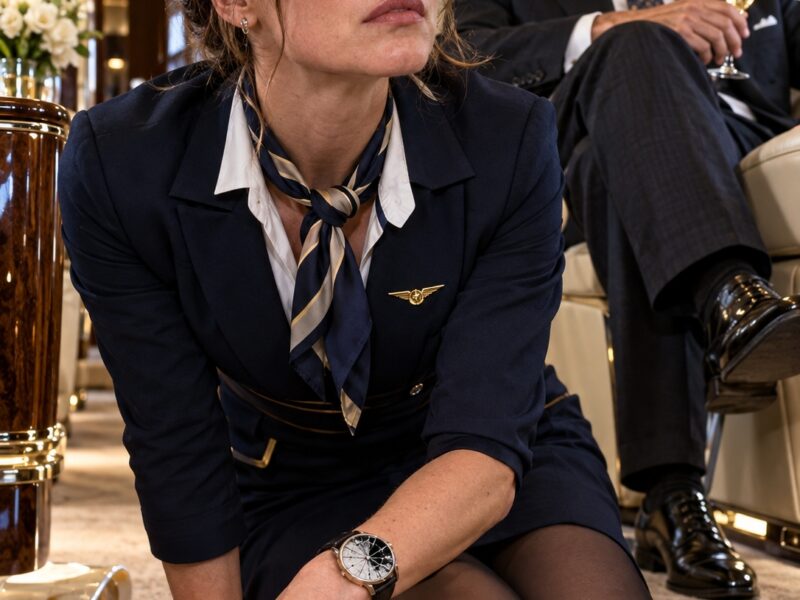
HE MADE THE FLIGHT ATTENDANT KNEEL—THEN FOUR ARMED MEN HIJACKED HIS $70 MILLION JET AND CALLED HER “SPARROW”

At forty thousand feet above the North Atlantic, four armed men took control of Conrad Whitmore’s seventy-million-dollar private jet in less than nine seconds.
Conrad went white.
The chief legal officer stopped breathing.
The copilot hit the galley floor bleeding.
And Evelyn Sloan—the flight attendant Conrad had humiliated before sunrise—was on her knees again, gathering shards of crystal from the carpet while a rifle hung inches above her head.
“You heard him,” Russell Vane said.
He kicked another broken glass toward her.
“Do your job.”
Evelyn lowered her eyes.
She picked up the first shard.
Then the second.
Then the third.
Nobody in that cabin noticed what she was really doing.
She was counting weapons.
Counting footsteps.
Counting loyalties.
Counting the seconds between Grant Blackwood checking his satellite phone and the man with the steel signet ring looking toward the cockpit.
Conrad Whitmore saw a servant cleaning his floor.
Russell saw a frightened woman who had finally learned her place.
Grant Blackwood was beginning to see something else.
And that was why, for the first time since the hijacking began, he looked nervous.
Because nine years earlier, in a city Evelyn no longer allowed herself to name, men with far better training than Russell Vane had made exactly the same mistake.
They had looked at Evelyn Sloan and decided she was harmless.
One of them had not survived long enough to correct the assumption.
But that morning had begun quietly.
Almost beautifully.
The sky over Teterboro was still the color of wet slate when Evelyn crossed the private ramp carrying a stainless-steel thermos in one hand and the cabin log in the other.
It was a little after six.
She had been awake since three.
She liked airports at that hour.
Before executives arrived.
Before engines screamed.
Before expensive people began explaining to everyone else why their time mattered more.
The white Gulfstream waited under the ramp lights like something carved from bone.
Evelyn climbed aboard alone.
She set the cabin temperature to sixty-eight degrees, checked the catering inventory, inspected the medical kit, counted the oxygen bottles, tested the emergency lighting and ran her thumb across the forward exit latch until she felt the detent click into place.
Most corporate attendants performed the safety check quickly.
Evelyn never did anything quickly simply because nobody was watching.
On her left wrist was an old watch.
It looked wrong against the immaculate navy cuff of her uniform.
The leather strap was cracked and faded. Brass showed through the worn casing. A hairline fracture ran across the crystal from eleven o’clock toward the center of the dial.
She could have repaired it for forty dollars.
She had carried it broken for nine years.
Some damage, Evelyn had once believed, deserved to remain visible.
At 6:15, the cars arrived.
Conrad Whitmore III entered the aircraft the way he entered most rooms—as though the room had already disappointed him.
He was fifty-six, broad through the shoulders, silver at the temples, and rich enough that entire municipal governments had returned his calls.
Whitmore Global Holdings had started with warehouses and patents and grown into a sprawling international conglomerate involved in logistics, aerospace systems, industrial software, advanced guidance technology and a dozen other businesses Conrad liked describing as “infrastructure.”
He had inherited advantages.
He had also multiplied them.
That distinction mattered enormously to him.
“The cabin is warm.”
“Good morning, Mr. Whitmore.”
“And this isn’t the water I requested.”
“I’ll replace it.”
He handed her his coat without looking at her.
Behind him came Daphne Caldwell, Whitmore Global’s chief legal officer.
Daphne carried a hard-sided black briefcase herself.
She did not surrender it to the ground crew.
She did not surrender it to Evelyn.
That registered.
Not because Evelyn was curious.
Because Evelyn noticed things.
Daphne gave her a tired nod.
“Morning.”
“Good morning, Ms. Caldwell.”
There was something in the lawyer’s face Evelyn had seen many times in airports: a person who had slept but had not rested.
Conrad settled into his usual seat.
Evelyn brought his coffee exactly as he preferred it.
Two sugars.
No cream.
Gold-rimmed cup.
She placed it beside him.
Conrad lifted it.
Then deliberately—or carelessly enough that the distinction no longer mattered—rolled his wrist.
Coffee splashed across the cream carpet.
The saucer struck the cabinet.
It broke into three pieces.
Silence.
Conrad looked down.
“Well?”
Evelyn met his eyes.
“Sir?”
“Clean it.”
Daphne turned from the window.
“Conrad.”
“What?”
“You could say please.”
Conrad gave a short laugh.
“For what? Asking someone to perform the job I’m paying for?”
Evelyn crouched.
She collected the pieces with their sharp edges turned inward so no one reaching past the tray later would cut a hand.
Conrad continued speaking over her.
“Some people build things. Some people carry things. The sooner everyone understands which category they belong to, the happier civilization becomes.”
Daphne’s expression hardened.
“That’s an ugly thing to say.”
“It’s arithmetic.”
His gaze dropped toward Evelyn.
“She’s thirty-eight years old and on her knees cleaning coffee from my carpet. I’m not insulting her. I’m describing reality.”
Evelyn pressed a towel into the stain.
“I’ll have it out in two minutes, Mr. Whitmore.”
Her voice contained no anger.
That bothered Daphne more than anger would have.
Conrad smiled.
“See? Professional.”
He turned back to his tablet.
Evelyn continued blotting the carpet.
Years earlier, someone had taught her that the face you showed an arrogant man was information.
Show anger, and he knew where to push.
Show fear, and he knew where to stand.
Show nothing, and eventually he began talking as if you were furniture.
Furniture heard remarkable things.
Evelyn stood with the tray.
That was when she noticed the fifth man.
Four security officers were listed on the manifest.
Five were approaching the aircraft.
Evelyn knew the regular detail.
Marcus Hale, the lead, had two daughters and a bad knee.
She had flown with the others enough times to know who drank black coffee, who hated turbulence and who always called his wife before takeoff.
The fifth man was unfamiliar.
Broad shoulders.
Gray at the temples.
Correct dark suit.
Correct earpiece.
Correct shoes.
Everything about him was correct.
Except his attention.
A legitimate protection officer looked first at the client, the aircraft and the access points.
This man looked at the fuel truck.
Then the catering van.
Then the tower.
Then he repeated the sequence.
The duffel in his right hand sagged like it contained metal rather than clothes.
Evelyn carried the tray into the galley and picked up the ground handset.
“I have five security personnel at the stairs and four on the manifest. I need identification on the additional passenger before we close.”
Conrad heard her.
“Are you delaying my departure?”
“I’m confirming a passenger.”
“I confirmed him.”
“I still need—”
“He was added last night.”
Conrad stood.
The irritation in his face was disproportionate, which meant it was not really about the delay.
“He comes from the office of a man whose net worth makes mine look like a parking fine. I am not standing on a runway explaining my guest list to the person who folds my towels.”
Daphne looked up sharply.
“Conrad.”
He ignored her.
“This is what happens when you give people checklists. They start believing they’re management.”
Evelyn said nothing.
Thirty seconds later, the ground supervisor responded.
The fifth man had been cleared through corporate security.
Authorization on file.
Nothing further required.
Evelyn stared at the handset.
Every instinct she had was telling her not to close the door.
But instincts were not authority.
She could refuse cabin service.
She could report a discrepancy.
She could not ground Conrad Whitmore’s aircraft after corporate security had cleared his passenger.
So she stood beside the door and greeted each protection officer by name.
People using borrowed identities often hesitated when strangers used the name first.
“Morning, Marcus.”
“Morning, Evelyn.”
“David.”
“Good morning.”
“Sam.”
“Hey, Ev.”
The fifth man reached the stairs.
Evelyn smiled.
“Good morning.”
He smiled back.
“Morning, ma’am.”
No name.
His right hand closed around the grab rail.
And Evelyn saw the ring.
Brushed steel.
Flat face.
A tiny geometric mark cut into its surface.
Her stomach went cold.
She had seen that symbol once before.
Nine years earlier.
In a surveillance photograph attached to a file she had never been permitted to keep.
For one second, the private terminal disappeared.
There was concrete under her knees.
A stairwell.
Gunfire somewhere below.
A man named David Ruiz pressing something into her hand.
Then the memory was gone.
The man stepped past her.
Evelyn closed the door.
At 6:51, the Gulfstream lifted from Teterboro and climbed northeast.
In the rear of the cabin, the fifth man took out his phone.
Just before the signal disappeared, he sent four words.
Evelyn did not see them.
Target is on board.
Hours later, after they had crossed the coast and the world below became nothing but gray Atlantic, the hijacking began with a sound no louder than a seat-belt buckle.
The fifth man stood.
He put a pistol against Marcus Hale’s head.
At exactly the same moment, three members of Conrad’s own protection detail rose with weapons in their hands.
For half a second, nobody understood what they were seeing.
Then everybody understood at once.
Marcus froze.
Daphne’s briefcase slipped against her shoe.
Conrad stared at the men he had paid to protect him.
“Hands flat on the armrests,” the fifth man said.
Nobody moved.
“I’ll say it once more. Hands flat. Eyes forward. Nobody dies in the next ten minutes unless somebody decides to be brave.”
In the cockpit, First Officer Cole Bennett heard the change in voices and reached for the security lock.
He was one second too slow.
The door burst inward.
There was a short, violent struggle.
Cole hit the galley floor with blood pouring down his forearm.
Captain Nathaniel Brooks kept both hands on the controls.
He did not turn around.
“If I stop flying,” he said calmly, “we all stop existing.”
A weapon pressed behind his seat.
“Then fly.”
A heading was dictated.
The radios went silent.
The transponder remained untouched.
The man who took control of the cabin introduced himself as Grant Blackwood.
He did it without shouting.
He did not need to.
“My name is Grant Blackwood. In approximately six hours, this aircraft will land somewhere I choose. Every person here can still be alive when that happens.”
He looked toward Conrad.
“That outcome depends largely on Mr. Whitmore.”
Conrad stood.
“You have absolutely no idea who you’re dealing with.”
Grant watched him.
“I know senators. Cabinet officials. People whose names you’ve only seen on television. Whatever someone is paying you, I’ll double it.”
Grant placed one hand on Conrad’s shoulder.
Then slowly pushed him back into his seat.
Not violently.
Almost politely.
Like closing a drawer.
For perhaps the first time in his adult life, Conrad Whitmore was physically made to sit down.
“You keep thinking this is about money,” Grant said.
“Money is how you talk. It isn’t how I listen.”
At the rear of the cabin, Evelyn was already beside Cole.
The copilot’s wound looked catastrophic at first glance.
It wasn’t arterial.
Bad, but survivable.
She opened the medical kit.
A boot came down on it.
Russell Vane stood over her.
He was the youngest hijacker and the only one who seemed to be enjoying himself.
“Did anyone ask you?”
“He’s bleeding.”
“I can see that.”
“He needs pressure on the wound.”
Russell grabbed Evelyn by the collar and threw her against the cabinet.
Her shoulder struck metal.
Pain flashed down her arm.
Daphne gasped.
Russell leaned close.
“You carry trays. That’s what you do. Right now nobody needs a tray.”
Evelyn looked at him.
Then lowered herself onto the floor.
Hands visible.
Compliant.
Russell saw surrender.
Evelyn saw that he favored his left knee.
That his weapon sling was adjusted too long.
That his attention drifted whenever Grant spoke.
Three facts.
Stored.
Grant looked over.
“Let her work.”
Russell turned.
“She—”
“If Bennett bleeds out, Brooks flies alone. If Brooks makes a mistake, we die with everyone else.”
Russell hesitated.
Half a second too long.
Then moved his boot.
Evelyn noticed that too.
She returned to Cole.
And while she bandaged him, she listened.
Men who thought the woman kneeling beside them was irrelevant tended to speak freely.
These men knew the catering load had been reduced.
They knew Conrad had moved his Geneva meeting forward by one day.
They knew Daphne carried the black briefcase.
Not that there was a briefcase.
The exact manufacturer.
The exact model.
They discussed the alternate fuel load.
That changed everything.
Criminals could buy guns.
They could buy manifests.
They could buy people.
But fuel planning lived deep inside an operation.
Somebody downstairs had built this hijacking for them.
Grant placed an old photograph on Conrad’s table.
Five men stood outside a cargo hangar beneath hard white sunlight.
Four smiled.
One did not.
“Recognize them?”
Conrad stared at it.
“No.”
“Look again.”
“I’ve never seen them.”
Grant’s expression barely changed.
“That’s exactly the answer I expected.”
He tapped the photograph.
“That’s the problem with men like you. You never see the people who die beneath your signatures.”
Then Grant explained what he wanted.
A transaction file.
Buried on a private Whitmore Global server.
Two-key authentication.
Conrad held one credential.
Daphne held the other.
The file documented technology transfers routed through an intermediary company called Harrowline Technical Services.
Grant wanted the credentials.
The passphrase.
Twenty minutes of satellite bandwidth.
Conrad denied everything.
“No such file exists.”
Grant waited.
“I sign thousands of documents.”
Still Grant waited.
“I cannot personally know every transaction conducted by a corporation this size.”
Daphne closed her eyes.
Something in that tiny movement told Evelyn more than Conrad’s entire speech.
Grant saw it too.
He nodded toward Russell.
Russell dragged Daphne from her seat.
He shoved her against the bulkhead.
“Conrad.”
Grant’s voice remained quiet.
“Maybe you don’t care what happens to you.”
Russell twisted Daphne’s arm.
“But perhaps we can discover what you care about.”
Evelyn stood.
“Stop.”
Four faces turned toward her.
“Her shoulder is dislocated.”
It wasn’t.
Russell frowned.
“What?”
“If you need her to enter a passphrase, she needs the arm. Let me reduce it.”
A small lie.
A stupid lie.
A useful lie.
Russell pushed Daphne into a seat.
“Fix her.”
Evelyn took the lawyer’s arm gently.
Daphne was hyperventilating.
Under the pretense of examining the joint, Evelyn leaned closer.
“Breathe slower.”
Daphne looked at her.
“You’re safe for the next ten seconds. Use them.”
Daphne’s breathing changed.
Conrad watched them.
And somehow, in the wreckage of everything happening around him, he still found someone beneath him to blame.
“This is her fault.”
Nobody answered.
Conrad pointed toward Evelyn.
“She delayed us on the ramp. She was playing security officer instead of doing her job. If she had simply—”
Even he heard the stupidity before finishing.
Russell smiled.
He swept three crystal glasses from the credenza.
They exploded across the carpet.
“Your boss is right.”
He pointed at the glass.
“Do your job.”
Evelyn knelt.
Again.
Russell stood above her.
“Some people spend their whole lives thinking they’re special. But there are only two kinds of people. The ones who get carried and the ones who carry.”
Evelyn picked up a shard.
Six inches above the floor gave her a better sightline beneath the seats.
She watched Grant check his phone twice.
She watched the signet-ring man remain separate from the others.
She watched Russell stare at Grant’s back whenever the leader gave an order.
Resentment.
Hierarchy.
Fracture.
The airplane jolted through rough air.
Peter, a twenty-six-year-old analyst in the staff section, slammed against his belt and cried out.
One hijacker spun.
His weapon rose.
Evelyn moved.
She pulled Daphne behind the bulkhead and placed her own body between the lawyer and the muzzle.
Nobody fired.
The moment lasted less than a second.
But Grant had seen it.
“That was fast.”
“I was standing.”
“No.”
He approached.
“You were kneeling.”
Evelyn said nothing.
Grant studied her.
“Where did you work before corporate aviation?”
“Charter.”
“Before that?”
“International.”
“Which carriers?”
“The kind that hire women willing to work nights.”
His eyes remained on her.
Finally he stepped away.
“From now on, she stays forward of the second divider.”
Russell nodded.
Evelyn understood what she had purchased.
Daphne’s safety had cost her freedom of movement.
Once, nine years earlier, she had made another calculation.
There had been a stairwell.
A drive.
A mission.
And David Ruiz.
She had chosen the mission.
David had died.
For nine years she had told herself it was the correct decision.
For nine years she had never believed it.
Ten minutes later, Evelyn was pouring water for Cole when she heard Grant speaking quietly on the satellite phone.
“Tell Harrowline the window moved.”
The cup nearly slipped from her hand.
Harrowline.
The word opened a locked door inside her.
Harrowline Technical Services.
A bland company in a cooperative jurisdiction.
The name on the last page of the last operational file Evelyn had seen before David Ruiz died.
She caught the cup.
Turned.
Grant stood at the divider.
He wasn’t looking at her face.
He was looking at her wrist.
The watch had slipped from beneath her cuff.
The cracked crystal gleamed under the cabin lights.
“Where did you get that?”
Evelyn did not cover it.
“It belonged to a friend.”
Grant’s eyes narrowed.
“He died. His sister gave it to me after the funeral.”
Grant said nothing.
Then:
“How long ago?”
“Nine years.”
Something changed behind his eyes.
He walked away.
Four minutes later, Russell was ordered to remain near Evelyn.
For the next two hours, he barely stopped watching her.
The atmosphere aboard the jet shifted.
Grant’s employer had begun changing the plan.
Evelyn heard fragments.
“That wasn’t the agreement.”
Pause.
“The agreement was Mauritania.”
Another pause.
“No. You don’t change the destination four hours into an operation.”
Grant disconnected.
For the first time, he looked rattled.
Then Russell lost control.
Peter asked whether Cole could have more water.
Russell hit him.
Peter raised his hands.
Russell struck him again.
Then lifted his boot.
Evelyn stepped between them.
She did not think.
That was the frightening part.
Her body remembered before her mind gave permission.
She stepped inside the arc of Russell’s leg, turned her hips, shifted his supporting knee and used his own weight against him.
Russell hit the carpet.
His rifle landed six feet away.
His wrist was pinned beneath Evelyn’s knee.
Two and a half seconds.
Silence swallowed the cabin.
Grant raised his weapon.
So did the others.
Evelyn released Russell immediately.
She stood.
Hands open.
She did not reach for the rifle.
One against four was not courage.
It was arithmetic.
Russell rose slowly.
Humiliation burned across his face.
He retrieved the weapon.
Pressed the muzzle against Evelyn’s forehead.
“Who the hell are you?”
Evelyn looked directly at him.
“The person who asked you to stop.”
Grant reached out.
With one finger, he pushed Russell’s barrel aside.
“Enough.”
Russell stared at him.
Grant’s voice hardened.
“If you touch her again without my permission, I will leave you wherever we land.”
Conrad sat frozen.
For three years, Evelyn had poured his coffee.
He had never learned what books she read.
Whether she had family.
Where she had lived.
What she had done before appearing in his cabin.
He had never imagined she possessed a history because, to Conrad, people beneath a certain income level seemed to begin existing only when they entered his field of vision.
Twenty minutes later, Daphne found an opportunity.
Evelyn was changing Cole’s dressing.
Daphne whispered without moving her lips.
“The file isn’t financial.”
Evelyn kept working.
“What is it?”
“Guidance and targeting technology.”
Evelyn’s hands paused for less than a second.
Daphne continued.
“Whitmore Global licensed a package to Harrowline. Official use was agricultural surveying. Harrowline transferred it onward.”
“To whom?”
“A procurement network.”
“Government?”
“No.”
That answer was worse.
Daphne swallowed.
“There are three incidents where Whitmore hardware appeared somewhere it should never have been. People died.”
“Did Conrad know?”
“Conrad signed the authorization.”
Evelyn tightened the bandage.
“And you?”
“I’ve been building the evidence for eleven months.”
“Geneva.”
Daphne nodded.
“I was supposed to meet independent counsel there.”
A shadow fell across them.
Grant had crouched beside the aisle.
He looked directly at Evelyn.
Then he said one word.
“Hello, Sparrow.”
The cabin disappeared.
The engine noise seemed to move miles away.
Evelyn had not heard that name spoken by another living person in nine years.
Sparrow.
She had been Sparrow in Nicosia.
Sparrow in Bucharest.
Sparrow in ports where cranes moved through the night and men carried passports belonging to dead people.
She had been Sparrow for four years and eleven months.
Then, on a Tuesday nine years earlier, David Ruiz had bled to death on a stairwell while she carried a drive through a service exit because the drive was the mission.
Because David had told her to go.
Because she had obeyed.
“I don’t know that name,” Evelyn said.
Grant almost smiled.
“You answered before I finished saying it.”
Evelyn’s expression remained still.
“I was told Sparrow died.”
“Who told you?”
“The same people who are currently changing my contract.”
Grant sat opposite her.
Nine years earlier, he explained, he had not been a hijacker.
He had been a private security contractor.
Badged.
Insured.
Legal enough on paper.
His employer provided force protection for a logistics subcontractor connected through several corporate layers to Harrowline Technical Services.
One afternoon, Grant had photographed cargo being unloaded.
Six weeks later, every man in that photograph except him was dead.
Three countries.
Three supposed accidents.
Nineteen days.
Grant spent years trying to understand why.
Then someone offered him four million dollars to steal a file from Conrad Whitmore’s aircraft.
“I thought somebody was finally paying me to do what I’d been trying to do for free.”
Evelyn studied him.
“They told you to steal it?”
“Yes.”
“Not publish it?”
Grant said nothing.
“Not copy it?”
Nothing.
“Destroy it?”
His eyes shifted.
Evelyn leaned forward.
“And you never asked why the people paying four million dollars wanted evidence destroyed?”
Before Grant could answer, Conrad lunged from his seat.
He grabbed Evelyn’s sleeve.
Gone was the billionaire who had laughed while she cleaned his coffee.
What remained looked frightened and strangely young.
“You can do something.”
Evelyn looked down at his hands.
“I saw what you did to him. Whatever they paid you before—whatever you used to earn—I’ll triple it.”
“Let go.”
“Five million.”
“Mr. Whitmore.”
“Ten.”
“Let go of me.”
“My attorneys can put it in writing. Get me off this airplane.”
Evelyn removed his fingers one at a time.
“I am going to try to get everyone home.”
Conrad stared at her.
“That includes Peter. It includes Captain Brooks. It includes Cole. It includes Ms. Caldwell.”
She paused.
“And it includes you.”
Relief appeared on his face.
Then she finished.
“But I’m not assigning prices to any of you.”
His expression changed.
“Because the moment I decide your life is worth more than theirs because you can pay me, I become exactly the person you assumed I was this morning.”
She turned to Grant.
“Describe your employer.”
“Voice only.”
“Payment?”
“Liechtenstein structure.”
“What information did he provide?”
“Manifest. Security. Fuel.”
“The fuel load?”
Grant nodded.
Evelyn looked toward the cockpit.
“Before dispatch?”
Another pause.
“Yes.”
She lowered her voice.
“He knew the fuel before the crew.”
Grant understood where she was going.
Evelyn continued.
“He gave you the aircraft. The passengers. The security arrangement. The destination. And now he keeps changing the destination.”
Grant’s jaw tightened.
“He has never once asked whether the file is intact, has he?”
Silence.
“No.”
“He doesn’t care about the file anymore.”
Grant looked toward the windows.
There was nothing beyond them but cloud and ocean.
Evelyn said, “You have a cabin full of witnesses who can identify you.”
Grant looked back.
“So tell me something.”
Her voice became very quiet.
“What does a man do with a hijacking crew he no longer needs when they’re four miles above the Atlantic?”
The satellite phone buzzed.
Grant removed it.
Read the message.
Evelyn was close enough to see four words.
WHITMORE NEED NOT RETURN.
Grant stared at the screen.
The discipline left his face.
And Evelyn knew the most dangerous phase had just begun.
Betrayal did not make Grant panic.
It made him desperate.
If the employer would not pay, Conrad became the only asset left.
Grant ordered Brooks onto a heading that burned fuel they could not spare.
He began preparing a transmission that would turn the covert seizure into an international hostage crisis.
Two hijackers followed him.
Russell followed anything that promised violence.
But the man with the steel signet ring remained at the rear.
Watching.
Waiting.
Taking no part.
That finally answered one question.
He had never belonged to Grant.
Evelyn began moving quietly through the cabin.
To Daphne:
“When something hits the floor, stay behind the galley bulkhead.”
To Cole:
“If I give you the cockpit door, can you close it?”
The wounded copilot nodded.
To Peter:
“You’ll hear something fall. Pull the two people behind you down.”
Peter’s face went pale.
“What are you going to do?”
“I don’t know yet.”
That was the truth.
She leaned toward the cockpit.
“Captain.”
Brooks glanced back.
“When I say now, kill the cabin lights.”
He understood immediately.
Russell made the next move for her.
Humiliation had been growing inside him for two hours.
He grabbed Peter by the hair.
Pulled him halfway from his seat.
Pressed a muzzle beneath his jaw.
Then looked directly at Evelyn.
“Come fix this one too.”
Evelyn walked toward him.
Slowly.
Hands visible.
“Russell.”
“Stay back.”
“He’s twenty-six.”
“Another step and he dies.”
“He’s not worth spending the rest of your life on.”
Russell laughed.
“You think I have a rest of my life?”
That sentence told her everything.
She kept walking.
Because she was speaking, he was listening.
Because he was listening, he was not shooting.
One arm’s length.
Evelyn reached past the weapon.
Not for it.
For the sling.
She turned.
The muzzle left Peter’s jaw.
A shot exploded into the seat.
Peter dropped.
Evelyn locked Russell’s elbow.
The rifle hit the floor.
“Now!”
Darkness.
Captain Brooks killed every cabin light.
At thirty-nine thousand feet, the darkness inside an aircraft is nearly absolute.
Passengers screamed.
Someone fired.
The shot went nowhere useful.
Evelyn had counted the cabin that morning.
Seven steps from the galley.
Three to the divider.
Cabinet corner.
Cart latch.
Seat base.
She moved through darkness she had already mapped.
One man came toward her.
She used his momentum to drive him into the galley cabinet.
Another turned toward the sound.
She approached from an angle his eyes had not adjusted fast enough to see.
The weapon left his hands.
Cole dragged himself into the cockpit.
The door slammed.
Locked.
Lights returned.
Grant stood in the center aisle.
One arm around Conrad’s throat.
Weapon against his ear.
One loyal hijacker beside him.
The signet-ring man remained at the rear.
“Everybody stops,” Grant said.
Everybody stopped.
Evelyn raised her empty hands.
“Grant.”
“Don’t.”
“Your employer sent the message in front of us.”
His grip tightened.
“I said don’t.”
“Whitmore need not return.”
Conrad shut his eyes.
Evelyn nodded toward the rear.
“Ask yourself why he hasn’t fired.”
Grant’s eyes moved toward the signet ring.
“Why he joined through authorization you didn’t arrange.”
The remaining loyal hijacker turned too.
The signet-ring man looked almost disappointed that the game had ended.
Evelyn continued.
“He wasn’t sent to help you take this aircraft.”
The man’s hand drifted toward his belt.
“He was sent to make sure nobody leaves it.”
Something broke inside the hijacking at that moment.
Not physically.
Structurally.
They stopped being a team.
They became frightened men with separate survival instincts.
Grant looked at the ring.
Then at Conrad.
Then at Evelyn.
For the first time all day, he seemed tired.
The next fourteen minutes were negotiation, not combat.
Evelyn spoke to each man by name.
She never told them they had lost.
She gave them easier choices.
Put the weapon down.
Move backward.
Sit.
Breathe.
Survive the next minute.
Then the next.
Conrad nearly ruined everything.
He tried offering the signet-ring man money.
Of course he did.
Even now.
Even after everything.
The man looked toward Daphne.
And Evelyn understood instantly.
Daphne was the witness who could authenticate the file.
If someone had to die before landing, it would be her.
The signet-ring man moved.
Evelyn chose Daphne.
There was no calculation this time.
No mission versus person.
No stairwell.
No David.
She moved toward the lawyer and surrendered her angle on Grant.
Nine years earlier, she would have called that a tactical mistake.
Now she understood it was the entire point.
Grant saw her make the choice.
Something in him gave way.
He released Conrad.
Placed his weapon on the carpet.
Sat in seat four.
He stared through the window at the Atlantic.
“Nine years,” he murmured.
Evelyn watched him.
“And he was always going to bury me.”
Captain Brooks eventually got a coded emergency squawk transmitted.
Two hours and twenty minutes later, the damaged Gulfstream descended toward Gander, Newfoundland, with fire trucks racing beside the runway.
Hijackers sat restrained in the rear with zip ties, belts and galley equipment.
Cole was pale but conscious.
Peter’s mouth was swollen.
Daphne still held her briefcase.
Conrad found Evelyn in the galley.
She was counting medical supplies.
For several seconds, he said nothing.
Then:
“This morning.”
Evelyn looked up.
“The coffee.”
She waited.
“The glass.”
Still she waited.
“I made you kneel.”
“Twice.”
Conrad swallowed.
“If something happens when we land… if this becomes complicated… would you leave me?”
It was perhaps the first question he had ever asked Evelyn for which money could not purchase the answer.
She set the medical kit down.
“You were wrong about what a person is worth, Mr. Whitmore.”
He lowered his eyes.
“But I’m not going to let your mistake decide who I am.”
He looked at her.
Before he could answer, something buzzed inside a drawer.
Daphne’s phone.
It had been locked away and forgotten during the chaos.
Daphne retrieved it.
A message from an unknown number filled the screen.
EVELYN SLOAN DOES NOT LEAVE THAT AIRCRAFT.
Daphne went still.
She brought the phone to Evelyn.
“That number has contacted me three times in eleven months.”
“Can you trace it?”
“Not directly.”
“But?”
“I traced the pattern.”
Daphne looked toward Conrad.
“Every message came after a meeting only four people attended. And every time, within twenty-four hours, Warren Ashcroft called Conrad about something he should not have known.”
Conrad’s face changed.
Warren Ashcroft.
His largest outside investor.
Nineteen years.
The man who had put forty million dollars into Whitmore Global when it had consisted of three warehouses and a promising patent.
The man Conrad had described in interviews as closer than family.
And suddenly the structure became visible.
Warren had not been collecting evidence of illegal technology transfers to expose them.
He had been part of them.
Harrowline sat inside a lattice of trusts, holding companies, investment vehicles and intermediaries constructed to separate ownership from responsibility.
The file Grant had been hired to steal was not leverage Warren wanted.
It was evidence he needed erased.
Grant had never been the thief.
He had been the match.
Four million dollars.
A hijacking.
Reduced fuel.
An altered route.
A contractor wearing a steel ring.
Then an accident over open water.
No survivors.
No hijacking investigation.
No Daphne Caldwell to authenticate the documents.
No Conrad Whitmore to explain signatures.
No Grant Blackwood to reveal who hired him.
Whitmore Global would lose its chief executive overnight.
Markets would panic.
The board would fracture.
And Warren Ashcroft, grieving publicly for his “dear friend,” would be perfectly positioned to take control of whatever survived.
Evelyn sat on the jump seat.
She turned her wrist.
The cracked watch caught the cabin light.
And finally, after nine years, the last piece moved into place.
David Ruiz had died protecting her exit from a building where they had recovered procurement records tied to an illicit technology network.
The brokerage in those records had been capitalized through layers of entities.
One American investment trust had been redacted in every version Evelyn was allowed to see.
She had asked who controlled it.
Her supervisor told her the answer was above her clearance.
David died.
Evelyn completed the mission.
Eleven weeks later, she left the service.
Everyone assumed she was trying to escape her past.
They were wrong.
She had started looking.
Quietly.
Alone.
For two and a half years, she followed fragments.
A corporate registration.
A director who appeared twice.
A payment routed through Luxembourg.
A logistics contract.
Finally the thread reached Harrowline Technical Services.
Harrowline had one significant disclosed commercial relationship.
Whitmore Global Holdings.
So Evelyn Sloan took a corporate cabin-service certification course.
She applied to the company staffing Whitmore aircraft.
She accepted terrible rotations.
Night flights.
Holiday flights.
Last-minute callouts.
She waited until seniority brought her onto Conrad’s principal aircraft.
Nobody recruited her.
No intelligence service placed her there.
No handler waited for reports.
No backup team knew her name.
For three years, Evelyn had poured Conrad Whitmore’s coffee.
She had listened while he insulted employees.
Memorized manifests.
Watched visitors.
Noted companies.
Waited.
For a ring.
A name.
One careless sentence.
That was why she had challenged the fifth security officer at Teterboro.
That was why the signet ring had frozen her blood.
That was why hearing Harrowline in the galley had nearly made her drop a cup.
She had not accidentally boarded the center of the conspiracy.
She had spent three years standing quietly inside it.
But that was not the truth that changed her.
For nine years, Evelyn had believed there was only one way to finish what David died helping her begin.
Choose the mission.
Accept the cost.
Leave somebody on the stairs if necessary.
That morning, she had been prepared to do exactly that.
Instead, when Daphne was threatened, Evelyn chose Daphne.
When Peter was threatened, she chose Peter.
When Grant held Conrad, she still tried to save Conrad.
And when she had the opportunity to pursue the man who could answer everything, she surrendered the angle to protect the lawyer.
She chose the person.
And the truth survived anyway.
Daphne sat beside her.
“There’s something you should know.”
Evelyn looked over.
“Before we departed, I lodged a complete copy of the file with independent counsel in Zurich.”
Evelyn stared at her.
“If I failed to make contact within forty-eight hours, they were instructed to release it.”
A strange laugh escaped Daphne.
“I thought I was protecting myself from Conrad.”
“No,” Evelyn said.
“You were protecting yourself from Warren.”
Daphne looked toward the cabin.
“You just didn’t know his name yet.”
Across from them, Conrad Whitmore sat with his hands in his lap.
At fifty-six years old, he finally understood that the two people most capable of saving both his life and what remained of his company were a lawyer he had never properly thanked and a flight attendant he had ordered onto her knees.
Captain Nathaniel Brooks landed the Gulfstream so softly that several restrained men in the rear did not realize the wheels had touched pavement.
Later, everyone aboard would remember that landing.
Five and a half hours with armed men behind him.
A wounded copilot.
A compromised fuel state.
No certainty that the people fighting behind the cockpit door would still be alive when he opened it.
And still Brooks put the airplane onto Newfoundland asphalt as though returning from an ordinary business flight.
Nothing afterward was ordinary.
Evelyn gave statements for nine hours across two days.
She spoke plainly.
Dates.
Routes.
Names.
Corporate structures.
The dispatch system accessed from Greenwich before dawn.
She did not volunteer old affiliations to the first Canadian constable who interviewed her.
She did authorize investigators to request her service records.
After that, the room changed.
Daphne’s Zurich package opened on schedule.
Copies reached the United States Department of Justice, Treasury investigators and a Senate committee.
What emerged was larger than a single corrupt transaction.
Eleven years.
Four intermediaries.
Layers of capital.
Technology moved through legal-looking agreements until guidance hardware ended up with people who should never have possessed it.
Warren Ashcroft was not arrested because of one threatening message.
A text was not enough.
He was arrested fourteen months later.
Investigators connected the dispatch intrusion to a contractor on his personal payroll.
Grant Blackwood testified under oath about nine years of connections in exchange for consideration at sentencing, though not freedom.
A forensic accountant in Virginia spent six months reconstructing structures designed specifically to prevent reconstruction.
Conrad Whitmore was removed as chief executive nineteen days after the landing.
He was not charged with murder.
He had not committed one.
Reality did not need invented crimes to make him guilty of the ones he had actually committed.
Export violations.
False representations.
Compliance failures.
Transactions he had signed because profits mattered more than the questions he chose not to ask.
He would spend years in litigation.
Conrad did not transform into a good man.
People rarely change that cleanly.
Two days after the landing, in a hotel conference room in St. John’s, he met Evelyn.
He placed an envelope on the table.
“What’s this?”
“Four million dollars.”
Evelyn looked at him.
Conrad pushed it toward her.
“No conditions.”
She pushed it back unopened.
“Why?”
“Because I didn’t do it for you.”
“You saved my life.”
“I tried to save everyone’s life.”
“That distinction seems academic.”
“It isn’t.”
She leaned back.
“Everyone on that airplane had somebody who expected them to arrive somewhere.”
Conrad looked at the envelope.
“Including you,” Evelyn said.
For a long time, he was silent.
Then:
“I’m sorry.”
Evelyn said nothing.
“For the coffee.”
He swallowed.
“For that morning.”
His eyes remained on the table.
“And for the three years before it.”
That made her look at him.
“For every person I spoke to the way I spoke to you.”
There was no attorney in the room.
No camera.
No settlement agreement.
Nothing Conrad could gain from the sentence.
It might have been the first completely unprofitable thing he had said in his adult life.
Evelyn did not forgive him.
Not there.
Maybe forgiveness was not the point.
She simply stood.
“Goodbye, Mr. Whitmore.”
That autumn, Evelyn drove to a small town outside Bakersfield.
Celia Ruiz opened the door.
David’s sister had aged in the ordinary ways people age when life keeps moving after the worst thing that ever happened to them.
She recognized Evelyn immediately.
They sat in the kitchen.
Coffee between them.
Afternoon sunlight on the table.
Evelyn removed the watch.
For the first time in nine years, her wrist felt naked.
She placed it between them.
Beside it she set a folder.
It contained everything investigators had cleared her to share.
Not everything.
Enough.
Enough to tell a family why David had died.
Enough to prove his death had mattered.
Enough to give his name back to the people who had spent nine years living with explanations that never quite fit.
Celia touched the cracked crystal.
“You kept it.”
“Every day.”
“Why?”
Evelyn looked at the watch.
“I thought it was because I wanted to remember him.”
“And now?”
“I think I was using it to stay there.”
Celia understood.
“In the stairwell.”
Evelyn nodded.
Celia pushed the watch back.
“Keep it.”
“I can’t.”
“He gave his life helping you get out.”
“That’s why.”
“No.”
Celia’s voice was gentle.
“That’s exactly why you keep it.”
Evelyn looked up.
Celia smiled sadly.
“My brother wouldn’t have wanted to become a monument.”
The kitchen was very quiet.
“He’d probably tell you to get the damn glass fixed.”
Evelyn laughed.
It surprised both women.
Then she cried.
Not dramatically.
Not the way grief happens in movies.
Her eyes filled while she sat at a kitchen table in California with a cold cup of coffee in front of her.
Celia reached across.
Held her hand.
For once, Evelyn did not pull away.
She never became famous.
There was coverage.
Interviews were requested.
She declined most of them.
Other stories arrived.
Other scandals.
Other names.
Within months, Evelyn Sloan became the kind of person people remembered only if they searched.
She did not write a book.
She did not become a security consultant.
She did not build a career out of being the woman who survived a hijacking.
She took eight months off.
Then she went back to work.
Because despite everything, she still loved airplanes.
The following spring, Evelyn crossed the central concourse of Denver International Airport in a plain navy uniform.
Her repaired watch ticked beneath her cuff.
Ahead of her, a woman rushing for a connection caught a carry-on against a stanchion.
The bag opened.
Pens rolled across the tile.
Boarding passes fluttered under a bench.
A charger skidded toward a trash can.
A child’s drawing landed facedown near Evelyn’s shoe.
Hundreds of travelers kept moving.
Some stepped around the mess.
Others barely noticed.
Evelyn stopped.
She knelt.
She collected the pens.
The charger.
The boarding passes.
Then the drawing.
She stacked everything carefully, edges aligned, the same way she had gathered broken glass from a billionaire’s carpet.
The woman crouched beside her.
“Oh God, thank you.”
Evelyn handed her the drawing.
The woman looked around at the river of travelers passing them.
“Honestly, nobody ever stops anymore.”
Evelyn smiled.
“It’s nothing.”
She stood.
Adjusted her bag.
And disappeared into the crowd.
Nobody in that concourse knew about Grant Blackwood.
Nobody knew the name Sparrow.
Nobody knew about Harrowline, Warren Ashcroft, the Atlantic, the gunshot through the seat or the eleven seconds in darkness when an entire aircraft had depended on a woman everyone had mistaken for furniture.
Nobody knew about David Ruiz.
Nobody knew why the crystal on Evelyn Sloan’s old watch was no longer cracked.
And Evelyn no longer needed them to.
For nine years, she had believed strength meant completing the mission no matter who had to be left behind.
It had taken one terrible flight to teach her something David had probably understood before she did.
Sometimes strength was not walking away from the person on the stairs.
Sometimes it was going back.
Sometimes it was refusing to become cruel simply because cruel people had mistaken kindness for weakness.
And sometimes the strongest person in the room was simply the one willing to kneel when everyone else kept walking.









