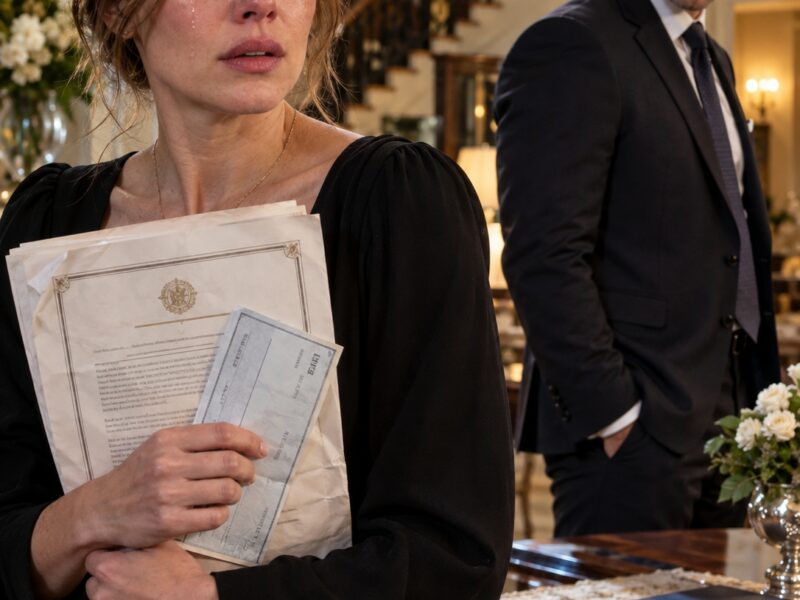
HE MARRIED HIS PARENTS’ CAREGIVER TO SAVE THEIR HOME—THEN DISCOVERED WHO HER DEAD HUSBAND REALLY WAS

The first time Andrew Anderson realized he might have destroyed his family, his seventy-eight-year-old father was lying on a hospital bed with dried blood near his temple, refusing to look at him.
Rain tapped softly against the dark window.
A heart monitor counted the seconds Andrew wished he could take back.
Across the room, Edward Anderson kept his face turned toward the wall.
“You chose who to believe,” the old man said.
His voice was weak.
It still cut cleanly.
“Now live with it.”
Andrew stood there in the same charcoal suit he had worn to work that morning, except the jacket was wrinkled, his tie was loose, and there was flour on one sleeve.
Lauren’s flour.
He had found it on the kitchen counter after she left.
A pale handprint near the bread bowl.
A stupid, ordinary thing.
He had stared at it for almost ten minutes because somehow that handprint hurt more than the empty bedroom upstairs, more than Mason’s missing backpack by the stairs, more than his mother sitting at the dining table asking why nobody had brushed her hair.
Lauren Reed had been gone for six days.
Six days earlier, Andrew had stood in his kitchen and accused her of entering his parents’ home for revenge.
Six days earlier, she had looked at him as if he had struck something inside her that could not be repaired.
And six days earlier, she had reminded him of the one promise he had made before she agreed to become his wife.
If you ever discover something about me that frightens you, ask me before you judge me.
He had promised.
Then he had done exactly the opposite.
Now his father was in a hospital because he had fallen near the stairs before dawn, searching the dark kitchen for bread Lauren was no longer there to bake.
His mother had almost stopped eating.
His brother was trying to take legal control of their parents.
And somewhere in North Carolina, the woman Andrew had married for one year on paper was carrying a truth about his family that had begun with a dead man named James Reed.
A man who had died inside an Anderson Woodworks factory.
A man Andrew had never heard about.
Or perhaps, Andrew would soon learn, a man someone had worked very hard to make sure he never heard about.
But that night in the hospital, Andrew still did not know the worst part.
The worst part was that Lauren had told him the truth.
He simply had not believed her.
Eight months earlier, Andrew’s biggest problem had seemed much simpler.
He could not keep a caregiver in his parents’ house.
Grace Palmer became number seven on a cold Tuesday morning.
Andrew had barely stepped through the front door when he heard a suitcase striking the staircase.
Thump.
Thump.
Thump.
Grace came down with tears in her eyes and one hand clenched around the handle.
“I’m sorry, Mr. Anderson.”
Andrew stopped in the foyer.
“What happened?”
“What happened?”
She laughed once, without humor.
“Your father threw his soup bowl against the wall last night. Your mother hasn’t spoken to me in four days. Yesterday she asked me whether her daughter was coming home from college, and when I told her I didn’t know, your father accused me of upsetting her on purpose.”
From the dining room came Edward’s rough voice.
“I can hear you.”
Grace shut her eyes.
Edward appeared in the doorway, leaning heavily on his cane.
At seventy-eight, he was still a large man, broad through the shoulders, but Parkinson’s had introduced a tremor into the hands that had once shaped walnut and oak with almost surgical precision.
“I don’t need a nurse hovering over me,” he snapped. “I’m old, not dead.”
“You threw a bowl at the wall.”
“The soup was terrible.”
“That is not the point.”
“It was the point to the soup.”
Grace looked at Andrew.
“See?”
Andrew rubbed both hands over his face.
He had been awake since 4:30 that morning.
At forty-two, he ran Anderson Woodworks, a furniture company his father had built from a two-man workshop into one of western North Carolina’s largest regional manufacturers. Hundreds of employees depended on decisions Andrew made before most people finished breakfast.
He could negotiate seven-figure supply agreements without raising his voice.
He could walk into a failing plant and find waste in an afternoon.
He could read balance sheets the way musicians read notes.
But he could not keep peace inside the house where he had grown up.
“I can increase your pay,” he told Grace.
“No.”
“Take the weekend off.”
“No.”
“Grace—”
“I’m sorry.”
She softened for half a second.
“You seem like a good man, Mr. Anderson. But good men can still ask people to stay inside impossible situations.”
Then she left.
The front door closed.
Edward muttered something about weakness.
Andrew turned toward him.
“Seven.”
“What?”
“Seven caregivers in eight months.”
“Then stop hiring people I don’t like.”
“You don’t like anyone.”
“That saves time.”
Andrew almost laughed.
Almost.
Then he saw his mother.
Abigail Anderson stood at the end of the hallway in a pale blue robe.
Her silver hair was uncombed.
She looked small in a house that had once seemed to orbit around her.
“Is Sarah home?” she asked.
Silence filled the foyer.
Edward looked away.
Andrew felt the familiar pressure behind his ribs.
“No, Mom.”
“She said she’d be home for Christmas.”
Sarah had been dead for six years.
She had been Andrew’s younger sister.
She had been thirty-two.
An aneurysm had taken her without warning.
Edward had responded to grief by becoming harder.
Abigail had disappeared inward.
Depression came first. Then confusion. Then mornings when she forgot meals, afternoons when she remembered Sarah as a child, evenings when she understood perfectly that her daughter was dead and wept as if hearing it for the first time.
Andrew crossed the hall.
“Come on, Mom.”
He guided her toward the kitchen.
She stopped.
“Who was the woman with the suitcase?”
Andrew looked at the closed front door.
“Someone who decided she couldn’t stay.”
Abigail nodded slowly.
“People keep doing that.”
Andrew had no answer.
That evening, his older brother arrived with one.
Richard Anderson was forty-seven, handsome in the polished way that came from expensive haircuts, controlled smiles, and a lifelong talent for looking calm while somebody else was bleeding.
His wife, Megan, came with him.
So did Bernard Bennett, the family attorney.
Andrew knew it was trouble when Bernard carried a folder.
They sat in the living room beneath a painting Abigail had chosen thirty years earlier.
Bernard placed the folder on the coffee table.
“Andrew, we need to discuss long-term arrangements.”
“They’re staying here.”
Bernard had not even opened the folder.
“I haven’t said anything yet.”
“You brought Richard.”
Richard leaned back.
“Always nice to see you too.”
Bernard opened the folder.
“Your parents need professional, round-the-clock care. Given the repeated caregiver turnover, their medical histories, and the increasing incidents—”
“They’re staying here.”
“Then we may have to consider guardianship.”
The word changed the room.
Andrew looked at Richard.
Richard did not look away.
“Who?”
Bernard folded his hands.
“Your brother has indicated he would be willing.”
There it was.
Not concern.
Control.
Edward and Abigail still held the largest combined block of voting shares in Anderson Woodworks.
A legal guardian could influence their financial decisions.
And their shares.
Andrew leaned forward.
“This is about the company.”
Richard sighed.
“Of course you think that. Everything is the company to you.”
“You’ve spent three years pushing Dad to transfer voting authority.”
“And you’ve spent fifteen years acting like being CEO makes you the only responsible adult in the family.”
Megan crossed one leg over the other.
“Richard and I have a stable household.”
Andrew looked at her.
“So?”
Richard smiled.
“You’re divorced.”
The word landed exactly where Richard intended.
“Valerie left because you were never home,” he continued. “You work twelve-hour days. Sometimes fourteen. Seven caregivers have quit. A judge is going to notice.”
Andrew’s jaw tightened.
“What do you want?”
“I want Mom and Dad somewhere safe.”
“You want their votes.”
Richard leaned forward.
“And what do you want, Andrew? To keep pretending this house isn’t collapsing because admitting it would mean admitting there’s one problem you can’t solve by writing a check?”
That one hurt because part of it was true.
Andrew hated him for knowing.
“Give me one month.”
Richard laughed.
“One month for what?”
“I’ll find someone.”
“You found seven someones.”
“I said one month.”
Bernard glanced between them.
“A judge may consider evidence that reasonable alternatives were attempted.”
Richard’s smile faded.
“Fine.”
He stood.
“One month.”
Then he looked around the living room.
“Start getting used to saying goodbye.”
Andrew did not sleep.
Before sunrise, he drove downtown through streets still wet from overnight rain and parked beside a small stone church his family had attended when he was a boy.
Reverend Arthur Collins found him sitting alone in the third pew.
Arthur was in his late sixties, with white hair, tired eyes, and the infuriating patience of a man who had spent decades waiting for people to stop lying to themselves.
“I need help,” Andrew said.
Arthur sat beside him.
“That must have hurt.”
“What?”
“Saying it.”
Andrew stared at the stained-glass window.
“Do you know anyone who cares for elderly people?”
“Yes.”
“Someone qualified.”
“Yes.”
“Someone patient.”
Arthur smiled.
“That requirement narrows the field considerably.”
“Arthur.”
“I know a woman.”
Her name was Lauren Reed.
She worked part-time at the church senior center.
She cooked meals, helped older members bathe, drove them to appointments, and, according to Arthur, possessed the unusual ability to sit beside frightened people without making them feel watched.
“She’s a widow,” Arthur said. “Thirty-four. Has a nine-year-old boy named Mason.”
Andrew frowned.
“A child?”
“You asked for a caregiver, not a monastery.”
“My father is difficult.”
“I know your father.”
“My mother gets confused.”
“I know Abigail too.”
Andrew studied him.
“Then why do you think this woman would agree?”
Arthur’s expression changed.
“I didn’t say she would.”
Two days later, Lauren Reed stood outside the Anderson house holding Mason’s hand.
She carried one worn suitcase.
A cloth-wrapped loaf of bread rested against her hip.
Andrew had expected someone in scrubs.
Lauren wore jeans, brown boots, and a cream sweater beneath an old coat.
She was not glamorous.
She was not fragile.
She had calm hazel eyes and the posture of someone accustomed to carrying more than people noticed.
Mason stood close beside her with a backpack nearly as large as his torso.
Andrew gave them the tour.
He explained medications.
Schedules.
Emergency numbers.
Edward’s Parkinson’s.
Abigail’s depression and confusion.
The seven caregivers.
The broken dishes.
The shouting.
Lauren listened.
When he finished, she asked one question.
“What time do they eat dinner?”
Andrew blinked.
“Dinner?”
“Yes.”
“Usually eight. If they eat.”
“Then I’ll eat with them.”
“That’s your question?”
“For now.”
At eight that evening, Edward stared at Lauren across the dining table as if she had personally invaded his country.
She placed bread beside his soup.
He looked at it.
Then at her.
“How much are they paying you to tolerate a useless old man?”
Andrew stopped eating.
Lauren did not.
She broke the loaf.
“I don’t know what patience costs, Mr. Anderson.”
Edward’s eyes narrowed.
“I know what this bread cost.”
“What?”
“A dark morning. Flour on my sleeves. And the hope that strangers might remember they’re people if they sit around the same table long enough.”
Nobody spoke.
Lauren placed a piece beside his bowl.
“You don’t have to eat it.”
Edward leaned back.
“But?”
“But I won’t leave angry before supper.”
Andrew waited for the explosion.
Instead, Abigail reached across the table.
She took the bread.
She ate half.
Then the other half.
It was the first full thing she had eaten all day.
Edward watched his wife.
Then he picked up his piece.
He did not thank Lauren.
But ten minutes later, he cleared his throat.
“Is there more?”
Something shifted.
Small enough that Andrew nearly missed it.
But Lauren did not.
Neither did Edward.
Later that night, after Mason had fallen asleep, Edward summoned Lauren into his study.
A photograph of Sarah stood on the desk.
Edward sat beside it.
For a long moment, he simply stared at Lauren.
Then he said, “I know your face.”
Her fingers tightened around the edge of her sweater.
“I’m sorry?”
“I’ve seen you somewhere.”
Lauren’s heartbeat changed.
She could feel it.
She forced herself not to touch the chain beneath her collar.
“I’m from Bryson City. My father was a baker. Maybe church?”
Edward kept staring.
“My husband died three years ago.”
Something flickered in the old man’s eyes.
“Name?”
Lauren hesitated.
“James.”
“James what?”
“Reed.”
Edward’s hand trembled harder.
Lauren noticed.
So did he.
“I’m old,” he said quietly. “Not foolish.”
“I never said you were.”
“You’re hiding something.”
Lauren looked toward the hallway where her son slept.
“If you want me gone tomorrow, I’ll leave.”
Edward said nothing.
“But tonight,” she continued, “your wife ate dinner. My son is asleep. And nobody threw a bowl.”
A faint movement touched his mouth.
Not quite a smile.
“One peaceful night,” Lauren said. “Can we manage that?”
Edward dismissed her.
But after the door closed, he remained motionless for several minutes.
Then he opened the bottom drawer of his desk.
Inside was an old folder tied with faded blue ribbon.
He touched it.
And began to cry.
Upstairs, Lauren sat on the edge of her bed.
She opened her suitcase.
Beneath Mason’s clothes was a photograph.
James Reed stood in work clothes, smiling into sunlight, one arm lifted as though whoever held the camera had called his name.
Lauren traced his face with her thumb.
“They didn’t do it, James,” she whispered.
Her eyes filled.
“Those two old people didn’t do anything to you.”
By sunrise, she was kneading dough.
Mason stood on a chair beside her shaping crooked rolls.
The Anderson house began changing so gradually that nobody could say exactly when it happened.
Lauren never tried to defeat Edward’s anger.
She let it exhaust itself.
One afternoon, he complained for twenty minutes about the uselessness of modern furniture.
Instead of correcting him, she asked about the first table he ever sold.
Edward went quiet.
“It was crooked.”
Mason looked up from his homework.
“You sold a crooked table?”
“It was 1968. I was twenty.”
“To who?”
“A woman with three children.”
“Did she know it was crooked?”
Edward’s mouth twitched.
“She said she didn’t care. She needed somewhere for her children to eat.”
His eyes drifted toward the long dining table.
“I built thousands after that.”
Then his voice dropped.
“And somehow nobody sits at mine anymore.”
The next morning, Lauren took Mason into the workshop.
“Mr. Anderson is going to teach you how to sand.”
Edward stared at her.
“My hands shake.”
“You don’t need to hold the sandpaper.”
“Then what exactly am I doing?”
“You know more than he does.”
Mason grinned.
“That’s probably true.”
Edward looked offended.
Then laughed.
It was the first time Andrew heard his father laugh in months.
With Abigail, Lauren moved more gently.
Every morning she brushed Abigail’s silver hair.
Sometimes Abigail spoke.
Sometimes she did not.
Lauren hummed old songs and never corrected every mistake.
One morning Abigail looked into the mirror.
“Sarah?”
Lauren’s hand stopped.
“No, ma’am.”
Abigail’s face fell.
Lauren resumed brushing.
“But I can stay.”
A week later, Abigail touched Lauren’s cheek.
“Thank you, my daughter.”
Lauren had to turn away.
Andrew started coming home earlier.
At first he told himself it was because he needed to monitor the arrangement.
Then he realized he wanted dinner.
Not food.
Dinner.
His father telling Mason the difference between red oak and white oak.
His mother folding napkins badly.
Lauren moving through the kitchen with flour on her wrists.
One evening he asked, “What medicine did you discover?”
Lauren smiled.
“None.”
“Then what are you doing?”
“Sometimes people need company before they need instructions.”
Andrew looked toward his parents.
For the first time in years, he wondered how often he had mistaken management for love.
The peace lasted three weeks.
Then Megan came for Sunday lunch.
She watched Lauren the way some people inspected a stain.
“You live here now?”
“For the moment.”
“With your son?”
“Yes.”
“How convenient.”
Lauren continued pouring tea.
Andrew heard it.
He said nothing.
That would matter later.
Twenty minutes afterward, Megan came downstairs carrying Abigail’s jewelry box.
“The emerald brooch is gone.”
Andrew stood.
“What?”
“The one Dad gave her on their fortieth anniversary.”
Abigail looked confused.
Megan faced Lauren.
“Perhaps we should check your room.”
Lauren went still.
“My room?”
“Your suitcase.”
“Megan,” Andrew said.
“What? Seven caregivers come through this house and suddenly this one moves in with her child. Now jewelry disappears.”
Lauren looked at Andrew.
That was the moment.
Not Megan’s accusation.
Andrew’s hesitation.
One second.
Maybe two.
But Lauren saw it.
Before anyone moved, Mason appeared in the hallway.
“My mom didn’t take it.”
Megan smiled thinly.
“Adults are talking.”
“I saw Mrs. Anderson put something green in your purse.”
The room froze.
Megan laughed.
“That’s ridiculous.”
Abigail suddenly stood.
Her chair scraped against the floor.
“Open it.”
“Abigail—”
“My purse isn’t—”
“Open. Your. Purse.”
Megan looked at Richard.
Richard looked away.
Slowly, she opened it.
Beneath her wallet and a silk handkerchief lay the emerald brooch.
Megan immediately claimed Abigail had given it to her for cleaning.
Nobody believed her.
Abigail took the brooch.
Then she walked toward Lauren.
Her hands shook as she pinned it briefly to Lauren’s sweater.
“There.”
Megan’s face burned.
“Now everybody knows who I trust.”
Lauren removed the brooch gently.
She placed it in Andrew’s palm.
“I don’t need jewelry to know who I am.”
Then she walked back to the kitchen.
Andrew watched her go.
The shame came late.
Megan’s revenge did not.
From her car, she called Richard.
“We have a problem.”
“What?”
“That woman is becoming family.”
Three days later, Richard and Bernard walked into Andrew’s office carrying a court notice.
The guardianship petition had been filed.
Bernard explained the case with clinical calm.
Andrew was divorced.
He worked excessive hours.
Seven caregivers had quit.
His parents had significant medical needs.
And now he had moved an unrelated widow and her child into their residence.
A social worker would inspect the home.
Richard smiled.
“When I become guardian, I’ll control Mom and Dad’s voting decisions.”
Andrew stood.
“You’re not even pretending anymore.”
“I’m preparing.”
“For what?”
Richard looked around the office.
“For you to clean out your desk.”
Bernard gathered his papers.
“What did you say the caregiver’s name was?”
“Lauren Reed.”
Bernard stopped.
Not dramatically.
Just enough.
His fingers tightened around his briefcase.
“Reed?”
Andrew noticed.
“Yes.”
Bernard recovered.
“Common name.”
He left.
In the hallway, he called Richard.
At home that evening, Edward opened the blue-ribbon folder again.
He read one page.
Then another.
By the time Lauren brought his coffee, tears were running down his face.
She pretended not to notice.
He looked at her.
“You stay.”
“Mr. Anderson?”
“Whatever happens.”
His voice broke.
“You stay in this house.”
Lauren stared at him.
For the first time, she wondered how much he knew.
The strange solution to the guardianship problem came from Abigail.
An old friend named Lillian visited one afternoon.
Lauren was adjusting a cushion behind Abigail when Abigail took her hand.
“Lillian, this is Lauren.”
Lillian smiled.
“We’ve met.”
“No.”
Abigail squeezed Lauren’s fingers.
“This is Andrew’s wife.”
Lauren nearly dropped the cushion.
“Mrs. Anderson—”
“She’s good to me.”
Abigail looked toward the hallway.
“My son finally found someone who knows how to make a home.”
Andrew stood unseen around the corner.
He heard everything.
That night, he found Lauren kneading bread after midnight.
He stood in the doorway longer than necessary.
“Can I ask you something insane?”
She glanced at him.
“That depends on whether you expect an insane answer.”
He sat at the island.
“The guardianship hearing is coming.”
“I know.”
“Richard’s argument is that this house isn’t stable.”
Lauren stopped kneading.
Andrew felt ridiculous.
Then desperate.
“Marry me.”
Silence.
Flour drifted from her fingers.
“What?”
“Legally.”
“That clarification did not improve the sentence.”
“For one year.”
Lauren stared at him.
Andrew spoke quickly.
“Separate rooms. Written boundaries. A contract. Nothing changes unless we agree. I’ll guarantee Mason’s education. I’ll make sure you’re financially protected.”
Her expression hardened.
“Do you think I’m for sale?”
“No.”
“Because it sounds remarkably like you just put a price on me.”
“I’m desperate.”
That stopped her.
Andrew looked toward the dark hallway.
“My parents were disappearing before you came here.”
His voice lowered.
“My father was angry at everything. My mother barely ate. Now she gets dressed because you brush her hair.”
Lauren looked down.
“I’m asking the only person who has helped them breathe again.”
She was silent.
“Give me until morning.”
That night, Lauren sat beside Abigail’s bed.
And remembered the morning James Reed had left for work three years earlier.
He had kissed Mason.
Forgotten his coffee.
Come back for it.
Kissed Lauren twice because he said the first one had been rushed.
By noon, he was dead.
The accident happened at Anderson Woodworks’ Hickory plant.
Company representatives said James ignored safety procedures.
They offered Lauren money if she signed documents accepting the official version.
She refused.
Because James had told her about the machine.
A damaged safety guard.
Repeated maintenance reports.
Supervisors who kept saying there was no budget.
When Reverend Arthur first said the name Anderson, Lauren almost walked away.
Then she thought about Edward.
Abigail.
Two old people drowning in grief who had never met James.
Hatred, she had decided, should not be collected from people who did not owe the debt.
In the morning, she found Andrew.
“I’ll do it.”
He exhaled.
“But I have conditions.”
“Name them.”
“I don’t want your personal money.”
“Lauren—”
“Mason’s education. That’s enough.”
“All right.”
“Your parents never learn it’s temporary.”
Andrew nodded.
“And one more.”
She held his gaze.
“If you discover something about me that scares you, embarrasses you, makes you angry—ask me.”
He frowned.
“Ask you what?”
“Anything. Before you judge me.”
Andrew did not understand why her voice trembled.
But he said, “I promise.”
They married quietly at the county courthouse.
Charlotte, the Andersons’ longtime housekeeper, cried.
Reverend Arthur witnessed the ceremony.
Mason wore a tie he hated.
When the clerk smiled and told Andrew he could kiss his bride, both of them froze.
Then Andrew bent and kissed Lauren gently on the forehead.
Her eyes closed.
Only for a second.
Afterward, Andrew gave her the first payment check required by the agreement.
Lauren folded it.
Put it inside her purse.
And never cashed it.
That evening, Abigail prayed over dinner.
It was the first full prayer she had completed since Sarah died.
Andrew felt the contract folded inside his coat.
For the first time, its expiration date bothered him.
Edward knew.
Andrew discovered that two nights later.
“You heard us?”
“The walls are old. You two whisper badly.”
“Dad—”
“I’m not angry about the contract.”
“You should be.”
“I’m angry that you spent twenty years treating your office like your real family.”
Andrew flinched.
Edward leaned closer.
“That woman didn’t come here for your money.”
“How do you know?”
Edward looked toward the kitchen.
“She carried something heavier through that door.”
Andrew waited.
Edward said nothing else.
“What does that mean?”
“You’ll learn.”
“When?”
“When it belongs to you.”
Then Edward gripped his son’s wrist.
“When you learn what it is, remember something.”
“What?”
“Don’t let her go.”
Life became dangerously ordinary.
Andrew and Lauren met in the kitchen before dawn.
She baked.
He drank cinnamon coffee.
They spoke about failed marriages and dead spouses.
Andrew admitted Valerie had divorced him because he was never present.
Lauren told him James could work twelve hours and still come home ready to build cardboard forts with Mason.
“Where did he work?” Andrew once asked.
Lauren’s hands paused.
Then she changed the subject.
Andrew noticed.
He let it go.
Mason changed him too.
They worked on fractions with slices of bread.
When Mason earned a perfect score, Andrew pinned the test to the refrigerator.
He came home early that night just to look at it again.
Edward began walking through the garden.
In a storage room, he and Mason found a small wooden chair Edward had built for Sarah when she was five.
One leg was loose.
They repaired it together.
When Abigail saw it, she remembered Sarah.
Not her death.
A birthday.
Chocolate frosting.
Sarah wearing a paper crown.
Abigail laughed until tears ran down her cheeks.
For one evening, grief became memory instead of injury.
Then Pamela Grant arrived.
The court-appointed social worker walked through the house with a clipboard.
Richard and Megan arrived uninvited.
Megan described Lauren as a “domestic employee who entered into a suspicious marriage with her employer.”
Pamela ignored her.
She sat with Abigail.
“Do you feel safe here?”
Abigail looked at Lauren.
“My medicine is that woman brushing my hair every morning.”
Richard shifted.
Abigail pointed toward him.
“That one visits, drinks coffee, checks his watch and leaves.”
“Mom.”
“Lauren gave me a reason to get dressed.”
Edward walked Pamela through the garden.
His cane sank into soft earth.
“Three months ago, I wouldn’t leave my chair.”
He looked toward Richard.
“Ask my oldest son when he last bothered to notice.”
Richard walked away.
Before Pamela left, she pulled Lauren aside.
“My report will be favorable.”
Lauren exhaled.
“The judge makes the final decision. But I rarely see improvement this visible.”
Andrew heard.
Relief overwhelmed him.
He hugged Lauren.
There was no calculation.
No contract.
No audience that mattered.
For one startled second, Lauren froze.
Then her arms went around him.
Across the driveway, Megan watched.
That embrace convinced her to dig deeper.
Private investigator Scott Taylor returned within days.
He brought photographs from Bryson City.
Lauren’s marriage certificate.
James Reed’s death certificate.
And a copy of Andrew and Lauren’s one-year marriage contract obtained after someone entered Andrew’s study.
Megan smiled.
Richard did not.
He stared at the death certificate.
Place of death: Anderson Woodworks, Hickory Plant.
His face lost its color.
He called Bernard.
“It’s James Reed’s widow.”
Silence.
Then Bernard spoke.
“If Andrew starts investigating that accident, we have a serious problem.”
Richard sat down.
“What do we do?”
“Make him believe she came for revenge.”
Richard stared at Lauren’s photograph.
Bernard’s voice turned cold.
“Make Andrew send her away before he starts asking questions.”
The next morning, Richard walked into Andrew’s office carrying an envelope.
He did not attack.
That was why it worked.
“I need to show you something.”
Andrew looked at James’s death certificate.
The company name seemed to rise off the page.
Richard spoke carefully.
“James Reed died at our Hickory plant.”
Andrew said nothing.
“He ignored safety procedures.”
“Lauren’s husband?”
“She rejected compensation. Threatened to make the company pay.”
Andrew looked up.
Richard slid the marriage contract across the desk.
“Then three years later, she enters Mom and Dad’s house.”
“Stop.”
“She gains their trust.”
“Stop.”
“She marries you.”
Andrew stood.
Richard remained calm.
“You really think that happened by accident?”
Andrew wanted to throw him out.
He remembered Lauren feeding Abigail.
Teaching Edward to let Mason help.
The untouched financial arrangements.
Her dignity when Megan accused her.
Then he remembered something else.
Where did James work?
Lauren changing the subject.
His promise.
Ask me before you judge me.
He drove home in the rain.
Lauren was cutting carrots when he entered the kitchen.
She looked up.
“You’re early.”
Andrew placed the death certificate on the counter.
The knife stopped.
“Where did James work?”
Lauren closed her eyes.
“At your Hickory plant.”
The room seemed to contract.
“Since when did you know who my family was?”
“From the beginning.”
That was the moment Andrew failed.
Not because he felt hurt.
He had a right to feel hurt.
Not because he asked questions.
He should have.
He failed because pain reached his mouth before trust reached his mind.
“You knew.”
“Yes.”
“You sat here every morning.”
“I was going to tell you.”
“When?”
“When I knew you would listen.”
“You married me.”
“You asked me to.”
“And you never told me.”
“I was afraid.”
“Of what?”
“That you would do exactly what you’re doing.”
His jaw tightened.
“My brother says you came here for revenge.”
“Your brother is wrong.”
“James died at my company.”
“Yes.”
“And you hid that.”
“James did not die because he was careless.”
Andrew stared.
“He reported that machine.”
“What?”
“The guard was broken.”
“Lauren—”
“He reported it repeatedly.”
Andrew barely heard her.
He heard only the secret.
“You used my parents.”
Her face changed.
“No.”
“You knew they were grieving. Vulnerable.”
“No.”
“You made yourself indispensable.”
“I cared for them.”
“You entered this family knowing—”
“Knowing what? That my husband died under a roof with your last name on it?”
“Sarah would never have done something like this.”
The second her name left his mouth, Andrew knew he had gone too far.
Lauren went white.
Not angry.
Wounded.
Deeply.
Quietly.
“You promised.”
Andrew’s breathing slowed.
“Lauren—”
“You promised you would ask me before judging.”
“I am asking.”
“No.”
She removed her apron.
“You already decided.”
She left that afternoon.
Mason packed his own backpack.
Andrew stood in the foyer, unable to find the sentence that would stop them without admitting he had been wrong.
Lauren took none of Abigail’s gifts.
None of Andrew’s money.
The original courthouse check remained untouched inside her purse.
Before leaving, she gave Charlotte a sealed letter.
“Not yet.”
Charlotte frowned.
“When?”
“When he’s ready to listen.”
Lauren went upstairs one final time.
Abigail sat before the mirror.
Lauren brushed her silver hair.
Slowly.
Exactly as always.
Abigail watched her reflection.
“You aren’t going away for a few days.”
Lauren’s hand stopped.
Abigail turned.
“You’re leaving.”
Lauren swallowed.
“I’m sorry.”
“Did my son hurt you?”
Lauren could not answer.
Abigail touched her cheek.
“You don’t have to protect him from the answer.”
Lauren hugged her.
Downstairs, Mason waited by the door.
Edward did not come out of his study.
But after the car disappeared, Andrew found him sitting alone beside Sarah’s photograph.
“You let her go.”
“She lied.”
Edward looked at him.
“No.”
“She hid—”
“She was afraid.”
“Dad, you don’t know—”
“I know more than you.”
Andrew stopped.
Edward turned away.
“But you’ll have to earn the rest.”
The house collapsed faster the second time.
Abigail stopped eating.
She could begin prayers but forgot how to finish them.
Edward refused medication.
Mason’s test remained on the refrigerator.
Andrew could not take it down.
Six nights later, a crash woke him.
He found Edward near the stairs.
Blood at his temple.
One hand stretched toward the kitchen.
At the hospital, the doctor told Andrew the fall was not the only concern.
“Missed medication. Depression. Disrupted routine. At his age, those things compound quickly.”
Richard and Megan arrived.
Richard stopped outside Edward’s room.
He would not enter.
Andrew noticed something he had never seen clearly before.
Fear.
Not grief.
Fear.
That evening, Charlotte gave him Lauren’s letter.
Andrew opened it alone.
Lauren did not defend herself.
That made it worse.
She wrote that she had known the Anderson name before she entered the house.
She admitted she once hated it.
James had repeatedly reported the damaged safety guard.
After his death, Bernard Bennett offered her money if she signed a statement accepting the company’s version.
She refused.
Then came the line Andrew read four times.
I eventually understood that Edward and Abigail did not owe me James’s death simply because they carried the same name as the people who failed him. Hatred should not be handed to innocent people like an inherited debt.
Andrew covered his mouth.
At the bottom, Lauren had written instructions.
Brush your mother’s hair slowly.
Don’t rush when she forgets words.
Never let your father go downstairs alone before dawn.
He sometimes wakes expecting fresh bread.
Andrew folded the letter.
Charlotte stood nearby.
“I’m going to Bryson City.”
She shook her head.
“Not yet.”
He looked at her.
“You’ll arrive with flowers and an apology. She deserves more.”
“What?”
“The truth.”
Andrew understood.
“I’m not going to ask her to forgive me until I prove what happened to James.”
Charlotte nodded.
“Then you should know something.”
The family driver, Robert, had been spending unusual amounts of cash.
Andrew confronted him.
Robert lasted twelve minutes.
Megan had paid him to allow the private investigator into Andrew’s study.
But that was not the worst confession.
Three years earlier, Bernard had ordered Robert to transport boxes of old Hickory factory records for destruction.
“Why you?”
“He said it was routine.”
“Was it?”
Robert cried.
“I didn’t ask.”
“Where are the records?”
“Gone.”
Andrew’s hope died.
Then Robert whispered, “Except one box.”
Andrew stared.
“There wasn’t room in the car.”
“Where?”
“The archive basement.”
Andrew drove to Hickory that night.
Frank Lewis had supervised the shift when James died.
He was older now.
Gray.
Tired.
When Andrew said James Reed’s name, Frank stopped breathing for a second.
“James was one of our safest operators.”
Andrew felt cold.
“The report says—”
“The report lied.”
Frank looked toward the factory floor.
“That machine guard was broken for weeks.”
“Who knew?”
“Everybody.”
“Did James report it?”
“Again and again.”
“Why wasn’t it repaired?”
Frank looked directly at him.
“Your brother cut the maintenance budget.”
Andrew said nothing.
“After James died, Bennett told us anybody contradicting the official report could lose their job.”
“You signed?”
Frank lowered his eyes.
“I had three children.”
His voice cracked.
“I signed.”
They searched the basement.
Dust covered forgotten cartons.
Andrew’s hands shook when he opened the last box.
Maintenance requests.
Incident warnings.
Internal notes.
Then he found James Reed’s name.
One report read:
DEFECTIVE SAFETY GUARD — SERIOUS INJURY RISK — IMMEDIATE REPAIR RECOMMENDED.
Attached beneath it was the rejection.
Repair deferred. Budget unavailable.
Authorized by:
Richard Anderson.
Andrew sat down on the concrete floor.
“My brother knew.”
Frank nodded.
“If you expose this, I’ll testify.”
Andrew looked up.
“So will others,” Frank said.
Then Andrew’s phone rang.
Hospital.
Edward had suffered a medical crisis.
And while Andrew had been unreachable, Richard and Bernard had obtained an emergency order.
Richard Anderson had been appointed temporary guardian.
He now controlled their parents’ medical decisions.
And their voting shares.
His first decision had already been made.
Abigail would be transferred to a residential facility at nine the next morning.
Andrew reached the hospital after midnight.
Edward looked smaller than he ever had.
Andrew placed James’s report beside him.
Edward read the signature.
Then closed his eyes.
“So now you know.”
“You knew too?”
Edward looked at him.
The answer broke Andrew in a different place.
“Years ago, somebody mailed me a copy of James’s complaint.”
Andrew stepped back.
“You knew?”
“I confronted Richard.”
“And?”
“He said it was fabricated.”
“Dad.”
“Bernard brought me reports. Statements. Documents.”
“And you believed them?”
Edward’s eyes filled.
“I believed my son because the other possibility was unbearable.”
Andrew could barely speak.
“A man died.”
“I know.”
“A child lost his father.”
“I know.”
“A woman came into our home and cared for you anyway.”
Edward wept.
“I know.”
Then he told Andrew where he had seen Lauren.
James Reed’s funeral.
Edward had attended secretly.
He stood far from the family.
He saw Lauren holding Mason’s hand.
That was why he recognized her the first night.
“Why didn’t you tell me?”
“The truth was hers.”
Edward swallowed.
“And I was ashamed.”
He pointed weakly toward the chair.
“The blue-ribbon folder.”
“What’s inside?”
“Evidence Bernard thought was gone.”
Copies of payments.
Workers who had signed false statements.
Records connecting the cover-up.
Edward gripped Andrew’s hand.
“I spent years protecting Richard from the consequences of what he did.”
His voice trembled.
“I called it love.”
Andrew bent closer.
“It wasn’t.”
Edward looked toward the ceiling.
“It was cowardice wearing love’s clothes.”
At dawn, Andrew returned home.
A van from the residential facility waited outside.
Charlotte stood in the doorway.
“No one is taking Mrs. Anderson.”
The attendants looked uncomfortable.
Andrew asked for two hours.
Then he went upstairs.
Abigail sat before the mirror holding her hairbrush.
“Lauren?”
“No, Mom.”
Disappointment crossed her face.
Andrew took the brush.
He began.
Too fast.
He stopped.
Remembered.
Slowly.
From the crown downward.
His hands were clumsy.
The bun came out crooked.
Abigail studied herself.
“That’s close enough, son.”
Andrew laughed.
Then cried.
“I’m bringing her home.”
What he did not know was that Lauren was already driving toward Asheville.
Bernard had summoned her to the shareholders’ meeting as a witness.
If she refused, he threatened fraud proceedings over the marriage.
Lauren went for one reason.
James’s name would not be buried again.
The boardroom was full.
Shareholders.
Directors.
Attorneys.
Richard stood at the head of the table.
Bernard sat nearby with the guardianship order.
A judge had also been asked to review the emergency arrangement because of the dispute surrounding Edward and Abigail’s shares.
Lauren entered holding Mason’s hand.
Whispers began immediately.
Richard smiled.
He threw the marriage contract onto the table.
“This woman married my brother for money and revenge.”
Lauren remained standing.
“Her husband died at our plant. She entered my parents’ home as a caregiver, manipulated two vulnerable elderly people, then signed a one-year marriage agreement.”
The judge looked at Lauren.
“Is the contract genuine?”
“Yes.”
The room shifted.
Lauren opened her purse.
She removed the check Andrew had given her after their courthouse wedding.
Still folded.
Still uncashed.
She tore it once.
Twice.
Again.
Then scattered the pieces across the contract.
“Yes, I signed it.”
Richard smiled.
Lauren looked at him.
“I signed because two old people were about to lose their home.”
Silence.
“I never took the money.”
Her hand found Mason’s.
“And yes. My husband died at Anderson Woodworks.”
Richard leaned back.
“There.”
Lauren continued.
“But Richard knows why.”
His smile faltered.
“The official report says your husband ignored safety procedures.”
Lauren stared at him.
“The official report was a lie.”
The voice came from the doorway.
Everybody turned.
Charlotte pushed Edward Anderson into the boardroom in a wheelchair.
A nurse followed.
The blue-ribbon folder rested on his lap.
Richard went pale.
“Dad.”
Edward said nothing.
“You’re confused. You should be in bed.”
Edward locked the wheelchair.
Placed both hands on the armrests.
And stood.
His legs shook violently.
But he stood.
“My hands tremble.”
Richard stared at him.
Edward’s voice filled the room.
“Not my memory.”
Andrew entered behind him carrying James’s maintenance report.
Edward opened the folder.
Payment records.
Signed statements.
Dates.
Names.
Bernard stopped moving.
Andrew placed James’s report on the table.
“The safety guard was reported repeatedly.”
He slid forward the rejection.
“Repair denied.”
Richard looked at his own signature.
Outside the room waited Frank Lewis and several former employees prepared to testify.
Bernard quietly reached for his briefcase.
The judge looked at him.
“Sit down, Mr. Bennett.”
Bernard froze.
“You may need counsel of your own.”
Megan stood.
“I hired the investigator. That’s all I did.”
Richard turned toward her.
“Megan.”
“I knew nothing about the factory.”
She stepped away.
For the first time, Richard looked completely alone.
The emergency guardianship was suspended.
The order transferring Abigail was cancelled.
The board removed Richard from management pending investigation.
Authorities were notified about the falsified safety records and evidence of concealment.
Security approached Richard.
He looked at his father.
“Dad.”
Edward’s face held no victory.
Only grief.
“I protected you for years.”
Richard’s eyes filled.
“I’m your son.”
“Yes.”
Edward nodded.
“That’s why I should have loved you enough to make you face what you did.”
Richard was escorted out.
Lauren watched until the door closed.
James’s name was clear.
That was enough.
She took Mason’s hand.
They headed toward the elevator.
“Lauren.”
Andrew ran after them.
She stopped.
He had rehearsed apologies.
None survived seeing her face.
“I broke my promise.”
Lauren said nothing.
“I believed fear before I believed you.”
Her eyes glistened.
“I’m sorry.”
“You won.”
“What?”
“The guardianship.”
Her voice sounded tired, not angry.
“You don’t need a wife for the judge anymore.”
Andrew removed the marriage contract from his coat.
He tore it in half.
Lauren stared.
“That’s why I can finally ask without using it.”
“Ask what?”
“I don’t want you back as my parents’ caregiver.”
He swallowed.
“And I don’t want you as a wife on paper.”
Mason peeked from behind Lauren.
Andrew looked at her.
“I want a chance to become someone you can trust.”
Lauren did not answer immediately.
Mason finally whispered, “Does that mean you’ll still help me with fractions?”
Andrew laughed through tears.
“If your mother lets me.”
Lauren’s mouth softened.
Not forgiveness.
Not yet.
Something smaller.
She held out her hand.
“Then start with your mother.”
Andrew took it.
“She hasn’t been eating.”
That afternoon, Lauren walked into the Anderson kitchen.
Abigail heard her voice.
She turned.
“My daughter.”
Lauren’s eyes filled.
“Is the bread ready?”
Lauren crossed the room and embraced her.
“Almost.”
Abigail held her tighter.
Lauren closed her eyes.
“We have time.”
And this time, nobody in that house treated those words as a promise they could waste.
The investigation lasted months.
Frank testified.
Others followed.
Records confirmed that safety warnings had been ignored and documents altered after James’s death.
Bernard lost his position and faced legal consequences.
Richard eventually admitted his role in the cover-up.
Anderson Woodworks established a safety fund in James Reed’s name and replaced equipment that should have been repaired years earlier. Andrew ordered an independent review of every plant, even when it cost the company money.
Especially when it cost money.
But the hardest repairs happened at home.
Andrew never asked Lauren to forgive him quickly.
He stopped performing remorse and began practicing change.
He came home for dinner.
He helped Mason with school.
He learned how Abigail liked her hair brushed.
He learned Edward preferred cinnamon in his coffee but would deny it if anyone asked.
He learned that being responsible for people was not the same as being present with them.
Lauren stayed.
Not because a judge needed her there.
Not because Edward asked.
Not because Abigail called her daughter.
She stayed because Andrew stopped asking for trust as if it were something an apology purchased.
He earned small pieces.
One morning at a time.
One dinner at a time.
One promise kept when nobody was watching.
Early that winter, Andrew drove Lauren and Mason to a mountain chapel outside Bryson City.
Snow clung to the trees.
Lauren stepped inside and stopped.
Edward stood near the altar with his cane.
Abigail wore pearls.
Charlotte was already crying.
Reverend Arthur smiled.
Mason held a small ring box.
Lauren turned toward Andrew.
“No contract?”
“No.”
“No court hearing?”
“No.”
“No payment?”
Andrew shook his head.
“Nothing to save?”
He thought about that.
Then smiled.
“Maybe me.”
Lauren laughed softly.
Andrew took her hand.
“The first time I asked you to marry me, I was afraid of losing my parents.”
His voice shook.
“The second time, I’m afraid too.”
“Of what?”
“That I’ll spend the rest of my life knowing I was lucky enough to meet you and too foolish to ask again.”
Lauren looked at Mason.
At Edward.
At Abigail.
Then back at Andrew.
“Yes.”
This time, when they kissed, there was no clerk waiting.
No deadline.
No contract folded inside a coat.
Only the sound of Charlotte crying louder than necessary and Mason whispering, “Finally.”
That evening, they gathered around the long dining table at the Anderson house.
Near Sarah’s photograph stood another.
James Reed.
Not hidden.
Not treated as an accusation.
Given a place.
Lauren set fresh bread in the center of the table.
Edward reached for it first.
“Still expensive?”
She smiled.
“Very.”
“How much?”
“A dark morning. Flour on my sleeves.”
Edward broke off a piece.
“And?”
Lauren looked around the table.
Andrew.
Mason.
Abigail.
Edward.
Sarah’s photograph.
James’s.
“The hope that strangers might feel like people around one table.”
Edward lowered his eyes.
Abigail began the dinner prayer.
Everyone waited.
Halfway through, she paused.
Andrew almost helped.
Lauren touched his wrist.
Wait.
Abigail closed her eyes.
The words returned.
She finished without help.
Then she opened her eyes and looked around.
“Now everyone is here.”
Nobody corrected her.
Because Andrew finally understood what she meant.
Not everyone was alive.
Sarah was gone.
James was gone.
There were things no money could restore, no court could reverse, no apology could erase.
But everyone had been given a place.
For most of Andrew’s life, he had believed love was proved by solving problems.
He paid bills.
Built the company.
Hired professionals.
Worked until midnight.
Made sure nobody lacked anything measurable.
And all the while, his parents had been starving for something no balance sheet could record.
Time.
Edward needed someone willing to hear the grief beneath his anger.
Abigail needed someone patient enough to brush her hair without treating the task as an inconvenience.
Mason needed an adult who would sit beside him until the impossible fraction became simple.
Lauren needed something harder.
She needed someone who would believe her dignity before demanding evidence of it.
Andrew had failed once.
He never forgot it.
Lauren carried a different lesson.
Grief had given her every excuse to build a life around hatred.
Her husband had died.
People had lied.
A corporation had tried to purchase her silence.
She had raised their child alone while James’s name carried blame he did not deserve.
She could have entered the Anderson house wanting revenge against anyone who shared the name.
Instead, she had looked at two broken old people and separated guilt from blood.
Forgiving Edward and Abigail had not erased injustice.
It had allowed her to seek justice without letting hatred decide who she became.
Edward carried his lesson too.
For years, he had protected Richard because admitting his son’s guilt felt unbearable.
In the end, that protection harmed James.
Lauren.
Mason.
The company.
His family.
And Richard himself.
Love without accountability, Edward learned too late, could become fear wearing a gentler name.
And Andrew never forgot the promise he broke in the kitchen.
Trust was not destroyed only by spectacular betrayals.
Sometimes it disappeared in a single ordinary moment when fear spoke faster than love.
Rebuilding it required more than saying I’m sorry.
It required different habits.
Repeated quietly.
Especially when nobody applauded.
The Anderson family did not become perfect.
Abigail still forgot things.
Edward’s hands still shook.
Lauren still woke some mornings missing James so fiercely she could barely breathe.
Andrew still worked too late sometimes.
Mason still hated fractions.
There were arguments.
Bad days.
Hospital appointments.
Silences.
Memories that arrived without permission.
Their home was not healed because sorrow disappeared.
It healed because nobody had to carry sorrow alone anymore.
And on the table between them sat a warm loaf of bread, broken into uneven pieces and passed from hand to hand.
The first loaf Lauren had brought into that house had been offered to strangers.
This one belonged to a family.
Not because they shared blood.
Not because a contract said so.
Not because grief had spared them.
But because after everything they had broken, hidden, doubted, and lost, they had finally learned the hardest thing about love:
Sometimes home is not the place where nothing terrible happened.
Sometimes home is the place where the truth is finally allowed to sit at the table—and nobody asks it to leave.









