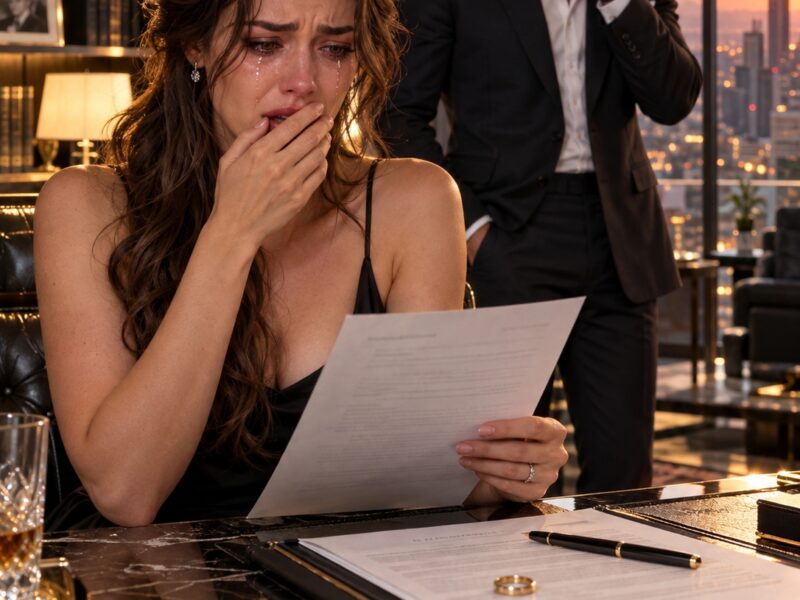
HE MARRIED ME FOR 90 DAYS TO SAVE HIS BILLION-DOLLAR STUDIO—THEN I FOUND THE DIVORCE PAPERS ON HIS DESK

The first time Mark Sterling asked me to marry him, there was no ring.
There were no flowers.
No nervous smile. No trembling confession. No story about how he had loved me secretly for years.
There was only a black leather folder on the desk between us, a wall of windows overlooking Los Angeles, and a number printed on page six that made my throat tighten.
$10,000,000.
Mark leaned back in his chair as if he had just offered me a job.
“Marry me for ninety days.”
I stared at him.
Outside his study, somewhere beyond the carved walnut doors, his housekeeper was directing staff through preparations for a dinner attended by people whose names regularly appeared in Variety and The Hollywood Reporter.
Inside, one of the most recognizable men in America was asking his housekeeper’s daughter to become his wife.
For three months.
For ten million dollars.
“You’re serious.”
“Completely.”
I closed the folder.
“No.”
Something changed in his expression.
Not disappointment.
Interest.
Mark Sterling was used to people wanting something from him. Money. Access. A photograph. A role. A recommendation. Five minutes at the right table.
He wasn’t used to hearing no before he finished speaking.
“You haven’t heard the reason.”
“I heard the price.”
“Belle—”
“That’s usually enough information when a man puts a dollar amount next to a marriage.”
His jaw tightened.
And for the first time since I had walked into that room, Mark Sterling stopped looking like a movie star.
He looked scared.
That was when I realized this wasn’t a joke.
And whatever was inside that folder was bigger than either of us.
Three hours earlier, I hadn’t even known Mark was home.
My mother, Elena Carter, had worked for the Sterling family for nearly twenty years.
She didn’t call herself a housekeeper anymore because technically she managed the entire household staff, but that distinction meant very little to me growing up.
To me, Mom was simply the woman who knew which Sterling child had allergies, which guest drank bourbon without ice, which antique table could survive champagne and which one absolutely could not.
And Mark Sterling was the tall boy who occasionally appeared barefoot in the kitchen at midnight looking for leftover pie.
Then he became famous.
Not gradually.
Violently.
One successful film became three. Three became a franchise. A franchise became awards. Awards became magazine covers, private jets, paparazzi and a production company that eventually grew into Sterling Studios.
By thirty-nine, Mark had more money than most people could understand and enough public scandals to make strangers believe they understood him.
I hadn’t seen him properly in years.
Until Mom called me that afternoon.
“Belle, I left a folder at home.”
I was sitting in a coffee shop in Silver Lake pretending not to notice the email rejecting my latest screenplay.
“What folder?”
“The Sterling trust documents. Blue tab. Kitchen counter.”
“Mom, that sounds like something you shouldn’t leave on a kitchen counter.”
“I was rushing.”
“You?”
“Don’t start.”
I smiled despite myself.
Mom never rushed.
Which should have warned me.
Twenty minutes later I was driving through the gates of the Sterling estate with a folder on the passenger seat and another rejection sitting unopened in my inbox.
I was twenty-eight years old.
I had written four screenplays.
One had placed in a competition.
Two had gotten me meetings that went nowhere.
The fourth had just been rejected by a producer who told my agent the writing was “emotionally sophisticated but commercially uncertain.”
Hollywood had beautiful ways of telling you that you weren’t wanted.
I parked near the service entrance, planning to drop off the documents and leave.
Instead, I heard cameras.
“Mark!”
“Mark Sterling!”
“Look this way!”
A black SUV had stopped beneath the porte cochère.
Mark stepped out wearing dark sunglasses, a charcoal jacket and the exhausted expression of someone who had been photographed too many times in one lifetime.
“Mark! Who was the woman at Chateau Marmont?”
“Are you back with Vanessa?”
“Is the board replacing you?”
He ignored all of it.
Then he saw me.
His head turned.
For half a second, his expression went blank.
“Elena’s daughter?”
I stopped.
“Belle.”
“I know.”
That surprised me.
He removed his sunglasses.
“You used to hide behind the kitchen counter whenever I came in.”
“I was twelve.”
“You still did it.”
“You were twenty-three and had strangers following you with cameras.”
“That was frightening?”
“You wore leather pants.”
He laughed.
An actual laugh.
The photographers went crazy.
I immediately regretted making him do it.
Mom appeared at the doorway.
“Belle.”
She looked from me to Mark and knew instantly that something inconvenient had happened.
“She was only supposed to drop off the papers.”
“I distracted her,” Mark said.
“You tend to do that.”
“Mom.”
She took the folder.
Mark glanced at it.
Something in his face changed.
“Trust documents?”
Mom hesitated.
“Nothing you need to worry about tonight.”
That was the first lie.
I just didn’t know it yet.
Mark walked me toward the kitchen wing instead of letting one of the staff do it.
“You still writing?”
I looked at him.
“You remember that?”
“Your mother used to tell everyone you were going to win an Oscar.”
“My mother thinks confidence is a substitute for evidence.”
“It often is in this town.”
I laughed.
He glanced at me again.
Not flirtatiously.
Curiously.
Most people probably behaved differently around Mark Sterling.
I didn’t.
I’d once seen him eat cold mashed potatoes directly from a refrigerator at two in the morning.
Celebrity was difficult to maintain after that.
“You staying for dinner?” he asked.
“No.”
“Good.”
I raised an eyebrow.
His mouth twitched.
“I mean, good for you. I wouldn’t.”
“What’s wrong with dinner?”
“Board members.”
“That bad?”
“Worse. Lawyers.”
I should have left then.
Instead, twenty minutes later, while Mom searched for something in the pantry, I passed the study and heard raised voices.
“The shareholder meeting is in ninety-four days.”
I recognized Mark.
The other voice belonged to a woman I later learned was Nora Hayes, his attorney.
“The board is nervous,” she said. “Three public breakups in eighteen months, last week’s tabloid story, Kane feeding reporters the idea that you’re unstable—”
“Tom wants the studio.”
“He wants influence over it.”
“He wants control.”
“And your father gave him the weapon.”
Silence.
Then Mark said, “Say it.”
Nora did.
“If you are not legally married for ninety consecutive days before the shareholder meeting, the controlling stake transfers according to the trust provisions.”
“To Sophia.”
“Yes.”
“And Tom pressures Sophia until she gives him what he wants.”
“That is what we’re trying to prevent.”
I stopped walking.
It wasn’t my business.
Then Nora said something even stranger.
“You need a wife, Mark.”
I kept walking.
I made it four steps.
Behind me, the study door opened.
“Belle.”
I turned.
Mark stood there.
He looked at me for several seconds.
Then at the folder my mother had brought inside.
Then back at me.
It was the look of a man watching an impossible problem rearrange itself.
I should have recognized danger.
Instead, I asked, “What?”
“Can you come back tomorrow?”
That was how I ended up staring at a ten-million-dollar marriage contract the next afternoon.
Mark explained everything.
His father, Richard Sterling, had built Sterling Studios from a small production company into one of Hollywood’s most valuable independent entertainment businesses.
Richard had also apparently believed his eldest son needed stability.
Not happiness.
Stability.
His will contained a clause.
If Mark remained unmarried by the critical shareholder meeting following his fortieth birthday, a controlling block of voting shares would transfer into a trust overseen by Mark’s younger sister, Sophia.
Normally that wouldn’t have mattered.
Mark trusted Sophia.
The problem was Tom Kane.
Tom had spent years acquiring minority positions, courting board members and waiting for a fracture inside the Sterling family.
Sophia wasn’t weak.
But she hated corporate warfare.
Tom knew it.
And Mark believed that once control moved out of his hands, Tom would make Sterling Studios into something their father would have despised.
“So marry someone,” I said.
“I’m trying.”
“Someone you love.”
His eyes held mine.
“If I had that option, you wouldn’t be here.”
It shouldn’t have hurt.
It did anyway.
I hated that.
“Why me?”
“You’re beautiful.”
I gave him a flat look.
“That answer probably works more often than it should.”
“It wasn’t the complete answer.”
“Then try again.”
He stood and walked toward the windows.
“Because you knew me before any of this mattered.”
He gestured toward the mansion, the city, perhaps his entire ridiculous life.
“You’re Elena’s daughter. I trust your mother more than most of my relatives. You don’t sell stories. You don’t chase cameras. You walked into this house yesterday carrying documents worth more than most people’s homes and barely looked at them.”
“I didn’t know what they were.”
“Exactly.”
He turned.
“And when I offered you ten million dollars, you looked offended instead of impressed.”
“I am offended.”
“I know.”
“You seem to like that.”
“I find it reassuring.”
I should have walked away.
I almost did.
Then I thought about the screenplay rejection in my inbox.
My apartment lease.
My mother’s aching hands after twenty years of work.
The medical bills she pretended weren’t bothering her.
And something else I didn’t want to admit.
I thought about Mark standing in the study doorway the night before, suddenly looking less like the man on billboards and more like the lonely twenty-three-year-old who used to steal pie from his own kitchen.
“What exactly happens for ninety days?”
“We live together.”
“No.”
“Belle—”
“Separate bedrooms.”
“Fine.”
“No affairs.”
His eyebrows rose.
“For either of us.”
“Fine.”
“No humiliating me in public.”
“I wouldn’t.”
“You’ve had three public breakups in eighteen months.”
“Two.”
“Your lawyer said three.”
“Nora is dramatic.”
From the corner, Nora said, “I’m sitting right here.”
I almost smiled.
I kept going.
“No controlling my career. No buying me a screenwriting deal. No calling studio executives and telling them to hire me.”
Mark’s expression became more serious.
“All right.”
“And either one of us can walk away if the other breaks the rules.”
“Agreed.”
I hesitated before the last one.
Because it sounded childish.
Because maybe it was.
“And no real feelings.”
Mark stared at me.
Then he leaned against the desk.
“That seems ambitious.”
“Which part?”
“The feelings.”
My pulse jumped.
I hated that, too.
“Put it in.”
“Why?”
“Because you’re you.”
He didn’t smile.
“And I’m not interested in becoming another woman whose worst day gets turned into entertainment.”
Something passed through his eyes.
Regret, perhaps.
“Fair enough.”
Nora slid the revised agreement toward us.
Mark signed first.
I watched his pen move.
Then I signed beneath him.
Belle Carter.
For the last time.
Because less than twenty-four hours later, in a private ceremony with my mother, Nora, Sophia and two witnesses standing beneath white roses in the Sterling garden, I became Belle Sterling.
Mark looked at me when the officiant asked the question.
“Do you, Mark Sterling, take Belle Carter to be your lawfully wedded wife?”
His expression was calm.
“I do.”
Then it was my turn.
My mouth suddenly felt dry.
“Do you, Belle Carter, take Mark Sterling to be your lawfully wedded husband?”
Ninety days.
Ten million dollars.
Separate rooms.
No feelings.
“I do.”
Mark slid the ring onto my finger.
His hand was warm.
Mine was shaking.
His thumb brushed once against my knuckle.
So lightly nobody else noticed.
But I did.
And for one terrifying second, I wondered if we had already broken the most important rule.
The press discovered the marriage before sunset.
By six o’clock, helicopters were circling above the estate.
By seven, my face was everywhere.
WHO IS BELLE CARTER?
MARK STERLING’S SECRET WEDDING.
HOLLYWOOD’S MOST ELIGIBLE BACHELOR MARRIES MYSTERY WOMAN.
At eight, I made the mistake of reading comments.
Gold digger.
Housekeeper’s daughter hits jackpot.
Ten bucks says she’s pregnant.
Nobody marries Mark Sterling for love.
That last one shouldn’t have bothered me.
Because it was true.
But truth has a different weight when strangers throw it at you.
Mark found me sitting on the edge of the bed in my new room.
My room.
Not ours.
He stood in the doorway.
“Don’t read them.”
“That’s excellent advice approximately fifteen minutes too late.”
He crossed the room and took the phone gently from my hand.
“You’ll get used to it.”
“That sounds horrible.”
“It is.”
He put the phone facedown.
“Or you won’t get used to it.”
“Better.”
“Either way, I won’t leave you standing in it alone.”
That was the first promise he made that wasn’t written into our contract.
It was also the one that would hurt the most when everything fell apart.
Living with Mark was nothing like I expected.
He woke at five-thirty.
He drank terrible coffee.
He watched old black-and-white movies when he couldn’t sleep.
He hated parties despite being photographed at hundreds of them.
He knew every employee’s first name.
And when he was anxious, he rubbed the side of his thumb against his index finger as though trying to erase something invisible.
He also flirted shamelessly.
One morning he walked into the breakfast room while I was barefoot, wearing sweatpants and rewriting a scene.
“You know,” he said, “the contract didn’t prohibit flirting.”
I didn’t look up.
“I’ll ask Nora to add an amendment.”
“Please don’t.”
“Why?”
“Because I enjoy watching you pretend not to like it.”
I looked at him then.
He smiled.
I threw a blueberry at him.
He caught it in his mouth.
That should have been harmless.
Most dangerous things begin that way.
Sophia Sterling arrived three days later.
She was thirty-five, elegant without trying and completely unimpressed by her brother.
She hugged Mark, then looked at me.
“So you’re the ninety-day solution.”
Mark groaned.
“Sophia.”
“What? We all know why we’re here.”
I liked her immediately.
At dinner, she asked about my writing.
Mark answered before I could.
“She’s good.”
I turned.
“You haven’t read anything.”
His silence told me otherwise.
My stomach dropped.
“You read my script?”
“You left it on the kitchen counter.”
“That isn’t permission.”
“I got curious.”
“You read my screenplay without asking?”
“The second act is excellent.”
“That is not the point.”
“The mother-daughter scene on page forty—”
“Mark.”
“—feels painfully real.”
I stared at him.
He stopped.
Then, quietly, “I’m sorry.”
That surprised me more than the invasion itself.
People like Mark Sterling weren’t famous for apologizing quickly.
I folded my arms.
“Don’t do it again.”
“I won’t.”
Sophia looked between us.
Then she smiled into her wine.
“What?”
“Nothing.”
“Sophia.”
She shrugged.
“I’ve known my brother thirty-five years. I’ve never seen anyone tell him to stop talking and have it actually work.”
Mark ignored her.
Later that night, he knocked on my writing-room door.
He held my script.
“I want to show this to two producers.”
“No.”
“Belle—”
“You agreed not to buy my career.”
“A meeting isn’t buying your career.”
“With Mark Sterling making the call?”
“They’ll read it because I call. They’ll buy it only if it’s good.”
“That’s still an advantage.”
“Everyone in Hollywood gets through some door because somebody opened it.”
“And if I walk through yours, nobody will ever believe I could have opened one myself.”
He studied me.
I expected an argument.
Instead, he placed the script on my desk.
“All right.”
Then he turned to leave.
“Mark.”
He stopped.
“Do you really think it’s good?”
He looked back.
The teasing was gone.
“Yes.”
One word.
No charm.
No performance.
For some reason, that mattered more than a hundred compliments.
I began rewriting the next morning.
He never asked about it again.
That was when I started falling in love with him.
Not when he wore a tuxedo.
Not when photographers shouted our names.
Not when he put a diamond ring on my finger.
It happened because he learned when not to knock on my door.
Because he remembered I hated cilantro.
Because he began leaving coffee outside my writing room at six-thirty without interrupting.
Because one night, after a charity gala, I found him sitting alone beside the pool with his tie undone.
“Bad night?” I asked.
“My father died three years ago today.”
I sat beside him.
He didn’t look at me.
“Everyone thinks he left me an empire.”
“Didn’t he?”
“He left me a test.”
His laugh had no humor in it.
“Even dead, he was still trying to decide whether I was mature enough to keep what we built.”
“Maybe the marriage clause wasn’t about maturity.”
“What else would it be?”
“Fear.”
He finally looked at me.
“Whose?”
“His.”
I shrugged.
“Maybe he was afraid you’d become so good at being Mark Sterling that you’d forget how to be Mark.”
He stared at the water.
For a long time, neither of us spoke.
Then he whispered, “That’s an annoyingly good line.”
“I’m a writer.”
“I’ve heard.”
He smiled.
And in that quiet, without cameras or contracts or witnesses, his hand moved across the stone between us.
He didn’t touch me.
He stopped an inch away.
I looked at his hand.
Then at him.
Neither of us moved.
That inch became the most intimate distance I had ever known.
The next morning, Tom Kane introduced himself.
I was leaving a bookstore in West Hollywood when a black sedan pulled to the curb.
A man stepped out.
Mid-fifties. Silver hair. Expensive suit. The kind of smile that never reached the eyes.
“Belle Sterling.”
I kept walking.
“Mrs. Sterling.”
That made me stop.
“I know who you are.”
“Then we’re ahead.”
“What do you want?”
“A conversation.”
“No.”
He smiled.
“You’re very much like Elena.”
That frightened me.
Not visibly.
I hoped.
“You know my mother?”
“I know everyone around Mark.”
“That’s not the same thing.”
“No. It isn’t.”
He glanced toward the photographers across the street.
“Coffee?”
“I don’t drink coffee with men trying to steal my husband’s company.”
His smile widened.
“Your husband.”
Something about the way he said it made my skin crawl.
“What?”
“Nothing. It’s just interesting how quickly language changes.”
I turned away.
His next words stopped me.
“Do you know why Mark chose you?”
I faced him.
“Yes.”
“Do you?”
“He trusts me.”
Tom almost looked sorry for me.
“That is what Mark does best.”
“What?”
“He makes people feel chosen.”
I said nothing.
Tom stepped closer, lowering his voice.
“You were safe, Belle. Young. Pretty. Connected to the household. No scandal. No powerful family. No competing agenda. Most importantly, controllable.”
“You don’t know me.”
“No.”
He smiled.
“But Mark’s lawyers do.”
I felt cold.
“If you’re trying to turn me against him, you’ll need better material.”
“I don’t need to turn you against anyone.”
He opened his car door.
“Time will do that.”
Before getting in, he looked back.
“When the ninety days end, ask yourself whether you were ever his wife—or merely the cheapest way to keep a billion-dollar company.”
I stood on the sidewalk long after his car disappeared.
That night Mark knew something was wrong before I spoke.
“Tom contacted you.”
It wasn’t a question.
“How did you know?”
“Because you haven’t insulted me once since dinner.”
“I don’t insult you.”
“You absolutely do.”
I tried not to smile.
Failed.
Then I remembered Tom.
“He said I was convenient.”
Mark’s face hardened.
“He’s trying to destabilize you.”
“Was I?”
“What?”
“Convenient.”
Mark didn’t answer quickly enough.
That hurt.
“Belle—”
“Just tell me.”
“Yes.”
I swallowed.
He stepped closer.
“At first.”
There it was.
The truth.
Small enough to fit into two words.
Sharp enough to cut through everything.
“You were someone I could trust,” he continued. “You didn’t want anything from me. You understood the house. Your mother knew my family. I thought you would be safe.”
“Safe.”
“For both of us.”
I laughed softly.
“That’s almost worse.”
“I know.”
I looked toward the window.
“Tom said you make people feel chosen.”
Mark’s voice changed.
“And do you believe him?”
“I don’t know.”
He came closer.
“Then believe this.”
I turned.
His face was inches from mine.
“Somewhere between the photographs and the contract, you stopped feeling fake to me.”
My breath caught.
“Mark.”
“I know.”
“We had a rule.”
“I know.”
“Then don’t.”
He didn’t move.
“Tell me to stop.”
I should have.
Instead I whispered, “I don’t know if I can.”
His hand rose slowly, giving me time to move away.
I didn’t.
His fingertips touched my cheek.
Then he kissed me.
It wasn’t cinematic.
No orchestra.
No perfect angle.
He kissed me carefully at first, almost like he was waiting for me to regret it.
Then I grabbed the front of his shirt.
The kiss changed.
Everything changed.
When we finally separated, his forehead rested against mine.
“That wasn’t supposed to happen,” I whispered.
“No.”
“How long?”
“What?”
“How long have you wanted to do that?”
His eyes opened.
“A long time.”
The next morning, our marriage contract appeared online.
Not the whole thing.
Just enough.
My name.
Mark’s name.
Ninety days.
Ten million dollars.
The payment schedule.
The confidentiality clause.
By seven-thirty, satellite trucks blocked the street.
By eight, my phone had more than six hundred notifications.
By nine, my agent called.
“Belle, two producers canceled.”
My stomach dropped.
“Why?”
Silence.
“Tell me.”
“They’re worried about optics.”
“What optics?”
“You know what optics.”
“No. Say it.”
She sighed.
“They think your career is being financed by your husband.”
I closed my eyes.
“I haven’t taken anything from him.”
“I know.”
“They don’t.”
By noon, three more meetings were “postponed.”
By two, an entertainment site published an article titled:
THE $10 MILLION WIFE: INSIDE MARK STERLING’S MOST EXPENSIVE DEAL YET.
They used a photograph of me leaving the bookstore.
I looked happy.
That somehow made it worse.
Mom came into my room without knocking.
She found me sitting on the floor.
“Oh, baby.”
“Don’t.”
She stopped.
“If you hug me, I’m going to cry.”
“Then cry.”
“I can’t.”
“Why?”
“Because if I start, I’m afraid I’ll believe them.”
She sat beside me.
“Believe what?”
“That this is what I am.”
Mom took my hand.
“You know better.”
“Do I?”
“Yes.”
“You worked in this house twenty years, Mom. And now every article calls me ‘the housekeeper’s daughter who married the billionaire.’”
Her jaw tightened.
“There’s nothing shameful about being my daughter.”
“I know.”
“Then don’t say it like there is.”
I looked at her.
That broke me.
I cried against her shoulder like I was twelve again.
Across the house, Mark was going to war.
Nora confirmed Tom had leaked a partial copy.
They couldn’t prove it legally.
But they knew.
“We issue a statement,” Mark said.
Nora shook her head.
“Anything you say today becomes evidence that the marriage was manufactured.”
“Then I’ll tell them it isn’t anymore.”
I had entered the room unnoticed.
Everyone turned.
Mark looked at me.
“This stopped being a contract a long time ago.”
My heart twisted.
Nora’s expression softened.
“That’s exactly why you can’t say it.”
Mark stared at her.
“If I defend Belle by telling the world I love her, they’ll say we staged the romance after the leak.”
I felt every eye turn toward me.
The word hung there.
Love.
Mark didn’t take it back.
But I couldn’t accept it either.
Not like this.
Not surrounded by lawyers.
Not while television anchors debated my price.
“I need air.”
I walked into his study.
That was when I saw the papers.
They were beneath a folder on his desk.
Only the top page showed.
But the heading was enough.
PETITION FOR DISSOLUTION OF MARRIAGE.
My entire body went still.
There are moments when betrayal doesn’t arrive as pain.
It arrives as silence.
Your mind stops.
Your hands go cold.
The room becomes strangely detailed.
I remember a scratch on Mark’s desk.
The sound of helicopters outside.
The sunlight on the edge of the paper.
And his signature wasn’t there.
That should have mattered.
It didn’t.
Not then.
Mark entered behind me.
He saw what I was holding.
“Belle.”
“You already had them prepared.”
“Listen to me.”
“For how long?”
“Before the wedding.”
I laughed.
It sounded broken.
“Of course.”
“No. Not the way you’re thinking.”
“You had divorce papers ready before I became your wife.”
“So you would have an exit.”
I stared at him.
“What?”
“I didn’t want you trapped.”
“You offered me ten million dollars to marry you, wrote an expiration date into the relationship, and then had divorce papers waiting.”
“I never signed them.”
“But you prepared them.”
“For you.”
“You don’t get to make that romantic.”
“I’m not trying to.”
His voice cracked.
That almost destroyed me.
Almost.
“The whole world is calling me a transaction.”
“Belle—”
“And I come in here and find proof that you were preparing for the end before we even started.”
“I was preparing to give you a choice.”
“You keep saying that.”
“Because it’s true.”
“Then here’s my choice.”
I removed my wedding ring.
His face changed.
I couldn’t put it on the desk.
I couldn’t.
So I closed my fingers around it.
“I can’t stay here tonight.”
“Don’t leave because of Tom.”
“I’m not.”
“Then why?”
I looked at him.
“Because I don’t know which parts of us were real anymore.”
Pain moved across his face.
“Belle, all of it became real.”
“Became.”
He closed his eyes.
He knew immediately.
Wrong word.
Too late.
I walked past him.
He didn’t grab me.
Didn’t block the door.
Didn’t order security to stop me.
He kept the one promise I suddenly hated him for keeping.
He let me choose.
I moved into my mother’s small house in Pasadena.
The press followed for three days.
Then another celebrity scandal happened and half the cameras disappeared.
Hollywood’s cruelty has a short attention span.
Mark didn’t call.
That hurt more than if he had.
On the fourth day, flowers arrived.
No card.
I knew they were from him.
I threw them away.
Then pulled them out of the trash ten minutes later.
On the sixth day, Nora called.
I didn’t answer.
On the ninth, Sophia texted.
My brother is an idiot. Unfortunately, he is an idiot who loves you.
I stared at the message for a long time.
I didn’t reply.
On day twelve, my agent called.
“Someone wants your script.”
My heart stopped.
“Mark?”
“No.”
“Sterling Studios?”
“No.”
“Who?”
“Caroline Webb.”
I knew the name.
Everyone did.
Independent producer. Two Oscar nominations. Famous for hating studio politics.
“How did she get it?”
“Your competition submission from last year.”
I sat down.
“She kept it?”
“Apparently. Her assistant rediscovered it after all the coverage around you.”
I almost laughed.
My humiliation had resurrected my screenplay.
There was something brutally appropriate about that.
“She wants a meeting.”
“When?”
“Tomorrow.”
Caroline Webb did not care who my husband was.
That was the first thing she told me.
“If your script were bad, I wouldn’t be wasting lunch.”
I almost cried from gratitude.
Instead I said, “That’s strangely comforting.”
“It shouldn’t be. The third act needs work.”
I smiled.
For the first time in weeks, I felt like myself.
We spent two hours discussing characters.
Not Mark.
Not money.
Not the contract.
Me.
My words.
My choices.
My mistakes.
I went home and rewrote twenty-seven pages.
Then thirty more.
Days passed.
Mark remained silent.
I eventually understood why.
He had finally learned the difference between giving me space and controlling the outcome.
At Sterling Studios, meanwhile, Tom Kane’s attack began collapsing.
Not because Mark destroyed him.
Because Sophia surprised everyone.
At the emergency board session, Tom assumed she would panic.
Instead she placed the leaked contract on the table.
“You used confidential family documents to manipulate a corporate vote.”
Tom smiled.
“Can you prove that?”
“No.”
She smiled back.
“But I can prove three of your proxies purchased shares forty-eight hours before publication.”
The room went quiet.
Tom’s smile disappeared.
Sophia leaned forward.
“You thought I didn’t understand the company because I didn’t want Mark’s job.”
She paused.
“You confused disinterest with stupidity.”
By the time the shareholder meeting arrived, Tom’s coalition was fractured.
Mark didn’t need a wife anymore.
The ninety days were over.
That evening, I was alone at Mom’s kitchen table working on my screenplay when the doorbell rang.
Mom looked through the window.
Then at me.
“You should get that.”
“Who is it?”
She didn’t answer.
She went upstairs.
I knew.
My hands started shaking before I reached the door.
Mark stood outside alone.
No security.
No driver.
No flowers.
No cameras.
He wore jeans, a dark sweater and the expression of a man who hadn’t slept properly in weeks.
“You came by yourself.”
“It seemed like the only way you’d believe anything I said.”
I didn’t invite him in.
Not immediately.
Then I stepped aside.
He noticed my laptop.
“You’re still writing.”
“It’s the only thing that still feels like mine.”
He flinched.
I regretted saying it.
Not because it wasn’t true.
Because I knew exactly where it landed.
He remained standing.
“The ninety days ended at midnight.”
I looked at him.
“So we’re divorced?”
“No.”
My heart stumbled.
“What?”
“I never filed anything.”
“Mark—”
“We’re still legally married.”
I stared.
“Then why are you here?”
He took a breath.
“Because for the first time since this started, neither of us owes the other anything.”
“The trust?”
“Satisfied.”
“The board?”
“Handled.”
“Tom?”
“Licking his wounds somewhere expensive.”
Despite myself, I smiled.
Mark saw it.
His face softened.
Then he became serious again.
“The contract is over.”
I looked down.
“So what does that make us?”
“Free.”
That wasn’t the answer I expected.
He continued.
“It started as a deal. I won’t insult you by pretending otherwise.”
My throat tightened.
“I chose you because I needed someone I could trust. You agreed because ten million dollars could change your life. Those things were true.”
He moved one step closer.
“But they aren’t the whole truth anymore.”
I said nothing.
“I fell in love with you.”
There were no lawyers.
No photographers.
No board members.
No witnesses.
Just Mark and me in my mother’s kitchen.
“I think I started falling for you when you threatened to amend the contract because I flirted.”
A tear slipped down my cheek.
He smiled sadly.
“Maybe earlier.”
“Mark.”
“I don’t need you to say anything.”
“Then why come?”
“Because you deserved to hear the truth without an audience.”
That nearly broke me.
He continued quietly.
“I don’t want a ninety-day wife.”
My breath caught.
“I don’t want a woman who stays because my father’s trust says she should. I don’t want someone who stays because I can give her money, meetings or a house.”
He looked at me.
“I want Belle Carter.”
I laughed through my tears.
“Technically Belle Sterling.”
“Only if she wants to be.”
There it was again.
Choice.
But this time, he wasn’t using it to protect himself.
He was surrendering control.
“I don’t know if I can come back to that house.”
“Then don’t.”
“I don’t want people saying everything I accomplish came from you.”
“Then I’ll stay out of your career.”
“You say that now.”
“I’ll put it in writing.”
I laughed.
“Absolutely no more contracts.”
“Fair.”
Silence.
Then he said the one thing I hadn’t prepared myself to hear.
“If you decide you don’t want me, I’ll sign whatever you need tomorrow.”
I looked at him.
“You’d really do that?”
“No.”
I blinked.
He gave me the faintest smile.
“I’d do it while hating every second.”
That was Mark.
Not the movie star.
Not the billionaire.
Not the man whose face covered buildings.
Just Mark.
I walked toward him.
He didn’t move.
“I didn’t leave because I stopped loving you.”
His eyes closed for half a second.
“I left because I did.”
He looked at me.
“I was terrified that Tom was right. That you had made me feel chosen because that was what you needed me to feel.”
“I know.”
“And those divorce papers…”
“I know.”
“They made me feel disposable.”
His face broke.
“You were the first person in years I was afraid of losing.”
“Then why prepare them?”
“Because loving someone doesn’t give you the right to trap them.”
I stared at him.
For weeks, I had hated those papers.
Suddenly I understood them differently.
They had never been proof he wanted me gone.
They were proof he had planned for the possibility that I might want to go.
He had been protecting the door.
Not pushing me through it.
“I came back,” I whispered.
His eyes searched mine.
“For what?”
“Not the house.”
He waited.
“Not the money.”
He stepped closer.
“Not the contract.”
“Belle.”
“I came back because I love you.”
His breath left him.
For once, Mark Sterling had nothing clever to say.
“I love you too.”
Then he kissed me.
This time there was no rule to break.
Three weeks later, Caroline Webb called.
She wanted the screenplay.
Not a meeting.
Not another rewrite.
The script.
A real offer.
I sat frozen in my writing room while my agent screamed into the phone.
Mark appeared in the doorway.
“What happened?”
I covered the receiver.
“They want it.”
His face lit up.
“Who?”
“Caroline Webb.”
He crossed the room and lifted me off the floor.
I laughed.
Then I saw something in his expression.
“I know that look.”
“What look?”
“You want to produce it.”
“I didn’t say anything.”
“You were about to.”
He put me down.
“Fine. I was thinking it.”
“No.”
“Belle—”
“No.”
“Sterling could give it a wider release.”
“I know.”
“We could protect the budget.”
“I know.”
“We could—”
I put a finger against his lips.
“If Sterling Studios makes my first movie, everyone will say you bought it for me.”
His eyes softened.
“I don’t care what they say.”
“I do.”
He became quiet.
“I need this one to stand without you.”
That hurt him.
But he understood.
Finally he nodded.
“Then give it to Caroline.”
“You’re sure?”
“I’ve never been more sure of anything.”
I smiled.
“Anything?”
He stepped closer.
“Anything that isn’t you.”
The film went into production eight months later.
My name appeared on a call sheet for the first time.
Written by Belle Carter Sterling.
I stared at it for nearly a minute.
I thought about every rejection.
Every comment.
Every stranger who had called me a gold digger.
Every person who believed a woman’s proximity to a powerful man automatically erased her own talent.
Then I folded the call sheet and put it inside the drawer where I kept the old marriage contract.
I had never taken the ten million dollars.
Mark had canceled the payment before the ninety days ended.
Not because I asked.
Because he said paying me after we had fallen in love felt obscene.
I agreed.
The contract remained, though.
I kept it.
Not as evidence of something shameful.
As evidence that sometimes the worst beginning doesn’t determine the ending.
A year after our secret wedding, Mark and I attended the premiere of my film.
The carpet was chaos.
Lights.
Cameras.
People shouting.
For a second, I was back on the first day of our marriage, terrified and clinging to his arm while strangers demanded to know who I was.
Only this time they knew.
“Belle!”
“Belle, look here!”
“Who are you wearing?”
“How does it feel to have your first feature?”
“Mark!”
“Mark, ninety days ago everyone thought your marriage was a business arrangement!”
I felt his hand tighten around mine.
A reporter leaned over the barricade.
“What changed?”
Mark stopped.
Nora, several feet away, gave him the look she always gave him when she knew he was about to ignore every piece of media training he had ever received.
He looked at me.
Not the cameras.
Me.
Then he turned toward the reporter.
“The contract expired.”
The crowd laughed.
Mark didn’t.
His thumb moved slowly across my wedding ring.
“My feelings didn’t.”
Cameras erupted.
I could already imagine the headlines.
I could imagine strangers debating whether the line had been rehearsed.
I could imagine Tom Kane somewhere rolling his eyes.
For once, none of it mattered.
Because the strangest thing about love wasn’t that Mark and I had found it inside a fake marriage.
It was that both of us had entered those ninety days believing the contract would keep us safe.
I thought rules could protect my heart.
Mark thought money could simplify human emotion.
We were both wrong.
Contracts can define property.
They can establish deadlines.
They can specify separate bedrooms, public appearances, confidentiality, payments and exits.
But they cannot tell you when someone’s coffee cup beside yours begins to feel like home.
They cannot explain why silence with one person feels safer than applause from a thousand strangers.
They cannot stop fear from becoming tenderness.
Or tenderness from becoming need.
And they certainly cannot guarantee that the person you agreed to leave after ninety days won’t become the person you spend the rest of your life choosing.
That night, after the premiere, we slipped away from the party early.
No limousine.
No entourage.
Mark drove.
We stopped at a twenty-four-hour diner outside Los Angeles where nobody cared about gowns, box-office projections or Sterling Studios.
I kicked off my heels beneath the table.
Mark stole fries from my plate.
“You’re a billionaire,” I said. “Order your own.”
“They taste better when they’re yours.”
“That explains a lot about your personality.”
He grinned.
Outside, rain began tapping softly against the glass.
For a while we said nothing.
Then Mark looked at my left hand.
“You know what today is?”
I did.
Exactly one year since he had put the first contract in front of me.
“One year since you tried to buy a wife.”
He winced.
“That’s a hostile interpretation.”
“Accurate interpretation.”
“I prefer ‘innovative proposal.’”
“I prefer ‘temporary insanity.’”
He laughed.
Then reached across the table.
“Would you do it again?”
I looked at him.
The question was playful.
The answer wasn’t.
Would I?
Would I relive the humiliation?
The headlines?
Tom?
The divorce papers?
The night I left?
The terrible weeks when I thought the best thing that had ever happened to me might also have been the most elaborate lie?
I turned my hand beneath his and intertwined our fingers.
“No.”
His smile disappeared.
Then I continued.
“I wouldn’t marry you for ninety days again.”
He waited.
“I’d marry you without an expiration date.”
For once, Mark Sterling looked completely stunned.
I smiled.
“Look at that. I finally found a way to make you stop talking.”
He reached into his jacket.
My smile vanished.
“No.”
He placed a small velvet box on the table.
“Mark.”
“Before you panic, there are no contracts.”
People in the booths around us began noticing.
I stared at him.
“You planned this?”
“For weeks.”
“In a diner?”
“You said the first wedding was too ridiculous.”
“It was in your garden.”
“With twelve thousand dollars’ worth of roses.”
“That was ridiculous.”
“Exactly.”
He opened the box.
The ring inside wasn’t enormous.
It wasn’t designed for magazines.
It was simple.
Old-fashioned.
Beautiful.
“My grandmother’s,” he said.
That made my eyes fill.
“She married my grandfather when they had almost nothing. Dad kept this after she died.”
He swallowed.
“I’ve spent most of my life surrounded by things with prices attached to them.”
His voice lowered.
“You’re the first person who made me understand that value and price have almost nothing to do with each other.”
I was crying now.
So was the waitress standing ten feet away.
Mark smiled nervously.
I had never seen him nervous before.
“Belle Carter Sterling, will you marry me again?”
I laughed through tears.
“We’re already married.”
“I know.”
“Legally.”
“Yes.”
“This proposal is completely unnecessary.”
“Also yes.”
I looked at him.
“Then why?”
His expression softened.
“Because the first time, I asked you because I needed something.”
The diner became very quiet.
“This time, I’m asking because I don’t.”
That was the difference.
Ninety days earlier, Mark Sterling had offered me ten million dollars to become his wife.
He needed my name beside his.
He needed my presence in photographs.
He needed my signature to protect an empire.
But sitting beneath cheap diner lights while rain streaked the windows, he had nothing left to bargain with.
No deadline.
No trust clause.
No board vote.
No reason I had to stay.
Only a question.
And maybe that was what love had been trying to teach us from the beginning.
The first marriage happened because neither of us was free.
The second began because we finally were.
I leaned across the table and kissed him.
When I pulled away, Mark looked amused.
“That wasn’t technically an answer.”
I held out my left hand.
“Yes.”
He slid his grandmother’s ring beside the one I already wore.
The waitress started clapping.
Someone near the counter joined her.
Then another person.
Mark laughed.
I laughed.
And for once, neither of us cared who was watching.
Years later, people would still ask how we met.
Sometimes Mark told them the romantic version.
Sometimes Sophia told them the humiliatingly accurate one.
My mother simply said, “He finally found a woman who wasn’t impressed by him.”
But when it was just Mark and me, we never pretended our beginning was prettier than it was.
He needed a wife.
I needed money.
We signed our names beneath rules designed to make sure neither of us could get hurt.
Then we hurt each other anyway.
We doubted.
We left.
We came back.
And somewhere inside all those imperfect choices, we found something neither of us had been clever enough to negotiate in advance.
Something that couldn’t be purchased for ten million dollars.
Something no trust could require.
Something no leaked contract could destroy.
A life neither of us was obligated to choose.
But did.
Again and again.
And the old dissolution papers?
Mark once asked whether I wanted him to burn them.
I said no.
They’re still in a locked drawer beneath the original contract.
Two documents describing the beginning and possible end of a marriage that eventually became neither.
Sometimes I take them out when I’m stuck on a screenplay.
Not because they make me sad.
Because they remind me of something every writer eventually learns.
The most important part of a story is rarely the promise made at the beginning.
It’s what the characters choose when that promise no longer binds them.
Mark’s father thought ninety days of marriage would prove his son was capable of commitment.
Tom Kane thought ninety days would expose us as frauds.
The tabloids thought ninety days had a ten-million-dollar price tag.
All of them misunderstood.
Those ninety days didn’t prove our marriage was real.
What came after did.
Because on day ninety-one, Mark Sterling didn’t need me anymore.
And I didn’t need him.
There was no money left to earn.
No corporate clause left to satisfy.
No deadline hanging over us.
No legal reason to stay.
That was the first day our marriage truly began.
And sometimes, when we’re alone and Mark catches me staring at the two rings on my hand, he still asks the same question.
“What?”
I always give him the same answer.
“Nothing.”
But that’s not entirely true.
I’m remembering the black folder.
The ten-million-dollar number.
The separate bedrooms.
The rules.
The cameras.
The papers on his desk.
The night I walked away convinced I had been nothing more than the easiest solution to a billionaire’s problem.
Then I remember him standing in my mother’s kitchen after the ninety days had expired, with nothing left to offer me except himself.
And I understand something I couldn’t have understood on the afternoon he first asked me to marry him.
The contract had never been the dangerous part.
The dangerous part was what happened when it ended.
Because the contract expired.
His feelings didn’t.
Neither did mine.









