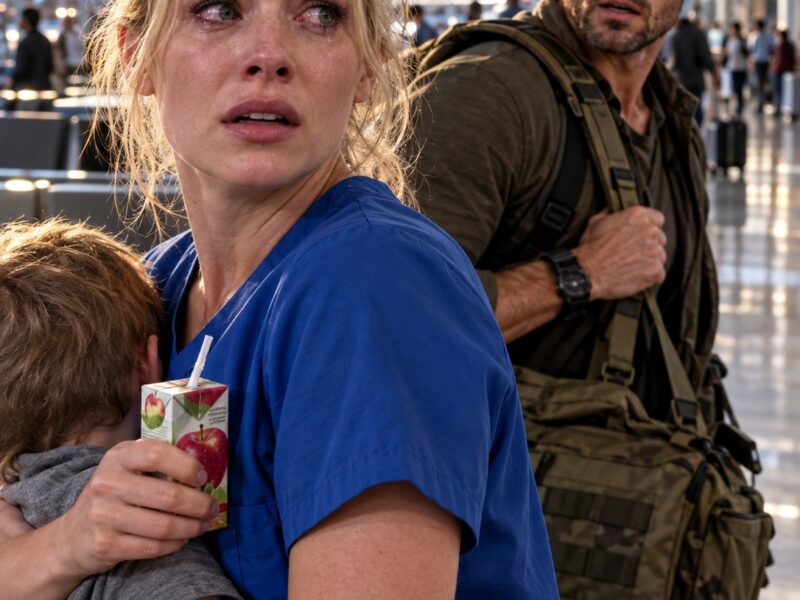
He Missed Six Months of His Son’s Life—Then Found the Woman Who Had Secretly Saved Them Both
Sarah Bennett missed her flight because a little boy was crying beside Gate C14.
At the time, that seemed like the whole story.
She had no idea that less than an hour later, blood would stain her blue scrubs, part of the airport would collapse, and a soldier she had never met would look into her face and quietly speak a name she had spent two years trying to bury.
“Ghost Six.”
And just like that, the life Sarah had been running from found her in the middle of an airport.
But before any of that happened, there was only a frightened five-year-old boy.
And a boarding gate that was about to close.
“Ma’am, you need to step away from the child.”
Sarah didn’t.
She lowered herself farther instead, until both knees touched the cold terminal floor and her eyes were level with his.
The boy looked about five.
Dark brown hair.
Khaki shorts.
A navy backpack hanging crookedly from one shoulder, its zipper pull broken.
His cheeks were wet with tears, but crying wasn’t what frightened Sarah.
It was everything else.
The sweat along his hairline despite the air-conditioned terminal.
The trembling in his hands.
The unfocused pupils.
The way his small body seemed to be fighting to remain upright.
And beneath the left leg of his shorts, a matte-black prosthetic curved into a sneaker.
Sarah’s training took over before fear had time to become thought.
“Hey,” she said softly. “Can you tell me your name?”
The boy swallowed.
“Noah.”
“Okay, Noah. I’m Sarah.”
Behind her, a security guard shifted impatiently.
“Ma’am—”
Sarah lifted one finger without looking back.
“Give me thirty seconds.”
“I need you to move away from him.”
“No.”
That finally made the guard stop.
Sarah kept her eyes on Noah.
“Do you have diabetes?”
His lower lip trembled.
He nodded.
“Do you wear a sensor?”
Another nod.
He raised one shaking arm.
A glucose sensor was attached above his elbow.
Sarah exhaled once.
There it was.
Not panic.
Not simply a lost child.
Hypoglycemia.
And judging by the tremors, confusion, and sweat, it was getting worse.
She pulled her carry-on toward her and unzipped it.
A paperback.
Phone charger.
Toiletry bag.
A folder containing printed information about the Seattle trauma unit where she was supposed to interview tomorrow morning.
And beneath it all, an apple juice box she had thrown into the bag before leaving her hotel.
She stabbed the straw through the foil.
“Small sips.”
Noah reached for it, but his hand shook too badly.
Sarah steadied the box.
“That’s it. Slow.”
“Ma’am.”
The guard’s voice hardened.
Sarah finally looked at him.
His badge said DOYLE.
“I’m a registered nurse,” she said.
“We haven’t verified that.”
“You can verify it while he drinks.”
“We don’t know what you just gave him.”
“Apple juice.”
“You could be anyone.”
“And his blood sugar could be low enough that in five minutes you’ll be explaining why you spent those five minutes arguing with the nurse trying to help him.”
Doyle’s mouth tightened.
Around them, travelers had begun slowing down.
Watching.
Some had phones raised.
Nobody had stepped forward.
That bothered Sarah more than Doyle did.
Noah had apparently been standing near the gate for several minutes, alone and visibly distressed, while hundreds of people moved around him with luggage, coffees, headphones, children, business calls and boarding passes.
An entire terminal full of people had seen a crying child.
Almost everyone had decided someone else would handle it.
Sarah understood that instinct better than she wanted to.
For the last two years, “someone else” had been exactly what she had tried to become.
Someone else’s nurse.
Someone else’s employee.
Someone passing through another city.
Someone with no history anyone needed to know.
But she had never learned how to walk past someone in danger.
That part of her had survived everything.
“Call medical,” Sarah told Doyle. “Tell them pediatric hypoglycemia. If the tremors don’t improve within ninety seconds, I want EMS here.”
Doyle hesitated.
“Now.”
Something in her voice changed.
Not louder.
Just flatter.
Sharper.
Absolute.
Doyle reached for his radio.
Sarah turned back to Noah.
His breathing was fast.
“Talk to me.”
“I lost my grandma.”
“We’ll find her.”
“She went to the bathroom.”
“Okay.”
“She said stay there, but there were too many people, and I thought I saw her, and then I couldn’t…”
His voice broke.
Sarah placed one hand gently on his shoulder.
“You did the right thing by stopping.”
“I did?”
“Yes.”
“My dad says if I get lost, stay in one place.”
“Your dad’s smart.”
“He’s coming home today.”
Something changed in Noah’s face when he said it.
The fear remained, but underneath it appeared something brighter.
“My grandma was taking me to meet him.”
“Where’s he been?”
Noah took another sip.
“Far away.”
Sarah smiled faintly.
“That sounds mysterious.”
“He’s a soldier.”
The smile left her eyes before it left her mouth.
Only for a second.
But it left.
“Is he?”
“He’s been gone six months.”
“That’s a long time.”
“He calls me.”
“I bet he does.”
“He says my leg makes me faster.”
Sarah glanced at the prosthetic.
“Does it?”
“I can beat my cousin Ben.”
“That’s the only medical evidence I need.”
Noah gave the smallest laugh.
It was weak, but it was a laugh.
Sarah checked his pulse.
Still fast.
But better.
Her fingers remained on his wrist while an announcement echoed over the terminal.
“Final boarding call for Flight 2214 to Seattle…”
Sarah’s eyes moved instinctively toward the gate.
Her gate.
Her flight.
The fresh start she had spent months arranging.
Seattle was three thousand miles from the places where too many people knew pieces of her past.
A trauma center had offered her an interview.
Better salary.
Better schedule.
A city where nobody knew why fireworks made her stop breathing for half a second.
Nobody knew why she always chose restaurant seats facing the door.
Nobody knew why she woke sometimes with one hand reaching toward a radio that no longer existed.
Seattle meant anonymity.
She had become very good at anonymity.
The gate agent called her flight again.
Sarah looked at Noah.
His hand was still trembling around the juice box.
She stayed.
The gate closed.
Her flight left without her.
And Sarah felt almost nothing.
That surprised her.
For two years, she had treated leaving as survival.
New hospitals.
New apartments.
New cities.
Whenever coworkers became friends, she moved.
Whenever questions became personal, she found another opportunity.
Whenever somebody noticed that her emergency-room instincts seemed a little too precise for her résumé, she smiled, changed the subject, and eventually disappeared.
But now, as Flight 2214 pulled away from the terminal, Sarah remained kneeling beside a child she had known for less than ten minutes.
“Your hands are better,” she told Noah.
He studied them.
The tremors were easing.
“You fixed me.”
“No. The juice helped. You helped by drinking it.”
“My dad fixes people.”
Sarah’s gaze lifted.
“What does he do?”
“He says mostly paperwork.”
She laughed despite herself.
“That means absolutely nothing.”
Noah smiled.
Then a woman screamed his name.
“Noah!”
An older woman came running around the corner, silver hair slipping from its clip, purse bouncing against her hip.
Noah tried to jump up.
Sarah caught his shoulders.
“Slowly.”
“Grandma!”
The woman dropped to her knees and wrapped him in both arms.
“Oh, baby. Oh my God. I’m sorry. I turned around for one minute. One minute.”
“It’s okay.”
“No, it isn’t. I’m so sorry.”
Sarah kept one hand lightly against Noah’s back, watching his breathing.
“He’s stable,” she said. “Medical is coming to check his glucose. He needs something with protein once they clear him.”
The grandmother looked up.
Her eyes were wet.
“Who are you?”
Sarah almost said nobody.
The word reached the back of her throat.
Instead she said, “Sarah.”
“You stayed with him?”
“Of course.”
“You missed your flight.”
Sarah glanced toward the dark gate monitor.
DEPARTED.
Apparently someone had noticed.
“It’s just a flight.”
The woman stared at her as though she had said something impossible.
Sarah looked away.
She knew better than most people that some things could be replaced.
Some couldn’t.
She was checking Noah’s pupils again when the crowd shifted.
A man was running toward them.
Not jogging.
Running.
A military pack hung over one shoulder. His jaw was covered with deployment stubble, his clothes wrinkled from more than twenty hours of travel.
He moved through the terminal with the controlled aggression of someone accustomed to making crowded spaces get out of his way.
Then he saw Noah.
Everything in him broke.
“Noah!”
The boy twisted around.
“Dad!”
Jack Coleman dropped his pack.
Noah threw himself into his father’s arms.
For several seconds, Jack said nothing.
He just held him.
Six months disappeared into that embrace.
Six months of pixelated video calls.
Six months of bad connections.
Six months of asking a child how school had been from a place where the night sky sometimes flashed for reasons Jack never explained.
He pressed his face into Noah’s hair.
“You’re home,” Noah whispered.
“I’m home.”
“For real?”
“For real.”
Jack pulled back and looked over him.
His hands moved automatically over Noah’s shoulders, face, arms.
Checking.
Counting.
Confirming.
Sarah noticed.
Jack noticed her noticing.
“What happened?”
“I got lost,” Noah said. “And my arm buzzed. And I got shaky.”
Jack’s face went white.
“But Sarah helped me.”
Noah pointed.
Jack looked at her.
For the first time.
Sarah was still crouched near the pillar, cobalt scrubs wrinkled at the knees, blonde hair coming loose from its ponytail, stethoscope around her neck.
There was nothing extraordinary about her.
That was what Jack would remember later.
Nothing obvious.
Nothing that explained the strange feeling that struck him immediately.
Because she wasn’t looking at him.
She was scanning the crowd.
Slowly.
Methodically.
Not staring.
Assessing.
Exit.
Security station.
Raised phone.
Abandoned bag.
Movement.
Distance.
Jack had spent enough years around trained men and women to recognize when somebody’s eyes were doing work their face pretended not to be doing.
Then a stranger moved closer with a phone raised toward Noah.
Sarah shifted.
Half a step.
Barely noticeable.
Suddenly her body stood between the camera and the boy.
Jack stared.
He knew that movement.
“Thank you,” he said.
Sarah turned.
“For what?”
“For my son.”
“He did most of it.”
“He’s five.”
“He followed instructions better than plenty of adults.”
Jack almost smiled.
“You work here?”
“No.”
“Hospital nearby?”
“No.”
“Then…”
“I was catching a flight.”
Jack looked toward the gate.
“Was?”
“Seattle left without me.”
His expression changed.
“You missed your flight because of Noah?”
Sarah shrugged.
“He needed me more than Seattle did.”
There it was again.
That feeling.
Something in the cadence.
Not the words.
The delivery.
Priority stated as fact.
No drama.
No need for praise.
Mission first.
Everything else afterward.
Jack felt memory scratch somewhere deep inside his mind.
But before he could reach it, an EMT arrived.
Noah was examined.
His glucose had risen enough to remove the immediate danger.
Protein was recommended.
His grandmother cried again.
Doyle stood nearby looking irritated that the emergency had turned out exactly as Sarah had said it would.
Eventually Sarah stood.
“I should find the rebooking desk.”
Jack rose with her.
“At least let me buy you coffee.”
“You don’t owe me coffee.”
“I owe you more than coffee.”
“No, you don’t.”
“Sarah.”
She stopped.
“Sarah Bennett.”
“Jack Coleman.”
“I figured you were Dad.”
A tired smile crossed his face.
“And you’re really okay just walking away after missing a flight?”
“I’ve missed worse.”
Jack heard it.
Not what she said.
What she didn’t.
Before he could ask, a sound rolled through the terminal.
Low.
Metallic.
Wrong.
Sarah’s head snapped toward Gate C19.
Jack saw her body change.
The relaxed nurse vanished.
Not gradually.
Instantly.
Her weight shifted forward.
Her shoulders squared.
Her eyes locked onto scaffolding surrounding a renovation area farther down the concourse.
The metal groan became a violent crack.
Someone screamed.
People froze.
Sarah moved.
“Stay with Grandma,” she told Noah.
Then she ran toward the sound.
Jack stood motionless for one second.
One second was all it took.
The scaffolding collapsed.
Dust exploded through the terminal.
Travelers ran in every direction.
Sarah ran toward it.
And something inside Jack’s memory opened.
He knew that run.
Not her face.
Not her name.
The movement.
The instinct.
Toward danger.
Three years earlier.
Eight thousand miles away.
A valley in Afghanistan.
Eleven men pinned against a ridgeline with enemy fire closing from above.
A radio cracking against his ear.
A voice.
Calm when everyone else was shouting.
Calm when command wanted the strike aborted.
Calm when the margin between survival and killing their own men had become terrifyingly small.
“Hold position.”
Jack remembered the voice perfectly.
“Danger close.”
He stared after Sarah.
“No way,” he whispered.
Then he ran.
By the time Jack reached the collapse, Sarah was already beneath the hanging dust.
A maintenance worker lay pinned under a steel support.
Both legs trapped.
Blood spread across the tile.
The man screamed.
Sarah slid beside him.
“Look at me.”
“Oh God—my legs—”
“Look at me.”
He did.
“What’s your name?”
“Rey.”
“Okay, Rey. I’m Sarah. You’re going to keep your eyes on me.”
“My legs—”
“I know.”
“Get it off!”
“No.”
Rey stared at her.
“Please!”
“Not yet.”
Sarah’s hands were already moving.
Chest.
Abdomen.
Pelvis.
Pulse.
Bleeding.
Position of the beam.
Color of the trapped limbs.
Time.
Always time.
“Someone tell me exactly when this fell.”
“Maybe a minute ago!”
“Do not lift the beam.”
A firefighter approaching the wreckage stopped.
“What?”
“Do not release it yet.”
“We need to free him.”
“You release that pressure without vascular access and fluids ready, he can crash from reperfusion before you get him outside.”
The firefighter stared at her.
“Who are you?”
“Nurse. Field trauma background.”
“Ma’am—”
“You can argue with me after he has an IV.”
The firefighter hesitated.
Sarah didn’t.
“Call full trauma. Bilateral crush injury. Tell incoming EMS we need aggressive fluids before release.”
Then she turned to the crowd.
“You. Belt.”
A businessman blinked.
“What?”
“Your belt. Now.”
He pulled it off.
“You in the gray sweater. I need clean fabric.”
A woman tore off her cardigan.
“You. Bottle of water.”
People began moving.
Jack stopped at the edge of the scene.
He had seen panic before.
Real panic.
The kind that emptied trained people’s minds.
Sarah wasn’t eliminating it.
She was organizing it.
Turning fear into jobs.
Jobs into movement.
Movement into time.
And time into survival.
“Rey,” Sarah said. “Listen to me.”
He was crying now.
“Am I going to lose my legs?”
Sarah paused for less than half a second.
“I don’t know.”
Jack noticed that too.
No false promise.
No comforting lie.
“But I’m going to give you the best chance I can.”
Rey squeezed his eyes shut.
“I have two daughters.”
“Then tell me their names.”
“Maria and Ellie.”
“How old?”
“Seven and eleven.”
“Good. Keep talking about them.”
Sarah cinched the belt high.
Her hands moved with terrifying familiarity.
Not textbook familiarity.
Memory.
The firefighter saw it too.
“You’ve done this before.”
“Yes.”
“Where?”
Sarah looked at him.
“Somewhere with worse lighting.”
That was when Jack knew.
Not suspected.
Knew.
EMS arrived.
Sarah delivered the patient handoff in clipped phrases.
Age.
Mechanism.
Entrapment time.
Interventions.
Risks.
Requested treatment.
No wasted words.
Jack stopped hearing the airport.
For a moment, there was only static.
Dust.
Night.
Gunfire.
A radio pressed against his ear three years ago.
A voice saying:
“Ghost Six. Danger close. Hold position.”
The voice had guided aircraft onto an enemy position frighteningly close to Jack’s men.
Ninety meters.
Too close.
Command had wanted the strike reconsidered.
Jack remembered thinking they were already dead.
Then Ghost Six spoke.
Calm.
Precise.
Almost cold.
Aircraft inbound.
Coordinates corrected.
Final attack heading confirmed.
And when the mountain exploded, the enemy position disappeared.
Eleven Americans walked off that ridgeline.
Jack had spent years wondering whose voice had saved them.
He had asked.
Nobody would tell him.
Some records were sealed.
Some missions stayed buried.
Some debts remained impossible to repay.
Now he watched Sarah Bennett place two fingers against Rey’s neck while paramedics prepared to lift the beam.
“Fluids running?”
“Yes.”
“Ready for release?”
“Ready.”
“Slowly.”
The beam rose.
Rey screamed.
Then suddenly stopped.
Sarah’s fingers tightened against his pulse.
Jack’s heart stopped with them.
“Come on.”
A second.
Two.
Sarah looked at the medic.
“Pressure.”
Another second.
Then she exhaled.
“Got it.”
Rey was loaded onto a backboard.
Minutes later, he was moving toward the ambulance.
Sarah remained kneeling on the floor.
Blood covered the front of her scrubs.
Dust coated her hair.
The noise around her began returning.
She stood.
For one brief moment, she straightened unconsciously.
Chin lifted.
Shoulders squared.
Jack had seen that posture thousands of times.
It did not belong to a civilian nurse.
He walked toward her.
Sarah accepted a paper towel from someone and began wiping blood from her hands.
Jack stopped close enough that nobody else would hear.
“Ghost Six.”
Sarah froze.
The paper towel stopped between her fingers.
Slowly, she looked up.
All the color left her face.
“What did you say?”
Jack’s throat tightened.
“Ghost Six.”
Her expression closed.
“How do you know that name?”
And suddenly Jack Coleman—the man who had walked through gunfire, carried wounded men out of burning vehicles, and spent half his adult life pretending fear was merely another problem to manage—could barely speak.
“Kunar Province.”
Sarah said nothing.
“Three years ago.”
Still nothing.
“Eleven-man element pinned on a ridgeline outside a village nobody back home ever heard of.”
Sarah’s eyes changed.
Jack saw recognition.
Not of him.
Of the night.
“You walked an air strike onto the enemy position danger close.”
“Jack…”
“Ninety meters.”
“Stop.”
“Command wanted you to abort.”
“I said stop.”
“You didn’t.”
Sarah closed her eyes.
Jack’s voice cracked.
“I was the squad leader on that ridge.”
Her eyes opened.
For a moment neither of them moved.
“I’ve spent three years trying to find you,” Jack said.
“You shouldn’t have.”
“I wanted to thank you.”
“You don’t know what happened.”
“I know eleven men came home.”
“You know one side.”
“It’s the side I was standing on.”
Sarah looked away.
That was the problem.
He was grateful.
She had spent years terrified of gratitude.
People imagined being thanked made memories easier.
Sometimes it made them heavier.
“I’m not supposed to discuss the operation.”
“I’m not asking you to.”
“Then what are you asking?”
Jack looked past her.
Noah stood twenty yards away beside his grandmother.
Small.
Alive.
Waiting for his father.
“I’m asking you to let me tell you what happened after.”
Sarah’s jaw tightened.
“After what?”
“After you made that call.”
Jack swallowed.
“Daniel Mercer went home and had a daughter.”
Sarah stared at him.
“Ortiz got married.”
Her lips parted.
“Briggs became a high school football coach. Mason finally opened that stupid auto shop he talked about every night. Carter still sends Christmas cards to everyone. And me…”
Jack looked at Noah.
“I got to watch my son grow up.”
Sarah’s composure began to crack.
“You don’t need to do this.”
“Yes, I do.”
“No.”
“You spent all these years remembering the ten seconds before that strike.”
Sarah’s eyes flashed.
“You don’t know what I remember.”
“No. But I know what I remember.”
His voice softened.
“I remember the years after it.”
Silence stretched between them.
“You gave eleven men an after.”
Sarah looked down at the blood drying on her hands.
“That mission is why I left.”
Jack didn’t speak.
“I finished my contract,” she continued. “Took almost another year. But that night was when I decided.”
“Why?”
Sarah laughed once.
There was no humor in it.
“Because I did the math.”
“What math?”
“The kind nobody tells you follows you home.”
Her voice lowered.
“Ten seconds.”
Jack waited.
“I had maybe ten seconds to decide whether the strike came in or pulled off. Eleven Americans were trapped. Enemy fighters were moving. Aircraft were running low on time. Command was worried about the distance. Everyone wanted certainty.”
She looked at him.
“There wasn’t any.”
Jack knew.
“I made the call anyway.”
“You made the right one.”
“That time.”
Two words.
That time.
Jack finally understood.
Sarah wasn’t running from a mistake.
She was running from the knowledge that one day she might make one.
“I sat alone afterward,” she said. “And I kept thinking about what would’ve happened if I had been ten seconds slower. Or ten meters wrong. Or if the wind had shifted. Or if I misunderstood one transmission.”
“But you didn’t.”
“You keep saying that like it makes the responsibility smaller.”
Jack had no answer.
Sarah rubbed her palms together.
“I couldn’t keep being the person whose ten-second decision determined whether somebody else went home. So I got out.”
“And became a trauma nurse.”
“Which was supposed to be quieter.”
Jack glanced at the collapsed scaffolding.
“Going well.”
A laugh escaped her before she could stop it.
Small.
Shaky.
Real.
Then a voice interrupted them.
“Ma’am.”
Doyle.
Sarah turned.
The security guard stood beside an airport operations supervisor.
His expression had regained its authority now that the emergencies were over.
“I’m going to need you to come with us.”
Sarah blinked.
“Why?”
“You interfered with an active emergency response.”
Jack stared at him.
“You cannot be serious.”
“You directed rescue personnel without verified credentials. You treated an unaccompanied minor. You entered an active collapse zone.”
“She saved two people today.”
“That isn’t the point.”
Jack stepped forward.
“It is exactly the point.”
“Sir, stay out of this.”
Sarah touched Jack’s arm.
“I’ve got it.”
Then she faced Doyle.
“Verify my nursing license.”
“We intend to.”
“Pull the security footage too.”
Doyle’s jaw tightened.
“Gladly.”
“Good. Then you can include the part where I told you Noah needed medical attention while you were busy deciding whether apple juice was suspicious.”
A few people nearby laughed.
Doyle flushed.
“That attitude isn’t helping.”
“Neither did yours.”
The operations supervisor raised a hand.
“Everyone calm down.”
“I am calm,” Sarah said.
Jack almost smiled.
He had heard her calm before.
Apparently so had enemy fighters in Afghanistan.
Doyle shook his head.
“Being confident doesn’t give random civilians the right to take over.”
“She isn’t a random civilian,” Jack said.
“Jack.”
“No.”
He looked directly at Doyle.
“She served in Air Force Combat Control.”
The supervisor’s eyes widened.
Sarah closed hers briefly.
Jack continued.
“She has a combat decoration most people in this airport will never understand, and she helped bring eleven American servicemen home from a mission that should have killed us.”
Doyle stared at Sarah.
The supervisor looked stunned.
“CCT?”
Sarah sighed.
“Former.”
“My brother-in-law was Army.”
“That doesn’t make me exempt from airport rules.”
“No, ma’am. But it does explain…”
He looked toward the wreckage.
“A lot.”
Doyle seemed suddenly interested in the floor.
“I still need to file the incident report.”
Sarah nodded.
“File it.”
Then she glanced toward the ambulance doors.
“Include the outcome.”
Hours later, word returned from the regional trauma center.
Rey was in surgery.
The early fluid intervention and controlled release of the beam had likely saved his life.
Possibly both legs.
Noah’s glucose was stable.
Sarah’s nursing license had been verified.
Doyle’s report, according to the airport medical liaison, would require “substantial clarification.”
And Flight 2214 was somewhere over the western United States without Sarah Bennett aboard.
She sat on a bench near the rebooking counter.
Her new flight left the following morning.
Jack sat beside her.
Noah slept against his grandmother several seats away.
For a while, neither adult spoke.
Jack turned Noah’s empty juice box between his hands.
“You kept it?”
Sarah asked.
He looked down.
Apparently he had.
“Evidence.”
“Of what?”
“I haven’t decided yet.”
Sarah leaned back.
She was exhausted enough that even breathing felt deliberate.
“Can I ask you something?” Jack said.
“You’ve already asked a lot.”
“One more.”
“I reserve the right to ignore you.”
“Why nursing?”
She looked at him.
“You already know.”
“No. I know why you left. That’s different.”
Sarah watched names of cities flicker across the departure board.
Chicago.
Denver.
Boston.
Seattle.
Places had always seemed easier when they were just names.
No memories attached.
No people expecting her tomorrow.
“I thought quiet meant safe.”
“For you?”
“For everyone.”
Jack waited.
“I thought if I worked ordinary shifts and changed dressings and checked vitals and handed people discharge papers, I could stop making decisions that mattered that much.”
“Today didn’t look ordinary.”
“No.”
“You know what I think?”
“I’m sure you’ll tell me.”
“I think you misunderstood what you were trying to escape.”
Sarah looked over.
“You thought the problem was the size of the stakes.”
“And?”
“I think the problem was believing you had to carry them alone.”
That landed somewhere she wasn’t prepared to defend.
She looked away.
Jack continued more quietly.
“You saved us. Then you went home and carried the whole night by yourself.”
Sarah’s throat tightened.
“That’s not your responsibility to fix.”
“No.”
He nodded toward Noah.
“But maybe remembering what happened afterward is.”
Noah shifted in his sleep.
His prosthetic tapped softly against the metal bench.
Sarah watched him.
A child she should never have met.
A child who had delayed her long enough for Jack to arrive.
A child whose father she had unknowingly kept alive three years before meeting either of them.
Life had always seemed random to Sarah.
Today felt almost offensively precise.
“I keep moving,” she admitted.
Jack didn’t interrupt.
“Every few months. New hospital. New apartment. Sometimes a new state.”
“Why?”
“I tell people I like change.”
“And really?”
“It’s easier to leave before anyone asks questions.”
Jack nodded slowly.
“You were going to Seattle to disappear again.”
Sarah stared at the boarding board.
“Yes.”
There.
She had said it.
Not fresh start.
Not career opportunity.
Disappear.
Jack turned the juice box again.
“I run a foundation.”
Sarah frowned.
“That transition needs work.”
He smiled.
“It’s small.”
“What kind?”
“Veterans mostly. But not only veterans.”
He leaned forward.
“We teach civilians emergency response. School employees. Security teams. Teachers. Church staff. People who are likely to be standing nearby before EMS arrives.”
Sarah listened.
“We teach bleeding control, basic trauma response, how not to freeze.”
“That last one is harder.”
“Exactly.”
Jack looked at her.
“We could use somebody who understands both worlds.”
Sarah stared.
“You’re offering me a job?”
“I’m offering you a conversation.”
“We met today.”
“You saved my son today.”
“That is not a hiring qualification.”
“You also took control of a crush injury with airport security arguing behind you.”
“Better.”
“And I know what you did before nursing.”
Sarah’s expression cooled slightly.
Jack immediately softened his voice.
“Not because I want Ghost Six.”
That surprised her.
“Then who?”
“The woman who gave a terrified kid her juice box.”
Sarah said nothing.
“Someone who knows what panic looks like from the inside and still knows how to move through it.”
“Jack…”
“You don’t have to decide anything.”
“I have a flight tomorrow.”
“I know.”
“A job interview.”
“I know.”
“A plan.”
“Do you want the plan?”
Sarah looked toward Seattle on the board.
For months she had wanted it.
Or had told herself she did.
Now the city looked exactly like every other city she had used before.
A place to become unfamiliar again.
“I don’t know.”
Jack nodded.
“Then maybe that’s the first honest thing you’ve said about Seattle.”
Noah woke fifteen minutes later.
His first action was to look for Sarah.
When he found her, he smiled.
“Are you leaving?”
“Tomorrow.”
His face fell.
“But not right now.”
That seemed sufficient.
He slid from his grandmother’s lap and limped toward her.
“Want to see what my leg does?”
Sarah smiled.
“Absolutely.”
“It lights up.”
“No.”
“Yes.”
“You’re making that up.”
“I’m not.”
Noah bent his knees and jumped.
The jump was unimpressive.
The result was not.
A soft blue light flashed along part of the prosthetic.
Sarah laughed.
A real laugh this time.
Noah beamed.
“My dad says it’s the coolest leg in America.”
Jack raised both hands.
“I stand by that statement.”
Sarah looked at the boy.
Different wasn’t broken.
The thought arrived without warning.
She wondered how long she had needed someone to tell her the same thing.
The next morning, Sarah stood at the gate with her boarding pass.
Seattle.
Her bag rested against her leg.
Passengers formed a line.
Group One.
Group Two.
Families moved forward.
Business travelers checked phones.
A baby cried somewhere behind her.
Sarah had spent two years becoming very good at departure.
There was always a moment when a city stopped belonging to you.
A key returned.
An apartment emptied.
A badge surrendered.
A suitcase zipped.
A gate number announced.
Leaving became procedural if you practiced enough.
“Group Four may now board.”
Sarah looked at her boarding pass.
Group Four.
People moved around her.
She didn’t.
“Ma’am?”
The gate agent smiled.
“You can board.”
Sarah looked down the jet bridge.
Then back toward the terminal.
Yesterday she had told Noah that when you were lost, the smartest thing you could do was stay still long enough to be found.
The irony struck her so hard she almost laughed.
For two years, she had done the opposite.
Every time she felt lost, she ran.
New city.
New hospital.
New life.
Again.
Again.
Again.
Maybe she had never actually been searching for a destination.
Maybe she had been trying to stay in motion so nothing could catch her.
But something had.
A five-year-old boy.
An empty juice box.
A collapsed scaffold.
A voice from Afghanistan returning through another man’s memory.
And eleven lives she had spent years remembering only as responsibility instead of continuation.
“Final boarding for Seattle.”
Sarah closed her eyes.
Then she stepped out of line.
Three months later, twenty-two school security officers sat in folding chairs inside a converted hangar.
Two off-duty firefighters occupied the back row.
A whiteboard behind Sarah displayed diagrams of tourniquet placement, triage priorities and emergency assessment.
Jack operated the projector.
Noah sat cross-legged near the door with homework open on his lap.
He was not doing homework.
He was listening to Sarah.
“The first thing I want you to understand,” she told the room, “is that freezing does not make you weak.”
Several people looked up.
“It usually means your brain is waiting for someone more qualified to arrive and tell you what to do.”
Sarah walked slowly between the rows.
“In an emergency, those minutes matter.”
A security officer raised his hand.
“What if we do something wrong?”
Sarah stopped.
“You will.”
The room went quiet.
“So will I.”
A few people exchanged looks.
“That’s not what most training courses tell you,” the man said.
“I’m not most training courses.”
Jack smiled from the back.
Sarah continued.
“You don’t act recklessly. You don’t pretend to know something you don’t. But you also don’t stand over a bleeding human being doing nothing because you’re waiting for the perfect person with the perfect equipment to arrive.”
She picked up a training tourniquet.
“Sometimes the person who changes the outcome is simply the first one willing to kneel down.”
Noah looked up from his worksheet.
Sarah noticed.
Their eyes met.
He grinned.
After class, people stayed behind to ask questions.
A teacher wanted advice about emergency kits.
One firefighter challenged her on a scenario and ended up agreeing with her after a ten-minute argument both of them enjoyed more than they admitted.
Jack folded chairs.
Noah practiced hopping until his prosthetic flashed blue.
Eventually the hangar emptied.
Sarah erased the whiteboard.
Jack leaned against a table.
“You ever regret it?”
She kept erasing.
“What?”
“Seattle.”
Sarah stopped.
Through the open hangar door, evening sunlight spread across the parking lot.
Noah was outside with Jack’s mother, racing between painted lines.
His gait wasn’t perfect.
It didn’t need to be.
He ran as though the idea of being embarrassed by his leg had simply never occurred to him.
Sarah watched him.
“No.”
“Never?”
She thought about it.
“Sometimes I wonder what would’ve happened.”
“That’s different.”
“Yes.”
Jack stepped beside her.
“You know what Noah told his teacher?”
“That concerns me already.”
“He said when he grows up, he wants to be a nurse soldier.”
Sarah laughed.
“Those are two separate professions.”
“I explained that.”
“What did he say?”
“That adults make too many rules.”
“He’s right.”
They stood quietly.
Three months wasn’t enough to erase Sarah’s nightmares.
She still woke sometimes reaching for a radio.
Crowded rooms still made her count exits.
Fireworks still arrived in her body before they arrived in her ears.
Healing had not transformed her into someone who had never been hurt.
It had only changed what she believed the hurt meant.
For years, she had interpreted every scar as evidence that she needed distance.
Now she was beginning to understand that scars could also be maps.
Proof of where she had been.
Not instructions about where she had to go next.
“I spent two years thinking disappearing was the safest thing I could do,” Sarah said.
Jack looked at her.
“For everyone?”
“For me too.”
“And now?”
Sarah watched Noah turn at the far end of the parking lot.
He shouted something she couldn’t hear.
Then started running back.
“Now I think I was confusing being invisible with being free.”
Jack said nothing.
He had learned when not to.
Sarah smiled faintly.
“The strangest part is that I thought the bravest thing I ever did happened overseas.”
“The strike?”
She nodded.
“For years, yes.”
“And now?”
Noah was getting closer.
His backpack bounced against his shoulders.
The setting sun caught the metal and carbon fiber of his prosthetic.
Sarah remembered him sitting beside Gate C14.
Sweating.
Terrified.
Trying to hold a juice box with trembling hands.
She remembered a boarding announcement echoing overhead.
Seattle.
Final call.
The life she thought she wanted leaving without her.
“I think maybe the bravest thing I did was miss a flight.”
Jack smiled.
“That’s considerably less impressive on a medal citation.”
“Good.”
Noah jumped over a crack in the pavement.
The prosthetic flashed.
Blue.
Bright enough to see even in the fading sunlight.
Sarah watched him run toward them.
Three years earlier, she had made a decision in ten seconds that allowed Jack Coleman to come home.
Three months earlier, she had made another decision without realizing it was a decision at all.
She had knelt beside his son.
She had stayed.
And somehow, after two years of believing survival meant always knowing when to leave, a lost little boy had taught Sarah Bennett the one thing all her training never had.
Sometimes the person who needs rescuing isn’t the one lying on the ground.
Sometimes courage isn’t running toward gunfire.
Sometimes it isn’t making the impossible call.
Sometimes it is standing at an open gate with every old instinct telling you to disappear again—
and finally deciding not to go.
Noah reached them breathless.
“Did you see it?”
Sarah crouched.
“I saw it.”
“The blue?”
“The blue.”
He grinned.
“Told you.”
Sarah looked at Jack.
Then back at Noah.
Behind them, the hangar was quiet.
Ahead of them, there were no departure boards.
No boarding announcements.
No city waiting to let her become anonymous again.
Just a boy with a blue light in his prosthetic leg.
A father who finally knew whose voice had brought him home.
And a woman slowly learning that the parts of herself she had tried hardest to bury were not necessarily the parts that had broken her.
Some of them had saved people.
Some of them had saved eleven soldiers on a forgotten ridgeline.
Some had saved a maintenance worker beneath a steel beam.
And one of them had stopped beside a frightened little boy while an entire airport kept walking.
Sarah stood.
Noah slipped his small hand into hers without asking.
This time, she didn’t look for an exit.
She simply held on.









