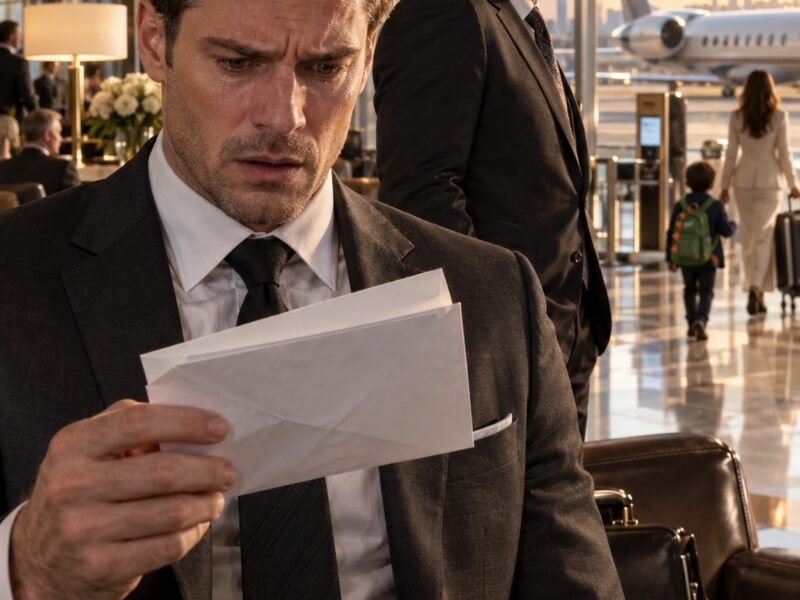
HE MISSED THE FLIGHT THAT COULD SAVE HIS COMPANY TO HELP A LOST BOY—THEN THE BOY’S MOTHER HANDED HIM AN ENVELOPE THAT CHANGED EVERYTHING

The final boarding call for Flight 218 to New York echoed through Chicago O’Hare just as Grant Callaway realized there were moments in a man’s life when every choice felt like betrayal.
If he ran, he betrayed the frightened little boy tugging on his sleeve.
If he stayed, he might betray two hundred and fourteen employees who were counting on him to keep their company alive.
“Mr. Callaway,” the gate agent called over the crowd. “This is your final boarding call.”
Marcus Reed, Grant’s executive assistant, grabbed his forearm.
“Grant, we have to move. Right now.”
Grant barely heard him.
He was looking down.
A boy stood beside his polished black shoes, maybe six years old, wearing a navy dinosaur backpack and a Chicago Cubs sweatshirt two sizes too big. One of his sneakers was untied. The lace dragged across the dirty airport floor.
But it wasn’t the shoelace that stopped Grant.
It was the boy’s face.
Children weren’t supposed to know how to hide panic, yet this one was trying.
“Excuse me, sir,” the boy whispered. “Can you tie this?”
Grant stared at him.
“Your shoe?”
The boy nodded quickly, then added, almost as though embarrassed by the real problem, “I can’t find my mom.”
Marcus closed his eyes.
“Grant.”
Another announcement came over the speakers.
“Final passenger, Grant Callaway, please report immediately to Gate C17.”
Marcus lowered his voice.
“If we miss this flight, Northbridge signs with Ridgewell. You know that.”
Grant knew.
For eleven months, Callaway Technologies had been negotiating the largest enterprise contract in the company’s history. Northbridge Systems operated distribution networks across twelve states. Landing them would do more than produce revenue.
It would save Callaway Technologies.
Without it, their remaining cash runway was measured in weeks, not quarters.
Grant looked toward the jet bridge.
The gate agent had one hand on the door.
Then he looked at the little boy again.
“Where’s your mother?”
The child swallowed.
“I don’t know.”
That was the moment.
Not the shoelace.
Not the boarding call.
Not even the contract.
Those three words.
I don’t know.
Grant dropped to one knee.
Marcus stared at him.
“You cannot be serious.”
Grant picked up the boy’s loose laces.
“What’s your name, buddy?”
“Noah.”
“All right, Noah. I’m Grant.”
He tied one lace, then the other.
Double knot.
His father had always double-knotted Grant’s shoes.
The memory came so suddenly that his fingers paused.
He could almost hear Robert Callaway’s voice from thirty years earlier.
If somebody needs five minutes of your life, Grant, give them five minutes. Success can wait. Kindness usually can’t.
Grant had spent most of his adult life forgetting that sentence.
Apparently, it had taken a lost six-year-old to bring it back.
Marcus crouched beside him.
“Grant, please listen to me. I know this looks terrible, but airport security is twenty seconds away. We can hand him to an employee.”
Grant looked around.
Thousands of people moved past them in every direction. Rolling suitcases rattled across tile. Business travelers stared at phones. Families rushed toward gates. A cleaning cart beeped behind them.
Nobody was looking for Noah.
At least nobody Grant could see.
He finished the knot and stood.
“When did you last see your mom?”
Noah pointed vaguely toward the security concourse.
“She was helping the old lady.”
“What old lady?”
“She fell.”
Marcus looked toward the gate again.
The agent was closing the door.
“Grant.”
Grant watched it shut.
The metallic click was quiet.
It still sounded like something breaking.
Marcus turned toward him slowly.
“You just missed the flight.”
“I know.”
“The meeting starts in four hours.”
“I know.”
“Ridgewell’s CEO is already in Manhattan.”
“I know, Marcus.”
“Then tell me what the hell you’re doing.”
Grant took Noah’s small hand.
“What I can live with.”
Marcus stared at him for another second, then looked away.
Grant felt Noah’s fingers tighten around his.
And somewhere beyond the glass, Flight 218 began pulling away from the gate.
The company Grant had spent twelve years building might have just left with it.
He didn’t know yet that the person who would decide its future was already running toward him.
Grant and Marcus walked Noah toward the nearest information desk.
Grant kept expecting to see a frantic parent pushing through the crowd.
Nobody came.
Noah was quiet now.
Too quiet.
Grant had negotiated hostile acquisitions with men who enjoyed intimidating people. He had testified before state committees, faced furious shareholders and once stood in front of three hundred employees to announce layoffs he had fought unsuccessfully to prevent.
None of that made him as uncomfortable as the tiny hand holding his.
Because Noah trusted him.
Completely.
And Grant had no idea whether he deserved it.
“Does your mom have a phone?” he asked.
Noah nodded.
“Do you know her number?”
Another nod.
Then a pause.
“No.”
Grant almost smiled.
“Fair enough.”
“I know mine.”
“You have a phone?”
“No. But I know my number.”
Marcus rubbed his forehead.
“That’s not—”
Grant shot him a look.
Marcus stopped.
Noah looked at Grant anxiously. “Am I in trouble?”
“No.”
“But Mom said I have to stay where she can see me.”
“You made a mistake. That’s different from being bad.”
The boy studied him as though deciding whether adults were allowed to make such distinctions.
Then he asked, “Do grown-ups make mistakes?”
Marcus let out a humorless laugh.
“Constantly.”
Grant glanced at him.
Marcus muttered, “Sorry.”
Noah thought about that.
Then he seemed relieved.
They had almost reached the information counter when Grant saw a woman running toward them.
Not walking quickly.
Running.
She wore an ivory blouse beneath a camel coat, tailored black trousers and low heels clearly not designed for sprinting through O’Hare. Her dark brown hair had partly fallen loose from what had once been a neat twist.
Her face was pale.
She scanned left, right, left again.
Then her eyes found Noah.
The transformation was instant.
“Noah!”
Noah dropped Grant’s hand.
“Mommy!”
The woman fell to her knees before he even reached her.
She caught him against her chest with enough force to knock his backpack sideways.
Grant looked away.
The intimacy of a terrified parent finding a lost child felt almost private.
“Oh, God. Noah.”
“I’m sorry.”
She pressed her face into his hair.
“Don’t apologize. Just—just let me look at you.”
She held his face between both hands.
“You’re okay?”
“Yes.”
“You’re not hurt?”
“No.”
“Did anybody touch you? Did anybody scare you?”
Noah shook his head.
Then he pointed proudly toward Grant.
“He tied my shoes.”
For one strange second, the woman simply stared at Grant.
Tears still clung to her lower lashes.
Grant had met beautiful women before. He had dated them, worked with them, watched men lose their judgment around them.
This felt different.
Maybe because there was nothing composed about her now.
No polished smile.
No practiced confidence.
Only relief so raw it made him feel intrusive for witnessing it.
She stood.
“You found him?”
“He found me, actually.”
Noah corrected him.
“I asked him because my shoe was bad.”
Grant nodded solemnly.
“It was a serious shoelace emergency.”
Noah smiled.
The woman did too, though hers trembled.
“Thank you.”
“You don’t have to thank me.”
“Yes, I do.”
“You would’ve done the same thing.”
Something changed in her expression.
Grant noticed it but didn’t understand it.
She looked past him toward the departures board.
“Were you going somewhere?”
Before Grant could answer, Marcus stepped forward.
“New York.”
Grant closed his eyes briefly.
Marcus continued.
“He was supposed to be on Flight 218.”
The woman followed his gaze toward Gate C17.
The jet bridge was empty.
Her face fell.
“You missed your flight because of Noah?”
“No,” Grant said.
Marcus looked at him.
Grant continued, “I missed my flight because I decided to stay.”
“That distinction doesn’t exactly help,” Marcus muttered.
The woman looked horrified.
“I’m so sorry.”
“No.”
“You don’t understand. I was only a few feet from him.”
She placed one hand protectively on Noah’s shoulder.
“There was an elderly woman near security. She collapsed. Everyone walked around her. I stopped because she hit her head, and I was trying to keep her awake until medical staff arrived. Noah was standing beside me.”
She looked down.
“I thought he was standing beside me.”
Her voice cracked.
Grant’s expression softened.
“When I looked back, he was gone.”
Noah whispered, “I thought you walked away.”
She immediately crouched again.
“No, sweetheart.”
“I was trying to catch you.”
“I know.”
“I’m sorry.”
This time she pulled him close instead of telling him not to apologize.
Grant glanced at Marcus.
The anger in his assistant’s face had faded.
Not disappeared.
But faded.
The woman stood again.
“My name is Vivian Sterling.”
“Grant Callaway.”
They shook hands.
Her grip was warm.
Steady now.
“Noah Sterling,” Noah announced.
Grant looked down at him.
“We’ve met.”
Noah grinned.
Then Marcus’s phone rang.
One look at the screen erased what little calm had returned to his face.
“Grant.”
Grant knew before Marcus answered.
“Take it.”
Marcus stepped away.
Vivian watched him.
“Was the meeting important?”
Grant could have lied.
For some reason, he didn’t.
“It mattered.”
“How much?”
He smiled faintly.
“Enough.”
She looked toward Marcus, whose shoulders were tightening as he listened.
“Your assistant looks like somebody just died.”
“That’s his normal phone face.”
Marcus turned around.
It was not his normal phone face.
Grant’s smile vanished.
Marcus walked back slowly.
“They signed.”
Grant didn’t move.
“Who?”
“You know who.”
“Say it.”
Marcus lowered his voice.
“Northbridge signed the preliminary contract with Ridgewell thirty minutes ago.”
The airport seemed to become louder.
Wheels. Announcements. Children. Engines behind the glass.
Grant heard all of it and none of it.
“Preliminary?” he asked.
“Exclusive ninety-day term.”
Which meant it was over.
Marcus continued.
“They moved the meeting up after they heard our flight was delayed. Ridgewell matched our implementation timetable and undercut us by six percent.”
Grant’s jaw tightened.
Six percent.
They had known his number.
That thought flashed through his mind, sharp and unpleasant.
Then disappeared beneath something more immediate.
“We still have two regional contracts pending.”
“They’re not Northbridge.”
“I know.”
“The board is going to call an emergency meeting.”
“I know.”
“Grant, we needed this.”
Grant looked toward the terminal windows.
Flight 218 was gone.
For eleven months, he had pictured signing the Northbridge contract.
He had imagined walking into the office with the news.
He had imagined the relief on his CFO’s face, Marcus opening a bottle of bad champagne, the engineering team cheering because nobody would have to wonder whether their jobs existed in two months.
Instead, he had a lost contract and a chocolate bar being pushed toward his hand.
Grant blinked.
Noah had opened his dinosaur backpack.
He was holding out a small Hershey bar.
“My mom says chocolate helps when people are sad.”
Vivian closed her eyes.
“Noah.”
“What?”
“That was for the plane.”
“I’m not sad.”
Grant looked at the boy.
Then at the chocolate.
There were humiliations in life that made a man feel small.
This wasn’t one of them.
This made him feel something worse.
Human.
He accepted the candy.
“Thank you.”
Noah nodded with great seriousness.
“You have to eat it.”
“I will.”
“Now.”
Marcus made a sound suspiciously close to laughter.
Grant tore open the wrapper.
He took a bite.
Noah smiled.
Grant swallowed around the sudden pressure in his throat.
Vivian had been watching him the entire time.
“Mr. Callaway.”
“Grant.”
“Grant.”
She hesitated.
“If Noah hadn’t—”
“Don’t.”
She stopped.
“I mean it. Don’t finish that sentence.”
“But your company—”
“You weren’t responsible for my decision.”
“You wouldn’t have missed the flight if—”
“If your son hadn’t asked me for help, maybe I would’ve boarded.”
He looked at Noah.
“But I made the choice.”
Vivian searched his face.
“And you don’t regret it?”
The truthful answer was complicated.
Grant regretted the contract.
He regretted the employees he might have to disappoint.
He regretted the numbers waiting for him on his laptop.
But he looked at Noah standing safely beside his mother.
“No.”
Marcus stared at him.
Vivian did too.
Grant put the rest of the chocolate in his pocket.
“I can lose a contract and figure out what comes next. I couldn’t have boarded that plane knowing a six-year-old was standing alone in an airport.”
He picked up his carry-on.
“So, no. I don’t regret that.”
His phone vibrated.
BOARD EMERGENCY CALL — 7:30 P.M.
There it was.
The consequence.
Grant read the message, slipped the phone back into his pocket and looked up.
Vivian Sterling was still staring at him.
Not with gratitude anymore.
With curiosity.
Neither of them could have known that his answer had just become more important than the contract he had lost.
Twenty minutes later, an announcement informed passengers that severe storms over the Northeast had disrupted departures.
All remaining flights to New York were delayed three hours.
Marcus stared at the ceiling.
“Of course.”
Grant almost laughed.
“You all right?”
“No, actually.”
Marcus pointed toward the departure board.
“If our original flight had been delayed five minutes earlier, you could have saved the kid and boarded.”
“Apparently weather has poor timing.”
“You think this is funny?”
“No.”
“You’re acting like you do.”
Grant’s smile disappeared.
“Because if I don’t laugh, Marcus, I get to think about two hundred people going home tonight wondering if they should update their résumés.”
That silenced him.
Vivian was standing several feet away, helping Noah zip his backpack.
She had heard.
Grant could tell.
She pretended otherwise.
Noah looked toward a café.
“Mom, I’m hungry.”
“I know.”
Then he pointed at Grant.
“Can Mr. Grant eat with us?”
Vivian glanced at Grant apologetically.
“You absolutely don’t have to.”
Marcus opened his mouth.
Grant spoke first.
“My evening calendar seems to have become unexpectedly flexible.”
Noah cheered.
Marcus stared at him.
Grant put a hand on his shoulder.
“Go make the board calls.”
“And you?”
“I’m going to eat airport food with a six-year-old who has already taken one meal from me.”
Noah looked shocked.
“My chocolate was not a meal.”
“That depends how bad the airport food is.”
Vivian laughed.
It surprised Grant.
Not because it was particularly loud, but because it seemed to surprise her too.
They ended up at a café overlooking the runway.
Marcus sat three tables away with two phones, a laptop and the expression of a man negotiating the end of civilization.
Noah colored dinosaurs.
Vivian ordered coffee.
Grant ordered nothing until she frowned at him.
“You should eat.”
“I had chocolate.”
“That’s not food.”
“Your son disagrees.”
“My son believes gummy worms are a food group.”
Noah looked up.
“They are.”
Grant smiled.
Vivian shook her head.
For a few minutes they talked about nothing important.
The weather.
Chicago winters.
Noah’s kindergarten teacher.
Which dinosaurs were unfairly portrayed by Hollywood.
Then Vivian asked, “What kind of company do you run?”
“Technology.”
“That could mean anything from payroll software to satellites.”
“Industrial logistics.”
She looked more interested.
“We build predictive systems for supply chains. Routing, inventory failures, warehouse automation. Mostly the boring things people only notice when they stop working.”
“That doesn’t sound boring.”
“Most investors disagree.”
“You have investors.”
“I have people who once thought I knew what I was doing.”
She smiled.
“And now?”
“Now they’re about to spend the evening debating whether I should remain CEO.”
The smile left her face.
“You’re serious.”
“I usually am when discussing my unemployment.”
“Because you missed one meeting?”
“Because one meeting represented eleven months of runway strategy.”
Vivian folded her hands around her coffee.
“How bad?”
Grant looked toward Marcus.
He should not have answered.
Vivian was a stranger.
A beautiful stranger with a thoughtful little boy, yes.
Still a stranger.
“Sixty-one days.”
She didn’t react immediately.
“That specific?”
“Our CFO is precise.”
“Sixty-one days until what?”
“Until cash gets low enough that we start cutting.”
“Employees?”
“Eventually.”
Vivian watched his face.
“You hate that.”
“Does anyone enjoy layoffs?”
“Some executives treat them like arithmetic.”
Grant gave a small shrug.
“Arithmetic doesn’t have mortgages.”
Something passed through her eyes.
Recognition, maybe.
He changed the subject.
“What about you?”
“What about me?”
“What does Vivian Sterling do when she isn’t abandoning her child to rescue unconscious strangers?”
She gave him a look.
“That joke is too soon.”
“Much too soon.”
“I run a business.”
“What kind?”
“Investments.”
Grant waited.
She sipped her coffee.
“That’s it?”
“It’s a family company.”
“Small?”
Her mouth twitched.
“Not exactly.”
Noah looked up from his drawing.
“Mom has a really big office.”
Vivian glanced at him.
“Thank you, Noah.”
“It has a piano.”
“I’m beginning to suspect your son is violating a confidentiality agreement.”
Grant leaned toward Noah.
“Any secret underground volcano?”
Noah’s eyes widened.
“No.”
“Good answer.”
Vivian laughed again.
An hour passed.
Then two.
For the first time in months, Grant stopped checking his phone every thirty seconds.
They talked about books.
Vivian loved old detective novels.
Grant admitted he read biographies because fiction made him feel guilty for wasting time.
She told him that sounded exhausting.
He agreed.
Noah showed Grant a drawing of a green dinosaur destroying a skyscraper.
“That one’s you,” he said.
Grant stared at the monster.
“Which part?”
“The dinosaur.”
Vivian covered her mouth.
“Why am I the dinosaur?”
“Because you’re big.”
Grant looked at Vivian.
“He makes a persuasive case.”
“Don’t encourage him.”
Eventually their flights were called from different gates.
At the intersection between concourses, Noah’s face fell.
“You’re leaving?”
“I have to.”
“When will I see you?”
Grant glanced at Vivian.
She went very still.
Adults understood certain questions were complicated.
Children rarely cared.
“I don’t know, buddy.”
Noah looked dissatisfied.
Then he tore a page from his coloring book.
It was another dinosaur.
Blue this time.
He handed it to Grant.
“You can keep this.”
Grant accepted it carefully.
“Are you sure?”
“It’s my best one.”
“Then I definitely need it.”
Vivian watched as Grant folded it once, very carefully, and tucked it into the inside pocket of his jacket.
Something about that small gesture reached a place in her that she had kept guarded for years.
She opened her handbag.
“Grant.”
“Yes?”
She removed a plain white envelope.
No logo.
No address.
She handed it to him.
“What’s this?”
“Something you may want later.”
“For what?”
“You said your company has sixty-one days.”
He stared at her.
The warmth in her face had changed.
Not vanished.
Sharpened.
“Vivian.”
“If you reach a point where you don’t know what door to knock on, open it.”
“I’m not very good at mysterious envelopes.”
“You’ll survive.”
“What’s inside?”
She smiled.
“Not money.”
“That eliminates my first guess.”
“Noah.”
The boy was already walking toward their gate.
“Coming!”
Vivian took two steps, then turned back.
“Grant?”
“Yeah?”
“Whatever happens tonight with your board…”
She hesitated.
“You made the right decision.”
Grant looked toward Noah.
“I hope so.”
Vivian’s expression softened.
“I’m not talking about business.”
Then she disappeared into the crowd.
Grant stood there holding the envelope.
Marcus appeared beside him.
“What did she give you?”
“No idea.”
“Open it.”
“No.”
“Why?”
“Because she said to open it when I’m at a crossroads.”
Marcus stared at him.
“You missed an eighty-six-million-dollar contract, we have sixty-one days of cash, and our board is currently gathering to decide whether to fire you.”
He pointed at the envelope.
“What, exactly, does a crossroads look like to you?”
Grant slid it into his jacket beside Noah’s dinosaur.
“Apparently slightly worse than this.”
Three hours later, Grant discovered how much worse things could get.
The Callaway Technologies conference room had never felt so cold.
Nine board members sat around the walnut table.
No one touched the coffee.
The Northbridge proposal glowed on the large wall screen behind Grant, its status changed from PENDING to LOST.
Elaine Porter, the CFO who had helped him build the company from twelve people to more than two hundred, spoke first.
“We have eight weeks of unrestricted operating capital.”
“Sixty-one days,” Grant said.
“If receivables clear on schedule.”
“They will.”
“You can’t guarantee that.”
“No.”
Across the table, board member Martin Voss removed his glasses.
“Do you know what I find extraordinary?”
Grant waited.
“You knew the company’s financial position.”
“Yes.”
“You knew the importance of today’s meeting.”
“Yes.”
“And yet you voluntarily missed your flight.”
Grant felt Marcus shift near the wall.
“Yes.”
Martin stared at him.
“For a child you didn’t know.”
“A lost child.”
“Airport security exists for a reason.”
“I saw no security officer when he asked for help.”
“You could have found one.”
“I did.”
“After missing the flight.”
Grant leaned both palms against the table.
“If you’re asking whether I’d make the same decision again, Martin, save us both the time.”
Martin’s jaw tightened.
“This is not a morality seminar. You have a fiduciary responsibility.”
“To the company, yes.”
“And today?”
“I fulfilled a responsibility to a six-year-old standing alone in one of the busiest airports in America.”
Martin gave a cold laugh.
“Wonderful. Perhaps we can put that on the bankruptcy filing.”
Elaine looked down.
Grant felt the insult but refused to react.
Another board member, David Kim, intervened.
“Northbridge made the decision unusually quickly.”
Grant turned toward him.
“What do you mean?”
“They knew Ridgewell’s revised pricing before your flight was even scheduled to land.”
Marcus straightened.
Grant’s mind returned to the airport.
Six percent.
“They undercut us by six percent.”
“Yes.”
“Our final discount was confidential.”
Elaine looked up.
“Four people had the final model.”
“Five,” Grant said.
The room went quiet.
Martin leaned back.
“Are you suggesting someone here leaked pricing?”
“I’m suggesting Ridgewell somehow landed within half a percentage point of the lowest number we could accept.”
“That sounds like paranoia from a CEO looking for someone else to blame.”
Grant’s eyes fixed on him.
“I haven’t blamed anyone.”
“No. You’re too busy being noble.”
“Martin.”
Elaine’s voice was sharp now.
“Enough.”
But Grant had heard something in Martin’s tone.
Something he filed away.
They argued for another hour.
Asset sale.
Bridge financing.
Layoffs.
Strategic acquisition.
The words became increasingly sterile as the human consequences became increasingly ugly.
At 10:12 p.m., Elaine projected three scenarios.
In the worst, Callaway Technologies would begin terminating employees in forty-five days.
In the best, Grant had twelve weeks to find new capital.
“There’s one other option,” Martin said.
Grant looked at him.
“Ridgewell.”
“No.”
“They’ve made informal inquiries.”
“No.”
“They would acquire the company, absorb the platform and retain approximately sixty percent of staff.”
“You mean fire eighty-five people.”
“I mean save a hundred and twenty-nine.”
Grant’s hands tightened beneath the table.
“My answer is no.”
“It may not remain your decision.”
That landed harder than anything else said all night.
Grant looked around the table.
Nobody contradicted Martin.
At 10:47, the meeting adjourned.
Grant remained alone.
The lights of Chicago glittered beyond the windows.
Twelve years.
That was what the city represented from this height.
Twelve years of sleeping under desks, maxed credit cards, missed holidays, impossible product launches.
Twelve years of telling people to trust him.
His father had been dead for nine of them.
His mother for four.
There was nobody left to call when Grant was afraid.
He sat in the dark for almost ten minutes before remembering the envelope.
It was still inside his jacket.
He took it out.
Turned it over.
Vivian’s words returned to him.
If you reach a point where you don’t know what door to knock on, open it.
Grant slid one finger under the seal.
Then stopped.
He didn’t open it.
Not yet.
Because part of him was afraid it would contain nothing useful.
And another part was afraid it would.
He placed it on his desk.
Beside it, he unfolded Noah’s dinosaur.
The drawing made him smile despite himself.
Under the dinosaur, in uneven blue crayon, Noah had written three words.
FOR MR. GRANT.
Grant stared at them for a long time.
Then his phone buzzed.
A message from Elaine.
We found something in the Northbridge audit.
Call me before you speak to anyone.
Grant’s smile disappeared.
He reached for the phone.
The next morning, he arrived before sunrise.
Elaine was waiting.
She closed his office door behind her.
“We checked document access.”
“And?”
“Somebody downloaded your final Northbridge pricing model forty-eight hours before Ridgewell revised its bid.”
Grant’s stomach tightened.
“Who?”
“We don’t know yet.”
“You have login records.”
“The credentials belonged to Marcus.”
Grant stared at her.
“No.”
“I’m telling you what the system shows.”
“Marcus has had access to my calendar for six years. He has never touched pricing models.”
“I know.”
“You think somebody used his credentials?”
“I think you shouldn’t confront anyone until IT finishes the audit.”
Grant looked through the glass wall toward Marcus’s empty desk.
He remembered the airport.
Marcus furious that Grant had missed the flight.
Marcus knowing every detail of the Northbridge negotiation.
Marcus constantly telling him the company needed that deal.
It made no sense.
Which was exactly why doubt was dangerous.
Grant shook his head.
“I’m not accusing him.”
“Good.”
“When will we know?”
“Hopefully tonight.”
Elaine left.
Grant sat down.
The envelope was still on his desk.
Suddenly the crossroads had acquired another road.
He opened it.
Inside was a single heavy card.
STERLING GLOBAL HOLDINGS.
No phone number.
No explanation.
Only an address on Park Avenue and six handwritten words in elegant blue ink.
When you’re ready, ask for Vivian.
Grant stared at it.
He knew the Sterling name.
Everybody in business knew it.
But Sterling Global Holdings?
He opened his laptop.
Thirty seconds later, he stopped breathing.
The firm managed investments across infrastructure, technology, logistics, energy, healthcare and commercial real estate.
Assets and affiliated holdings measured in the tens of billions.
Grant clicked the leadership page.
There she was.
Vivian Eleanor Sterling.
Chief Executive Officer.
The photograph showed the same woman from the airport.
Except not the same at all.
Hair immaculate.
Charcoal suit.
Expression calm enough to make nervous markets feel foolish.
A profile beside her photograph described her as the youngest CEO in Sterling Global’s seventy-year history.
Grant leaned back.
“What the hell?”
Marcus appeared in his doorway carrying coffee.
“What?”
Grant rotated the laptop.
Marcus looked.
Then looked again.
“Oh.”
Grant said nothing.
Marcus leaned closer.
“Oh.”
“That’s twice.”
“Vivian Sterling?”
“Apparently.”
“The Vivian?”
“I wasn’t aware there were categories.”
Marcus walked into the office.
“You sat in an airport café for three hours with Vivian Sterling and didn’t know who she was?”
“She said she worked in a family business.”
Marcus stared at him.
“That is technically one of the funniest things a billionaire has ever said.”
Grant looked at the card.
“She gave me this.”
Marcus read the handwriting.
His expression changed.
“Call her.”
“No.”
“Grant.”
“I’m not calling a woman whose son I helped because I need money.”
“She gave you the card.”
“That doesn’t mean I turn a basic human decision into a financing strategy.”
Marcus put the coffee down.
“Your company is eight weeks from layoffs.”
“I’m aware.”
“You have an invitation from the CEO of Sterling Global.”
“I’m aware.”
“Then what are you waiting for?”
Grant glanced at him.
The IT audit flashed through his mind.
Marcus’s credentials.
He hated himself for thinking about it.
Marcus noticed.
“What?”
“Nothing.”
“You just looked at me like I said something wrong.”
Grant forced the thought away.
“You didn’t.”
Marcus studied him, unconvinced.
Then Grant’s phone rang.
Elaine.
He answered immediately.
“What did you find?”
Her voice came low and tense.
“The Northbridge file was downloaded from a conference-room terminal.”
“Which one?”
“Executive conference room.”
“That room requires a badge.”
“Yes.”
Grant stood.
“Whose badge?”
Elaine hesitated.
“Martin Voss.”
Grant closed his eyes.
Marcus’s face changed.
He had heard.
Grant spoke carefully.
“You’re certain?”
“Security footage confirms he entered after midnight. We’re pulling more records.”
Grant stared through the office glass.
Martin Voss had spent months arguing that Callaway should sell to Ridgewell.
And yesterday, he had been the first person to suggest it again.
The lost flight suddenly looked different.
The lost contract suddenly looked different.
Maybe Grant’s decision at the airport hadn’t destroyed the Northbridge deal.
Maybe somebody had decided to destroy it before he ever met Noah.
Marcus whispered, “Son of a bitch.”
Grant looked down at Vivian’s card.
For the first time, he understood that the airport hadn’t created his crisis.
It might have interrupted a plan already underway.
He picked up the phone.
“Get me a flight to New York.”
Marcus looked at him.
“To confront Martin?”
Grant slipped Vivian’s card into his pocket.
“No.”
“Then why?”
Grant looked at the six handwritten words again.
“Because apparently I have another meeting.”
Two days later, Grant stepped into the lobby of Sterling Global Holdings in Manhattan and felt, for the first time in years, genuinely underdressed in a six-thousand-dollar suit.
The ceiling rose three stories.
A sculptural staircase curved through the center of the building. Light poured through glass walls overlooking Park Avenue. Employees crossed marble floors with the quiet speed of people whose time was aggressively expensive.
Marcus whistled.
“I think their lobby has a higher valuation than our company.”
“Helpful.”
“I’m coping.”
They approached reception.
A woman looked up.
“Good morning.”
Grant handed her Vivian’s card.
“I was told to ask for Ms. Sterling.”
The receptionist glanced down.
Her eyes stopped on the handwriting.
Then she stood.
“Mr. Callaway?”
Grant frowned.
“Yes.”
“Ms. Sterling asked that you be brought upstairs whenever you arrived.”
Marcus leaned closer.
“She knew you were coming?”
“Apparently she knows me better than I do.”
Within a minute, a senior executive had appeared.
Not an assistant.
Not security.
The company’s chief strategy officer, according to the directory Grant had read the night before.
“Mr. Callaway. Welcome.”
They shook hands.
“Ms. Sterling is finishing a call.”
The private elevator opened.
Marcus whispered as they entered, “Senior executives do not retrieve random visitors from lobbies.”
Grant looked at him.
“Stop helping.”
The elevator rose.
Thirty-four floors.
Thirty-five.
Thirty-six.
When the doors opened, Manhattan spread beyond glass like a living map.
They walked down a corridor lined with paintings Grant suspected belonged in museums.
At the end were two walnut doors.
The executive opened them.
“Ms. Sterling.”
Grant stepped inside.
Vivian was standing near the windows.
For one second, his mind tried to reconcile two versions of her.
The mother sprinting through O’Hare with tears on her face.
The woman standing before him now.
Dark gray suit.
Silk blouse.
Hair swept neatly back.
No panic.
No vulnerability.
She belonged in this room so completely it almost made their airport conversation feel imagined.
Then she smiled.
The illusion broke.
“You opened it.”
Grant looked at the office.
“Eventually.”
Marcus remained near the door.
Grant approached her.
“You own Sterling Global.”
“My family owns a substantial portion.”
“You’re the CEO.”
“Yes.”
“You told me you ran a family business.”
“I do.”
“That sentence feels dishonest now.”
Vivian laughed.
“I was technically accurate.”
“That is what people say when they know they were misleading.”
“Would you have spoken to me the same way if I had told you?”
Grant considered it.
“No.”
“Exactly.”
She gestured toward a seating area.
“Coffee?”
“No, thank you.”
“Marcus?”
Marcus blinked.
“You know my name?”
“I do my homework.”
He glanced at Grant.
“Coffee would be great.”
Vivian pressed a button.
Grant sat across from her.
“You investigated me.”
“After the airport.”
“Why?”
Vivian’s expression shifted.
“Because I couldn’t stop thinking about something.”
“My company?”
“No.”
That answer threw him.
She leaned forward slightly.
“You lost an eighty-six-million-dollar contract.”
Grant’s eyes narrowed.
“You really did your homework.”
“And you refused to blame my son.”
“He was six.”
“You’d be surprised what adults blame children for when they need somewhere to put their anger.”
Her voice carried something personal.
Grant noticed.
He didn’t ask.
Vivian continued.
“You were under enormous pressure. You made a choice that could hurt you financially, and when the consequence arrived, your first instinct was to protect Noah from feeling responsible.”
“I don’t see why that deserves an investigation.”
“Because I spend my life listening to executives talk about values.”
She gave a small, tired smile.
“Integrity. Leadership. Responsibility. Culture. They print those words on walls.”
“And?”
“I wanted to know what yours cost.”
Grant said nothing.
“At O’Hare, yours cost you something.”
Vivian’s eyes held his.
“That made me curious.”
She stood and walked toward her desk.
Grant felt unease rise in him.
“Vivian, I didn’t come here to be rewarded for helping Noah.”
“I know.”
“If that’s what this is—”
“It isn’t.”
She picked up a thick black folder.
“Open it.”
Grant did.
Inside were reports.
Callaway Technologies.
Product architecture.
Patent portfolio.
Retention rates.
Customer churn.
Margins.
Enterprise pipeline.
Security audits.
A depth of analysis that could not have been assembled casually.
Grant turned another page.
“How long have your people been doing this?”
“Since the morning after O’Hare.”
He looked up.
“Why?”
“Because kindness made me look.”
She sat across from him.
“The company made me continue.”
Grant scanned the report.
Sterling’s analysts had identified the exact problem Callaway’s own board had fought about for months.
Excellent technology.
Strong clients.
Poor capitalization.
Too much revenue concentrated in a small number of enterprise customers.
Expansion attempted six months too early.
Grant closed the folder.
“You know about Northbridge?”
“Yes.”
“You know about Ridgewell?”
“Yes.”
“You know Martin Voss may have leaked our pricing?”
Vivian’s expression didn’t change.
Grant caught it.
“You know.”
“We discovered unusual communication between a Ridgewell advisory firm and an entity connected to Martin three months ago.”
Grant’s body went still.
“Why didn’t you tell me?”
“Because our information wasn’t sufficient to make an accusation.”
“Mine is.”
“I assumed you would reach that conclusion.”
Grant stood and walked toward the windows.
Anger began rising in him.
Not hot.
Cold.
Precise.
Martin had watched employees give everything.
He had watched Grant borrow against his own shares.
And all along, he might have been weakening the company to make a sale inevitable.
Vivian approached him but kept her distance.
“Grant.”
He looked at her reflection.
“Did I lose Northbridge because I stayed with Noah?”
“We don’t know.”
“I need an answer.”
“We know Ridgewell had access to information they should not have had before your flight left Chicago.”
Grant’s jaw tightened.
“So, probably not.”
“Probably not.”
For two days, he had defended his decision.
Yet some hidden part of him had still wondered.
Had kindness been irresponsible?
Had he chosen one child over hundreds of livelihoods?
Had his father’s old lesson belonged to a simpler world?
Grant closed his eyes.
Vivian’s voice softened.
“You did not destroy your company by stopping for Noah.”
He turned.
“No.”
“Martin may have been working against us for months.”
“Yes.”
“And now what?”
Vivian returned to the table.
She opened another folder.
“Now we talk business.”
The first page contained a number.
Grant stared at it.
Sterling Global proposed a strategic investment large enough to recapitalize Callaway Technologies, expand two product divisions, replace short-term debt and fund eighteen months of growth.
Marcus, who had been silent near the coffee tray, nearly choked.
Grant looked up.
“This is insane.”
Vivian raised one eyebrow.
“I usually prefer ambitious.”
“This is not a small investment.”
“No.”
“You could buy half the company for this.”
“We don’t want half.”
“What do you want?”
“Twenty-two percent, one board seat, standard protective provisions and performance milestones.”
Grant read another page.
His pulse accelerated.
The terms were aggressive.
But fair.
Maybe more than fair.
He closed the folder.
“No.”
Marcus made a strangled sound.
Vivian stared at Grant.
“No?”
“I can’t take this.”
“You haven’t even read the full proposal.”
“I don’t need to.”
“Grant—”
“No.”
He pushed the folder back.
“I helped your son.”
Vivian’s eyes cooled slightly.
“I’m aware.”
“You investigated my company because of that.”
“Yes.”
“Now you’re offering an investment that can save it.”
“Because of what we found.”
“How do I separate those things?”
“By reading the report.”
“I’m serious.”
“So am I.”
Grant stood.
“I need to know this isn’t gratitude dressed as due diligence.”
Vivian rose too.
For the first time since he entered, she looked offended.
“Do you think I move tens of millions of dollars because somebody tied my son’s shoes?”
“That’s not what I said.”
“It is essentially what you said.”
“I’m saying I refuse to let one decent decision become leverage.”
“And I refuse to let your pride rewrite reality.”
The room went silent.
Marcus looked at the floor.
Grant stared at her.
Vivian stepped closer.
“You believe accepting help somehow contaminates the goodness of helping Noah.”
“That isn’t—”
“Yes, it is.”
Her voice remained calm.
“You want your choice at the airport to remain pure. Fine. It was pure. You knew nothing about me.”
She placed one hand on the investment folder.
“But this is not payment.”
“Then prove it.”
Vivian held his gaze.
For a moment, nobody spoke.
Then she pressed a button on the conference console.
“Daniel?”
A voice answered.
“Yes, Vivian?”
“Bring the committee in.”
Grant frowned.
“What committee?”
The doors opened.
Seven people entered.
Grant recognized three from business publications.
Sterling Global’s technology investment committee.
One of them carried another folder.
Vivian stepped aside.
“Mr. Callaway,” the committee chair said, “we’ve been waiting for you to ask that question.”
Grant looked at Vivian.
A trace of satisfaction touched her face.
The chairman opened the folder.
“Vivian’s airport experience brought Callaway Technologies to our attention. That is the extent of its relevance.”
He slid several pages toward Grant.
“Every member of this committee reviewed your company independently.”
Grant looked down.
Scores.
Risk models.
Technology assessments.
Customer interviews.
Engineering reviews.
The chairman continued.
“Your platform received the highest technical innovation score of any logistics software company we’ve reviewed this year.”
Another executive spoke.
“We called fourteen of your customers. Twelve said switching away from Callaway would materially damage their operations.”
Another.
“Your problem is capital structure, not product-market fit.”
Grant turned pages slowly.
No charity.
No vague promise.
Work.
His team’s work.
Years of it.
The chairman sat back.
“Ms. Sterling did not participate in the final scoring.”
Grant looked at Vivian.
She folded her arms.
“I knew you wouldn’t believe me.”
“You recused yourself?”
“From the investment vote.”
“Why?”
“Because I knew you would sit exactly where you’re sitting and wonder if the airport had bought you something.”
Grant looked down.
The committee chair smiled faintly.
“For the record, Mr. Callaway, the committee approved proceeding unanimously.”
Marcus exhaled.
Grant didn’t.
He looked at Vivian for a long moment.
“You really planned all this?”
“No.”
“No?”
“I planned the due diligence.”
Her mouth softened.
“I had no idea you would be this difficult.”
Marcus coughed into his fist.
Grant finally smiled.
The tension in the room broke.
Then a small voice sounded from the hallway.
“Mr. Grant?”
Grant froze.
Noah appeared between the doors with a woman Grant assumed was his nanny several steps behind him.
The boy’s entire face lit up.
He ran.
Grant barely had time to stand before Noah wrapped both arms around his waist.
“You came!”
“I did.”
“I told Mom you would.”
“You did?”
“She said maybe.”
Grant looked at Vivian.
“Your mother is very cautious.”
“I know.”
Vivian shook her head.
Noah looked at the documents.
“Are you helping Mom?”
Marcus laughed.
“That depends which one of them you ask.”
Noah turned back to Grant.
“I made another dinosaur.”
“Of course you did.”
Grant crouched.
Noah reached into his backpack.
For the first time that day, the numbers on the table stopped feeling like the most important thing in the room.
Vivian watched Grant listen seriously as Noah explained the anatomical inaccuracies of his latest dinosaur.
The committee members began quietly leaving.
Marcus followed.
Soon Vivian stood alone across the room from them.
Grant looked up.
Their eyes met.
And something shifted.
Not gratitude.
Not business.
Something more dangerous precisely because neither of them had planned it.
Vivian looked away first.
Three weeks later, Grant discovered that saving a company was easier than saving trust.
Sterling Global announced that it had entered exclusive negotiations to invest in Callaway Technologies.
The news spread quickly.
Employees cheered.
Shares held by early private investors recovered value overnight.
Recruiters who had been circling Grant’s engineers suddenly stopped calling.
And Martin Voss hired a lawyer.
Callaway’s internal investigation discovered encrypted messages, consulting payments and a trail of information passing from Martin to an intermediary connected with Ridgewell Dynamics.
He denied leaking Northbridge pricing.
The evidence said otherwise.
In an emergency board meeting, Grant placed the records in front of him.
Martin didn’t touch them.
“You were going to force a sale,” Grant said.
Martin sat expressionless.
“I was going to protect shareholder value.”
“By weakening the company.”
“By recognizing what you refused to recognize.”
“You leaked confidential pricing.”
“You can’t prove I gave Ridgewell those numbers.”
“We can prove you downloaded them.”
Martin leaned forward.
“And we can prove you abandoned the Northbridge meeting to play hero in an airport.”
Grant stared at him.
Martin smiled without warmth.
“That’s the part your employees don’t know, is it?”
“They know I missed the flight.”
“Do they know why?”
“Yes.”
“Do Sterling’s investment committee members know why?”
“Every one of them.”
Martin’s smile faded.
Grant slid another document across the table.
“Your resignation.”
“I’m not signing that.”
“Then the board votes to remove you for breach of fiduciary duty and refers the evidence to counsel.”
Martin looked around.
This time, nobody looked back.
He stood.
“You think Sterling saved you.”
Grant remained seated.
“No.”
“You think because Vivian Sterling likes you, you won.”
The words landed unexpectedly.
Grant’s eyes hardened.
Martin noticed.
There it was.
The pressure point.
“Oh,” he said. “I see.”
“Careful.”
“She likes you.”
“This discussion is over.”
“Does she know that the moment she puts money into this company, every competitor will say you got financed because you played substitute father to her kid?”
Grant stood.
“You’re done here.”
Martin picked up the resignation document.
“You used to be smart enough to understand appearances.”
He signed.
Then he slid the paper back.
“Now you’re emotionally compromised.”
Grant watched him walk out.
The door closed.
Nobody spoke.
That evening, Grant canceled dinner with Vivian.
She texted once.
Everything okay?
He stared at the message.
Typed yes.
Deleted it.
Typed long day.
Deleted that too.
Finally:
Board situation. I need a night.
Her reply came thirty seconds later.
Of course.
No questions.
No guilt.
That somehow made it worse.
He canceled again four days later.
The investment negotiations remained professional.
Too professional.
Vivian noticed.
So did Noah.
On Saturday morning, Grant was reviewing contracts in his apartment when someone knocked.
He opened the door.
Noah stood there holding a paper bag.
Vivian stood behind him.
Grant blinked.
“Hi.”
Noah marched inside.
“You missed tacos.”
Grant looked at Vivian.
She lifted both hands.
“I tried to explain boundaries.”
“No, you didn’t,” Noah called from inside.
Vivian closed her eyes.
Grant almost smiled.
“Come in.”
She stepped inside.
Noah placed the bag on Grant’s kitchen island.
“I brought muffins.”
Grant looked inside.
“They appear crushed.”
“They were better before.”
“I’m sure.”
Noah went to investigate Grant’s view of Lake Michigan.
Vivian stayed near the door.
“You’ve been avoiding me.”
There was no accusation in her voice.
That was worse.
Grant leaned against the counter.
“Martin said something.”
“I assumed.”
“You know?”
“I know men like Martin.”
“He said people would think the investment happened because of us.”
“There is no us.”
Grant looked at her.
Vivian flinched almost imperceptibly.
“That came out wrong.”
“No,” she said. “It came out accurately.”
“That isn’t what I meant either.”
“Then what did you mean?”
Grant looked toward Noah.
The boy was pressing his forehead against the window.
“You and Noah matter to me.”
Vivian’s expression softened but remained guarded.
“That’s exactly what frightens me.”
She was silent.
Grant continued.
“I have employees depending on this deal. You have shareholders. If this becomes…”
He stopped.
“Personal?” Vivian finished.
“Yes.”
“It already is.”
Grant looked at her.
She took a breath.
“The airport was personal.”
“Noah giving you chocolate was personal. You keeping his ridiculous dinosaur was personal. Him asking about you every other day is personal.”
Her voice lowered.
“And whatever is happening between you and me is personal, whether we acknowledge it or not.”
Grant looked away.
Vivian walked closer.
“But the investment is not.”
“I know that intellectually.”
“Then what are you afraid of?”
He laughed once, without humor.
“Everything.”
For the first time, she saw it clearly.
Grant Callaway wasn’t withdrawing because he didn’t feel enough.
He was withdrawing because he did.
“You know what happened to Noah’s father?” she asked.
Grant shook his head.
“I assumed you were divorced.”
“I’m a widow.”
His face changed.
“I’m sorry.”
“Daniel died four years ago.”
She glanced toward Noah.
“A cerebral aneurysm. He left for work on a Tuesday morning and never came home.”
Grant said nothing.
“What I learned afterward was that grief makes you very good at controlling things.”
She smiled faintly.
“My calendar. My company. My home. Noah’s school. His doctor. Every financial decision.”
Her eyes returned to Grant.
“If I control enough variables, maybe nothing can disappear unexpectedly.”
“That doesn’t work.”
“No.”
“No, it doesn’t.”
“I know.”
Noah turned from the window.
“Mom?”
“Yes?”
“Mr. Grant doesn’t have any toys.”
Grant looked offended.
“I have a television.”
Noah stared at him.
“That’s sad.”
Vivian laughed.
Grant did too.
The tension loosened.
Noah wandered into the living room.
Vivian lowered her voice.
“Grant, I don’t know what happens with us.”
“Neither do I.”
“But please don’t disappear because Martin Voss said something designed to make you afraid.”
Grant looked at her.
She had spent years protecting herself by controlling every variable.
Now she was asking him not to do the same.
“When are the final investment documents signed?” he asked.
“Thursday.”
“After Thursday?”
“What about it?”
“Dinner.”
Vivian’s expression changed.
“Business?”
“No.”
A quiet smile appeared.
“Friday?”
“Friday.”
“Seven?”
“Seven.”
Noah shouted from the living room.
“Can I come?”
Both adults froze.
Then Vivian shouted back, “No.”
“Why?”
“Because grown-ups are allowed to eat without you.”
Noah considered this.
“That’s rude.”
Grant laughed until his eyes watered.
Friday arrived.
Then vanished beneath crisis.
At 5:42 p.m., two hours before Grant was supposed to meet Vivian, Callaway’s security team called him.
They had found something else.
The Northbridge leak went beyond Martin.
Ridgewell had obtained internal architecture documents.
Not just pricing.
Source code descriptions.
Security infrastructure.
Customer deployment maps.
Grant went cold.
“Who accessed them?”
The security director hesitated.
“Marcus.”
Grant stopped.
“We already covered that. His credentials were compromised.”
“These weren’t credentials.”
“What do you mean?”
“Biometric entry.”
Grant stared at the screen.
“Say that again.”
“Someone used Marcus Reed’s fingerprint authorization to access the secure engineering archive three times.”
Grant looked through his office wall.
Marcus was ten feet away.
Laughing at something with Elaine.
Six years.
That was how long Marcus had worked for him.
He knew Grant’s parents’ names.
He had been at the hospital when Grant had emergency surgery.
He had spent Thanksgiving at Grant’s apartment twice.
Grant stepped out.
“Marcus.”
Marcus looked up.
“Yeah?”
“My office.”
Something in Grant’s face made the smile disappear.
Marcus followed him inside.
Grant closed the door.
“Did you access the engineering archive?”
Marcus went still.
“What?”
“Answer me.”
“No.”
“Biometrics say you did.”
Marcus’s face drained.
“That’s impossible.”
“Three times.”
“When?”
Grant gave him the dates.
Marcus thought.
Then his expression changed.
“Oh, God.”
“What?”
“My old security key.”
“What security key?”
“The biometric dongle.”
“You lost it?”
“No. IT replaced it six months ago because the reader malfunctioned.”
“Where is the old one?”
“I gave it to Martin.”
Grant stared at him.
“What?”
“He said he was taking old hardware to IT. We were leaving a board meeting.”
Marcus stepped closer.
“Grant, I swear to you—”
Grant believed him.
Not because he wanted to.
Because fear had filled Marcus’s face before Grant had explained why the key mattered.
It was the fear of a man understanding how a careless moment had been weaponized.
Grant sat down.
“Martin cloned your access.”
Marcus’s knees seemed to weaken.
“He used me.”
“Yes.”
“Jesus.”
Marcus looked sick.
“I pushed you onto that flight because I thought Northbridge was our last chance.”
“I know.”
“I spent days angry at you for missing it.”
“I know.”
“And the whole time…”
His voice broke.
“Grant, I’m sorry.”
Grant looked at the man who had stood beside him through six years of chaos.
“You didn’t do this.”
“I handed him the key.”
“You made a mistake.”
Marcus stared at him.
Grant heard Noah’s voice from the airport.
Do grown-ups make mistakes?
Constantly.
“You made a mistake,” Grant repeated. “That is different from being the person who betrayed us.”
Marcus slowly sat down.
Grant’s phone vibrated.
Vivian.
Are we still on for tonight?
He looked at the time.
6:07.
He thought of canceling.
Again.
Then he remembered something else.
Success can wait five more minutes.
Kindness can’t.
Maybe life couldn’t always be postponed until the crisis was over.
Because crises had a way of replacing one another forever.
He texted back.
Absolutely.
At 7:12, Grant walked into a small Italian restaurant in the West Loop and found Vivian waiting near the window.
No corporate entourage.
No assistant.
No Noah.
She wore a deep green dress beneath a black coat.
Grant stopped for half a second longer than he should have.
Vivian noticed.
“So?”
“So what?”
“You look surprised.”
“I’m recalibrating.”
“That sounds romantic.”
“I run a technology company.”
“Tragic.”
He pulled out her chair.
They ordered wine.
For the first twenty minutes, neither discussed business.
Grant almost didn’t know how.
For twelve years, every dinner had contained a deal, a pitch, a problem or a phone placed faceup beside his plate.
Tonight, his phone stayed in his coat.
Vivian asked about his father.
Grant told her about Robert Callaway fixing industrial equipment in a small shop outside Milwaukee.
“He could repair anything.”
“Were you close?”
“Very.”
“What happened?”
“Cancer.”
“How old were you?”
“Thirty-one.”
“I’m sorry.”
Grant looked at the candle between them.
“The last year of his life, I was building Callaway.”
“You were busy.”
“That’s a generous word for absent.”
Vivian said nothing.
“I kept telling myself I was doing it for him. To prove the idea worked. To make him proud.”
Grant gave a small, painful smile.
“He never asked me to prove anything.”
“Parents rarely do.”
“I missed dinners. Appointments. One Christmas morning because a server crashed.”
Vivian watched him.
“Were you there when he died?”
“Yes.”
Grant swallowed.
“He was barely awake. I told him I was sorry I had wasted so much time.”
“What did he say?”
Grant’s eyes glistened despite his effort.
“He said, ‘Then stop wasting the next part.’”
Vivian reached across the table.
Her fingers rested over his.
No grand speech.
No reassurance.
Just warmth.
Grant looked down at their hands.
Then up.
“I forgot.”
“What?”
“The next part.”
Vivian’s thumb moved slightly against his knuckle.
“Maybe you’re remembering.”
Neither pulled away.
Outside, Chicago traffic moved through wet streets.
Inside, something quiet began.
Not a promise.
Not yet.
But enough to make both of them afraid.
And neither let go.
Over the next four months, Callaway Technologies changed faster than it had in four years.
Sterling’s investment closed.
Martin Voss was referred to federal investigators after Callaway’s attorneys documented unauthorized disclosures and payments. Ridgewell denied directing any theft, and the legal fight promised to last months.
Grant stopped caring about revenge.
He cared about rebuilding.
The capital stabilized payroll.
A new Midwestern distribution client replaced almost half the revenue Northbridge would have brought.
Sterling’s operating team helped Callaway restructure debt and delay an expensive expansion.
Nobody was magically rescued.
They worked.
That mattered to Grant.
At the company’s first quarterly town hall after the investment, he stood in front of two hundred employees and told them the truth.
Not every detail.
Enough.
“We came closer to losing this company than many of you knew.”
The room went silent.
“I made mistakes.”
He looked around.
“So did people I trusted. But this company is standing because the work built here was worth protecting.”
He paused.
“Not because anyone felt sorry for us.”
Elaine smiled from the front row.
Marcus sat beside her.
Grant continued.
“Six months ago, I thought leadership meant having the answer before anyone saw you hesitate.”
He looked at faces he had known for years.
“I was wrong.”
A few people shifted.
“Sometimes leadership is telling people you don’t know yet—and still staying in the room long enough to figure it out together.”
The applause began slowly.
Then spread.
Grant didn’t feel victorious.
He felt relieved.
There was a difference.
His relationship with Vivian grew just as slowly.
They had dinner.
Then another.
Sometimes Noah came.
Often he insisted.
Grant attended Noah’s school science night and spent forty-five minutes helping him build a cardboard volcano that failed to erupt until it unexpectedly sprayed red foam onto Grant’s shirt.
Vivian laughed so hard she had to sit down.
Grant began keeping spare clothes in his car.
Noah started calling him simply Grant instead of Mr. Grant.
That change affected him more than he admitted.
Vivian noticed.
She noticed other things too.
Grant never promised Noah anything casually.
If he said he would be somewhere at four, he arrived at 3:50.
If work threatened the promise, work moved.
The first time it happened, Vivian asked why.
Grant looked surprised.
“Because I told him I’d be there.”
“That simple?”
“Yes.”
She stared at him.
“What?”
“Nothing.”
But it wasn’t nothing.
Daniel had loved Noah.
He had been a wonderful father.
After he died, people made promises to Vivian constantly.
Call anytime.
We’re here for you.
Noah will always have us.
Most disappeared back into their lives within six months.
She had stopped judging them.
People had their own families, their own griefs, their own obligations.
Still, she had learned not to trust promises made in emotional rooms.
Grant never made emotional promises.
He simply arrived.
One evening, after Noah fell asleep on Grant’s couch during a movie, Vivian stood in the kitchen while Grant washed popcorn bowls.
“You know he loves you.”
Grant’s hands stopped beneath the running water.
Vivian regretted the sentence immediately.
“I shouldn’t have said that.”
“No.”
He shut off the faucet.
“I know.”
She looked at him.
“And?”
Grant dried his hands.
“And I love him too.”
It came out without hesitation.
That frightened both of them.
Vivian looked toward the sleeping boy.
“Grant…”
“I know.”
“No, I don’t think you do.”
She lowered her voice.
“If this doesn’t work between us, he doesn’t understand adult explanations.”
Grant leaned against the counter.
“I know.”
“He already lost his father.”
“I know.”
“I cannot let him build his heart around someone who might decide this is too complicated.”
Grant absorbed the words.
He didn’t get defensive.
That made it harder for Vivian to stay guarded.
“What do you want me to say?”
“The truth.”
“All right.”
He took a breath.
“The truth is this terrifies me.”
Vivian said nothing.
“I’m forty-two years old. Until a few months ago, the closest thing I had to a family was Marcus insulting me in airports.”
She smiled despite herself.
“Then a kid asked me to tie his shoe.”
Grant looked toward Noah.
“And somehow I got used to being asked whether dinosaurs could beat sharks and whether cereal counts as dinner.”
“It doesn’t.”
“Debatable.”
“Grant.”
He became serious again.
“I’m not promising you forever tonight.”
Vivian’s face changed.
He continued before she could retreat.
“Because forever is easy to promise when nothing is testing it.”
He took one step closer.
“But I can promise this.”
He looked directly into her eyes.
“I will never disappear from Noah’s life because a relationship conversation gets uncomfortable. If you and I ever change, I will handle that like an adult.”
Vivian’s eyes filled.
“And you?”
“What about me?”
“Would you disappear from mine?”
Grant’s voice softened.
“No.”
That was the first night she kissed him.
It was not cinematic.
No music.
No skyline.
The dishwasher was running.
A dinosaur blanket was half falling off the couch.
Grant still smelled faintly of burnt popcorn.
Vivian kissed him anyway.
And when she pulled back, he rested his forehead against hers.
Neither said I love you.
Not because it wasn’t becoming true.
Because some truths became more precious when you didn’t rush to name them.
Six months after the airport, Grant stood backstage at a downtown Chicago hotel while a crowd applauded Callaway Technologies’ newest expansion.
A screen behind the stage announced a partnership between Callaway and Sterling Global to open three regional innovation centers.
Hundreds of new jobs.
New customers.
A future nobody in Grant’s conference room had dared predict half a year earlier.
Marcus adjusted Grant’s tie.
“You hate these things.”
“I hate you touching my tie more.”
“You tied it crooked.”
“I’m an adult.”
“Debatable.”
Grant looked toward the crowd.
“Remember O’Hare?”
Marcus laughed.
“I have stress dreams about Gate C17.”
“We thought missing that flight destroyed us.”
“I thought you had lost your mind.”
“You told me that.”
“Repeatedly.”
Grant smiled.
Marcus’s expression softened.
“For what it’s worth…”
“What?”
“I’m glad you stopped.”
Grant looked at him.
Marcus shrugged.
“We discovered Martin because Northbridge moved too quickly. Sterling found us because you met Vivian. You became slightly less unbearable.”
“Careful.”
“My point is, I spent years thinking every important thing happened because we forced it to happen.”
Marcus glanced toward the ballroom.
“Maybe some important things happen because we stop forcing everything for five minutes.”
Grant smiled.
“You’ve been spending too much time around Noah.”
“He says I need a dinosaur backpack.”
“He’s right.”
The stage manager called Grant’s name.
He stepped out.
Applause rose.
Flashbulbs flickered.
Grant spoke for twelve minutes.
He thanked his employees.
Elaine.
Marcus.
Sterling Global.
He did not tell the airport story.
Reporters already knew fragments of it, but Grant had refused to turn Noah into corporate mythology.
Kindness didn’t need branding.
When the event ended, he shook hands until his face hurt from smiling.
Then he slipped out through a service corridor.
Marcus followed.
“Where are you going?”
“Lincoln Park.”
“The Sterling dinner begins in forty minutes.”
“I know.”
“You are the guest of honor.”
“They can honor me later.”
Marcus grinned.
“Go.”
Grant drove across the city.
Vivian had taken Noah to a park after school.
The sun was low when Grant saw them.
Noah saw him first.
“Grant!”
He ran.
Grant crouched just before impact.
Noah slammed into him.
“You came!”
“I said I would.”
“You’re wearing your fancy clothes.”
“I escaped.”
“From jail?”
“Worse.”
Vivian approached laughing.
“Board meeting?”
“Corporate event.”
“Definitely worse.”
Grant stood.
For a moment, he just looked at her.
Six months earlier, she had been a stranger sprinting across an airport.
Now he knew the way she tucked hair behind one ear when thinking.
He knew she drank tea when nervous and coffee when angry.
He knew she hated people moving things on her desk but allowed Noah to cover it with dinosaur stickers.
He knew some nights she still woke from dreams about Daniel.
He knew not to try to erase those memories.
Love, he had learned, did not require competing with the dead.
Vivian looked at his suit.
“How did the announcement go?”
“Good.”
“Just good?”
“Very good.”
“I watched the stream.”
“You did?”
“You looked terrified.”
“I was speaking to nine hundred people.”
“You negotiate nine-figure deals.”
“They don’t applaud randomly.”
Noah tugged Grant’s hand.
“Come on.”
“Where?”
“I have to show you something.”
He dragged both adults toward a path lined with yellowing trees.
Leaves blew across the pavement.
For twenty minutes, Noah showed Grant important discoveries.
A bird nest.
A stick shaped like a sword.
A rock Vivian was apparently required to carry home.
Then Noah ran ahead toward the playground.
Vivian slowed beside Grant.
“I’ve been meaning to ask you something.”
“That sentence never leads anywhere safe.”
“Why did you really stay?”
“At the airport?”
“Yes.”
“You know why.”
“I know what you say.”
Grant looked ahead.
Noah climbed onto a low platform.
“What do you think the secret answer is?”
Vivian smiled.
“I don’t know.”
Grant shoved his hands into his coat pockets.
“My father.”
She waited.
“He used to say success could wait five minutes. Kindness couldn’t.”
“You told me about that.”
“I hadn’t thought about those words in years.”
A breeze moved through the trees.
“Then Noah tugged on my sleeve.”
Grant smiled.
“And suddenly I was eight again, watching my dad stop on the side of the road to help strangers.”
Vivian’s eyes softened.
“I spent years becoming the opposite of him in certain ways.”
“How?”
“He could lose an hour helping someone change a tire.”
Grant laughed quietly.
“I considered five minutes without email a productivity failure.”
“You built something extraordinary.”
“I nearly let it become the only thing I had.”
He looked at her.
“That’s different.”
Vivian studied his face.
“Do you ever think about what would’ve happened if Noah hadn’t gotten lost?”
“Sometimes.”
“You would have boarded.”
“Yes.”
“You might have landed the deal.”
“Maybe.”
“We never would have met.”
“Probably not.”
Vivian looked ahead.
The thought unsettled her even now.
Grant gently bumped his shoulder against hers.
“But we did.”
She looked up.
“And you missed your flight.”
“Yes.”
“And lost Northbridge.”
“Yes.”
“And almost lost your company.”
“Yes.”
She smiled.
“You’re very bad at reassuring people.”
“I’m building toward something.”
“I hope so.”
Grant stopped walking.
Vivian stopped too.
“For years, I thought my life would begin after the next thing worked.”
Her smile faded.
“The next contract. The next funding round. The next product launch.”
He glanced toward Noah.
“Then my father died, and somehow I kept doing it.”
“Doing what?”
“Postponing life.”
The park sounds seemed to soften around them.
Grant stepped closer.
“I thought losing that flight was the worst-timed thing that had happened to me.”
“And now?”
“Now I think maybe I was the one who was late.”
Vivian’s eyes glistened.
Before she could answer, Noah came running toward them.
“Grant!”
He stopped dramatically and lifted one foot.
The shoelace hung loose.
Grant stared.
Vivian laughed.
“You’re kidding.”
Noah grinned.
“What?”
Grant crouched.
“You know how to tie these yourself now.”
“I know.”
“So why am I doing it?”
Noah shrugged.
“Because you’re better.”
Grant looked up at Vivian.
She was trying not to cry.
He double-knotted Noah’s shoe.
“Better?”
Noah inspected it.
“Yes.”
Then, without ceremony, he put one hand into Grant’s.
The other reached for Vivian.
She took it.
Noah started walking.
Grant and Vivian had no choice except to follow.
The three of them moved down the path beneath trees glowing gold in the evening light.
Noah swung their hands.
Once.
Twice.
Then asked, “Are we going to dinner?”
Grant glanced at Vivian.
“I was hoping your mom would go to dinner with me Friday.”
Noah frowned.
“Just Mom?”
Grant nodded.
“That’s not fair.”
Vivian laughed.
“You ate dinner with Grant twice this week.”
“That’s different.”
“How?”
“I’m six.”
Grant nodded.
“Strong argument.”
Noah looked between them.
“Are you going to get married?”
Vivian stumbled.
Grant coughed.
“Noah.”
“What?”
Vivian’s face turned red.
“That is not an appropriate question.”
“Why?”
“Because—”
She looked helplessly at Grant.
He was enjoying this far too much.
“Because grown-ups sometimes need time.”
Noah thought about that.
“How much?”
Grant answered.
“More than five minutes.”
Noah sighed dramatically.
“Grown-ups are complicated.”
“You have no idea,” Vivian said.
They reached the edge of the playground.
Noah ran toward a slide.
Grant and Vivian remained beside each other.
Her fingers brushed his.
Then stayed.
Grant looked down at their hands.
“I never properly thanked him.”
Vivian followed his gaze toward Noah.
“For what?”
“For asking me to tie his shoe.”
Her eyes filled again.
“You saved him that day.”
Grant shook his head.
“No.”
He watched Noah laughing as he climbed.
“I think he saved something in me.”
Vivian leaned against his shoulder.
Neither spoke for a while.
The man Grant had been six months earlier would have checked his phone.
He would have calculated drive time.
Reviewed tomorrow’s schedule.
Answered the email vibrating in his pocket.
This Grant let the phone ring.
Once.
Twice.
Then stop.
The world did not collapse.
His company continued operating.
The city continued moving.
Deals were made without him for five whole minutes.
And beside him stood a woman who had spent years believing love could vanish without warning.
Ahead of him ran a little boy whose untied shoelaces had interrupted the most important meeting of Grant’s career.
Grant smiled.
He finally understood what his father had meant.
Some opportunities announced themselves with contracts, conference rooms and final boarding calls.
Others were almost invisible.
A frightened child.
A loose shoelace.
A stranger running through an airport.
A chocolate bar offered when everything seemed lost.
A plain white envelope waiting inside a jacket pocket.
And sometimes, the opportunity that changed a life looked exactly like an inconvenience when it arrived.
Vivian squeezed his hand.
“You’re thinking again.”
“I’ve been accused of that.”
“About what?”
Grant watched Noah wave at them from the top of the slide.
“About how close I came to getting on that plane.”
Vivian looked at him.
“Do you regret missing it?”
Grant smiled.
This time there was no complicated answer.
“No.”
Noah shouted, “Watch me!”
Grant and Vivian turned toward him.
They watched.
And for once, Grant Callaway did not wonder what important thing was happening somewhere else.









