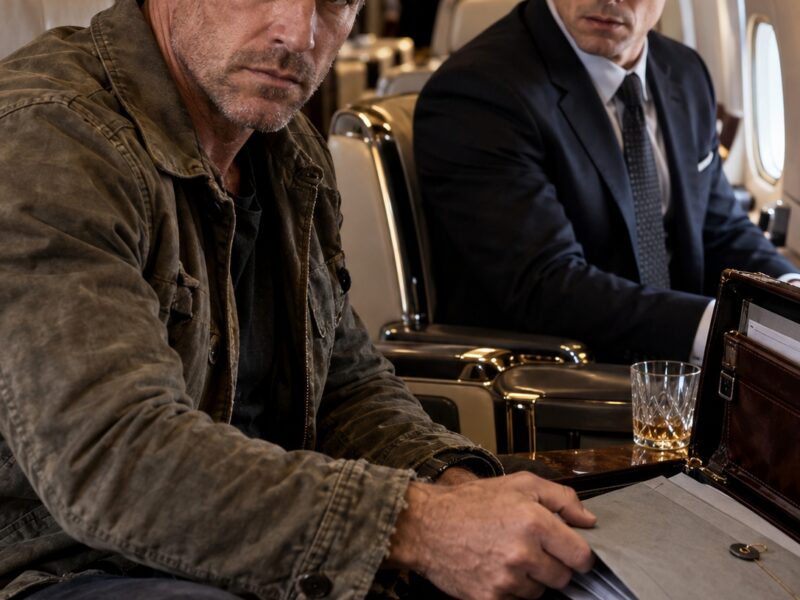
HE MOCKED THE MAN IN SEAT 14B—THEN THE HIJACKERS SAW HIS SCAR AND CHANGED THE ENTIRE MISSION
At 33,000 feet, three men took control of Northstar Flight 417.
One hundred eighty-six passengers believed they were about to die.
And the only passenger who didn’t scream was the man everyone had laughed at before takeoff.
He sat in seat 14B wearing a faded olive canvas jacket, scuffed work boots, and the expression of someone waiting for bad weather he had already seen coming.
Less than two hours earlier, a billionaire businesswoman had looked at those clothes and decided he didn’t belong near first class.
Her security director had gone further.
“Guy like that probably isn’t even flying,” Grant Whitmore had said loudly at the gate. “Probably hangs around terminals because the heat’s free.”
A few people had laughed.
The man in the faded jacket hadn’t answered.
Now nobody was laughing.
A hijacker in a gray hoodie was walking slowly down the aisle when he reached row 14.
He passed it.
Stopped.
Then stepped backward.
His eyes fixed on the thin white scar cutting through the outer edge of the man’s left eyebrow.
Something changed in his face.
Recognition.
Not complete recognition.
Something worse.
Fear mixed with uncertainty.
The hijacker raised a radio.
He whispered four words.
Then he hurried toward the front of the aircraft.
Seconds later, Ethan Vale—the man apparently leading the takeover—turned from the forward galley and stared down the entire length of the cabin.
Not at the frightened billionaire.
Not at the crew.
Not at the crying children.
At seat 14B.
For eleven long seconds, he didn’t move.
Then he picked up the cabin interphone.
“Change of order,” he said.
His voice carried into the first rows.
“No demands. No transmissions. Nothing happens until I know exactly who is sitting in seat 14B.”
And for the first time since the hijacking began, Caleb Ror stopped pretending he didn’t know why.
Because some ghosts don’t stay buried.
Sometimes they board the same airplane.
Sometimes they recognize your face.
And sometimes they remember your name before you do.
Two hours earlier, Caleb had been standing beside a window at Denver International Airport watching deicing trucks crawl around aircraft under a hard gray sky.
He was forty-three, a little over six feet tall, broad without looking like a man who spent time trying to be broad. Brown hair had begun going silver at his temples. His hands carried the faint permanent discoloration of hydraulic fluid and machinery grease.
The jacket had been with him for years.
Olive canvas.
Frayed cuffs.
One repaired tear near the pocket.
It was warm, comfortable, and had never once asked him to explain himself.
Caleb liked things like that.
He carried one canvas duffel.
No rolling suitcase.
No laptop bag.
No expensive watch.
Nothing about him suggested importance.
That was intentional.
For nine years, ordinary had been the closest thing Caleb had found to peace.
He repaired ground-support equipment outside Bozeman, Montana—hydraulic lifts, generators, baggage tractors, whatever arrived broken and needed to leave working.
Machines made sense.
A damaged seal leaked.
A burnt relay failed.
A fractured hose burst.
Machines did not rewrite reports after people died.
Machines did not decide a convenient explanation was more useful than the truth.
Machines did not tell you grief was classified.
So Caleb fixed machines.
He worked.
He went home.
He spoke to very few people.
And whenever possible, he sat where he could see the exits.
At the gate that afternoon, he noticed the premium boarding line forming before the announcement came.
Not because he wanted to be in it.
Because he noticed movement.
He always noticed movement.
A woman pushing a stroller struggled around a cluster of luggage, and Caleb stepped aside to give her room.
That movement placed one of his boots several inches inside the roped boundary separating general boarding from priority passengers.
It shouldn’t have mattered.
To Victoria Ashcraft, it did.
Victoria was forty-eight and chairwoman of Ashcraft Aeronautics, a defense and aerospace corporation whose contracts were measured in numbers most people only encountered in government budgets.
She wore charcoal wool tailored perfectly to her body.
A slim leather briefcase rested against her leg.
She looked first at Caleb’s duffel.
Then his jacket.
Then his boots.
People like Victoria rarely believed they were judging strangers.
They believed they were identifying them.
“Some people,” she said to the gate agent, loud enough to travel, “should learn to recognize where they belong.”
The gate agent stiffened.
Caleb turned his head.
Their eyes met.
Victoria expected irritation.
Embarrassment, perhaps.
Maybe an apology.
Caleb simply looked at her for a moment and stepped farther away from the rope.
That should have ended it.
Grant Whitmore made sure it didn’t.
He stood half a step behind Victoria, thirty-nine years old, square-jawed, polished, wearing an expensive blazer designed to look casual.
Officially, Grant was Victoria’s director of corporate security.
Unofficially, he was the kind of man powerful people hired because he understood how to make unpleasant things disappear before they reached a boardroom.
“He’s probably not even flying,” Grant said.
Several nearby passengers looked over.
Grant smiled.
“Guy like that hangs around terminals because the heat’s free. Unemployed. Pretending to be a passenger.”
A man near the charging station laughed.
Then another.
Small laughs.
Cowardly laughs.
The kind people make when they’re relieved cruelty has selected someone else.
Caleb looked at Grant for perhaps two seconds.
There was something about the man he didn’t like.
Not the insult.
Caleb had been insulted by better men in worse places.
It was Grant’s eyes.
His mouth smiled.
His eyes kept moving.
Gate.
Phone.
Victoria’s briefcase.
Departure board.
Phone again.
Caleb had spent eleven years learning that the body often confessed several seconds before the mouth did.
He hated that the old instincts were still there.
He hated more that they were usually right.
The boarding announcement sounded.
Caleb lifted his duffel.
He walked away without saying a word.
Grant watched him go.
“See?” he murmured. “Nothing to say.”
Caleb heard him.
He didn’t turn around.
There had been a time in his life when silence was not weakness.
Silence meant somebody was listening.
He had never forgotten that.
His assigned seat was 14B.
Middle seat.
Economy.
Near enough to the business-class divider that the curtain shifted whenever the galley cart passed.
Caleb stored his duffel overhead and sat.
Seat 14A belonged to Walter Pruitt, a seventy-one-year-old retired accountant traveling to see his daughter.
Across the aisle, 14D belonged to Peter Long, a college student carrying a sociology textbook he would not open again for several hours.
Caleb buckled his belt.
Then Victoria noticed him.
She was settling into 2C when she looked through the divider and saw the faded jacket.
Her expression hardened.
She raised two fingers toward the lead flight attendant.
Marin Ellis had been flying for nine years.
At thirty-four, she had learned to identify trouble before trouble knew what it wanted.
She leaned toward Victoria.
“Yes, ma’am?”
“I’d like that passenger’s boarding pass checked.”
“Which passenger?”
“The man in the canvas jacket.”
Marin followed her gaze.
“Is there a problem?”
“I don’t believe he’s seated correctly.”
Marin paused.
Victoria lowered her voice without lowering its sharpness.
“I have no interest in spending four hours on an aircraft with someone who wandered aboard.”
Marin had encountered every version of wealth.
Polite wealth.
Nervous wealth.
Invisible wealth.
And wealth that mistook access for authority.
She walked back to row 14.
“Sir?”
Caleb looked up.
“Could I see your boarding pass?”
He handed it to her.
No protest.
No defensive explanation.
Marin checked the name.
CALEB ROR.
14B.
Denver to Washington.
She returned it.
“Thank you, sir.”
Then, loud enough for row two to hear, she added:
“You’re exactly where you’re supposed to be.”
Caleb almost smiled.
Almost.
He slipped the boarding pass into his jacket.
Then he began watching.
Not obviously.
Never obviously.
One hundred eighty-six passengers.
Seven crew.
Forward and rear galleys.
Four lavatories.
Emergency exits.
Obstructions.
Children.
Elderly passengers.
One man using a cane.
A woman in row twenty-six with an infant.
It was automatic.
Caleb hated that too.
Nine years in Montana had not erased what eleven years elsewhere had built.
Then he noticed Grant Whitmore.
Grant sat in 3C.
During the eleven minutes between boarding and pushback, he checked his phone fourteen times.
Not casually.
Not like a businessman waiting for an email.
Each time he unlocked the screen, his shoulders tightened before he read whatever was there.
Twice, he looked at Victoria’s leather briefcase.
Both times, his jaw flexed.
Caleb recognized that movement.
A man swallowing words.
Or fear.
He looked away.
Not my problem, he told himself.
That sentence had become part of his civilian life.
Not my mission.
Not my team.
Not my war.
The aircraft began taxiing.
The safety demonstration started.
Then a passenger in row nine stood briefly to adjust something in the overhead compartment.
Caleb saw his face.
And the world became quieter.
Narrow features.
Dark hair.
Small flat mole below the right ear.
Caleb had seen that face before.
Not in person.
A photograph.
Eight or nine years earlier.
A thin intelligence folder lying on a plywood desk under fluorescent lights in a place Caleb had spent years trying not to remember.
The photograph had been one of dozens.
A contractor employee.
Communications-related.
Not important enough to memorize.
Except Caleb had always remembered faces.
The man sat down.
The engines climbed.
Denver fell away beneath them.
Caleb stared through the window past Walter’s shoulder.
Coincidence, he thought.
Then he thought about Grant’s phone.
The briefcase.
The man in row nine.
And somewhere above ten thousand feet, coincidence stopped being an explanation Caleb was willing to trust.
For fifty-eight minutes, nothing happened.
Caleb drank water.
Declined pretzels.
Walter told him he hated flying.
“Then why fly?” Caleb asked.
“My daughter had a baby.”
Caleb nodded.
“Good reason.”
Walter smiled.
“Granddaughter. Six weeks old.”
“Better reason.”
Walter showed him a photograph.
Caleb looked longer than necessary.
A tiny face wrapped in pink.
“You have children?” Walter asked.
“No.”
“Wife?”
“No.”
Walter seemed to sense the door closing and politely left it closed.
Caleb appreciated him for that.
Two rows ahead, the man from row nine walked toward the forward lavatory.
Turned around before reaching it.
Ten minutes later, he did it again.
Another man from row six made the same trip.
Neither used the restroom.
Caleb’s pulse did not increase.
That frightened him more than if it had.
The aircraft leveled at 33,000 feet over Iowa.
The seatbelt sign chimed off.
Eleven seconds later, the world changed.
A service cart slammed violently into the forward bulkhead.
Passengers gasped.
Somebody shouted.
The cockpit door had been open for the captain’s scheduled break.
The cart strike happened at exactly that moment.
Not luck.
Timing.
The first officer went down.
A man moved through the opening.
Another blocked the galley.
The cockpit door shut.
Then Ethan Vale stepped through the curtain.
He held a short black cylinder in one hand.
“Everyone stays seated.”
At first, people didn’t understand.
Modern life trains people to treat impossible things as misunderstandings.
A mechanical problem.
A drunk passenger.
A security exercise.
Then Ethan spoke again.
“The flight deck is under our control.”
Someone screamed.
The sound moved through the aircraft like flame.
A child started crying.
Then another.
Two additional men appeared in the aisle.
One toward the rear.
One in the middle.
Hands went over mouths.
Phones appeared and disappeared as passengers realized there was nowhere to call that could help them quickly enough.
Ethan raised his voice.
“The aircraft is flying normally. Keep your hands visible. Stay seated. Cooperate, and you will land today.”
Victoria stood halfway out of 2C.
Of course she did.
“Whatever you’re being paid,” she said, “I’ll pay ten times more.”
Grant turned toward her sharply.
Victoria kept going.
“I can move funds before we descend through twenty thousand feet. Whatever jurisdiction you need. Whatever guarantees—”
Ethan walked to her row.
He let her finish.
That frightened Caleb.
Professionals interrupted chaos.
People with personal motives listened.
Ethan tilted his head.
“You think everything has a price?”
Victoria’s mouth opened.
Ethan’s expression changed.
“You’ve believed that for a very long time.”
He glanced at the leather briefcase.
“That’s why we’re here.”
Then he walked away.
Victoria sank back into her seat.
Grant didn’t look at her.
He looked at the briefcase.
Caleb saw it.
And understood one thing immediately.
This was not random.
Beside him, Walter began breathing too quickly.
Caleb turned.
The older man’s skin had gone gray.
“Walter.”
No response.
“Walter, look at me.”
“I can’t—I can’t breathe.”
“Yes, you can.”
Caleb lifted his wrist.
“Look at my watch. Breathe in while the second hand moves from twelve to six. Out from six to twelve.”
Walter shook his head.
“Do it anyway.”
The tone worked.
It had worked on younger men in darker places.
Walter followed the second hand.
Once.
Twice.
Again.
By the sixth breath, some color returned.
By the eleventh, tears were sliding down his cheeks.
Caleb squeezed his shoulder.
“Good.”
“I don’t want to die here.”
“Then don’t spend the next minute doing it early.”
Walter stared at him.
Caleb regretted the sentence immediately.
Then Walter gave a broken little laugh.
It helped.
From the galley, Marin Ellis had been watching.
Most passengers had become louder or smaller.
Caleb had become quieter.
That distinction mattered.
It mattered to someone else too.
The hijacker in the gray hoodie came down the aisle.
He reached row 14.
Passed Caleb.
Stopped.
Stepped backward.
And stared at his scar.
Caleb felt the man’s attention before he looked up.
The hijacker’s eyes narrowed.
His lips parted.
Then came the radio.
Four whispered words.
The man hurried forward.
Ethan listened.
Turned.
Stared at Caleb.
And changed the mission.
Minutes later, Ethan stopped beside 14B.
He crouched.
“What’s your name?”
“Caleb Ror.”
“What do you do, Mr. Ror?”
“Repair equipment.”
“What kind?”
“Ground support machinery. Hydraulics. Electrical. Whatever breaks.”
“Where?”
“Montana.”
Ethan studied his face.
“Did you serve?”
The cabin seemed to shrink.
Caleb could have lied.
Instead, habit betrayed him.
“A long time ago.”
Ethan waited.
Caleb added, “I don’t talk about it.”
The instant he said it, he knew it was the wrong answer.
Ethan smiled.
Not because he was amused.
Because a locked door had just appeared in front of him.
He stood.
“Get up.”
Caleb did.
Ethan pulled him into the aisle.
“On your knees.”
Caleb lowered himself.
Hands behind his head.
Smoothly.
Too smoothly.
Marin noticed.
Ethan noticed.
Victoria noticed something else.
An opportunity.
“He was behaving strangely at the gate,” she said.
Caleb closed his eyes for half a second.
Victoria continued quickly.
“I asked for his documents to be checked. Something about him was wrong.”
Grant joined immediately.
“He’s been watching the forward cabin since boarding.”
Ethan looked toward him.
Grant gestured toward Caleb.
“I do corporate security. I know surveillance behavior. That man has been surveilling this aircraft.”
A murmur traveled through the cabin.
Fear loves an explanation.
It doesn’t care whether the explanation is true.
Peter Long leaned across the aisle.
“Why aren’t you fighting back?”
Caleb turned his head.
Peter looked terrified.
Barely twenty.
A kid pretending he wasn’t.
Caleb answered quietly.
“Because right now the question isn’t who’s stronger.”
He looked toward the cockpit.
“The question is how many of us are standing when those doors open.”
Peter swallowed.
“Everything else is vanity.”
Marin felt something cold move through her.
She wasn’t watching a frightened passenger surrender.
She was watching someone choose not to act.
There was a difference.
Ethan saw it too.
He crouched again.
His eyes returned to the scar.
“I’ve seen that.”
Caleb said nothing.
“A photograph.”
Nothing.
“Eight years ago.”
Caleb’s heartbeat changed for the first time.
Ethan leaned closer.
“There was a call sign under it.”
The engines hummed around them.
Then Ethan spoke two words Caleb had not heard aloud in nine years.
“Greywolf Actual.”
Caleb lifted his eyes.
That was all.
But it was enough.
Something opened behind them.
Not rage.
Not fear.
Recognition of a room he had spent nine years locking from the inside.
Ethan stood.
“You led the team.”
Caleb remained silent.
“You went in with eleven men.”
Walter stared at him.
Peter stared.
Marin forgot to breathe.
Ethan’s voice rose.
“You came out with ten.”
Caleb stood slowly.
Ethan didn’t stop him.
The cabin was completely silent now.
“The man you’ve been looking at like trash,” Ethan said, turning toward the passengers, “spent eleven years in one of the most selective direct-action units in the United States military.”
Victoria’s face lost its remaining color.
Ethan looked directly at her.
“He commanded a hostage recovery operation that brought five American civilians home alive.”
Nobody moved.
Victoria looked down at Caleb’s frayed cuffs.
At the old jacket.
At the boots she’d judged before she’d known his name.
Her own words came back to her.
Some people should learn to recognize where they belong.
For the first time in years, Victoria Ashcraft had nothing intelligent to say.
But Caleb wasn’t watching her.
He was watching Grant.
Grant had gone still.
Not impressed.
Not frightened by Caleb.
Calculating.
That interested Caleb far more.
Because nine years earlier, eleven men had gone into a hostile compound.
Ten came home.
Mason Keane did not.
Mason had been twenty-nine.
He had a two-year-old daughter.
He hummed off-key while waiting for missions because silence made him restless.
Caleb had assigned him the north corner.
The enemy had been waiting at the north corner.
Later, investigators learned the team’s approach vector had been compromised hours before insertion.
The official explanation blamed a contractor employee who had sold routing information.
The employee was arrested.
Eleven months later, he died in custody before trial.
Case closed.
Caleb had read the report twice.
He didn’t believe it either time.
He had been told, politely at first, that his disbelief was not evidence.
Fourteen months later, he left the Army.
Not dramatically.
No shouting.
No medals thrown onto desks.
He simply eroded.
One day, he realized he no longer knew whether obedience and loyalty were still the same thing.
So he left.
Montana followed.
Machines followed.
Silence followed.
And Mason’s photograph went face down in a drawer.
Until now.
Caleb looked at Ethan.
“You didn’t come here for an airplane.”
Ethan’s jaw tightened.
“You came for something on it.”
“No.”
Ethan looked forward.
“I came for someone on it.”
His eyes settled on Victoria.
“You’re the part I didn’t plan.”
Caleb looked from Ethan to the briefcase.
Then to Grant.
And suddenly the shape of the thing began changing.
There had been no ransom demand.
No prisoner exchange.
No political statement.
No request for another destination.
A hijacking without demands wasn’t a hijacking.
It was a search.
Ethan walked to row two.
He pointed toward Victoria’s briefcase.
“Open it.”
Victoria held it closer.
“It contains confidential board correspondence.”
“Open it.”
“No.”
Ethan leaned toward her.
“The second compartment.”
Her face changed.
Caleb saw it.
So did Grant.
Ethan continued.
“Behind the lining.”
Grant whispered, “Victoria—”
Ethan looked at him.
Then back at her.
“I want the 2017 internal audit on the Meridian communications contract.”
The word hit Caleb like a physical blow.
Meridian.
Ethan continued.
“And I want the appendix identifying who authorized the routing architecture to leave your secure network.”
Caleb felt the cabin tilt beneath him.
Meridian.
The communications architecture.
The borrowed relay.
The compromised route.
Nine years.
He looked at Victoria.
“Ashcraft built it.”
It wasn’t a question.
Victoria didn’t answer.
Ethan did.
“Her company held the secure communications contract.”
Caleb stared at the woman who had mocked his jacket ninety minutes earlier.
She had been sitting eleven rows away from the answer to the worst night of his life.
Ethan’s voice cracked for the first time.
“My brother’s name was Alan Vale.”
Caleb looked at him.
“He was the contractor employee they blamed.”
Ethan’s face had lost the detached calm of a hijacker.
Now Caleb could see the brother underneath.
“He was a compliance analyst. He had a security clearance, a mortgage, and a stutter he never managed to beat. Investigators said he sold a routing package to a foreign intermediary for a hundred and forty thousand dollars.”
Ethan looked at Victoria.
“He was arrested on a Tuesday.”
His jaw trembled.
“He died eleven months later. Two weeks before trial.”
Victoria looked away.
Ethan followed her gaze.
“Your own compliance officers didn’t believe the government’s theory. Ashcraft ran an internal audit in 2017.”
Silence.
“You buried it.”
“No,” Victoria said.
“You buried it.”
“That is not what happened.”
“You’ve carried a copy for years.”
Victoria shook her head.
Ethan pointed at the briefcase.
“Because it’s leverage against your own board.”
“You’re wrong.”
“Then open the case.”
“I said you’re wrong.”
Grant suddenly leaned forward.
“There’s nothing in that case worth one hundred ninety-three lives.”
Caleb looked at him.
The sentence hung in the air.
Wrong.
Too fast.
Too specific.
Nobody had asked Grant.
Caleb’s attention sharpened.
Victoria turned on Ethan.
“You’re threatening innocent people because you want to rehabilitate your brother’s reputation.”
“My brother was innocent.”
“You don’t know that.”
“I know what your company found.”
Victoria’s fear hardened into anger.
Anger was familiar territory.
“Operations fail,” she snapped. “People die. Soldiers make mistakes, and then everyone looks for a contractor because blaming the men who executed the operation is inconvenient.”
Caleb stood.
Three hijackers shifted toward him.
He raised both hands.
“Mason took the north corner because I put him there.”
Victoria stopped.
Caleb’s voice remained quiet.
“I’ve carried that for nine years.”
He looked at Ethan.
“I’ll carry it until I’m dead. No audit changes my order. No report gives me back my friend.”
Ethan stared at him.
“But somebody sold us.”
Caleb took one step.
“I knew it then.”
Another.
“And you know what you’re doing now?”
Ethan said nothing.
“Exactly what was done to us.”
Caleb gestured toward the cabin.
“You’re deciding innocent people are acceptable losses because your cause is righteous.”
Ethan’s eyes changed.
“That’s the disease.”
Caleb’s voice dropped.
“That’s what killed Mason.”
For several seconds, nobody spoke.
Then Grant did.
“I can get you the file.”
Everyone looked at him.
Grant lifted his hands.
“I have corporate credentials. If the audit exists, I can authenticate it through the onboard network and transmit a verified copy wherever you want.”
Ethan studied him.
“This ends without anyone else getting hurt,” Grant said.
Reasonable.
Helpful.
Calm.
Caleb had met men like that before.
Sometimes they were the most dangerous people in the room.
Grant opened his laptop.
Logged into the corporate portal.
He narrated each step.
“Authentication server.”
Click.
“Archive.”
Click.
“Meridian.”
Caleb couldn’t see the screen clearly from where he stood.
He didn’t need to.
He watched Grant’s left hand.
The posture.
The rhythm.
The brief hesitation before each command.
And the reflection in the darkened window.
Caleb’s stomach dropped.
“He’s not retrieving it.”
Ethan turned.
Caleb’s voice sharpened.
“He’s deleting it.”
Ethan crossed the aisle in three strides.
He ripped the laptop toward himself.
Grant tried to close it.
Too late.
Ethan saw the screen.
His face emptied.
“You—”
He grabbed Grant by the collar.
“What did you do?”
The operation fractured.
The hijacker in the gray hoodie panicked.
He seized Dana Castellanos, a twenty-two-year-old passenger in row four.
Pulled her into the aisle by her hair.
Pressed the black cylinder under her jaw.
Dana screamed.
Passengers surged.
Children cried.
Marin shouted for everyone to stay seated.
And Caleb moved.
Not fast.
That was what surprised everyone.
He walked.
Hands open.
“Take me.”
The man holding Dana stared at him.
Caleb kept coming.
“She’s twenty-two.”
“Stay back!”
“She’s nobody’s leverage.”
“I said stay back!”
“You stopped an entire operation because of me.”
Caleb stepped closer.
“If you need someone in the aisle, take the person your leader actually cares about.”
Dana was sobbing.
Caleb extended his hand.
“Let her go.”
The hijacker hesitated.
One second.
Maybe less.
Enough.
Caleb caught Dana’s forearm and guided her backward.
Marin was already there.
She pulled Dana behind her.
The hijacker swung.
The black cylinder extended.
Steel baton.
Caleb had suspected it.
He had refused to bet 193 lives on being right.
Now he knew.
The baton came toward his head.
Caleb moved inside the arc.
The steel struck his left forearm.
Pain exploded up to his shoulder.
Something tore.
He trapped the attacker’s wrist.
Turned his hips.
Drove him into the seatback.
The man hit the floor.
Three seconds.
Maybe less.
Caleb didn’t strike his head.
Didn’t choke him unconscious.
He simply removed his balance and kept him there.
Peter Long was suddenly on the man’s legs.
A retired corrections officer from Dayton joined him.
Someone produced galley tape.
Fear had finally found something useful to do.
Within seconds, the hijacker was restrained.
Caleb stepped back holding his injured arm.
Blood darkened the sleeve of his faded jacket.
Ethan stared at him.
“You could’ve taken me earlier.”
Caleb said nothing.
“When I crouched beside your seat.”
“Yes.”
“You knew you could.”
“Yes.”
“Then why didn’t you?”
Caleb glanced toward the cockpit.
“Your fourth man was behind that door.”
Ethan followed his eyes.
“The captain was still flying.”
Caleb breathed through the pain.
“I don’t trade a pilot for a hostage.”
Ethan looked at him as if seeing him for the first time.
“Pilots are what’s keeping everybody alive. Not me. Not you.”
Up front, Captain Nolan Briggs had been doing exactly that.
Flying.
Surviving.
And communicating without appearing to communicate.
He had slowly altered altitude.
Drifted from track.
Manipulated the transponder one digit at a time.
Cleveland Center had noticed.
Military aircraft were already behind them.
None of the passengers knew.
Neither did Ethan.
Then Victoria stood.
Her legs shook.
She opened the leather briefcase.
Reached behind the lining.
And removed a sealed gray folder.
Ethan stopped breathing.
“It’s real,” Victoria said.
Grant’s face changed.
Victoria held the folder against her chest.
“The audit is real.”
Her voice broke.
“And I’ve had it for nine years.”
Caleb watched her.
“Why?”
Victoria closed her eyes.
“Because it could destroy the company.”
Ethan laughed once.
There was no humor in it.
“My brother died.”
“I know.”
“No. You knew a problem died.”
Victoria flinched.
Ethan reached for the folder.
Then Grant spoke.
“Don’t be an idiot, Vale.”
Everyone turned.
His voice was different now.
No polish.
No deference.
No helpful security director.
“You’ve been working for me since February.”
Ethan froze.
“What?”
Grant straightened his collar.
And Caleb knew.
Some men could not resist explaining themselves once they believed the outcome was already secure.
“Your brother’s attorney filed another request for Meridian documentation in February,” Grant said. “It routed through corporate security.”
Ethan stared.
“I saw your name.”
Grant smiled faintly.
“I saw what you wanted.”
Victoria whispered, “Grant…”
“I could’ve reported him,” Grant continued. “Instead, I watched.”
Ethan’s face went white.
“You let me plan this.”
“I encouraged conditions.”
“You booked her on this flight.”
Grant looked at Victoria.
“I arranged the itinerary.”
Victoria backed away.
“Why?”
Grant’s expression became almost bored.
“Because an incident in the air involving a dead suspect’s brother is the only environment chaotic enough for the last authenticated audit to disappear without anyone asking the right questions.”
The air system hummed.
Nobody else moved.
Caleb stared at him.
“You weren’t protecting Ashcraft.”
Grant met his eyes.
“You were protecting yourself.”
Grant didn’t answer.
He didn’t have to.
Caleb stepped closer.
“Alan Vale didn’t sell the routing schedule.”
Grant looked at Ethan.
“Your brother was convenient.”
Ethan made a sound Caleb would remember for years.
Not a shout.
Something smaller.
Something breaking.
Grant continued because cruelty often becomes talkative when finally unmasked.
“Alan had access. No political family. No institutional protection. He was exactly the shape the investigation needed.”
Ethan lunged.
Caleb stepped between them.
“Not yet.”
“Move.”
“No.”
“He killed my brother.”
“No. He helped create what killed your brother. If you kill him now, you give him the last thing he needs.”
“What?”
“Silence.”
Ethan stopped.
Caleb turned toward Grant.
“Why did you do it?”
Grant’s mouth tightened.
“An export authorization.”
Victoria stared.
“What authorization?”
Grant finally looked at her.
“2016. Foreign partner. Eight-hundred-million-dollar airframe contract. They wanted interoperability assurances.”
Victoria whispered, “You signed off on secure architecture?”
“I signed an authorization.”
“You exposed military routing.”
“I didn’t know how it would be used.”
Caleb’s eyes hardened.
“Eleven men.”
Grant looked at him.
“Five hostages.”
Caleb stepped closer.
“One of mine.”
“I know the numbers.”
That sentence nearly did what bullets and grief had failed to do for nine years.
Caleb wanted to hit him.
Not professionally.
Not tactically.
As a man.
He saw Mason humming beside a helicopter.
Mason showing everyone a photograph of his daughter.
Mason complaining about powdered eggs.
Mason taking the north corner because Caleb had told him to.
He saw the body.
He saw the report.
He heard the words again.
Your disbelief is not a finding.
Caleb’s right hand curled.
Then relaxed.
Grant noticed.
“Go ahead,” he said.
Caleb looked at him.
Grant smiled.
“You’ve probably wanted somebody to punish for nine years.”
Caleb’s voice became very quiet.
“That’s where you’re wrong.”
He glanced toward the frightened passengers.
“I’ve been punishing somebody for nine years.”
Grant’s smile disappeared.
“Me.”
Victoria sat down as if her knees had stopped working.
She finally understood.
She had known her company buried an irregularity.
She had justified it as protecting shareholders, contracts, national interests, thousands of employees.
She had never asked hard enough whose life had been placed underneath all those abstractions.
Grant nodded toward the folder.
“That’s the only authenticated copy left.”
Victoria looked at him.
“What?”
“The server instance is gone. Archive mirror was decommissioned.”
“You told the board—”
“I told the board what it needed to hear.”
Grant looked at Ethan.
“Everything you’ve done today was for that folder.”
Then Caleb spoke.
“No.”
Grant turned.
Caleb’s eyes were on the gray file.
“That’s not the only copy.”
Silence.
“I’m flying to Washington to meet a federal investigator named Derek Harland.”
Grant’s face changed.
Only slightly.
Enough.
Caleb saw it.
“He worked the intelligence failure review after my mission.”
Grant said nothing.
“Six weeks ago, Derek received new material from an anonymous source.”
Victoria looked at Caleb.
“Material about Meridian?”
“Material about Mason’s death.”
Grant swallowed.
Caleb saw it.
“Independently authenticated.”
Grant’s confidence cracked.
“You’re lying.”
“I’m an equipment mechanic from Montana sitting in a middle seat.”
Caleb almost smiled.
“Remember?”
Nobody did.
“I’m not on a mission. I didn’t know Ethan existed until today. I was going to Washington, eat a bad dinner with a man I hadn’t seen in years, and finally find out whether the worst night of my life happened because of an accident…”
He looked directly at Grant.
“…or a decision.”
Ethan slowly lowered the folder.
Caleb continued.
“The truth isn’t in your hands anymore.”
For eight years, Ethan Vale had believed truth was an object.
A file.
A page.
Something that could be stolen or burned.
Now he understood he had hijacked an airplane to protect evidence that was already beyond his reach.
Worse, the man who had quietly guided his rage toward disaster was standing six feet away.
Ethan dropped the folder.
It struck the carpet.
He sat in an empty aisle seat.
Covered his face with both hands.
For several seconds, nobody spoke.
Then Ethan said:
“Tell them to stand down.”
One hijacker placed his baton on the floor.
Raised his hands.
Ethan picked up the interphone.
“It’s over,” he told the man inside the cockpit. “Open the door. Empty hands.”
It should have ended there.
It almost did.
Then Grant Whitmore lunged.
Not at Ethan.
At the folder.
He grabbed for it and the galley handle in the same movement.
Caleb understood immediately.
A man who believed disclosure would destroy his life might prefer an ending where nobody survived to testify.
Caleb reached him in two steps.
He hit Grant across the shoulders with his good arm.
They crashed into the forward row.
Grant drove an elbow into Caleb’s injured forearm.
White pain erased the cabin.
Caleb nearly went down.
Then the retired corrections officer joined him.
Grant hit the floor.
Passengers piled onto him.
The gray folder burst open.
Pages scattered.
One slid beneath the galley cart.
Then the cockpit door opened.
Captain Briggs’s voice came over the speakers.
“This is the captain.”
The entire cabin froze.
“I have control of my aircraft.”
People began crying.
“We are descending for an emergency landing. I need everyone seated and belted within ninety seconds.”
Marin became command itself.
“Seats! Now! Move!”
Passengers obeyed.
The subdued hijackers were restrained in the galley.
Grant was secured to a jump seat.
Ethan offered no resistance.
Caleb’s left arm was taped against his chest.
Still, he walked the aisle.
He tightened Walter’s belt.
“Remember the watch?”
Walter was crying.
“Yeah.”
“Same thing.”
A little boy in row twenty looked at Caleb.
“Are we going to crash?”
His mother covered her mouth.
Caleb crouched despite the pain.
“No.”
“How do you know?”
“Because the man flying this airplane has been waiting fifty-four minutes to get it back.”
The boy stared at him.
Caleb nodded toward the window.
“And he’s angry now.”
The boy almost smiled.
Caleb stood.
In the galley, Ethan lay face down, wrists secured.
As Caleb passed, Ethan spoke.
“I was supposed to be my brother’s proof.”
Caleb stopped.
Ethan looked at the floor.
“I became somebody else’s weapon.”
Caleb didn’t tell him it was okay.
It wasn’t.
One hundred eighty-six passengers had believed they were about to die.
Dana would hear the sound of that baton in her sleep for years.
The first officer had blood in his collar.
A child had asked a stranger whether he would live.
Grief explained things.
It did not erase them.
“You stopped,” Caleb said.
Ethan looked up.
“That’s the only part you still owned.”
Then Caleb walked away.
At 4:41 p.m., Northstar Flight 417 touched down at Dulles.
Main gear.
Nose gear.
Reverse thrust.
A shudder through the cabin.
Then slowing.
Slowing.
Slowing.
Until the aircraft stopped.
Nobody cheered immediately.
For several seconds, nobody trusted stillness.
Then Walter began sobbing.
Someone behind him applauded.
Another person joined.
Then the whole aircraft seemed to exhale at once.
Federal tactical teams boarded within minutes.
The evacuation was controlled.
Passengers emerged into cold gray afternoon light.
Dana sat wrapped in a blanket.
The first officer left on a stretcher.
Investigators recovered the folder.
Including the page beneath the cart.
Caleb sat on a steel equipment case beside a fire truck while a medic splinted his forearm.
He watched families reunite beyond the cordon.
People running.
Crying.
Holding each other.
For years, he had told himself he disliked airports.
That afternoon, he understood it wasn’t airports.
It was arrivals.
Arrivals reminded you that sometimes people came home.
Victoria approached alone.
No assistants.
No security director.
No board members.
Her makeup had mostly disappeared.
For the first time since Caleb had met her, she looked like a person before she looked like a position.
She stopped several feet away.
“Mr. Ror.”
Caleb looked up.
“Victoria.”
She absorbed the absence of a title.
At the gate, she might have corrected him.
Now she almost seemed grateful.
“I owe you an apology.”
Caleb waited.
She swallowed.
“I said some people should learn to recognize where they belong.”
“I remember.”
Her eyes lowered.
“I judged you by your clothes.”
“Yes.”
“I was wrong.”
“Yes.”
The simplicity hurt more than anger would have.
Victoria looked toward the ambulances.
“I’d like to compensate you.”
Caleb frowned.
“A substantial amount. My attorneys can arrange—”
“No.”
She stopped.
“I don’t want your money.”
“Then what?”
Caleb nodded toward Dana.
“She’s twenty-two.”
Victoria followed his gaze.
“Pay for her therapy as long as she needs it.”
Victoria said nothing.
“The first officer has a family. Make sure they don’t lose anything while he recovers.”
She nodded.
Caleb looked toward the terminal.
“And Mason Keane had a daughter.”
Victoria closed her eyes.
“She’s eleven now.”
Caleb stood.
His splinted arm hung against his chest.
“Pay for her education.”
“I will.”
“And when investigators ask what you knew in 2017…”
Victoria met his eyes.
“Tell them everything.”
She nodded.
“Everything.”
“That’s the invoice.”
Then he walked away.
Derek Harland found him forty minutes later.
Derek was forty-five, graying, tired, wearing a federal badge clipped to a windbreaker.
He carried two coffees.
“These are terrible,” he said.
Caleb took one.
“Good.”
They stood beside the edge of the cordon watching floodlights come on across the apron.
Derek looked at his splint.
“Dinner’s canceled, I assume.”
Caleb sipped the coffee.
It was terrible.
“Dinner’s been upgraded.”
Derek smiled.
Then his expression changed.
“What I received six weeks ago is real.”
Caleb stopped drinking.
“Authenticated?”
“Independently.”
“Alan?”
Derek nodded.
“Alan Vale didn’t sell the package.”
Caleb looked toward the aircraft.
“And Grant?”
“Based on what half a cabin heard him say? He’s going to spend a lot of time explaining himself to people who don’t care who his family knows.”
Caleb stared into the coffee.
There was one question left.
The question that had followed him into Montana.
Into every winter.
Every quiet shop.
Every night he woke remembering the north corner.
Derek knew.
“Mason.”
Caleb didn’t look at him.
Derek spoke carefully.
“Mason Keane died because a man in a good suit authorized information he had no right to release in order to protect a contract.”
Caleb’s jaw tightened.
“Your order didn’t kill him.”
“I sent him north.”
“You sent him where the plan required.”
“I sent him north.”
“And someone told the enemy north was coming.”
Caleb said nothing.
Derek continued.
“Nothing you did that night caused the compromise.”
Caleb stared across the runway.
“I’ll put it in writing,” Derek said.
Caleb almost laughed.
“Nine years ago, writing was the problem.”
“This time it’ll be the correction.”
They stood silently.
Marin approached.
Her hands were finally shaking.
Caleb noticed.
She noticed him noticing.
“Adrenaline,” she said.
“Usually waits until afterward.”
“You would know.”
Caleb looked at her.
Marin smiled tiredly.
“Nine years flying. I’ve seen medical emergencies, engine failures, people lose their minds over overhead bins.”
She looked toward the aircraft.
“Never that.”
Caleb said nothing.
Marin studied him.
“Can I ask you something?”
“Sure.”
“You knew what you could do.”
Caleb looked away.
“Some of it.”
“You could’ve fought earlier.”
“Maybe.”
“You didn’t.”
“No.”
“You spent the first minutes helping an old man breathe.”
Caleb glanced toward Walter, who was being embraced by a woman Caleb assumed was his daughter.
Marin’s voice softened.
“How does someone who has obviously lost that much still stand in an aisle worrying about a stranger’s breathing?”
For the first time that day, Caleb didn’t have a tactical answer.
Only the true one.
“I couldn’t bring all my men home.”
Marin waited.
Caleb watched Walter hold his daughter.
“Today I wanted everybody to get the chance.”
Marin’s eyes filled.
Caleb looked down at his coffee.
“That’s all.”
Later, cameras waited beyond the secured area.
Reporters shouted his name.
Someone had already discovered Greywolf.
Someone else knew Delta.
Another shouted a question about heroism.
Caleb pulled the faded canvas jacket over his splint.
Picked up his duffel with his good arm.
And walked through them without answering.
Eleven weeks later, Grant Whitmore was indicted on charges connected to obstruction, destruction of evidence, false statements, and conspiracy surrounding the aircraft incident.
His family’s political connections produced noise.
They did not produce escape.
Ethan Vale pleaded guilty.
He cooperated fully.
The cooperation mattered.
It did not erase what he had done.
Victoria Ashcraft resigned as chairwoman while regulators and federal investigators reopened years of corporate conduct.
For three days, she testified.
This time, when lawyers suggested ways to avoid answering, she answered anyway.
That spring, Sergeant First Class Mason Keane’s record was formally corrected.
His daughter attended the ceremony.
She was eleven.
Old enough to understand that adults had spent most of her life arguing about how her father died.
Too young to remember much about the man himself.
She accepted the amended citation with both hands.
Caleb did not attend.
He watched a recording alone in Montana.
Then he turned off the screen.
The shop smelled like grease, steel, and cold air.
Outside, snow had begun collecting along the bottom of the doors.
A hydraulic pump sat disassembled on his bench.
Caleb opened the drawer beneath it.
Inside was a photograph.
Eleven men stood in front of a dust-covered helicopter.
Young enough to believe survival was mostly a matter of preparation.
Mason stood near the edge.
Grinning.
Caleb had kept the photograph face down for nine years.
He lifted it.
For a long time, he simply stood there.
Then he placed it upright on the workbench.
He returned to the hydraulic pump.
A minute later, he stopped.
Looked at the photograph again.
This time, he didn’t look away.
Outside, Montana disappeared beneath snow.
Inside, an old heater clicked and rattled.
No reporters.
No medals.
No applause.
Just a mechanic in a faded jacket, eleven younger men in a photograph, and one empty place that would never stop being empty.
Caleb reached over and wiped a thin line of dust from the frame.
For nine years, he had believed peace would arrive when somebody finally proved he wasn’t responsible.
He had been wrong.
Proof could correct a report.
It could clear a dead man’s name.
It could put another man in prison.
But it could not return Mason to the north corner and change what happened there.
Peace was smaller than that.
Harder, too.
It was allowing the photograph to stand upright.
It was accepting that remembering a dead friend did not require dying beside him forever.
Caleb switched off the work light.
For a second, only the small lamp above the photograph remained.
Eleven men.
One mission.
Ten returned.
And after nine years, perhaps one of them had finally come home.









